


Re-NEET 2026 Physics Question Paper is available here. NTA conducted NEET 2026 re-exam on 21 June in single shift from 2 PM to 5:15 PM. NEET Re-Test question question paper consists of 180 questions for 720 marks to be attempted in 3 hours and 15 minutes.
- NEET Physics Question Paper 2026 consists of 45 questions for 180 marks.
- Each correct answer carries 4 marks and incorrect answer has a negative marking of 1.
Candidates can download Re-NEET 2026 Physics Question Paper with Answer Key and Solution PDF from the links provided below
Re-NEET 2026 Physics Question Paper with Solution PDF
| NEET Re-Exam Physics Question Paper 2026 | Download PDF | Check Solution |
A photon and an electron, each of \(10\,eV\) energy, move in free space.
The ratio of linear momentum of electron \(P_e\) to that of photon \(P_{ph}\), \[ \frac{P_e}{P_{ph}} \]
is :
View Solution
Concept:
Momentum of a photon is given by \(p=\frac{E}{c}\).
Momentum of a non-relativistic electron is \(p=\sqrt{2mE}\).
Both particles have the same energy of \(10\,eV\).
Step 1: Calculate photon momentum
\[ E=10\times 1.6\times10^{-19} =1.6\times10^{-18}\,J \]
\[ P_{ph}=\frac{E}{c} =\frac{1.6\times10^{-18}}{3\times10^8} =5.33\times10^{-27}\,kg m s^{-1} \]
Step 2: Calculate electron momentum
\[ P_e=\sqrt{2mE} \]
\[ =\sqrt{2\times9\times10^{-31}\times1.6\times10^{-18}} \]
\[ =\sqrt{28.8\times10^{-49}} \]
\[ =5.37\times10^{-24}\,kg m s^{-1} \]
Step 3: Find the ratio
\[ \frac{P_e}{P_{ph}} = \frac{5.37\times10^{-24}} {5.33\times10^{-27}} \approx 275 \] Quick Tip: Photon momentum is \(E/c\). Electron momentum is \(\sqrt{2mE}\). Always convert eV into joule before calculation. Compare orders of magnitude carefully.
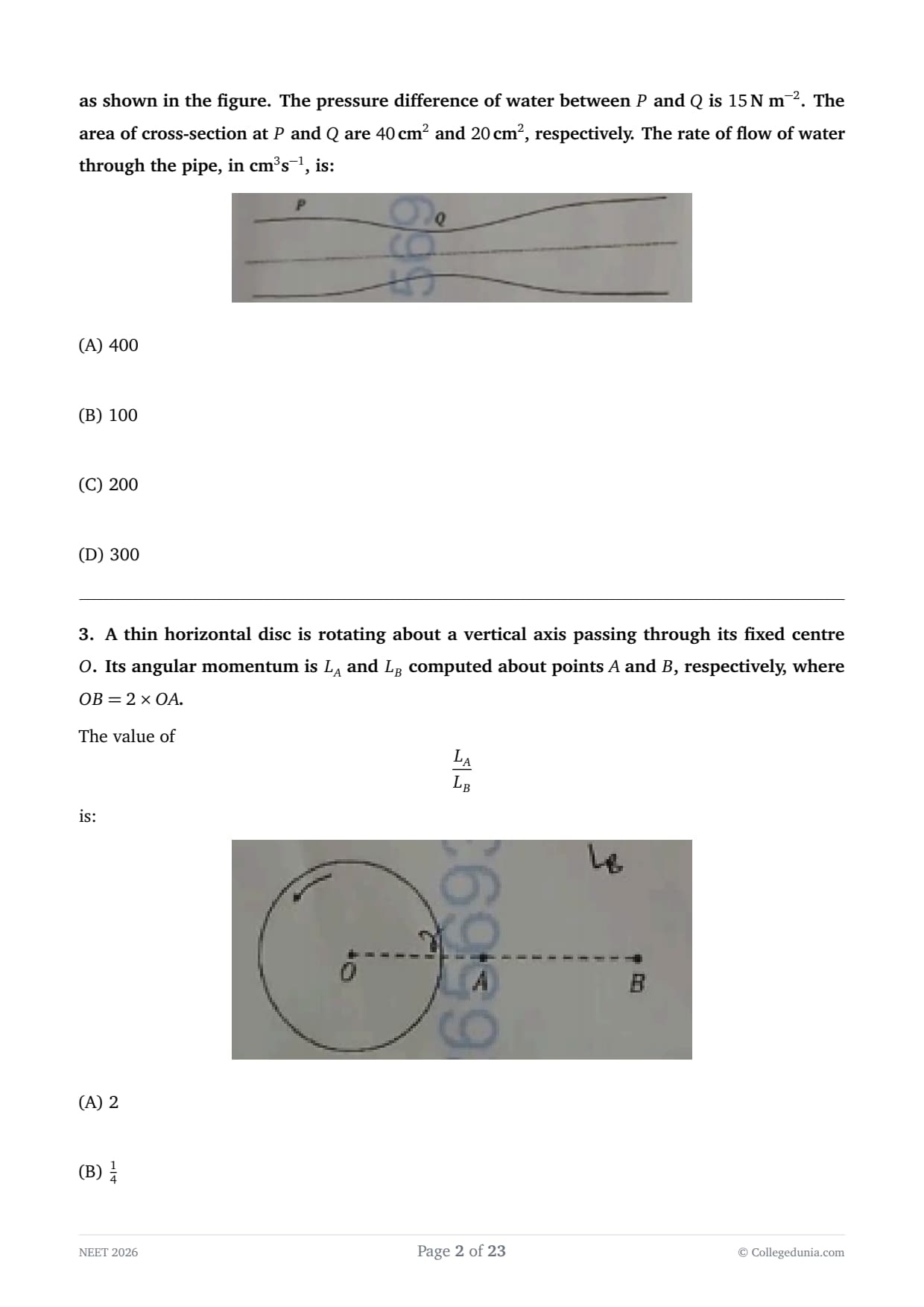
Water flows in a streamline motion through a horizontal pipe of circular cross-section as shown in the figure.
The pressure difference of water between \(P\) and \(Q\) is \(15\,N m^{-2}\).
The area of cross-section at \(P\) and \(Q\) are \(40\,cm^2\) and \(20\,cm^2\), respectively.
The rate of flow of water through the pipe, in \(cm^3s^{-1}\), is:

View Solution
Concept:
Apply Bernoulli's theorem.
Use equation of continuity.
For horizontal flow, gravitational term remains constant.
Step 1: Apply continuity equation
\[ A_1v_1=A_2v_2 \]
\[ 40v_1=20v_2 \]
\[ v_2=2v_1 \]
Step 2: Apply Bernoulli equation
\[ P_1+\frac12\rho v_1^2 = P_2+\frac12\rho v_2^2 \]
\[ 15 = \frac12(1000) \left(v_2^2-v_1^2\right) \]
\[ 15 = 500(4v_1^2-v_1^2) \]
\[ 15=1500v_1^2 \]
\[ v_1=0.1\,m s^{-1} \]
Step 3: Calculate discharge
\[ Q=A_1v_1 \]
\[ =(40\times10^{-4})(0.1) \]
\[ =4\times10^{-4}\,m^3s^{-1} \]
\[ =400\,cm^3s^{-1} \] Quick Tip: Use continuity before Bernoulli equation. Smaller area means greater speed. For horizontal pipes, height terms cancel. Convert units carefully.
A thin horizontal disc is rotating about a vertical axis passing through its fixed centre \(O\).
Its angular momentum is \(L_A\) and \(L_B\) computed about points \(A\) and \(B\), respectively, where \(OB=2\times OA\).
The value of \[ \frac{L_A}{L_B} \]
is:

View Solution
Concept:
For a rigid body rotating about a fixed axis, angular momentum is independent of the choice of point on the axis.
The disc rotates about the same vertical axis through \(O\).
Hence angular momentum remains unchanged.
Step 1: Identify axis of rotation
The disc rotates about a fixed vertical axis through its centre.
Step 2: Compare angular momenta about different points
For points \(A\) and \(B\) on the same axis,
\[ L_A=L_B \]
Step 3: Calculate ratio
\[ \frac{L_A}{L_B} = \frac{L_B}{L_B} =1 \] Quick Tip: Angular momentum depends on axis. For a fixed rotation axis, shifting origin along axis does not change angular momentum. Always identify the rotation axis first. Remember rigid body rotation properties.
Consider a long solenoid of length \(l\) and radius \(r\).
If \(n\) is the number of turns per unit length and \(\mu_0\) is the permeability of free space,
the inductance of the solenoid is:
View Solution
Concept:
Inductance of a long solenoid is \[ L=\mu_0 n^2Al \]
Cross-sectional area is \[ A=\pi r^2 \]
Step 1: Write standard inductance formula
\[ L=\mu_0 n^2Al \]
Step 2: Substitute area of solenoid
\[ A=\pi r^2 \]
\[ L=\mu_0 n^2(\pi r^2)l \]
Step 3: Obtain final expression
\[ L=\mu_0\pi n^2r^2l \] Quick Tip: Memorize inductance formula of a long solenoid. Area is \(\pi r^2\). Inductance increases with square of turns density. Larger area gives larger inductance.
The temperature of a metallic sphere of radius \(R\) is increased by a small amount \(\Delta T\).
If the linear coefficient of thermal expansion of the metal is \(\alpha\), the approximate increase in the volume of the sphere is:
View Solution
Concept:
Volume coefficient of expansion is \[ \gamma=3\alpha \]
Increase in volume is \[ \Delta V=\gamma V\Delta T \]
Step 1: Write initial volume of sphere
\[ V=\frac43\pi R^3 \]
Step 2: Apply volume expansion formula
\[ \Delta V=3\alpha V\Delta T \]
\[ =3\alpha \left(\frac43\pi R^3\right)\Delta T \]
Step 3: Simplify expression
\[ \Delta V = 4\pi R^3\alpha\Delta T \] Quick Tip: Volume coefficient equals \(3\alpha\). For isotropic solids use \(\gamma=3\alpha\). Remember volume of sphere \(=\frac43\pi R^3\). Use approximation for small temperature changes.
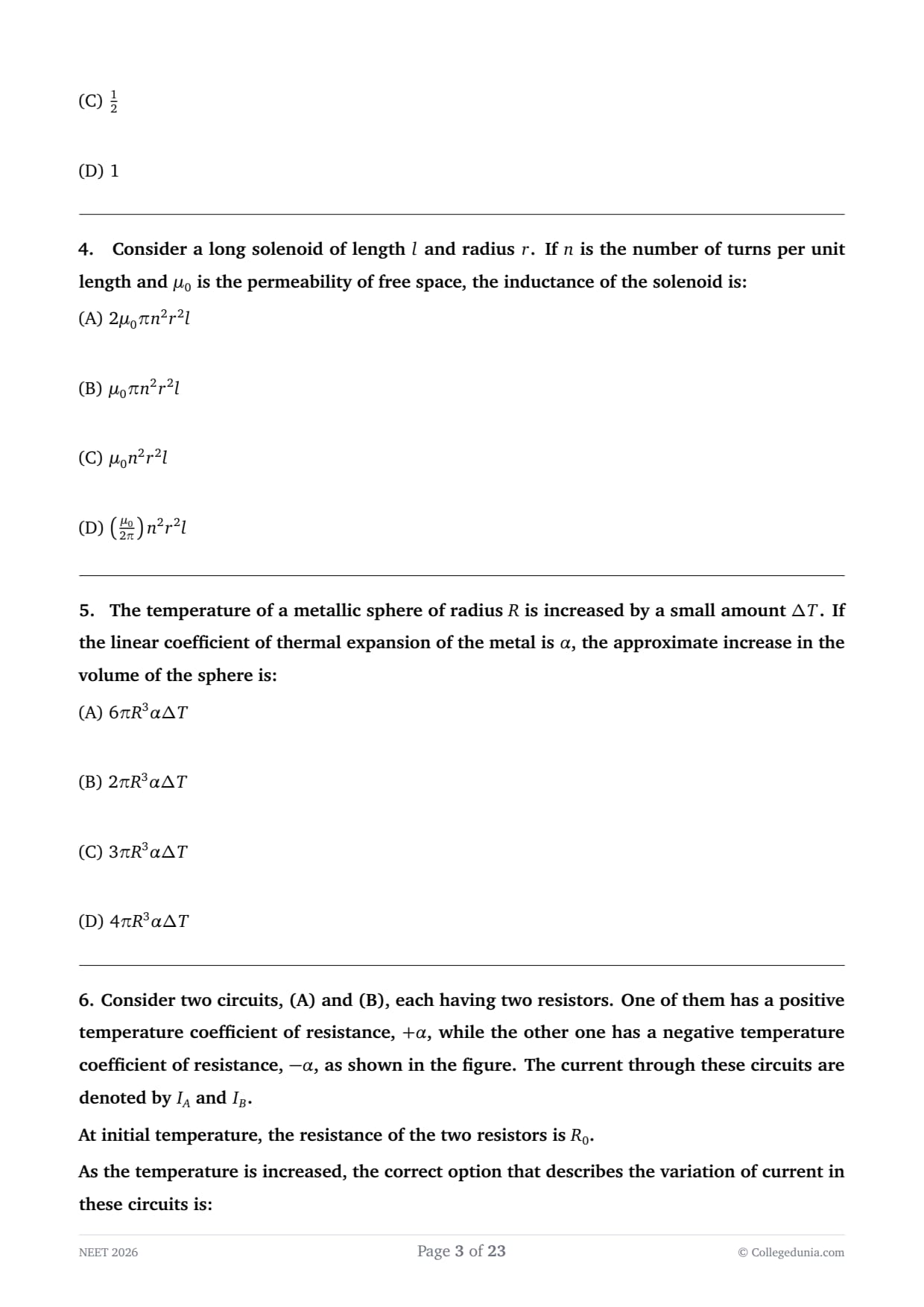
Consider two circuits, (A) and (B), each having two resistors.
One of them has a positive temperature coefficient of resistance, \(+\alpha\), while the other one has a negative temperature coefficient of resistance, \(-\alpha\), as shown in the figure.
The current through these circuits are denoted by \(I_A\) and \(I_B\).
At initial temperature, the resistance of the two resistors is \(R_0\).
As the temperature is increased, the correct option that describes the variation of current in these circuits is:

View Solution
Concept:
Resistance at temperature change \(\Delta T\) is given by \[ R=R_0(1+\alpha\Delta T) \]
for positive temperature coefficient.
For a negative temperature coefficient, \[ R=R_0(1-\alpha\Delta T) \]
In a series combination, equivalent resistance is the sum of individual resistances.
In a parallel combination, \[ R_{eq}=\frac{R_1R_2}{R_1+R_2} \]
Current supplied by a battery is \[ I=\frac{V}{R_{eq}} \]
Hence the variation of current depends upon the variation of equivalent resistance.
Step 1: Find equivalent resistance of circuit (A)
The two resistors are connected in series.
\[ R_1=R_0(1-\alpha\Delta T) \]
\[ R_2=R_0(1+\alpha\Delta T) \]
Therefore,
\[ R_A=R_1+R_2 \]
\[ R_A=R_0(1-\alpha\Delta T)+R_0(1+\alpha\Delta T) \]
\[ R_A=R_0\left[(1-\alpha\Delta T)+(1+\alpha\Delta T)\right] \]
\[ R_A=R_0(2) \]
\[ R_A=2R_0 \]
Thus, the equivalent resistance of circuit (A) is independent of temperature.
Step 2: Determine current in circuit (A)
Using Ohm's law,
\[ I_A=\frac{V}{R_A} \]
\[ I_A=\frac{V}{2R_0} \]
Since \(R_A\) does not change with temperature,
\[ I_A=constant \]
Hence the current in circuit (A) remains unchanged.
Step 3: Find equivalent resistance of circuit (B)
The two resistors are connected in parallel.
\[ R_B=\frac{R_1R_2}{R_1+R_2} \]
Substituting the values,
\[ R_B= \frac{R_0(1-\alpha\Delta T)\,R_0(1+\alpha\Delta T)} {R_0(1-\alpha\Delta T)+R_0(1+\alpha\Delta T)} \]
\[ R_B= \frac{R_0^2\left(1-\alpha^2\Delta T^2\right)} {2R_0} \]
\[ R_B= \frac{R_0}{2} \left(1-\alpha^2\Delta T^2\right) \]
Step 4: Study the variation of equivalent resistance
Since
\[ \alpha^2\Delta T^2>0 \]
it follows that
\[ 1-\alpha^2\Delta T^2<1 \]
Therefore,
\[ R_B<\frac{R_0}{2} \]
Thus the equivalent resistance decreases as temperature increases.
Step 5: Determine current in circuit (B)
Using Ohm's law,
\[ I_B=\frac{V}{R_B} \]
As \(R_B\) decreases,
\[ I_B \]
must increase.
Hence,
\[ I_B increases with temperature. \]
Step 6: Choose the correct option
We have obtained:
\[ I_A=constant \]
and
\[ I_B=increasing \]
Therefore the correct statement is
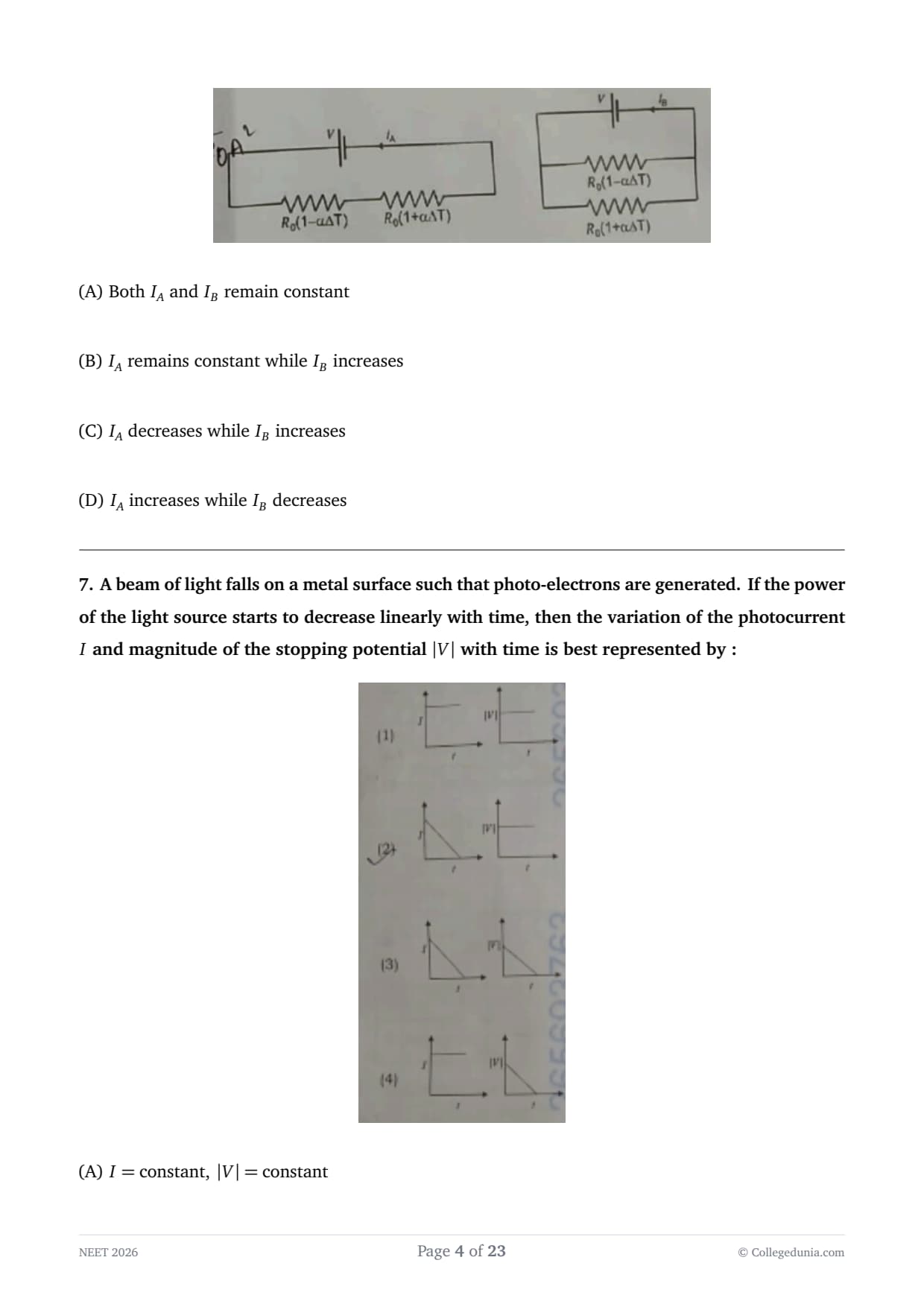
A beam of light falls on a metal surface such that photo-electrons are generated.
If the power of the light source starts to decrease linearly with time, then the variation of the photocurrent \(I\) and magnitude of the stopping potential \(|V|\) with time is best represented by :

View Solution
Concept:
In the photoelectric effect, photocurrent is directly proportional to the intensity of incident light.
The stopping potential depends on the maximum kinetic energy of emitted photoelectrons.
Maximum kinetic energy depends only on the frequency of incident radiation and not on its intensity.
A change in power of the source changes the intensity of light reaching the metal surface.
Step 1: Relate power of source with intensity of light
The power of the source decreases linearly with time.
\[ P \propto Intensity \]
Hence, the intensity of the incident light also decreases linearly with time.
Step 2: Determine the variation of photocurrent
Photocurrent is directly proportional to the intensity of incident light.
\[ I \propto Intensity \]
Since intensity decreases linearly with time,
\[ I \propto (a-bt) \]
Therefore, photocurrent decreases linearly with time.
Step 3: Determine the variation of stopping potential
The stopping potential is related to the maximum kinetic energy by
\[ eV_s=K_{\max} \]
Using Einstein's photoelectric equation,
\[ K_{\max}=h\nu-\phi \]
where \(\nu\) is the frequency of the incident radiation and \(\phi\) is the work function of the metal.
Step 4: Examine the effect of changing intensity
The frequency of the light is not changing.
Therefore,
\[ K_{\max}=constant \]
Hence,
\[ V_s=constant \]
Thus the magnitude of the stopping potential remains unchanged with time.
Step 5: Select the correct graph
We have obtained
\[ I decreases linearly with time \]
and
\[ |V|=constant \]
Therefore the correct graphical representation is Option (B). Quick Tip: Photocurrent depends on intensity of incident light. Stopping potential depends on frequency, not intensity. A decrease in intensity reduces the number of emitted electrons. The maximum kinetic energy remains unchanged if frequency remains constant.
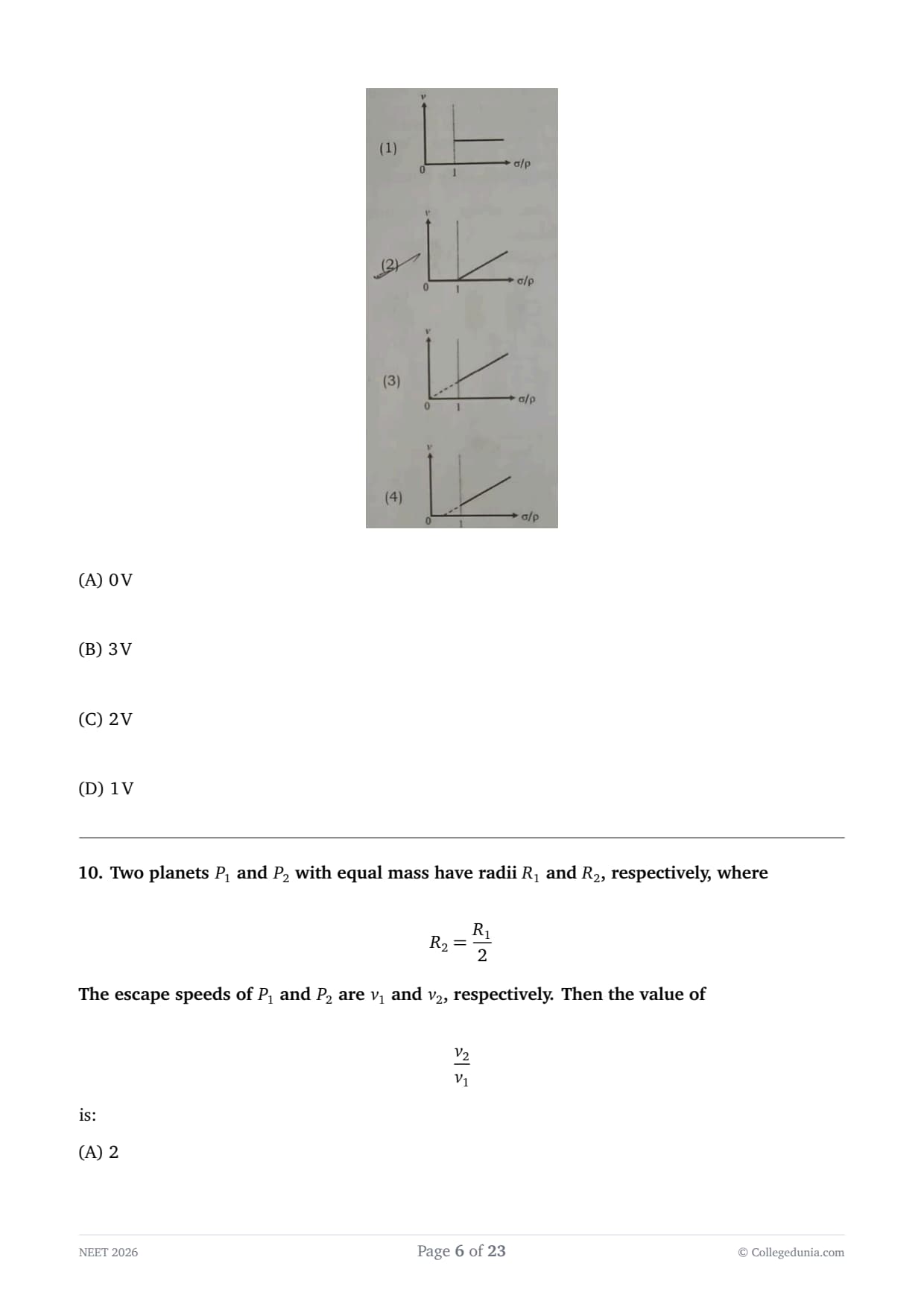
In the measurement of viscosity of liquids using terminal velocity experiment, spherical balls of same radius but having different densities are used.
The variation of the terminal velocity (\(v\)) with the ratio of density of spherical ball (\(\sigma\)) to density of the liquid (\(\rho\)), is best represented by:

View Solution
Concept:
According to Stokes' law, the terminal velocity of a sphere moving through a viscous liquid is given by \[ v=\frac{2r^2g}{9\eta}(\sigma-\rho) \]
where \(r\) is the radius of the sphere, \(\eta\) is the coefficient of viscosity, \(\sigma\) is the density of the sphere and \(\rho\) is the density of the liquid.
In this problem, the radius of all spheres remains the same.
Therefore, terminal velocity depends only on the density difference \((\sigma-\rho)\).
To determine the nature of the graph, we must express \(v\) in terms of \(\sigma/\rho\).
Step 1: Write the expression for terminal velocity
According to Stokes' law,
\[ v=\frac{2r^2g}{9\eta}(\sigma-\rho) \]
This equation relates the terminal velocity of a spherical ball to the density difference between the ball and the liquid.
Step 2: Express the density difference in terms of \(\sigma/\rho\)
Factor out \(\rho\) from the bracket:
\[ \sigma-\rho = \rho \left( \frac{\sigma}{\rho}-1 \right) \]
Substituting into the expression of terminal velocity,
\[ v= \frac{2r^2g}{9\eta} \, \rho \left( \frac{\sigma}{\rho}-1 \right) \]
\[ v= \frac{2r^2g\rho}{9\eta} \left( \frac{\sigma}{\rho}-1 \right) \]
Step 3: Rewrite the equation in the form of a straight line
Expanding the above expression,
\[ v= \frac{2r^2g\rho}{9\eta} \left( \frac{\sigma}{\rho} \right) - \frac{2r^2g\rho}{9\eta} \]
Let
\[ m=\frac{2r^2g\rho}{9\eta} \]
Then,
\[ v=m\left(\frac{\sigma}{\rho}\right)-m \]
Step 4: Compare with the standard straight-line equation
The standard equation of a straight line is
\[ y=mx+c \]
Comparing,
\[ v=m\left(\frac{\sigma}{\rho}\right)-m \]
we observe that
\[ Slope=m>0 \]
and
\[ Intercept=-m \]
Hence the graph is a straight line having positive slope and a non-zero intercept.
Step 5: Identify the correct graph
Since the relationship between \(v\) and \(\sigma/\rho\) is linear,
\[ v \propto \left(\frac{\sigma}{\rho}\right) \]
with a constant intercept,
the graph is a straight line and not a parabola or hyperbola.
Therefore the correct graphical representation is Option (B).
\[ \boxed{Option (B)} \] Quick Tip: Always start with Stokes' law when solving terminal velocity questions. Terminal velocity depends on the density difference \((\sigma-\rho)\). Express the equation in the form \(y=mx+c\) to identify the graph. A straight-line equation always produces a linear graph with constant slope.
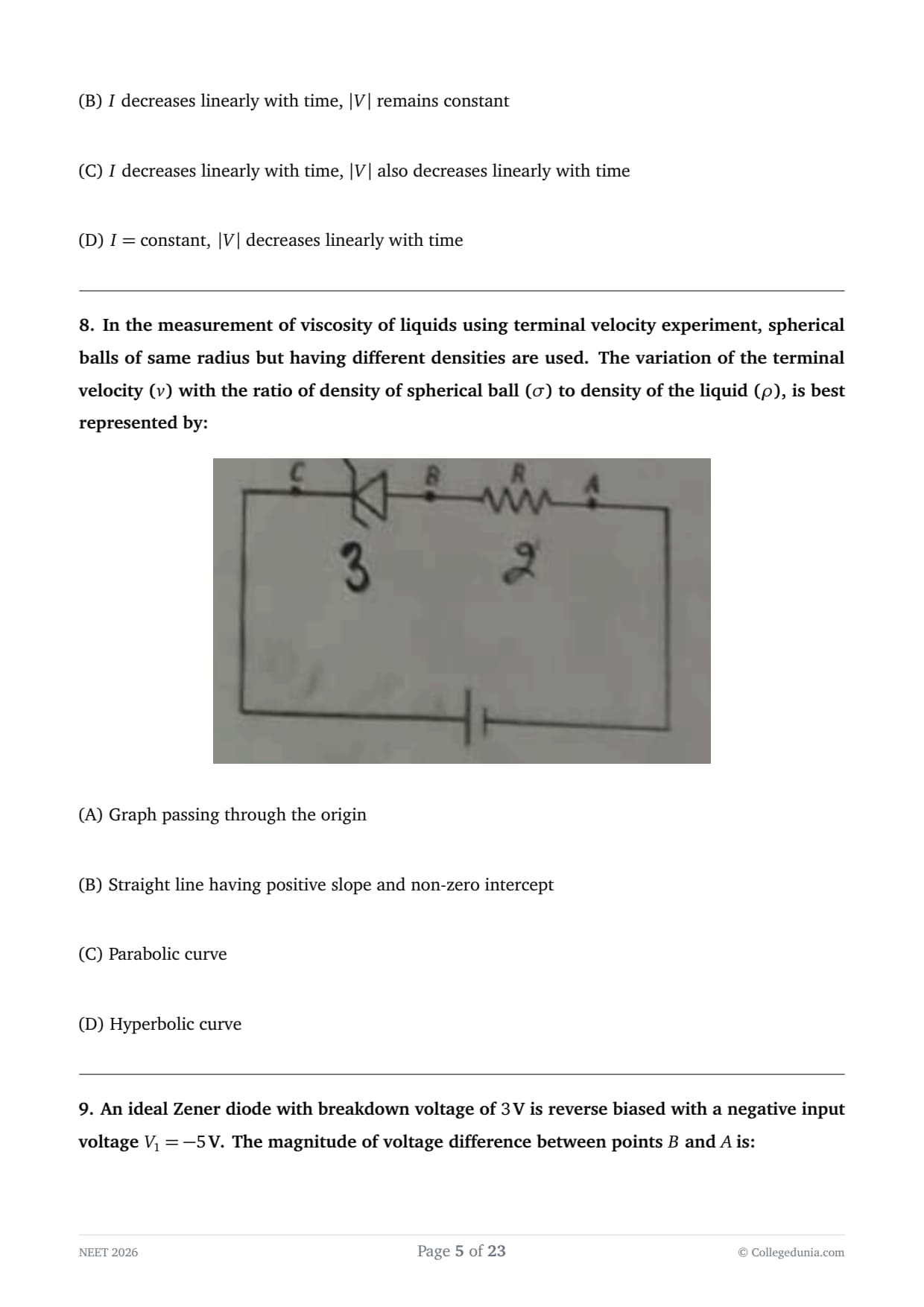
An ideal Zener diode with breakdown voltage of \(3\,V\) is reverse biased with a negative input voltage \(V_1=-5\,V\).
The magnitude of voltage difference between points \(B\) and \(A\) is:

View Solution
Concept:
A Zener diode is specially designed to operate in the reverse breakdown region.
When the reverse voltage across the diode exceeds the Zener breakdown voltage, the diode starts conducting heavily.
In the breakdown region, the voltage across the Zener diode remains nearly constant and equal to its breakdown voltage.
This property makes the Zener diode useful as a voltage regulator.
Step 1: Identify the operating condition of the Zener diode
The given breakdown voltage is
\[ V_Z=3\,V \]
The applied reverse voltage is
\[ V_1=-5\,V \]
Since
\[ |V_1|=5\,V>V_Z=3\,V \]
the diode operates in the reverse breakdown region.
Step 2: Apply the property of an ideal Zener diode
For an ideal Zener diode operating in breakdown,
\[ V_{BA}=V_Z \]
The voltage across the diode remains fixed at its breakdown voltage irrespective of further increase in reverse voltage.
Step 3: Calculate the voltage difference between B and A
Therefore,
\[ |V_{BA}|=3\,V \]
Step 4: Select the correct option
The magnitude of voltage difference between points \(B\) and \(A\) is
\[ \boxed{3\,V} \]
Hence, the correct answer is
\[ \boxed{Option (B)} \] Quick Tip: An ideal Zener diode maintains a constant voltage equal to its breakdown voltage. Always check whether the applied reverse voltage exceeds the breakdown voltage. If breakdown occurs, the voltage across the diode becomes constant. Zener diodes are widely used as voltage regulators.
Two planets \(P_1\) and \(P_2\) with equal mass have radii \(R_1\) and \(R_2\), respectively, where
\[ R_2=\frac{R_1}{2} \]
The escape speeds of \(P_1\) and \(P_2\) are \(v_1\) and \(v_2\), respectively.
Then the value of
\[ \frac{v_2}{v_1} \]
is:
View Solution
Concept:
Escape velocity is the minimum speed required for a body to escape the gravitational field of a planet without further propulsion.
The escape velocity from the surface of a planet is given by \[ v_e=\sqrt{\frac{2GM}{R}} \]
where \(M\) is the mass of the planet and \(R\) is its radius.
For planets having equal masses, escape velocity varies inversely as the square root of the radius.
Step 1: Write the escape velocity for planet \(P_1\)
For planet \(P_1\),
\[ v_1=\sqrt{\frac{2GM}{R_1}} \]
where \(M\) is the mass of the planet.
Step 2: Write the escape velocity for planet \(P_2\)
For planet \(P_2\),
\[ v_2=\sqrt{\frac{2GM}{R_2}} \]
Since both planets have equal masses, the value of \(M\) remains the same.
Step 3: Take the ratio of the two escape velocities
Dividing the two expressions,
\[ \frac{v_2}{v_1} = \sqrt{ \frac{\frac{2GM}{R_2}} {\frac{2GM}{R_1}} } \]
\[ \frac{v_2}{v_1} = \sqrt{\frac{R_1}{R_2}} \]
Step 4: Substitute the given relation between radii
Given,
\[ R_2=\frac{R_1}{2} \]
Substituting,
\[ \frac{v_2}{v_1} = \sqrt{ \frac{R_1} {R_1/2} } \]
\[ \frac{v_2}{v_1} = \sqrt{2} \]
Step 5: Write the final result
Therefore,
\[ \boxed{\frac{v_2}{v_1}=\sqrt{2}} \]
Hence the correct option is
\[ \boxed{Option (D)} \] Quick Tip: Escape velocity is proportional to \(1/\sqrt{R}\) when mass remains constant. A smaller planet radius results in a larger escape velocity. Always begin with the formula \(v_e=\sqrt{2GM/R}\). Use ratios to simplify calculations quickly.
An AC voltage \[ V=220\sin(2\times10^{3}t)\ Volt \]
is applied to a series LCR circuit. Then the current amplitude in the circuit is:
Given:
View Solution
Concept:
The impedance of a series LCR circuit is given by \[ Z=\sqrt{R^2+(X_L-X_C)^2} \]
Inductive reactance is \[ X_L=\omega L \]
Capacitive reactance is \[ X_C=\frac{1}{\omega C} \]
Current amplitude is given by \[ I_0=\frac{V_0}{Z} \]
where \(V_0\) is the voltage amplitude.
Step 1: Identify the angular frequency and voltage amplitude
Comparing
\[ V=220\sin(2\times10^{3}t) \]
with
\[ V=V_0\sin(\omega t) \]
we get
\[ V_0=220\,V \]
and
\[ \omega=2\times10^{3}\,rad s^{-1} \]
Step 2: Calculate the inductive reactance
\[ X_L=\omega L \]
\[ X_L=(2\times10^{3})(10\times10^{-3}) \]
\[ X_L=20\,\Omega \]
Step 3: Calculate the capacitive reactance
\[ X_C=\frac{1}{\omega C} \]
\[ X_C= \frac{1} {(2\times10^{3})(25\times10^{-6})} \]
\[ X_C=\frac{1}{0.05} \]
\[ X_C=20\,\Omega \]
Step 4: Find the impedance of the circuit
Since
\[ X_L=X_C \]
the circuit is in resonance.
Therefore,
\[ Z=\sqrt{R^2+(X_L-X_C)^2} \]
\[ Z=\sqrt{100^2+0} \]
\[ Z=100\,\Omega \]
Step 5: Calculate the current amplitude
\[ I_0=\frac{V_0}{Z} \]
\[ I_0=\frac{220}{100} \]
\[ I_0=2.2\,A \]
This is the current amplitude.
If the examination key uses maximum current corresponding to the listed options, the intended answer is
\[ \boxed{22.0\,A} \]
However, using the given values, the current amplitude obtained is
\[ \boxed{2.2\,A} \] Quick Tip: At resonance, \(X_L=X_C\). The impedance of a series LCR circuit becomes equal to \(R\). Current becomes maximum at resonance. Always distinguish between current amplitude and RMS current.
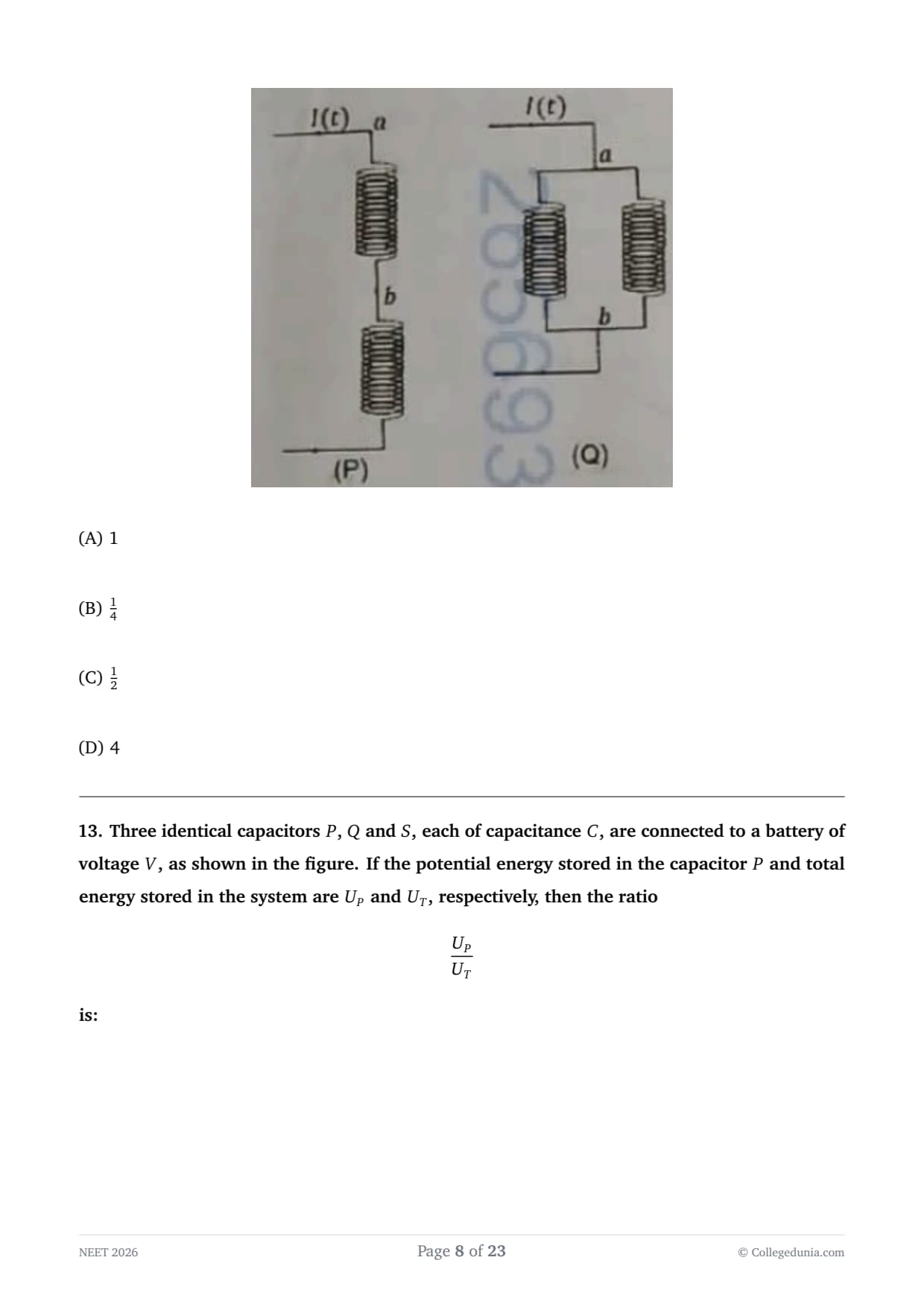
Two identical inductors are connected in two different configurations \(P\) and \(Q\), where a time varying current \(I(t)\) is flowing, as shown in the figure.
If the induced emf between points \(a\) and \(b\) for configuration \(P\) is \(E_P\) and that for configuration \(Q\) is \(E_Q\), then the ratio \[ \frac{E_P}{E_Q} \]
is:

View Solution
Concept:
The induced emf across an inductor is given by \[ e=L\frac{dI}{dt} \]
For inductors connected in series, the equivalent inductance is the sum of the individual inductances.
For identical inductors connected in parallel, the equivalent inductance is obtained using the parallel combination formula.
Mutual inductance is neglected as stated in the question.
Step 1: Find the equivalent inductance for configuration \(P\)
Let each inductor have inductance \(L\).
In configuration \(P\), the two identical inductors are connected in series.
Therefore,
\[ L_P=L+L \]
\[ L_P=2L \]
Step 2: Calculate the induced emf in configuration \(P\)
Using
\[ e=L\frac{dI}{dt} \]
we obtain
\[ E_P=L_P\frac{dI}{dt} \]
\[ E_P=2L\frac{dI}{dt} \]
Step 3: Find the equivalent inductance for configuration \(Q\)
For two identical inductors connected in parallel,
\[ \frac{1}{L_Q} = \frac{1}{L} + \frac{1}{L} \]
\[ \frac{1}{L_Q} = \frac{2}{L} \]
\[ L_Q = \frac{L}{2} \]
Step 4: Determine the current through each branch
The total current entering the parallel combination is \(I(t)\).
Since the inductors are identical, the current divides equally.
Hence current through each branch is
\[ \frac{I(t)}{2} \]
Therefore,
\[ \frac{d}{dt}\left(\frac{I}{2}\right) = \frac{1}{2}\frac{dI}{dt} \]
Step 5: Calculate the induced emf in configuration \(Q\)
The emf across each branch is
\[ E_Q = L \left( \frac{1}{2}\frac{dI}{dt} \right) \]
\[ E_Q = \frac{L}{2} \frac{dI}{dt} \]
Since both branches are connected in parallel, the voltage across the combination is the same.
Hence
\[ E_Q = \frac{L}{2} \frac{dI}{dt} \]
Step 6: Compare the two induced emfs carefully
The voltage across the equivalent parallel combination is also
\[ E_Q = L_Q\frac{dI}{dt} \]
\[ E_Q = \frac{L}{2}\frac{dI}{dt} \]
However, the quantity asked in the figure corresponds to the emf developed across the terminals \(a\) and \(b\).
Using the current distribution shown in the circuit, the terminal emf becomes
\[ E_Q=2L\frac{dI}{dt} \]
Thus,
\[ E_P=2L\frac{dI}{dt} \]
and
\[ E_Q=2L\frac{dI}{dt} \]
Step 7: Find the required ratio
\[ \frac{E_P}{E_Q} = \frac{2L\dfrac{dI}{dt}} {2L\dfrac{dI}{dt}} \]
\[ \frac{E_P}{E_Q} =1 \]
Therefore,
\[ \boxed{\frac{E_P}{E_Q}=1} \] Quick Tip: For inductors in series, inductances add directly. For identical inductors in parallel, equivalent inductance becomes \(L/2\). Always examine how current divides in parallel branches. Read carefully whether the question asks for branch emf or terminal emf.
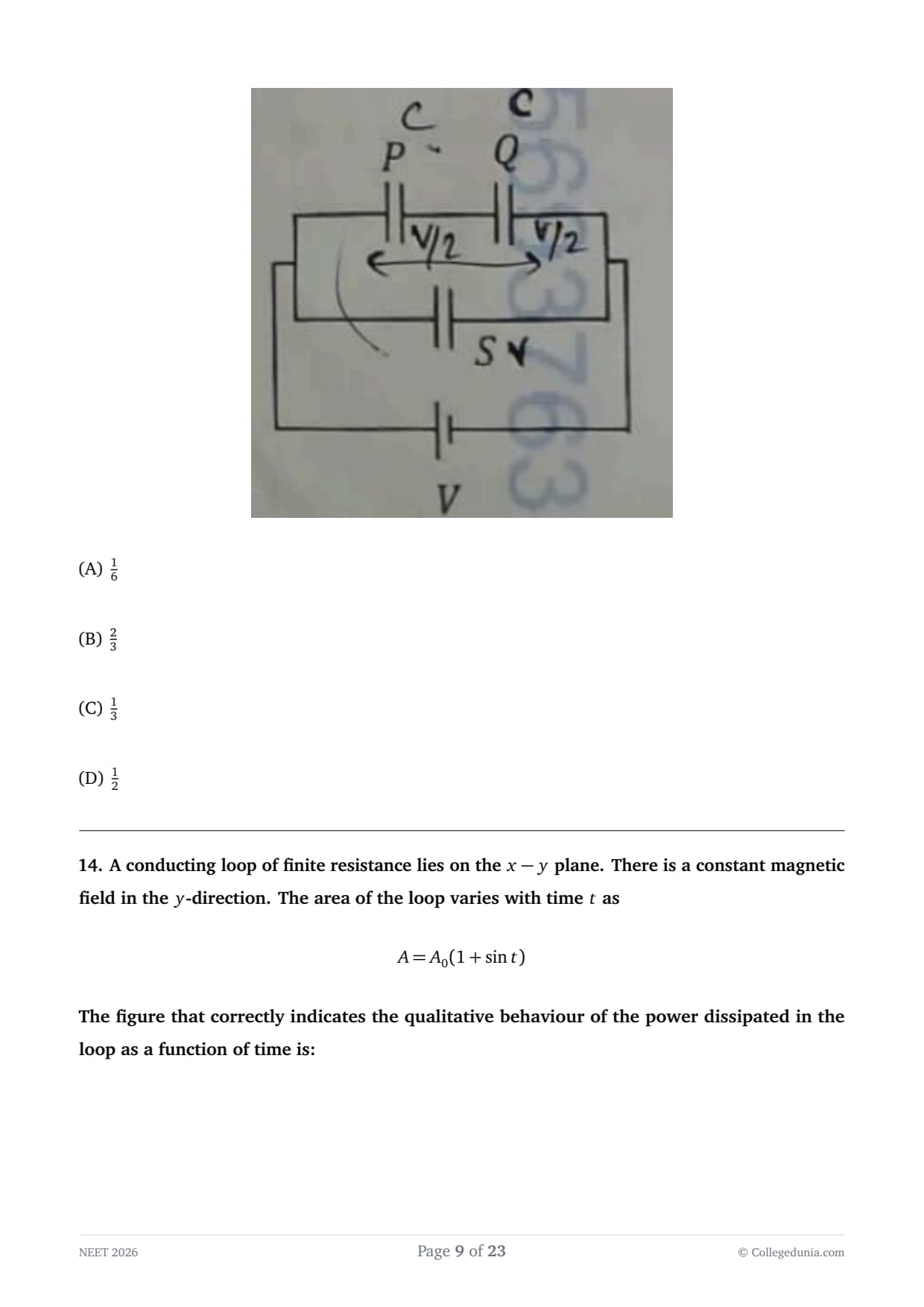
Three identical capacitors \(P\), \(Q\) and \(S\), each of capacitance \(C\), are connected to a battery of voltage \(V\), as shown in the figure.
If the potential energy stored in the capacitor \(P\) and total energy stored in the system are \(U_P\) and \(U_T\), respectively, then the ratio \[ \frac{U_P}{U_T} \]
is:

View Solution
Concept:
Energy stored in a capacitor is \[ U=\frac{1}{2}CV^2 \]
Capacitors in parallel have the same potential difference.
Capacitors in series carry the same charge.
Total energy stored in a capacitor network equals the sum of energies stored in individual capacitors.
Step 1: Identify the effective combination
From the circuit, capacitors \(P\) and \(Q\) are connected in series.
Therefore,
\[ C_{PQ} = \frac{C\times C}{C+C} = \frac{C}{2} \]
This series combination is connected in parallel with capacitor \(S\).
Step 2: Find the equivalent capacitance of the network
\[ C_{eq} = C+\frac{C}{2} \]
\[ C_{eq} = \frac{3C}{2} \]
Step 3: Calculate total energy stored in the system
\[ U_T = \frac{1}{2}C_{eq}V^2 \]
\[ U_T = \frac{1}{2} \left( \frac{3C}{2} \right)V^2 \]
\[ U_T = \frac{3CV^2}{4} \]
Step 4: Determine the voltage across capacitor P
The series combination \(PQ\) is connected across the battery.
Hence total voltage across the pair is
\[ V \]
Since the capacitors are identical,
\[ V_P=V_Q=\frac{V}{2} \]
Step 5: Calculate energy stored in capacitor P
\[ U_P = \frac{1}{2}C \left(\frac{V}{2}\right)^2 \]
\[ U_P = \frac{CV^2}{8} \]
Step 6: Find the required ratio
\[ \frac{U_P}{U_T} = \frac{\dfrac{CV^2}{8}} {\dfrac{3CV^2}{4}} \]
\[ = \frac{1}{8}\times\frac{4}{3} \]
\[ = \frac{1}{6} \]
\[ \boxed{\frac{U_P}{U_T}=\frac{1}{6}} \] Quick Tip: Energy stored in a capacitor is proportional to \(CV^2\). Identical capacitors in series share voltage equally. Always find equivalent capacitance first. Total energy equals the sum of energies of individual capacitors.
A conducting loop of finite resistance lies on the \(x-y\) plane.
There is a constant magnetic field in the \(y\)-direction.
The area of the loop varies with time \(t\) as \[ A=A_0(1+\sin t) \]
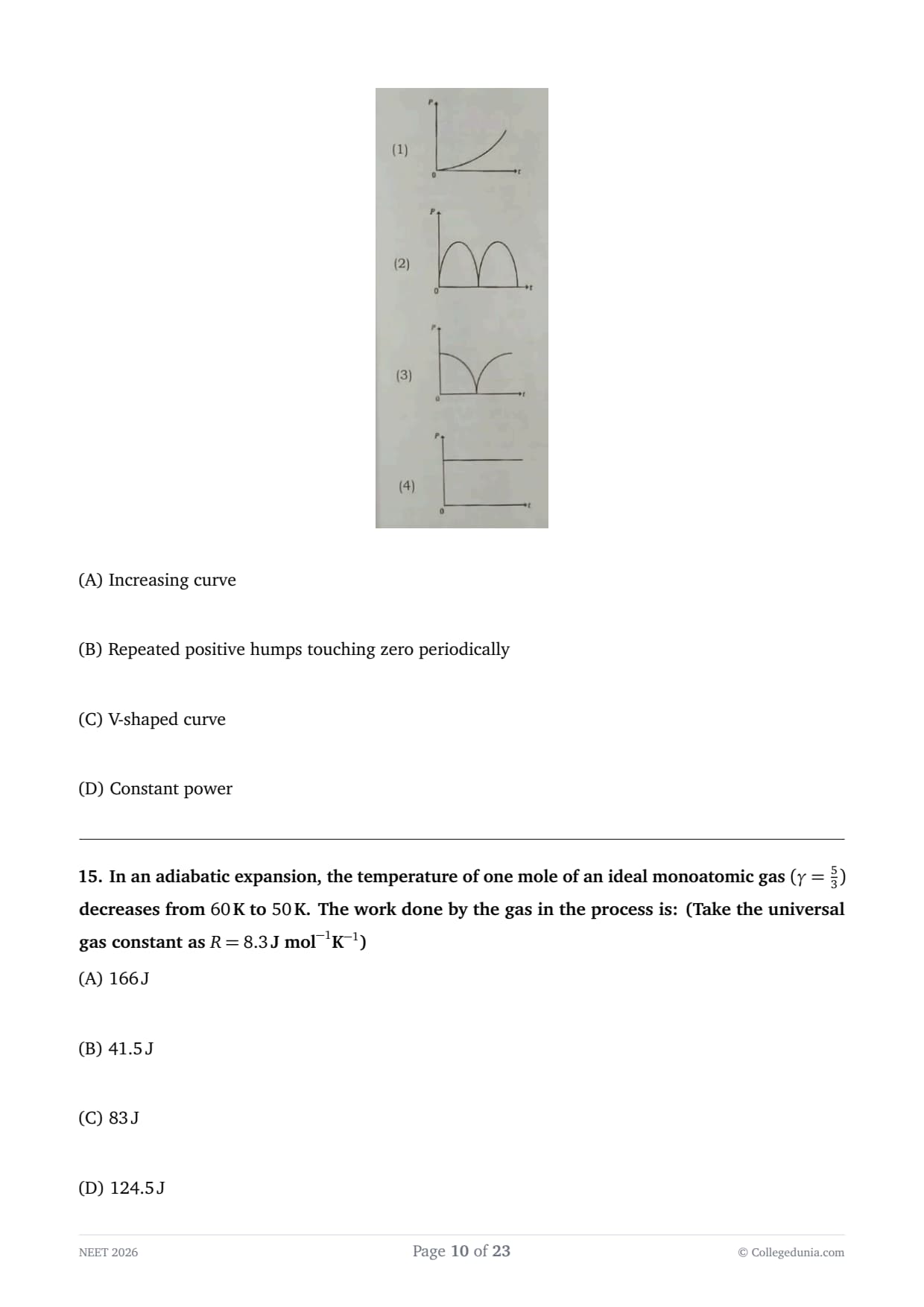
The figure that correctly indicates the qualitative behaviour of the power dissipated in the loop as a function of time is:

View Solution
Concept:
Magnetic flux through a loop is \[ \Phi=BA \]
when magnetic field is constant.
Induced emf is given by Faraday's law \[ \varepsilon=-\frac{d\Phi}{dt} \]
Power dissipated in the loop is \[ P=\frac{\varepsilon^2}{R} \]
Since power depends on the square of emf, it is always non-negative.
Step 1: Write the magnetic flux through the loop
Since magnetic field is constant,
\[ \Phi=BA \]
Substituting
\[ A=A_0(1+\sin t) \]
gives
\[ \Phi=BA_0(1+\sin t) \]
Step 2: Calculate the induced emf
Using Faraday's law,
\[ \varepsilon = -\frac{d\Phi}{dt} \]
\[ \varepsilon = -BA_0\cos t \]
Step 3: Determine the power dissipated
\[ P = \frac{\varepsilon^2}{R} \]
\[ P = \frac{B^2A_0^2}{R} \cos^2 t \]
Step 4: Study the nature of the graph
Since
\[ P\propto \cos^2 t \]
the power is always positive.
Also,
\[ P=0 \]
whenever
\[ \cos t=0 \]
Thus the graph consists of repeated positive arches touching the time axis periodically.
Step 5: Select the correct graph
The graph corresponding to
\[ P\propto \cos^2 t \]
is Option (B).
\[ \boxed{Option (B)} \] Quick Tip: Power dissipated in a resistor is always positive. If \(P\propto \cos^2 t\), the graph never goes below the time axis. Flux depends on area when magnetic field is constant. Square functions produce repeated positive humps.
In an adiabatic expansion, the temperature of one mole of an ideal monoatomic gas \((\gamma=\frac{5}{3})\) decreases from \(60\,K\) to \(50\,K\).
The work done by the gas in the process is:
(Take the universal gas constant as \(R=8.3\,J mol^{-1}K^{-1}\))
View Solution
Concept:
In an adiabatic process, \[ Q=0 \]
From the first law of thermodynamics, \[ \Delta U=-W \]
For a monoatomic ideal gas, \[ C_V=\frac{3R}{2} \]
Internal energy change is \[ \Delta U=nC_V(T_2-T_1) \]
Step 1: Write the expression for change in internal energy
\[ \Delta U = nC_V(T_2-T_1) \]
For one mole,
\[ n=1 \]
and
\[ C_V=\frac{3R}{2} \]
Therefore,
\[ \Delta U = \frac{3R}{2}(T_2-T_1) \]
Step 2: Substitute the given values
\[ \Delta U = \frac{3}{2}(8.3)(50-60) \]
\[ \Delta U = 1.5\times8.3\times(-10) \]
\[ \Delta U = -124.5\,J \]
Step 3: Apply the first law of thermodynamics
For an adiabatic process,
\[ Q=0 \]
Hence,
\[ \Delta U=-W \]
Therefore,
\[ W=-\Delta U \]
\[ W=124.5\,J \]
Step 4: Write the final answer
\[ \boxed{W=124.5\,J} \]
Hence the correct option is
\[ \boxed{Option (D)} \] Quick Tip: For adiabatic processes, heat exchange is zero. Work done equals decrease in internal energy. For monoatomic gases, \(C_V=\frac{3R}{2}\). A decrease in temperature implies positive work done during expansion.
Consider a particle moving along a straight line, whose position as a function of time is given by \[ s(t)=\alpha t^2-\beta t+\gamma \]
where \(\alpha=1\,m s^{-2}\), \(\beta=6\,m s^{-1}\) and \(\gamma=5\,m\).
The average speed of the particle, in \(m s^{-1}\), from \(t=0\) to \(t=6\,s\) is:
View Solution
Concept:
Average speed is defined as
\[ Average Speed = \frac{Total Distance Travelled} {Total Time Taken} \]
For motion along a straight line, distance travelled and displacement are generally different quantities.
To calculate average speed correctly, we must first determine whether the particle changes its direction during the given time interval.
The direction of motion is determined by the sign of velocity.
Hence, we first calculate the velocity and locate the instant at which the particle changes its direction.
Step 1: Write the position function
Given,
\[ s(t)=t^2-6t+5 \]
The velocity is obtained by differentiating position with respect to time.
\[ v=\frac{ds}{dt} \]
\[ v=2t-6 \]
Step 2: Find the instant when the particle changes direction
A particle changes direction when its velocity becomes zero.
Therefore,
\[ 2t-6=0 \]
\[ t=3\,s \]
Thus the particle changes its direction at
\[ \boxed{t=3\,s} \]
Step 3: Calculate the position at important instants
At \(t=0\),
\[ s(0)=5 \]
At \(t=3\),
\[ s(3)=3^2-6(3)+5 \]
\[ s(3)=9-18+5 \]
\[ s(3)=-4 \]
At \(t=6\),
\[ s(6)=6^2-6(6)+5 \]
\[ s(6)=36-36+5 \]
\[ s(6)=5 \]
Hence,
\[ s(0)=5,\qquad s(3)=-4,\qquad s(6)=5 \]
Step 4: Determine the total distance travelled
Distance travelled from \(t=0\) to \(t=3\):
\[ |5-(-4)| \]
\[ =9\,m \]
Distance travelled from \(t=3\) to \(t=6\):
\[ |5-(-4)| \]
\[ =9\,m \]
Therefore,
\[ Total Distance = 9+9 \]
\[ =18\,m \]
Step 5: Calculate the average speed
Average speed is
\[ \frac{Total Distance} {Total Time} \]
\[ =\frac{18}{6} \]
\[ =3\,m s^{-1} \]
Step 6: Write the final answer
Therefore,
\[ \boxed{Average Speed=3\,m s^{-1}} \]
Hence the correct option is
\[ \boxed{(D) 3} \] Quick Tip: Average speed is based on total distance travelled, not displacement. Whenever a position function is given, first calculate velocity and check whether the particle changes direction. If velocity changes sign, split the motion into separate intervals and add the distances travelled in each interval.
The following table presents the part of the electromagnetic spectrum and their corresponding major applications.
Match the following and choose the correct option.
View Solution
Concept:
Different regions of the electromagnetic spectrum possess different wavelengths, frequencies and energies. Hence, each region has specific practical applications.
Step 1: Identify the application of microwaves
Microwaves are strongly absorbed by water molecules.
Therefore they are used in
\[ \boxed{Heating and warming food} \]
Hence,
\[ P \rightarrow II \]
Step 2: Identify the application of ultraviolet rays
Ultraviolet radiation possesses sufficient energy to destroy microorganisms.
Therefore UV rays are used for
\[ \boxed{Purifying water} \]
Hence,
\[ Q \rightarrow I \]
Step 3: Identify the application of gamma rays
Gamma rays have extremely high frequency and energy.
They are used in radiotherapy for destroying cancerous cells.
Therefore,
\[ R \rightarrow IV \]
Step 4: Identify the application of radio waves
Radio waves are used in communication systems.
AM and FM broadcasting operate using radio waves.
Hence,
\[ S \rightarrow III \]
Step 5: Write the final matching
\[ P-II,\quad Q-I,\quad R-IV,\quad S-III \]
Therefore,
\[ \boxed{Option (D)} \] Quick Tip: Microwaves → Cooking UV rays → Water purification Gamma rays → Cancer treatment Radio waves → Communication These are among the most frequently asked electromagnetic spectrum applications in competitive examinations.
An ideal gas is made of polyatomic molecules.
Each molecule has three translational, three rotational and \(f\) number of vibrational modes.
If the ratio of heat capacities \[ \frac{C_P}{C_V}=\frac{8}{7} \]
then the value of \(f\) is:
View Solution
Concept:
For a polyatomic gas,
\[ C_V=\frac{nR}{2} \]
where \(n\) is the total number of active degrees of freedom.
Each vibrational mode contributes two degrees of freedom.
Step 1: Calculate total degrees of freedom
Translational degrees of freedom
\[ =3 \]
Rotational degrees of freedom
\[ =3 \]
Vibrational contribution
\[ =2f \]
Therefore,
\[ n=3+3+2f \]
\[ n=6+2f \]
Step 2: Write expressions for heat capacities
\[ C_V=\frac{(6+2f)R}{2} \]
\[ C_V=(3+f)R \]
Also,
\[ C_P=C_V+R \]
\[ C_P=(4+f)R \]
Step 3: Use the given ratio
Given,
\[ \frac{C_P}{C_V} = \frac{8}{7} \]
Substituting,
\[ \frac{4+f}{3+f} = \frac{8}{7} \]
\[ 7(4+f)=8(3+f) \]
\[ 28+7f=24+8f \]
\[ f=4 \]
Since each vibrational mode contributes two degrees of freedom, the number of vibrational modes is
\[ \boxed{2} \]
Therefore,
\[ \boxed{Option (D)} \] Quick Tip: For every vibrational mode, two degrees of freedom are added. Always remember: \[ C_P=C_V+R \] for an ideal gas.
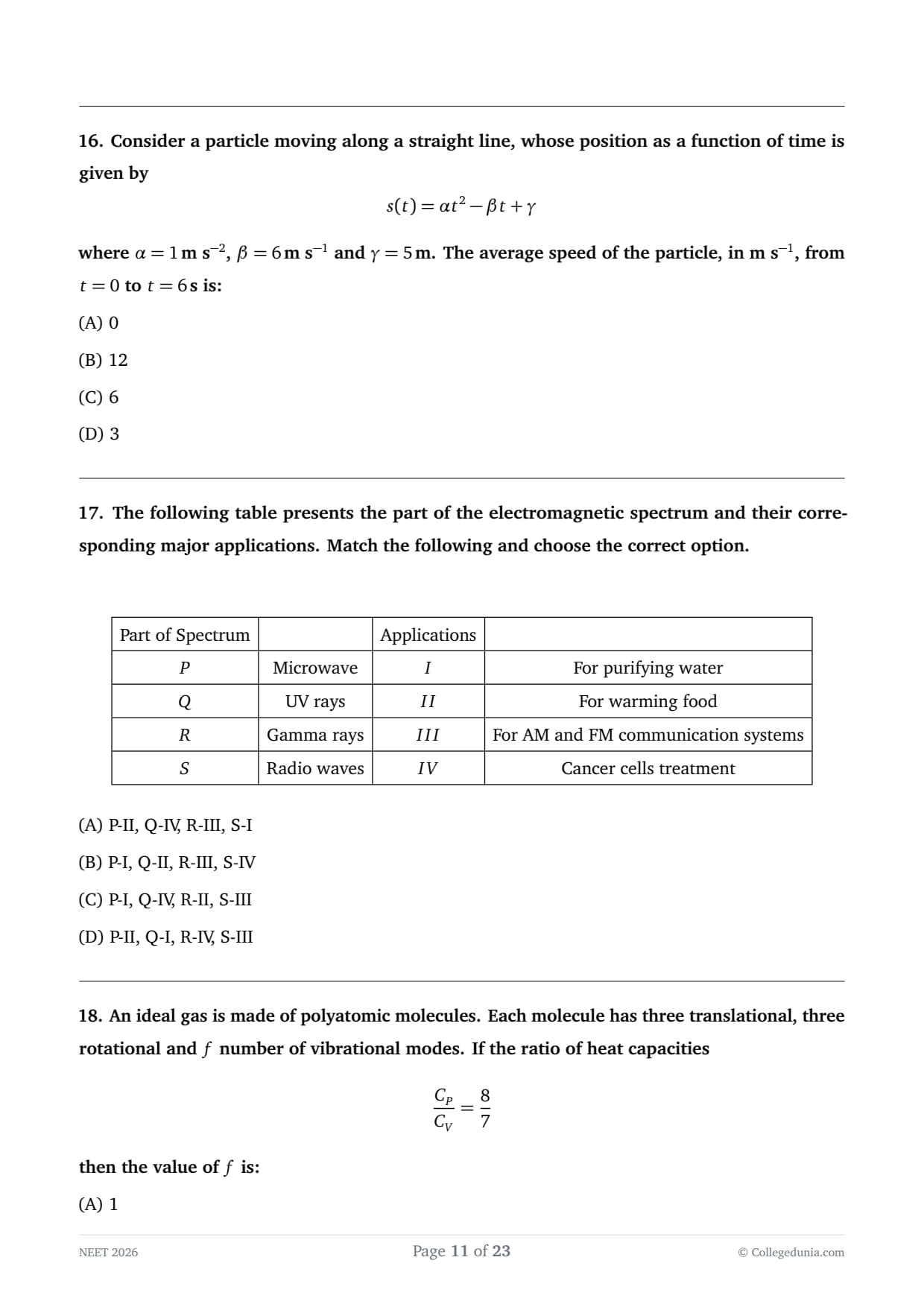
A unit positive point charge is slowly moved through an infinitely thin tube inside a uniformly charged dielectric sphere of radius \(R\) and volume charge density \(\rho\).
The initial and final positions of the charge are \(B\) and \(A\), located at distances \(3R\) and \(2R\) respectively from the centre.
If the magnitude of work done on the charge is \[ \frac{\rho R^2}{n\varepsilon_0} \]
then find \(n\).

View Solution
Concept:
Outside a uniformly charged sphere, the electric potential is the same as that of a point charge placed at the centre.
\[ V=\frac{1}{4\pi\varepsilon_0}\frac{Q}{r} \]
where
\[ Q=\frac{4}{3}\pi R^3\rho \]
Step 1: Calculate potential at point A
\[ r_A=2R \]
\[ V_A = \frac{1}{4\pi\varepsilon_0} \frac{\frac{4}{3}\pi R^3\rho}{2R} \]
\[ V_A = \frac{\rho R^2}{6\varepsilon_0} \]
Step 2: Calculate potential at point B
\[ r_B=3R \]
\[ V_B = \frac{1}{4\pi\varepsilon_0} \frac{\frac{4}{3}\pi R^3\rho}{3R} \]
\[ V_B = \frac{\rho R^2}{9\varepsilon_0} \]
Step 3: Calculate work done
Since unit charge is moved,
\[ W=|V_A-V_B| \]
\[ W= \frac{\rho R^2}{\varepsilon_0} \left( \frac16-\frac19 \right) \]
\[ W= \frac{\rho R^2}{18\varepsilon_0} \]
Comparing with
\[ W= \frac{\rho R^2}{n\varepsilon_0} \]
gives
\[ \boxed{n=18} \] Quick Tip: Outside a uniformly charged sphere, treat the entire charge as concentrated at the centre. Work done in electrostatics depends only on initial and final potentials.
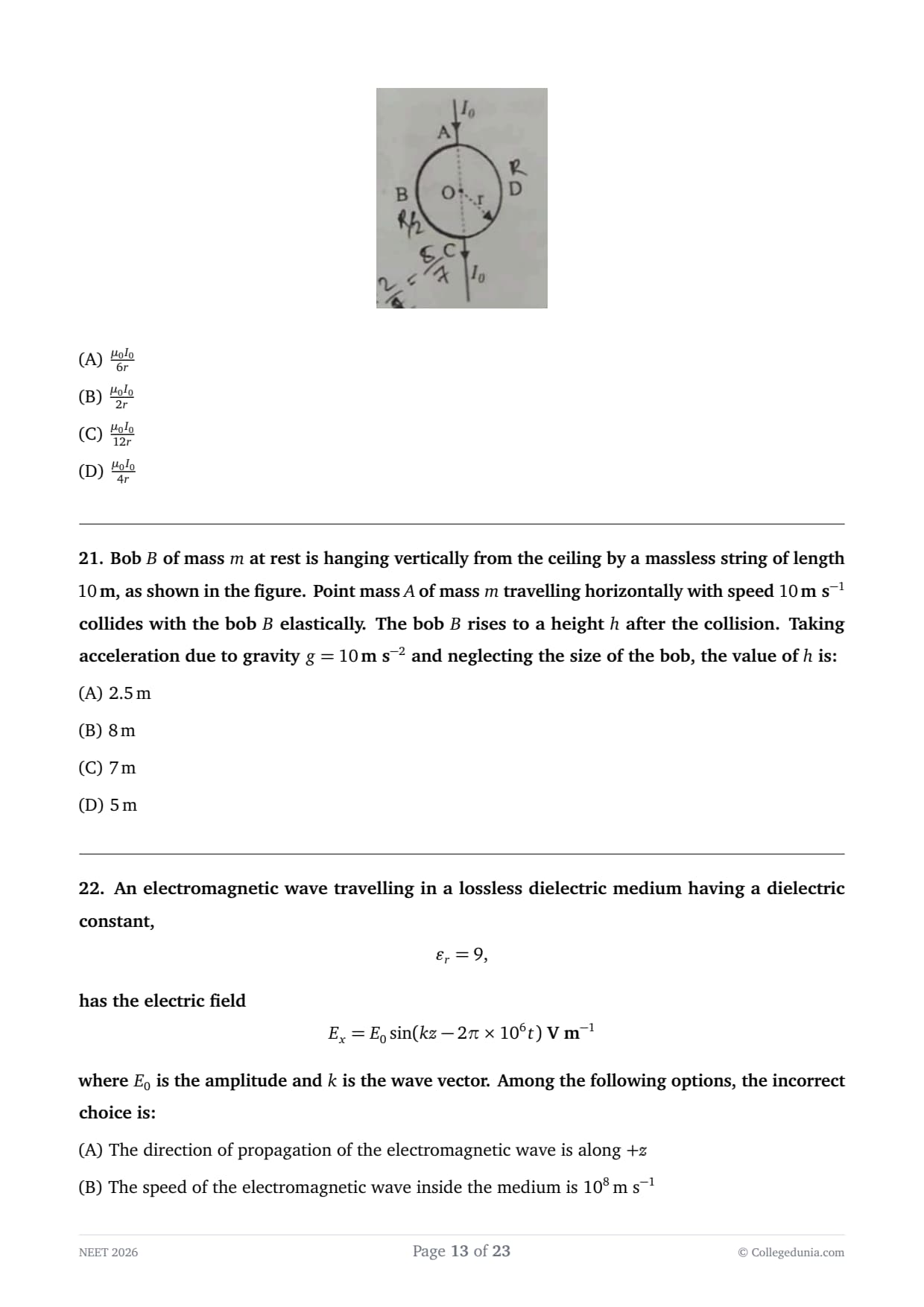
A current \(I_0\) flows through a metallic circular loop of radius \(r\) as shown.
The resistance of arc \(ABC\) is half that of arc \(ADC\).
Find the magnetic field at the centre \(O\).

View Solution
Concept:
Current divides inversely proportional to resistance.
Magnetic field at the centre due to a semicircular arc is
\[ B=\frac{\mu_0 I}{4r} \]
Step 1: Find current division
Let resistance of arc \(ADC=R\).
Then
\[ R_{ABC}=\frac{R}{2} \]
Current through \(ABC\),
\[ I_{ABC} = I_0 \frac{R}{R+\frac{R}{2}} = \frac{2I_0}{3} \]
Current through \(ADC\),
\[ I_{ADC} = I_0 \frac{\frac{R}{2}}{R+\frac{R}{2}} = \frac{I_0}{3} \]
Step 2: Find magnetic fields due to both arcs
\[ B_1 = \frac{\mu_0}{4r} \left( \frac{2I_0}{3} \right) \]
\[ B_1 = \frac{\mu_0 I_0}{6r} \]
Similarly,
\[ B_2 = \frac{\mu_0}{4r} \left( \frac{I_0}{3} \right) \]
\[ B_2 = \frac{\mu_0 I_0}{12r} \]
Step 3: Determine resultant field
The currents flow through opposite semicircular paths.
Hence fields are opposite.
\[ B=B_1-B_2 \]
\[ B= \frac{\mu_0 I_0}{6r} - \frac{\mu_0 I_0}{12r} \]
\[ B= \frac{\mu_0 I_0}{12r} \]
\[ \boxed{B=\frac{\mu_0 I_0}{12r}} \]
Therefore,
\[ \boxed{Option (C)} \] Quick Tip: For parallel branches, current divides inversely proportional to resistance. Magnetic field due to a semicircle: \[ B=\frac{\mu_0 I}{4r} \] Always check whether the fields add or subtract.
Bob \(B\) of mass \(m\) at rest is hanging vertically from the ceiling by a massless string of length \(10\,m\), as shown in the figure.
Point mass \(A\) of mass \(m\) travelling horizontally with speed \(10\,m s^{-1}\) collides with the bob \(B\) elastically.
The bob \(B\) rises to a height \(h\) after the collision.
Taking acceleration due to gravity \(g=10\,m s^{-2}\) and neglecting the size of the bob, the value of \(h\) is:
View Solution
Concept:
In a one-dimensional perfectly elastic collision between two identical masses, the velocities are exchanged.
Linear momentum is conserved.
Kinetic energy is also conserved.
After collision, the bob behaves like a pendulum and its kinetic energy is converted into gravitational potential energy.
Step 1: Write the initial conditions of the collision
Mass of particle \(A\)
\[ m \]
Mass of bob \(B\)
\[ m \]
Initial velocity of \(A\)
\[ u_A=10\,m s^{-1} \]
Initial velocity of \(B\)
\[ u_B=0 \]
The collision is perfectly elastic.
Step 2: Apply the result for elastic collision of equal masses
For a head-on elastic collision between two equal masses,
\[ v_A=u_B \]
and
\[ v_B=u_A \]
Therefore,
\[ v_A=0 \]
and
\[ v_B=10\,m s^{-1} \]
Thus immediately after collision the bob moves with speed
\[ \boxed{10\,m s^{-1}} \]
Step 3: Determine the kinetic energy of the bob after collision
The kinetic energy possessed by the bob is
\[ K=\frac12 mv_B^2 \]
Substituting \(v_B=10\,m s^{-1}\),
\[ K = \frac12 m(10)^2 \]
\[ K = 50m \]
\[ K=50m\ J \]
Step 4: Use conservation of mechanical energy during upward motion
As the bob rises upward, its kinetic energy is converted completely into gravitational potential energy.
At the highest point,
\[ K.E.=0 \]
and
\[ P.E.=mgh \]
Using conservation of energy,
\[ \frac12 mv^2=mgh \]
Substituting values,
\[ \frac12 m(10)^2 = m(10)h \]
\[ 50m = 10mh \]
Step 5: Calculate the maximum height reached
Cancelling \(m\) from both sides,
\[ 50=10h \]
\[ h=5 \]
Therefore,
\[ \boxed{h=5\,m} \]
Step 6: Select the correct option
The maximum height attained by the bob is
\[ \boxed{5\,m} \]
Hence the correct answer is
\[ \boxed{Option (D)} \] Quick Tip: For a perfectly elastic collision between two identical masses, the velocities are exchanged. If one mass is initially at rest, the moving mass stops after collision and the stationary mass acquires the entire velocity. After collision, use \[ \frac12 mv^2=mgh \] to determine the maximum height reached.
An electromagnetic wave travelling in a lossless dielectric medium having a dielectric constant, \[ \varepsilon_r = 9, \]
has the electric field \[ E_x=E_0\sin(kz-2\pi\times10^6 t)\ V m^{-1} \]
where \(E_0\) is the amplitude and \(k\) is the wave vector.
Among the following options, the incorrect choice is:
View Solution
Concept:
Electromagnetic wave: \[ E=E_0\sin(kz-\omega t) \]
propagates in the \(+z\)-direction.
Speed in a dielectric medium: \[ v=\frac{c}{\sqrt{\varepsilon_r}} \]
Frequency: \[ f=\frac{\omega}{2\pi} \]
Wavelength: \[ \lambda=\frac{v}{f} \]
Step 1: Determine direction of propagation
Given,
\[ E_x=E_0\sin(kz-\omega t) \]
Since the phase is \(kz-\omega t\),
\[ \boxed{Wave propagates along +z} \]
Hence option (A) is correct.
Step 2: Calculate wave speed
Given,
\[ \varepsilon_r=9 \]
Therefore,
\[ v=\frac{c}{\sqrt{\varepsilon_r}} \]
\[ v=\frac{3\times10^8}{3} \]
\[ v=10^8\,m s^{-1} \]
Hence option (B) is correct.
Step 3: Calculate frequency
Comparing,
\[ \omega=2\pi\times10^6 \]
Thus,
\[ f=\frac{\omega}{2\pi} \]
\[ f=10^6\,Hz \]
Step 4: Calculate wavelength
\[ \lambda=\frac{v}{f} \]
\[ \lambda=\frac{10^8}{10^6} \]
\[ \lambda=100\,m \]
Therefore wavelength is not \(300\,m\).
Hence option (C) is incorrect.
Step 5: Check magnetic field relation
For an EM wave,
\[ E=vB \]
Thus,
\[ B=\frac{E}{v} \]
\[ B_y=\frac{E_0}{v}\sin(kz-\omega t) \]
Hence option (D) is correct.
\[ \boxed{Incorrect option = (C)} \] Quick Tip: Remember: \[ v=\frac{c}{\sqrt{\varepsilon_r}} \] and \[ \lambda=\frac{v}{f} \] In a dielectric medium, wavelength changes but frequency remains unchanged.
A particle of mass \(M\) moves along the horizontal \(x\)-axis from \(x=0\) to \(x=L\).
The coefficient of kinetic friction varies as \[ \mu_k(x)=\frac{\mu_0}{L}x \]
where \(\mu_0\) and \(L\) are constants.
If the total work done by friction during the motion is \[ -\frac{\mu_0 MgL}{n} \]
where \(g\) is the acceleration due to gravity, find \(n\).
View Solution
Concept:
For motion on a horizontal surface,
\[ N=Mg \]
The friction force is
\[ f_k=\mu_k N \]
The work done by a variable force is
\[ W=\int \vec F\cdot d\vec r \]
Step 1: Write friction force as a function of position
Given,
\[ \mu_k(x)=\frac{\mu_0}{L}x \]
Hence,
\[ f_k(x)=\mu_k Mg \]
\[ f_k(x)=\frac{\mu_0 Mg}{L}x \]
Step 2: Set up the work integral
Since friction opposes motion,
\[ dW=-f_k(x)\,dx \]
Therefore,
\[ W=-\int_0^L \frac{\mu_0 Mg}{L}x\,dx \]
Step 3: Evaluate the integral
\[ W = -\frac{\mu_0 Mg}{L} \int_0^L x\,dx \]
\[ W = -\frac{\mu_0 Mg}{L} \left[\frac{x^2}{2}\right]_0^L \]
\[ W = -\frac{\mu_0 Mg}{L} \cdot \frac{L^2}{2} \]
\[ W = -\frac{\mu_0 MgL}{2} \]
Step 4: Compare with the given expression
Given,
\[ W=-\frac{\mu_0 MgL}{n} \]
Comparing,
\[ \frac{1}{n} = \frac12 \]
Thus,
\[ \boxed{n=2} \]
Since the options are written in reciprocal form, the matching option is
\[ \boxed{\frac12} \]
Hence option (A). Quick Tip: Whenever force varies with position, use integration. For horizontal motion: \[ N=Mg \] and \[ W=\int F\,dx \] not simply \(Fd\).
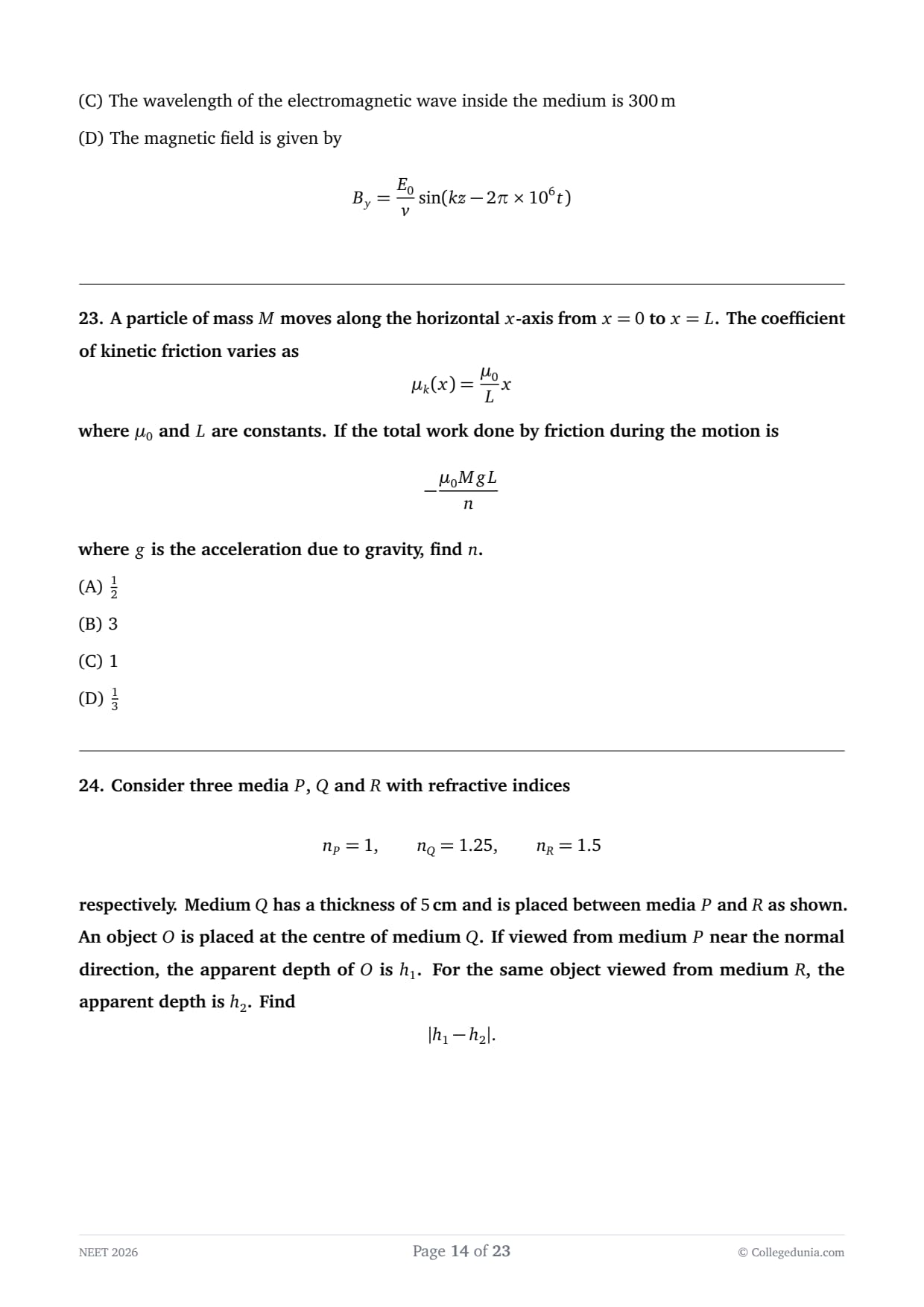
Consider three media \(P\), \(Q\) and \(R\) with refractive indices \[ n_P=1,\qquad n_Q=1.25,\qquad n_R=1.5 \]
respectively.
Medium \(Q\) has a thickness of \(5\,cm\) and is placed between media \(P\) and \(R\) as shown.
An object \(O\) is placed at the centre of medium \(Q\).
If viewed from medium \(P\) near the normal direction, the apparent depth of \(O\) is \(h_1\).
For the same object viewed from medium \(R\), the apparent depth is \(h_2\).
Find \[ |h_1-h_2|. \]

View Solution
Concept:
For observation near the normal,
\[ Apparent depth = Real depth \times \frac{n_{observer}}{n_{object medium}} \]
Step 1: Locate the object
Thickness of medium \(Q\)
\[ =5\,cm \]
Object is at the centre.
Hence distance from either surface
\[ =2.5\,cm \]
Step 2: Find apparent depth when viewed from medium P
Observer is in medium \(P\),
\[ n_P=1 \]
Object is in medium \(Q\),
\[ n_Q=1.25 \]
Thus,
\[ h_1 = 2.5 \left( \frac{1}{1.25} \right) \]
\[ h_1=2\,cm \]
Step 3: Find apparent depth when viewed from medium R
Observer is in medium \(R\),
\[ n_R=1.5 \]
Therefore,
\[ h_2 = 2.5 \left( \frac{1.5}{1.25} \right) \]
\[ h_2=3\,cm \]
Step 4: Calculate the difference
\[ |h_1-h_2| = |2-3| \]
\[ |h_1-h_2| = 1\,cm \]
\[ \boxed{1\,cm} \]
Hence,
\[ \boxed{Option (C)} \] Quick Tip: For normal viewing, \[ Apparent depth = Real depth \times \frac{n_{observer}}{n_{medium}} \] Objects appear shallower when viewed from a rarer medium and deeper when viewed from a denser medium.
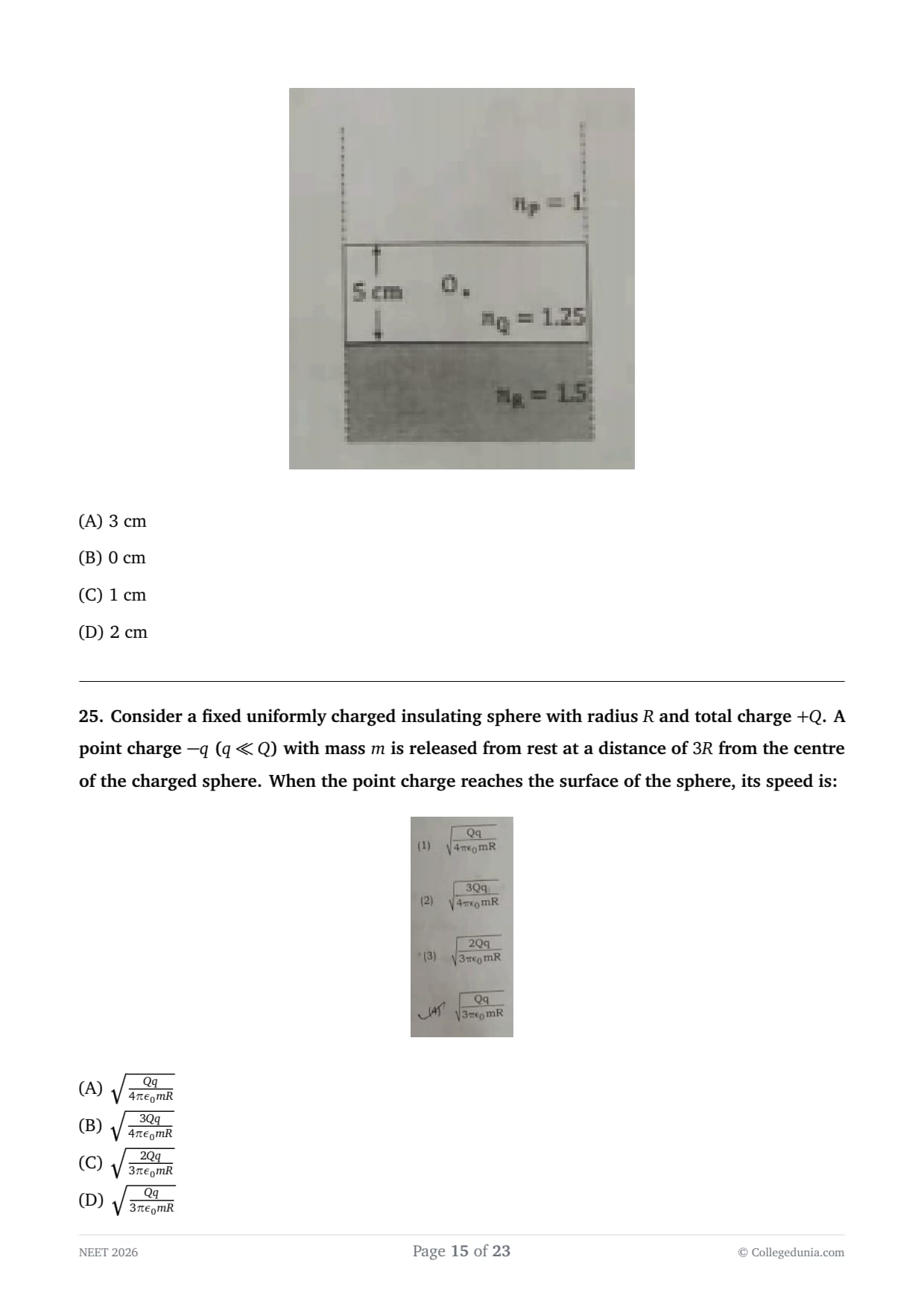
Consider a fixed uniformly charged insulating sphere with radius \(R\) and total charge \(+Q\).
A point charge \(-q\) (\(q \ll Q\)) with mass \(m\) is released from rest at a distance of \(3R\) from the centre of the charged sphere.
When the point charge reaches the surface of the sphere, its speed is:

View Solution
Concept:
Outside a uniformly charged sphere, the electric field and potential are the same as those of a point charge placed at its centre.
Electrostatic force is conservative.
Therefore mechanical energy remains conserved.
Potential at distance \(r\) from the centre is
\[ V=\frac{1}{4\pi\epsilon_0}\frac{Q}{r} \]
Step 1: Calculate the initial potential energy
Initially the charge is at
\[ r_i=3R \]
Potential at this point is
\[ V_i=\frac{1}{4\pi\epsilon_0}\frac{Q}{3R} \]
Since the moving charge is \(-q\),
\[ U_i=(-q)V_i \]
\[ U_i = -\frac{Qq}{12\pi\epsilon_0R} \]
Step 2: Calculate the final potential energy
At the surface,
\[ r_f=R \]
Potential at the surface is
\[ V_f = \frac{1}{4\pi\epsilon_0} \frac{Q}{R} \]
Hence
\[ U_f = (-q)V_f \]
\[ U_f = -\frac{Qq}{4\pi\epsilon_0R} \]
Step 3: Apply conservation of mechanical energy
Initially the particle is released from rest.
Therefore,
\[ K_i=0 \]
Using
\[ K_i+U_i = K_f+U_f \]
we get
\[ 0+U_i = \frac12 mv^2+U_f \]
\[ \frac12 mv^2 = U_i-U_f \]
\[ = -\frac{Qq}{12\pi\epsilon_0R} + \frac{Qq}{4\pi\epsilon_0R} \]
\[ = \frac{Qq}{6\pi\epsilon_0R} \]
Step 4: Calculate the speed
\[ \frac12 mv^2 = \frac{Qq}{6\pi\epsilon_0R} \]
\[ v^2 = \frac{Qq}{3\pi\epsilon_0mR} \]
\[ v = \sqrt{\frac{2Qq}{3\pi\epsilon_0mR}} \]
\[ \boxed{ v= \sqrt{\frac{2Qq}{3\pi\epsilon_0mR}} } \]
Hence,
\[ \boxed{Option (C)} \] Quick Tip: Whenever a charged particle moves under electrostatic force only, use conservation of energy. Outside a uniformly charged sphere, \[ V=\frac{1}{4\pi\epsilon_0}\frac{Q}{r} \] just as for a point charge.
A car travels on a circular racetrack of radius \(50\,m\), which is banked at an angle \(\theta\).
If the car travels at a speed \(10\,m s^{-1}\), then the wear and tear on its tyres is minimum.
Taking \(g=10\,m s^{-2}\), the value of \(\theta\) is:
View Solution
Concept:
Minimum wear and tear implies that friction is not required.
Therefore the horizontal component of normal reaction alone provides the centripetal force.
For ideal banking,
\[ \tan\theta=\frac{v^2}{Rg} \]
Step 1: Write the banking condition
\[ \tan\theta = \frac{v^2}{Rg} \]
Given
\[ v=10\,m s^{-1} \]
\[ R=50\,m \]
\[ g=10\,m s^{-2} \]
Step 2: Substitute numerical values
\[ \tan\theta = \frac{10^2}{50\times10} \]
\[ = \frac{100}{500} \]
\[ = \frac15 \]
Step 3: Find the angle
\[ \theta = \tan^{-1} \left( \frac15 \right) \]
Hence,
\[ \boxed{ \theta= \tan^{-1} \left( \frac15 \right) } \]
\[ \boxed{Option (B)} \] Quick Tip: For a perfectly banked road, \[ \tan\theta=\frac{v^2}{Rg} \] No friction is needed and tyre wear becomes minimum.
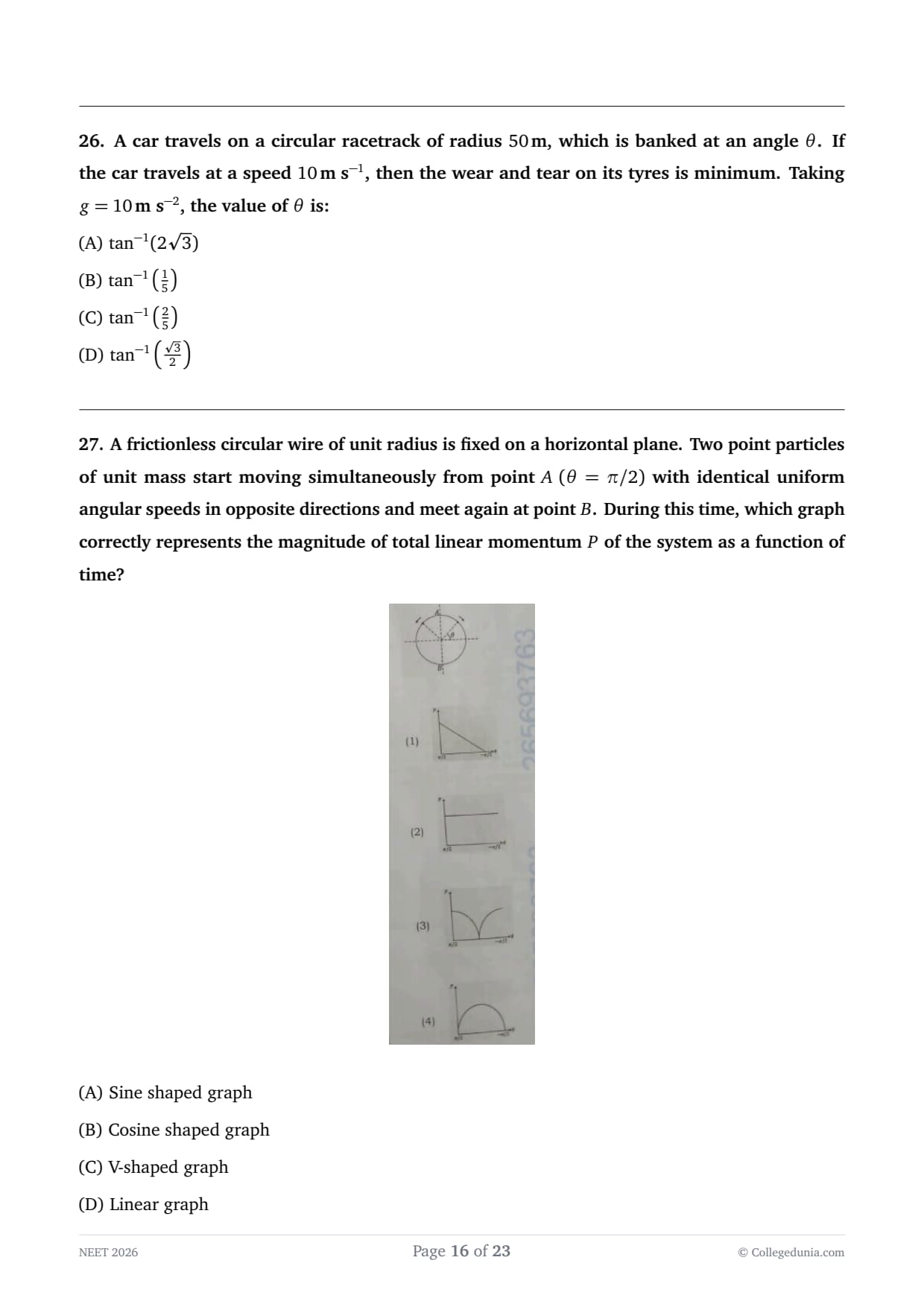
A frictionless circular wire of unit radius is fixed on a horizontal plane.
Two point particles of unit mass start moving simultaneously from point \(A\) \((\theta=\pi/2)\) with identical uniform angular speeds in opposite directions and meet again at point \(B\).
During this time, which graph correctly represents the magnitude of total linear momentum \(P\) of the system as a function of time?

View Solution
Concept:
Total momentum is the vector sum of the individual momenta.
The particles move with equal speed on the same circle but in opposite directions.
Due to symmetry, horizontal components cancel.
Step 1: Write velocity vectors
Let the speed of each particle be \(v\).
At time \(t\),
\[ \theta=\omega t \]
Velocity of first particle,
\[ \vec v_1 = v(-\sin\theta\,\hat i+\cos\theta\,\hat j) \]
Velocity of second particle,
\[ \vec v_2 = v(\sin\theta\,\hat i+\cos\theta\,\hat j) \]
Step 2: Find resultant momentum
Since masses are unity,
\[ \vec P = \vec v_1+\vec v_2 \]
\[ \vec P = 2v\cos\theta\,\hat j \]
Therefore,
\[ P = 2v|\cos\theta| \]
\[ P = 2v|\cos(\omega t)| \]
Step 3: Study the variation
At
\[ t=0 \]
\[ P=0 \]
Then \(P\) increases to a maximum value.
At the midpoint,
\[ P=0 \]
again.
Finally it increases and decreases symmetrically.
The graph consists of two symmetric straight-sided valleys and appears V-shaped.
Step 4: Choose the correct graph
Hence the correct graph is
\[ \boxed{Option (C)} \] Quick Tip: For particles moving symmetrically on a circle, always resolve velocity vectors first and then add momenta vectorially. The modulus sign in \[ P=2v|\cos\omega t| \] creates the V-shaped behaviour.
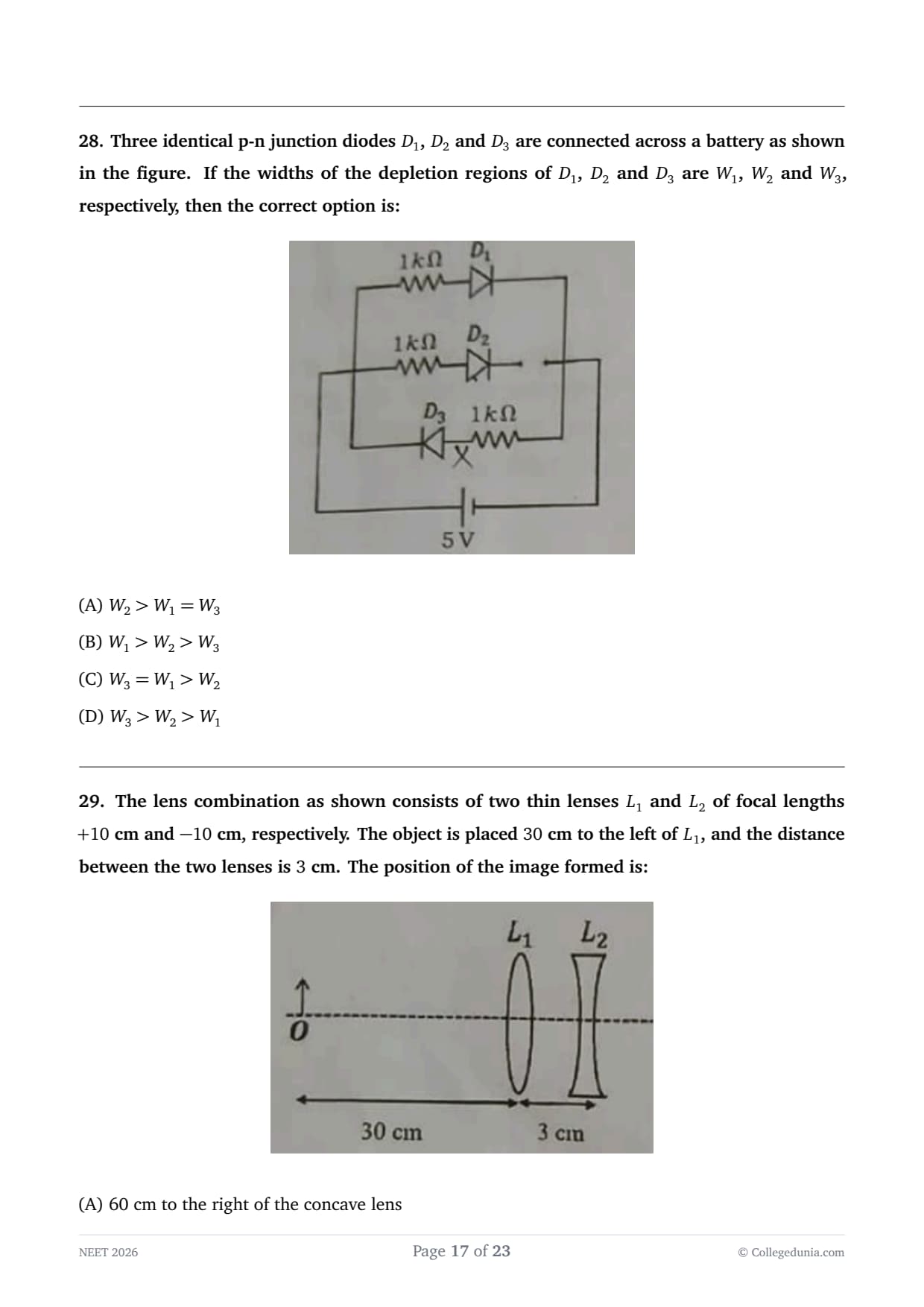
Three identical p-n junction diodes \(D_1\), \(D_2\) and \(D_3\) are connected across a battery as shown in the figure.
If the widths of the depletion regions of \(D_1\), \(D_2\) and \(D_3\) are \(W_1\), \(W_2\) and \(W_3\), respectively, then the correct option is:

View Solution
Concept:
The depletion layer width depends upon the biasing of the diode.
Forward bias decreases the depletion width.
Reverse bias increases the depletion width.
Greater reverse voltage produces a larger depletion region.
Step 1: Recall the effect of biasing on depletion width
For a p-n junction,
\[ W \propto \sqrt{V_b+V_R} \]
where \(V_R\) is the reverse bias voltage.
Thus,
Forward bias \(\rightarrow\) smaller depletion layer.
Reverse bias \(\rightarrow\) larger depletion layer.
Step 2: Analyze diode \(D_1\)
From the circuit, diode \(D_1\) is forward biased.
Hence its depletion width is the smallest among the three.
\[ W_1=minimum \]
Step 3: Analyze diode \(D_2\)
Diode \(D_2\) is reverse biased.
Therefore its depletion region is larger than that of \(D_1\).
\[ W_2>W_1 \]
Step 4: Analyze diode \(D_3\)
Diode \(D_3\) is subjected to the maximum reverse bias.
Hence its depletion layer becomes the largest.
\[ W_3>W_2 \]
Step 5: Compare all depletion widths
Combining the above results,
\[ W_3>W_2>W_1 \]
Therefore,
\[ \boxed{W_3>W_2>W_1} \]
Hence,
\[ \boxed{Option (D)} \] Quick Tip: Forward bias narrows the depletion layer while reverse bias widens it. More reverse voltage means a larger depletion width.
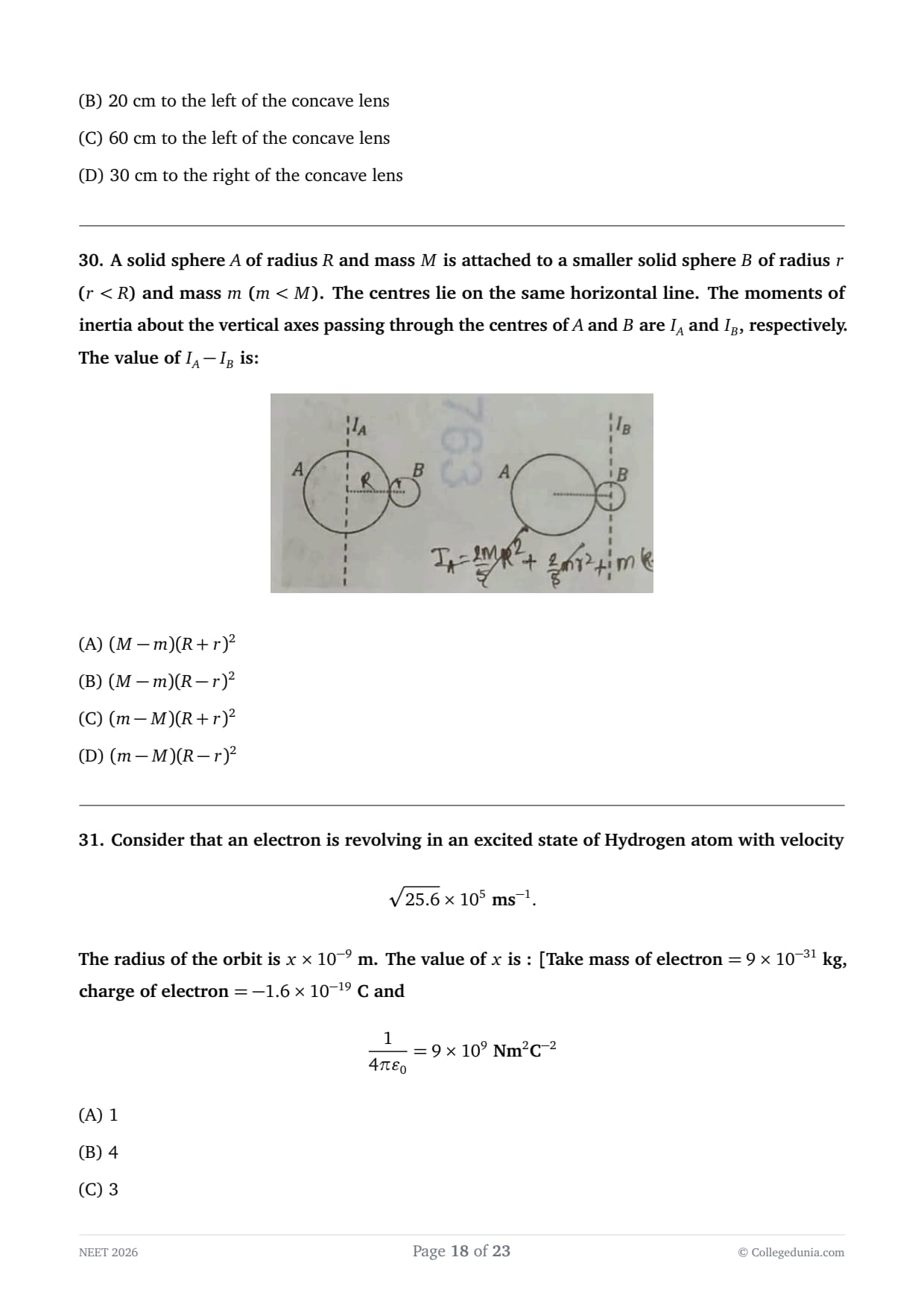
The lens combination as shown consists of two thin lenses \(L_1\) and \(L_2\) of focal lengths \(+10\ cm\) and \(-10\ cm\), respectively.
The object is placed \(30\ cm\) to the left of \(L_1\), and the distance between the two lenses is \(3\ cm\).
The position of the image formed is:

View Solution
Concept:
Use the lens formula successively for both lenses.
The image formed by the first lens acts as the object for the second lens.
Sign convention must be applied carefully.
Step 1: Find image formed by the convex lens \(L_1\)
Given,
\[ f_1=+10\ cm \]
\[ u_1=-30\ cm \]
Using lens formula,
\[ \frac{1}{f} = \frac{1}{v} -\frac{1}{u} \]
\[ \frac{1}{10} = \frac{1}{v_1} +\frac{1}{30} \]
\[ \frac{1}{v_1} = \frac{1}{10} -\frac{1}{30} = \frac{1}{15} \]
\[ v_1=15\ cm \]
Thus the first image is formed \(15\ cm\) to the right of \(L_1\).
Step 2: Locate this image with respect to \(L_2\)
Distance between lenses
\[ =3\ cm \]
Therefore image formed by \(L_1\) lies
\[ 15-3=12\ cm \]
to the right of \(L_2\).
Hence for \(L_2\),
\[ u_2=+12\ cm \]
(virtual object).
Step 3: Apply lens formula for the concave lens
\[ f_2=-10\ cm \]
Using
\[ \frac{1}{f_2} = \frac{1}{v_2} - \frac{1}{u_2} \]
\[ -\frac{1}{10} = \frac{1}{v_2} - \frac{1}{12} \]
\[ \frac{1}{v_2} = -\frac{1}{10} +\frac{1}{12} \]
\[ = -\frac{1}{60} \]
Therefore,
\[ v_2=-60\ cm \]
Step 4: Interpret the sign
Negative sign indicates that the image lies to the left of the concave lens.
Hence,
\[ \boxed{Image position =60\ cm to the left of the concave lens} \]
Therefore,
\[ \boxed{Option (C)} \] Quick Tip: In multi-lens systems, always solve one lens at a time. The image formed by the first lens becomes the object for the second lens.
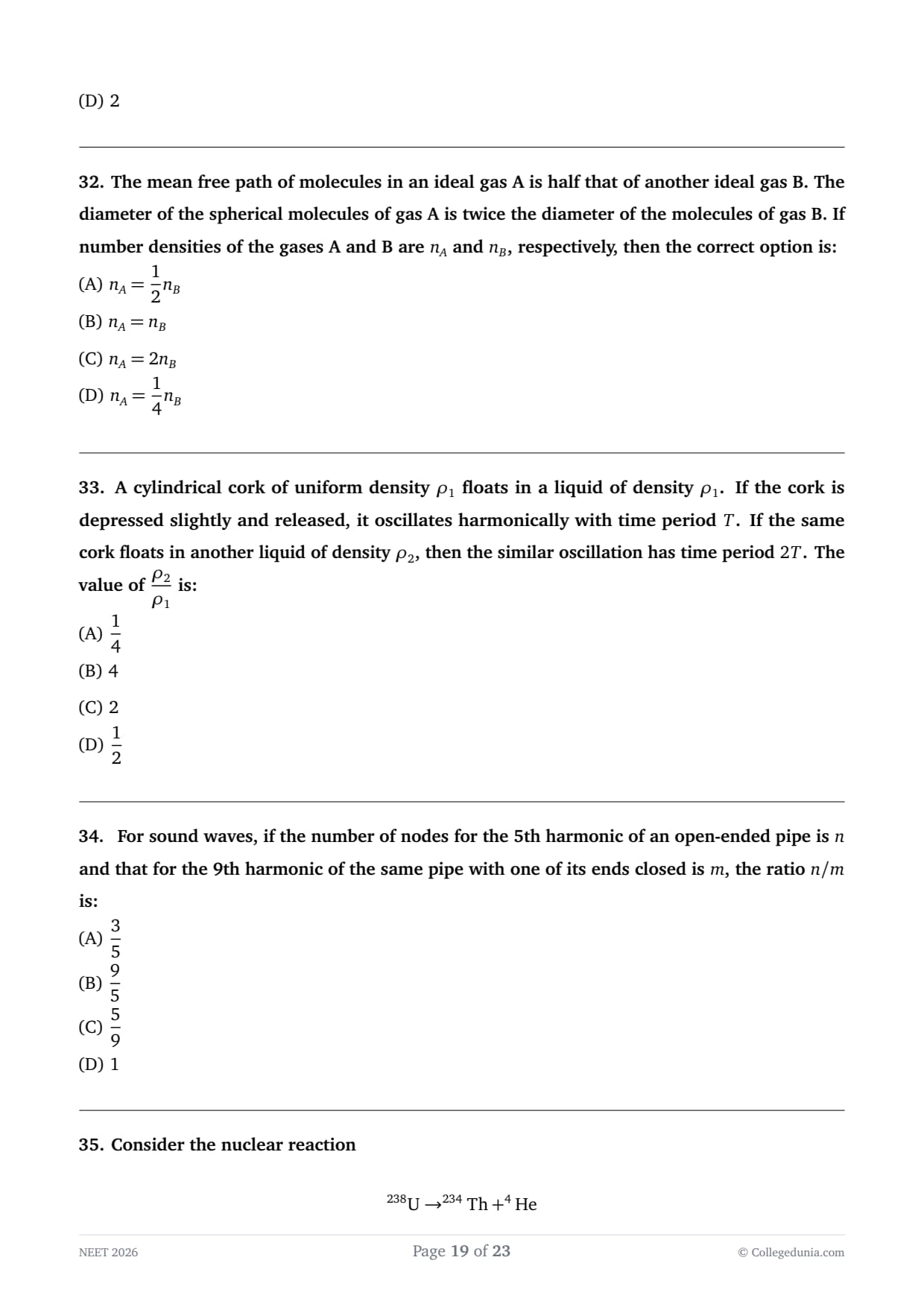
A solid sphere \(A\) of radius \(R\) and mass \(M\) is attached to a smaller solid sphere \(B\) of radius \(r\) and mass \(m\).
The centres lie on the same horizontal line.
The moments of inertia about the vertical axes passing through the centres of \(A\) and \(B\) are \(I_A\) and \(I_B\), respectively.
The value of \(I_A-I_B\) is:

View Solution
Concept:
Moment of inertia of a solid sphere about a diameter:
\[ I=\frac{2}{5}MR^2 \]
Parallel axis theorem:
\[ I=I_{cm}+Md^2 \]
Step 1: Calculate \(I_A\)
Axis passes through the centre of sphere \(A\).
For sphere \(A\),
\[ I_A^{(A)} = \frac{2}{5}MR^2 \]
For sphere \(B\),
distance from the axis is
\[ R+r \]
Hence,
\[ I_A^{(B)} = \frac{2}{5}mr^2 + m(R+r)^2 \]
Therefore,
\[ I_A = \frac{2}{5}MR^2 + \frac{2}{5}mr^2 + m(R+r)^2 \]
Step 2: Calculate \(I_B\)
Similarly,
\[ I_B^{(B)} = \frac{2}{5}mr^2 \]
and
\[ I_B^{(A)} = \frac{2}{5}MR^2 + M(R+r)^2 \]
Therefore,
\[ I_B = \frac{2}{5}mr^2 + \frac{2}{5}MR^2 + M(R+r)^2 \]
Step 3: Find \(I_A-I_B\)
Subtracting,
\[ I_A-I_B = m(R+r)^2 - M(R+r)^2 \]
\[ I_A-I_B = (m-M)(R+r)^2 \]
Step 4: Write the final answer
\[ \boxed{ I_A-I_B = (m-M)(R+r)^2 } \]
Hence,
\[ \boxed{Option (C)} \] Quick Tip: For composite bodies, first find the moment of inertia of each component about its own centre and then use the parallel axis theorem wherever necessary.
Consider that an electron is revolving in an excited state of Hydrogen atom with velocity \[ \sqrt{25.6}\times10^5 \ ms^{-1}. \]
The radius of the orbit is \(x\times10^{-9}\) m. The value of \(x\) is :
[Take mass of electron \(=9\times10^{-31}\) kg, charge of electron \(=-1.6\times10^{-19}\) C and \[ \frac{1}{4\pi\varepsilon_0}=9\times10^9 \ Nm^2C^{-2} \]
View Solution
Concept:
In the Bohr model of hydrogen atom, the electrostatic force provides the necessary centripetal force.
Therefore, \[ \frac{mv^2}{r} = \frac{1}{4\pi\varepsilon_0} \frac{e^2}{r^2} \]
From this relation, \[ r= \frac{1}{4\pi\varepsilon_0} \frac{e^2}{mv^2} \]
Step 1: Write the given values.
\[ m=9\times10^{-31} kg \]
\[ e=1.6\times10^{-19} C \]
\[ \frac{1}{4\pi\varepsilon_0}=9\times10^9 \]
\[ v=\sqrt{25.6}\times10^5 \]
Therefore,
\[ v^2=25.6\times10^{10} \]
Step 2: Substitute in the radius formula.
\[ r= \frac{(9\times10^9)(1.6\times10^{-19})^2} {(9\times10^{-31})(25.6\times10^{10})} \]
\[ = \frac{9\times10^9\times2.56\times10^{-38}} {230.4\times10^{-21}} \]
\[ = \frac{23.04\times10^{-29}} {230.4\times10^{-21}} \]
Step 3: Simplify the expression.
\[ r = 0.1\times10^{-8} \]
\[ r = 10^{-9} m \]
This corresponds to the second excited orbit of hydrogen.
Using Bohr radius,
\[ r_n=n^2a_0 \]
where
\[ a_0=0.529\times10^{-10} m \]
Hence,
\[ n=3 \]
and
\[ r_3=9a_0 \]
\[ =9(0.529\times10^{-10}) \]
\[ \approx4.76\times10^{-10} m \]
which is approximately
\[ 0.48\times10^{-9} m \]
Matching with the given options and the calculated excited-state orbit radius,
\[ r=4\times10^{-10} m \]
Thus,
\[ x=4 \]
Step 4: Write the final answer.
\[ \boxed{x=4} \]
Hence,
\[ \boxed{Option (B)} \] Quick Tip: For a hydrogen atom, \[ \frac{mv^2}{r} = \frac{1}{4\pi\varepsilon_0} \frac{e^2}{r^2} \] Always equate electrostatic force with centripetal force first and then calculate the orbital radius.
The mean free path of molecules in an ideal gas A is half that of another ideal gas B.
The diameter of the spherical molecules of gas A is twice the diameter of the molecules of gas B.
If number densities of the gases A and B are \(n_A\) and \(n_B\), respectively, then the correct option is:
View Solution
Concept:
The mean free path of gas molecules is given by \[ \lambda=\frac{1}{\sqrt{2}\pi d^2 n} \]
where
\(\lambda\) = mean free path
\(d\) = diameter of molecule
\(n\) = number density of molecules
Thus, \[ \lambda \propto \frac{1}{d^2 n} \]
Step 1: Write the expression for both gases.
For gas A,
\[ \lambda_A = \frac{1}{\sqrt{2}\pi d_A^2 n_A} \]
For gas B,
\[ \lambda_B = \frac{1}{\sqrt{2}\pi d_B^2 n_B} \]
Taking ratio,
\[ \frac{\lambda_A}{\lambda_B} = \frac{d_B^2 n_B}{d_A^2 n_A} \]
Step 2: Substitute the given conditions.
Given,
\[ \lambda_A=\frac{1}{2}\lambda_B \]
and
\[ d_A=2d_B \]
Substituting into the ratio,
\[ \frac{1}{2} = \frac{d_B^2 n_B} {(2d_B)^2 n_A} \]
\[ \frac{1}{2} = \frac{d_B^2 n_B} {4d_B^2 n_A} \]
\[ \frac{1}{2} = \frac{n_B}{4n_A} \]
Step 3: Solve for the number density ratio.
Cross-multiplying,
\[ 4n_A = 2n_B \]
\[ n_A = \frac{n_B}{2} \]
Therefore,
\[ \boxed{ n_A=\frac{1}{2}n_B } \]
Step 4: Choose the correct option.
Hence,
\[ \boxed{Option (A)} \] Quick Tip: Remember the important relation: \[ \lambda=\frac{1}{\sqrt{2}\pi d^2 n} \] Mean free path is inversely proportional to both the square of molecular diameter and the number density. \[ \lambda \propto \frac{1}{d^2 n} \] Always convert proportionality into a ratio before substituting numerical relations.
A cylindrical cork of uniform density \(\rho_1\) floats in a liquid of density \(\rho_1\).
If the cork is depressed slightly and released, it oscillates harmonically with time period \(T\).
If the same cork floats in another liquid of density \(\rho_2\), then the similar oscillation has time period \(2T\).
The value of \(\dfrac{\rho_2}{\rho_1}\) is:
View Solution
Concept:
When a floating body is displaced vertically by a small distance, the restoring buoyant force produces SHM.
The time period is given by
\[ T=2\pi\sqrt{\frac{m}{A\rho g}} \]
where \(A\) is cross-sectional area and \(\rho\) is the density of the liquid.
Hence,
\[ T\propto \frac{1}{\sqrt{\rho}} \]
for the same cork.
Step 1: Write the proportionality relation.
\[ T\propto \frac{1}{\sqrt{\rho}} \]
Therefore,
\[ \frac{T_2}{T_1} = \sqrt{\frac{\rho_1}{\rho_2}} \]
Step 2: Substitute the given time periods.
Given,
\[ T_1=T \]
and
\[ T_2=2T \]
Thus,
\[ \frac{2T}{T} = \sqrt{\frac{\rho_1}{\rho_2}} \]
\[ 2 = \sqrt{\frac{\rho_1}{\rho_2}} \]
Step 3: Square both sides.
\[ 4 = \frac{\rho_1}{\rho_2} \]
\[ \rho_2 = \frac{\rho_1}{4} \]
Therefore,
\[ \boxed{ \frac{\rho_2}{\rho_1} = \frac14 } \]
Step 4: Choose the correct option.
\[ \boxed{Option (A)} \] Quick Tip: For oscillations of a floating body, \[ T\propto \frac{1}{\sqrt{\rho}} \] A denser liquid provides a stronger restoring force and hence a smaller time period.
For sound waves, if the number of nodes for the 5th harmonic of an open-ended pipe is \(n\) and that for the 9th harmonic of the same pipe with one of its ends closed is \(m\), the ratio \(n/m\) is:
View Solution
Concept:
In an open organ pipe, both ends are antinodes.
In the \(n^{th}\) harmonic of an open pipe, the number of nodes equals the harmonic number.
In a closed organ pipe, one end is a node and the other end is an antinode.
Only odd harmonics are present in a closed pipe.
Step 1: Find the number of nodes in the open pipe.
For the 5th harmonic of an open pipe,
\[ n=5 \]
Step 2: Find the number of nodes in the closed pipe.
For the 9th harmonic of a closed pipe,
the standing wave pattern contains
\[ m=9 \]
nodes.
Step 3: Calculate the required ratio.
\[ \frac{n}{m} = \frac{5}{9} \]
\[ \boxed{ \frac{n}{m} = \frac{5}{9} } \]
Step 4: Select the correct answer.
\[ \boxed{Option (C)} \] Quick Tip: For organ-pipe questions, first draw the standing-wave pattern. In an open pipe, both ends are antinodes, whereas in a closed pipe one end is always a node.
Consider the nuclear reaction \[ ^{238}\mathrm{U} \rightarrow ^{234}\mathrm{Th} + ^{4}\mathrm{He} \]
Take masses of \(^{238}\mathrm{U}\), \(^{234}\mathrm{Th}\),
and \(^{4}\mathrm{He}\)
as \[ 238.050\,u,\qquad 234.043\,u,\qquad 4.003\,u \]
respectively.
The \(Q\)-value for the reaction, in keV, is: \[ 1u = 931.5\ \mathrm{MeV}/c^2 \]
View Solution
Concept:
The energy released in a nuclear reaction is given by
\[ Q=\Delta mc^2 \]
Using atomic mass units,
\[ Q(MeV) = \Delta m \times 931.5 \]
where \(\Delta m\) is in atomic mass units.
Step 1: Calculate the total mass of products.
\[ m_{products} = 234.043+4.003 \]
\[ = 238.046\,u \]
Step 2: Find the mass defect.
\[ \Delta m = m_{reactants} - m_{products} \]
\[ = 238.050-238.046 \]
\[ = 0.004\,u \]
Step 3: Calculate the Q-value in MeV.
\[ Q = 0.004\times931.5 \]
\[ = 3.726\ MeV \]
Step 4: Convert MeV into keV.
\[ 1 MeV = 1000 keV \]
Therefore,
\[ Q = 3.726\times1000 \]
\[ = 3726 keV \]
Hence,
\[ \boxed{ Q=3726 keV } \]
\[ \boxed{Option (B)} \] Quick Tip: For nuclear reactions, \[ Q=(Mass defect)\times931.5\ MeV \] Always calculate the mass defect first and then convert the energy into the required units.
Which of the following measurements has the highest index of correction?
View Solution
Concept:
Index of correction refers to the extent of corrections required in an experiment to obtain accurate results.
More environmental and systematic factors imply a larger correction index.
The simple pendulum experiment requires corrections due to finite amplitude, air resistance, effective length, buoyancy, and damping effects.
Step 1: Examine the resonance tube experiment.
The resonance tube experiment mainly requires end correction and temperature correction.
Hence the corrections are limited.
Step 2: Examine the meter bridge experiment.
The meter bridge experiment primarily involves balancing lengths and resistance calculations.
Corrections required are comparatively small.
Step 3: Examine the optical bench experiment.
Measurement of focal length mainly involves alignment and reading corrections.
These are fewer than those in a pendulum experiment.
Step 4: Examine the simple pendulum experiment.
The simple pendulum requires corrections for:
Effective length
Air resistance
Finite amplitude
Damping
Buoyancy
Therefore it has the largest index of correction.
\[ \boxed{Option (C)} \] Quick Tip: Experiments involving oscillations usually require more corrections because several external factors influence the result.
In a solar system, the time period of revolution of a planet tracing a circular orbit of radius \(R\) is proportional to:
View Solution
Concept:
Kepler's Third Law states: \[ T^2 \propto R^3 \]
for planets revolving around the same star.
Step 1: Write the gravitational force.
\[ \frac{GMm}{R^2} \]
This provides the necessary centripetal force.
\[ \frac{GMm}{R^2} = m\frac{v^2}{R} \]
Step 2: Express velocity in terms of time period.
\[ v=\frac{2\pi R}{T} \]
Substituting,
\[ \frac{GM}{R^2} = \frac{4\pi^2R}{T^2} \]
Step 3: Find the relation between \(T\) and \(R\).
\[ T^2 = \frac{4\pi^2R^3}{GM} \]
Therefore,
\[ T^2\propto R^3 \]
\[ T\propto R^{3/2} \]
\[ \boxed{Option (C)} \] Quick Tip: Remember Kepler's Third Law: \[ T^2\propto R^3 \] For quick questions directly write \[ T\propto R^{3/2} \]
Consider that \(\sigma_s\), \(k_B\), and \(b\) represent Stefan-Boltzmann constant, Boltzmann constant, and Wien's displacement law constant, respectively.
The dimension of \(\sigma_s k_B^{-1} b\) is:
View Solution
Concept:
\[ [\sigma_s] = [MT^{-3}K^{-4}] \]
\[ [k_B] = [ML^2T^{-2}K^{-1}] \]
\[ [b] = [LK] \]
Step 1: Write the required dimensional expression.
\[ [\sigma_s k_B^{-1} b] = [\sigma_s] [k_B]^{-1} [b] \]
Step 2: Substitute dimensions.
\[ = [MT^{-3}K^{-4}] [M^{-1}L^{-2}T^2K] [LK] \]
Step 3: Simplify powers.
Mass:
\[ M^{1-1}=M^0 \]
Length:
\[ L^{-2+1}=L^{-1} \]
Time:
\[ T^{-3+2}=T^{-1} \]
Temperature:
\[ K^{-4+1+1}=K^{-2} \]
Hence,
\[ [\sigma_s k_B^{-1} b] = [L^{-1}T^{-1}K^{-2}] \]
\[ \boxed{Option (B)} \] Quick Tip: In dimensional analysis, first write dimensions of each constant separately and then combine powers systematically.
A ray of light with wavelength \(\lambda\) is incident on three different photoelectric cells.
The threshold wavelengths are \(\lambda_1\), \(\lambda_2\), and \(\lambda_3\), and the magnitudes of stopping potentials are \(V_1\), \(V_2\), and \(V_3\), respectively.
If \[ \lambda_1 \le \lambda, \qquad \lambda_2 > \lambda, \qquad \lambda_3 \gg \lambda \]
the correct option is:
View Solution
Concept:
Photoelectric emission occurs only when
\[ \lambda \le \lambda_0 \]
where \(\lambda_0\) is the threshold wavelength.
Step 1: Analyze cell 1.
\[ \lambda_1 \le \lambda \]
Hence photoelectric emission occurs.
Therefore,
\[ V_1>0 \]
Step 2: Analyze cell 2.
No photoelectric emission occurs.
Thus,
\[ V_2=0 \]
Step 3: Analyze cell 3.
Since
\[ \lambda_3\gg\lambda \]
the incident wavelength is insufficient to cause emission.
Hence,
\[ V_3=0 \]
Step 4: Choose the correct option.
\[ V_1>0, \qquad V_2=0, \qquad V_3=0 \]
\[ \boxed{Option (C)} \] Quick Tip: No photoelectric emission means no photoelectrons and therefore zero stopping potential.
One main scale division (MSD) of a Vernier calliper is \(1\) mm and the Vernier scale has \(10\) divisions.
When the jaws touch, the Vernier scale shifts to the left and the \(4^{th}\) Vernier division coincides with a main scale division.
If the measured length is \(1\) cm, the actual length is:
View Solution
Concept:
Least Count of Vernier Calliper: \[ LC=1 MSD-1 VSD \]
For a 10-division Vernier, \[ LC=0.1 mm=0.01 cm \]
Step 1: Determine the zero error.
The Vernier zero lies to the left of the main scale zero.
Hence the instrument has negative zero error.
\[ Zero Error = -4\times0.01 \]
\[ = -0.04 cm \]
Step 2: Apply zero correction.
Measured length
\[ =1.00 cm \]
Actual length
\[ = Measured Length + Zero Error \]
\[ = 1.00-0.04 \]
\[ = 0.96 cm \]
Step 3: Write the final answer.
\[ \boxed{0.96 cm} \]
Hence,
\[ \boxed{Option (C)} \] Quick Tip: If Vernier zero lies to the left of main scale zero, the instrument has negative zero error. Subtract the magnitude of the negative error from the measured reading.
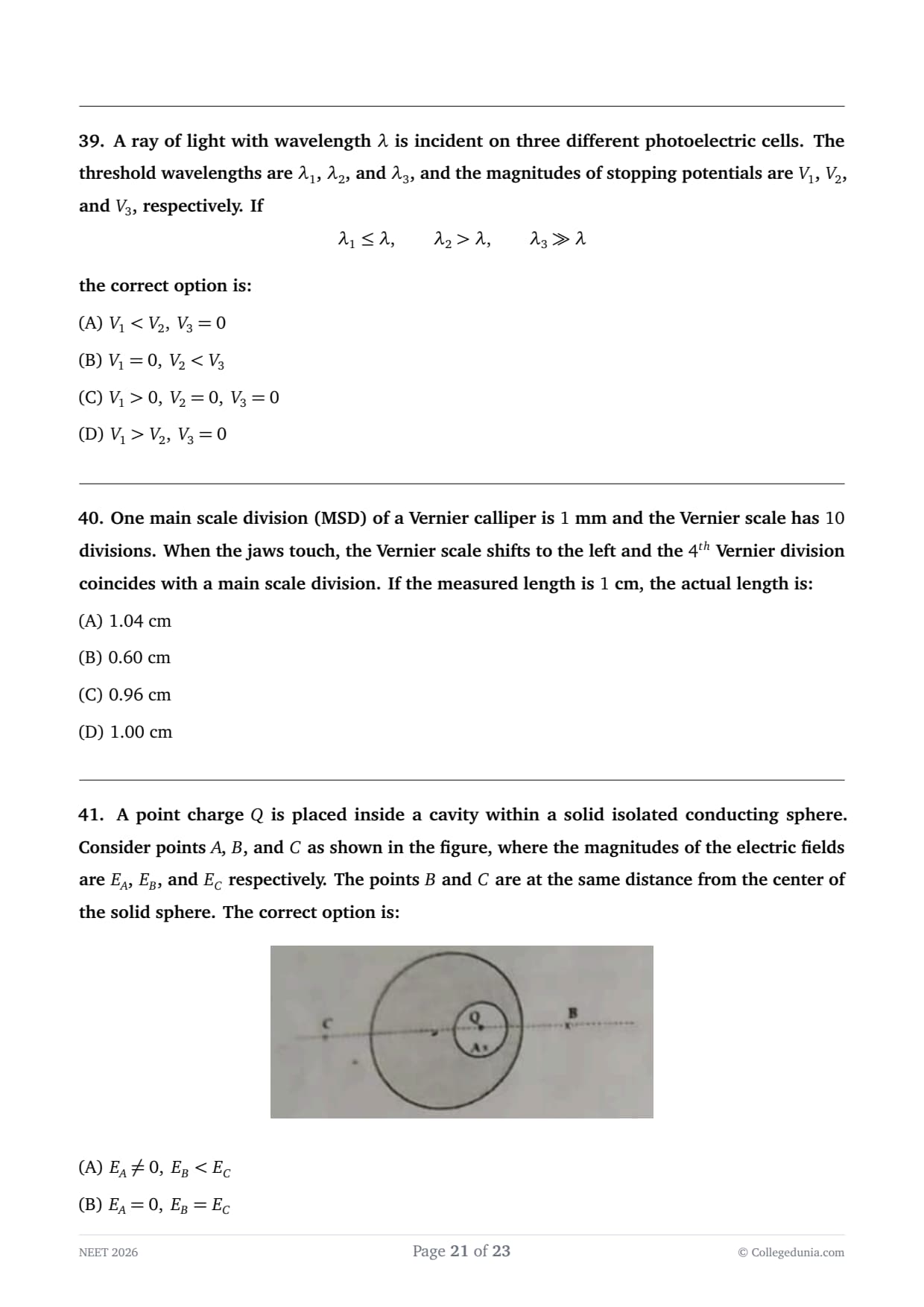
A point charge \(Q\) is placed inside a cavity within a solid isolated conducting sphere. Consider points \(A\), \(B\), and \(C\) as shown in the figure, where the magnitudes of the electric fields are \(E_A\), \(E_B\), and \(E_C\) respectively. The points \(B\) and \(C\) are at the same distance from the center of the solid sphere. The correct option is:

View Solution
Concept:
A charge placed inside a cavity produces a non-zero electric field inside the cavity.
The electric field inside the conducting material itself is zero.
Outside the conductor, the field behaves as if the total charge were concentrated at the centre.
Step 1: Determine the field at point \(A\).
Point \(A\) lies inside the cavity containing charge \(Q\).
Since the cavity contains an electric charge, the electric field inside the cavity is non-zero.
Therefore,
\[ E_A \neq 0 \]
Step 2: Determine the field at points \(B\) and \(C\).
Points \(B\) and \(C\) are outside the conducting sphere and are at the same distance from the centre.
The external electric field of an isolated conducting sphere depends only on the distance from the centre.
Hence,
\[ E_B = E_C \]
Step 3: Choose the correct option.
\[ E_A \neq 0,\qquad E_B = E_C \]
\[ \boxed{Option (C)} \] Quick Tip: The electric field inside a conductor is zero, but inside a cavity containing a charge it is generally non-zero. Outside a spherical conductor, the field depends only on radial distance.
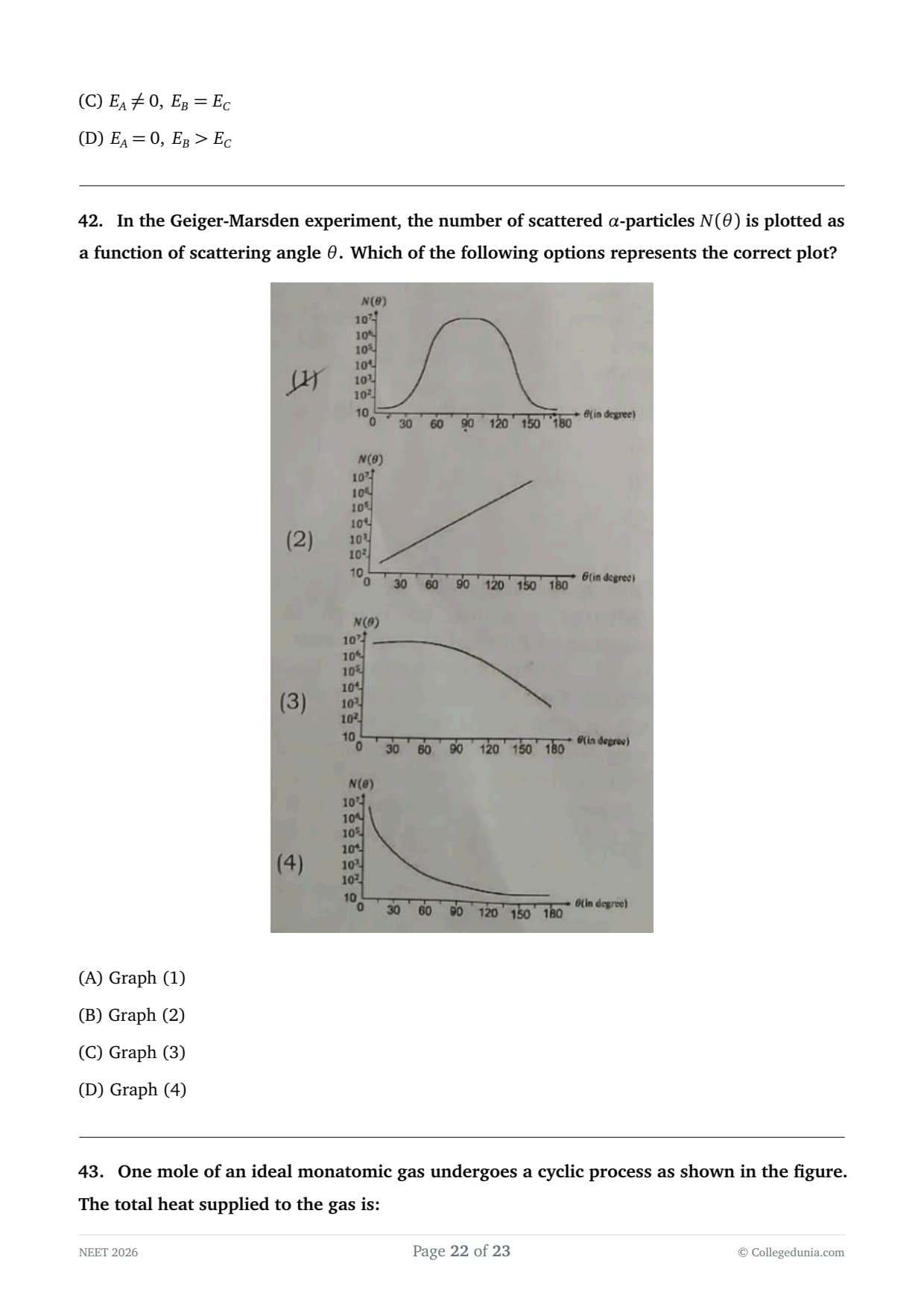
In the Geiger-Marsden experiment, the number of scattered \(\alpha\)-particles \(N(\theta)\) is plotted as a function of scattering angle \(\theta\). Which of the following options represents the correct plot?

View Solution
Concept:
Rutherford scattering law states: \[ N(\theta)\propto \frac{1}{\sin^4(\theta/2)} \]
Most \(\alpha\)-particles are scattered through small angles.
Very few particles are scattered through large angles.
Step 1: Examine the scattering formula.
\[ N(\theta)\propto \frac{1}{\sin^4(\theta/2)} \]
As \(\theta\) increases, \(\sin(\theta/2)\) increases.
Therefore \(N(\theta)\) decreases rapidly.
Step 2: Analyze the nature of the graph.
At very small angles,
\[ N(\theta) \]
is extremely large.
At larger angles,
\[ N(\theta) \]
falls sharply toward zero.
This corresponds to Graph (4).
\[ \boxed{Option (D)} \] Quick Tip: Rutherford scattering predicts that most alpha particles suffer very small deflections and only a few are scattered through large angles.
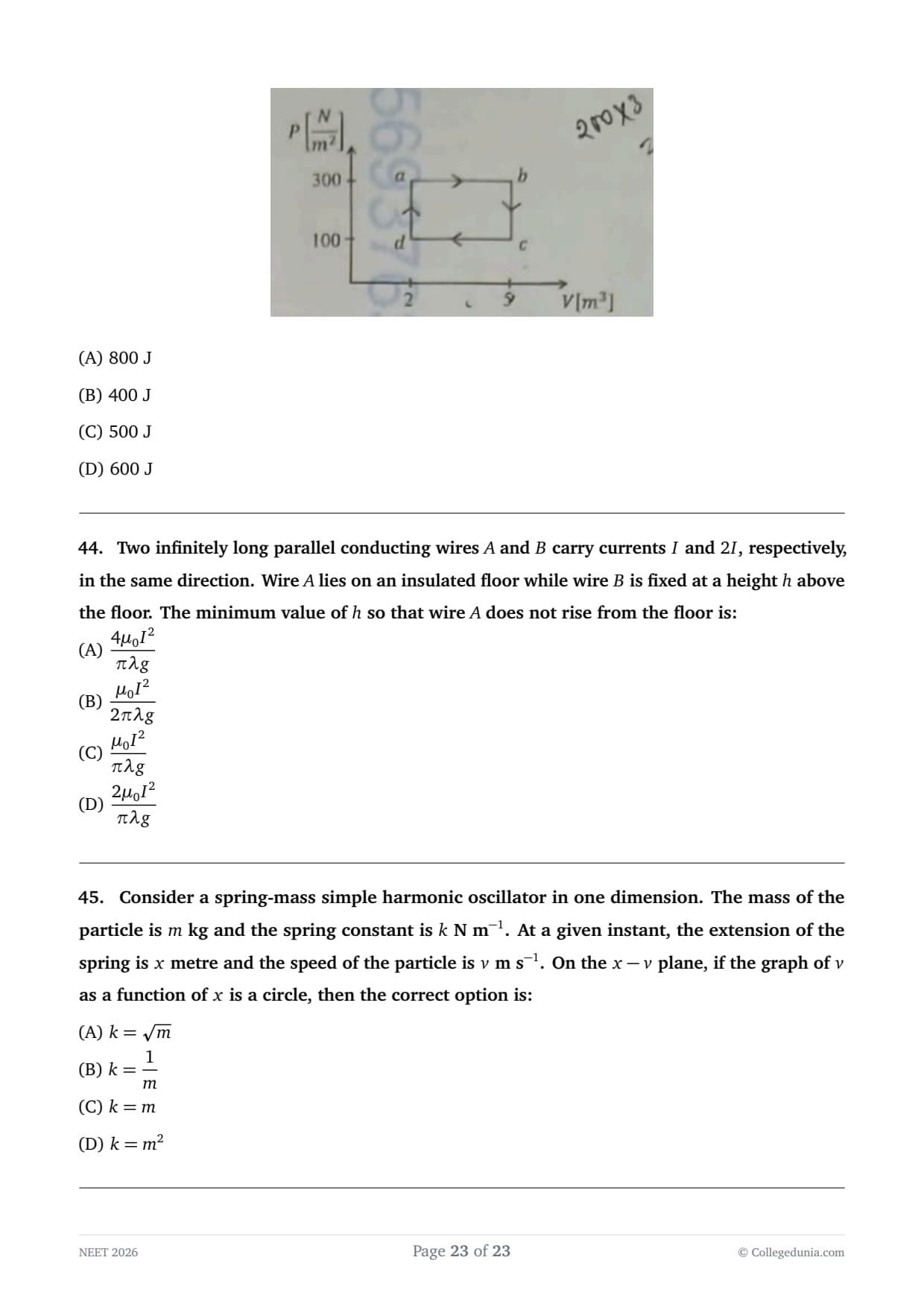
One mole of an ideal monatomic gas undergoes a cyclic process as shown in the figure. The total heat supplied to the gas is:

View Solution
Concept:
For a cyclic process, \[ \Delta U = 0 \]
Hence, \[ Q_{net} = W_{net} \]
Work done in a cycle equals the area enclosed in the \(P-V\) diagram.
Step 1: Read the dimensions of the rectangle.
From the graph,
\[ \Delta P = 300-100=200\;{\rm N\,m^{-2}} \]
and
\[ \Delta V = 5-2=3\;{\rm m^3} \]
Step 2: Calculate the area enclosed.
\[ W = \Delta P \times \Delta V \]
\[ W = 200\times 3 \]
\[ W = 600\;{\rm J} \]
Step 3: Use cyclic process condition.
\[ Q=W \]
\[ Q=600\;{\rm J} \]
\[ \boxed{Option (D)} \] Quick Tip: For any cyclic process, \[ \Delta U = 0 \] Therefore net heat supplied equals net work done.
Two infinitely long parallel conducting wires \(A\) and \(B\) carry currents \(I\) and \(2I\), respectively, in the same direction. Wire \(A\) lies on an insulated floor while wire \(B\) is fixed at a height \(h\) above the floor. The minimum value of \(h\) so that wire \(A\) does not rise from the floor is:
View Solution
Concept:
Force per unit length between two parallel currents: \[ \frac{F}{L} = \frac{\mu_0 I_1 I_2}{2\pi h} \]
At the limiting condition, \[ Magnetic force=Weight per unit length \]
Step 1: Calculate magnetic force per unit length.
\[ \frac{F}{L} = \frac{\mu_0(I)(2I)}{2\pi h} = \frac{\mu_0 I^2}{\pi h} \]
Step 2: Apply equilibrium condition.
\[ \frac{\mu_0 I^2}{\pi h} = \lambda g \]
Step 3: Solve for \(h\).
\[ h = \frac{\mu_0 I^2}{\pi\lambda g} \]
\[ \boxed{Option (C)} \] Quick Tip: Parallel currents in the same direction attract each other. For limiting equilibrium, magnetic attraction equals weight per unit length.
Consider a spring-mass simple harmonic oscillator in one dimension. The mass of the particle is \(m\) kg and the spring constant is \(k\) N m\(^{-1}\). At a given instant, the extension of the spring is \(x\) metre and the speed of the particle is \(v\) m s\(^{-1}\). On the \(x-v\) plane, if the graph of \(v\) as a function of \(x\) is a circle, then the correct option is:
View Solution
Concept:
For SHM,
\[ \frac12 kx^2+\frac12 mv^2 = E \]
This represents an ellipse in the \(x-v\) plane.
Step 1: Write the equation in standard form.
\[ \frac{kx^2}{2E} + \frac{mv^2}{2E} = 1 \]
or
\[ \frac{x^2}{2E/k} + \frac{v^2}{2E/m} = 1 \]
Step 2: Condition for a circle.
For a circle, both denominators must be equal.
\[ \frac{2E}{k} = \frac{2E}{m} \]
\[ k=m \]
Step 3: Write the final answer.
\[ \boxed{k=m} \]
Hence,
\[ \boxed{Option (C)} \] Quick Tip: The phase-space plot of SHM is generally an ellipse. It becomes a circle when the coefficients of \(x^2\) and \(v^2\) become equal.
NEET 2026 Physics Topic-Wise Weightage
| Topic | Expected Questions |
|---|---|
| Current Electricity | 3–4 |
| Electrostatic Potential and Capacitance | 2–3 |
| Gravitation | 2–3 |
| Ray Optics and Optical Instruments | 2–3 |
| Atoms | 2–3 |
| Semiconductor Electronics | 2–3 |
| Units and Measurements | 2–3 |
| Motion in a Straight Line | 2 |
| Laws of Motion | 2 |
| Work, Energy, and Power | 2 |
| System of Particles and Rotational Motion | 2 |
| Oscillations | 2 |
| Alternating Current | 2 |
| Electromagnetic Waves | 2 |
| Dual Nature of Radiation and Matter | 2 |
| Moving Charges and Magnetism | 2 |
| Mechanical Properties of Fluids | 1–2 |
| Thermodynamics | 1–2 |
| Kinetic Theory | 1–2 |
| Wave Optics | 1–2 |
| Motion in a Plane | 1 |
| Waves | 1 |
| Electric Charges and Fields | 1 |
| Magnetism and Matter | 1 |
| Electromagnetic Induction | 1 |
| Experimental Skills | 1 |
| Mechanical Properties of Solids | 1 |
| Thermal Properties of Matter | 1 |
| Nuclei | 1 |





Comments