Re-NEET 2026 Botany Question Paper is available here. NTA conducted NEET 2026 re-exam on 21 June in single shift from 2 PM to 5:15 PM. NEET Re-Test question question paper consists of 180 questions for 720 marks to be attempted in 3 hours and 15 minutes.

  • NEET Botany Question Paper 2026 consists of 45 questions for 180 marks.
  • Each correct answer carries 4 marks and incorrect answer has a negative marking of 1.

Candidates can download NEET 2026 Re-Exam Botany Question Paper with Answer Key and Solution PDF from the links provided below

Re-NEET 2026 Botany Question Paper with Solution PDF

NEET Re-Exam Botany Question Paper 2026 Download PDF Check Solution

Question 1:

Given below are two statements :

Statement I : The class name Reptilia refers to creeping or crawling mode of locomotion.

Statement II : All organisms belonging to Reptilia have three chambered heart.

In the light of the above statements, choose the most appropriate answer from the options given below :

  • (1) Statement I is incorrect but Statement II is correct
  • (2) Both Statement I and Statement II are correct
  • (3) Both Statement I and Statement II are incorrect
  • (4) Statement I is correct but Statement II is incorrect

Question 2:

How many turns of Calvin cycle are required for the formation of three molecules of glucose?

  • (1) 18
  • (2) 6
  • (3) 3
  • (4) 1

Question 3:

Photorespiration reaction catalyzed by RuBisCO is shown below :
\[ RuBP + O_2 \rightarrow 3-Phosphoglycerate + X \]
Identify "X" from the given options :

  • (1) Malate
  • (2) Phosphoenolpyruvate
  • (3) 2-Phosphoglycolate
  • (4) Oxaloacetate

Question 4:

Given below are two statements :

Statement I : In gymnosperms, the male and female gametophytes remain within the sporangia.

Statement II : In gymnosperms, the seeds are not covered.

In the light of the above statements, choose the most appropriate answer from the options given below :

  • (1) Statement I is incorrect but Statement II is correct
  • (2) Both Statement I and Statement II are correct
  • (3) Both Statement I and Statement II are incorrect
  • (4) Statement I is correct but Statement II is incorrect

Question 5:

How many molecules of pyruvic acid are produced at the end of glycolysis from 206 molecules of glucose?

  • (1) 412
  • (2) 206
  • (3) 309
  • (4) 103

Question 6:

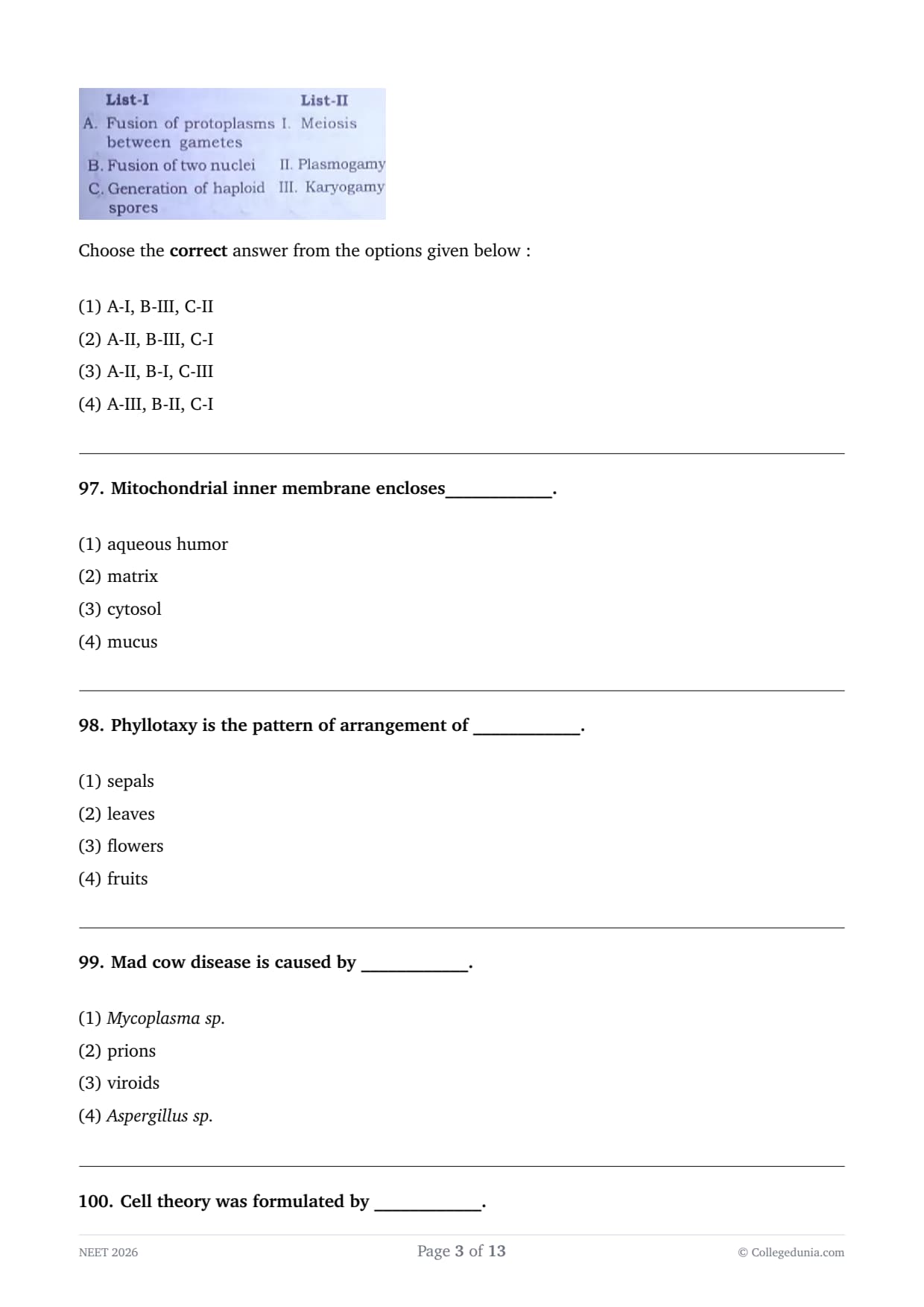
Match List-I with List-II.


Choose the correct answer from the options given below :

  • (1) A-I, B-III, C-II
  • (2) A-II, B-III, C-I
  • (3) A-II, B-I, C-III
  • (4) A-III, B-II, C-I

Question 7:

Mitochondrial inner membrane encloses____________.

  • (1) aqueous humor
  • (2) matrix
  • (3) cytosol
  • (4) mucus

Question 8:

Phyllotaxy is the pattern of arrangement of ____________.

  • (1) sepals
  • (2) leaves
  • (3) flowers
  • (4) fruits

Question 9:

Mad cow disease is caused by ____________.

  • (1) Mycoplasma sp.
  • (2) prions
  • (3) viroids
  • (4) Aspergillus sp.

Question 10:

Cell theory was formulated by ____________.

  • (1) Antonie Von Leeuwenhoek
  • (2) Schleiden and Schwann
  • (3) Robert Brown
  • (4) Singer and Nicolson

Question 11:

Which of the following plant growth regulators promotes internode elongation prior to flowering in cabbage ?

  • (1) Ethephon
  • (2) Abscisic acid
  • (3) Gibberellin
  • (4) Indole butyric acid

Question 12:

Which pigment has absorption peak at 700 nm in the photosynthetic reaction centre PS I (P700) ?

  • (1) Carotenoids
  • (2) Chlorophyll b
  • (3) Chlorophyll a
  • (4) Xanthophylls

Question 13:

Sphenopsida class belongs to ____________.

  • (1) pteridophytes
  • (2) bryophytes
  • (3) angiosperms
  • (4) gymnosperms

Question 14:

Which of the following represents the correct sequence of arrangement of bones in the lower limb of humans ?

  • (1) Femur-tarsal-patella-tibia
  • (2) Femur-tibia-patella-tarsal
  • (3) Patella-femur-tibia-tarsal
  • (4) Femur-patella-tibia-tarsal

Question 15:

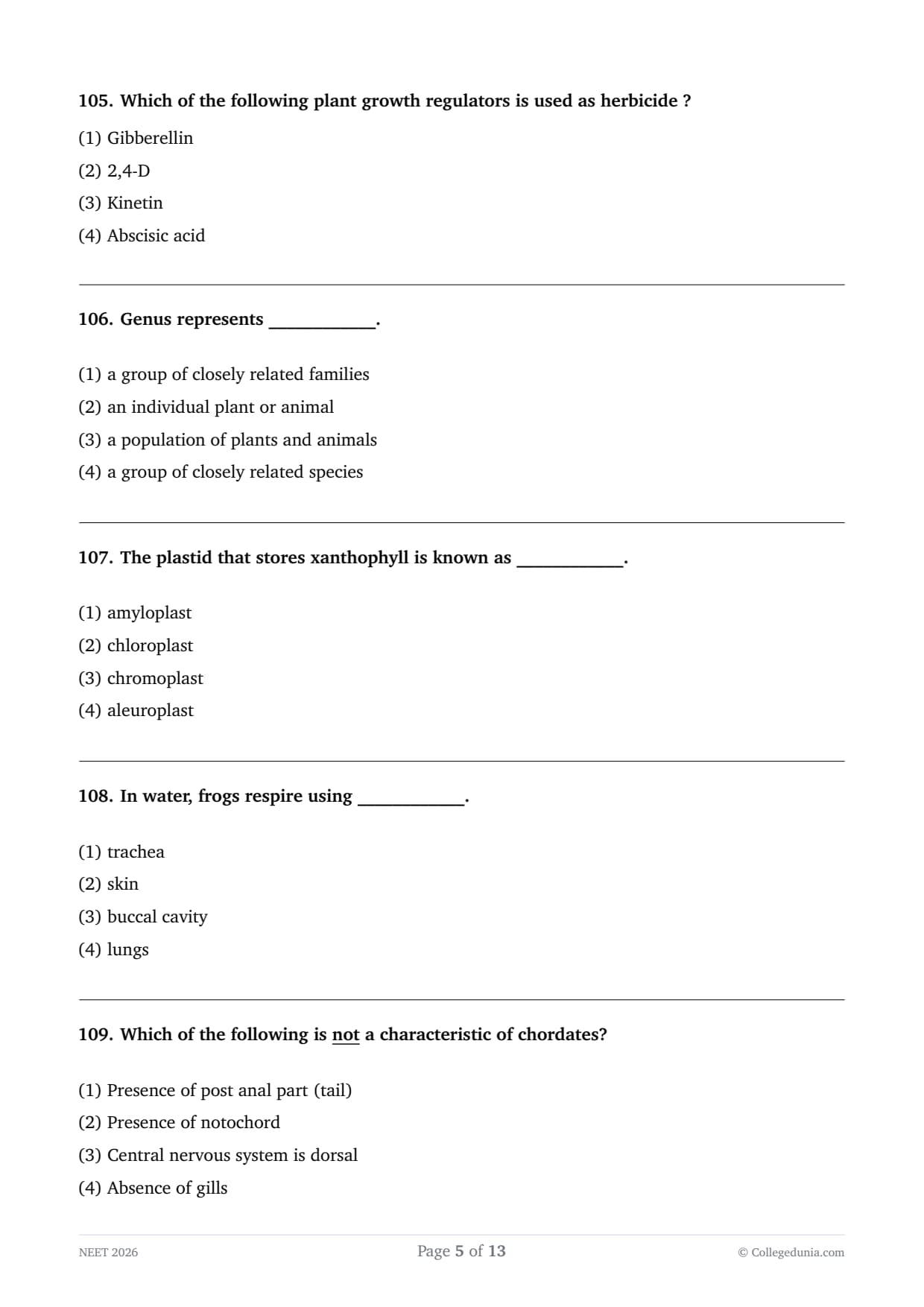
Which of the following plant growth regulators is used as herbicide ?

  • (1) Gibberellin
  • (2) 2,4-D
  • (3) Kinetin
  • (4) Abscisic acid

Question 16:

Genus represents ____________.

  • (1) a group of closely related families
  • (2) an individual plant or animal
  • (3) a population of plants and animals
  • (4) a group of closely related species

Question 17:

The plastid that stores xanthophyll is known as ____________.

  • (1) amyloplast
  • (2) chloroplast
  • (3) chromoplast
  • (4) aleuroplast

Question 18:

In water, frogs respire using ____________.

  • (1) trachea
  • (2) skin
  • (3) buccal cavity
  • (4) lungs

Question 19:

Which of the following is not a characteristic of chordates?

  • (1) Presence of post anal part (tail)
  • (2) Presence of notochord
  • (3) Central nervous system is dorsal
  • (4) Absence of gills

Question 20:

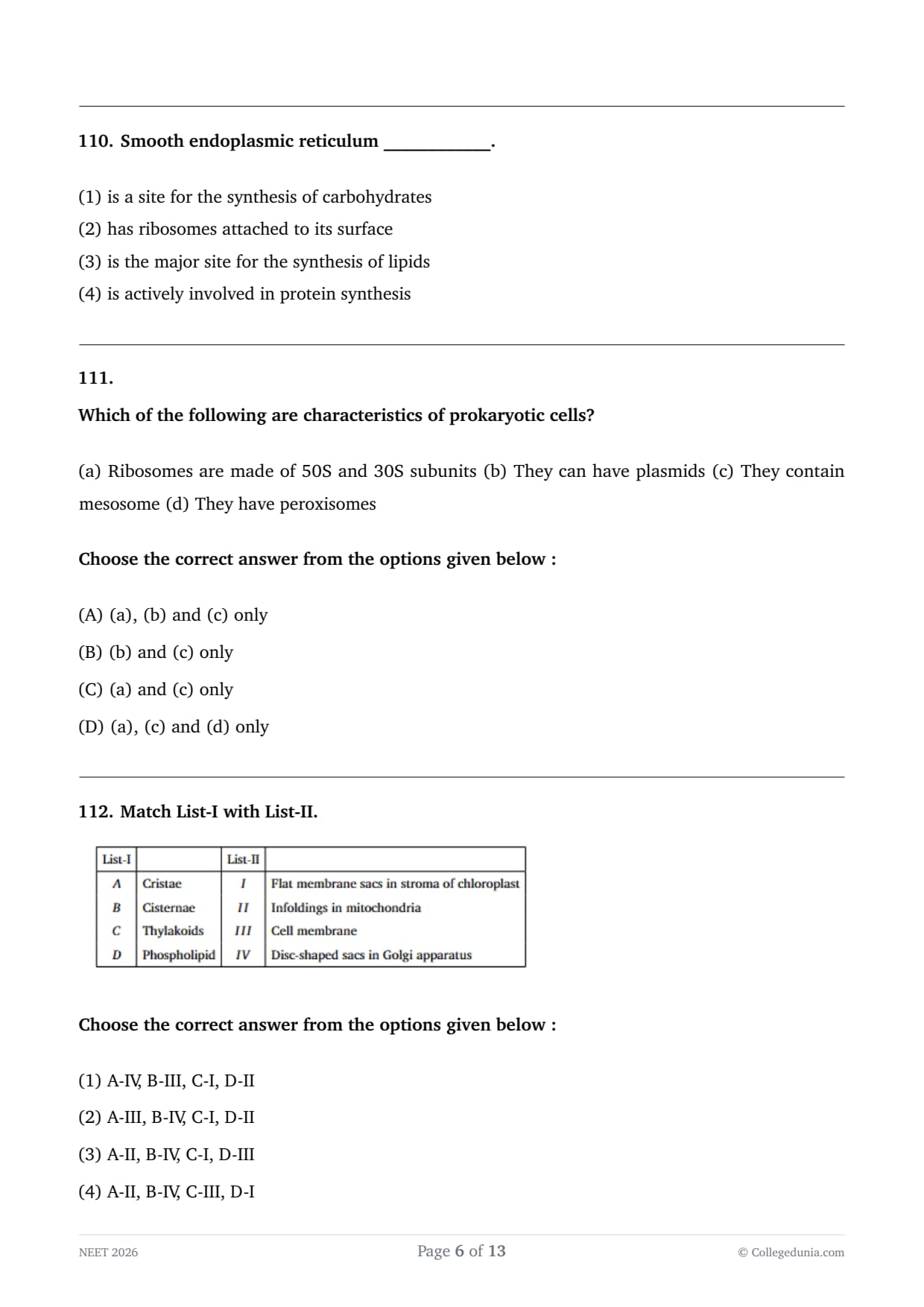
Smooth endoplasmic reticulum ____________.

  • (1) is a site for the synthesis of carbohydrates
  • (2) has ribosomes attached to its surface
  • (3) is the major site for the synthesis of lipids
  • (4) is actively involved in protein synthesis

Question 21:

Which of the following are characteristics of prokaryotic cells?


(a) Ribosomes are made of 50S and 30S subunits
(b) They can have plasmids
(c) They contain mesosome
(d) They have peroxisomes


Choose the correct answer from the options given below :

  • (A) (a), (b) and (c) only
  • (B) (b) and (c) only
  • (C) (a) and (c) only
  • (D) (a), (c) and (d) only

Question 22:

Match List-I with List-II.


Choose the correct answer from the options given below :

  • (1) A-IV, B-III, C-I, D-II
  • (2) A-III, B-IV, C-I, D-II
  • (3) A-II, B-IV, C-I, D-III
  • (4) A-II, B-IV, C-III, D-I

Question 23:

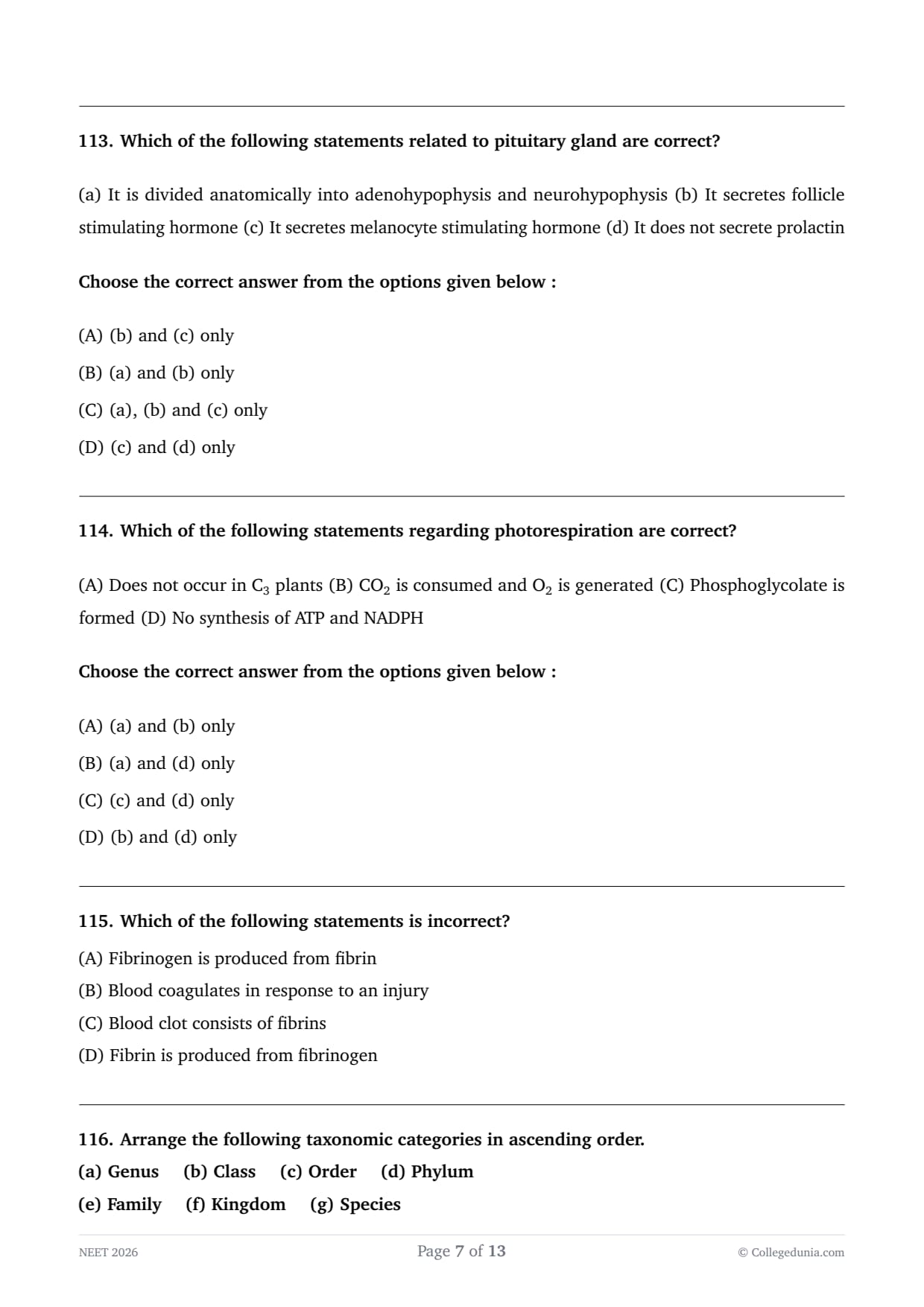
Which of the following statements related to pituitary gland are correct?


(a) It is divided anatomically into adenohypophysis and neurohypophysis
(b) It secretes follicle stimulating hormone
(c) It secretes melanocyte stimulating hormone
(d) It does not secrete prolactin


Choose the correct answer from the options given below :

  • (A) (b) and (c) only
  • (B) (a) and (b) only
  • (C) (a), (b) and (c) only
  • (D) (c) and (d) only

Question 24:

Which of the following statements regarding photorespiration are correct?


(A) Does not occur in C\(_3\) plants
(B) CO\(_2\) is consumed and O\(_2\) is generated
(C) Phosphoglycolate is formed
(D) No synthesis of ATP and NADPH


Choose the correct answer from the options given below :

  • (A) (a) and (b) only
  • (B) (a) and (d) only
  • (C) (c) and (d) only
  • (D) (b) and (d) only

Question 25:

Which of the following statements is incorrect?

  • (A) Fibrinogen is produced from fibrin
  • (B) Blood coagulates in response to an injury
  • (C) Blood clot consists of fibrins
  • (D) Fibrin is produced from fibrinogen

Question 26:

Arrange the following taxonomic categories in ascending order.

(a) Genus    (b) Class    (c) Order    (d) Phylum

(e) Family    (f) Kingdom    (g) Species

  • (A) (f), (c), (b), (g), (d), (e), (a)
  • (B) (g), (a), (e), (c), (b), (d), (f)
  • (C) (a), (c), (d), (g), (f), (b), (e)
  • (D) (g), (c), (d), (b), (e), (a), (f)

Question 27:

Select the correct sequence of experiments that led to gradual understanding of photosynthesis in green plants.

  • (A) Production of glucose \(\rightarrow\) role of air \(\rightarrow\) release of oxygen \(\rightarrow\) absorption spectra of chlorophyll a and b
  • (B) Absorption spectra of chlorophyll a and b \(\rightarrow\) production of glucose \(\rightarrow\) release of oxygen \(\rightarrow\) role of air
  • (C) Role of air \(\rightarrow\) release of oxygen \(\rightarrow\) production of glucose \(\rightarrow\) absorption spectra of chlorophyll a and b
  • (D) Release of oxygen \(\rightarrow\) production of glucose \(\rightarrow\) absorption spectra of chlorophyll a and b \(\rightarrow\) role of air

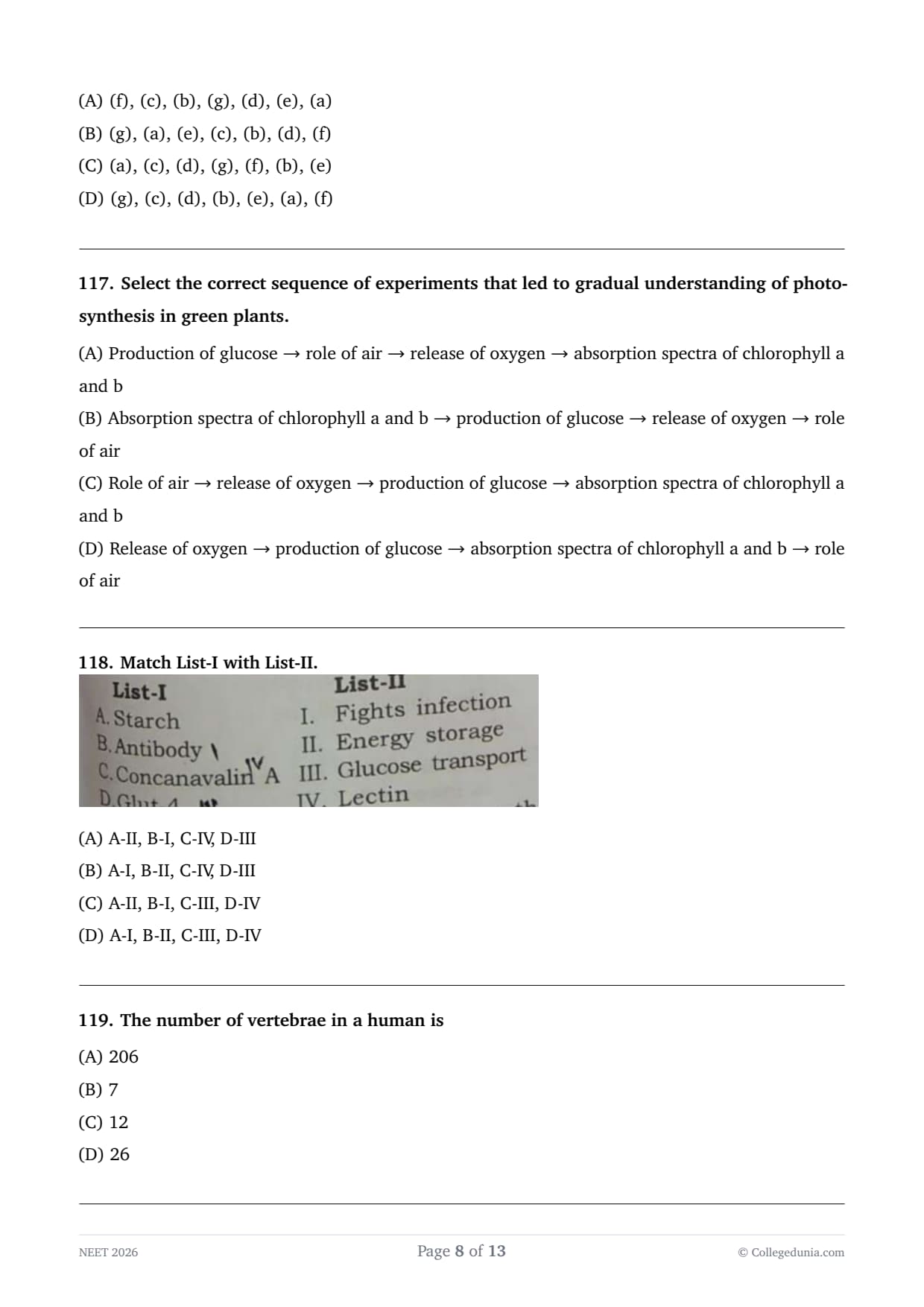
Question 28:

Match List-I with List-II.

  • (A) A-II, B-I, C-IV, D-III
  • (B) A-I, B-II, C-IV, D-III
  • (C) A-II, B-I, C-III, D-IV
  • (D) A-I, B-II, C-III, D-IV

Question 29:

The number of vertebrae in a human is

  • (A) 206
  • (B) 7
  • (C) 12
  • (D) 26

Question 30:

Endomembrane system includes

  • (A) Golgi complex, chloroplast, peroxisomes and vacuole
  • (B) Endoplasmic reticulum, Golgi complex, lysosomes and vacuole
  • (C) Endoplasmic reticulum, chloroplast, peroxisomes and vacuole
  • (D) Mitochondria, chloroplast, peroxisomes and vacuole

Question 31:

Length of the stem at time 0 is 20 cm. The arithmetic growth rate is 30 cm per day. What is the length of the stem at the end of the 7th day?

  • (A) 460 cm
  • (B) 50 cm
  • (C) 170 cm
  • (D) 230 cm

Question 32:

Match List-I with List-II.

  • (A) A-II, B-IV, C-I, D-III
  • (B) A-I, B-III, C-II, D-IV
  • (C) A-III, B-II, C-I, D-IV
  • (D) A-II, B-I, C-IV, D-III

Question 33:

The number of action potentials generated by sino-atrial node (SAN) in a healthy human is ______ per minute.

  • (A) 120 – 140
  • (B) 28 – 30
  • (C) 70 – 75
  • (D) 100 – 110

Question 34:

Match List-I with List-II.


Choose the correct answer from the options given below:

  • (A) A-III, B-V, C-II, D-IV, E-I
  • (B) A-I, B-V, C-II, D-IV, E-III
  • (C) A-II, B-I, C-III, D-IV, E-V
  • (D) A-II, B-III, C-V, D-I, E-IV

Question 35:

Which of the following is not a part of human central neural system?

  • (A) Pericardium
  • (B) Arachnoid
  • (C) Dura mater
  • (D) Pia mater

Question 36:

Given below are two statements:

Statement I: Chromosomes are fully condensed at the end of prophase I.

Statement II: Meiosis I resembles mitosis.

Choose the most appropriate answer from the options given below:

  • (A) Statement I is incorrect, but Statement II is true
  • (B) Both Statement I and Statement II are true
  • (C) Both Statement I and Statement II are false
  • (D) Statement I is correct, but Statement II is false

Question 37:

Match List-I with List-II.

  • (A) A-IV, B-II, C-I, D-III
  • (B) A-II, B-IV, C-I, D-III
  • (C) A-IV, B-II, C-III, D-I
  • (D) A-IV, B-III, C-I, D-II

Question 38:

Symbiotic association between fungi and algae are called _______.

  • (A) Chrysophytes
  • (B) Lichens
  • (C) Sponges
  • (D) Mycorrhiza

Question 39:

Which of the following is not a prokaryote?

  • (A) Fungi
  • (B) Bacteria
  • (C) Blue green algae
  • (D) Mycoplasma

Question 40:

The pigment responsible for the red colour of ripe tomato is

  • (A) Xanthophyll
  • (B) Lycopene
  • (C) Chlorophyll
  • (D) Anthocyanin

Question 41:

Which of the following statement is correct regarding enzymes?

  • (A) Enzymes are consumed permanently after reaction
  • (B) Enzymes lower activation energy of reaction
  • (C) Enzymes increase activation energy of reaction
  • (D) Enzymes are inorganic compounds

Question 42:

Which of the following are characteristic features of Solanaceae family?

(a) Flowers are bisexual and actinomorphic

(b) Calyx have five sepals and are united

(c) Androecium have five stamens and are epipetalous

(d) Ovary is inferior

Choose the correct answer from the options given below:

  • (A) (b), (c) and (d) only
  • (B) (a), (b) and (c) only
  • (C) (d) only
  • (D) (a) and (b) only

Question 43:

Given below are two statements:

Statement I : When any plane passing through the central axis of the body divides the organism into two identical halves, it is called radial symmetry.

Statement II : In phylum Echinodermata, both adults and larvae are radially symmetrical.

Choose the most appropriate answer.

  • (A) Statement I is incorrect but Statement II is correct
  • (B) Both Statement I and Statement II are correct
  • (C) Both Statement I and Statement II are incorrect
  • (D) Statement I is correct but Statement II is incorrect

Question 44:

The correct sequence of adult cell cycle phases is

  • (A) S-M-G2-G1
  • (B) G1-G2-S-M
  • (C) G1-M-G2-S
  • (D) G1-S-G2-M

Question 45:

In frogs, the number of pairs of cranial nerves arising from the brain are _______.

  • (A) 12
  • (B) 6
  • (C) 9
  • (D) 10


NEET 2026 Botany Topic-Wise Weightage

Topic Expected Questions
Molecular Basis of Inheritance 6–7
Biotechnology: Principles and Processes 5–6
Biotechnology and Its Applications 4–5
Plant Kingdom 3–5
Morphology of Flowering Plants 3–4
Cell: The Unit of Life 3–4
Biomolecules 3–4
Sexual Reproduction in Flowering Plants 3–5
Photosynthesis in Higher Plants 2–3
Plant Growth and Development 2–3
Anatomy of Flowering Plants 2–3
Respiration in Plants 1–2
Biological Classification 1–2
The Living World 1

NEET 2026 Botany Paper Analysis