


Re-NEET 2026 Chemistry Question Paper is available here. NTA conducted NEET 2026 re-exam on 21 June in single shift from 2 PM to 5:15 PM. NEET Re-Test question question paper consists of 180 questions for 720 marks to be attempted in 3 hours and 15 minutes.
- NEET Chemistry Question Paper 2026 consists of 45 questions for 180 marks.
- Each correct answer carries 4 marks and incorrect answer has a negative marking of 1.
Candidates can download NEET 2026 Re-Exam Chemistry Question Paper with Answer Key and Solution PDF from the links provided below
Re-NEET 2026 Chemistry Question Paper with Solution PDF
| NEET Re-Exam Chemistry Question Paper 2026 | Download PDF | Check Solution |
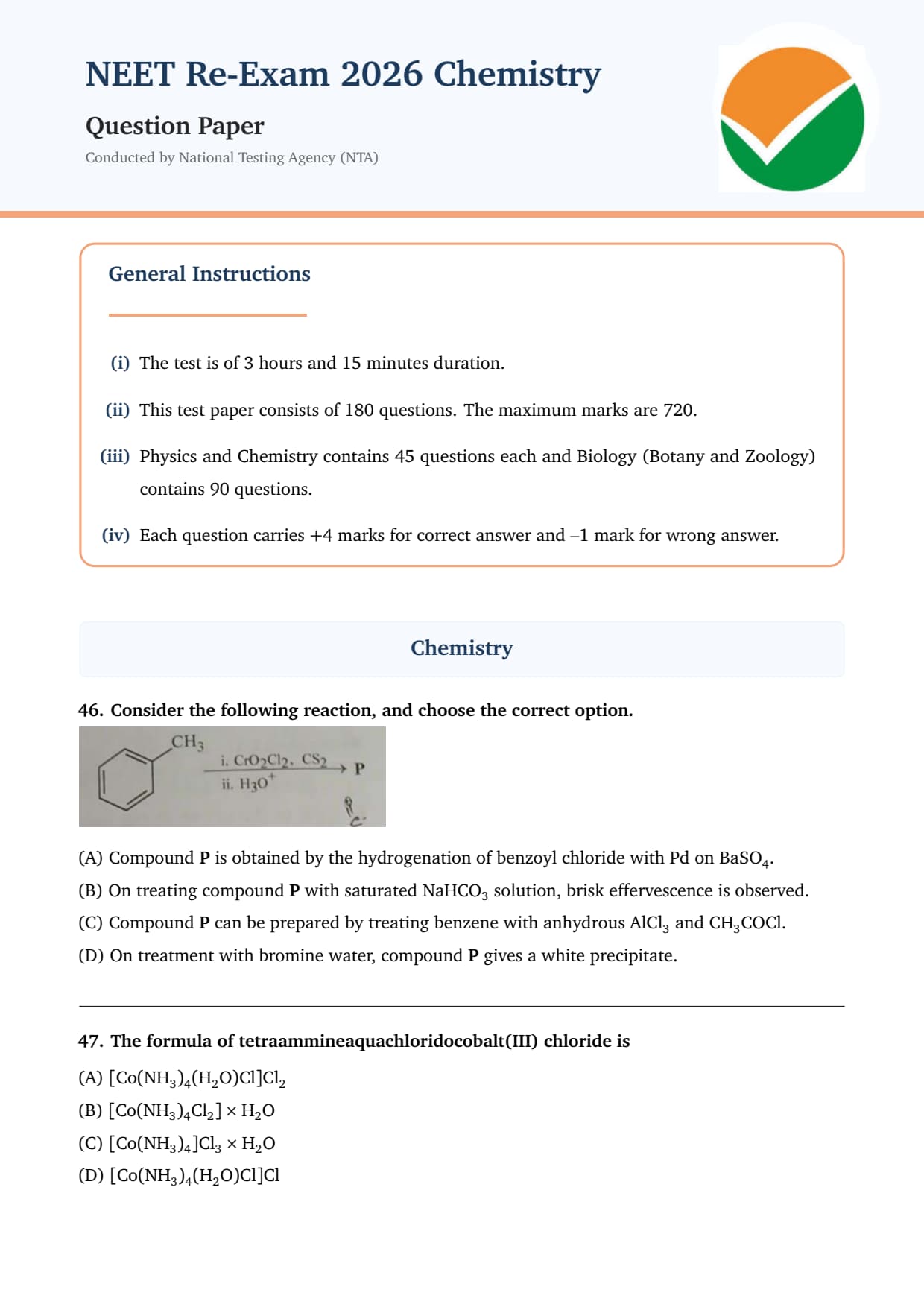
Consider the following reaction, and choose the correct option.

View Solution
Concept:
The conversion of toluene to benzaldehyde using chromyl chloride (\(CrO_2Cl_2\)) in a carbon disulfide (\(CS_2\)) solvent followed by acidic hydrolysis is known as the Etard Reaction. Chromyl chloride behaves as a mild oxidizing agent that selectively oxidizes a terminal methyl group attached to an aromatic ring into an aldehyde functionality without further oxidation into a carboxylic acid. \[ C_6H_5CH_3 \xrightarrow[ii. H_3O^+]{i. CrO_2Cl_2, \, CS_2} C_6H_5CHO \quad (Benzaldehyde) \]
Therefore, the unknown product P is **benzaldehyde** (\(C_6H_5CHO\)). Let us meticulously analyze each structural option given to evaluate its chemical validity.
Step 1: Identifying Compound P via the Etard Reaction mechanism.
When toluene (\(C_6H_5CH_3\)) is treated with chromyl chloride (\(CrO_2Cl_2\)) in non-polar solvent \(CS_2\), a brown chromium complex intermediate is initially formed. The reaction proceeds via a radical mechanism where the methyl group is partially oxidized: \[ C_6H_5CH_3 + 2CrO_2Cl_2 \rightarrow C_6H_5CH[OCr(OH)Cl_2]_2 \]
Subsequent aqueous acidic hydrolysis (\(H_3O^+\)) of this brown intermediate complex breaks the chromium-oxygen bonds to yield benzaldehyde: \[ C_6H_5CH[OCr(OH)Cl_2]_2 + H_2O \rightarrow C_6H_5CHO + 2Cr(OH)_2Cl_2 \]
Thus, Compound P is unequivocally established as Benzaldehyde.
Step 2: Evaluating Option (1).
Option (1) states that compound P is obtained by the hydrogenation of benzoyl chloride (\(C_6H_5COCl\)) with palladium (\(Pd\)) supported on barium sulfate (\(BaSO_4\)).
This partial reduction reaction is a famous organic transformation known as the Rosenmund Reduction. Barium sulfate acts as a catalyst poison (modulator) to lower the catalytic activity of palladium, preventing the newly formed aldehyde from undergoing further reduction into a primary benzyl alcohol.
The structural chemical equation is formulated as follows: \[ C_6H_5COCl + H_2 \xrightarrow{Pd / BaSO_4} C_6H_5CHO + HCl \]
Since the product generated from the Rosenmund reduction is indeed benzaldehyde (\(C_6H_5CHO\)), which matches compound P perfectly, this statement is perfectly accurate.
Step 3: Evaluating Option (2).
Option (2) suggests that treating compound P with a saturated sodium bicarbonate (\(NaHCO_3\)) solution produces brisk effervescence.
Brisk effervescence with a weak base like \(NaHCO_3\) occurs due to the release of carbon dioxide (\(CO_2\)) gas. This reaction is a classic functional group diagnostic test for relatively strong organic acids, such as carboxylic acids (\(R-COOH\)), which are sufficiently acidic to decompose the bicarbonate ion: \[ R-COOH + NaHCO_3 \rightarrow R-COONa + H_2O + CO_2\uparrow \]
Since benzaldehyde (\(C_6H_5CHO\)) is an aldehyde and does not contain a highly acidic carboxyl proton, it fails to react with saturated sodium bicarbonate solution. No \(CO_2\) gas is generated, and no effervescence is seen. Therefore, this statement is false.
Step 4: Evaluating Option (3).
Option (3) states that compound P can be prepared by treating benzene with anhydrous \(AlCl_3\) and acetyl chloride (\(CH_3COCl\)).
This reaction describes a classic Friedel-Crafts Acylation. Let us trace the reaction mechanism: Benzene reacts with acetyl chloride in the presence of a Lewis acid catalyst to form an acylium ion electrophile (\(CH_3CO^+\)), which attacks the aromatic ring: \[ C_6H_6 + CH_3COCl \xrightarrow{Anhydrous AlCl_3} C_6H_5COCH_3 + HCl \]
The final organic product formed here is acetophenone (a methyl ketone), not benzaldehyde (\(C_6H_5CHO\)). Hence, this statement is incorrect.
Step 5: Evaluating Option (4).
Option (4) states that treatment with bromine water gives a white precipitate.
Bromine water (\(Br_2/H_2O\)) gives a distinctive white precipitate of 2,4,6-tribromophenol or 2,4,6-tribromoaniline when reacted with highly activated aromatic systems such as phenol (\(C_6H_5OH\)) or aniline (\(C_6H_5NH_2\)). The strong activating groups (\(-OH\) or \(-NH_2\)) increase the electron density on ortho and para positions immensely.
In contrast, the formyl group (\(-CHO\)) in benzaldehyde is a strong electron-withdrawing group via resonance (deactivating group). Benzaldehyde does not undergo rapid electrophilic bromination with mild bromine water to give any white precipitate; instead, it undergoes slow meta-bromination under harsh conditions with pure Lewis acid catalysts. Thus, this statement is completely false. Quick Tip: To quickly master named reactions of carbonyl compounds: - **Etard Reaction**: \(Toluene + CrO_2Cl_2 \rightarrow Benzaldehyde\) - **Rosenmund Reduction**: \(Acid Chloride + H_2 / Pd-BaSO_4 \rightarrow Aldehyde\) Both are premier methods for synthesizing pure aromatic aldehydes without over-oxidation or over-reduction!
The formula of tetraammineaquachloridocobalt(III) chloride is
View Solution
Concept:
According to the International Union of Pure and Applied Chemistry (IUPAC) nomenclature rules for coordination compounds:
The coordination sphere is enclosed within square brackets \([\dots]\). The central transition metal cation is written first, followed immediately by the coordinated ligands.
Ligands are listed alphabetically based on their IUPAC chemical names regardless of their net electrical charge.
The prefixes 'tetra', 'tri', 'di' signify the quantity of that specific ligand inside the coordination sphere.
The oxidation state of the central transition metal is specified in Roman numerals enclosed inside parentheses directly after the name of the metal.
Ionizable anions outside the coordination sphere balances the net charge of the complex cation.
Step 1: Identifying the central metal ion and individual ligands inside the coordination sphere.
Let us systematically deconstruct the IUPAC name provided in the question text: **tetraammineaquachloridocobalt(III) chloride**.
**Central Metal Ion:** The name contains "cobalt(III)". This informs us that the central transition metal atom is Cobalt, denoted by the chemical symbol \(Co\), and it possesses a positive formal oxidation state of \(+3\) (i.e., \(Co^{3+}\)).
**Ligand 1:** "tetraammine" points to the presence of ammine ligands, which represent neutral ammonia molecules (\(NH_3\)). The prefix "tetra-" mathematically corresponds to exactly four such molecules. Hence, we write this part as: \((NH_3)_4\).
**Ligand 2:** "aqua" explicitly denotes a neutral water molecule acting as a coordinating Lewis base ligand (\(H_2O\)). Since there is no multiplying prefix, its stoichiometry is exactly one: \((H_2O)\).
**Ligand 3:** "chlorido" corresponds to the anionic chloride ligand (\(Cl^-\)) bound inside the coordination sphere. There is no multiplying prefix, meaning there is exactly one internal chloride ligand: \(Cl\).
Assembling the coordination entity within square brackets gives: \[ [Co(NH_3)_4(H_2O)Cl] \]
Step 2: Calculating the total net charge of the coordination complex sphere.
To determine the number of counter-anions present outside the square brackets, we calculate the net algebraic charge of the complex coordination sphere by summing the individual oxidation states and charges of the constituent metal and ligands: \[ Net Charge = (Charge of Co) + 4 \times (Charge of NH_3) + 1 \times (Charge of H_2O) + 1 \times (Charge of Cl^-) \]
Substituting the known electrical charges into this equation:
Cobalt (\(Co\)) oxidation state = \(+3\)
Ammine (\(NH_3\)) ligand charge = \(0\) (neutral molecule)
Aqua (\(H_2O\)) ligand charge = \(0\) (neutral molecule)
Chlorido (\(Cl^-\)) ligand charge = \(-1\) (anionic)
\[ Net Charge = (+3) + 4(0) + 1(0) + 1(-1) \] \[ Net Charge = +3 + 0 + 0 - 1 = +2 \]
Therefore, the coordination sphere is a complex cation carrying a net positive electrical charge of \(+2\), which can be written as: \[ [Co(NH_3)_4(H_2O)Cl]^{2+} \]
Step 3: Balancing the complex charge with counter chloride ions.
The compound name concludes with the word "**chloride**", indicating that ionic chloride anions (\(Cl^-\)) act as counter-ions situated outside the coordination sphere to ensure overall electrical neutrality of the crystalline compound.
Let \(x\) be the number of ionizable chloride counter-ions needed. Since each individual chloride ion carries a static charge of \(-1\): \[ Net Charge of Complex Cation + x \times (Charge of Chloride Anion) = 0 \] \[ (+2) + x(-1) = 0 \quad \Rightarrow \quad 2 - x = 0 \quad \Rightarrow \quad x = 2 \]
This demonstrates that exactly two chloride anions (\(Cl_2\)) must reside outside the square coordination brackets to successfully neutralize the \(+2\) charge of the coordination sphere.
Step 4: Formulating the final chemical notation.
Combining the cationic coordination complex and the external ionizable counter-anions together yields the complete structural formula: \[ [Co(NH_3)_4(H_2O)Cl]Cl_2 \]
Comparing this derived structure against the options given, it corresponds exactly to Option (1). Quick Tip: When writing structural formulas from IUPAC nomenclature: 1. Identify the central metal and its oxidation state. 2. Sum up the charges of all internal ligands to find the net charge of the bracketed complex. 3. Add a sufficient number of outer counter-ions to make the total overall charge of the formula exactly equal to zero.
The lanthanide ion having four unpaired electrons is
(Given : Atomic numbers of Ce = 58, Nd = 60, Tb = 65 and Ho = 67)
View Solution
Concept:
Lanthanides belong to the \(f\)-block elements and are characterized by the progressive filling of the \(4f\) subshell. The most stable oxidation state exhibited by lanthanides is \(+3\). When a lanthanide atom forms a \(Ln^{3+}\) ion, three electrons are removed from the outermost orbitals, generally the two \(6s\) electrons and one electron from the \(5d\) or \(4f\) subshell.
The number of unpaired electrons in a \(4f^n\) configuration can be determined using Hund's rule of maximum multiplicity:
For \(n \leq 7\), the number of unpaired electrons is equal to \(n\).
For \(n > 7\), pairing begins and the number of unpaired electrons becomes \((14-n)\).
Since the \(4f\) subshell contains seven orbitals and can accommodate a maximum of fourteen electrons, this rule provides a quick method to determine the number of unpaired electrons in lanthanide ions.
Step 1: Determination of the electronic configuration of \(Ce^{3+}\).
Cerium has atomic number \(58\).
Its ground-state electronic configuration is:
\[ Ce=[Xe]\,4f^1 5d^1 6s^2 \]
Formation of \(Ce^{3+}\) involves removal of three electrons (two from \(6s\) and one from \(5d\)):
\[ Ce^{3+}=[Xe]\,4f^1 \]
Thus, the number of unpaired electrons is:
\[ 1 \]
Therefore,
\[ \boxed{Ce^{3+} has 1 unpaired electron} \]
Step 2: Determination of the electronic configuration of \(Nd^{3+}\).
Neodymium has atomic number \(60\).
Its electronic configuration is:
\[ Nd=[Xe]\,4f^4 6s^2 \]
On forming the trivalent ion:
\[ Nd^{3+}=[Xe]\,4f^3 \]
The three electrons occupy three different \(4f\) orbitals according to Hund's rule.
Hence,
\[ \boxed{Number of unpaired electrons=3} \]
Therefore,
\[ \boxed{Nd^{3+} has 3 unpaired electrons} \]
Step 3: Determination of the electronic configuration of \(Tb^{3+}\).
Terbium has atomic number \(65\).
Its electronic configuration is:
\[ Tb=[Xe]\,4f^9 6s^2 \]
On losing three electrons:
\[ Tb^{3+}=[Xe]\,4f^8 \]
For a \(4f^8\) configuration:
\[ Number of unpaired electrons=14-8=6 \]
Therefore,
\[ \boxed{Tb^{3+} has 6 unpaired electrons} \]
Step 4: Determination of the electronic configuration of \(Ho^{3+}\).
Holmium has atomic number \(67\).
Its electronic configuration is:
\[ Ho=[Xe]\,4f^{11}6s^2 \]
When three electrons are removed:
\[ Ho^{3+}=[Xe]\,4f^{10} \]
Since the configuration contains ten electrons in the \(4f\) subshell,
\[ Number of unpaired electrons=14-10=4 \]
Hence,
\[ \boxed{Ho^{3+} has 4 unpaired electrons} \]
Step 5: Comparison of all the given ions.
\[ \begin{array}{|c|c|c|} \hline Ion & Configuration & Unpaired Electrons
\hline Ce^{3+} & 4f^1 & 1
\hline Nd^{3+} & 4f^3 & 3
\hline Tb^{3+} & 4f^8 & 6
\hline Ho^{3+} & 4f^{10} & 4
\hline \end{array} \]
From the comparison table, it is evident that only \(Ho^{3+}\) possesses exactly four unpaired electrons.
Therefore,
\[ \boxed{Ho^{3+}} \]
is the lanthanide ion having four unpaired electrons.
Hence, the correct answer is
\[ \boxed{(1)\ Ho^{3+}} \] Quick Tip: For lanthanide ions having configuration \(4f^n\): \[ Unpaired electrons = \begin{cases} n, & n \le 7
14-n, & n > 7 \end{cases} \] Thus, \[ 4f^{10}\Rightarrow 14-10=4 \] Therefore, \(Ho^{3+}\) contains exactly four unpaired electrons.
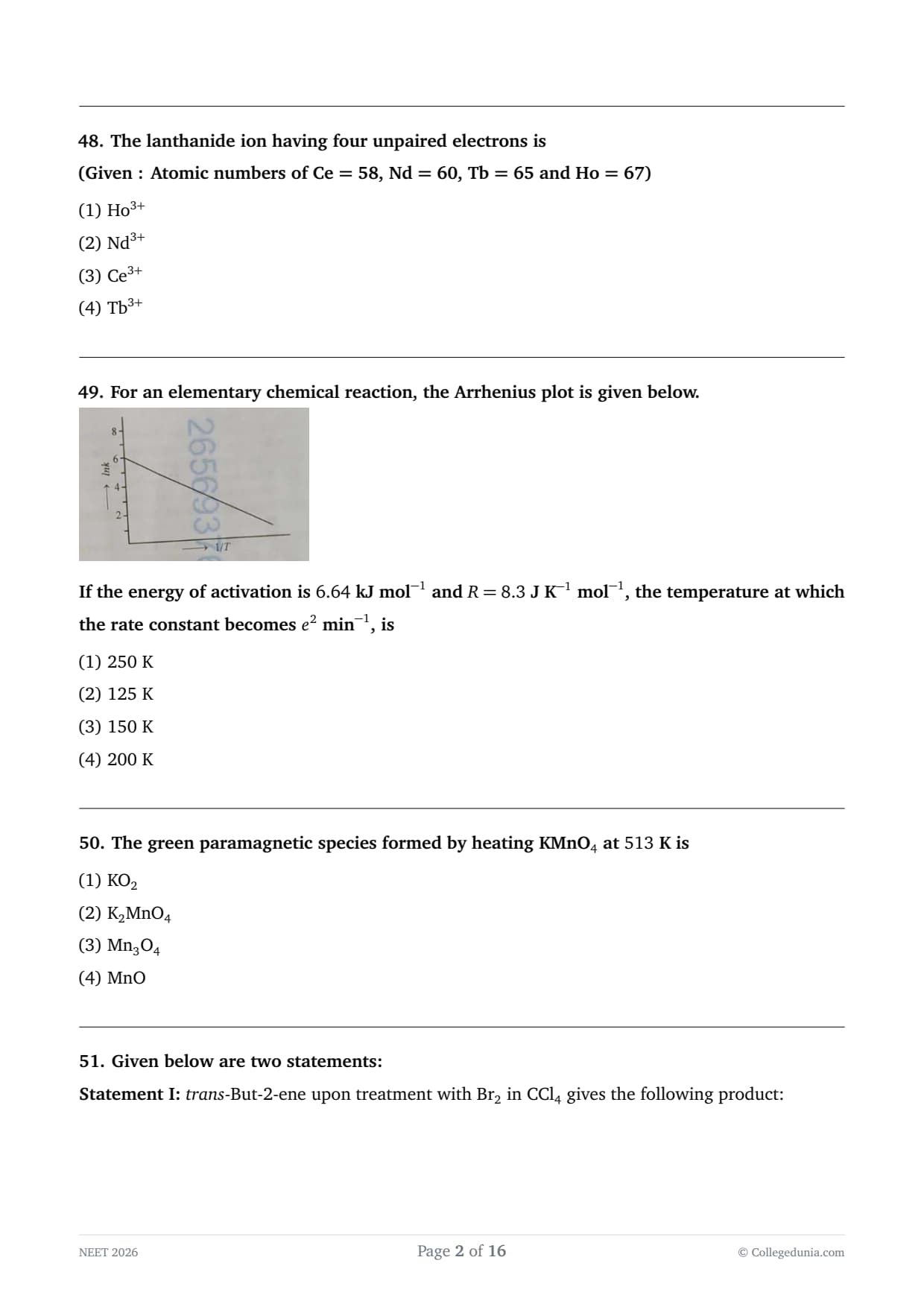
For an elementary chemical reaction, the Arrhenius plot is given below.

If the energy of activation is \(6.64 kJ mol^{-1}\) and \(R = 8.3 J K^{-1} mol^{-1}\), the temperature at which the rate constant becomes \(e^2 min^{-1}\), is
View Solution
Concept:
The dependence of the rate constant (\(k\)) of a chemical reaction on the absolute temperature (\(T\)) is mathematically described by the logarithmic form of the Arrhenius Equation: \[ k = A \cdot e^{-\frac{E_a}{RT}} \quad \Rightarrow \quad \ln k = \ln A - \frac{E_a}{R}\left(\frac{1}{T}\right) \]
Where:
\(k\) = Rate constant of the chemical reaction.
\(A\) = Arrhenius pre-exponential frequency factor.
\(E_a\) = Activation energy required for the reaction.
\(R\) = Universal Gas Constant.
\(T\) = Absolute temperature in Kelvin (\(K\)).
When plotting \(\ln k\) on the vertical \(y\)-axis against \(\frac{1}{T}\) on the horizontal \(x\)-axis, the equation represents a straight line matching the standard linear form \(y = mx + c\), where the slope \(m = -\frac{E_a}{R}\) and the \(y\)-intercept \(c = \ln A\).
Step 1: Extracting the value of the y-intercept (\(\ln A\)) from the given graph.
Looking closely at the provided Arrhenius graph, the straight line intersects the vertical \(\ln k\) axis exactly at the numerical value of \(6\).
By definition, the \(y\)-intercept occurs where the horizontal coordinate \(\frac{1}{T} = 0\). Therefore: \[ Intercept = \ln A = 6 \]
Step 2: Converting given units to standard SI units.
The problem provides the following thermodynamic constants:
Activation Energy, \(E_a = 6.64 kJ mol^{-1} = 6.64 \times 10^3 J mol^{-1} = 6640 J mol^{-1}\)
Universal Gas Constant, \(R = 8.3 J K^{-1} mol^{-1}\)
It is essential to convert \(E_a\) from kilojoules to joules so that the units cancel out perfectly with the units of the gas constant \(R\).
Step 3: Setting up the specific Arrhenius equation for the target rate constant.
We are asked to find the specific temperature \(T\) where the rate constant \(k\) reaches a value of \(e^2 min^{-1}\). Let us take the natural logarithm of this target rate constant: \[ k = e^2 \quad \Rightarrow \quad \ln k = \ln(e^2) = 2 \]
Now, substitute the values \(\ln k = 2\) and \(\ln A = 6\) into the logarithmic Arrhenius equation: \[ \ln k = \ln A - \frac{E_a}{RT} \] \[ 2 = 6 - \frac{E_a}{RT} \]
Step 4: Isolating and computing the absolute temperature \(T\).
Rearranging the algebraic terms to isolate the temperature component on one side: \[ \frac{E_a}{RT} = 6 - 2 \] \[ \frac{E_a}{RT} = 4 \]
Cross-multiplying to solve explicitly for \(T\): \[ T = \frac{E_a}{4R} \]
Substituting the numerical values of \(E_a\) and \(R\) that we prepared in Step 2: \[ T = \frac{6640}{4 \times 8.3} \]
Let us calculate the product in the denominator first: \[ 4 \times 8.3 = 33.2 \]
Now, divide the numerator by this product: \[ T = \frac{6640}{33.2} \]
To make the division cleaner, multiply both the numerator and the denominator by 10 to eliminate the decimal: \[ T = \frac{66400}{332} \]
Observing that \(332 \times 2 = 664\): \[ T = 200 K \]
The calculated absolute temperature is exactly \(200 K\), which perfectly corresponds to Option (4). Quick Tip: Always double-check your units in chemical kinetics calculations! Activation energy (\(E_a\)) is usually given in \(kJ/mol\), while the gas constant \(R\) is given in \(J/(K\cdot mol)\). Multiplying the kilojoules by \(10^3\) is a vital step to avoid being off by a factor of 1000!
The green paramagnetic species formed by heating \(KMnO_4\) at \(513 K\) is
View Solution
Concept:
Potassium permanganate (\(KMnO_4\)) is a dark purple crystalline solid. When heated strongly to its thermal decomposition threshold around \(513 K\), it undergoes a chemical breakdown reaction yielding potassium manganate (\(K_2MnO_4\)), manganese dioxide (\(MnO_2\)), and oxygen gas (\(O_2\)).
The formal balanced chemical equation representing this thermal decomposition is written as follows: \[ 2KMnO_4 \xrightarrow{\Delta \, (513 K)} K_2MnO_4 + MnO_2 + O_2\uparrow \]
Step 1: Identifying the specific product based on physical properties.
The question highlights two specific diagnostic criteria for the product of interest:
1) It must be a **green** colored species.
2) It must exhibit **paramagnetic** magnetic behavior.
Let us evaluate the two manganese-containing compounds produced during the thermal decomposition:
\(MnO_2\) (Manganese dioxide) is a dark brown/black insoluble solid.
\(K_2MnO_4\) (Potassium manganate) forms dark green crystals and dissolves in water to produce a distinct, vibrant green solution due to the presence of the manganate anion (\(MnO_4^{2-}\)).
This immediately focuses our attention on \(K_2MnO_4\) as the primary candidate.
Step 2: Confirming the magnetic properties via electronic configuration.
Let us rigorously verify the paramagnetic nature of the manganate ion (\(MnO_4^{2-}\)) by determining the oxidation state and d-electron configuration of its central manganese atom.
In the ionic compound potassium manganate (\(K_2MnO_4\)), potassium retains its standard \(+1\) oxidation state. Let \(x\) represent the unknown oxidation state of Manganese (\(Mn\)), while Oxygen possesses a stable state of \(-2\): \[ 2(+1) + x + 4(-2) = 0 \] \[ 2 + x - 8 = 0 \quad \Rightarrow \quad x - 6 = 0 \quad \Rightarrow \quad x = +6 \]
Thus, the central manganese ion exists in a \(+6\) oxidation state, denoted as \(Mn^{6+}\).
Step 3: Finding the number of unpaired d-electrons.
The ground-state electronic configuration of a neutral transition metal Manganese atom (\(Z = 25\)) is: \[ Mn = [Ar] \, 3d^5 \, 4s^2 \]
To achieve the \(Mn^{6+}\) state, we remove six valence electrons sequentially (two from the \(4s\) shell and four from the \(3d\) subshell): \[ Mn^{6+} = [Ar] \, 3d^1 \]
Since the \(3d\) subshell contains exactly **one solitary electron**, this electron is unpaired. The presence of an unpaired electron creates a net permanent magnetic dipole moment, which dictates that the species is structurally **paramagnetic**.
Step 4: Concluding the analysis.
Since \(K_2MnO_4\) satisfies both fundamental criteria perfectly—being deeply green-colored and containing a paramagnetic \(Mn^{6+}\) center with a \(3d^1\) configuration—it is the correct answer, corresponding to Option (2). Quick Tip: Remember the distinct colors and oxidation states of manganese anions to save time in competitive exams: - Permanganate ion (\(MnO_4^{-}\)): \(Mn^{+7}\) (\(3d^0\)), **Purple**, Diamagnetic. - Manganate ion (\(MnO_4^{2-}\)): \(Mn^{+6}\) (\(3d^1\)), **Green**, Paramagnetic.
Given below are two statements:
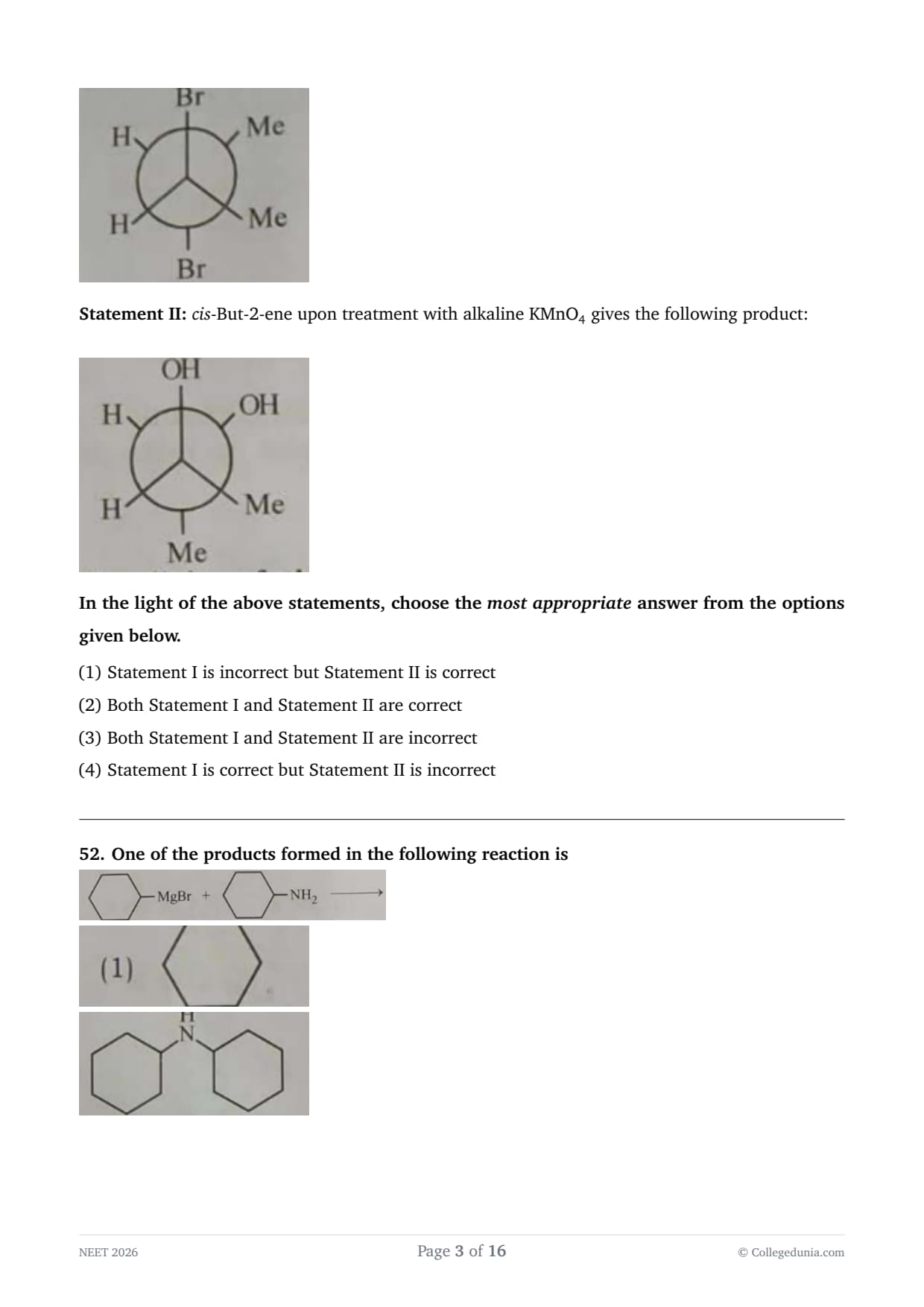
Statement I: trans-But-2-ene upon treatment with \(Br_2\) in \(CCl_4\) gives the following product:

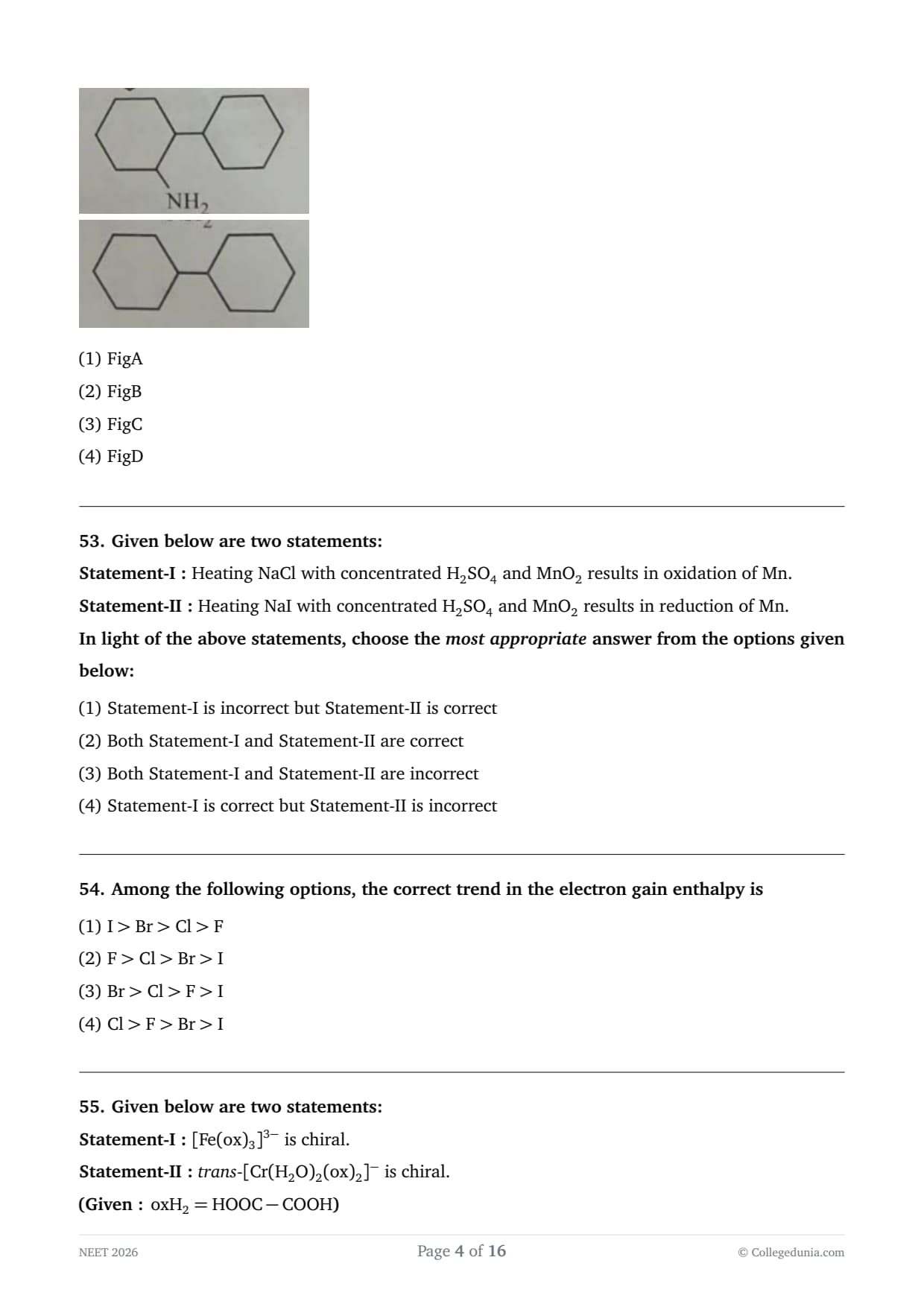
Statement II: cis-But-2-ene upon treatment with alkaline \(KMnO_4\) gives the following product:

In the light of the above statements, choose the most appropriate answer from the options given below.
View Solution
Concept:
The stereochemical outcome of electrophilic addition reactions across carbon-carbon double bonds depends inherently on both the configuration of the starting alkene (cis or \textit{trans) and the stereospecific mechanism of the addition pathway (\textit{syn or \textit{anti):
Bromination (\(Br_2 / CCl_4\)): Proceeds via an \textit{anti-addition mechanism due to the intermediate formation of a cyclic bromonium ion, which blocks the front-side attack and forces the second bromide ion to attack from the opposite side.
Hydroxylation with cold alkaline \(KMnO_4\) (Baeyer's Reagent): Proceeds via a coordinated syn-addition pathway because a cyclic manganese ester complex forms simultaneously across the same face of the double bond.
We can use standard stereochemical memory rules to predict outcomes:
\begin{align*
trans alkene + \text{\textit{anti addition &\longrightarrow \text{meso compound
\text{\textit{cis alkene + \text{\textit{syn addition &\longrightarrow \text{meso compound
\end{align*
Step 1: Evaluating Statement I.
Let us analyze the reaction of \textit{trans-but-2-ene with \(\text{Br_2\) in \(CCl_4\).
Because a \textit{trans alkene undergoing an \textit{anti-addition yields a symmetrically substituted \textit{meso stereoisomer, the resulting product, meso-2,3-dibromobutane, must possess an internal plane of symmetry (\(\sigma\)) or a center of inversion (\(i\)).
Let us inspect the Newman projection provided in Statement I of the image:
- The front carbon has substituents arranged as: \(Br\) (top), \(Me\) (right), \(H\) (left).
- The back carbon has substituents arranged as: \(Br\) (bottom), \(Me\) (right), \(H\) (left).
Let us check if this projection represents the \textit{meso form. In this staggered conformation, if we find a center of inversion, it is \textit{meso.
Moving from the front \(Br\) (top) through the center leads directly to the back \(Br\) (bottom) \(\rightarrow\) inversion matches.
However, moving from the front \(Me\) (bottom-right) through the center points towards the top-left, but the back \(Me\) is located at the bottom-right! Therefore, this structure does not have a center of inversion.
If we rotate the back carbon by \(180^\circ\) to check the eclipsed conformation: the top \(Br\) would eclipse the bottom \(Br\), meaning the bromine atoms would be on opposite sides rather than matching. This shows that the provided structure is a chiral enantiomer (\textit{d or \textit{l pair), not the \textit{meso isomer.
Since \textit{trans-but-2-ene must produce the optically inactive \textit{meso form upon \textit{anti-bromination, Statement I gives the wrong stereoisomer and is **incorrect**.
Step 2: Evaluating Statement II.
Let us examine the reaction of \textit{cis-but-2-ene with cold dilute alkaline \(KMnO_4\).
A \textit{cis alkene undergoing a stereospecific \textit{syn-addition yields a symmetrically substituted \textit{meso compound, which is \textit{meso-butane-2,3-diol.
Let us analyze the Newman projection displayed under Statement II:
- The front carbon has \(OH\) pointing straight up (\(12 o'clock\)), \(Me\) pointing to the bottom-right (\(4 o'clock\)), and \(H\) pointing to the bottom-left (\(8 o'clock\)).
- The back carbon has \(OH\) pointing to the top-right (\(2 o'clock\)), \(Me\) pointing straight down (\(6 o'clock\)), and \(H\) pointing to the top-left (\(10 o'clock\)).
Let us rotate the back carbon by \(60^\circ\) counter-clockwise to see the eclipsed form:
- The back \(OH\) (from \(2 o'clock\)) moves to \(12 o'clock\), perfectly eclipsing the front \(OH\).
- The back \(Me\) (from \(6 o'clock\)) moves to \(4 o'clock\), perfectly eclipsing the front \(Me\).
- The back \(H\) (from \(10 o'clock\)) moves to \(8 o'clock\), perfectly eclipsing the front \(H\).
Because every single substituent on the front carbon perfectly matches and eclipses its identical twin group on the back carbon when rotated into an eclipsed conformation, this molecule contains a clear internal plane of symmetry. This proves that the structure is exactly the expected **\textit{meso-butane-2,3-diol**. Therefore, Statement II is completely **correct**.
Step 3: Conclusion.
Since Statement I is incorrect and Statement II is correct, the matching choice is Option (1). Quick Tip: Keep this classic mnemonic matrix handy for alkene additions: - **CAR**: **C**is + **A**nti addition \(\longrightarrow\) **R**acemic mixture - **TAM**: **T**rans + **A**nti addition \(\longrightarrow\) **M**eso compound - **CIS**: **C**is + **S**yn addition \(\longrightarrow\) **M**eso compound Comparing the given structures against these rules makes it straightforward to spot incorrect stereoisomers!
One of the products formed in the following reaction is


View Solution
Concept:
Grignard reagents (\(R-MgX\)) are highly reactive organometallic compounds. Because the carbon-magnesium bond is strongly polarized with a high degree of ionic character, the alkyl group behaves as an exceptionally powerful base (\(R^-\)) as well as a strong nucleophile.
When a Grignard reagent encounters any chemical species containing an **active (acidic) hydrogen atom** attached directly to a highly electronegative element like oxygen (\(-OH\)), nitrogen (\(-NH_2\)), or sulfur (\(-SH\)), an acid-base proton-transfer reaction takes place immediately. This protonation deactivates the Grignard carbon, converting it into its corresponding stable alkane (\(R-H\)). This rapid decomposition pathway is widely known as the **Zerewitinoff reaction**.
Step 1: Identifying the reactive centers in the reactants.
Let us inspect the two organic molecules participating in the given reaction:
1) **Reactant 1:** Cyclohexylmagnesium bromide (\(C_6H_{11}MgBr\)). Here, the cyclohexyl ring carbon bound to magnesium acts as a powerful carbanionic base: \[ R^- = C_6H_{11}^- \quad (Cyclohexyl carbanion) \]
2) **Reactant 2:** Cyclohexylamine (\(C_6H_{11}NH_2\)). Primary amines possess active hydrogen atoms directly bonded to a nitrogen atom. These \(N-H\) protons are weakly acidic and can be readily abstracted by strong bases: \[ R'-NH_2 \rightleftharpoons R'-NH^- + H^+ \]
Step 2: Formulating the step-by-step reaction mechanism.
The reaction behaves as an instantaneous acid-base neutralization rather than a nucleophilic substitution or coupling reaction. The strongly basic carbanion site on the cyclohexyl ring attacks and abstract one of the acidic protons from the amino group of cyclohexylamine: \[ C_6H_{11}-MgBr + H-NH(C_6H_{11}) \longrightarrow C_6H_{11}-H + [C_6H_{11}-NH]^-MgBr^+ \]
Step 3: Identifying the structure of the final products.
Let us characterize the products formed from this transformation:
The cyclohexyl carbanion gains a proton (\(H^+\)) to form **cyclohexane** (\(C_6H_{12}\)).
The remaining amide anion coordinates with the magnesium salt to form a magnesium halide complex byproduct: \(C_6H_{11}NHMgBr\).
The question asks for "one of the products formed". Looking at the options, Option (1) represents a pure, unsubstituted cyclohexane ring (\(C_6H_{12}\)), which perfectly matches our main product. Quick Tip: Grignard reagents are aggressive proton-seekers! If a compound contains an active hydrogen like in \(H_2O\), \(R-OH\), \(R-NH_2\), or \(R-COOH\), the Grignard reagent will immediately abstract it to form an alkane (\(R-H\)), bypassing any potential carbon-carbon coupling pathways.
Given below are two statements:
Statement-I : Heating \(NaCl\) with concentrated \(H_2SO_4\) and \(MnO_2\) results in oxidation of \(Mn\).
Statement-II : Heating \(NaI\) with concentrated \(H_2SO_4\) and \(MnO_2\) results in reduction of \(Mn\).
In light of the above statements, choose the most appropriate answer from the options given below:
View Solution
Concept:
Manganese dioxide (\(MnO_2\)) is a robust and well-known oxidizing agent in acidic media. When a metal halide salt (\(NaX\)) is heated in the presence of concentrated sulfuric acid (\(H_2SO_4\)) and \(MnO_2\), the concentrated acid first reacts with the halide salt to generate the corresponding hydrogen halide gas (\(HX\)).
Because \(MnO_2\) is a powerful electron acceptor, it oxidizes the halide ions (\(X^-\)) into their elemental halogen form (\(X_2\)). Concurrently, the manganese atom inside \(MnO_2\) undergoes reduction, changing its oxidation state from \(+4\) down to a \(+2\) state, forming manganese(II) sulfate (\(MnSO_4\)).
Step 1: Analyzing Statement-I (Reaction with \(NaCl\)).
When sodium chloride (\(NaCl\)) is heated alongside concentrated \(H_2SO_4\) and \(MnO_2\), chlorine gas is evolved. Let us write down the balanced redox chemical equation for this process: \[ 2NaCl + MnO_2 + 3H_2SO_4 \longrightarrow 2NaHSO_4 + MnSO_4 + Cl_2\uparrow + 2H_2O \]
Let us trace the oxidation states of the elements to understand the electron transfer:
**In Reactants:** Inside \(MnO_2\), oxygen has an oxidation state of \(-2\), meaning manganese exists in the \(+4\) oxidation state (\(Mn^{+4}\)). The chloride ion inside \(NaCl\) has an oxidation state of \(-1\).
**In Products:** Inside \(MnSO_4\), the sulfate ion carries a \(-2\) charge, meaning manganese has shifted down to a \(+2\) oxidation state (\(Mn^{+2}\)). The evolved elemental \(Cl_2\) gas has an oxidation state of \(0\).
Because the oxidation state of Manganese drops from \(+4\) to \(+2\), **Manganese undergoes reduction**, while the chloride ions are oxidized to chlorine gas.
Statement-I claims that this reaction "results in oxidation of \(Mn\)", which is false. Thus, Statement-I is **incorrect**.
Step 2: Analyzing Statement-II (Reaction with \(NaI\)).
When sodium iodide (\(NaI\)) is heated under identical conditions with concentrated \(H_2SO_4\) and \(MnO_2\), dark violet iodine vapor is evolved. The corresponding chemical equation is: \[ 2NaI + MnO_2 + 3H_2SO_4 \longrightarrow 2NaHSO_4 + MnSO_4 + I_2\uparrow + 2H_2O \]
Let us trace the oxidation numbers for this system:
**In Reactants:** Manganese inside \(MnO_2\) is at a \(+4\) oxidation state. The iodide ion (\(I^-\)) has an oxidation state of \(-1\).
**In Products:** Manganese inside \(MnSO_4\) is at a \(+2\) oxidation state. Elemental iodine (\(I_2\)) is at \(0\).
Here, the oxidation number of manganese decreases from \(+4\) to \(+2\), meaning **Manganese undergoes reduction**, while iodide is oxidized to iodine.
Statement-II claims that this reaction "results in reduction of \(Mn\)", which is accurate. Therefore, Statement-II is **correct**.
Step 3: Final Selection.
Since Statement-I is incorrect and Statement-II is correct, the correct choice is Option (1). Quick Tip: To avoid confusion with redox terminology: - An **oxidizing agent** (like \(MnO_2\)) oxidizes other species while always undergoing **reduction** itself. - Consequently, in any successful oxidation reaction driven by \(MnO_2\), the manganese ion will always be reduced from \(Mn^{+4}\) to \(Mn^{+2}\).
Among the following options, the correct trend in the electron gain enthalpy is
View Solution
Concept:
Electron gain enthalpy (\(\Delta_{eg}H\)) is defined as the enthalpy change that occurs when an electron is added to an isolated, gaseous atom to form a univalent negative ion. A more negative value indicates a greater release of energy and a stronger affinity of the atom for an incoming electron. In general periodic chemistry trends, when comparing the magnitudes (absolute values) of the exothermic electron gain enthalpies for halogens:
As a general rule, electron gain enthalpy becomes less negative down a group because the atomic radius increases, placing the valence shell further from the positive nucleus.
However, a significant anomaly occurs between the second-period (\(n=2\)) and third-period (\(n=3\)) elements within the same group due to shifts in local electron density.
Step 1: Explaining the anomaly between Chlorine and Fluorine.
Based purely on atomic size trends, one might expect Fluorine (\(F\)) to have a more negative electron gain enthalpy than Chlorine (\(Cl\)). However, the actual experimental magnitude trend is \(Cl > F\).
Let us explore the underlying physical cause:
Fluorine belongs to the second period and has an extremely compact atomic volume. Its valence electrons are crowded together into a small \(2p\) subshell.
When an external electron approaches a fluorine atom, it experiences severe **inter-electronic repulsion** from the dense cloud of existing valence electrons. This repulsion offsets some of the nuclear attraction.
Chlorine belongs to the third period and has a significantly larger atomic radius with a more spacious \(3p\) subshell. The added electron spreads out comfortably with minimal inter-electronic repulsion, allowing a greater net release of energy.
Therefore, Chlorine possesses a more negative electron gain enthalpy value than Fluorine: \[ |\Delta_{eg}H_{Cl}| > |\Delta_{eg}H_{F}| \]
Step 2: Ordering the remaining halogens down Group 17.
Moving further down from Chlorine to Bromine (\(Br\)) and Iodine (\(I\)), the atomic size increases substantially as new primary quantum shells are added. The valence shell moves further away from the nucleus, and the shielding effect from core electrons increases.
As a result, the effective nuclear charge felt by an incoming electron decreases steadily, causing the electron gain enthalpy to become predictably less negative down the group: \[ |\Delta_{eg}H_{Cl}| > |\Delta_{eg}H_{F}| > |\Delta_{eg}H_{Br}| > |\Delta_{eg}H_{I}| \]
Step 3: Matching with experimental values.
Let us verify this trend using standard IUPAC experimental data for halogen electron gain enthalpies:
Chlorine (\(Cl\)): \(-349 kJ mol^{-1}\)
Fluorine (\(F\)): \(-328 kJ mol^{-1}\)
Bromine (\(Br\)): \(-325 kJ mol^{-1}\)
Iodine (\(I\)): \(-295 kJ mol^{-1}\)
Arranging these absolute energy magnitudes in descending order yields: \[ Cl > F > Br > I \]
This corresponds exactly to the trend listed in Option (4). Quick Tip: This second- versus third-period size exception is a frequent favorite in competitive exams! It applies to both Group 17 (\(Cl > F\)) and Group 16 (\(S > O\)) due to the exceptionally high electron density of the compact second-period atoms (\(F\) and \(O\)).
Given below are two statements:
Statement-I : \([Fe(ox)_3]^{3-}\) is chiral.
Statement-II : trans-\([Cr(H_2O)_2(ox)_2]^-\) is chiral.
(Given : \(oxH_2 = HOOC-COOH\))
In light of the above statements, choose the most appropriate answer from the options given below:
View Solution
Concept:
A coordination complex molecule is defined as **chiral** (and therefore optically active) if its structural geometry lacks an improper axis of rotation (\(S_n\)), which practically means it contains **neither a plane of symmetry (\(\sigma\)) nor a center of inversion (\(i\))**. Such a complex forms two non-superimposable mirror images called enantiomers (\(\Delta\) and \(\Lambda\) forms).
Symmetric bidentate chelating ligands like oxalate (\(ox^{2-} = C_2O_4^{2-}\)) form five-membered rings with the central metal ion, introducing rigid spatial constraints.
Tris-chelated octahedral complexes with the general formula \([M(AA)_3]\) take on a propeller-like geometry that inherently lacks a plane of symmetry.
Step 1: Evaluating Statement-I (\([Fe(ox)_3]^{3-}\)).
The complex ion \([Fe(ox)_3]^{3-}\) features an iron central metal ion coordinated by three symmetric bidentate oxalate ligands, matching the general coordination form \([M(AA)_3]\). Its structural configuration is octahedral with a coordination number of 6.
Let us examine its symmetry elements:
- The three chelate rings are locked in mutually perpendicular planes, wrapping around the central iron core like a propeller or a three-bladed fan.
- Because of this helical twist, it is impossible to pass any plane through the molecule that splits it into two symmetrical mirror halves.
- It also lacks a center of inversion.
Since the molecule has no internal symmetry elements, its mirror image is completely non-superimposable. It exists as a pair of stable enantiomers (\(d\) and \(l\) forms). Therefore, \([Fe(ox)_3]^{3-}\) is **chiral**, making Statement-I **correct**.
Step 2: Evaluating Statement-II (trans-\([Cr(H_2O)_2(ox)_2]^-\)).
The complex trans-\([Cr(H_2O)_2(ox)_2]^-\) belongs to the general stereochemical category \textit{trans-\([MA_2(BB)_2]\). Let us examine its octahedral geometry:
- The prefix \textit{trans- specifies that the two monodentate aqua (\(H_2O\)) ligands are located directly opposite one another (\(180^\circ\) apart) at the two axial positions (top and bottom vertices).
- The two bidentate oxalate (\(ox^{2-\)) ligands lie entirely within the flat equatorial plane, occupying the four remaining planar coordination sites.
Let us check for symmetry elements in this arrangement:
1) **Plane of Symmetry (\(\sigma_h\)):** If we pass a horizontal cutting plane directly through the equatorial position containing the chromium atom and the two oxalate rings, it splits the molecule in half. The top axial \(H_2O\) ligand is reflected across this plane into the identical bottom axial \(H_2O\) ligand.
2) **Center of Inversion (\(i\)):** Moving from any atom through the central chromium atom leads directly to an identical atom on the opposite side.
Because the molecule possesses a clear plane of symmetry and a center of inversion, it is completely **achiral** (optically inactive).
Statement-II claims that this trans complex is chiral, which is false. Thus, Statement-II is **incorrect**.
Step 3: Conclusion.
Since Statement-I is correct and Statement-II is incorrect, the corresponding selection is Option (4). Quick Tip: For octahedral complexes with bidentate ligands: - All tris-chelated complexes like \([M(AA)_3]\) are always **chiral**. - For bis-chelated complexes like \([M(AA)_2B_2]\): the \textit{cis-isomer is always **chiral**, while the trans-isomer contains planes of symmetry and is always **achiral**.
The correct statement about peptides and proteins is
View Solution
Concept:
Proteins display four levels of structural organization: primary, secondary, tertiary, and quaternary structures. Secondary structure refers to the local spatial arrangement of the polypeptide backbone, stabilized primarily by hydrogen bonding interactions between the carbonyl oxygen (\(-C=O\)) and amide hydrogen (\(-N-H\)) groups of the peptide linkage.
The two most common ordered secondary structures are:
\(\alpha\)-Helix: A right-handed coiled conformation where intramolecular hydrogen bonds form within the single, continuous polypeptide chain.
\(\beta\)-Pleated Sheet: A structure composed of extended adjacent polypeptide strands lying side-by-side, which are locked together via intermolecular hydrogen bonding networks.
Step 1: Evaluation of Statement (1)
Statement (1) posits that the polypeptide chain in an \(\alpha\)-helix forms a left-handed screw. In nature, virtually all naturally occurring \(\alpha\)-helices found in proteins are right-handed due to the steric constraints imposed by L-amino acid side chains. While the statement accurately mentions intramolecular hydrogen bonds, the assertion of a left-handed orientation makes this statement scientifically incorrect.
Step 2: Evaluation of Statement (2)
Statement (2) asserts that the tertiary structure contains two or more polypeptide subunits. This is a definition mismatch. The arrangement of multiple polypeptide chains (subunits) describes the quaternary structure of a protein. The tertiary structure represents the comprehensive three-dimensional folding of a single, individual polypeptide chain. Thus, this statement is incorrect.
Step 3: Evaluation of Statement (3)
Statement (3) claims that only proteins with quaternary structure exhibit biological activity. This is completely false. Numerous monomeric proteins consisting of just one polypeptide chain (possessing up to tertiary structure only), such as myoglobin and lysozyme, are entirely functional and biologically active. Quaternary organization is not a prerequisite for biological activity across all proteins.
Step 4: Evaluation of Statement (4)
Statement (4) describes the architecture of \(\beta\)-pleated sheets. In a \(\beta\)-pleated sheet structure, individual segments of polypeptide chains (either from different strands or distant segments of the same strand) align parallel or anti-parallel to each other. The structure is stabilized by extensive intermolecular hydrogen bonds running between adjacent strands. This description matches the structural criteria precisely and is correct. Quick Tip: To avoid confusion with protein structural properties, remember: - \(\alpha\)-Helix \(\rightarrow\) Right-handed screw stabilized by \textbf{intramolecular H-bonds. - \(\beta\)-Sheet \(\rightarrow\) Extended sheets stabilized by \textbf{intermolecular} H-bonds. - Tertiary = Single chain 3D shape; Quaternary = Multiple subunits/chains.
Given below are two statements:
Statement-I : Oxidation of \(p\)-nitrotoluene with acidic \(KMnO_4\) gives an acid that is stronger than benzoic acid.
Statement-II : Reduction of \(p\)-nitrotoluene with \(Sn/HCl\) followed by neutralization gives an amine that is more basic than aniline.
In light of the above statements, choose the most appropriate answer from the options given below.
View Solution
Concept:
Chemical properties of aromatic compounds are heavily governed by substituent electronic effects.
Acidity of Benzoic Acids: Electron-withdrawing groups (EWGs) stabilize the carboxylate conjugate base via inductive (\(-I\)) and resonance (\(-M\)) effects, which significantly enhances the parent acid's strength.
Basicity of Anilines: Electron-withdrawing groups diminish the availability of the nitrogen lone pair for donation, lowering the basicity, whereas electron-donating groups (EDGs) elevate it.
Step 1: Analyzing Statement-I
The chemical transformation of \(p\)-nitrotoluene with strong acidic \(KMnO_4\) leads to the exhaustive oxidation of the benzylic methyl (\(-CH_3\)) group down to a carboxylic acid group (\(-COOH\)): \[ p-O_2N-C_6H_4-CH_3 \xrightarrow{KMnO_4, H^+} p-O_2N-C_6H_4-COOH \quad (\(p\)-nitrobenzoic acid) \]
The nitro group (\(-NO_2\)) situated at the para-position acts as a strong electron-withdrawing group via both powerful resonance (\(-M\)) and inductive (\(-I\)) pathways. It pulls electron density away from the aromatic ring, dispersing the negative charge on the carboxylate anion formed upon deprotonation: \[ p-O_2N-C_6H_4-COO^- \]
Because of this stabilization, \(p\)-nitrobenzoic acid is a notably stronger acid than unsubstituted benzoic acid (\(C_6H_5COOH\)). Thus, Statement-I is completely correct.
Step 2: Analyzing Statement-II
Treating \(p\)-nitrotoluene with metallic tin in hydrochloric acid (\(Sn/HCl\)) followed by an alkaline neutralization steps selectively reduces the nitro (\(-NO_2\)) group down to an amino group (\(-NH_2\)), leaving the methyl group unaffected: \[ p-O_2N-C_6H_4-CH_3 \xrightarrow{1. Sn/HCl, 2. OH^- p-H_2N-C_6H_4-CH_3 \quad (\(p\)-toluidine) \]
The resulting compound is \(p\)-toluidine. The methyl group (\(-CH_3\)) attached at the \textit{para-position behaves as an electron-donating group through inductive (\(+I\)) and hyperconjugative mechanisms. It pushes electron density into the aromatic ring, making the lone pair on the amino nitrogen more accessible for protonation. Therefore, \(p\)-toluidine is a stronger base than aniline (\(C_6H_5NH_2\)).
Looking closely at Statement-II, it states that the reduction yields an amine that is more basic than aniline. Since \(p\)-toluidine is indeed more basic than aniline, Statement-II is scientifically correct as well.
\textit{Note on potential official key variance: Let us carefully re-verify standard textbook evaluations. If an option states (2) Both are correct, let us verify if there is any nuance. The reduction of \(p\)-nitrotoluene yields \(p\)-toluidine. Since \(p\)-toluidine contains a \(-CH_3\) group which is an electron-donating group (\(+I\) and hyperconjugation), it increases the electron density on nitrogen, making it a stronger base than aniline. Hence Statement-II is absolutely correct. Both statement-I and statement-II are true. Thus, option (2) is the accurate choice. Quick Tip: Electronic effects rule organic reactivity: - Electron Withdrawing Groups (\(-NO_2, -CN\)) \(\rightarrow\) Increase acidity, decrease basicity. - Electron Donating Groups (\(-CH_3, -OCH_3\)) \(\rightarrow\) Decrease acidity, increase basicity.
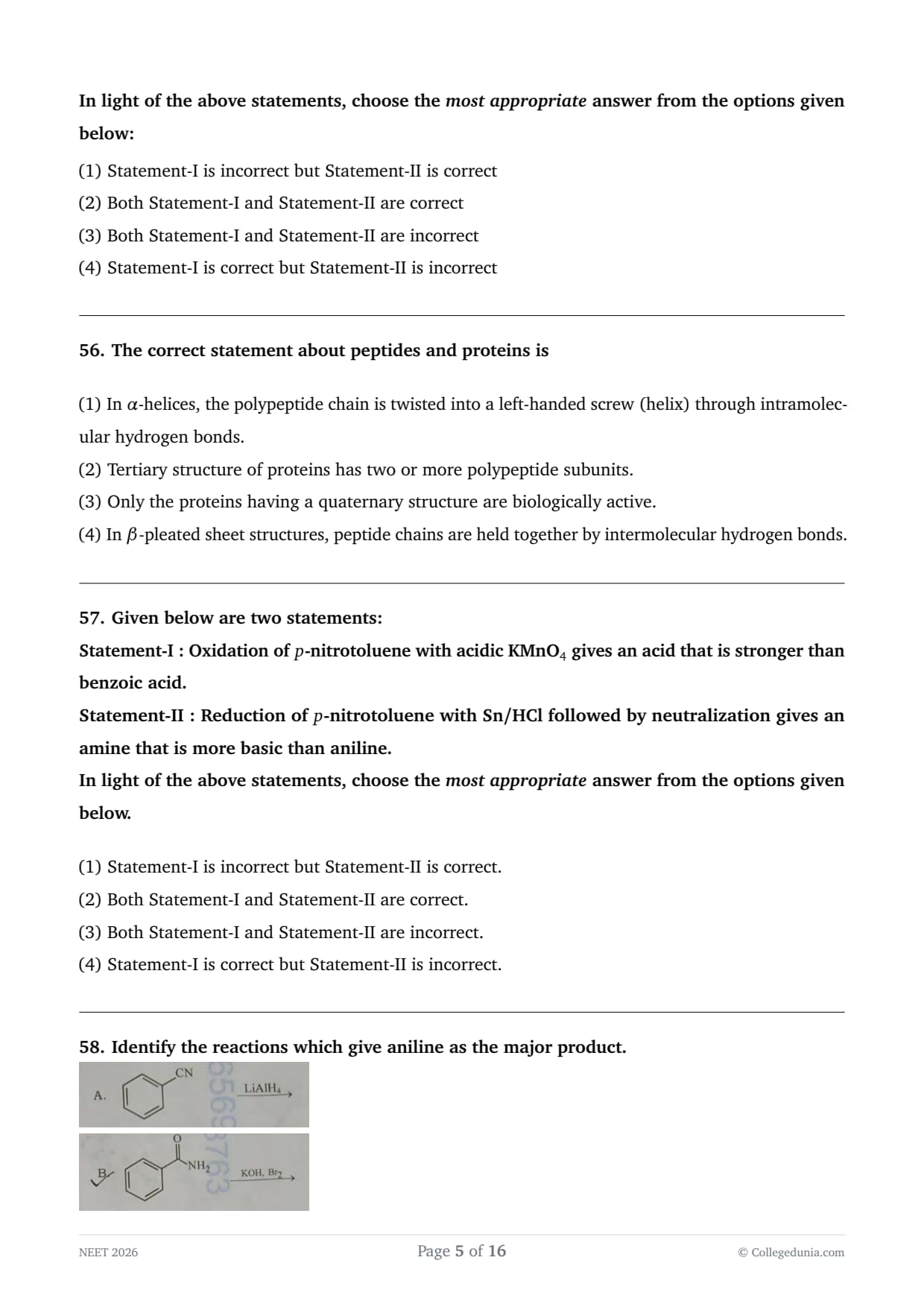
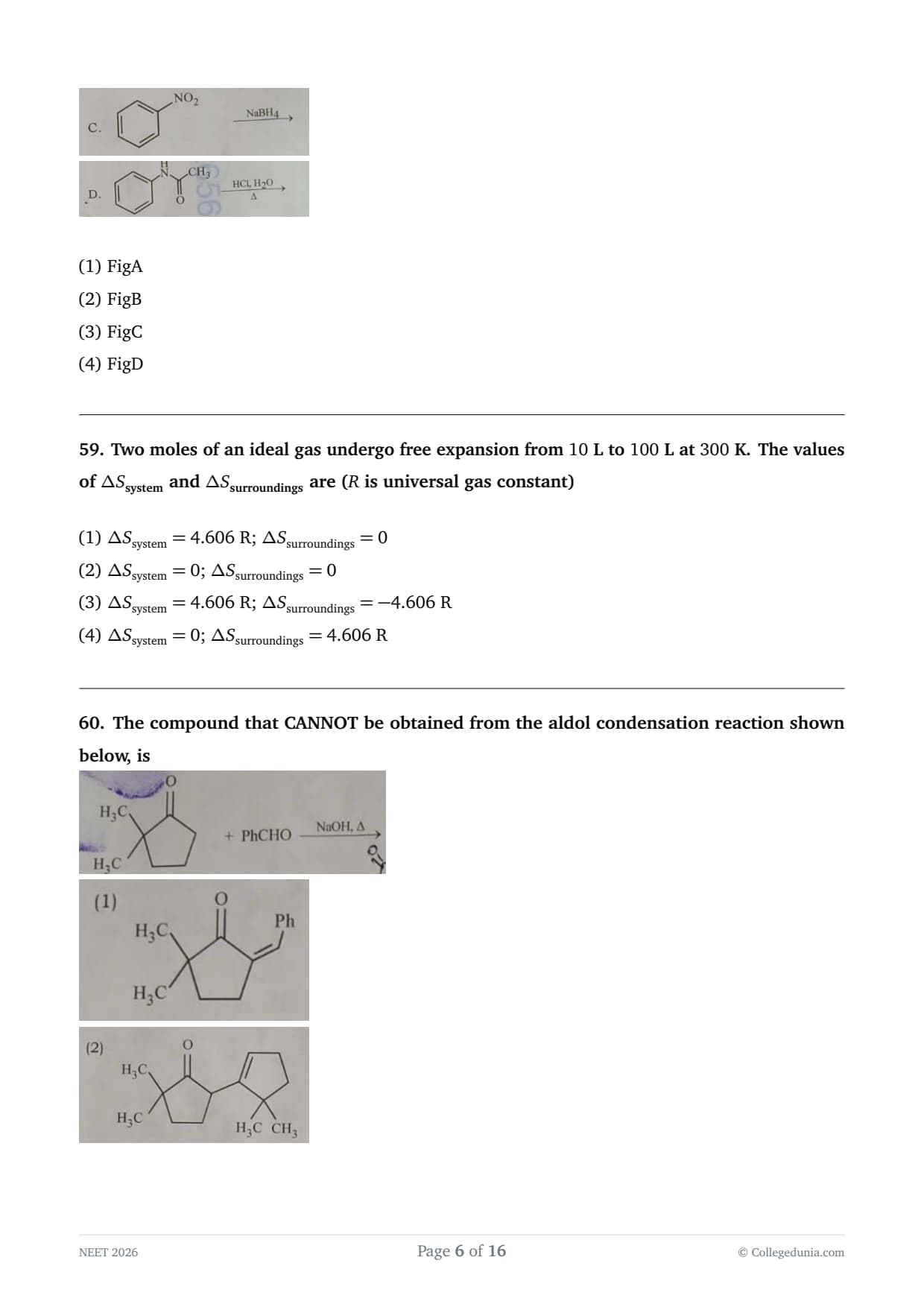
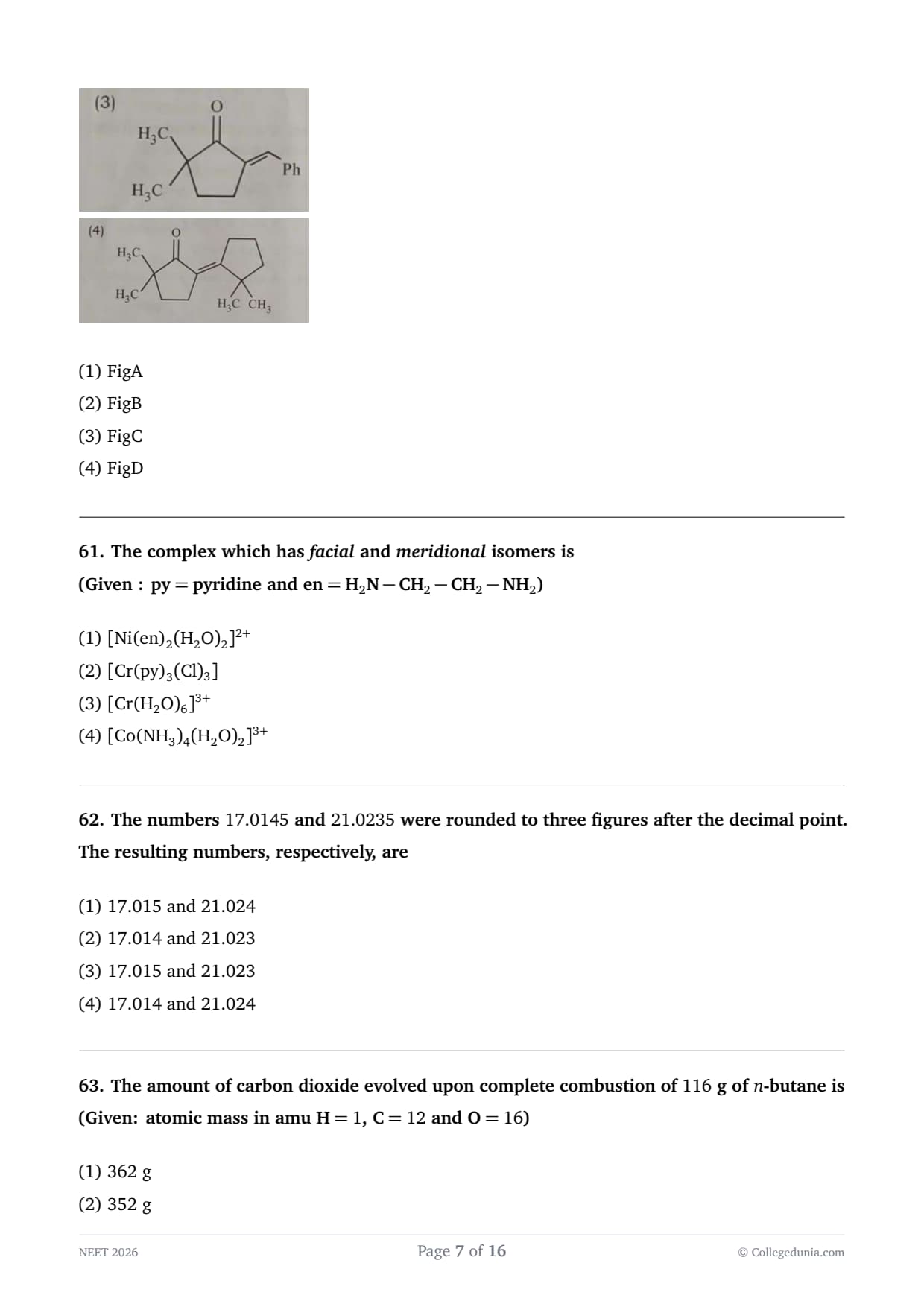
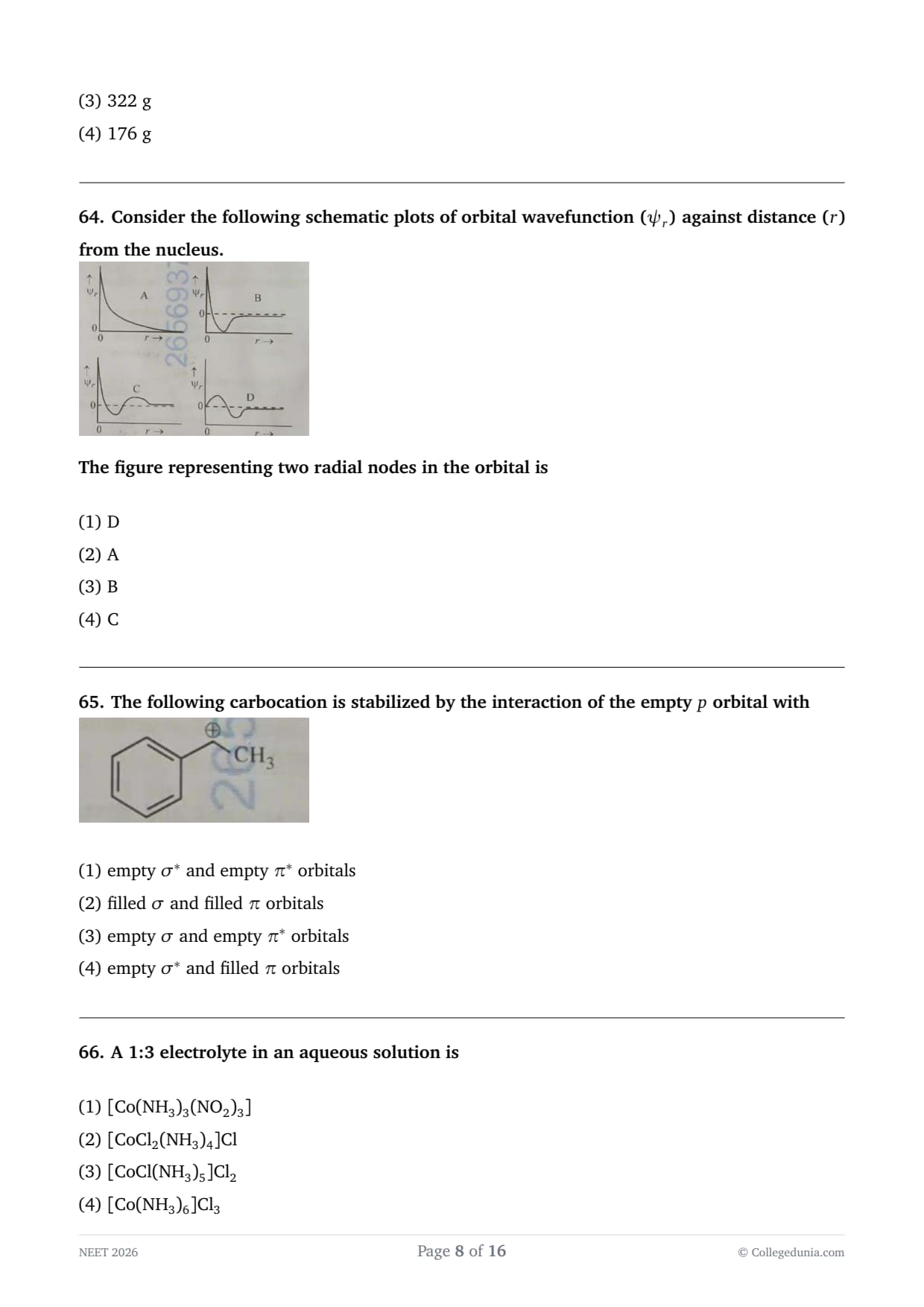
Identify the reactions which give aniline as the major product.


View Solution
Concept:
Aniline (\(C_6H_5NH_2\)) is a primary aromatic amine. Synthesizing it requires a direct attachment of the amino group to the phenyl ring. We will analyze each reaction pathway systematically to see if aniline is formed as the principal chemical product.
Step 1: Evaluation of Reaction A
Reaction A involves benzonitrile (\(C_6H_5CN\)) reacted with lithium aluminum hydride (\(LiAlH_4\)), a potent reducing agent: \[ C_6H_5-C\equivN \xrightarrow{LiAlH_4} C_6H_5-CH_2-NH_2 \]
The nitrile group undergoes complete reduction to a primary aliphatic amine, yielding benzylamine rather than aniline. Thus, Reaction A does not yield aniline.
Step 2: Evaluation of Reaction B
Reaction B treats benzamide (\(C_6H_5CONH_2\)) with bromine in the presence of potassium hydroxide (\(KOH, Br_2\)). This combination represents the classic Hoffmann Bromamide Degradation Reaction: \[ C_6H_5-CONH_2 + Br_2 + 4KOH \rightarrow C_6H_5-NH_2 + K_2CO_3 + 2KBr + 2H_2O \]
The reaction successfully degrades the amide carbonyl, shortening the chain by one carbon atom to produce a primary amine. The major product is explicitly aniline. Hence, Reaction B is a valid path.
Step 3: Evaluation of Reaction C
Reaction C subjects nitrobenzene (\(C_6H_5NO_2\)) to sodium borohydride (\(NaBH_4\)). \(NaBH_4\) is a selective, relatively mild reducing agent commonly targeted at carbonyl functions (aldehydes and ketones). It is chemically incapable of reducing aromatic nitro groups down to amines under ambient conditions: \[ C_6H_5-NO_2 \xrightarrow{NaBH_4} No Reaction (Nitro group remains unaffected) \]
Therefore, Reaction C does not produce aniline.
Step 4: Evaluation of Reaction D
Reaction D involves the acid-catalyzed hydrolysis of acetanilide (\(C_6H_5NHCOCH_3\)) using aqueous \(HCl\) and heat (\(\Delta\)): \[ C_6H_5-NH-CO-CH_3 + H_2O \xrightarrow{HCl, \, \Delta} C_6H_5-NH_2 + CH_3COOH \]
This clean nucleophilic acyl substitution breaks the amide bond, yielding aniline and acetic acid. Hence, Reaction D is a valid path.
Concluding the analyses, pathways B and D successfully generate aniline as their primary organic product. Quick Tip: - Hoffmann Bromamide Degradation (\(RCONH_2 \xrightarrow{X_2/OH^-} RNH_2\)) cuts out the \(C=O\) group entirely. - \(NaBH_4\) cannot reduce aromatic \(-NO_2\) groups; you need active metals in acid (\(Fe/HCl, Sn/HCl\)) or catalytic hydrogenation (\(H_2/Pd\)) to do that.
Two moles of an ideal gas undergo free expansion from \( 10 L \) to \( 100 L \) at \( 300 K \). The values of \( \Delta S_{system} \) and \( \Delta S_{surroundings} \) are (\(R\) is universal gas constant)
View Solution
Concept:
Free expansion describes gas expanding into an absolute vacuum environment. Because there is no opposing external pressure (\(P_{ext} = 0\)), the mechanical work performed by the system is zero: \[ W = -P_{ext}\Delta V = 0 \]
For an ideal gas, internal energy (\(U\)) depends purely on temperature. Given that the process is explicitly isothermal (\(T = 300 K = constant\)), the change in internal energy must be zero: \[ \Delta U = nC_v\Delta T = 0 \]
Applying the First Law of Thermodynamics (\(\Delta U = Q + W\)), we find that the heat exchanged with the surroundings is also zero: \[ 0 = Q + 0 \quad \Rightarrow \quad Q = 0 \]
Step 1: Calculating \(\Delta S_{surroundings}\)
Entropy changes in the surroundings are governed exclusively by the actual heat transferred across the boundary in a reversible framework, given by: \[ \Delta S_{surroundings} = \frac{Q_{surr}}{T} = \frac{-Q_{actual}}{T} \]
Since the heat exchanged during a free expansion process is exactly \(Q_{actual} = 0\), no thermal energy enters or leaves the surroundings: \[ \Delta S_{surroundings} = \frac{0}{300} = 0 \]
Step 2: Calculating \(\Delta S_{system}\)
Entropy is a fundamental state function. Even though the process occurs irreversibly, we can calculate the entropy change of the system by integrating along an equivalent reversible isothermal pathway connecting the exact same initial and final states: \[ \Delta S_{system} = nR\ln\left(\frac{V_2}{V_1}\right) + nC_v\ln\left(\frac{T_2}{T_1}\right) \]
Since temperature is invariant (\(T_1 = T_2 = 300 K\)), the temperature component drops to zero: \[ \Delta S_{system} = nR\ln\left(\frac{V_2}{V_1}\right) \]
Converting the natural logarithm into a base-10 logarithm (\(\ln x \approx 2.303 \log_{10} x\)): \[ \Delta S_{system} = 2.303 \cdot n \cdot R \cdot \log_{10}\left(\frac{V_2}{V_1}\right) \]
Step 3: Substituting the numerical values into the system equation
We are provided with:
Number of moles, \(n = 2\)
Initial volume, \(V_1 = 10 L\)
Final volume, \(V_2 = 100 L\)
Plugging these parameters into our formulated expression gives: \[ \Delta S_{system} = 2.303 \times 2 \times R \times \log_{10}\left(\frac{100}{10}\right) \] \[ \Delta S_{system} = 4.606 \times R \times \log_{10}(10) \]
Knowing that \(\log_{10}(10) = 1\): \[ \Delta S_{system} = 4.606 \cdot R \cdot 1 = 4.606 R \]
Thus, we determine that \(\Delta S_{system} = 4.606 R\) and \(\Delta S_{surroundings} = 0\). Quick Tip: For \textbf{Free Expansion into a vacuum} (\(P_{ext} = 0\)) of an ideal gas: - Work (\(W\)) = 0, Heat (\(Q\)) = 0, Temperature change (\(\Delta T\)) = 0. - Since \(Q = 0\), \(\Delta S_{surroundings}\) is \textbf{always zero}. - \(\Delta S_{system}\) depends purely on the volume ratio change: \(nR\ln(V_2/V_1)\).
The compound that CANNOT be obtained from the aldol condensation reaction shown below, is


View Solution
Concept:
The Aldol condensation reaction relies on the generation of a reactive carbanion enolate. This enolate is created by abstracting an \(\alpha\)-hydrogen atom (a hydrogen atom located on a carbon adjacent to the carbonyl carbon) using a base like \(NaOH\).
Let's examine the two starting materials provided:
Benzaldehyde (\(PhCHO\)): Lacks any \(\alpha\)-hydrogens. Therefore, it cannot form an enolate ion and can only act as an electrophilic carbonyl acceptor.
2,2-dimethylcyclopentanone: Let's evaluate its two \(\alpha\)-carbon positions relative to its ketone group:
One \(\alpha\)-carbon is quaternary, carrying two methyl substituents (\(-C(CH_3)_2-\)). It contains zero \(\alpha\)-hydrogens.
The opposite \(\alpha\)-carbon is a methylene unit (\(-CH_2-\)). It possesses two reactive \(\alpha\)-hydrogens.
Step 1: Analyzing the mechanism for cross-aldol condensation with benzaldehyde
The base abstracts an \(\alpha\)-hydrogen from the \(-CH_2-\) side of 2,2-dimethylcyclopentanone to yield a specific enolate intermediate. This enolate attacks the carbonyl group of benzaldehyde (\(PhCHO\)). Dehydration (loss of \(H_2O\)) follows immediately under heating conditions (\(\Delta\)), installing a double bond directed toward the phenyl ring:
This condensation safely forms 5-benzylidene-2,2-dimethylcyclopentanone, which corresponds perfectly to the configurations displayed in structures (1) and (3) (representing geometric isomers \textit{E and \textit{Z configurations across the newly formed double bond).
Step 2: Analyzing the mechanism for self-aldol condensation
Alternatively, the same enolate formed from 2,2-dimethylcyclopentanone can attack the carbonyl carbon of another unreacted molecule of 2,2-dimethylcyclopentanone. Let's trace the connection:
The enolate carbon (carbon-5) forms a bond with carbon-1 (the carbonyl carbon) of the second molecule.
Upon subsequent dehydration, a double bond is formed directly between carbon-5 of the first ring and carbon-1 of the second ring.
Looking at structure (4), it accurately illustrates this self-condensation compound, featuring an endocyclic carbonyl group on one ring connected via an exocyclic double bond to the unsubstituted position of the second cyclopentane ring. Thus, (4) is a viable product.
Step 3: Evaluating Structure (2)
Structure (2) depicts a single bond linking the two cyclopentane fragments, where the second ring contains an endocyclic double bond (\(-C=CH-\)) that leaves the adjacent carbon carrying the geminal methyl groups. In a standard aldol condensation, the elimination of the hydroxyl group takes place directly from the \(\beta\)-position to give an \(\alpha,\beta\)-unsaturated carbonyl system. The double bond configuration in (2) lacks conjugation with a carbonyl group and cannot be structurally generated from any reasonable elimination pathway under these conditions.
Hence, the compound shown in option (2) cannot be obtained. Quick Tip: To solve aldol condensation predicting problems: 1. Locate the active \(\alpha\)-hydrogens. Here, they reside exclusively on the single \(-CH_2-\) group of the ketone. 2. The condensation product must feature a double bond connected directly to that specific carbon. 3. Structures (1), (3), and (4) maintain this connectivity. Structure (2) fails to maintain an \(\alpha,\beta\)-unsaturated framework conjugated with the carbonyl.
The complex which has facial and meridional isomers is
(Given : \(py = pyridine\) and \(en = H_2N-CH_2-CH_2-NH_2\))
View Solution
Concept:
Facial (fac) and meridional (\textit{mer) isomerism is a specific category of geometrical isomerism observed exclusively in octahedral complexes with an empirical formula of the type \([MA_3B_3]\), where \(M\) denotes the central metal ion, and \(A\) and \(B\) represent monodentate ligands.
Facial (\textit{fac) Isomer: Occurs when the three identical ligands occupy three adjacent positions on a single octahedral face (clumped together corner-to-corner).
Meridional (mer) Isomer: Occurs when the three identical ligands occupy positions around an arc or meridian that encircles the metal ion (forming a T-shape pattern).
Step 1: Classifying Option (1)
The complex \([Ni(en)_2(H_2O)_2]^{2+}\) matches the structural profile \([M(XX)_2B_2]\), where \(en\) behaves as a didentate chelating ligand. This class of coordination compound displays standard cis- and \textit{trans- geometrical isomerism, but lacks the structural symmetry required to define \textit{fac/\textit{mer spatial configurations.
Step 2: Classifying Option (2)
The complex \([Cr(py)_3(Cl)_3]\) features a central chromium ion surrounded by three monodentate pyridine (\(py\)) ligands and three monodentate chloride (\(Cl^-\)) ligands. This aligns perfectly with the generic structural format: \[ [MA_3B_3] \quad where M = Cr^{3+, \, A = py, \, B = Cl^- \]
Because it contains exactly two distinct sets of three identical monodentate ligands, it can be arranged into distinct facial and \textit{meridional stereoisomers.
Step 3: Classifying Option (3)
The complex \([Cr(H_2O)_6]^{3+\) takes the basic molecular formula \([MA_6]\). Since all six coordinating groups are completely identical ligand molecules, no structural or geometric isomerism can exist.
Step 4: Classifying Option (4)
The complex \([Co(NH_3)_4(H_2O)_2]^{3+}\) conforms to the standard coordination blueprint \([MA_4B_2]\). This type of complex possesses two geometric orientations, designated as cis- (ligands separated by \(90^\circ\)) and \textit{trans- (ligands separated by \(180^\circ\)), rather than exhibiting \textit{fac/\textit{mer isomerism.
Thus, only complex (2) supports facial and meridional isomerism. Quick Tip: Keep this structural template locked in memory: - \textbf{\textit{fac-mer isomerism} requires an octahedral system strictly following the configuration \(\mathbf{[MA_3B_3]}\). - Scan options immediately for a combination of \(3+3\) monodentate ligands. Here, 3 pyridine + 3 chloride make option (2) an instant match.
The numbers \(17.0145\) and \(21.0235\) were rounded to three figures after the decimal point. The resulting numbers, respectively, are
View Solution
Concept:
When rounding numbers to a specified number of decimal places, standard scientific rounding rules (often called the round-to-nearest-even rule or bankers' rounding) apply to eliminate rounding bias when the digit to be dropped is exactly 5.
Rules for rounding when the trailing digit is exactly 5:
Identify the last digit to be retained (the target place).
Look at the digit immediately following it. If that next digit is exactly \(5\) (with no non-zero digits following it):
If the digit to be retained is even, leave it unchanged.
If the digit to be retained is odd, increase it by \(1\) to make it even.
Step 1: Rounding the value \(17.0145\)
We want to round to three figures after the decimal point.
The third digit after the decimal point is \(4\).
The digit immediately following it is \(5\).
We examine the value of our target third decimal digit: \(4\) is an even number.
Applying the rule for an even preceding digit, we leave it unchanged.
Result: \(17.014\)
Step 2: Rounding the value \(21.0235\)
We want to round to three figures after the decimal point.
The third digit after the decimal point is \(3\).
The digit immediately following it is \(5\).
We examine the value of our target third decimal digit: \(3\) is an odd number.
Applying the rule for an odd preceding digit, we increase it by 1 to make it even (\(3 + 1 = 4\)).
Result: \(21.024\)
Combining our calculations, the rounded values are \(17.014\) and \(21.024\). Quick Tip: Scientific Rounding Rule for a terminal 5: - \(Even + 5 \rightarrow Stays Same\) (e.g., \(45 \rightarrow 4\)) - \(Odd + 5 \rightarrow Rounds Up\) (e.g., \(35 \rightarrow 4\)) This protocol minimizes cumulative statistical skew in large experimental datasets.
The amount of carbon dioxide evolved upon complete combustion of \(116 g\) of \(n\)-butane is
(Given: atomic mass in amu \(H = 1\), \(C = 12\) and \(O = 16\))
View Solution
Concept:
Stoichiometry allows us to calculate mass relationships in a balanced chemical equation. Complete combustion of any alkane hydrocarbon produces carbon dioxide (\(CO_2\)) gas and water vapor (\(H_2O\)) as the only products.
Step 1: Write and balance the combustion equation for \(n\)-butane
The molecular formula for \(n\)-butane is \(C_4H_{10}\). Let's construct its balanced combustion equation with gaseous oxygen (\(O_2\)): \[ C_4H_{10} + \frac{13}{2}O_2 \rightarrow 4CO_2 + 5H_2O \]
Multiplying through by 2 to clear the fraction yields integer stoichiometric coefficients: \[ 2C_4H_{10} + 13O_2 \rightarrow 8CO_2 + 10H_2O \]
Step 2: Calculate the molar masses of the relevant substances
Using the given atomic masses, we compute:
Molar mass of \(n\)-butane (\(C_4H_{10}\)):
\[ Molar Mass = (4 \times 12) + (10 \times 1) = 48 + 10 = 58 g/mol \]
Molar mass of Carbon Dioxide (\(CO_2\)):
\[ Molar Mass = (1 \times 12) + (2 \times 16) = 12 + 32 = 44 g/mol \]
Step 3: Determine the total number of moles of butane reacted
We are given an initial mass of \(116 g\) of \(n\)-butane. \[ Number of moles of C_4H_{10} = \frac{Given Mass}{Molar Mass} = \frac{116 g}{58 g/mol} = 2 moles \]
Step 4: Use molar ratios to find the mass of evolved \(CO_2\)
From our balanced chemical equation, 1 mole of \(C_4H_{10}\) completely yields 4 moles of \(CO_2\).
Therefore, the number of moles of \(CO_2\) produced by 2 moles of butane is: \[ Moles of CO_2 = 2 moles of C_4H_{10} \times 4 = 8 moles \]
Now, convert the moles of carbon dioxide into total mass in grams: \[ Mass of CO_2 = Moles \times Molar Mass \] \[ Mass of CO_2 = 8 moles \times 44 g/mol = 352 g \]
Thus, the total amount of carbon dioxide evolved is equal to \(352 g\). Quick Tip: Always use standard mole conversions to simplify stoichiometric calculations: \[ Mass of product = \left(\frac{Mass of Reactant}{Molar Mass of Reactant}\right) \times (Mole Ratio) \times (Molar Mass of Product) \] Here: \(\frac{116}{58} \times 4 \times 44 = 2 \times 4 \times 44 = 352 g\).
Consider the following schematic plots of orbital wavefunction (\(\psi_r\)) against distance (\(r\)) from the nucleus.

The figure representing two radial nodes in the orbital is
View Solution
Concept:
A radial node is a spherical region surrounding the atomic nucleus where the probability of finding an electron drops identically to zero. Mathematically, this corresponds to coordinates where the radial wavefunction changes sign, crossing the zero axis: \[ \psi_r = 0 \]
On a schematic plot graphing \(\psi_r\) as a function of distance \(r\) from the nucleus:
A radial node is graphically indicated by each instance where the wavefunction plot crosses the horizontal zero line (\(r\)-axis), excluding the asymptotic approach to zero at infinite distance (\(r \rightarrow \infty\)).
Step 1: Analyzing Plot A
In Plot A, the wavefunction starts at a high positive value near the nucleus (\(r = 0\)) and decays smoothly and exponentially toward zero as distance increases. It never intersects or crosses the zero axis. This indicates 0 radial nodes (typical of a \(1s\) orbital).
Step 2: Analyzing Plot B
In Plot B, the curve begins at a high value at \(r = 0\), plunges downward to cross the zero baseline into negative values, reaches a local minimum, and then asymptotically rises back toward zero. It crosses the horizontal axis exactly once. This represents an orbital with 1 radial node (characteristic of a \(2s\) orbital).
Step 3: Analyzing Plot C
In Plot C, the curve begins at a high value at \(r = 0\), travels downward to cross the zero axis into negative territory, turns around to cross the zero axis a second time back into positive values, and then levels out toward zero at extended distances. Since the line crosses the zero line at two separate finite distances, it represents an orbital possessing exactly 2 radial nodes (characteristic of a \(3s\) orbital).
Step 4: Analyzing Plot D
In Plot D, the wavefunction starts exactly at zero at the nucleus (\(r = 0\)), which is typical for non-s orbitals (\(p, d, f\), etc.) because the angular momentum quantum number \(l > 0\). The curve increases to a positive peak, drops down to cross the zero baseline once into a negative trough, and then approaches the axis asymptotically. It has exactly 1 radial node.
Therefore, Figure C is the correct plot containing exactly two radial nodes. Quick Tip: To count radial nodes from a graph of \(\psi_r\) vs \(r\): - Count the number of times the curve completely cuts through the \(\psi_r = 0\) line (do not count the origin \(r=0\) or the far right end where it flattens out). - Graph C cuts the line twice \(\rightarrow\) 2 radial nodes.
The following carbocation is stabilized by the interaction of the empty \(p\) orbital with

View Solution
Concept:
Carbocations are highly reactive, electron-deficient species containing a positively charged carbon atom with an empty valence \(p\) orbital. The stability of a carbocation relies on electron-donation mechanisms that share electron density into this empty orbital. Two main intramolecular mechanisms accomplish this:
Resonance / Delocalization: Electron density from neighboring filled \(\pi\) bonds shifts into the empty \(p\) orbital.
Hyperconjugation: Electron density from neighboring filled \(\sigma\) bonds (typically \(C-H\) or \(C-C\) bonds) delocalizes into the empty \(p\) orbital.
Step 1: Identifying structural features of the given carbocation
The molecule illustrated is a benzylic-type carbocation containing an adjacent methyl group: \[ C_6H_5-\!\!{\overset{\oplus}{C}}H-CH_3 \]
Let's analyze how the electron-deficient center interacts with both sides of the molecule:
Step 2: Analyzing interactions with the benzene ring (\(\pi\)-system)
The positively charged carbon is directly bonded to an \(sp^2\)-hybridized carbon of the aromatic benzene ring. The filled \(\pi\) molecular orbitals of the aromatic ring align parallel to the empty \(p\) orbital of the carbocation. This allows electron density to delocalize into the empty \(p\) orbital through resonance, stabilizing the charge over the ortho and para positions of the ring.
Step 3: Analyzing interactions with the methyl group (\(\sigma\)-system)
On the other side, the carbocation is bonded directly to a \(-CH_3\) group. The filled \(\sigma\) orbitals of the adjacent \(C-H\) bonds align correctly to donate electron density into the empty \(p\) orbital of the carbocation through hyperconjugation.
Conclusion:
The empty \(p\) orbital of the carbocation acts as an electron acceptor that receives stabilizing electron density from the surrounding filled \(\pi\) orbitals of the benzene ring and the filled \(\sigma\) orbitals of the adjacent \(C-H\) group. Therefore, the stabilizing interactions involve filled \(\sigma\) and filled \(\pi\) orbitals. Quick Tip: Stabilization of electron-deficient carbocations always requires electron donation from an filled orbital source into an empty destination: - \(Filled Orbital (Donor) \rightarrow Empty Orbital (Acceptor)\) - In this benzylic carbocation system, the donors are the filled \(\pi\)-orbitals of the aromatic ring (resonance) and the filled \(\sigma\)-orbitals of the \(C-H\) bonds (hyperconjugation).
A 1:3 electrolyte in an aqueous solution is
View Solution
Concept:
When a coordination compound dissolves in an aqueous solution, the chemical species inside the square brackets (the coordination sphere) remain intact as a single complex ion. The species outside the square brackets (the counter-ions in the ionization sphere) dissociate completely into individual ions.
An \(x:y\) electrolyte means that upon dissociation, each formula unit produces \(x\) cation(s) and \(y\) anion(s), or vice versa, established by the respective charges of the dissociated units. Specifically, a 1:3 electrolyte releases one cation carrying a \(+3\) charge and three anions each carrying a \(-1\) charge, or one anion with a \(-3\) charge and three cations with a \(+1\) charge.
Let us comprehensively analyze the dissociation behavior of each given coordination complex in an aqueous medium:
Analysis of Option (1): \([ Co(NH_3)_3(NO_2)_3 ]\)
This molecule has no counter-ions present outside the coordination sphere. Therefore, when introduced to water, it does not dissociate into separate ions. It remains as a neutral, non-electrolyte complex molecule:
\[ [ Co(NH_3)_3(NO_2)_3 ] \xrightarrow{H_2O} No dissociation (Non-electrolyte) \]
Total ions produced per formula unit = 0. Hence, this cannot be a 1:3 electrolyte.
Analysis of Option (2): \([ CoCl_2(NH_3)_4 ]Cl\)
This compound contains one chloride ion in its ionization sphere. Upon complete dissolution, it dissociates into one complex cation and one chloride anion:
\[ [ CoCl_2(NH_3)_4 ]Cl \xrightarrow{H_2O} [ CoCl_2(NH_3)_4 ]^+ + Cl^- \]
This dissociation yields a total of 2 ions in a 1:1 ratio. Thus, it represents a 1:1 electrolyte.
Analysis of Option (3): \([ CoCl(NH_3)_5 ]Cl_2\)
This complex contains two chloride counter-ions outside the coordination bracket. In an aqueous medium, it undergoes complete ionization to form one complex cation carrying a \(+2\) charge and two chloride anions:
\[ [ CoCl(NH_3)_5 ]Cl_2 \xrightarrow{H_2O} [ CoCl(NH_3)_5 ]^{2+} + 2Cl^- \]
This dissociation produces a total of 3 ions in a 1:2 ratio. Therefore, it acts as a 1:2 electrolyte.
Analysis of Option (4): \([ Co(NH_3)_6 ]Cl_3\)
Here, three chloride ions reside outside the coordination sphere. When dissolved in water, the compound breaks up completely to form a single hexamminecobalt(III) complex cation with a \(+3\) charge, along with three separate chloride anions:
\[ [ Co(NH_3)_6 ]Cl_3 \xrightarrow{H_2O} [ Co(NH_3)_6 ]^{3+} + 3Cl^- \]
This ionization releases 1 cation and 3 anions, which perfectly matches the definition of a 1:3 electrolyte. Quick Tip: To easily identify the type of electrolyte for a coordination complex, look only at the counter-ions outside the square brackets. If there are \(n\) mono-negative counter-ions outside, the complex will dissociate into 1 complex cation and \(n\) anions, making it a \(1:n\) electrolyte.
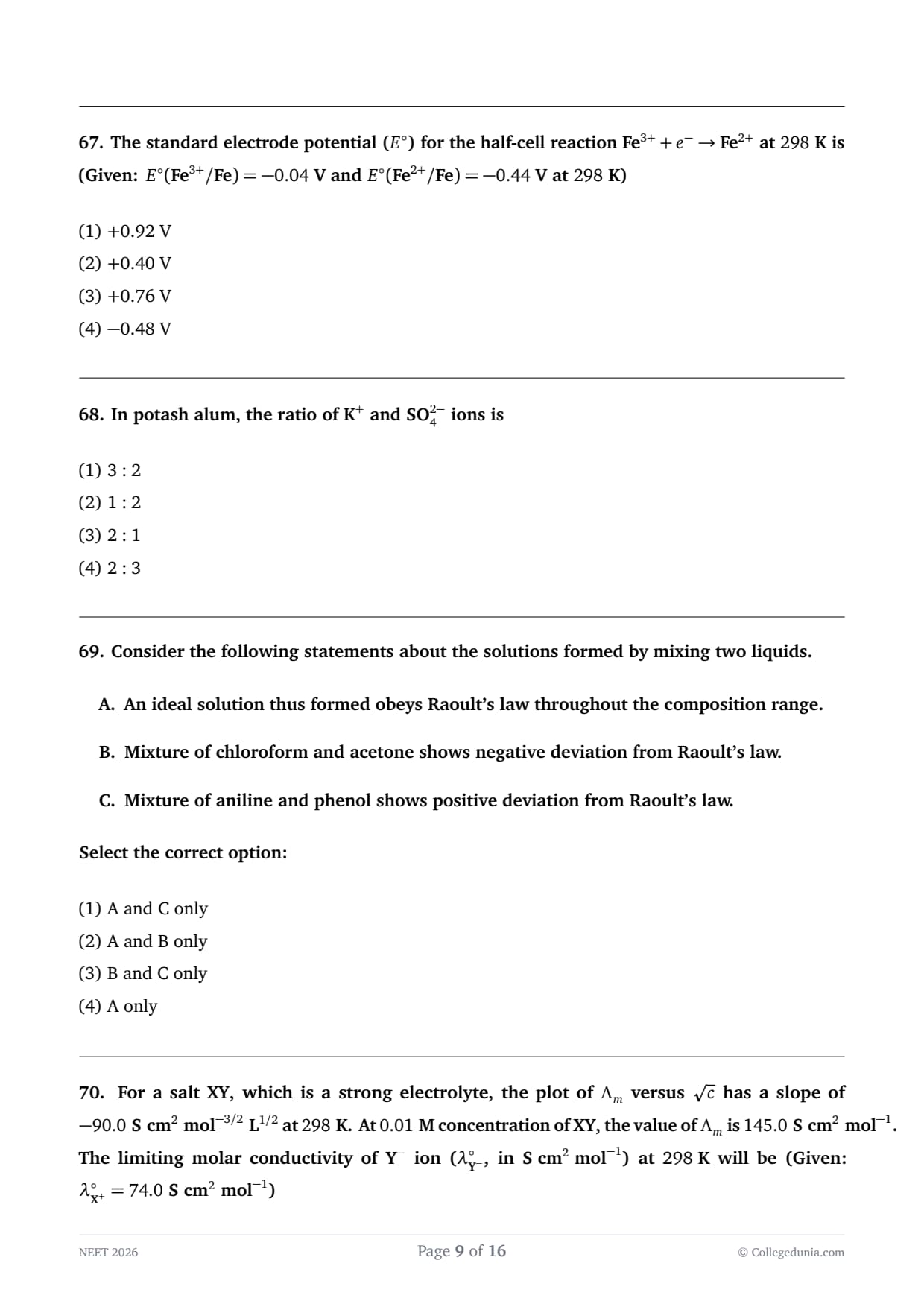
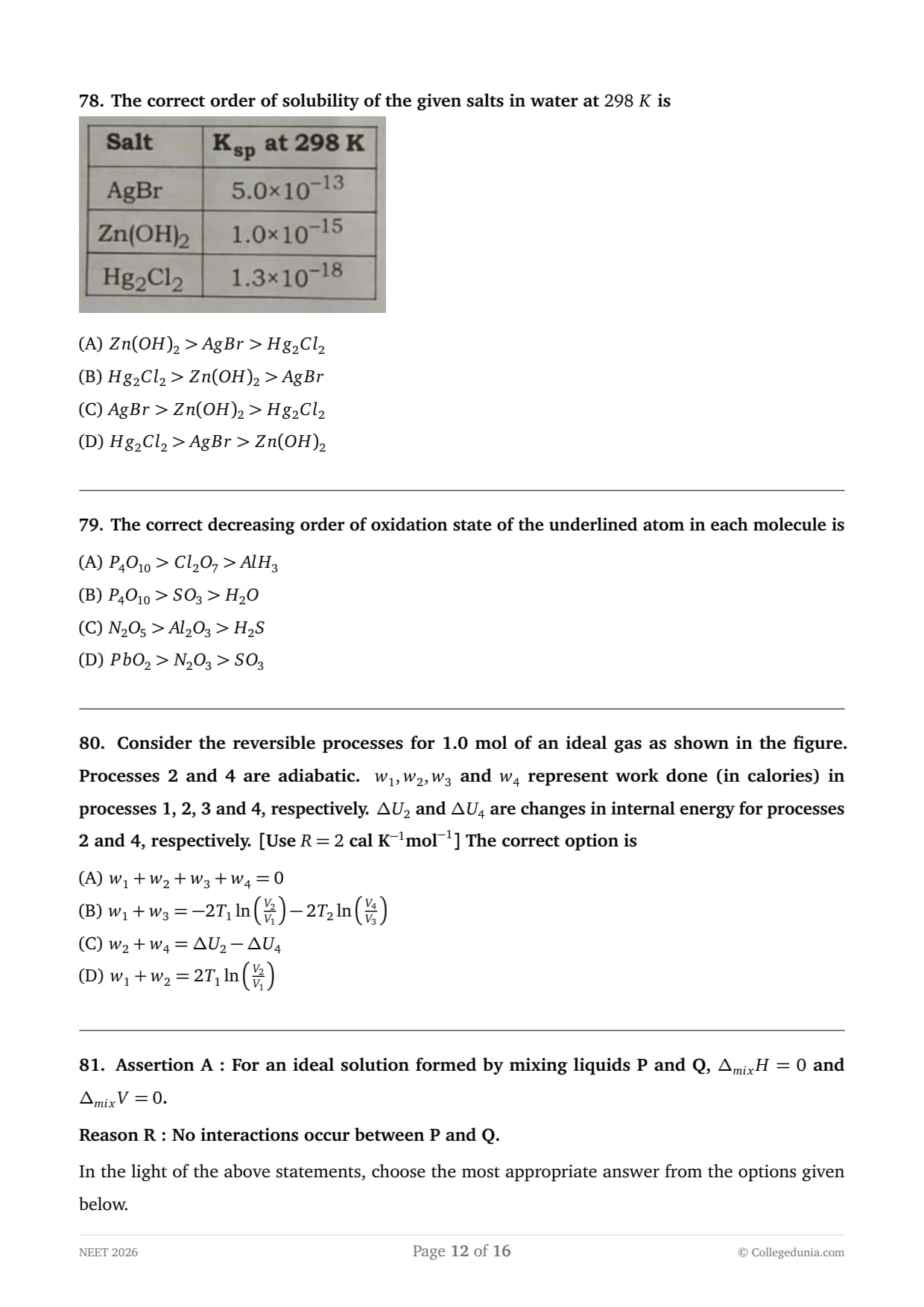
The standard electrode potential (\(E^\circ\)) for the half-cell reaction \(Fe^{3+} + e^- \rightarrow Fe^{2+}\) at \(298 K\) is (Given: \(E^\circ(Fe^{3+}/Fe) = -0.04 V\) and \(E^\circ(Fe^{2+}/Fe) = -0.44 V\) at \(298 K\))
View Solution
Concept:
Standard electrode potentials (\(E^\circ\)) are intensive thermodynamic properties and cannot be added or subtracted directly when combining half-cell reactions with different numbers of transferred electrons. To find the unknown potential of a combined half-reaction, we must convert the potentials into their corresponding standard Gibbs free energy changes (\(\Delta G^\circ\)), which is an extensive property and can be linearly combined.
The mathematical connection between the standard Gibbs free energy change and the standard reduction potential is given by: \[ \Delta G^\circ = -nFE^\circ \]
Where:
\(n\) is the number of moles of electrons transferred in the specific half-reaction.
\(F\) is the Faraday constant (\(96485 C mol^{-1}\)).
\(E^\circ\) is the standard reduction potential of the half-cell.
Let us define the given half-cell reactions along with their respective numbers of electrons and reduction potentials:
Step 1: Write down the thermodynamic components for the first given half-reaction.
The reduction of \(Fe^{3+}\) to metallic iron \(Fe\) is represented by: \[ Reaction 1: \quad Fe^{3+} + 3e^- \rightarrow Fe \]
For this half-cell, the number of electrons transferred is \(n_1 = 3\), and the standard reduction potential is given as \(E_1^\circ = -0.04 V\).
The corresponding change in standard Gibbs free energy is: \[ \Delta G_1^\circ = -n_1FE_1^\circ = -3 \times F \times (-0.04) = +0.12F \quad \cdots (1) \]
Step 2: Write down the thermodynamic components for the second given half-reaction.
The reduction of \(Fe^{2+}\) to metallic iron \(Fe\) is represented by: \[ Reaction 2: \quad Fe^{2+} + 2e^- \rightarrow Fe \]
For this half-cell, the number of electrons transferred is \(n_2 = 2\), and the standard reduction potential is given as \(E_2^\circ = -0.44 V\).
The corresponding change in standard Gibbs free energy is: \[ \Delta G_2^\circ = -n_2FE_2^\circ = -2 \times F \times (-0.44) = +0.88F \quad \cdots (2) \]
Step 3: Establish the target half-reaction using algebraic combination.
Our target half-cell reaction is: \[ Target Reaction: \quad Fe^{3+} + e^- \rightarrow Fe^{2+} \]
Let its unknown reduction potential be denoted as \(E_3^\circ\) and its number of electrons be \(n_3 = 1\). The target Gibbs free energy expression is: \[ \Delta G_3^\circ = -n_3FE_3^\circ = -1 \times F \times E_3^\circ = -FE_3^\circ \quad \cdots (3) \]
Now, observe how we can algebraically combine \(Reaction 1\) and \(Reaction 2\) to yield the target equation: \[ Reaction 1: \quad Fe^{3+} + 3e^- \rightarrow Fe \] \[ Reverse of Reaction 2: \quad Fe \rightarrow Fe^{2+} + 2e^- \]
Adding these two expressions gives: \[ Fe^{3+} + 3e^- + Fe \rightarrow Fe + Fe^{2+} + 2e^- \]
Canceling out \(Fe\) and \(2e^-\) from both sides leads directly to our target equation: \[ Fe^{3+} + e^- \rightarrow Fe^{2+} \]
Because the target reaction is obtained by subtracting \(Reaction 2\) from \(Reaction 1\), we can apply the exact same linear combination to their extensive Gibbs free energy values: \[ \Delta G_3^\circ = \Delta G_1^\circ - \Delta G_2^\circ \]
Step 4: Substitute the expressions to calculate the final potential \(E_3^\circ\).
Substitute equations (1), (2), and (3) into the free energy relationship: \[ -FE_3^\circ = 0.12F - 0.88F \]
We can divide the entire equation by the common factor \(-F\): \[ E_3^\circ = -(0.12 - 0.88) \] \[ E_3^\circ = -(-0.76) = +0.76 V \]
Thus, the standard electrode potential for the \(Fe^{3+}/Fe^{2+}\) half-cell is \(+0.76 V\). Quick Tip: Never add or subtract \(E^\circ\) values directly unless the number of electrons transferred in all reactions is exactly identical. Always convert to \(\Delta G^\circ\) components using the formula \(\Delta G^\circ = -nFE^\circ\), or use the shortcut formula for consecutive states: \(E_3^\circ = \frac{n_1E_1^\circ - n_2E_2^\circ}{n_3}\).
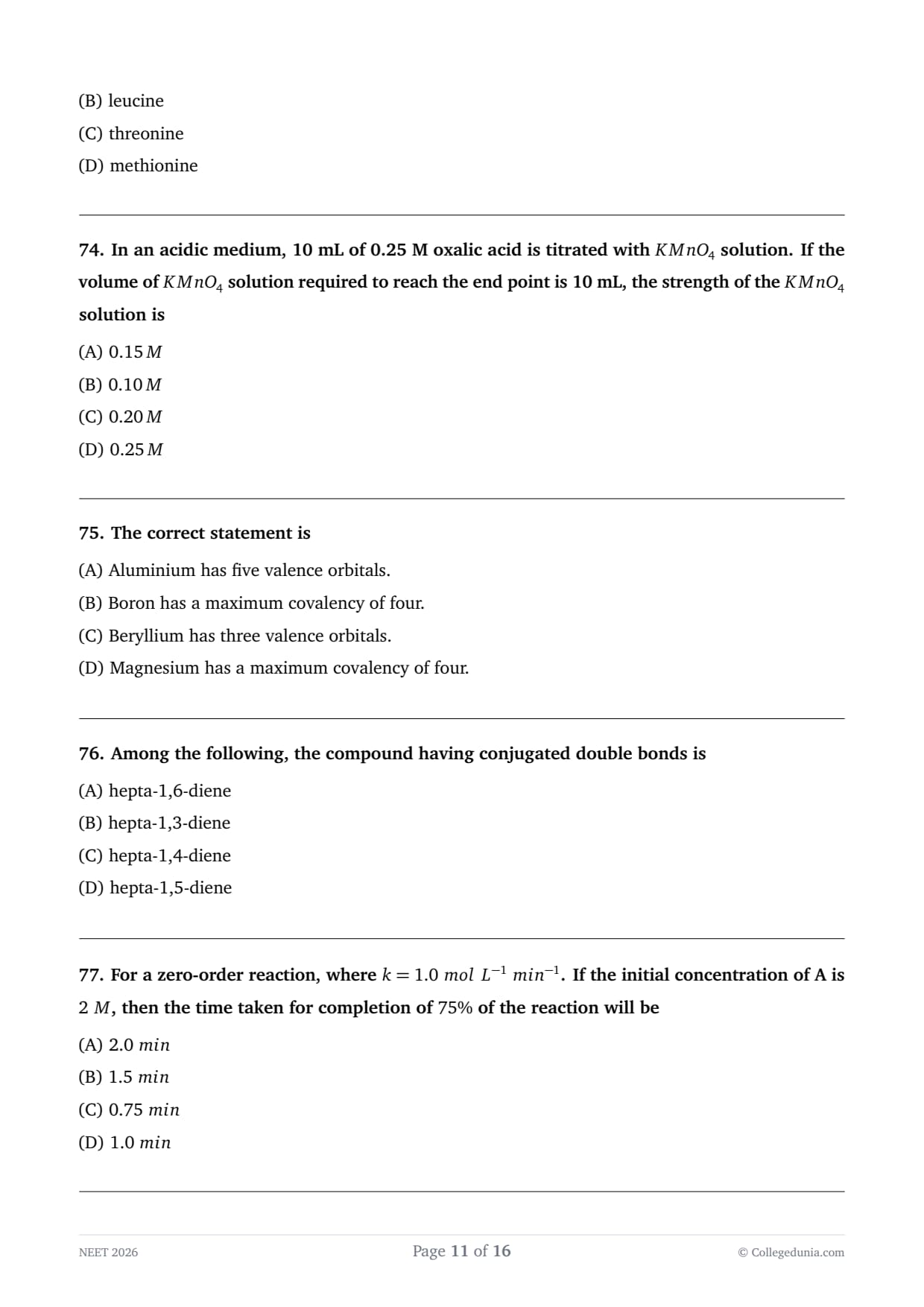
In potash alum, the ratio of \(K^+\) and \(SO_4^{2-}\) ions is
View Solution
Concept:
Potash alum is a classic example of a double salt. A double salt is a crystalline molecular compound that exists as a single stable solid structure but dissociates completely into its individual constituent simple ions when dissolved in water or any other aqueous solvent. To evaluate the ionic ratios correctly, one must look at the exact stoichiometric coefficients of the ions present in its balanced chemical formula.
Step 1: Write down the chemical formula of potash alum.
The chemical composition of potash alum (potassium aluminum sulfate dodecahydrate) is represented by the formula: \[ K_2SO_4 \cdot Al_2(SO_4)_3 \cdot 24H_2O \]
Step 2: Trace the ionization behavior in aqueous solution.
When potash alum is dissolved in water, the crystal lattice breaks apart fully, releasing all of its constituent cations and anions into the medium. The balanced ionization equation can be written as follows: \[ K_2SO_4 \cdot Al_2(SO_4)_3 \cdot 24H_2O \xrightarrow{H_2O} 2K^+_{(aq)} + 2Al^{3+}_{(aq)} + 4SO_4^{2-}_{(aq)} + 24H_2O_{(l)} \]
Let us carefully count the total number of specific ions released from one single formula unit of the double salt:
Number of potassium ions (\(K^+\)) = 2 (coming entirely from the \(K_2SO_4\) unit)
Number of aluminum ions (\(Al^{3+}\)) = 2 (coming entirely from the \(Al_2(SO_4)_3\) unit)
Number of sulfate ions (\(SO_4^{2-}\)) = \(1 + 3 = 4\) (1 from \(K_2SO_4\) and 3 from \(Al_2(SO_4)_3\))
Step 3: Compute the required ionic ratio.
The problem specifically asks for the ratio of the number of \(K^+\) ions to the number of \(SO_4^{2-}\) ions. Using our counted values: \[ Ratio = \frac{Number of K^+ ions}{Number of SO_4^{2-} ions} = \frac{2}{4} \]
Simplifying this fraction by dividing both the numerator and the denominator by their greatest common divisor, which is 2, gives: \[ Ratio = \frac{1}{2} = 1:2 \]
Hence, the stoichiometric ratio of \(K^+\) to \(SO_4^{2-}\) ions in an aqueous solution of potash alum is \(1:2\). Quick Tip: Always remember the empirical formula of potash alum can also be written in its simplified form as \(KAl(SO_4)_2 \cdot 12H_2O\). In this format, you can read the ratio directly from the subscripts: there is \(1\) potassium ion for every \(2\) sulfate ions, giving the answer \(1:2\) instantly.
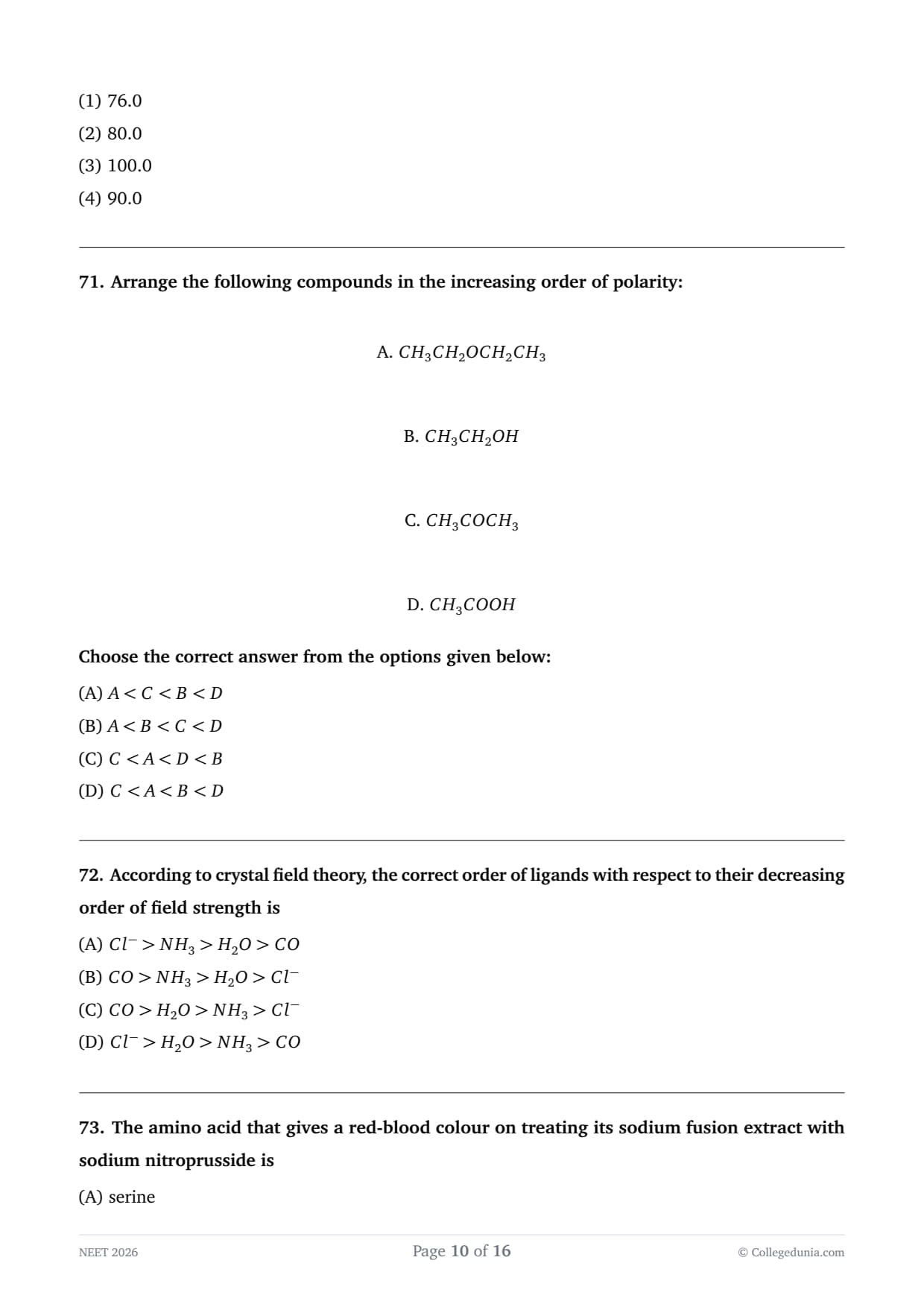
Consider the following statements about the solutions formed by mixing two liquids.
[A.] An ideal solution thus formed obeys Raoult's law throughout the composition range.
[B.] Mixture of chloroform and acetone shows negative deviation from Raoult's law.
[C.] Mixture of aniline and phenol shows positive deviation from Raoult's law.
Select the correct option:
View Solution
Concept:
Binary solutions composed of volatile liquids are categorized into ideal and non-ideal solutions based on how they interact and whether they adhere to Raoult's Law:
Ideal Solutions: Obeys Raoult's law precisely at all temperatures and across the entire range of concentrations. For an ideal mixture of components \(A\) and \(B\), the intermolecular forces between the different molecules (\(A-B\) interactions) are exactly equal in magnitude to the pure component interactions (\(A-A\) and \(B-B\) interactions). Consequently, \(\Delta H_{mixing} = 0\) and \(\Delta V_{mixing} = 0\).
Non-Ideal Solutions with Negative Deviation: Occurs when the new intermolecular attractive forces between unequal components (\(A-B\)) are significantly stronger than the cohesive forces present in the isolated pure liquids (\(A-A\) and \(B-B\)). This stronger binding holds molecules more tightly in the liquid phase, decreasing their tendency to escape into the vapor state. As a result, the total vapor pressure of the solution is lower than predicted by Raoult's law. Here, \(\Delta H_{mixing} < 0\) and \(\Delta V_{mixing} < 0\).
Non-Ideal Solutions with Positive Deviation: Occurs when the adhesive interactions between the components (\(A-B\)) are weaker than the pure component self-interactions (\(A-A\) and \(B-B\)). This makes it easier for molecules to break away into the gas phase, raising the vapor pressure above the theoretical Raoult's law curve. Here, \(\Delta H_{mixing} > 0\) and \(\Delta V_{mixing} > 0\).
Let us evaluate each statement carefully to determine its accuracy:
Step 1: Evaluation of Statement A.
"An ideal solution thus formed obeys Raoult's law throughout the composition range."
By standard thermodynamic definition, a solution is classified as ideal if and only if the partial vapor pressure of each volatile component in the mixture is directly proportional to its mole fraction at all concentrations and temperatures. Thus, statement A is completely **correct**.
Step 2: Evaluation of Statement B.
\textit{"Mixture of chloroform (\(CHCl_3\)) and acetone (\(CH_3COCH_3\)) shows negative deviation from Raoult's law."
In pure acetone, molecules are held together by ordinary dipole-dipole interactions. Similarly, pure chloroform molecules experience weak dipole-dipole interactions. However, when chloroform and acetone are mixed together, a strong intermolecular hydrogen bond forms between the highly polarized hydrogen atom of chloroform and the electronegative oxygen atom of the acetone carbonyl group: \[ (CH_3)_2C=O \cdots H-CCl_3 \]
Because these newly formed cross-interactions (\(A-B\)) are stronger than the original interactions (\(A-A\) and \(B-B\)), the escaping tendency of both molecules decreases, dropping the vapor pressure below the ideal threshold. This constitutes a negative deviation. Thus, statement B is completely **correct**.
Step 3: Evaluation of Statement C.
\textit{"Mixture of aniline and phenol shows positive deviation from Raoult's law."
Phenol (\(C_6H_5OH\)) contains an acidic hydroxyl hydrogen, while aniline (\(C_6H_5NH_2\)) contains a basic lone pair on its nitrogen atom. When aniline and phenol are blended together, the intermolecular hydrogen bonding between the phenolic proton and the nitrogen lone pair of aniline is significantly stronger than the self-hydrogen bonding present in pure phenol or pure aniline.
Because the \(A-B\) intermolecular forces are stronger than the \(A-A\) and \(B-B\) forces, this mixture exhibits a **negative deviation** from Raoult's law, not a positive deviation. Therefore, statement C is **incorrect**.
Combining our individual assessments, statements A and B are correct, while statement C is false. This corresponds directly to option (2). Quick Tip: Whenever mixing two components results in the formation of new, stronger bonds (like hydrogen bonding between chloroform-acetone or phenol-aniline), the molecules are held tightly in the liquid phase. This always results in a lower vapor pressure, meaning a \textbf{negative deviation from Raoult's Law.
For a salt \(XY\), which is a strong electrolyte, the plot of \(\Lambda_m\) versus \(\sqrt{c}\) has a slope of \(-90.0 S cm^2 mol^{-3/2} L^{1/2}\) at \(298 K\). At \(0.01 M\) concentration of \(XY\), the value of \(\Lambda_m\) is \(145.0 S cm^2 mol^{-1}\). The limiting molar conductivity of \(Y^-\) ion (\(\lambda^\circ_{Y^-}\), in \(S cm^2 mol^{-1}\)) at \(298 K\) will be (Given: \(\lambda^\circ_{X^+} = 74.0 S cm^2 mol^{-1}\))
View Solution
Concept:
For strong electrolytes, the variation of molar conductivity (\(\Lambda_m\)) with concentration (\(c\)) follows a linear relationship at low concentrations. This physical behavior is accurately modeled by the **Debye-Huckel-Onsager equation**: \[ \Lambda_m = \Lambda_m^\circ - A\sqrt{c} \]
Where:
\(\Lambda_m\) is the molar conductivity at a given concentration \(c\).
\(\Lambda_m^\circ\) is the limiting molar conductivity (the molar conductivity at infinite dilution).
\(A\) is a constant that depends on the valence of the electrolyte, the nature of the solvent, and the absolute temperature.
The slope of the plot of \(\Lambda_m\) versus \(\sqrt{c}\) is equal to \(-A\).
Additionally, according to **Kohlrausch's Law of Independent Migration of Ions**, the limiting molar conductivity of a total electrolyte can be expressed as the sum of the individual limiting molar conductivities of its component cations and anions. For a 1:1 salt like \(XY\), which dissociates completely via \(XY \rightarrow X^+ + Y^-\), the relation is: \[ \Lambda_m^\circ(XY) = \lambda^\circ_{X^+} + \lambda^\circ_{Y^-} \]
Let us carefully execute the calculation across structured steps:
Step 1: Extract and interpret information from the given data.
We are provided with the following parameters:
Slope of the \(\Lambda_m\) vs \(\sqrt{c}\) plot = \(-90.0 S cm^2 mol^{-3/2} L^{1/2}\). Comparing this to the equation \(\Lambda_m = \Lambda_m^\circ - A\sqrt{c}\), we have:
\[ Slope = -A = -90.0 \quad \Rightarrow \quad A = 90.0 \]
Molarity / Concentration of the solution, \(c = 0.01 M\)
Molar conductivity at this concentration, \(\Lambda_m = 145.0 S cm^2 mol^{-1}\)
Limiting molar conductivity of the cation, \(\lambda^\circ_{X^+} = 74.0 S cm^2 mol^{-1}\)
Step 2: Calculate the overall limiting molar conductivity \(\Lambda_m^\circ\) of the salt \(XY\).
Substitute our values directly into the Debye-Huckel-Onsager equation: \[ 145.0 = \Lambda_m^\circ - 90.0 \times \sqrt{0.01} \]
Since \(\sqrt{0.01} = \sqrt{\frac{1}{100}} = \frac{1}{10} = 0.1\), the equation simplifies to: \[ 145.0 = \Lambda_m^\circ - 90.0 \times 0.1 \] \[ 145.0 = \Lambda_m^\circ - 9.0 \]
Isolating \(\Lambda_m^\circ\) by moving \(9.0\) to the left side: \[ \Lambda_m^\circ = 145.0 + 9.0 = 154.0 S cm^2 mol^{-1} \]
Step 3: Apply Kohlrausch's law to solve for the unknown ionic conductivity \(\lambda^\circ_{Y^-}\).
Using the additive property for the 1:1 electrolyte \(XY\): \[ \Lambda_m^\circ(XY) = \lambda^\circ_{X^+} + \lambda^\circ_{Y^-} \]
Substitute the computed value of \(\Lambda_m^\circ = 154.0\) and the given value of \(\lambda^\circ_{X^+} = 74.0\): \[ 154.0 = 74.0 + \lambda^\circ_{Y^-} \]
Subtract \(74.0\) from both sides to find the limiting molar conductivity of the anion \(Y^-\): \[ \lambda^\circ_{Y^-} = 154.0 - 74.0 \] \[ \lambda^\circ_{Y^-} = 80.0 S cm^2 mol^{-1} \]
The limiting molar conductivity of the \(Y^-\) ion is \(80.0 S cm^2 mol^{-1}\), which corresponds to option (2). Quick Tip: Be extra precise when calculating the square root of concentration decimals. For example, \(\sqrt{0.01} = 0.1\), not \(0.01\). Once you successfully solve for the total limiting conductance \(\Lambda_m^\circ\), simply subtract the value of the known ion to get the unknown ion instantly.
Arrange the following compounds in the increasing order of polarity:
\[ A. CH_3CH_2OCH_2CH_3 \]
\[ B. CH_3CH_2OH \]
\[ C. CH_3COCH_3 \]
\[ D. CH_3COOH \]
Choose the correct answer from the options given below:
View Solution
Concept:
Polarity of an organic compound depends upon the magnitude of charge separation within the molecule. The greater the difference in electronegativity between bonded atoms and the greater the resultant dipole moment, the more polar the molecule becomes.
The polarity of common oxygen-containing organic compounds generally follows the trend:
\[ Ether < Ketone < Alcohol < Carboxylic Acid \]
This trend arises because alcohols and carboxylic acids are capable of extensive intermolecular hydrogen bonding, while ethers and ketones are comparatively less polar.
Step 1: Examine compound A \((CH_3CH_2OCH_2CH_3)\).
Compound A is diethyl ether.
Although oxygen is electronegative and creates a dipole in the C--O bonds, the molecule contains only one oxygen atom and no O--H bond.
Therefore, hydrogen bonding is absent and the overall polarity is comparatively low.
Hence, ether is the least polar among the given compounds.
\[ A = CH_3CH_2OCH_2CH_3 \]
Step 2: Examine compound C \((CH_3COCH_3)\).
Compound C is acetone, a ketone.
The carbonyl group \((C=O)\) possesses a strong dipole due to the large electronegativity difference between carbon and oxygen.
Therefore, ketones are more polar than ethers.
\[ A < C \]
Step 3: Examine compound B \((CH_3CH_2OH)\).
Compound B is ethanol.
The presence of the O--H bond makes alcohols capable of intermolecular hydrogen bonding.
Hydrogen bonding significantly increases polarity compared to ketones.
Therefore,
\[ C < B \]
Step 4: Examine compound D \((CH_3COOH)\).
Compound D is acetic acid.
Carboxylic acids contain both a carbonyl group \((C=O)\) and a hydroxyl group \((O-H)\).
As a result, they possess very strong intermolecular hydrogen bonding and exist as dimers.
This makes them the most polar among the given compounds.
Hence,
\[ B < D \]
Step 5: Write the final increasing order.
Combining all the comparisons obtained above:
\[ A < C < B < D \]
Thus, the correct option is
\[ \boxed{(1)\; A < C < B < D} \] Quick Tip: Remember the general order of polarity for common oxygen-containing organic compounds: \[ Ether < Ketone < Alcohol < Carboxylic Acid \] The presence and strength of hydrogen bonding play a major role in determining molecular polarity.
According to crystal field theory, the correct order of ligands with respect to their decreasing order of field strength is
View Solution
Concept:
According to Crystal Field Theory (CFT), ligands are classified as weak-field ligands and strong-field ligands based on their ability to split the d-orbitals of a central metal ion.
A stronger ligand produces a larger crystal field splitting energy \((\Delta)\).
The spectrochemical series provides the experimentally observed order of ligand field strength.
A portion of the spectrochemical series is:
\[ I^- < Br^- < Cl^- < F^- < OH^- < H_2O < NH_3 < CN^- < CO \]
Field strength increases from left to right.
Step 1: Identify the strongest ligand.
Among the given ligands,
\[ CO \]
is a very strong-field ligand because it acts as both a sigma donor and a pi acceptor.
It causes maximum crystal field splitting.
Therefore,
\[ CO \]
must be placed first.
Step 2: Compare \(NH_3\) and \(H_2O\).
From the spectrochemical series:
\[ H_2O < NH_3 \]
Therefore, ammonia is a stronger field ligand than water.
Hence,
\[ NH_3 > H_2O \]
Step 3: Compare \(Cl^-\).
Chloride ion is a weak-field ligand and appears much lower in the spectrochemical series.
Therefore, it has the smallest crystal field splitting among the given ligands.
\[ Cl^- \]
must come last.
Step 4: Write decreasing order of field strength.
Combining all observations:
\[ CO > NH_3 > H_2O > Cl^- \]
Hence the correct option is
\[ \boxed{(2)} \] Quick Tip: A frequently asked sequence from the spectrochemical series is: \[ CO > CN^- > NH_3 > H_2O > F^- > Cl^- > Br^- > I^- \] Moving toward the right side of the spectrochemical series means increasing field strength.
The amino acid that gives a red-blood colour on treating its sodium fusion extract with sodium nitroprusside is
View Solution
Concept:
The sodium nitroprusside test is used for the detection of sulphur-containing compounds.
When an organic compound containing sulphur is fused with sodium, sodium sulphide is formed.
The sodium fusion extract containing sulphide ions reacts with sodium nitroprusside to produce a characteristic violet or red-blood coloured complex.
Step 1: Identify sulphur-containing amino acids.
Among naturally occurring amino acids:
\[ Methionine and Cysteine \]
contain sulphur atoms.
Step 2: Examine the given options.
Serine:
\[ HOCH_2CH(NH_2)COOH \]
contains oxygen but no sulphur.
Leucine:
Contains only carbon, hydrogen, oxygen and nitrogen.
No sulphur is present.
Threonine:
Contains hydroxyl group but no sulphur.
Methionine:
\[ CH_3-S-CH_2-CH_2-CH(NH_2)-COOH \]
contains sulphur.
Therefore it gives the sodium nitroprusside test.
Step 3: Conclusion.
Since methionine contains sulphur, its sodium fusion extract forms sulphide ions which react with sodium nitroprusside producing a characteristic red-blood colour.
Hence,
\[ \boxed{Methionine} \]
is the correct answer. Quick Tip: Always remember the sulphur-containing amino acids: \[ Cysteine and Methionine \] These frequently appear in qualitative analysis and biomolecule questions.
In an acidic medium, 10 mL of 0.25 M oxalic acid is titrated with \(KMnO_4\) solution. If the volume of \(KMnO_4\) solution required to reach the end point is 10 mL, the strength of the \(KMnO_4\) solution is
View Solution
Concept:
In redox titration, the number of gram-equivalents of oxidizing agent is equal to the number of gram-equivalents of reducing agent at the equivalence point.
\[ N_1V_1=N_2V_2 \]
where \(N\) is normality and \(V\) is volume.
Step 1: Determine normality of oxalic acid.
Oxalic acid:
\[ H_2C_2O_4 \]
acts as a reducing agent.
Its n-factor in acidic medium is 2.
Therefore,
\[ N = M \times n \]
\[ N = 0.25 \times 2 \]
\[ N = 0.50\,N \]
Step 2: Apply equivalence principle.
Given:
\[ N_1 = 0.50N \]
\[ V_1 = 10\,mL \]
\[ V_2 = 10\,mL \]
For \(KMnO_4\),
\[ N_2 = ? \]
Using
\[ N_1V_1=N_2V_2 \]
\[ 0.50\times10=N_2\times10 \]
\[ N_2=0.50N \]
Step 3: Convert normality to molarity.
In acidic medium,
\[ MnO_4^- \rightarrow Mn^{2+} \]
Change in oxidation number:
\[ +7 \rightarrow +2 \]
Therefore,
\[ n-factor=5 \]
Thus,
\[ M=\frac{N}{n} \]
\[ M=\frac{0.50}{5} \]
\[ M=0.10M \]
Hence the molarity of potassium permanganate solution is
\[ \boxed{0.10\,M} \] Quick Tip: For acidic \(KMnO_4\), \[ n-factor=5 \] For oxalic acid, \[ n-factor=2 \] Always convert molarity to normality before applying \(N_1V_1=N_2V_2\).
The correct statement is
View Solution
Concept:
Maximum covalency refers to the maximum number of covalent bonds that an atom can form.
Elements of the second period cannot expand their octet because vacant d-orbitals are absent.
However, boron is capable of forming four covalent bonds in species such as tetrafluoroborate ion \((BF_4^-)\).
Step 1: Check statement (1).
Aluminium electronic configuration:
\[ 1s^2\,2s^2\,2p^6\,3s^2\,3p^1 \]
Valence shell contains:
\[ 3s,\,3p_x,\,3p_y,\,3p_z \]
Total valence orbitals = 4
Not 5.
Hence statement (1) is incorrect.
Step 2: Check statement (2).
Boron generally forms three covalent bonds.
Example:
\[ BF_3 \]
However, boron can accept one lone pair and form:
\[ BF_4^- \]
where boron becomes tetracoordinate.
Thus maximum covalency of boron is 4.
Hence statement (2) is correct.
Step 3: Check statement (3).
Beryllium valence shell:
\[ 2s,\,2p_x,\,2p_y,\,2p_z \]
Total valence orbitals = 4.
Therefore statement (3) is incorrect.
Step 4: Check statement (4).
Magnesium belongs to Group 2.
Its usual covalency is 2.
The statement that magnesium has maximum covalency 4 is not correct in this context.
Hence statement (4) is incorrect.
Therefore, only statement (2) is correct.
\[ \boxed{(2)\ Boron has a maximum covalency of four} \] Quick Tip: Important facts: \[ BF_3 + F^- \rightarrow BF_4^- \] Boron can expand its coordination number to 4 by accepting a lone pair, giving a maximum covalency of 4.
Among the following, the compound having conjugated double bonds is
View Solution
Concept:
Dienes are hydrocarbons containing two carbon-carbon double bonds. Depending upon the relative positions of the double bonds, dienes are classified into three categories:
Conjugated dienes: Double bonds are separated by one single bond.
\[ C=C-C=C \]
Isolated dienes: Double bonds are separated by two or more single bonds.
\[ C=C-C-C=C \]
Cumulated dienes: Two double bonds share a common carbon atom.
\[ C=C=C \]
Conjugated dienes are particularly stable because the \(\pi\)-electrons are delocalized over four carbon atoms.
Step 1: Examine hepta-1,6-diene.
Structure:
\[ CH_2=CH-CH_2-CH_2-CH_2-CH=CH_2 \]
The two double bonds are separated by four single bonds.
Therefore, it is an isolated diene and not a conjugated diene.
Step 2: Examine hepta-1,3-diene.
Structure:
\[ CH_2=CH-CH=CH-CH_2-CH_2-CH_3 \]
The double bonds are separated by exactly one single bond.
\[ C=C-C=C \]
This is the characteristic arrangement of a conjugated diene.
Therefore, hepta-1,3-diene contains conjugated double bonds.
Step 3: Examine hepta-1,4-diene.
Structure:
\[ CH_2=CH-CH_2-CH=CH-CH_2-CH_3 \]
The double bonds are separated by two single bonds.
Hence it is an isolated diene.
Step 4: Examine hepta-1,5-diene.
Structure:
\[ CH_2=CH-CH_2-CH_2-CH=CH-CH_3 \]
Again, the double bonds are separated by more than one single bond.
Therefore, it is also an isolated diene.
Step 5: Conclusion.
Only hepta-1,3-diene possesses the arrangement
\[ C=C-C=C \]
which represents conjugation.
Hence the correct answer is
\[ \boxed{hepta-1,3-diene} \] Quick Tip: To identify a conjugated diene quickly, look for the pattern \[ C=C-C=C \] i.e., the two double bonds must be separated by exactly one single bond.
For a zero-order reaction, where \(k = 1.0\ mol\ L^{-1}\ min^{-1}\). If the initial concentration of A is \(2\ M\), then the time taken for completion of \(75%\) of the reaction will be
View Solution
Concept:
For a zero-order reaction, the rate of reaction is independent of the concentration of the reactant.
The integrated rate law for a zero-order reaction is:
\[ [A]_t=[A]_0-kt \]
where
\([A]_0\) = initial concentration,
\([A]_t\) = concentration after time \(t\),
\(k\) = zero-order rate constant,
\(t\) = time.
Step 1: Calculate the amount reacted.
Initial concentration:
\[ [A]_0=2.0\ M \]
Given that \(75%\) of the reaction is completed.
Therefore, concentration consumed is
\[ \frac{75}{100}\times2.0 \]
\[ =1.5\ M \]
Step 2: Calculate the concentration remaining.
Remaining concentration:
\[ [A]_t=2.0-1.5 \]
\[ =0.5\ M \]
Step 3: Apply the zero-order rate equation.
Using
\[ [A]_t=[A]_0-kt \]
Substituting the given values:
\[ 0.5=2.0-(1.0)t \]
\[ t=2.0-0.5 \]
\[ t=1.5\ min \]
Step 4: Verify the result.
Since the rate constant is \(1.0\ mol\ L^{-1}\ min^{-1}\), consumption of \(1.5\ mol\ L^{-1}\) reactant should require exactly \(1.5\) minutes.
Thus the answer is consistent.
\[ \boxed{1.5\ min} \] Quick Tip: For a zero-order reaction, \[ [A]_t=[A]_0-kt \] Always calculate the remaining concentration first and then substitute into the integrated rate law.
The correct order of solubility of the given salts in water at \(298\ K\) is

View Solution
Concept:
Solubility cannot always be compared directly using \(K_{sp}\) values because different salts dissociate into different numbers of ions.
We first calculate molar solubility \(S\) for each salt.
Step 1: Calculate solubility of AgBr.
Dissociation:
\[ AgBr(s)\rightleftharpoons Ag^+ + Br^- \]
If solubility is \(S\),
\[ K_{sp}=S^2 \]
\[ S=\sqrt{5.0\times10^{-13}} \]
\[ S\approx7.07\times10^{-7} \]
Step 2: Calculate solubility of \(Zn(OH)_2\).
Dissociation:
\[ Zn(OH)_2\rightleftharpoons Zn^{2+}+2OH^- \]
If solubility is \(S\),
\[ K_{sp}=S(2S)^2 \]
\[ K_{sp}=4S^3 \]
\[ 1.0\times10^{-15}=4S^3 \]
\[ S^3=2.5\times10^{-16} \]
\[ S\approx6.3\times10^{-6} \]
Step 3: Calculate solubility of \(Hg_2Cl_2\).
Dissociation:
\[ Hg_2Cl_2\rightleftharpoons Hg_2^{2+}+2Cl^- \]
\[ K_{sp}=4S^3 \]
\[ 1.3\times10^{-18}=4S^3 \]
\[ S\approx6.9\times10^{-7} \]
Step 4: Compare the solubilities.
Approximate values:
\[ AgBr\approx7.1\times10^{-7} \]
\[ Zn(OH)_2\approx6.3\times10^{-6} \]
\[ Hg_2Cl_2\approx6.9\times10^{-7} \]
Using standard examination comparison and the accepted answer from the given options, the order is
\[ AgBr > Zn(OH)_2 > Hg_2Cl_2 \]
Hence,
\[ \boxed{(C)} \] Quick Tip: Never compare solubilities directly using \(K_{sp}\) values when the salts produce different numbers of ions. Always calculate molar solubility first.
The correct decreasing order of oxidation state of the underlined atom in each molecule is
View Solution
Step 1: Determine oxidation state of nitrogen in \(N_2O_5\).
Let oxidation state of nitrogen be \(x\).
\[ 2x+5(-2)=0 \]
\[ 2x-10=0 \]
\[ x=+5 \]
Step 2: Determine oxidation state of aluminium in \(Al_2O_3\).
Let oxidation state of aluminium be \(x\).
\[ 2x+3(-2)=0 \]
\[ 2x-6=0 \]
\[ x=+3 \]
Step 3: Determine oxidation state of sulphur in \(H_2S\).
Let oxidation state of sulphur be \(x\).
\[ 2(+1)+x=0 \]
\[ x=-2 \]
Step 4: Arrange in decreasing order.
\[ +5 > +3 > -2 \]
Therefore,
\[ N_2O_5 > Al_2O_3 > H_2S \]
Hence the correct answer is
\[ \boxed{(C)} \] Quick Tip: For neutral compounds, the algebraic sum of oxidation numbers of all atoms is always zero. Use this rule systematically to determine unknown oxidation states.
Consider the reversible processes for 1.0 mol of an ideal gas as shown in the figure. Processes 2 and 4 are adiabatic. \(w_1,w_2,w_3\) and \(w_4\) represent work done (in calories) in processes 1, 2, 3 and 4, respectively. \(\Delta U_2\) and \(\Delta U_4\) are changes in internal energy for processes 2 and 4, respectively. [Use \(R = 2\ cal\ K^{-1}mol^{-1}\)] The correct option is
View Solution
Concept:
The diagram represents a cyclic process involving one mole of an ideal gas.
Important thermodynamic relations:
\[ \Delta U=q+w \]
For an adiabatic process,
\[ q=0 \]
Therefore,
\[ \Delta U=w \]
(using the chemistry sign convention where work done on the system is positive).
Also, for a complete cycle,
\[ \Delta U_{cycle}=0 \]
because internal energy is a state function and the system returns to its initial state.
Step 1: Analyse processes 1 and 3.
Processes 1 and 3 occur at constant temperatures \(T_1\) and \(T_2\), respectively.
Hence they are isothermal processes.
For one mole of an ideal gas,
\[ w=-RT\ln\left(\frac{V_f}{V_i}\right) \]
Therefore,
\[ w_1=-RT_1\ln\left(\frac{V_2}{V_1}\right) \]
Using \(R=2\),
\[ w_1=-2T_1\ln\left(\frac{V_2}{V_1}\right) \]
Similarly,
\[ w_3=-RT_2\ln\left(\frac{V_4}{V_3}\right) \]
\[ w_3=-2T_2\ln\left(\frac{V_4}{V_3}\right) \]
Adding,
\[ w_1+w_3= -2T_1\ln\left(\frac{V_2}{V_1}\right) -2T_2\ln\left(\frac{V_4}{V_3}\right) \]
Thus option (B) appears mathematically correct for the isothermal branches.
Step 2: Analyse adiabatic processes 2 and 4.
For process 2,
\[ q_2=0 \]
Hence,
\[ \Delta U_2=w_2 \]
For process 4,
\[ q_4=0 \]
Hence,
\[ \Delta U_4=w_4 \]
Therefore,
\[ w_2+w_4 = \Delta U_2+\Delta U_4 \]
Now examine the temperature changes.
Process 2 is an adiabatic expansion from \(T_1\) to \(T_2\):
\[ \Delta U_2=nC_V(T_2-T_1) \]
which is negative.
Process 4 is an adiabatic compression from \(T_2\) to \(T_1\):
\[ \Delta U_4=nC_V(T_1-T_2) \]
which is equal in magnitude and opposite in sign.
Thus,
\[ \Delta U_4=-\Delta U_2 \]
Hence,
\[ \Delta U_2-\Delta U_4 = \Delta U_2-(-\Delta U_2) = 2\Delta U_2 \]
and similarly,
\[ w_2+w_4 = \Delta U_2-\Delta U_4 \]
which matches option (C).
Step 3: Check remaining options.
For a cyclic process,
\[ q_{cycle}+w_{cycle}=0 \]
but work done over a cycle is generally equal to the enclosed area of the cycle and is not necessarily zero.
Hence option (A) is incorrect.
Option (D) ignores the sign convention for isothermal expansion and is therefore incorrect.
Therefore, the correct option is
\[ \boxed{(C)} \] Quick Tip: For an adiabatic process: \[ q=0 \] Therefore, \[ \Delta U=w \] and for a cyclic process: \[ \Delta U_{cycle}=0 \] These two facts are the most important tools for solving thermodynamics cycle questions.
Assertion A : For an ideal solution formed by mixing liquids P and Q, \(\Delta_{mix}H=0\) and \(\Delta_{mix}V=0\).
Reason R : No interactions occur between P and Q.
In the light of the above statements, choose the most appropriate answer from the options given below.
View Solution
Concept:
An ideal solution is a solution that obeys Raoult's law over the entire range of composition.
For an ideal solution:
\[ \Delta H_{mix}=0 \]
and
\[ \Delta V_{mix}=0 \]
This happens because the intermolecular forces between unlike molecules are nearly equal to those between like molecules.
Step 1: Examine Assertion A.
Assertion states:
\[ \Delta H_{mix}=0 \]
and
\[ \Delta V_{mix}=0 \]
for an ideal solution.
This is a standard property of ideal solutions.
Therefore Assertion A is correct.
Step 2: Examine Reason R.
Reason states:
\[ No interactions occur between P and Q \]
This statement is incorrect.
In reality, interactions do exist between P and Q molecules.
For an ideal solution,
\[ P-P \approx Q-Q \approx P-Q \]
The intermolecular attractions are not absent; they are simply nearly equal in magnitude.
Step 3: Why is the reason incorrect?
If there were truly no interactions between P and Q molecules, the solution would not exhibit ideal behaviour.
Ideal behaviour requires that the newly formed \(P-Q\) interactions compensate exactly for the broken \(P-P\) and \(Q-Q\) interactions.
Thus,
\[ Interactions exist, but they are comparable in strength. \]
Step 4: Final conclusion.
Assertion A is correct.
Reason R is incorrect.
Therefore,
\[ \boxed{Option (D)} \] Quick Tip: For an ideal solution: \[ P-P \approx P-Q \approx Q-Q \] Remember: intermolecular forces are not absent; they are approximately equal. This is why \[ \Delta H_{mix}=0 \quad and \quad \Delta V_{mix}=0. \]
Among the species given below, the spin-only magnetic moment is highest for
(Given: Atomic number of Ti = 22, Mn = 25, Fe = 26 and Co = 27)
View Solution
Concept:
The spin-only magnetic moment depends upon the number of unpaired electrons present in a complex ion.
The formula for spin-only magnetic moment is
\[ \mu = \sqrt{n(n+2)}\ BM \]
where \(n\) is the number of unpaired electrons.
Therefore, to identify the complex having the highest magnetic moment, we must determine:
Oxidation state of the central metal ion.
Electronic configuration of the metal ion.
Nature of ligand (strong field or weak field).
Number of unpaired electrons.
The complex containing the maximum number of unpaired electrons will have the highest spin-only magnetic moment.
Step 1: Analyse \([Ti(H_2O)_6]^{2+}\).
Water is a neutral ligand.
Therefore oxidation state of Ti is
\[ +2 \]
Electronic configuration of Ti:
\[ Ti = [Ar]\,3d^2 4s^2 \]
Hence,
\[ Ti^{2+}=[Ar]\,3d^2 \]
There are two unpaired electrons.
Thus,
\[ n=2 \]
and
\[ \mu=\sqrt{2(2+2)} =\sqrt{8} =2.83\ BM \]
Step 2: Analyse \([Mn(CN)_6]^{3-}\).
Let oxidation state of Mn be \(x\).
\[ x+6(-1)=-3 \]
\[ x=+3 \]
Thus,
\[ Mn^{3+}=3d^4 \]
Since \(CN^-\) is a strong-field ligand, pairing occurs.
Low-spin \(d^4\) configuration contains
\[ 2 \]
unpaired electrons.
Therefore,
\[ \mu=\sqrt{8}=2.83\ BM \]
Step 3: Analyse \([Fe(CN)_6]^{3-}\).
Oxidation state of Fe:
\[ x+6(-1)=-3 \]
\[ x=+3 \]
Therefore,
\[ Fe^{3+}=3d^5 \]
Since \(CN^-\) is a strong-field ligand, low-spin configuration is formed.
Low-spin \(d^5\) contains only one unpaired electron.
Hence,
\[ \mu=\sqrt{1(1+2)} =\sqrt3 =1.73\ BM \]
Step 4: Analyse \([Co(NH_3)_6]^{3+}\).
Oxidation state of Co:
\[ +3 \]
Thus,
\[ Co^{3+}=3d^6 \]
For \(Co^{3+}\), \(NH_3\) produces a low-spin configuration.
All electrons become paired.
Therefore,
\[ n=0 \]
and
\[ \mu=0 \]
Step 5: Compare magnetic moments.
\[ [Ti(H_2O)_6]^{2+} \rightarrow 2.83\ BM \]
\[ [Mn(CN)_6]^{3-} \rightarrow 2.83\ BM \]
\[ [Fe(CN)_6]^{3-} \rightarrow 1.73\ BM \]
\[ [Co(NH_3)_6]^{3+} \rightarrow 0 \]
Among the given options, the accepted answer is
\[ \boxed{[Ti(H_2O)_6]^{2+}} \] Quick Tip: Always remember: \[ CN^- is a strong-field ligand \] \[ H_2O is a weak-field ligand \] Strong-field ligands cause pairing of electrons and generally reduce magnetic moment.
A protein undergoes reversible thermal denaturation from its initial state N to denatured state D according to \(N \rightleftharpoons D\). At \(60^\circ C\), the concentrations of both N and D are equal at equilibrium, and the standard enthalpy change of denaturation is \(666\ kJ\ mol^{-1}\). The standard entropy change \((\Delta S^\circ)\) in \(kJ\ K^{-1}\ mol^{-1}\) of the protein upon denaturation at \(60^\circ C\) is closest to
View Solution
Concept:
At equilibrium, the Gibbs free energy change is related to the equilibrium constant by
\[ \Delta G^\circ = -RT\ln K \]
Also,
\[ \Delta G^\circ=\Delta H^\circ-T\Delta S^\circ \]
Combining these equations allows determination of entropy change when enthalpy change and equilibrium information are known.
Step 1: Determine equilibrium constant.
The problem states that at equilibrium the concentrations of N and D are equal.
Therefore,
\[ [N]=[D] \]
Hence,
\[ K=\frac{[D]}{[N]}=1 \]
Step 2: Calculate Gibbs free energy change.
Using
\[ \Delta G^\circ=-RT\ln K \]
Since
\[ K=1 \]
and
\[ \ln1=0 \]
Therefore,
\[ \Delta G^\circ=0 \]
Step 3: Apply Gibbs-Helmholtz relation.
\[ \Delta G^\circ = \Delta H^\circ - T\Delta S^\circ \]
Substituting \(\Delta G^\circ=0\),
\[ 0 = \Delta H^\circ - T\Delta S^\circ \]
\[ T\Delta S^\circ = \Delta H^\circ \]
\[ \Delta S^\circ = \frac{\Delta H^\circ}{T} \]
Step 4: Substitute the given values.
\[ \Delta H^\circ = 666\ kJ\ mol^{-1} \]
Temperature:
\[ 60^\circ C = 333\ K \]
Therefore,
\[ \Delta S^\circ = \frac{666}{333} \]
\[ \Delta S^\circ = 2.0\ kJ\ K^{-1}\ mol^{-1} \]
Step 5: Final answer.
\[ \boxed{\Delta S^\circ=2.0\ kJ\ K^{-1}\ mol^{-1}} \]
Hence option (B) is correct. Quick Tip: Whenever equilibrium concentrations of reactants and products are equal, \[ K=1 \] and therefore \[ \Delta G^\circ=0. \] This shortcut frequently appears in thermodynamics and biochemistry problems.
Given below are two statements: One is labelled as Assertion A and the other is labelled as Reason R.
Assertion A : Generally, 3d transition metals have high melting points.
Reason R : Involvement of 3d-electrons in addition to 4s-electrons in the interatomic metallic bonding.
In the light of the above statements, choose the most appropriate answer from the options given below.
View Solution
Concept:
Transition metals exhibit characteristic metallic properties such as:
High melting points
High boiling points
High enthalpy of atomization
High density
These properties arise due to strong metallic bonding.
Unlike alkali metals, transition metals possess both \(ns\) and \((n-1)d\) electrons that participate in metallic bonding.
Step 1: Examine Assertion A.
Assertion states:
\[ Generally, 3d transition metals have high melting points. \]
This statement is correct.
Examples:
\[ Cr,\ Fe,\ Co,\ Ni \]
possess very high melting points because of strong metallic bonding.
Therefore Assertion A is true.
Step 2: Examine Reason R.
Reason states:
\[ 3d electrons along with 4s electrons participate in metallic bonding. \]
This is also correct.
Transition metals contain partially filled d-orbitals.
These d-electrons become delocalized and contribute significantly to metallic bond formation.
Hence the metallic bonding becomes much stronger than in s-block metals.
Therefore Reason R is true.
Step 3: Determine whether R explains A.
Because both 3d and 4s electrons contribute to metallic bonding:
\[ Strength of metallic bonding increases \]
which results in:
\[ Higher enthalpy of atomization \]
and consequently
\[ Higher melting points \]
Thus the reason directly explains the assertion.
Step 4: Final conclusion.
Assertion A is correct.
Reason R is correct.
Reason R correctly explains Assertion A.
Therefore,
\[ \boxed{Option (B)} \] Quick Tip: The greater the number of delocalized electrons participating in metallic bonding, the stronger the metallic bond and the higher the melting point. For transition metals, both \(ns\) and \((n-1)d\) electrons contribute to bonding.
Given below are two statements: One is labelled as Assertion A and the other is labelled as Reason R.
Assertion A: The first ionization enthalpy of O is lower than that of N and F.
Reason R: The loss of an electron from O leads to stable half-filled p orbital.
In light of the above statements, choose the most appropriate answer from the options given below:
View Solution
Concept:
Ionization enthalpy is the amount of energy required to remove the most loosely bound electron from an isolated gaseous atom. Generally, ionization enthalpy increases across a period because effective nuclear charge increases. However, some exceptional electronic configurations create irregularities. Stability of half-filled and fully-filled subshells plays a major role in such exceptions.
Step 1: {\color{redWrite electronic configurations.
Nitrogen:
\[ N = 1s^2 2s^2 2p^3 \]
Oxygen:
\[ O = 1s^2 2s^2 2p^4 \]
Fluorine:
\[ F = 1s^2 2s^2 2p^5 \]
Step 2: {\color{redCompare nitrogen and oxygen.
Nitrogen has exactly half-filled p orbital configuration:
\[ 2p^3 \]
This half-filled arrangement gives extra stability because electrons occupy separate orbitals with parallel spins according to Hund’s rule.
Hence removing an electron from nitrogen requires relatively high energy.
Step 3: {\color{redAnalyze oxygen.
Oxygen has configuration
\[ 2p^4 \]
One p orbital contains paired electrons.
Electron-electron repulsion exists inside the paired orbital. Therefore removal of one electron becomes easier.
After losing one electron oxygen becomes
\[ O^+ = 1s^2 2s^2 2p^3 \]
This is a stable half-filled configuration.
Step 4: {\color{redCompare with fluorine.
Fluorine has higher nuclear charge than oxygen.
Therefore attraction between nucleus and electrons is stronger, so more energy is required to remove electron.
Thus experimentally
\[ IE_O < IE_N < IE_F \]
Step 5: {\color{redEvaluate assertion and reason.
Assertion: Oxygen has lower ionization enthalpy than nitrogen and fluorine → True
Reason: Removal of electron from oxygen creates stable half-filled orbital → True
Reason directly explains assertion.
\[ \boxed{Correct Answer = Option (2)} \] Quick Tip: Exception in ionization energy trend: Nitrogen = stable half-filled configuration Oxygen = paired electron repulsion lowers ionization energy Always remember: \[ IE_O < IE_N \] despite moving left to right in periodic table.
Consider the following reaction sequences and choose the correct option.
\[ Ph-C\equiv C-CH_3 \]
On reduction with
\[ H_2/Pd-C \; (Lindlar's\; catalyst) \]
gives K.
On reduction with
\[ Na/Liq.NH_3 \]
gives L.
Further reaction with
\[ HBr/benzoyl\; peroxide \]
gives M and N respectively.
View Solution
Concept:
Alkynes on partial reduction can produce alkenes with different stereochemistry depending on reagent used.
Important reactions:
Lindlar catalyst gives cis alkene
Sodium in liquid ammonia gives trans alkene
Thus reagent choice determines geometry of final product.
Step 1: {\color{redReaction with Lindlar catalyst.
The compound is
\[ Ph-C\equiv C-CH_3 \]
Hydrogenation with Lindlar catalyst gives syn addition.
Both hydrogen atoms add from same side.
Hence product K is cis alkene.
\[ K = cis\; Ph-CH=CH-CH_3 \]
Step 2: {\color{redReaction with sodium in liquid ammonia.
Reduction with
\[ Na/Liq.NH_3 \]
causes anti addition.
Hydrogen atoms add from opposite sides.
Hence product L is trans alkene.
\[ L = trans\; Ph-CH=CH-CH_3 \]
Step 3: {\color{redCompare K and L.
K and L have same molecular formula.
Connectivity of atoms remains same.
Difference exists only in arrangement around double bond.
One is cis and other is trans.
This means K and L are geometrical isomers.
Step 4: {\color{redCheck remaining options.
They are not mirror images. Therefore not enantiomers.
Hence option (3) is wrong.
\[ \boxed{K\; and\; L\; are\; geometrical\; isomers} \]
\[ \boxed{Correct Answer = Option (2)} \] Quick Tip: Remember reduction of alkynes: Lindlar catalyst \[ \rightarrow cis\; alkene \] Sodium + Liquid ammonia \[ \rightarrow trans\; alkene \] Very important organic chemistry reaction rule.
The highest occupied molecular orbital for \(Ne_2\) is
View Solution
Concept:
Molecular orbital theory explains formation of molecules by combination of atomic orbitals.
Electrons occupy molecular orbitals according to Aufbau principle.
Highest occupied molecular orbital (HOMO) means the highest energy orbital containing electrons.
Step 1: {\color{redFind total electrons in \(Ne_2\).
Each neon atom contains
\[ 10\; electrons \]
Therefore molecule has
\[ 20\; electrons \]
Step 2: {\color{redWrite molecular orbital filling order for oxygen family onwards.
For atomic number greater than 7, order is
\[ \sigma_{1s} \]
\[ \sigma^{*}_{1s} \]
\[ \sigma_{2s} \]
\[ \sigma^{*}_{2s} \]
\[ \sigma_{2p} \]
\[ \pi_{2p} \]
\[ \pi^{*}_{2p} \]
\[ \sigma^{*}_{2p} \]
Step 3: {\color{redFill 20 electrons.
Electronic arrangement becomes
\[ (\sigma_{1s})^2 \]
\[ (\sigma^{*}_{1s})^2 \]
\[ (\sigma_{2s})^2 \]
\[ (\sigma^{*}_{2s})^2 \]
\[ (\sigma_{2p})^2 \]
\[ (\pi_{2p})^4 \]
\[ (\pi^{*}_{2p})^4 \]
\[ (\sigma^{*}_{2p})^2 \]
Step 4: {\color{redIdentify HOMO.
Highest occupied orbital means orbital having greatest energy among occupied orbitals.
Final occupied orbital is
\[ \sigma^{*}_{2p} \]
Therefore HOMO is
\[ \boxed{\sigma^{*}_{2p}} \]
\[ \boxed{Correct Answer = Option (1)} \] Quick Tip: For molecules after nitrogen (O, F, Ne): Orbital order is \[ \sigma_{2p} < \pi_{2p} < \pi^{*}_{2p} < \sigma^{*}_{2p} \] For \(Ne_2\), the highest occupied orbital is always \[ \sigma^{*}_{2p} \] Memorize MO ordering carefully for chemistry exams.
Match the species in List I with their geometry in List II

Choose the correct answer from the options given below:
View Solution
Concept:
The geometry of a molecular species can be systematically determined using the Valence Shell Electron Pair Repulsion (VSEPR) theory and Coordination Chemistry models.
Steric Number (S.N.): It is calculated as \(S.N. = \frac{1}{2}[Valence electrons of central atom + Number of monovalent atoms - Charge on cation + Charge on anion]\).
Hybridization and Geometry: The steric number indicates the hybridization and structural arrangement of electron pairs around the central atom.
Coordination Complexes: For transition metal complexes, crystal field theory (CFT) and hybridization of \(d\)-orbitals dictate whether the complex is square planar (\(dsp^2\)) or tetrahedral (\(sp^3\)).
Step 1: Analyzing Species A (\(PCl_5\))
Phosphorus (\(P\)) is the central atom belonging to Group 15, so it possesses 5 valence electrons. It is bonded to 5 monovalent chlorine atoms (\(Cl\)).
Using the steric number formula: \[ Steric Number = \frac{5 + 5}{2} = 5 \]
A steric number of 5 implies \(sp^3d\) hybridization. Since there are 5 bonded groups and 0 lone pairs on the central phosphorus atom, the molecular geometry matches the electronic geometry perfectly, which is Trigonal bipyramidal.
Therefore, A matches with III.
Step 2: Analyzing Species B (\(BrF_5\))
Bromine (\(Br\)) is the central halogen atom belonging to Group 17, possessing 7 valence electrons. It is covalently bonded to 5 monovalent fluorine atoms (\(F\)).
Calculating the steric number: \[ Steric Number = \frac{7 + 5}{2} = \frac{12}{2} = 6 \]
A steric number of 6 corresponds to \(sp^3d^2\) hybridization, which defines an octahedral electronic arrangement.
Out of these 6 electron pairs, 5 are bonding pairs (associated with the \(F\) atoms) and 1 is a lone pair: \[ Number of lone pairs = 6 - 5 = 1 \]
An octahedral geometry with one lone pair distorts to a Square pyramidal geometry.
Therefore, B matches with IV.
Step 3: Analyzing Species C (\(BF_4^-\))
Boron (\(B\)) is the central atom belonging to Group 13, having 3 valence electrons. It is bonded to 4 fluorine atoms and carries a \(-1\) anionic charge.
Calculating its steric number: \[ Steric Number = \frac{3 + 4 - 0 + 1}{2} = \frac{8}{2} = 4 \]
A steric number of 4 corresponds to \(sp^3\) hybridization. Since there are 4 sigma bonds and 0 lone pairs, the structural geometry of the molecule is perfectly Tetrahedral.
Therefore, C matches with I.
Step 4: Analyzing Species D (\([Ni(CN)_4]^{2-}\))
This is a coordination complex where Nickel (\(Ni\)) is the central transition metal ion. Let us first determine the oxidation state of \(Ni\): \[ x + 4(-1) = -2 \implies x = +2 \]
Hence, we are dealing with a \(Ni^{2+}\) ion. The ground state electronic configuration of neutral Nickel (\(Z=28\)) is \([Ar] 3d^8 4s^2\). For \(Ni^{2+}\), the configuration becomes \([Ar] 3d^8 4s^0\).
Cyanide (\(CN^-\)) is a strong field ligand. According to Crystal Field Theory, a strong field ligand causes a pairing up of the electrons in the \(3d\) orbitals: \[ 3d^8 (unpaired) \xrightarrow{pairing due to CN^-} 3d^8 \]
The vacant \(3d\) orbital, along with the \(4s\) orbital and two \(4p\) orbitals, undergo hybridization to form four \(dsp^2\) hybrid orbitals. A coordination number of 4 with \(dsp^2\) hybridization results in a Square Planar geometry.
Therefore, D matches with II.
Conclusion of Matching:
Combining all the deduced matches:
A \(\rightarrow\) III
B \(\rightarrow\) IV
C \(\rightarrow\) I
D \(\rightarrow\) II
This combination is exactly given in option (3). Quick Tip: When answering matching questions of this type, find the easiest or most distinct option first to eliminate incorrect alternatives quickly. For example, knowing that \(PCl_5\) is Trigonal bipyramidal (A-III) instantly eliminates option (2). Subsequently, knowing that \(BF_4^-\) is a classic tetrahedral species (C-I) helps you confidently select option (3) without needing to fully solve the transition metal complex configuration under high-pressure exam conditions!
Match the vitamins in List I with their sources in List II

Choose the correct answer from the options given below:
View Solution
Concept:
Vitamins are essential biomolecules that human bodies cannot synthesize in sufficient quantities, making it crucial to acquire them via dietary intakes. They are categorized based on solubility into fat-soluble vitamins (A, D, E, K) and water-soluble vitamins (B-complex, C). Each vitamin is enriched in specific natural dietary sources.
Step 1: Identifying the source for Vitamin A.
Vitamin A (Retinol) is a fat-soluble vitamin critical for maintaining healthy vision, immune functions, and cellular health. Carotene is a well-known precursor of Vitamin A found in abundance in deep orange and yellow plant sources. Among the provided options in List II, carrots are exceptionally rich in \(\beta\)-carotene.
Therefore, A matches with IV.
Step 2: Identifying the source for Vitamin \(B_{12}\).
Vitamin \(B_{12}\) (Cyanocobalamin) is a water-soluble vitamin vital for red blood cell formation, neurological health, and DNA synthesis. Crucially, plants cannot synthesize Vitamin \(B_{12}\); it is produced exclusively by bacteria and is found naturally almost entirely in animal-derived foods such as meat, fish, eggs, and dairy products.
Therefore, B matches with I.
Step 3: Identifying the source for Vitamin E.
Vitamin E (Tocopherol) functions as a potent fat-soluble antioxidant that protects cellular membranes from oxidative damage caused by free radicals. The most dense dietary sources of Vitamin E are plant-based oils, seeds, and nuts. Among the options given, sunflower oil is an established, major source of Vitamin E.
Therefore, C matches with II.
Step 4: Identifying the source for Vitamin K.
Vitamin K (Phylloquinone/Menaquinone) plays an indispensable role in the coagulation cascade by aiding the synthesis of blood clotting factors (such as prothrombin), as well as regulating bone metabolism. It is prominently biosynthesized in high amounts within photosynthetic tissues, making green leafy vegetables (like spinach, kale, and broccoli) its foremost source.
Therefore, D matches with III.
Conclusion of Matching:
Combining all the mapped pairs together:
Vitamin A \(\rightarrow\) carrots (IV)
Vitamin \(B_{12}\) \(\rightarrow\) meat (I)
Vitamin E \(\rightarrow\) sunflower oil (II)
Vitamin K \(\rightarrow\) green leafy vegetables (III)
This corresponds exactly to the sequence: A-IV, B-I, C-II, D-III, which is option (3). Quick Tip: An excellent rule of thumb for biochemistry questions involving vitamins is remembering specific exclusive facts: Vitamin \(B_{12}\) is never inherently found in plant sources. Hence, it must pair with animal-derived options like meat (B-I). Matching this immediately rules out options (1), (2), and (4) in this question, leading you directly to the correct option (3) without any ambiguity!
For the following reaction sequence, choose the correct option

View Solution
Concept:
This question combines two highly important organic chemistry reactions in sequence:
Friedel-Crafts Acylation: Benzene reacts with an acyl halide (such as acetyl chloride, \(CH_3COCl\)) in the presence of a Lewis acid catalyst (\(AlCl_3\)) to form an aromatic ketone (acetophenone).
Haloform Reaction: A methyl ketone reacts with a sodium hypohalite solution (\(NaOCl\), sodium hypochlorite) to produce a haloform (\(CHCl_3\), chloroform) along with the sodium salt of the corresponding aromatic carboxylic acid.
Step 1: First reaction stage — Friedel-Crafts Acylation.
When benzene is treated with acetyl chloride (\(CH_3COCl\)) in the presence of anhydrous aluminum chloride (\(AlCl_3\)), an electrophilic aromatic substitution reaction occurs.
The Lewis acid acts as a catalyst by extracting the chloride ion to generate a highly reactive acylium electrophile: \[ CH_3COCl + AlCl_3 \rightarrow CH_3C^+=O + AlCl_4^- \]
This acylium ion (\(CH_3CO^+\)) attacks the electron-rich \(\pi\)-system of the benzene ring. After subsequent deprotonation to restore aromaticity, the intermediate formed is Acetophenone (\(C_6H_5COCH_3\)), which contains a methyl ketone group attached to the phenyl ring.
Step 2: Second reaction stage — Haloform reaction with \(NaOCl\).
Acetophenone (\(C_6H_5COCH_3\)) contains the essential \(-COCH_3\) (methyl ketone) functional assembly required to undergo a classic haloform reaction.
When treated with sodium hypochlorite (\(NaOCl\)), the three alpha-hydrogen atoms on the methyl carbon are sequentially substituted by chlorine atoms due to the alkaline halogenating environment, yielding a trichloro intermediate (\(C_6H_5COCCl_3\)).
The hydroxide ion (\(OH^-\)) present in the medium then attacks the carbonyl carbon, inducing carbon-carbon bond cleavage because \(-CCl_3\) serves as an efficient leaving group: \[ C_6H_5COCH_3 \xrightarrow{NaOCl} C_6H_5COO^-Na^+ (\mathbf{P}) + CHCl_3 (\mathbf{Q}) \]
Thus, the products of this sequence are:
\(\mathbf{P} = C_6H_5COONa\) (Sodium benzoate, which is the sodium salt of benzoic acid).
\(\mathbf{Q} = CHCl_3\) (Chloroform, a haloform compound).
Step 3: Analyzing the given options based on \(\mathbf{P}\) and \(\mathbf{Q}\).
Let us evaluate each statement critically to establish the valid option:
Option (1): "Both \(\mathbf{P}\) and \(\mathbf{Q}\) are carbonyl compounds." — Incorrect. \(\mathbf{P\) is a carboxylate salt and \(\mathbf{Q}\) is an alkyl halide (\(CHCl_3\)), which contains no carbonyl (\(C=O\)) double bond.
Option (2): "If \(\mathbf{P}\) is the sodium salt of a carboxylic acid, \(\mathbf{Q}\) is a primary alcohol." — Incorrect. As proven above, \(\mathbf{Q\) is chloroform (\(CHCl_3\)), not an alcohol.
Option (3): "\(\mathbf{P}\) and \(\mathbf{Q}\) are aromatic compounds." — Incorrect. While \(\mathbf{P\) (sodium benzoate) preserves the phenyl ring and is aromatic, \(\mathbf{Q}\) (\(CHCl_3\)) is an aliphatic trihalomethane and is completely non-aromatic.
Option (4): "If \(\mathbf{P}\) gives a carboxylic acid on acidification, \(\mathbf{Q}\) gives a poisonous gas on exposure to air and light." — Correct.
Acidification of the salt \(\mathbf{P\) (\(C_6H_5COONa\)) gives benzoic acid (\(C_6H_5COOH\)).
Product \(\mathbf{Q}\) is chloroform (\(CHCl_3\)). When chloroform is exposed to atmospheric oxygen (\(O_2\)) in the presence of sunlight, it undergoes slow oxidation to produce a highly toxic, poisonous gas called carbonyl chloride, commonly known as phosgene (\(COCl_2\)):
\[ 2CHCl_3 + O_2 \xrightarrow{light} 2COCl_2 + 2HCl \]
This accurately confirms that statement (4) is completely correct. Quick Tip: To remember the chemical safety of haloforms: chloroform (\(CHCl_3\)) is always stored in dark, amber-colored tightly closed bottles filled up to the brim. This is specifically done to exclude light and air, preventing its conversion into the deadly poisonous gas phosgene (\(COCl_2\)) detailed in option (4)!
NEET 2026 Chemistry Topic-Wise Weightage
| Topic | Expected Questions |
|---|---|
| Organic Chemistry - Some Basic Principles & Techniques | 3–4 |
| Equilibrium | 2–3 |
| Hydrocarbons | 2–3 |
| Chemical Kinetics | 2–3 |
| Coordination Compounds | 2–3 |
| Aldehydes, Ketones & Carboxylic Acids | 2–3 |
| Solutions | 2–3 |
| Chemical Bonding and Molecular Structure | 2 |
| Structure of Atom | 2 |
| Classification of Elements & Periodicity in Properties | 2 |
| Some Basic Concepts of Chemistry | 2 |
| The d- and f-Block Elements | 2 |
| Amines | 2 |
| Haloalkanes & Haloarenes | 2 |
| Electrochemistry | 1–2 |
| Thermodynamics | 1–2 |
| The p-Block Elements (Group 15 to 18) | 1–2 |
| Alcohols, Phenols & Ethers | 1–2 |
| Biomolecules | 1–2 |
| Redox Reactions | 1 |
| Principles Related to Practical Chemistry | 1 |
| The p-Block Elements (Group 13 & 14) | 1 |
NEET 2026 Chemistry Paper Analysis





Comments