





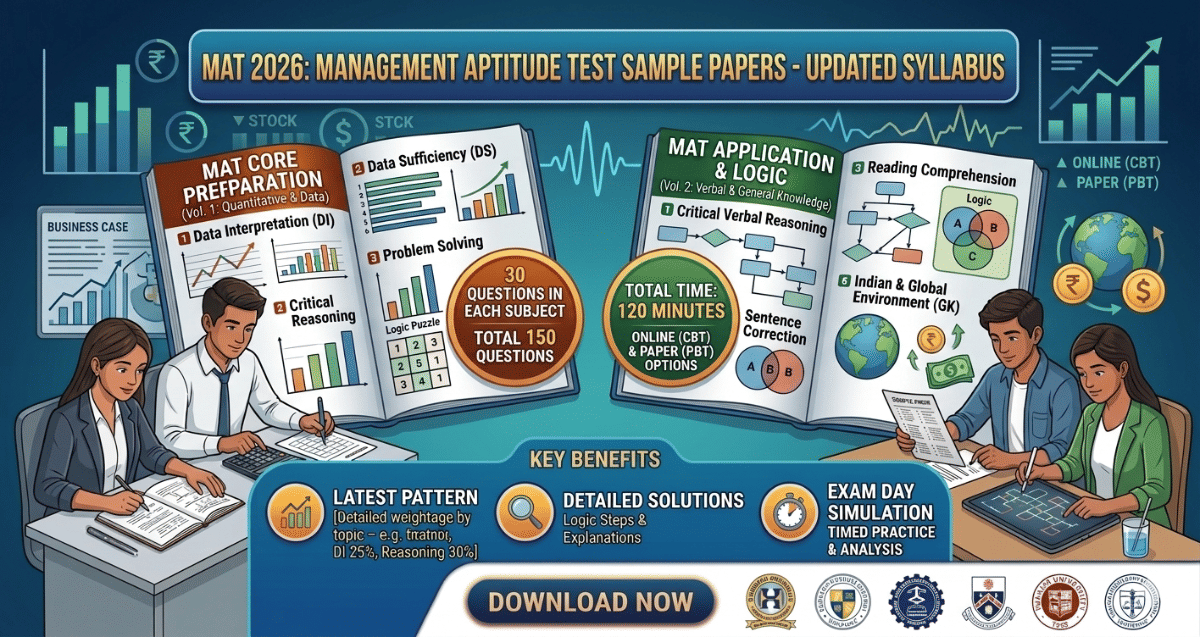
MAT Sample Papers are designed to mirror the actual Management Aptitude Test in structure, difficulty, and timing. Based on the official pattern prescribed by AIMA, these papers cover all five sections —
- Language Comprehension, Intelligence & Critical Reasoning, Data Analysis & Data Sufficiency, Mathematical Skills, and Economic & Business Environment giving you a genuine feel of what 120 minutes under exam pressure actually looks like.
- Most MBA aspirants underestimate how different MAT feels from CAT or XAT. The paper isn't harder on concept, but the pacing demands are real. You have 150 questions in 120 minutes, which works out to under 48 seconds per question.
- There is no sectional time limit, which sounds like a relief until you realise that without a personal time plan, it's easy to burn 35 minutes on Mathematical Skills and scramble through the rest. Sample papers fix this but only if you use them correctly.
MAT Sample Paper 2026: Download PDF
| MAT Subject-wise Sample Paper | Sample Paper |
|---|---|
| MAT Mathematical Skills Sample Paper | Download PDF |
| MAT Language Comprehension Sample Paper | Download PDF |
| MAT Data Analysis & Sufficiency Sample Paper | Download PDF |
| MAT Economic & Business Environment Sample Paper | Download PDF |
How to Solve MAT Sample Papers
Getting through a paper isn't the same as gaining from it. These are the steps that actually make a difference.
-
Set real exam conditions: Attempt the paper in one sitting, set a strict 120-minute timer, keep the phone away. If you are preparing for PBT mode, print the paper out. If you are going for CBT, attempt it on screen. The mode difference matters more than people expect.
-
Do a 3-minute scan first: Before diving in, flip through the paper to spot the section order and identify which parts look manageable. Some MAT papers have unusually dense RC passages or tricky DI sets on particular pages, and a quick scan helps you mentally map where to slow down
- Section attempt order matters: Many toppers and coaching faculty recommend starting with Intelligence & Critical Reasoning, then Language Comprehension, followed by Data Analysis, Mathematical Skills, and GK last.
- Watch the negative marking: With 0.25 marks deducted per wrong answer, a few reckless guesses can quietly hurt your composite score. In sections like Mathematical Skills, where a calculation error can confidently mislead you toward a wrong option, it is often better to skip and move on.
- Post-paper analysis is non-negotiable: This is where most students lose their edge. After every paper, note your time per section, where accuracy dropped, and which question types caused repeated errors. A mistake log, even a basic notebook, is worth more than solving two extra papers without any review.
MAT Sample Paper 2026: Why Solving Them Matters
There is a reason experienced faculty always push sample papers over theory revision in the final month. MAT rewards familiarity. The question types, the RC passage length, and the DI table format all follow a pattern, and students who have seen 10 to 15 papers before the actual exam simply feel less anxious. That composure matters when you are staring at a dense data sufficiency set at the 90-minute mark.
- Familiarity with the five-section structure: The GK section (Economic & Business Environment) does not count toward your composite score or percentile, but that is something many first-time MAT students discover only after wasting 20 minutes on it. Sample papers teach you this in a safe way before the exam.
- Time management: Most preparation guides suggest roughly 20 to 25 minutes per section as a benchmark. In reality, students often find Language Comprehension takes longer, and GK takes much less. You will not know your personal rhythm without timed practice.
- Accuracy over attempts: This is the key distinction in MAT. Unlike exams where maximising attempts is the strategy, MAT rewards selective, accurate attempts. Solving 17 to 20 solid questions per section with near-perfect accuracy can yield a stronger score than attempting 25 carelessly.
- Knowing where your score is actually leaking: Post-paper analysis often reveals that students are not weak in a subject, they are weak in a specific question type within it. DI bar graphs versus DI tables, for instance. Sample papers surface this granularity.
- Composite score awareness: AIMA scales raw marks to a composite score between 199 and 801. GK is excluded from this. Students who have practised with sample papers understand which sections are doing the heavy lifting in their score and where to invest the last few weeks of effort.
Why Choose Collegedunia's MAT Sample Papers 2026
Collegedunia's sample papers are built on the actual AIMA-prescribed pattern: 150 MCQ questions across five sections, +1 for correct answers, –0.25 for incorrect ones, no sectional time limit, and GK excluded from the composite score. The papers reflect this accurately, not a rough approximation.
- Latest and Accurate: All papers are aligned to the AIMA MAT 2026 pattern and work for both PBT (May 31) and CBT (June 14) modes.
- Detailed Solutions: Step-by-step explanations by subject experts, especially useful for Data Analysis and Mathematical Skills, where the method matters as much as the answer.
- User-Friendly: Hyperlinked questions and solutions let you jump between an answer and the explanation without losing your place. This comes in handy when you are reviewing specific errors after a timed attempt.
- Regular Updates: Papers are revised if AIMA makes any changes to the pattern or syllabus between sessions.
- Free to Download: All sample papers are available at no cost. Click the Download PDF link to access them.
- Quality Questions: Every question is mapped to the MAT 2026 syllabus, with a focus on topic areas that have shown up consistently in previous sessions, including Arithmetic, Algebra, Syllogism, Coding-Decoding, and Vocabulary.
MAT 2026: Exam Pattern at a Glance
MAT is conducted in two modes, Paper-Based Test (PBT) and Computer-Based Test (CBT), and the pattern is identical across both.
| Section | No. of Questions | Marks | Counts for Percentile? |
|---|---|---|---|
| Language Comprehension | 30 | 30 | Yes |
| Intelligence & Critical Reasoning | 30 | 30 | Yes |
| Data Analysis & Data Sufficiency | 30 | 30 | Yes |
| Mathematical Skills | 30 | 30 | Yes |
| Economic & Business Environment | 30 | 30 | No |
Marking Scheme: +1 for each correct answer | –0.25 for each incorrect answer | No deduction for unattempted questions
Duration: 120 minutes | No sectional time limit
One thing worth knowing: the "no sectional time limit" is officially a flexibility, but without a self-imposed time plan, it becomes a trap. Set your own internal checkpoints 25 minutes per scoreable section leaves a buffer for review.
Other Useful Resources for MAT 2026
| Particular | Direct Link |
|---|---|
| Best Books | Click to Download |
| Mock Test | Click to Download |
| Question Papers | Click to Download |
Mistakes to Avoid While Solving Sample Papers
Students often notice these errors only after making them, so it is worth reading this before you start.
- Do not begin full-length papers before you have covered most of the syllabus. Attempting papers blind can build bad habits around guessing and skipping that are hard to unlearn.
- Skipping the analysis phase is the most common mistake. The paper itself is not the learning, the review is. Students who solve a paper, check the score, and move on are not preparing, they are just practising being wrong faster.
- Do not ignore the GK section entirely. It does not count toward your percentile, true. But many B-schools review the GK score separately during shortlisting, and a very poor GK performance can quietly affect how your profile looks. Spend 10 to 12 minutes on it, not 25.
- Avoid using outdated sample papers, especially pre-2023 papers that may reflect an older question count or pattern. MAT has had some structural changes in recent years and earlier papers will not replicate the current experience accurately.
- In the early weeks of practice, go through solutions even for questions you answered correctly. Whether your reasoning was sound matters. You might have got to the right answer the slow way, and that compounds under time pressure.
FAQs on MAT Sample Papers 2026
Ques. How many sample papers should I solve before the exam?
Ans. A realistic target is 10 to 15 full-length papers, but the number matters less than what you do after each one. Ten well-analysed papers will do more than 25 papers rushed through without review.
Ques. Are previous year question papers enough, or do I need sample papers too?
Ans. Previous year papers are genuinely useful for understanding question style and topic trends. But since AIMA does not release official PYQs in bulk, sample papers built on previous year analysis fill the gap. Use both.
Ques. Where can I find reliable MAT 2026 sample papers?
Ans. Collegedunia offers full-length and section-wise papers based on the current AIMA pattern. You can also access the official mock test from the AIMA portal at mat.aima.in.
Ques. Should I start with subject-wise papers or full-length tests?
Ans. Start section-wise for the first week or two. This builds speed and confidence in individual areas. Move to full-length papers after that. Closer to the exam, full papers are the only mode that really simulates exam conditions.
Ques. Is there negative marking in MAT 2026?
Ans. Yes, 0.25 marks are deducted for every wrong answer across all five sections. Skip questions where you are not reasonably confident, especially in Mathematical Skills where wrong calculations can seem convincing.
Ques. The GK section does not count for percentile. Should I attempt it at all?
Ans. Attempt it, but do not spend more than 10 to 12 minutes on it. Many B-schools accepting MAT scores do look at sectional breakdowns. A completely blank GK section is avoidable. Skim through it at the end and mark the ones you are sure about.
Ques. How can I actually improve my MAT score through sample papers?
Ans. Keep an error log. Every wrong or skipped question goes into a notebook with the reason, whether it was a wrong concept, rushed reading, misread options, or time pressure. Review it weekly. Candidates who track errors and revisit those topics consistently tend to see the clearest score improvement over 4 to 6 weeks of practice.



Comments