





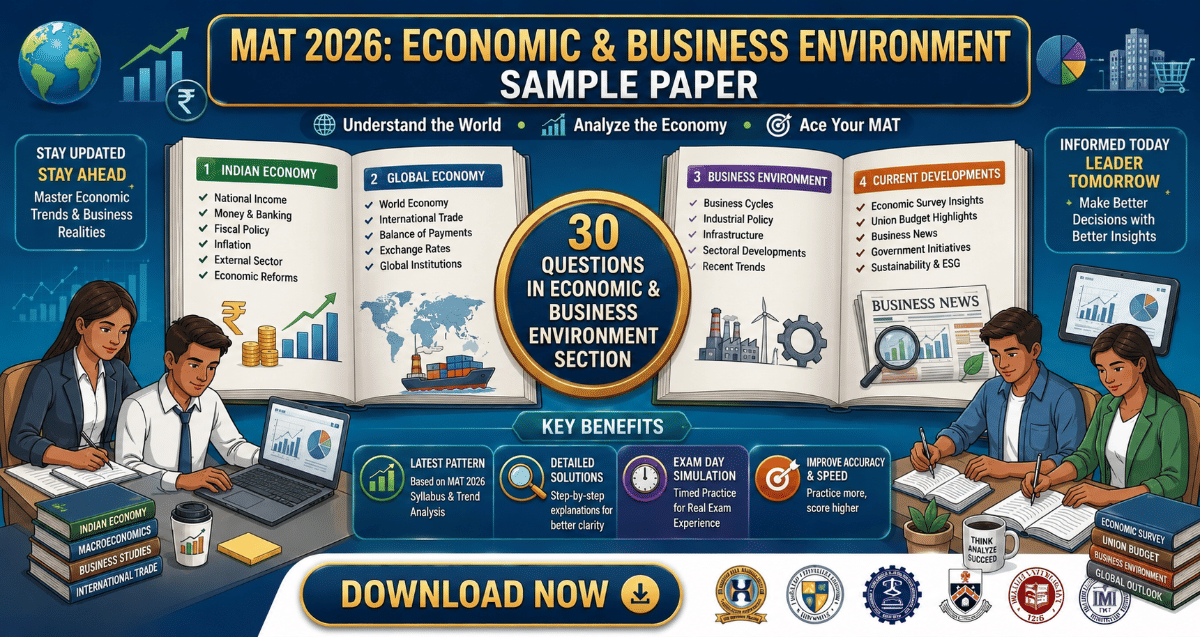
MAT Economic & Business Environment Sample Papers 2026 are created to help aspirants understand the type of questions, topic coverage, and awareness level this section demands in the actual exam.
- The papers include all major areas such as Indian Economy, Business & Corporate Affairs, Government Policies & Schemes, International Trade, and Current Economic Developments, keeping in line with what has come in previous MAT sessions and the AIMA syllabus.
- Students preparing for MAT 2026 can work through these Economic & Business Environment sample papers to check how well they are keeping up with current affairs, spot the topic areas where their knowledge has gaps, and build the kind of business and economic awareness that this section tests.
MAT Economic & Business Environment Sample Paper 2026 PDF Download
| MAT Economic & Business Environment Sample Paper | Direct Link |
|---|---|
| MAT Economic & Business Environment Sample Paper 1 | Download PDF |
| MAT Economic & Business Environment Sample Paper 2 | Download PDF |
| MAT Economic & Business Environment Sample Paper 3 | Download PDF |
| MAT Economic & Business Environment Sample Paper 4 | Download PDF |
| MAT Economic & Business Environment Sample Paper 5 | Download PDF |
| MAT Economic & Business Environment Sample Paper 6 | Download PDF |
| MAT Economic & Business Environment Sample Paper 7 | Download PDF |
| MAT Economic & Business Environment Sample Paper 8 | Download PDF |
| MAT Economic & Business Environment Sample Paper 9 | Download PDF |
| MAT Economic & Business Environment Sample Paper 10 | Download PDF |
| MAT Economic & Business Environment Sample Paper 11 | Download PDF |
| MAT Economic & Business Environment Sample Paper 12 | Download PDF |
| MAT Economic & Business Environment Sample Paper 13 | Download PDF |
| MAT Economic & Business Environment Sample Paper 14 | Download PDF |
| MAT Economic & Business Environment Sample Paper 15 | Download PDF |
| MAT Economic & Business Environment Sample Paper 16 | Download PDF |
| MAT Economic & Business Environment Sample Paper 17 | Download PDF |
| MAT Economic & Business Environment Sample Paper 18 | Download PDF |
| MAT Economic & Business Environment Sample Paper 19 | Download PDF |
| MAT Economic & Business Environment Sample Paper 20 | Download PDF |
Related Articles:
- MAT Economic & Business Environment Syllabus: Topic-wise Breakdown
- MAT Economic & Business Environment Mock Tests with Solutions
- MAT Economic & Business Environment Previous Year Questions (PYQs)
Why Should You Solve MAT Economic & Business Environment Sample Papers?
Most students treat Economic & Business Environment as a section they will handle through last-minute news reading. That approach rarely works. The section goes well beyond headlines. It tests specific knowledge of economic terms, government schemes, RBI policies, corporate events, and trade data that requires consistent reading over weeks, not a rushed revision the night before.
This is also the one section in MAT where you either know the answer or you do not. There is no working through logic or applying a formula. That makes it both the quickest section to score in and the easiest to lose marks in if you have not prepared properly. Solving sample papers through your preparation period tells you exactly where your knowledge stands and which areas need more reading.
Here are some real benefits you get from solving MAT Economic & Business Environment sample papers regularly:
- Better understanding of question pattern: In most MAT sessions, this section includes questions on static economic concepts, current business affairs, government policy, and recent economic data. Going through sample papers shows you how questions are framed in this section so questions in the actual exam feel recognisable rather than surprising.
- Helps in time management: Economic & Business Environment is one section where spending too long on a single question is a sign that you simply do not know the answer. If a question about a government scheme or a trade agreement is not clicking within 20 to 25 seconds, it is better to move on and come back. Sample paper practice builds that awareness of when to hold and when to skip.
- Identifies important chapters: After going through a few papers, it is clear that Indian economy, banking and finance, and business current affairs come up in almost every MAT session. International organisations and trade policy questions are less frequent but still appear. That picture helps you focus your newspaper reading and revision on areas that actually matter for the exam.
- Improves accuracy: This section has 0.25 negative marking per wrong answer, and the danger is guessing on questions that seem familiar but are not clear. A half-remembered fact about a government scheme or a vague recollection of an RBI announcement can lead to a wrong answer with full confidence. Regular sample paper practice teaches you to know the difference between actually knowing something and just recognising a keyword.
- Builds exam confidence: Many students entering MAT from an engineering or science background find this section the hardest to prepare for because there is no formula or method to rely on. Working through 10 to 12 papers over the course of preparation builds a solid base of economic and business knowledge. Students who have done that reading come into the exam ready for this section rather than hoping for familiar topics.
MAT 2026 Economic & Business Environment: Exam Pattern and Marking Scheme
According to the MAT 2026 exam pattern released by AIMA, the Economic & Business Environment section has 30 MCQs, all carrying equal marks. Whether you are appearing for the PBT on May 31 or the CBT on June 14, the section structure stays the same.
| Detail | Specifics |
|---|---|
| Number of Questions | 30 |
| Marks per Question | 1 |
| Negative Marking | 0.25 per wrong answer |
| Total Marks | 30 |
| Sectional Time Limit | None (overall 120 minutes for all 5 sections) |
| Counts for Percentile | Yes |
There is no sectional timer in MAT, so you decide how much time to give each section. Most coaching faculties suggest wrapping up Economic & Business Environment in 15 to 20 minutes since questions here are direct and either known or not. The time saved on this section is better used in Mathematical Skills or Intelligence & Critical Reasoning.
MAT 2026 Economic & Business Environment Sample Papers: Topic-wise Weightage
The sample papers are built by looking at what topics have actually appeared in previous MAT sessions and how many questions each topic has contributed over the years. Indian Economy and Business & Corporate Affairs consistently bring in the most questions, while Banking, Finance, and Government Schemes also hold reliable weightage from session to session.
Students should start with Indian economy fundamentals and recent economic events before moving to international trade and corporate affairs. Reading a business newspaper for 20 to 30 minutes daily through the preparation period covers most of what this section asks, far more effectively than cramming topic lists in the last week.
| Unit | Topic | Avg Qs/year | % Weightage | Priority |
|---|---|---|---|---|
| 1 | Current Affairs (national + international) | 7 | 23% | High |
| 2 | Indian Economy & Budget | 4 | 14% | High |
| 3 | Banking, Finance & Financial Products | 4 | 13% | High |
| 4 | Business & Corporate (M&A, brands, ads) | 4 | 13% | High |
| 5 | Static GK (Constitution/History/Geography) | 4 | 13% | High |
| 6 | International Organisations & Trade | 3 | 10% | Medium |
| 7 | Awards / Books / Sports / Films | 3 | 9% | Medium |
| 8 | Science & Technology | 2 | 5% | Medium |
Based on previous year MAT session analysis.
FAQs
Ques. Are the MAT Economic & Business Environment sample papers based on the latest syllabus?
Ans. Yes. These sample papers follow the AIMA syllabus and are built around what has actually come in previous MAT sessions. Static economic concepts in this section stay consistent year after year. Current affairs questions are updated to reflect recent developments, so the papers give you a good idea of both what to study and how current your preparation needs to be for MAT 2026.
Ques. Which topics carry the highest weightage in MAT Economic & Business Environment?
Ans. Indian Economy, Business & Corporate Affairs, and Banking & Finance together cover the majority of questions in this section across most MAT sessions. Government schemes and policies also show up regularly. International trade and budget-related questions appear in smaller numbers but are still worth covering since they tend to be straightforward marks if you have done the reading.
Ques. How many Economic & Business Environment sample papers should I solve before MAT?
Ans. Solving 10 to 12 section-wise papers through your preparation is a good target, combined with full-length mock tests. Going through wrong answers after each attempt matters more than the count. When you get a question wrong, trace it back to the specific fact or concept you were missing and fill that gap rather than just noting the correct answer and moving on.
Ques. Can I prepare for this section only through newspapers?
Ans. Newspaper reading covers the current affairs part well, but this section also has static economic concepts, RBI and finance terminology, and questions on international economic organisations that need separate study. A good approach is to pair daily newspaper reading with a short revision of static economic topics each week. Sample papers help you check whether that combination is working by showing you which question types you are consistently missing.
Ques. Do the MAT Economic & Business Environment sample papers include solutions?
Ans. Yes, solutions are included with most papers. For this section especially, reading the explanation matters even when you got the answer right. Many questions in Economic & Business Environment have close options that test whether you know a detail precisely or only roughly. The solution explanation often clarifies exactly what distinguishes the right answer from the wrong ones, and that level of detail is genuinely useful for avoiding similar mistakes in the actual exam.



Comments