





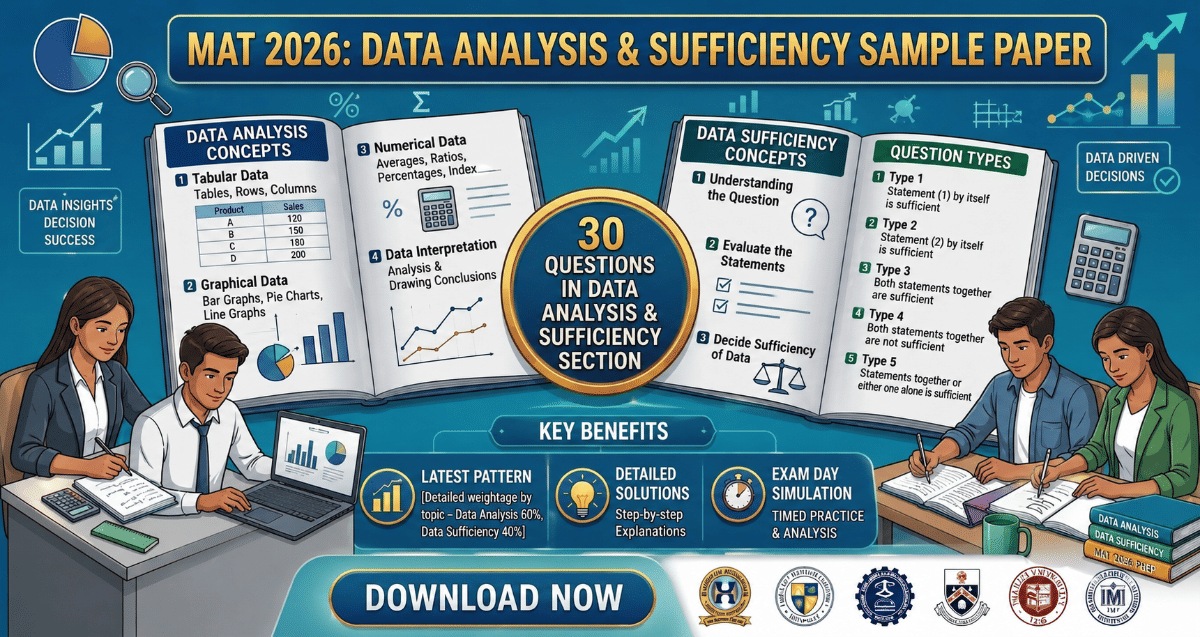
MAT Data Analysis & Sufficiency Sample Papers 2026 are designed to give aspirants a realistic feel of the question types, data formats, and reasoning demands they will actually face in this section of the exam.
- The papers cover all key areas, including Data Tables, Bar Graphs, Line Charts, Pie Charts, Caselets, and Data Sufficiency, in line with previous year MAT trends and the AIMA-prescribed syllabus.
- Students preparing for MAT 2026 can use these Data Analysis & Sufficiency sample papers to improve how fast they read and process data, identify which chart types cost them the most time, and get genuinely comfortable with the kind of calculation-heavy DI sets the actual paper tends to throw at you.
MAT Data Analysis & Sufficiency Sample Paper 2026 PDF Download
| MAT Data Analysis & Sufficiency Sample Paper | Direct Link |
|---|---|
| MAT Data Analysis & Sufficiency Sample Paper 1 | Download PDF |
| MAT Data Analysis & Sufficiency Sample Paper 2 | Download PDF |
| MAT Data Analysis & Sufficiency Sample Paper 3 | Download PDF |
| MAT Data Analysis & Sufficiency Sample Paper 4 | Download PDF |
| MAT Data Analysis & Sufficiency Sample Paper 5 | Download PDF |
| MAT Data Analysis & Sufficiency Sample Paper 6 | Download PDF |
| MAT Data Analysis & Sufficiency Sample Paper 7 | Download PDF |
| MAT Data Analysis & Sufficiency Sample Paper 8 | Download PDF |
| MAT Data Analysis & Sufficiency Sample Paper 9 | Download PDF |
| MAT Data Analysis & Sufficiency Sample Paper 10 | Download PDF |
| MAT Data Analysis & Sufficiency Sample Paper 11 | Download PDF |
| MAT Data Analysis & Sufficiency Sample Paper 12 | Download PDF |
| MAT Data Analysis & Sufficiency Sample Paper 13 | Download PDF |
| MAT Data Analysis & Sufficiency Sample Paper 14 | Download PDF |
| MAT Data Analysis & Sufficiency Sample Paper 15 | Download PDF |
| MAT Data Analysis & Sufficiency Sample Paper 16 | Download PDF |
| MAT Data Analysis & Sufficiency Sample Paper 17 | Download PDF |
| MAT Data Analysis & Sufficiency Sample Paper 18 | Download PDF |
| MAT Data Analysis & Sufficiency Sample Paper 19 | Download PDF |
| MAT Data Analysis & Sufficiency Sample Paper 20 | Download PDF |
Related Articles:
- MAT Data Analysis & Sufficiency Syllabus: Topic-wise Breakdown
- MAT Data Analysis & Sufficiency Mock Tests with Solutions
- MAT Data Analysis & Sufficiency Previous Year Questions (PYQs)
Why Should You Solve MAT Data Analysis & Sufficiency Sample Papers?
Many students start MAT preparation assuming Data Analysis is just about reading graphs and doing basic maths. That assumption tends to cost them. The section is more layered than it looks. Each set of questions is built around a single data source, which means one misread of a table or graph affects all four or five questions that follow it. There is no recovering easily from that in the middle of a 120-minute paper.
Data Analysis & Sufficiency in MAT is also the section where most aspirants lose the most marks not because they find the questions too hard, but because they rush. The numbers look manageable, so students attempt quickly and skip verification. Sample papers are the most effective way to break that habit before it matters.
Here are some real benefits you get from solving MAT Data Analysis & Sufficiency sample papers regularly:
- Better understanding of question pattern: In most MAT sessions, this section has 3 to 4 DI sets along with around 8 to 10 Data Sufficiency questions. The DI sets are graph- or table-based, asking you to calculate percentages, ratios, averages, and growth rates from the given data. Practising sample papers makes this mix familiar so you already know what to expect when you sit for the actual exam.
- Helps in time management: This section consistently catches aspirants off guard with set-based questions. If the opening DI set has a poorly-formatted table or multi-layered conditions, it can take 6 to 8 minutes to process and attempt all five questions. Sample paper practice trains you to scan sets quickly, decide whether to attempt or skip, and move on. That decision-making skill is something no formula chart can teach you.
- Identifies important chapters: After going through a handful of papers, patterns become clear. Table-based DI and Bar Graph sets appear in almost every MAT session. Pie Charts and Caselets are moderately frequent. Data Sufficiency tends to focus on arithmetic relationships and tests whether given conditions are individually or jointly sufficient to answer a question. That clarity helps you direct preparation where it actually counts.
- Improves accuracy: DI questions in MAT carry a 0.25 negative marking per wrong answer, and the tricky part is that calculation errors here feel correct in the moment. Reading the wrong row in a table, picking a value from the wrong year, or mixing up units like lakhs and crores are all easy mistakes to make when you are moving fast, and they cost marks. Timed practice with sample papers builds the habit of checking your data source twice before committing to an option.
- Builds exam confidence: Many PG entrance aspirants are more comfortable with verbal and reasoning sections and find Data Analysis genuinely stressful. Solving 10 to 12 full-length section-wise papers changes that relationship with the section. Students who have solved enough papers go into the exam knowing exactly what kind of sets to expect, and that makes a real difference on the day.
MAT 2026 Data Analysis & Sufficiency: Exam Pattern and Marking Scheme
According to the MAT 2026 exam pattern released by AIMA, the Data Analysis & Sufficiency section has 30 MCQs, all carrying equal marks. Whether you are appearing for the PBT on May 31 or the CBT on June 14, the section structure stays the same.
| Detail | Specifics |
|---|---|
| Number of Questions | 30 |
| Marks per Question | 1 |
| Negative Marking | 0.25 per wrong answer |
| Total Marks | 30 |
| Sectional Time Limit | None (overall 120 minutes for all 5 sections) |
| Counts for Percentile | Yes |
| Difficulty Level | Easy to Moderate |
- There is no sectional timer in MAT, so you decide how much time to spend on each section.
- Most coaching institutes recommend spending 20 to 25 minutes on Data Analysis & Sufficiency.
- The Data Sufficiency questions are typically faster to attempt than full DI sets, so saving a few minutes for those makes strategic sense.
MAT 2026 Data Analysis & Sufficiency Sample Papers: Topic-wise Weightage
The sample papers are built by looking at what topics have actually appeared in previous MAT sessions and how many questions each topic has contributed over the years. Table-based and Bar Graph DI sets consistently carry the highest share of questions, while Data Sufficiency also carries good weightage and is a topic many students do not give enough attention during preparation.
Students should get their DI fundamentals solid first. That means percentage change, ratio comparison, and average calculation from raw data. Once those are in place, moving to trickier set types like Caselets and Mixed Graphs becomes much more manageable.
| Topic / Area | Avg Questions / Session | % Weightage | Priority |
|---|---|---|---|
| Data Tables (Single & Composite) | 8–10 | 20–25% | High |
| Bar Graphs (Simple, Stacked, Grouped) | 6–8 | 15–20% | High |
| Data Sufficiency (Arithmetic & Logical) | 8–10 | 20–25% | High |
| Line Charts (Single & Multiple) | 4–6 | 10–15% | High |
| Pie Charts (Single & Comparative) | 4–5 | 10–13% | Medium |
| Caselets (Paragraph-based DI) | 3–4 | 8–10% | Medium |
| Mixed / Combination Graphs | 2–3 | 5–8% | Medium |
Based on the previous year MAT session analysis.
FAQs
Ques. Are the MAT Data Analysis & Sufficiency sample papers based on the latest syllabus?
Ans. Yes. These sample papers follow the AIMA syllabus and are built around what has actually come in previous MAT sessions. The topics and question types in this section have not changed much over the years, so what you practise here is very much in line with what MAT 2026 will ask.
Ques. Which topics carry the highest weightage in MAT Data Analysis & Sufficiency?
Ques. How many Data Analysis & Sufficiency sample papers should I solve before MAT?
Ques. Is Data Sufficiency different from the DI sets in this section?
Ans. Yes, they test different things. DI sets give you data in graph or table form and ask you to extract and calculate values from it. Data Sufficiency gives you a question along with two statements, and you have to decide whether those statements, alone or together, are enough to answer the question. Both appear in the same section and need separate preparation strategies.
Ques. Do the MAT Data Analysis & Sufficiency sample papers include solutions?
Ans. Yes, most papers come with detailed step-by-step solutions. Make it a habit to go through solutions even for questions you got right. Faster calculation approaches and smarter data-reading shortcuts often show up in good solution keys, and those small time savings add up considerably across an entire paper.



Comments