


The NEET 2026 Re-Exam Question Paper Code 60 is available for download here. NTA conducted the NEET Re-Exam 2026 on 21 June in a single shift from 2 PM to 5:15 PM. The NEET Re-Test question paper consists of 180 questions for 720 marks to be attempted in 3 hours and 15 minutes.
- NEET Question Paper 2026 is divided into 3 sections- Physics (45 questions), Chemistry (45 questions), and Biology (90 questions).
- Each correct answer carries 4 marks, and an incorrect answer has a negative marking of 1.
Candidates can download the NEET Re-Exam 2026 Question Paper Code 60 with Answer Key and Solution PDF from the links provided below. According to initial student reaction, NEET Re-Test Paper 2026 was of easy to moderate to level.
NEET 2026 Re-Exam Question Paper with Solution PDF Code 60
| NEET Re-Exam Code 60 Question Paper 2026 | Download PDF | Check Solutions |
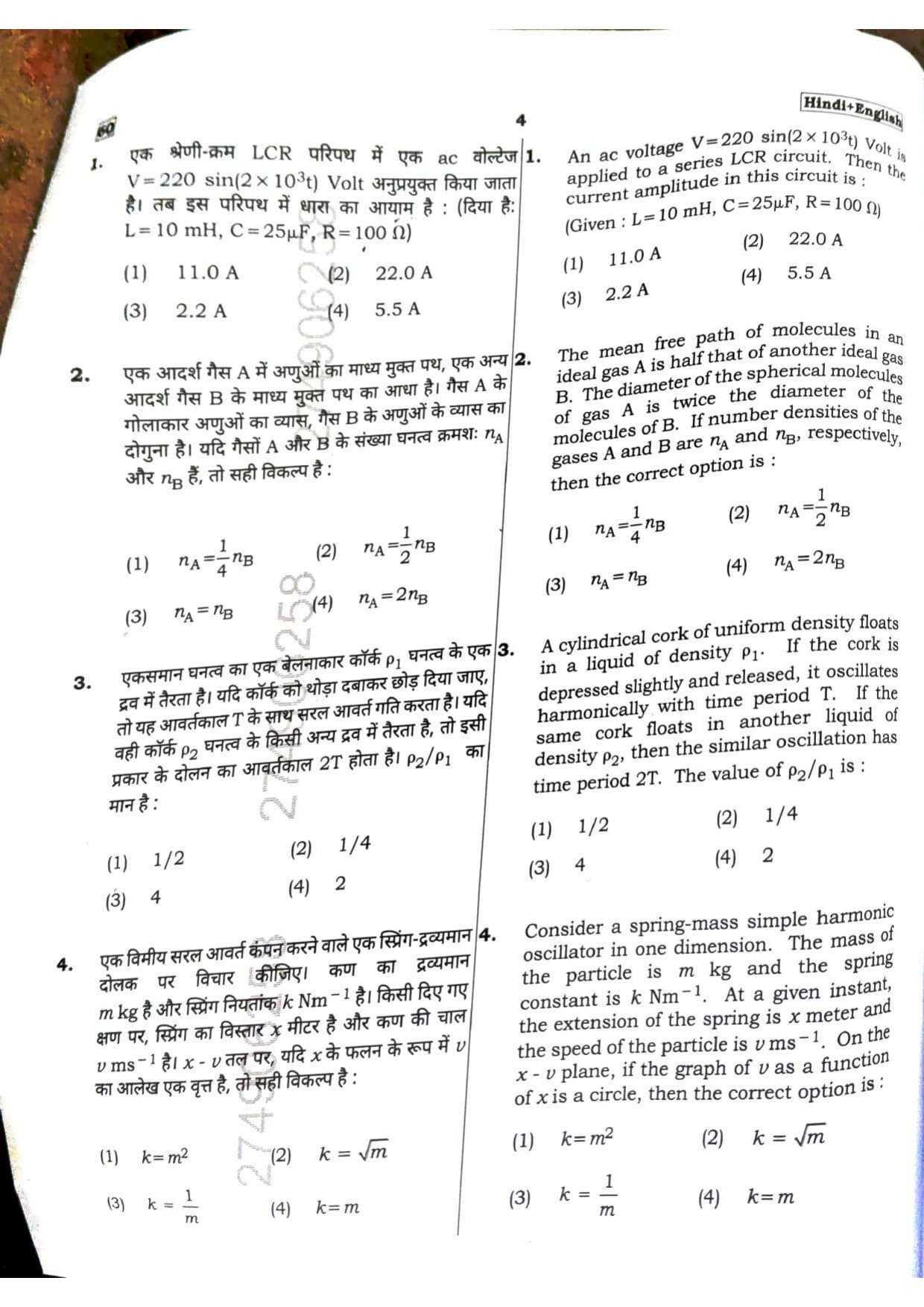




















An ac voltage \(V = 220 \sin(2 \times 10^3 t)\) Volt is applied to a series LCR circuit. Then the current amplitude in this circuit is: (Given: \(L = 10 mH\), \(C = 25 \muF\), \(R = 100 \Omega\))
The mean free path of molecules in an ideal gas A is half that of another ideal gas B. The diameter of the spherical molecules of gas A is twice the diameter of the molecules of gas B. If number densities of the gases A and B are \(n_A\) and \(n_B\), respectively, then the correct option is:
A cylindrical cork of uniform density floats in a liquid of density \(\rho_1\). If the cork is depressed slightly and released, it oscillates harmonically with time period T. If the same cork floats in another liquid of density \(\rho_2\), then the similar oscillation has time period 2T. The value of \(\rho_2/\rho_1\) is:
Consider a spring-mass simple harmonic oscillator in one dimension. The mass of the particle is \(m\) kg and the spring constant is \(k Nm^{-1}\). At a given instant, the extension of the spring is \(x\) meter and the speed of the particle is \(v ms^{-1}\). On the \(x-v\) plane, if the graph of \(v\) as a function of \(x\) is a circle, then the correct option is:
In an adiabatic expansion, the temperature of one mole of an ideal monatomic gas (\(\gamma = 5/3\)) decreases from 60K to 50K. The work done by the gas in the process is: (Take the universal gas constant as \(R = 8.3 J mol^{-1} K^{-1}\))
The following table presents the part of the electromagnetic spectrum and their corresponding major applications.
\begin{tabular}{|l|l|c|l|}
\hline
\multicolumn{2}{|c|}{\textbf{EM Spectrum Part}} & \multicolumn{2}{c|}{\textbf{Applications}}
\hline
P & Microwave & I & For purifying the water
\hline
Q & UV rays & II & For warming the food
\hline
R & Gamma rays & III & For AM and FM communication systems
\hline
S & Radio wave & IV & For treating the Cancer cells
\hline
\end{tabular}
The correct option is :
A unit positive point charge is taken slowly through an infinitesimally thin tube that is inside a charged dielectric sphere of radius \(R\), having uniform positive charge density \(\rho\). The initial and final positions of the charge are marked by \(A\) and \(B\) at distances \(2R\) and \(3R\) respectively, from the centre of the sphere. In this process, the magnitude of the total work done on the point charge is \(\frac{\rho R^2}{n \epsilon_0}\). The value of \(n\) is :

A beam of light falls on a metal surface such that photo-electrons are generated. If power of the light source starts to decrease linearly with time \(t\), then variation of the photocurrent \(I\) and magnitude of the stopping potential \(|V|\) with time is best represented by :

Bob \(B\) of mass \(m\) at rest is hanging vertically from the ceiling via a massless string of length 10 m. Point mass \(A\) of mass \(m\) travelling horizontally with speed 10 ms\(^{-1}\) hits bob \(B\) elastically. The bob \(B\) rises \(h\) meter after the collision. Taking \(g = 10\) ms\(^{-2}\), the value of \(h\) is :

An ideal gas is made of polyatomic molecules. Each of the molecules has three translational, three rotational and \(f\) number of vibrational modes. If the ratio of heat capacities \(C_p/C_v\) of the gas is 8/7, then the value of \(f\) is :
In the measurement of viscosity of liquids using terminal velocity experiment, spherical balls of same radius but having different densities are used. The variation of the terminal velocity \(v\) with the ratio of density of spherical ball \(\sigma\) to density of the liquid \(\rho\), is best represented by :

In a solar system, the time-period of revolution of a planet tracing a circular orbit of radius \(R\) is proportional to :

A solid sphere \(A\) of radius \(R\) and mass \(M\) is attached at a point to a smaller solid sphere \(B\) of radius \(r < R\) and mass \(m < M\). Assume that the line joining their centres lies along the horizontal. The moment of inertia of the system calculated about a vertical axis passing through the centre of \(A\) is \(I_A\) and that calculated about a vertical axis passing through the centre of \(B\) is \(I_B\). The difference \(I_A - I_B\) is :
Consider the following nuclear reaction : \[ ^{238}U \rightarrow ^{234}Th + ^4He \] Take masses of \(^{238}U\), \(^{234}Th\) and \(^4He\) as \(238.050\) u, \(234.043\) u and \(4.003\) u respectively. The \(Q\) value for the reaction, in keV, is : [Given: \(1 u = 931.5 MeV c^{-2}\)]
Consider a fixed uniformly charged insulating sphere with radius \(R\) and total charge \(+Q\). A point charge \(-q\) (\(q \ll Q\)) with mass \(m\) is released from rest at a distance of \(3R\) from the centre of the charged sphere. When the point charge reaches the surface of the sphere, its speed is : (\(\epsilon_0\) is the permittivity of vacuum, neglect gravitational forces).
Consider two circuits, (A) and (B), each having two resistors. One of them has a positive temperature coefficient of resistance, \(+\alpha\), while the other one has a negative temperature coefficient of resistance, \(-\alpha\), as shown in the figure. The current through these circuits are denoted by \(I_A\) and \(I_B\). At initial temperature, the resistance of the two resistors is \(R_0\). As the temperature is increased, the correct option that describes the variation of current in these circuits is :

A conducting loop of finite resistance lies on the \(x - y\) plane. There is a constant magnetic field in the \(z\) direction. The area of the loop varies with time \(t\), as \(A = A_0(1 + \sin t)\) in appropriate units. The figure that correctly indicates the qualitative behaviour of the power \(P\) dissipated in the loop as a function of time is :

A photon and an electron, each of \(20\) eV energy, move in free space. The ratio of linear momentum of electron \(p_e\) to that of photon \(p_{ph}\) is : (Take speed of light \(= 3 \times 10^8 ms^{-1}\), charge of electron \(= 1.6 \times 10^{-19}\) C and mass of electron \(= 9 \times 10^{-31}\) kg)
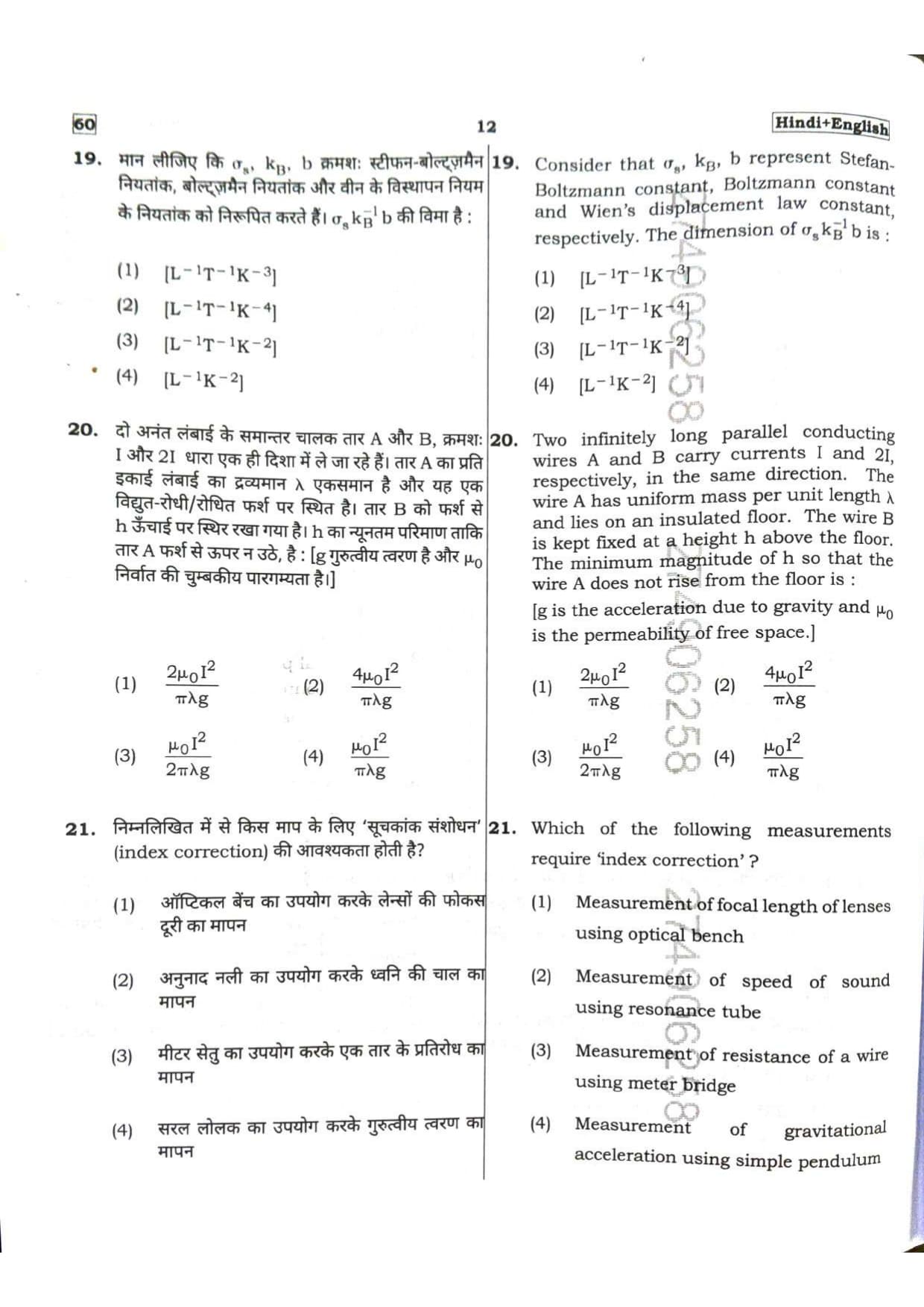
Consider that \(\sigma_s, k_B, b\) represent Stefan-Boltzmann constant, Boltzmann constant and Wien's displacement law constant, respectively. The dimension of \(\sigma_s k_B^{-1} b\) is :
Two infinitely long parallel conducting wires A and B carry currents \(I\) and \(2I\), respectively, in the same direction. The wire A has uniform mass per unit length \(\lambda\) and lies on an insulated floor. The wire B is fixed at a height \(h\) above the floor. The minimum magnitude of \(h\) so that the wire A does not rise from the floor is : [\(g\) is the acceleration due to gravity and \(\mu_0\) is the permeability of free space.]
Which of the following measurements require 'index correction' ?
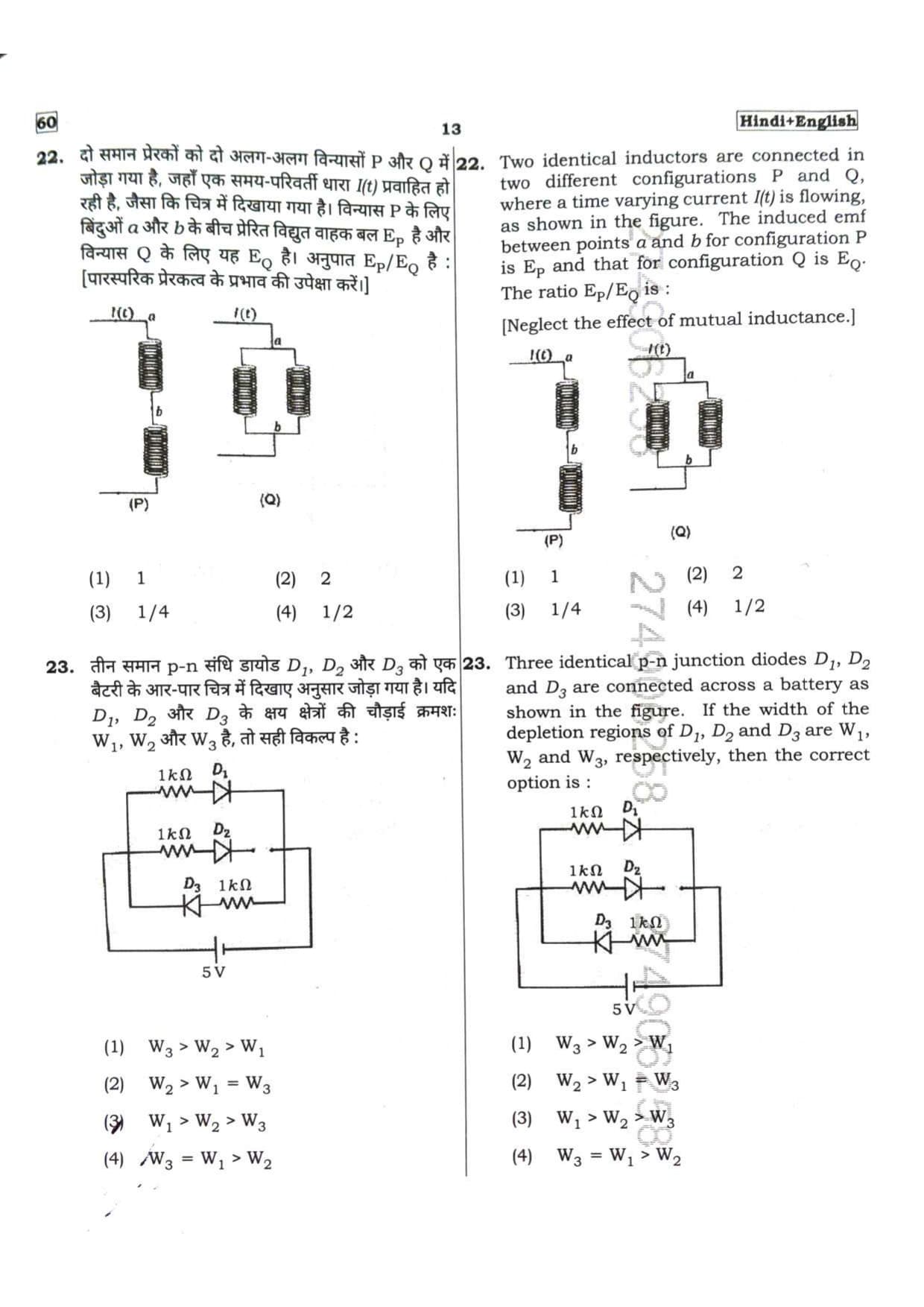
Two identical inductors are connected in two different configurations P and Q, where a time varying current \(I(t)\) is flowing, as shown in the figure. The induced emf between points \(a\) and \(b\) for configuration P is \(E_P\) and that for configuration Q is \(E_Q\). The ratio \(E_P/E_Q\) is : [Neglect the effect of mutual inductance.]

Three identical p-n junction diodes \(D_1, D_2\) and \(D_3\) are connected across a battery as shown in the figure. If the width of the depletion regions of \(D_1, D_2\) and \(D_3\) are \(W_1, W_2\) and \(W_3\), respectively, then the correct option is :

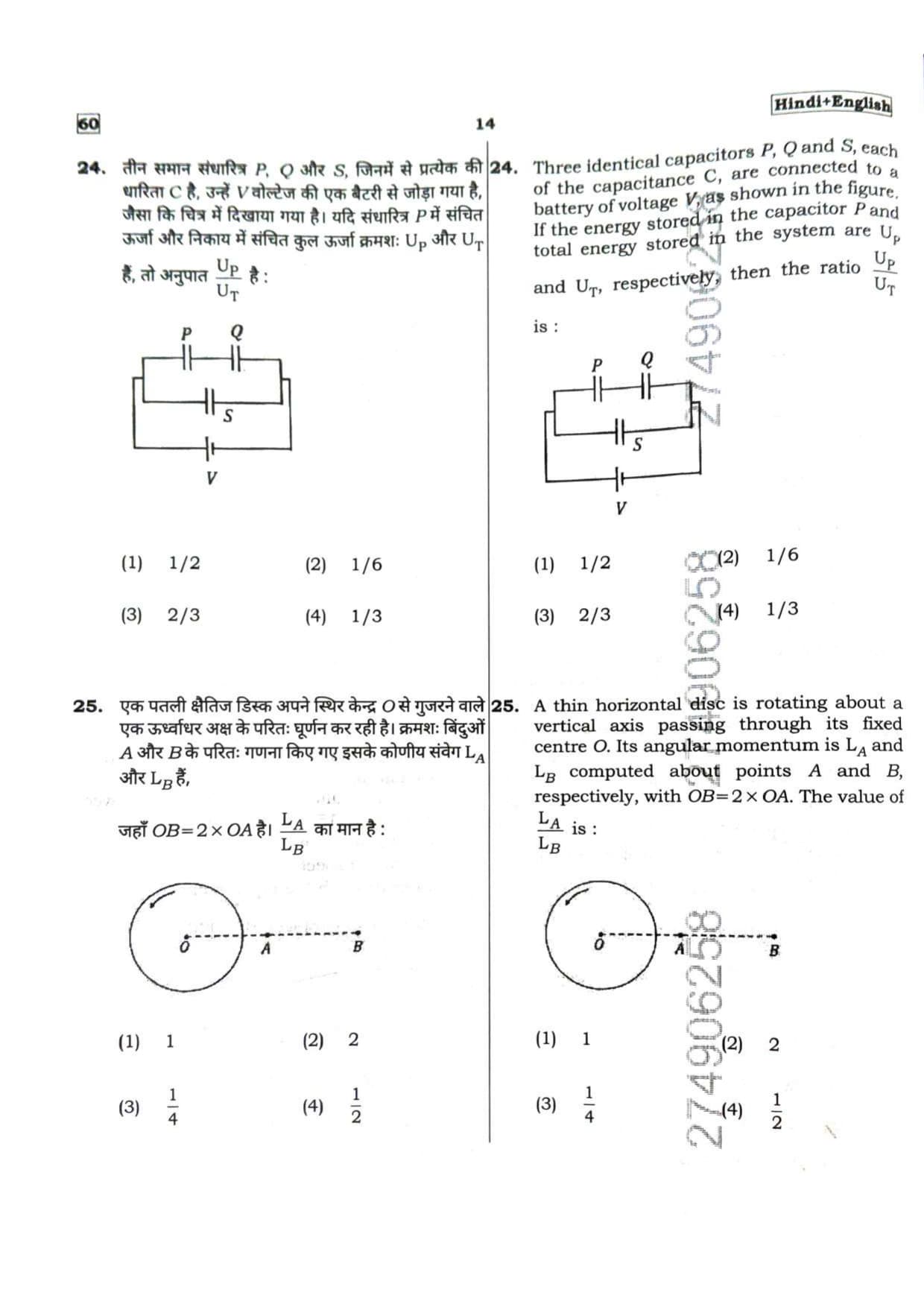
Three identical capacitors P, Q and S, each of the capacitance C, are connected to a battery of voltage V as shown in the figure. If the energy stored in the capacitor P and total energy stored in the system are \(U_P\) and \(U_T\), respectively, then the ratio \(U_P/U_T\) is :

A thin horizontal disc is rotating about a vertical axis passing through its fixed centre O. Its angular momentum is \(L_A\) and \(L_B\) computed about points A and B, respectively, with \(OB = 2 \times OA\). The value of \(L_A/L_B\) is :

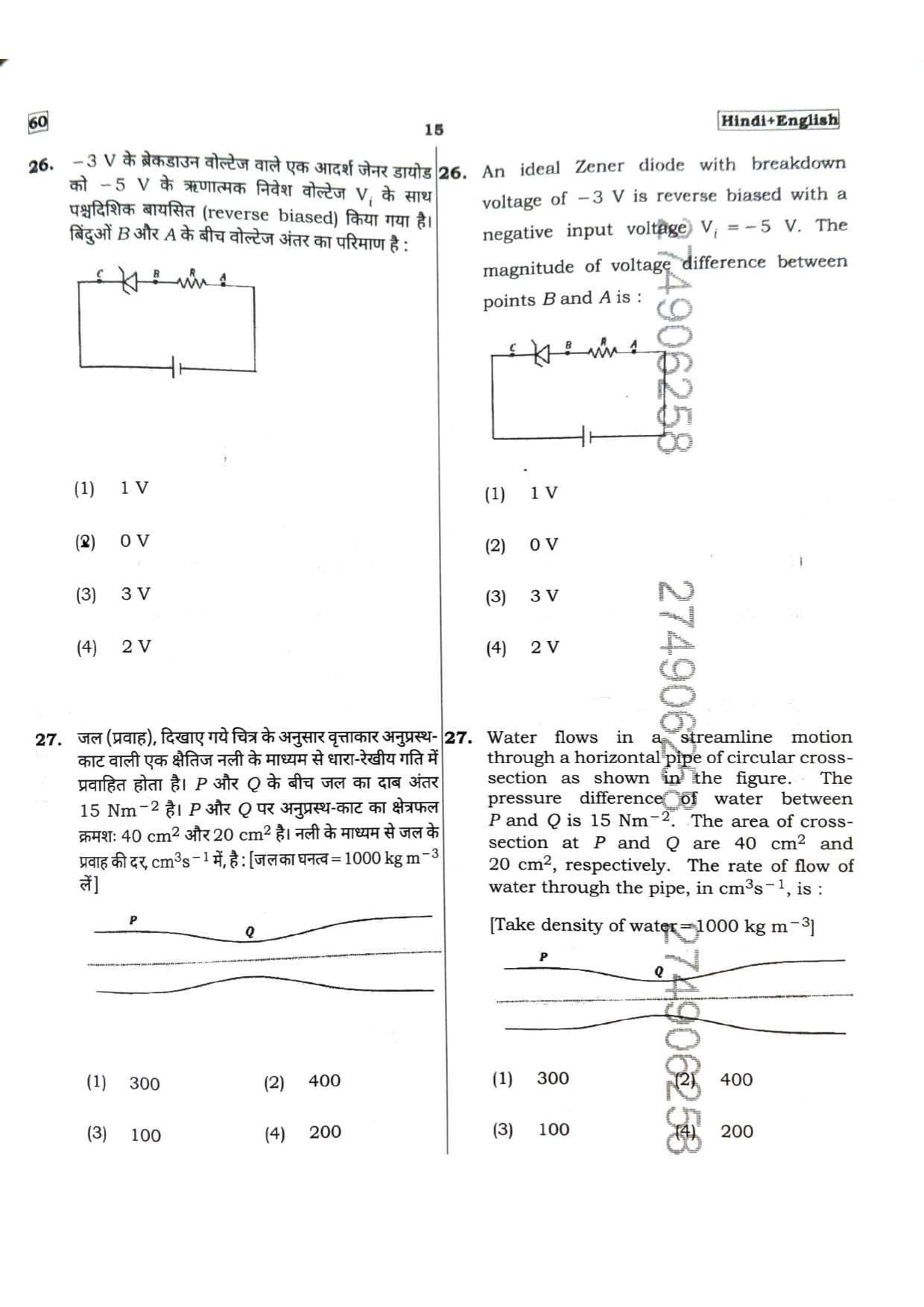
An ideal Zener diode with breakdown voltage of \(-3\) V is reverse biased with a negative input voltage \(V_i = -5\) V. The magnitude of voltage difference between points \(B\) and \(A\) is :

Water flows in a streamline motion through a horizontal pipe of circular cross-section as shown in the figure. The pressure difference of water between \(P\) and \(Q\) is \(15 Nm^{-2}\). The area of cross-section at \(P\) and \(Q\) are \(40 cm^2\) and \(20 cm^2\), respectively. The rate of flow of water through the pipe, in \(cm^3s^{-1}\), is : [Take density of water \(= 1000 kg m^{-3}\)]

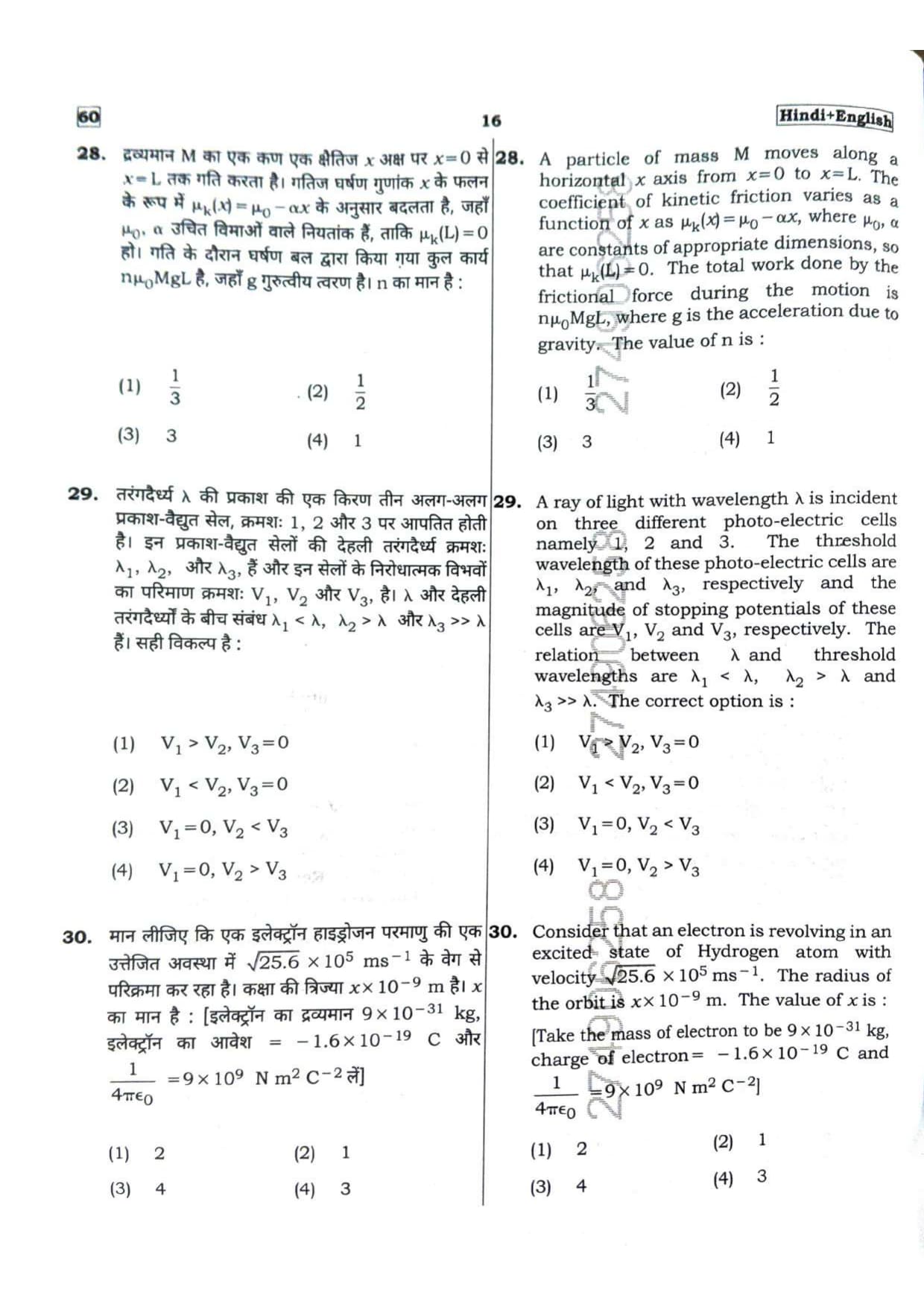
A particle of mass \(M\) moves along a horizontal \(x\) axis from \(x = 0\) to \(x = L\). The coefficient of kinetic friction varies as a function of \(x\) as \(\mu_k(x) = \mu_0 - \alpha x\), where \(\mu_0, \alpha\) are constants, so that \(\mu_k(L) = 0\). The total work done by the frictional force during the motion is \(n \mu_0 Mg L\). The value of \(n\) is :
A ray of light with wavelength \(\lambda\) is incident on three different photo-electric cells namely 1, 2 and 3. The threshold wavelength of these cells are \(\lambda_1, \lambda_2\) and \(\lambda_3\), respectively and the stopping potentials are \(V_1, V_2\) and \(V_3\). The relation between \(\lambda\) and threshold wavelengths are \(\lambda_1 < \lambda, \lambda_2 > \lambda\) and \(\lambda_3 \gg \lambda\). The correct option is :
Consider that an electron is revolving in an excited state of Hydrogen atom with velocity \(\sqrt{25.6} \times 10^5 ms^{-1}\). The radius of the orbit is \(x \times 10^{-9} m\). The value of \(x\) is : [Take \(m_e = 9 \times 10^{-31} kg, e = 1.6 \times 10^{-19} C, k = 9 \times 10^9 N m^2C^{-2}\)]
A car travels on a circular racetrack of radius \(50 m\), which is banked at an angle \(\theta\). If the car travels at a speed \(10 ms^{-1}\), then the wear and tear on its tyres is minimum. Taking \(g = 10 ms^{-2}\), the value of \(\theta\) is :
One mole of an ideal monatomic gas undergoes a cyclic process as shown in the figure. The total heat supplied to the gas is :

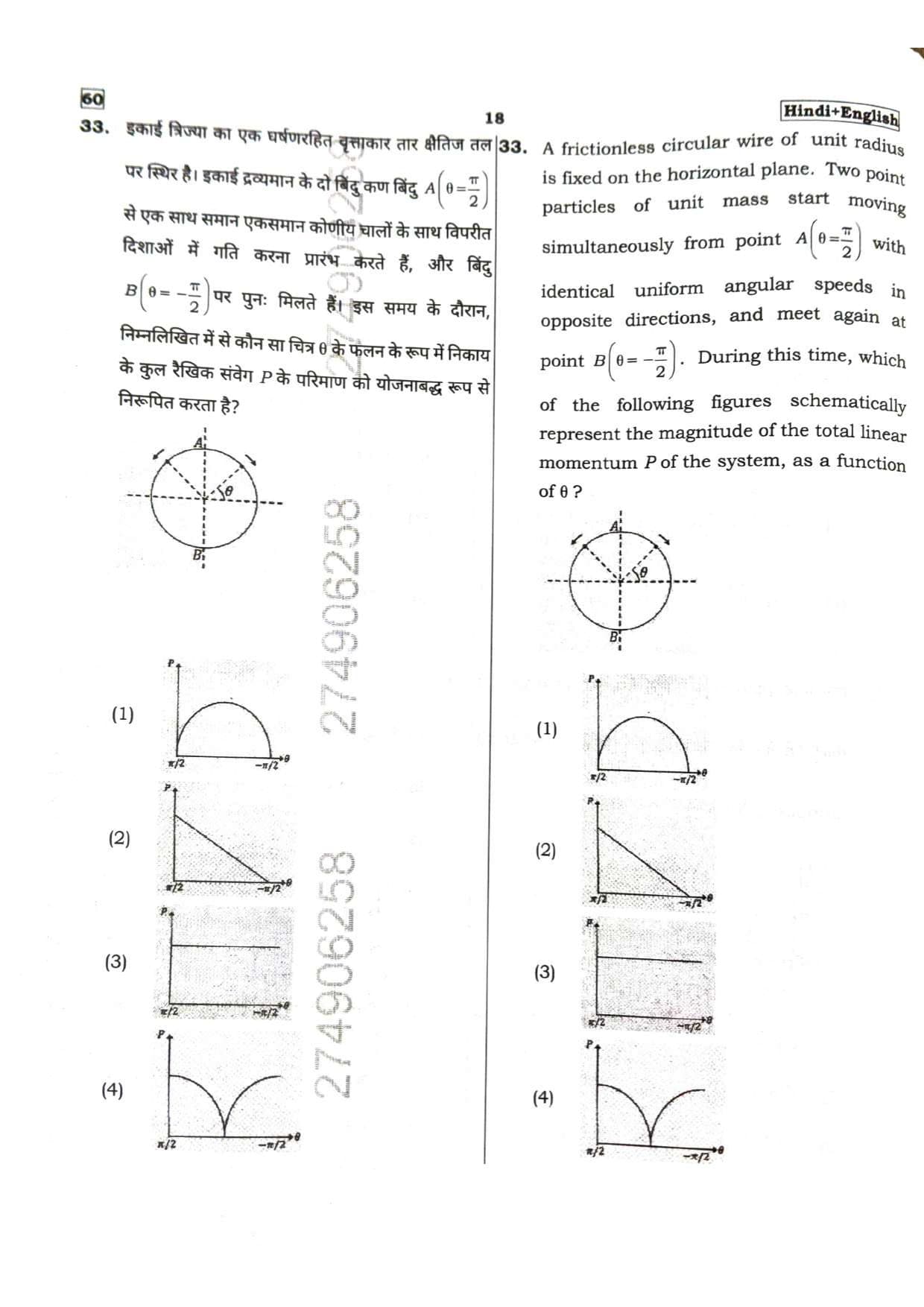
A frictionless circular wire of unit radius is fixed on the horizontal plane. Two point particles of unit mass start moving simultaneously from point \(A (\theta = \pi/2)\) with identical uniform angular speeds in opposite directions, and meet again at point \(B (\theta = -\pi/2)\). During this time, which of the following figures schematically represent the magnitude of the total linear momentum \(P\) of the system, as a function of \(\theta\) ?

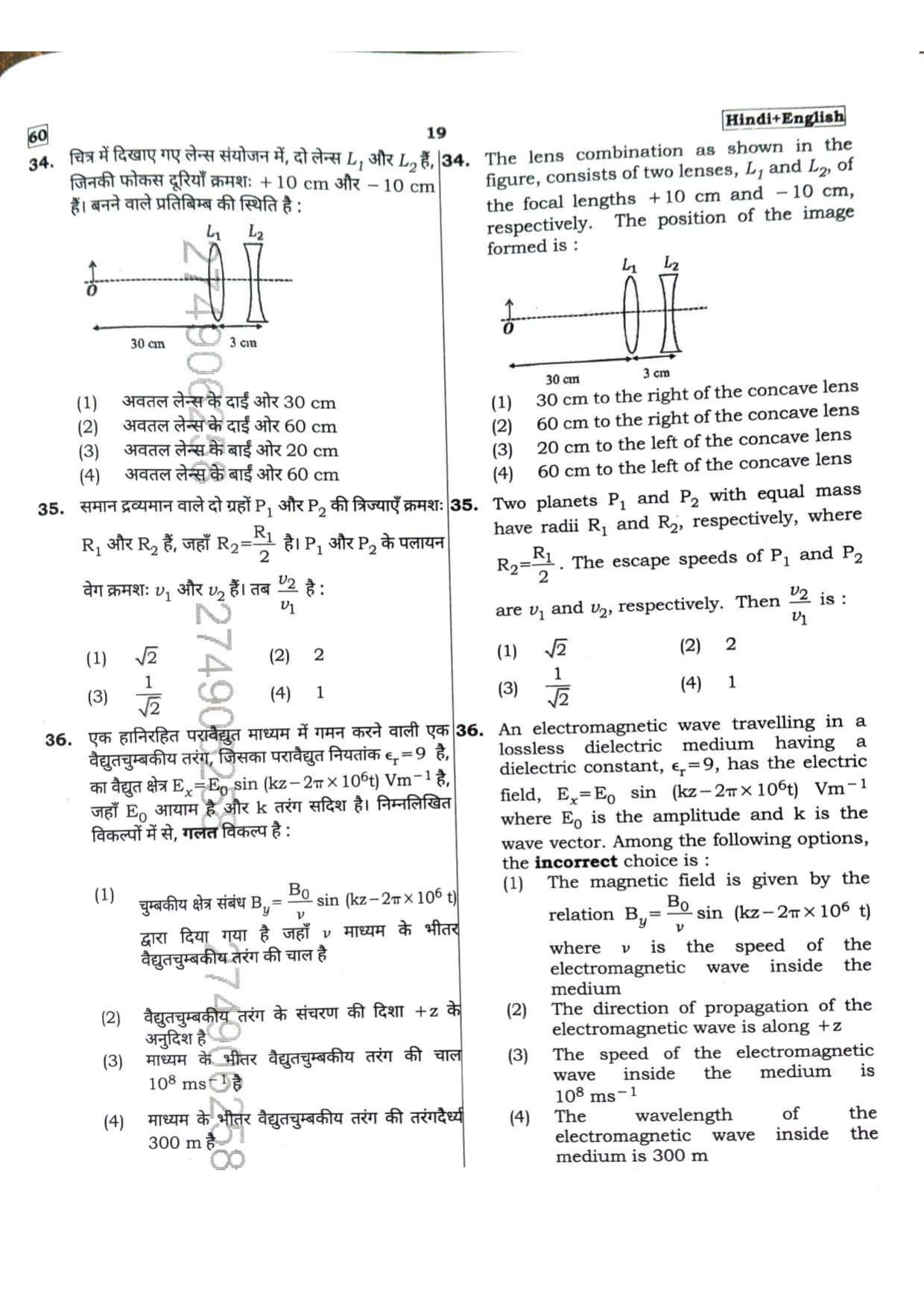
The lens combination consists of two lenses, \(L_1\) and \(L_2\), of the focal lengths \(+10 cm\) and \(-10 cm\), respectively. The position of the image formed is :

Two planets \(P_1\) and \(P_2\) with equal mass have radii \(R_1\) and \(R_2\), where \(R_2 = R_1 / 2\). The escape speeds of \(P_1\) and \(P_2\) are \(v_1\) and \(v_2\), respectively. Then \(v_2 / v_1\) is :
An electromagnetic wave travelling in a lossless dielectric medium having a lossless dielectric constant, \(\epsilon_r = 9\), has the electric field, \(E_x = E_0 \sin (kz - 2\pi \times 10^6 t) Vm^{-1}\), where \(E_0\) is the amplitude and \(k\) is the wave vector. Among the following options, the incorrect choice is :
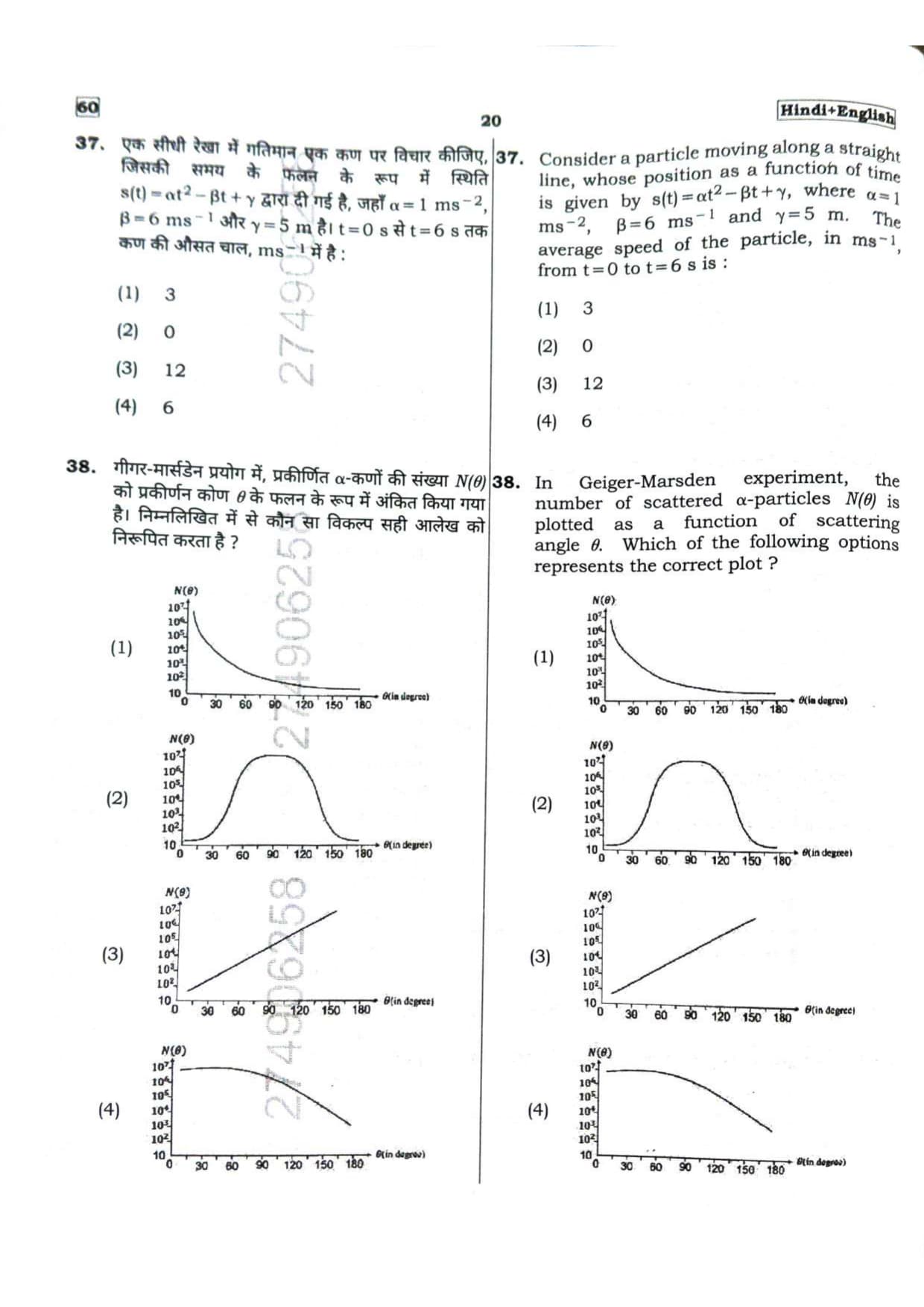
Consider a particle moving along a straight line, whose position as a function of time is given by \(s(t) = \alpha t^2 - \beta t + \gamma\), where \(\alpha = 1 ms^{-2}, \beta = 6 ms^{-1}\) and \(\gamma = 5 m\). The average speed of the particle, in \(ms^{-1}\), from \(t = 0 s\) to \(t = 6 s\) is :
In Geiger-Marsden experiment, the number of scattered \(\alpha\)-particles \(N(\theta)\) is plotted as a function of scattering angle \(\theta\). Which of the following options represents the correct plot ?

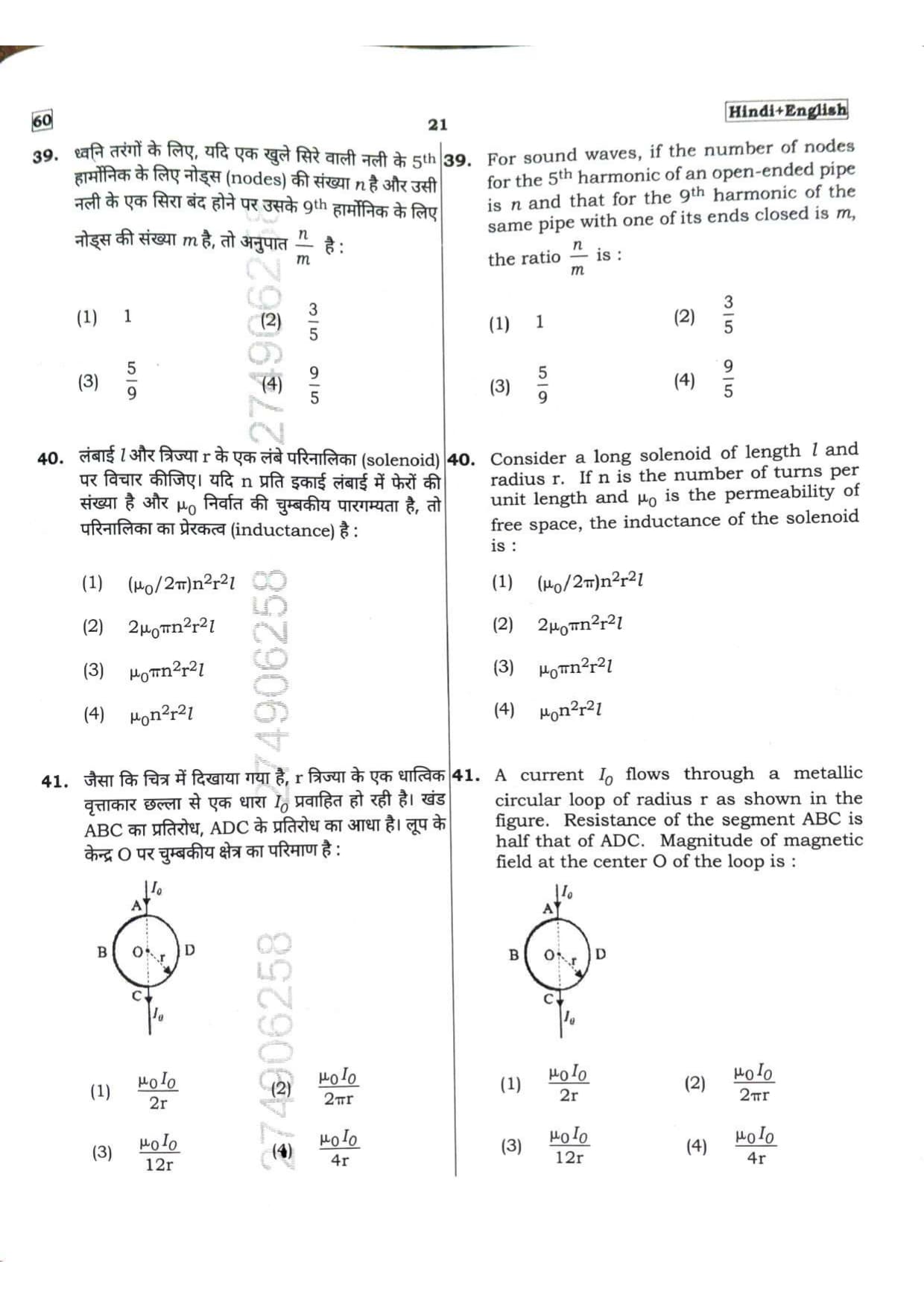
For sound waves, if the number of nodes for the \(5^{th}\) harmonic of an open-ended pipe is \(n\) and that for the \(9^{th}\) harmonic of the same pipe with one of its ends closed is \(m\), the ratio \(\frac{n}{m}\) is :
Consider a long solenoid of length \(l\) and radius \(R\). If \(n\) is the number of turns per unit length and \(\mu_0\) is the permeability of free space, the inductance of the solenoid is :
A current \(I_0\) flows through a metallic circular loop of radius \(r\) as shown in the figure. Resistance of the segment ABC is half that of ADC. Magnitude of magnetic field at the center O of the loop is :

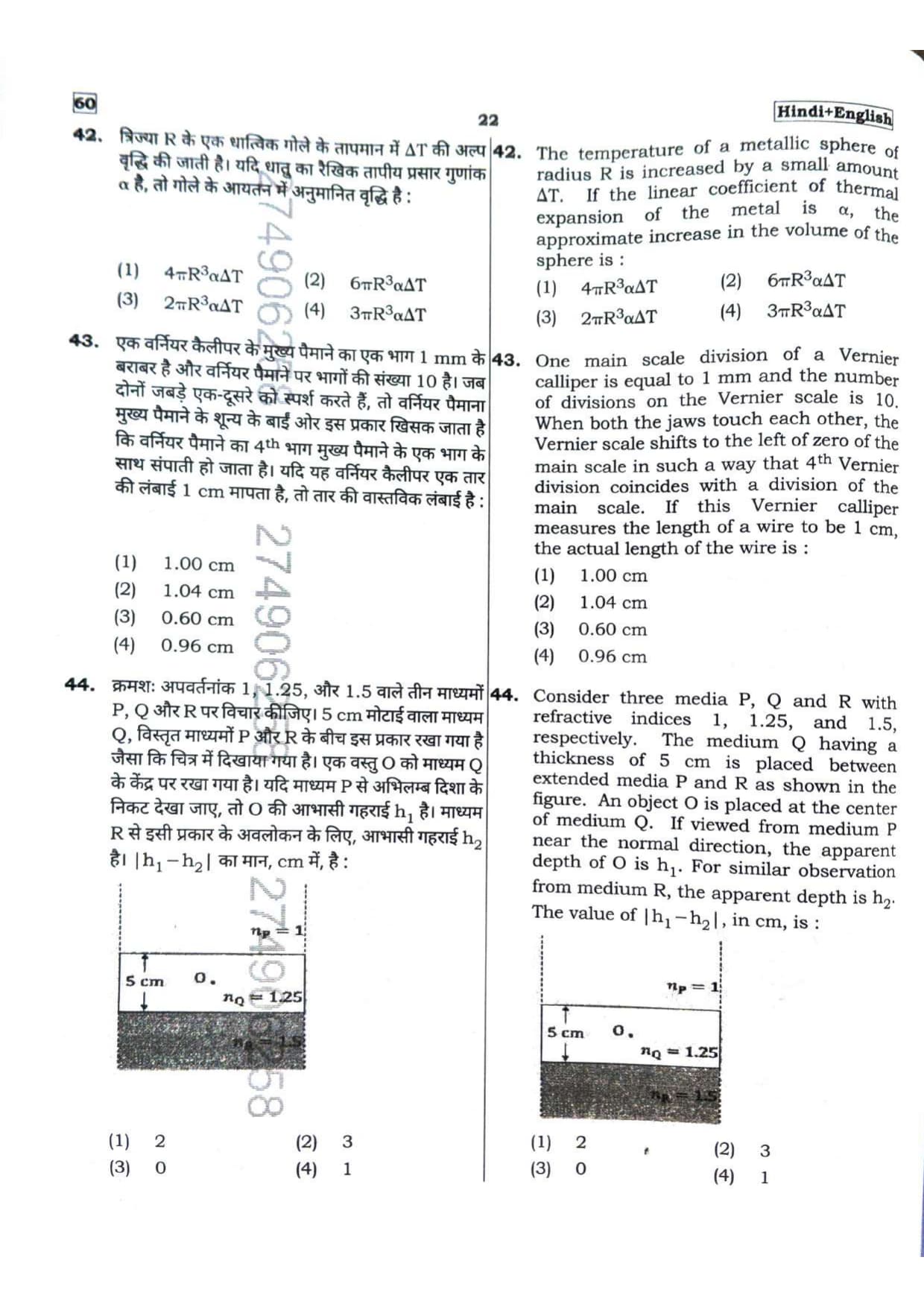
The temperature of a metallic sphere of radius R is increased by a small amount \(\Delta T\). If the linear coefficient of thermal expansion of the metal is \(\alpha\), the approximate increase in the volume of the sphere is :
One main scale division of a Vernier calliper is equal to 1 mm and the number of divisions on the Vernier scale is 10. When both the jaws touch each other, the Vernier scale shifts to the left of zero of the main scale in such a way that \(4^{th}\) Vernier division coincides with a division of the main scale. If this Vernier calliper measures the length of a wire to be 1 cm, the actual length of the wire is :
Consider three media P, Q and R with refractive indices 1, 1.25, and 1.5, respectively. The medium Q having a thickness of 5 cm is placed between extended media P and R as shown in the figure. An object O is placed at the center of medium Q. If viewed from medium P near the normal direction, the apparent depth of O is \(h_1\). For similar observation from medium R, the apparent depth is \(h_2\). The value of \(|h_1 - h_2|\), in cm, is :

A point charge Q is placed inside a cavity within a solid isolated conducting sphere. Consider points A, B and C as shown in the figure, where the magnitudes of the electric fields are \(E_A, E_B\) and \(E_C\), respectively. The points B and C are at the same distance from the center of the solid sphere. The correct option is :

The lanthanide ion having four unpaired electrons is (Given: Atomic numbers of \(Ce = 58\), \(Nd = 60\), \(Tb = 65\) and \(Ho = 67\)):
The standard electrode potential (\(E^\circ\)) for the half-cell reaction \(Fe^{3+} + e^- \rightarrow Fe^{2+}\) at \(298 K\) is (Given: \(E^\circ(Fe^{3+}/Fe) = -0.04 V\) and \(E^\circ(Fe^{2+}/Fe) = -0.44 V\) at \(298 K\)):
Given below are two statements:
Statement-I: Heating \(NaCl\) with concentrated \(H_2SO_4\) and \(MnO_2\) results in oxidation of \(Mn\).
Statement-II: Heating \(NaI\) with concentrated \(H_2SO_4\) and \(MnO_2\) results in reduction of \(Mn\).
In light of the above statements, choose the most appropriate answer from the options given below:
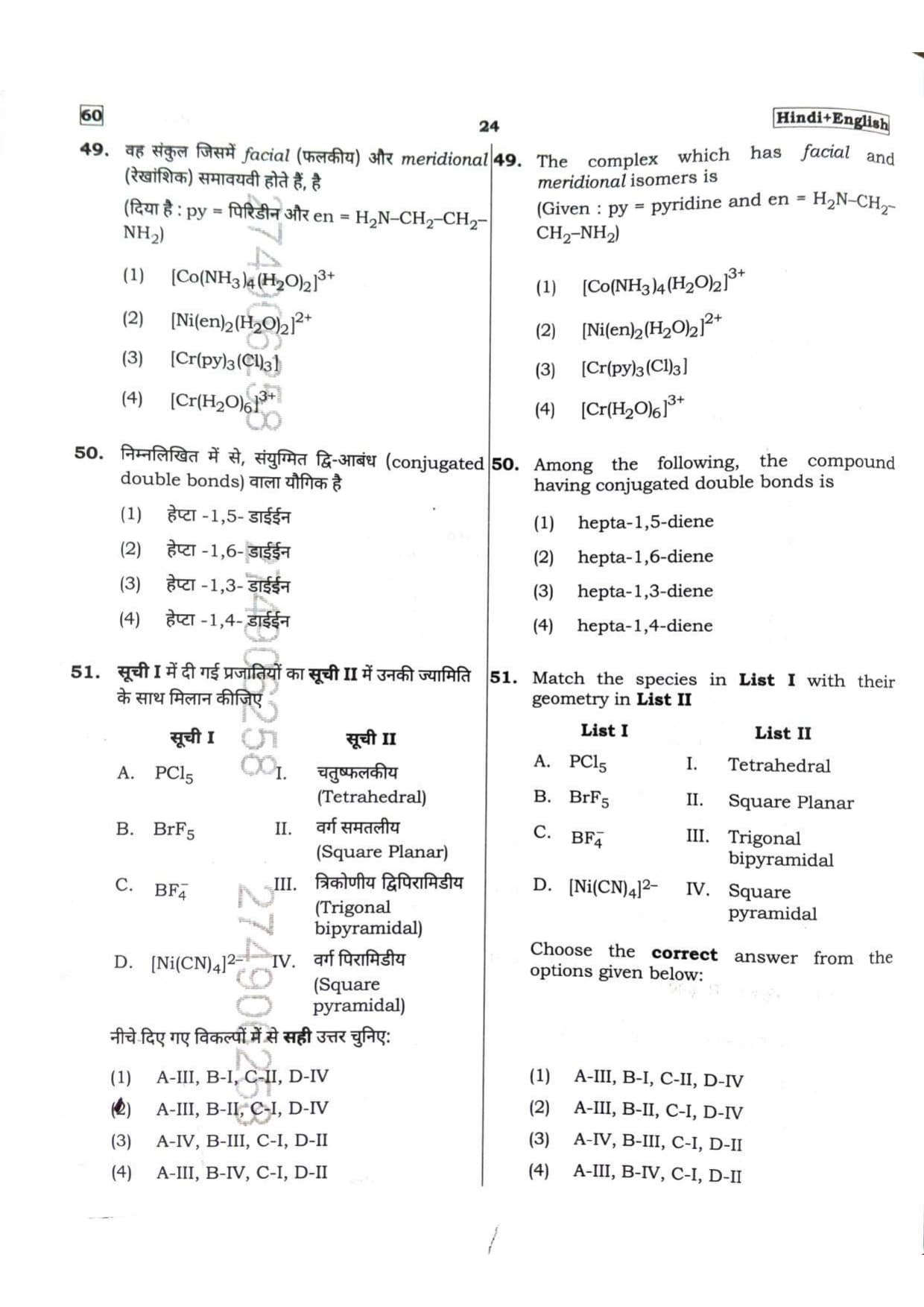
The complex which has facial and meridional isomers is (Given: \(py = pyridine\) and \(en = H_2N-CH_2-CH_2-NH_2\)):
Among the following, the compound having conjugated double bonds is:
Match the species in List I with their geometry in List II:

Choose the correct answer from the options given below:
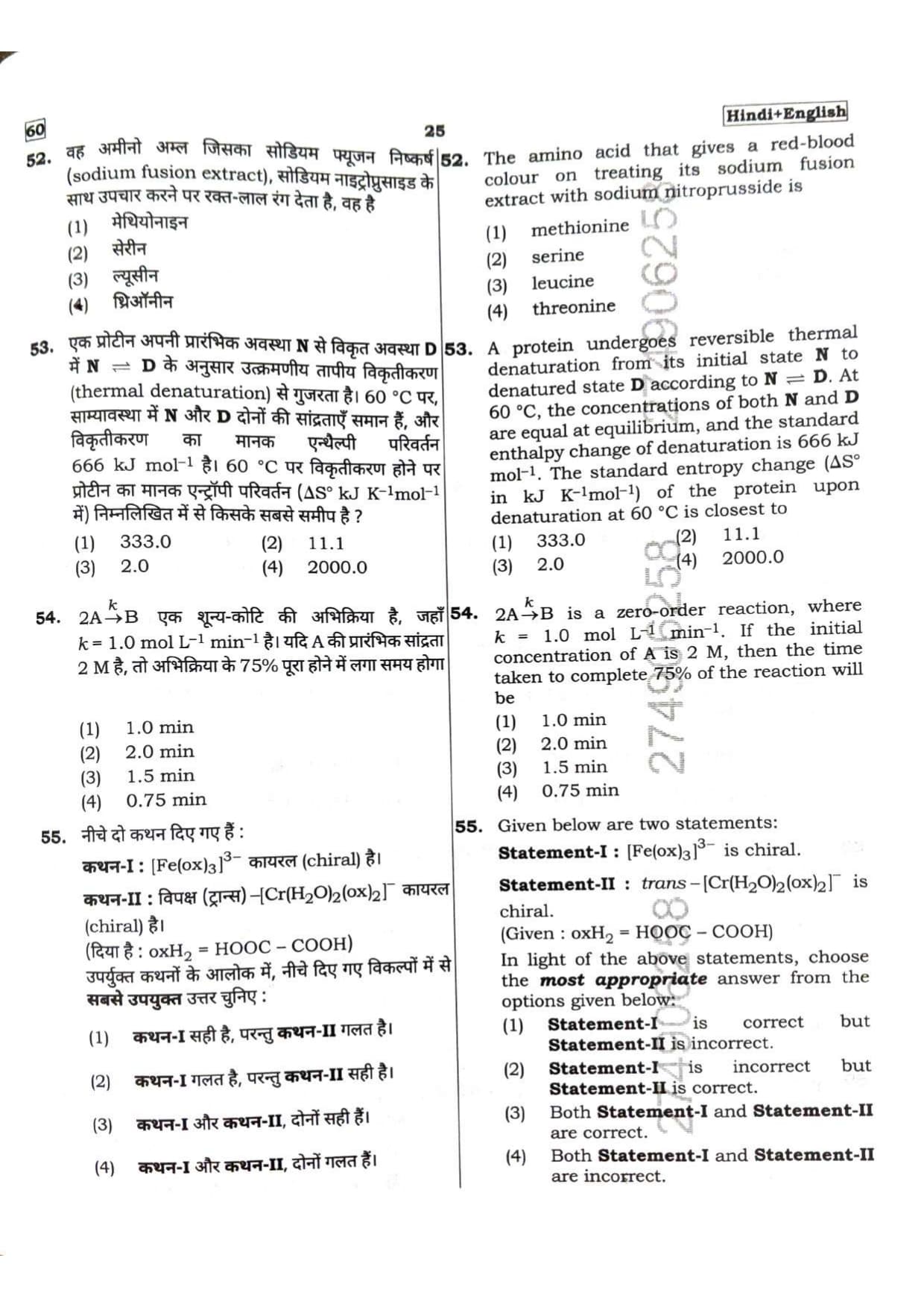
The amino acid that gives a red-blood colour on treating its sodium fusion extract with sodium nitroprusside is:
A protein undergoes reversible thermal denaturation from its initial state \(N\) to denatured state \(D\) according to \(N \rightleftharpoons D\). At \(60 \,\, ^\circC\), the concentrations of both \(N\) and \(D\) are equal at equilibrium, and the standard enthalpy change of denaturation is \(666 kJ mol^{-1}\). The standard entropy change (\(\Delta S^\circ\) in \(kJ K^{-1}mol^{-1}\)) of the protein upon denaturation at \(60 \,\, ^\circC\) is closest to:
\(2A \xrightarrow{k} B\) is a zero-order reaction, where \(k = 1.0 mol L^{-1}min^{-1}\). If the initial concentration of \(A\) is \(2 M\), then the time taken to complete \(75%\) of the reaction will be:
Given below are two statements:
Statement-I: \([Fe(ox)_3]^{3-}\) is chiral.
Statement-II: \textit{trans-\([Cr(H_2O)_2(ox)_2]^-\) is chiral.
(Given: \(oxH_2 = HOOC-COOH\))
In light of the above statements, choose the most appropriate answer from the options given below:
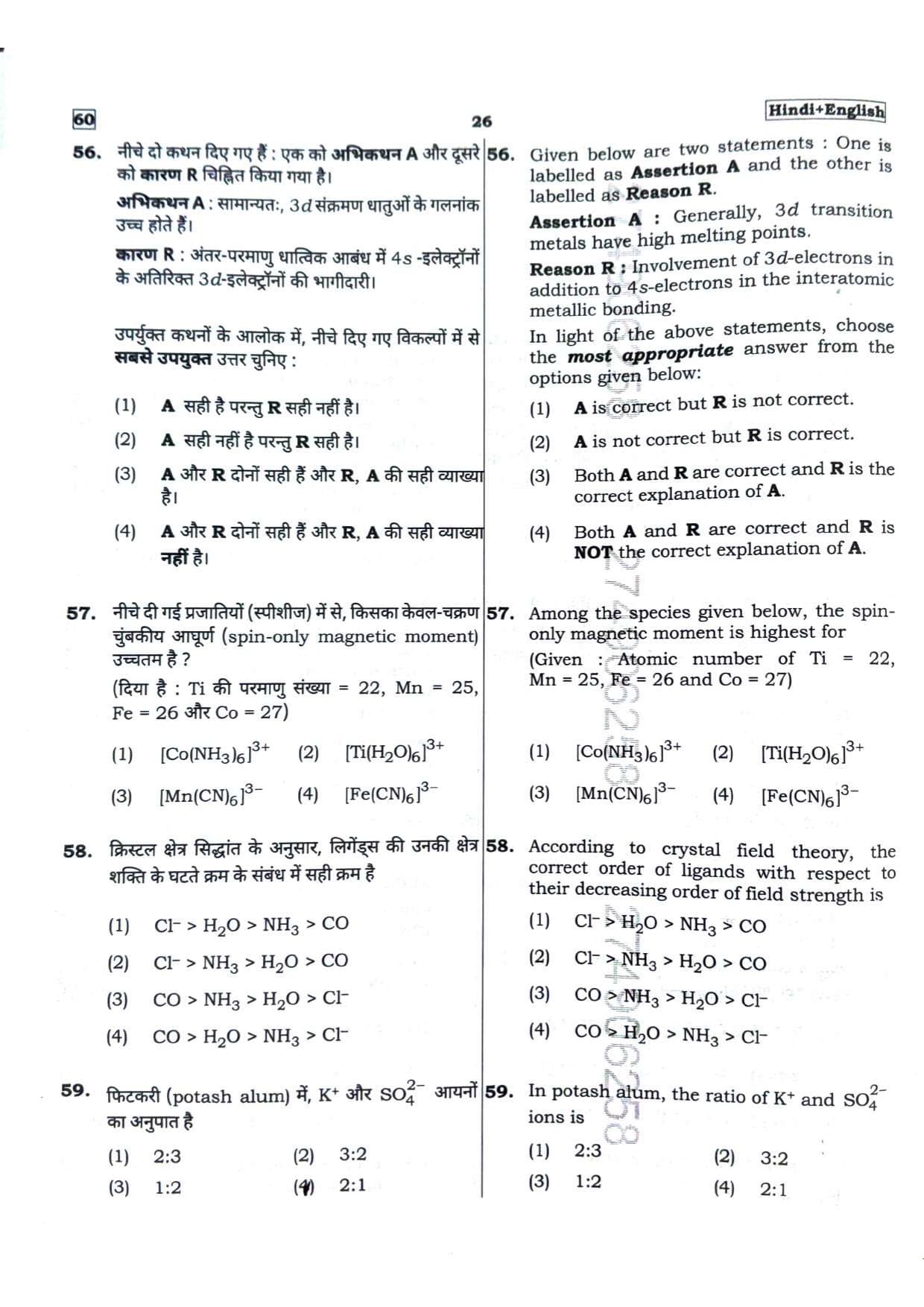
Given below are two statements : One is labelled as Assertion A and the other is labelled as Reason R.
Assertion A : Generally, \(3d\) transition metals have high melting points.
Reason R : Involvement of \(3d\)-electrons in addition to \(4s\)-electrons in the interatomic metallic bonding.
In light of the above statements, choose the most appropriate answer from the options given below:
Among the species given below, the spin-only magnetic moment is highest for (Given : Atomic number of \(Ti = 22\), \(Mn = 25\), \(Fe = 26\) and \(Co = 27\)):
According to crystal field theory, the correct order of ligands with respect to their decreasing order of field strength is:
In potash alum, the ratio of \(K^+\) and \(SO_4^{2-}\) ions is:
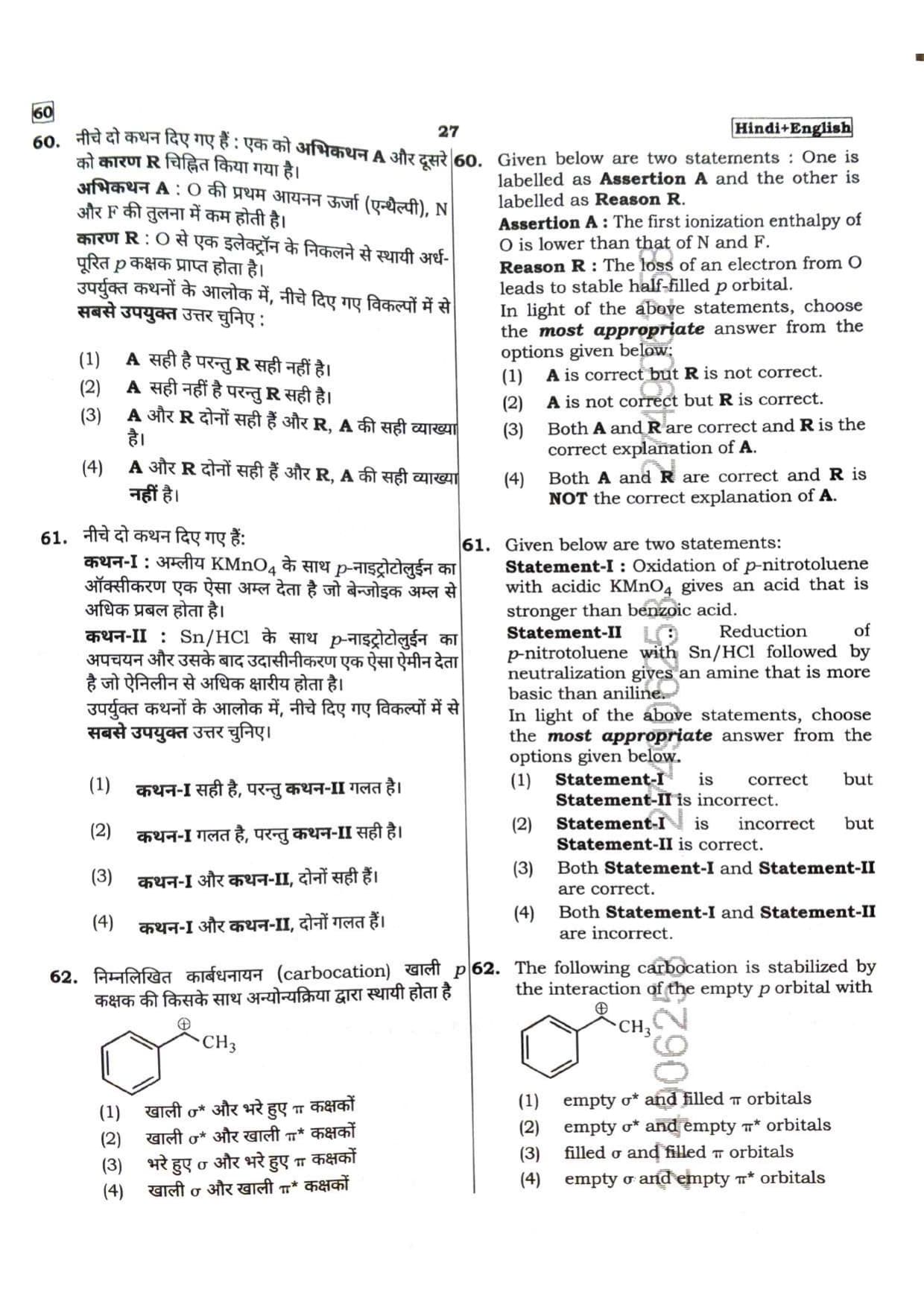
Given below are two statements : One is labelled as Assertion A and the other is labelled as Reason R.
Assertion A : The first ionization enthalpy of O is lower than that of N and F.
Reason R : The loss of an electron from O leads to stable half-filled p orbital.
In light of the above statements, choose the most appropriate answer from the options given below:
Given below are two statements:
Statement-I : Oxidation of \(p\)-nitrotoluene with acidic \(KMnO_4\) gives an acid that is stronger than benzoic acid.
Statement-II : Reduction of \(p\)-nitrotoluene with \(Sn/HCl\) followed by neutralization gives an amine that is more basic than aniline.
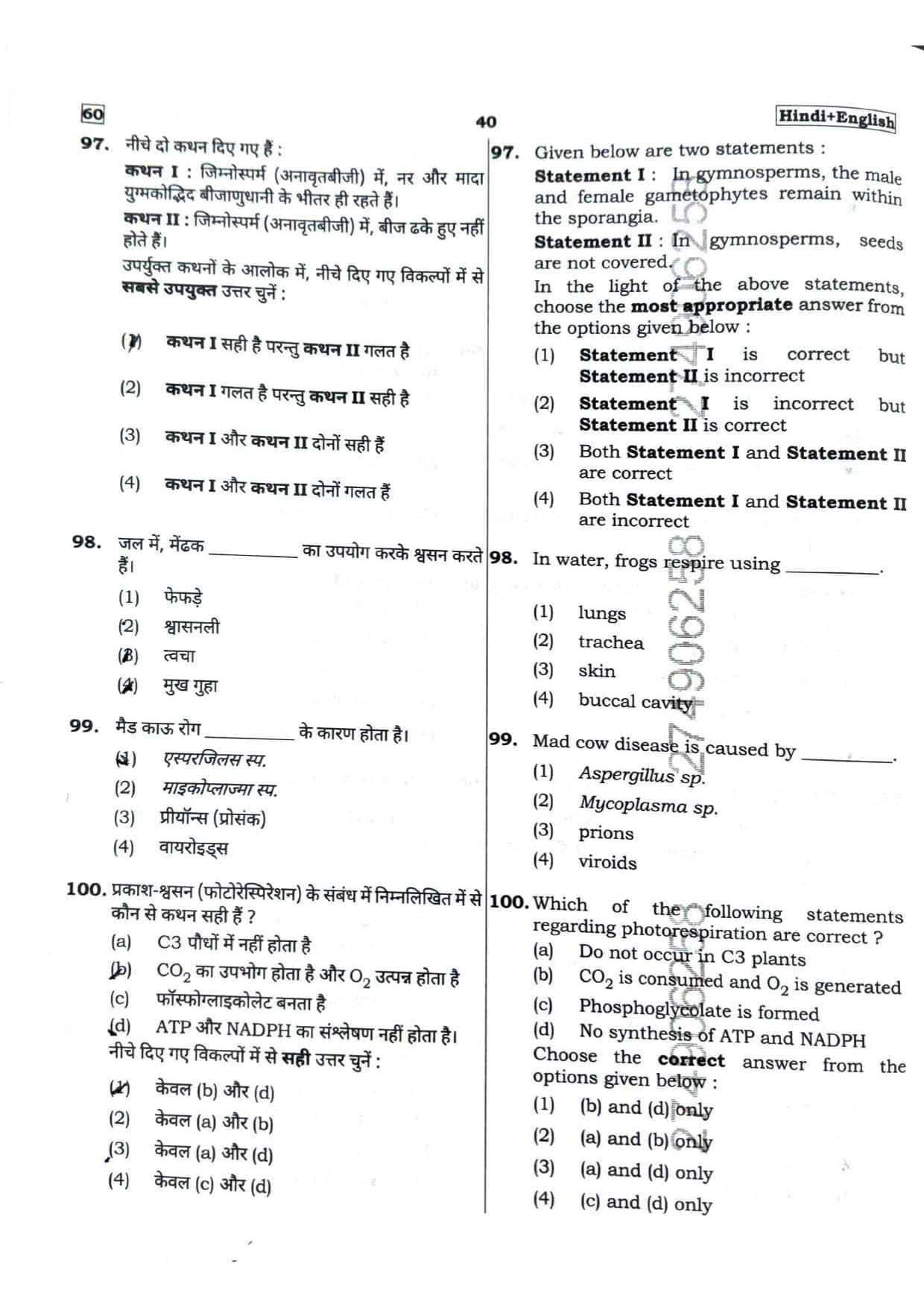
In light of the above statements, choose the most appropriate answer from the options given below:
The following carbocation is stabilized by the interaction of the empty \(p\) orbital with:

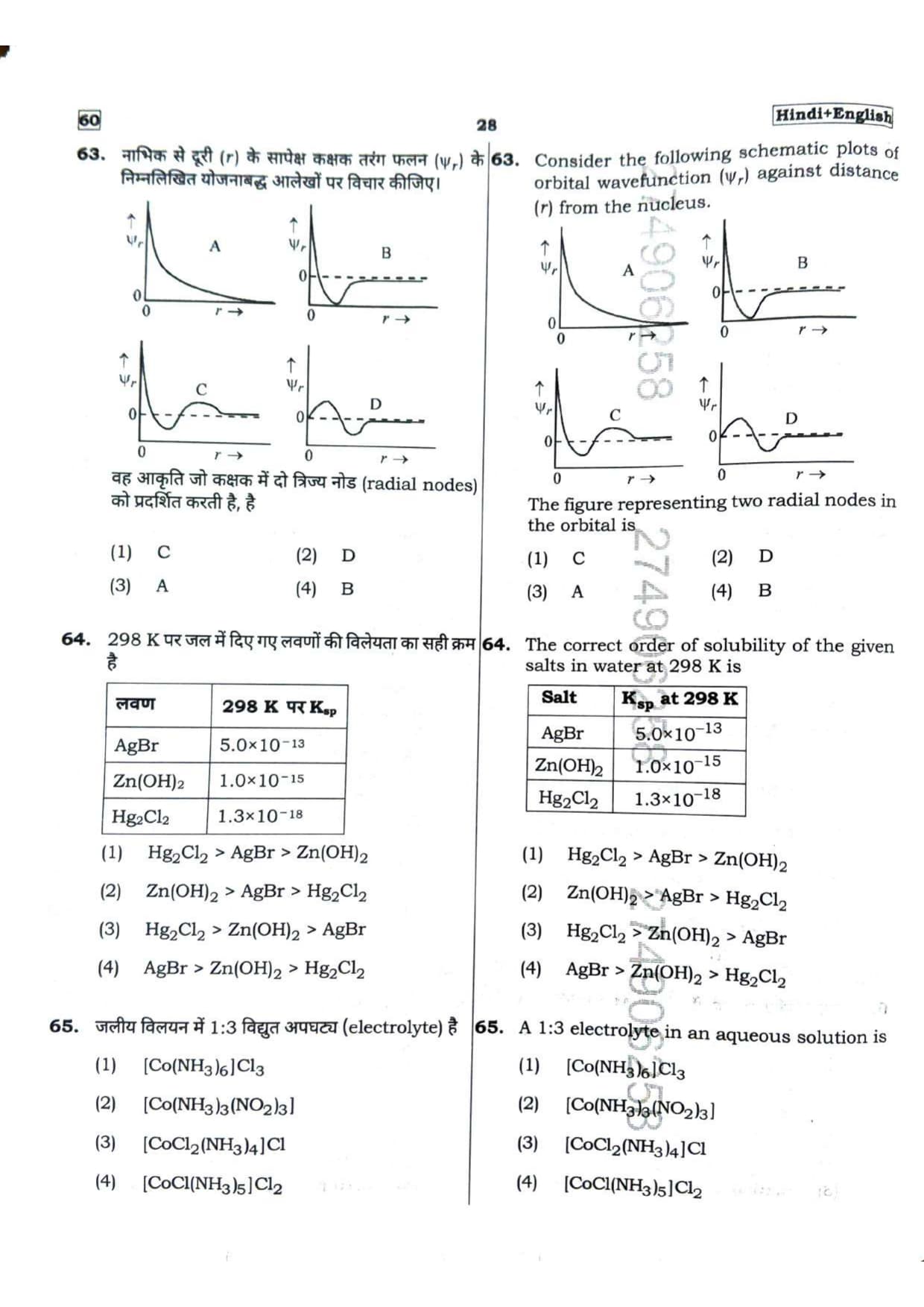
Consider the following schematic plots of orbital wavefunction (\(\psi_r\)) against distance (\(r\)) from the nucleus.

The figure representing two radial nodes in the orbital is:
The correct order of solubility of the given salts in water at \(298 K\) is:

A 1:3 electrolyte in an aqueous solution is:
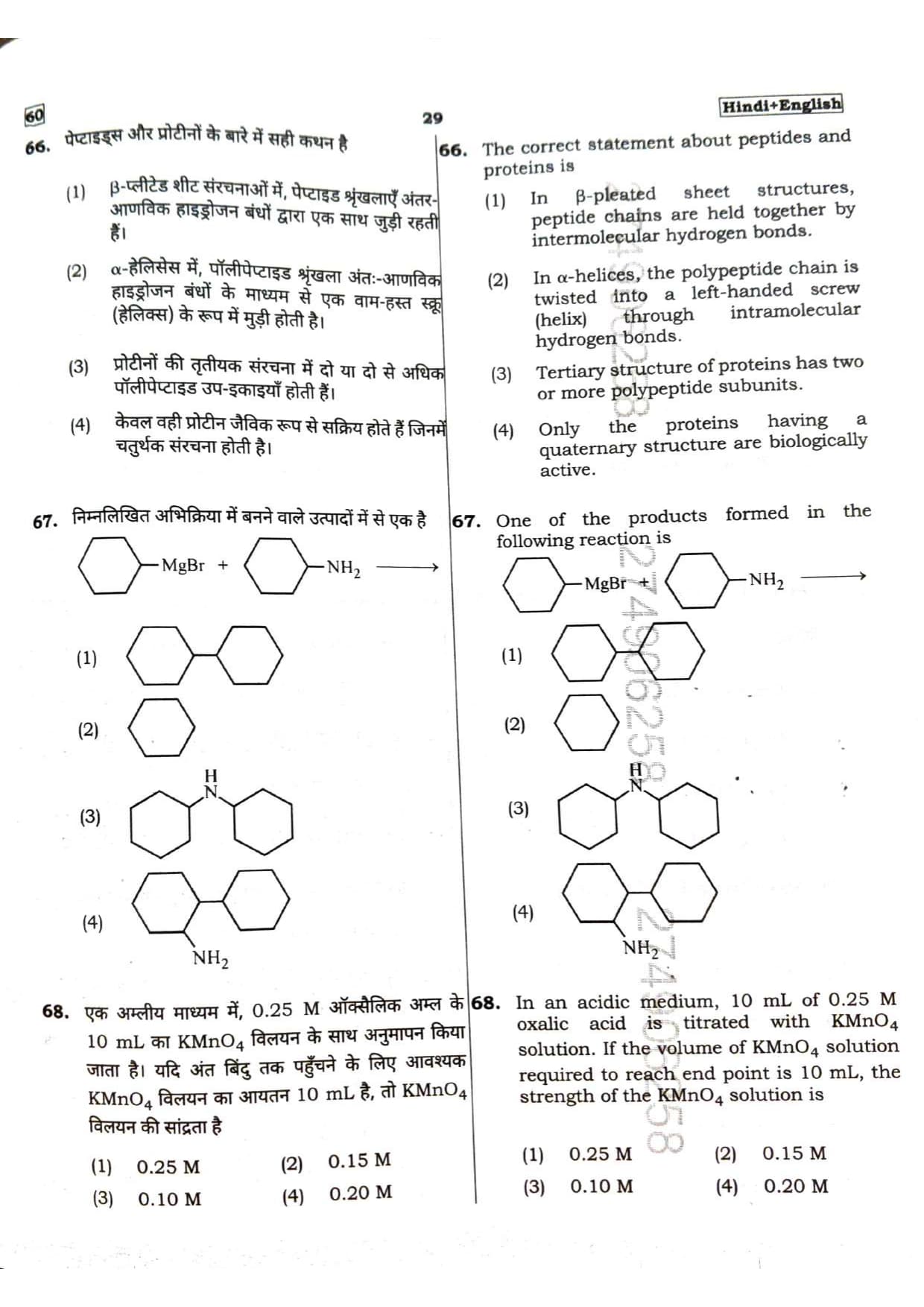
The correct statement about peptides and proteins is
One of the products formed in the following reaction is


In an acidic medium, \( 10 mL \) of \( 0.25 M \) oxalic acid is titrated with \(KMnO_4\) solution. If the volume of \(KMnO_4\) solution required to reach end point is \( 10 mL \), the strength of the \(KMnO_4\) solution is
Consider the following reaction sequences and choose the correct option.

Arrange the following compounds in the increasing order of polarity \[ A. CH_3CH_2OCH_2CH_3 \qquad B. CH_3CH_2OH \qquad C. CH_3COCH_3 \qquad D. CH_3COOH \]
Choose the correct answer from the options given below.
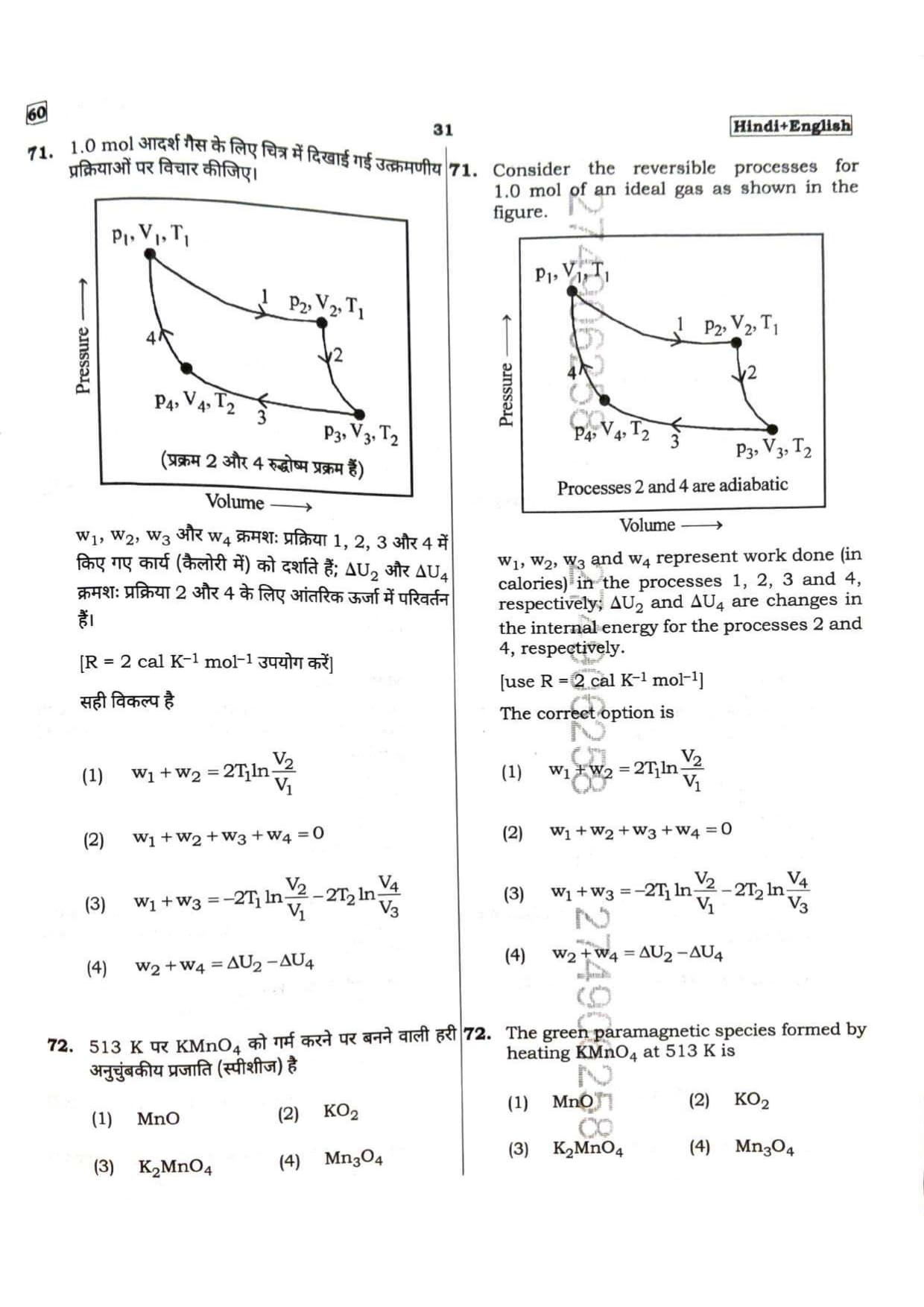
Consider the reversible processes for \(1.0 mol\) of an ideal gas as shown in the figure.
Processes 2 and 4 are adiabatic. \(w_1\), \(w_2\), \(w_3\) and \(w_4\) represent work done (in calories) in the processes 1, 2, 3 and 4, respectively; \(\Delta U_2\) and \(\Delta U_4\) are changes in the internal energy for the processes 2 and 4, respectively. [use \(R = 2 cal K^{-1} mol^{-1}\)] The correct option is

The green paramagnetic species formed by heating \(KMnO_4\) at \(513 K\) is
The numbers \(17.0145\) and \(21.0235\) were rounded to three figures after the decimal point. The resulting numbers, respectively, are
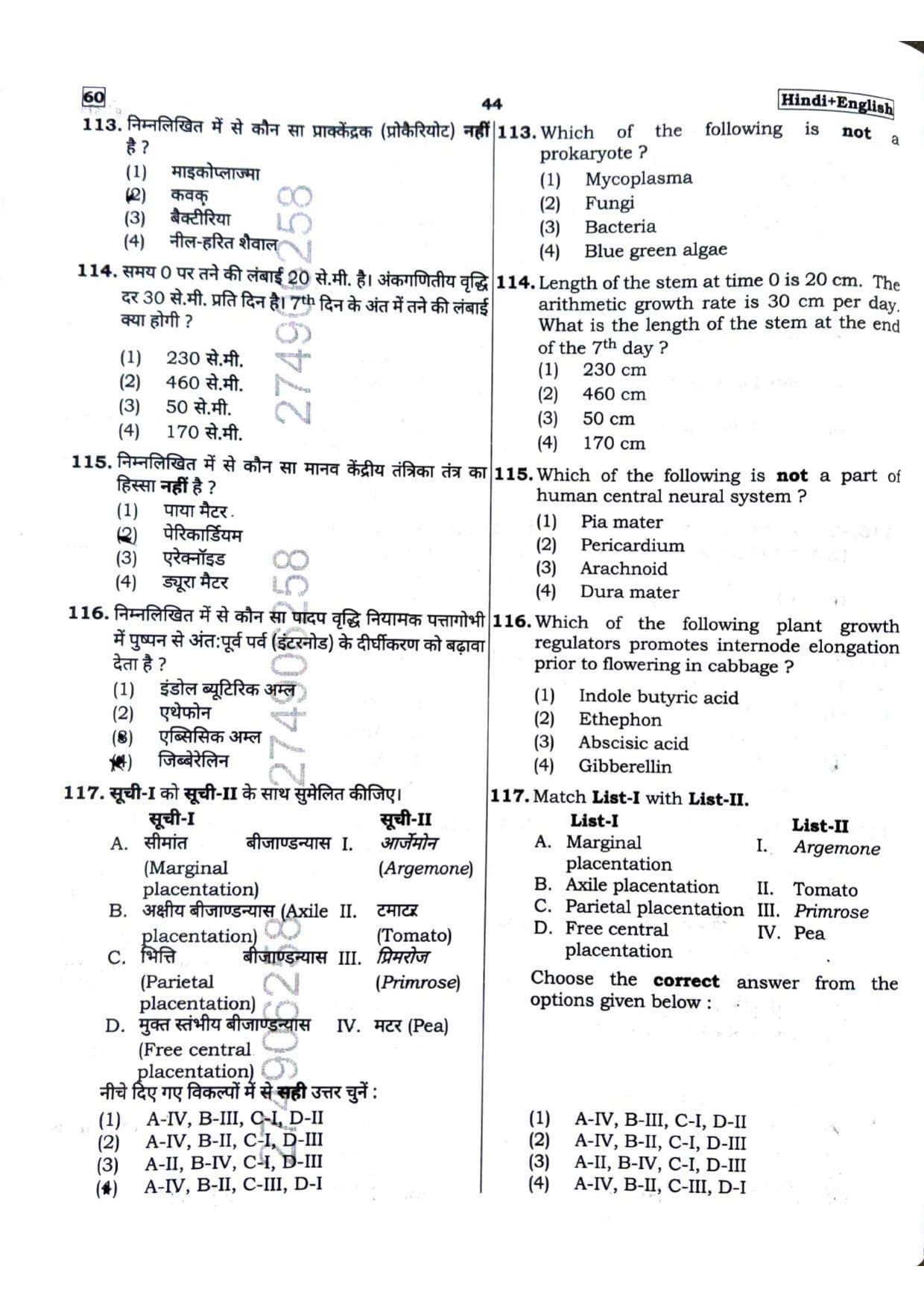
Given below are two statements:
Statement I : trans-But-2-ene upon treatment with \(Br_2\) in \(CCl_4\) gives the following product

Statement II : \textit{cis-But-2-ene upon treatment with alkaline \(KMnO_4\) gives the following product

In the light of the above statements, choose the \textbf{most appropriate answer from the options given below.
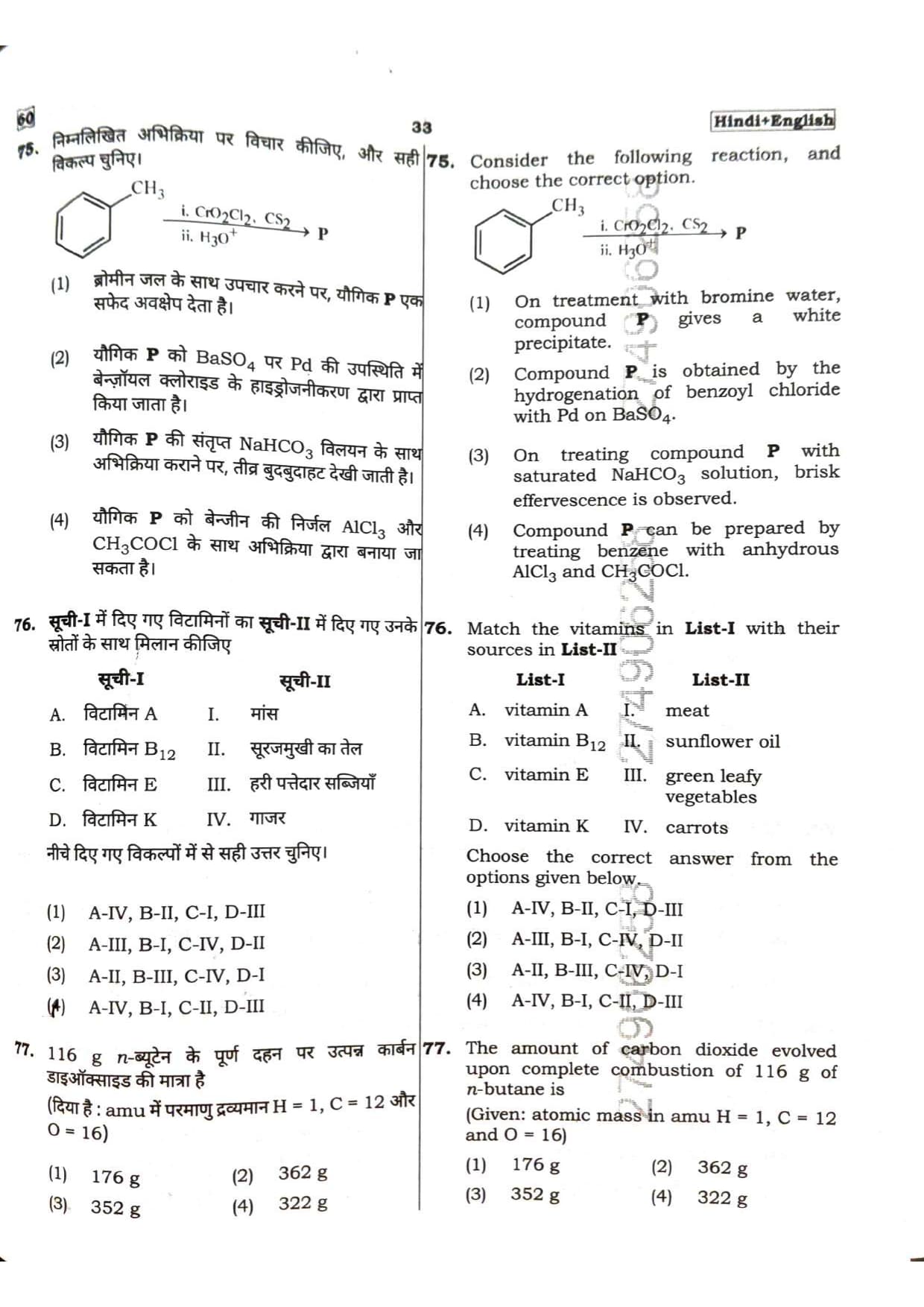
Consider the following reaction, and choose the correct option:

Match the vitamins in List-I with their sources in List-II:

Choose the correct answer from the options given below:
The amount of carbon dioxide evolved upon complete combustion of \(116 g\) of \(n\)-butane is
(Given: atomic mass in amu \(H = 1\), \(C = 12\) and \(O = 16\)):
The compound that CANNOT be obtained from the aldol condensation reaction shown below, is:


The correct statement is:
The formula of tetraammineaquachloridocobalt(III) chloride is:
Assertion A: For an ideal solution formed by mixing liquids P and Q, \(\Delta_{mix} H = 0\) and \(\Delta_{mix} V = 0\).
Reason R: No interactions occur between P and Q.
In the light of the above statements, choose the most appropriate answer from the options given below:
Identify the reactions which give aniline as the major product:


Choose the correct answer from the options given below:
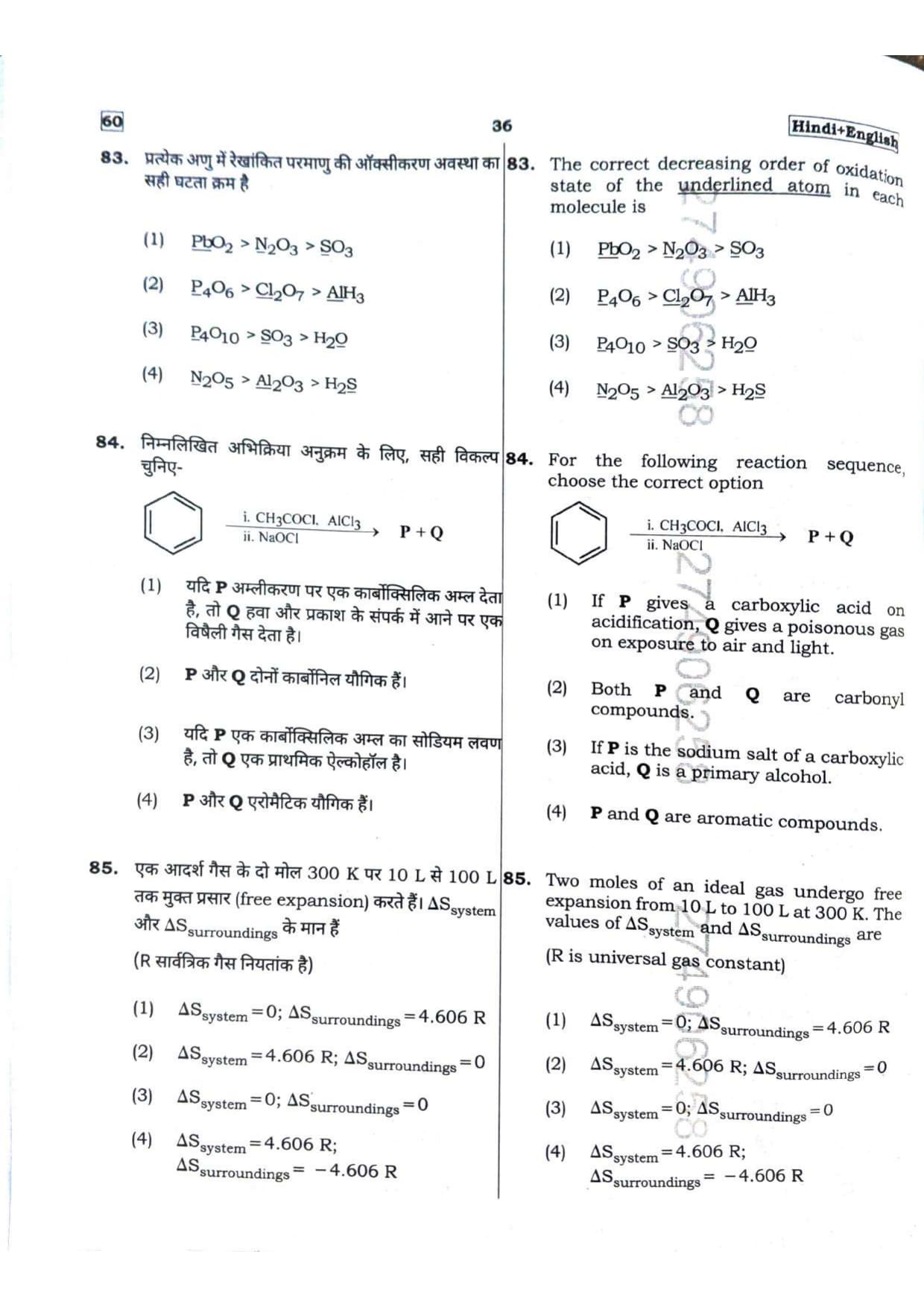
The correct decreasing order of oxidation state of the underlined atom in each molecule is:
For the following reaction sequence, choose the correct option:

Two moles of an ideal gas undergo free expansion from \(10 L\) to \(100 L\) at \(300 K\). The values of \(\Delta S_{system}\) and \(\Delta S_{surroundings}\) are (\(R\) is universal gas constant):
For an elementary chemical reaction, the Arrhenius plot is given below.

If the energy of activation is \(6.64 kJ mol^{-1}\) and \(R = 8.3 J K^{-1} mol^{-1}\), the temperature at which the rate constant becomes \(e^2 min^{-1}\), is:
Consider the following statements about the solutions formed by mixing two liquids:
[A.] An ideal solution thus formed obeys Raoult's law throughout the composition range.
[B.] Mixture of chloroform and acetone shows negative deviation from Raoult's law.
[C.] Mixture of aniline and phenol shows positive deviation from Raoult's law.
Choose the correct answer from the options given below:
The highest occupied molecular orbital for \(Ne_2\) is:
For a salt \(XY\), which is a strong electrolyte, the plot of \(\Lambda_m\) versus \(\sqrt{c}\) has a slope of \(-90.0 S cm^2 mol^{-3/2} L^{1/2}\) at \(298 K\). At \(0.01 M\) concentration of \(XY\), the value of \(\Lambda_m\) is \(145.0 S cm^2 mol^{-1}\). The limiting molar conductivity of \(Y^-\) ion (\(\lambda_{Y^-}^0\), in \(S cm^2 mol^{-1}\)) at \(298 K\) will be
(Given : \(\lambda_{X^+}^0 = 74.0 S cm^2 mol^{-1}\)):
Among the following options, the correct trend in the electron gain enthalpy is:
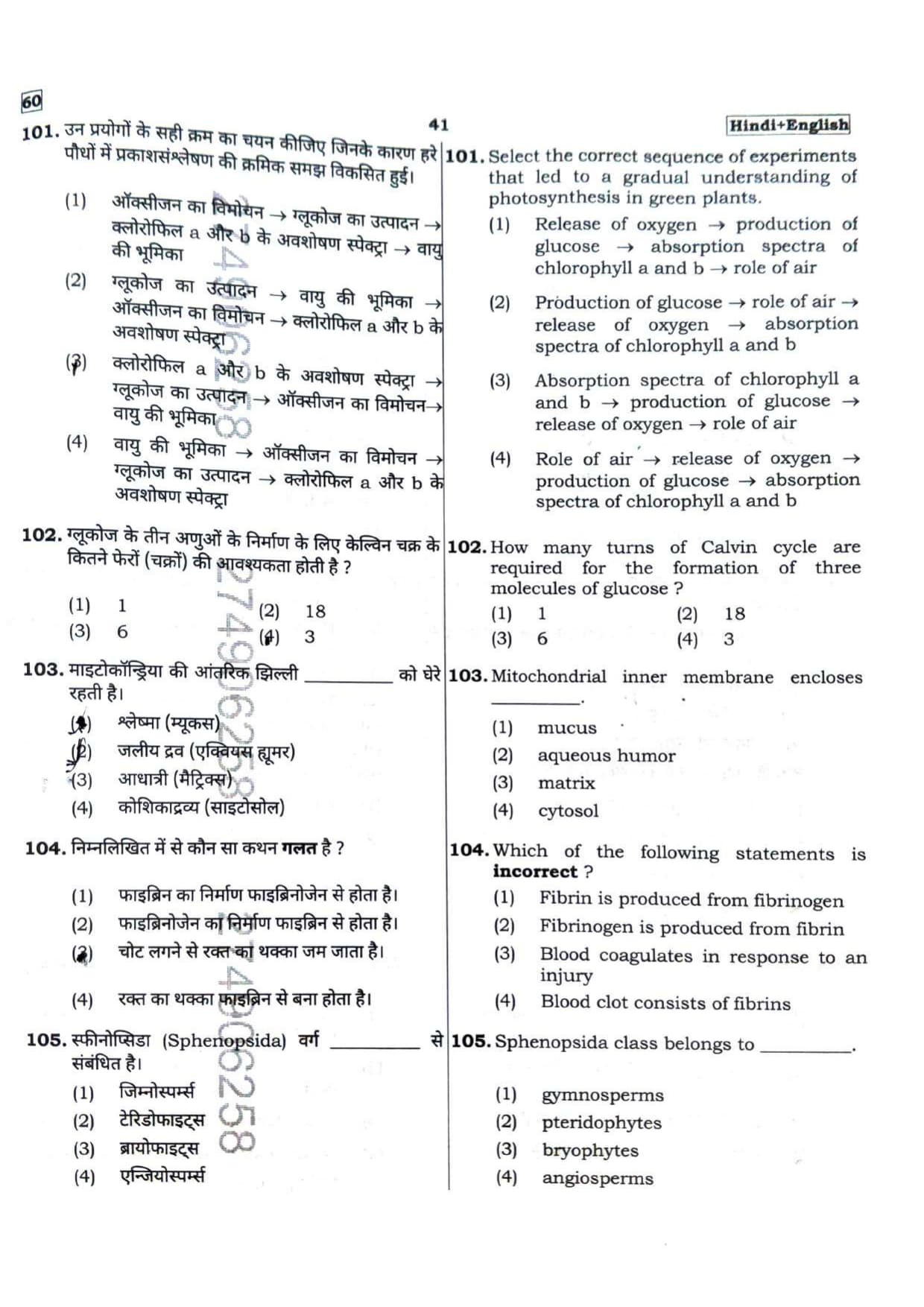
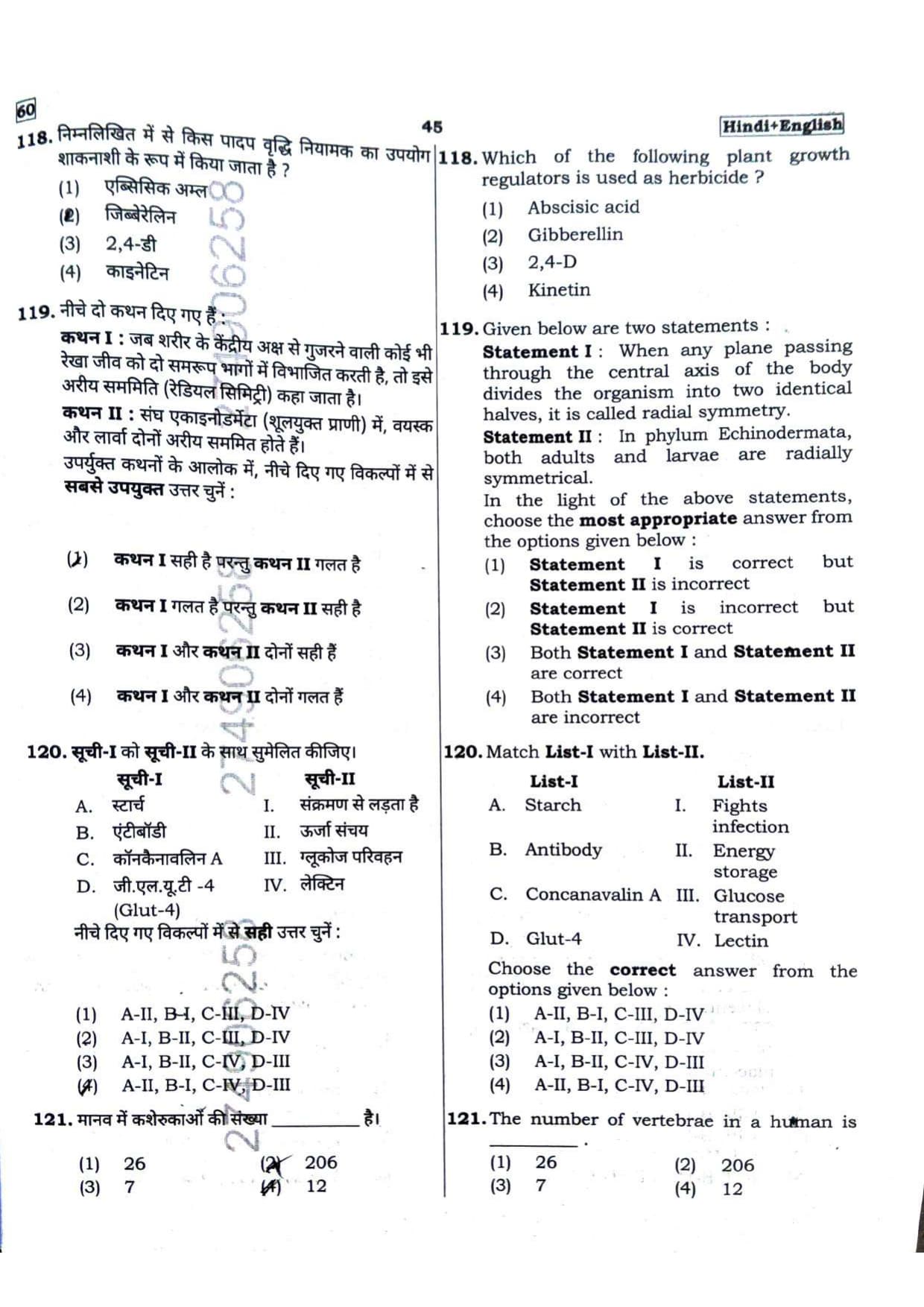
Photorespiration reaction catalyzed by RuBisCo is shown below :
\[ RuBP + O_2 \rightarrow 3-Phosphoglycerate + X \]
Identify ``X'' from the given options :
Which of the following are characteristic features of Solanaceae family ?
(a) Flowers are bisexual and actinomorphic
(b) Calyx have five sepals and are united
(c) Androecium have five stamens and are epipetalous
(d) Ovary is inferior
Choose the correct answer from the options given below :
Sperm motility is due to __________.
Given below are two statements : one is labelled as Assertion A and the other is labelled as Reason R.
Assertion A : Abingdon tortoise in Galapagos islands became extinct within a decade after goats were introduced.
Reason R : Goats were more efficient at browsing than Abingdon tortoise.
In the light of the above statements, choose the most appropriate answer from the options given below :
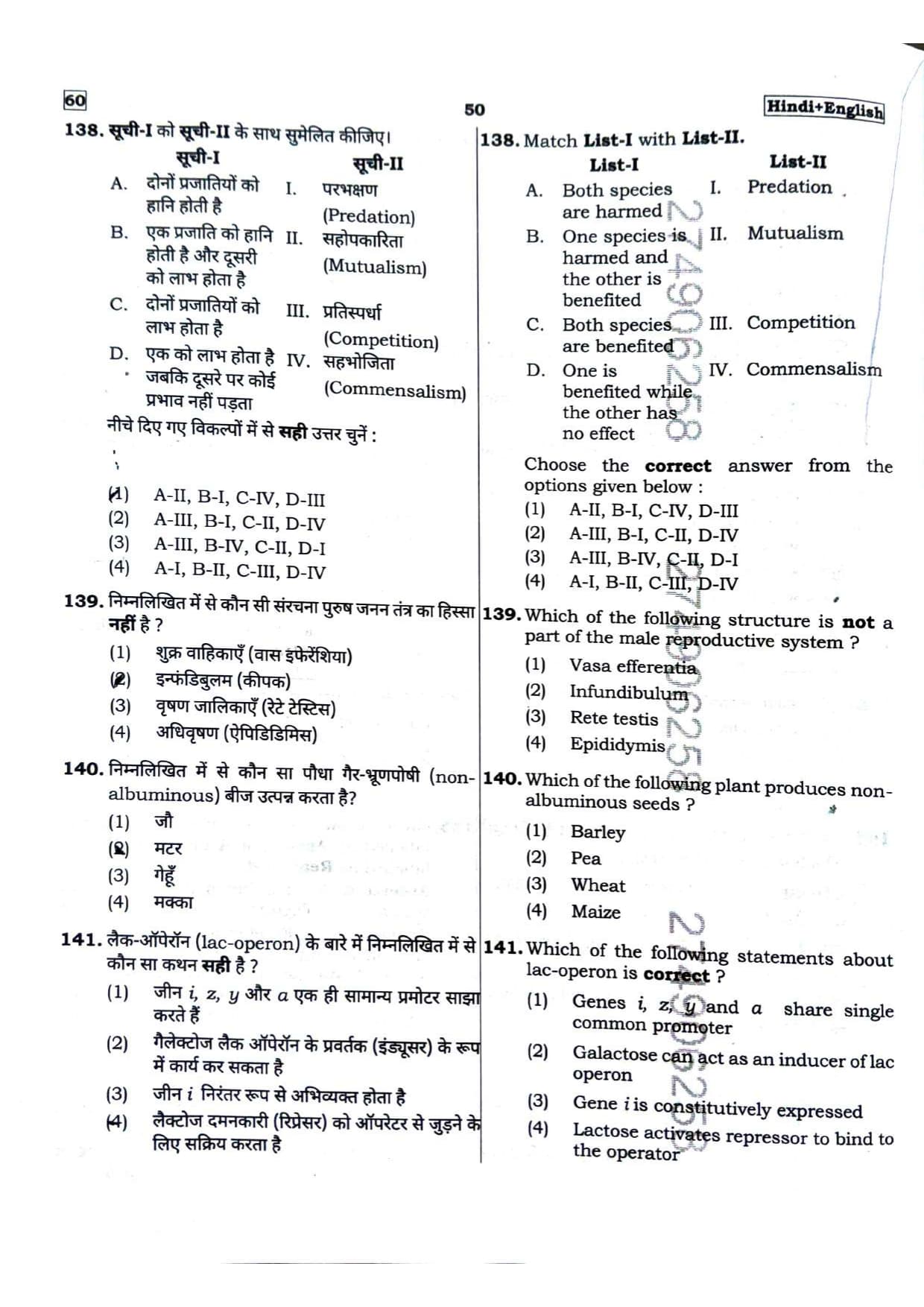
Match List-I with List-II.
\begin{tabular{ll
List-I & List-II
A. Both species are harmed & I. Predation
B. One species is harmed and the other is benefited & II. Mutualism
C. Both species are benefited & III. Competition
D. One is benefited while the other has no effect & IV. Commensalism
\end{tabular
Choose the correct answer from the options given below :
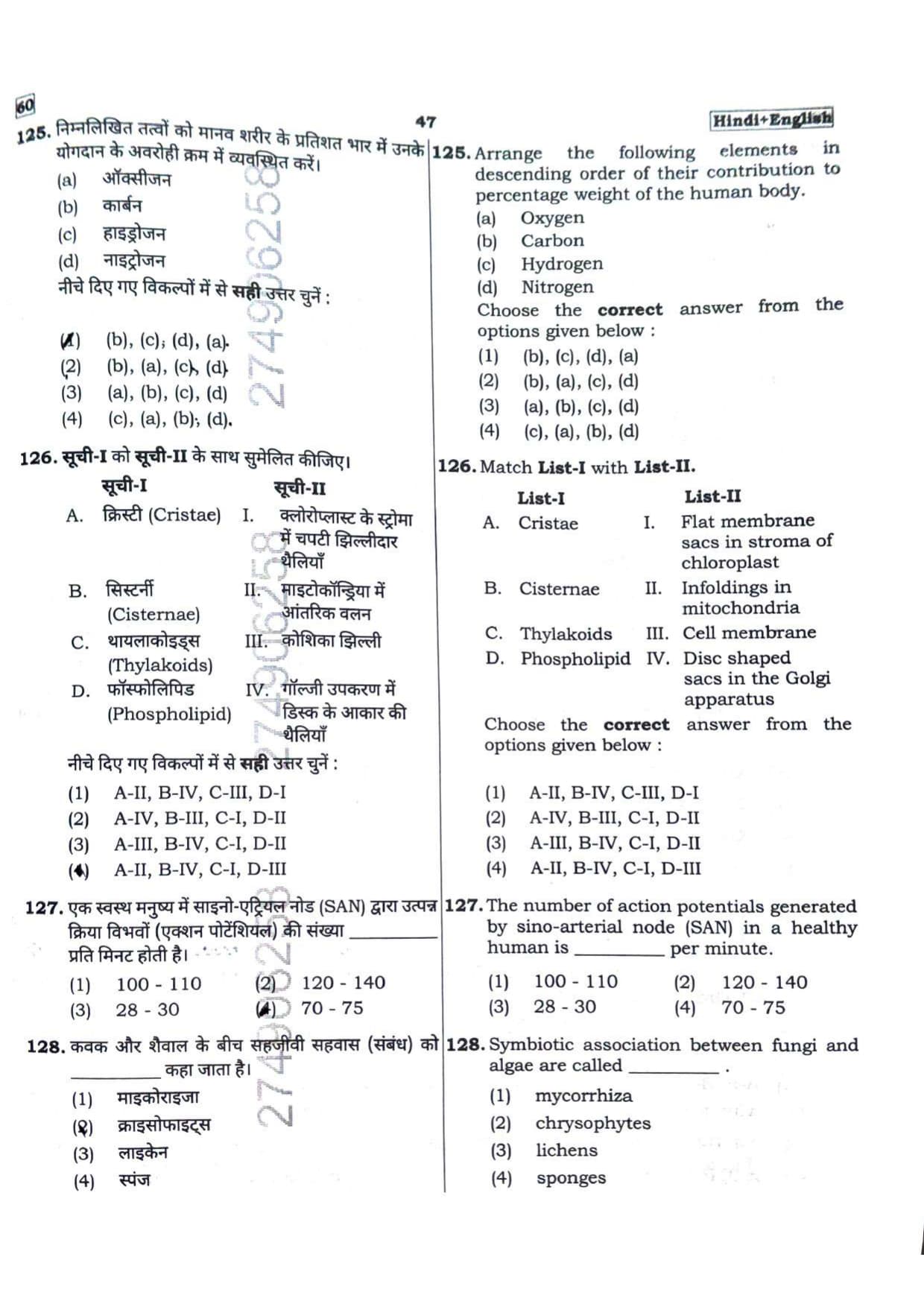
Which of the following structure is not a part of the male reproductive system ?
Which of the following plant produces non-albuminous seeds ?
Which of the following statements about lac-operon is correct ?
Which of the following is used as an effective sedative and painkiller for treating post-surgery patients ?
Which of the following is the correct order of arrangement of vertebrate column from the head to toe ?
Muscle contraction is initiated by a signal sent by the central nervous system by the release of
Given below are two statements : one is labelled as Assertion A and the other is labelled as Reason R.
Assertion A : Forelimbs of human and bats are homologous.
Reason R : Forelimbs of humans and bats have similar anatomical structure.
In the light of the above statements, choose the most appropriate answer from the options given below :
Given below are two statements :
Statement I : Down's syndrome is caused by the absence of one of the X-chromosomes.
Statement II : Turner's syndrome is caused by the presence of an additional copy of the chromosomes.
In the light of the above statements, choose the correct answer from the options given below :
Which of the following statements about the reabsorption process in Henle's loop are correct ?
(a) The descending limb of Henle's loop is permeable to water but almost impermeable to electrolytes.
(b) Urine gets concentrated in Henle's loop.
(c) Reabsorption of \(Na^+\) and water takes place in Henle's loop.
(d) Active or passive transport of electrolytes occurs in the ascending limb of Henle's loop.
Choose the correct answer from the options given below :
If the diploid chromosome number of typical angiosperm is 36, what would be the chromosome number in its endosperm ?
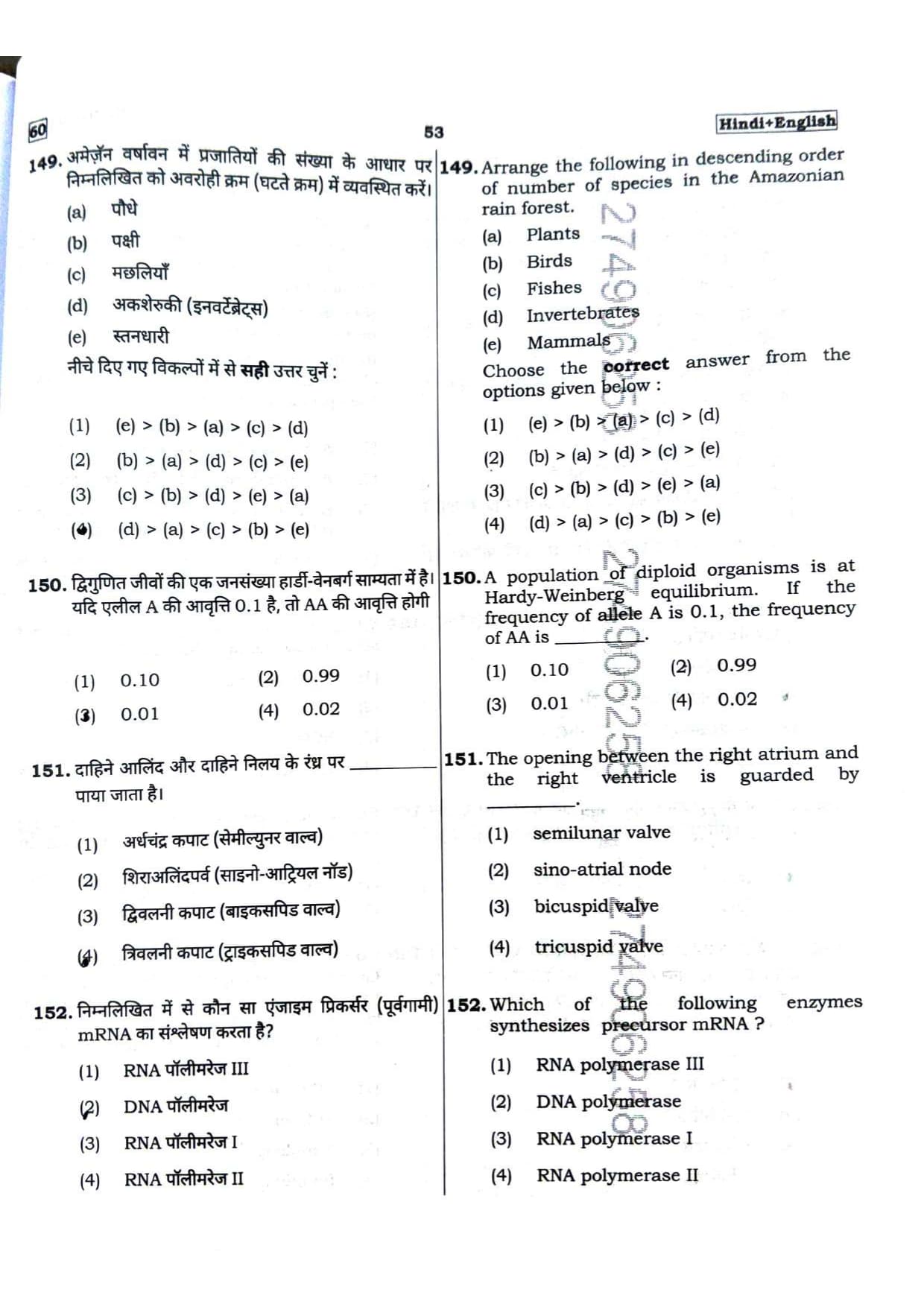
Arrange the following in descending order of number of species in the Amazonian rain forest.
(a) Plants
(b) Birds
(c) Fishes
(d) Invertebrates
(e) Mammals
Choose the correct answer from the options given below :
A population of diploid organisms is at Hardy-Weinberg equilibrium. If the frequency of allele A is 0.1, the frequency of AA is
The opening between the right atrium and the right ventricle is guarded by
Which of the following enzymes synthesizes precursor mRNA ?
Given below are two statements : one is labelled as Assertion A and the other is labelled as Reason R.
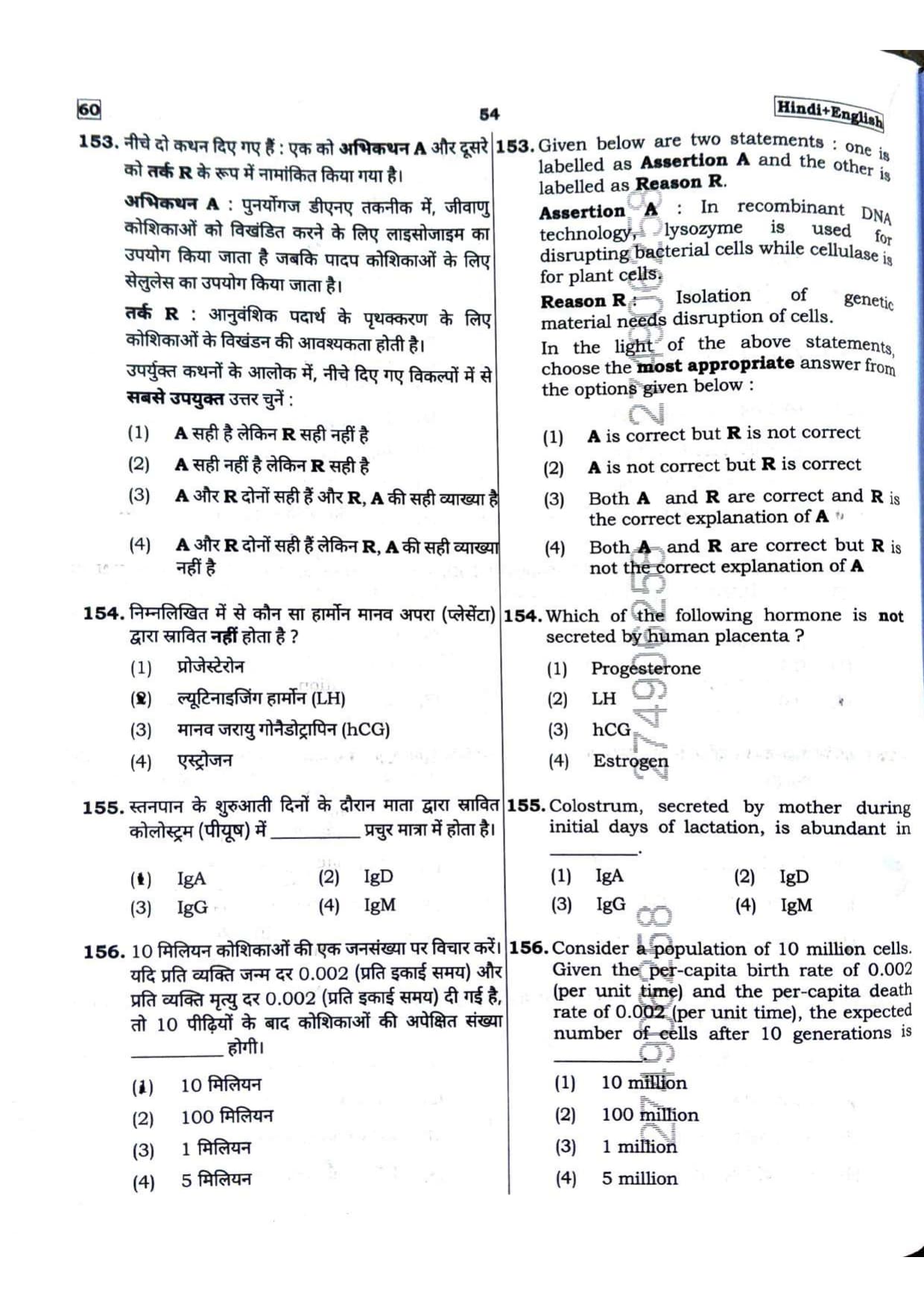
Assertion A : In recombinant DNA technology, lysozyme is used for disrupting bacterial cells while cellulase is used for plant cells.
Reason R : Isolation of genetic material needs disruption of cells.
In the light of the above statements, choose the most appropriate answer from the options given below :
Which of the following hormone is not secreted by human placenta ?
Colostrum, secreted by mother during initial days of lactation, is abundant in
Consider a population of 10 million cells. Given the per-capita birth rate of 0.002 (per unit time) and the per-capita death rate of 0.002 (per unit time), the expected number of cells after 10 generations is
Given below are two statements :
Statement I : Plasmids are autonomously replicating DNA.
Statement II : Plasmids are extrachromosomal DNA.
In the light of the above statements, choose the most appropriate answer from the options given below :
During PCR, primers bind to the DNA strands in the ______ step.
Match List-I with List-II.
\begin{tabular{ll
List-I & List-II
A. Transformation & I. Restriction enzyme
B. Cloning site & II. Transfer DNA to host bacteria
C. Selection & III. Replication
D. Ori & IV. Antibiotic
\end{tabular
Choose the correct answer from the options given below :
Adaptive radiation in placental mammals and Australian Marsupials leading to similarity between distant species is an example of ______.
The covering of ovum at ovulation is
Which of the following statements are correct ?
(a) Energy flow from producers to consumers is unidirectional
(b) Energy pyramid can never be inverted
(c) Transfer of energy follows the 1% law
Choose the correct answer from the options given below :
How many theca are present in each lobe of a typical bilobed angiosperm anther ?
Which of the following statements is correct about Plasmodium ?
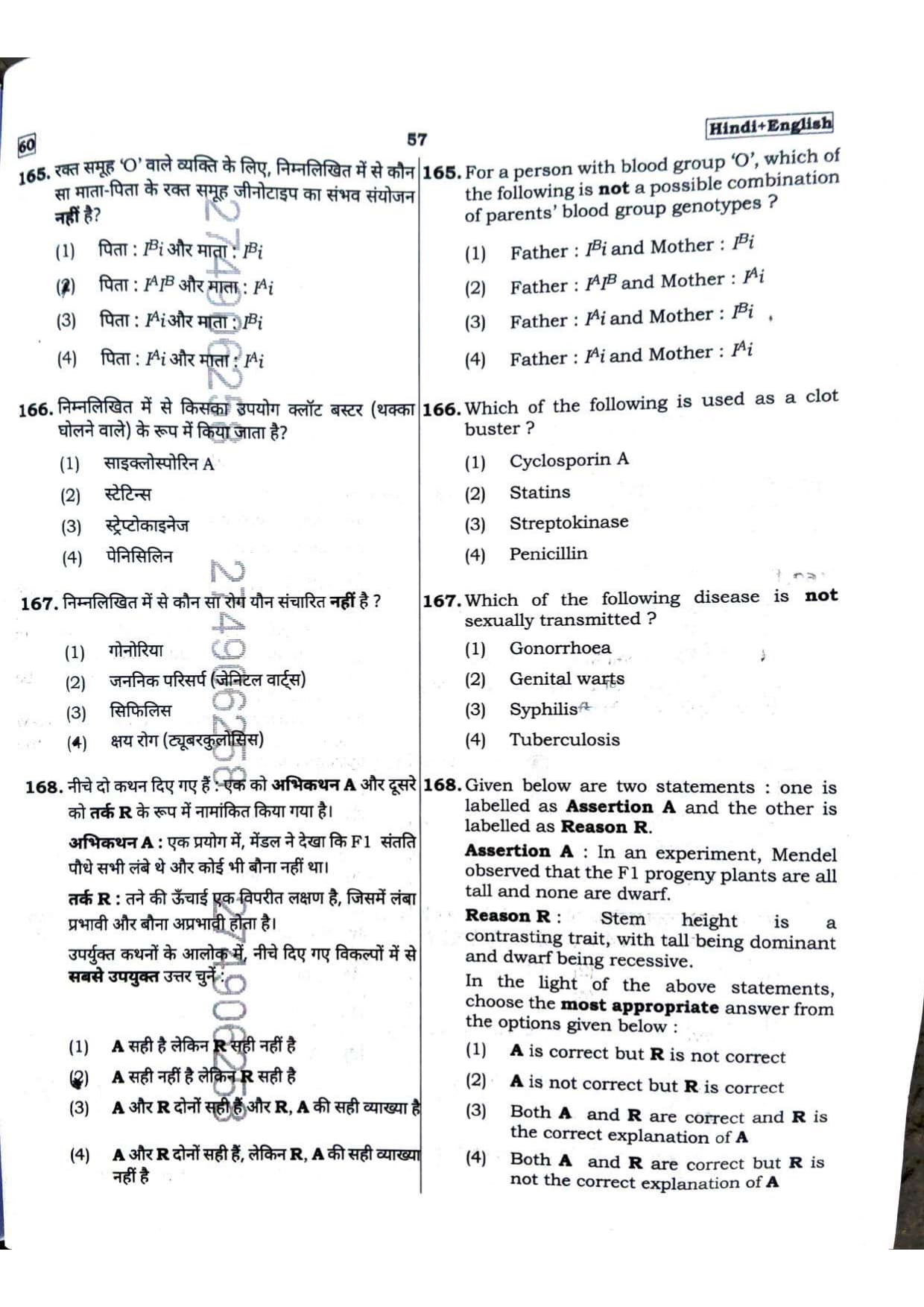
For a person with blood group 'O', which of the following is not a possible combination of parents' blood group genotypes ?
Which of the following is used as a clot buster ?
Which of the following disease is not sexually transmitted ?
Given below are two statements : one is labelled as Assertion A and the other is labelled as Reason R.
Assertion A : In an experiment, Mendel observed that the F1 progeny plants are all tall and none are dwarf.
Reason R : Stem height is a contrasting trait, with tall being dominant and dwarf being recessive.
In the light of the above statements, choose the most appropriate answer from the options given below :
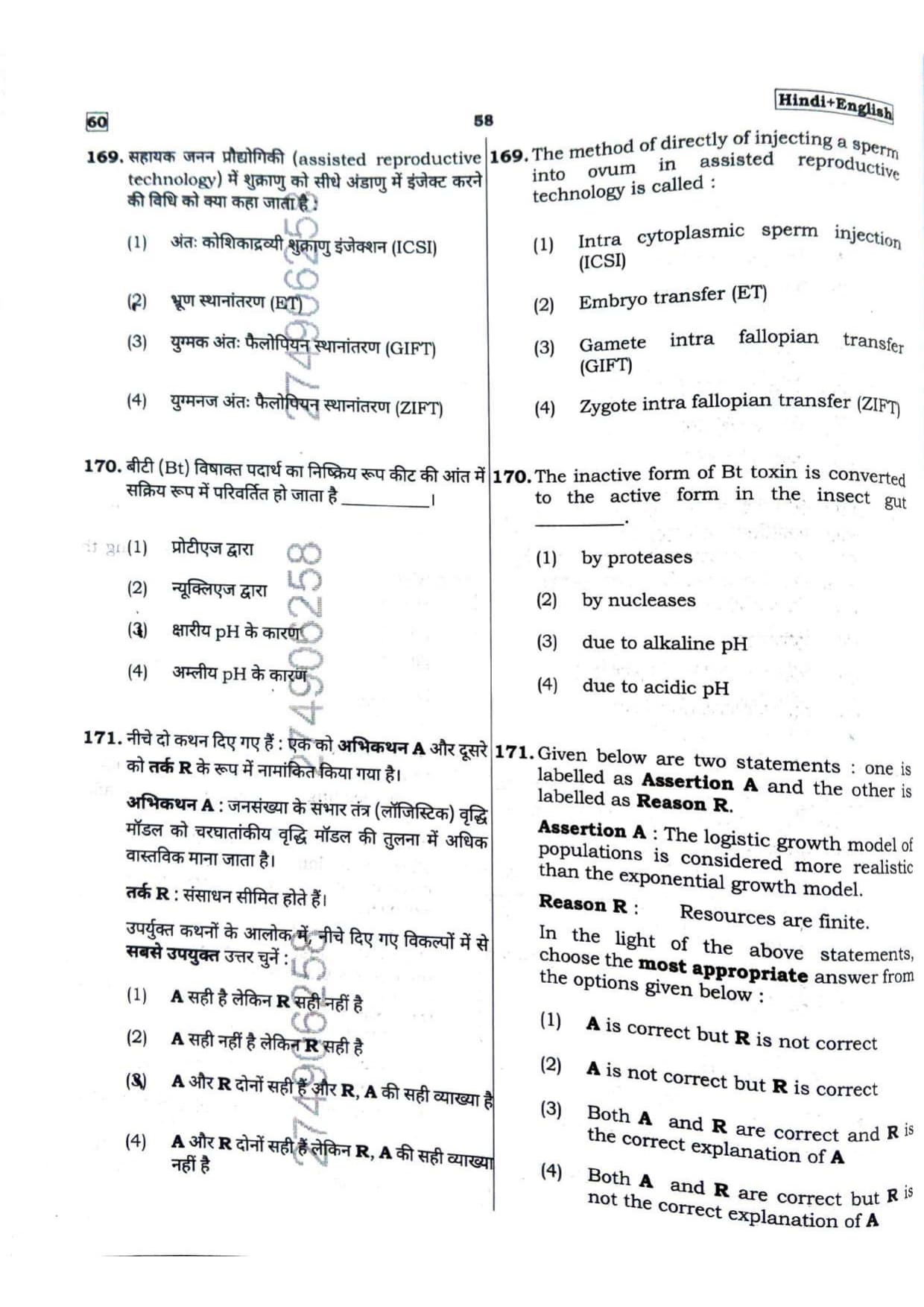
The method of directly of injecting a sperm into ovum in assisted reproductive technology is called :
The inactive form of Bt toxin is converted to the active form in the insect gut
Given below are two statements : one is labelled as Assertion A and the other is labelled as Reason R.
Assertion A : The logistic growth model of populations is considered more realistic than the exponential growth model.
Reason R : Resources are finite.
In the light of the above statements, choose the most appropriate answer from the options given below :
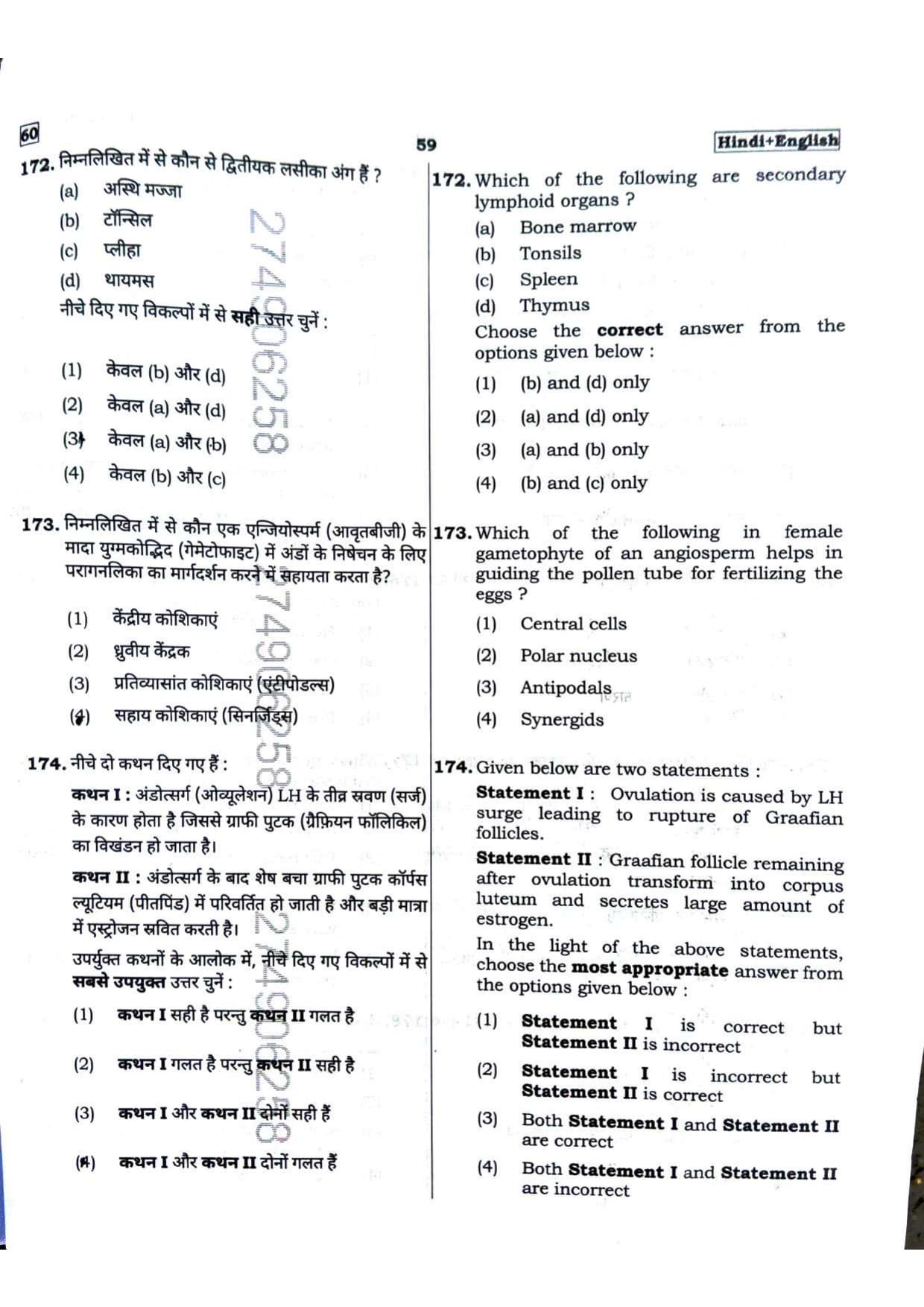
Which of the following are secondary lymphoid organs ?
(a) Bone marrow
(b) Tonsils
(c) Spleen
(d) Thymus
Choose the correct answer from the options given below :
Which of the following in female gametophyte of an angiosperm helps in guiding the pollen tube for fertilizing the eggs ?
Given below are two statements :
Statement I : Ovulation is caused by LH surge leading to rupture of Graafian follicles.
Statement II : Graafian follicle remaining after ovulation transform into corpus luteum and secretes large amount of estrogen.
In the light of the above statements, choose the most appropriate answer from the options given below :
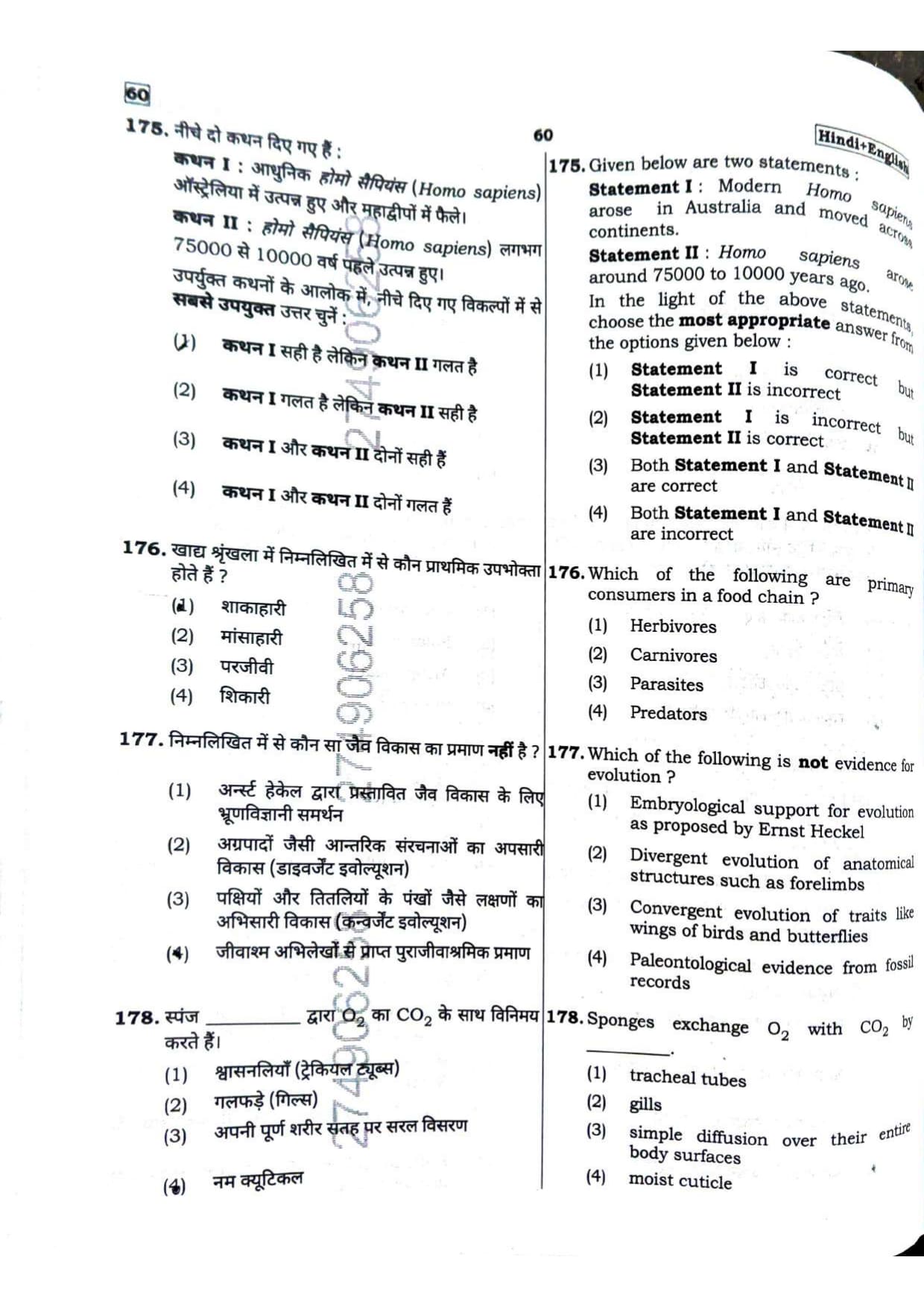
Given below are two statements :
Statement I : Modern \textit{Homo sapiens arose in Australia and moved across continents.
Statement II : \textit{Homo sapiens arose around 75000 to 10000 years ago.
In the light of the above statements, choose the most appropriate answer from the options given below :
Which of the following are primary consumers in a food chain ?
Which of the following is not evidence for evolution ?
Sponges exchange \(O_2\) with \(CO_2\) by
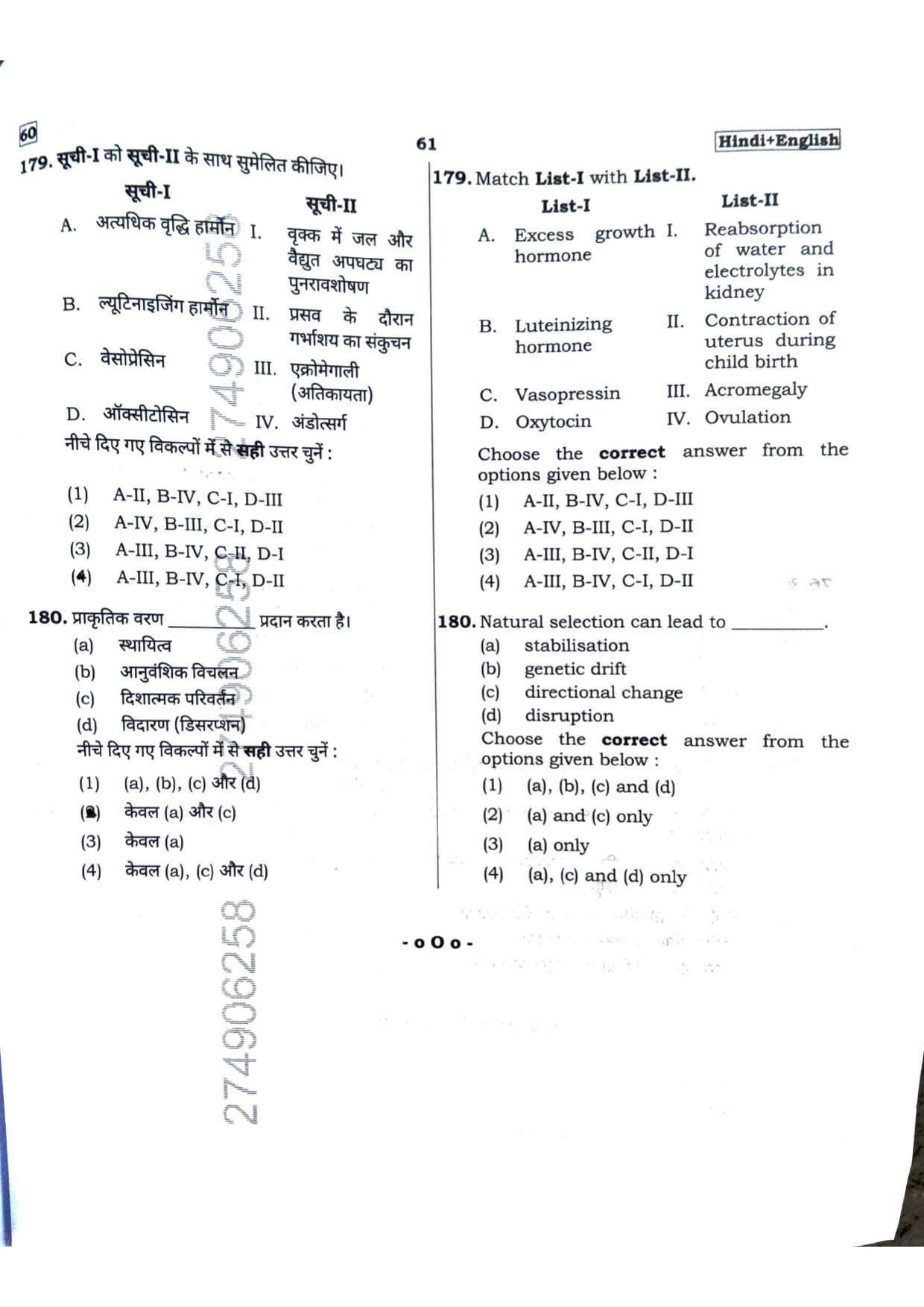
Match List-I with List-II.
\begin{tabular{ll
List-I & List-II
A. Excess growth hormone & I. Reabsorption of water and electrolytes in kidney
B. Luteinizing hormone & II. Contraction of uterus during child birth
C. Vasopressin & III. Acromegaly
D. Oxytocin & IV. Ovulation
\end{tabular
Choose the correct answer from the options given below :
Natural selection can lead to __________
(a) stabilisation
(b) genetic drift
(c) directional change
(d) disruption
Choose the correct answer from the options given below :
NEET Re-Exam Pattern 2026
| Parameter | Details |
|---|---|
| Exam Mode | Offline (Pen-and-Paper, OMR Based) |
| Duration | 3 Hours and 15 minutes (195 Minutes) |
| Total Questions | 180 (All Compulsory) |
| Subjects | Physics, Chemistry, Biology (Botany and Zoology) |
| Question Type | Multiple Choice Questions (MCQs) |
| Total Marks | 720 |
| Marking Scheme |
|
NEET 2026 Subject-Wise Weightage
| Subject | Number of Questions | Marks |
|---|---|---|
| Physics | 45 | 180 |
| Chemistry | 45 | 180 |
| Biology | 90 | 360 |
| Total | 180 | 720 |





Comments