




Preparing for WBJEE requires a well-structured strategy, strong conceptual clarity, and consistent practice.
- WBJEE 2026 preparation requires a clear study plan, regular practice, and strong conceptual understanding of Mathematics, Physics, and Chemistry.
- Start with NCERT books, then move to standard reference books for advanced problem-solving and exam-level questions.
- Follow a realistic timetable that balances theory, numerical practice, revision, and mock tests throughout the week.
- Solve previous years' WBJEE question papers to understand the exam pattern, difficulty level, and important topics.
- Take full-length mock tests regularly to improve speed, accuracy, time management, and question-selection skills.
The WBJEE Paper 1 (Mathematics) and Paper 2 (Physics and Chemistry) were held on the same day. WBJEE 2026 was held on May 24, 2026.
Also Read:

Key Preparation Tips for WBJEE at a Glance
- Finish the NCERT Class 11 and 12 syllabus first, because WBJEE asks no topics outside the NCERT.
- Spend the most time on Mathematics, as Paper 1 alone carries 100 marks.
- Always attempt Category 3 questions, since they carry no negative marking.
- Solve at least 10 years of WBJEE previous year question papers (PYQs).
- Take a full-length mock test every week and analyse every mistake.
- Keep the last 30 days only for revision, formula sheets, and mock tests.
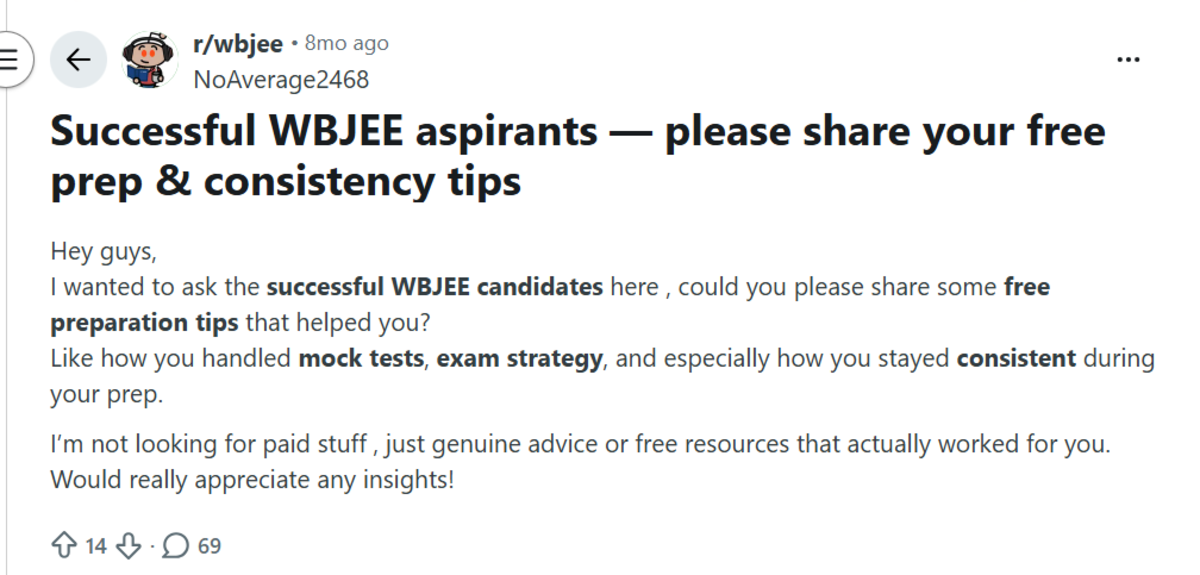
Source: Reddit
Reddit users were discussing preparation and consistency tips for the 2026 WBJEE examination.
Why a Strategy Matters for WBJEE 2026?
WBJEE rewards accuracy more than speed. The exam has three question categories, each marked differently, so a blind attempt can cost you your rank.
- Category 1 gives 1 mark with a 0.25 penalty
- Category 2 gives 2 marks with a 0.50 penalty
- Category 3 gives 2 marks with zero penalty.
- A student who understands this scheme attempts smarter and scores higher than one who just studies hard.
Understand the WBJEE 2026 Exam Pattern First
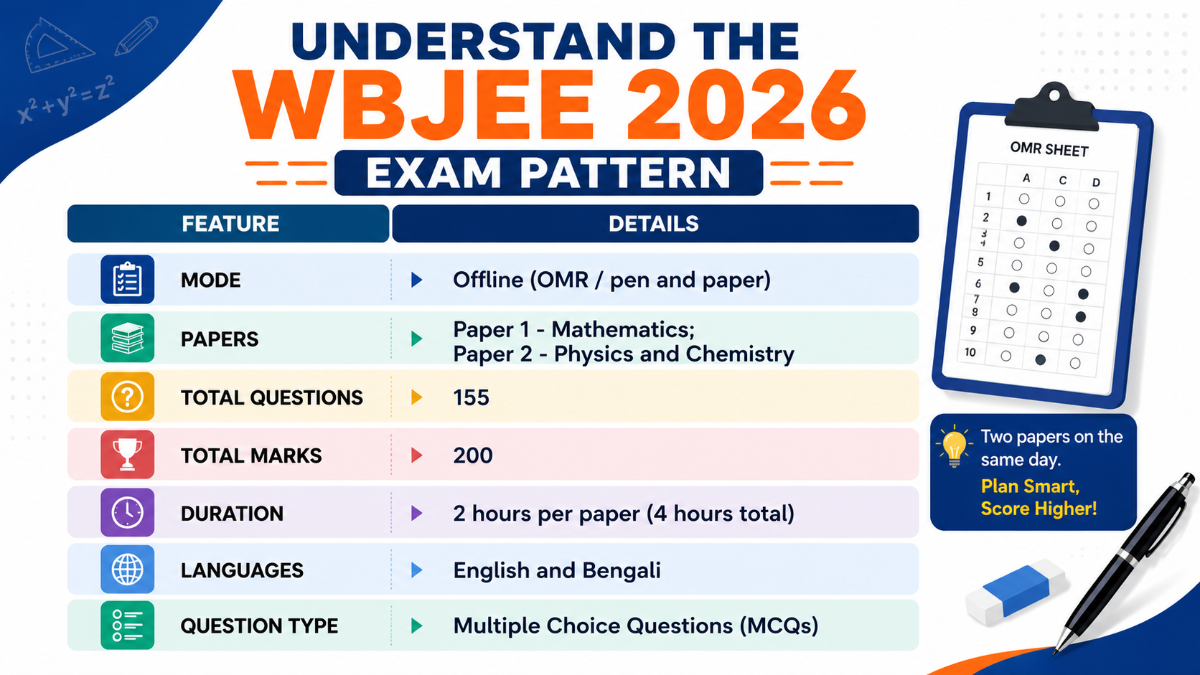
You cannot plan your preparation without knowing the structure of the paper. The table below shows the WBJEE 2026 exam pattern.
| Feature | Details |
|---|---|
| Mode | Offline (OMR / pen and paper) |
| Papers | Paper 1 - Mathematics; Paper 2 - Physics and Chemistry |
| Total Questions | 155 |
| Total Marks | 200 |
| Duration | 2 hours per paper (4 hours total) |
| Languages | English and Bengali |
| Question Type | Multiple Choice Questions (MCQs) |
WBJEE Marking Scheme
Category 1 has one correct option and carries 1 mark for each correct answer and -0.25 marks for each incorrect answer.
- Category 2 has one correct option and carries 2 marks for each correct answer and -0.50 marks for each incorrect answer.
- Category 3 has one or more correct options and carries 2 marks for each correct answer and has no negative marking.
| Category | Correct Options | Marks for Correct | Negative Marking |
|---|---|---|---|
| Category 1 | One | +1 | -0.25 |
| Category 2 | One | +2 | -0.50 |
| Category 3 | One or more | +2 | None (partial marks allowed) |
Category 3 is your biggest advantage in WBJEE, so never leave these questions blank. Even a partly correct attempt can earn you marks here.
Best Books for WBJEE 2026 Preparation
Start with NCERT for every subject, then move to standard reference books. The table below lists the most recommended WBJEE books.
| Subject | Recommended Books |
|---|---|
| Physics | NCERT (Class 11 and 12), Concepts of Physics by HC Verma, DC Pandey series |
| Chemistry | NCERT (Class 11 and 12), Physical Chemistry by OP Tandon, Organic Chemistry by MS Chouhan |
| Mathematics | NCERT, Objective Mathematics by RD Sharma, IIT Mathematics by ML Khanna |
NCERT should be your base book, because WBJEE questions are built directly on the NCERT syllabus.
- Use reference books only to practise more variety and tougher problems.
Subject-Wise Preparation Tips
Mathematics Preparation Tips
Mathematics is the highest-scoring section, so give it the most practice time.
- Master Algebra, Calculus, Coordinate Geometry, and Trigonometry, as they carry heavy weightage.
- Practise problems daily to improve both speed and accuracy.
- Keep a separate formula notebook and revise it every morning.
- Solve PYQs to learn the exact difficulty level WBJEE expects from you.
Physics Preparation Tips
Physics needs strong concepts plus regular numerical practice.
- Build clear concepts in Mechanics, Electrostatics, Current Electricity, and Modern Physics.
- Learn the derivation logic, not just the final formula.
- Practice numericals every day to handle the calculation-heavy questions.
- Revise units and dimensions early, because they help you eliminate wrong options quickly.
Chemistry Preparation Tips
Chemistry is the most scoring subject if you cover all three branches well.
- Read the NCERT line by line for Inorganic and Physical Chemistry.
- Memorise reactions, named reactions, and exceptions in Organic Chemistry.
- Practice Mole Concept, Equilibrium, and Thermodynamics for Physical Chemistry numericals.
- Make short notes of periodic trends and key reactions for last-day revision.
How to Make a WBJEE Study Plan
A timetable keeps your preparation balanced across all three subjects. The plan below is a simple structure you can follow and adjust.
| Phase | Duration | Focus |
|---|---|---|
| Phase 1 - Build | First few months | Complete the NCERT and core concepts of all subjects |
| Phase 2 - Practise | Middle phase | Solve topic-wise questions and previous year papers |
| Phase 3 - Test | Final phase | Take full mock tests and analyse weak areas |
| Phase 4 - Revise | Last 30 days | Revise formulas, notes, and attempt timed mocks |
Study all three subjects every day instead of finishing one subject at a time. A daily mix keeps every subject fresh in your memory.
WBJEE Preparation Strategy
As per the Let’s Improve YouTube channel, you should follow the following strategies for a high score in the WBJEE exam:
| Preparation Tip | Details |
|---|---|
| Smart Time Allocation | Reserve the final 15–20 days exclusively for revision, mock tests, and practice. If you're starting late, spend the first 10–15 days covering high-weightage chapters. |
| One Chapter Per Day Rule | Complete one chapter from each subject daily to ensure systematic syllabus coverage and consistent progress. |
| Study Hours | Study for 12 hours per day if you're beginning preparation now. If you're already revising, aim for 9–10 hours daily. |
| Prioritize Practice Over Theory | Focus on solving 30–50 MCQs per subject every day. Include Previous Year Questions (PYQs) to understand the exam pattern and frequently asked concepts. |
| Mock Test Strategy | Attempt mock tests during the actual exam timings (11:00 AM–1:00 PM and 2:00 PM–4:00 PM) to build exam-day stamina and concentration. |
| Analyze Your Mistakes | After every mock test, review incorrect answers to identify whether mistakes are caused by conceptual gaps or careless errors. |
| Formula Revision | Spend 30–60 minutes daily revising Physics and Chemistry formulas to improve retention and speed during the exam. |
For more information, check out the Let’s Improve channel’s video:
WBJEE 2026 Important Chapters and Topic-Wise Weightage
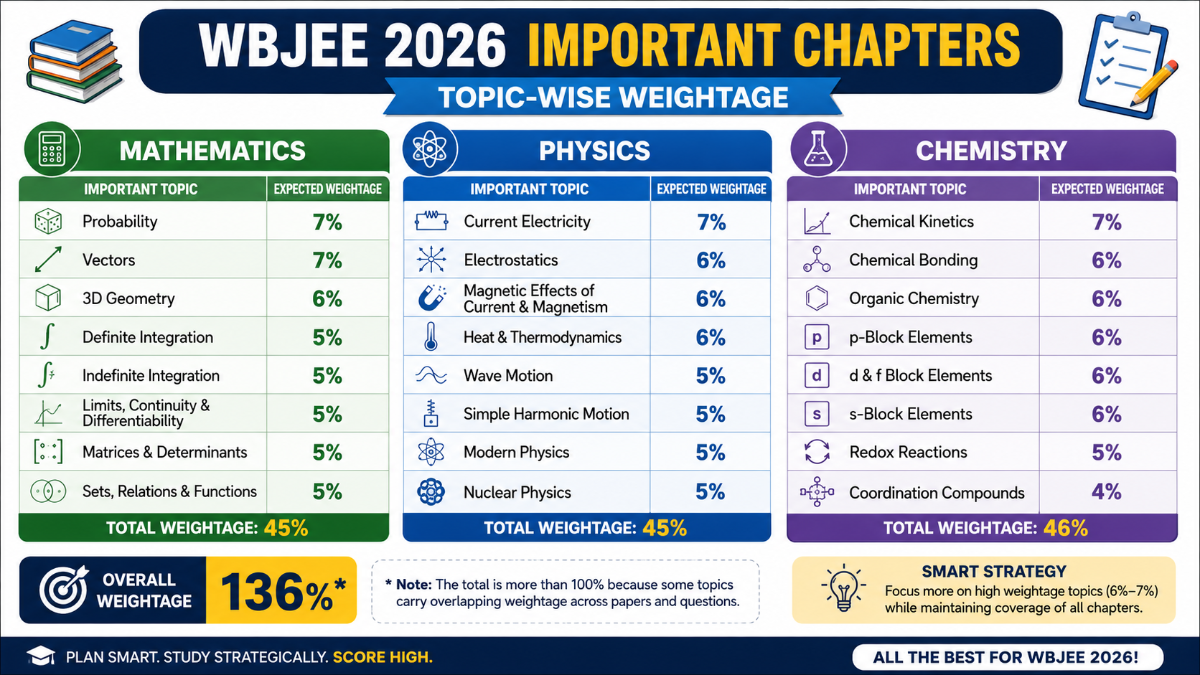
Knowing the most important chapters can help you prioritize your preparation and maximize your score in a limited time. While WBJEE does not officially release chapter-wise weightage, previous year trends show that certain topics consistently contribute a large number of questions.
| Subject | Important Topic | Expected Weightage |
|---|---|---|
| Mathematics | Probability | 7% |
| Vectors | 7% | |
| 3D Geometry | 6% | |
| Definite Integration | 5% | |
| Indefinite Integration | 5% | |
| Limits, Continuity & Differentiability | 5% | |
| Matrices & Determinants | 5% | |
| Sets, Relations & Functions | 5% | |
| Physics | Current Electricity | 7% |
| Electrostatics | 6% | |
| Magnetic Effects of Current & Magnetism | 6% | |
| Heat & Thermodynamics | 6% | |
| Wave Motion | 5% | |
| Simple Harmonic Motion | 5% | |
| Modern Physics | 5% | |
| Nuclear Physics | 5% | |
| Chemistry | Chemical Kinetics | 7% |
| Chemical Bonding | 6% | |
| Organic Chemistry | 6% | |
| p-Block Elements | 6% | |
| d & f Block Elements | 6% | |
| s-Block Elements | 6% | |
| Redox Reactions | 5% | |
| Coordination Compounds | 4% |
Also Read:
WBJEE 2026 Rank vs Marks Analysis
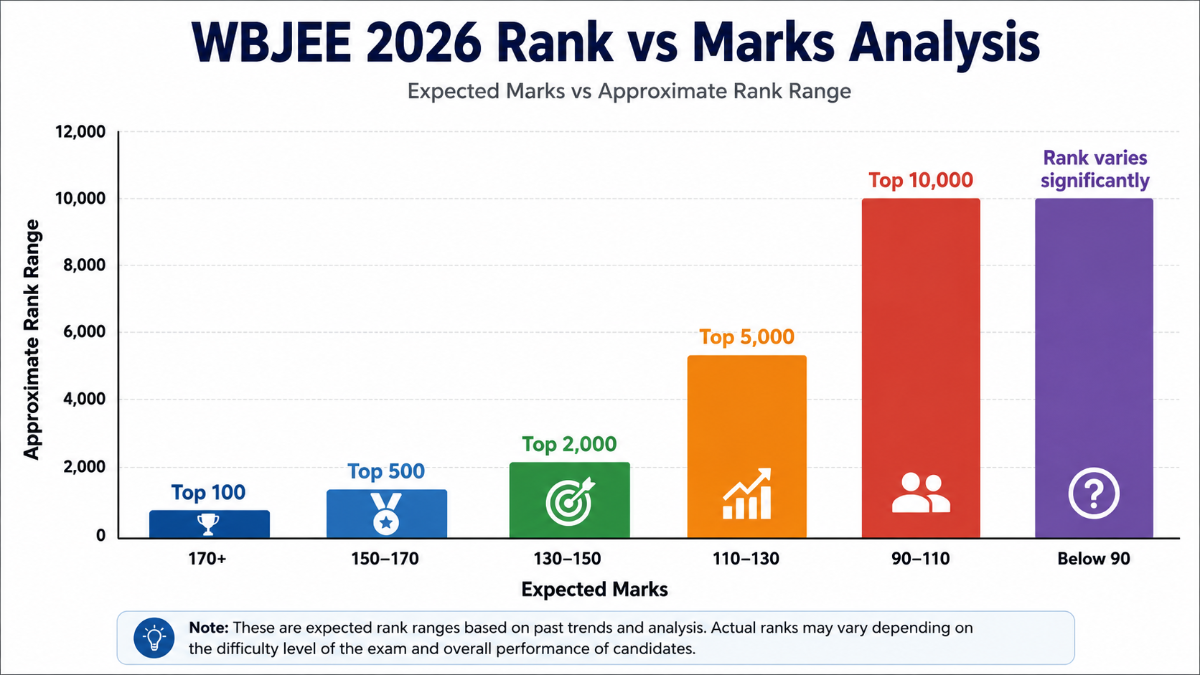
A score of 170 marks or above usually places a candidate within the top 100 ranks, making admission to the most competitive branches and colleges highly achievable.
- Students scoring between 150 and 170 marks can generally expect a rank within the top 500, which is still considered an excellent performance.
- A score in the 130–150 range often translates to a rank within the top 2,000, keeping many good engineering options open.
- Candidates scoring 110–130 marks may secure a rank within the top 5,000, while those in the 90–110 mark range typically fall within the top 10,000.
| Expected Marks | Approximate Rank Range |
|---|---|
| 170+ | Top 100 |
| 150–170 | Top 500 |
| 130–150 | Top 2,000 |
| 110–130 | Top 5,000 |
| 90–110 | Top 10,000 |
| Below 90 | Rank varies significantly |
Students targeting top engineering colleges should aim for at least 130–150 marks to remain competitive.
Check: WBJEE Marks vs Rank 2026: Expected Analysis, College-Wise Trends and Cutoff
Time Management and Attempt Strategy
Smart time management in the exam can raise your score without extra study.
- Spend around 1 to 1.5 minutes on each Category 1 question.
- Attempt easy and known questions first to secure quick marks.
- Be careful with Category 2 questions, since wrong answers cost you 0.50 marks.
- Attempt every Category 3 question, as there is no penalty for a wrong answer.
- Fill the OMR sheet carefully with a black or blue ball pen, and avoid stray marks.
Use Mock Tests and Previous Year Papers
Mock tests turn your knowledge into real exam performance.
- Take one full-length mock test every week in real exam conditions.
- Solve at least 10 years of WBJEE PYQs to understand the recurring pattern.
- Analyse every mock test, because finding your mistakes matters more than your score.
- Track your accuracy, speed, and silly errors after each test.
Check: WBJEE Question Paper (Available), Download Previous Years Question Paper and Answer Key PDFs
Revision Strategy for the Final Month
The last month decides how much of your preparation you can actually recall in the exam.
- Stop learning new topics and focus only on revision.
- Revise from your own short notes and formula sheets.
- Solve one or two mock tests every week to stay exam-ready.
- Sleep well and avoid stress in the final days.
Common Mistakes to Avoid
Many students lose rank because of avoidable errors.
- Ignoring NCERT and jumping straight to tough reference books.
- Guessing Category 1 and 2 questions without confidence.
- Skipping mock test analysis after every attempt.
- Studying only the favourite subject and ignoring the weak one.
- Leaving Category 3 questions blank and losing easy marks.
Top Engineering Colleges Accepting WBJEE Scores
Understanding the colleges you can get through WBJEE helps you set a realistic score and rank target. West Bengal has several reputed engineering institutes that offer admission through WBJEE counselling.
| College | Popular Courses |
|---|---|
| Jadavpur University | Computer Science, IT, Electronics, Mechanical Engineering |
| IIEST Shibpur | Computer Science, Electrical Engineering, Civil Engineering |
| Heritage Institute of Technology | Computer Science, IT, Electronics and Communication |
| Institute of Engineering and Management (IEM) | Computer Science, AI & ML, Electronics |
| Techno India University | Computer Science, Data Science, Electronics |
| Kalyani Government Engineering College | Electrical, Mechanical, Computer Science |
| Government College of Engineering and Ceramic Technology | CSE, IT, Ceramic Technology |
FAQs on WBJEE Preparation Tips 2026
Ques: How many hours should I study daily for WBJEE 2026?
Ans. You should study around 6 to 8 focused hours daily, with all three subjects covered each day.
Ques: Is NCERT enough for WBJEE 2026?
Ans. NCERT is your most important book, but you should add reference books for extra practice and tougher questions.
Ques: Should I attempt all WBJEE questions?
Ans. You should attempt every Category 3 question since it has no negative marking, and attempt Categories 1 and 2 only when you are confident.
Ques: How many previous year papers should I solve?
Ans. You should solve at least 10 years of WBJEE previous year papers to learn the exam pattern and difficulty level.
Ques: Are mock tests important for WBJEE preparation?
Ans. Yes, weekly mock tests improve your speed, accuracy, and time management, and help you find your weak areas before the exam.
Ques: Which subject should I focus on the most?
Ans. You should give the most time to Mathematics, because Paper 1 alone carries 100 marks out of 200.



Comments