


The JEE Advanced 2026 cutoff will be released by IIT Roorkee — the organising institute for 2026 — along with the results on the tentative date of June 1, 2026, at jeeadv.ac.in. The cutoff refers to the minimum marks you need to secure (subject-wise and in aggregate) to be included in the JEE Advanced rank list and to be eligible for JoSAA counselling for IIT admissions. A separate admission cutoff, in the form of opening and closing ranks, is published by JoSAA after each round of counselling.
- The JEE Advanced 2026 qualifying cutoff is expected to be around 93–98 marks out of 360 (approx. 20.56% aggregate) for the General / CRL category, based on previous year trends.
- The exam was held on May 17, 2026, with IIT Roorkee as the organising authority.
- 2,50,182 candidates qualified from JEE Main 2026 and were eligible to appear for JEE Advanced 2026.
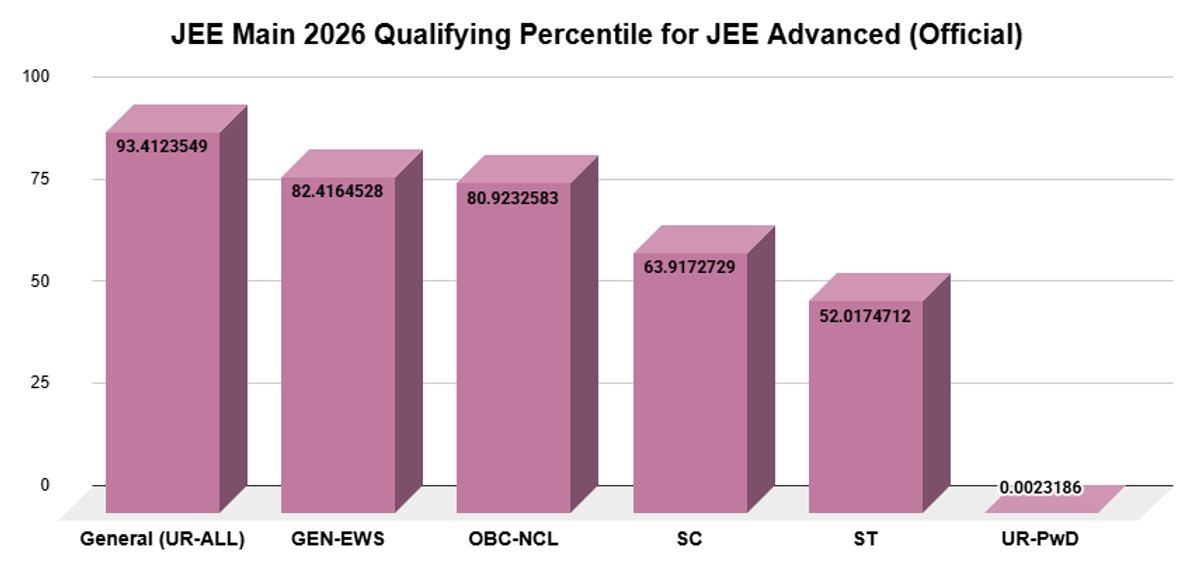
- The JEE Main 2026 qualifying cutoff for JEE Advanced was 93.41 percentile for General (UR) and 52.02 percentile for ST category.
- For SC / ST / PwD categories, the expected qualifying cutoff is significantly lower — around 10.28% aggregate (approx. 37 marks).
- IIT Bombay CSE had a closing rank of 66 (General category) in JoSAA 2025 Round 6, making it the toughest branch to secure.
- JoSAA counselling 2026 is expected to begin on June 2, 2026, one day after the result declaration.
| Direct Link | Status |
|---|---|
| Direct Link to JEE Advanced Cutoff 2026 on jeeadv.ac.in | Soon |
| Direct Link to JoSAA 2026 Opening and Closing Ranks | Soon |
Also Read

Key Summary: JEE Advanced Cutoff 2026
- Cutoff status: To be released on June 1, 2026 with the result on jeeadv.ac.in.
- Expected General (CRL) qualifying marks: ~93–98 out of 360 (approx. 20.56% aggregate).
- SC / ST / PwD expected qualifying marks: ~37–40 out of 360 (approx. 10.28% aggregate).
- Admission cutoff (IIT-wise closing ranks) released by JoSAA during counselling rounds in June–July 2026.
- IIT Bombay CSE is consistently the most competitive branch — closing rank was 66 (General) in 2025.
Table of Contents
- JEE Advanced Cutoff 2026
- JEE Advanced Cutoff 2026: Important Dates
- Factors Affecting JEE Advanced Cutoff
- JEE Advanced 2026 Qualifying Cutoff: Category Wise
- JEE Main 2026 Cutoff for JEE Advanced Qualification
- JEE Advanced Cutoff for Top IITs 2026
- JEE Advanced Marks vs Rank 2026
- JEE Advanced Previous Year Cutoff Trends
- What After JEE Advanced Cutoff? JoSAA Counselling 2026
- JEE Advanced Cutoff 2026: FAQs
What is JEE Advanced Cutoff 2026?
The JEE Advanced 2026 cutoff has two distinct components.
- The qualifying cutoff is the minimum subject-wise and aggregate percentage you must score to be included in the rank list.
- The admission cutoff is the IIT-wise, branch-wise, and round-wise opening and closing ranks released by JoSAA during counselling.
JEE Advanced 2026 was conducted by IIT Roorkee on May 17, 2026. Based on student reviews and paper analysis, Paper 1 and Paper 2 were reported as moderate to difficult in difficulty. Based on this difficulty level and previous year trends, the 2026 qualifying cutoff is expected to remain similar to or slightly above the 2025 cutoff.
Previous Year Official JEE Advanced Cutoff
The table below shows the official year-wise qualifying marks required for inclusion in the JEE Advanced rank list from 2021 to 2025. The qualifying cutoff has changed over the years — rising sharply from 55 marks in 2022 to 109 marks in 2024, then dropping to 74 marks in 2025.
| Year | CRL (General) | GEN-EWS | OBC-NCL | SC | ST | PwD | Prep Course |
|---|---|---|---|---|---|---|---|
| 2025 | 74 (20.56%) | 66 (18.50%) | 66 (18.50%) | 37 (10.28%) | 37 (10.28%) | 37 (10.28%) | 19 (5.14%) |
| 2024 | 109 (30.34%) | 98 (27.30%) | 98 (27.30%) | 55 (15.17%) | 55 (15.17%) | 55 (15.17%) | 27 (7.58%) |
| 2023 | 86 (23.89%) | 77 (21.39%) | 77 (21.39%) | 43 (11.94%) | 43 (11.94%) | 43 (11.94%) | 21 (5.97%) |
| 2022 | 55 (15.28%) | 50 (13.89%) | 50 (13.89%) | 28 (7.64%) | 28 (7.64%) | 28 (7.64%) | 13 (3.82%) |
| 2021 | 63 (17.50%) | 56 (15.75%) | 56 (15.75%) | 31 (8.75%) | 31 (8.75%) | 31 (8.75%) | 15 (4.38%) |
Source: JEE Advanced Official Website – jeeadv.ac.in (Result press releases 2021–2025)
Related Links:
JEE Advanced Cutoff 2026: Important Dates
The table below covers all key events related to the JEE Advanced 2026 cutoff and counseling timeline. Dates are based on previous year patterns and the official JEE Advanced 2026 schedule.
| Event | Date | Status |
|---|---|---|
| JEE Advanced 2026 Exam Date | May 17, 2026 | Completed |
| JEE Advanced 2026 Provisional Answer Key Release | May 25, 2026 | Released |
| Answer Key Challenge / Objection Window | May 25–28, 2026 (Tentative) | Tentative |
| JEE Advanced 2026 Result Declaration | June 1, 2026 (Tentative) | Upcoming |
| JEE Advanced 2026 Qualifying Cutoff Release | June 1, 2026 (with result) | Upcoming |
| JoSAA 2026 Counselling Registration Begins | June 2, 2026 (Tentative) | Upcoming |
| JoSAA 2026 Choice Filling Window Opens | June 2, 2026 (Tentative) | Upcoming |
| JoSAA Round 1 Seat Allotment Result | Mid-June 2026 (Tentative) | Upcoming |
| IIT-Wise Admission Cutoff (Opening / Closing Ranks) | June–July 2026 (Round-wise) | Upcoming |
| JoSAA 2026 Counselling (All 6 Rounds) | June 2 – Last week of July 2026 | Tentative |
Related Links:
Factors Affecting JEE Advanced Cutoff
The JEE Advanced qualifying cutoff is not a fixed value. IIT Roorkee will determine the 2026 cutoff based on several variables. Understanding these factors helps you estimate whether the expected cutoff will be higher or lower than the previous year.
| Factor | Effect on Cutoff |
|---|---|
| Difficulty level of JEE Advanced 2026 | Tougher paper → lower marks required → cutoff drops. Easier paper → cutoff rises. |
| Number of candidates who appeared | More students = more competition = upward pressure on cutoff marks. |
| Total number of IIT seats available | If seats increase, more students qualify; the qualifying bar can be slightly relaxed. |
| Previous year cutoff trends | The IIT organising committee uses historical data as a reference benchmark while setting cutoffs. |
| Category-wise reservations | SC / ST / PwD categories always have significantly lower cutoffs — typically around 10.28% aggregate. |
| Subject-wise minimum marks requirement | You must clear the minimum in each of the three subjects (Physics, Chemistry, Mathematics) separately — even a high aggregate cannot compensate for failing one subject. |
| Overall student performance distribution | If most students score low due to an unexpected paper pattern, the aggregate cutoff adjusts downward. |
| Number of students to be ranked | IITs typically prepare a rank list for approximately 40,000–50,000 candidates; the cutoff is calibrated to include this pool. |
Based on the JEE Advanced 2026 paper review, both Paper 1 and Paper 2 were reported as moderate to difficult in overall difficulty. This suggests the 2026 qualifying cutoff may remain similar to the 2025 cutoff of 74 marks, or see a modest increase if the difficulty was comparable to 2023 levels.
Related Links:
JEE Advanced 2026 Qualifying Cutoff: Category Wise
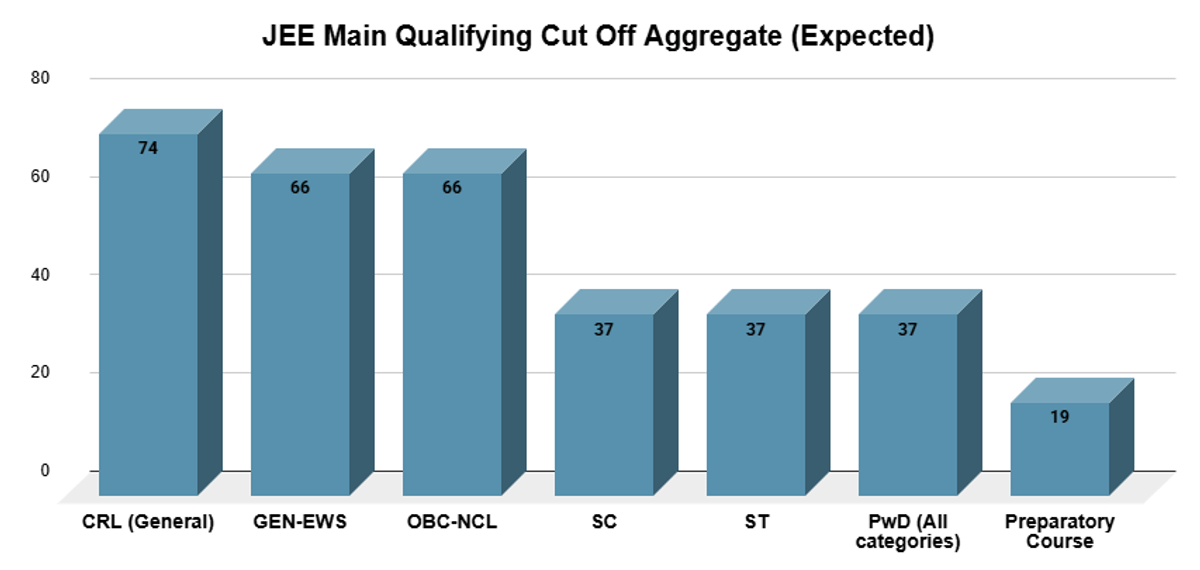
The qualifying cutoff for JEE Advanced 2026 will be officially released on June 1, 2026 along with the result at jeeadv.ac.in. Until then, the table below shows the expected category-wise qualifying marks based on 2025 data and 2026 paper difficulty trends.
| Rank List | Min. Marks in Each Subject (Expected) | Min. Aggregate Marks (Expected) | Min. Aggregate % (Expected) | 2025 Official Aggregate |
|---|---|---|---|---|
| CRL (General) | ~7–8 marks | ~74–80 marks | ~20.56–22.22% | 74 marks (20.56%) |
| GEN-EWS | ~6–7 marks | ~66–72 marks | ~18.50–20% | 66 marks (18.50%) |
| OBC-NCL | ~6–7 marks | ~66–72 marks | ~18.50–20% | 66 marks (18.50%) |
| SC | ~3–4 marks | ~37–40 marks | ~10.28–11.11% | 37 marks (10.28%) |
| ST | ~3–4 marks | ~37–40 marks | ~10.28–11.11% | 37 marks (10.28%) |
| PwD (All categories) | ~3–4 marks | ~37–40 marks | ~10.28–11.11% | 37 marks (10.28%) |
| Preparatory Course | ~2 marks | ~19–20 marks | ~5.14–5.56% | 19 marks (5.14%) |
The total marks for JEE Advanced 2026 is 360 — divided across two papers (Paper 1: 180 marks, Paper 2: 180 marks), with each subject carrying 120 marks in total. Appearing in both papers is mandatory for ranking consideration.
Source: JEE Advanced Official Website – jeeadv.ac.in (JEE Advanced 2025 Information Brochure; 2026 cutoff to be updated post-result)
Related Links:
JEE Main 2026 Cutoff for JEE Advanced Qualification
Before you appear for JEE Advanced, you first need to qualify JEE Main 2026 with a percentile at or above the category-wise threshold. This is the JEE Main qualifying cutoff for JEE Advanced. NTA has already declared this cutoff for 2026 along with the JEE Main Session 2 result.
| Category | JEE Main 2026 Qualifying Percentile (Official) |
|---|---|
| General (UR-ALL) | 93.4123549 |
| GEN-EWS | 82.4164528 |
| OBC-NCL | 80.9232583 |
| SC | 63.9172729 |
| ST | 52.0174712 |
| UR-PwD | 0.0023186 |
Out of all JEE Main 2026 unique candidates, 2,50,182 students qualified for JEE Advanced 2026. These students are the top performers who are eligible to compete for IIT seats through JEE Advanced and JoSAA counselling.
Source: NTA JEE Main Official Website – jeemain.nta.nic.in (JEE Main 2026 Session 2 Result and Scorecard)
Related Links:
JEE Advanced Cutoff for Top IITs 2026
The admission cutoff for IITs is published by JoSAA in the form of opening and closing ranks for each institute, branch, category, and counselling round. For 2026, these ranks will be released after JEE Advanced results — from June 2026 onward — across six rounds. Until then, you can use the 2025 JoSAA closing ranks (Round 6) as a reference to shortlist your options.
IIT Bombay CSE is the most competitive program — its closing rank has consistently stayed within the top 70 in the General category. CSE at top IITs like IIT Delhi and IIT Madras also demands a rank within the top 200 in General category.
IIT Bombay Cutoff 2025 (JoSAA Round 6 – General Category)
| Branch | Opening Rank (General) | Closing Rank (General) | Closing Rank (OBC-NCL) | Closing Rank (SC) |
|---|---|---|---|---|
| Computer Science and Engineering (CSE) | 1 | 66 | 54 | 31 |
| Electrical Engineering | 259 | 418 | 325 | 151 |
| Engineering Physics | — | ~800 | — | — |
| Mechanical Engineering | — | ~1,100 | — | — |
| Chemical Engineering | — | ~2,464 | — | — |
IIT Delhi Cutoff 2025 (JoSAA Round 6 – General Category)
| Branch | Opening Rank (General) | Closing Rank (General) | Closing Rank (OBC-NCL) | Closing Rank (SC) |
|---|---|---|---|---|
| Computer Science and Engineering (CSE) | 99 | 126 | 91 | 45 |
| Electrical Engineering | ~150 | ~330 | ~200 | ~156 |
| Mathematics and Computing | ~200 | 323 | — | — |
| Mechanical Engineering | — | ~1,200 | — | — |
| Chemical Engineering | — | ~2,548 | — | — |
Top IITs CSE Closing Ranks Comparison 2025 (General Category, Round 6)
| IIT | CSE Closing Rank – General | CSE Closing Rank – EWS | CSE Closing Rank – OBC-NCL | CSE Closing Rank – SC | CSE Closing Rank – ST |
|---|---|---|---|---|---|
| IIT Bombay | 66 | 20 | 54 | 31 | 19 |
| IIT Delhi | 126 | 34 | 91 | 45 | 26 |
| IIT Madras | 171 | 29 | 97 | — | — |
| IIT Kanpur | 270 | — | — | — | — |
| IIT Kharagpur | 450 | 78 | 209 | 102 | 68 |
| IIT Roorkee | 535 | 95 | 244 | 121 | 74 |
| IIT Hyderabad | ~600 | — | — | — | — |
| IIT Guwahati | ~700 | — | — | — | — |
| IIT Indore | ~1,000 | — | — | — | — |
| Newer IITs (IIT Bhilai / Goa / Dharwad / Jammu) | 5,600 – 6,200+ | ~900 | ~2,500 | — | — |
The JEE Advanced 2026 IIT-wise admission cutoffs will be published by JoSAA at josaa.nic.in during counselling rounds in June–July 2026. Use the 2025 data above to shortlist your choices. Closing ranks can shift by 5–15% based on paper difficulty and the number of qualified students.
Source: JoSAA Official Website – josaa.nic.in (JoSAA 2025 Round 6 Opening and Closing Ranks)
Related Links:
- JEE Advanced Cut Off 2026: Check Branch-wise Cut Off, Qualifying Marks, JoSAA Closing Ranks for Top IITs
- JEE Advanced Marks vs Rank 2026: Check Category-wise marks vs rank, minimum marks required & cutoff
JEE Advanced Marks vs Rank 2026
In JEE Advanced, your All India Rank (AIR) is determined by your aggregate marks across Paper 1 and Paper 2 combined. Unlike JEE Main, JEE Advanced does not use percentile-based scoring. Small differences of 5–10 marks can shift your rank by hundreds of positions at the competitive end of the distribution.
The table below shows the expected marks vs rank mapping for JEE Advanced 2026, based on historical patterns from 2024 and 2025.
| Expected AIR (All India Rank) | Expected Marks Out of 360 (2026) | Reference: 2025 Marks |
|---|---|---|
| 1–100 | 300+ | 300+ |
| 101–500 | 250–300 | 250–300 |
| 501–1,000 | 230–250 | 230–250 |
| 1,001–1,500 | 220–230 | 220–230 |
| 1,501–2,000 | 205–220 | 205–220 |
| 2,001–3,000 | 189–205 | 195–205 |
| 3,001–5,000 | 170–189 | 175–189 |
| 5,001–8,000 | 145–170 | 150–170 |
| 8,001–12,000 | 115–145 | 120–145 |
| 12,001–20,000 | 85–115 | 90–120 |
| Qualifying range (CRL) | ~74–80 marks (expected) | 74 marks (official) |
Key insight for 2026: If the paper was moderate to difficult (as reported in student reviews), the marks needed for the same rank may be 5–10 marks lower than 2024 but similar to 2025. Aim for 200+ marks to secure a good rank at older IITs in popular branches.
Related Links:

JEE Advanced Previous Year Cutoff Trends
Looking at qualifying cutoff trends over the past five years gives a strong indication of what to expect in 2026. The table below compares the aggregate qualifying marks required across key categories from 2021 to 2025.
| Year | CRL (General) Marks | GEN-EWS / OBC-NCL Marks | SC / ST / PwD Marks | Prep Course Marks | Organising IIT |
|---|---|---|---|---|---|
| 2025 | 74 (20.56%) | 66 (18.50%) | 37 (10.28%) | 19 (5.14%) | IIT Kanpur |
| 2024 | 109 (30.34%) | 98 (27.30%) | 55 (15.17%) | 27 (7.58%) | IIT Madras |
| 2023 | 86 (23.89%) | 77 (21.39%) | 43 (11.94%) | 21 (5.97%) | IIT Guwahati |
| 2022 | 55 (15.28%) | 50 (13.89%) | 28 (7.64%) | 13 (3.82%) | IIT Bombay |
| 2021 | 63 (17.50%) | 56 (15.75%) | 31 (8.75%) | 15 (4.38%) | IIT Kharagpur |
| 2026 (Expected) | ~74–85 (20.56–23%) | ~66–77 (18.50–21%) | ~37–43 (10.28–12%) | ~19–21 (5–6%) | IIT Roorkee |
The cutoff has shown sharp year-on-year variation. The 2024 cutoff of 109 marks was the highest in five years, while 2025 saw a major drop to 74 marks — a 30% reduction. This confirms that exam difficulty is the single biggest driver of the qualifying cutoff. Since JEE Advanced 2026 was reported as moderate to difficult, the 2026 cutoff is expected to fall in the 74–85 mark range for the General category.
Source: JEE Advanced Official Website – jeeadv.ac.in (Official result press releases and information brochures 2021–2025)
What After JEE Advanced Cutoff? JoSAA Counselling 2026
Once the JEE Advanced 2026 result and qualifying cutoff are released, the next step is JoSAA (Joint Seat Allocation Authority) counselling. JoSAA manages IIT seat allocation jointly with NIT / IIIT / GFTI admissions in a centralised, merit-based process. Clearing the qualifying cutoff makes you eligible to participate — but your actual IIT seat depends on your AIR, category, and your choice filling order.
| Step | Activity | Expected Timeline |
|---|---|---|
| 1 | JoSAA Registration + Choice Filling opens | June 2, 2026 (Tentative) |
| 2 | Mock Seat Allotment (Round 1 Preview) | Mid-June 2026 |
| 3 | Lock Choices | Before choice filling deadline |
| 4 | Round 1 Seat Allotment (Opening/Closing Ranks released) | Mid-June 2026 |
| 5 | Seat Acceptance, Document Upload, Fee Payment | After each round result |
| 6 | Rounds 2 to 6 (seat upgrades / new allotments) | June–July 2026 |
| 7 | Reporting to allotted IIT | Last week of July 2026 |
Key JoSAA tips:
- Fill as many choices as possible — the system allows up to 25,000 combinations across all IITs, NITs, IIITs, and GFTIs.
- Always prioritise by your genuine preference, not just by prestige. A branch you like at a lesser IIT often beats a branch you dislike at a top IIT.
- Use the Float option (not Freeze) if you want to keep upgrade possibilities open in later rounds while holding your current seat.
- The seat acceptance fee is ₹45,000 for General / OBC-NCL / EWS and ₹20,000 for SC / ST / PwD candidates.
- Missing the seat acceptance deadline leads to permanent cancellation of candidature for all future JoSAA rounds.
JEE Advanced Cutoff 2026: FAQs
Q: What is the JEE Advanced cutoff 2026?
Ans. The JEE Advanced 2026 cutoff is the minimum marks you must score to be included in the rank list. It has two components: the qualifying cutoff (minimum subject-wise and aggregate marks) released with the result, and the admission cutoff (IIT-wise opening and closing ranks) released by JoSAA during counselling. The 2026 qualifying cutoff is expected around 74–85 marks out of 360 for the General category, and will be officially released on June 1, 2026.
Q: When will the JEE Advanced 2026 cutoff be released?
Ans. The JEE Advanced 2026 qualifying cutoff will be released along with the result on the tentative date of June 1, 2026, on the official website jeeadv.ac.in. IIT-wise admission cutoffs (opening and closing ranks) will follow during JoSAA counselling starting June 2, 2026.
Q: How is the JEE Advanced cutoff calculated?
Ans. The qualifying cutoff is based on a fixed minimum percentage of total marks — typically around 20.56% aggregate for General (CRL) and 10.28% for SC / ST / PwD. IIT Roorkee determines the 2026 cutoff after accounting for exam difficulty, the number of candidates, and available seats. Subject-wise minimum marks must also be met separately.
Q: What is the minimum percentile required to get IIT Bombay CSE?
Ans. There is no percentile cutoff for IIT Bombay CSE — it works on AIR (All India Rank) via JoSAA. In 2025, the closing rank for CSE at IIT Bombay was 66 in the General category. To secure this rank, you need approximately 300+ marks out of 360 in JEE Advanced.
Q: Is the JEE Advanced cutoff the same every year?
Ans. No. The qualifying cutoff varies significantly each year based on paper difficulty. In 2022, it was 55 marks (General). It rose to 109 marks in 2024 before dropping sharply to 74 marks in 2025. The trend shows direct correlation with the difficulty level of the exam.
Q: What happens if I score below the JEE Advanced cutoff?
Ans. If your marks fall below the qualifying cutoff, you will not be included in the rank list. You will not be eligible for JoSAA IIT admissions in 2026. However, you may still apply to other engineering colleges using your JEE Main score. You can also re-appear for JEE Main and JEE Advanced next year (subject to the two consecutive attempt rule).
Q: What is the OBC-NCL cutoff for JEE Advanced 2026?
Ans. The OBC-NCL qualifying cutoff for JEE Advanced 2026 is expected to be around 66–72 marks out of 360 (approximately 18.50–20% aggregate), based on 2025 trends. The official cutoff will be released on June 1, 2026. For IIT admissions, OBC-NCL candidates use category rank in the separate OBC-NCL rank list.
Q: How many marks do I need to clear JEE Advanced 2026 cutoff for SC / ST?
Ans. SC, ST, and PwD candidates are expected to need around 37–40 marks out of 360 (approximately 10.28–11% aggregate) to be included in the rank list. Additionally, you must meet minimum subject-wise marks in each of Physics, Chemistry, and Mathematics separately.
Q: Can I get IIT admission without clearing the qualifying cutoff?
Ans. No. Clearing the qualifying cutoff is a mandatory first step. Without being included in the JEE Advanced rank list, you cannot participate in JoSAA counselling for IIT admissions.
Q: Where is the official JEE Advanced 2026 cutoff published?
Ans. The official qualifying cutoff is published at jeeadv.ac.in along with the result. IIT-wise opening and closing ranks (admission cutoff) are published at josaa.nic.in after each JoSAA counselling round.
Q: Does the JEE Advanced cutoff change round to round in JoSAA?
Ans. Yes. The JoSAA admission cutoff (closing ranks) changes with each round. Typically, closing ranks for top branches at top IITs get slightly higher (numerically larger, meaning more students qualify) in later rounds as unfilled seats get redistributed. Always check round-wise closing ranks at josaa.nic.in.
Q: What is the difference between opening rank and closing rank in JEE Advanced?
Ans. The opening rank is the best (lowest) AIR at which the first seat was allotted in a specific IIT-branch-category combination in a given round. The closing rank is the highest (numerically largest) AIR at which the last seat was allotted. Your AIR must be at or below the closing rank to get a seat in that combination.
*The article might have information for the previous academic years, which will be updated soon subject to the notification issued by the University/College.



Comments