


Candidates scoring 150 marks out of 360 marks in JEE Advanced 2026 can get expected rank in General category is between 7000-10500 based on the previous year data.
- For OBC NCL category candidates with 150 marks can get expected category rank of 1200 to 2500 in JEE Advanced 2026 based on recent JoSAA data.
- For EWS category candidates with 150 marks can secure expected category rank between 700-1600 whereas SC and ST category candidates have category rank of 180-450 and 50-600 in JEE Advanced 2026.
- Candidates with 150 marks can get admission in Civil Engineering, Chemical Engineering, Mechanical Engineering, Mining Engineering, Metallurgical Engineering and other core branches at newer and mid tier IITs such as IIT Dhanbad, IIT Mandi, IIT Tirupati, IIT Palakkad and IIT Jammu in JoSAA 2026 counselling.
Related Links:
- JEE Advanced 2026: Result Out, JoSAA Counselling, Cutoff and Marks vs Rank
- JEE Advanced Seat Matrix 2026: Total Seats in IITs, Institute Wise and Category Wise Distribution
- JoSAA 2026 Round 1 Opening and Closing Ranks Out at josaa nic in
Key Summary
- The JEE Advanced 2026 result was declared on June 1 2026.
- 150 marks in JEE advanced is equivalent to 41.7% overall marks.
- JEE Advanced 2026 is conducted across Paper 1 and Paper 2 for a combined total of 360 marks and the final ranks are prepared using the aggregate marks obtained in both papers together.
- Separate category wise rank lists are released for OBC-NCL, EWS, SC, ST and PwD candidates in JEE Advanced 2026.
- There is no normalisation process in JEE Advanced rank calculation.
- NITs, IIITs and GFTIs do not consider JEE Advanced ranks for admission and their admissions are based on JEE Main ranks so the admission chances mentioned here apply only to IITs.
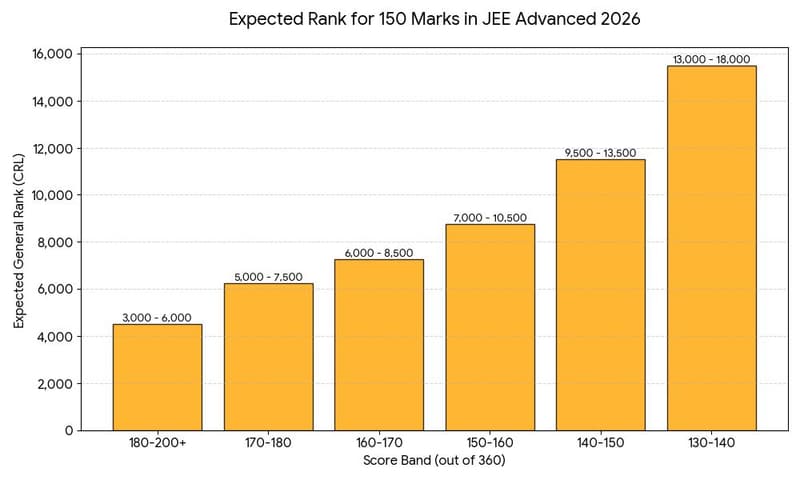
Expected Rank for 150 Marks in JEE Advanced 2026
The rank you receive in JEE Advanced depends on how many students score above you. Based on 2024–2025 trends, a score of 150 out of 360 typically places General category (CRL) Candidates in the 7,000 – 10,500 rank range. The table below shows expected ranks across nearby score bands.
| Score Band (out of 360) | Expected General Rank (CRL) | Competitive Outlook |
|---|---|---|
| 180 – 200+ |
3,000 – 6,000 |
Strong options in older & newer IITs |
| 170–180 |
5,000 – 7,500 |
Good IIT options across multiple disciplines |
| 160–170 | 6,000 – 8,500 |
Solid branches in many IITs |
| 150–160 | 7,000 – 10,500 |
Newer & mid-tier IITs; branches like Civil, Chemical, Mechanical, Mining, Metallurgy, etc. |
| 140–150 | 9,500 – 13,500 |
Limited options in newer IITs |
| 130–140 | 13,000 – 18,000+ |
Preparatory courses or very limited seats |
All rank estimates above are expected values based on 2024–2025 official trends and are not official predictions. Actual 2026 ranks will depend heavily on Paper difficulty, Number of qualified students and Overall score distribution.
Students scoring exactly 150 marks usually fall in the lower half of the 150–160 band. This typically translates to a rank around 8,000 – 10,500 (sometimes stretching to 11,000 depending on the year). Even a few extra marks (or fewer) can shift your rank by 1,000–2,500 positions in this dense scoring zone.
Also Check:
- JEE Advanced 2026 IIT Branches Under 5000 Rank: Full JoSAA List
- 100 Marks in JEE Advanced 2026: Expected Rank and IIT Chances
Ques. Is 150 marks a good score in JEE Advanced 2026 for getting an IIT seat?
Ans. Yes, 150 marks in JEE Advanced 2026 is considered a competitive score for General category candidates. Based on previous years’ trends, candidates scoring around 150 marks are expected to secure a CRL rank between 7,000 – 10,500, which can provide admission opportunities in newer and mid-tier IITs in branches such as Civil, Chemical, Mechanical, Mining, and Metallurgy.
Ques. Can rank change significantly even with a small score difference near 150 marks in JEE Advanced 2026?
Ans. Yes, the 140–170 marks range in JEE Advanced is usually very dense, meaning many candidates score within this band. Because of this, even a difference of 5–10 marks can shift the expected rank by nearly 1,000–2,500 positions depending on paper difficulty and overall score distribution in JEE Advanced 2026.
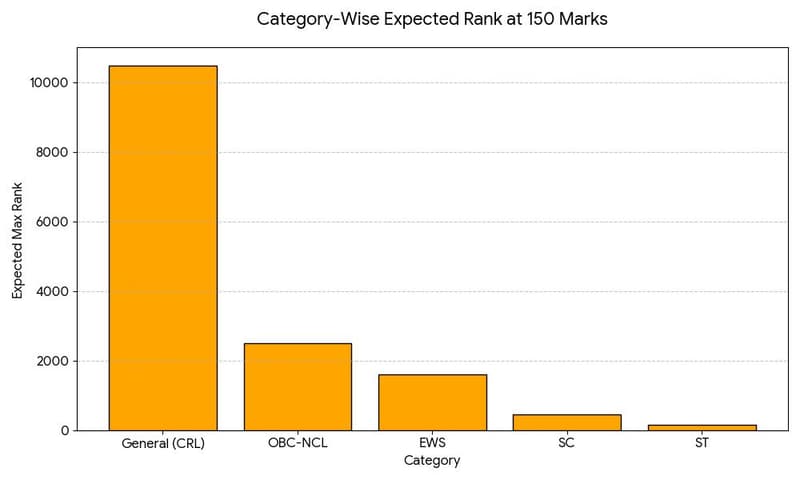
Category-Wise Expected Rank at 150 Marks
JEE Advanced publishes separate rank lists for each category. Your category rank (not CRL) is used by JoSAA for seat allotment under reserved quota seats. Students from SC, ST, EWS, and OBC-NCL categories can often access better IITs and branches than General category students at the same aggregate score.
- All category rank estimates are based on 2023–2025 trends and serve as a planning reference only. Actual ranks for 2026 depend on the number of qualified candidates, paper difficulty, and exact performance distribution.
- Reserved category students must meet the minimum qualifying marks (subject-wise + aggregate) set for their category to be included in the rank list.
- EWS and SC students scoring around 150 marks have strong prospects at several established and newer IIT campuses. ST students at this score can realistically target core engineering branches at many IITs (including some mid-tier ones), based on JoSAA previous year closing ranks.
| Category | Expected Rank at 150 Marks | Remark |
|---|---|---|
| General (CRL) | 7000 – 10500 | Common Rank List; highest competition |
| OBC-NCL | 1200 – 2500 | 27% horizontal reservation in IITs |
| EWS | 700 – 1600 | 10% reservation; strong IIT options |
| SC | 180 – 450 | 15% reservation; wider branch access |
| ST | 50 – 160 | 7.5% reservation; top IIT branches possible |
Also Check :
- 180 Marks in JEE Advanced 2026: Expected Rank and IITs You Can Get
- 210 Marks in JEE Advanced 2026: Expected Rank and IIT Chances
Ques. Can SC, ST, OBC-NCL, and EWS candidates get better IIT branches than General candidates at 150 marks in JEE Advanced 2026?
Ans. Yes, reserved category candidates generally receive significantly better IIT admission opportunities at the same score because JoSAA seat allotment uses category-wise ranks for reserved seats. At 150 marks in JEE Advanced 2026, SC, ST, EWS, and OBC-NCL candidates may access stronger IIT campuses and better branches compared to General category candidates with the same marks.
Ques. Is qualifying marks criteria still required for reserved category ranks in JEE Advanced 2026?
Ans. Yes, reserved category candidates must still clear the official minimum subject-wise and aggregate qualifying marks to receive a category rank in JEE Advanced 2026. Only candidates who satisfy the qualifying criteria are included in the respective OBC-NCL, EWS, SC, or ST rank lists used during JoSAA counselling.
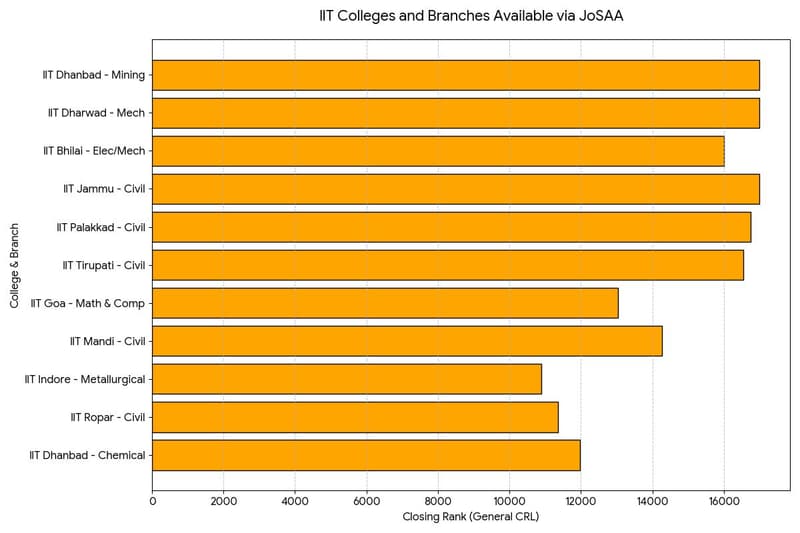
IIT Colleges and Branches Available via JoSAA
For General category candidates with an expected JEE Advanced rank between 7,000 and 10,500, the IIT branches listed below closed within this range during JoSAA 2024 counselling and may serve as a planning reference for 2026 admissions.
- Admissions to IITs are conducted through the JEE Advanced Common Rank List (CRL) during JoSAA counselling.
- NITs, IIITs, and GFTIs use the JEE Main rank for admission and are not allotted through JEE Advanced ranks.
- The closing ranks mentioned below are based on JoSAA 2024 data and should be treated only as expected planning estimates for JoSAA 2026.
- Actual JoSAA 2026 closing ranks may vary depending on factors such as seat matrix changes, number of qualified candidates, paper difficulty level, and candidate preference patterns.
- Candidates belonging to OBC-NCL, GEN-EWS, SC, ST, and PwD categories should check category-specific closing ranks separately during JoSAA counselling.
- SC and ST category candidates scoring around 150 marks in JEE Advanced generally secure much stronger category ranks compared to General category candidates with the same marks.
- JoSAA 2026 registration and choice filling was conducted from June 2 to June 11, 2026.
- The counselling process is currently underway, and candidates should regularly check josaa.nic.in for seat allotment updates and reporting deadlines.
| IIT College | Branch | JoSAA 2024 Closing Rank (General CRL) |
|---|---|---|
| IIT (ISM) Dhanbad | Chemical Engineering | 11,398 – 11,980 |
| IIT Ropar |
Civil Engineering |
11,365 |
| IIT Indore | Metallurgical Engineering and Materials Science | 10,894 |
| IIT Mandi | Civil Engineering |
~12,562 – 14,274 |
| IIT Goa |
Mathematics & Computing |
~7,932 – 13,030 |
| IIT Tirupati | Civil Engineering |
~15,429 – 16,548 |
| IIT Palakkad | Civil Engineering |
~15,812 – 16,753 |
| IIT Jammu | Civil Engineering |
~14,000 – 17,000 |
| IIT Bhilai |
Electrical / Mechanical Engineering |
~13,000 – 16,000 |
| IIT Dharwad | Mechanical Engineering |
~14,000 – 17,000 |
| IIT (ISM) Dhanbad | Mining Engineering |
~15,000 – 17,000 |
Also Check :
- JEE Advanced 2026 ST Category Cutoff: JoSAA Ranks and Branches
- JEE Advanced 2026: 300 Marks Expected Rank and IIT Branch Choices
Ques. Which IIT branches can General category candidates expect at 7,000–10,500 rank in JoSAA 2026?
Ans. General category candidates with an expected JEE Advanced 2026 rank between 7,000 and 10,500 may get branches such as Civil Engineering, Chemical Engineering, Metallurgical Engineering, Mechanical Engineering, Mining Engineering, and Mathematics & Computing in newer and mid-tier IITs. Based on JoSAA 2024 trends, IIT Goa, IIT Mandi, IIT Jammu, IIT Bhilai, IIT Dharwad, IIT Palakkad, IIT Tirupati, and IIT (ISM) Dhanbad are among the IITs where closing ranks extended into this range.
Ques. Are NITs and IIITs allotted through JEE Advanced rank in JoSAA counselling?
Ans. No, NITs, IIITs, and GFTIs are not allotted through JEE Advanced ranks. Admissions to these institutes are based on JEE Main ranks during JoSAA counselling. JEE Advanced ranks are used only for IIT admissions through the Common Rank List (CRL) and category-wise IIT rank lists.
How JEE Advanced Marks Translate to Rank
Understanding how your score becomes a rank helps you set realistic expectations before the result. The process involves several steps and factors that go beyond your raw marks.
- Aggregate score decides rank: JEE Advanced rank is based on total marks across Paper 1 and Paper 2 combined. There is no normalisation across sessions — it is a single-day exam with both papers on the same date.
- Subject-wise minimum qualifying marks apply: Students must score a minimum percentage in each subject (Physics, Chemistry, Mathematics) and in aggregate to qualify. Scoring high overall but failing the subject minimum leads to disqualification.
- More students scoring above you means a higher rank number: Your rank equals the count of students who scored strictly above your aggregate. A rank of 12,000 means roughly 12,000 students scored more than you.
- Ties are broken by subject-wise marks: If two students share the same aggregate, JEE Advanced uses Mathematics marks first, then Physics to break the tie.
- Category rank lists are generated separately: After the CRL is published, separate category-specific rank lists are generated for OBC-NCL, EWS, SC, ST, and PwD students. These rank lists power JoSAA’s reserved seat allotment.
- JoSAA uses rank — not marks — for seat allotment: Once ranks are published, JoSAA 2026 runs multiple rounds of counselling. Your rank and preferences together determine which IIT seat you receive.
Students aiming for a specific IIT branch should study JoSAA closing ranks from 2022–2024. Rank trends shift by 500–2,000 positions year on year depending on paper difficulty and the total qualified pool. Using three-year closing rank data gives a more reliable planning range than a single year.
Also Check :
- JEE Advanced 2026 IIT Bombay CSE Cutoff: Opening and Closing Ranks
- JEE Advanced 2026: 180 Marks Expected Rank and IIT Branches
Ques. Does JEE Advanced use normalisation while calculating ranks?
Ans. No, JEE Advanced does not use any normalisation process because all candidates appear for both Paper 1 and Paper 2 on the same day. The final Common Rank List (CRL) is prepared directly from the aggregate marks obtained across both papers combined, subject to minimum qualifying marks in each subject and overall aggregate.
Ques. Why can two students with the same JEE Advanced marks get different ranks?
Ans. If two candidates score the same aggregate marks in JEE Advanced, the official tie-breaking rules are applied to determine rank. Mathematics marks are checked first, followed by Physics marks if the tie still continues. Because of this process, two students with identical total scores may still receive different JEE Advanced ranks during result preparation.
JEE Advanced 2026 150 Marks: Reddit Discussion
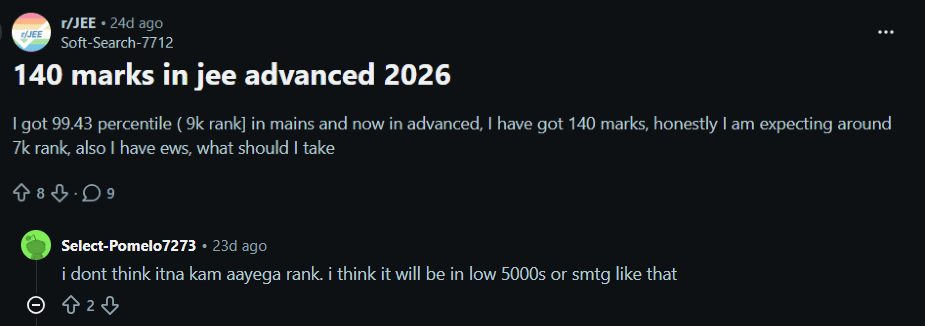
- The discussion focused on the expected JEE Advanced 2026 rank at 140 marks, where a candidate with 99.43 percentile and around 9K rank in JEE Main was estimating possible admission opportunities under the EWS category.
- Another Reddit user suggested that the expected JEE Advanced rank may be better than 7K, predicting that a score of 140 marks could potentially result in a rank in the lower 5000s range.
Source: Reddit
JEE Advanced 2026 150 Marks Expected Rank Frequently Asked Questions
Ques. What rank can I expect with 150 marks in JEE Advanced 2026?
Ans. Students scoring 150 marks can expect a General category (CRL) rank of approximately 7,000–10,500, based on 2024–2025 trends. This is an estimate — actual rank depends on the overall score distribution.
Ques. Can I get an IIT seat with 150 marks in JEE Advanced 2026?
Ans. Yes, IIT admission is possible for General category students. Branches like Civil Engineering, Mining Engineering, Metallurgical Engineering, and Mechanical at newer IITs (e.g., IIT Mandi, IIT Tirupati, IIT Jammu, IIT Palakkad, IIT (ISM) Dhanbad) had JoSAA closing ranks in the 12,000–17,000 range in recent years. Reserved category students have significantly wider options.
Ques. Will 150 marks in JEE Advanced 2026 make me eligible for NIT or IIIT admission?
Ans. No. NITs, IIITs, and GFTIs admit students based on JEE Main rank, not JEE Advanced rank. JEE Advanced rank is used only for IITs through JoSAA.
Ques. What is the expected OBC-NCL rank for 150 marks in JEE Advanced 2026?
Ans. OBC-NCL students scoring 150 marks can typically expect a category rank of approximately 1,200–3,000 (based on recent trends). This is used for the 27% OBC-NCL reservation in IITs.
Ques. When will JEE Advanced 2026 results be declared?
Ans. The JEE Advanced 2026 result was declared on June 1, 2026. Candidates can check their scorecard and rank on jeeadv.ac.in.
Ques. How are marks converted to rank in JEE Advanced 2026?
Ans. JEE Advanced does not use normalisation. Rank is based on the total aggregate marks (Paper 1 + Paper 2). Your rank equals the number of candidates who scored higher than you. You must meet the minimum qualifying marks in each subject (Physics, Chemistry, Mathematics) and in aggregate. Ties are broken first by Mathematics marks, then Physics (and other rules).



Comments