





The CAT QA syllabus 2026 covers five major areas such as Arithmetic, Algebra, Geometry and Mensuration, Number System and Modern Mathematics.
- The IIMs do not publish an official CAT QA syllabus and the topics are identified from previous years' CAT question papers.
- The CAT 2026 QA syllabus is based on Class 9 and Class 10 Mathematics concepts with a higher level of application and logical reasoning.
- Candidates should focus their CAT 2026 Quantitative Aptitude preparation on the high weightage topics from these five areas.
- Algebra and Geometry have remained among the more challenging topics for many CAT aspirants in recent years.
Related Links:
- CAT Syllabus 2026- Download Syllabus PDF, Section-wise Weightage and Preparation Tips
- CAT Topic Wise Weightage for QA, VARC and DILR, Check Previous Years’ Question
- Download Free CAT Study Material PDF for VARC, DILR, and Quant
Key Summary
- The CAT 2026 QA section is expected to include 22 questions to be solved in 40 minutes.
- Arithmetic is expected to carry the highest weightage with around 7 to 10 questions.
- The QA section includes a combination of MCQs and TITA (Type In The Answer) questions.
- Negative marking applies only to MCQs with 1 mark deducted for every incorrect answer.
- The detailed CAT QA syllabus available online is generally prepared by coaching institutes using the trends from previous years' CAT papers, as the IIMs do not release an official syllabus PDF.
CAT QA Syllabus 2026: Overview
The Quantitative Aptitude section in CAT 2026 has 22 questions out of the total 68 questions in the examination.
- The QA section is based mainly on Class 9 and Class 10 Mathematics concepts with a greater focus on application-based and logical problem-solving questions.
- The CAT 2026 Quantitative Aptitude syllabus is broadly divided into five major areas.
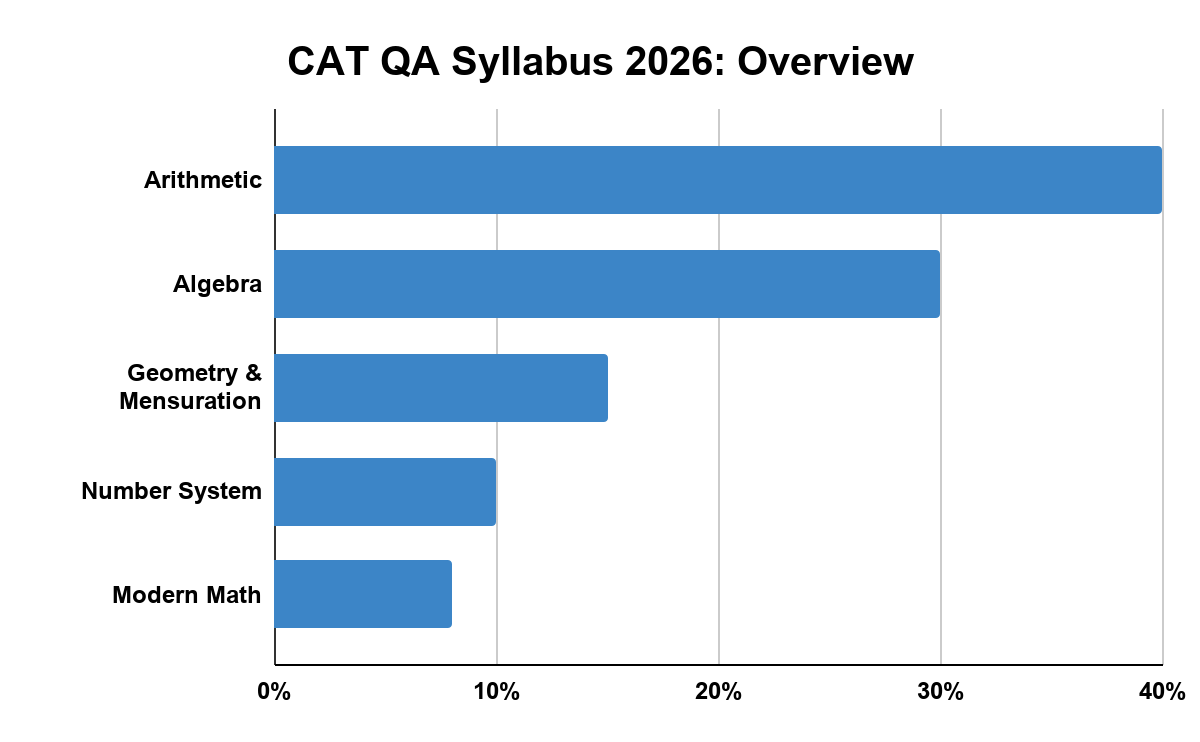
- Arithmetic and Algebra are expected to contribute around 60–70% of the Quantitative Aptitude questions.
| Topic | Key Sub-Topics | Approx. Questions | Weightage |
|---|---|---|---|
| Arithmetic | Percentages, Profit & Loss, Discount, Ratio & Proportion, Averages, Mixtures & Alligations, Simple & Compound Interest, Time & Work, Pipes & Cisterns, Time-Speed-Distance, Boats & Streams, Partnerships | 7–10 | 40% |
| Algebra | Linear & Quadratic Equations, Inequalities, Functions, Logarithms, Progressions (AP, GP, HP), Sequences & Series, Polynomials, Maxima & Minima | 5–7 | 25–30% |
| Geometry & Mensuration | Triangles, Circles, Quadrilaterals, Polygons, Coordinate Geometry, 3D Mensuration (Volume, Surface Area), Lines & Angles, Similarity, Trigonometry basics | 3–5 | 15% |
| Number System | Divisibility, HCF & LCM, Factors & Multiples, Remainders, Base Systems, Surds & Indices, Cyclicity, Factorials | 2–3 | 5–10% |
| Modern Math | Permutations & Combinations, Probability, Set Theory, Sequences & Series | 1–2 | 5–8% |
Also Check:
- CAT VARC Exam Analysis: Check Section-wise Analysis, Difficulty Level, & Weightage
- CAT Verbal Ability & Reading Comprehension Syllabus, CAT VARC Syllabus Topic-wise Weightage, Study Material
Ques. Which topics have the highest weightage in CAT 2026 Quantitative Aptitude?
Ans. Arithmetic carries the highest weightage in CAT 2026 QA with 7–10 questions (around 40%), followed by Algebra with 5–7 questions (25–30%). Candidates should prioritize these two topics as they together contribute nearly 60–70% of the Quantitative Aptitude section.
Ques. Is Class 10 Mathematics enough for CAT 2026 Quantitative Aptitude?
Ans. Yes, the CAT 2026 Quantitative Aptitude syllabus is primarily based on Class 9 and Class 10 Mathematics. However, candidates should focus on application-based problem solving, speed, and accuracy, as CAT questions test concepts in a more analytical way than school-level exams.
CAT QA Syllabus 2026: Topic-Wise List
Candidates should give priority to Arithmetic and Algebra, as these two areas contribute the highest number of questions in the CAT Quantitative Aptitude section.
- In Arithmetic, topics such as Percentages, Profit and Loss, Time and Work and Time, Speed and Distance (TSD) are expected to carry significant weightage.
- In Algebra, Equations and Inequalities remain among the most important topics for preparation.
- Candidates should first focus on improving accuracy in Arithmetic and Algebra while preparing Geometry and Number System according to their strengths.
- Recent CAT papers have focused more on conceptual understanding, speed and application-based word problems rather than direct formula based questions.
| Main Topic | Sub-Topics |
|---|---|
| Arithmetic | Percentages |
| Profit & Loss, Discount | |
| Ratio & Proportion | |
| Averages | |
| Mixtures & Alligations | |
| Simple & Compound Interest | |
| Time & Work, Pipes & Cisterns | |
| Time, Speed & Distance (Trains, Boats & Streams) | |
| Partnerships | |
| Algebra | Linear Equations |
| Quadratic Equations | |
| Inequalities | |
| Functions & Graphs | |
| Logarithms | |
| Progressions (AP, GP, HP) | |
| Sequences & Series | |
| Polynomials | |
| Maxima & Minima | |
| Surds & Indices | |
| Geometry & Mensuration | Lines & Angles |
| Triangles (Properties, Similarity, Congruence) | |
| Circles & Properties | |
| Quadrilaterals & Polygons | |
| Coordinate Geometry | |
| Mensuration – 2D (Area, Perimeter) | |
| Mensuration – 3D (Volume, Surface Area) | |
| Trigonometry (Basics) | |
| Number System | Divisibility Rules |
| HCF & LCM | |
| Factors, Multiples & Prime Numbers | |
| Remainders & Cyclicity | |
| Base Systems | |
| Surds & Indices | |
| Factorials & Trailing Zeros | |
| Unit Digit & Last Two Digits | |
| Modern Mathematics | Permutations & Combinations |
| Probability | |
| Set Theory | |
| Binomial Theorem | |
| Sequences & Series (overlap with Algebra) |
Also Check:
- CAT DILR Exam Analysis: Check Slot-wise Analysis, Weightage, Cut off
- CAT DILR Syllabus PDF- Check Topics, Weightage, Pattern, Previous Year Trends
Ques. Which Arithmetic topics should I prepare first for CAT 2026 QA?
Ans. Candidates should begin with Percentages, Profit & Loss, Ratio & Proportion, Time & Work, and Time, Speed & Distance, as these topics frequently appear in CAT Quantitative Aptitude. Building a strong foundation in these areas improves performance in many application-based questions.
Ques. Are formula-based questions common in CAT 2026 Quantitative Aptitude?
Ans. No. Recent CAT papers have focused more on conceptual understanding, logical thinking, and application-based word problems rather than direct formula-based questions. Candidates should practice solving varied problem types instead of memorizing formulas alone.
CAT QA Exam Pattern 2026
The QA section is expected to be the third section in CAT 2026 following VARC and DILR.
- Candidates cannot switch between sections during the CAT 2026 examination.
- The QA section is designed to assess speed, accuracy and a strong understanding of fundamental mathematical concepts.
- This exam pattern is based on the latest CAT trends and the expected CAT 2026 examination structure.
- CAT 2026 is expected to be conducted in three slots on the examination day.
| Particulars | Details |
|---|---|
| Section Name | Quantitative Aptitude (QA) |
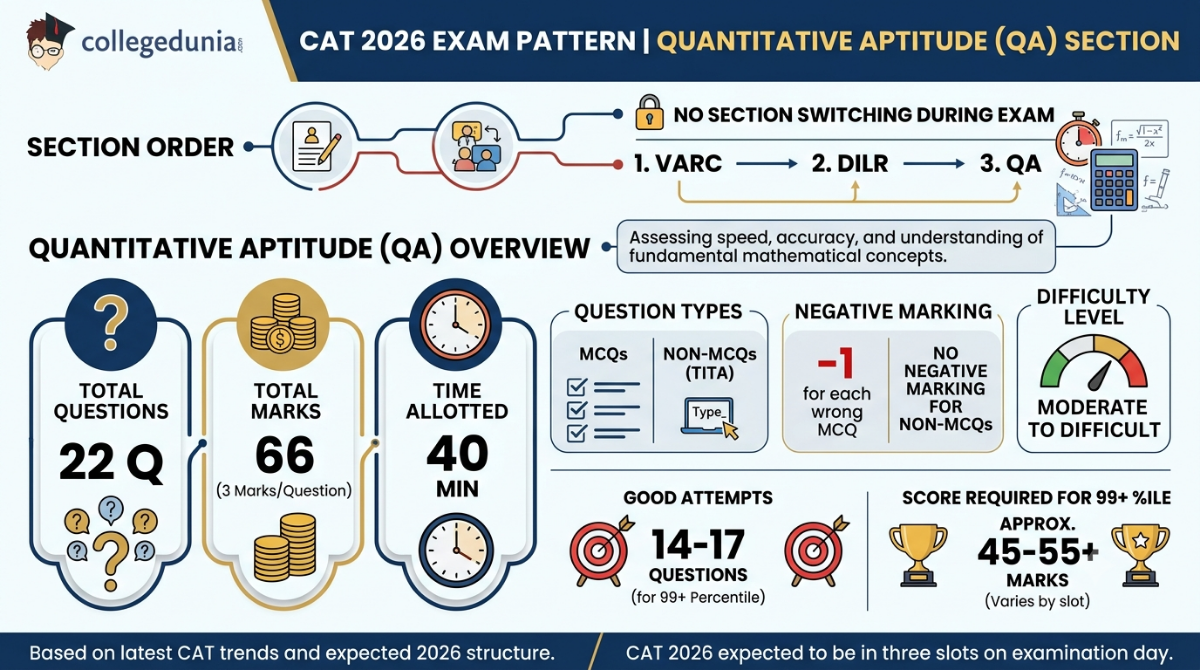
| Total Questions | 22 |
| Total Marks | 66 (3 marks per question) |
| Time Allotted | 40 minutes |
| Question Types | MCQs + Non-MCQs (TITA) |
| Negative Marking | -1 for each wrong MCQNo negative marking for Non-MCQs |
| Difficulty Level | Moderate to Difficult |
| Good Attempts | 14 – 17 questions (for 99+ percentile) |
| Score Required for 99+ %ile | Approx. 45 – 55+ marks (varies by slot) |
Also Check:
- CAT Quantitative Aptitude Exam Analysis
- CAT Quantitative Aptitude Syllabus: Important Topics, Preparation Tips, Study Material and Previous Year Papers
Ques. How many questions should I attempt in CAT 2026 QA for a 99+ percentile?
Ans. Based on recent CAT trends, candidates should aim for 14–17 accurate attempts in the Quantitative Aptitude section. A score of approximately 45–55+ marks may be sufficient for a 99+ percentile, depending on the exam slot and overall difficulty level.
Ques. Is there negative marking for TITA questions in CAT 2026 Quantitative Aptitude?
Ans. No. Non-MCQ (TITA) questions do not have negative marking in CAT 2026. However, MCQs carry a penalty of -1 mark for every incorrect answer, so candidates should avoid random guessing in MCQs.
Best Books for CAT QA 2026
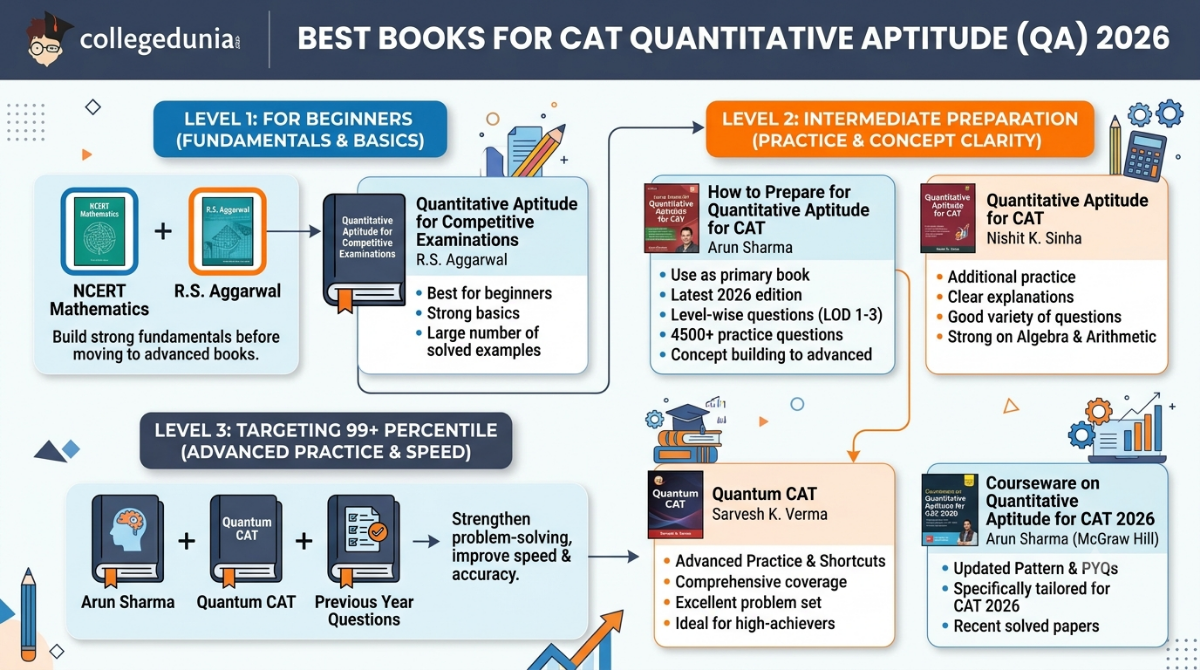
Beginners should start with NCERT Mathematics and R.S. Aggarwal to build strong fundamentals before moving to Arun Sharma.
- Candidates with an intermediate level of preparation can use Arun Sharma as the primary book along with Nishit Sinha for additional practice.
- Candidates targeting a 99+ percentile should practise from Arun Sharma, Quantum CAT and Previous Year Questions to strengthen problem solving skills and improve speed and accuracy.
| Book Title | Author | Best For | Key Highlights |
|---|---|---|---|
| How to Prepare for Quantitative Aptitude for CAT | Arun Sharma | Overall Preparation & Practice | Latest 2026 edition, Level-wise questions (LOD 1-3), 4500+ practice questions, excellent for concept building to advanced |
| Quantitative Aptitude for CAT | Nishit K. Sinha | Conceptual Clarity | Clear explanations, good variety of questions, strong on Algebra & Arithmetic |
| Quantum CAT | Sarvesh K. Verma | Advanced Practice & Shortcuts | Comprehensive coverage, excellent problem set, ideal for 99+ percentile aspirants |
| Quantitative Aptitude for Competitive Examinations | R.S. Aggarwal | Building Fundamentals | Best for beginners, strong basics, large number of solved examples |
| Courseware on Quantitative Aptitude for CAT 2026 | Arun Sharma (McGraw Hill) | Updated Pattern & PYQs | Specifically tailored for CAT 2026 with recent solved papers |
Also Check:
- CAT Previous Year Question Papers Difficulty Comparison 2020 to 2025
- CAT Previous 10 Years Question Papers with Solutions PDF for 99 Percentile
Ques. Which is the best book for CAT 2026 Quantitative Aptitude beginners?
Ans. Beginners should start with R.S. Aggarwal's Quantitative Aptitude for Competitive Examinations and NCERT Mathematics to build strong fundamentals. After mastering the basics, candidates can move to Arun Sharma's How to Prepare for Quantitative Aptitude for CAT for CAT-specific practice.
CAT QA Syllabus 2026: Reddit Discussion
- The discussion focused on improving Quantitative Aptitude for CAT 2026, with candidates looking for effective practice material and strategies after struggling to score well in the Quant section despite extensive preparation.
- Another Reddit user suggested that success in CAT Quant depends more on concept clarity and question selection than solving a large number of problems. The user recommended strengthening Arithmetic and Algebra fundamentals, thoroughly analysing previous years' CAT papers, and practising when to skip difficult questions, emphasizing that better decision-making in the exam is often more valuable than increasing practice volume.
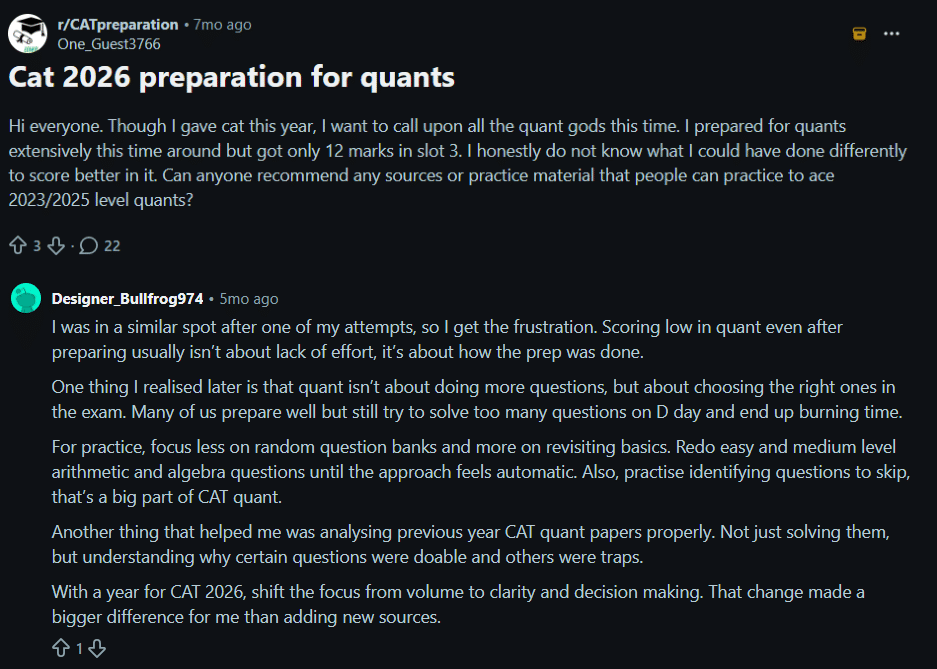
Source: Reddit



Comments