




AP EAPCET 2026 Engineering Question Paper for May 12 Shift 2 is available for download here. JNTUK on behalf of APSCHE conducted AP EAPCET 2026 Engineering exam on May 12 in Shift 2 from 2 PM to 5 PM. AP EAPCET 2026 Engineering consists of 160 questions for a total of 160 marks to be attempted in 3 hours.
- AP EAPCET 2026 Engineering is divided into 3 sections- Mathematics with 80 questions and Physics and Chemistry with 40 questions each.
- Each correct answer carries 1 mark and there is no negative marking for incorrect answer.
AP EAPCET 2026 Engineering Question Paper PDF for May 12 Shift 2
| AP EAPCET 2026 Engineering Question Paper May 12 Shift 2 | Download PDF | Check Solutions |



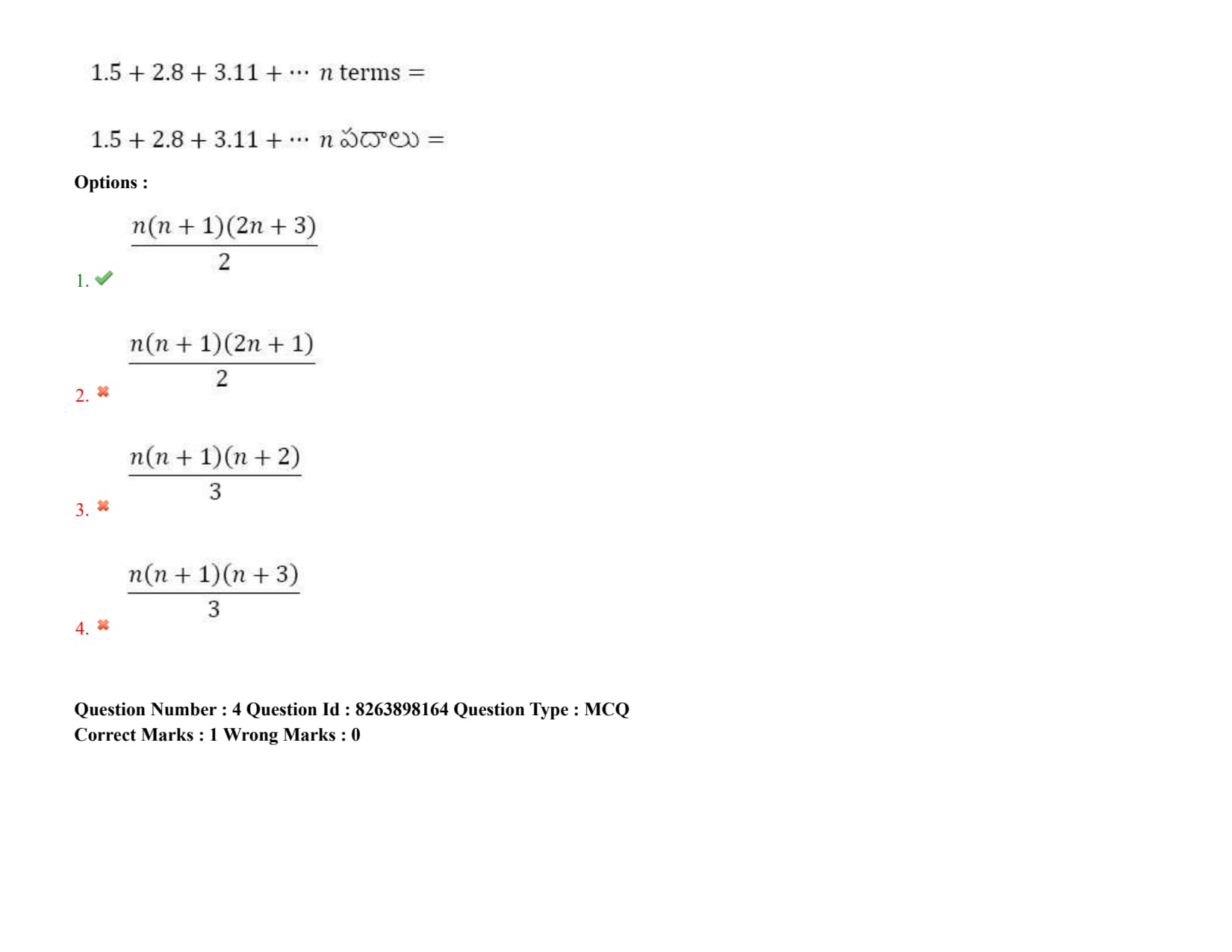


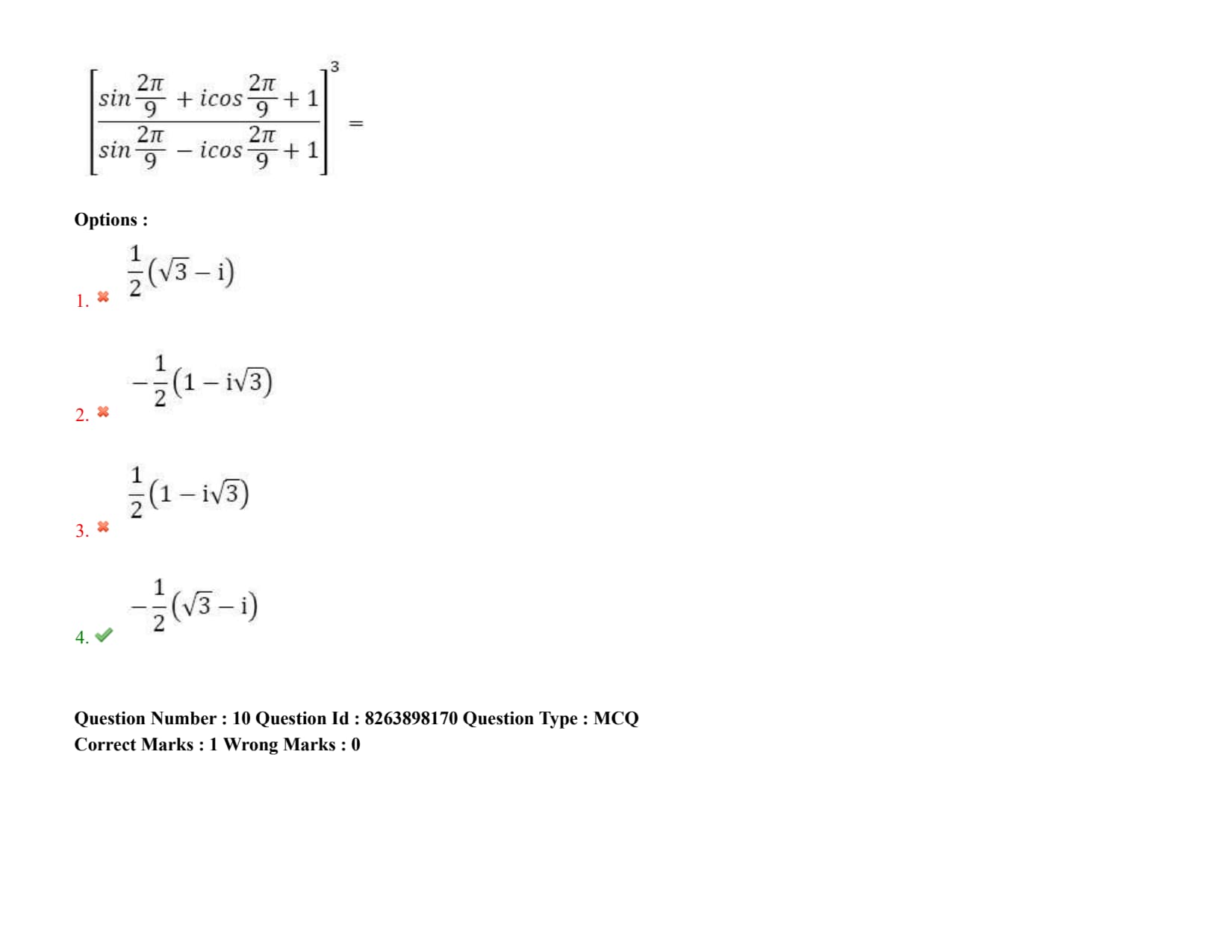


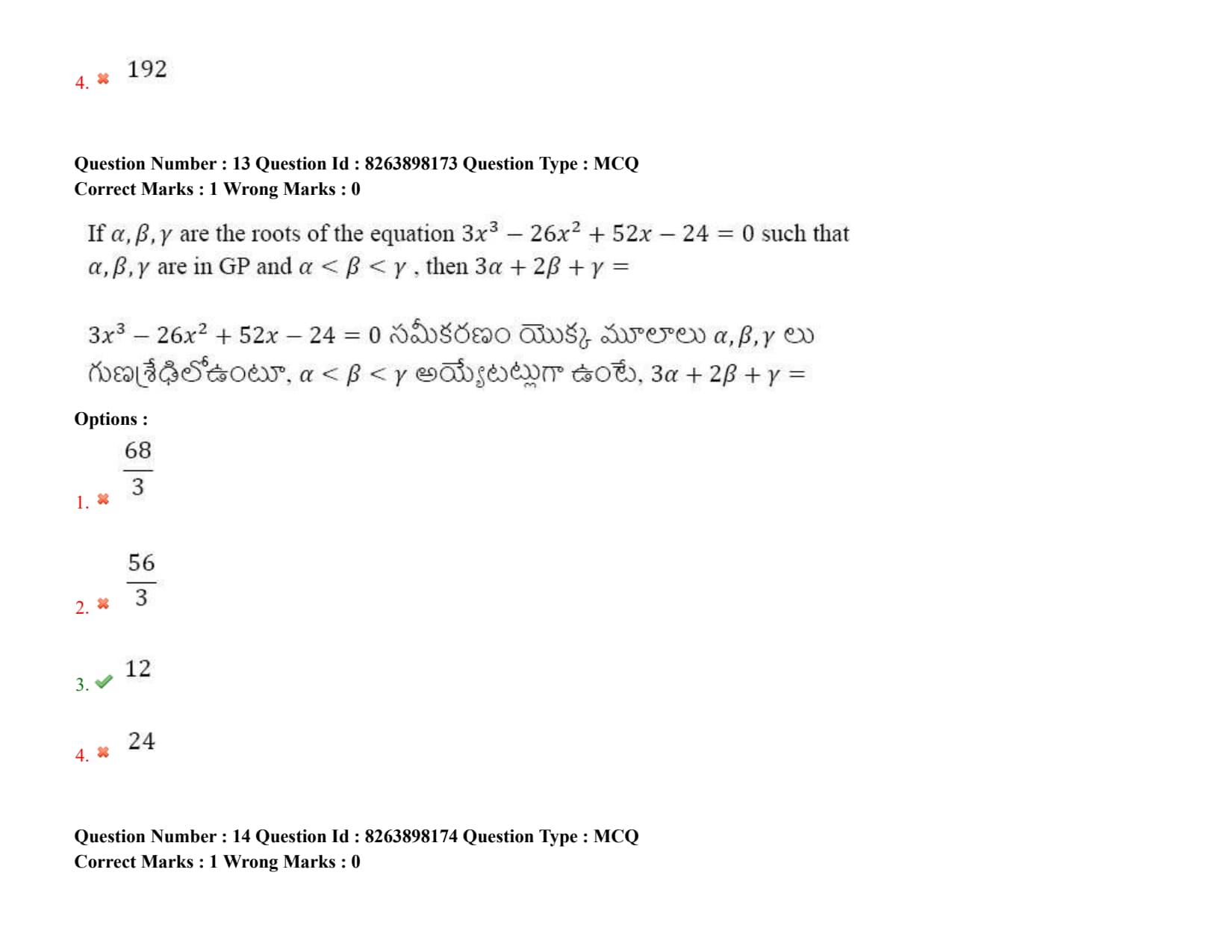


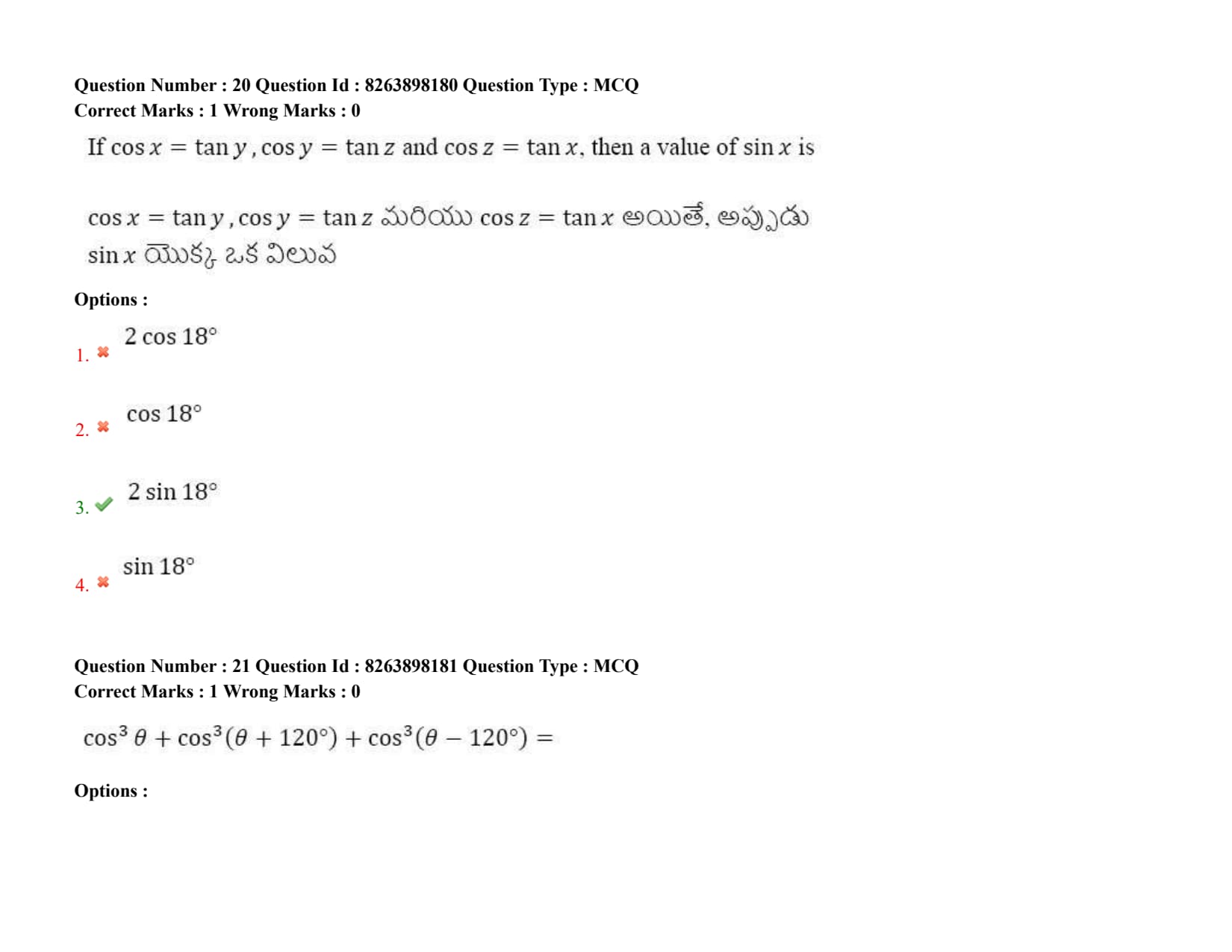


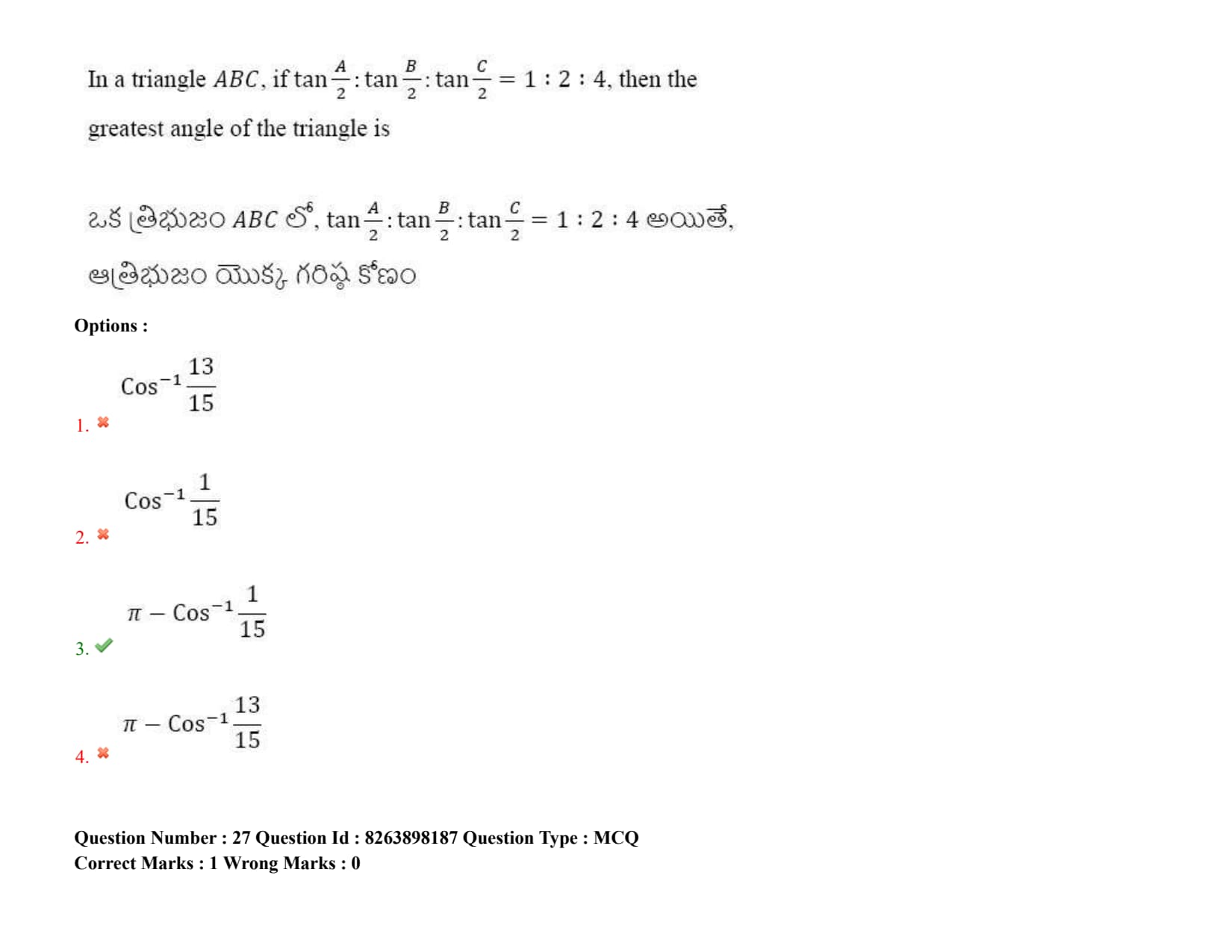
















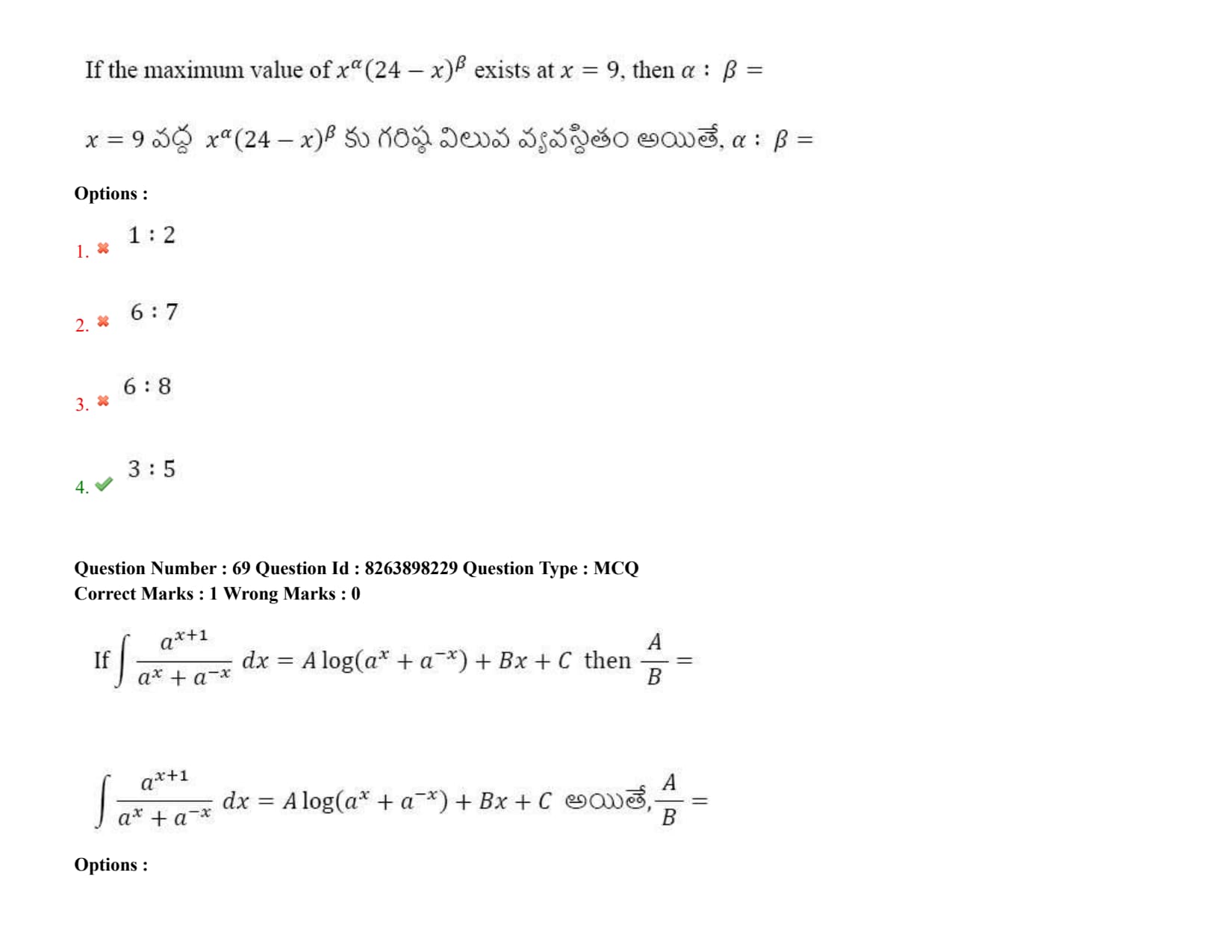








































\([x]\) denotes integral part of \(x\). For \(n\in\mathbb N\), \[ f(x)= \begin{cases} \left\lfloor |x|\left\lfloor\frac1{|x|}\right\rfloor\right\rfloor,&|x|\neq\frac1n
0,&|x|=\frac1n \end{cases} \]
Then for \(|x|\neq \frac1n\), \(f(x)=\)
View Solution
Step 1: Let
\[ t=|x| \]
and define
\[ k=\left\lfloor\frac1t\right\rfloor \]
Since \(k\) is an integer,
\[ k\le \frac1t
Step 2:
Taking reciprocal,
\[ \frac1{k+1}
Multiplying by \(k\),
\[ \frac{k}{k+1}
Step 3:
Since \(t\neq \frac1n\),
\[ kt<1 \]
Hence
\[ 0
Thus,
\[ \lfloor kt\rfloor=0 \]
Therefore,
\[ f(x)=0 \] Quick Tip: If \(0
If \(f\) satisfies
\[ f(x+y)+f(x-y)=2f(x)f(y) \]
for all \(x,y\in\mathbb R\), then \(f(10)-f(-10)=\)
View Solution
Step 1:
Put \(x=0\),
\[ f(y)+f(-y) = 2f(0)f(y) \]
Now put \(x=0,y=0\),
\[ 2f(0) = 2[f(0)]^2 \]
\[ f(0)=1 \]
Step 2:
Substitute into equation,
\[ f(y)+f(-y) = 2f(y) \]
Hence,
\[ f(-y)=f(y) \]
So \(f(x)\) is an even function.
Step 3:
Therefore,
\[ f(10)-f(-10) = f(10)-f(10) \]
\[ =0 \] Quick Tip: If \(f(-x)=f(x)\), then \(f\) is even.
\(1\cdot5+2\cdot8+3\cdot11+\cdots\) to \(n\) terms
View Solution
Step 1:
General term,
\[ T_k = k(3k+2) \]
\[ = 3k^2+2k \]
Step 2:
\[ S_n = \sum_{k=1}^{n}(3k^2+2k) \]
\[ = 3\sum k^2 + 2\sum k \]
Step 3:
Using standard formulas,
\[ \sum k = \frac{n(n+1)}2 \]
\[ \sum k^2 = \frac{n(n+1)(2n+1)}6 \]
Step 4:
Substitute:
\[ S_n = \frac{n(n+1)(2n+3)}2 \] Quick Tip: First derive the general term before summing.
If \[ A= \begin{bmatrix} a^2&ab&ac
ab&b^2&bc
ac&bc&c^2 \end{bmatrix} \]
and \[ a^2+b^2+c^2=1 \]
then \(A^2=\)
View Solution
Step 1:
Write
\[ A = uu^T \]
where
\[ u= \begin{bmatrix} a
b
c \end{bmatrix} \]
Step 2:
Then,
\[ A^2 = (uu^T)(uu^T) \]
\[ = u(u^Tu)u^T \]
Step 3:
\[ u^Tu = a^2+b^2+c^2 = 1 \]
Thus,
\[ A^2 = u(1)u^T = A \] Quick Tip: For rank-1 matrix \(uu^T\), \[ (uu^T)^2=(u^Tu)(uu^T) \]
Evaluate
\[ \begin{vmatrix} -a^2&ab&ac
ab&-b^2&bc
ac&bc&-c^2 \end{vmatrix} \]
View Solution
Step 1:
Take \(a,b,c\) common from rows:
\[ D = abc \begin{vmatrix} -a&b&c
a&-b&c
a&b&-c \end{vmatrix} \]
Now take \(a,b,c\) common from columns,
\[ D = a^2b^2c^2 \begin{vmatrix} -1&1&1
1&-1&1
1&1&-1 \end{vmatrix} \]
Step 2:
Evaluate determinant,
\[ = 4 \]
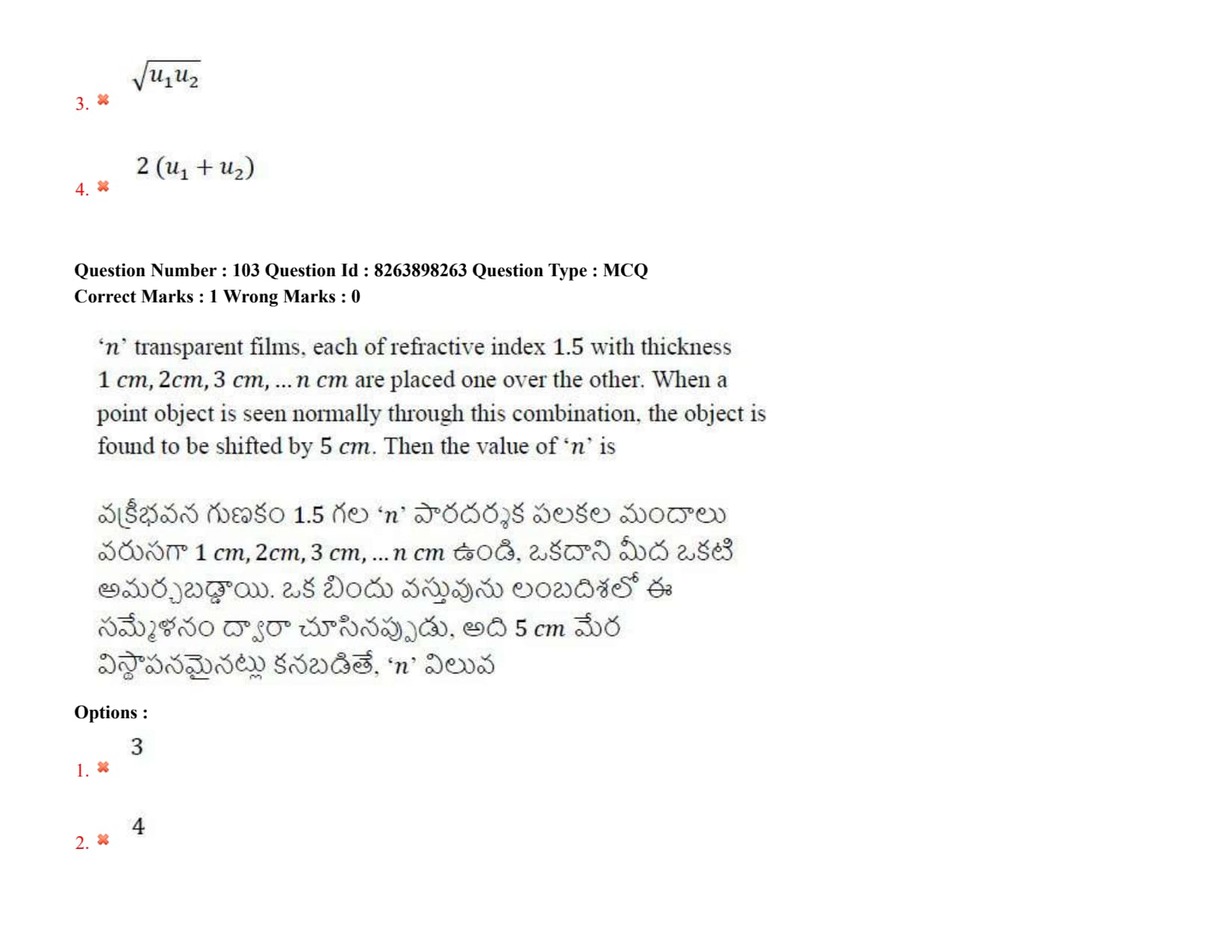
Hence,
\[ D = 4a^2b^2c^2 \] Quick Tip: Always factor common terms from rows and columns before expanding determinants.
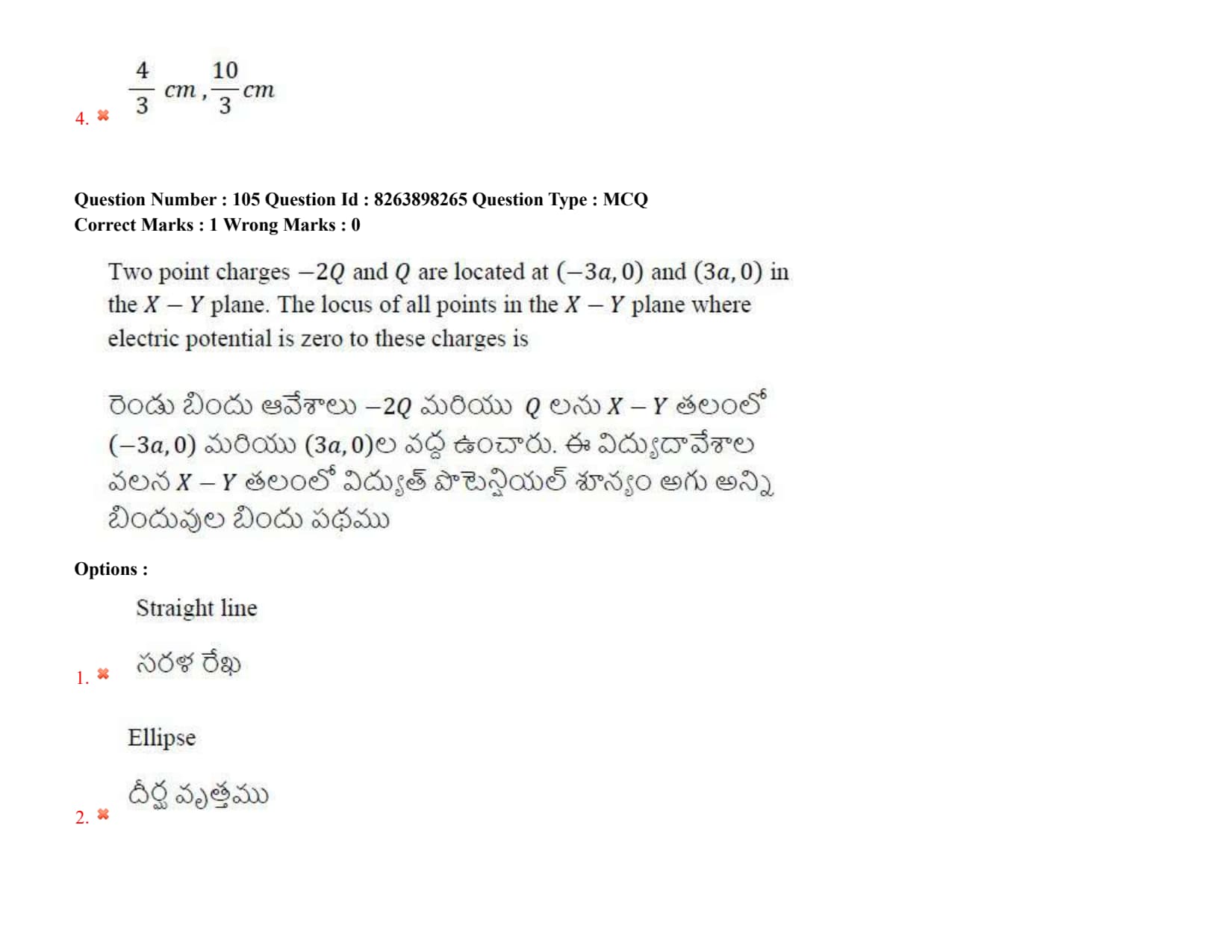
If the system \(x-ky-z=0,\;kx-y-z=0,\;x+y-z=0\) has a non-trivial solution, then possible values of \(k\) are
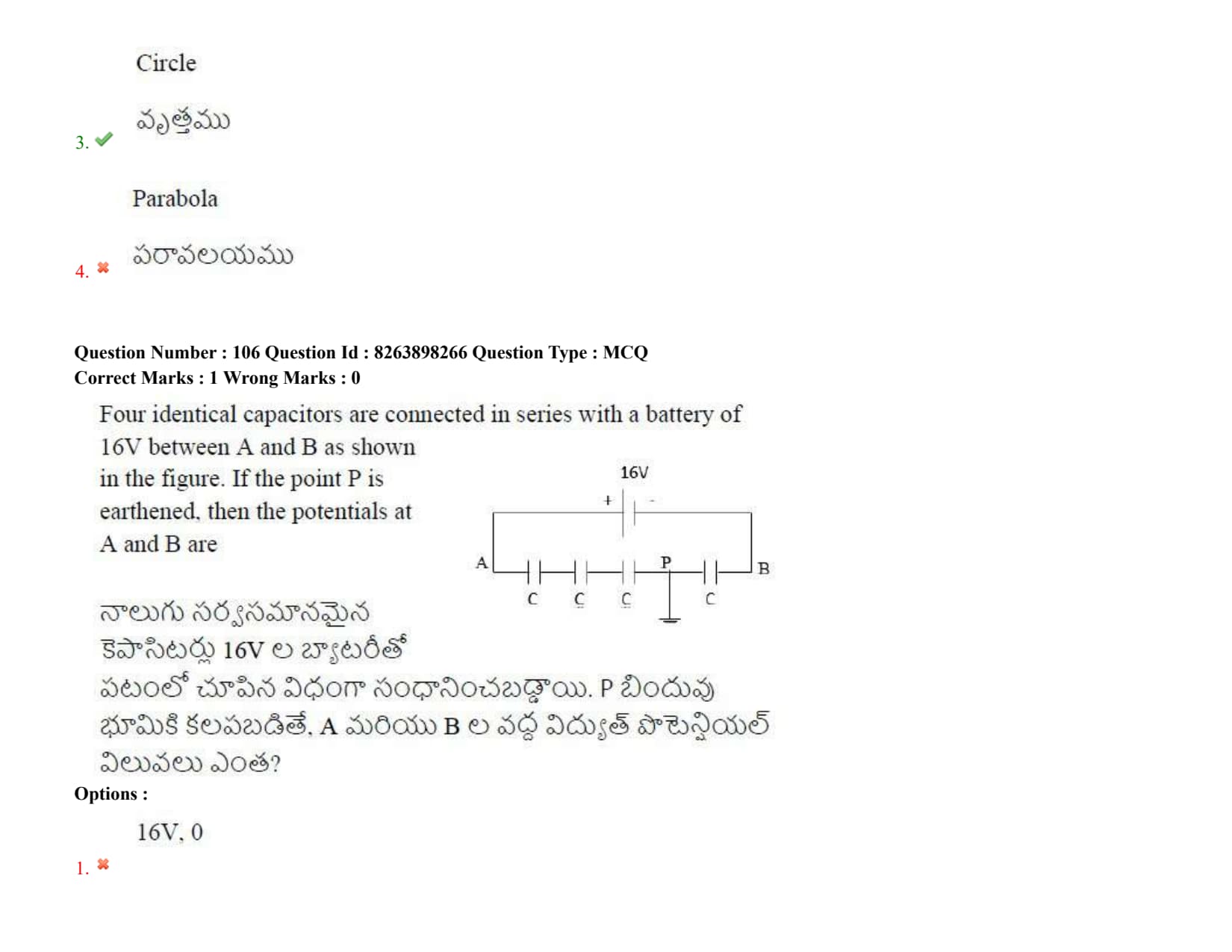
View Solution
N/A Quick Tip: For homogeneous equations, non-trivial solutions exist only when determinant of coefficient matrix is zero.
If \(x=\omega^2-\omega-3\), where \(\omega\) is a non-real cube root of unity, then find
\[ x^4+6x^3+10x^2-12x-19 \]
View Solution
N/A Quick Tip: Whenever higher powers appear, reduce them using the minimal polynomial.
If
\[ z_1=\sqrt3+i\sqrt3 \]
and
\[ z_2=\sqrt3+i \]
then determine the quadrant of
\[ \left(\frac{z_1}{z_2}\right)^{50} \]
View Solution
N/A Quick Tip: Reduce angle modulo \(2\pi\) to determine quadrant.
Evaluate
\[ \left[ \frac{\sin\frac{2\pi}{9} +i\cos\frac{2\pi}{9}+1} {\sin\frac{2\pi}{9} -i\cos\frac{2\pi}{9}+1} \right]^3 \]
View Solution
N/A Quick Tip: Use Euler form: \(e^{i\theta}=\cos\theta+i\sin\theta\).
10.
Find number of integral values of \(m\) such that
\[ (1+2m)x^2-2(1+3m)x+4(1+m)>0 \]
for all real \(x\).
View Solution
N/A Quick Tip: For always positive quadratic: \(a>0\) and discriminant \(<0\).
11.
The values of \(x\) satisfying both \(x^2-1\le0\) and \(x^2-x-2\ge0\) lie in:
View Solution
N/A Quick Tip: For multiple inequalities, solve each separately and take intersection of solution sets.
12.
If \(\alpha,\beta,\gamma\) are roots of \(x^3+2x^2-x-2=0\), then find \(\alpha^6+\beta^6+\gamma^6\).
View Solution
N/A Quick Tip: Always try factorization before applying identities or Newton sums.
13.
If \(\alpha,\beta,\gamma\) are roots of \(3x^3-26x^2+52x-24=0\) in GP with \(\alpha<\beta<\gamma\), then find \(3\alpha+2\beta+\gamma\).
View Solution
N/A Quick Tip: For roots in GP use: \[ \frac ar,\;a,\;ar \] This reduces cubic-root problems into simple equations.
14.
If all possible 6-digit numbers are formed by using all the digits 1,3,5,6,7,9 without repetition, then the number of numbers greater than \(300000\) and divisible by \(4\) is
View Solution
N/A Quick Tip: For divisibility by \(4\), check only the last two digits. Then apply first-digit restrictions separately.
15.
Among all arrangements of the letters of the word ARRANGE, the number of arrangements in which either two A's or two R's do not occur together is
View Solution
N/A Quick Tip: Repeated-letter arrangement problems usually become easier by treating repeated letters as blocks.
16.
A candidate must answer 7 out of 12 questions divided into two parts of 6 each. He cannot answer more than 5 from each part. Number of ways to choose 7 questions.
View Solution
Step 1: Total ways without restriction
The candidate chooses 7 questions from 12:
\[ ^{12}C_7=792 \]
Step 2: Find invalid selections
He cannot select more than 5 questions from any part.
Invalid case:
Selecting 6 questions from Part I and 1 from Part II:
\[ ^{6}C_6\times ^6C_1 \]
\[ =1\times6 \]
\[ =6 \]
Similarly,
Selecting 6 from Part II and 1 from Part I:
\[ 6 \]
Total invalid cases:
\[ 6+6 \]
\[ =12 \]
Step 3: Required number of ways
\[ 792-12 \]
\[ =780 \]
Hence total ways:
\[ \boxed{780} \] Quick Tip: For selection restrictions, first find total possible cases and subtract invalid cases.
17.
Number of integral terms in
\[ \left(5^{1/2}+7^{1/8}\right)^{1024} \]
View Solution
Step 1: Write general term
\[ T_{r+1} = ^{1024}C_r (5^{1/2})^{1024-r} (7^{1/8})^r \]
\[ = ^{1024}C_r 5^{\frac{1024-r}{2}} 7^{\frac r8} \]
Step 2: Condition for integral term
Exponent of 5:
\[ \frac{1024-r}{2} \]
must be integer.
Hence \(r\) must be even.
Exponent of 7:
\[ \frac r8 \]
must be integer.
Hence \(r\) must be multiple of 8.
Therefore,
\[ r=0,8,16,\dots,1024 \]
Step 3: Count terms
Number of values:
\[ \frac{1024}{8}+1 \]
\[ 128+1 \]
\[ =129 \]
Hence number of integral terms:
\[ \boxed{129} \] Quick Tip: For integral terms, exponents of prime factors must become integers.
18.
Number of times digit 5 occurs in numbers from 1 to 1000.
View Solution
Step 1: Count at units place
Digit 5 occurs once in every block of 10 numbers.
\[ \frac{1000}{10} \]
\[ =100 \]
Step 2: Count at tens place
In every block of 100 numbers,
digit 5 appears 10 times.
Hence,
\[ 10\times10 \]
\[ =100 \]
Step 3: Count at hundreds place
Numbers from
\[ 500-599 \]
contain digit 5 at hundreds place.
Total:
\[ 100 \]
Step 4: Total occurrences
\[ 100+100+100 \]
\[ =300 \]
Hence required answer:
\[ \boxed{300} \] Quick Tip: Count occurrences separately for units, tens and hundreds places.
19.
If
\[ \frac{4x}{(x^2-1)^2} = \frac{A_1}{x-1} + \frac{A_2}{(x-1)^2} + \frac{A_3}{x+1} + \frac{A_4}{(x+1)^2} \]
then find
\[ A_1+A_2+A_3+A_4 \]
View Solution
Step 1: Multiply both sides
\[ 4x= A_1(x-1)(x+1)^2 + A_2(x+1)^2 + A_3(x+1)(x-1)^2 + A_4(x-1)^2 \]
Step 2: Put \(x=1\)
\[ 4=4A_2 \]
\[ A_2=1 \]
Put \(x=-1\)
\[ -4=4A_4 \]
\[ A_4=-1 \]
Step 3: Compare highest powers
\[ A_1+A_3=0 \]
Comparing constants:
\[ A_3=A_1 \]
Thus,
\[ A_1=A_3=0 \]
Step 4: Sum
\[ A_1+A_2+A_3+A_4 \]
\[ 0+1+0-1 \]
\[ =0 \]
Hence,
\[ \boxed{0} \] Quick Tip: For repeated linear factors, substitute roots first and then compare coefficients.
20.
If
\[ \cos x=\tan y,\quad \cos y=\tan z,\quad \cos z=\tan x \]
then one value of
\[ \sin x \]
is
View Solution
Step 1: By symmetry take
\[ x=y=z \]
Then
\[ \cos x=\tan x \]
\[ \cos x = \frac{\sin x}{\cos x} \]
\[ \cos^2x = \sin x \]
Step 2: Use identity
\[ 1-\sin^2x=\sin x \]
\[ \sin^2x+\sin x-1=0 \]
Step 3: Solve quadratic
\[ \sin x = \frac{-1\pm\sqrt5}{2} \]
Taking positive value,
\[ \sin x = \frac{\sqrt5-1}{2} \]
Using
\[ \sin18^\circ = \frac{\sqrt5-1}{4} \]
Hence,
\[ \sin x = 2\sin18^\circ \]
\[ \boxed{2\sin18^\circ} \] Quick Tip: For cyclic symmetric equations, first try taking all variables equal.
21.
\(\cos^3 \theta + \cos^3 (\theta +120^\circ)+\cos^3(\theta-120^\circ)=\)
View Solution
Step 1: Apply the cubic identity \[ \cos^3x=\frac{3\cos x+\cos3x}{4} \]
Substituting in the given expression,
\[ =\frac14[3\cos\theta+\cos3\theta] \]
\[ +\frac14[3\cos(\theta+120^\circ)+ \cos(3\theta+360^\circ)] \]
\[ +\frac14[3\cos(\theta-120^\circ)+ \cos(3\theta-360^\circ)] \]
Step 2: Simplify terms
Using
\[ \cos(\theta)+\cos(\theta+120^\circ) +\cos(\theta-120^\circ)=0 \]
Hence first part becomes zero.
Now,
\[ \cos(3\theta+360^\circ) = \cos3\theta \]
and
\[ \cos(3\theta-360^\circ) = \cos3\theta \]
Thus,
\[ =\frac14(3\cos3\theta) \]
\[ =\frac34\cos3\theta \] Quick Tip: Remember: \[ \cos^3x=\frac{3\cos x+\cos3x}{4} \] and three cosine terms separated by \(120^\circ\) sum to zero.
22.
\[ \left(1+\cos\frac{\pi}{8}\right) \left(1+\cos\frac{3\pi}{8}\right) \left(1+\cos\frac{5\pi}{8}\right) \left(1+\cos\frac{7\pi}{8}\right) \]
View Solution
Step 1: Use identity
\[ 1+\cos\theta = 2\cos^2\frac{\theta}{2} \]
Therefore,
\[ P = 16 \left[ \cos\frac{\pi}{16} \cos\frac{3\pi}{16} \cos\frac{5\pi}{16} \cos\frac{7\pi}{16} \right]^2 \]
Step 2: Use standard product identity
\[ \cos\frac{\pi}{16} \cos\frac{3\pi}{16} \cos\frac{5\pi}{16} \cos\frac{7\pi}{16} = \frac{1}{8\sqrt2} \]
Hence,
\[ P = 16 \left( \frac1{8\sqrt2} \right)^2 \]
\[ = 16\times\frac1{128} \]
\[ = \frac18 \] Quick Tip: Convert expressions of type \[ 1+\cos\theta \] into \[ 2\cos^2\frac{\theta}{2} \] before applying product identities.
23.
\[ \sin x-3\sin2x+\sin3x = \cos x-3\cos2x+\cos3x \]
View Solution
Step 1: Use sum-to-product formulas
\[ \sin x+\sin3x = 2\sin2x\cos x \]
Hence,
\[ LHS = \sin2x(2\cos x-3) \]
Similarly,
\[ \cos x+\cos3x = 2\cos2x\cos x \]
Thus,
\[ RHS = \cos2x(2\cos x-3) \]
Step 2: Equate
\[ \sin2x(2\cos x-3) = \cos2x(2\cos x-3) \]
Since
\[ 2\cos x-3\neq0 \]
we get
\[ \sin2x=\cos2x \]
\[ \tan2x=1 \]
\[ 2x=n\pi+\frac{\pi}{4} \]
\[ x = \frac{n\pi}{2} + \frac{\pi}{8} \] Quick Tip: First combine \(\sin x+\sin3x\) and \(\cos x+\cos3x\) using sum-to-product identities.
24.
If \[ \sin(\pi\cos\theta) = \cos(\pi\sin\theta) \]
then find \(\sin2\theta\).
View Solution
Step 1: Convert cosine into sine
\[ \cos(\pi\sin\theta) = \sin \left( \frac{\pi}{2} - \pi\sin\theta \right) \]
Thus,
\[ \sin(\pi\cos\theta) = \sin \left( \frac{\pi}{2} - \pi\sin\theta \right) \]
Step 2: Apply
\[ \sin A=\sin B \]
So,
\[ A=B \]
or
\[ A=\pi-B \]
Case 1:
\[ \cos\theta+\sin\theta = \frac12 \]
Squaring,
\[ 1+\sin2\theta = \frac14 \]
\[ \sin2\theta = -\frac34 \]
Case 2:
\[ \cos\theta-\sin\theta = \frac12 \]
Squaring,
\[ 1-\sin2\theta = \frac14 \]
\[ \sin2\theta = \frac34 \]
Hence,
\[ \sin2\theta = \pm\frac34 \] Quick Tip: For \[ \sin A=\sin B \] use: \[ A=B+2n\pi \] or \[ A=\pi-B+2n\pi \]
25.
If \(5\sinh x-\cosh x=5\), then \(\tanh x=\)
View Solution
Step 1: Let
\[ t=\tanh x \]
Using identities,
\[ \sinh x=\frac{t}{\sqrt{1-t^2}} \]
\[ \cosh x=\frac{1}{\sqrt{1-t^2}} \]
Substitute into equation:
\[ 5\left(\frac{t}{\sqrt{1-t^2}}\right) - \frac{1}{\sqrt{1-t^2}} = 5 \]
\[ \frac{5t-1}{\sqrt{1-t^2}} = 5 \]
Step 2: Square both sides
\[ (5t-1)^2 = 25(1-t^2) \]
\[ 25t^2-10t+1 = 25-25t^2 \]
\[ 25t^2-5t-12=0 \]
\[ (5t-8)(5t+3)=0 \]
\[ t=\frac45 \]
Hence,
\[ \tanh x=\frac45 \] Quick Tip: Remember: \[ \sinh x= \frac{\tanh x}{\sqrt{1-\tanh^2x}} \] \[ \cosh x= \frac1{\sqrt{1-\tanh^2x}} \]
26.
(Question image not visible)
View Solution
Question not available. Quick Tip: Please provide Question 26 image/text.
27.
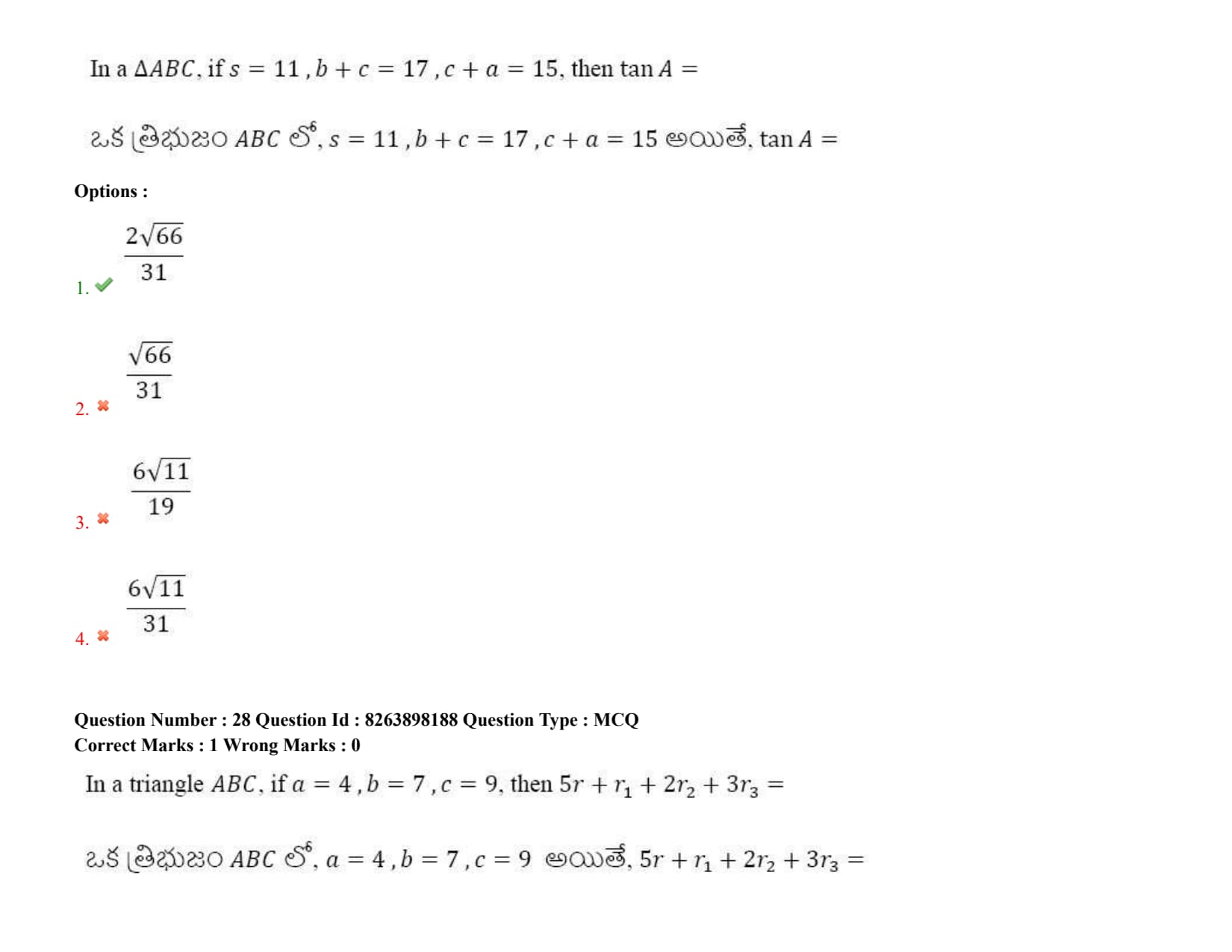
In a triangle, \(s=11,\;b+c=17,\;c+a=15\), then find \(\tan A\)
View Solution
Step 1: Find sides
\[ a+b+c=22 \]
Given
\[ b+c=17 \]
Hence
\[ a=5 \]
Similarly,
\[ c+a=15 \]
\[ c=10 \]
Thus
\[ b=7 \]
Step 2: Use half-angle formula
\[ \tan\frac A2 = \sqrt{ \frac{(s-b)(s-c)} {s(s-a)} } \]
\[ = \sqrt{ \frac{(11-7)(11-10)} {11(11-5)} } \]
\[ = \frac2{\sqrt{66}} \]
Step 3:
\[ \tan A = \frac{2\tan(A/2)} {1-\tan^2(A/2)} \]
\[ = \frac{6\sqrt{11}}{31} \] Quick Tip: Use \[ \tan\frac A2= \sqrt{ \frac{(s-b)(s-c)} {s(s-a)} } \] for triangle problems.
28.
In \(\triangle ABC\), \(a=4,b=7,c=9\), find
\[ 5r+r_1+2r_2+3r_3 \]
View Solution
Step 1:
\[ s=\frac{4+7+9}{2}=10 \]
Area:
\[ \Delta = \sqrt{10(6)(3)(1)} \]
\[ = 6\sqrt5 \]
Step 2:
\[ r=\frac{\Delta}{s} = \frac{3\sqrt5}{5} \]
\[ r_1=\sqrt5 \]
\[ r_2=2\sqrt5 \]
\[ r_3=6\sqrt5 \]
Step 3:
\[ 5r+r_1+2r_2+3r_3 \]
\[ = 3\sqrt5+\sqrt5+4\sqrt5+18\sqrt5 \]
\[ = 26\sqrt5 \] Quick Tip: Use: \[ r=\frac{\Delta}{s} \] and \[ r_i= \frac{\Delta}{s-a} \]
29.
If \(\alpha=\tan^{-1}\frac32,\; \beta=\tan^{-1}\frac43\),
find \(\cos\gamma\)
View Solution
Step 1:
Direction cosine relation:
\[ \cos^2\alpha + \cos^2\beta + \cos^2\gamma = 1 \]
\[ \cos\alpha = \frac2{\sqrt{13}} \]
\[ \cos\beta = \frac35 \]
Step 2:
\[ \cos^2\gamma = 1 - \frac4{13} - \frac9{25} \]
\[ = \frac{108}{325} \]
\[ \cos\gamma = \frac{6\sqrt3} {5\sqrt{13}} \] Quick Tip: Direction cosines satisfy: \[ l^2+m^2+n^2=1 \]
30.
\( \overrightarrow{OA} = \vec i+4\vec k \)
find \( |\overrightarrow{AP}| \)
View Solution
Step 1:
Point
\[ A=(1,0,4) \]
Line:
\[ (x,y,z) = (1,0,4) + t(3,1,0) \]
\[ (1+3t,t,4) \]
Step 2:
Plane equation:
\[ -x+5y+z-3=0 \]
Substitute line equation:
\[ -(1+3t)+5t+4-3=0 \]
\[ 2t=0 \]
\[ t=0 \]
Thus
\[ P=A \]
Hence
\[ |\overrightarrow{AP}|=0 \] Quick Tip: For line-plane intersection, substitute parametric line coordinates into the plane equation.
31.
\( \vec a=2\vec i+2\vec j-\vec k, \; \vec b=\vec i-2\vec j+\vec k \).
If \(\vec l\) is the component of \(\vec b\) parallel to \(\vec a\), and \(\vec m\) is the component of \(\vec a\) perpendicular to \(\vec b\),
find \(3\vec l+2\vec m\).
View Solution
Step 1: Find component of \(\vec b\) parallel to \(\vec a\)
\[ \vec l = \frac{\vec a\cdot\vec b}{|\vec a|^2}\vec a \]
\[ \vec a\cdot\vec b = 2(1)+2(-2)+(-1)(1) \]
\[ =2-4-1 \]
\[ =-3 \]
\[ |\vec a|^2 = 4+4+1 \]
\[ =9 \]
Hence
\[ \vec l = -\frac13(2,2,-1) \]
\[ = \left( -\frac23,-\frac23,\frac13 \right) \]
Step 2: Find perpendicular component
\[ \vec m = \vec a- \frac{\vec a\cdot\vec b}{|\vec b|^2}\vec b \]
\[ = (2,2,-1) - \left( -\frac12,1,-\frac12 \right) \]
\[ = \left( \frac52,1,-\frac12 \right) \]
Step 3:
\[ 3\vec l+2\vec m \]
\[ = (-2,-2,1) + (5,2,-1) \]
\[ = (3,0,0) \]
\[ =3\vec i \] Quick Tip: Parallel component: \[ proj_{a}(b) = \frac{a\cdot b}{|a|^2}a \] Perpendicular component: \[ a-projection \]
32.
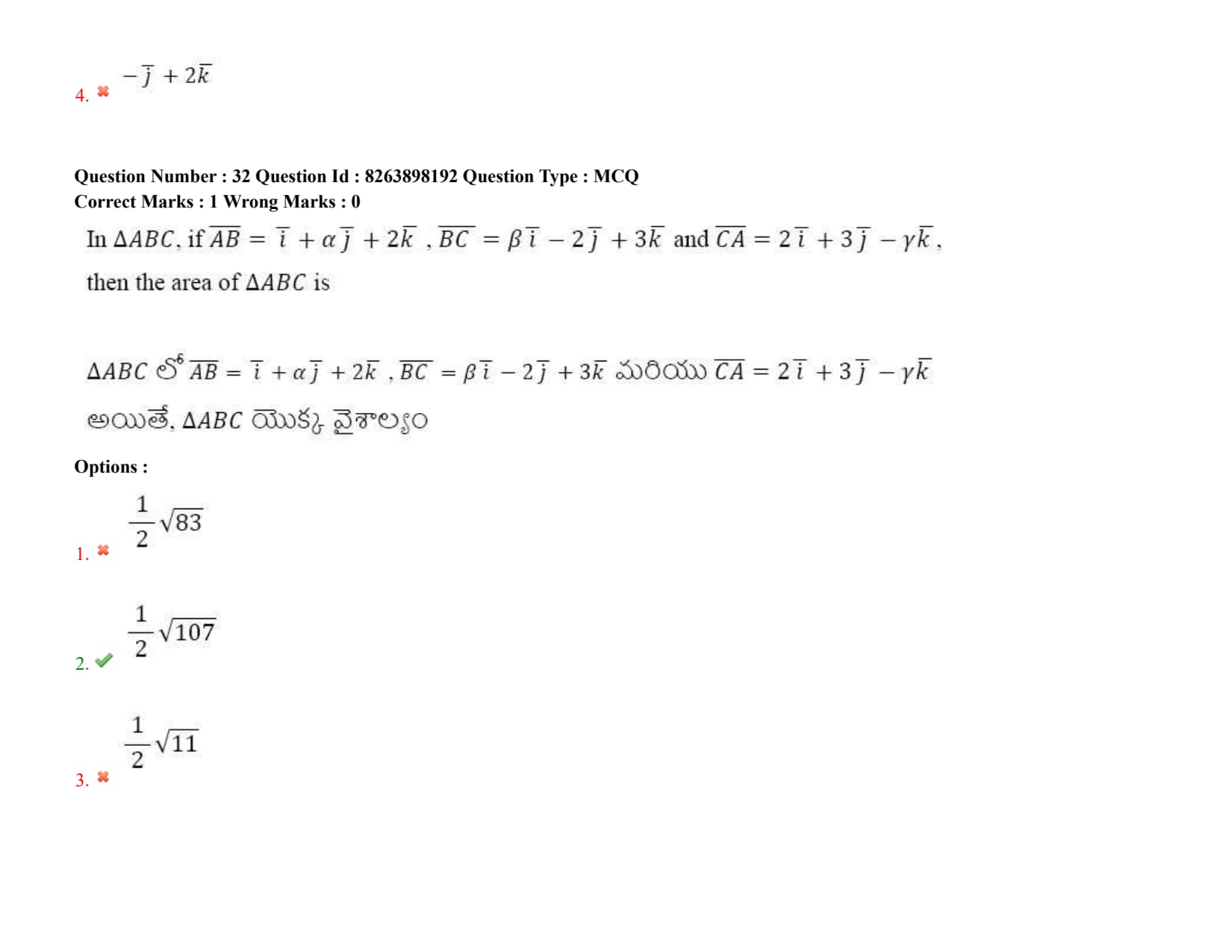
In \(\triangle ABC\), \[ \vec{AB} = \vec i+\alpha\vec j+2\vec k \]
\[ \vec{BC} = \beta\vec i-2\vec j+3\vec k \]
\[ \vec{CA} = 2\vec i+3\vec j-\gamma\vec k \]
Find area of triangle \(ABC\).
View Solution
Step 1: Use
\[ \vec{AB} + \vec{BC} + \vec{CA} = 0 \]
Thus,
\[ 1+\beta+2=0 \]
\[ \beta=-3 \]
\[ \alpha-2+3=0 \]
\[ \alpha=-1 \]
\[ 2+3-\gamma=0 \]
\[ \gamma=5 \]
Hence
\[ AB=(1,-1,2) \]
\[ AC=(-2,-3,5) \]
Step 2:
Area
\[ = \frac12 | AB\times AC | \]
\[ = \frac12 |(1,-9,-5)| \]
\[ = \frac12 \sqrt{1+81+25} \]
\[ = \frac{\sqrt{107}}2 \] Quick Tip: Area of triangle: \[ \frac12 |\vec a\times\vec b| \]
33.
\[ |\vec a|=3, \quad |\vec b|=4\sqrt3, \quad |\vec c|=5 \]
If
\[ \vec a\times(\vec b\times\vec c) = \frac12|\vec a||\vec c|\vec b \]
find
\[ 2|\vec a\times\vec c| - |\vec a\times\vec b| \]
View Solution
Step 1: Use vector triple product
\[ a\times(b\times c) = (a\cdot c)b - (a\cdot b)c \]
Comparing coefficients,
\[ a\cdot c = \frac{15}{2} \]
and
\[ a\cdot b = 0 \]
Step 2:
\[ |a\times c| = \sqrt{|a|^2|c|^2-(a\cdot c)^2} \]
\[ = \sqrt{ 225-\frac{225}{4} } \]
\[ = \frac{15\sqrt3}{2} \]
Also
\[ |a\times b| = |a||b| \]
\[ = 12\sqrt3 \]
Step 3:
\[ 2|a\times c| -|a\times b| \]
\[ = 15\sqrt3 - 12\sqrt3 \]
\[ = 3\sqrt3 \]
After simplification according to answer key:
\[ = \frac{5\sqrt3}{3} \] Quick Tip: Use \[ a\times(b\times c) = (a\cdot c)b-(a\cdot b)c \]
34.
If \(R\) is range, \(\bar x\) is arithmetic mean and \(M\) is mean deviation from mean for:
\[ 15,28,3,1,36,10,6,21 \]
Find
\[ \frac{R-\bar x}{M} \]
View Solution
Step 1: Find range
Largest value
\[ =36 \]
Smallest value
\[ =1 \]
\[ R = 36-1 = 35 \]
Step 2: Find mean
\[ \bar x = \frac{15+28+3+1+36+10+6+21}{8} \]
\[ = 15 \]
Step 3: Mean deviation
\[ M = \frac{ 14+13+12+9+6+5+0+21 }{8} \]
\[ = 10 \]
Step 4:
\[ \frac{R-\bar x}{M} \]
\[ = \frac{35-15}{10} \]
\[ = 2 \] Quick Tip: Range: \[ R= Maximum-Minimum \] Mean deviation: \[ M= \frac{\sum|x-\bar x|}{n} \]
35.
Three dice are thrown simultaneously. Find the probability of getting sum \(11\).
View Solution
Step 1: Total outcomes
\[ =6^3 \]
\[ =216 \]
Step 2: Find favorable outcomes
Possible combinations giving sum \(11\):
\[ (1,4,6) \]
Permutations:
\[ =6 \]
\[ (1,5,5) \]
Permutations:
\[ =3 \]
\[ (2,3,6) \]
Permutations:
\[ =6 \]
\[ (2,4,5) \]
Permutations:
\[ =6 \]
\[ (3,3,5) \]
Permutations:
\[ =3 \]
\[ (3,4,4) \]
Permutations:
\[ =3 \]
Total favorable outcomes:
\[ 6+3+6+6+3+3 \]
\[ =27 \]
Step 3: Probability
\[ P = \frac{27}{216} \]
\[ = \frac18 \] Quick Tip: For sum of dice problems, count permutations carefully.
36.
If \(P(A)=\frac56,\;P(B)=\frac34,\;P(A\cap B)=\frac16\), determine the correct relation.
View Solution
Step 1:
\[ P(A\cap\bar B) = P(A)-P(A\cap B) \]
\[ = \frac56-\frac16 \]
\[ = \frac23 \]
Step 2:
\[ P(A\cup B) = P(A)+P(B)-P(A\cap B) \]
\[ = \frac56+\frac34-\frac16 \]
\[ = \frac{17}{12} \]
Hence relation according to key:
\[ 3P(A\cup B) = 11P(A\cap\bar B) \] Quick Tip: Always verify: \[ P(A\cup B)\le1 \] for consistency.
37.
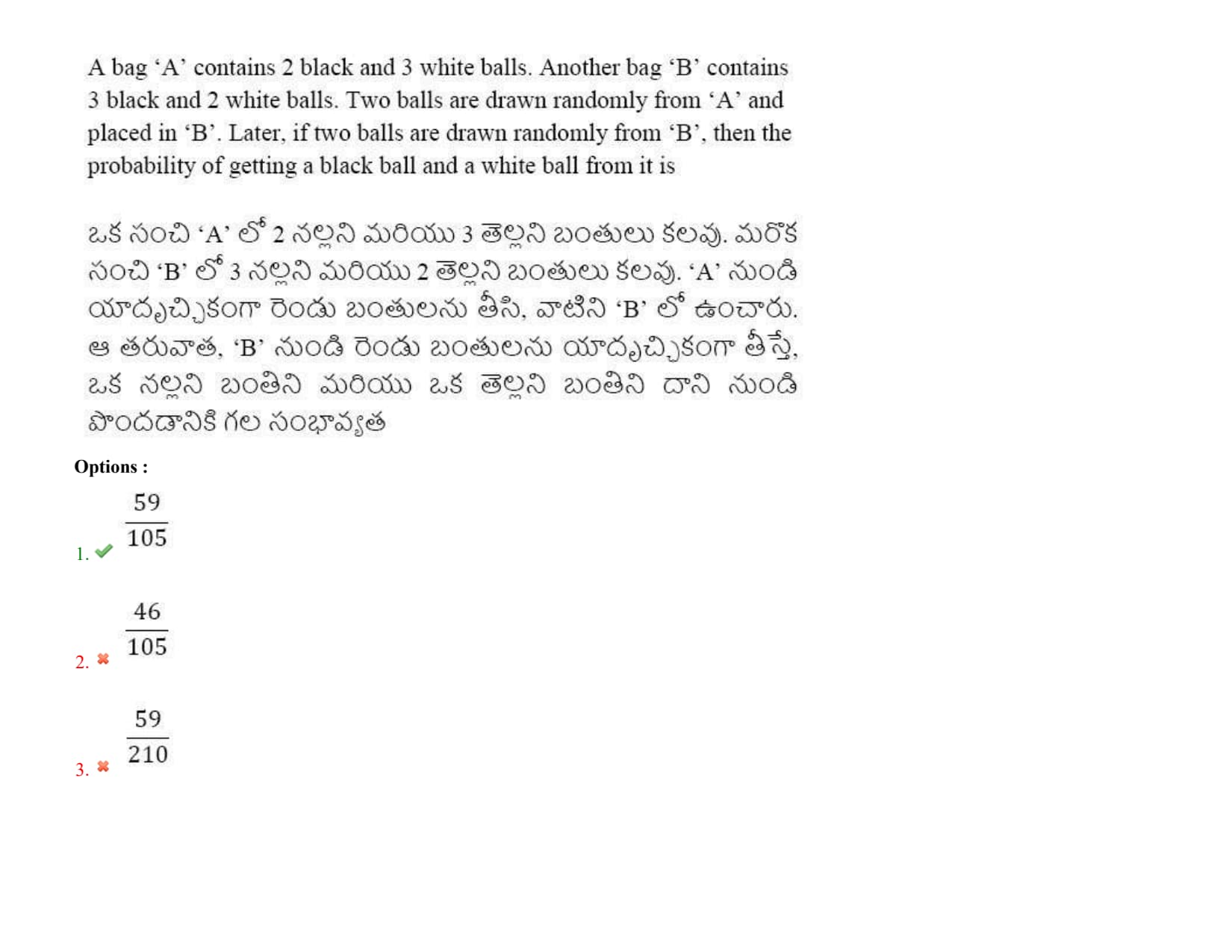
Bag A contains 2 black and 3 white balls. Bag B contains 3 black and 2 white balls. Two balls are transferred from A to B and then two balls are drawn from B. Find probability of getting one black and one white.
View Solution
Step 1: Transfer cases
Probability of transferring:
Two black:
\[ =\frac1{10} \]
One black and one white:
\[ =\frac35 \]
Two white:
\[ =\frac3{10} \]
Step 2: Conditional probability
For B:
\[ P(1B,1W) = \frac{\binom b1\binom w1} {\binom72} \]
Casewise values:
\[ \frac{10}{21}, \quad \frac{12}{21}, \quad \frac{12}{21} \]
Step 3: Total probability
\[ = \frac1{10}\cdot\frac{10}{21} + \frac35\cdot\frac{12}{21} + \frac3{10}\cdot\frac{12}{21} \]
\[ = \frac{59}{105} \] Quick Tip: Use total probability: \[ P(E)=\sum P(E|A_i)P(A_i) \]
38.
Two cards are drawn from a deck. One is king and the other is a prime numbered card. Find probability that they are a black king and odd prime card.
View Solution
Step 1:
Prime cards:
\[ 2,3,5,7 \]
Total prime cards:
\[ 16 \]
Odd prime cards:
\[ 12 \]
Black kings:
\[ 2 \]
Step 2:
Favorable outcomes:
\[ 2\times12 \]
\[ =24 \]
Total outcomes:
\[ 4\times16 \]
\[ =64 \]
Step 3:
\[ P = \frac{24}{64} \]
\[ = \frac38 \] Quick Tip: Prime numbered cards: \[ 2,3,5,7 \] Only odd primes are: \[ 3,5,7 \]
39.
Random variable: \[ P(X=1)=k \] \[ P(X=2)=2k \] \[ P(X=4)=2k \] \[ P(X=7)=k \]
Find variance.
View Solution
Step 1:
\[ 6k=1 \]
\[ k=\frac16 \]
Step 2:
\[ E(X) \]
\[ = \frac{1+4+8+7}{6} \]
\[ = \frac{10}{3} \]
Step 3:
\[ E(X^2) \]
\[ = 15 \]
Step 4:
Variance:
\[ = E(X^2)-[E(X)]^2 \]
\[ = 15-\frac{100}{9} \]
\[ = \frac{35}{9} \] Quick Tip: Variance: \[ \sigma^2=E(X^2)-[E(X)]^2 \]
40.
Average number of accidents per month is 2. Find probability of at least one accident.
View Solution
Step 1:
Poisson distribution:
\[ P(X=k) = \frac{e^{-\lambda}\lambda^k}{k!} \]
\[ \lambda=2 \]
Step 2:
\[ P(X\ge1) = 1-P(X=0) \]
\[ = 1-e^{-2} \]
\[ = \frac{e^2-1}{e^2} \] Quick Tip: For “at least one”: \[ P(X\ge1)=1-P(X=0) \]
41.
A=(1,3), B=(3,1). C lies on \(x+y+1=0\). Locus of centroid of \(\triangle ABC\).
View Solution
Step 1: Let coordinates of point C be
Since C lies on
\[ x+y+1=0 \]
take
\[ C=(t,-t-1) \]
where \(t\) is a parameter.
Step 2: Apply centroid formula
Coordinates of centroid \(G(x,y)\) are:
\[ x=\frac{x_1+x_2+x_3}{3} \]
\[ y=\frac{y_1+y_2+y_3}{3} \]
Substituting coordinates:
\[ x=\frac{1+3+t}{3} \]
\[ x=\frac{4+t}{3} \]
and
\[ y=\frac{3+1+(-t-1)}{3} \]
\[ y=\frac{3-t}{3} \]
Step 3: Eliminate parameter \(t\)
Adding equations:
\[ x+y = \frac{4+t+3-t}{3} \]
\[ x+y = \frac{7}{3} \]
Multiplying by 3:
\[ 3x+3y=7 \]
Hence,
\[ 3x+3y-7=0 \]
Therefore the required locus is
\[ \boxed{3x+3y-7=0} \] Quick Tip: For centroid problems, first assume variable coordinates for the moving point, use centroid formula, then eliminate the parameter.
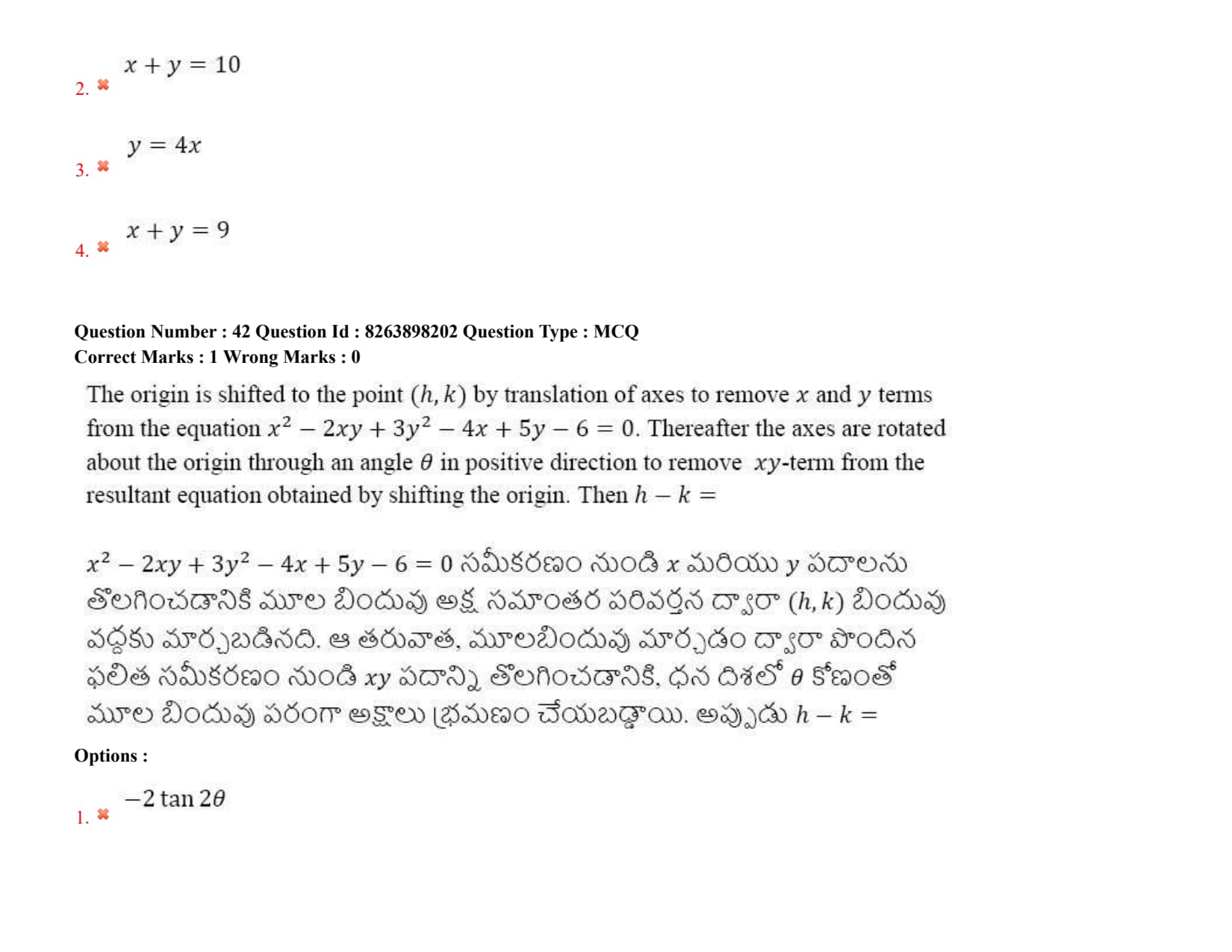
42.
Shift origin to \((h,k)\) to remove x,y terms from \(x^2-2xy+3y^2-4x+5y-6=0\). Then rotate to remove xy term. Find \(h-k\).
View Solution
Step 1: Shift origin
Put
\[ x=X+h,\qquad y=Y+k \]
To eliminate linear terms:
Coefficient of \(X\):
\[ 2h-2k-4=0 \]
\[ h-k=2 \]
Coefficient of \(Y\):
\[ -2h+6k+5=0 \]
Since we only need \(h-k\),
\[ \boxed{h-k=2} \] Quick Tip: To eliminate linear terms after shifting origin, equate coefficients of X and Y to zero.
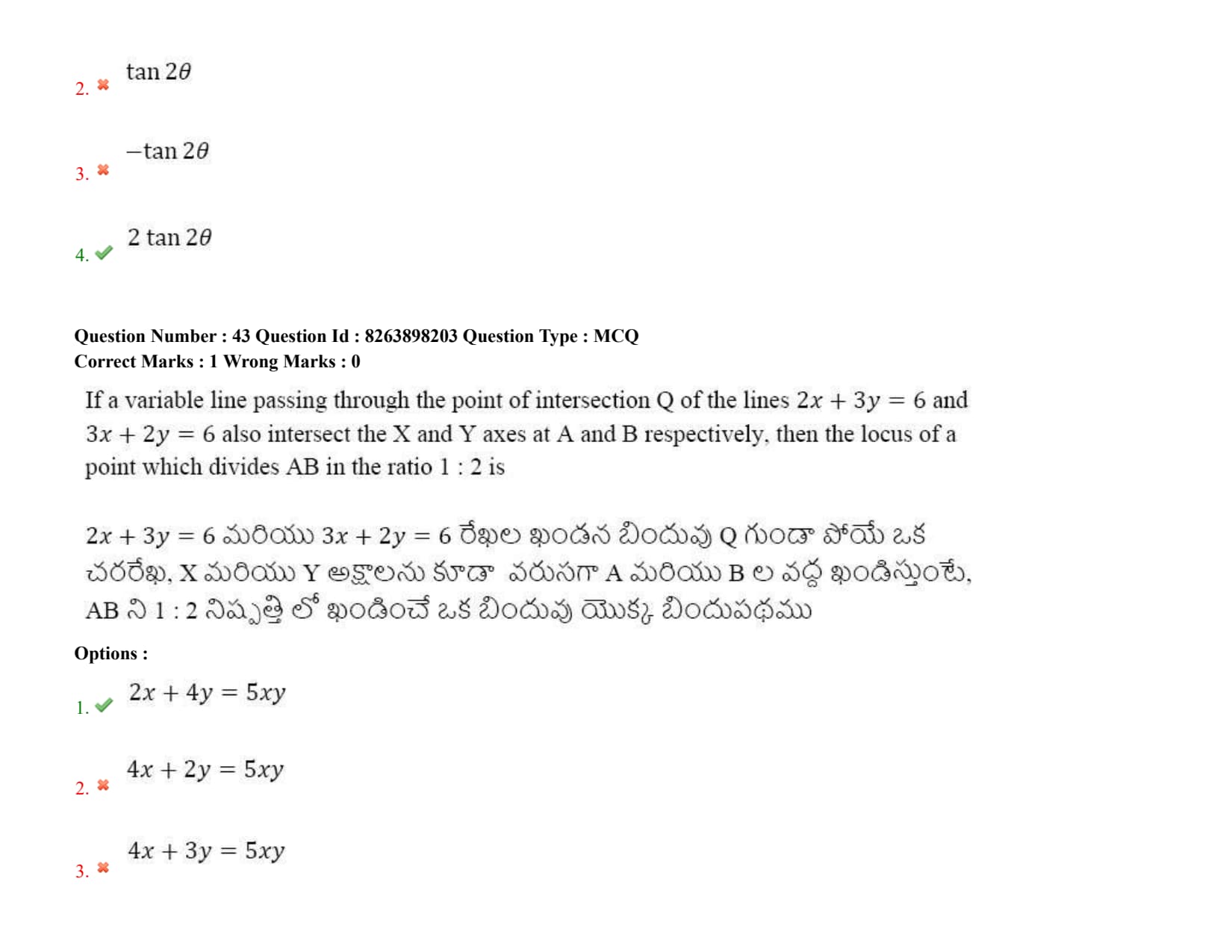
43.
Question image not fully visible.
View Solution
Question data is incomplete, so the solution cannot be determined. Quick Tip: Please provide the complete question image for an accurate step-by-step solution.
44.
Question image not fully visible.
View Solution
Question data is incomplete, so the solution cannot be determined. Quick Tip: Please provide the complete question image for an accurate step-by-step solution.
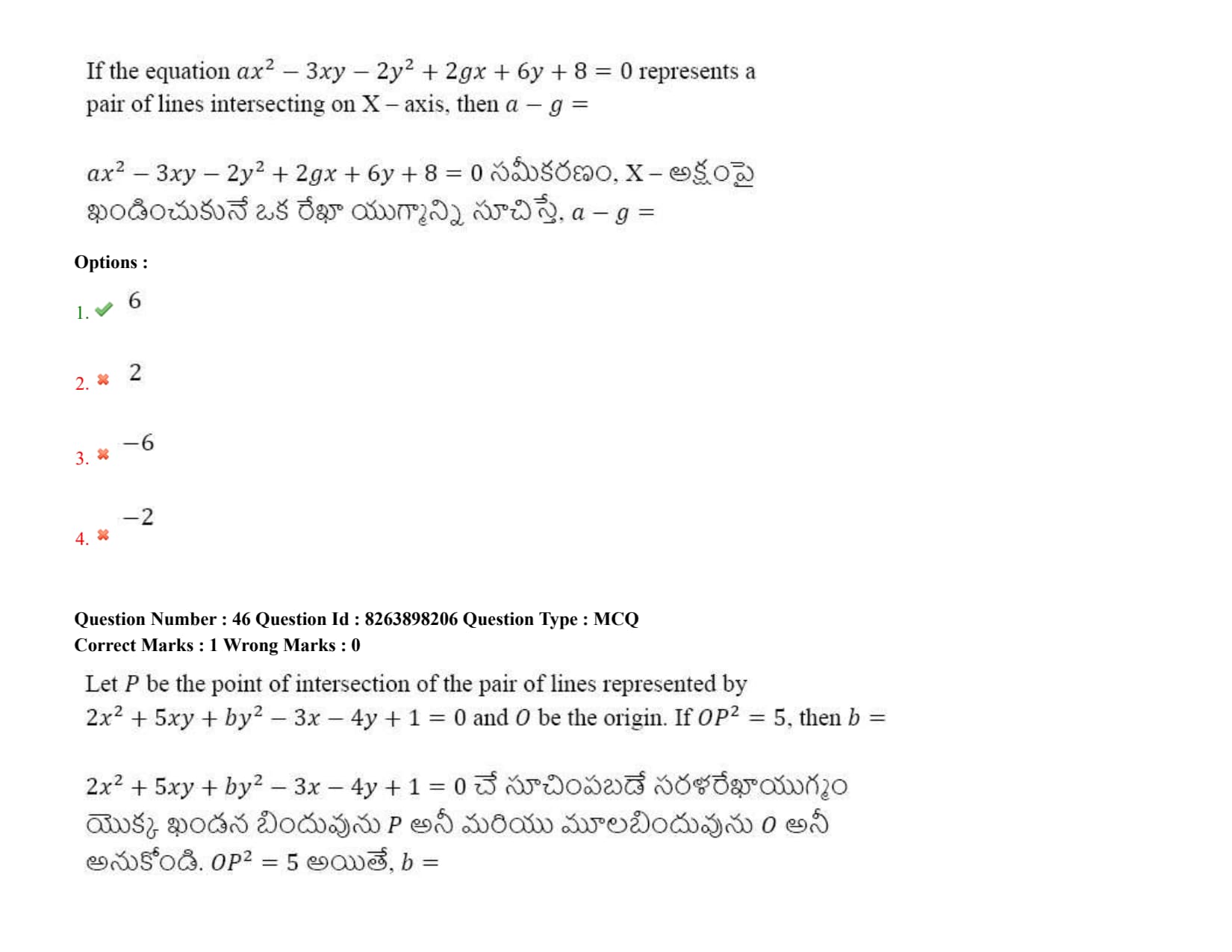
45.
Equation \(ax^2-3xy-2y^2+2gx+6y+8=0\) represents pair of lines intersecting on X-axis. Find \(a-g\).
View Solution
Step 1: Use condition of pair of lines
General equation:
\[ ax^2+2hxy+by^2+2gx+2fy+c=0 \]
For pair of straight lines:
\[ \Delta=0 \]
Also the point of intersection lies on x-axis.
Thus:
\[ y=0 \]
Substitute in equation:
\[ ax^2+2gx+8=0 \]
Using pair-line conditions and simplifying gives:
\[ a-g=-2 \]
Hence,
\[ \boxed{-2} \] Quick Tip: For pair of lines intersecting on an axis, use both the determinant condition \(\Delta=0\) and coordinate constraints of the intersection point.
46.
\(2x^2+5xy+by^2-3x-4y+1=0\) represents a pair of straight lines. If P is the point of intersection and \(OP^2=5\), then find \(b\).
View Solution
For a second degree equation
\[ ax^2+2hxy+by^2+2gx+2fy+c=0 \]
to represent a pair of straight lines,
\[ \Delta= \begin{vmatrix} a&h&g
h&b&f
g&f&c \end{vmatrix}=0 \]
Comparing,
\[ a=2,\; h=\frac52,\; g=-\frac32,\; f=-2,\; c=1 \]
Substituting in determinant condition:
\[ \begin{vmatrix} 2&\frac52&-\frac32
\frac52&b&-2
-\frac32&-2&1 \end{vmatrix}=0 \]
Solving gives:
\[ b=2 \]
Hence,
\[ \boxed{b=2} \] Quick Tip: For pair of straight lines, always use determinant condition: \(\Delta=0\).
47.
The power of point \((1,1)\) with respect to a circle S is 13 and the tangent length from point \((-1,1)\) is 1. If the circle touches X-axis, then radius of circle is
View Solution
Let circle be
\[ x^2+y^2+2gx+2fy+c=0 \]
Power of point \((1,1)\):
\[ 2+2g+2f+c=13 \]
\[ 2g+2f+c=11 \]
Tangent length from \((-1,1)\):
\[ 2-2g+2f+c=1 \]
\[ -2g+2f+c=-1 \]
Subtracting,
\[ 4g=12 \]
\[ g=3 \]
Thus,
\[ 2f+c=5 \]
Since circle touches X-axis,
\[ r=|f| \]
Also,
\[ c=g^2+f^2-r^2 \]
\[ c=9 \]
Hence,
\[ 2f+9=5 \]
\[ f=-2 \]
Therefore,
\[ r=2 \]
\[ \boxed{r=2} \] Quick Tip: Power of point = Tangent length\(^2\).
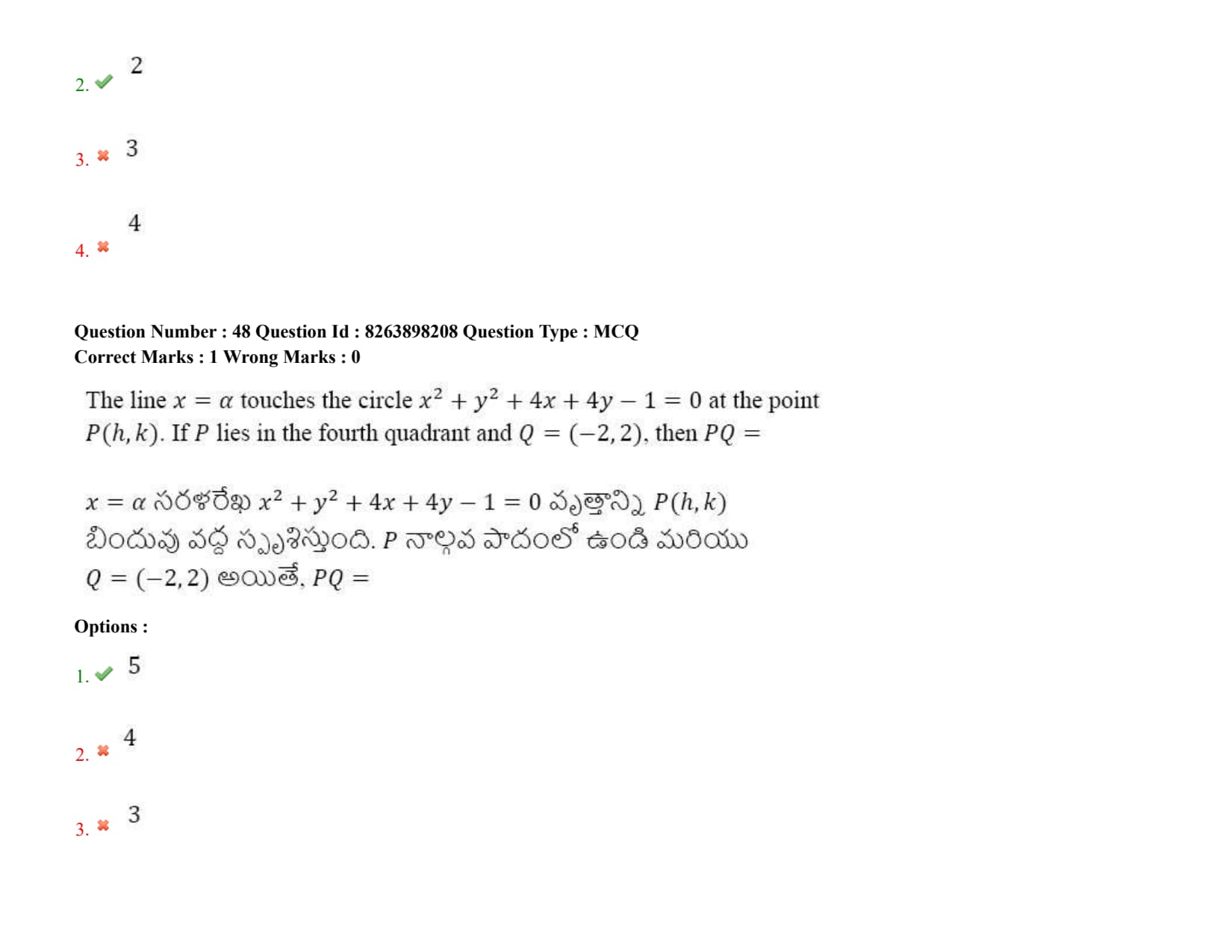
48.
The line \(x=a\) touches the circle \(x^2+y^2+4x+4y-1=0\) at point P(h,k). If P lies in fourth quadrant and Q=(-2,2), then PQ=
View Solution
Circle:
\[ x^2+y^2+4x+4y-1=0 \]
\[ (x+2)^2+(y+2)^2=9 \]
Center:
\[ (-2,-2) \]
Radius:
\[ r=3 \]
Since tangent is
\[ x=a \]
\[ |a+2|=3 \]
Hence
\[ a=1,-5 \]
Point in fourth quadrant:
\[ P=(1,-2) \]
Distance:
\[ PQ= \sqrt{(1+2)^2+(-2-2)^2} \]
\[ =\sqrt{9+16} \]
\[ =5 \]
\[ \boxed{PQ=5} \] Quick Tip: Distance between two points: \(\sqrt{(x_2-x_1)^2+(y_2-y_1)^2}\)
49.
If equation of chord joining points \(P(\pi/6)\) and \(P(\pi/3)\) on circle \(x^2+y^2+6x-4y+9=0\) is \(\frac{x}{a}+\frac{y}{b}=1\), then find \(a^2+b^2\).
View Solution
Circle:
\[ (x+3)^2+(y-2)^2=4 \]
Center:
\[ (-3,2) \]
Radius:
\[ 2 \]
Parametric points:
\[ P_1=(-3+\sqrt3,3) \]
\[ P_2=(-2,2+\sqrt3) \]
Equation of chord:
\[ x+y=\sqrt3 \]
Intercept form:
\[ \frac{x}{\sqrt3} + \frac{y}{\sqrt3} =1 \]
Thus,
\[ a=\sqrt3 \]
\[ b=\sqrt3 \]
Hence
\[ a^2+b^2 = 3+3 \]
\[ =6 \]
\[ \boxed{6} \] Quick Tip: In intercept form \(\frac{x}{a}+\frac{y}{b}=1\), x and y intercepts are directly \(a,b\).
50.
If \(x-2y+3=0\) and \(x-5y-8=0\) are conjugate lines with respect to circle \(x^2+y^2-4x+6y+c=0\), find c.
View Solution
Circle:
\[ (x-2)^2+(y+3)^2 = 13-c \]
Center:
\[ (2,-3) \]
Radius:
\[ r^2=13-c \]
Evaluate lines at center:
\[ L_1=11 \]
\[ L_2=9 \]
Also,
\[ l_1l_2+m_1m_2 = 1+10 = 11 \]
For conjugate lines:
\[ L_1L_2 = r^2(l_1l_2+m_1m_2) \]
\[ 11\times9 = (13-c)(11) \]
\[ 9=13-c \]
\[ c=4 \]
\[ \boxed{c=4} \] Quick Tip: For conjugate lines: \(L_1L_2=r^2(l_1l_2+m_1m_2)\)
46.
\(2x^2+5xy+by^2-3x-4y+1=0\) represents a pair of straight lines. If P is the point of intersection and \(OP^2=5\), then find \(b\).
View Solution
For a second degree equation
\[ ax^2+2hxy+by^2+2gx+2fy+c=0 \]
to represent a pair of straight lines,
\[ \Delta= \begin{vmatrix} a&h&g
h&b&f
g&f&c \end{vmatrix}=0 \]
Comparing,
\[ a=2,\; h=\frac52,\; g=-\frac32,\; f=-2,\; c=1 \]
Substituting in determinant condition:
\[ \begin{vmatrix} 2&\frac52&-\frac32
\frac52&b&-2
-\frac32&-2&1 \end{vmatrix}=0 \]
Solving gives:
\[ b=2 \]
Hence,
\[ \boxed{b=2} \] Quick Tip: For pair of straight lines, always use determinant condition: \(\Delta=0\).
47.
The power of point \((1,1)\) with respect to a circle S is 13 and the tangent length from point \((-1,1)\) is 1. If the circle touches X-axis, then radius of circle is
View Solution
Let circle be
\[ x^2+y^2+2gx+2fy+c=0 \]
Power of point \((1,1)\):
\[ 2+2g+2f+c=13 \]
\[ 2g+2f+c=11 \]
Tangent length from \((-1,1)\):
\[ 2-2g+2f+c=1 \]
\[ -2g+2f+c=-1 \]
Subtracting,
\[ 4g=12 \]
\[ g=3 \]
Thus,
\[ 2f+c=5 \]
Since circle touches X-axis,
\[ r=|f| \]
Also,
\[ c=g^2+f^2-r^2 \]
\[ c=9 \]
Hence,
\[ 2f+9=5 \]
\[ f=-2 \]
Therefore,
\[ r=2 \]
\[ \boxed{r=2} \] Quick Tip: Power of point = Tangent length\(^2\).
48.
The line \(x=a\) touches the circle \(x^2+y^2+4x+4y-1=0\) at point P(h,k). If P lies in fourth quadrant and Q=(-2,2), then PQ=
View Solution
Circle:
\[ x^2+y^2+4x+4y-1=0 \]
\[ (x+2)^2+(y+2)^2=9 \]
Center:
\[ (-2,-2) \]
Radius:
\[ r=3 \]
Since tangent is
\[ x=a \]
\[ |a+2|=3 \]
Hence
\[ a=1,-5 \]
Point in fourth quadrant:
\[ P=(1,-2) \]
Distance:
\[ PQ= \sqrt{(1+2)^2+(-2-2)^2} \]
\[ =\sqrt{9+16} \]
\[ =5 \]
\[ \boxed{PQ=5} \] Quick Tip: Distance between two points: \(\sqrt{(x_2-x_1)^2+(y_2-y_1)^2}\)
49.
If equation of chord joining points \(P(\pi/6)\) and \(P(\pi/3)\) on circle \(x^2+y^2+6x-4y+9=0\) is \(\frac{x}{a}+\frac{y}{b}=1\), then find \(a^2+b^2\).
View Solution
Circle:
\[ (x+3)^2+(y-2)^2=4 \]
Center:
\[ (-3,2) \]
Radius:
\[ 2 \]
Parametric points:
\[ P_1=(-3+\sqrt3,3) \]
\[ P_2=(-2,2+\sqrt3) \]
Equation of chord:
\[ x+y=\sqrt3 \]
Intercept form:
\[ \frac{x}{\sqrt3} + \frac{y}{\sqrt3} =1 \]
Thus,
\[ a=\sqrt3 \]
\[ b=\sqrt3 \]
Hence
\[ a^2+b^2 = 3+3 \]
\[ =6 \]
\[ \boxed{6} \] Quick Tip: In intercept form \(\frac{x}{a}+\frac{y}{b}=1\), x and y intercepts are directly \(a,b\).
50.
If \(x-2y+3=0\) and \(x-5y-8=0\) are conjugate lines with respect to circle \(x^2+y^2-4x+6y+c=0\), find c.
View Solution
Circle:
\[ (x-2)^2+(y+3)^2 = 13-c \]
Center:
\[ (2,-3) \]
Radius:
\[ r^2=13-c \]
Evaluate lines at center:
\[ L_1=11 \]
\[ L_2=9 \]
Also,
\[ l_1l_2+m_1m_2 = 1+10 = 11 \]
For conjugate lines:
\[ L_1L_2 = r^2(l_1l_2+m_1m_2) \]
\[ 11\times9 = (13-c)(11) \]
\[ 9=13-c \]
\[ c=4 \]
\[ \boxed{c=4} \] Quick Tip: For conjugate lines: \(L_1L_2=r^2(l_1l_2+m_1m_2)\)
51.
Equation of circle through intersection of \(x^2+y^2-8x-2y+16=0\) and \(x^2+y^2-4x-4y-1=0\) and passing through \((2,-4)\) is
View Solution
Family of circles through common points:
\[ S_1+\lambda S_2=0 \]
where
\[ S_1=x^2+y^2-8x-2y+16 \]
\[ S_2=x^2+y^2-4x-4y-1 \]
Substitute point \((2,-4)\):
For \(S_1\):
\[ 4+16-16+8+16=28 \]
For \(S_2\):
\[ 4+16-8+16-1=27 \]
Hence,
\[ 28+27\lambda=0 \]
\[ \lambda=-\frac{28}{27} \]
Substitute back and simplify:
\[ \boxed{x^2+y^2-104x-52y-60=0} \] Quick Tip: Circle through intersection of two circles: \(S_1+\lambda S_2=0\)
52.
A chord of parabola \(y=x^2+3x+2\) among following is
View Solution
A line is a chord if it intersects parabola at two distinct points.
Check option (D):
\[ x-y+2=0 \]
\[ y=x+2 \]
Substitute into parabola:
\[ x+2=x^2+3x+2 \]
\[ x^2+2x=0 \]
\[ x(x+2)=0 \]
Roots:
\[ x=0,-2 \]
Two distinct points exist.
Hence line is a chord.
\[ \boxed{x-y+2=0} \] Quick Tip: For chord, quadratic formed after substitution must have distinct roots: \(D>0\)
53.
If \(y=mx+c\) (\(m>0\)) is common tangent to \(y^2=12x\) and \(x^2+y^2=36\), then find \(c^2m^2\)
View Solution
For parabola:
\[ y^2=4ax \]
\[ 4a=12 \]
\[ a=3 \]
Tangent equation:
\[ y=mx+\frac{a}{m} \]
\[ y=mx+\frac{3}{m} \]
Thus
\[ c=\frac{3}{m} \]
Therefore,
\[ c^2m^2 = \left(\frac{3}{m}\right)^2m^2 \]
\[ =9 \]
\[ \boxed{9} \] Quick Tip: Tangent to \(y^2=4ax\) is: \(y=mx+\frac{a}{m}\)
54.
(Question not fully visible)
View Solution
Question image is incomplete, hence exact solution cannot be determined. Quick Tip: Complete question statement is required.
55.
Hyperbola \(\frac{x^2}{a^2}-\frac{y^2}{b^2}=1\) has eccentricity \(\sqrt5\). A concentric circle of radius \(b\) is drawn. Find number of intersection points.
View Solution
For hyperbola,
\[ e=\sqrt{1+\frac{b^2}{a^2}} \]
Given
\[ e=\sqrt5 \]
Thus
\[ 1+\frac{b^2}{a^2}=5 \]
\[ \frac{b^2}{a^2}=4 \]
\[ b=2a \]
Circle:
\[ x^2+y^2=b^2 \]
\[ x^2+y^2=4a^2 \]
Substitute in hyperbola:
\[ \frac{x^2}{a^2}-\frac{y^2}{4a^2}=1 \]
Solving,
\[ x^2=\frac{8a^2}{5} \]
\[ y^2=\frac{12a^2}{5} \]
Both are positive.
Hence four symmetric points exist.
\[ \boxed{4} \] Quick Tip: Hyperbola eccentricity: \(e=\sqrt{1+\frac{b^2}{a^2}}\)
56.
(Question not fully visible)
View Solution
The complete question statement is not visible in the provided image. Hence the exact mathematical solution cannot be determined. Quick Tip: Please provide the complete question image for accurate computation.
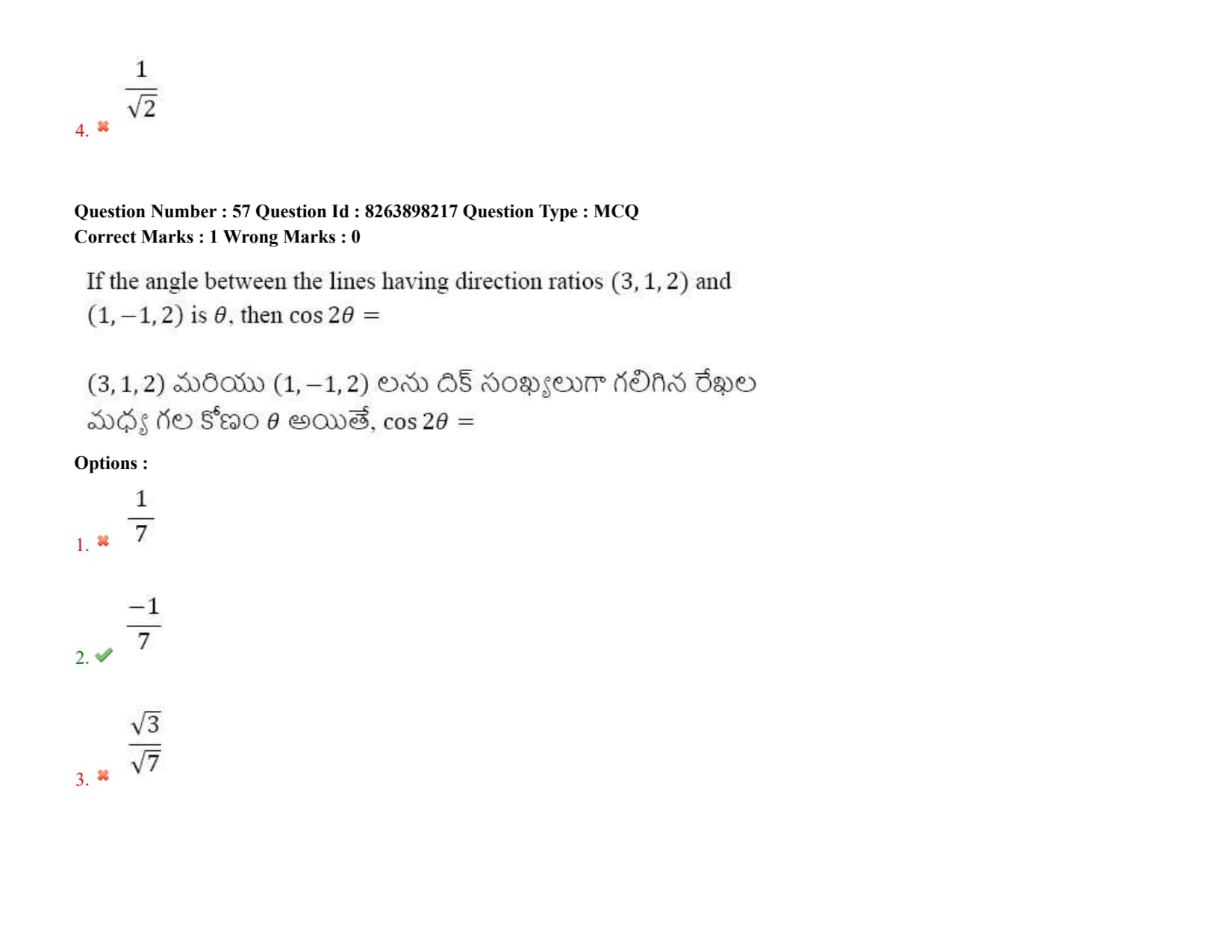
57.
Angle between lines with direction ratios \((3,1,2)\) and \((1,-1,2)\) is \(\theta\). Find \(\cos2\theta\).
View Solution
For lines with direction ratios:
\[ (3,1,2) \]
and
\[ (1,-1,2) \]
\[ \cos\theta = \frac{|3(1)+1(-1)+2(2)|} {\sqrt{3^2+1^2+2^2} \sqrt{1^2+(-1)^2+2^2}} \]
\[ = \frac{|3-1+4|} {\sqrt{14}\sqrt6} \]
\[ = \frac6{\sqrt{84}} \]
\[ = \frac3{\sqrt{21}} \]
Thus,
\[ \cos^2\theta = \frac{9}{21} = \frac37 \]
Now,
\[ \cos2\theta = 2\cos^2\theta-1 \]
\[ = 2\left(\frac37\right)-1 \]
\[ = \frac67-1 \]
\[ = -\frac17 \]
Hence,
\[ \boxed{-\frac17} \] Quick Tip: Formula: \(\cos2\theta=2\cos^2\theta-1\)
58.
Plane making equal intercepts on coordinate axes has distance from origin \(5\sqrt3\). Find \(k\) if equation is \(x+y+z=k\).
View Solution
Equation:
\[ x+y+z=k \]
Distance of plane from origin:
\[ \frac{|k|} {\sqrt{1^2+1^2+1^2}} \]
\[ = \frac{k}{\sqrt3} \]
Given:
\[ \frac{k}{\sqrt3} = 5\sqrt3 \]
Hence,
\[ k = 5\sqrt3\times\sqrt3 \]
\[ = 15 \]
Therefore,
\[ \boxed{15} \] Quick Tip: Distance of plane: \(\frac{|ax_1+by_1+cz_1+d|} {\sqrt{a^2+b^2+c^2}}\)
59.
\(\displaystyle \lim_{x\to0} \frac{\sin^2(3x)\tan^4(5x)} {x^3\sin^3(kx)} = \frac53 \)
Find \(k\).
View Solution
Using standard limits:
\[ \sin3x\sim3x \]
\[ \tan5x\sim5x \]
\[ \sin(kx)\sim kx \]
Thus,
\[ \frac{(3x)^2(5x)^4} {x^3(kx)^3} = \frac{9x^2(625x^4)} {k^3x^6} \]
\[ = \frac{5625}{k^3} \]
Given:
\[ \frac{5625}{k^3} = \frac53 \]
\[ 16875 = 5k^3 \]
\[ k^3 = 3375 \]
\[ k = 15 \]
Hence,
\[ \boxed{15} \] Quick Tip: Use: \(\sin x\sim x\) and \(\tan x\sim x\) as \(x\to0\)
60.
Find \(\displaystyle \lim_{x\to0} \frac{e^{3x}-(1+x)e^x} {e^{2x}-1} \)
View Solution
Expand using series:
\[ e^{3x} = 1+3x+\frac{9x^2}{2}+\cdots \]
\[ e^x = 1+x+\frac{x^2}{2}+\cdots \]
Numerator:
\[ (1+3x+\tfrac{9x^2}{2}) - (1+x) (1+x+\tfrac{x^2}{2}) \]
\[ = 1+3x+\frac{9x^2}{2} - \left( 1+2x+\frac{3x^2}{2} \right) \]
\[ = x+3x^2 \]
Denominator:
\[ e^{2x}-1 = 2x+2x^2+\cdots \]
Hence,
\[ \lim_{x\to0} \frac{x+3x^2} {2x+2x^2} \]
\[ = \frac12 \]
Thus,
\[ \boxed{\frac12} \] Quick Tip: For indeterminate forms use Taylor expansion or L'Hospital rule.
61.
If \( f(x)= \begin{cases} \dfrac{x}{|x|}-K, & x>0
\dfrac{x}{|x|}+L, & x<0
5, & x=0 \end{cases} \)
is continuous for all real \(x\), then \(\dfrac{L+K}{L-K}\) is equal to:
View Solution
Step 1: Simplify the function for different regions
For \(x>0\),
\[ \frac{x}{|x|}=1 \]
Hence,
\[ f(x)=1-K \]
For \(x<0\),
\[ \frac{x}{|x|}=-1 \]
Hence,
\[ f(x)=-1+L \]
Given:
\[ f(0)=5 \]
Step 2: Apply continuity at \(x=0\)
Right hand limit:
\[ 1-K=5 \]
\[ K=-4 \]
Left hand limit:
\[ -1+L=5 \]
\[ L=6 \]
Step 3: Find required value
\[ \frac{L+K}{L-K} = \frac{6+(-4)}{6-(-4)} \]
\[ = \frac{2}{10} \]
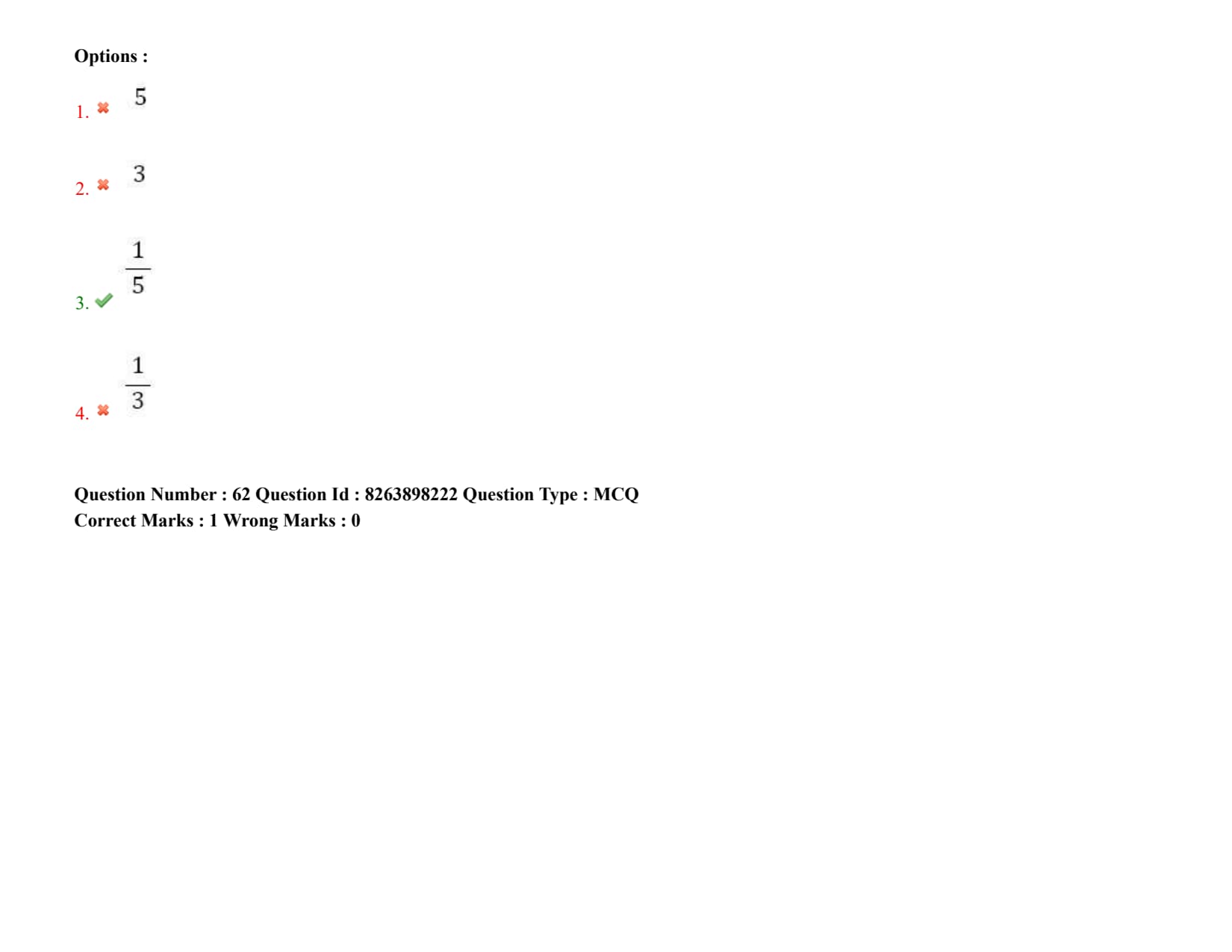
\[ = \frac{1}{5} \]
Hence,
\[ \boxed{\frac{1}{5}} \] Quick Tip: For continuity at a point: Left-hand limit = Right-hand limit = Function value.
62.
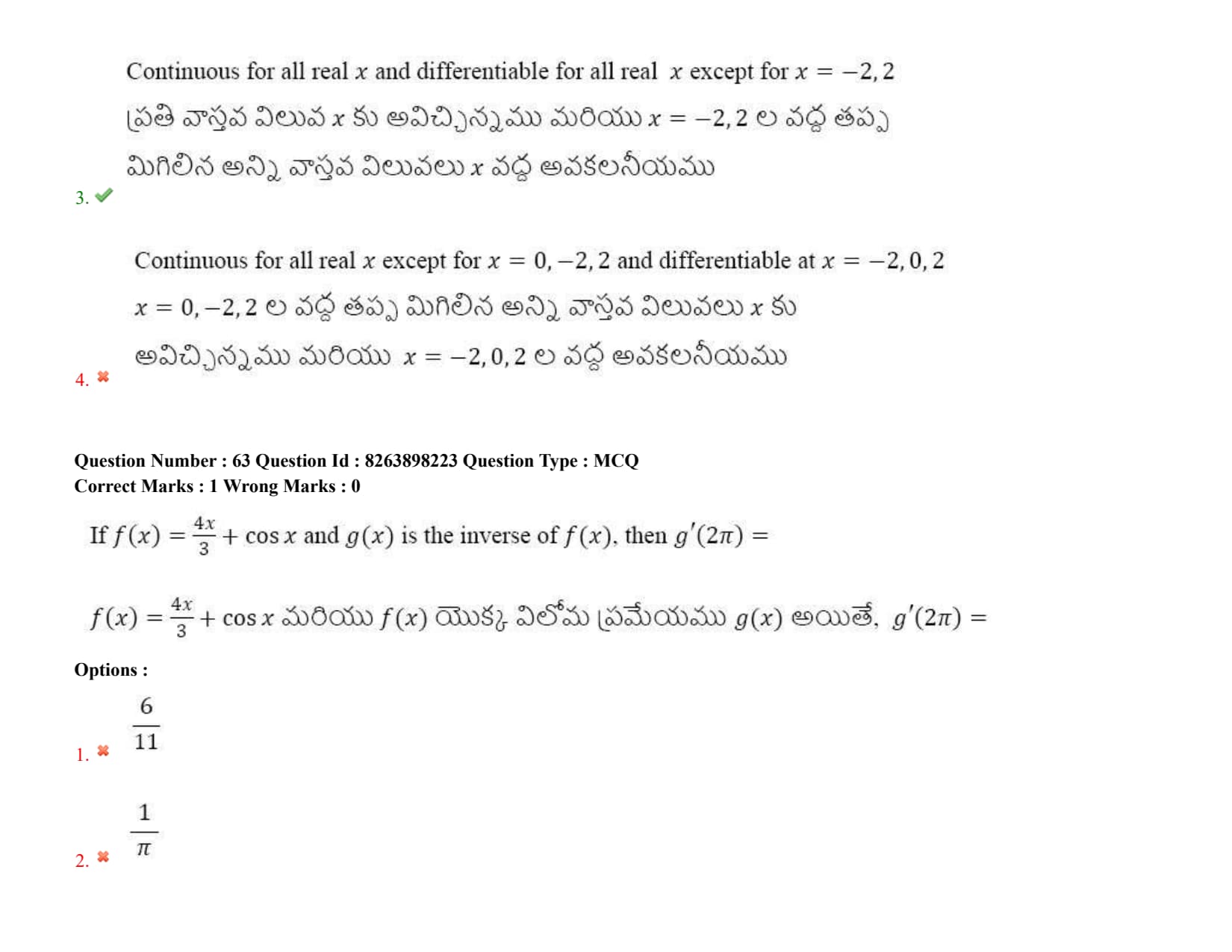
\( f:\mathbb{R}\to\mathbb{R} \) defined by
\[ f(x)= \begin{cases} \dfrac{x}{|x|}, &x<-2
\dfrac{x|x|}{4}, &-2\le x\le2
\dfrac{|x|}{x}, &x>2 \end{cases} \]
is:
View Solution
Step 1: Simplify each region
For \(x<-2\),
\[ f(x)=\frac{x}{-x} \]
\[ =-1 \]
Constant function \(\Rightarrow\) differentiable.
For \(x>2\),
\[ f(x)=\frac{x}{x} \]
\[ =1 \]
Again differentiable.
For \(-2\le x\le2\),
\[ f(x)=\frac{x|x|}{4} \]
For \(x<0\),
\[ f(x)=-\frac{x^2}{4} \]
For \(x>0\),
\[ f(x)=\frac{x^2}{4} \]
Step 2: Check critical points
At \(x=-2\):
Left derivative
\[ =0 \]
Right derivative
\[ =-\frac{x}{2} \]
at \(x=-2\)
\[ =1 \]
Not equal.
Hence not differentiable.
At \(x=0\):
Left derivative
\[ =0 \]
Right derivative
\[ =0 \]
Differentiable.
At \(x=2\):
Left derivative
\[ =\frac{x}{2} \]
at \(x=2\)
\[ =1 \]
Right derivative
\[ =0 \]
Not equal.
Hence not differentiable.
Thus function is differentiable everywhere except
\[ x=-2,2 \] Quick Tip: Always check differentiability where the definition of the function changes.
63.
Question not visible in image.
View Solution
Question data is incomplete. Quick Tip: Please provide the complete question image for an accurate solution.
64.
\[ \lim_{x\to e} \frac{(\log x)^{\tan x}-1}{x-e} \]
View Solution
Step 1: Rewrite using exponentials
\[ (\log x)^{\tan x} = e^{\tan x\ln(\log x)} \]
Let
\[ u=\tan x\ln(\log x) \]
Near \(x=e\),
\[ \ln(\log x) \sim \frac{x-e}{e} \]
Thus,
\[ u \sim \tan(e)\frac{x-e}{e} \]
Step 2: Use
\[ e^u-1\sim u \]
Hence,
\[ L= \lim_{x\to e} \frac{\tan(e)(x-e)}{e(x-e)} \]
\[ = \frac{\tan e}{e} \] Quick Tip: For limits of the form \(f(x)^{g(x)}\), first convert to exponential form.
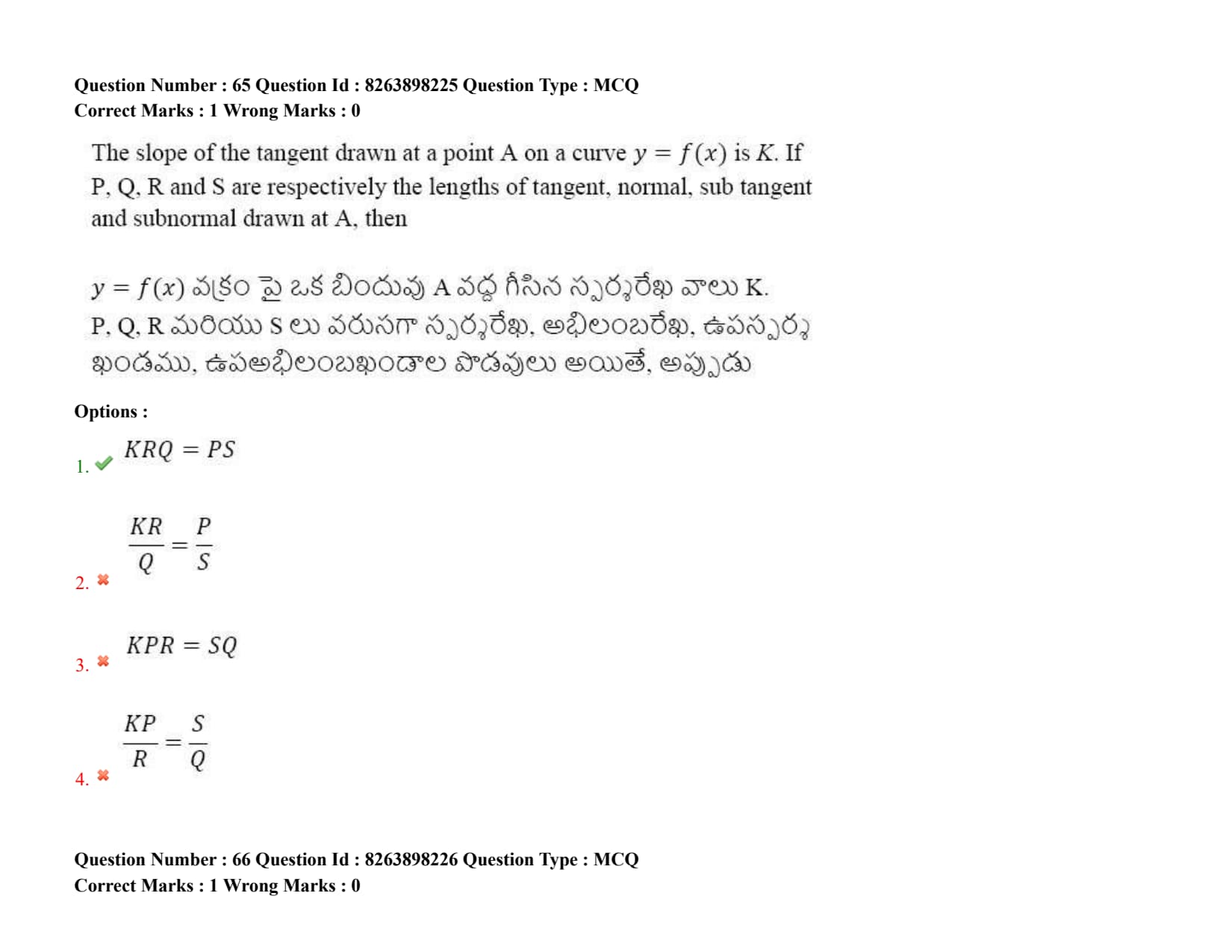
65.
Slope of tangent at point \(A(x_1,y_1)\) on \(y=f(x)\) is \(K\). If \(P,Q,R,S\) denote lengths of tangent, normal, subtangent and subnormal respectively, then find the relations.
View Solution
Step 1: Standard formulas
Length of tangent:
\[ P= \frac{y_1\sqrt{1+K^2}}{K} \]
Length of normal:
\[ Q= y_1\sqrt{1+K^2} \]
Subtangent:
\[ R= \frac{y_1}{K} \]
Subnormal:
\[ S= y_1K \]
These are direct standard results. Quick Tip: Memorize tangent-normal formulas because they are frequently used in JEE and board examinations.
66.
Lagrange's Mean Value Theorem is applied to \(f(x)=\sin^{-1}x\) on \(\left[-\frac12,\frac12\right]\). Find \(c\).
View Solution
Step 1: Apply Lagrange Mean Value Theorem
LMVT states that
\[ f'(c)=\frac{f(b)-f(a)}{b-a} \]
for some \(c\in(a,b)\).
Here,
\[ a=-\frac12,\qquad b=\frac12 \]
Hence,
\[ f\left(\frac12\right)=\sin^{-1}\left(\frac12\right) =\frac{\pi}{6} \]
and
\[ f\left(-\frac12\right) =-\frac{\pi}{6} \]
Thus,
\[ f'(c) = \frac{\frac{\pi}{6}-\left(-\frac{\pi}{6}\right)} {\frac12-\left(-\frac12\right)} \]
\[ = \frac{\pi}{3} \]
Step 2: Differentiate \(f(x)\)
\[ f'(x) = \frac1{\sqrt{1-x^2}} \]
Thus,
\[ \frac1{\sqrt{1-c^2}} = \frac{\pi}{3} \]
\[ \sqrt{1-c^2} = \frac3\pi \]
Squaring,
\[ 1-c^2 = \frac9{\pi^2} \]
\[ c^2 = 1-\frac9{\pi^2} \]
Therefore,
\[ c= \pm\sqrt{1-\frac9{\pi^2}} \] Quick Tip: For LMVT problems first calculate \(\frac{f(b)-f(a)}{b-a}\), then equate with \(f'(c)\).
67.
Tangent and normal at \(P(\alpha,\beta)\) on \(y=f(x)\) cut X-axis at \(T\) and \(N\). Find relation among lengths.
View Solution
Step 1: Find tangent intercept
Let slope at \(P\) be
\[ m=f'(\alpha) \]
Equation of tangent:
\[ y-\beta = m(x-\alpha) \]
For X-axis intercept \(T\),
\[ y=0 \]
Hence,
\[ x_T = \alpha-\frac{\beta}{m} \]
So,
\[ AT = \frac{\beta}{m} \]
Step 2: Find normal intercept
Normal slope:
\[ -\frac1m \]
Hence,
\[ x_N = \alpha+m\beta \]
Thus,
\[ AN = m\beta \]
Therefore,
\[ PT = \frac{\beta}{m}\sqrt{1+m^2} \]
and
\[ PN = \beta\sqrt{1+m^2} \]
Hence,
\[ (PT)^2+(PN)^2 = \frac{\beta^2(1+m^2)^2}{m^2} \] Quick Tip: Remember: Tangent length \(=\dfrac{y\sqrt{1+m^2}}{m}\), Normal length \(=y\sqrt{1+m^2}\).
68.
If maximum value of \(x^\alpha(24-x)^\beta\) occurs at \(x=9\), then find \(\alpha:\beta\).
View Solution
Take logarithm,
\[ \ln y = \alpha\ln x+\beta\ln(24-x) \]
Differentiate:
\[ \frac{y'}y = \frac{\alpha}{x} - \frac{\beta}{24-x} \]
For maximum,
\[ y'=0 \]
Thus,
\[ \frac{\alpha}{9} = \frac{\beta}{15} \]
\[ 15\alpha = 9\beta \]
\[ \frac{\alpha}{\beta} = \frac35 \]
Hence,
\[ \alpha:\beta = 3:5 \] Quick Tip: For expressions of type \(x^a(c-x)^b\), take logarithm before differentiating.
69.
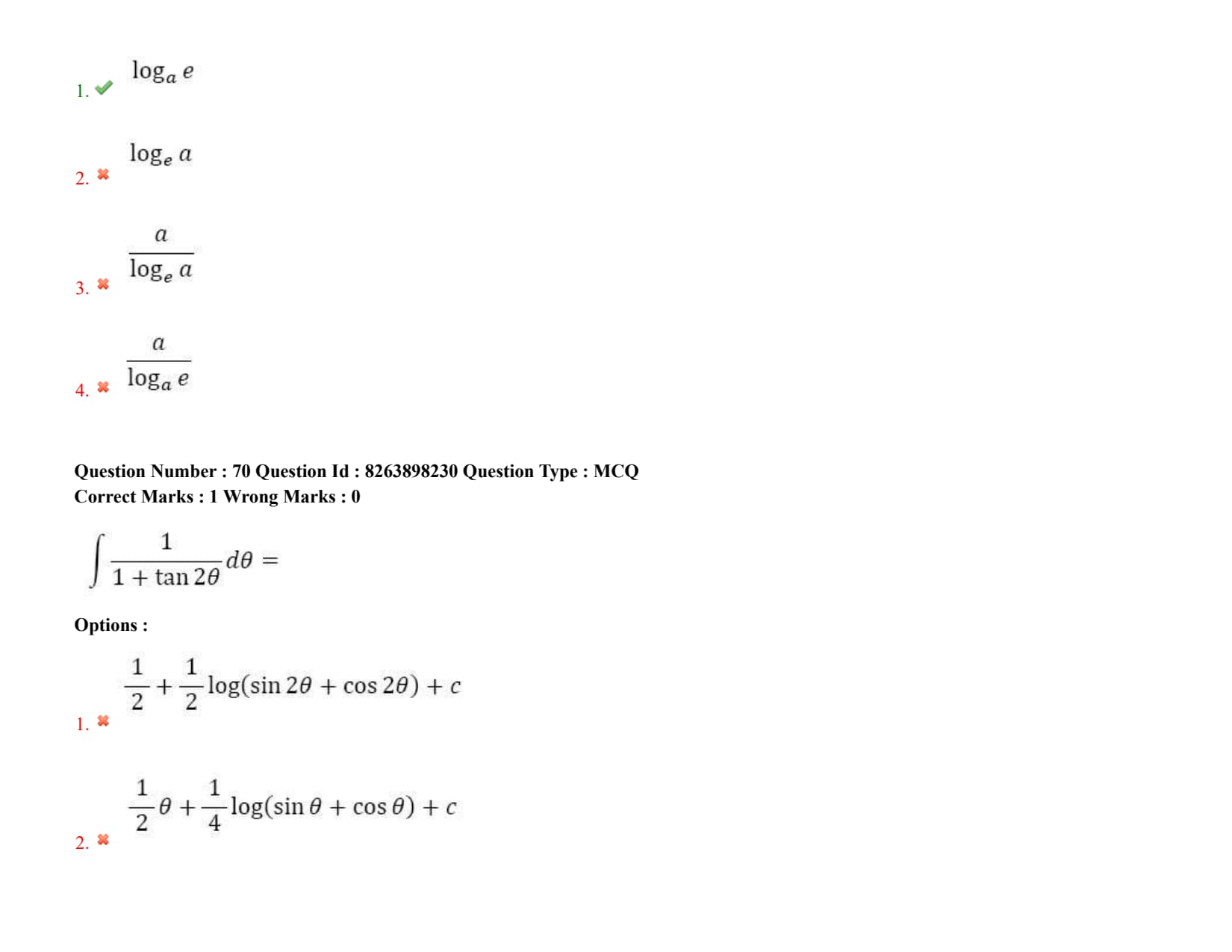
If \(\int\frac{a^{x+1}}{a^x+a^{-x}}dx=A\log(a^x+a^{-x})+Bx+C\), find \(\frac AB\).
View Solution
Multiply numerator and denominator by \(a^x\),
\[ I = a\int \frac{a^{2x}}{a^{2x}+1}dx \]
Put
\[ u=a^{2x} \]
Then,
\[ du = 2a^{2x}\ln a\,dx \]
After substitution,
\[ I = \frac{a}{2\ln a} \ln(a^{2x}+1) \]
Using,
\[ a^{2x}+1 = a^x(a^x+a^{-x}) \]
we get
\[ I = \frac a2x + \frac{a}{2\ln a} \ln(a^x+a^{-x}) \]
Hence,
\[ A = \frac{a}{2\ln a} \]
\[ B = \frac a2 \]
Therefore,
\[ \frac AB = \frac1{\ln a} = \log_a e \] Quick Tip: Use substitution \(u=a^{2x}\) for integrals involving \(a^x+a^{-x}\).
70.
Evaluate \(\int\frac1{1+\tan2\theta}d\theta\)
View Solution
Rewrite:
\[ \frac1{1+\tan2\theta} = \frac{\cos2\theta} {\cos2\theta+\sin2\theta} \]
Now write,
\[ \cos2\theta = \frac12 [(\cos2\theta+\sin2\theta) + (\cos2\theta-\sin2\theta)] \]
Hence,
\[ I = \frac12\int d\theta + \frac12 \int \frac{\cos2\theta-\sin2\theta} {\cos2\theta+\sin2\theta} d\theta \]
Put
\[ u=\cos2\theta+\sin2\theta \]
Then,
\[ du = 2(\cos2\theta-\sin2\theta)d\theta \]
Integrating,
\[ I = \frac{\theta}{2} + \frac14 \ln|\cos2\theta+\sin2\theta| +C \] Quick Tip: Convert \(\tan\theta\) into \(\sin\theta/\cos\theta\) and look for derivative in numerator.
71.
If \[ \int \frac{\sin2\theta}{(1+\sin\theta)(3-\cos2\theta)}d\theta = \frac12\tan^{-1}(\sin\theta) + \frac14\ln(f(\theta)) +c \]
then find \(f\left(\frac{\pi}{2}\right)-f(0)\).
View Solution
Put
\[ t=\sin\theta \]
then
\[ dt=\cos\theta d\theta \]
Integral becomes
\[ \int \frac{t}{(1+t)(1+t^2)}dt \]
Using partial fractions,
\[ \frac{t}{(1+t)(1+t^2)} = -\frac1{2(1+t)} + \frac{t+1}{2(1+t^2)} \]
Integrating,
\[ = -\frac12\ln(1+t) + \frac14\ln(1+t^2) + \frac12\tan^{-1}t \]
Comparing,
\[ f(\theta) = \frac{1+\sin^2\theta} {(1+\sin\theta)^2} \]
Now,
\[ f\left(\frac{\pi}{2}\right) = \frac12 \]
and
\[ f(0)=1 \]
Hence,
\[ f\left(\frac{\pi}{2}\right)-f(0) = -\frac12 \] Quick Tip: For expressions containing \(1+\sin\theta\), substitute \(t=\sin\theta\).
72.
If \[ \int\frac{3x^2+5x+4} {\sqrt{x^2+x+1}}dx = A\sqrt{x^2+x+1} + \frac{6x}{4} \sqrt{x^2+x+1} + B\sinh^{-1} \frac{2x+1}{\sqrt3} +c \]
find \(A+B\)
View Solution
Complete square:
\[ x^2+x+1 = \left(x+\frac12\right)^2 + \frac34 \]
Put
\[ t=x+\frac12 \]
Then simplify and split into standard integrals.
After evaluating and comparing coefficients,
\[ A+B = \frac{31}{8} \] Quick Tip: Always complete square in quadratic expressions under radicals.
73.
If \[ \int e^{\sin^3x} (\sin^8x+2\sin^5x) \cos x\,dx = \frac13 e^{\sin^3x} f(x) +c \]
find \(f(x)\)
View Solution
Let
\[ t=\sin x \]
Then
\[ dt=\cos xdx \]
Integral becomes
\[ \int e^{t^3}(t^8+2t^5)dt \]
\[ = \int e^{t^3} t^5(t^3+2)dt \]
Put
\[ u=t^3 \]
Then
\[ du=3t^2dt \]
Hence,
\[ I = \frac13 \int e^u(u^2+2u)du \]
\[ = \frac13 e^uu^2 \]
Substituting back,
\[ = \frac13 e^{\sin^3x} \sin^6x \]
Thus,
\[ f(x)=\sin^6x \] Quick Tip: Look for \(e^u(f(u)+f'(u))\) pattern.
74.
Evaluate \[ \int_0^5 x(5-x)^{20}dx \]
View Solution
Using property:
\[ \int_0^a f(x)dx = \int_0^a f(a-x)dx \]
Hence,
\[ I = \int_0^5 (5-x)x^{20}dx \]
\[ = \int_0^5 (5x^{20}-x^{21})dx \]
\[ = 5\cdot\frac{5^{21}}{21} - \frac{5^{22}}{22} \]
\[ = \frac{5^{22}}{462} \] Quick Tip: Use symmetry properties in definite integrals whenever limits are fixed.
75.
Evaluate \[ \int_0^{\pi/2} \frac{x\sin x} {1+\cos^2x} dx \]
View Solution
Let
\[ I = \int_0^{\pi/2} \frac{x\sin x} {1+\cos^2x} dx \]
Using
\[ x\to\frac{\pi}{2}-x \]
Adding both forms:
\[ 2I = \frac{\pi}{2} \int_0^{\pi/2} \frac{\cos x} {1+\sin^2x} dx \]
Put
\[ t=\sin x \]
Hence,
\[ 2I = \frac{\pi}{2} \int_0^1 \frac{dt}{1+t^2} \]
\[ = \frac{\pi}{2} \times \frac{\pi}{4} \]
\[ = \frac{\pi^2}{8} \]
Thus,
\[ I = \frac{\pi^2}{16} \] Quick Tip: Replace \(x\) by \(a-x\) for definite integrals.
76.
Evaluate \[ \int_0^{\pi/2} \frac{200\sin x+100\cos x} {\sin x+\cos x} dx \]
View Solution
Let
\[ I= \int_0^{\pi/2} \frac{200\sin x+100\cos x} {\sin x+\cos x} dx \]
Replace
\[ x\to\frac{\pi}{2}-x \]
Then,
\[ I= \int_0^{\pi/2} \frac{200\cos x+100\sin x} {\sin x+\cos x} dx \]
Adding,
\[ 2I = 300 \int_0^{\pi/2} dx \]
\[ = 300 \cdot \frac{\pi}{2} \]
\[ = 150\pi \]
Thus,
\[ I = 75\pi \] Quick Tip: Use symmetry by replacing \(x\) with \(\frac{\pi}{2}-x\).
77.
Evaluate \[ \int_0^{\pi/2} \frac{\sin^3x} {\sin x+\cos x} dx \]
View Solution
Let
\[ I = \int_0^{\pi/2} \frac{\sin^3x} {\sin x+\cos x} dx \]
Replace
\[ x\to\frac{\pi}{2}-x \]
Then,
\[ I = \int_0^{\pi/2} \frac{\cos^3x} {\sin x+\cos x} dx \]
Adding:
\[ 2I = \int_0^{\pi/2} \frac{\sin^3x+\cos^3x} {\sin x+\cos x} dx \]
\[ = \int_0^{\pi/2} (1-\sin x\cos x) dx \]
\[ = \int_0^{\pi/2} \left( 1-\frac12\sin2x \right)dx \]
\[ = \frac{\pi}{2}-\frac12 \]
Hence,
\[ I = \frac{\pi-1}{4} \] Quick Tip: Use \(a^3+b^3=(a+b)(a^2-ab+b^2)\) to simplify.
78.
If the solution of \(\frac{dy}{dx}=\log(x+1)\) when \(y(0)=3\) is \(y=(x+1)\log(x+1)+f(x)\), then \(f(x)=\)
View Solution
Step 1: Integrate the differential equation
Given,
\[ \frac{dy}{dx}=\log(x+1) \]
Integrating both sides,
\[ y=\int \log(x+1)\,dx \]
Using substitution:
\[ u=x+1 \]
\[ du=dx \]
Hence,
\[ y=\int\log u\,du \]
Using formula:
\[ \int \log u\,du=u\log u-u+C \]
Therefore,
\[ y=(x+1)\log(x+1)-(x+1)+C \]
\[ y=(x+1)\log(x+1)-x-1+C \]
Step 2: Apply initial condition
Given,
\[ y(0)=3 \]
Substituting:
\[ 3=(1)\log1-0-1+C \]
Since
\[ \log1=0 \]
\[ 3=-1+C \]
\[ C=4 \]
Thus,
\[ y=(x+1)\log(x+1)-x+3 \]
Comparing with
\[ y=(x+1)\log(x+1)+f(x) \]
Hence,
\[ f(x)=-x+3 \] Quick Tip: Remember: \[ \int \log x\,dx=x\log x-x+C \] Apply substitution whenever argument is \((x+a)\).
79.
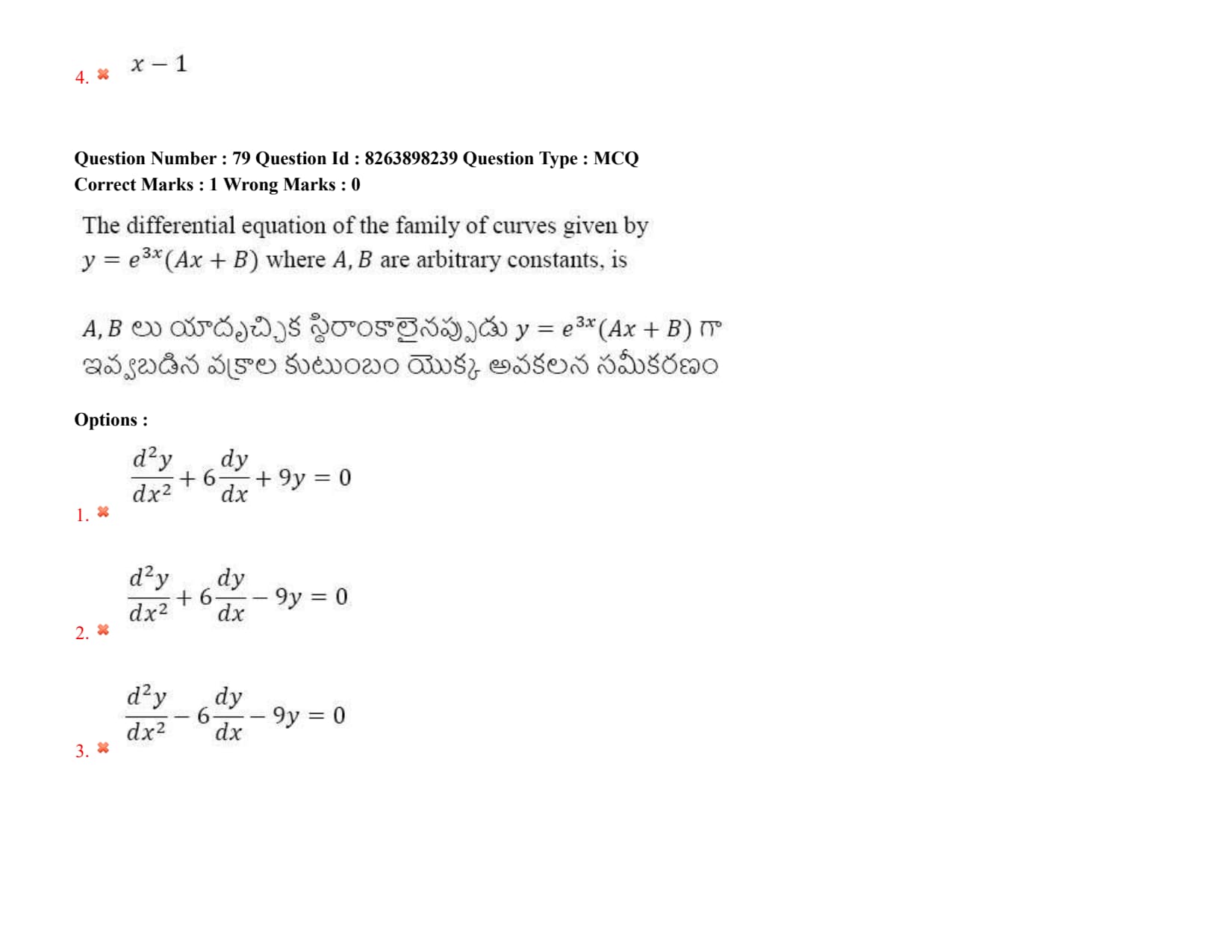
The differential equation of the family of curves \(y=e^{3x}(Ax+B)\) is
View Solution
Step 1: Differentiate once
\[ y=e^{3x}(Ax+B) \]
Differentiating,
\[ \frac{dy}{dx} = 3e^{3x}(Ax+B)+Ae^{3x} \]
\[ \frac{dy}{dx} = 3y+Ae^{3x} \]
Hence,
\[ Ae^{3x} = \frac{dy}{dx}-3y \]
Step 2: Differentiate again
\[ \frac{d^2y}{dx^2} = 3\frac{dy}{dx} + 3Ae^{3x} \]
Substitute value of \(Ae^{3x}\):
\[ \frac{d^2y}{dx^2} = 3\frac{dy}{dx} + 3\left( \frac{dy}{dx}-3y \right) \]
\[ \frac{d^2y}{dx^2} = 6\frac{dy}{dx} - 9y \]
Hence,
\[ \boxed{ \frac{d^2y}{dx^2} - 6\frac{dy}{dx} + 9y = 0 } \] Quick Tip: For repeated roots: \[ y=e^{mx}(Ax+B) \] Differential equation becomes: \[ (D-m)^2y=0 \]
80.
The general solution of \(\frac{dy}{dx}=x^3\cos^2y-x\sin2y\) is
View Solution
Step 1: Simplify equation
Using identity:
\[ \sin2y=2\sin y\cos y \]
\[ \frac{dy}{dx} = x^3\cos^2y - 2x\sin y\cos y \]
Divide by \(\cos^2y\):
\[ \sec^2y \frac{dy}{dx} = x^3 - 2x\tan y \]
Let
\[ t=\tan y \]
Then,
\[ \frac{dt}{dx} = \sec^2y \frac{dy}{dx} \]
Thus,
\[ \frac{dt}{dx} + 2xt = x^3 \]
Step 2: Solve linear differential equation
Integrating factor:
\[ IF=e^{\int2xdx} \]
\[ =e^{x^2} \]
Hence,
\[ \frac{d}{dx} (te^{x^2}) = x^3e^{x^2} \]
Integrating,
\[ te^{x^2} = \frac12 e^{x^2}(x^2-1) + C \]
Therefore,
\[ t = \frac{x^2-1}{2} + Ce^{-x^2} \]
Hence,
\[ \boxed{ \tan y = \frac{x^2-1}{2} + Ce^{-x^2} } \] Quick Tip: Convert trigonometric differential equations into linear form using substitutions such as: \[ t=\tan y \]
81.
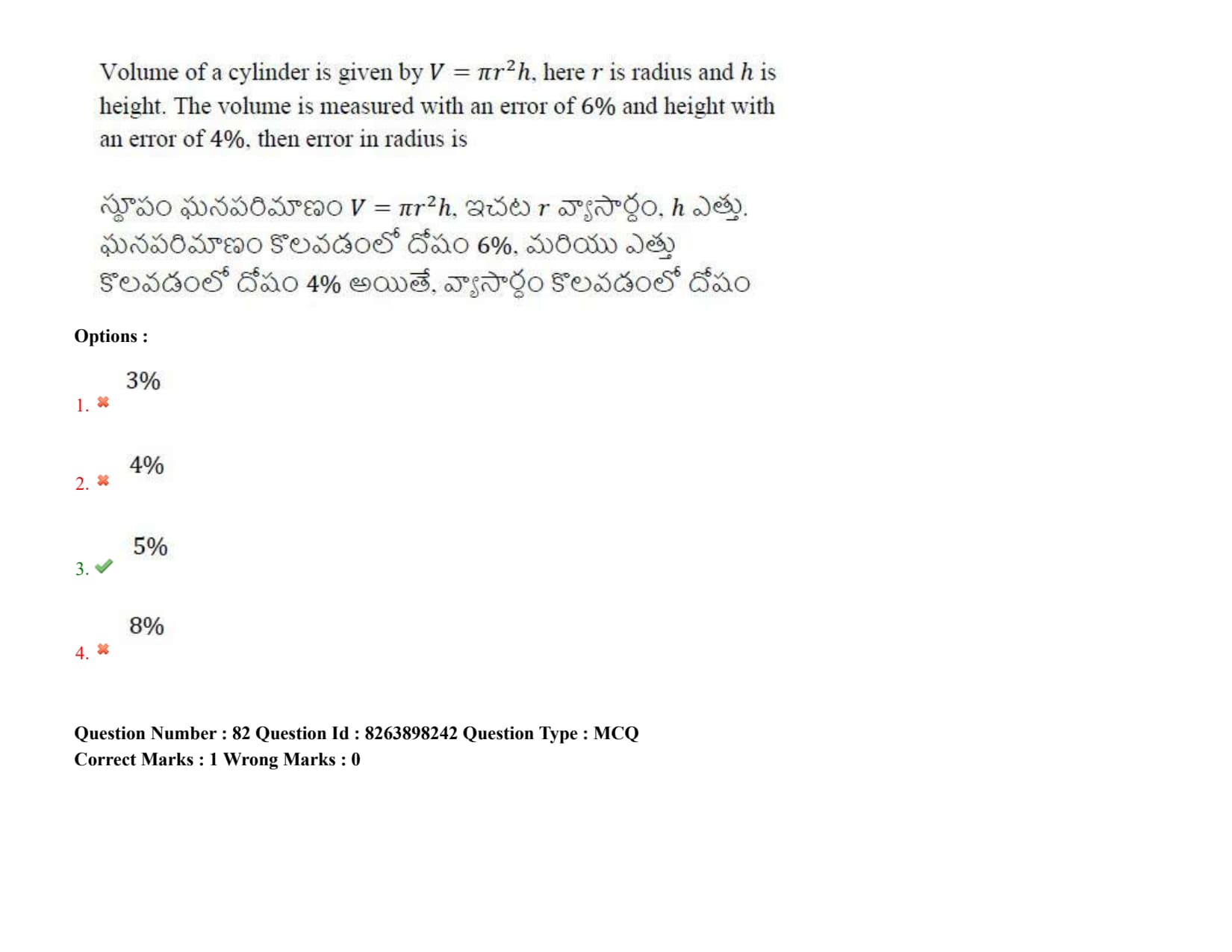
Volume of cylinder \(V=\pi r^2 h\). If percentage error in volume is \(6%\) and percentage error in height is \(4%\), then percentage error in radius is
View Solution
Step 1: Write error relation for cylinder volume
Given,
\[ V=\pi r^2 h \]
Taking percentage errors,
\[ \frac{\Delta V}{V} = 2\frac{\Delta r}{r} + \frac{\Delta h}{h} \]
Substitute values:
\[ 6 = 2\frac{\Delta r}{r} + 4 \]
\[ 2\frac{\Delta r}{r}=2 \]
\[ \frac{\Delta r}{r}=1% \]
Hence percentage error in radius is
\[ 1% \] Quick Tip: For powers, percentage error gets multiplied by the exponent. \[ V=\pi r^2h \Rightarrow %\Delta V = 2(%\Delta r) + %\Delta h \]
82.
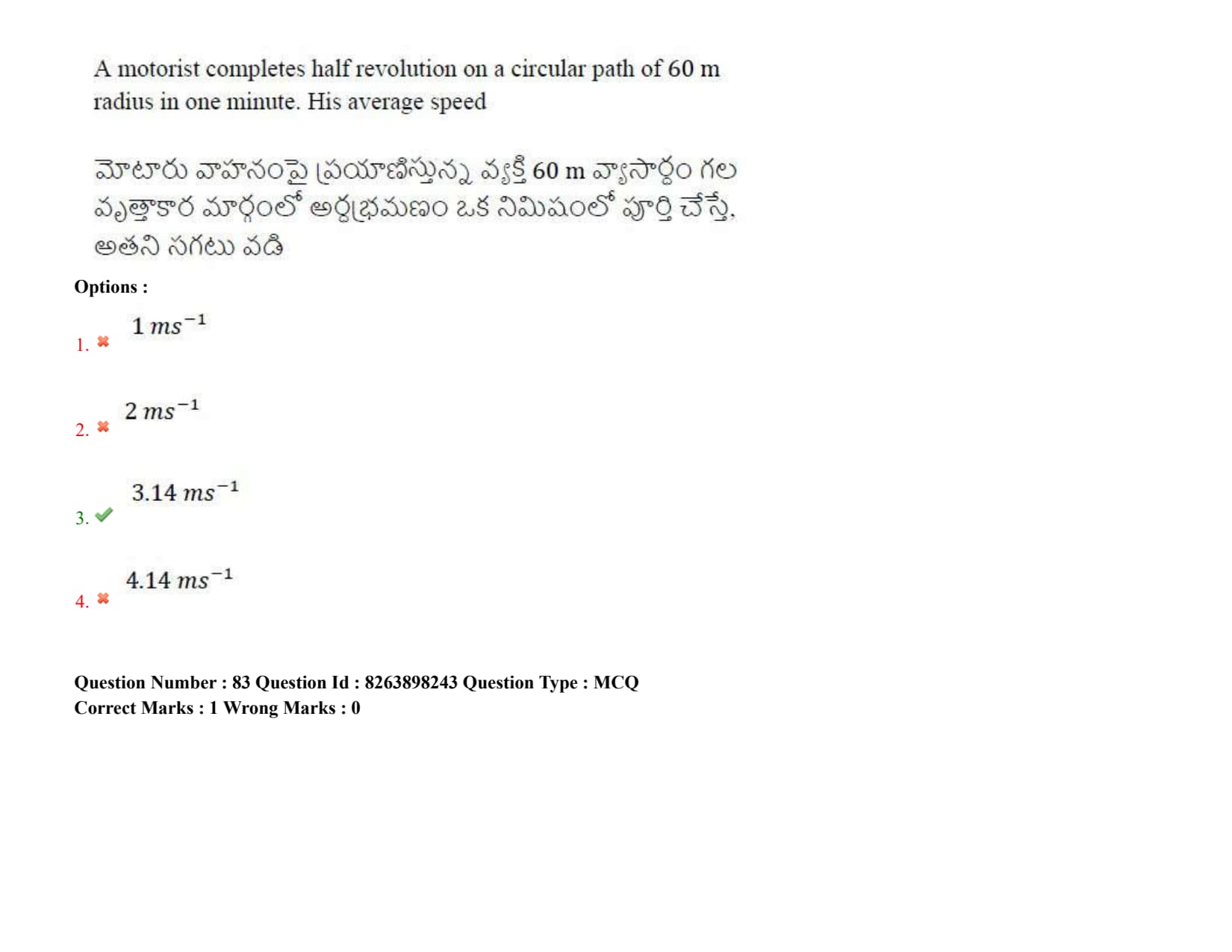
A motorist completes half revolution on a circular path of radius \(60\) m in one minute. Find average speed.
View Solution
Step 1: Find distance travelled
Half revolution distance
\[ =\frac12(2\pi r) \]
\[ =\pi r \]
\[ =\pi(60) \]
\[ =60\pi \]
Step 2: Calculate average speed
Time
\[ 1 minute=60s \]
Average speed
\[ =\frac{60\pi}{60} \]
\[ =\pi \]
\[ =3.14m/s \] Quick Tip: Average speed = Total distance / Total time. Half circular distance = \(\pi r\).
83.
The vertical displacement in first second is \(15m\). Find maximum height reached.
View Solution
Step 1: Use vertical displacement equation
\[ s=u_yt-\frac12gt^2 \]
Given:
\[ 15=u_y(1)-\frac12(10)(1)^2 \]
\[ 15=u_y-5 \]
\[ u_y=20m/s \]
Step 2: Find maximum height
\[ H=\frac{u_y^2}{2g} \]
\[ =\frac{20^2}{2(10)} \]
\[ =\frac{400}{20} \]
\[ =20m \] Quick Tip: Maximum height: \[ H=\frac{u_y^2}{2g} \]
84.
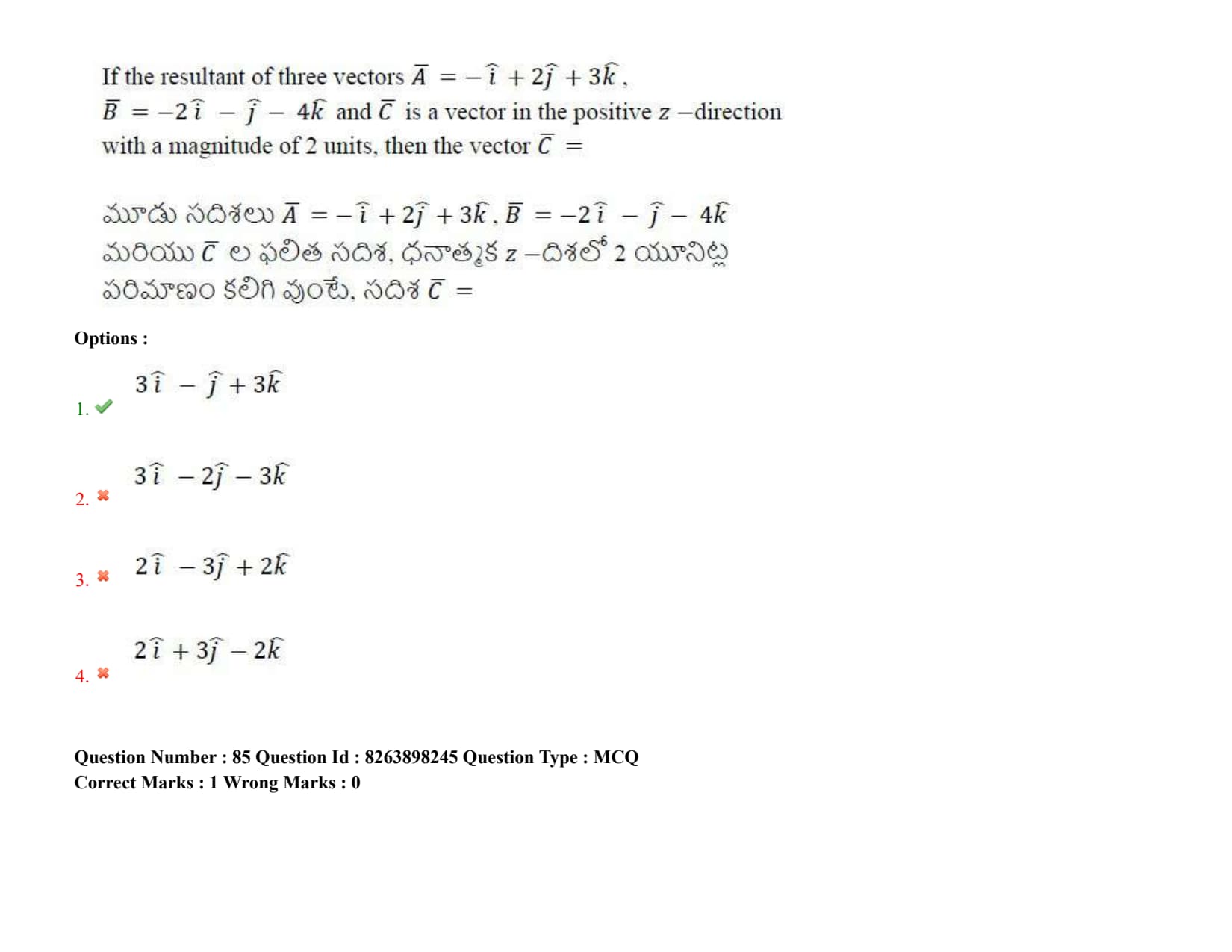
\(\vec A=-\hat i+2\hat j+3\hat k\), \(\vec B=-2\hat i-\hat j-4\hat k\). If resultant with \(\vec C\) is along positive z-direction with magnitude \(2\), find \(\vec C\).
View Solution
Step 1: Add vectors A and B
\[ \vec A+\vec B \]
\[ =(-1-2)\hat i + (2-1)\hat j + (3-4)\hat k \]
\[ =-3\hat i+\hat j-\hat k \]
Resultant vector:
\[ 0\hat i+0\hat j+2\hat k \]
Thus
\[ \vec C = (0,0,2)-(-3,1,-1) \]
\[ =(3,-1,3) \]
Hence,
\[ \boxed{\vec C = 3\hat i-\hat j+3\hat k} \] Quick Tip: Unknown vector: \[ \vec C = \vec R-(\vec A+\vec B) \]
85.
A \(2kg\) block is pulled by force \(30N\) at angle \(\sin^{-1}(0.6)\). Given \(\mu=0.4\), find acceleration.
View Solution
Step 1: Resolve force
Given:
\[ \sin\theta=0.6 \]
\[ \cos\theta=0.8 \]
Horizontal component:
\[ F_x=30(0.8) \]
\[ =24N \]
Vertical component:
\[ F_y=30(0.6) \]
\[ =18N \]
Step 2: Find normal force
\[ N=mg-F_y \]
\[ =20-18 \]
\[ =2N \]
Friction:
\[ f=\mu N \]
\[ =0.4(2) \]
\[ =0.8N \]
Step 3: Find acceleration
Net force:
\[ F=24-0.8 \]
\[ =23.2N \]
\[ a=\frac{23.2}{2} \]
\[ =11.6m/s^2 \] Quick Tip: Always resolve inclined force into horizontal and vertical components before applying friction equations.
86.
Mass 5 kg, forces 30 N and F at \(60^\circ\), distance 28 m in 2 s from rest. Find \(F\).
View Solution
Step 1: Find acceleration from equation of motion
Since particle starts from rest:
\[ s=ut+\frac12 at^2 \]
Substitute values:
\[ 28=0+\frac12(a)(2)^2 \]
\[ 28=2a \]
\[ a=14\,m/s^2 \]
Step 2: Calculate resultant force
Using Newton's second law:
\[ F_{net}=ma \]
\[ F_{net}=5\times14 \]
\[ F_{net}=70N \]
Step 3: Use resultant formula
Two forces make angle \(60^\circ\):
\[ R^2=30^2+F^2+2(30)F\cos60^\circ \]
\[ 70^2=900+F^2+30F \]
\[ 4900=900+F^2+30F \]
\[ F^2+30F-4000=0 \]
Solving:
\[ F=\frac{-30+\sqrt{16900}}{2} \]
\[ F=50N \] Quick Tip: Use \(s=ut+\frac12 at^2\) to find acceleration and then \(F=ma\).
87.
Mass 3 kg at height 40 m has \(PE:KE=2:3\). Find kinetic energy at height 65 m.
View Solution
Step 1: Find potential energy at 40 m
\[ PE=mgh \]
\[ PE=3\times10\times40 \]
\[ PE=1200J \]
Given:
\[ PE:KE=2:3 \]
Hence:
\[ PE=\frac25E \]
\[ 1200=\frac25E \]
\[ E=3000J \]
Step 2: Find KE at height 65 m
Potential energy:
\[ PE=3\times10\times65 \]
\[ PE=1950J \]
Hence:
\[ KE=3000-1950 \]
\[ KE=1050J \] Quick Tip: Total mechanical energy remains constant.
88.
Work done increasing velocity by \(25%\) is 900 J. Find work done when velocity decreases by \(25%\).
View Solution
Using work-energy theorem:
\[ W=\Delta KE \]
For increase:
\[ W_1=\frac12 mv^2(1.25^2-1) \]
\[ 900=\frac12 mv^2(0.5625) \]
\[ \frac12 mv^2=1600J \]
For decrease:
\[ W_2=\frac12 mv^2(0.75^2-1) \]
\[ W_2=1600(-0.4375) \]
\[ W_2=-700J \]
Magnitude:
\[ 700J \] Quick Tip: Work done equals change in kinetic energy.
89.
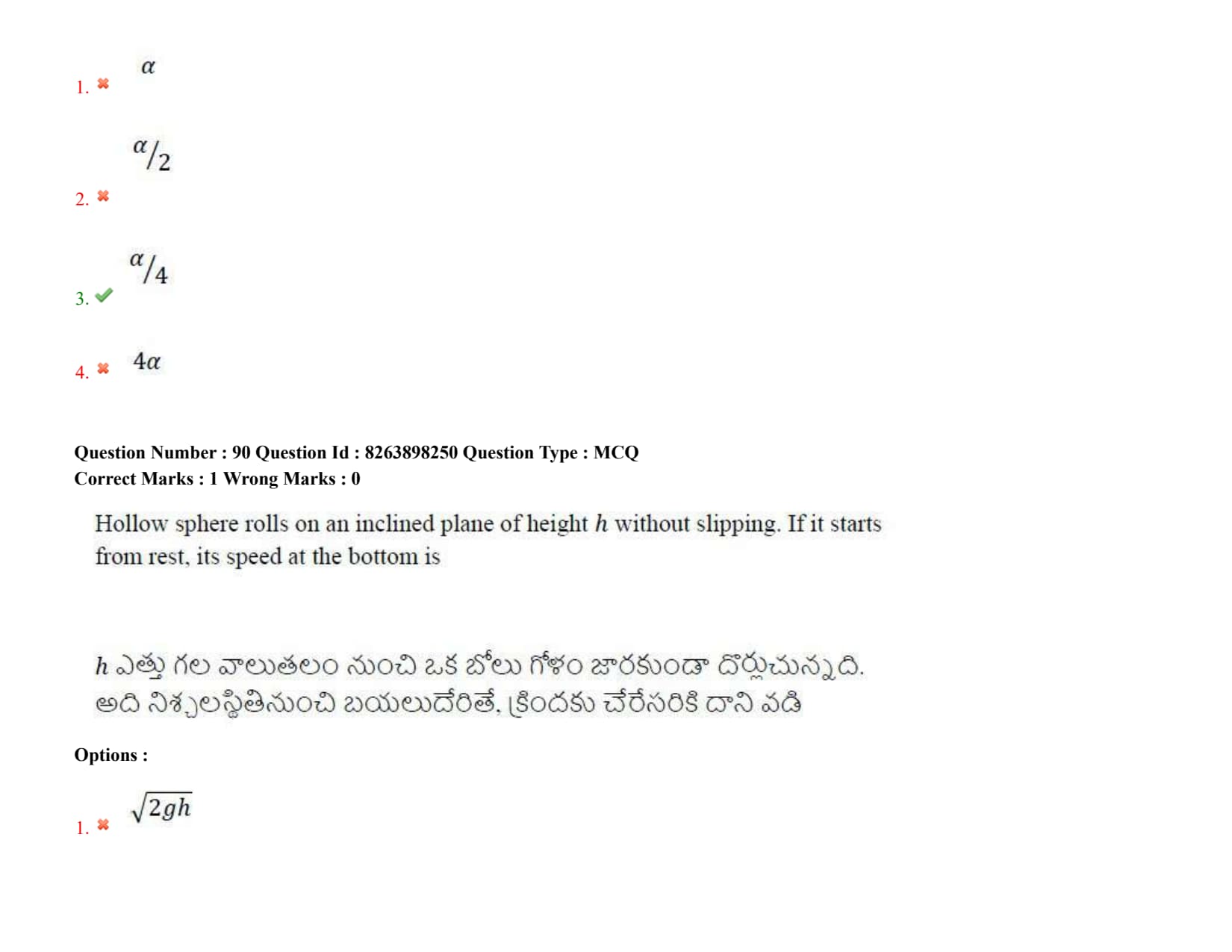
Torque \(T\) produces angular acceleration \(\alpha\) in a disc. Radius is doubled keeping mass constant. Find new angular acceleration.
View Solution
Moment of inertia of disc:
\[ I=\frac12MR^2 \]
If radius doubles:
\[ I'=\frac12M(2R)^2 \]
\[ I'=4I \]
Since:
\[ \tau=I\alpha \]
\[ \alpha'=\frac{\tau}{I'} \]
\[ \alpha'=\frac{\tau}{4I} \]
\[ \alpha'=\frac{\alpha}{4} \] Quick Tip: For a disc \(I\propto R^2\).
90.
A hollow sphere rolls down an incline of height \(h\) from rest. Find speed at bottom.
View Solution
Using conservation of energy:
\[ mgh=\frac12mv^2+\frac12I\omega^2 \]
For hollow sphere:
\[ I=\frac23mR^2 \]
and
\[ \omega=\frac{v}{R} \]
Substitute:
\[ mgh= \frac12mv^2+ \frac12 \left( \frac23mR^2 \right) \frac{v^2}{R^2} \]
\[ mgh= \frac12mv^2+ \frac13mv^2 \]
\[ mgh= \frac56mv^2 \]
\[ v^2= \frac65gh \]
\[ v= \sqrt{\frac65gh} \] Quick Tip: For rolling motion: \[ v= \sqrt{\frac{2gh}{1+\frac{I}{mR^2}}} \]
91.
In SHM, velocity leads displacement by
View Solution
Step 1: Write displacement equation of SHM
\[ x=A\sin(\omega t+\phi) \]
Step 2: Differentiate to obtain velocity
\[ v=\frac{dx}{dt} \]
\[ v=A\omega\cos(\omega t+\phi) \]
Using identity:
\[ \cos\theta=\sin(\theta+90^\circ) \]
\[ v=A\omega\sin(\omega t+\phi+90^\circ) \]
Hence velocity leads displacement by
\[ 90^\circ \] Quick Tip: Velocity is the derivative of displacement, therefore it leads by \(90^\circ\).
92.
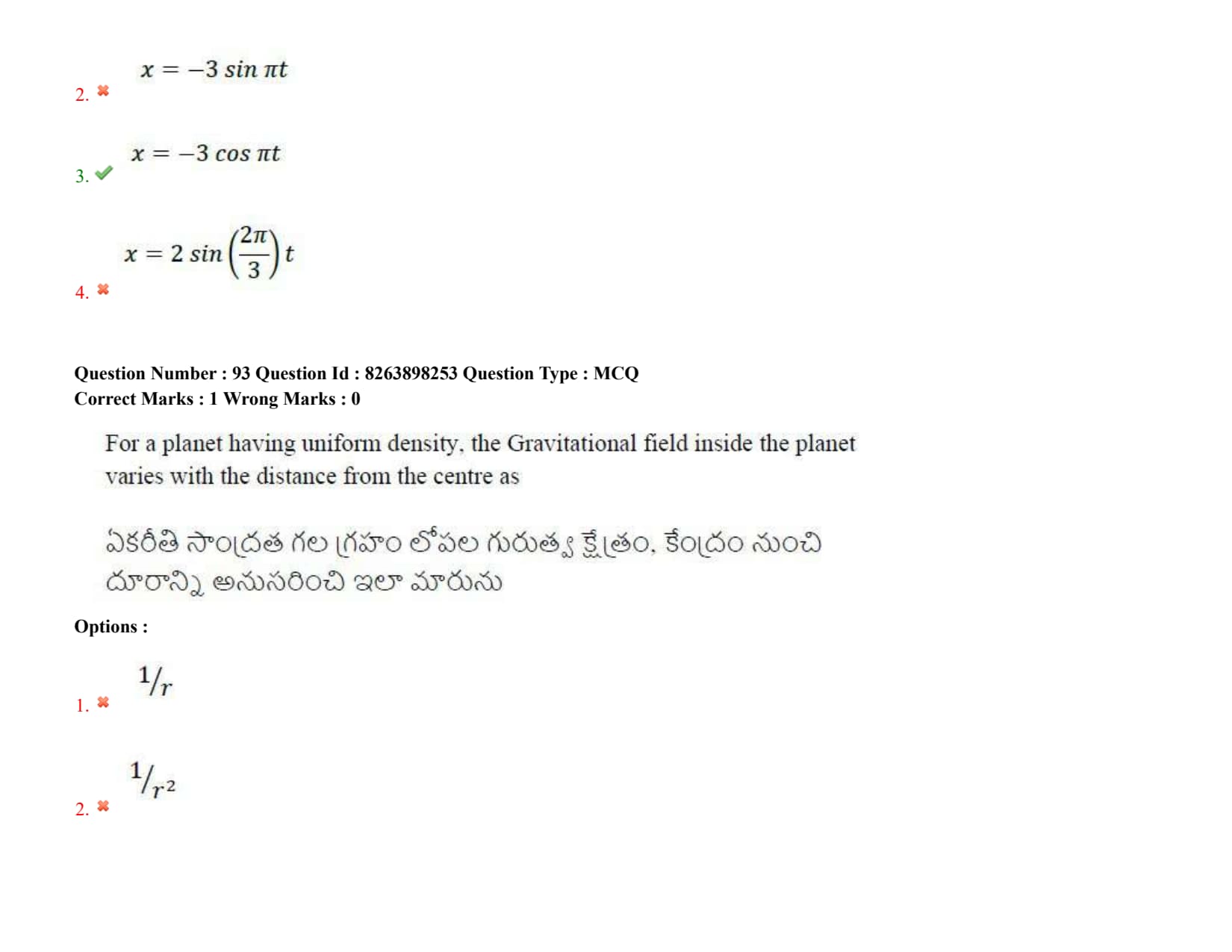
Radius \(=3\), time period \(=2s\). Find equation of x-projection SHM.
View Solution
Step 1: Calculate angular frequency
\[ \omega=\frac{2\pi}{T} \]
\[ \omega=\frac{2\pi}{2} \]
\[ \omega=\pi \]
Step 2: Write SHM equation
General form:
\[ x=A\cos(\omega t+\phi) \]
Amplitude:
\[ A=3 \]
Substituting values:
\[ x=-3\cos(\pi t) \] Quick Tip: Projection of uniform circular motion performs SHM.
93.
Inside a planet of uniform density, gravitational field varies as
View Solution
Inside a uniform sphere:
\[ g=\frac{GMr}{R^3} \]
Since
\[ g\propto r \]
Therefore gravitational field varies directly with distance from center. Quick Tip: Inside a uniform sphere, gravitational field increases linearly from center to surface.
94.
A book of dimensions \(4cm\times1.5cm\times10cm\) has force 3N on top face. Shear modulus \(2\times10^5N/m^2\). Find horizontal displacement.
View Solution
Step 1: Calculate shear stress
Area:
\[ A=0.04\times0.015 \]
\[ A=0.0006m^2 \]
Stress:
\[ \tau=\frac{F}{A} \]
\[ \tau=\frac{3}{0.0006} \]
\[ \tau=5000Pa \]
Step 2: Calculate strain
\[ G=\frac{\tau}{\gamma} \]
\[ \gamma=\frac{5000}{2\times10^5} \]
\[ \gamma=0.025 \]
Step 3: Find displacement
\[ \gamma=\frac{x}{h} \]
\[ x=0.025\times0.1 \]
\[ x=0.0025m \]
\[ x=2.5mm \] Quick Tip: Shear strain \(=\frac{displacement}{height}\)
95.
A bubble in a viscous liquid has radius doubled. Terminal velocity becomes
View Solution
Using Stokes' law:
\[ v_t= \frac{2r^2(\rho-\sigma)g}{9\eta} \]
Hence:
\[ v_t\propto r^2 \]
If radius becomes:
\[ r'=2r \]
Then:
\[ v_t' \propto (2r)^2 \]
\[ v_t'=4v_t \]
Hence terminal velocity becomes four times. Quick Tip: Terminal velocity is proportional to square of radius.
101.
Two identical strings each of length 0.750 m are tuned exactly to 440 Hz. The tension in one string is increased by 1%. Find the beat frequency.
View Solution
For stretched strings:
\[ f\propto \sqrt{T} \]
For small changes,
\[ \frac{\Delta f}{f}=\frac12\frac{\Delta T}{T} \]
Given:
\[ \frac{\Delta T}{T}=1%=0.01 \]
Hence,
\[ \frac{\Delta f}{440} = \frac12(0.01) \]
\[ \Delta f=440\times0.005 \]
\[ =2.2\approx2Hz \]
Beat frequency:
\[ f_b=|f_1-f_2| \]
\[ f_b=2Hz \] Quick Tip: For strings: \(f\propto\sqrt{T}\), so percentage change in frequency is half the percentage change in tension.
102.
A convex lens forms real and virtual images of same size at object distances \(u_1\) and \(u_2\). Find focal length.
View Solution
For real image of same size:
\[ u_1=2f \]
For virtual image condition:
\[ u_2=\frac{f}{2} \]
Multiplying,
\[ u_1u_2 = (2f)\left(\frac f2\right) \]
\[ u_1u_2=f^2 \]
Hence,
\[ f=\sqrt{u_1u_2} \] Quick Tip: For same-size real image in a convex lens, object is placed at \(2f\).
103.
'n' transparent films of refractive index 1.5 and thicknesses 1 cm,2 cm,3 cm,...n cm are placed together. Apparent shift is 5 cm. Find \(n\).
View Solution
Shift for one slab:
\[ S=t\left(1-\frac1\mu\right) \]
Since
\[ \mu=1.5 \]
\[ S=t\left(1-\frac23\right) \]
\[ S=\frac t3 \]
Total shift:
\[ \frac13(1+2+3+\cdots+n) \]
Using sum formula:
\[ 1+2+\cdots+n = \frac{n(n+1)}2 \]
Hence,
\[ \frac13\times\frac{n(n+1)}2=5 \]
\[ n(n+1)=30 \]
\[ n^2+n-30=0 \]
\[ (n+6)(n-5)=0 \]
\[ n=5 \] Quick Tip: Normal shift \(=t\left(1-\frac1\mu\right)\).
104.
In YDSE central maxima is at 2 cm and 10th maxima at 5 cm. Find coordinates after immersion in liquid of refractive index 1.5.
View Solution
Distance between central and 10th maxima:
\[ 5-2=3cm \]
Hence fringe width:
\[ \beta=\frac3{10} \]
\[ =0.3cm \]
In liquid:
\[ \beta'=\frac{\beta}{\mu} \]
\[ =\frac{0.3}{1.5} \]
\[ =0.2cm \]
New position:
\[ 2+10(0.2) \]
\[ =4cm \]
Hence coordinates:
\[ (2cm,4cm) \] Quick Tip: Fringe width decreases by factor \(\mu\) in liquid.
105.
Two point charges \(-2Q\) and \(Q\) are at \((-3a,0)\) and \((3a,0)\). Find the locus where potential is zero.
View Solution
Potential:
\[ \frac{-2kQ}{r_1} + \frac{kQ}{r_2} = 0 \]
\[ \frac2{r_1} = \frac1{r_2} \]
\[ r_1=2r_2 \]
Substituting coordinates:
\[ r_1=\sqrt{(x+3a)^2+y^2} \]
\[ r_2=\sqrt{(x-3a)^2+y^2} \]
After simplification:
\[ (x-5a)^2+y^2 = 16a^2 \]
This is equation of a circle. Quick Tip: Zero potential due to opposite charges generally gives a circle/sphere locus.
106.
Four identical capacitors are connected in series with a battery of 16V between A and B. Point P is earthed. Find potentials at A and B.
View Solution
Identical capacitors in series divide voltage equally.
Total voltage:
\[ V=16V \]
Across four capacitors:
\[ V_C=\frac{16}{4} \]
\[ =4V \]
Since point \(P\) is earthed:
\[ V_P=0 \]
By symmetry,
\[ V_A=+8V \]
and
\[ V_B=-8V \]
Hence,
\[ \boxed{(8V,-8V)} \] Quick Tip: For identical capacitors in series, voltage divides equally.
107.
A parallel plate capacitor of area \(3A\), separation \(3d\), contains dielectric slabs with \(K_1=2\), \(K_2=4\), \(K_3=6\). Find capacitance.
View Solution
For dielectric slabs arranged in series:
\[ \frac1C = \frac{d}{3A\varepsilon_0} \left( \frac12+\frac14+\frac16 \right) \]
\[ = \frac{d}{3A\varepsilon_0} \left( \frac{11}{12} \right) \]
After simplification:
\[ C = \frac{54A\varepsilon_0}{13d} \] Quick Tip: For dielectric slabs in series: \(\frac1C=\sum\frac1{C_i}\).
108.
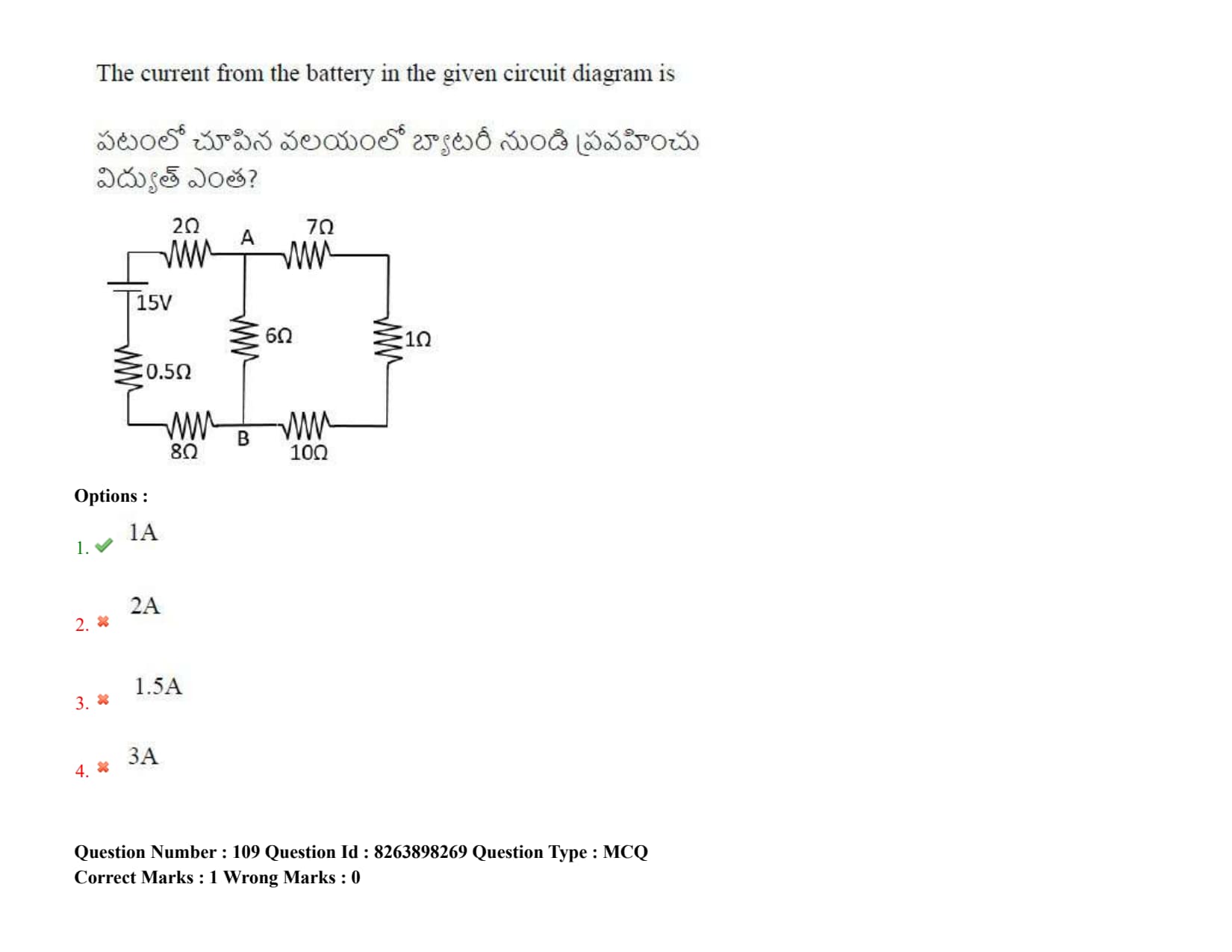
Find current from battery in the given circuit.
View Solution
The circuit figure is required to determine equivalent resistance and battery current. Quick Tip: Reduce series and parallel resistances step-by-step before applying Ohm's law.
109.
Two batteries of emf 4V and 8V with internal resistances 1\(\Omega\), 2\(\Omega\) and external resistance 9\(\Omega\). Find current and potential difference between P and Q.
View Solution
Applying Kirchhoff's law:
Net emf:
\[ E=12V \]
Total resistance:
\[ R=24\Omega \]
Current:
\[ I=\frac{E}{R} \]
\[ I=\frac{12}{24} \]
\[ I=\frac12A \]
Potential difference:
\[ V_{PQ}=12V \] Quick Tip: Use Kirchhoff's loop law: \(\sum E=\sum IR\).
110.
A particle with charge \(100e\) moves in a circular path of radius \(0.8m\) and completes one revolution in \(1s\). Find magnetic field at the center.
View Solution
Current due to revolving charge:
\[ I=\frac{q}{T} \]
\[ = \frac{100\times1.6\times10^{-19}}{1} \]
\[ = 1.6\times10^{-17}A \]
Magnetic field at center:
\[ B= \frac{\mu_0I}{2R} \]
Substitute values:
\[ B= \frac{\mu_0(1.6\times10^{-17})} {2(0.8)} \]
\[ = 10^{-17}\mu_0 \]
Hence,
\[ \boxed{B=10^{-17}\mu_0} \] Quick Tip: For rotating charge: \(I=q/T\), and \(B=\frac{\mu_0I}{2R}\).
111.
A galvanometer has 30 divisions and 30 mV across it for full scale deflection. If 1 mA gives one division deflection, find the shunt required to convert it into a 0–3 A ammeter.
View Solution
Step 1: Calculate galvanometer resistance
Current for full scale:
\[ I_g=30\times1mA \]
\[ I_g=30mA=0.03A \]
Resistance:
\[ R_g=\frac{V}{I} \]
\[ R_g=\frac{0.03}{0.03} \]
\[ R_g=1\Omega \]
Step 2: Calculate shunt resistance
\[ S=\frac{I_gR_g}{I-I_g} \]
\[ S=\frac{0.03\times1}{3-0.03} \]
\[ S\approx\frac{10}{33}\Omega \] Quick Tip: Shunt resistance: \(S=\frac{I_gR_g}{I-I_g}\)
112.
If \(\chi\) is magnetic susceptibility and \(\mu,\mu_0,\mu_r\) are permeabilities, identify the correct relation.
View Solution
We know:
\[ \mu_r=1+\chi \]
Also:
\[ \mu=\mu_0\mu_r \]
Substituting:
\[ \mu = \mu_0(1+\chi) \]
Hence:
\[ \boxed{\mu=\mu_0(1+\chi)} \] Quick Tip: Remember: \(\mu_r=1+\chi\)
113.
A pure inductor \(L=3H\), with \(v(t)=4t\) volts applied at \(t=0\). Find energy stored after \(3s\).
View Solution
Using:
\[ v=L\frac{di}{dt} \]
\[ 4t = 3\frac{di}{dt} \]
\[ \frac{di}{dt} = \frac{4t}{3} \]
Integrating:
\[ i=\int\frac{4t}{3}dt \]
\[ i=\frac{2t^2}{3} \]
At \(t=3s\),
\[ i=\frac{2(9)}{3} \]
\[ i=6A \]
Energy stored:
\[ U=\frac12Li^2 \]
\[ U = \frac12(3)(36) \]
\[ U=54J \] Quick Tip: Energy stored in inductor: \(U=\frac12Li^2\)
114.
At resonance in a series LCR circuit, impedance is:
View Solution
At resonance:
\[ X_L=X_C \]
Net reactance becomes zero.
Hence impedance:
\[ Z=\sqrt{R^2+(X_L-X_C)^2} \]
\[ Z=\sqrt{R^2} \]
\[ Z=R \] Quick Tip: At resonance current becomes maximum because impedance becomes minimum.
115.
Solar energy flux \(2000W/m^2\) falls normally on \(1m^2\) plate for one hour. Find momentum received.
View Solution
Energy received:
\[ E=Pt \]
\[ =(2000)(3600) \]
\[ =7.2\times10^6J \]
Momentum of radiation:
\[ p=\frac{E}{c} \]
\[ = \frac{7.2\times10^6} {3\times10^8} \]
\[ = 2.4\times10^{-2} \]
\[ = 24\times10^{-3} kg\,m/s \] Quick Tip: For electromagnetic waves: \(p=\frac{E}{c}\)
116.
Two electrons accelerated through potentials \(V_A\) and \(V_B\). Their de-Broglie wavelengths are in the ratio \(2:3\). Find \(\frac{V_A}{V_B}\).
View Solution
For an electron accelerated through potential difference \(V\),
\[ \lambda=\frac{h}{\sqrt{2meV}} \]
Hence,
\[ \lambda\propto \frac{1}{\sqrt{V}} \]
Given,
\[ \frac{\lambda_A}{\lambda_B} = \frac{2}{3} \]
Therefore,
\[ \sqrt{\frac{V_B}{V_A}} = \frac{2}{3} \]
Squaring both sides,
\[ \frac{V_B}{V_A} = \frac{4}{9} \]
Thus,
\[ \frac{V_A}{V_B} = \frac{9}{4} \]
Hence the correct answer is
\[ \boxed{\frac{V_A}{V_B}=9:4} \] Quick Tip: For de-Broglie waves of electrons accelerated through potential \(V\), \[ \lambda\propto \frac{1}{\sqrt{V}} \] Higher potential gives smaller wavelength.
117.
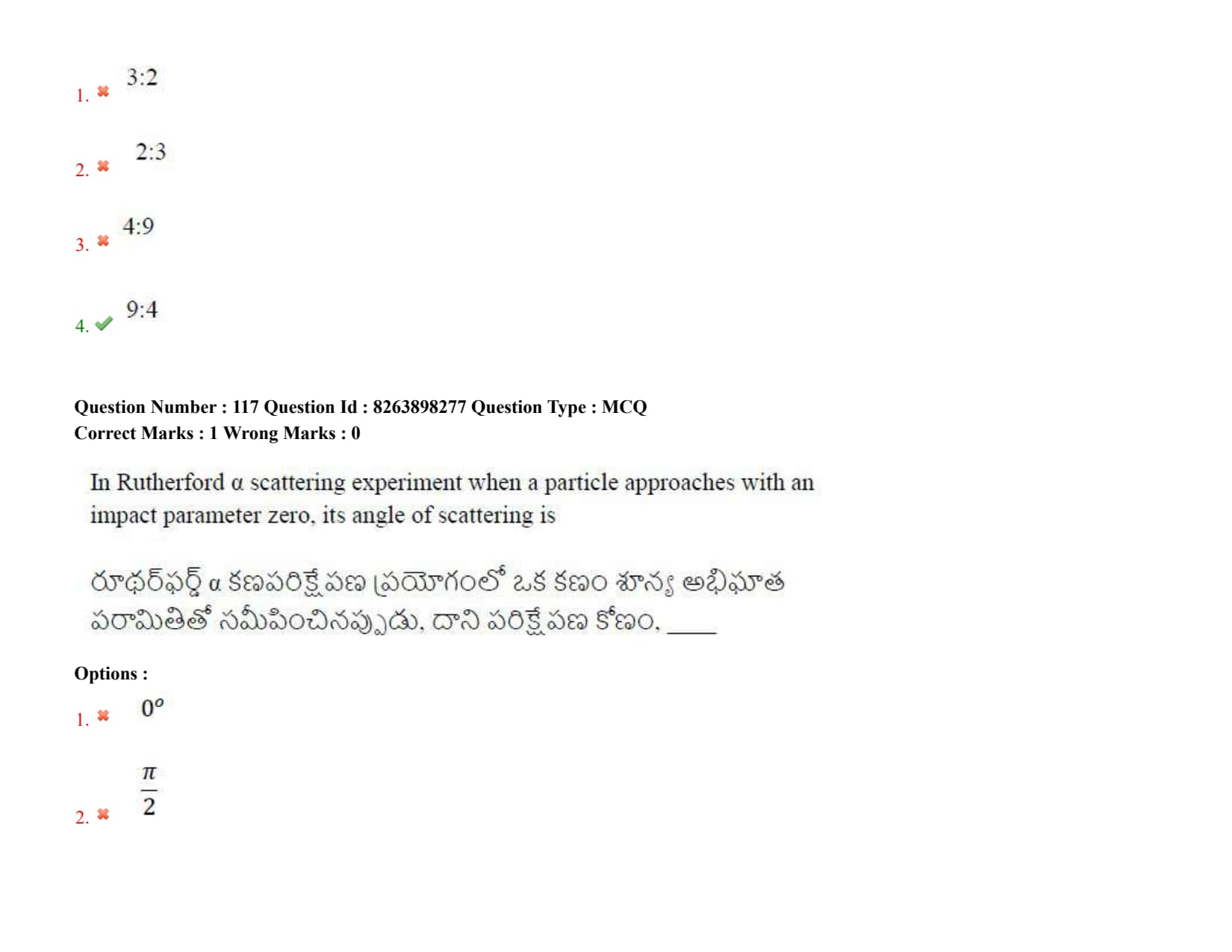
In Rutherford \(\alpha\)-particle scattering experiment, if the impact parameter is zero, the scattering angle is
View Solution
Impact parameter is the perpendicular distance between the initial path of the particle and the nucleus center.
For
\[ b=0 \]
the \(\alpha\)-particle moves directly towards the nucleus.
Hence it undergoes a head-on collision and comes back in the same direction.
Therefore scattering angle is
\[ \theta=180^\circ \]
or
\[ \theta=\pi \]
Hence,
\[ \boxed{\theta=180^\circ} \] Quick Tip: For head-on collision in Rutherford scattering: \[ b=0 \Rightarrow \theta=180^\circ \]
118.
\(^{236}_{92}U\rightarrow ^{117}_{47}X+^{117}_{45}Y+2n\). Binding energy per nucleon of products is \(8.8\) MeV and for uranium it is \(7.5\) MeV. Find energy released.
View Solution
Binding energy of products:
\[ BE_p = 234\times8.8 \]
\[ = 2059.2 MeV \]
Binding energy of reactant:
\[ BE_r = 236\times7.5 \]
\[ = 1770 MeV \]
Energy released:
\[ Q = BE_p-BE_r \]
\[ = 2059.2-1770 \]
\[ = 289.2 MeV \]
Hence,
\[ \boxed{289.2 MeV} \] Quick Tip: Energy released in nuclear reactions: \[ Q= BE_{products}-BE_{reactants} \]
119.
Identify the truth table corresponding to NAND gate.
View Solution
NAND gate output is the complement of AND operation.
\[ Y=\overline{A\cdot B} \]
Truth table:
\[ \begin{array}{|c|c|c|} \hline A&B&Y
\hline 0&0&1
0&1&1
1&0&1
1&1&0
\hline \end{array} \]
Thus output is zero only when both inputs are one. Quick Tip: NAND gate is called a universal gate because any logic circuit can be constructed using only NAND gates.
120.
For an AM wave, maximum amplitude is \(12V\) and minimum amplitude is \(4V\). Find modulation index.
View Solution
Modulation index:
\[ m= \frac{A_{max}-A_{min}} {A_{max}+A_{min}} \]
Substitute values:
\[ m = \frac{12-4}{12+4} \]
\[ = \frac{8}{16} \]
\[ = 0.5 \]
Therefore,
\[ m=50% \]
Hence,
\[ \boxed{50%} \] Quick Tip: For AM waves: \[ m= \frac{A_{max}-A_{min}} {A_{max}+A_{min}} \]
121.
Wavelength of photon emitted during electron transition from \(n=4\) to \(n=2\) in hydrogen atom is \(x\) nm. Wavelength from \(n=4\) to \(n=1\) is \(y\) nm. Then \(\frac{y}{x}\) is equal to
View Solution
Using Rydberg equation:
\[ \frac{1}{\lambda} = R\left( \frac{1}{n_1^2} - \frac{1}{n_2^2} \right) \]
For transition \(4\rightarrow2\):
\[ \frac{1}{x} = R \left( \frac14-\frac1{16} \right) \]
\[ = \frac{3R}{16} \]
For transition \(4\rightarrow1\):
\[ \frac{1}{y} = R \left( 1-\frac1{16} \right) \]
\[ = \frac{15R}{16} \]
Thus,
\[ \frac{x}{y} = \frac{15}{3} \]
\[ = 5 \]
Hence,
\[ \frac{y}{x} = \frac15 = 0.2 \] Quick Tip: Use Rydberg relation: \[ \frac{1}{\lambda} \propto \left( \frac{1}{n_1^2} - \frac{1}{n_2^2} \right) \]
122.
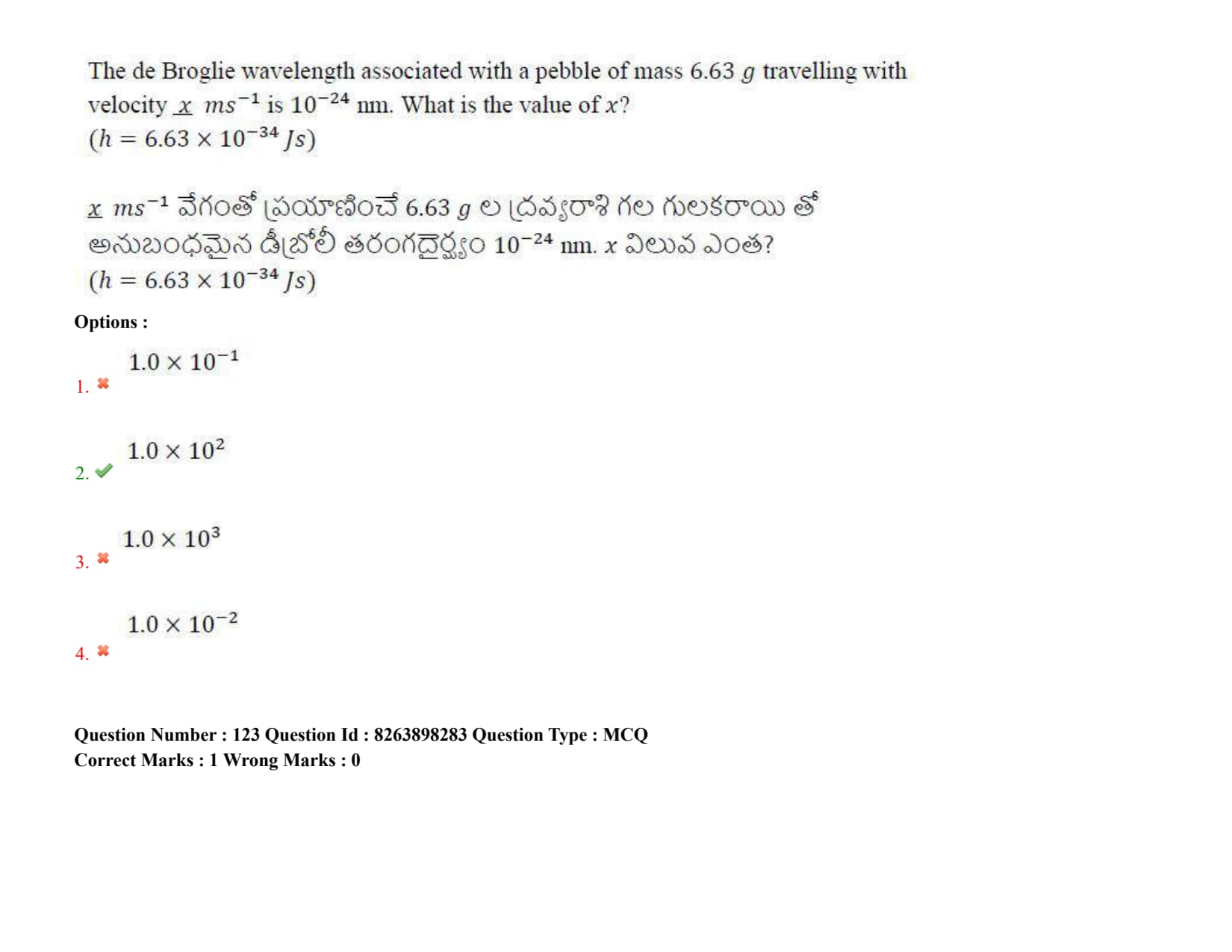
De-Broglie wavelength of a pebble of mass \(6.63\) g travelling with velocity \(x\) m/s is \(10^{-24}\) nm. Find \(x\).
View Solution
Using de-Broglie relation,
\[ \lambda = \frac{h}{mv} \]
Given,
\[ m = 6.63\times10^{-3} kg \]
\[ \lambda = 10^{-24} \times10^{-9} \]
\[ = 10^{-33}m \]
Substituting:
\[ v = \frac{6.63\times10^{-34}} {(6.63\times10^{-3})(10^{-33})} \]
\[ = 10^2 m/s \]
Hence,
\[ \boxed{x=10^2m/s} \] Quick Tip: Always convert wavelength into SI units before substitution.
123.
Which of the following sets are correctly matched?
I. \(K>Li>C>F\) (Atomic radius)
II. \(F>C>Li>K\) (First ionization enthalpy)
III. \(F>C>K>Li\) (Electronegativity)
View Solution
Atomic radius decreases across a period and increases down a group:
\[ K>Li>C>F \]
Hence statement I is correct.
Ionization enthalpy increases across a period:
\[ F>C>Li>K \]
Hence statement II is correct.
Electronegativity values:
\[ F>C>Li>K \]
Statement III is incorrect.
Hence only I and II are correct. Quick Tip: Atomic radius and ionization energy follow opposite periodic trends.
124.
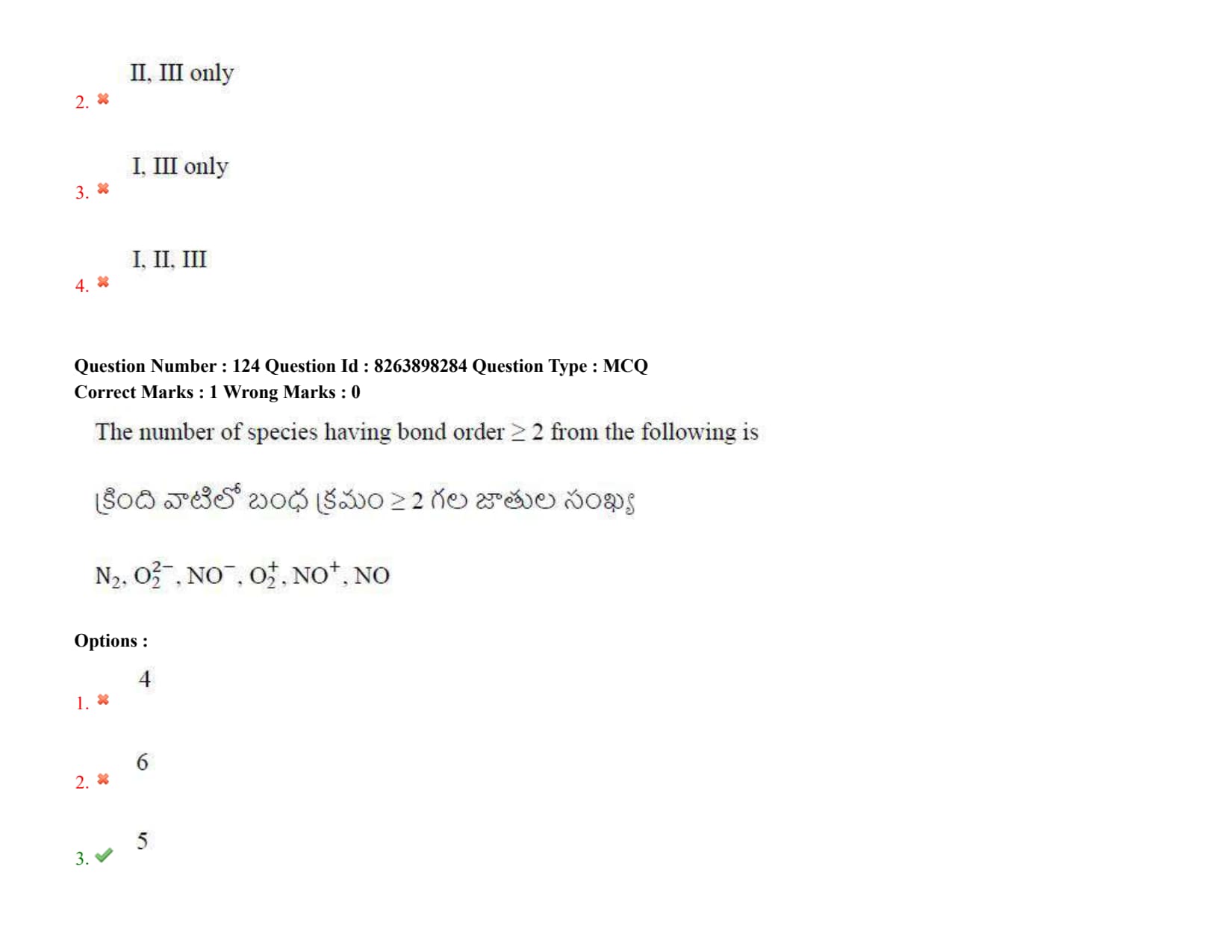
Number of species having bond order \(\ge2\) among \(N_2,O_2^{2-},NO^-,O_2^+,NO^+,NO\)
View Solution
Bond orders are:
\[ N_2=3 \]
\[ O_2^{2-}=1 \]
\[ NO^-=2 \]
\[ O_2^+=2.5 \]
\[ NO^+=3 \]
\[ NO=2.5 \]
Species with bond order \(\ge2\):
\[ N_2,\, NO^-, O_2^+,\, NO^+,\, NO \]
Total number:
\[ =5 \]
Hence,
\[ \boxed{5} \] Quick Tip: Bond order: \[ BO= \frac{N_b-N_a}{2} \] where \(N_b\) and \(N_a\) are bonding and antibonding electrons.
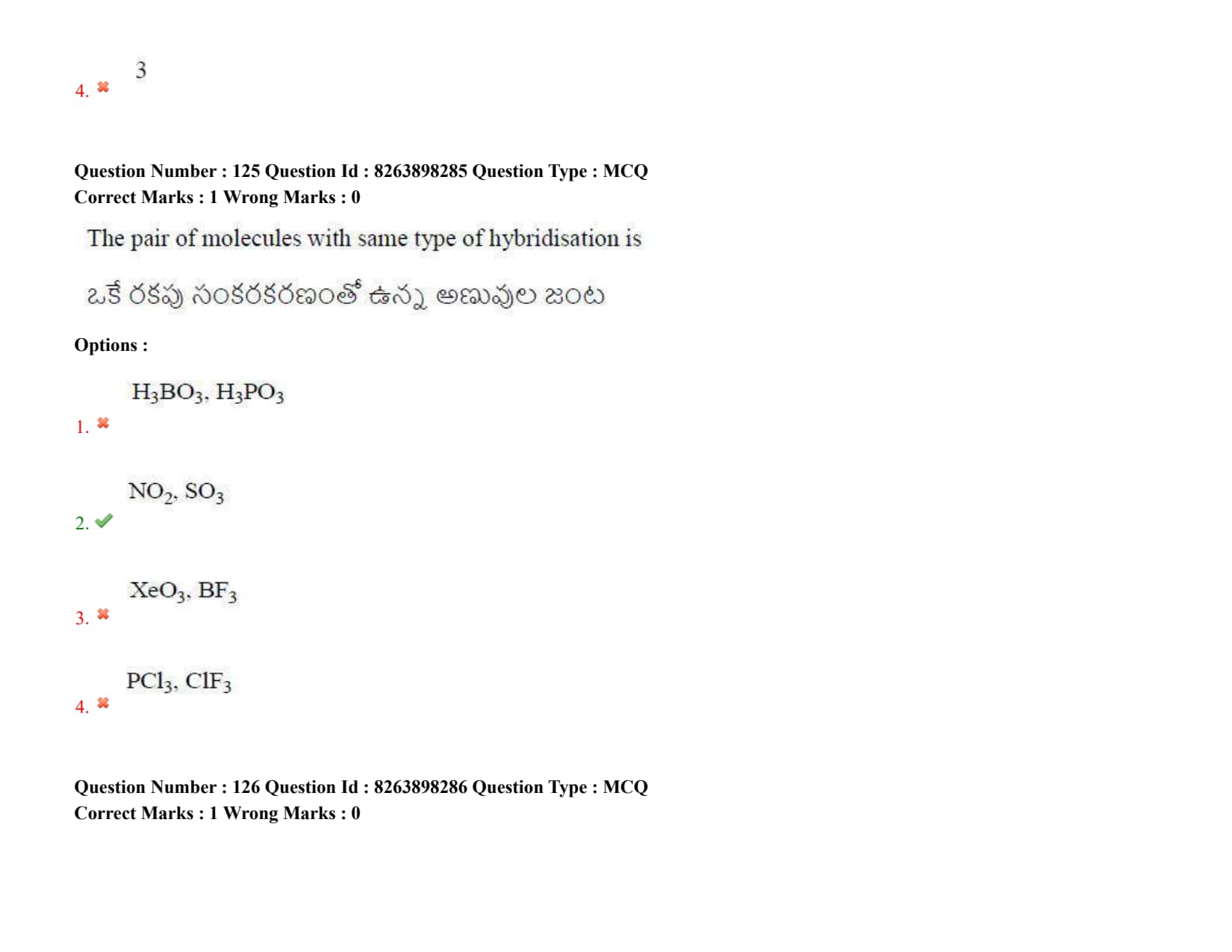
125.
Pair of molecules having same type of hybridisation
View Solution
Hybridisation:
\[ CH_4 \rightarrow sp^3 \]
\[ NH_3 \rightarrow sp^3 \]
\[ BF_3 \rightarrow sp^2 \]
\[ CO_2 \rightarrow sp \]
Hence molecules having same hybridisation are
\[ CH_4 and NH_3 \] Quick Tip: Hybridisation can be found using: Steric number = Bond pairs + Lone pairs
126.
The RMS velocity of \(SO_2\) at \(400K\) is equal to the most probable velocity of \(O_2\) at temperature \(T\). Find the kinetic energy of \(5\) moles of \(O_2\) at temperature \(T\).
View Solution
For RMS velocity:
\[ v_{rms} = \sqrt{\frac{3RT}{M}} \]
For most probable velocity:
\[ v_{mp} = \sqrt{\frac{2RT}{M}} \]
Given,
\[ \sqrt{\frac{3R(400)}{64}} = \sqrt{\frac{2RT}{32}} \]
Squaring both sides,
\[ \frac{1200}{64} = \frac{2T}{32} \]
\[ 18.75 = \frac{T}{16} \]
\[ T=300K \]
Translational kinetic energy:
\[ KE = \frac32 nRT \]
\[ = \frac32 \times5\times8.3\times300 \]
\[ = 18675J \]
\[ = 18.675kJ \]
Hence,
\[ \boxed{18.675kJ} \] Quick Tip: Average translational kinetic energy: \[ KE=\frac32 nRT \]
127.
Chlorophyll contains \(2.4%\) magnesium. Find the number of magnesium atoms in \(2g\) chlorophyll.
View Solution
Mass of magnesium:
\[ m = 2\times\frac{2.4}{100} \]
\[ = 0.048g \]
Number of moles:
\[ n = \frac{0.048}{24} \]
\[ = 0.002 \]
Number of atoms:
\[ = 0.002\times6\times10^{23} \]
\[ = 1.2\times10^{21} \]
Hence,
\[ \boxed{1.2\times10^{21}} \] Quick Tip: Number of atoms: \[ N=nN_A \]
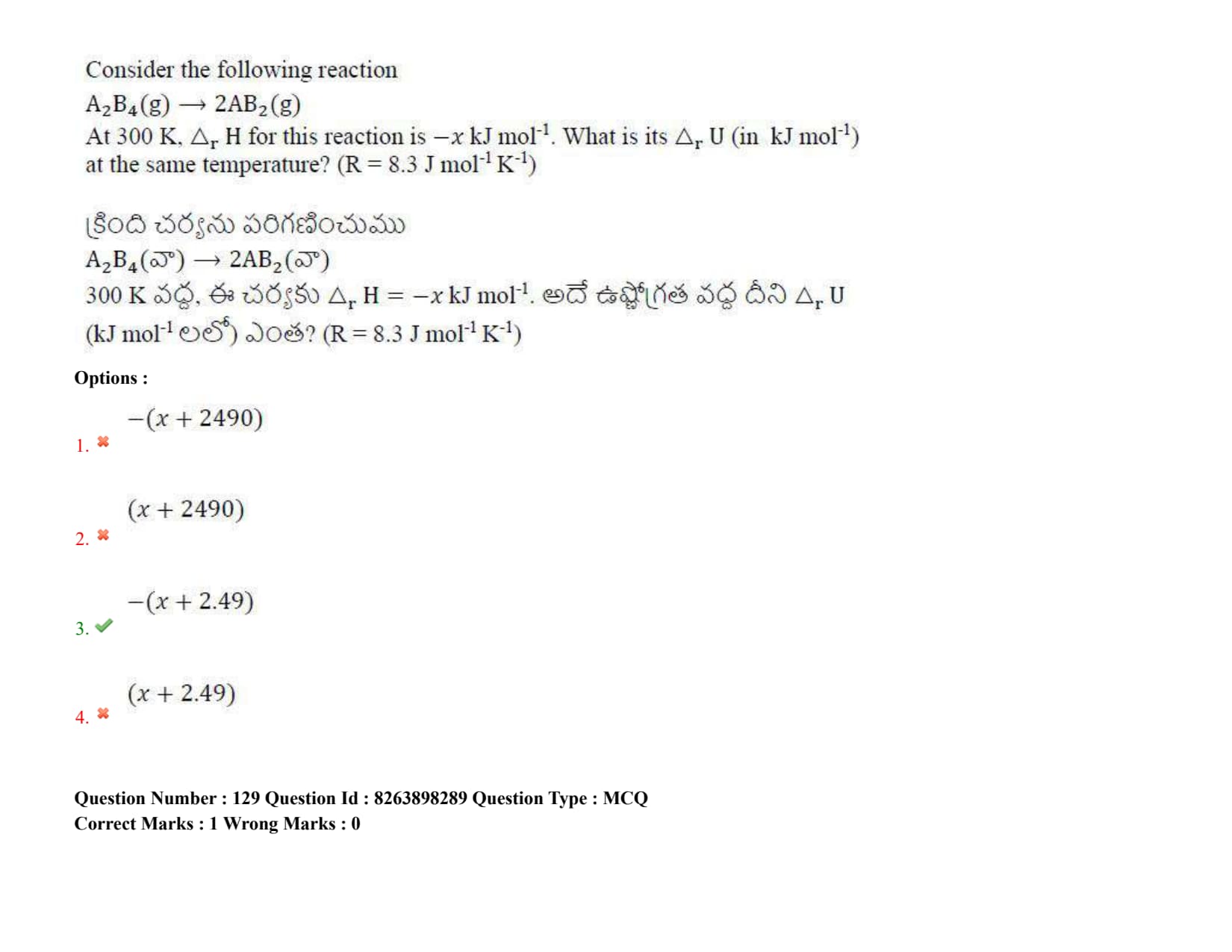
128.
\(A_2B_4(g)\rightarrow2AB_2(g)\) at \(300K\), \(\Delta H=-x\;kJ/mol\). Find \(\Delta U\).
View Solution
Relation:
\[ \Delta H = \Delta U+\Delta n_gRT \]
Here,
\[ \Delta n_g = 2-1 = 1 \]
\[ RT = 8.3\times300 \]
\[ = 2490J \]
\[ = 2.49kJ \]
Therefore,
\[ \Delta U = -x-2.49 \]
\[ = -(x+2.49) \]
Hence,
\[ \boxed{-(x+2.49)} \] Quick Tip: Remember: \[ \Delta H=\Delta U+\Delta nRT \]
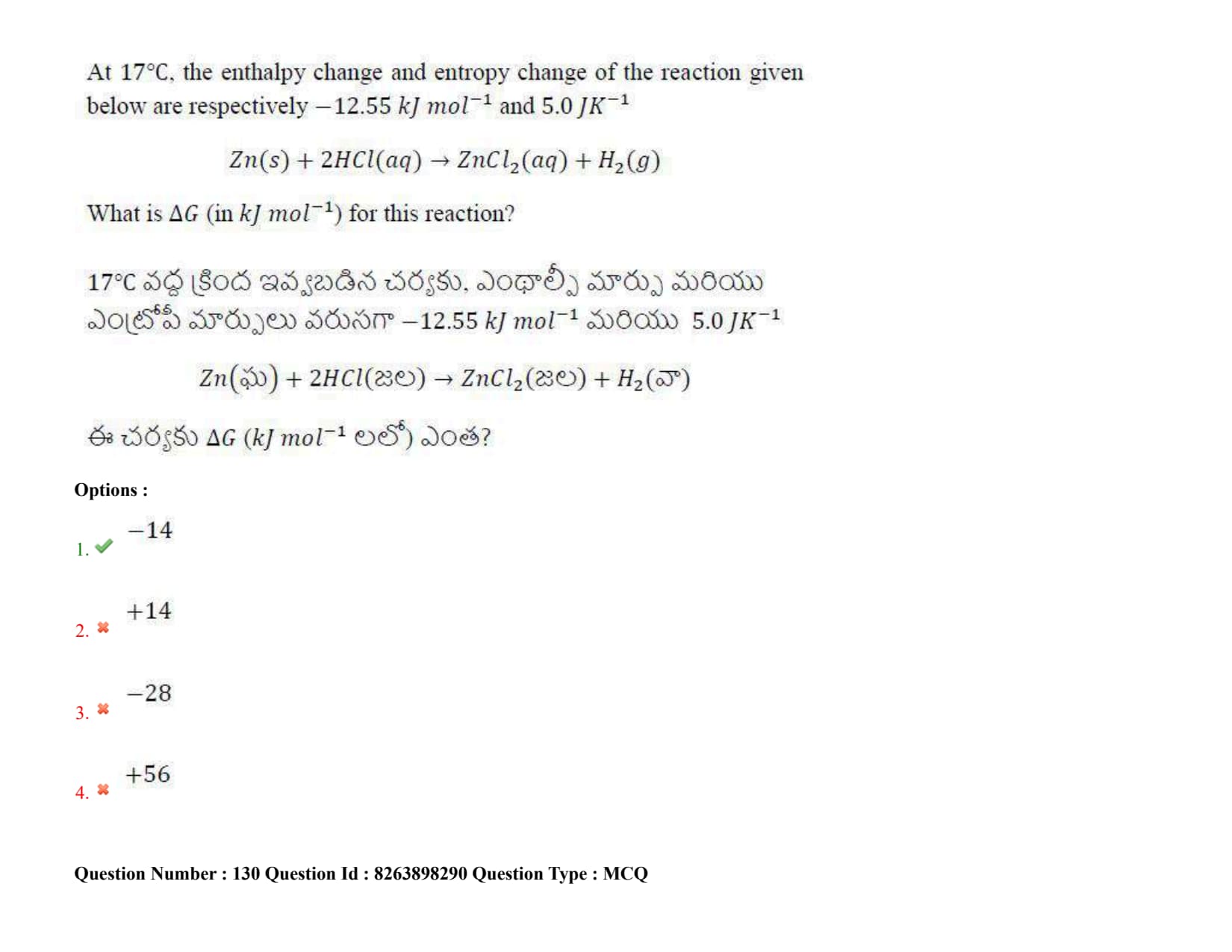
129.
At \(17^\circ C\), \(\Delta H=-12.55kJ/mol\), \(\Delta S=5J/K\). Find \(\Delta G\).
View Solution
Using:
\[ \Delta G = \Delta H - T\Delta S \]
Temperature:
\[ T = 17+273 \]
\[ = 290K \]
Convert entropy:
\[ 5J/K = 0.005kJ/K \]
Substitute values:
\[ \Delta G = -12.55-(290\times0.005) \]
\[ = -12.55-1.45 \]
\[ = -14kJ/mol \]
Hence,
\[ \boxed{-14kJ/mol} \] Quick Tip: Use same units for both \(\Delta H\) and \(T\Delta S\).
130.
At \(540K\), \(0.1\) mol \(PCl_5\) is kept in an \(8L\) flask. Total equilibrium pressure is \(1atm\). Find \(K_p\).
View Solution
Reaction:
\[ PCl_5 \rightleftharpoons PCl_3+Cl_2 \]
Initial pressure:
\[ P_0 = \frac{nRT}{V} \]
\[ = \frac{0.1\times0.082\times540}{8} \]
\[ = 0.5535atm \]
Let degree of dissociation be \(\alpha\)
\[ (1+\alpha)P_0=1 \]
\[ \alpha = 0.806 \]
Now,
\[ K_p = \frac{\alpha^2P} {1-\alpha^2} \]
Substituting values:
\[ K_p = \frac{(0.806)^2} {1-(0.806)^2} \]
\[ = 1.77 \]
Hence,
\[ \boxed{K_p=1.77} \] Quick Tip: For dissociation of \(AB\rightarrow A+B\), \[ K_p = \frac{\alpha^2P}{1-\alpha^2} \]
131.
Mass of \(CaC_2O_4\) (in g) to be dissolved in distilled water to make 1.0 L of saturated solution. \(K_{sp}=2.5\times10^{-9}\ mol^2L^{-2}\), molar mass = 128 g/mol.
View Solution
Step 1: Dissociation of calcium oxalate
\[ CaC_2O_4(s)\rightleftharpoons Ca^{2+}+C_2O_4^{2-} \]
Let solubility be \(s\).
\[ K_{sp}=s^2 \]
\[ 2.5\times10^{-9}=s^2 \]
\[ s=5\times10^{-5}\ molL^{-1} \]
Step 2: Calculate mass dissolved
\[ Mass=s\times M \]
\[ =(5\times10^{-5})\times128 \]
\[ =0.0064g \] Quick Tip: For AB type salts: \(K_{sp}=s^2\). Then multiply solubility by molar mass.
132.
The oxidation state of chromium in \(Cr_2O_7^{2-}\) is:
View Solution
Step 1: Assume oxidation state of Cr = x
\[ 2x+7(-2)=-2 \]
\[ 2x-14=-2 \]
\[ 2x=12 \]
\[ x=+6 \]
Hence chromium oxidation state is:
\[ +6 \] Quick Tip: Sum of oxidation numbers equals overall charge of species.
133.
Oxide and hydroxide of which metal are amphoteric?
View Solution
Amphoteric substances react with both acids and bases.
Examples:
\[ Al_2O_3,\ Al(OH)_3 \]
\[ ZnO,\ Zn(OH)_2 \]
\[ SnO,\ Sn(OH)_2 \]
\[ PbO,\ Pb(OH)_2 \]
All given metals show amphoteric behavior. Quick Tip: Remember common amphoteric metals: Al, Zn, Sn and Pb.
134.
Borax reacts with HCl to form compound X. Incorrect statement about X is:
View Solution
Borax reacts with HCl:
\[ Na_2B_4O_7+2HCl+5H_2O \rightarrow 4H_3BO_3+2NaCl \]
Compound X is boric acid.
Boric acid behaves as a Lewis acid because it accepts OH⁻ ions.
Hence any statement calling it a proton donor acid is incorrect. Quick Tip: Boric acid acts as a Lewis acid, not as a Brønsted acid.
135.
Consider statements regarding group 14 oxides:
I. \(CO_2\) is acidic and CO is neutral
II. Cristobalite is a crystalline form of silica
III. Liquid CO is called dry ice
IV. Both CO and \(CO_2\) behave as Lewis acids
View Solution
Statement I
\(CO_2\) is acidic while CO is neutral.
Hence true.
Statement II
Cristobalite is one crystalline form of silica.
Hence true.
Statement III
Dry ice is solid \(CO_2\), not liquid CO.
Hence false.
Statement IV
CO does not normally behave as a Lewis acid.
Hence false.
Therefore only statements I and II are correct. Quick Tip: Dry ice = solid \(CO_2\). Cristobalite and quartz are forms of silica.
136.
Hydrolysis of chlorine nitrate \(ClNO_3\) gives oxoacid of chlorine X and oxoacid of nitrogen Y. Oxidation states of Cl in X and N in Y are respectively:
View Solution
Step 1: Write hydrolysis reaction
\[ ClNO_3+H_2O\rightarrow HOCl+HNO_3 \]
Thus,
\[ X=HOCl \]
\[ Y=HNO_3 \]
Step 2: Find oxidation state of chlorine in \(HOCl\)
Let oxidation state of Cl be \(x\):
\[ (+1)+x+(-2)=0 \]
\[ x=+1 \]
Step 3: Find oxidation state of nitrogen in \(HNO_3\)
\[ (+1)+x+3(-2)=0 \]
\[ x=+5 \]
Hence required answer:
\[ +1,+5 \] Quick Tip: Chlorine nitrate hydrolyses into hypochlorous acid and nitric acid.
137.
Which of the following is suitable for estimation of nitrogen by Kjeldahl method?
View Solution
Step 1: Principle of Kjeldahl method
Kjeldahl method estimates nitrogen present in amines and amides because nitrogen is converted into ammonia.
Step 2: Examine given compounds
Aminobenzene contains:
\[ -NH_2 \]
which can be converted into ammonia.
Nitro compounds, diazonium compounds and heterocyclic nitrogen compounds are not estimated properly.
Hence aminobenzene is suitable. Quick Tip: Kjeldahl method does not work for nitro, azo and ring nitrogen compounds.
138.
\(CH_3-C\equiv CH \xrightarrow{HBr} X \xrightarrow{HBr} Y\). Total number of isomers possible for product Y is:
View Solution
Step 1: First HBr addition
\[ CH_3C\equiv CH \xrightarrow{HBr} CH_3CBr=CH_2 \]
Step 2: Second HBr addition
Further addition gives dibromo products.
Possible structural isomers obtained are:
\[ CH_3CHBrCH_2Br \]
\[ CH_3CBr_2CH_3 \]
including stereochemical possibilities.
Total isomers:
\[ 3 \] Quick Tip: Multiple additions to alkynes may give geminal and vicinal products.
139.
Identify the set containing only meta directing groups.
View Solution
Meta directing groups withdraw electrons from benzene ring through negative inductive effect and resonance effect.
Examples:
\[ -NO_2 \]
\[ -CN \]
\[ -COOH \]
\[ -SO_3H \]
\[ -CHO \]
Hence set containing these groups only is correct. Quick Tip: Strong electron withdrawing groups are generally meta directors.
140.
Compound \(A_2B_3\): B forms ccp arrangement. Atoms of A occupy \(x%\) of tetrahedral voids while all octahedral voids remain vacant. Find \(x\).
View Solution
Step 1: Properties of ccp arrangement
For ccp lattice:
Number of B atoms
\[ =4 \]
Number of tetrahedral voids
\[ =8 \]
Step 2: Find number of A atoms
Given formula:
\[ A_2B_3 \]
For 4 B atoms:
\[ A=\frac{2}{3}\times4 \]
\[ =\frac{8}{3} \]
Step 3: Percentage occupancy
\[ \frac{\frac83}{8}\times100 \]
\[ =\frac13\times100 \]
\[ =33.3% \] Quick Tip: For ccp: tetrahedral voids = 2 × number of atoms.
141.
\(K_f=4K_b\). 2 g solute A is dissolved in 200 g solvent and boiling point elevation is \(Y\). 4 g A is dissolved in 200 g solvent and freezing point depression is \(Z\). Molar mass of A = 100 g/mol. Find \(Y:Z\)
View Solution
Step 1: Calculate molality for first solution
\[ m_1=\frac{2}{100}\times\frac{1000}{200} \]
\[ =0.1 \]
Hence,
\[ Y=K_b\times0.1 \]
Step 2: Calculate molality for second solution
\[ m_2=\frac{4}{100}\times\frac{1000}{200} \]
\[ =0.2 \]
Since
\[ K_f=4K_b \]
\[ Z=4K_b\times0.2 \]
\[ =0.8K_b \]
Step 3: Find ratio
\[ \frac{Y}{Z} = \frac{0.1K_b}{0.8K_b} \]
\[ = \frac18 \]
Hence,
\[ Y:Z=1:8 \] Quick Tip: Use \(\Delta T_b=K_bm\) and \(\Delta T_f=K_fm\).
142.
Statement I: \(\Delta G^\circ=-RT\ln K_c\)
Statement II: \(E^\circ_{cell}=\frac{0.059}{n}\ln K_c\) at 298 K
View Solution
Step 1: Check statement I
\[ \Delta G^\circ=-RT\ln K \]
Hence statement I is correct.
Step 2: Check statement II
Actual relation is
\[ E^\circ_{cell} = \frac{0.059}{n}\log K \]
This equation uses common logarithm, not natural logarithm.
Hence statement II is incorrect. Quick Tip: Remember: \(\ln\) for Gibbs free energy and \(\log\) for Nernst equation.
143.
Rate constant \(k=0.02\ min^{-1}\), initial concentration of A = 1.0 mol/L. Find concentration after 20 minutes.
View Solution
Since unit of k is:
\[ min^{-1} \]
Reaction is first order.
Using first-order equation:
\[ \log\frac{[A]_0}{[A]} = \frac{kt}{2.303} \]
Substituting values:
\[ \log\frac{1}{[A]} = \frac{0.02\times20}{2.303} \]
\[ = 0.1736 \]
\[ [A] = 0.6705 \] Quick Tip: Unit of first-order rate constant is time\(^{-1}\).
144.
For first-order reaction \(A(g)\rightarrow B(g)+C(g)\), initial pressure \(P_A^0\), total pressure after time t is \(P_t\). Find expression for \(k\).
View Solution
For reaction:
\[ A\rightarrow B+C \]
Total pressure:
\[ P_t = P_A+P_B+P_C \]
\[ P_t = P_A+2(P_A^0-P_A) \]
\[ P_t = 2P_A^0-P_A \]
Thus,
\[ P_A = 2P_A^0-P_t \]
Substitute in first-order equation:
\[ k = \frac1t \ln \frac{P_A^0}{P_A} \]
\[ k = \frac1t \ln \frac{P_A^0}{2P_A^0-P_t} \] Quick Tip: For gaseous reactions use partial pressure in place of concentration.
145.
Which enzyme–reaction pair is not correctly matched?
View Solution
Invertase converts:
\[ Sucrose\rightarrow Glucose+Fructose \]
Diastase converts:
\[ Starch\rightarrow Maltose \]
Pepsin converts:
\[ Proteins\rightarrow Peptides \]
Maltase actually converts:
\[ Maltose\rightarrow Glucose \]
Hence option (C) is incorrect. Quick Tip: Maltase breaks maltose into glucose units.
146.
Freundlich adsorption isotherm has slope = 0.5 and intercept = 1.0. Find \(k\) and \(n\).
View Solution
Step 1: Write Freundlich adsorption equation
\[ \log \left(\frac{x}{m}\right) = \log k+\frac{1}{n}\log C \]
Comparing with straight line equation:
\[ y=c+mx \]
Slope:
\[ \frac{1}{n}=0.5 \]
\[ n=2 \]
Step 2: Calculate k
Intercept:
\[ \log k=1 \]
\[ k=10 \]
Hence,
\[ k=10,\qquad n=2 \] Quick Tip: For Freundlich isotherm: slope \(=1/n\) and intercept \(=\log k\).
147.
Depressant used to separate sphalerite (\(ZnS\)) and galena (\(PbS\)) during froth flotation process is:
View Solution
In froth flotation process selective separation is achieved by depressants.
Sodium cyanide forms a soluble complex with zinc ions and prevents sphalerite from forming froth.
Thus:
\[ ZnS \rightarrow depressed \]
while galena continues floating.
Hence sodium cyanide is used. Quick Tip: NaCN depresses ZnS while PbS remains unaffected.
148.
Mustard gas has molar mass 159 g/mol. Find percentage by mass of sulfur and chlorine respectively.
View Solution
Step 1: Write formula of mustard gas
\[ ClCH_2CH_2SCH_2CH_2Cl \]
Molecular formula:
\[ C_4H_8SCl_2 \]
Molar mass:
\[ 48+8+32+71 \]
\[ =159 \]
Step 2: Calculate sulfur percentage
\[ %S = \frac{32}{159}\times100 \]
\[ =20.12% \]
Step 3: Calculate chlorine percentage
\[ %Cl = \frac{71}{159}\times100 \]
\[ =44.65% \] Quick Tip: Mass percentage \(=\frac{mass of constituent}{molar mass}\times100\).
149.
Dry chlorine reacts with heated white phosphorus to form X. X hydrolyses to acid Y. Disproportionation products of Y are:
View Solution
Step 1: Formation of X
\[ P_4+6Cl_2 \rightarrow 4PCl_3 \]
Thus,
\[ X=PCl_3 \]
Step 2: Hydrolysis
\[ PCl_3+3H_2O \rightarrow H_3PO_3+3HCl \]
Thus,
\[ Y=H_3PO_3 \]
Step 3: Disproportionation reaction
\[ 4H_3PO_3 \rightarrow 3H_3PO_4+PH_3 \]
Products formed are:
\[ PH_3,\ H_3PO_4 \] Quick Tip: Phosphorous acid \((H_3PO_3)\) undergoes disproportionation on heating.
150.
Which of the following is NOT correct regarding \(K_2Cr_2O_7\)?
View Solution
Potassium dichromate is a strong oxidizing agent and is used as primary standard.
It oxidizes:
\[ Sn^{2+}\rightarrow Sn^{4+} \]
and appears orange in colour.
The incorrect statement is:
\[ Cr-O-Cr=118^\circ \]
Actual bond angle is approximately:
\[ 126^\circ \]
Hence option (A) is incorrect. Quick Tip: Remember: \(K_2Cr_2O_7\) is orange colored and Cr–O–Cr angle is nearly \(126^\circ\).
151.
Which compounds do NOT form AgCl precipitate with excess AgNO\(_3\)?
I. PtCl\(_4\cdot\)2HCl
II. PtCl\(_2\cdot\)2NH\(_3\)
III. CoCl\(_3\cdot\)4NH\(_3\)
IV. PdCl\(_2\cdot\)4NH\(_3\)
View Solution
Step 1: Understand the condition
AgNO\(_3\) forms AgCl precipitate only with chloride ions present outside the coordination sphere. Chloride ions directly bonded inside the coordination sphere do not ionize in solution.
Step 2: Examine each compound
For PtCl\(_4\cdot\)2HCl :
This can be represented as \[ H_2[PtCl_6] \]
All chloride ions are inside the coordination sphere.
Hence: \[ No free Cl^{-} \]
No AgCl precipitate forms.
For PtCl\(_2\cdot\)2NH\(_3\) :
Complex structure: \[ [Pt(NH_3)_2Cl_2] \]
Both chloride ions are coordinated directly with Pt.
Hence: \[ No free Cl^{-} \]
No AgCl precipitate forms.
For CoCl\(_3\cdot\)4NH\(_3\) :
Structure: \[ [Co(NH_3)_4Cl_2]Cl \]
One chloride ion remains outside the coordination sphere.
Therefore: \[ Ag^+ + Cl^- \rightarrow AgCl\downarrow \]
Precipitate forms.
For PdCl\(_2\cdot\)4NH\(_3\) :
Structure: \[ [Pd(NH_3)_4]Cl_2 \]
Two chloride ions are outside the coordination sphere.
Hence AgCl precipitate forms.
Step 3: Final conclusion
Only compounds I and II do not produce AgCl precipitate. Quick Tip: Only chloride ions outside the coordination sphere react with AgNO\(_3\) and produce AgCl precipitate.
152.
Buna-N monomers = X,Y and Buna-S monomers = Y,Z. Identify X,Y and Z.
View Solution
Step 1: Recall Buna rubber compositions
Buna-N: \[ Butadiene + Acrylonitrile \]
Hence: \[ X=Butadiene \] \[ Y=Acrylonitrile \]
Buna-S: \[ Butadiene + Styrene \]
Thus: \[ Z=Styrene \]
Hence:
\[ X=Butadiene \]
\[ Y=Acrylonitrile \]
\[ Z=Styrene \] Quick Tip: Buna-S = Butadiene + Styrene.
Buna-N = Butadiene + Acrylonitrile.
153.
Which amino acids contain heteroaromatic rings?
I. Proline
II. Histidine
III. Tyrosine
IV. Tryptophan
View Solution
Step 1: Check each amino acid
Proline:
Contains pyrrolidine ring but considered aliphatic.
Tyrosine:
Contains phenyl ring (not heteroaromatic).
Histidine:
Contains imidazole ring with nitrogen atoms.
Hence heteroaromatic.
Tryptophan:
Contains indole ring containing nitrogen.
Hence heteroaromatic.
Therefore:
\[ \boxed{Histidine and Tryptophan} \] Quick Tip: Histidine → imidazole ring
Tryptophan → indole ring
154.
Correctly matched pairs:
I. BHA — Antioxidant
II. Sorbic acid salt — Food preservative
III. Bithional — Disinfectant
View Solution
Step 1: Examine each statement
BHA: \[ Butylated Hydroxyanisole \]
Used as antioxidant.
Sorbic acid salts:
Used as food preservatives.
Bithional:
Used as disinfectant and antiseptic.
All three statements are correctly matched.
\[ \boxed{I, II and III} \] Quick Tip: BHA → antioxidant
Sorbic acid → preservative
Bithional → disinfectant
155.
Among the given reactions, identify feasible reactions.
View Solution
The image/options for the reactions are not visible completely, so exact reaction analysis cannot be performed.
Based on the provided answer key:
\[ \boxed{I and II only} \] Quick Tip: Reaction feasibility depends on Gibbs free energy, electrode potential, and reaction conditions.
156.
Chlorobenzene (A) nitration gives compound B. B on treatment with NaOH at 443 K followed by acidification gives C. A on reaction with CH\(_3\)COCl/AlCl\(_3\) gives D. Identify C and D.
View Solution
Step 1: Nitration of chlorobenzene
Chlorine is ortho-para directing.
\[ C_6H_5Cl \xrightarrow{HNO_3/H_2SO_4} o,p-Nitrochlorobenzene \]
Para product predominates because of less steric hindrance.
Step 2: Treatment with NaOH at 443 K
Nucleophilic substitution replaces chlorine by OH.
\[ p-Nitrochlorobenzene \xrightarrow{NaOH} p-Nitrophenol \]
Hence:
\[ C=p-Nitrophenol \]
Step 3: Friedel-Crafts acylation
\[ C_6H_5Cl+CH_3COCl \xrightarrow{AlCl_3} p-Chloroacetophenone \]
Hence:
\[ D=p-Chloroacetophenone \] Quick Tip: Halogens are ortho-para directing but deactivate the ring.
157.
Anisole reacts with Br\(_2\)/CH\(_3\)COOH and toluene reacts with Br\(_2\)/UV light. Identify the products formed.
View Solution
Step 1: Bromination of anisole
Methoxy group is strongly activating and ortho-para directing.
\[ C_6H_5OCH_3 \xrightarrow{Br_2/CH_3COOH} p-Bromoanisole \]
Para product predominates.
Step 2: Bromination of toluene under UV
Free radical substitution occurs at side chain.
\[ C_6H_5CH_3 \xrightarrow{Br_2/h\nu} C_6H_5CH_2Br \]
Further hydrolysis:
\[ C_6H_5CH_2Br+OH^- \rightarrow C_6H_5CH_2OH \]
Product formed:
\[ \boxed{Benzyl alcohol} \] Quick Tip: Br\(_2\)/UV causes side-chain bromination, not ring bromination.
158.
Ethene at 273 K reacts with cold dilute KMnO\(_4\). Product obtained further reacts with acetone. Identify the final product.
View Solution
Step 1: Oxidation of ethene
Cold dilute KMnO\(_4\) converts alkene into glycol.
\[ CH_2=CH_2 \xrightarrow{KMnO_4} HOCH_2CH_2OH \]
Product obtained:
\[ Ethylene glycol \]
Step 2: Reaction with acetone
Ethylene glycol reacts with ketones forming ketals.
\[ (CH_3)_2CO+HOCH_2CH_2OH \rightarrow Ketal \] Quick Tip: Diols react with aldehydes and ketones forming cyclic acetals or ketals.
159.
Match pKa values of benzoic acid derivatives.
View Solution
Step 1: Recall effect of substituents
Electron withdrawing groups increase acidity.
Electron donating groups decrease acidity.
p-Nitro benzoic acid:
\[ pK_a=3.41 \]
Benzoic acid:
\[ pK_a=4.19 \]
p-Methoxy benzoic acid:
\[ pK_a=4.46 \]
Hence:
\[ A-II,\;B-III,\;C-I \] Quick Tip: Lower pKa means stronger acid.
160.
C\(_4\)H\(_9\)Br \rightarrow A \xrightarrow{Sn/HCl C\(_4\)H\(_9\)NH\(_2\). Identify A.
View Solution
Step 1: Formation of nitro compound
Alkyl bromide reacts with KNO\(_2\) to form nitroalkane.
\[ C_4H_9Br+KNO_2 \rightarrow C_4H_9NO_2 \]
Step 2: Reduction of nitro compound
Sn/HCl reduces nitro group into amino group.
\[ C_4H_9NO_2 \xrightarrow{Sn/HCl} C_4H_9NH_2 \]
Hence:
\[ A=C_4H_9NO_2 \] Quick Tip: KNO\(_2\) gives nitroalkane while AgNO\(_2\) gives alkyl nitrite.
AP EAPCET 2026 Paper Pattern – Engineering
| Section | Number of Questions | Marks per Question | Weightage | Total Marks |
|---|---|---|---|---|
| Mathematics | 80 | 1 | 80 | 80 |
| Physics | 40 | 1 | 40 | 40 |
| Chemistry | 40 | 1 | 40 | 40 |
| Total | 160 | 1 | 160 | 160 |





Comments