




AP EAPCET 2026 Engineering Question Paper for May 12 Shift 1 is available for download here. JNTUK on behalf of APSCHE conducted AP EAPCET 2026 Engineering exam on May 12 in Shift 1 from 9 AM to 12 PM. AP EAPCET 2026 Engineering consists of 160 questions for a total of 160 marks to be attempted in 3 hours.
- AP EAPCET 2026 Engineering is divided into 3 sections- Mathematics with 80 questions and Physics and Chemistry with 40 questions each.
- Each correct answer carries 1 mark and there is no negative marking for incorrect answer.
Also Check: AP EAPCET 2026 Engineering Question Paper May 13 Shift 1
AP EAPCET 2026 Engineering Question Paper PDF for May 12 Shift 1
| AP EAPCET 2026 Engineering Question Paper May 12 Shift 1 | Download PDF | Check Solutions |

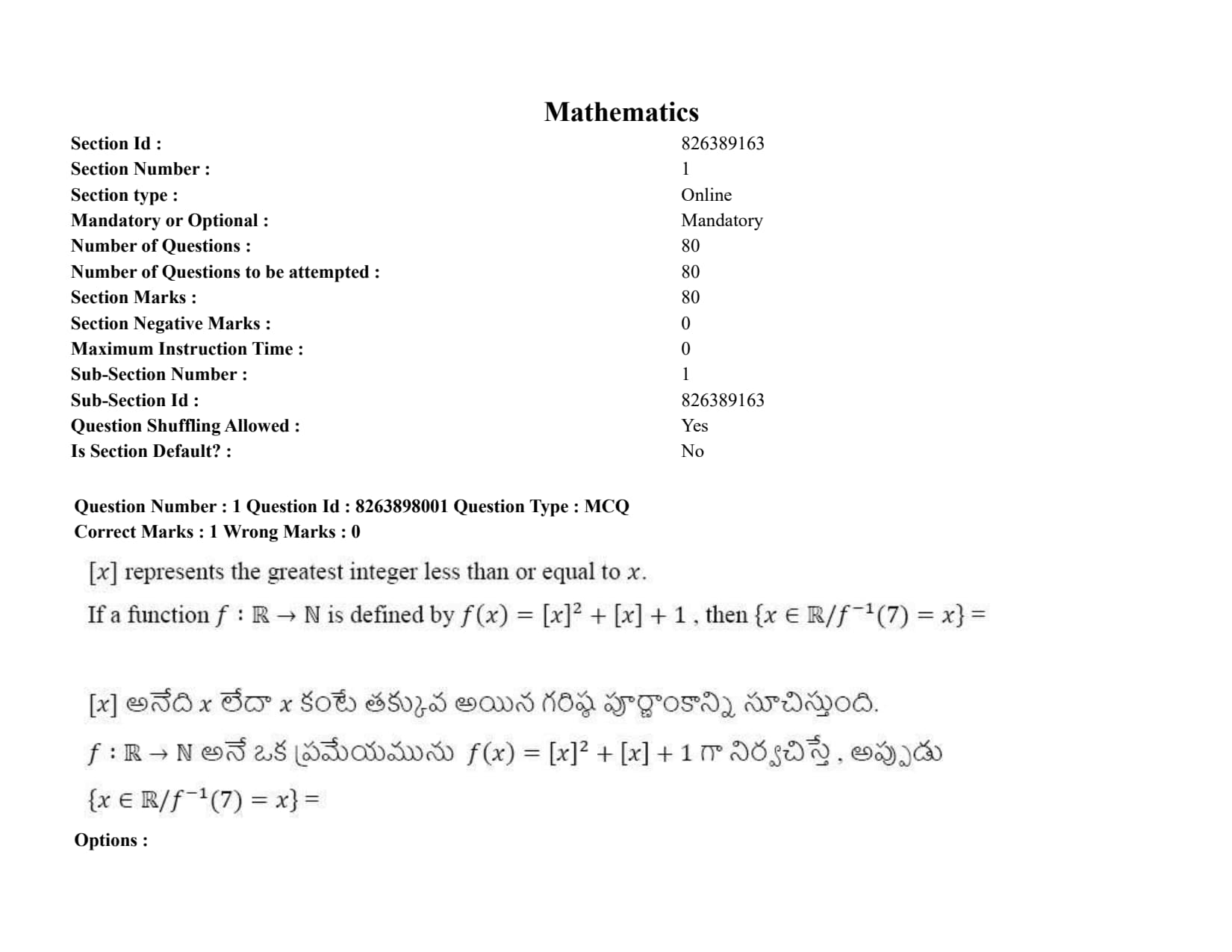
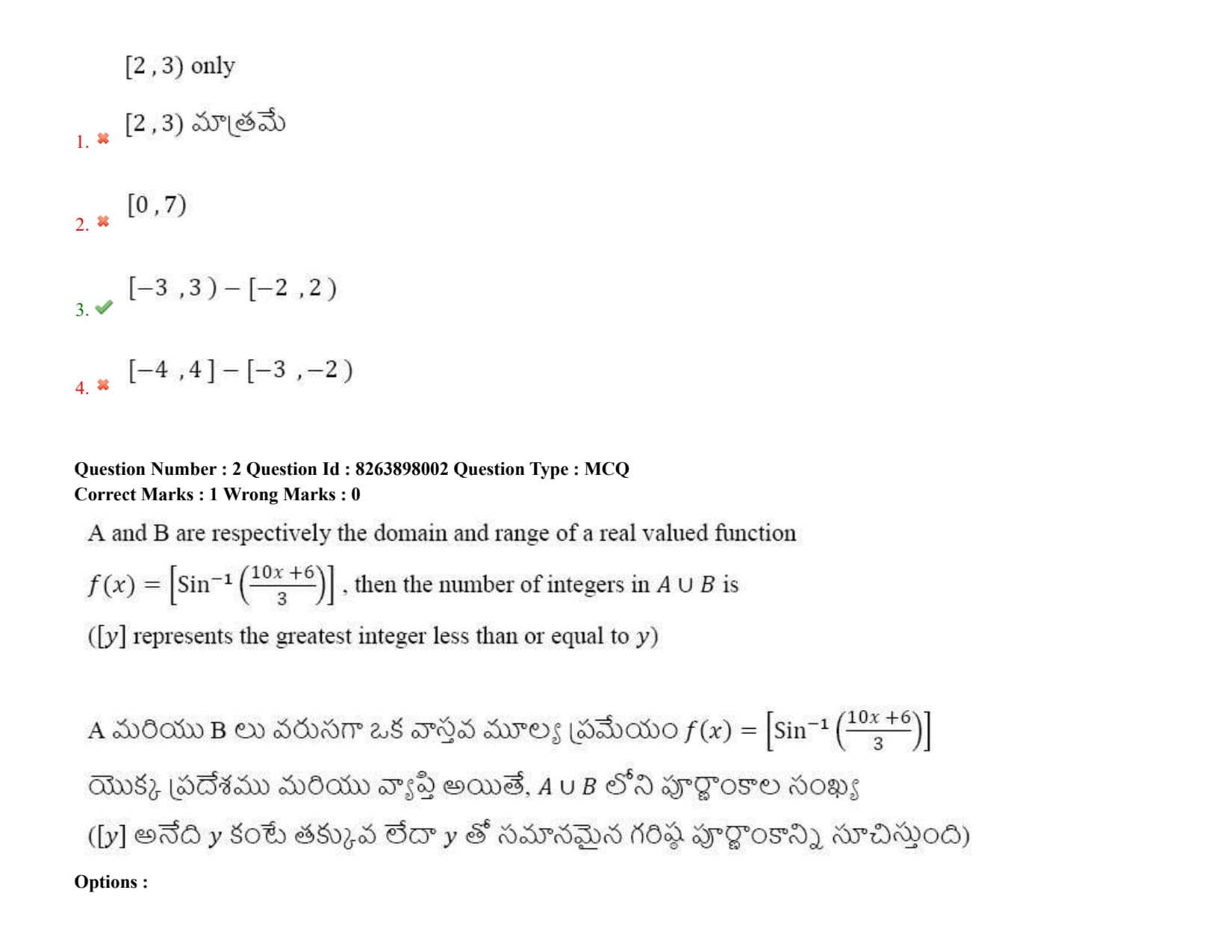
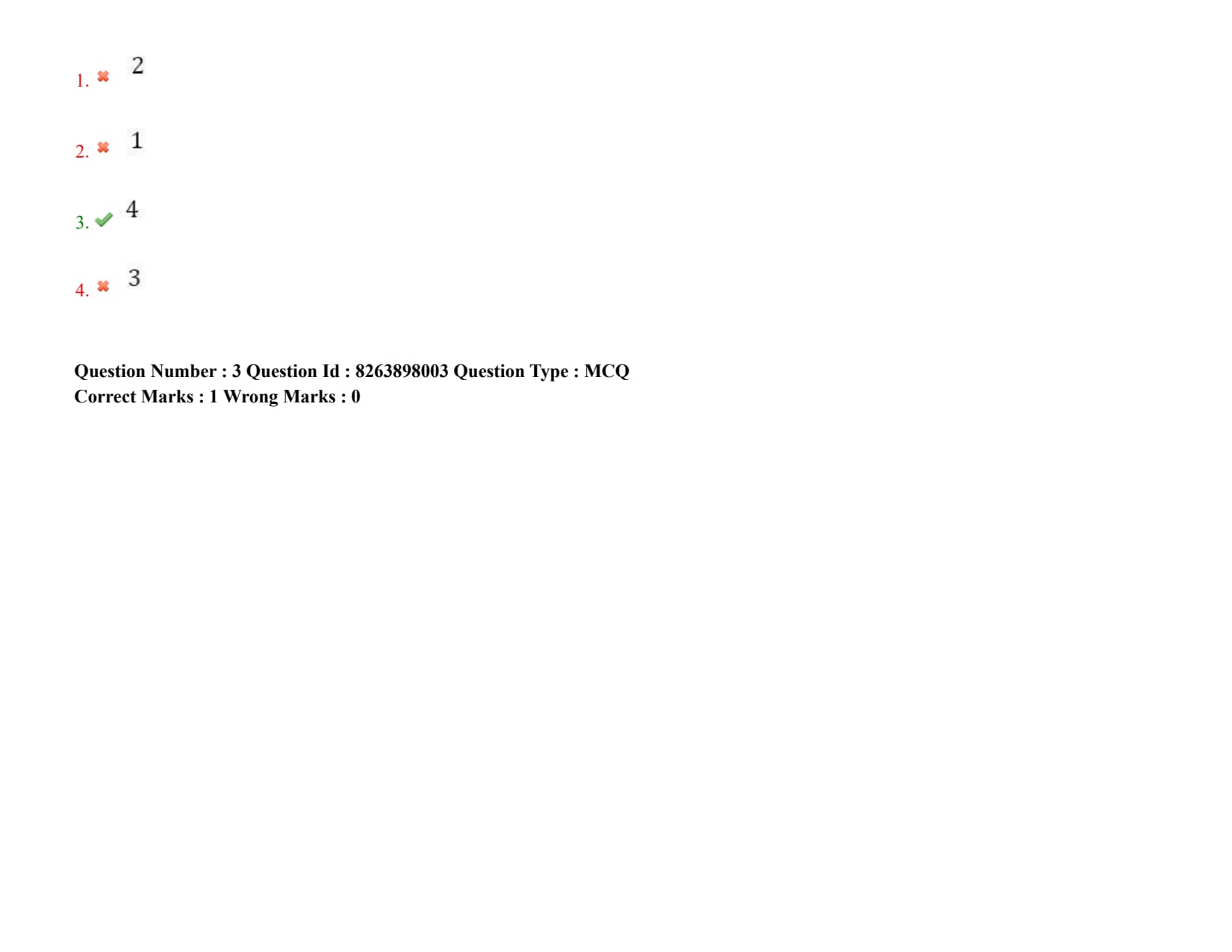
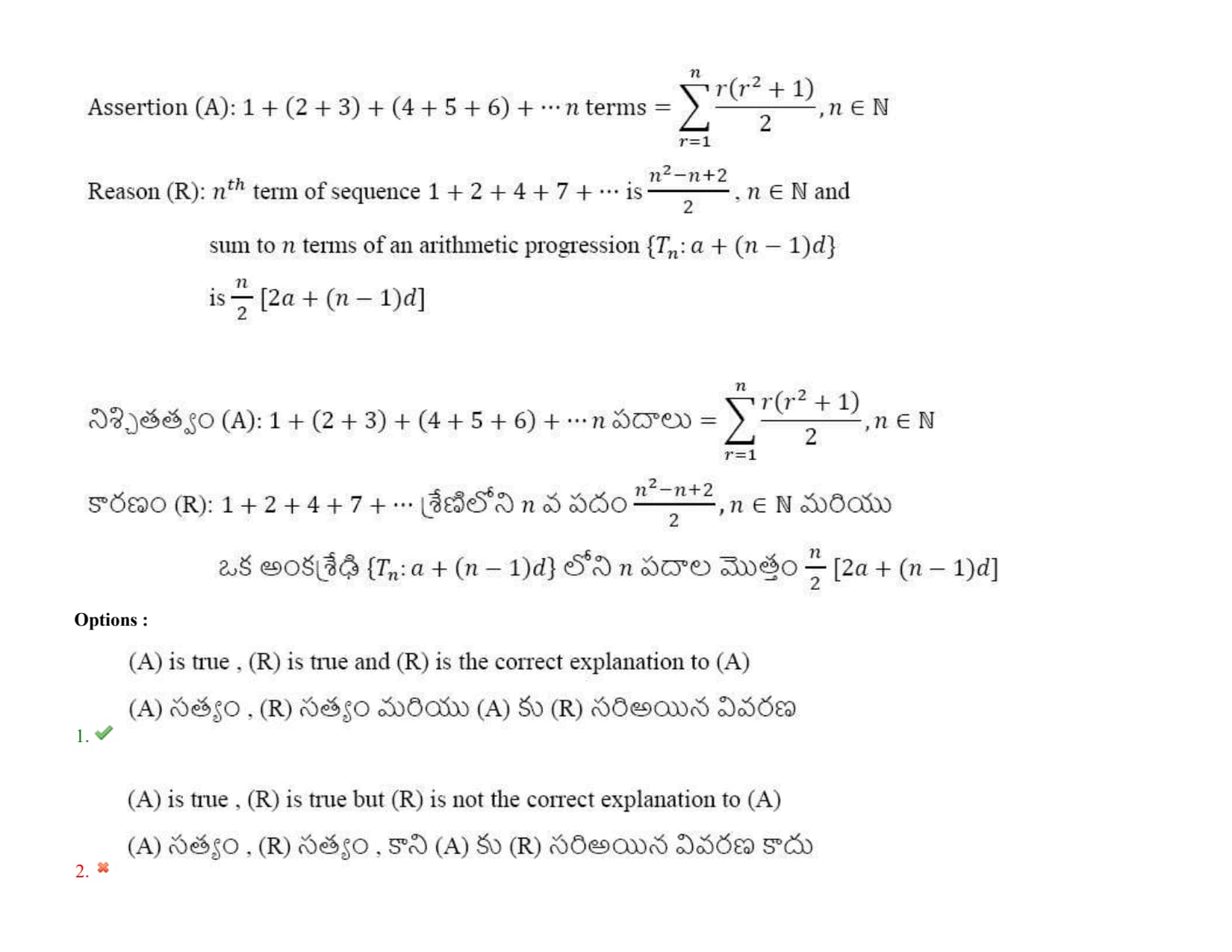


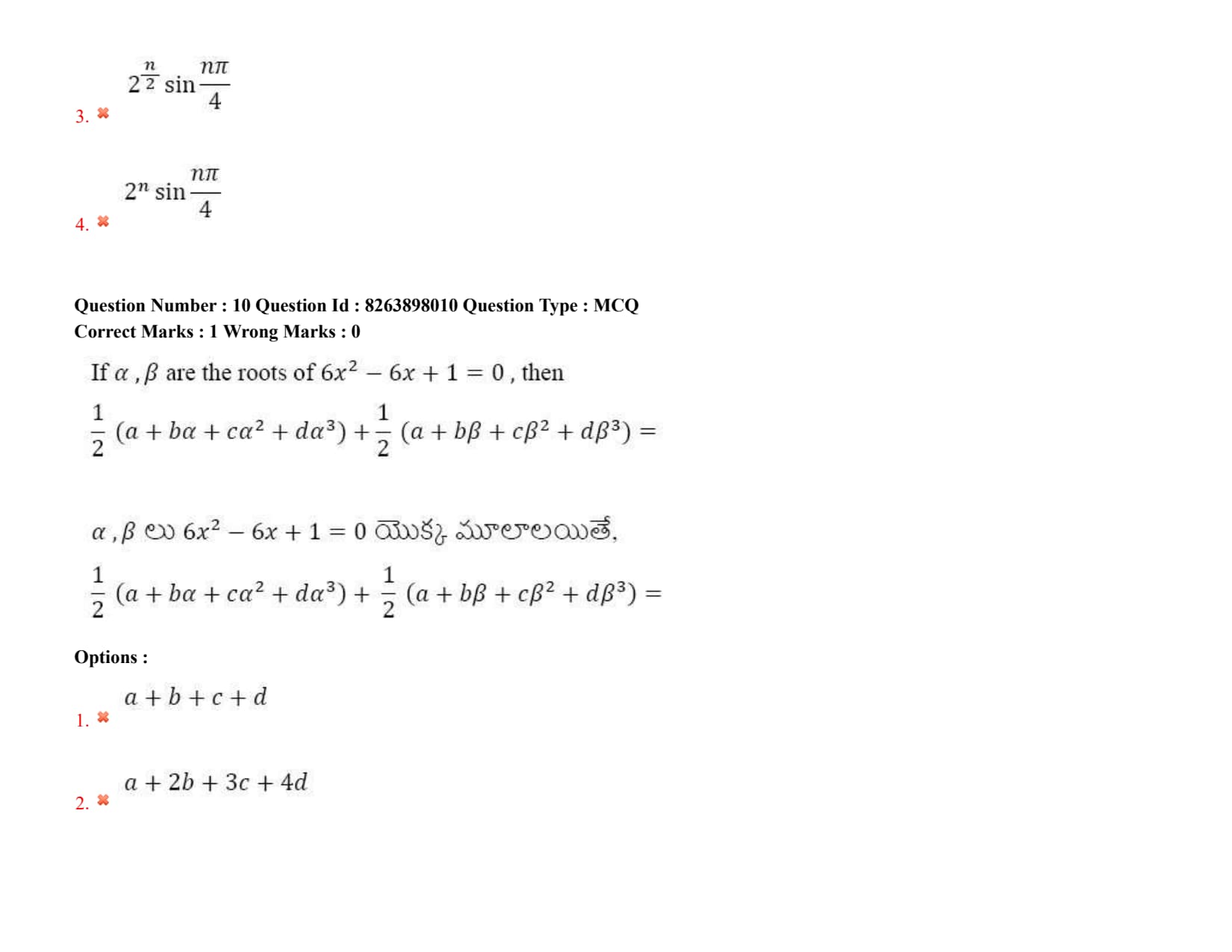
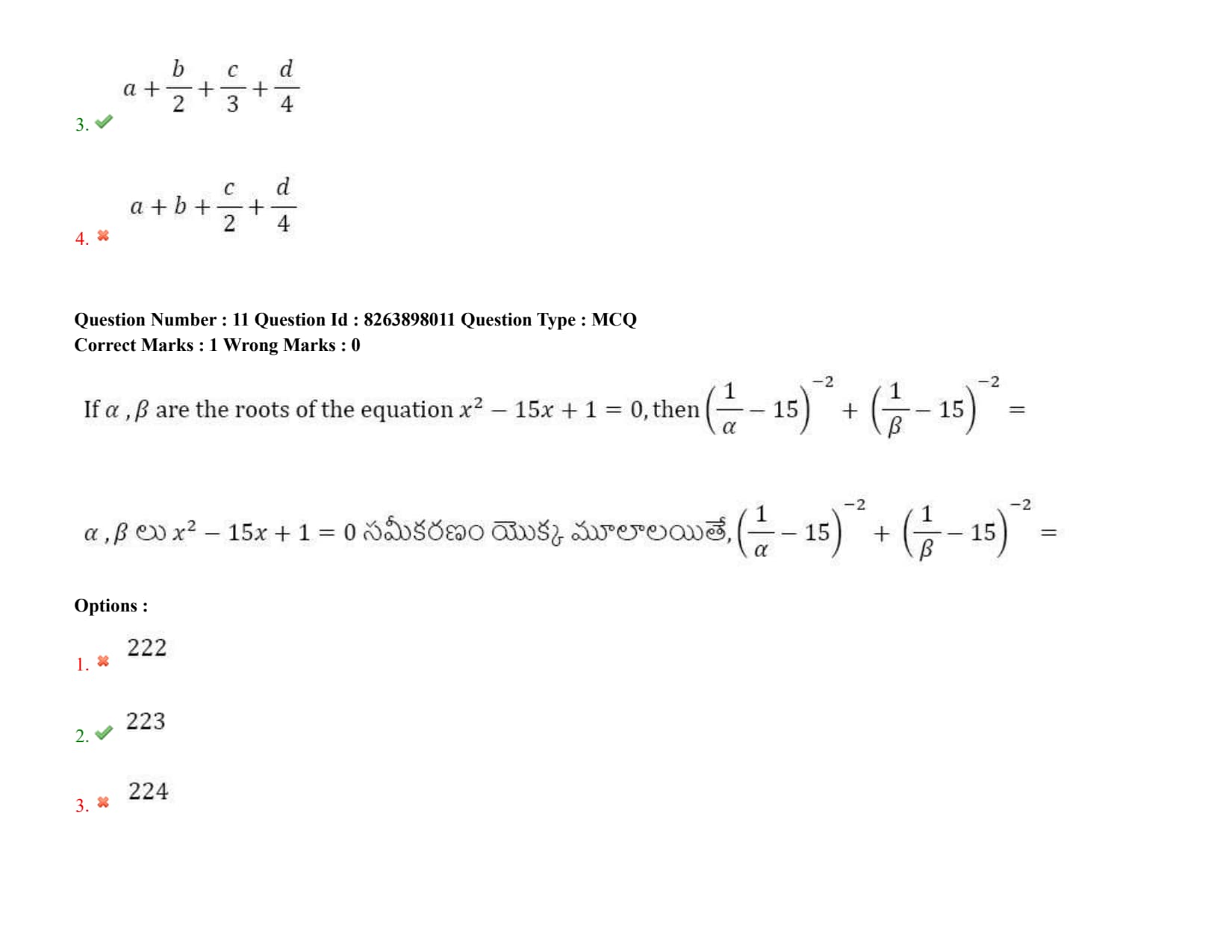
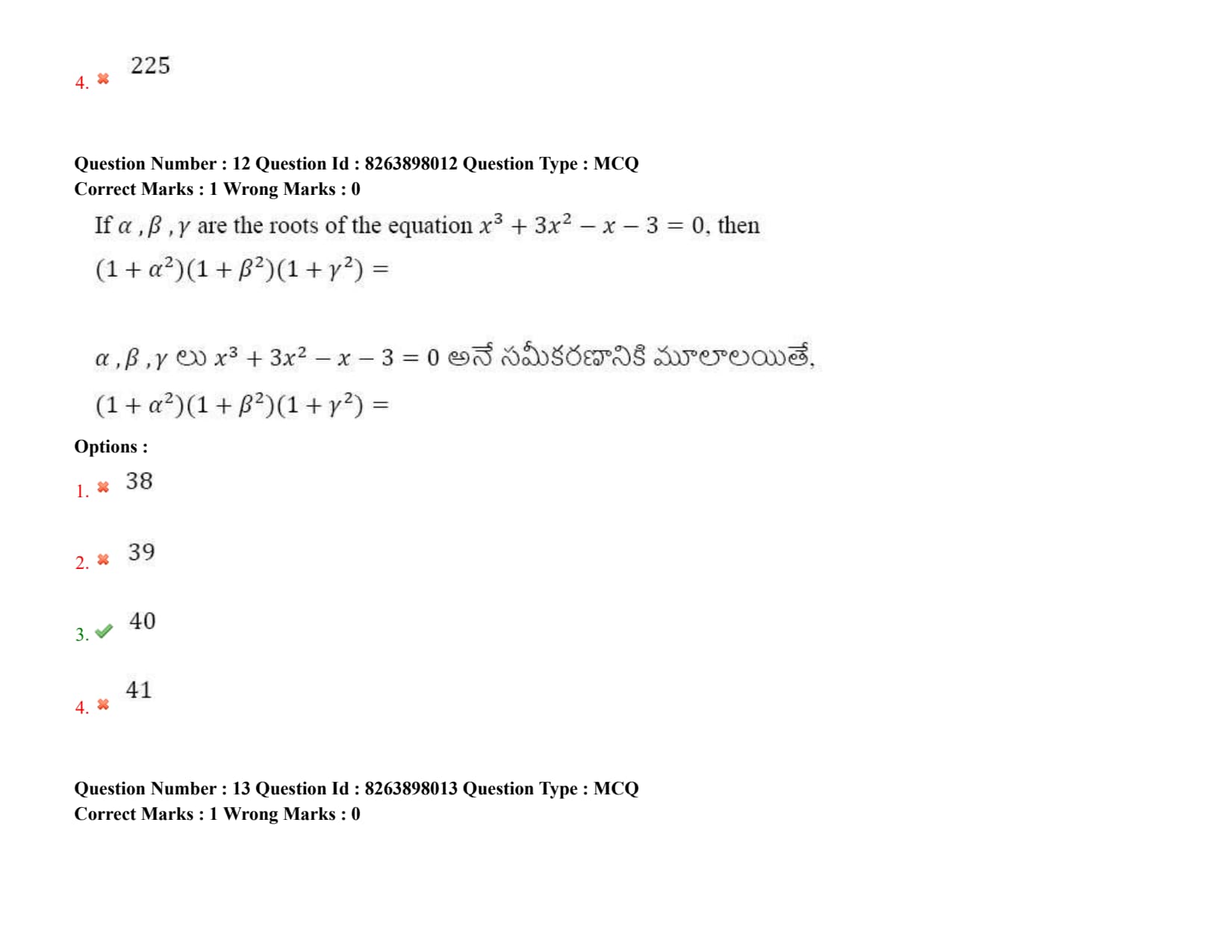
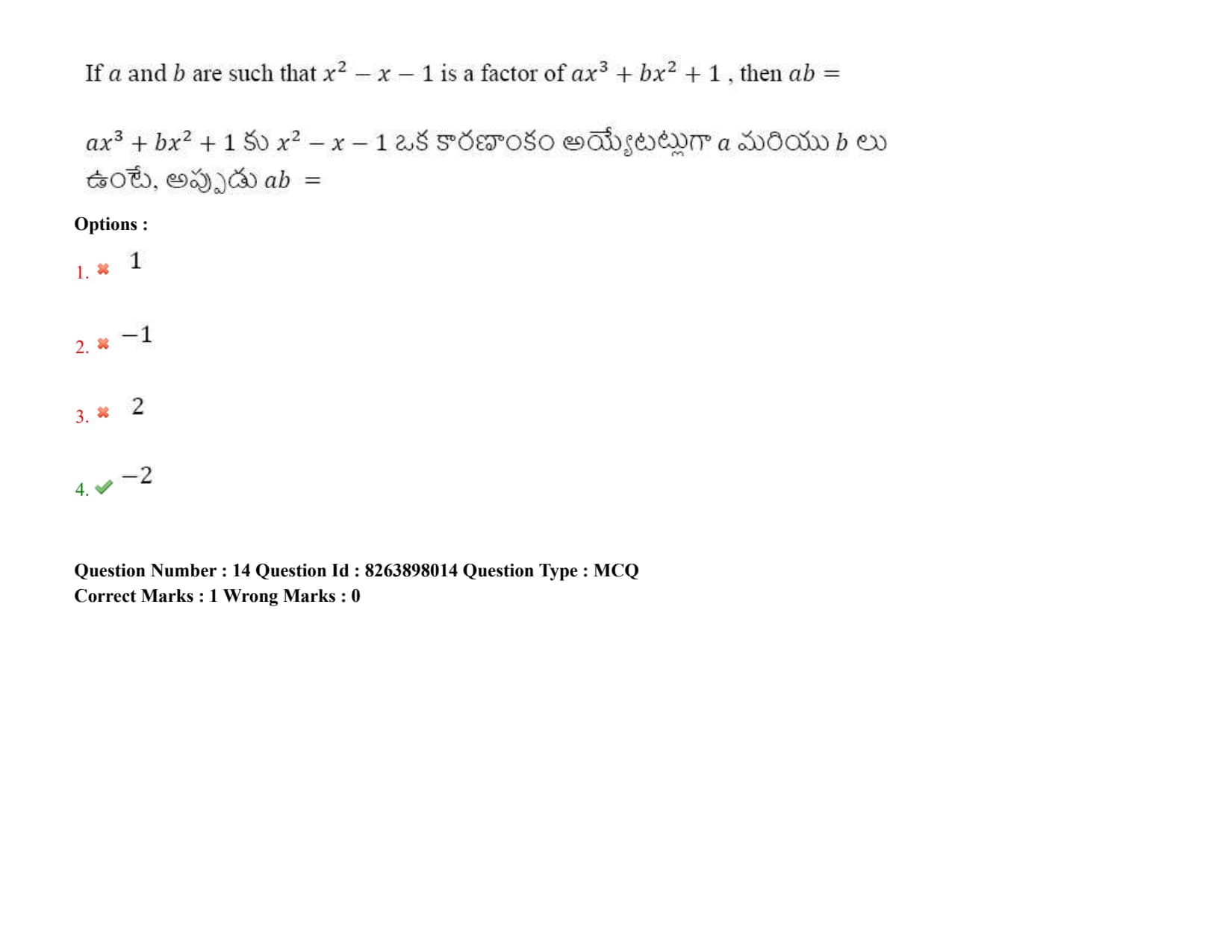

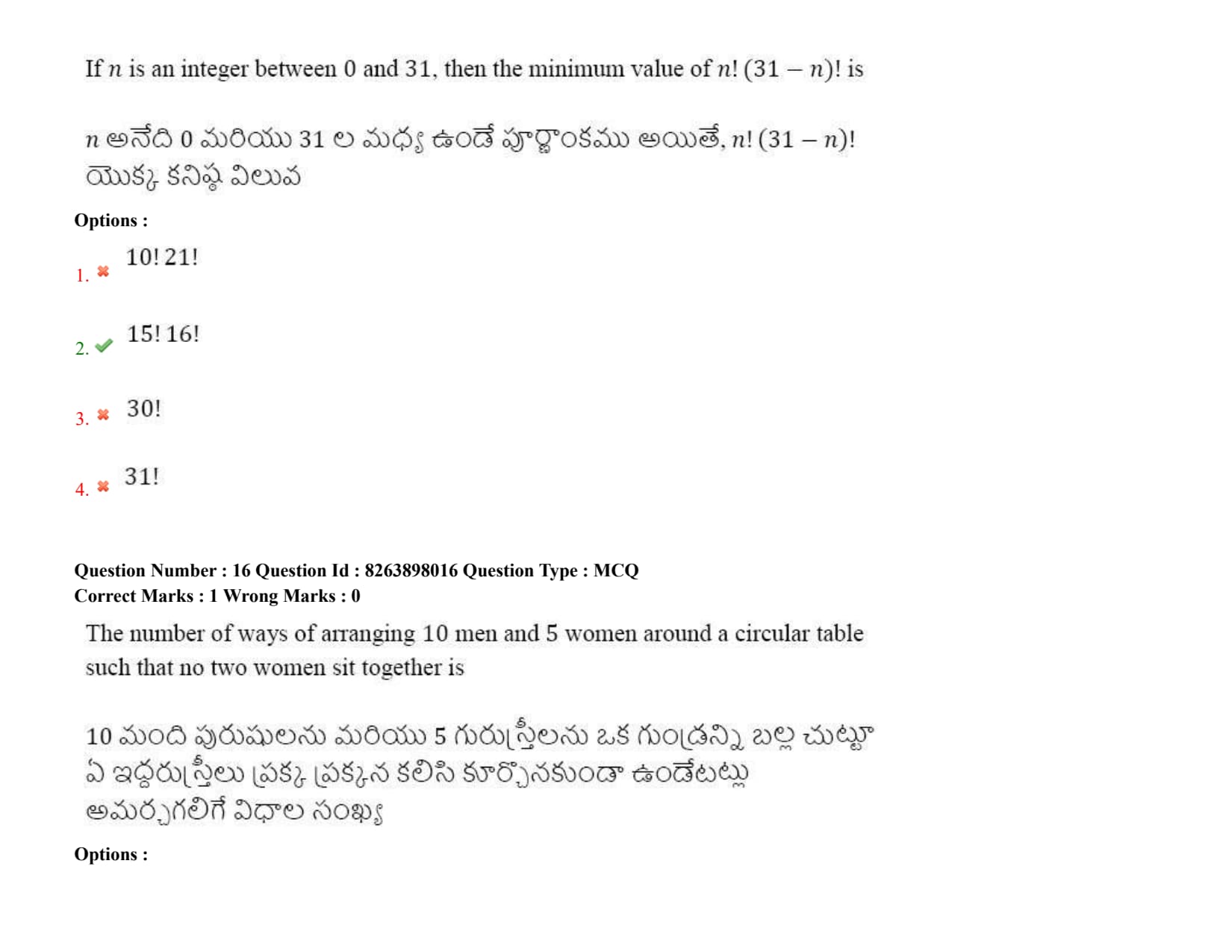


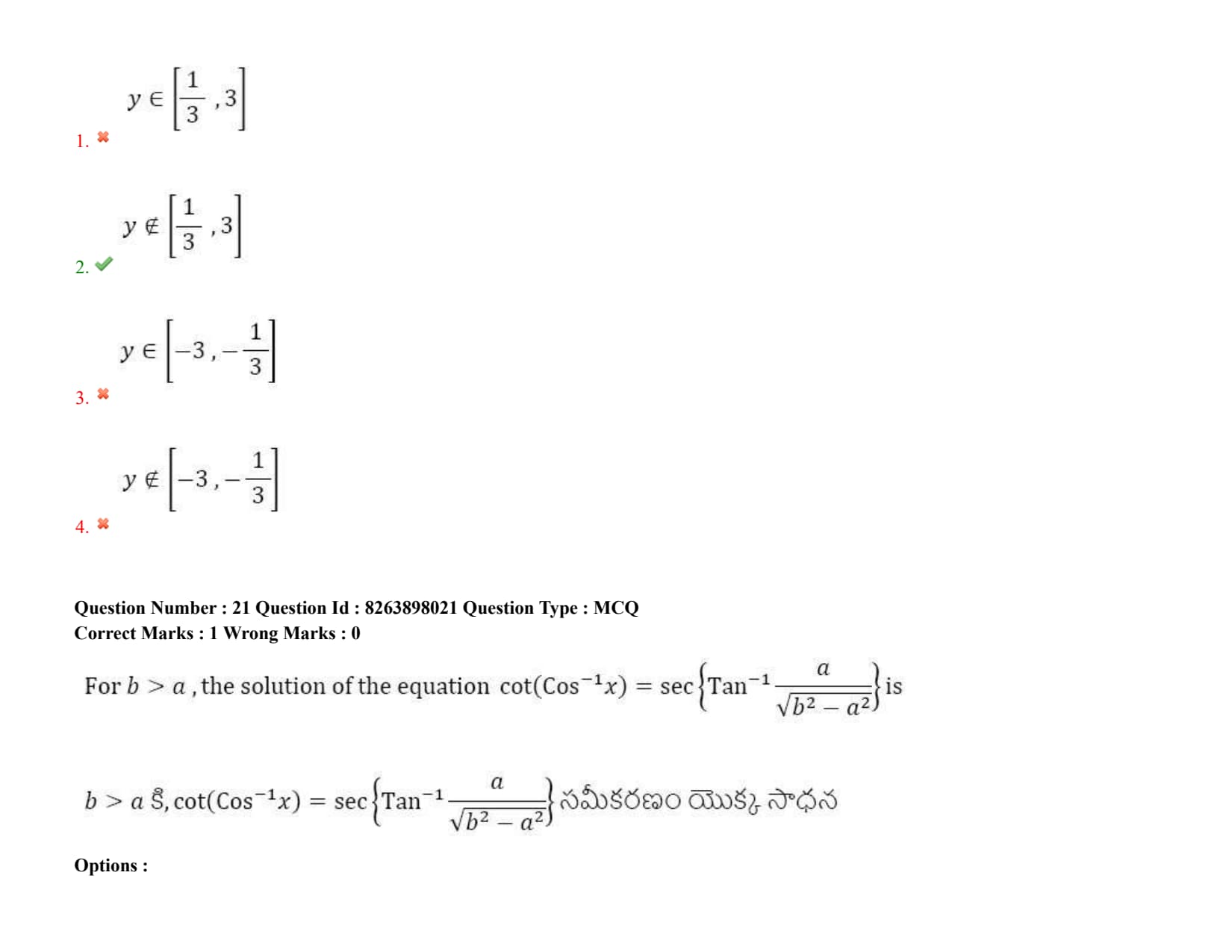
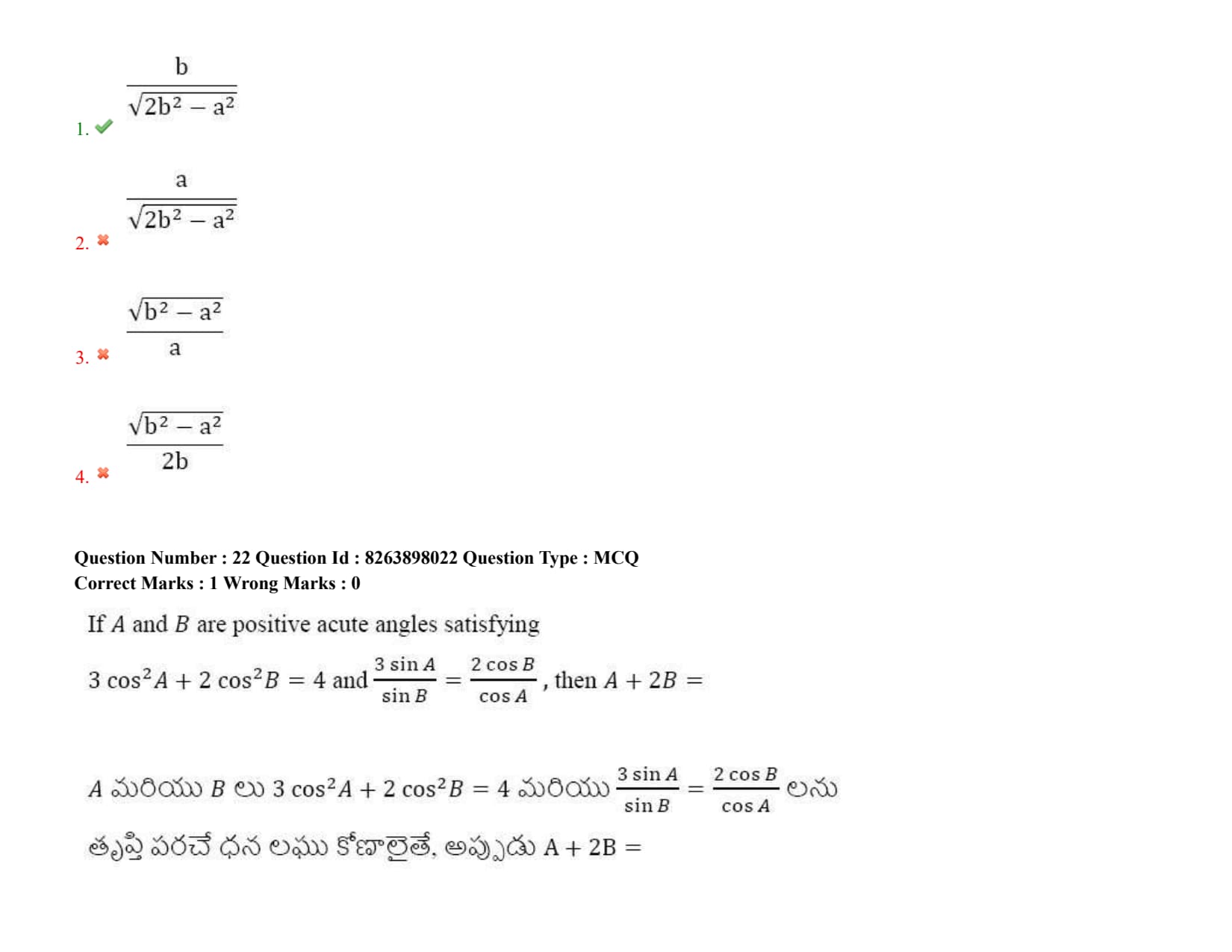
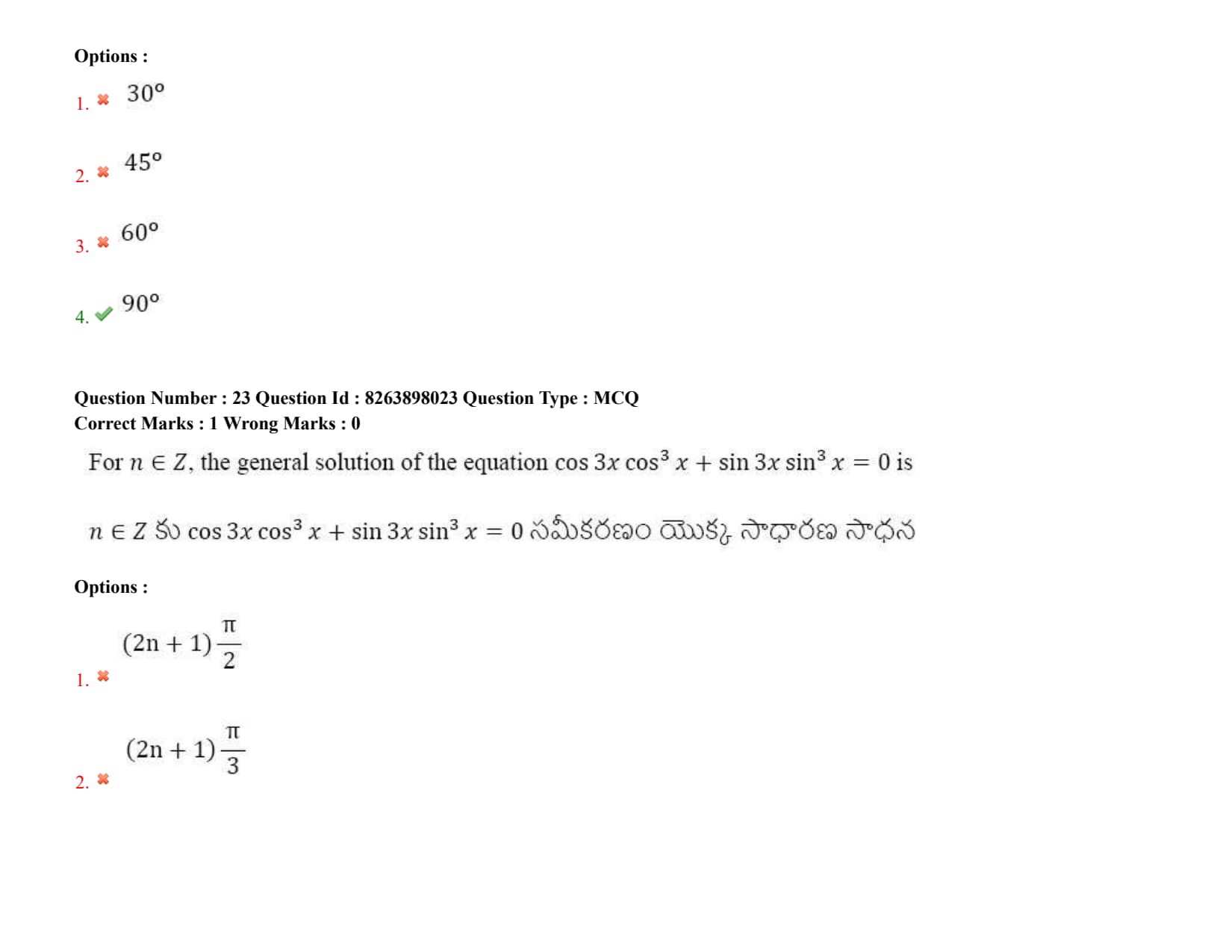





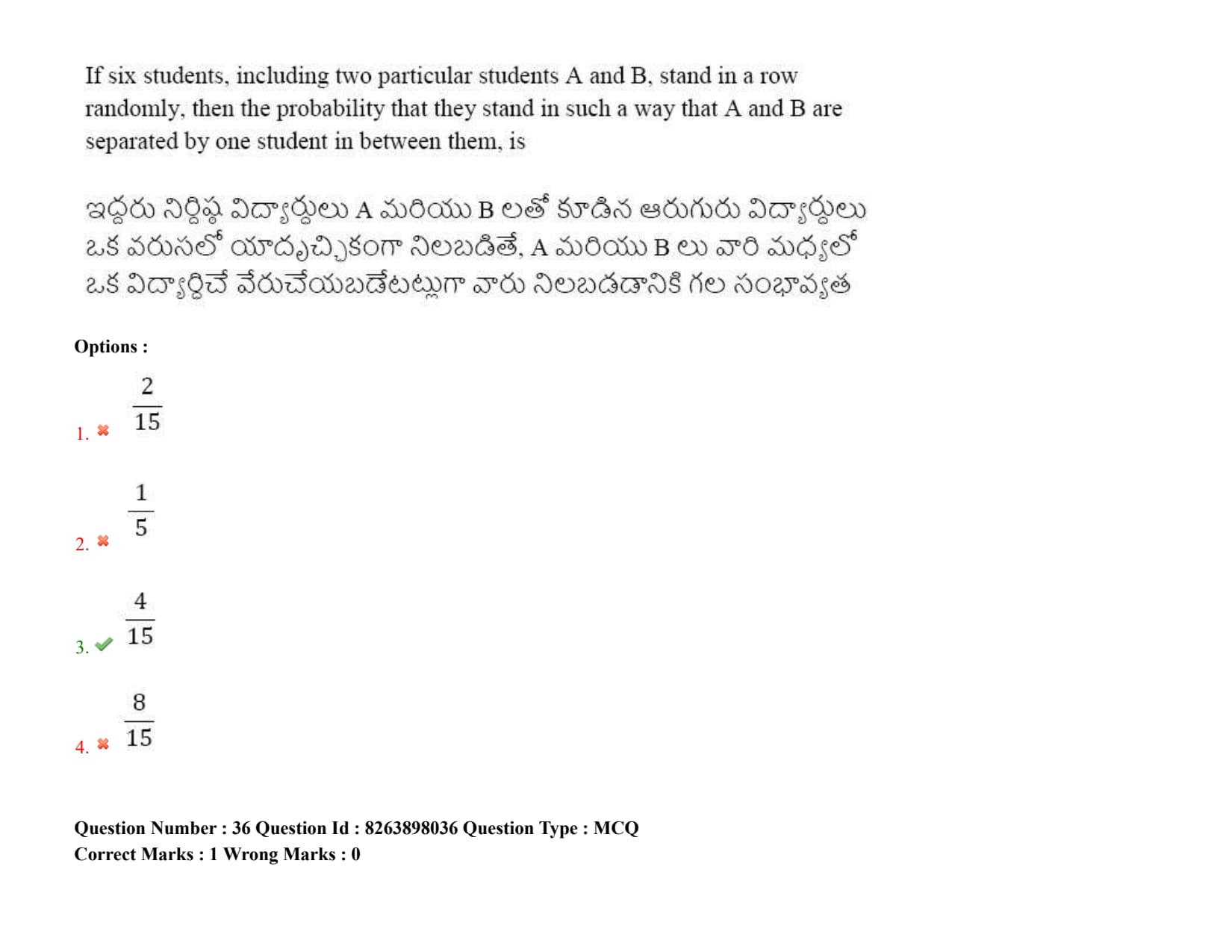






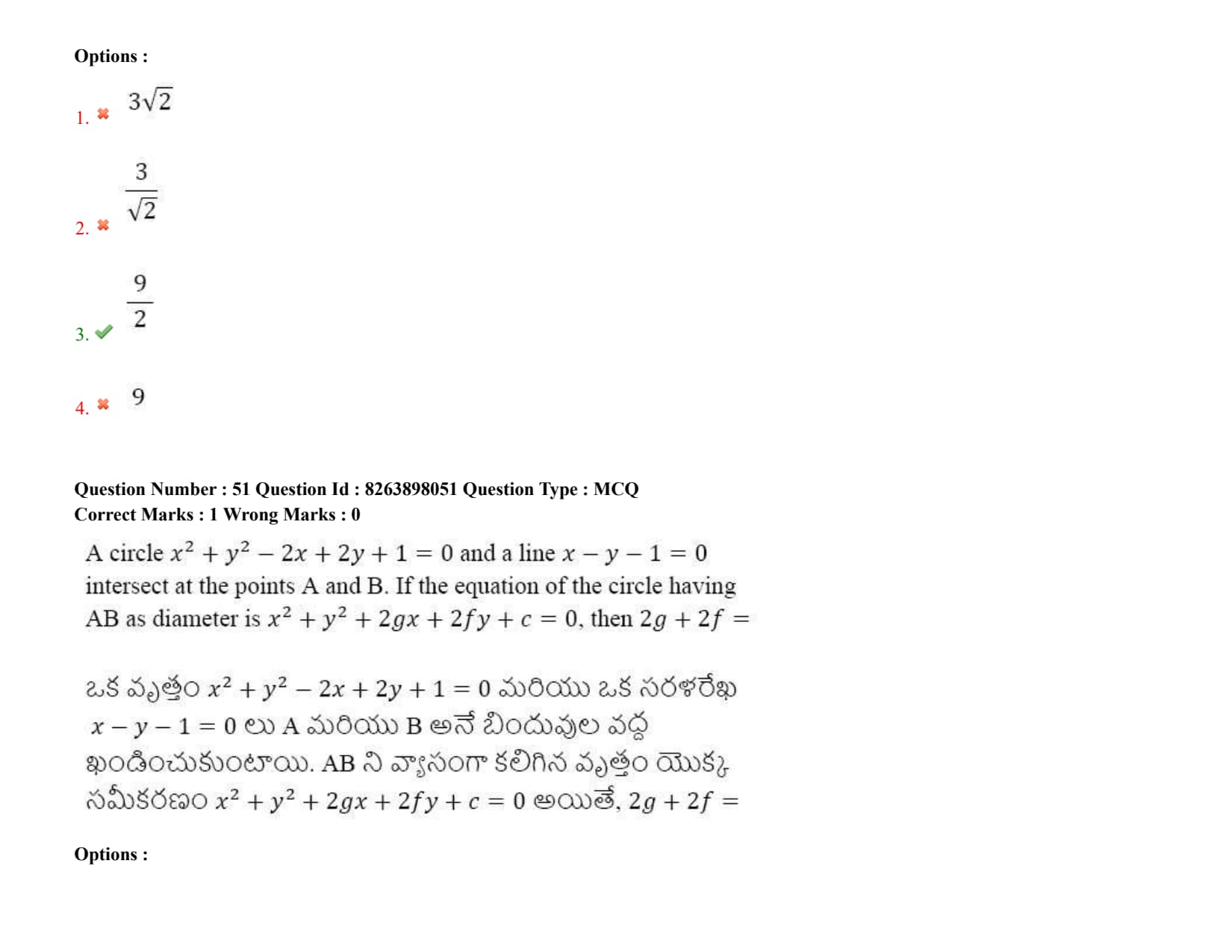

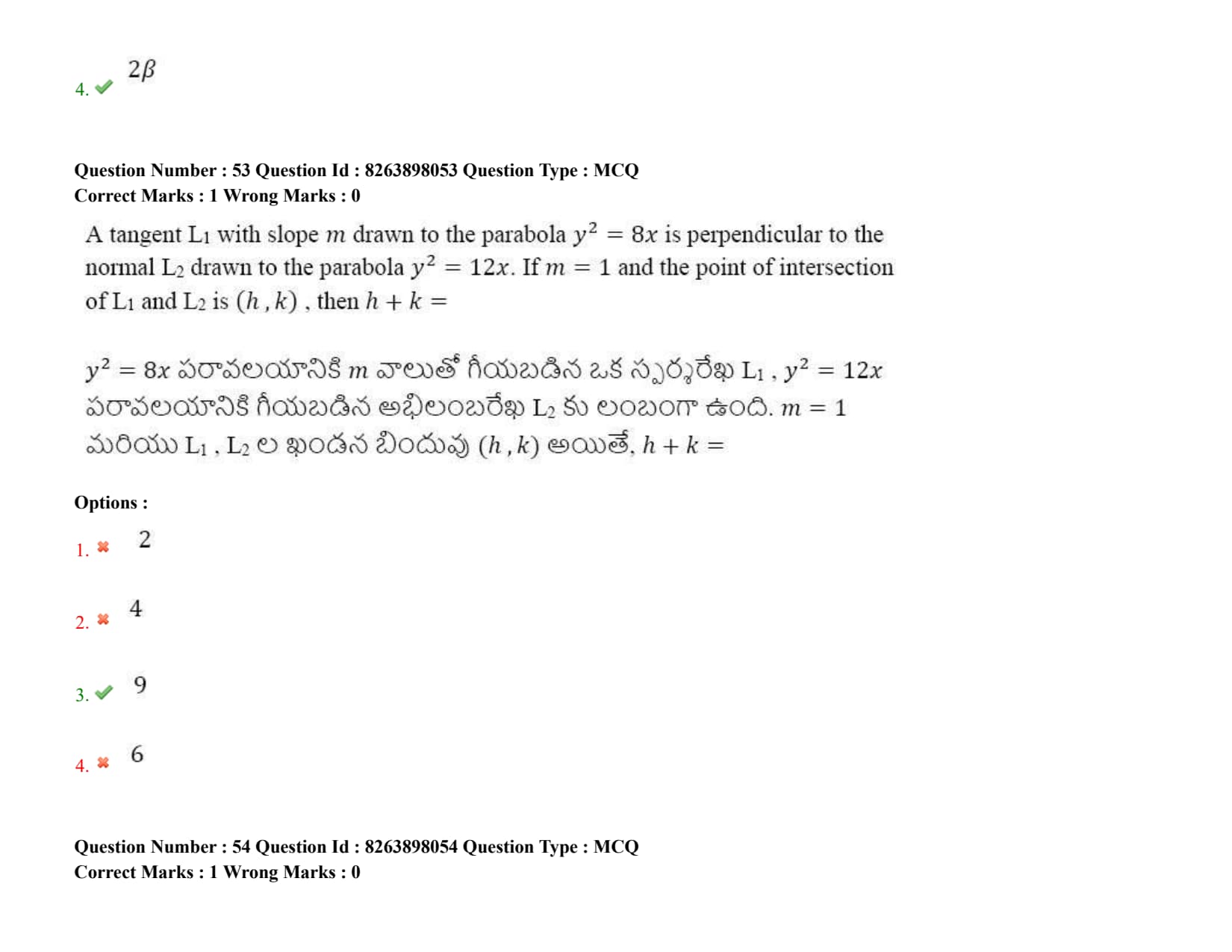

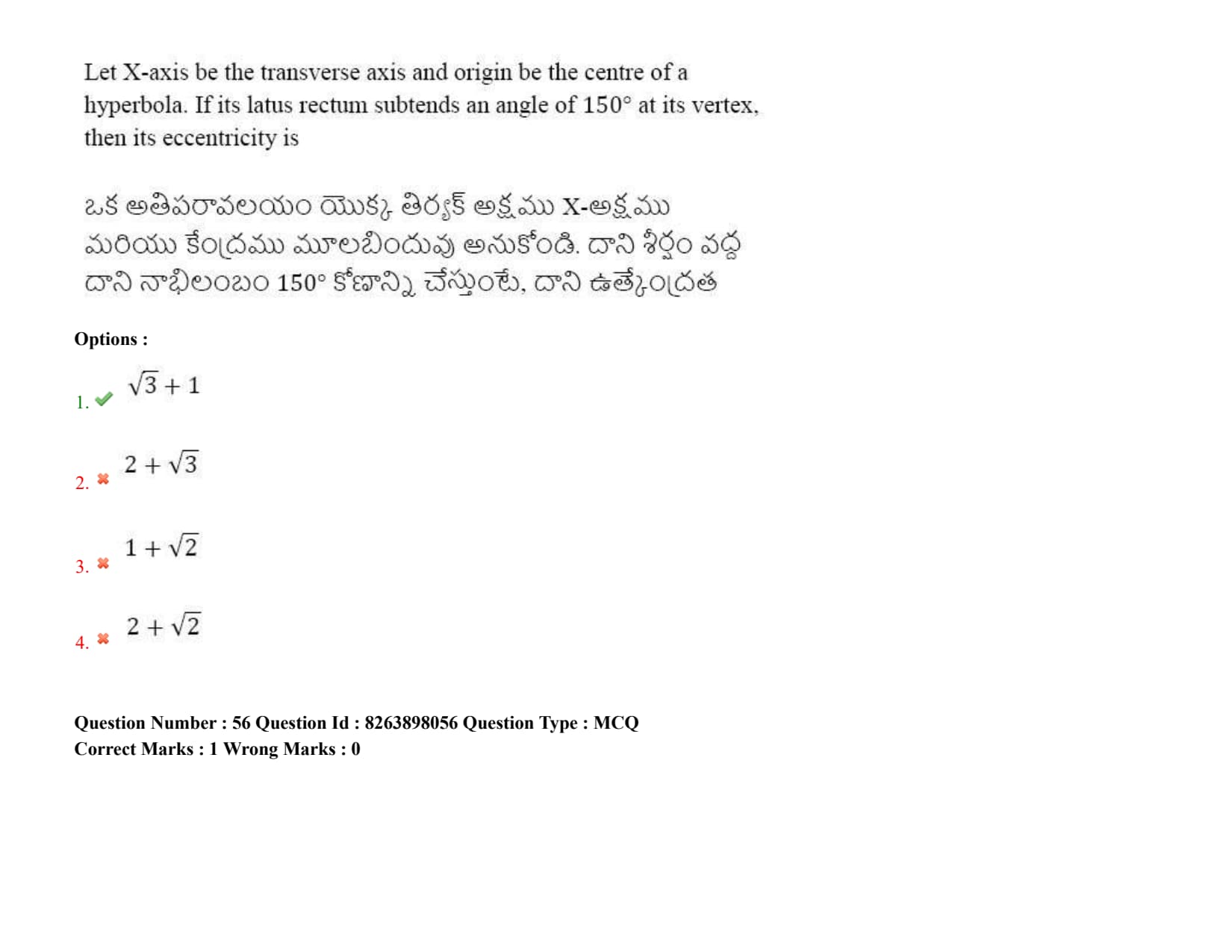
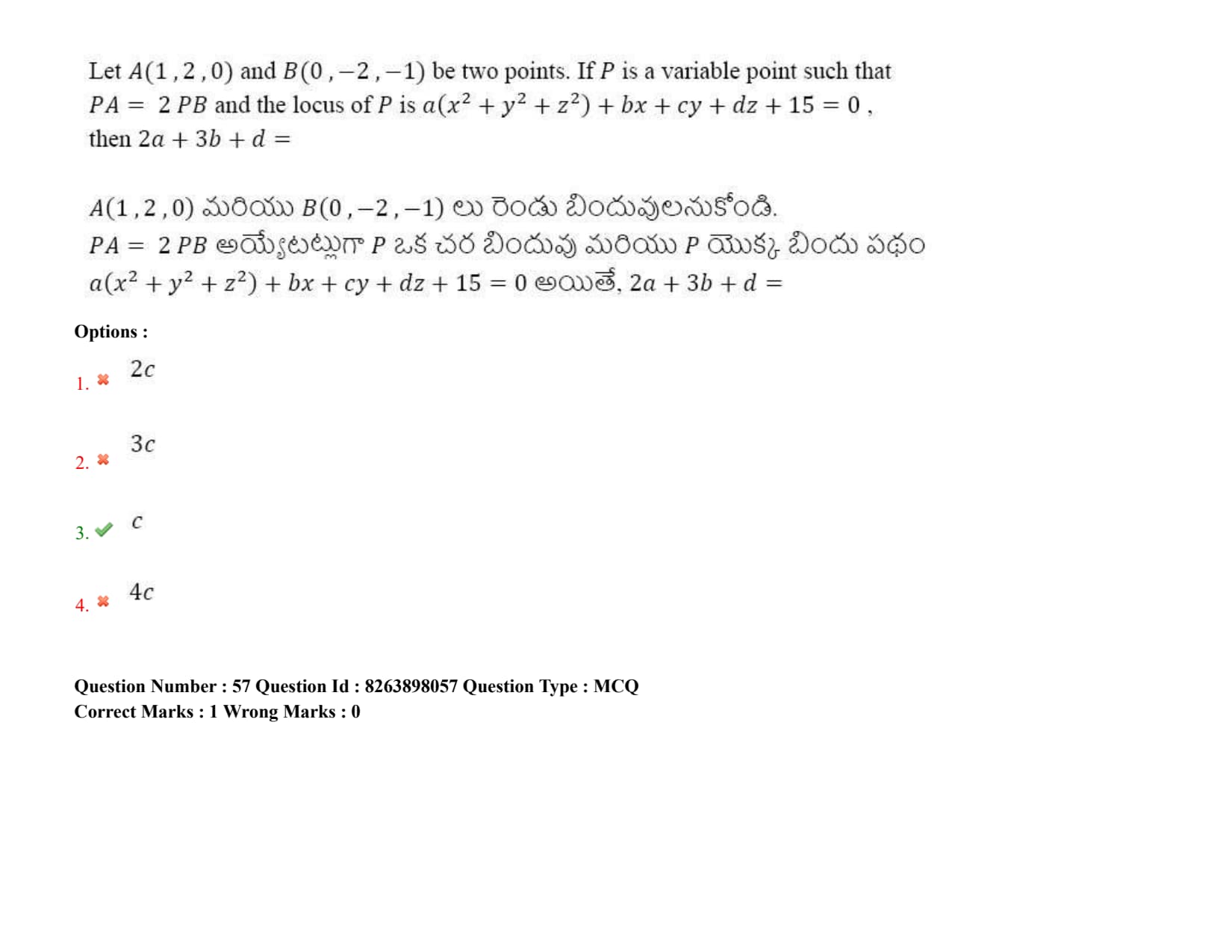

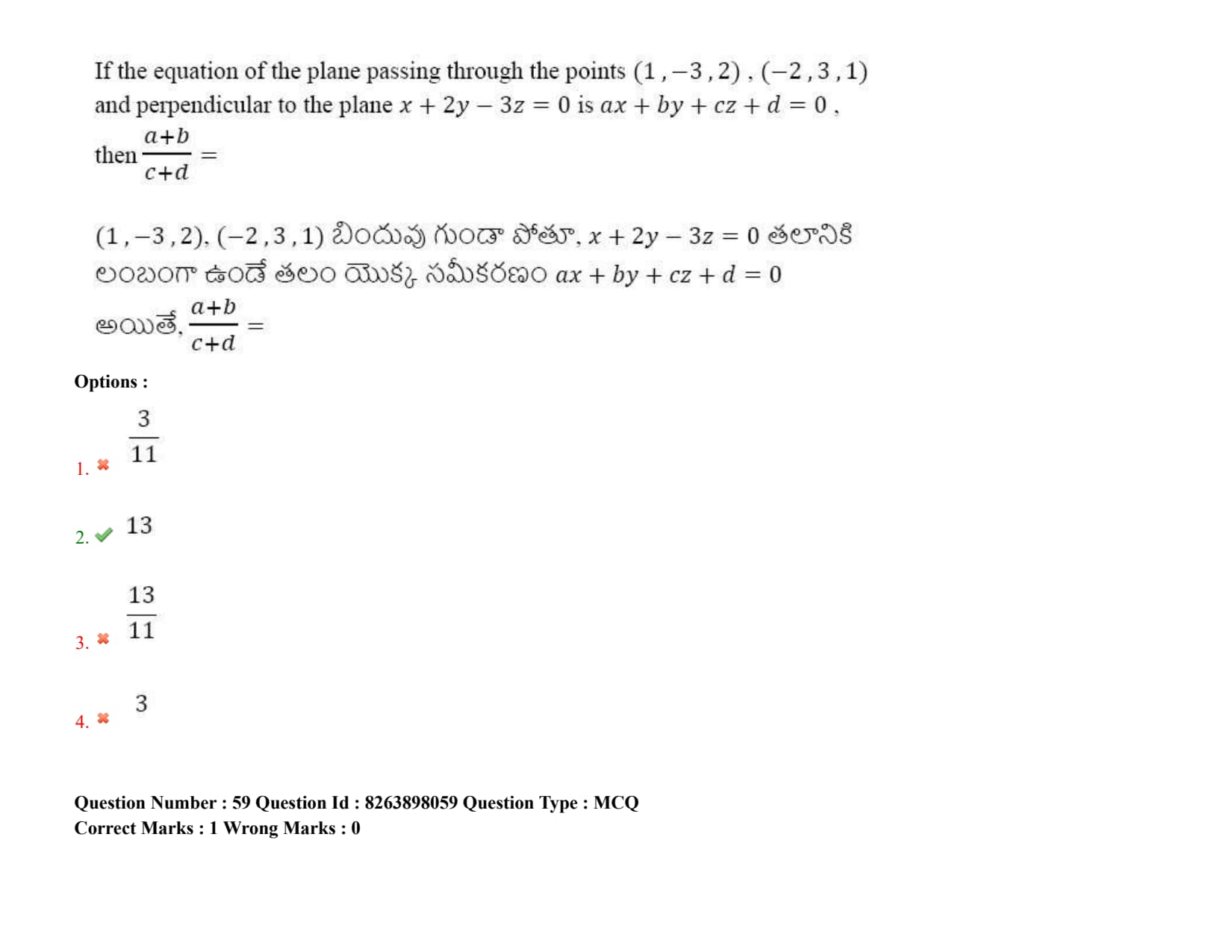
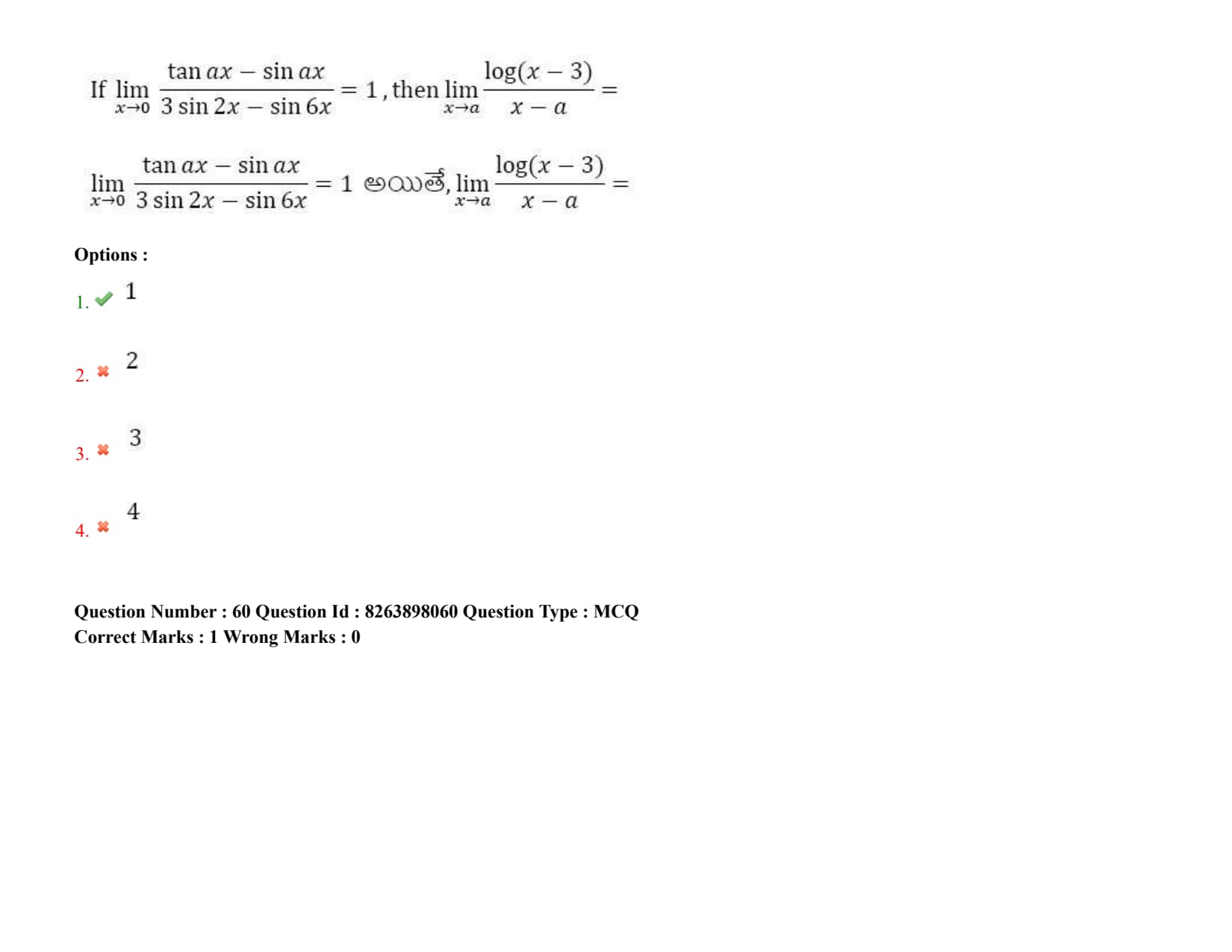

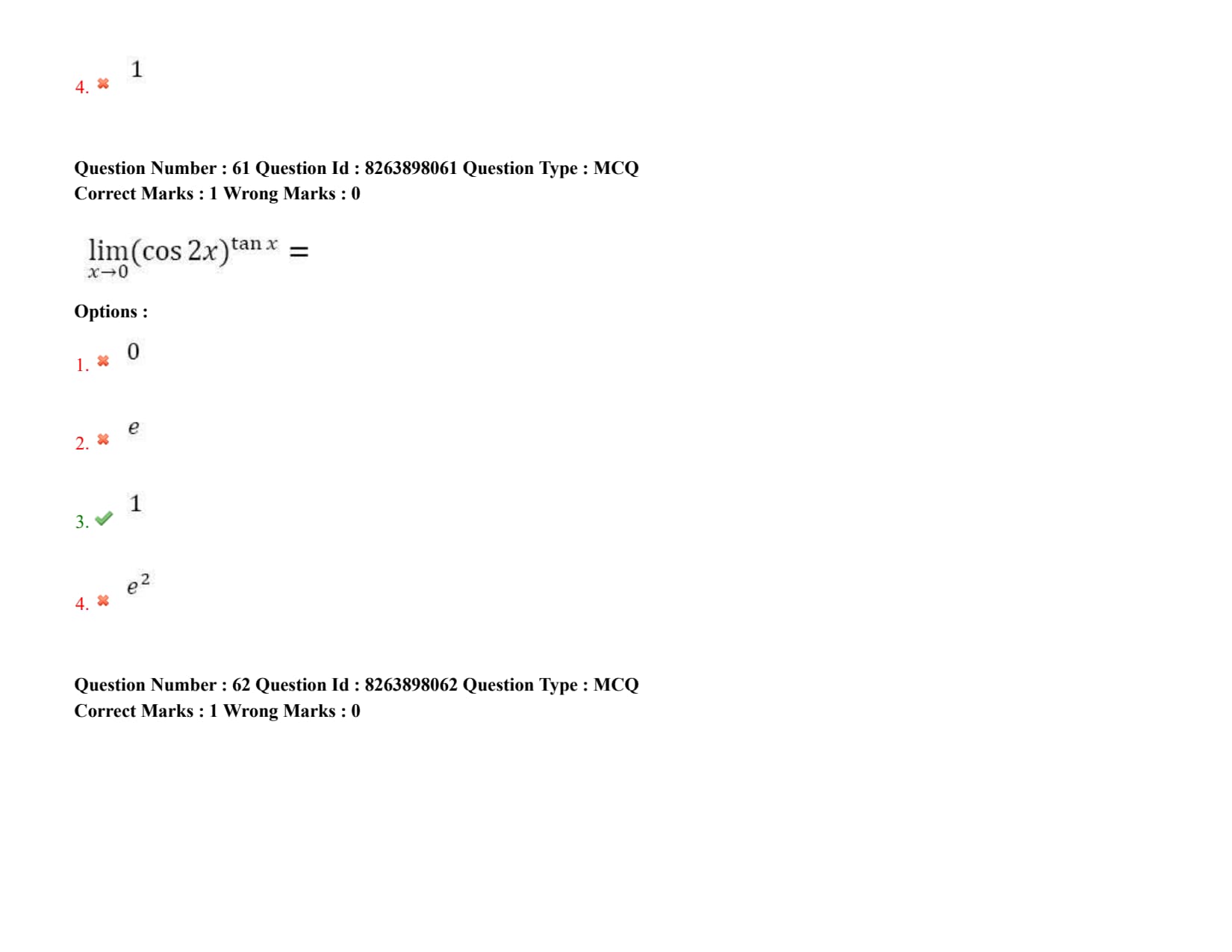
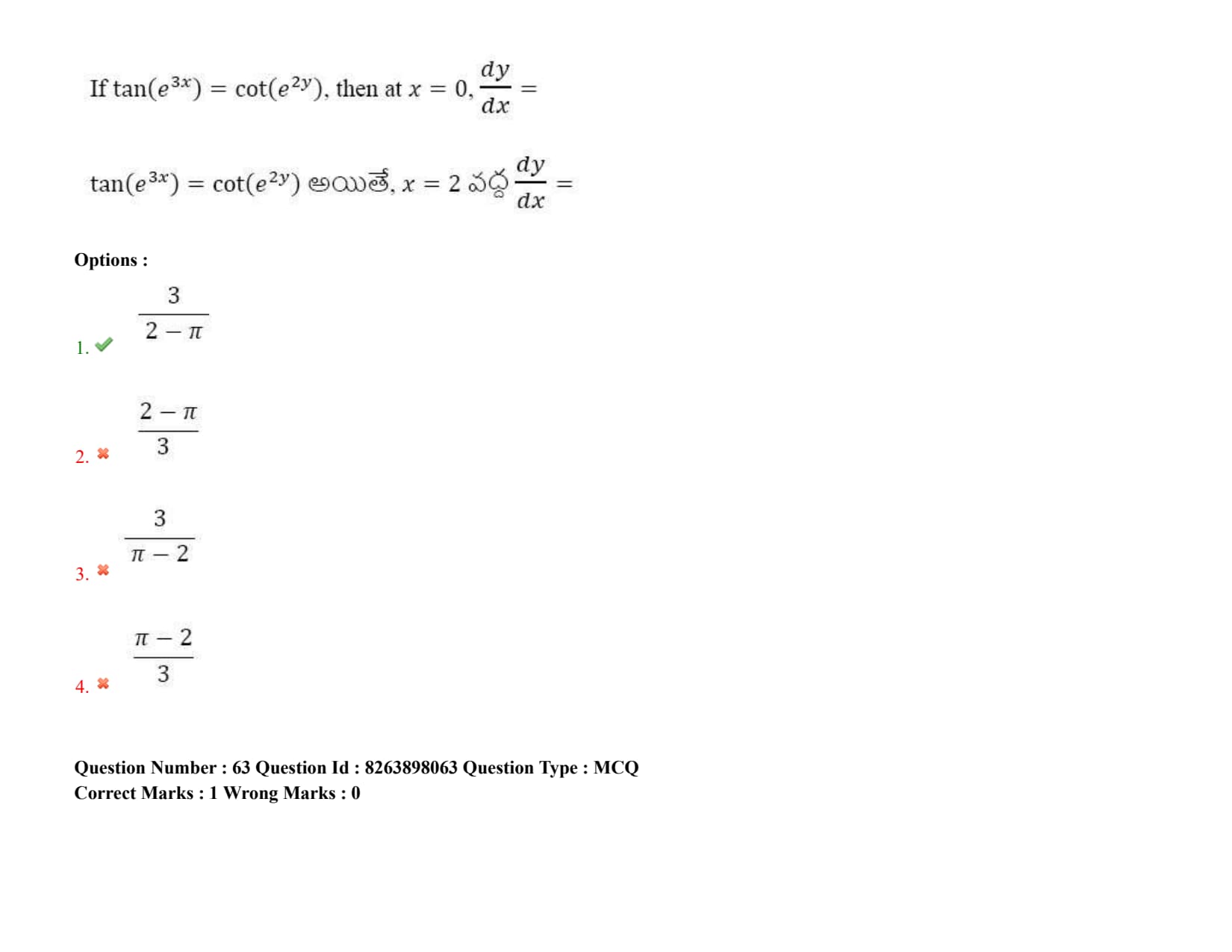
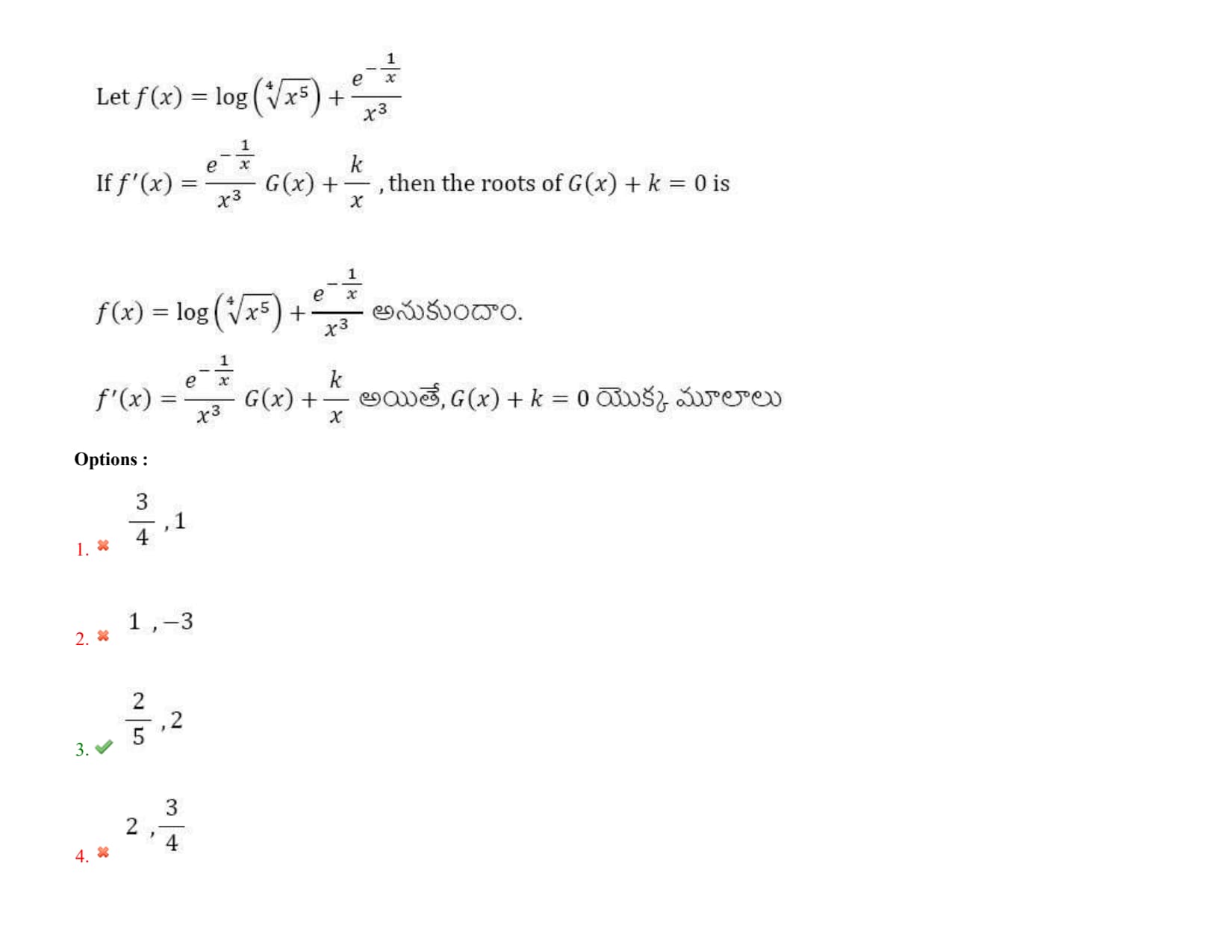


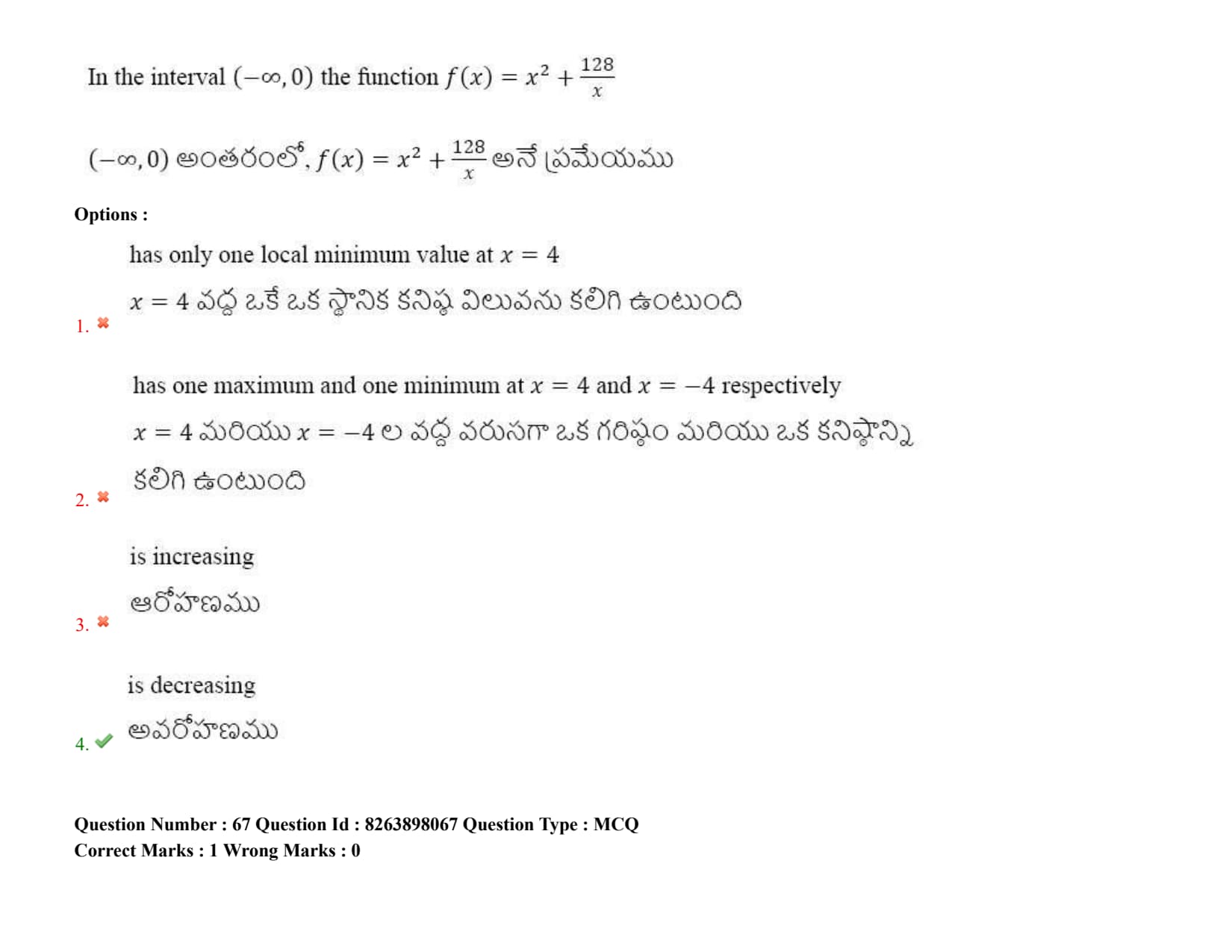

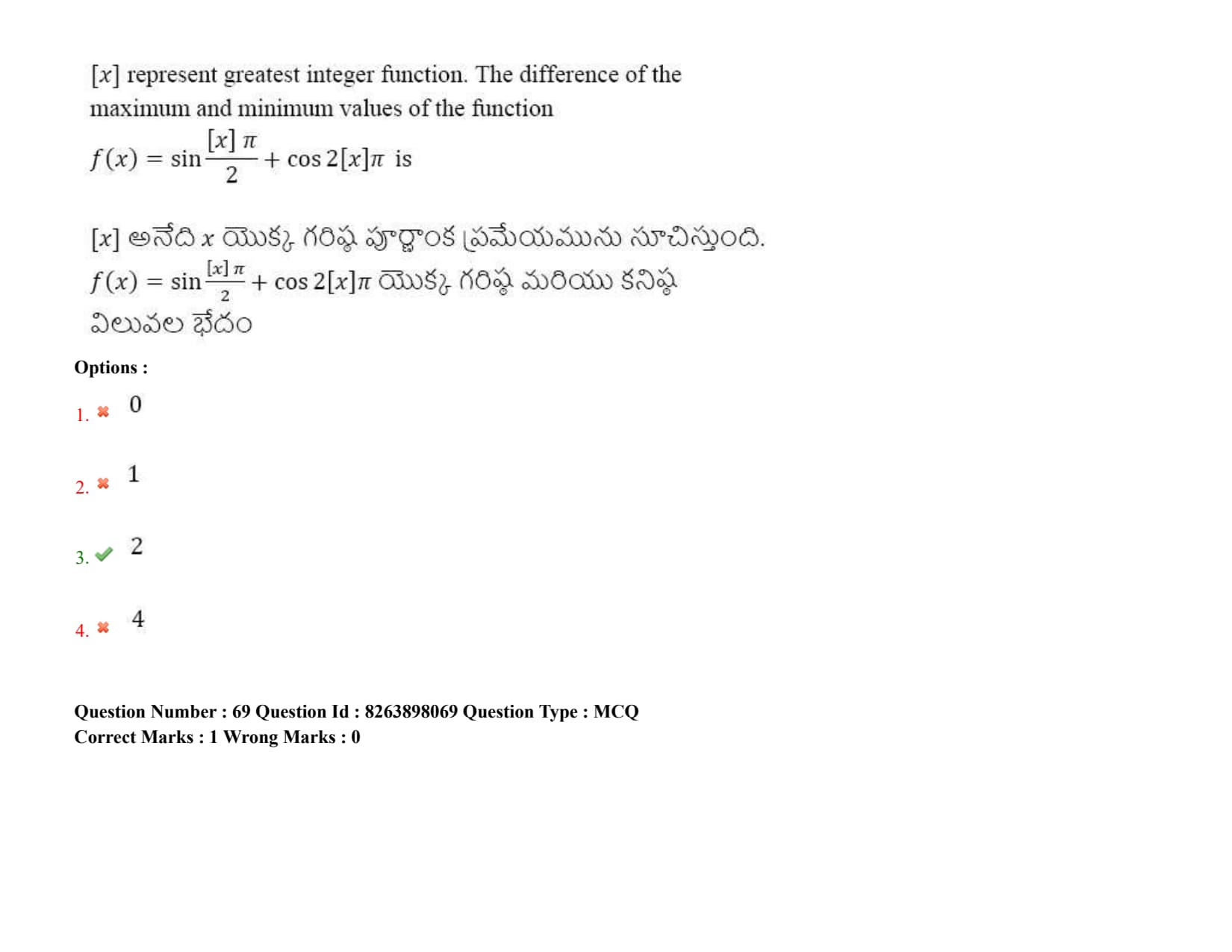


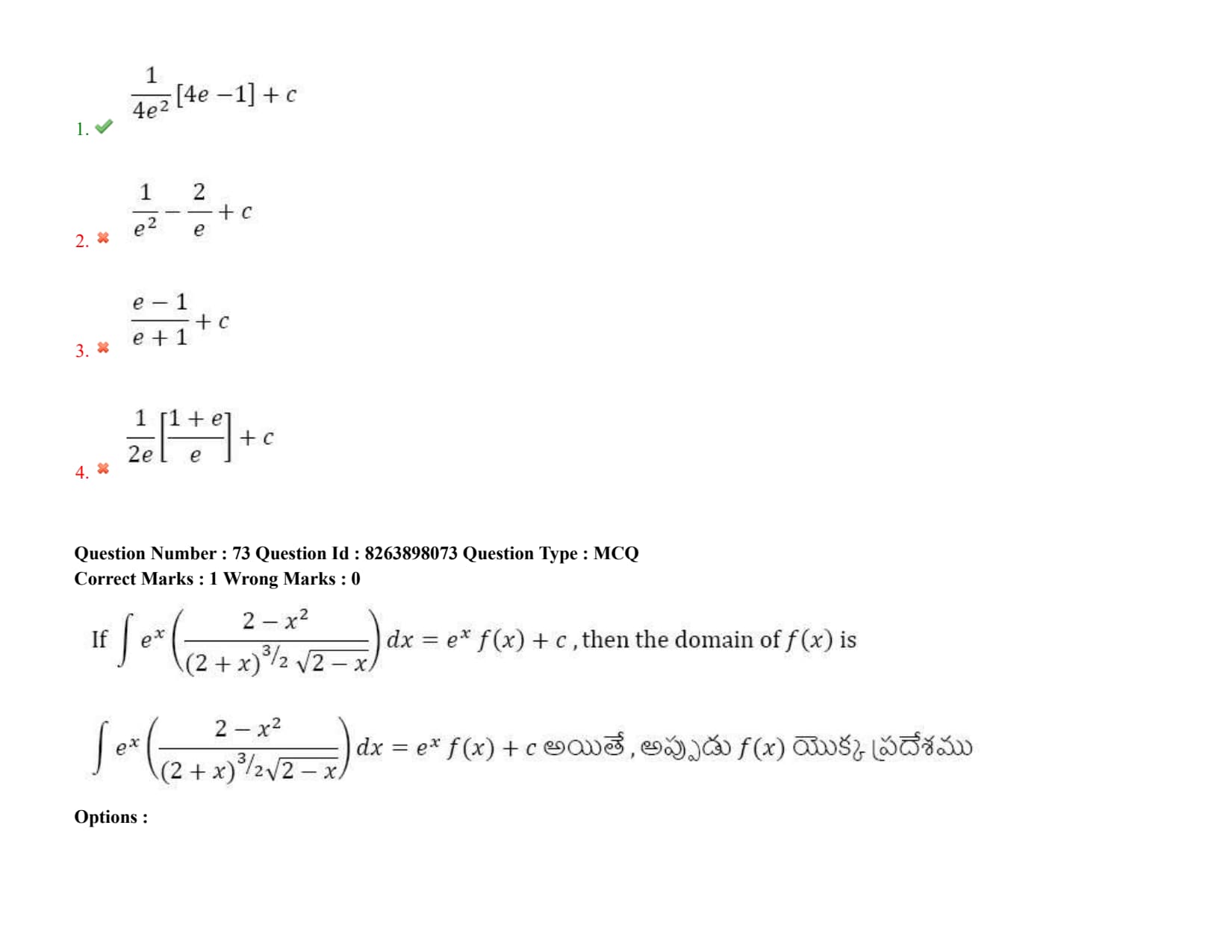
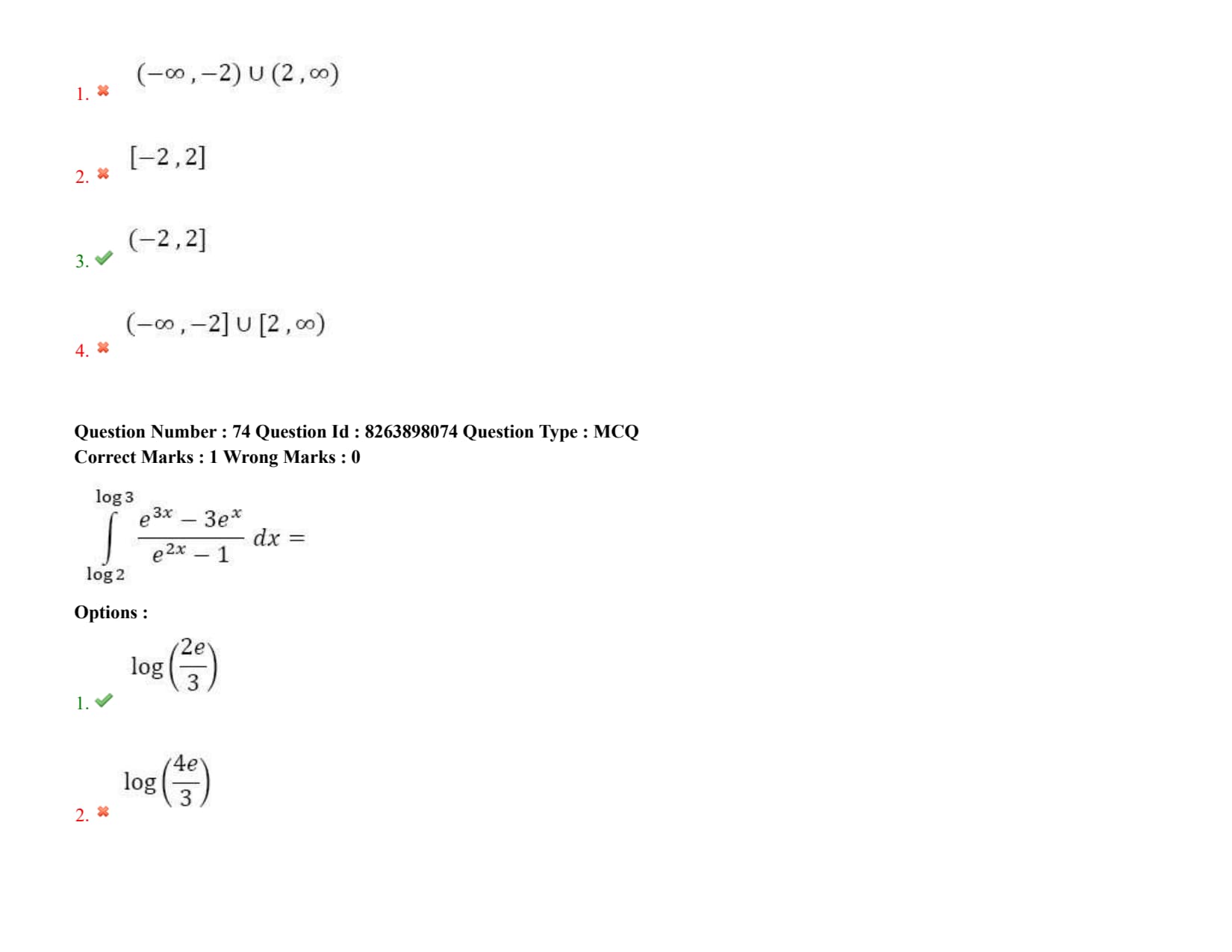


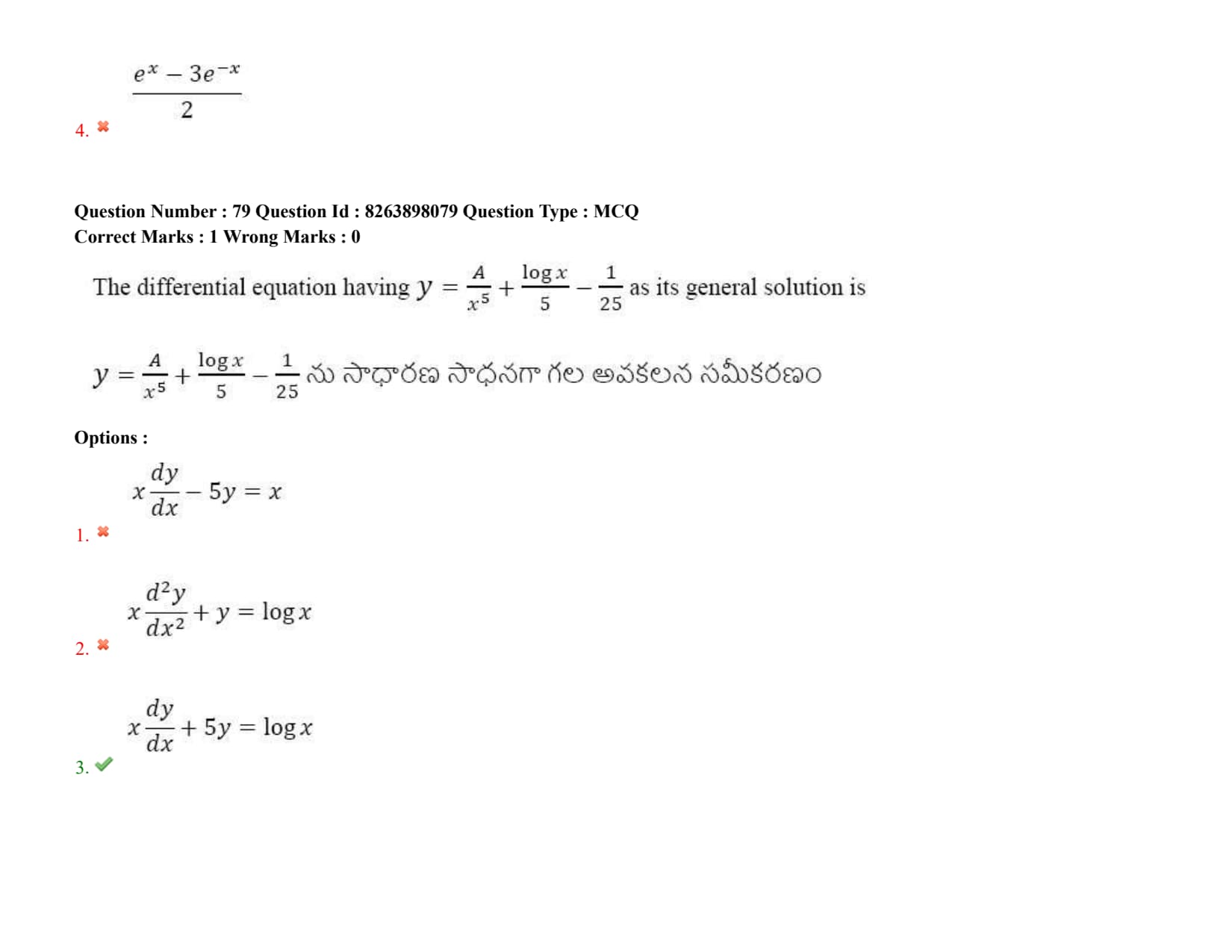
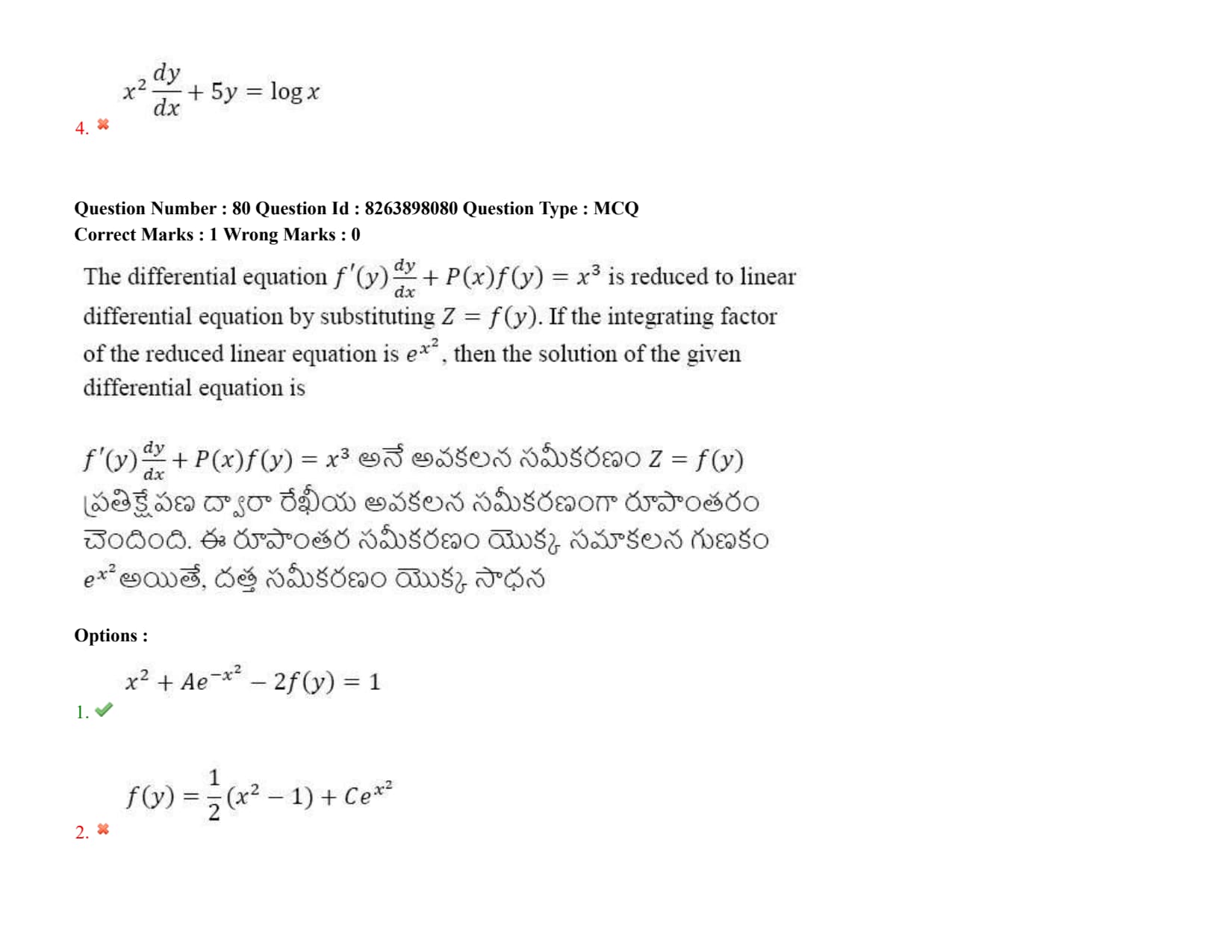


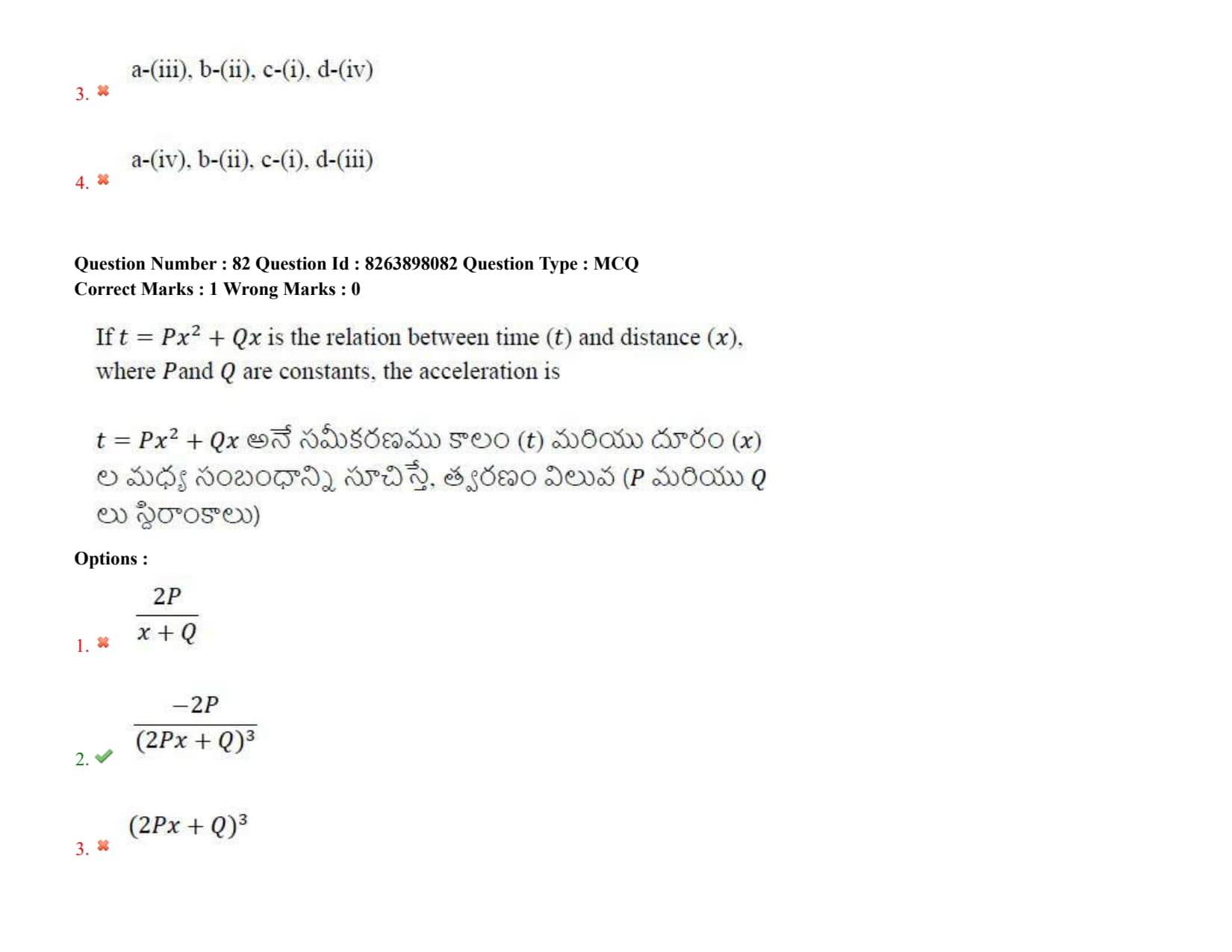














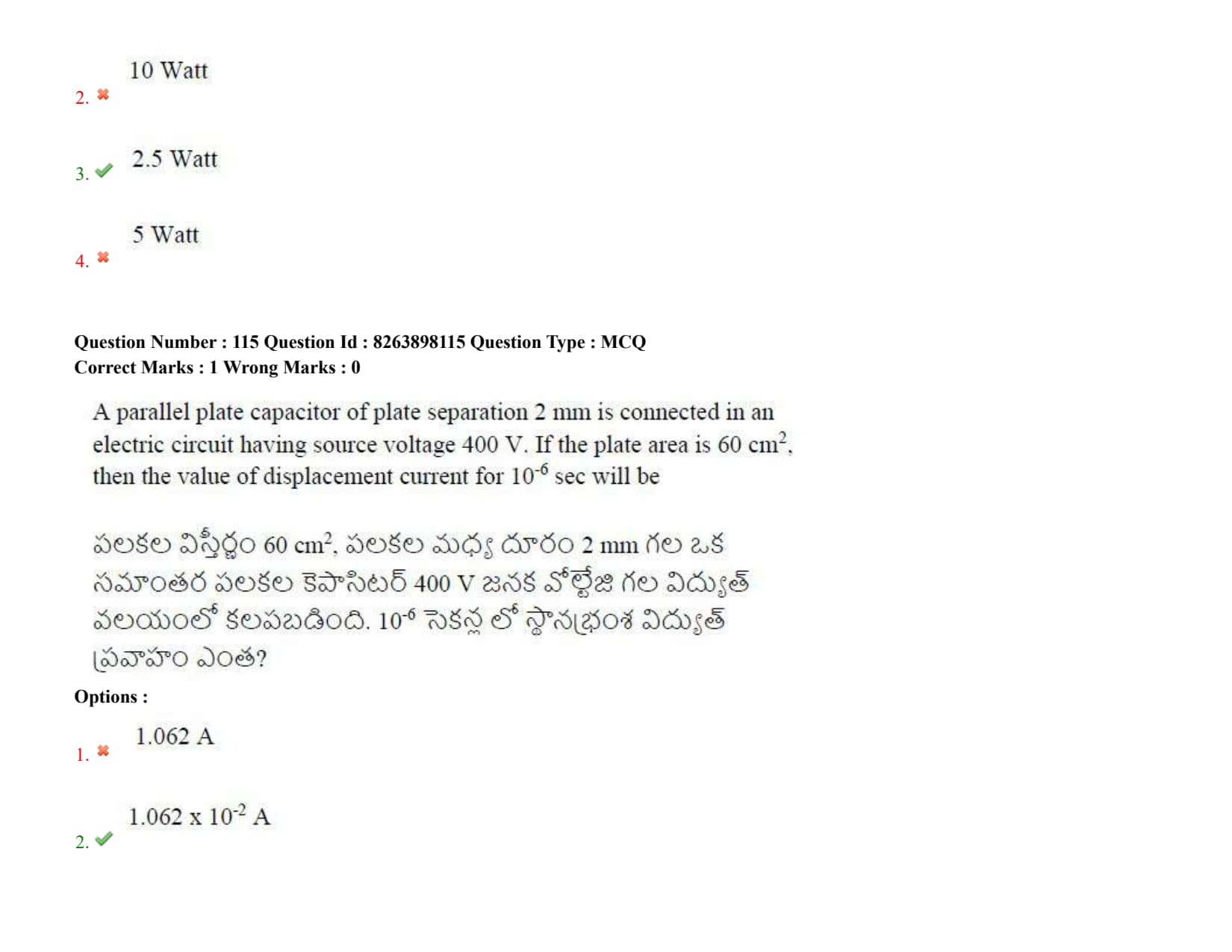

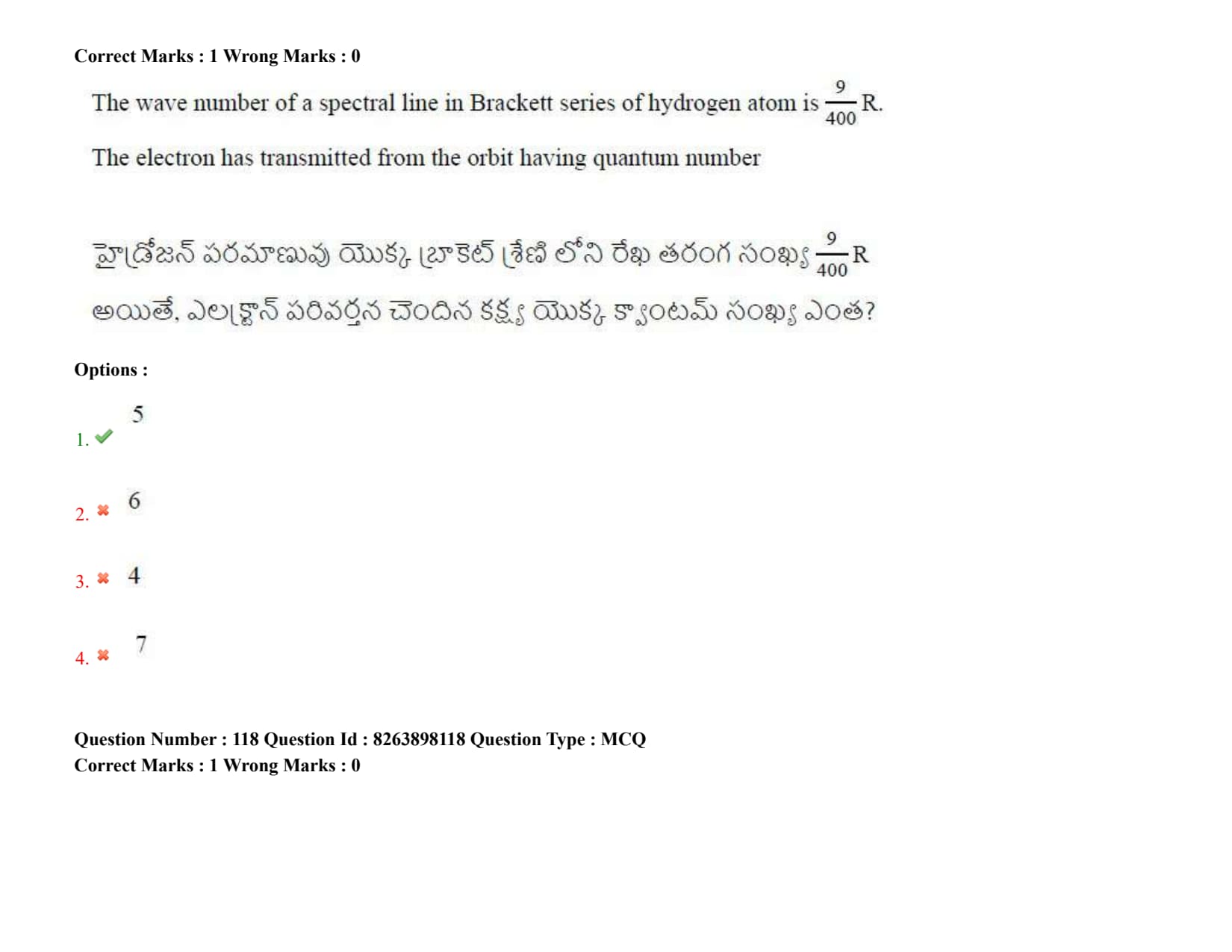
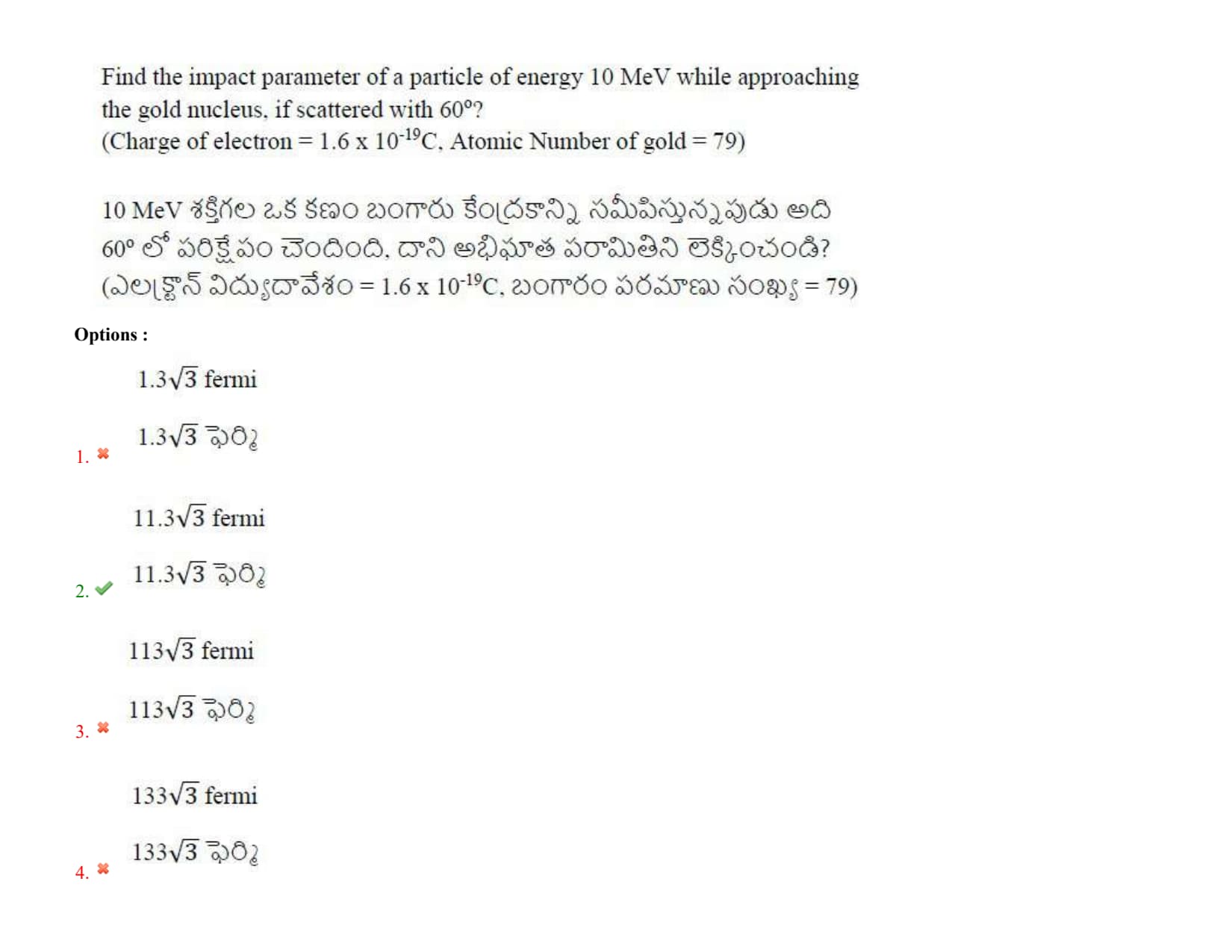


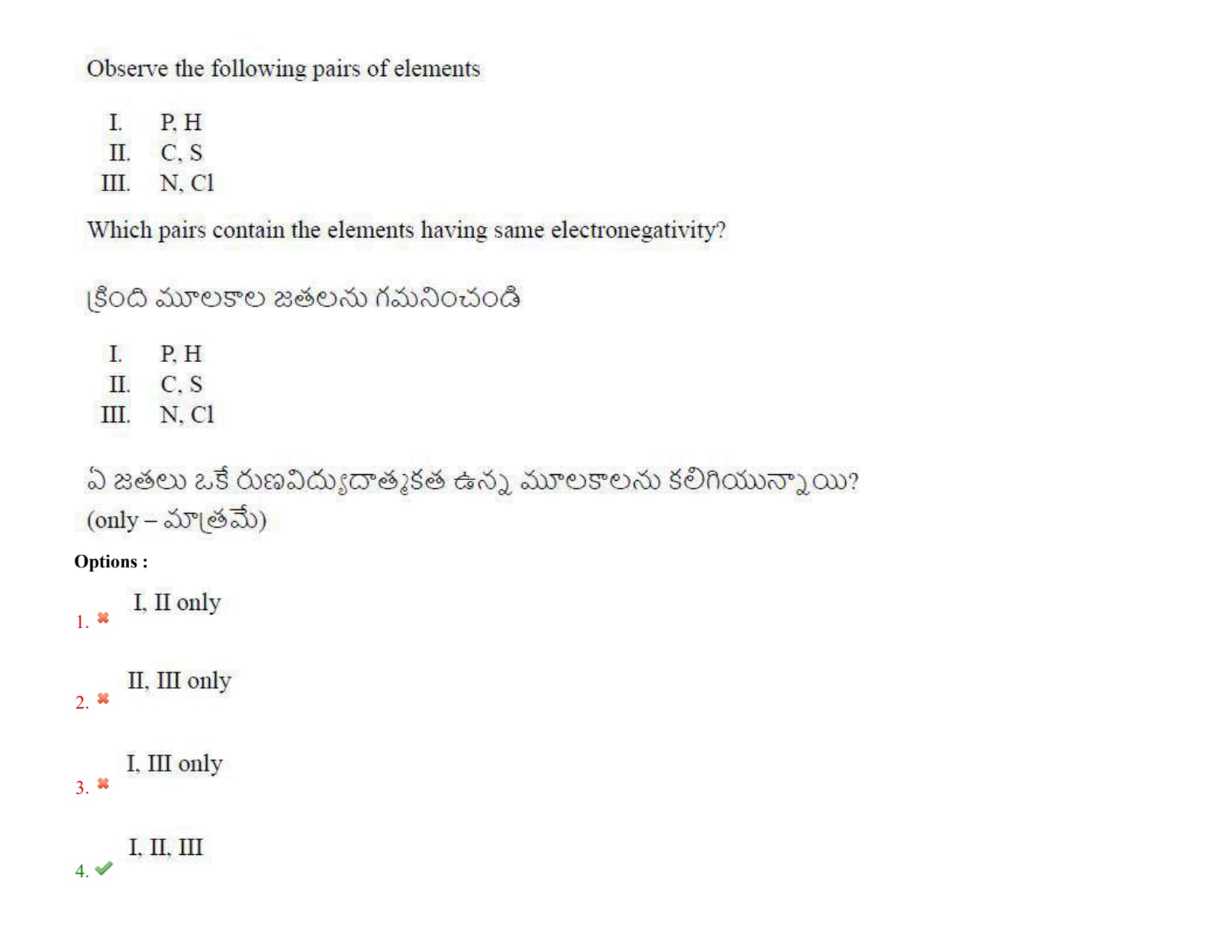





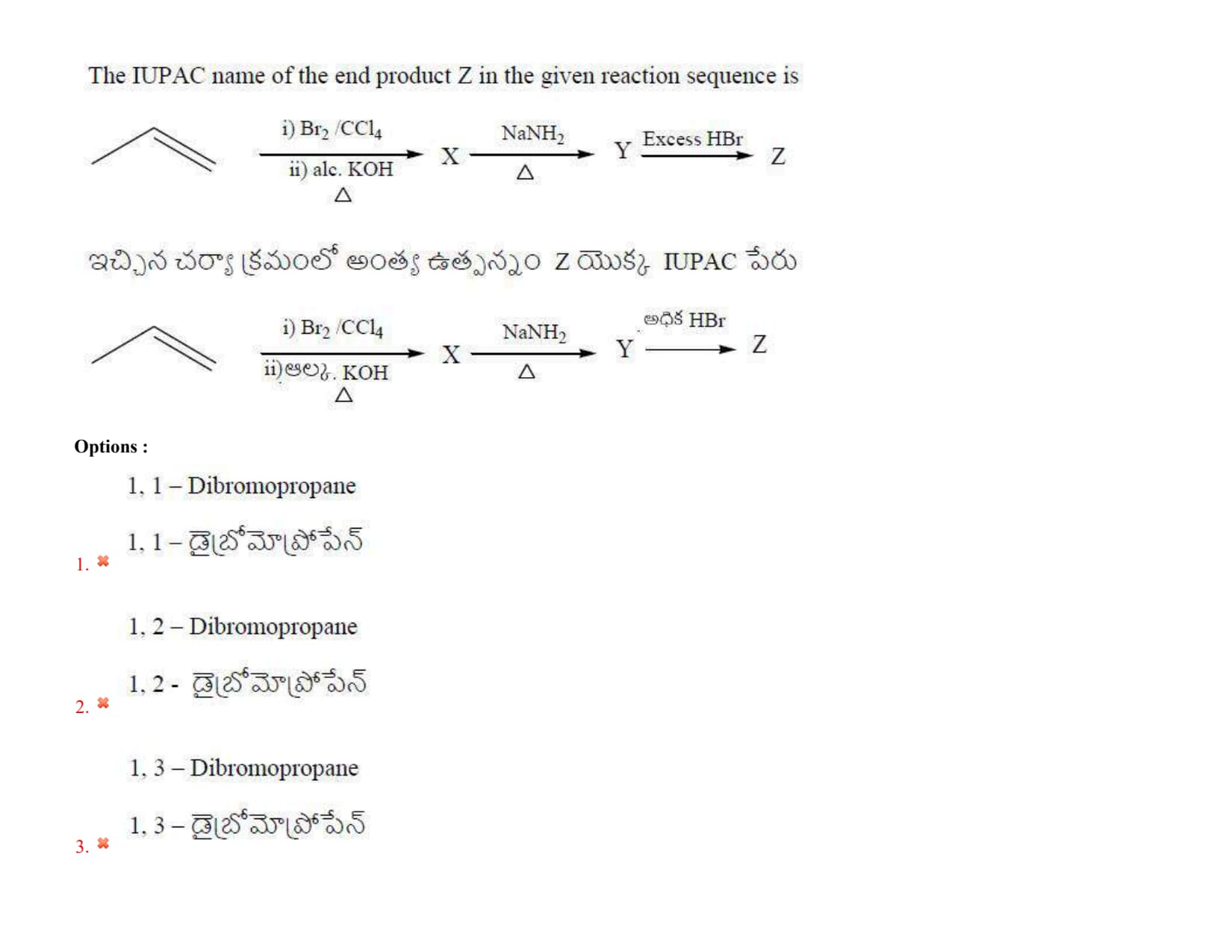
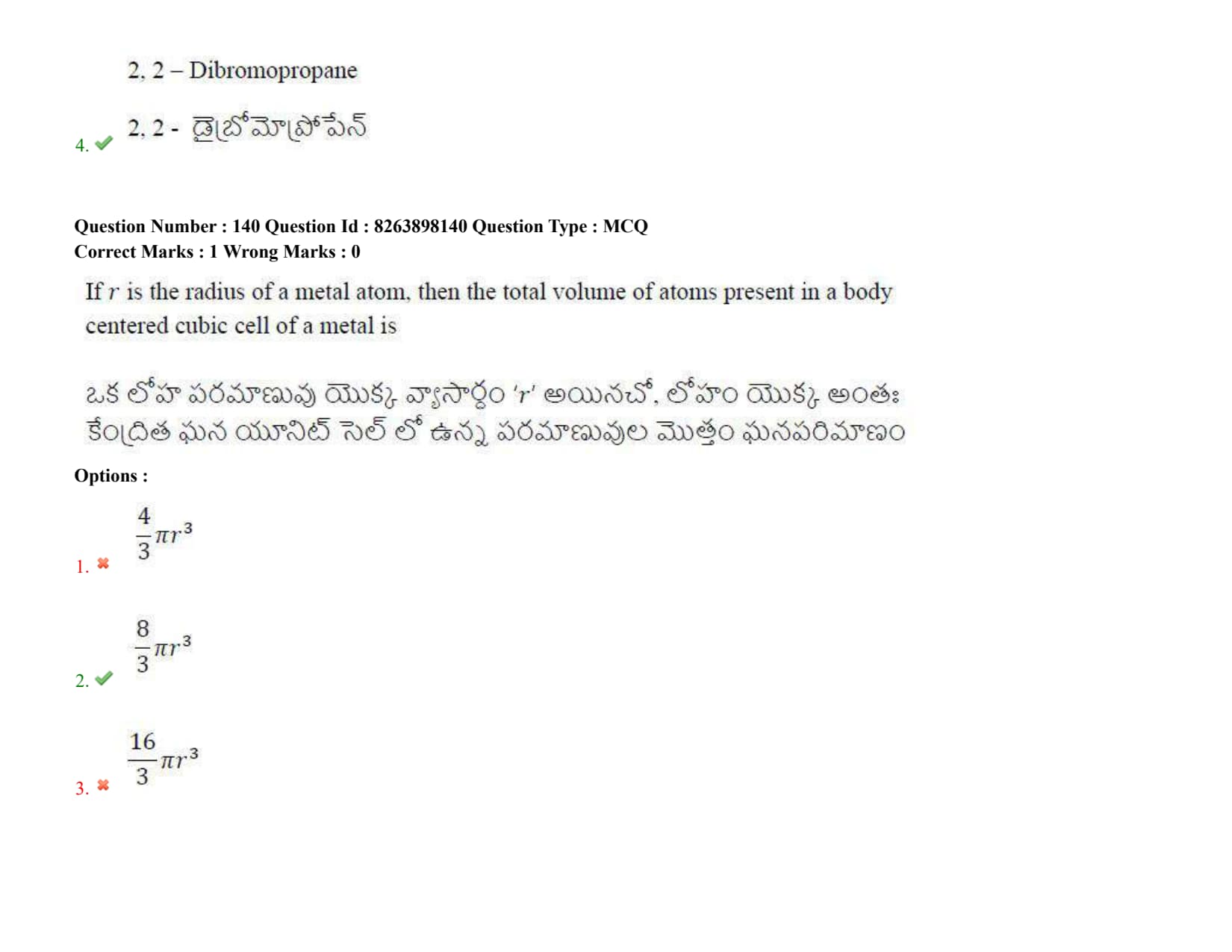

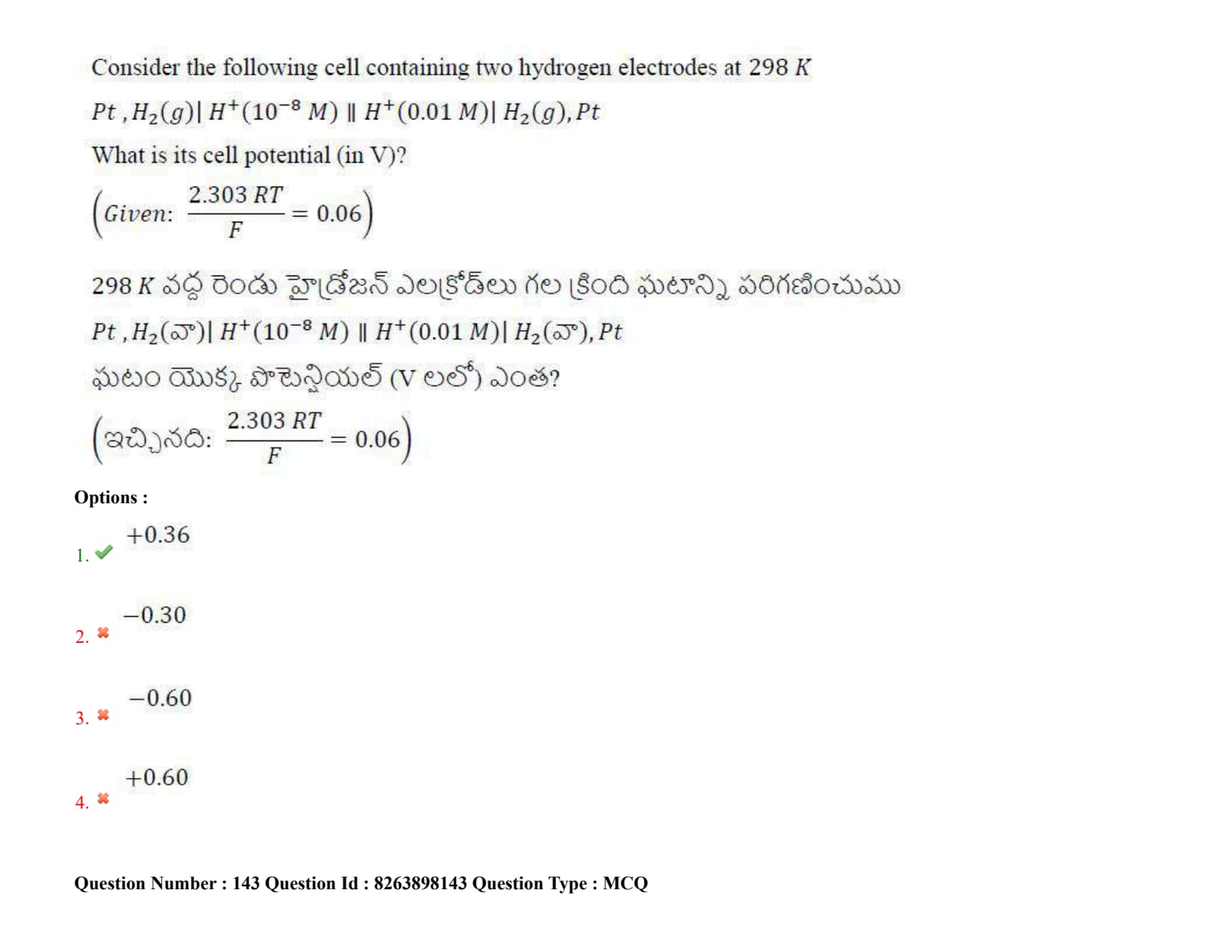
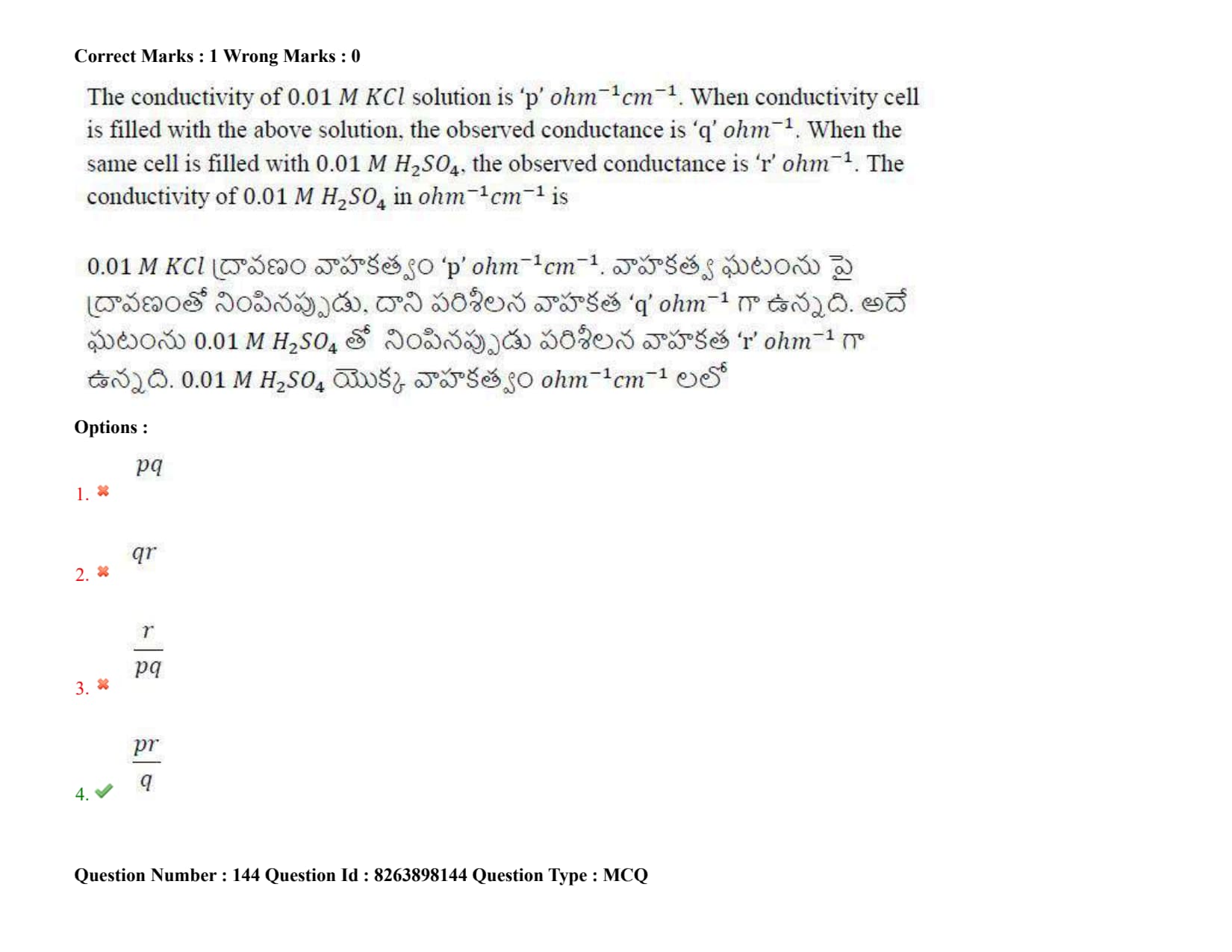









If \(f : [1, \infty) \to [1, \infty)\) is defined by \(f(x) = 2^{x(x-1)}\), then \(f^{-1}(x) =\)
View Solution
Step 1: Concept
To find the inverse function \(f^{-1}(x)\), we set \(y = f(x)\) and solve for \(x\) in terms of \(y\). Since the domain of \(f\) is \([1, \infty)\), we choose the branch of the inverse that satisfies \(x \ge 1\).
Step 2: Meaning
The given function is \(y = 2^{x(x-1)}\). Since both the domain and codomain are \([1, \infty)\), we have \(x \ge 1\) and \(y \ge 1\).
Step 3: Analysis
Taking the logarithm to the base 2 on both sides gives: \[ \log_2 y = x(x-1) \implies x^2 - x - \log_2 y = 0 \]
This is a quadratic equation in \(x\). Using the quadratic formula, we obtain: \[ x = \frac{-(-1) \pm \sqrt{(-1)^2 - 4(1)(-\log_2 y)}}{2} = \frac{1 \pm \sqrt{1 + 4\log_2 y}}{2} \]
Since \(x \ge 1\), we must choose the positive square root branch because the negative branch would yield a value less than or equal to \(0.5\) for \(y \ge 1\).
Step 4: Conclusion
Replacing \(y\) with \(x\) gives the inverse function: \[ f^{-1}(x) = \frac{1}{2} [1 + \sqrt{1 + 4\log_2 x}] \]
Final Answer: (A) Quick Tip: Since the domain is \(x \ge 1\), the inverse function must also return a value \(\ge 1\) for any \(x \ge 1\). The negative branch yields values \(\le 0.5\), which immediately rules it out.
The domain of the function \(f(x) = \sqrt{\log_{10} \left(\frac{5x - x^2}{4}\right)}\) is:
View Solution
Step 1: Concept
For a real-valued square root function \(f(x) = \sqrt{g(x)}\), we require \(g(x) \ge 0\). For a logarithmic function \(\log_{10}(h(x))\), we require \(h(x) > 0\).
Step 2: Meaning
Here, we require the argument of the logarithm to be positive: \(\frac{5x - x^2}{4} > 0\), and the term inside the square root to be non-negative: \(\log_{10} \left(\frac{5x - x^2}{4}\right) \ge 0\).
Step 3: Analysis
From the first condition: \[ 5x - x^2 > 0 \implies x(5-x) > 0 \implies x \in (0, 5) \]
From the second condition: \[ \log_{10} \left(\frac{5x - x^2}{4}\right) \ge 0 \implies \frac{5x - x^2}{4} \ge 10^0 \implies \frac{5x - x^2}{4} \ge 1 \] \[ \implies 5x - x^2 \ge 4 \implies x^2 - 5x + 4 \le 0 \implies (x-1)(x-4) \le 0 \implies x \in [1, 4] \]
Taking the intersection of the two intervals \((0, 5) \cap [1, 4]\) yields the domain: \[ x \in [1, 4] \]
Step 4: Conclusion
The domain of the given function is the closed interval \([1, 4]\).
Final Answer: (A) Quick Tip: Test boundaries! At \(x=1\), we get \(\log_{10}(1) = 0\), which is valid under a square root, meaning \(1\) must be included (closed interval). At \(x=0\), the logarithm argument is \(0\), which is undefined, meaning \(0\) must be excluded.
If \(a_n = \sum_{r=0}^n \frac{1}{^{n}C_r}\) and \(b_n = \sum_{r=0}^n \frac{r}{^{n}C_r}\), then \(\frac{b_n}{a_n} =\)
View Solution
Step 1: Concept
We can rewrite the summation for \(b_n\) by using the property of binomial coefficients: \(^{n}C_r = ^{n}C_{n-r}\).
Step 2: Meaning
Reversing the order of summation terms allows us to express \(b_n\) in terms of \(a_n\) and solve for their ratio.
Step 3: Analysis
Substitute \(r = n-r\) in the expression for \(b_n\): \[ b_n = \sum_{r=0}^n \frac{r}{^{n}C_r} = \sum_{r=0}^n \frac{n-r}{^{n}C_{n-r}} = \sum_{r=0}^n \frac{n-r}{^{n}C_r} \]
Adding the two expressions for \(b_n\) yields: \[ 2b_n = \sum_{r=0}^n \frac{r}{^{n}C_r} + \sum_{r=0}^n \frac{n-r}{^{n}C_r} = \sum_{r=0}^n \frac{r + n - r}{^{n}C_r} = n \sum_{r=0}^n \frac{1}{^{n}C_r} \]
Since \(a_n = \sum_{r=0}^n \frac{1}{^{n}C_r}\), we can substitute it into the equation: \[ 2b_n = n a_n \implies \frac{b_n}{a_n} = \frac{n}{2} \]
Step 4: Conclusion
The ratio of the two series \(\frac{b_n}{a_n}\) is mathematically constant at \(\frac{n}{2}\).
Final Answer: (B) Quick Tip: For a quick test, substitute a small value like \(n = 1\). This gives \(a_1 = \frac{1}{1} + \frac{1}{1} = 2\) and \(b_1 = \frac{0}{1} + \frac{1}{1} = 1\). The ratio is \(\frac{1}{2}\), which matches \(\frac{n}{2}\).
If \([x]\) denotes the greatest integer less than or equal to \(x\), then the value of \(\sum_{r=1}^{100} \left[ \frac{r}{5} \right]\) is:
View Solution
Step 1: Concept
The greatest integer function \([x]\) increases by 1 for every unit interval. For \(\left[\frac{r}{5}\right]\), the value is a constant integer for every group of 5 consecutive terms of \(r\).
Step 2: Meaning
We can group the terms from \(r = 1\) to \(100\) into blocks of size 5 to simplify the summation.
Step 3: Analysis
Evaluating the terms systematically:
For \(r = 1, 2, 3, 4\), \(\left[\frac{r}{5}\right] = 0\) (4 terms)
For \(r = 5, 6, 7, 8, 9\), \(\left[\frac{r}{5}\right] = 1\) (5 terms)
For \(r = 10, 11, 12, 13, 14\), \(\left[\frac{r}{5}\right] = 2\) (5 terms)
\(\dots\)
For \(r = 95, 96, 97, 98, 99\), \(\left[\frac{r}{5}\right] = 19\) (5 terms)
For \(r = 100\), \(\left[\frac{100}{5}\right] = 20\) (1 term)
Summing these up: \[ S = (0 \times 4) + (1 \times 5) + (2 \times 5) + \dots + (19 \times 5) + 20 \] \[ S = 5 \times (1 + 2 + \dots + 19) + 20 \]
Using the sum of first \(n\) natural numbers formula: \[ 1 + 2 + \dots + 19 = \frac{19 \times 20}{2} = 190 \] \[ S = 5 \times 190 + 20 = 950 + 20 = 970 \]
Step 4: Conclusion
The final sum of the given terms is \(970\).
Final Answer: (D) Quick Tip: Recognize the periodic nature of division steps: \([r/d]\) repeats \(d\) times for each integer value except at the boundaries. Here, there are \(5\) copies of each integer from \(1\) to \(19\), with a single \(20\) at the end.
If the system of linear equations \(x + y + z = 1\), \(x + 2y + 4z = \eta\), \(x + 4y + 10z = \eta^2\) has a solution, then the value of \(\eta\) is:
View Solution
Step 1: Concept
For a system of linear equations to have a solution (consistency), the rank of the coefficient matrix must equal the rank of the augmented matrix.
Step 2: Meaning
This means any row operations that reduce a row of the coefficient matrix to zero must also reduce the corresponding element of the constants column to zero.
Step 3: Analysis
We write the augmented matrix \([A | B]\) and perform row reduction: \[ \begin{pmatrix} 1 & 1 & 1 & | & 1
1 & 2 & 4 & | & \eta
1 & 4 & 10 & | & \eta^2 \end{pmatrix} \]
Performing \(R_2 \to R_2 - R_1\) and \(R_3 \to R_3 - R_1\): \[ \begin{pmatrix} 1 & 1 & 1 & | & 1
0 & 1 & 3 & | & \eta - 1
0 & 3 & 9 & | & \eta^2 - 1 \end{pmatrix} \]
Performing \(R_3 \to R_3 - 3R_2\): \[ \begin{pmatrix} 1 & 1 & 1 & | & 1
0 & 1 & 3 & | & \eta - 1
0 & 0 & 0 & | & (\eta^2 - 1) - 3(\eta - 1) \end{pmatrix} \]
For the system to be consistent, the last entry in the augmented column must be zero: \[ (\eta^2 - 1) - 3(\eta - 1) = 0 \implies \eta^2 - 3\eta + 2 = 0 \] \[ \implies (\eta - 1)(\eta - 2) = 0 \implies \eta = 1 or \eta = 2 \]
Step 4: Conclusion
The system of equations is consistent and has a solution only when \(\eta = 1\) or \(\eta = 2\).
Final Answer: (A) Quick Tip: Look for linear dependency in the columns or rows: \(3 \times (Eq. 2) - 2 \times (Eq. 1) = (Eq. 3)\) holds for the LHS coefficients. Hence, the same relationship must hold for the RHS: \(3\eta - 2 = \eta^2 \implies \eta^2 - 3\eta + 2 = 0\).
If \(A = \begin{pmatrix} 1 & 2
3 & 4 \end{pmatrix}\), then \(A^2 - 5A - 2I =\)
View Solution
Step 1: Concept
According to the Cayley-Hamilton Theorem, every square matrix satisfies its own characteristic equation, \(\det(A - \lambda I) = 0\).
Step 2: Meaning
For a \(2 \times 2\) matrix \(A\), the characteristic equation is given by: \[ \lambda^2 - tr(A)\lambda + \det(A) = 0 \]
Substituting matrix \(A\) in place of \(\lambda\) yields \(A^2 - tr(A)A + \det(A)I = O\).
Step 3: Analysis
Given \(A = \begin{pmatrix} 1 & 2
3 & 4 \end{pmatrix}\):
Trace, \(tr(A) = 1 + 4 = 5\)
Determinant, \(\det(A) = (1)(4) - (2)(3) = 4 - 6 = -2\)
Substituting these values into the characteristic equation: \[ A^2 - 5A - 2I = O \]
Step 4: Conclusion
Thus, the expression \(A^2 - 5A - 2I\) evaluates directly to the null matrix \(O\).
Final Answer: (A) Quick Tip: Do not waste time manually multiplying \(A \times A\)! The trace (\(tr(A)\)) is \(5\) and the determinant is \(-2\). The identity \(A^2 - (tr A)A + (\det A)I = O\) always holds.
If the conjugate of a complex number \(z\) is \(\frac{1}{z - i}\), then \(z\) can be:
View Solution
Step 1: Concept
We use the fundamental property of complex conjugates: \(z\bar{z} = |z|^2\), which is always a real number.
Step 2: Meaning
We are given \(\bar{z} = \frac{1}{z - i}\). By rearranging, we can express the imaginary and real parts to restrict the possible form of \(z\).
Step 3: Analysis
Multiplying both sides by \(z - i\): \[ \bar{z}(z - i) = 1 \implies z\bar{z} - i\bar{z} = 1 \implies |z|^2 - i\bar{z} = 1 \] \[ \implies i\bar{z} = |z|^2 - 1 \]
Since \(|z|^2 - 1\) is a purely real number, the term \(i\bar{z}\) must also be purely real. Let \(z = x + iy\), so \(\bar{z} = x - iy\): \[ i\bar{z} = i(x - iy) = ix + y \]
For \(ix + y\) to be real, the imaginary part must be zero: \[ x = 0 \]
Thus, \(z\) is purely imaginary (\(z = iy\)). Substituting \(z = iy\) and \(\bar{z} = -iy\) back into the original relation: \[ -iy = \frac{1}{iy - i} \implies -iy = \frac{1}{i(y - 1)} = \frac{-i}{y - 1} \implies y = \frac{1}{y - 1} \] \[ \implies y^2 - y - 1 = 0 \implies y = \frac{1 \pm \sqrt{5}}{2} \]
Thus, \(z = iy = i\left(\frac{1 \pm \sqrt{5}}{2}\right)\).
Step 4: Conclusion
Comparing with the options, \(z = i\left(\frac{1+\sqrt{5}}{2}\right)\) is a possible value of \(z\).
Final Answer: (A) Quick Tip: Since \(|z|^2 - i\bar{z} = 1\) is real, \(i\bar{z}\) must be real. This immediately implies that \(\bar{z}\) (and thus \(z\)) has no real part and is purely imaginary, which eliminates options (C) and (D).
If \(z = \frac{\sqrt{3} + i}{2}\), then \(z^{101} + z^{103} =\)
View Solution
Step 1: Concept
Complex numbers with large exponents are easiest to compute when converted into polar/exponential form (\(z = r e^{i\theta}\)) using Euler's formula.
Step 2: Meaning
The given complex number \(z = \frac{\sqrt{3} + i}{2}\) can be written as: \[ z = \cos\left(\frac{\pi}{6}\right) + i\sin\left(\frac{\pi}{6}\right) = e^{i\pi/6} \]
Step 3: Analysis
Factor out \(z^{102}\) from the given expression: \[ z^{101} + z^{103} = z^{102}(z^{-1} + z) \]
Let's find \(z^{102}\) and \((z + z^{-1})\): \[ z^{102} = (e^{i\pi/6})^{102} = e^{i \frac{102\pi}{6}} = e^{i 17\pi} = \cos(17\pi) + i\sin(17\pi) = -1 \] \[ z + z^{-1} = e^{i\pi/6} + e^{-i\pi/6} = 2 \cos\left(\frac{\pi}{6}\right) = 2 \cdot \frac{\sqrt{3}}{2} = \sqrt{3} \]
Multiplying these together yields: \[ z^{101} + z^{103} = (-1)(\sqrt{3}) = -\sqrt{3} \]
Step 4: Conclusion
The value of the complex expression is the real number \(-\sqrt{3}\).
Final Answer: (A) Quick Tip: Any expression \(z^{n-1} + z^{n+1}\) can be factored as \(z^n(z + 1/z)\). Since \(z + z^{-1} = 2Re(z) = \sqrt{3}\) and \(z^{102} = (z^6)^{17} = (-1)^{17} = -1\), the result is simply \(-\sqrt{3}\).
If the roots of the quadratic equation \(x^2 - 2px + q^2 = 0\) are real and distinct, then:
View Solution
Step 1: Concept
For any quadratic equation \(ax^2 + bx + c = 0\) to have real and distinct roots, its discriminant \(D = b^2 - 4ac\) must be strictly greater than zero (\(D > 0\)).
Step 2: Meaning
For the equation \(x^2 - 2px + q^2 = 0\), the coefficients are \(a = 1\), \(b = -2p\), and \(c = q^2\).
Step 3: Analysis
Calculate the discriminant: \[ D = (-2p)^2 - 4(1)(q^2) = 4p^2 - 4q^2 \]
Since the roots are real and distinct: \[ D > 0 \implies 4p^2 - 4q^2 > 0 \implies p^2 > q^2 \]
Taking the square root on both sides: \[ |p| > |q| \]
Step 4: Conclusion
Thus, the condition for real and distinct roots is \(|p| > |q|\).
Final Answer: (A) Quick Tip: "Real and distinct" strictly translates to a strict inequality (\(>\)). This immediately rules out options (C) and (D) containing \(\ge\) and \(\le\).
If \(\alpha, \beta\) are the roots of the quadratic equation \(x^2 - 2x + 4 = 0\), then the value of \(\alpha^n + \beta^n\) is:
View Solution
Step 1: Concept
Find the complex roots using the quadratic formula, express them in trigonometric polar form, and apply De Moivre's Theorem to find their powers.
Step 2: Meaning
The given quadratic equation is \(x^2 - 2x + 4 = 0\).
Step 3: Analysis
Finding the roots: \[ x = \frac{-(-2) \pm \sqrt{(-2)^2 - 4(1)(4)}}{2} = \frac{2 \pm \sqrt{4 - 16}}{2} = 1 \pm i\sqrt{3} \]
Converting these roots into polar form: \[ \alpha = 1 + i\sqrt{3} = 2 \left( \frac{1}{2} + i \frac{\sqrt{3}}{2} \right) = 2 \left( \cos \frac{\pi}{3} + i \sin \frac{\pi}{3} \right) \] \[ \beta = 1 - i\sqrt{3} = 2 \left( \frac{1}{2} - i \frac{\sqrt{3}}{2} \right) = 2 \left( \cos \frac{\pi}{3} - i \sin \frac{\pi}{3} \right) \]
Using De Moivre's Theorem for \(n\)-th powers: \[ \alpha^n = 2^n \left( \cos \frac{n\pi}{3} + i \sin \frac{n\pi}{3} \right) \] \[ \beta^n = 2^n \left( \cos \frac{n\pi}{3} - i \sin \frac{n\pi}{3} \right) \]
Summing the powers: \[ \alpha^n + \beta^n = 2^n \left( 2 \cos \frac{n\pi}{3} \right) = 2^{n+1} \cos\left(\frac{n\pi}{3}\right) \]
Step 4: Conclusion
Thus, the sum of the \(n\)-th powers of the roots is \(2^{n+1} \cos\left(\frac{n\pi}{3}\right)\).
Final Answer: (A) Quick Tip: Test for \(n = 1\): \(\alpha^1 + \beta^1\) is the sum of the roots, which is \(2\). Plugging \(n = 1\) into option (A) gives \(2^{1+1} \cos(\pi/3) = 4 \times 0.5 = 2\), validating the answer instantly.
If the roots of the equation \(x^3 - 7x^2 + 14x - 8 = 0\) are in geometric progression, then the common ratio can be:
View Solution
Step 1: Concept
Let the roots of a cubic equation \(ax^3 + bx^2 + cx + d = 0\) be in geometric progression (GP). We can represent these roots as \(\frac{a}{r}\), \(a\), and \(ar\), where \(r\) is the common ratio.
Step 2: Meaning
The product of the roots of the cubic equation is given by \(-d/a\). Here, the equation is \(x^3 - 7x^2 + 14x - 8 = 0\), so the product of the roots is \(8\).
Step 3: Analysis
Product of roots: \[ \left(\frac{a}{r}\right) \cdot a \cdot (ar) = 8 \implies a^3 = 8 \implies a = 2 \]
Sum of roots: \[ \frac{a}{r} + a + ar = 7 \implies 2\left(\frac{1}{r} + 1 + r\right) = 7 \implies \frac{1}{r} + 1 + r = \frac{7}{2} \] \[ \implies r + \frac{1}{r} = \frac{5}{2} \implies 2r^2 - 5r + 2 = 0 \implies (2r - 1)(r - 2) = 0 \implies r = 2 or r = \frac{1}{2} \]
Step 4: Conclusion
Thus, the possible common ratio is \(2\).
Final Answer: (B) Quick Tip: If the roots of a cubic equation are in GP, the middle term \(a\) is always the cube root of the constant term (with sign changed if the leading coefficient is 1). Here, \(\sqrt[3]{8} = 2\).
If the number of permutations of \(n\) different things taken all at a time is \(5040\), then \(n =\)
View Solution
Step 1: Concept
The number of permutations of \(n\) distinct objects taken all at a time is given by \(n!\) (n-factorial).
Step 2: Meaning
We are given that \(n! = 5040\), and we need to find the value of the positive integer \(n\).
Step 3: Analysis
Let us compute factorials of consecutive integers:
\(5! = 120\)
\(6! = 720\)
\(7! = 720 \times 7 = 5040\)
Thus, \(n\) must equal \(7\).
Step 4: Conclusion
The value of \(n\) is \(7\) because \(7!\) equals \(5040\).
Final Answer: (C) Quick Tip: Memorize the first few factorials: \(5! = 120\), \(6! = 720\), \(7! = 5040\). This saves calculation time during competitive exams.
If \(^{n}C_{12} = ^{n}C_{8}\), then \(^{n}C_{17} =\)
View Solution
Step 1: Concept
The combination formula satisfies the property that if \(^{n}C_{x} = ^{n}C_{y}\), then either \(x = y\) or \(x + y = n\).
Step 2: Meaning
Since \(12 \ne 8\), we must have \(n = 12 + 8 = 20\).
Step 3: Analysis
Substitute \(n = 20\) into \(^{n}C_{17}\): \[ ^{20}C_{17} = ^{20}C_{20-17} = ^{20}C_{3} \]
Using the combination formula: \[ ^{20}C_{3} = \frac{20 \times 19 \times 18}{3 \times 2 \times 1} = 20 \times 19 \times 3 = 1140 \]
Step 4: Conclusion
Therefore, the value of \(^{n}C_{17}\) is \(1140\).
Final Answer: (A) Quick Tip: Always simplify combinations using \(^{n}C_r = ^{n}C_{n-r}\) before computing to minimize arithmetic operations (\(^{20}C_{17} \to ^{20}C_3\)).
The number of terms in the expansion of \((x + y + z)^{10}\) is:
View Solution
Step 1: Concept
The number of terms in the multinomial expansion of \((x_1 + x_2 + \dots + x_r)^n\) is given by the formula \(^{n+r-1}C_{r-1}\).
Step 2: Meaning
Here, we have \(3\) variables (\(x, y, z\)), so \(r = 3\), and the power is \(n = 10\).
Step 3: Analysis
Substitute \(n = 10\) and \(r = 3\) into the formula: \[ Number of terms = ^{10+3-1}C_{3-1} = ^{12}C_2 \]
Calculate \(^{12}C_2\): \[ ^{12}C_2 = \frac{12 \times 11}{2 \times 1} = 6 \times 11 = 66 \]
Step 4: Conclusion
The expansion of \((x + y + z)^{10}\) contains exactly \(66\) distinct terms.
Final Answer: (B) Quick Tip: For a trinomial \((x+y+z)^n\), the number of terms simplifies to \(\frac{(n+1)(n+2)}{2}\). For \(n=10\): \(\frac{11 \times 12}{2} = 66\).
If \(\frac{3x + 4}{(x-1)(x-2)^2} = \frac{A}{x-1} + \frac{B}{x-2} + \frac{C}{(x-2)^2}\), then \(A + B + C =\)
View Solution
Step 1: Concept
We decompose a rational function into partial fractions. We can solve for the coefficients \(A\), \(B\), and \(C\) by multiplying through by the common denominator and substituting specific values of \(x\).
Step 2: Meaning
The given equation is: \[ 3x + 4 = A(x-2)^2 + B(x-1)(x-2) + C(x-1) \]
Step 3: Analysis
To find \(A\), substitute \(x = 1\): \[ 3(1) + 4 = A(1-2)^2 \implies 7 = A(1) \implies A = 7 \]
To find \(C\), substitute \(x = 2\): \[ 3(2) + 4 = C(2-1) \implies 10 = C(1) \implies C = 10 \]
To find \(B\), compare the coefficient of \(x^2\) on both sides: \[ 0 = A + B \implies B = -A = -7 \]
Now, calculate \(A + B + C\): \[ A + B + C = 7 + (-7) + 10 = 10 \]
Step 4: Conclusion
The sum of the coefficients \(A + B + C\) is equal to \(10\).
Final Answer: (A) Quick Tip: To find the sum of coefficients in a partial fraction identity of this type, you can sometimes substitute strategic values, but here, the direct determination of \(A, B, C\) is extremely fast.
If \(\sin \theta + \cos \theta = \sqrt{2} \cos \theta\), then \(\cos \theta - \sin \theta =\)
View Solution
Step 1: Concept
We use trigonometric identity transformations or algebraic manipulations on the equation \(\sin \theta + \cos \theta = \sqrt{2} \cos \theta\).
Step 2: Meaning
We want to express \(\cos \theta - \sin \theta\) in terms of \(\sin \theta\) or \(\cos \theta\).
Step 3: Analysis
From the given equation: \[ \sin \theta = \sqrt{2} \cos \theta - \cos \theta \implies \sin \theta = (\sqrt{2} - 1) \cos \theta \]
Multiply both sides by \((\sqrt{2} + 1)\): \[ (\sqrt{2} + 1) \sin \theta = (\sqrt{2} + 1)(\sqrt{2} - 1) \cos \theta \] \[ \sqrt{2} \sin \theta + \sin \theta = (2 - 1) \cos \theta = \cos \theta \]
Rearranging the terms: \[ \cos \theta - \sin \theta = \sqrt{2} \sin \theta \]
Step 4: Conclusion
Thus, the expression \(\cos \theta - \sin \theta\) is equal to \(\sqrt{2} \sin \theta\).
Final Answer: (A) Quick Tip: There is a famous identity: if \(a \cos\theta + b \sin\theta = c\), then \(b \cos\theta - a \sin\theta = \pm \sqrt{a^2+b^2-c^2}\). Here, \(1^2 + 1^2 - (\sqrt{2}\cos\theta)^2 = 2 - 2\cos^2\theta = 2\sin^2\theta\), giving \(\sqrt{2}\sin\theta\).
The maximum value of \(3 \sin x + 4 \cos x + 5\) is:
View Solution
Step 1: Concept
The expression \(a \sin x + b \cos x\) always lies in the range \([-\sqrt{a^2 + b^2}, \sqrt{a^2 + b^2}]\).
Step 2: Meaning
Therefore, the expression \(a \sin x + b \cos x + c\) has a maximum value of \(c + \sqrt{a^2 + b^2}\).
Step 3: Analysis
Identify the constants from the given expression: \(a = 3\), \(b = 4\), and \(c = 5\).
Compute the maximum value: \[ Maximum Value = 5 + \sqrt{3^2 + 4^2} = 5 + \sqrt{9 + 16} = 5 + \sqrt{25} = 5 + 5 = 10 \]
Step 4: Conclusion
The maximum value that the function can achieve is \(10\).
Final Answer: (B) Quick Tip: \((3, 4, 5)\) is a standard Pythagorean triple, so \(\sqrt{3^2+4^2}\) is instantly \(5\). Add \(5\) to get \(10\).
If \(\tan^{-1}(x) + \tan^{-1}(y) + \tan^{-1}(z) = \frac{\pi}{2}\), then \(xy + yz + zx =\)
View Solution
Step 1: Concept
We use the identity for the sum of three inverse tangent functions: \[ \tan^{-1}(x) + \tan^{-1}(y) + \tan^{-1}(z) = \tan^{-1}\left(\frac{x+y+z - xyz}{1 - (xy + yz + zx)}\right) \]
Step 2: Meaning
Since the sum equals \(\frac{\pi}{2}\), the argument of the inverse tangent must approach infinity, which means the denominator of the fraction must be zero.
Step 3: Analysis
Setting the denominator to zero: \[ 1 - (xy + yz + zx) = 0 \implies xy + yz + zx = 1 \]
Step 4: Conclusion
Thus, the expression \(xy + yz + zx\) evaluates to \(1\).
Final Answer: (B) Quick Tip: If \(\sum \tan^{-1}x = \pi/2\), then \(\sum xy = 1\). If \(\sum \tan^{-1}x = \pi\), then \(\sum x = xyz\).
If \(\sinh x = \frac{3}{4}\), then \(\cosh 2x =\)
View Solution
Step 1: Concept
We use the hyperbolic double-angle identity: \(\cosh 2x = 1 + 2 \sinh^2 x\).
Step 2: Meaning
We are given \(\sinh x = \frac{3}{4}\) and need to compute the value of \(\cosh 2x\).
Step 3: Analysis
Substitute \(\sinh x = \frac{3}{4}\) into the identity: \[ \cosh 2x = 1 + 2 \left(\frac{3}{4}\right)^2 = 1 + 2 \left(\frac{9}{16}\right) \]
Simplify the expression: \[ \cosh 2x = 1 + \frac{9}{8} = \frac{17}{8} \]
Step 4: Conclusion
The value of \(\cosh 2x\) is \(\frac{17}{8}\).
Final Answer: (A) Quick Tip: Hyperbolic trigonometric identities are very similar to standard ones but watch out for sign differences (\(\cosh^2 x - \sinh^2 x = 1\) and \(\cosh 2x = 1 + 2\sinh^2 x\)).
In a triangle \(ABC\), if \(a = 13\), \(b = 14\), \(c = 15\), then the area of the triangle is:
View Solution
Step 1: Concept
The area of a triangle with known side lengths \(a\), \(b\), and \(c\) can be calculated using Heron's Formula: \(\Delta = \sqrt{s(s-a)(s-b)(s-c)}\), where \(s = \frac{a+b+c}{2}\) is the semi-perimeter.
Step 2: Meaning
Here, the side lengths are \(13\), \(14\), and \(15\).
Step 3: Analysis
First, calculate the semi-perimeter \(s\): \[ s = \frac{13 + 14 + 15}{2} = \frac{42}{2} = 21 \]
Now, substitute \(s\) and the sides into Heron's Formula: \[ \Delta = \sqrt{21(21-13)(21-14)(21-15)} = \sqrt{21 \times 8 \times 7 \times 6} \]
Simplify the terms inside the square root: \[ \Delta = \sqrt{(3 \times 7) \times (2^3) \times 7 \times (2 \times 3)} = \sqrt{7^2 \times 3^2 \times 2^4} \] \[ \Delta = 7 \times 3 \times 2^2 = 21 \times 4 = 84 \]
Step 4: Conclusion
The area of the triangle \(ABC\) is exactly \(84\) square units.
Final Answer: (A) Quick Tip: A triangle with sides \(13, 14, 15\) is a standard classic triangle in geometry problems; its area is always \(84\), and its semi-perimeter is \(21\). Remembering this saves valuable time.
If \(\vec{a} = 2\vec{i} + 3\vec{j} - \vec{k}\), \(\vec{b} = -\vec{i} + 2\vec{j} - 4\vec{k}\) and \(\vec{c} = \vec{i} + \vec{j} + \vec{k}\), then \((\vec{a} \times \vec{b}) \cdot (\vec{a} \times \vec{c}) =\)
View Solution
Step 1: Concept
We use the vector identity for the dot product of two cross products: \[ (\vec{u} \times \vec{v}) \cdot (\vec{w} \times \vec{z}) = (\vec{u} \cdot \vec{w})(\vec{v} \cdot \vec{z}) - (\vec{u} \cdot \vec{z})(\vec{v} \cdot \vec{w}) \]
Step 2: Meaning
Substituting \(\vec{u} = \vec{a}\), \(\vec{v} = \vec{b}\), \(\vec{w} = \vec{a}\), and \(\vec{z} = \vec{c}\) into the identity, we get: \[ (\vec{a} \times \vec{b}) \cdot (\vec{a} \times \vec{c}) = (\vec{a} \cdot \vec{a})(\vec{b} \cdot \vec{c}) - (\vec{a} \cdot \vec{c})(\vec{b} \cdot \vec{a}) \]
Step 3: Analysis
First, let us calculate the individual dot products:
\(\vec{a} \cdot \vec{a} = 2^2 + 3^2 + (-1)^2 = 4 + 9 + 1 = 14\)
\(\vec{b} \cdot \vec{c} = (-1)(1) + (2)(1) + (-4)(1) = -1 + 2 - 4 = -3\)
\(\vec{a} \cdot \vec{c} = (2)(1) + (3)(1) + (-1)(1) = 2 + 3 - 1 = 4\)
\(\vec{b} \cdot \vec{a} = (-1)(2) + (2)(3) + (-4)(-1) = -2 + 6 + 4 = 8\)
Now, substitute these values back into the expression: \[ (\vec{a} \times \vec{b}) \cdot (\vec{a} \times \vec{c}) = (14)(-3) - (4)(8) \] \[ \implies -42 - 32 = -74 \]
Step 4: Conclusion
The value of \((\vec{a} \times \vec{b}) \cdot (\vec{a} \times \vec{c})\) is \(-74\).
Final Answer: (A) Quick Tip: Using Lagrange's identity for cross products saves significant time compared to computing the cross products \(\vec{a}\times\vec{b}\) and \(\vec{a}\times\vec{c}\) individually.
Let \(\vec{a}\) and \(\vec{b}\) be two unit vectors. If the angle between them is \(\theta\), then \(\cos(\theta/2) =\)
View Solution
Step 1: Concept
The magnitude of the sum of two vectors is given by the relation \(|\vec{a} + \vec{b}|^2 = |\vec{a}|^2 + |\vec{b}|^2 + 2\vec{a} \cdot \vec{b}\).
Step 2: Meaning
Since \(\vec{a}\) and \(\vec{b}\) are unit vectors, we have \(|\vec{a}| = 1\) and \(|\vec{b}| = 1\). The dot product is \(\vec{a} \cdot \vec{b} = |\vec{a}||\vec{b}|\cos\theta = \cos\theta\).
Step 3: Analysis
Substituting the values: \[ |\vec{a} + \vec{b}|^2 = 1^2 + 1^2 + 2\cos\theta \] \[ |\vec{a} + \vec{b}|^2 = 2 + 2\cos\theta = 2(1 + \cos\theta) \]
Using the trigonometric half-angle formula \(1 + \cos\theta = 2\cos^2(\theta/2)\): \[ |\vec{a} + \vec{b}|^2 = 2\left(2\cos^2\frac{\theta}{2}\right) = 4\cos^2\frac{\theta}{2} \]
Taking the square root on both sides: \[ |\vec{a} + \vec{b}| = 2\cos\frac{\theta}{2} \implies \cos\frac{\theta}{2} = \frac{1}{2}|\vec{a} + \vec{b}| \]
Step 4: Conclusion
The value of \(\cos(\theta/2)\) is equal to \(\frac{1}{2}|\vec{a} + \vec{b}|\).
Final Answer: (A) Quick Tip: For unit vectors, remember the standard forms: \(|\vec{a}+\vec{b}| = 2\cos(\theta/2)\) and \(|\vec{a}-\vec{b}| = 2\sin(\theta/2)\).
If \(\vec{a} = \vec{i} + \vec{j} + \vec{k}\), \(\vec{b} = 4\vec{i} + 3\vec{j} + 4\vec{k}\) and \(\vec{c} = \vec{i} + \alpha\vec{j} + \beta\vec{k}\) are linearly dependent vectors and \(|\vec{c}| = \sqrt{3}\), then:
View Solution
Step 1: Concept
Three vectors in three-dimensional space are linearly dependent if and only if they are coplanar. This implies their scalar triple product (or the determinant of their coefficients) is equal to zero.
Step 2: Meaning
We can set up the determinant of the coefficients of \(\vec{a}\), \(\vec{b}\), and \(\vec{c}\) to be zero, and use the magnitude condition \(|\vec{c}| = \sqrt{3}\) to solve for \(\alpha\) and \(\beta\).
Step 3: Analysis
Since the vectors are linearly dependent, the determinant of their coefficients is zero: \[ \begin{vmatrix} 1 & 1 & 1
4 & 3 & 4
1 & \alpha & \beta \end{vmatrix} = 0 \]
Expanding along the first row: \[ 1(3\beta - 4\alpha) - 1(4\beta - 4) + 1(4\alpha - 3) = 0 \] \[ 3\beta - 4\alpha - 4\beta + 4 + 4\alpha - 3 = 0 \] \[ 1 - \beta = 0 \implies \beta = 1 \]
Now, using the magnitude of \(\vec{c}\): \[ |\vec{c}| = \sqrt{1^2 + \alpha^2 + \beta^2} = \sqrt{3} \] \[ 1 + \alpha^2 + 1 = 3 \implies \alpha^2 = 1 \implies \alpha = \pm 1 \]
This gives possible solutions \((\alpha, \beta)\) as \((1, 1)\) or \((-1, 1)\).
Step 4: Conclusion
Comparing with the options, the values \(\alpha = 1, \beta = 1\) are correct.
Final Answer: (B) Quick Tip: Linear dependency of three vectors in \(\mathbb{R}^3\) is equivalent to coplanarity. Always set the determinant to \(0\).
The variance of the first \(n\) even natural numbers is:
View Solution
Step 1: Concept
The variance (\(\sigma^2\)) of a set of observations \(x_i\) is given by the formula \(\sigma^2 = \frac{\sum x_i^2}{n} - \bar{x}^2\), where \(\bar{x}\) is the mean.
Step 2: Meaning
The first \(n\) even natural numbers are \(2, 4, 6, \dots, 2n\). We compute their mean and sum of squares.
Step 3: Analysis
Mean (\(\bar{x}\)): \[ \bar{x} = \frac{2 + 4 + \dots + 2n}{n} = \frac{2(1 + 2 + \dots + n)}{n} = \frac{2 \cdot \frac{n(n+1)}{2}}{n} = n+1 \]
Sum of squares of the terms: \[ \sum x_i^2 = 2^2 + 4^2 + \dots + (2n)^2 = 4(1^2 + 2^2 + \dots + n^2) = 4 \cdot \frac{n(n+1)(2n+1)}{6} \]
Now, calculating the variance: \[ \sigma^2 = \frac{4}{n} \cdot \frac{n(n+1)(2n+1)}{6} - (n+1)^2 \] \[ \sigma^2 = \frac{2(n+1)(2n+1)}{3} - (n+1)^2 \] \[ \sigma^2 = (n+1) \left[ \frac{2(2n+1) - 3(n+1)}{3} \right] \] \[ \sigma^2 = (n+1) \left[ \frac{4n + 2 - 3n - 3}{3} \right] = (n+1) \left[ \frac{n-1}{3} \right] = \frac{n^2-1}{3} \]
Step 4: Conclusion
The variance of the first \(n\) even natural numbers is \(\frac{n^2-1}{3}\).
Final Answer: (B) Quick Tip: Since the first \(n\) natural numbers have a variance of \(\frac{n^2-1}{12}\), scaling them by 2 (even numbers) scales the variance by \(2^2 = 4\). Thus, \(4 \times \frac{n^2-1}{12} = \frac{n^2-1}{3}\).
If the mean deviation of the numbers \(1, 1+d, 1+2d, \dots, 1+100d\) from their mean is 255, then \(d =\)
View Solution
Step 1: Concept
The mean deviation of \(N\) observations from their mean is given by \(M.D. = \frac{\sum |x_i - \bar{x}|}{N}\).
Step 2: Meaning
There are \(N = 101\) terms in the given arithmetic progression. Since the number of terms is odd, the mean is the middle term, which is the 51st term: \(\bar{x} = 1 + 50d\).
Step 3: Analysis
The deviations of the terms from the mean \(\bar{x} = 1+50d\) are: \[ |x_i - \bar{x}| = \{ 50|d|, 49|d|, \dots, 1|d|, 0, 1|d|, \dots, 50|d| \} \]
Sum of deviations: \[ \sum |x_i - \bar{x}| = 2 \cdot |d| \cdot (1 + 2 + \dots + 50) = 2|d| \cdot \frac{50 \times 51}{2} = 2550|d| \]
Mean deviation: \[ M.D. = \frac{2550|d|}{101} = 255 \] \[ \implies \frac{10|d|}{101} = 1 \implies |d| = \frac{101}{10} = 10.1 \]
Step 4: Conclusion
The value of the common difference \(d\) is 10.1.
Final Answer: (A) Quick Tip: The mean deviation of an arithmetic progression of \((2n+1)\) terms with common difference \(d\) is \(\frac{n(n+1)}{2n+1}|d|\). Here, \(n=50\), so \(\frac{50 \times 51}{101}|d| = 255 \implies |d| = 10.1\).
A bag contains 5 red and 4 black balls. Three balls are drawn at random from the bag. The probability that two of them are red and one is black is:
View Solution
Step 1: Concept
The classical definition of probability of an event is \(P(E) = \frac{n(E)}{n(S)}\), where \(n(E)\) is the number of favorable outcomes and \(n(S)\) is the total number of possible outcomes.
Step 2: Meaning
The total number of balls in the bag is \(5 + 4 = 9\). We are choosing \(3\) balls. We want exactly \(2\) red balls (from \(5\)) and \(1\) black ball (from \(4\)).
Step 3: Analysis
Total number of ways to choose 3 balls out of 9: \[ n(S) = ^{9}C_3 = \frac{9 \times 8 \times 7}{3 \times 2 \times 1} = 84 \]
Number of ways to choose 2 red balls and 1 black ball: \[ n(E) = ^{5}C_2 \times ^{4}C_1 = 10 \times 4 = 40 \]
Calculating the probability: \[ P(E) = \frac{n(E)}{n(S)} = \frac{40}{84} = \frac{10}{21} \]
Step 4: Conclusion
The probability of drawing 2 red balls and 1 black ball is \(\frac{10}{21}\).
Final Answer: (B) Quick Tip: Always simplify combinations first: \(^{5}C_2 = 10\) and \(^{9}C_3 = 84\). This makes dividing \(\frac{40}{84}\) to get \(\frac{10}{21}\) straightforward.
If \(A\) and \(B\) are two events such that \(P(A) = 0.4\), \(P(B) = 0.8\) and \(P(B|A) = 0.6\), then \(P(\bar{A} \cap B) =\)
View Solution
Step 1: Concept
We use the conditional probability formula \(P(B|A) = \frac{P(A \cap B)}{P(A)}\) and the set theory identity \(P(\bar{A} \cap B) = P(B) - P(A \cap B)\).
Step 2: Meaning
We first calculate the probability of the intersection \(P(A \cap B)\) and then subtract it from \(P(B)\) to get the probability of \(B\) occurring without \(A\).
Step 3: Analysis
From the conditional probability formula: \[ P(A \cap B) = P(B|A) \cdot P(A) \] \[ P(A \cap B) = 0.6 \times 0.4 = 0.24 \]
Now, compute \(P(\bar{A} \cap B)\): \[ P(\bar{A} \cap B) = P(B) - P(A \cap B) \] \[ P(\bar{A} \cap B) = 0.8 - 0.24 = 0.56 \]
Step 4: Conclusion
The value of \(P(\bar{A} \cap B)\) is equal to 0.56.
Final Answer: (A) Quick Tip: \(P(\bar{A} \cap B)\) represents the probability of "only B". Visualizing this on a Venn diagram makes the relation \(P(B) - P(A \cap B)\) immediately clear.
Three houses are available in a locality. Three persons apply for the houses. Each applies for one house without consulting others. The probability that all three apply for the same house is:
View Solution
Step 1: Concept
The probability is calculated by dividing the number of favorable ways by the total possible ways of applying for the houses.
Step 2: Meaning
Each of the 3 persons has 3 choices of houses. We want to find the probability that they all select the exact same house.
Step 3: Analysis
Total possible ways the 3 persons can apply for the houses: \[ n(S) = 3 \times 3 \times 3 = 3^3 = 27 \]
Favorable ways where all three apply for the same house: \[ n(E) = 3 \quad (either all choose House 1, all choose House 2, or all choose House 3) \]
Calculating the probability: \[ P(E) = \frac{n(E)}{n(S)} = \frac{3}{27} = \frac{1}{9} \]
Step 4: Conclusion
The probability that all three persons apply for the same house is \(\frac{1}{9}\).
Final Answer: (B) Quick Tip: Alternatively: the first person can choose any house (prob = 1). The second and third persons must choose that same house, each with probability \(1/3\). Total probability \(= 1 \times \frac{1}{3} \times \frac{1}{3} = \frac{1}{9}\).
A random variable \(X\) has the following probability distribution:
\(X = x\): 0, 1, 2, 3, 4, 5
\(P(X=x)\): \(k\), \(3k\), \(5k\), \(7k\), \(9k\), \(11k\)
Then the value of \(k\) is:
View Solution
Step 1: Concept
For any discrete probability distribution, the sum of all probabilities must equal 1: \(\sum P(X=x) = 1\).
Step 2: Meaning
Summing the probabilities for all possible values of \(X\) will yield an equation in terms of \(k\) that we can solve.
Step 3: Analysis
Summing the probabilities: \[ \sum P(X=x) = k + 3k + 5k + 7k + 9k + 11k \] \[ \sum P(X=x) = 36k \]
Since the sum must be 1: \[ 36k = 1 \implies k = \frac{1}{36} \]
Step 4: Conclusion
The value of \(k\) is \(\frac{1}{36}\).
Final Answer: (A) Quick Tip: The coefficients \(1, 3, 5, 7, 9, 11\) are the first 6 odd natural numbers. The sum of the first \(n\) odd natural numbers is always \(n^2\). Here, \(6^2 = 36\), so \(36k = 1 \implies k = 1/36\).
In a binomial distribution, the mean is 4 and the variance is 3. Then the number of trials \(n\) is:
View Solution
Step 1: Concept
For a binomial distribution with \(n\) trials and probability of success \(p\), the Mean is given by \(np\) and the Variance is given by \(npq\), where \(q = 1 - p\) is the probability of failure.
Step 2: Meaning
We are given the Mean (\(np = 4\)) and Variance (\(npq = 3\)). We can divide the variance by the mean to find \(q\), then find \(p\), and finally calculate \(n\).
Step 3: Analysis
Given: \[ np = 4 \] \[ npq = 3 \]
Dividing Variance by Mean: \[ \frac{npq}{np} = \frac{3}{4} \implies q = \frac{3}{4} \]
Since \(p + q = 1\): \[ p = 1 - q = 1 - \frac{3}{4} = \frac{1}{4} \]
Substitute \(p\) into the Mean equation: \[ n \cdot \left(\frac{1}{4}\right) = 4 \implies n = 16 \]
Step 4: Conclusion
The number of trials \(n\) is 16.
Final Answer: (C) Quick Tip: In a binomial distribution, the variance is always less than the mean. The ratio \(Variance/Mean\) gives \(q\) directly, so \(p = 1 - q\), and then \(n = Mean/p\).
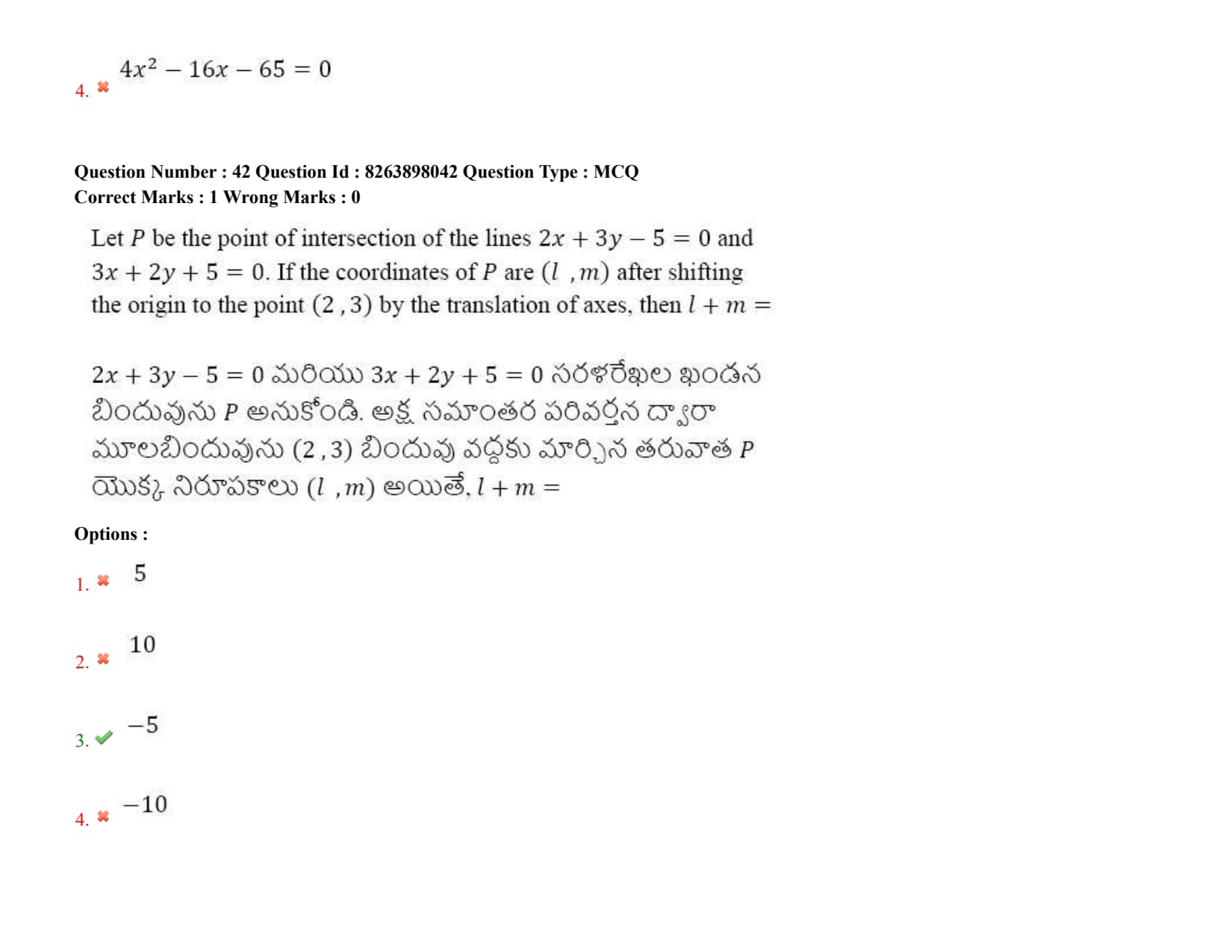
When the origin is shifted to \((2, 3)\) by translation of axes, the coordinates of a point \(P\) become \((1, -2)\). The original coordinates of \(P\) are:
View Solution
Step 1: Concept
When the origin is shifted to a new point \((h, k)\) by translation of axes, the relationship between the original coordinates \((x, y)\) and the new coordinates \((x', y')\) is given by the formulas \(x = x' + h\) and \(y = y' + k\).
Step 2: Meaning
Here, the shifted origin is \((h, k) = (2, 3)\) and the transformed coordinates of the point \(P\) are \((x', y') = (1, -2)\). We need to determine the original coordinates \((x, y)\).
Step 3: Analysis
Using the translation formulas: \[ x = x' + h = 1 + 2 = 3 \] \[ y = y' + k = -2 + 3 = 1 \]
Thus, the original coordinates of the point \(P\) are \((3, 1)\).
Step 4: Conclusion
The original coordinates of the point \(P\) are \((3, 1)\), which corresponds to option (A).
Final Answer: (A) Quick Tip: Remember the intuitive relation: \(Original = New + Shift\). Simply add the coordinate values directly: \((1+2, -2+3) = (3, 1)\).
If the straight lines \(x + 2y - 9 = 0\), \(3x + 5y - 5 = 0\) and \(ax + by - 1 = 0\) are concurrent, then the straight line \(22x - 35y = 1\) passes through the point:
View Solution
Step 1: Concept
Three straight lines are concurrent if they intersect at a single, common point.
Step 2: Meaning
We solve the first two line equations to find their point of intersection, and then substitute this point into the third line equation since they are concurrent.
Step 3: Analysis
The first two equations are:
1) \(x + 2y - 9 = 0 \implies x = 9 - 2y\)
2) \(3x + 5y - 5 = 0\)
Substituting (1) into (2): \[ 3(9 - 2y) + 5y - 5 = 0 \implies 27 - 6y + 5y - 5 = 0 \implies 22 - y = 0 \implies y = 22 \]
Substituting \(y = 22\) back into (1): \[ x = 9 - 2(22) = 9 - 44 = -35 \]
Thus, the point of intersection is \((-35, 22)\). Since the third line \(ax + by - 1 = 0\) passes through this point: \[ a(-35) + b(22) - 1 = 0 \implies 22b - 35a = 1 \]
Now, we are given the equation of a straight line \(22x - 35y = 1\). Substituting the point \((b, a)\) into this equation: \[ 22(b) - 35(a) = 1 \implies 22b - 35a = 1 \]
This perfectly satisfies the condition.
Step 4: Conclusion
Therefore, the line \(22x - 35y = 1\) passes through the point \((b, a)\), corresponding to option (B).
Final Answer: (B) Quick Tip: Look at the coefficients of the given line \(22x - 35y = 1\) and the obtained relation \(22b - 35a = 1\). By matching variables, \(x = b\) and \(y = a\), yielding the point \((b, a)\) instantly.
The distance between the parallel lines \(5x + 12y - 3 = 0\) and \(5x + 12y + 10 = 0\) is:
View Solution
Step 1: Concept
The perpendicular distance \(d\) between two parallel lines \(Ax + By + C_1 = 0\) and \(Ax + By + C_2 = 0\) is given by: \[ d = \frac{|C_1 - C_2|}{\sqrt{A^2 + B^2}} \]
Step 2: Meaning
For the given parallel lines, we have \(A = 5\), \(B = 12\), \(C_1 = -3\), and \(C_2 = 10\).
Step 3: Analysis
Substituting the values into the formula: \[ d = \frac{|-3 - 10|}{\sqrt{5^2 + 12^2}} \] \[ d = \frac{|-13|}{\sqrt{25 + 144}} = \frac{13}{\sqrt{169}} = \frac{13}{13} = 1 \]
Step 4: Conclusion
The distance between the parallel lines is \(1\) unit.
Final Answer: (A) Quick Tip: Since \((5, 12, 13)\) is a standard Pythagorean triplet, the denominator \(\sqrt{5^2+12^2}\) is instantly \(13\). The difference in constants is \(10 - (-3) = 13\). The distance is simply \(13/13 = 1\).
If the angle between the pair of lines \(x^2 - 2cxy - 7y^2 = 0\) is \(\frac{\pi}{3}\), then the value of \(c^2\) is:
View Solution
Step 1: Concept
The angle \(\theta\) between the pair of straight lines represented by the equation \(ax^2 + 2hxy + by^2 = 0\) is given by: \[ \tan\theta = \frac{2\sqrt{h^2 - ab}}{|a + b|} \]
Step 2: Meaning
Comparing the given equation \(x^2 - 2cxy - 7y^2 = 0\) with the general equation, we get \(a = 1\), \(b = -7\), \(2h = -2c \implies h = -c\), and the angle \(\theta = \frac{\pi}{3}\).
Step 3: Analysis
Substitute the parameters into the formula: \[ \tan\left(\frac{\pi}{3}\right) = \frac{2\sqrt{(-c)^2 - (1)(-7)}}{|1 - 7|} \] \[ \sqrt{3} = \frac{2\sqrt{c^2 + 7}}{|-6|} \] \[ \sqrt{3} = \frac{2\sqrt{c^2 + 7}}{6} = \frac{\sqrt{c^2 + 7}}{3} \]
Cross-multiplying and squaring both sides: \[ 3\sqrt{3} = \sqrt{c^2 + 7} \implies 27 = c^2 + 7 \implies c^2 = 20 \]
Step 4: Conclusion
The value of \(c^2\) is \(20\).
Final Answer: (A) Quick Tip: Simplify the fraction inside the angle formula first before squaring to prevent arithmetic mistakes: \(\sqrt{3} = \frac{\sqrt{c^2+7}}{3} \implies c^2+7 = 27 \implies c^2 = 20\).
If the lines joining the origin to the points of intersection of the line \(y = mx + 1\) and the circle \(x^2 + y^2 = 1\) are perpendicular to each other, then the value of \(m^2\) is:
View Solution
Step 1: Concept
To find the equation of the lines joining the origin to the intersection points of a curve and a line, we homogenize the equation of the curve to degree 2 using the equation of the line.
Step 2: Meaning
The line equation is \(y - mx = 1\). We use this relationship to homogenize the circle equation \(x^2 + y^2 = 1\).
Step 3: Analysis
Homogenizing the circle equation: \[ x^2 + y^2 = 1^2 \implies x^2 + y^2 = (y - mx)^2 \]
Expanding the right-hand side: \[ x^2 + y^2 = y^2 - 2mxy + m^2x^2 \] \[ x^2(1 - m^2) + 2mxy = 0 \]
Since the lines are perpendicular to each other, the sum of the coefficients of \(x^2\) and \(y^2\) must equal zero: \[ Coefficient of x^2 + Coefficient of y^2 = 0 \] \[ (1 - m^2) + 0 = 0 \implies m^2 = 1 \]
Step 4: Conclusion
The value of \(m^2\) is \(1\).
Final Answer: (A) Quick Tip: Homogenization reduces the perpendicularity condition of the intersecting lines to simply setting the sum of the \(x^2\) and \(y^2\) coefficients to zero: \((1-m^2) + 0 = 0 \implies m^2 = 1\).
If the circle \(x^2 + y^2 + 2gx + 2fy + c = 0\) passes through the origin, has radius 3, and its center lies on the line \(x + y = 4\), then \(g + f =\)
View Solution
Step 1: Concept
For the general equation of a circle \(x^2 + y^2 + 2gx + 2fy + c = 0\), the center coordinates are \((-g, -f)\).
Step 2: Meaning
Since the center lies on the straight line \(x + y = 4\), the coordinates of the center must satisfy the equation of the line.
Step 3: Analysis
Substitute the center \((-g, -f)\) into the line equation \(x + y = 4\): \[ (-g) + (-f) = 4 \] \[ -(g + f) = 4 \implies g + f = -4 \]
Step 4: Conclusion
The value of \(g + f\) is \(-4\).
Final Answer: (A) Quick Tip: Do not waste time using the radius or origin conditions! The question only requires matching the center \((-g, -f)\) on the line \(x+y=4\), which directly yields \(g+f = -4\) regardless of other parameters.
If the circle \(x^2 + y^2 - 4x - 6y + \lambda = 0\) touches the x-axis, then the value of \(\lambda\) is:
View Solution
Step 1: Concept
A circle \(x^2 + y^2 + 2gx + 2fy + c = 0\) touches the x-axis if and only if \(g^2 = c\).
Step 2: Meaning
Comparing the given circle \(x^2 + y^2 - 4x - 6y + \lambda = 0\) with the general equation, we get \(2g = -4 \implies g = -2\), and \(c = \lambda\).
Step 3: Analysis
Using the condition for the circle touching the x-axis: \[ g^2 = c \implies (-2)^2 = \lambda \implies \lambda = 4 \]
Step 4: Conclusion
The value of the parameter \(\lambda\) is \(4\).
Final Answer: (A) Quick Tip: Standard relations: touching the x-axis means \(g^2 = c\). Touching the y-axis means \(f^2 = c\).
The equation of the common chord of the circles \(x^2 + y^2 - 4x - 4y = 0\) and \(x^2 + y^2 - 6x - 8y + 10 = 0\) is:
View Solution
Step 1: Concept
The equation of the common chord of two intersecting circles \(S_1 = 0\) and \(S_2 = 0\) is represented by the linear equation \(S_1 - S_2 = 0\).
Step 2: Meaning
We subtract the second circle equation from the first circle equation to eliminate the second-degree terms and get the line equation.
Step 3: Analysis
Let: \[ S_1 = x^2 + y^2 - 4x - 4y = 0 \] \[ S_2 = x^2 + y^2 - 6x - 8y + 10 = 0 \]
Subtracting the equations: \[ S_1 - S_2 = (x^2 + y^2 - 4x - 4y) - (x^2 + y^2 - 6x - 8y + 10) = 0 \] \[ -4x + 6x - 4y + 8y - 10 = 0 \] \[ 2x + 4y - 10 = 0 \]
Dividing the entire equation by 2: \[ x + 2y - 5 = 0 \]
Step 4: Conclusion
The equation of the common chord of the circles is \(x + 2y - 5 = 0\).
Final Answer: (A) Quick Tip: The common chord is always a straight line. Simply subtract the two circle equations directly to eliminate the quadratic terms \(x^2\) and \(y^2\).
If the circle \(x^2 + y^2 + 2x - 2y + c = 0\) cuts the circle \(x^2 + y^2 - 4x - 6y + 11 = 0\) orthogonally, then the value of \(c\) is:
View Solution
Step 1: Concept
Two circles \(x^2 + y^2 + 2g_1x + 2f_1y + c_1 = 0\) and \(x^2 + y^2 + 2g_2x + 2f_2y + c_2 = 0\) cut each other orthogonally if they satisfy the condition: \[ 2g_1g_2 + 2f_1f_2 = c_1 + c_2 \]
Step 2: Meaning
We identify the parameters of both circles:
First circle: \(g_1 = 1\), \(f_1 = -1\), \(c_1 = c\)
Second circle: \(g_2 = -2\), \(f_2 = -3\), \(c_2 = 11\)
Step 3: Analysis
Substitute the parameters into the orthogonality condition: \[ 2(1)(-2) + 2(-1)(-3) = c + 11 \] \[ -4 + 6 = c + 11 \] \[ 2 = c + 11 \implies c = -9 \]
Step 4: Conclusion
The value of \(c\) is \(-9\).
Final Answer: (A) Quick Tip: Memorize the orthogonality condition: \(2g_1g_2 + 2f_1f_2 = c_1 + c_2\). Be careful to keep the correct signs of \(g\) and \(f\).
The equation of the parabola with focus at \((3, 0)\) and directrix \(x + 3 = 0\) is:
View Solution
Step 1: Concept
The standard equation of a parabola with vertex at the origin \((0, 0)\), focus at \((a, 0)\), and directrix \(x = -a\) is given by \(y^2 = 4ax\).
Step 2: Meaning
Here, the focus is at \((3, 0)\), which lies on the positive x-axis, implying \(a = 3\). The directrix is \(x = -3 \implies x + 3 = 0\).
Step 3: Analysis
The vertex is the midpoint of the segment joining the focus \((3, 0)\) and the point \((-3, 0)\) on the directrix, which is indeed \((0, 0)\).
Using the standard parabola equation for \(a = 3\): \[ y^2 = 4(3)x \implies y^2 = 12x \]
Step 4: Conclusion
The equation of the parabola is \(y^2 = 12x\).
Final Answer: (A) Quick Tip: If the focus is on the positive x-axis \((a, 0)\) and directrix is parallel to the y-axis, the parabola opens rightwards with the standard form \(y^2 = 4ax\).
If the distance between the foci of an ellipse is 6 and the distance between its directrices is 12, then the length of its latus rectum is:
View Solution
Step 1: Concept
For an ellipse \(\frac{x^2}{a^2} + \frac{y^2}{b^2} = 1\) (\(a > b\)), the distance between the foci is \(2ae\), the distance between the directrices is \(\frac{2a}{e}\), and the length of the latus rectum is \(\frac{2b^2}{a}\).
Step 2: Meaning
We are given \(2ae = 6 \implies ae = 3\) and \(\frac{2a}{e} = 12 \implies \frac{a}{e} = 6\). We need to find \(a\), \(e\), and then \(b^2\) to compute \(\frac{2b^2}{a}\).
Step 3: Analysis
Multiplying \(ae = 3\) and \(\frac{a}{e} = 6\): \[ (ae) \cdot \left(\frac{a}{e}\right) = 3 \times 6 \implies a^2 = 18 \implies a = 3\sqrt{2} \]
Dividing \(ae = 3\) by \(\frac{a}{e} = 6\): \[ e^2 = \frac{3}{6} = \frac{1}{2} \implies e = \frac{1}{\sqrt{2}} \]
Now, find \(b^2\) using \(b^2 = a^2(1 - e^2)\): \[ b^2 = 18\left(1 - \frac{1}{2}\right) = 9 \]
The length of the latus rectum is: \[ L.R. = \frac{2b^2}{a} = \frac{2(9)}{3\sqrt{2}} = \frac{18}{3\sqrt{2}} = \frac{6}{\sqrt{2}} = 3\sqrt{2} \]
Step 4: Conclusion
The length of the latus rectum is \(3\sqrt{2}\).
Final Answer: (A) Quick Tip: Remember that the product of the focal distance (\(2ae\)) and the directrix distance (\(2a/e\)) is \(4a^2\). This is a fast way to find \(a^2\) directly!
The line \(y = mx + c\) touches the ellipse \(9x^2 + 16y^2 = 144\) if the value of \(c^2\) is:
View Solution
Step 1: Concept
The line \(y = mx + c\) touches the standard ellipse \(\frac{x^2}{a^2} + \frac{y^2}{b^2} = 1\) if it satisfies the tangency condition \(c^2 = a^2m^2 + b^2\).
Step 2: Meaning
We rewrite the ellipse equation \(9x^2 + 16y^2 = 144\) in standard form to identify \(a^2\) and \(b^2\).
Step 3: Analysis
Dividing \(9x^2 + 16y^2 = 144\) by 144: \[ \frac{x^2}{16} + \frac{y^2}{9} = 1 \]
Comparing with \(\frac{x^2}{a^2} + \frac{y^2}{b^2} = 1\), we find \(a^2 = 16\) and \(b^2 = 9\).
Using the tangency condition: \[ c^2 = a^2m^2 + b^2 \implies c^2 = 16m^2 + 9 \]
Step 4: Conclusion
Therefore, the line touches the ellipse if \(c^2 = 16m^2 + 9\).
Final Answer: (A) Quick Tip: Always convert the equation of the ellipse into standard form first to correctly identify \(a^2\) (under \(x^2\)) and \(b^2\) (under \(y^2\)).
If the eccentricity of a hyperbola is \(\sqrt{3}\), then the eccentricity of its conjugate hyperbola is:
View Solution
Step 1: Concept
If \(e_1\) and \(e_2\) are the eccentricities of a hyperbola and its conjugate hyperbola, they satisfy the reciprocal identity: \[ \frac{1}{e_1^2} + \frac{1}{e_2^2} = 1 \]
Step 2: Meaning
We are given \(e_1 = \sqrt{3}\) and need to solve for \(e_2\).
Step 3: Analysis
Substituting \(e_1 = \sqrt{3}\) into the identity: \[ \frac{1}{(\sqrt{3})^2} + \frac{1}{e_2^2} = 1 \implies \frac{1}{3} + \frac{1}{e_2^2} = 1 \] \[ \frac{1}{e_2^2} = 1 - \frac{1}{3} = \frac{2}{3} \] \[ e_2^2 = \frac{3}{2} \implies e_2 = \sqrt{\frac{3}{2}} \]
Step 4: Conclusion
The eccentricity of the conjugate hyperbola is \(\sqrt{\frac{3}{2}}\).
Final Answer: (A) Quick Tip: The elegant relationship \(\frac{1}{e_1^2} + \frac{1}{e_2^2} = 1\) is incredibly powerful and appears frequently in entrance exams. Memorize it!
The ratio in which the \(xy\)-plane divides the line segment joining the points \((2, 4, 5)\) and \((3, 5, -4)\) is:
View Solution
Step 1: Concept
The plane \(z = 0\) (the \(xy\)-plane) divides the line segment joining \((x_1, y_1, z_1)\) and \((x_2, y_2, z_2)\) in the ratio \(-z_1 : z_2\).
Step 2: Meaning
For the points \(P(2, 4, 5)\) and \(Q(3, 5, -4)\), we have \(z_1 = 5\) and \(z_2 = -4\).
Step 3: Analysis
Using the ratio formula: \[ Ratio = -\frac{z_1}{z_2} = -\frac{5}{-4} = \frac{5}{4} = 5 : 4 \]
Since the ratio is positive, the division is internal.
Step 4: Conclusion
Therefore, the \(xy\)-plane divides the segment in the ratio \(5 : 4\) internally.
Final Answer: (A) Quick Tip: If the coordinates of the two points have opposite signs for the coordinate perpendicular to the plane (here, \(z\)), the plane lies between them, meaning the division is always internal.
If a line makes angles \(45^\circ\) and \(60^\circ\) with the positive \(x\) and \(y\) axes respectively, then the acute angle it makes with the \(z\)-axis is:
View Solution
Step 1: Concept
If a line makes angles \(\alpha, \beta, \gamma\) with the coordinate axes, then their direction cosines \(l = \cos\alpha\), \(m = \cos\beta\), \(n = \cos\gamma\) satisfy the identity \(l^2 + m^2 + n^2 = 1 \implies \cos^2\alpha + \cos^2\beta + \cos^2\gamma = 1\).
Step 2: Meaning
We are given \(\alpha = 45^\circ\) and \(\beta = 60^\circ\). We need to find the acute angle \(\gamma\).
Step 3: Analysis
Substituting the given angles: \[ \cos^2 45^\circ + \cos^2 60^\circ + \cos^2 \gamma = 1 \] \[ \left(\frac{1}{\sqrt{2}}\right)^2 + \left(\frac{1}{2}\right)^2 + \cos^2 \gamma = 1 \] \[ \frac{1}{2} + \frac{1}{4} + \cos^2 \gamma = 1 \] \[ \frac{3}{4} + \cos^2 \gamma = 1 \implies \cos^2 \gamma = 1 - \frac{3}{4} = \frac{1}{4} \]
Since we need the acute angle, we take the positive root: \[ \cos\gamma = \frac{1}{2} \implies \gamma = 60^\circ \]
Step 4: Conclusion
The acute angle the line makes with the \(z\)-axis is \(60^\circ\).
Final Answer: (A) Quick Tip: Remember that the sum of squares of direction cosines is always 1. This is one of the most fundamental relations in 3D geometry!
The acute angle between the planes \(2x - y + z = 6\) and \(x + y + 2z = 3\) is:
View Solution
Step 1: Concept
The angle \(\theta\) between two planes \(A_1x + B_1y + C_1z + D_1 = 0\) and \(A_2x + B_2y + C_2z + D_2 = 0\) is equal to the angle between their normal vectors \(\vec{n_1} = (A_1, B_1, C_1)\) and \(\vec{n_2} = (A_2, B_2, C_2)\), given by: \[ \cos\theta = \frac{|A_1A_2 + B_1B_2 + C_1C_2|}{\sqrt{A_1^2 + B_1^2 + C_1^2}\sqrt{A_2^2 + B_2^2 + C_2^2}} \]
Step 2: Meaning
For the given planes, the normal vectors are \(\vec{n_1} = (2, -1, 1)\) and \(\vec{n_2} = (1, 1, 2)\).
Step 3: Analysis
Calculate the terms: \[ A_1A_2 + B_1B_2 + C_1C_2 = (2)(1) + (-1)(1) + (1)(2) = 2 - 1 + 2 = 3 \] \[ \sqrt{A_1^2 + B_1^2 + C_1^2} = \sqrt{2^2 + (-1)^2 + 1^2} = \sqrt{6} \] \[ \sqrt{A_2^2 + B_2^2 + C_2^2} = \sqrt{1^2 + 1^2 + 2^2} = \sqrt{6} \]
Now compute \(\cos\theta\): \[ \cos\theta = \frac{3}{\sqrt{6}\sqrt{6}} = \frac{3}{6} = \frac{1}{2} \]
Since \(\cos\theta = \frac{1}{2}\), the angle \(\theta = \frac{\pi}{3}\) (or \(60^\circ\)).
Step 4: Conclusion
The acute angle between the two planes is \(\frac{\pi}{3}\).
Final Answer: (A) Quick Tip: The angle between two planes is exactly the same as the angle between their normal vectors. Always extract the coefficients of \(x, y, z\) as the normal components!
The value of \(\lim_{x \to \infty} \left(\frac{x+6}{x+1}\right)^{x+4}\) is:
View Solution
Step 1: Concept
For limits of the indeterminate form \(1^\infty\), we use the standard theorem: if \(\lim_{x \to a} f(x) = 1\) and \(\lim_{x \to a} g(x) = \infty\), then: \[ \lim_{x \to a} [f(x)]^{g(x)} = e^{\lim_{x \to a} (f(x) - 1)g(x)} \]
Step 2: Meaning
Here, \(f(x) = \frac{x+6}{x+1}\) and \(g(x) = x+4\). As \(x \to \infty\), \(f(x) \to 1\) and \(g(x) \to \infty\).
Step 3: Analysis
Evaluate the exponent limit: \[ L = \lim_{x \to \infty} (f(x) - 1)g(x) = \lim_{x \to \infty} \left(\frac{x+6}{x+1} - 1\right)(x+4) \] \[ L = \lim_{x \to \infty} \left(\frac{x+6 - (x+1)}{x+1}\right)(x+4) = \lim_{x \to \infty} \left(\frac{5}{x+1}\right)(x+4) \] \[ L = \lim_{x \to \infty} \frac{5x + 20}{x+1} = 5 \]
Thus, the limit value is \(e^5\).
Step 4: Conclusion
The value of the limit is \(e^5\).
Final Answer: (A) Quick Tip: For \(\lim_{x \to \infty} \left(\frac{x+a}{x+b}\right)^{x+c}\), the limit is always \(e^{a-b}\). Here, \(a=6, b=1\), so the answer is \(e^{6-1} = e^5\). This shortcut takes only 2 seconds!
If \(f(x) = \frac{k \cos x}{\pi - 2x}\) for \(x \neq \frac{\pi}{2}\) and \(f\left(\frac{\pi}{2}\right) = 3\) is continuous at \(x = \frac{\pi}{2}\), then the value of \(k\) is:
View Solution
Step 1: Concept
For a function \(f(x)\) to be continuous at \(x = a\), we must have \(\lim_{x \to a} f(x) = f(a)\).
Step 2: Meaning
Here, we require \(\lim_{x \to \pi/2} \frac{k \cos x}{\pi - 2x} = 3\).
Step 3: Analysis
Let \(x = \frac{\pi}{2} + h\). As \(x \to \frac{\pi}{2}\), \(h \to 0\). \[ \lim_{h \to 0} \frac{k \cos\left(\frac{\pi}{2} + h\right)}{\pi - 2\left(\frac{\pi}{2} + h\right)} = \lim_{h \to 0} \frac{-k \sin h}{-2h} = \lim_{h \to 0} \frac{k \sin h}{2h} \]
Since \(\lim_{h \to 0} \frac{\sin h}{h} = 1\): \[ \frac{k}{2} = 3 \implies k = 6 \]
Step 4: Conclusion
The value of \(k\) for the function to be continuous is \(6\).
Final Answer: (A) Quick Tip: Apply L'Hopital's Rule for \(\frac{0}{0}\) limits: differentiate numerator and denominator with respect to \(x\): \(\lim_{x \to \pi/2} \frac{-k\sin x}{-2} = \frac{k}{2} = 3 \implies k = 6\). It's super fast!
If \(y = \tan^{-1}\left(\frac{\sin x + \cos x}{\cos x - \sin x}\right)\), then \(\frac{dy}{dx} = \)
View Solution
Step 1: Concept
Differentiate the function by first simplifying the trigonometric argument using standard inverse trigonometric identities.
Step 2: Meaning
We divide the numerator and the denominator inside the parentheses by \(\cos x\) to express it in terms of \(\tan x\).
Step 3: Analysis
\[ y = \tan^{-1}\left(\frac{\frac{\sin x}{\cos x} + 1}{1 - \frac{\sin x}{\cos x}}\right) = \tan^{-1}\left(\frac{1 + \tan x}{1 - \tan x}\right) \]
Using the identity \(\frac{1+\tan x}{1-\tan x} = \tan\left(\frac{\pi}{4} + x\right)\): \[ y = \tan^{-1}\left(\tan\left(\frac{\pi}{4} + x\right)\right) = \frac{\pi}{4} + x \]
Now, differentiating both sides with respect to \(x\): \[ \frac{dy}{dx} = \frac{d}{dx}\left(\frac{\pi}{4} + x\right) = 0 + 1 = 1 \]
Step 4: Conclusion
The derivative of the given function is \(1\).
Final Answer: (A) Quick Tip: Simplifying expressions inside inverse trigonometric functions using trig identities almost always reduces the problem to a simple linear function!
If \(x = a \cos^3 t\) and \(y = a \sin^3 t\), then the value of \(\frac{dy}{dx}\) at \(t = \frac{\pi}{4}\) is:
View Solution
Step 1: Concept
For parametric equations \(x = f(t)\) and \(y = g(t)\), the derivative is given by \(\frac{dy}{dx} = \frac{dy/dt}{dx/dt}\).
Step 2: Meaning
We differentiate both \(x\) and \(y\) with respect to the parameter \(t\), find their ratio, and then substitute \(t = \frac{\pi}{4}\).
Step 3: Analysis
Differentiating \(x\) with respect to \(t\): \[ \frac{dx}{dt} = 3a\cos^2 t (-\sin t) = -3a\cos^2 t \sin t \]
Differentiating \(y\) with respect to \(t\): \[ \frac{dy}{dt} = 3a\sin^2 t (\cos t) = 3a\sin^2 t \cos t \]
Now find \(\frac{dy}{dx}\): \[ \frac{dy}{dx} = \frac{3a\sin^2 t \cos t}{-3a\cos^2 t \sin t} = -\frac{\sin t}{\cos t} = -\tan t \]
At \(t = \frac{\pi}{4}\): \[ \frac{dy}{dx} = -\tan\left(\frac{\pi}{4}\right) = -1 \]
Step 4: Conclusion
The derivative of the parametric functions at \(t = \frac{\pi}{4}\) is \(-1\).
Final Answer: (A) Quick Tip: This is the parametric representation of an astroid. Differentiating gives the beautiful, simple result \(\frac{dy}{dx} = -\tan t\).
If \(y = e^{a \sin^{-1} x}\), then \((1 - x^2) y_2 - x y_1 =\)
View Solution
Step 1: Concept
We use successive differentiation and the chain rule of differentiation to find the first derivative \(y_1\) and second derivative \(y_2\) of the given function.
Step 2: Meaning
Differentiating \(y\) once gives us an expression containing \(\sqrt{1-x^2}\). Squaring and differentiating again will lead us directly to the required differential equation.
Step 3: Analysis
Given \(y = e^{a \sin^{-1} x}\).
Differentiating once with respect to \(x\): \[ y_1 = e^{a \sin^{-1} x} \cdot \frac{a}{\sqrt{1 - x^2}} = \frac{ay}{\sqrt{1 - x^2}} \]
Cross-multiplying: \[ y_1 \sqrt{1 - x^2} = ay \]
Squaring both sides: \[ y_1^2 (1 - x^2) = a^2 y^2 \]
Differentiating both sides with respect to \(x\) using the product rule and chain rule: \[ 2y_1 y_2 (1 - x^2) + y_1^2 (-2x) = a^2 (2y y_1) \]
Dividing both sides by \(2y_1\) (since \(y_1 \neq 0\)): \[ (1 - x^2) y_2 - x y_1 = a^2 y \]
Step 4: Conclusion
The value of \((1 - x^2) y_2 - x y_1\) is \(a^2 y\).
Final Answer: (A) Quick Tip: For functions of the form \(y = e^{a f(x)}\), squaring and cross-multiplying the first derivative helps to eliminate the radical term before doing the second derivative.
The slope of the normal to the curve \(y = 2x^2 + 3\sin x\) at \(x = 0\) is:
View Solution
Step 1: Concept
The slope of the tangent (\(m_t\)) to a curve \(y = f(x)\) at a given point is \(\frac{dy}{dx}\). The slope of the normal (\(m_n\)) is perpendicular to the tangent, so \(m_n = -\frac{1}{m_t}\).
Step 2: Meaning
We need to find the derivative \(\frac{dy}{dx}\), evaluate it at \(x = 0\) to get the tangent's slope, and then take the negative reciprocal.
Step 3: Analysis
Given curve: \(y = 2x^2 + 3\sin x\).
Differentiating with respect to \(x\): \[ \frac{dy}{dx} = 4x + 3\cos x \]
At \(x = 0\): \[ m_t = \left. \frac{dy}{dx} \right|_{x=0} = 4(0) + 3\cos(0) = 3 \]
Since the normal is perpendicular to the tangent: \[ m_n = -\frac{1}{m_t} = -\frac{1}{3} \]
Step 4: Conclusion
The slope of the normal to the curve at \(x = 0\) is \(-\frac{1}{3}\).
Final Answer: (A) Quick Tip: Remember: \(m_{tangent} \times m_{normal} = -1\). Once you find the derivative value as \(3\), its negative reciprocal is immediately \(-\frac{1}{3}\).
A balloon, which always remains spherical, has a variable radius. The rate at which its volume is increasing with respect to its radius \(r\) when \(r = 5\) cm is:
View Solution
Step 1: Concept
The rate of change of volume \(V\) with respect to the radius \(r\) is represented by the derivative \(\frac{dV}{dr}\).
Step 2: Meaning
Since the balloon is spherical, its volume is \(V = \frac{4}{3}\pi r^3\). We find \(\frac{dV}{dr}\) and evaluate it at \(r = 5\) cm.
Step 3: Analysis
The volume of a sphere is: \[ V = \frac{4}{3}\pi r^3 \]
Differentiating both sides with respect to \(r\): \[ \frac{dV}{dr} = \frac{4}{3}\pi (3r^2) = 4\pi r^2 \]
At \(r = 5\) cm: \[ \left. \frac{dV}{dr} \right|_{r=5} = 4\pi (5)^2 = 4\pi (25) = 100\pi \]
Step 4: Conclusion
The rate at which the volume increases with respect to the radius when \(r = 5\) cm is \(100\pi\) \(cm^3/cm\).
Final Answer: (A) Quick Tip: Differentiating volume with respect to radius always yields the surface area of the sphere: \(\frac{dV}{dr} = 4\pi r^2\). Simply plug in the radius to get the area directly!
The minimum value of the function \(f(x) = x^2 + \frac{250}{x}\) for \(x > 0\) is:
View Solution
Step 1: Concept
To find the local extremum of a function \(f(x)\), we find the critical points where \(f'(x) = 0\) and use the second derivative test \(f''(x) > 0\) to confirm a local minimum.
Step 2: Meaning
We find the first derivative \(f'(x)\) of the function, set it to zero to solve for the critical value of \(x\), and calculate \(f(x)\) at that point.
Step 3: Analysis
The function is: \[ f(x) = x^2 + \frac{250}{x} \]
Differentiating with respect to \(x\): \[ f'(x) = 2x - \frac{250}{x^2} \]
Setting \(f'(x) = 0\): \[ 2x = \frac{250}{x^2} \implies 2x^3 = 250 \implies x^3 = 125 \implies x = 5 \]
Finding the second derivative to verify the minimum: \[ f''(x) = 2 + \frac{500}{x^3} \]
At \(x = 5\), \(f''(5) = 2 + \frac{500}{125} = 6 > 0\), confirming a minimum.
Now, calculate the minimum value at \(x = 5\): \[ f(5) = 5^2 + \frac{250}{5} = 25 + 50 = 75 \]
Step 4: Conclusion
The minimum value of the given function for \(x > 0\) is \(75\).
Final Answer: (A) Quick Tip: Alternatively, you can use the AM-GM inequality: \(x^2 + \frac{125}{x} + \frac{125}{x} \ge 3\sqrt[3]{x^2 \cdot \frac{125}{x} \cdot \frac{125}{x}} = 3(25) = 75\). This avoids calculus entirely!
The integral \(\int \frac{1}{\cos^2 x (1 - \tan x)^2} \, dx =\)
View Solution
Step 1: Concept
We use integration by substitution. First, we rewrite the trigonometric integrand using the identity \(\frac{1}{\cos^2 x} = \sec^2 x\).
Step 2: Meaning
Let \(I = \int \frac{\sec^2 x}{(1 - \tan x)^2} \, dx\). Since \(\sec^2 x\) is the derivative of \(\tan x\), we substitute \(u = 1 - \tan x\).
Step 3: Analysis
Let: \[ u = 1 - \tan x \implies du = -\sec^2 x \, dx \implies \sec^2 x \, dx = -du \]
Substituting these into the integral: \[ I = \int \frac{-du}{u^2} = -\int u^{-2} \, du \] \[ I = -\left( \frac{u^{-1}}{-1} \right) + C = \frac{1}{u} + C \]
Substituting \(u = 1 - \tan x\) back: \[ I = \frac{1}{1 - \tan x} + C \]
Step 4: Conclusion
The value of the indefinite integral is \(\frac{1}{1 - \tan x} + C\).
Final Answer: (A) Quick Tip: Always look for the derivative of a term present in the numerator. Here, \(\sec^2 x\) is the derivative of \(\tan x\), signaling a direct \(u\)-substitution.
The integral \(\int \frac{e^x (1 + x)}{\cos^2(x e^x)} \, dx =\)
View Solution
Step 1: Concept
We use the method of substitution by identifying the derivative of the angle argument \(x e^x\) in the numerator.
Step 2: Meaning
The derivative of \(x e^x\) with respect to \(x\) using the product rule is \(e^x(1 + x)\). This matches the numerator exactly.
Step 3: Analysis
Let: \[ u = x e^x \implies du = (1 \cdot e^x + x \cdot e^x) \, dx = e^x (1 + x) \, dx \]
Substitute these into the integral: \[ I = \int \frac{du}{\cos^2 u} = \int \sec^2 u \, du \]
Using the standard integration formula \(\int \sec^2 u \, du = \tan u + C\): \[ I = \tan u + C = \tan(x e^x) + C \]
Step 4: Conclusion
The value of the indefinite integral is \(\tan(x e^x) + C\).
Final Answer: (A) Quick Tip: The derivative of \(x e^x\) is \(e^x(x+1)\). Seeing this combination in any integrand strongly suggests substituting \(u = x e^x\).
The value of the definite integral \(\int_0^{\pi/2} \frac{\sin^{3/2} x}{\sin^{3/2} x + \cos^{3/2} x} \, dx\) is:
View Solution
Step 1: Concept
We apply the definite integral property: \[ \int_a^b f(x) \, dx = \int_a^b f(a + b - x) \, dx \]
Step 2: Meaning
For the limits \(0\) to \(\frac{\pi}{2}\), the property simplifies to replacing \(x\) with \(\frac{\pi}{2} - x\). This converts \(\sin x\) into \(\cos x\) and vice-versa.
Step 3: Analysis
Let the given integral be \(I\): \[ I = \int_0^{\pi/2} \frac{\sin^{3/2} x}{\sin^{3/2} x + \cos^{3/2} x} \, dx \quad --- (Eq. 1) \]
Applying the property: \[ I = \int_0^{\pi/2} \frac{\sin^{3/2} (\frac{\pi}{2} - x)}{\sin^{3/2} (\frac{\pi}{2} - x) + \cos^{3/2} (\frac{\pi}{2} - x)} \, dx \] \[ I = \int_0^{\pi/2} \frac{\cos^{3/2} x}{\cos^{3/2} x + \sin^{3/2} x} \, dx \quad --- (Eq. 2) \]
Adding Equation 1 and Equation 2: \[ 2I = \int_0^{\pi/2} \frac{\sin^{3/2} x + \cos^{3/2} x}{\sin^{3/2} x + \cos^{3/2} x} \, dx \] \[ 2I = \int_0^{\pi/2} 1 \, dx = [x]_0^{\pi/2} = \frac{\pi}{2} \] \[ I = \frac{\pi}{4} \]
Step 4: Conclusion
The value of the definite integral is \(\frac{\pi}{4}\).
Final Answer: (A) Quick Tip: For integrals of the form \(\int_0^{\pi/2} \frac{f(\sin x)}{f(\sin x) + f(\cos x)} \, dx\), the answer is always half the upper limit, which is \(\frac{\pi}{4}\).
The value of the definite integral \(\int_{-\pi/2}^{\pi/2} (x^3 + x\cos x + \tan^5 x + 1) \, dx\) is:
View Solution
Step 1: Concept
We use the symmetric interval property for even and odd functions: \[ \int_{-a}^{a} f(x) \, dx = 0 \quad if f(x) is an odd function (f(-x) = -f(x)) \]
Step 2: Meaning
We split the integrand into two parts: the sum of odd functions and a constant term.
Step 3: Analysis
Let the integral be split as follows: \[ I = \int_{-\pi/2}^{\pi/2} (x^3 + x\cos x + \tan^5 x) \, dx + \int_{-\pi/2}^{\pi/2} 1 \, dx \]
Let \(g(x) = x^3 + x\cos x + \tan^5 x\). Checking if \(g(x)\) is odd: \[ g(-x) = (-x)^3 + (-x)\cos(-x) + \tan^5(-x) \] \[ g(-x) = -x^3 - x\cos x - \tan^5 x = -g(x) \]
Since \(g(x)\) is purely an odd function, its integral over the symmetric interval \([-\frac{\pi}{2}, \frac{\pi}{2}]\) is zero: \[ \int_{-\pi/2}^{\pi/2} g(x) \, dx = 0 \]
Now evaluate the second integral: \[ I = 0 + \int_{-\pi/2}^{\pi/2} 1 \, dx = [x]_{-\pi/2}^{\pi/2} = \frac{\pi}{2} - \left(-\frac{\pi}{2}\right) = \pi \]
Step 4: Conclusion
The value of the definite integral is \(\pi\).
Final Answer: (A) Quick Tip: Odd powers of \(x\), \(\tan x\), and combinations like \(x \cos x\) are odd functions. They vanish completely over symmetric limits like \([-a, a]\).
The area (in square units) of the region bounded by the parabola \(y^2 = 4x\) and the line \(y = 2x\) is:
View Solution
Step 1: Concept
The area \(A\) of the region bounded by two curves \(y = f(x)\) and \(y = g(x)\) between their intersection points \(x = a\) and \(x = b\) is given by: \[ A = \int_a^b |f(x) - g(x)| \, dx \]
Step 2: Meaning
We first find the points of intersection of the parabola \(y^2 = 4x \implies y = 2\sqrt{x}\) (upper curve for \(x \ge 0\)) and the line \(y = 2x\) (lower curve).
Step 3: Analysis
Finding the intersection points: \[ (2x)^2 = 4x \implies 4x^2 = 4x \implies 4x(x - 1) = 0 \implies x = 0 and x = 1 \]
Thus, the limits of integration are from \(0\) to \(1\).
Calculating the area: \[ A = \int_0^1 (2\sqrt{x} - 2x) \, dx \] \[ A = \left[ 2 \cdot \frac{x^{3/2}}{3/2} - x^2 \right]_0^1 \] \[ A = \left[ \frac{4}{3}x^{3/2} - x^2 \right]_0^1 = \left( \frac{4}{3} - 1 \right) - (0) = \frac{1}{3} \]
Step 4: Conclusion
The area of the bounded region is \(\frac{1}{3}\) square units.
Final Answer: (A) Quick Tip: The area bounded by the parabola \(y^2 = 4ax\) and the line \(y = mx\) is given by the direct formula \(\frac{8a^2}{3m^3}\). Here, \(4a = 4 \implies a = 1\) and \(m = 2\), so \(\frac{8(1)^2}{3(2)^3} = \frac{8}{24} = \frac{1}{3}\).
The order and degree of the differential equation \(\left[1 + \left(\frac{dy}{dx}\right)^2\right]^{3/2} = \frac{d^2y}{dx^2}\) are respectively:
View Solution
Step 1: Concept
The order of a differential equation is the order of the highest derivative present. The degree is the power of this highest derivative after the equation is cleared of fractional powers and radicals.
Step 2: Meaning
We need to eliminate the fractional exponent \(\frac{3}{2}\) on the left-hand side before analyzing the degree of the equation.
Step 3: Analysis
The given equation is: \[ \left[1 + \left(\frac{dy}{dx}\right)^2\right]^{3/2} = \frac{d^2y}{dx^2} \]
To remove the fraction \(\frac{3}{2}\), we square both sides: \[ \left[1 + \left(\frac{dy}{dx}\right)^2\right]^3 = \left(\frac{d^2y}{dx^2}\right)^2 \]
Now analyze the equation:
The highest derivative present is \(\frac{d^2y}{dx^2}\), which is of second order. Thus, Order = \(2\).
The power of this highest derivative is \(2\). Thus, Degree = \(2\).
Step 4: Conclusion
The order and degree of the differential equation are \(2\) and \(2\) respectively.
Final Answer: (A) Quick Tip: Always clear fractional indices first! The degree of a differential equation can only be defined when it is written as a polynomial in its derivatives.
The general solution of the differential equation \(\frac{dy}{dx} + y \cot x = 2 \cos x\) is:
View Solution
Step 1: Concept
This is a first-order linear differential equation of the form \(\frac{dy}{dx} + P(x)y = Q(x)\). The general solution is given by: \[ y \cdot (I.F.) = \int Q(x) \cdot (I.F.) \, dx + C \]
where the integrating factor is \(I.F. = e^{\int P(x) \, dx}\).
Step 2: Meaning
Here, \(P(x) = \cot x\) and \(Q(x) = 2 \cos x\). We compute the Integrating Factor first.
Step 3: Analysis
Find the Integrating Factor: \[ I.F. = e^{\int \cot x \, dx} = e^{\ln|\sin x|} = \sin x \]
Now write the general solution: \[ y \sin x = \int (2 \cos x) \sin x \, dx + C \] \[ y \sin x = \int \sin 2x \, dx + C \] \[ y \sin x = -\frac{1}{2} \cos 2x + C \]
Step 4: Conclusion
The general solution is \(y \sin x = -\frac{1}{2} \cos 2x + C\).
Final Answer: (A) Quick Tip: Always remember that \(\int \cot x \, dx = \ln|\sin x|\), making the integrating factor simply \(\sin x\) for such standard equations.
The integrating factor of the differential equation \((1 + x^2) \frac{dy}{dx} + 2xy = \cos x\) is:
View Solution
Step 1: Concept
To find the integrating factor of a linear differential equation, we first write it in standard form: \(\frac{dy}{dx} + P(x)y = Q(x)\). The integrating factor is \(I.F. = e^{\int P(x) \, dx}\).
Step 2: Meaning
We divide the entire equation by \((1 + x^2)\) to isolate \(\frac{dy}{dx}\) and identify the function \(P(x)\).
Step 3: Analysis
Dividing by \((1 + x^2)\): \[ \frac{dy}{dx} + \left(\frac{2x}{1 + x^2}\right)y = \frac{\cos x}{1 + x^2} \]
Thus, \(P(x) = \frac{2x}{1 + x^2}\).
Now calculate the integrating factor: \[ I.F. = e^{\int \frac{2x}{1 + x^2} \, dx} \]
Using \(u\)-substitution for the exponent integration (\(\int \frac{f'(x)}{f(x)} \, dx = \ln|f(x)|\)): \[ I.F. = e^{\ln(1 + x^2)} = 1 + x^2 \]
Step 4: Conclusion
The integrating factor is \(1 + x^2\), which corresponds to option (B).
Final Answer: (B) Quick Tip: If the numerator is the exact derivative of the denominator, the integral is simply the natural log of the denominator, yielding a direct simplification with the base \(e\).
The foot of the perpendicular from the point \((1, 3)\) to the line \(x + y - 2 = 0\) is:
View Solution
Step 1: Concept
The foot of the perpendicular \((h, k)\) from any point \((x_1, y_1)\) to the line \(ax + by + c = 0\) can be calculated using the projection formula: \[ \frac{h - x_1}{a} = \frac{k - y_1}{b} = -\frac{a x_1 + b y_1 + c}{a^2 + b^2} \]
Step 2: Meaning
Here, the point is \((x_1, y_1) = (1, 3)\) and the line coefficients are \(a = 1\), \(b = 1\), \(c = -2\).
Step 3: Analysis
Evaluate the constant ratio: \[ Ratio = -\frac{1(1) + 1(3) - 2}{1^2 + 1^2} = -\frac{1 + 3 - 2}{2} = -\frac{2}{2} = -1 \]
Now solve for \(h\) and \(k\): \[ \frac{h - 1}{1} = -1 \implies h - 1 = -1 \implies h = 0 \] \[ \frac{k - 3}{1} = -1 \implies k - 3 = -1 \implies k = 2 \]
Thus, the foot of the perpendicular is \((0, 2)\).
Step 4: Conclusion
The coordinates of the foot of the perpendicular are \((0, 2)\).
Final Answer: (A) Quick Tip: You can quickly verify the answer by checking if the coordinate \((0, 2)\) satisfies the line equation: \(0 + 2 - 2 = 0\). This eliminates non-satisfying options immediately.
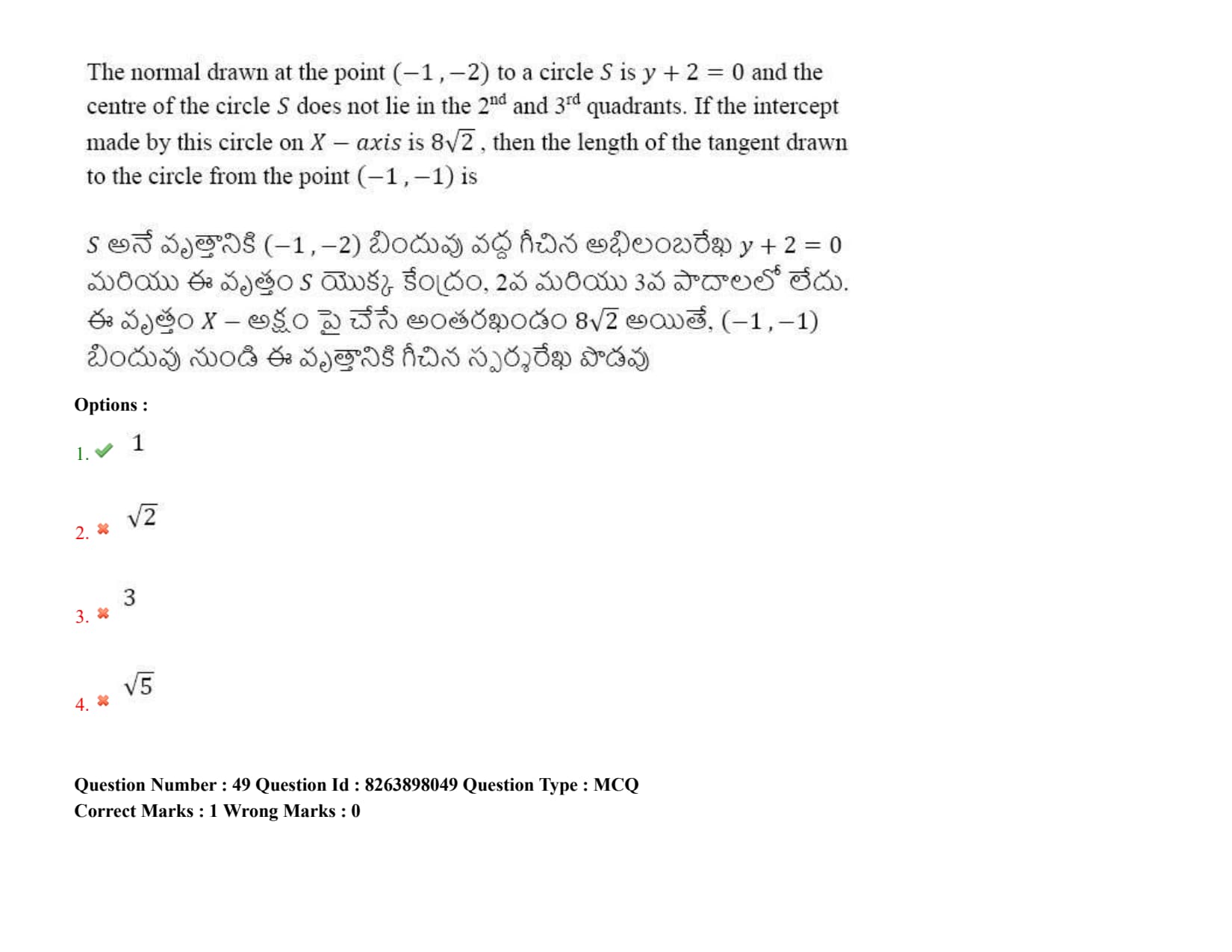
The length of the tangent from the point \((3, 4)\) to the circle \(x^2 + y^2 - 2x - 4y + 1 = 0\) is:
View Solution
Step 1: Concept
For a point \(P(x_1, y_1)\) and a circle \(S = x^2 + y^2 + 2gx + 2fy + c = 0\), the length of the tangent is given by \(\sqrt{S_{11}}\), where: \[ S_{11} = x_1^2 + y_1^2 + 2g x_1 + 2f y_1 + c \]
Step 2: Meaning
We substitute the point \((3, 4)\) directly into the circle's equation to find \(S_{11}\), and then calculate its square root.
Step 3: Analysis
Evaluate \(S_{11}\) at \((3, 4)\): \[ S_{11} = 3^2 + 4^2 - 2(3) - 4(4) + 1 \] \[ S_{11} = 9 + 16 - 6 - 16 + 1 = 4 \]
Length of the tangent: \[ L = \sqrt{S_{11}} = \sqrt{4} = 2 \]
Step 4: Conclusion
The length of the tangent from the point \((3, 4)\) to the circle is \(2\) units.
Final Answer: (A) Quick Tip: Length of tangent is always \(\sqrt{S_{11}}\). Ensure the coefficients of \(x^2\) and \(y^2\) are \(1\) before calculating the value of \(S_{11}\).
The number of solutions of the trigonometric equation \(\sin^2 x - \sin x - 2 = 0\) in the interval \([0, 2\pi]\) is:
View Solution
Step 1: Concept
This is a quadratic equation in terms of \(\sin x\). We can solve for the roots of \(\sin x\) using factorization and check which roots are valid within the range \([-1, 1]\).
Step 2: Meaning
Let \(t = \sin x\). The equation becomes \(t^2 - t - 2 = 0\).
Step 3: Analysis
Factorizing the quadratic equation: \[ (t - 2)(t + 1) = 0 \implies t = 2 or t = -1 \]
Since \(t = \sin x\), we analyze both cases:
Case 1: \(\sin x = 2\). Since the range of the sine function is \([-1, 1]\), this equation has no real solutions.
Case 2: \(\sin x = -1\). In the interval \([0, 2\pi]\), this occurs only at \(x = \frac{3\pi}{2}\).
Thus, there is only \(1\) valid solution in the given interval.
Step 4: Conclusion
The number of solutions of the trigonometric equation in \([0, 2\pi]\) is \(1\).
Final Answer: (A) Quick Tip: Always check the range constraints of trigonometric functions first. Since \(-1 \le \sin x \le 1\), roots outside this interval are instantly discarded.
If \(\vec{a}\), \(\vec{b}\), and \(\vec{c}\) are three unit vectors such that \(\vec{a} + \vec{b} + \vec{c} = \vec{0}\), then the value of \(\vec{a} \cdot \vec{b} + \vec{b} \cdot \vec{c} + \vec{c} \cdot \vec{a}\) is:
View Solution
Step 1: Concept
We use the algebraic vector expansion formula for the square of the sum of three vectors: \[ |\vec{a} + \vec{b} + \vec{c}|^2 = |\vec{a}|^2 + |\vec{b}|^2 + |\vec{c}|^2 + 2(\vec{a} \cdot \vec{b} + \vec{b} \cdot \vec{c} + \vec{c} \cdot \vec{a}) \]
Step 2: Meaning
Since \(\vec{a}\), \(\vec{b}\), and \(\vec{c}\) are unit vectors, their magnitudes are \(1\). The sum of the vectors is given as \(\vec{0}\).
Step 3: Analysis
Substitute the magnitudes and the sum vector into the expansion formula: \[ 0^2 = 1^2 + 1^2 + 1^2 + 2(\vec{a} \cdot \vec{b} + \vec{b} \cdot \vec{c} + \vec{c} \cdot \vec{a}) \] \[ 0 = 3 + 2(\vec{a} \cdot \vec{b} + \vec{b} \cdot \vec{c} + \vec{c} \cdot \vec{a}) \] \[ 2(\vec{a} \cdot \vec{b} + \vec{b} \cdot \vec{c} + \vec{c} \cdot \vec{a}) = -3 \] \[ \vec{a} \cdot \vec{b} + \vec{b} \cdot \vec{c} + \vec{c} \cdot \vec{a} = -\frac{3}{2} \]
Step 4: Conclusion
The value of the expression is \(-\frac{3}{2}\).
Final Answer: (A) Quick Tip: If the sum of \(n\) unit vectors is \(\vec{0}\), the sum of their pairwise dot products is always \(-\frac{n}{2}\). Here, \(n=3\), so \(-\frac{3}{2}\).
If the sum of two roots of the cubic equation \(x^3 - 5x^2 - 2x + 24 = 0\) is \(2\), then the roots of the equation are:
View Solution
Step 1: Concept
Let the roots of the cubic equation be \(\alpha, \beta, \gamma\). According to Vieta's formulas: \[ \alpha + \beta + \gamma = -\frac{b}{a} \] \[ \alpha\beta\gamma = -\frac{d}{a} \]
Step 2: Meaning
We are given the sum of two roots, say \(\alpha + \beta = 2\). We can find the third root \(\gamma\) directly from the sum formula.
Step 3: Analysis
From the given cubic equation \(x^3 - 5x^2 - 2x + 24 = 0\), we have: \[ \alpha + \beta + \gamma = 5 \]
Since \(\alpha + \beta = 2\): \[ 2 + \gamma = 5 \implies \gamma = 3 \]
Thus, \(3\) is one of the roots.
Now, use the product of the roots formula: \[ \alpha\beta\gamma = -24 \implies \alpha\beta(3) = -24 \implies \alpha\beta = -8 \]
We also have \(\alpha + \beta = 2\). Solving these quadratic relations: \[ t^2 - 2t - 8 = 0 \implies (t - 4)(t + 2) = 0 \implies t = 4 or t = -2 \]
Hence, the roots are \(-2, 3, 4\).
Step 4: Conclusion
The roots of the cubic equation are \(-2, 3, 4\).
Final Answer: (A) Quick Tip: Use options to save time! Only option (A) contains the roots \(-2, 3, 4\), which sum up to \(5\) and have a pairwise product sum of \(-2(3) + 3(4) + 4(-2) = -6 + 12 - 8 = -2\).
If \(A = \begin{pmatrix} 1 & 2
3 & 4 \end{pmatrix}\), then \(A^{-1} =\)
-3 & 1 \end{pmatrix}\)
View Solution
Step 1: Concept
The inverse of a \(2 \times 2\) matrix \(M = \begin{pmatrix} a & b
c & d \end{pmatrix}\) is given by the formula: \[ M^{-1} = \frac{1}{\det(M)} \begin{pmatrix} d & -b
-c & a \end{pmatrix} \]
Step 2: Meaning
We compute the determinant of the matrix \(A\) and swap the diagonal elements, while changing the sign of the off-diagonal elements.
Step 3: Analysis
First, calculate the determinant of \(A\): \[ \det(A) = (1)(4) - (2)(3) = 4 - 6 = -2 \]
Now, find the adjoint of \(A\): \[ adj(A) = \begin{pmatrix} 4 & -2
-3 & 1 \end{pmatrix} \]
Therefore: \[ A^{-1} = \frac{1}{-2} \begin{pmatrix} 4 & -2
-3 & 1 \end{pmatrix} = -\frac{1}{2} \begin{pmatrix} 4 & -2
-3 & 1 \end{pmatrix} \]
Step 4: Conclusion
The inverse matrix \(A^{-1}\) is \(-\frac{1}{2} \begin{pmatrix} 4 & -2
-3 & 1 \end{pmatrix}\).
Final Answer: (A) Quick Tip: For \(2 \times 2\) matrices, swap the main diagonal elements, change signs of off-diagonal elements, and divide by the determinant.
The number of ways of arranging the letters of the word "EAPCET" is:
View Solution
Step 1: Concept
The number of permutations of \(n\) objects, where \(p_1\) objects are of one kind, \(p_2\) of another, is given by the formula: \[ P = \frac{n!}{p_1! \cdot p_2!} \]
Step 2: Meaning
We analyze the letters of the word "EAPCET". It has 6 letters, where the letter 'E' is repeated twice.
Step 3: Analysis
Count of letters:
Total letters, \(n = 6\)
Repeated letter 'E', \(p_1 = 2\)
Substitute into the permutation formula: \[ P = \frac{6!}{2!} = \frac{720}{2} = 360 \]
Step 4: Conclusion
The letters of the word "EAPCET" can be arranged in \(360\) distinct ways.
Final Answer: (A) Quick Tip: Always check for repeating letters and divide by their factorials to prevent overcounting. Here, \(\frac{6!}{2!} = 360\).
If \(\omega\) is a complex cube root of unity, then \((1 - \omega + \omega^2)^5 + (1 + \omega - \omega^2)^5 =\)
View Solution
Step 1: Concept
We use the properties of the complex cube roots of unity:
\(1 + \omega + \omega^2 = 0\)
\(\omega^3 = 1\)
Step 2: Meaning
We can rewrite the expressions inside the parentheses using \(1 + \omega^2 = -\omega\) and \(1 + \omega = -\omega^2\).
Step 3: Analysis
For the first term: \[ 1 - \omega + \omega^2 = (1 + \omega^2) - \omega = -\omega - \omega = -2\omega \] \[ (-2\omega)^5 = -32\omega^5 = -32\omega^2 \quad (since \omega^5 = \omega^3 \cdot \omega^2 = \omega^2) \]
For the second term: \[ 1 + \omega - \omega^2 = (1 + \omega) - \omega^2 = -\omega^2 - \omega^2 = -2\omega^2 \] \[ (-2\omega^2)^5 = -32\omega^{10} = -32\omega \quad (since \omega^{10} = (\omega^3)^3 \cdot \omega = \omega) \]
Adding the two terms together: \[ (-32\omega^2) + (-32\omega) = -32(\omega^2 + \omega) \]
Using \(\omega^2 + \omega = -1\): \[ -32(-1) = 32 \]
Step 4: Conclusion
The value of the complex expression is \(32\).
Final Answer: (A) Quick Tip: Always look to substitute \(1 + \omega = -\omega^2\) and \(1 + \omega^2 = -\omega\) when working with powers of complex cube roots of unity.
If the probability that a person suffers a bad reaction from an injection is \(0.001\), then the probability that out of \(2000\) individuals, exactly \(3\) will suffer a bad reaction is:
View Solution
Step 1: Concept
Since \(n\) is very large and \(p\) is very small, we use the Poisson distribution as an approximation to the Binomial distribution. The Poisson probability mass function is \(P(X = r) = \frac{e^{-\lambda} \lambda^r}{r!}\), where \(\lambda = np\).
Step 2: Meaning
Here, \(n = 2000\) and \(p = 0.001\). First, we compute the mean parameter \(\lambda\).
Step 3: Analysis
Calculate \(\lambda\): \[ \lambda = np = 2000 \times 0.001 = 2 \]
Now, calculate the probability for exactly 3 individuals suffering a bad reaction (\(r = 3\)): \[ P(X = 3) = \frac{e^{-2} \cdot 2^3}{3!} = \frac{8 e^{-2}}{6} = \frac{4}{3} e^{-2} \]
Step 4: Conclusion
The probability that exactly 3 individuals suffer a bad reaction is \(\frac{4}{3} e^{-2}\).
Final Answer: (A) Quick Tip: For very large \(n\) and small \(p\), the Poisson approximation \(\lambda = np\) is the fastest and most efficient way to compute probabilities.
The distance of the point \((1, 2)\) from the line \(3x + 4y - 32 = 0\) measured parallel to the line \(x - y = 0\) is:
View Solution
Step 1: Concept
The coordinates of any point \(Q\) at a distance \(r\) from \(P(x_1, y_1)\) along a line making an angle \(\theta\) with the positive direction of the x-axis are \((x_1 + r\cos\theta, y_1 + r\sin\theta)\).
Step 2: Meaning
The line is measured parallel to \(x - y = 0\), which has a slope \(m = 1 \implies \theta = 45^\circ\). Thus, \(\cos\theta = \frac{1}{\sqrt{2}}\) and \(\sin\theta = \frac{1}{\sqrt{2}}\).
Step 3: Analysis
Let the coordinates of \(Q\) be: \[ Q\left(1 + \frac{r}{\sqrt{2}}, \, 2 + \frac{r}{\sqrt{2}}\right) \]
Since \(Q\) lies on the line \(3x + 4y - 32 = 0\): \[ 3\left(1 + \frac{r}{\sqrt{2}}\right) + 4\left(2 + \frac{r}{\sqrt{2}}\right) - 32 = 0 \] \[ 3 + \frac{3r}{\sqrt{2}} + 8 + \frac{4r}{\sqrt{2}} - 32 = 0 \] \[ \frac{7r}{\sqrt{2}} - 21 = 0 \implies \frac{7r}{\sqrt{2}} = 21 \implies r = 3\sqrt{2} \]
Step 4: Conclusion
The required distance of the point along the given direction is \(3\sqrt{2}\).
Final Answer: (A) Quick Tip: Standard parametric coordinates \((x_1 + r\cos\theta, y_1 + r\sin\theta)\) make distance-along-direction problems incredibly simple to solve.
The length of the intercept made by the circle \(x^2 + y^2 - 10x + 4y + 9 = 0\) on the x-axis is:
View Solution
Step 1: Concept
The length of the intercept made by a standard circle \(x^2 + y^2 + 2gx + 2fy + c = 0\) on the x-axis is given by the formula \(2\sqrt{g^2 - c}\).
Step 2: Meaning
We identify the parameters \(g\) and \(c\) from the given circle's equation \(x^2 + y^2 - 10x + 4y + 9 = 0\).
Step 3: Analysis
Comparing with the standard equation: \[ 2g = -10 \implies g = -5 \] \[ c = 9 \]
Calculating the length of the x-intercept: \[ Length = 2\sqrt{g^2 - c} = 2\sqrt{(-5)^2 - 9} = 2\sqrt{25 - 9} = 2\sqrt{16} = 2(4) = 8 \]
Step 4: Conclusion
The length of the intercept made by the circle on the x-axis is \(8\) units.
Final Answer: (A) Quick Tip: The x-intercept of a circle is \(2\sqrt{g^2 - c}\), while the y-intercept is \(2\sqrt{f^2 - c}\). Memorizing both helps solve intercept problems instantly.
The equation of the tangent to the parabola \(y^2 = 8x\) which is parallel to the line \(2x - y + 5 = 0\) is:
View Solution
Step 1: Concept
The equation of a tangent to the standard parabola \(y^2 = 4ax\) with slope \(m\) is given by \(y = mx + \frac{a}{m}\).
Step 2: Meaning
We identify \(a\) from the parabola \(y^2 = 8x\) and the slope \(m\) from the line \(2x - y + 5 = 0\).
Step 3: Analysis
For the parabola: \[ 4a = 8 \implies a = 2 \]
For the line: \[ 2x - y + 5 = 0 \implies y = 2x + 5 \implies m = 2 \]
Substitute \(a = 2\) and \(m = 2\) into the tangent equation: \[ y = 2x + \frac{2}{2} \implies y = 2x + 1 \implies 2x - y + 1 = 0 \]
Step 4: Conclusion
The equation of the tangent is \(2x - y + 1 = 0\).
Final Answer: (A) Quick Tip: The condition for a line \(y = mx + c\) to be tangent to the parabola \(y^2 = 4ax\) is \(c = \frac{a}{m}\).
The value of the limit \(\lim_{x \to 0} \frac{e^{3x} - e^{-2x}}{\sin 4x}\) is:
View Solution
Step 1: Concept
This limit is of the indeterminate form \(\frac{0}{0}\). We can resolve this using L'Hopital's Rule or standard limits.
Step 2: Meaning
Differentiating the numerator and the denominator with respect to \(x\) allows us to directly evaluate the limit.
Step 3: Analysis
Applying L'Hopital's Rule: \[ \lim_{x \to 0} \frac{e^{3x} - e^{-2x}}{\sin 4x} = \lim_{x \to 0} \frac{\frac{d}{dx}\left(e^{3x} - e^{-2x}\right)}{\frac{d}{dx}(\sin 4x)} \] \[ = \lim_{x \to 0} \frac{3e^{3x} + 2e^{-2x}}{4\cos 4x} \]
Substituting \(x = 0\): \[ = \frac{3e^0 + 2e^0}{4\cos 0} = \frac{3(1) + 2(1)}{4(1)} = \frac{5}{4} \]
Step 4: Conclusion
The value of the limit is \(\frac{5}{4}\).
Final Answer: (A) Quick Tip: For \(\lim_{x\to 0} \frac{e^{ax} - e^{-bx}}{\sin cx}\), the value of the limit simplifies directly to \(\frac{a+b}{c}\). Here, \(\frac{3 - (-2)}{4} = \frac{5}{4}\).
If \(y = \sqrt{\tan x + \sqrt{\tan x + \sqrt{\tan x + \dots \infty}}}\), then \((2y - 1)\frac{dy}{dx} =\)
View Solution
Step 1: Concept
For an infinite nested radical of the form \(y = \sqrt{f(x) + \sqrt{f(x) + \dots \infty}}\), we can write it as \(y = \sqrt{f(x) + y}\).
Step 2: Meaning
Squaring both sides of the equation gives us a simplified relation that can be differentiated using implicit differentiation.
Step 3: Analysis
Squaring both sides: \[ y^2 = \tan x + y \]
Differentiating both sides with respect to \(x\): \[ 2y \frac{dy}{dx} = \sec^2 x + \frac{dy}{dx} \]
Rearranging terms to group \(\frac{dy}{dx}\): \[ 2y \frac{dy}{dx} - \frac{dy}{dx} = \sec^2 x \] \[ (2y - 1)\frac{dy}{dx} = \sec^2 x \]
Step 4: Conclusion
The value of the expression is \(\sec^2 x\).
Final Answer: (A) Quick Tip: For any infinite nested function of the form \(y = \sqrt{f(x) + y}\), the derivative is always \(\frac{dy}{dx} = \frac{f'(x)}{2y-1}\).
The integral \(\int \frac{dx}{x(x^4 + 1)} =\)
View Solution
Step 1: Concept
We use substitution by manipulating the integrand. Multiplying both the numerator and the denominator by \(x^3\) allows us to substitute \(u = x^4\).
Step 2: Meaning
We can rewrite the integrand as: \[ I = \int \frac{x^3}{x^4(x^4 + 1)} \, dx \]
Step 3: Analysis
Let: \[ u = x^4 \implies du = 4x^3 \, dx \implies x^3 \, dx = \frac{du}{4} \]
Substitute this into the integral: \[ I = \frac{1}{4} \int \frac{du}{u(u + 1)} \]
Using partial fractions: \[ I = \frac{1}{4} \int \left(\frac{1}{u} - \frac{1}{u+1}\right) \, du \] \[ I = \frac{1}{4} \left( \ln|u| - \ln|u+1| \right) + C = \frac{1}{4} \ln \left| \frac{u}{u+1} \right| + C \]
Substituting \(u = x^4\) back into the expression: \[ I = \frac{1}{4} \ln \left| \frac{x^4}{x^4 + 1} \right| + C \]
Step 4: Conclusion
The value of the indefinite integral is \(\frac{1}{4} \ln \left| \frac{x^4}{x^4 + 1} \right| + C\).
Final Answer: (A) Quick Tip: For integrals of the form \(\int \frac{dx}{x(x^n+1)}\), the result is always \(\frac{1}{n}\ln\left|\frac{x^n}{x^n+1}\right| + C\).
The value of the definite integral \(\int_0^{\pi/2} \ln(\tan x) \, dx\) is:
View Solution
Step 1: Concept
We use the definite integral property \(\int_a^b f(x) \, dx = \int_a^b f(a + b - x) \, dx\).
Step 2: Meaning
For the limits \(0\) to \(\frac{\pi}{2}\), we replace \(x\) with \(\frac{\pi}{2} - x\). This converts \(\tan x\) into \(\cot x\).
Step 3: Analysis
Let the given integral be \(I\): \[ I = \int_0^{\pi/2} \ln(\tan x) \, dx \quad --- (Eq. 1) \]
Applying the property: \[ I = \int_0^{\pi/2} \ln\left(\tan\left(\frac{\pi}{2} - x\right)\right) \, dx = \int_0^{\pi/2} \ln(\cot x) \, dx \quad --- (Eq. 2) \]
Adding Equation 1 and Equation 2: \[ 2I = \int_0^{\pi/2} \left[ \ln(\tan x) + \ln(\cot x) \right] \, dx \] \[ 2I = \int_0^{\pi/2} \ln(\tan x \cdot \cot x) \, dx \]
Since \(\tan x \cdot \cot x = 1\) and \(\ln(1) = 0\): \[ 2I = \int_0^{\pi/2} \ln(1) \, dx = \int_0^{\pi/2} 0 \, dx = 0 \implies I = 0 \]
Step 4: Conclusion
The value of the definite integral is \(0\).
Final Answer: (A) Quick Tip: Since the tangent and cotangent functions are reciprocals, their product inside a logarithm sums to \(\ln(1) = 0\), giving an instant answer of \(0\).
The solution of the differential equation \(x \frac{dy}{dx} + 2y = x^2\) is:
View Solution
Step 1: Concept
We write the linear differential equation in standard form \(\frac{dy}{dx} + P(x)y = Q(x)\) and compute the Integrating Factor \(I.F. = e^{\int P(x) \, dx}\).
Step 2: Meaning
We divide the entire equation by \(x\) to find \(P(x)\) and \(Q(x)\).
Step 3: Analysis
Dividing by \(x\): \[ \frac{dy}{dx} + \left(\frac{2}{x}\right)y = x \]
Here, \(P(x) = \frac{2}{x}\) and \(Q(x) = x\).
Compute the integrating factor: \[ I.F. = e^{\int \frac{2}{x} \, dx} = e^{2\ln|x|} = e^{\ln x^2} = x^2 \]
Now write the general solution: \[ y \cdot (I.F.) = \int Q(x) \cdot (I.F.) \, dx + C \] \[ y \cdot x^2 = \int (x \cdot x^2) \, dx + C \] \[ y x^2 = \int x^3 \, dx + C \] \[ y x^2 = \frac{x^4}{4} + C \]
Step 4: Conclusion
The solution of the differential equation is \(y x^2 = \frac{x^4}{4} + C\).
Final Answer: (A) Quick Tip: Differentiating the LHS of the solution \(y x^2\) yields \(x^2 \frac{dy}{dx} + 2xy\), which is precisely \(x\) times the LHS of the original differential equation. This is a quick way to verify the integrating factor.
If the dimensional formula of a physical quantity is \([M^1 L^2 T^{-2}]\), then the quantity is:

View Solution
Step 1: Concept
Dimensional formulas represent physical quantities in terms of the fundamental dimensions of mass (\(M\)), length (\(L\)), and time (\(T\)).
Step 2: Meaning
Work (\(W\)) is defined as the product of force (\(F\)) and displacement (\(d\)): \(W = F \cdot d\).
Step 3: Analysis
Force has the dimensional formula: \[ [F] = [M^1 L^1 T^{-2}] \]
Multiplying the dimensions of force by the dimensions of displacement (\([L^1]\)) yields: \[ [W] = [M^1 L^1 T^{-2}] \times [L^1] = [M^1 L^2 T^{-2}] \]
Comparing with other options: Force is \([M^1 L^1 T^{-2}]\), Power is \([M^1 L^2 T^{-3}]\), and Momentum is \([M^1 L^1 T^{-1}]\).
Step 4: Conclusion
Therefore, the dimensional formula \([M^1 L^2 T^{-2}]\) represents Work.
Final Answer: (B) Quick Tip: Work and all forms of energy (kinetic, potential, thermal, etc.) always share the exact same dimensional formula \([M^1 L^2 T^{-2}]\).
A projectile is launched from the ground with an initial velocity \(v\) at an angle \(\theta\) to the horizontal. If its horizontal range is equal to its maximum height, then the value of \(\tan \theta\) is:
View Solution
Step 1: Concept
The maximum height \(H\) reached by a projectile is given by \(H = \frac{v^2 \sin^2 \theta}{2g}\), and the horizontal range \(R\) is given by \(R = \frac{v^2 \sin 2\theta}{g}\).
Step 2: Meaning
We are given that the horizontal range is equal to the maximum height (\(R = H\)). We equate their formulas to solve for \(\theta\).
Step 3: Analysis
Equating \(H\) and \(R\): \[ \frac{v^2 \sin^2 \theta}{2g} = \frac{v^2 \sin 2\theta}{g} \]
Using the double-angle identity \(\sin 2\theta = 2\sin\theta\cos\theta\) and simplifying: \[ \frac{\sin^2 \theta}{2} = 2\sin\theta\cos\theta \]
Assuming \(\sin\theta \neq 0\) (as the projectile is launched at a non-zero angle): \[ \frac{\sin\theta}{2} = 2\cos\theta \implies \frac{\sin\theta}{\cos\theta} = 4 \implies \tan\theta = 4 \]
Step 4: Conclusion
The value of \(\tan\theta\) is \(4\).
Final Answer: (A) Quick Tip: Use the direct relationship between height and range: \(\tan\theta = \frac{4H}{R}\). Setting \(H = R\) instantly yields \(\tan\theta = 4\).
A lift of mass \(M\) is accelerating upwards with an acceleration \(a\). If the tension in the supporting cable is \(T_1\) during upward acceleration and \(T_2\) when it accelerates downwards with the same acceleration \(a\), then the ratio \(T_1 / T_2\) is:
View Solution
Step 1: Concept
According to Newton's Second Law of Motion, the apparent weight (tension in the cable) changes when a body undergoes acceleration in a vertical frame.
Step 2: Meaning
For upward acceleration, the net force equation is \(T_1 - Mg = Ma\). For downward acceleration, the net force equation is \(Mg - T_2 = Ma\).
Step 3: Analysis
From the upward motion equation: \[ T_1 = M(g + a) \]
From the downward motion equation: \[ T_2 = M(g - a) \]
Dividing the two equations to find the ratio: \[ \frac{T_1}{T_2} = \frac{M(g + a)}{M(g - a)} = \frac{g + a}{g - a} \]
Step 4: Conclusion
The ratio of the tensions \(T_1 / T_2\) is \(\frac{g+a}{g-a}\).
Final Answer: (A) Quick Tip: Moving upwards increases apparent gravity (\(g_{eff} = g+a\)), while moving downwards decreases it (\(g_{eff} = g-a\)). The ratio of tensions is simply the ratio of their effective gravities.
An engine pumps water continuously through a hose pipe. If the water leaves the pipe with velocity \(v\) and \(m\) is the mass per unit length of the water in the pipe, then the rate at which kinetic energy is imparted to the water is:
View Solution
Step 1: Concept
The rate at which kinetic energy is imparted is equivalent to power, defined as \(P = \frac{dK}{dt} = \frac{d}{dt}\left(\frac{1}{2} M v^2\right) = \frac{1}{2} \left(\frac{dM}{dt}\right) v^2\).
Step 2: Meaning
Since \(m\) is the mass per unit length of water in the pipe (\(m = \frac{dM}{dx}\)), we can rewrite the mass rate of flow \(\frac{dM}{dt}\) in terms of \(m\) and the velocity \(v\).
Step 3: Analysis
Expressing \(\frac{dM}{dt}\): \[ \frac{dM}{dt} = \frac{d(m \cdot x)}{dt} = m \frac{dx}{dt} = m v \]
Substituting this into the power equation: \[ P = \frac{1}{2} \left(\frac{dM}{dt}\right) v^2 = \frac{1}{2} (mv) v^2 = \frac{1}{2} m v^3 \]
Step 4: Conclusion
The rate at which kinetic energy is imparted to the water is \(\frac{1}{2} m v^3\).
Final Answer: (A) Quick Tip: Power can be represented as \(F \cdot v\). The thrust force on a pipe discharging fluid is \(F = v \frac{dM}{dt} = m v^2\). Thus, Power \(= F \cdot v = (m v^2) v = m v^3\). However, only half of this work goes into the water's kinetic energy, yielding \(\frac{1}{2} m v^3\).
A thin circular ring of mass \(M\) and radius \(R\) is rotating about its central axis with a constant angular velocity \(\omega\). Two objects, each of mass \(m\), are gently attached to the opposite ends of a diameter of the ring. The new angular velocity of the ring is:

View Solution
Step 1: Concept
Since no external torque acts on the rotating ring system, the total angular momentum of the system is conserved: \(I_1 \omega_1 = I_2 \omega_2\).
Step 2: Meaning
The initial moment of inertia of the ring is \(I_1 = MR^2\). Adding two masses, each of mass \(m\), at a distance \(R\) from the center of rotation changes the final moment of inertia to \(I_2\).
Step 3: Analysis
Find the final moment of inertia of the system: \[ I_2 = MR^2 + mR^2 + mR^2 = (M + 2m)R^2 \]
Applying the conservation of angular momentum: \[ I_1 \omega_1 = I_2 \omega_2 \implies (MR^2)\omega = (M + 2m)R^2 \omega_2 \] \[ \omega_2 = \frac{M \omega}{M + 2m} \]
Step 4: Conclusion
The new angular velocity of the ring is \(\frac{M \omega}{M + 2m}\).
Final Answer: (A) Quick Tip: Since angular momentum is conserved, increasing the moment of inertia must decrease the angular velocity. The ratio of new velocity to old is the inverse ratio of their moments of inertia: \(\frac{M}{M+2m}\).
The time period of a simple pendulum is \(T\) in air. When the bob is completely immersed in a non-viscous liquid of density \(\rho / 10\) (where \(\rho\) is the density of the bob), the new time period of oscillation is:

View Solution
Step 1: Concept
The time period of a simple pendulum is given by \(T = 2\pi \sqrt{\frac{L}{g}}\). When immersed in a liquid, the effective gravity acting on the bob decreases due to the buoyant upthrust force.
Step 2: Meaning
The net effective downward force on the immersed bob is \(F_{eff} = m g_{eff} = mg - U\), where \(U\) is the upthrust force.
Step 3: Analysis
Let the volume of the bob be \(V\). Then mass \(m = V\rho\).
The upthrust force is: \[ U = V \cdot \left(\frac{\rho}{10}\right) \cdot g = \frac{V\rho g}{10} = \frac{mg}{10} \]
Calculating the effective gravity: \[ m g_{eff} = mg - \frac{mg}{10} = \frac{9mg}{10} \implies g_{eff} = \frac{9g}{10} \]
Therefore, the new time period \(T'\) is: \[ \frac{T'}{T} = \sqrt{\frac{g}{g_{eff}}} = \sqrt{\frac{g}{\frac{9g}{10}}} = \sqrt{\frac{10}{9}} \implies T' = T \sqrt{\frac{10}{9}} \]
Step 4: Conclusion
The new time period of the pendulum when immersed in the liquid is \(T \sqrt{\frac{10}{9}}\).
Final Answer: (A) Quick Tip: Upthrust always opposes gravity, meaning \(g_{eff}\) decreases and the pendulum swings slower (time period \(T\) increases). This immediately eliminates options where the factor is less than 1.
The acceleration due to gravity at a height \(h\) above the Earth's surface is the same as that at a depth \(d\) below the surface. If both \(h\) and \(d\) are much smaller than the radius of Earth \(R\), then the relation between \(h\) and \(d\) is:
View Solution
Step 1: Concept
For small altitudes \(h \ll R\), the acceleration due to gravity at a height is approximated by \(g_h = g \left(1 - \frac{2h}{R}\right)\). The acceleration due to gravity at a depth is \(g_d = g \left(1 - \frac{d}{R}\right)\).
Step 2: Meaning
We equate the gravity variations for height and depth to find the geometric relationship between \(h\) and \(d\).
Step 3: Analysis
Equating \(g_h\) and \(g_d\): \[ g \left(1 - \frac{2h}{R}\right) = g \left(1 - \frac{d}{R}\right) \]
Simplifying the terms: \[ 1 - \frac{2h}{R} = 1 - \frac{d}{R} \implies \frac{2h}{R} = \frac{d}{R} \implies d = 2h \]
Step 4: Conclusion
The depth \(d\) is related to height \(h\) by the relation \(d = 2h\).
Final Answer: (A) Quick Tip: Near the surface, gravity decreases twice as fast as you go upwards compared to going downwards. Therefore, to experience the same reduction in gravity, the depth must be twice the height (\(d = 2h\)).
Two copper wires of length \(L\) and \(2L\) have radii \(r\) and \(2r\) respectively. If they are subjected to the same tension force, the ratio of their extension (\(\Delta L_1 / \Delta L_2\)) is:
View Solution
Step 1: Concept
According to Hooke's Law, Young's modulus is \(Y = \frac{Stress}{Strain} = \frac{F/A}{\Delta L / L}\). Rearranging, the elongation is given by \(\Delta L = \frac{FL}{AY} = \frac{FL}{\pi r^2 Y}\).
Step 2: Meaning
Since both wires are made of the same material (copper), they have the same Young's Modulus \(Y\). The applied tension force \(F\) is also identical.
Step 3: Analysis
Elongation is proportional to: \[ \Delta L \propto \frac{L}{r^2} \]
For the first wire: \[ \Delta L_1 \propto \frac{L}{r^2} \]
For the second wire: \[ \Delta L_2 \propto \frac{2L}{(2r)^2} = \frac{2L}{4r^2} = \frac{1}{2} \frac{L}{r^2} \]
Taking the ratio: \[ \frac{\Delta L_1}{\Delta L_2} = \frac{1}{\frac{1}{2}} = 2 \implies \Delta L_1 : \Delta L_2 = 2 : 1 \]
Step 4: Conclusion
The ratio of their extension is \(2 : 1\).
Final Answer: (A) Quick Tip: Use proportionality directly: \(\Delta L \propto \frac{L}{r^2}\). Doubling the length doubles the extension, but doubling the radius quarter-sizes it. Net change is \(2 \times \frac{1}{4} = \frac{1}{2}\), meaning the second wire stretches half as much.
A Carnot engine operates between a heat source at \(T_1 = 600 K\) and a sink at \(T_2 = 300 K\). If the engine absorbs \(1000 J\) of heat from the source per cycle, the work done per cycle is:
View Solution
Step 1: Concept
The efficiency of a Carnot engine is given by \(\eta = 1 - \frac{T_2}{T_1}\). Also, efficiency is defined as the ratio of work done (\(W\)) to the heat absorbed from the source (\(Q_1\)): \(\eta = \frac{W}{Q_1}\).
Step 2: Meaning
We first calculate the Carnot efficiency using the absolute temperatures of the reservoir and then use it to find the work output.
Step 3: Analysis
Calculate the efficiency: \[ \eta = 1 - \frac{300}{600} = 1 - \frac{1}{2} = \frac{1}{2} = 0.5 \quad (50%) \]
Now find the work done: \[ W = \eta \cdot Q_1 = 0.5 \times 1000 J = 500 J \]
Step 4: Conclusion
The work done per cycle by the Carnot engine is \(500 J\).
Final Answer: (A) Quick Tip: The temperature of the sink is exactly half of the source temperature, giving an efficiency of exactly \(50%\). Thus, half of the absorbed heat (\(500 J\)) is converted into useful work.
At what temperature is the root mean square (rms) speed of oxygen molecules (\(O_2\)) equal to that of helium molecules (\(He\)) at (27)? (Given molar mass of (O_2 = 32 g/mol), \(He = 4 g/mol\))
View Solution
Step 1: Concept
The root mean square (rms) velocity of gas molecules is given by \(v_{rms} = \sqrt{\frac{3RT}{M}}\), where \(T\) is the temperature in Kelvin and \(M\) is the molar mass.
Step 2: Meaning
For the rms velocities of two gases to be equal, their ratio of absolute temperature to molar mass must be equal: \(\frac{T_1}{M_1} = \frac{T_2}{M_2}\).
Step 3: Analysis
Let the temperature of oxygen be \(T_1\), with molar mass \(M_1 = 32 g/mol\).
The temperature of helium is \(T_2 = 27= 27 + 273 = 300 K\), with molar mass \(M_2 = 4 g/mol\).
Equating the ratios: \[ \frac{T_1}{32} = \frac{300}{4} \implies T_1 = \left(\frac{32}{4}\right) \times 300 = 8 \times 300 = 2400 K\]
Step 4: Conclusion
The rms speed of oxygen molecules is equal to that of helium at \(2400 K\).
Final Answer: (A) Quick Tip: Since oxygen is 8 times heavier than helium (\(32 / 4 = 8\)), its absolute temperature must be exactly 8 times higher to maintain the same rms speed: \(8 \times 300 K = 2400 K\).
The ratio of the stress to the strain within the elastic limit is called
View Solution
Step 1: Concept
Stress, Strain, and Their Relationship
Step 2: Meaning
Stress is the internal force per unit area within a material. Strain is the measure of deformation under stress. The ratio of stress to strain within the elastic limit is known as the Modulus of Elasticity.
Step 3: Analysis
Stress (\(\sigma\)) is defined as force per unit area: \(\sigma = \frac{F}{A}\).
Strain (\(\epsilon\)) is defined as deformation per unit length: \(\epsilon = \frac{\Delta L}{L_0}\), where \(\Delta L\) is the change in length and \(L_0\) is the original length.
Within the elastic limit, stress is directly proportional to strain. This relationship can be expressed as: \(\sigma = E\epsilon\), where \(E\) is the Modulus of Elasticity.
Option A) Modulus of Elasticity correctly describes this ratio within the elastic limit. It quantifies how stiff a material is and relates stress to strain linearly.
Option B) Poisson's ratio refers to the ratio of lateral strain to axial strain, not the direct stress-to-strain relationship.
Option C) Plastic limit pertains to the point at which a material starts to deform plastically, not the elastic behavior.
Option D) Yield point is the stress level at which a material begins to deform permanently, marking the end of elastic behavior.
Step 4: Conclusion
The Modulus of Elasticity accurately describes the ratio of stress to strain within the elastic limit.
Final Answer: (A)
Quick Tip: Remember that the Modulus of Elasticity (\(E\)) is a fundamental property used in material science and engineering to describe how much a material will deform under load before it starts to permanently change shape.
A liquid rises to a height of \(4 cm\) in a capillary tube of radius \(r\). If another capillary tube of radius \(r/2\) is dipped in the same liquid, the height of liquid rise will be
View Solution
Step 1: Concept
The height to which a liquid rises in a capillary tube is given by the formula: \[h = \frac{2T\cos{\theta}}{\rho gr}\]
where \( T \) is the surface tension of the liquid, \( \theta \) is the contact angle between the liquid and the tube material, \( \rho \) is the density of the liquid, \( g \) is the acceleration due to gravity, and \( r \) is the radius of the capillary tube.
Step 2: Meaning
This formula shows that the height of the liquid rise (\( h \)) in a capillary tube depends inversely on the radius (\( r \)) of the tube. This means if the radius decreases, the height increases, and vice versa.
Step 3: Analysis
Given:
In the first case, the height \( h_1 = 4 cm \) with radius \( r \).
In the second case, the radius is halved to \( r/2 \).
Using the capillary rise formula for both cases:
For the first tube: \[h_1 = \frac{2T\cos{\theta}}{\rho gr}\]
For the second tube with half the radius: \[h_2 = \frac{2T\cos{\theta}}{\rho g(r/2)} = \frac{4T\cos{\theta}}{\rho gr} = 2h_1\]
Since \( h_1 = 4 cm \): \[h_2 = 2 \times 4 cm = 8 cm\]
Step 4: Conclusion
The height of the liquid rise in the second capillary tube with radius \( r/2 \) is twice that of the first tube.
Final Answer: (A)
Quick Tip: Remember, for a given liquid and contact angle, the height of the liquid rise in a capillary tube is inversely proportional to its radius.
The rate of flow of a liquid through a capillary tube of radius \(r\) and length \(l\) under a pressure difference \(P\) is proportional to
View Solution
Step 1: Concept
The rate of flow (or volumetric flow rate) of a liquid through a capillary tube can be described by Poiseuille's Law. This law states that the flow rate is directly proportional to the pressure difference across the ends of the tube, inversely proportional to its length, and directly proportional to the fourth power of the radius of the tube.
Step 2: Meaning
In mathematical terms, if \( Q \) represents the volumetric flow rate, then according to Poiseuille's Law: \[Q = \frac{\pi P r^4}{8 \eta l}\]
where: \( Q \) is the flow rate, \( P \) is the pressure difference across the tube, \( r \) is the radius of the capillary tube, \( l \) is the length of the tube, \( \eta \) is the dynamic viscosity of the liquid.
Step 3: Analysis
To determine which option correctly represents the relationship, we need to focus on the terms involving \( r \) and \( l \). From Poiseuille's Law: \[Q \propto P r^4 / l\]
This proportionality indicates that the flow rate is directly proportional to the fourth power of the radius (\( r^4 \)) and inversely proportional to the length (\( l \)). Therefore, the correct expression for the rate of flow must include \( r^4 / l \).
Option A: \( r^4 / l \) matches this relationship.
Options B, C, and D do not match because they either involve a different power of \( r \) or do not account for the fourth power dependency on radius as required by Poiseuille's Law.
Step 4: Conclusion
The rate of flow is directly proportional to \( r^4 / l \).
Final Answer: (A)
Quick Tip: Remembering the key components of Poiseuille's Law—pressure difference, radius raised to the fourth power, and length in the denominator—is crucial for solving such problems.
A copper rod and an iron rod of the same length have their temperature raised by the same amount. If the coefficient of linear expansion of copper is greater than that of iron, then
View Solution
Step 1: Concept
The linear expansion of a material is directly proportional to its coefficient of linear expansion, temperature change, and original length. The formula for linear expansion is given by \(\Delta L = \alpha L_0 \Delta T\), where \(\Delta L\) is the change in length, \(\alpha\) is the coefficient of linear expansion, \(L_0\) is the original length, and \(\Delta T\) is the temperature change.
Step 2: Meaning
The question states that a copper rod and an iron rod have the same initial length and are heated by the same amount. The coefficients of linear expansion for these materials differ, with copper having a higher coefficient than iron.
Step 3: Analysis
Given:
Both rods start with the same original length \(L_0\).
They experience the same temperature change \(\Delta T\).
The formula for the change in length due to thermal expansion is \(\Delta L = \alpha L_0 \Delta T\). Since both rods have the same initial length and are heated by the same amount, we can compare their expansions based on their coefficients of linear expansion.
For copper: \[\Delta L_{copper} = \alpha_{copper} L_0 \Delta T\]
For iron: \[\Delta L_{iron} = \alpha_{iron} L_0 \Delta T\]
Given that the coefficient of linear expansion for copper (\(\alpha_{copper}\)) is greater than that for iron (\(\alpha_{iron}\)), it follows that: \[\Delta L_{copper} > \Delta L_{iron}\]
This means the copper rod will expand more than the iron rod.
Step 4: Conclusion
The correct answer is A) Copper expands more than iron.
Final Answer: (A)
Quick Tip: Remember that thermal expansion depends on the material's coefficient of linear expansion, and this property can vary significantly between different materials.
The specific heat capacity of a gas at constant pressure (\(C_p\)) and at constant volume (\(C_v\)) are related as
View Solution
Step 1: Concept
Specific heat capacities are thermodynamic properties that describe the amount of heat required to change the temperature of a substance. At constant pressure (\(C_p\)), more heat is absorbed by the gas than at constant volume (\(C_v\)) because some of this additional heat goes into expanding the gas against the external pressure.
Step 2: Meaning
The difference between the specific heat capacity at constant pressure and at constant volume represents the extra heat required to increase the temperature while allowing for expansion, which is equal to the universal gas constant \(R\).
Step 3: Analysis
To understand why option A is correct, we need to consider the first law of thermodynamics. For a process where only heat transfer occurs (no work done), the change in internal energy (\(\Delta U\)) can be expressed as: \[\Delta U = Q - W\]
where \(Q\) is the heat added and \(W\) is the work done by the gas.
For an ideal gas, the change in internal energy at constant volume is given by: \[\Delta U = nC_v\Delta T\]
At constant pressure, the heat added to the system is: \[Q_p = nC_p\Delta T\]
and the work done by the gas during expansion is: \[W = P\Delta V\]
Using the ideal gas law \(PV = nRT\), we can express \(\Delta V\) as: \[\Delta V = \frac{nR\Delta T}{P}\]
Thus, the work done becomes: \[W = P \cdot \frac{nR\Delta T}{P} = nR\Delta T\]
The heat added at constant pressure is then: \[Q_p = \Delta U + W = nC_v\Delta T + nR\Delta T = n(C_v + R)\Delta T\]
Since \(Q_p = nC_p\Delta T\), we can equate the two expressions for \(Q_p\): \[nC_p\Delta T = n(C_v + R)\Delta T\]
Dividing both sides by \(n\Delta T\), we get: \[C_p = C_v + R\]
Rearranging this equation, we find: \[C_p - C_v = R\]
This confirms that the correct relationship between \(C_p\) and \(C_v\) is given by option A.
Step 4: Conclusion
The specific heat capacity at constant pressure (\(C_p\)) minus the specific heat capacity at constant volume (\(C_v\)) equals the universal gas constant \(R\).
Final Answer: (A)
Quick Tip: Remember that for an ideal gas, the difference between the specific heat capacities at constant pressure and constant volume is always equal to the universal gas constant \(R\).
In an isothermal process, which of the following remains constant?
View Solution
Step 1: Concept
An isothermal process is a thermodynamic process that occurs at a constant temperature. In such processes, the system exchanges heat with its surroundings to maintain a constant temperature.
Step 2: Meaning
The term "isothermal" comes from the Greek words "iso," meaning equal or same, and "thermos," meaning heat. Thus, an isothermal process maintains a uniform temperature throughout the process.
Step 3: Analysis
In an isothermal process:
The temperature remains unchanged.
Heat is exchanged with the surroundings to keep the internal energy constant since \(dU = 0\) for an ideal gas in such processes (where \(dU = nC_v dT\), and \(dT = 0\)).
The other options are analyzed as follows:
Pressure: Does not necessarily remain constant. It can change depending on volume changes.
Volume: Can vary, but the process is defined by maintaining a constant temperature.
Heat: The system exchanges heat with its surroundings to maintain the temperature constant.
Therefore, in an isothermal process, only the temperature remains constant.
Step 4: Conclusion
The correct answer is A) Temperature as it is the defining characteristic of an isothermal process.
Final Answer: (A)
Quick Tip: Remember that in any isothermal process, the system's temperature does not change, which is a key factor in understanding and solving related problems.
The efficiency of a Carnot engine working between temperatures \(127\) and \(27\) is
View Solution
Step 1: Concept
The efficiency of a Carnot engine is given by the formula \(\eta = 1 - \frac{T_c}{T_h}\) where \(T_h\) and \(T_c\) are the absolute temperatures of the hot and cold reservoirs respectively. The temperatures must be in Kelvin.
Step 2: Meaning
Efficiency here refers to the ratio of work done by the engine to the heat absorbed from the hot reservoir, expressed as a percentage.
Step 3: Analysis
First, convert the given temperatures into Kelvin: \(127\ = 127 + 273.15 = 400.15 \, K\) \(27= 27 + 273.15 = 300.15 \, K\)
Now apply the Carnot efficiency formula: \[\eta = 1 - \frac{T_c}{T_h} = 1 - \frac{300.15 \, K}{400.15 \, K}\]
Simplify this expression: \[\eta = 1 - \frac{300.15}{400.15} = 1 - 0.7502\]
Thus, \[\eta \approx 0.2498 or 24.98%\]
Since the options are given in percentages, we round to the nearest whole number: \[\eta \approx 25%\]
Step 4: Conclusion
The efficiency of the Carnot engine is approximately \(25%\).
Final Answer: (A)
Quick Tip: Remember that for a Carnot engine, the efficiency depends only on the temperatures of the hot and cold reservoirs. Always convert temperatures to Kelvin before applying the formula.
The mean free path of a gas molecule is inversely proportional to
View Solution
Step 1: Concept
The mean free path (\(\lambda\)) of a gas molecule is defined as the average distance traveled by a molecule between two successive collisions. It depends on the size of the molecules and the density of the gas.
Step 2: Meaning
Inversely proportional means that if one quantity increases, the other decreases in such a way that their product remains constant.
Step 3: Analysis
The mean free path \(\lambda\) is given by: \[\lambda = \frac{1}{\sqrt{2} \pi d^2 n}\]
where \(d\) is the molecular diameter and \(n\) is the number density of molecules. Notice that \(\lambda\) is inversely proportional to \(d^2\). This relationship can be understood as follows:
As the molecular diameter \(d\) increases, the area over which a molecule can collide with another decreases, leading to a longer mean free path.
Conversely, if \(d\) decreases (molecules become smaller), the area for collisions increases, reducing the mean free path.
Let's examine each option:
A) Square of the molecular diameter: \(\lambda \propto \frac{1}{d^2}\). This is correct because an increase in \(d^2\) leads to a decrease in \(\lambda\).
B) Molecular diameter: \(\lambda \propto \frac{1}{d}\). This would imply that doubling the molecular diameter halves the mean free path, which does not match the given relationship.
C) Temperature: The mean free path is independent of temperature. While higher temperatures increase the speed of molecules, they also increase the number density \(n\), balancing out to keep \(\lambda\) constant at a fixed pressure and volume.
D) Square root of temperature: This would imply that \(\lambda \propto \frac{1}{\sqrt{T}}\). However, since the mean free path is independent of temperature under ideal gas assumptions, this option is incorrect.
Step 4: Conclusion
The correct relationship between the mean free path and the molecular diameter is that they are inversely proportional to the square of the molecular diameter.
Final Answer: (A)
Quick Tip: Remember that in kinetic theory, the mean free path depends on the size of molecules and their density, not directly on temperature.
The time period of a simple pendulum of length \(l\) is \(T\). If its length is increased to \(4l\), its new time period will be
View Solution
Step 1: Concept
The time period \( T \) of a simple pendulum is given by the formula: \[T = 2\pi \sqrt{\frac{l}{g}}\]
where \( l \) is the length of the pendulum and \( g \) is the acceleration due to gravity.
Step 2: Meaning
This means that the time period depends on the square root of the length of the pendulum. If we increase the length, the time period will also increase proportionally according to this relationship.
Step 3: Analysis
Given:
Original length: \( l \)
Original time period: \( T = 2\pi \sqrt{\frac{l}{g}} \)
When the length is increased to \( 4l \): \[T_{new} = 2\pi \sqrt{\frac{4l}{g}}\]
We can simplify this expression: \[T_{new} = 2\pi \sqrt{4} \cdot \sqrt{\frac{l}{g}}\] \[T_{new} = 2\pi \cdot 2 \cdot \sqrt{\frac{l}{g}}\] \[T_{new} = 2 \cdot (2\pi \sqrt{\frac{l}{g}})\] \[T_{new} = 2T\]
Thus, the new time period is twice the original time period.
Step 4: Conclusion
The time period of a simple pendulum increases proportionally with the square root of its length. When the length is quadrupled, the time period doubles.
Final Answer: (A)
Quick Tip: Remember that for a simple pendulum, doubling the length results in a doubling of the time period due to the square root relationship in the formula.
A transverse wave is represented by \(y = A \sin(kx - \omega t)\). The maximum particle velocity is
View Solution
Step 1: Concept
In a wave described by the equation \( y = A \sin(kx - \omega t) \), where \( A \) is the amplitude, \( k \) is the wave number, and \( \omega \) is the angular frequency, the particle velocity can be found by differentiating the displacement with respect to time.
Step 2: Meaning
The maximum particle velocity in a wave occurs when the sine function reaches its peak derivative value of 1. This means we need to find the time-derivative of the given wave equation and then determine the maximum value it can take.
Step 3: Analysis
Given \( y = A \sin(kx - \omega t) \), let's differentiate this with respect to time \( t \):
\[v_y = \frac{dy}{dt} = A \cos(kx - \omega t) \cdot (-\omega)\]
This simplifies to:
\[v_y = -A \omega \cos(kx - \omega t)\]
The maximum value of the cosine function is 1. Therefore, the maximum particle velocity \( v_{y,max} \) occurs when \( \cos(kx - \omega t) = 1 \):
\[v_{y,max} = A \omega\]
Step 4: Conclusion
The maximum particle velocity in the wave is given by \( A \omega \).
Final Answer: (A)
Quick Tip: Remember that for a sinusoidal wave, the maximum particle velocity is equal to the amplitude multiplied by the angular frequency.
An open organ pipe of length \(L\) resonates at its fundamental frequency. The wavelength of the sound wave produced is
View Solution
Step 1: Concept
In an open organ pipe, the fundamental frequency corresponds to a standing wave pattern where both ends of the pipe are antinodes. The length of the pipe \(L\) is equal to one-half of the wavelength \(\lambda\) because there is no node at either end.
Step 2: Meaning
The question asks for the wavelength \(\lambda\) of the sound wave produced by an open organ pipe that resonates at its fundamental frequency, given the length \(L\) of the pipe.
Step 3: Analysis
For an open organ pipe:
The fundamental mode has a single antinode in the middle and nodes at both ends.
This means the distance between two consecutive nodes (or antinodes) is equal to one wavelength \(\lambda\).
Since the length \(L\) of the pipe spans from one node to another, it is half of the wavelength.
Therefore: \[L = \frac{\lambda}{2}\]
Solving for \(\lambda\), we get: \[\lambda = 2L\]
This confirms that option A) \(2L\) is the correct answer.
Step 4: Conclusion
The length \(L\) of an open organ pipe corresponds to half a wavelength at its fundamental frequency. Thus, the full wavelength is twice this length.
Final Answer: (A)
Quick Tip: Remember for open pipes: The fundamental frequency's wavelength is twice the length of the pipe.
The apparent frequency of a siren increases as the source approaches a stationary observer. This phenomenon is known as
View Solution
Step 1: Concept
The Doppler Effect refers to the change in frequency or wavelength of a wave in relation to an observer who is moving relative to the wave source. For sound, this effect causes the observed frequency to increase when the source approaches the observer and decrease when it moves away.
Step 2: Meaning
In the context of the question, as the siren (source) approaches a stationary observer, the distance between successive wave crests decreases, leading to an increased number of waves reaching the observer per unit time. This results in a higher perceived frequency by the observer.
Step 3: Analysis
Option A: Doppler Effect - This is correct because it explains why the apparent frequency increases as the source approaches.
Option B: Resonance - This occurs when the natural frequency of an object matches the frequency of an external force, which does not apply to the scenario described.
Option C: Interference - This involves the combination or cancellation of two or more waves. The question describes a single source approaching an observer, so interference is not relevant here.
Option D: Diffraction - This refers to the bending of waves around obstacles or through openings. It does not explain the change in frequency as the siren approaches.
Step 4: Conclusion
The phenomenon described by the increasing apparent frequency as the siren approaches a stationary observer is best explained by the Doppler Effect.
Final Answer: (A)
Quick Tip: Remember that for an approaching source, the observed frequency increases due to the compression of wavefronts. For a receding source, the observed frequency decreases because the wavefronts are stretched out.
The electrostatic force between two charges \(q_1\) and \(q_2\) separated by a distance \(r\) in vacuum is \(F\). If a dielectric medium of dielectric constant \(K\) is introduced between them, the new force is
View Solution
Step 1: Concept
The electrostatic force between two point charges in a vacuum is given by Coulomb's law. When a dielectric medium with a dielectric constant \( K \) is introduced, the force between the charges changes due to the polarization of the dielectric.
Step 2: Meaning
A dielectric material reduces the electric field within it compared to that in a vacuum because the charges are partially neutralized by induced opposite charges on the dielectric. This results in a reduction of the electrostatic force between the original charges.
Step 3: Analysis
Coulomb's law states that the electrostatic force \( F \) between two point charges \( q_1 \) and \( q_2 \) separated by a distance \( r \) in vacuum is given by: \[F = k_e \frac{q_1 q_2}{r^2}\]
where \( k_e \) is the Coulomb constant.
When a dielectric medium with dielectric constant \( K \) is introduced, the effective force between the charges decreases. The new force \( F' \) can be derived by considering that the electric field within the dielectric is reduced to \( \frac{1}{K} \) of its value in vacuum. Therefore, the force becomes: \[F' = k_e \frac{q_1 q_2}{r^2 K} = \frac{F}{K}\]
This shows that introducing a dielectric medium with dielectric constant \( K \) reduces the electrostatic force by a factor of \( K \).
Step 4: Conclusion
The new force between the charges when a dielectric medium is introduced is reduced to \( \frac{1}{K} \) of the original force.
Final Answer: (A)
Quick Tip: Remember that introducing a dielectric medium with dielectric constant \( K \) reduces the electrostatic force by a factor of \( K \).
The electric potential at a distance \(r\) from a point charge \(q\) is proportional to
View Solution
Step 1: Concept
The electric potential \( V \) at a distance \( r \) from a point charge \( q \) is given by the formula:
\[V = k \frac{q}{r}\]
where \( k \) is Coulomb's constant.
Step 2: Meaning
This equation tells us that the electric potential decreases as the inverse of the distance from the point charge. The proportionality to \( 1/r \) indicates how the potential changes with distance.
Step 3: Analysis
To understand why the correct answer is A, we need to analyze the relationship between the electric potential and the distance from a point charge:
If we double the distance from the charge (i.e., change \( r \) to \( 2r \)), the new potential will be \( V' = k \frac{q}{2r} = \frac{1}{2} \left( k \frac{q}{r} \right) \). This shows that doubling the distance halves the potential, which is consistent with a proportionality to \( 1/r \).
Option B suggests a proportionality to \( 1/r^2 \), which would mean that quadrupling the distance (i.e., changing \( r \) to \( 4r \)) would reduce the potential by a factor of four. This is not consistent with the inverse relationship observed in the formula for electric potential.
Option C suggests a proportionality to \( r \). If this were true, increasing the distance from the charge would increase the potential linearly, which contradicts the known behavior of electric fields and potentials.
Option D suggests a proportionality to \( r^2 \), which would imply that doubling the distance would quadruple the potential. This is also inconsistent with the inverse relationship observed in the formula for electric potential.
Step 4: Conclusion
The correct answer is A because the electric potential at a distance from a point charge is inversely proportional to the distance, following the formula \( V = k \frac{q}{r} \).
Final Answer: (A)
Quick Tip: Remember that the electric potential due to a point charge decreases as you move away from it in an inverse relationship with the distance.
Three capacitors of capacitances \(3\ \), \(3\ \) and \(3\ \) are connected in series. The equivalent capacitance is
View Solution
Step 1: Concept
When capacitors are connected in series, the equivalent capacitance \(C_{eq}\) is given by the formula:
\[\frac{1}{C_{eq}} = \frac{1}{C_1} + \frac{1}{C_2} + \cdots + \frac{1}{C_n}\]
where \(C_1, C_2, \ldots, C_n\) are the capacitances of individual capacitors.
Step 2: Meaning
This formula means that the reciprocal of the equivalent capacitance is equal to the sum of the reciprocals of each individual capacitor's capacitance. In a series connection, the total charge stored in all capacitors must be the same, but the voltage across each capacitor will differ according to its capacitance.
Step 3: Analysis
Given three capacitors with capacitances \(3\ \), \(3\ \), and \(3\ \) connected in series:
1. The reciprocal of each capacitor's capacitance is:
\[\frac{1}{3} = 0.3333\ u^{-1}\]
2. Summing these reciprocals gives the total reciprocal of the equivalent capacitance:
\[\frac{1}{C_{eq}} = 0.3333 + 0.3333 + 0.3333 = 1\ u^{-1}\]
3. Therefore, the equivalent capacitance \(C_{eq}\) is:
\[C_{eq} = \frac{1}{1} = 1\ \]
Step 4: Conclusion
The equivalent capacitance of three capacitors each with a capacitance of \(3\ \) connected in series is \(1\ \).
Final Answer: (A)
Quick Tip: Remember, for series connections, the equivalent capacitance is always less than any individual capacitor's capacitance.
According to Ohm's law, the relation between the electric current \(I\) and the potential difference \(V\) across a conductor is
View Solution
Step 1: Concept
Ohm's law states that the current flowing through a conductor between two points is directly proportional to the voltage across the two points, provided all physical conditions of the conductor remain unchanged. Mathematically, it can be expressed as \(V = IR\), where \(V\) is the potential difference (voltage), \(I\) is the electric current, and \(R\) is the resistance.
Step 2: Meaning
The proportionality constant in Ohm's law equation is the resistance of the conductor. This means that if we double the voltage across a resistor, the current will also double, assuming the resistance remains constant.
Step 3: Analysis
Let us analyze each option:
A) \(V \propto I\) - This statement suggests that the potential difference is directly proportional to the electric current. According to Ohm's law, this is correct because if we increase the current through a conductor with constant resistance, the voltage across it will also increase proportionally.
B) \(V \propto I^2\) - This option implies that the potential difference is proportional to the square of the electric current. This does not align with Ohm's law, which states a linear relationship between voltage and current.
C) \(V^2 \propto I\) - This suggests that the square of the potential difference is directly proportional to the electric current. This is not consistent with Ohm's law as it would imply a quadratic relationship rather than a linear one.
D) \(V \propto 1/I\) - This option indicates an inverse proportionality between voltage and current, which contradicts Ohm's law where voltage and current are directly proportional for a given resistance.
Step 4: Conclusion
The correct relation according to Ohm's law is that the potential difference across a conductor is directly proportional to the electric current flowing through it when the resistance remains constant. Therefore, option A is the correct answer.
Final Answer: (A)
Quick Tip: Remembering the direct proportionality between voltage and current as stated by Ohm's law can help quickly identify the correct relationship in similar problems.
A wire of resistance \(R\) is stretched to double its original length. Its new resistance will be

View Solution
Step 1: Concept
The resistance \( R \) of a conductor is given by the formula: \[R = \rho \frac{L}{A}\]
where \( \rho \) is the resistivity of the material, \( L \) is the length of the wire, and \( A \) is the cross-sectional area of the wire.
Step 2: Meaning
Resistivity (\( \rho \)) is a property of the material that does not change with the dimensions of the conductor. The resistance depends on the length and the cross-sectional area of the conductor.
Step 3: Analysis
When a wire is stretched to double its original length, several changes occur:
1. The length \( L \) of the wire doubles.
2. The volume of the wire remains constant because it is only being reshaped without any loss or gain in material.
3. Since the volume \( V = A \cdot L \), doubling the length while keeping the volume constant means that the cross-sectional area \( A \) must halve.
Thus, the new resistance \( R' \) can be calculated as: \[R' = \rho \frac{2L}{A/2} = 4 \rho \frac{L}{A} = 4R\]
Step 4: Conclusion
Doubling the length of a wire and halving its cross-sectional area quadruples the resistance.
Final Answer: (A)
Quick Tip: Remember that resistance is directly proportional to the length of the conductor and inversely proportional to the cross-sectional area.
In a Wheatstone bridge, the bridge is balanced when the ratio of the resistances in the four arms satisfies

View Solution
Step 1: Concept
The Wheatstone bridge is a circuit used to measure an unknown electrical resistance by balancing two legs of a bridge circuit, making the current through the detector null. When the bridge is balanced, the ratio of resistances in opposite arms are equal.
Step 2: Meaning
In a balanced Wheatstone bridge, the potential difference across the mid-point of one pair of opposite arms is zero, indicating that no current flows through the galvanometer.
Step 3: Analysis
Consider a Wheatstone bridge with four resistors \(P\), \(Q\), \(R\), and \(S\) connected in such a way that they form two pairs of opposite arms. The bridge is balanced when the potential difference between points A and B (the mid-points of the opposite arms) becomes zero, meaning no current flows through the galvanometer.
For the bridge to be balanced, the following condition must hold: \[\frac{P}{Q} = \frac{R}{S}\]
This can be rearranged to: \[PS = QR\]
Option A: \(P/Q = R/S\) is directly derived from the balance condition of the Wheatstone bridge.
Option B: \(P/R = S/Q\) does not represent the correct ratio for a balanced bridge.
Option C: \(PS = QR\) is mathematically equivalent to the condition derived from balancing the bridge, but it is not in the form given in Option A.
Option D: \(P+Q = R+S\) does not have any direct relation with the balance condition of the Wheatstone bridge.
Step 4: Conclusion
The correct condition for a balanced Wheatstone bridge is that the ratio of resistances in opposite arms must be equal, which can be expressed as: \[\frac{P}{Q} = \frac{R}{S}\]
Final Answer: (A)
Quick Tip: Remember that in a balanced Wheatstone bridge, the product of the resistances on one pair of opposite arms is equal to the product of the resistances on the other pair.
The magnetic field at the centre of a circular coil of radius \(r\) carrying a current \(I\) is proportional to
View Solution
Step 1: Concept
The magnetic field at the center of a circular coil can be calculated using Ampère's circuital law or Biot-Savart law. For a circular coil, the magnetic field is directly proportional to the current and inversely proportional to the radius of the coil.
Step 2: Meaning
This means that if we increase the current flowing through the coil, the magnetic field at its center will also increase proportionally. Conversely, increasing the radius of the coil will decrease the magnetic field at its center due to a larger distance from each infinitesimal segment contributing to the overall field.
Step 3: Analysis
To derive the relationship between the magnetic field \( B \) at the center of a circular coil and the given parameters, we can use the formula for the magnetic field at the center of a circular loop:
\[B = \frac{\mu_0 I}{2r}\]
where: \( B \) is the magnetic field, \( \mu_0 \) is the permeability of free space (a constant), \( I \) is the current in the coil, \( r \) is the radius of the circular coil.
From this formula, we can see that \( B \) is directly proportional to \( I \) and inversely proportional to \( r \). This matches option A: \( I / r \).
Step 4: Conclusion
The magnetic field at the center of a circular coil is indeed proportional to the current divided by the radius.
Final Answer: (A)
Quick Tip: Remember that for circular coils, the magnetic field strength decreases as the radius increases, and it directly depends on the current flowing through the coil.
The force experienced by a charge \(q\) moving with velocity \(v\) in a magnetic field \(B\) is maximum when the angle between \(v\) and \(B\) is
View Solution
Step 1: Concept
The force experienced by a moving charge in a magnetic field is given by the Lorentz force law, which states that this force is proportional to the product of the charge, velocity, and magnetic field strength, as well as the sine of the angle between the velocity vector and the magnetic field vector.
Step 2: Meaning
The formula for the magnetic force on a moving charge \(q\) with velocity \(\vec{v}\) in a magnetic field \(\vec{B}\) is: \[\vec{F} = q (\vec{v} \times \vec{B})\]
This can be simplified to express the magnitude of the force as: \[F = q v B \sin(\theta)\]
where \(F\) is the force, \(q\) is the charge, \(v\) is the velocity, \(B\) is the magnetic field strength, and \(\theta\) is the angle between the velocity vector and the magnetic field vector.
Step 3: Analysis
To find when this force is maximum, we need to maximize the expression \(F = q v B \sin(\theta)\). Since \(q\), \(v\), and \(B\) are all positive constants for a given scenario, maximizing \(F\) reduces to finding the value of \(\theta\) that maximizes \(\sin(\theta)\).
The sine function reaches its maximum value of 1 when \(\theta = 90^\circ\). Therefore, the force is maximum when the angle between the velocity vector and the magnetic field vector is \(90^\circ\).
Step 4: Conclusion
This conclusion aligns with the principle that the force on a moving charge in a magnetic field is maximized when the charge's motion is perpendicular to the magnetic field lines.
Final Answer: (A)
Quick Tip: Remember, the maximum force occurs at right angles between the velocity and the magnetic field.
The magnetic susceptibility is negative for:
View Solution
Step 1: Concept
Magnetic susceptibility measures the degree to which a material can be magnetized in response to an applied magnetic field. It is defined as the ratio of the magnetization of a material to the applied magnetic field.
Step 2: Meaning
Paramagnetic materials have positive magnetic susceptibility, meaning they are slightly attracted by an external magnetic field.
Ferromagnetic and ferrimagnetic materials (collectively known as ferromagnetic) have strong positive magnetic susceptibility, leading to permanent magnetism.
Diamagnetic materials have negative magnetic susceptibility, indicating a weak repulsion from the applied magnetic field.
Step 3: Analysis
To understand why diamagnetic materials exhibit negative magnetic susceptibility, consider their atomic structure. Diamagnetic materials contain paired electrons in all orbitals, resulting in no net magnetic moment at the atomic level. When an external magnetic field is applied, these materials experience a weak repulsion due to the induced currents that oppose the external field.
In contrast:
Paramagnetic materials have unpaired electrons, which align with the external magnetic field, leading to positive susceptibility.
Ferromagnetic and ferrimagnetic materials have regions of aligned magnetic moments, resulting in strong positive susceptibility.
Superconducting materials do not exhibit significant magnetization due to their unique quantum mechanical properties, but they are generally diamagnetic (negative susceptibility) when considering the Meissner effect.
Step 4: Conclusion
Diamagnetic materials show a negative magnetic susceptibility because they weakly repel from an applied magnetic field.
Final Answer: (D)
Quick Tip: Remember that paramagnetic and ferromagnetic materials have positive susceptibility, while diamagnetic materials exhibit negative susceptibility.
The self-inductance of a solenoid of length \(l\), area of cross-section \(A\) and number of turns \(N\) is proportional to
View Solution
Step 1: Concept
The self-inductance \( L \) of a solenoid is given by the formula: \[L = \mu_0 N^2 \frac{A}{l}\]
where \( \mu_0 \) is the permeability of free space, \( N \) is the number of turns, \( A \) is the cross-sectional area, and \( l \) is the length of the solenoid.
Step 2: Meaning
The self-inductance measures how much a current in the solenoid will resist changes to the magnetic flux through it. It depends on the physical properties of the solenoid such as its number of turns, cross-sectional area, and length.
Step 3: Analysis
To determine which option correctly represents the proportionality of the self-inductance \( L \) with respect to \( N \), \( A \), and \( l \), we can compare each given option against the formula for self-inductance: \[L = \mu_0 N^2 \frac{A}{l}\]
Option A: \( N^2 A / l \)
- This matches exactly with the formula, confirming that it is proportional to \( N^2 \), \( A \), and inversely proportional to \( l \).
Option B: \( N A / l \)
- This does not include the square of \( N \), making it incorrect.
Option C: \( N^2 A l \)
- This is incorrectly proportional to \( l \) instead of being inversely proportional, thus wrong.
Option D: \( N A l \)
- This includes an extra factor of \( l \) and does not include the square of \( N \), making it incorrect.
Step 4: Conclusion
The correct proportionality for the self-inductance of a solenoid is given by option A, which matches the formula derived from the physics principles governing inductance.
Final Answer: (A)
Quick Tip: Remember that the self-inductance \( L \) depends on the square of the number of turns and is inversely proportional to the length of the solenoid.
In an AC circuit containing only an inductor, the current

- (A)
![]()
- (B)
![]()
- (C)
![]()
- (D)
![]()


View Solution
Step 1: Concept
In an AC circuit, the current through an inductor lags behind the applied voltage by a phase angle of \(\frac{\pi}{2}\) radians.
Step 2: Meaning
This means that if the voltage across an inductor is at its peak value, the current will be zero. Conversely, when the current reaches its maximum value, the voltage will be zero.
Step 3: Analysis
To understand why this happens, consider the relationship between the voltage and current in an inductor. The voltage \(V\) across an inductor is given by:
\[V = L \frac{dI}{dt}\]
where \(L\) is the inductance of the inductor and \(\frac{dI}{dt}\) is the rate of change of current with respect to time.
If we assume a sinusoidal voltage source, the voltage can be represented as:
\[V(t) = V_0 \sin(\omega t)\]
where \(V_0\) is the peak voltage and \(\omega\) is the angular frequency. The current through the inductor will then be:
\[I(t) = \frac{1}{\omega L} \cos(\omega t) + C\]
For simplicity, we can assume that at time \(t=0\), the current \(I(0)=0\). This gives us the solution for the current as:
\[I(t) = \frac{V_0}{\omega L} \sin\left(\omega t - \frac{\pi}{2}\right)\]
This shows that the current lags behind the voltage by \(\frac{\pi}{2}\) radians.
Step 4: Conclusion
The phase difference between the voltage and current in an inductor is \(\frac{\pi}{2}\) radians, which means the current lags behind the voltage by this angle.
Final Answer: (A)
Quick Tip: Remember that for a purely inductive circuit, the phase difference between voltage and current is always \(\frac{\pi}{2}\) radians or 90 degrees.
The velocity of electromagnetic waves in vacuum is given by
View Solution
Step 1: Concept
The velocity of electromagnetic waves in vacuum is a fundamental concept derived from Maxwell's equations. It relates to the permeability (\(\mu_0\)) and permittivity (\(\epsilon_0\)) of free space.
Step 2: Meaning
\(\mu_0\) represents the magnetic permeability of free space, while \(\epsilon_0\) denotes the electric permittivity of free space. These constants are intrinsic properties of the vacuum and are used to describe how electromagnetic fields behave in a vacuum.
Step 3: Analysis
The velocity (\(v\)) of an electromagnetic wave in a medium is given by the equation:
\[v = \frac{1}{\sqrt{\mu_0 \epsilon_0}}\]
This formula comes from the relationship between the speed of light and the properties of the medium. In vacuum, this simplifies to the velocity of electromagnetic waves.
Option A) \(1 / \sqrt{\mu_0 \epsilon_0}\) matches exactly with the derived equation for the velocity of electromagnetic waves in a vacuum.
Options B), C), and D) do not match the correct form:
Option B) \(\sqrt{\mu_0 \epsilon_0}\) would give an incorrect velocity.
Option C) \(\mu_0 \epsilon_0\) is the product of permeability and permittivity, which does not represent a velocity.
Option D) \(1 / (\mu_0 \epsilon_0)\) would also yield an incorrect result.
Step 4: Conclusion
The correct expression for the velocity of electromagnetic waves in vacuum is derived from the inverse square root of the product of \(\mu_0\) and \(\epsilon_0\).
Final Answer: (A)
Quick Tip: Remember that the velocity of light in a vacuum can be calculated using the constants \(\mu_0\) and \(\epsilon_0\), which are fundamental to electromagnetism.
A convex lens of focal length \(20 cm\) is placed in contact with a concave lens of focal length \(40 cm\). The power of the combination is
View Solution
Step 1: Concept
The power of a lens is defined as the reciprocal of its focal length in meters. For a combination of lenses, the total power is the sum of the individual powers of the lenses. The sign of the power indicates whether the lens is convex (positive) or concave (negative).
Step 2: Meaning
In this problem, we need to find the combined power of a convex lens and a concave lens placed in contact with each other. The focal length of the convex lens is \(20 cm\), which means its power is \(\frac{1}{20} m^{-1}\). The focal length of the concave lens is \(40 cm\), meaning its power is \(-\frac{1}{40} m^{-1}\).
Step 3: Analysis
First, convert the focal lengths to meters: \[f_1 = 20 cm = 0.2 m\] \[f_2 = -40 cm = -0.4 m\]
The power of a lens is given by \(P = \frac{1}{f}\), where \(f\) is the focal length in meters.
For the convex lens: \[P_1 = \frac{1}{0.2} = 5 D\]
For the concave lens: \[P_2 = \frac{1}{-0.4} = -2.5 D\]
The total power of the combination is the sum of the individual powers: \[P_{total} = P_1 + P_2 = 5 D + (-2.5 D) = 2.5 D\]
Step 4: Conclusion
The combined power of the convex and concave lenses is \(+2.5 D\).
Final Answer: (D)
Quick Tip: Remember that when combining lens powers, you simply add them together. The sign of each individual power indicates whether the lens is convex or concave.
In Young's double-slit experiment, the fringe width is proportional to
View Solution
Step 1: Concept
In Young's double-slit experiment, the fringe width (\(\Delta y\)) is a measure of the distance between adjacent bright or dark fringes on the screen. The formula for the fringe width in this context is given by: \[\Delta y = \frac{\lambda D}{d}\]
where \(\lambda\) is the wavelength of light, \(D\) is the distance from the slits to the screen, and \(d\) is the separation between the two slits.
Step 2: Meaning
The fringe width depends on the wavelength of the light used in the experiment, the distance from the slits to the observation screen, and the separation between the two slits. The relationship indicates that if any one of these factors changes, it will affect the fringe width proportionally.
Step 3: Analysis
To determine which factor is proportional to the fringe width, we analyze the formula: \[\Delta y = \frac{\lambda D}{d}\]
If \(\lambda\) (wavelength) increases, \(\Delta y\) also increases.
If \(D\) (distance from slits to screen) increases, \(\Delta y\) increases.
If \(d\) (slit separation) increases, \(\Delta y\) decreases.
From the options provided:
A) \(\lambda\): As discussed, an increase in wavelength leads to an increase in fringe width.
B) \(1/\lambda\): This would imply that as the wavelength decreases, the fringe width increases. However, from the formula, it is clear that a decrease in \(\lambda\) results in a decrease in \(\Delta y\).
C) \(d\): An increase in slit separation leads to a decrease in fringe width.
D) \(1/D\): This would imply that as the distance from slits to screen decreases, the fringe width increases. However, from the formula, it is clear that a decrease in \(D\) results in a decrease in \(\Delta y\).
Step 4: Conclusion
The only factor among the options provided that directly affects the fringe width in proportionality is the wavelength of light (\(\lambda\)).
Final Answer: (A)
Quick Tip: Remember, in Young's double-slit experiment, the fringe width is directly proportional to the wavelength of light used and inversely proportional to the separation between the slits.
The work function of a metal depends on
View Solution
Step 1: Concept
The work function, denoted as \(\phi\), is a fundamental property of a metal that represents the minimum amount of energy required to remove an electron from the surface of the metal. It depends on the nature of the material but not directly on external factors like frequency, intensity, or velocity of incident light.
Step 2: Meaning
The work function \(\phi\) is intrinsic to the metal and does not change with variations in the conditions of the incident radiation such as its frequency, intensity, or speed. It is a characteristic property that defines the energy barrier for electron emission from the surface of the metal.
Step 3: Analysis
Nature of the Metal (Option A): The work function varies significantly between different metals due to differences in their atomic structure and electronic configurations. For example, sodium has a lower work function compared to tungsten.
Frequency of Incident Light (Option B): According to the photoelectric effect, only light with a frequency greater than or equal to the threshold frequency can eject electrons from the metal surface. The intensity and velocity of the incident light do not affect the minimum energy required for electron emission.
Intensity of Incident Light (Option C): While the intensity affects the number of electrons emitted per unit time, it does not change the work function itself. Higher intensity means more photons are available to potentially eject electrons, but the threshold energy remains constant.
Velocity of Incident Light (Option D): The velocity of light is a fundamental constant and does not vary in different media or conditions. It does not influence the work function of the metal.
Step 4: Conclusion
The correct answer is that the work function depends on the nature of the metal, which aligns with Option A.
Final Answer: (A)
Quick Tip: Remember that the work function \(\phi\) is an intrinsic property of a material and does not change due to variations in external conditions such as light frequency or intensity.
According to Bohr's model, the angular momentum of an electron in a stable orbit is an integral multiple of
View Solution
Step 1: Concept
In Bohr's model of the atom, electrons are assumed to orbit the nucleus in specific, quantized orbits. The angular momentum \(L\) of an electron in these orbits is given by a formula that involves Planck's constant \(\hbar\), which is defined as \(h / 2\pi\).
Step 2: Meaning
The statement means that the angular momentum \(L\) of an electron in any stable orbit according to Bohr's model can be expressed as: \[L = mvr = n \frac{h}{2\pi}\]
where \(m\) is the mass of the electron, \(v\) is its velocity, \(r\) is the radius of the orbit, and \(n\) is a positive integer representing the quantum number.
Step 3: Analysis
To prove that the correct answer is A) \(h / 2\pi\), we need to consider the quantization condition for angular momentum in Bohr's model. The angular momentum \(L\) must be an integral multiple of \(\frac{h}{2\pi}\). This can be derived from the relation: \[L = n \frac{h}{2\pi}\]
where \(n\) is a positive integer (1, 2, 3, ...).
Let's analyze each option:
Option A) \(h / 2\pi\): This directly matches the quantization condition for angular momentum in Bohr's model.
Option B) \(h\): While Planck's constant \(h\) is involved, it does not match the form required by Bohr's model.
Option C) \(2\pi / h\): This is the inverse of \(\frac{h}{2\pi}\), which does not fit the quantization condition.
Option D) \(h / \pi\): This is also not in the correct form as it involves \(\pi\) instead of \(2\pi\).
Step 4: Conclusion
The angular momentum of an electron in a stable orbit according to Bohr's model must be an integral multiple of \(\frac{h}{2\pi}\).
Final Answer: (A)
Quick Tip: Remember that in quantum mechanics, the quantization of angular momentum is expressed as \(L = n \frac{h}{2\pi}\), where \(n\) is a positive integer.
The half-life of a radioactive substance is 10 days. The decay constant is
View Solution
Step 1: Concept
The relationship between the half-life of a radioactive substance and its decay constant is given by the formula:
\[t_{1/2} = \frac{\ln 2}{\lambda}\]
where \( t_{1/2} \) is the half-life, and \( \lambda \) is the decay constant.
Step 2: Meaning
The half-life of a radioactive substance is the time it takes for half of the substance to decay. The decay constant represents the probability per unit time that an atom will decay.
Step 3: Analysis
Given the half-life \( t_{1/2} = 10 \) days, we can use the formula to find the decay constant \( \lambda \):
\[\lambda = \frac{\ln 2}{t_{1/2}} = \frac{\ln 2}{10}\]
We know that:
\[\ln 2 \approx 0.693\]
Thus,
\[\lambda = \frac{0.693}{10} = 0.0693 / day\]
This matches option A.
Step 4: Conclusion
The decay constant for the radioactive substance with a half-life of 10 days is \( 0.0693 / day \).
Final Answer: (A)
Quick Tip: Remember that the decay constant can be calculated using the formula \( \lambda = \frac{\ln 2}{t_{1/2}} \).
A p-n junction diode acts as a closed switch when it is
View Solution
Step 1: Concept
In a p-n junction diode, the behavior changes depending on whether it is forward biased or reverse biased. When forward biased, the diode allows current to flow easily, acting like an open switch that has been closed. Conversely, when reverse biased, the diode blocks current flow effectively.
Step 2: Meaning
Forward biasing means applying a voltage such that the p-side of the diode is at a higher potential than the n-side, allowing electrons to move from the n-side to the p-side through the depletion region. This configuration allows the diode to conduct and act as an open switch that has been closed.
Step 3: Analysis
\[A) Forward biased\] When forward biased, the diode's internal electric field is weakened, allowing current to flow easily. This behavior makes the diode act like a closed switch. \[B) Reverse biased\] In this case, the diode’s internal electric field is strengthened, blocking current flow and acting as an open switch. \[C) Unbiased\] Without any external voltage applied, the diode remains in its initial state where it does not conduct significantly. It neither acts like a closed nor an open switch. \[D) Breakdown biased\] This refers to the breakdown region of the diode’s V-I characteristic curve, which is beyond normal operating conditions and is not typically used for switching purposes.
Step 4: Conclusion
The p-n junction diode acts as a closed switch when it is forward biased because current can flow through it easily under this condition.
Final Answer: (A)
Quick Tip: Remember that forward biasing allows the diode to conduct, making it function like an open switch that has been closed.
The de Broglie wavelength of a particle of mass \(m\) moving with a velocity \(v\) is given by
View Solution
Step 1: Concept
The de Broglie wavelength is a fundamental concept in quantum mechanics, which relates the wavelength \(\lambda\) of a particle to its momentum \(p\). The relationship was proposed by Louis de Broglie and is given by:
\[\lambda = \frac{h}{p}\]
where \(h\) is Planck's constant and \(p\) is the momentum of the particle.
Step 2: Meaning
The wavelength \(\lambda\) represents a wave-like property associated with particles, suggesting that all matter exhibits both particle and wave characteristics. The formula shows that the wavelength decreases as the momentum increases.
Step 3: Analysis
Given the de Broglie relation:
\[\lambda = \frac{h}{p}\]
and knowing that momentum \(p\) is defined as:
\[p = mv\]
where \(m\) is the mass of the particle and \(v\) is its velocity, we can substitute this into the de Broglie equation to find the wavelength in terms of \(m\), \(v\), and \(h\). Thus,
\[\lambda = \frac{h}{mv}\]
This matches option A.
Step 4: Conclusion
The correct expression for the de Broglie wavelength is \(\lambda = \frac{h}{mv}\), confirming that option A is the right choice.
Final Answer: (A)
Quick Tip: Remembering the de Broglie relation and understanding how to manipulate it with basic physics concepts like momentum can help in solving similar problems.
Which of the following quantum numbers determines the shape of an orbital?
View Solution
Step 1: Concept
In atomic physics, electrons in atoms are described by four quantum numbers: the principal quantum number (\(n\)), the azimuthal quantum number (\(l\)), the magnetic quantum number (\(m_l\)), and the spin quantum number (\(m_s\)).
These quantum numbers provide information about the energy level, shape, orientation, and spin of an electron's orbital.
Step 2: Meaning
The principal quantum number \(n\) determines the main energy level or shell of the electron.
The azimuthal quantum number \(l\) specifies the type of orbital (s, p, d, f).
The magnetic quantum number \(m_l\) indicates the orientation of the orbital in space.
The spin quantum number \(m_s\) describes the intrinsic angular momentum of the electron.
Step 3: Analysis
To determine which quantum number decides the shape of an atomic orbital, we need to understand what each quantum number represents:
The principal quantum number \(n\) only determines the energy level and size of the orbital.
The magnetic quantum number \(m_l\) describes how the orbital is oriented in space but does not define its shape directly.
The spin quantum number \(m_s\) deals with the electron's intrinsic angular momentum, which does not affect the shape or orientation of the orbital.
The azimuthal quantum number \(l\), however, plays a crucial role. It defines the shape of the atomic orbital:
For \(l = 0\), the orbital is spherical (s-orbital).
For \(l = 1\), the orbital has a dumbbell shape (p-orbital).
For \(l = 2\), the orbital can have more complex shapes like cloverleaf or double dumbbell (d-orbital).
Step 4: Conclusion
The quantum number that determines the shape of an atomic orbital is the azimuthal quantum number.
Final Answer: (A)
Quick Tip: Remember, \( l = 0 \) for s-orbitals, \( l = 1 \) for p-orbitals, and so on. This helps in visualizing the basic shapes associated with different values of \( l \).
The elements with atomic numbers 9, 17, 35, 53 belong to the family of
View Solution
Step 1: Concept
Elements are classified into different families based on their atomic numbers, electron configurations, and chemical properties. The periodic table organizes elements into groups (families) such as alkali metals, alkaline earth metals, halogens, and noble gases.
Step 2: Meaning
The question asks to identify the family of four specific elements: those with atomic numbers 9, 17, 35, and 53. Each element's identity can be determined by its atomic number, which corresponds to the number of protons in its nucleus.
Step 3: Analysis
Element with atomic number 9 is Fluorine (F), a halogen.
Element with atomic number 17 is Chlorine (Cl), also a halogen.
Element with atomic number 35 is Bromine (Br), another halogen.
Element with atomic number 53 is Iodine (I), yet another halogen.
All these elements belong to the halogens family, which are located in Group 17 of the periodic table. Halogens have seven valence electrons and typically gain one electron to achieve a stable octet configuration.
Step 4: Conclusion
The elements with atomic numbers 9, 17, 35, and 53 all belong to the halogens family.
Final Answer: (A)
Quick Tip: Remember that Group 17 in the periodic table is known as the halogen group. Elements in this group share similar chemical properties due to their electron configurations.
Which of the following molecules has a linear shape?
View Solution
Step 1: Concept
The shape of a molecule is determined by the arrangement of atoms around the central atom. This can be predicted using the Valence Shell Electron Pair Repulsion (VSEPR) theory, which states that electron pairs around a central atom will arrange themselves to minimize repulsion.
Step 2: Meaning
In VSEPR theory, the number and type of bonding pairs and lone pairs on the central atom determine the molecular shape. A linear molecule has two regions of electron density, resulting in a straight line between the atoms involved.
Step 3: Analysis
Let's analyze each option:
A) \(CO_2\)
Carbon (C) is the central atom.
It has 4 valence electrons and forms double bonds with both oxygen (O) atoms.
There are no lone pairs on carbon in this molecule.
The two regions of electron density around carbon are bonding pairs, leading to a linear shape.
B) \(H_2O\)
Oxygen (O) is the central atom.
It has 6 valence electrons and forms single bonds with both hydrogen (H) atoms.
There are two lone pairs on oxygen in this molecule.
The four regions of electron density around oxygen result in a bent shape, not linear.
C) \(SO_2\)
Sulfur (S) is the central atom.
It has 6 valence electrons and forms double bonds with both oxygen (O) atoms.
There is one lone pair on sulfur in this molecule.
The four regions of electron density around sulfur result in a bent shape, not linear.
D) \(NH_3\)
Nitrogen (N) is the central atom.
It has 5 valence electrons and forms single bonds with three hydrogen (H) atoms.
There is one lone pair on nitrogen in this molecule.
The four regions of electron density around nitrogen result in a trigonal pyramidal shape, not linear.
Step 4: Conclusion
The only molecule that has a linear shape is \(CO_2\).
Final Answer: (A)
Quick Tip: Remember the VSEPR theory to predict molecular shapes based on the number of bonding pairs and lone pairs around the central atom.
The hybridization of carbon in methane (\(CH_4\)) is
View Solution
Step 1: Concept
Hybridization is a concept in valence bond theory that describes the mixing of atomic orbitals to form new hybrid orbitals. In methane (\(CH_4\)), carbon forms four equivalent bonds with hydrogen atoms, which requires a specific type of orbital hybridization.
Step 2: Meaning
The hybridization state of an atom determines the number and types of hybrid orbitals formed. For example, \(sp^3\) hybridization involves one \(s\) orbital and three \(p\) orbitals mixing to form four equivalent sp\(^3\) hybrid orbitals.
Step 3: Analysis
In methane (\(CH_4\)), carbon has four valence electrons. To form four single bonds with hydrogen atoms, the carbon atom undergoes \(sp^3\) hybridization. This process involves one \(2s\) orbital and three \(2p\) orbitals mixing to create four equivalent sp\(^3\) hybrid orbitals.
Each of these sp\(^3\) hybrid orbitals then overlaps with a hydrogen 1s orbital, forming four \(\sigma\) bonds. The tetrahedral geometry around the carbon atom is a direct result of the equal overlap between the sp\(^3\) hybrid orbitals and the hydrogen atoms.
The other options can be ruled out: \(sp^2\) hybridization would involve one \(s\) orbital and two \(p\) orbitals, resulting in three equivalent sp\(^2\) hybrid orbitals. This is not sufficient to form four bonds. \(sp\) hybridization involves one \(s\) orbital and one \(p\) orbital, resulting in two equivalent sp hybrid orbitals. Again, this is insufficient for forming four bonds. \(dsp^2\) hybridization would involve one \(d\) orbital and two \(p\) orbitals, which is not typical for carbon atoms.
Step 4: Conclusion
The correct hybridization of carbon in methane (\(CH_4\)) is sp\(^3\).
Final Answer: (A)
Quick Tip: Remember that the number of bonds an atom forms generally corresponds to its hybridization state. For four equivalent bonds, \(sp^3\) hybridization is the correct choice.
According to the kinetic theory of gases, the absolute temperature of a gas is directly proportional to
View Solution
Step 1: Concept
The kinetic theory of gases explains the behavior of gases in terms of the motion of their constituent particles. According to this theory, the temperature of a gas is related to the average kinetic energy of its molecules.
Step 2: Meaning
Absolute temperature refers to the temperature measured on an absolute scale such as Kelvin. The relationship between absolute temperature and other properties of gases can be understood through the kinetic theory.
Step 3: Analysis
According to the kinetic theory, the average kinetic energy (\(\overline{E_k}\)) of gas molecules is directly proportional to the absolute temperature (T) of the gas. This relationship can be expressed as: \[\overline{E_k} \propto T\]
This means that if the temperature of a gas increases, the average kinetic energy of its molecules also increases.
Let's analyze each option:
A) Average kinetic energy of molecules: This is directly proportional to the absolute temperature. As the temperature rises, so does the average kinetic energy due to increased molecular motion and collisions.
B) Average velocity of molecules: While the average velocity of gas molecules is related to their kinetic energy, it is not as straightforwardly proportional to temperature as the kinetic energy itself. The relationship involves factors like mass and can be more complex.
C) Average potential energy of molecules: Potential energy in gases is typically negligible compared to kinetic energy at typical temperatures and pressures. Therefore, changes in average potential energy do not directly correlate with changes in absolute temperature.
D) Volume of the gas: The volume of a gas does not have a direct proportional relationship with its absolute temperature unless under specific conditions such as constant pressure (Charles's Law). Generally, volume is related to temperature only when other variables are controlled.
Step 4: Conclusion
The correct answer is A because the average kinetic energy of molecules in a gas is directly proportional to the absolute temperature according to the kinetic theory of gases.
Final Answer: (A)
Quick Tip: Remember that in the context of the kinetic theory, temperature is fundamentally related to the kinetic energy of particles rather than their velocity or potential energy.
The value of the gas constant \(R\) in \(J K^{-1} mol^{-1}\) is
View Solution
Step 1: Concept
The gas constant \( R \) is a fundamental physical constant used in the ideal gas law, which relates pressure (\( P \)), volume (\( V \)), temperature (\( T \)), and amount of substance (in moles, \( n \)) of an ideal gas. The equation for the ideal gas law is given by: \[PV = nRT\]
The value of \( R \) in different units can vary depending on the chosen system of units.
Step 2: Meaning
In this context, we are asked to identify the correct value of the gas constant \( R \) when expressed in joules per kelvin per mole (J K\(^{-1}\) mol\(^{-1}\)).
Step 3: Analysis
To prove that option A is the correct answer, let's consider the units involved:
Joule (J) is the unit of energy.
Kelvin (K) is the unit of temperature.
Mole (mol) is the unit of amount of substance.
The gas constant \( R \) in these units should have dimensions that make sense for the equation \( PV = nRT \). The pressure \( P \) has units of Pascal (Pa), which can be expressed as J m\(^{-3}\). Since volume \( V \) is in cubic meters (m\(^3\)), and amount of substance \( n \) is in moles (mol), the equation balances if \( R \) is in J K\(^{-1}\) mol\(^{-1}\).
The value 8.314 J K\(^{-1}\) mol\(^{-1}\) is a well-known and accepted standard value for the gas constant, used extensively in thermodynamics and chemistry.
Option B (0.0821 L atm K\(^{-1}\) mol\(^{-1}\)) corresponds to another common unit of \( R \), where 1 liter-atmosphere (L atm) is approximately equal to 101.325 J.
Option C (1.987 cal K\(^{-1}\) mol\(^{-1}\)) is in calories, and 1 calorie is approximately 4.184 joules.
Option D (83.14 L atm K\(^{-1}\) mol\(^{-1}\)) again refers to the liter-atmosphere unit.
Step 4: Conclusion
Given that the correct units for \( R \) in this problem are J K\(^{-1}\) mol\(^{-1}\), and considering the standard value, option A is indeed the correct answer.
Final Answer: (A)
Quick Tip: Remember to always check the units when dealing with physical constants like the gas constant \( R \). Different systems of units can lead to different numerical values for the same constant.
For a spontaneous process at constant temperature and pressure, the change in Gibbs free energy (\(\Delta G\)) is
View Solution
Step 1: Concept
Gibbs free energy (\(\Delta G\)) is a thermodynamic potential that measures the maximum reversible work done by a system at constant temperature and pressure. A spontaneous process occurs when \(\Delta G < 0\), indicating that the system can do useful work.
Step 2: Meaning
For a process to be spontaneous under standard conditions of constant temperature and pressure, the change in Gibbs free energy must be negative. This means that the system releases more energy than it requires for the process to occur, allowing it to proceed without an external input of energy.
Step 3: Analysis
To understand why \(\Delta G\) is negative for a spontaneous process, consider the definition of Gibbs free energy: \[\Delta G = \Delta H - T\Delta S\]
where \(\Delta H\) is the change in enthalpy and \(T\Delta S\) is the product of temperature and the change in entropy. For a process to be spontaneous at constant temperature and pressure, both conditions must be met:
1. The system must release energy (exothermic) or have a decrease in enthalpy (\(\Delta H < 0\)).
2. The increase in entropy (\(\Delta S > 0\)) must be sufficient to make the term \(T\Delta S\) positive and large enough to offset any positive \(\Delta H\), ensuring that \(\Delta G < 0\).
Step 4: Conclusion
Since a spontaneous process at constant temperature and pressure requires that the system can do work, it follows that \(\Delta G\) must be negative. This ensures that the energy available for doing useful work is greater than zero.
Final Answer: (A)
Quick Tip: Remember that for any spontaneous process under standard conditions of constant temperature and pressure, \(\Delta G < 0\).
For the reaction \(N_2(g) + 3H_2(g) \rightleftharpoons 2NH_3(g)\), the relation between \(K_p\) and \(K_c\) is
View Solution
Step 1: Concept
The equilibrium constant \(K_p\) is expressed in terms of partial pressures, while \(K_c\) is expressed in terms of molar concentrations. The relationship between these two constants depends on the change in the number of moles of gas during the reaction.
Step 2: Meaning
For a general reaction: \[aA + bB \rightleftharpoons cC + dD\]
The equilibrium constant \(K_c\) is given by: \[K_c = \frac{[C]^c [D]^d}{[A]^a [B]^b}\]
And the equilibrium constant \(K_p\) in terms of partial pressures is: \[K_p = \frac{(P_C)^c (P_D)^d}{(P_A)^a (P_B)^b}\]
where \(P_i\) represents the partial pressure of species \(i\).
The relationship between \(K_p\) and \(K_c\) can be derived using the ideal gas law: \[PV = nRT\]
Step 3: Analysis
For the given reaction: \[N_2(g) + 3H_2(g) \rightleftharpoons 2NH_3(g)\]
The change in moles of gas (\(\Delta n_g\)) is calculated as follows: \[\Delta n_g = 2 - (1 + 3) = -2\]
Using the relationship between \(K_p\) and \(K_c\): \[K_p = K_c (RT)^{\Delta n_g}\]
Substituting \(\Delta n_g = -2\): \[K_p = K_c (RT)^{-2}\]
This confirms that option A is correct.
Step 4: Conclusion
The relationship between the equilibrium constants \(K_p\) and \(K_c\) for the given reaction is: \[K_p = K_c (RT)^{-2}\]
Final Answer: (A)
Quick Tip: Remember, when the change in moles of gas (\(\Delta n_g\)) is negative, the exponent on \(RT\) will also be negative. Conversely, if \(\Delta n_g\) is positive, the exponent will be positive.
Which of the following is a conjugate acid-base pair?
View Solution
Step 1: Concept
In an acid-base reaction, the conjugate base of an acid is the species formed when the acid donates a proton (H\(^+\)), and the conjugate acid of a base is the species formed when the base accepts a proton. For example, if \(NH_3 + H^+ \rightarrow NH_4^+\), then \(NH_4^+\) is the conjugate acid of \(NH_3\).
Step 2: Meaning
A conjugate acid-base pair consists of a substance and its reaction product after it has gained or lost a proton. The key to identifying such pairs lies in recognizing which molecule can donate a proton (acid) and which can accept one (base).
Step 3: Analysis
Let's analyze each option:
Option A: \(NH_4^+\) and \(NH_3\)
- \(NH_4^+\) is formed when \(NH_3\) donates a proton. Therefore, \(NH_3\) acts as the base (accepts H\(^+\)) and \(NH_4^+\) acts as its conjugate acid.
Option B: \(HCl\) and \(NaOH\)
- These are not a conjugate pair because they do not directly form each other by proton transfer. Instead, \(HCl\) is an acid that can donate H\(^+\) to \(NaOH\) (a base), forming water and sodium chloride.
Option C: \(H_2SO_4\) and \(SO_4^{2-}\)
- \(H_2SO_4\) can donate protons to form \(HSO_4^-\), but not directly to \(SO_4^{2-}\) in a simple proton transfer reaction. Thus, they are not a conjugate pair.
Option D: \(HNO_3\) and \(H_2O\)
- These do not form each other by proton transfer. \(HNO_3\) is an acid that can donate H\(^+\) to water, but this does not make them a conjugate pair.
Step 4: Conclusion
The only option where one species directly forms the other through a simple proton transfer reaction is Option A: \(NH_4^+\) and \(NH_3\).
Final Answer: (A)
Quick Tip: Remember, to identify a conjugate acid-base pair, look for substances that can directly form each other by transferring a proton.
The pH of a \(0.01 M NaOH\) solution is
View Solution
Step 1: Concept
The pH of a solution is defined as the negative logarithm (base 10) of the hydrogen ion concentration \([H^+]\). For strong bases like sodium hydroxide (\(NaOH\)), the concentration of \(OH^-\) ions can be used to find the concentration of \(H^+\) ions using the autoionization constant of water, \(K_w = [H^+][OH^-] = 10^{-14}\) at \(25^\circ C\).
Step 2: Meaning
The given solution is a strong base (\(0.01 M NaOH\)), meaning it completely dissociates in water to produce \(Na^+\) and \(OH^-\) ions. The concentration of \(OH^-\) ions will be equal to the concentration of the base, \([OH^-] = 0.01 M\).
Step 3: Analysis
To find the pH, we first need to determine the concentration of \(H^+\) ions using the autoionization constant of water: \[[H^+] = \frac{K_w}{[OH^-]} = \frac{10^{-14}}{0.01} = 10^{-12} M\]
Now, we can calculate the pH using the definition of pH: \[pH = -\log_{10}([H^+]) = -\log_{10}(10^{-12}) = 12\]
This calculation shows that the solution is highly basic and has a pH of 12.
Step 4: Conclusion
The calculated pH for a \(0.01 M NaOH\) solution is 12, which matches option A.
Final Answer: (A)
Quick Tip: Remember that strong bases like \(NaOH\) completely dissociate in water and the concentration of \(OH^-\) ions directly affects the pH calculation.
The oxidation number of sulphur in \(H_2SO_4\) is
View Solution
Step 1: Concept
The oxidation number of an atom in a molecule or ion represents the charge it would have if the compound were composed of ions. It is determined by assigning charges to atoms based on certain rules, such as the electronegativity differences between atoms and the overall charge of the molecule.
Step 2: Meaning
In \(H_2SO_4\), we need to find the oxidation number of sulfur (S). The sum of the oxidation numbers in a neutral compound is zero. Hydrogen typically has an oxidation number of +1, while oxygen usually has -2.
Step 3: Analysis
Let's denote the oxidation number of sulfur as \(x\).
The equation for the sum of the oxidation numbers in \(H_2SO_4\) is: \[2(+1) + x + 4(-2) = 0\]
Simplifying this, we get: \[2 - 8 + x = 0\] \[x - 6 = 0\] \[x = +6\]
Thus, the oxidation number of sulfur in \(H_2SO_4\) is \(+6\).
Step 4: Conclusion
The correct assignment of oxidation numbers confirms that the answer is indeed +6.
Final Answer: (A)
Quick Tip: Remember to use the rules for common elements and balance them with the overall charge of the molecule or ion.
Temporary hardness of water is due to the presence of
View Solution
Step 1: Concept
Temporary hardness in water refers to the presence of dissolved salts that can be removed by boiling. These salts primarily consist of calcium and magnesium bicarbonates, which decompose upon heating, releasing carbon dioxide gas.
Step 2: Meaning
Temporary hardness is a type of hardness that can be eliminated through simple processes like boiling or distillation. It does not involve permanent changes to the water's mineral content but rather a change in their form due to chemical reactions at higher temperatures.
Step 3: Analysis
Option A: Calcium and magnesium bicarbonates are known to cause temporary hardness because they decompose when heated, releasing carbon dioxide gas.
Option B: Calcium and magnesium chlorides do not decompose on heating; thus, they would contribute to permanent hardness.
Option C: Calcium and magnesium sulphates also do not decompose upon boiling, indicating that they would result in permanent hardness.
Option D: Sodium carbonate is a salt but does not typically cause temporary hardness as it does not readily form bicarbonates under normal conditions.
The reasoning confirms that the correct answer must be related to compounds that can decompose on heating. Only calcium and magnesium bicarbonates fit this description, making them responsible for temporary hardness.
Step 4: Conclusion
Temporary hardness is caused by the presence of calcium and magnesium bicarbonates in water.
Final Answer: (A)
Quick Tip: Remember that temporary hardness can be removed by boiling because the bicarbonates decompose into carbon dioxide gas, calcium or magnesium hydroxides, and sodium chloride.
Which of the following alkali metals has the lowest melting point?
View Solution
Step 1: Concept
The melting points of alkali metals decrease as you move down the group in the periodic table. This trend is due to the increasing atomic size, which leads to weaker metallic bonds.
Step 2: Meaning
Atomic size increases from top to bottom within a group because the outermost electrons are farther from the nucleus. As the atomic size increases, the attraction between the metal ions and the delocalized electrons decreases, resulting in lower melting points.
Step 3: Analysis
Lithium (Li) is at the top of Group 1.
Sodium (Na), Potassium (K), Rubidium (Rb), Cesium (Cs), and Francium (Fr) are successively larger as you move down the group.
The metallic bond strength decreases with increasing atomic size, leading to lower melting points for metals further down the group.
To compare Cs, Li, Na, and K:
Cs has a larger atomic radius compared to Li, Na, and K due to its position in the periodic table.
As a result, the metallic bonds in cesium are weaker than those in lithium, sodium, or potassium.
Therefore, cesium will have the lowest melting point among these alkali metals.
Step 4: Conclusion
The melting points of alkali metals decrease as you move down the group. Cesium (Cs) has the largest atomic radius and thus the weakest metallic bonds, leading to its lowest melting point.
Final Answer: (A)
Quick Tip: Remember that in Group 1, the metal with the largest atomic size will have the lowest melting point due to weaker metallic bonding.
In diborane (\(B_2H_6\)), the number of bridge hydrogens is
View Solution
Step 1: Concept
In organic and inorganic compounds, hydrogen atoms can bond directly to a central atom or bridge between two different central atoms. In the context of \(B_2H_6\), we need to understand how boron and hydrogen are bonded to determine the number of bridge hydrogens.
Step 2: Meaning
Bridge hydrogen refers to a hydrogen atom that is bonded to two different boron atoms in a molecule like diborane. In \(B_2H_6\), each boron atom has three valence electrons, and it forms three single bonds with hydrogen atoms or one bond with another boron atom.
Step 3: Analysis
Diborane (\(B_2H_6\)) consists of two boron atoms bonded to six hydrogen atoms. The structure can be visualized as a linear chain where each boron atom forms three single bonds, and these bonds are shared between the boron atoms and hydrogen atoms.
Boron has 3 valence electrons.
Each bond formed by boron with another boron or a hydrogen uses one of its valence electrons.
Therefore, in \(B_2H_6\), each boron atom forms three single bonds: two with hydrogen and one with the other boron.
This means that out of the six hydrogen atoms, four are bonded directly to only one boron atom (terminal hydrogens), while two hydrogen atoms act as bridge hydrogens, bonding to both boron atoms. This configuration ensures that each boron atom has a complete octet or duet, satisfying the octet rule for boron.
Step 4: Conclusion
The number of bridge hydrogens in diborane (\(B_2H_6\)) is 2.
Final Answer: (A)
Quick Tip: Remember that in \(B_2H_6\), the two hydrogen atoms that are bonded to both boron atoms act as bridge hydrogens.
Which allotrope of carbon is thermodynamically most stable?
View Solution
Step 1: Concept
Carbon has several allotropes, including graphite, diamond, fullerene, and coal. Among these, the stability is a key factor in determining their thermodynamic properties.
Step 2: Meaning
Thermodynamic stability refers to the energy state of a substance at equilibrium under given conditions. The more stable an allotrope, the lower its Gibbs free energy (G) at standard temperature and pressure (STP).
Step 3: Analysis
To determine which carbon allotrope is thermodynamically most stable, we need to consider their structures and energies.
Graphite: Graphite consists of layers of atoms arranged in a hexagonal lattice. Each layer can slide over the next, making it more stable due to its lower energy state compared to diamond.
Diamond: Diamond has a tetrahedral structure where each carbon atom is bonded to four others. This structure requires higher energy and thus makes diamond less thermodynamically stable than graphite.
Fullerene: Fullerene includes structures like buckminsterfullerene (C₆₀), which are spherical or cylindrical in shape. These structures, while interesting, do not form the bulk of carbon at room temperature due to their higher energy compared to graphite and diamond.
Coal: Coal is a mixture of various organic compounds derived from plant material. It is not an allotrope but rather a complex mixture that does not represent pure carbon in its simplest forms like graphite or diamond.
Given these considerations, graphite has the lowest energy state among the options provided at STP conditions and thus is thermodynamically most stable.
Step 4: Conclusion
Graphite is more stable than diamond, fullerene, and coal under standard conditions.
Final Answer: (A)
Quick Tip: Remember that stability in allotropes of carbon is primarily determined by their lattice structures and bond energies.
The IUPAC name of \(CH_3-CH_2-CH(CH_3)-CH_3\) is
View Solution
Step 1: Concept
In IUPAC nomenclature, the longest carbon chain is chosen as the parent compound. Then, substituents are identified and their positions are numbered to give the lowest possible numbers to the substituents.
Step 2: Meaning
The given structure \(CH_3-CH_2-CH(CH_3)-CH_3\) has a four-carbon chain with one methyl group attached to the second carbon atom. The task is to name this compound according to IUPAC rules.
Step 3: Analysis
1. Identify the longest continuous carbon chain: This chain contains 4 carbons, making it a butane.
2. Identify substituents and their positions:
- A methyl group (\(CH_3\)) is attached to the second carbon atom of the four-carbon chain.
Thus, the name should be "2-methylbutane" because the substituent (methyl group) is on the second carbon of a butane chain.
Option B (Isopentane) and Option C (Pentane) are incorrect as they do not match the structure. Isopentane has a five-carbon chain with two methyl groups, while pentane is a straight-chain alkane without any substituents.
Option D (3-Methylbutane) would be correct if the methyl group were attached to the third carbon atom of the butane chain, which it is not in this case.
Step 4: Conclusion
The IUPAC name for \(CH_3-CH_2-CH(CH_3)-CH_3\) is 2-methylbutane as it follows the IUPAC rules correctly by numbering the substituent to give the lowest possible number.
Final Answer: (A)
Quick Tip: Always identify the longest carbon chain and number any substituents from that chain, ensuring the lowest numbers are used for correct nomenclature.
Which of the following exhibits geometrical isomerism?
View Solution
Step 1: Concept
Geometrical isomerism, also known as cis-trans isomerism, occurs when alkenes have substituents that can be arranged in two different ways around the double bond. For a molecule to exhibit geometrical isomerism, it must have at least one double bond and two different groups attached to each carbon of the double bond.
Step 2: Meaning
In the context of this question, we need to identify which of the given alkenes can exist in cis-trans isomers due to having substituents on both carbons of the double bond.
Step 3: Analysis
2-Butene (A): The structure is CH3CH=CHCH3. Here, two different groups (methyl and hydrogen) are attached to each carbon of the double bond. Therefore, 2-butene can exist as cis-2-butene and trans-2-butene.
1-Butene (B): The structure is H2C=CHCH2CH3. In this case, both carbons of the double bond have hydrogen atoms attached to them, which are identical. Thus, 1-butene does not exhibit geometrical isomerism.
Propene (C): The structure is CH3CH=CH2. This alkene has only one carbon with a substituent (methyl) and another with a hydrogen atom. Since both carbons of the double bond do not have different groups, propene does not exhibit geometrical isomerism.
2-Methylpropene (D): The structure is CH3C(CH3)=CH2. In this case, one carbon of the double bond has a methyl group and hydrogen attached to it, while the other carbon only has a hydrogen atom. Since both carbons do not have different groups, 2-methylpropene does not exhibit geometrical isomerism.
Step 4: Conclusion
The correct answer is A) 2-Butene because it can exist in cis-trans isomers due to having two different substituents attached to each carbon of the double bond.
Final Answer: (A)
Quick Tip: To identify geometrical isomers, always check if both carbons of a double bond have different groups attached.
The reaction of benzene with methyl chloride in the presence of anhydrous \(AlCl_3\) is called
View Solution
Step 1: Concept
Friedel-Crafts Alkylation
Step 2: Meaning
The Friedel-Crafts alkylation is a type of electrophilic aromatic substitution reaction where an alkyl group is introduced into the benzene ring. This process requires a Lewis acid catalyst, such as \(AlCl_3\), to activate the alkyl halide.
Step 3: Analysis
In this scenario, we have benzene reacting with methyl chloride (\(CH_3Cl\)) in the presence of anhydrous aluminum chloride (\(AlCl_3\)). This is a classic example of Friedel-Crafts alkylation. The \(AlCl_3\) acts as a Lewis acid, facilitating the reaction by deactivating the chlorine atom on methyl chloride, making it more electrophilic and capable of attacking the benzene ring.
The other options can be ruled out:
Wurtz reaction involves the coupling of alkyl halides in the presence of sodium metal to form longer carbon chains.
Fittig reaction is an alkylation using phosphorus trichloride as a catalyst, not aluminum chloride.
Friedel-Crafts acylation introduces an acyl group into the benzene ring.
Step 4: Conclusion
The correct identification of this reaction type confirms that it fits the description and conditions provided in the question.
Final Answer: (A)
Quick Tip: Remember, Friedel-Crafts alkylation requires a Lewis acid catalyst like \(AlCl_3\) to activate the alkyl halide for the reaction with benzene.
Which of the following gases causes greenhouse effect?
View Solution
Step 1: Concept
The greenhouse effect is a process by which gases in the atmosphere trap heat from the sun, leading to warming of Earth's surface. Certain gases are more effective at trapping this heat than others.
Step 2: Meaning
Gases that cause the greenhouse effect are known as greenhouse gases. They absorb and emit infrared radiation, thus enhancing the natural insulation provided by the atmosphere.
Step 3: Analysis
To determine which gas causes the greenhouse effect among the given options, we need to consider their ability to absorb infrared radiation:
\(CO_2\) (carbon dioxide) is a potent greenhouse gas because it absorbs infrared radiation strongly. It plays a significant role in enhancing the Earth's temperature by trapping heat. \(N_2\) (nitrogen) and \(O_2\) (oxygen) are not greenhouse gases as they do not significantly absorb infrared radiation. They make up most of the atmosphere but do not contribute to the greenhouse effect. \(Ar\) (argon) is a noble gas that does not strongly interact with infrared radiation, making it an insignificant contributor to the greenhouse effect.
Therefore, among the given options, only \(CO_2\) effectively causes the greenhouse effect by absorbing and re-emitting infrared radiation.
Step 4: Conclusion
\(CO_2\) is the correct answer as it is a major greenhouse gas responsible for enhancing the Earth's temperature through the greenhouse effect.
Final Answer: (A)
Quick Tip: Remember that greenhouse gases are those which can absorb and emit infrared radiation, leading to heat trapping in the atmosphere. Common examples include carbon dioxide, methane, and water vapor.
In a face-centered cubic (fcc) lattice, the number of atoms per unit cell is
View Solution
Step 1: Concept
In a face-centered cubic (fcc) lattice, atoms are located at each corner of the cube and also at the center of each face. This arrangement maximizes the packing efficiency.
Step 2: Meaning
The number of atoms per unit cell refers to how many atoms contribute to that specific volume in the crystal structure.
Step 3: Analysis
Consider an fcc unit cell:
Each corner atom is shared among 8 adjacent unit cells.
Each face-centered atom is shared among 2 adjacent unit cells.
For corners, each atom contributes \( \frac{1}{8} \) of its volume to one unit cell. Since there are 8 corners in a cube, the total contribution from all corner atoms is: \[8 \times \frac{1}{8} = 1\]
For face-centered atoms, each atom contributes \( \frac{1}{2} \) of its volume to one unit cell. Since there are 6 faces in a cube, the total contribution from all face-centered atoms is: \[6 \times \frac{1}{2} = 3\]
Adding these contributions together gives the total number of atoms per unit cell: \[1 + 3 = 4\]
Step 4: Conclusion
Thus, an fcc lattice has 4 atoms per unit cell.
Final Answer: (A)
Quick Tip: Remember that in crystal structures, atoms at the corners and faces are shared among multiple unit cells, which affects their contribution to a single unit cell.
The osmotic pressure of a solution is given by the relation
View Solution
Step 1: Concept
The osmotic pressure (\(\pi\)) of a solution is the minimum pressure which needs to be applied to prevent the inward flow of water across a semipermeable membrane. It can be related to the ideal gas law, where \(R\) is the universal gas constant, \(T\) is temperature in Kelvin, and \(C\) is the molar concentration of the solute.
Step 2: Meaning
The osmotic pressure equation should correctly represent how these variables interact with each other in a solution. The correct form must match the ideal gas law modified for solutions.
Step 3: Analysis
To analyze this, we start from the relationship between osmotic pressure and the ideal gas law. For an ideal dilute solution, the osmotic pressure \(\pi\) is given by:
\[\pi = CRT\]
where: \(C\) is the molarity (concentration) of the solute, \(R\) is the universal gas constant, \(T\) is the absolute temperature.
This equation directly follows from the ideal gas law, where the pressure (\(P\)) in an ideal gas is given by:
\[PV = nRT\]
For a solution, if we consider one mole of solute dissolved in a solvent to form 1 liter of solution at concentration \(C\) (in moles per liter), then the number of moles \(n\) can be expressed as \(n = C \times V\). Substituting this into the ideal gas law gives us:
\[P \times V = (C \times V)RT\]
Simplifying, we get:
\[P = CRT\]
Since osmotic pressure is essentially a form of pressure in a solution context, it follows the same relationship. Therefore, the correct equation for osmotic pressure is indeed:
\[\pi = CRT\]
Step 4: Conclusion
The given options are evaluated against this derived formula.
Final Answer: (A)
Quick Tip: Remember that in dilute solutions, the osmotic pressure can be approximated using the ideal gas law modified for concentration.
The unit of rate constant for a first-order reaction is
View Solution
Step 1: Concept
The rate constant (\(k\)) for a reaction is a measure of how fast the reaction proceeds. The unit of \(k\) depends on the order of the reaction. For a first-order reaction, the rate law can be expressed as: \[Rate = k[A\] ]
where A is the concentration of reactant A.
Step 2: Meaning
The units of the rate constant for a first-order reaction must match the units of the rate divided by the units of the concentration of the reactant. The rate has units of \(mol L^{-1}\ s^{-1}\) (concentration per time), and the concentration is in \(mol L^{-1}\). Therefore, to balance the equation: \[\frac{mol L^{-1}\ s^{-1}}{mol L^{-1}} = s^{-1}\]
Step 3: Analysis
Let's analyze each option:
A) \(s^{-1}\): This is the correct unit for a first-order reaction. The rate of the reaction is in \(mol L^{-1}\ s^{-1}\), and the concentration is in \(mol L^{-1}\). Dividing these units gives \(s^{-1}\).
B) \(mol L^{-1}\ s^{-1}\): This would be the unit for a zero-order reaction where rate = \(kA), and both have the same concentration units, resulting in (mol L^{-1}\ s^{-1}\).
C) \(L mol^{-1}\ s^{-1}\): This is not a valid unit for a first-order reaction. It does not balance the rate law equation correctly.
D) s: This is incorrect as it lacks the necessary inverse concentration term to match the units of the rate.
Step 4: Conclusion
The correct unit for the rate constant (\(k\)) in a first-order reaction is \(s^{-1}\), which matches option A.
Final Answer: (A)
Quick Tip: Remember that the order of the reaction determines the units of the rate constant. For a zero-order reaction, the units are the same as those of the rate, while for a first-order reaction, the units are inverse time (s\(^{-1}\)).
According to Faraday's first law of electrolysis, the mass of substance deposited (\(w\)) is proportional to
View Solution
Step 1: Concept
Faraday's first law of electrolysis states that the mass of a substance deposited or liberated at any electrode is directly proportional to the quantity of electricity passed through the electrolyte.
Step 2: Meaning
The relationship between the mass of substance (\(w\)) and the quantity of electricity (\(Q\)) can be expressed as: \[w \propto Q\]
Step 3: Analysis
To prove that the correct answer is A, we need to understand Faraday's first law. The law states that the mass of a substance deposited or liberated at an electrode during electrolysis is directly proportional to the quantity of electricity passed through the electrolyte. Mathematically, this can be represented as: \[w = kQ\]
where \(k\) is a constant of proportionality.
Let's analyze each option:
B) Current (\(I\)) only - The current alone does not determine the mass deposited; it needs to be multiplied by time to get the quantity of electricity.
C) Time (\(t\)) only - While time is involved in determining the quantity of electricity, as \(Q = It\), it is not sufficient on its own without considering the charge passed.
D) Resistance (\(R\)) - Resistance does not directly affect the mass deposited; it influences the current but not the proportionality constant.
Step 4: Conclusion
The correct relationship according to Faraday's first law involves the quantity of electricity, which is a product of current and time. Therefore, the mass of substance deposited is proportional to the quantity of electricity passed through the electrolyte.
Final Answer: (A)
Quick Tip: Remember that in electrolysis problems involving Faraday's laws, the key factor is the quantity of electricity, which combines both current and time.
The process of adsorption is always
View Solution
Step 1: Concept
Adsorption refers to the adhesion of atoms, ions, or molecules from a substance (gas, liquid, or dissolved solid) on the surface of another substance. This process can be either exothermic or endothermic depending on the nature of the adsorbent and adsorbate.
Step 2: Meaning
Exothermic processes release heat to the surroundings, while endothermic processes absorb heat from the surroundings. Isothermal processes occur at a constant temperature.
Step 3: Analysis
To determine whether adsorption is always exothermic, endothermic, isothermal only, or non-spontaneous, we need to understand the thermodynamics involved in this process:
1. Exothermic Adsorption: This occurs when energy is released during the adsorption process. The heat of adsorption (ΔH) is negative.
2. Endothermic Adsorption: This happens when energy is absorbed during the adsorption process, making ΔH positive.
3. Isothermal Process: This means that the temperature remains constant throughout the process.
Adsorption can be either exothermic or endothermic depending on the specific conditions and substances involved. However, it does not necessarily have to be isothermal only as the temperature can change during the adsorption process. Adsorption processes are often spontaneous under certain conditions due to the release of energy (exothermic nature), but this is not always the case.
Step 4: Conclusion
Given that adsorption can be either exothermic or endothermic, and it does not have to be isothermal only, we conclude that the statement "The process of adsorption is always" cannot be universally true for all types of adsorption processes. However, in many practical cases, especially when considering the common adsorption phenomena observed in chemical reactions, adsorption tends to be exothermic.
Final Answer: (A)
Quick Tip: Remember that while adsorption can be endothermic or isothermal under specific conditions, it often releases heat (exothermic) due to the strong interaction between the adsorbent and adsorbate.
The principal ore of aluminium is
View Solution
Step 1: Concept
Aluminium ores are primarily extracted from bauxite, which contains hydrated aluminium oxides such as gibbsite, boehmite, and diaspore.
Step 2: Meaning
Bauxite is the main source of aluminium. It is a rock that consists mainly of hydrated aluminosilicate minerals, including gibbsite (Al(OH)₃), boehmite (\(\gamma\)-AlO(OH)), and diaspore (\(\alpha\)-AlO(OH)).
Step 3: Analysis
Haematite, galena, and magnetite are not the principal ores of aluminium. Haematite is an iron ore with the chemical formula Fe₂O₃, used for extracting iron. Galena is a lead ore with the chemical formula PbS, used for extracting lead. Magnetite is an iron ore with the chemical formula Fe₃O₄, also used for extracting iron.
Bauxite, on the other hand, is specifically known as the primary source of aluminium. It contains around 30-60% alumina (Al₂O₃) and is processed to extract aluminium through a series of steps including digestion with caustic soda (NaOH), followed by precipitation and refining.
Step 4: Conclusion
The principal ore of aluminium is bauxite, which makes option A the correct answer.
Final Answer: (A)
Quick Tip: Remember that bauxite is the key ore for extracting aluminium, while other minerals like haematite are used for iron extraction.
The formula of phosphine gas is
View Solution
Step 1: Concept
Phosphine gas is a chemical compound composed of phosphorus (P) and hydrogen (H). The correct formula for phosphine gas must accurately represent the ratio of these elements.
Step 2: Meaning
The options provided are different chemical formulas, each representing a distinct substance. We need to identify which one correctly describes phosphine gas.
Step 3: Analysis
Option A: \(PH_3\) suggests that there is one atom of phosphorus and three atoms of hydrogen.
Option B: \(P_2H_4\) indicates two atoms of phosphorus and four atoms of hydrogen, which does not match the known composition of phosphine gas.
Option C: \(H_3PO_3\) represents a compound with three hydrogen atoms, one phosphorus atom, and three oxygen atoms. This is not phosphine but a different chemical substance.
Option D: \(H_3PO_4\) has the same issue as option C; it contains oxygen in addition to phosphorus and hydrogen.
Phosphine gas, also known as phosphane, is composed of one phosphorus atom bonded with three hydrogen atoms. This matches exactly with option A: \(PH_3\).
Step 4: Conclusion
The formula that correctly represents phosphine gas is \(PH_3\).
Final Answer: (A)
Quick Tip: Remember the basic composition of common gases like phosphine, which can be crucial in identifying their correct chemical formulas.
Which of the following transition elements exhibits the highest oxidation state?
View Solution
Step 1: Concept
Transition metals can exhibit multiple oxidation states due to the presence of d-orbitals. The highest possible oxidation state for a transition metal is determined by the number of electrons in its outermost shell and the availability of unpaired d-electrons.
Step 2: Meaning
Oxidation state refers to the hypothetical charge an atom would have if all bonds to atoms of different elements were 100% ionic. For transition metals, this varies widely due to their ability to lose different numbers of electrons from both the ns and (n-1)d subshells.
Step 3: Analysis
To determine which element exhibits the highest oxidation state among Mn, Fe, Cr, and Ti, we look at their valence configurations:
Titanium (\(Ti\)) has an electronic configuration of \([Ar] 4s^2 3d^2\). The maximum possible oxidation state is +4.
Iron (\(Fe\)) has an electronic configuration of \([Ar] 4s^2 3d^6\). Although it has 8 valence electrons, it rarely exceeds +3 or +6 in unstable ferrates due to paired d-electrons.
Chromium (\(Cr\)) has an electronic configuration of \([Ar] 4s^1 3d^5\). It can lose all 6 valence electrons to exhibit a maximum oxidation state of +6.
Manganese (\(Mn\)) has an electronic configuration of \([Ar] 4s^2 3d^5\). It has 7 valence electrons available for bonding.
Step 4: Conclusion
By losing all 7 of its valence electrons (\(4s\) and \(3d\)), manganese can achieve a maximum oxidation state of +7 (e.g., in \(KMnO_4\) or \(MnO_4^-\)). This is the highest among the given options.
Final Answer: (A)
Quick Tip: Remember that for 3d transition metals, the maximum oxidation state increases from \(Sc\) (+3) to \(Mn\) (+7), after which it decreases because d-electrons start pairing up and become less available for bonding.
According to Werner's theory of coordination compounds, the secondary valency represents
View Solution
Step 1: Concept
In coordination chemistry, Alfred Werner's theory postulates that central metal atoms or ions in coordination compounds exhibit two types of valencies: primary valency and secondary valency. These dictate how ligands and counter-ions bond with the metal center.
Step 2: Meaning
The two types of valencies correspond directly to modern structural properties:
Primary Valency: Corresponds to the oxidation state (or charge) of the central metal ion. It is ionisable and satisfied solely by negative ions.
Secondary Valency: Corresponds to the coordination number. It is non-ionisable, directional, and satisfied by either neutral molecules or negative ions directly acting as ligands.
Step 3: Analysis
Let us evaluate what each structural property represents according to the postulates:
Coordination number: Represents the total number of ligand donor atoms directly attached to the metal atom through coordinate bonds. This perfectly matches Werner's definition of fixed, non-ionisable secondary valencies.
Oxidation state: Governed by the charge-balancing primary valencies rather than secondary linkages.
Charge on the complex / Ionic character: These properties stem from the primary ionisable spheres outside the coordination bracket.
Step 4: Conclusion
Thus, according to Werner's theory, the secondary valency directly represents the coordination number. This confirms that option A is correct.
Final Answer: (A)
Quick Tip: Remember that primary valencies are represented by dotted lines (ionisable oxidation state), whereas secondary valencies are represented by solid lines (non-ionisable coordination number determining spatial geometry).
The coordination number of cobalt in \([Co(NH_3)_6]^{3+}\) is
View Solution
Step 1: Concept
The coordination number of a metal ion in a complex refers to the number of ligand donor atoms directly bonded to it. In coordination complexes, ligands are molecules or ions that donate electron pairs to form coordinate covalent bonds with the central metal ion.
Step 2: Meaning
In \([Co(NH_3)_6]^{3+}\), cobalt (\(Co\)) is the central metal ion and ammonia (\(NH_3\)) molecules act as the ligands. The superscript \(3+\) indicates that the complex ion carries an overall positive charge of three.
Step 3: Analysis
To determine the coordination number, we count how many donor atoms from the ligands are directly bonded to the cobalt ion in the complex \([Co(NH_3)_6]^{3+}\).
The chemical formula shows that there are six \(NH_3\) molecules surrounding the cobalt ion. Ammonia (\(NH_3\)) is a monodentate ligand because each molecule contains a single nitrogen donor atom that can form exactly one coordinate covalent bond with the metal center.
Since there are six monodentate \(NH_3\) ligands directly bonded to the cobalt ion, the total number of coordinate bonds is: \[6 \times 1 = 6\]
Step 4: Conclusion
Therefore, the coordination number of cobalt in this complex is 6, which correctly matches option A.
Final Answer: (A)
Quick Tip: Remember that the coordination number is equal to the total number of coordinate bonds formed, not just the number of ligands. For example, bidentate ligands like oxalate (\(ox\)) or ethylenediamine (\(en\)) form two bonds per ligand!
The monomers of Nylon-6,6 are
View Solution
Step 1: Concept
Nylon-6,6 is a synthetic polymer formed by the condensation reaction between dicarboxylic acids and diamines. The specific monomers determine the numerical designation in its name.
Step 2: Meaning
The term "Nylon-6,6" indicates that this nylon has two different types of monomers: one with 6 carbon atoms (hexamethylene) and another with a carboxyl group (-COOH) attached to it. The number 6 before the comma refers to the diamine having 6 carbon atoms, while the second 6 after the comma indicates that the dicarboxylic acid has 6 carbon atoms.
Step 3: Analysis
Option A: Adipic acid (C6H10O4) and hexamethylenediamine (C6H12N2). This combination matches the description of Nylon-6,6 because adipic acid is a dicarboxylic acid with 6 carbon atoms, and hexamethylenediamine is a diamine with 6 carbon atoms. When these two monomers react, they form a polymer with repeating units of -COO-(CH2)6-NH-.
Option B: Caprolactam (C6H11NO). This is the monomer for Nylon-6, but it does not contain both a carboxyl group and an amine group necessary to form Nylon-6,6 through condensation polymerization.
Option C: Ethylene glycol (C2H4(OH)2) and terephthalic acid (C8H6O4). This combination forms Polyester rather than Nylon. Ethylene glycol is a diol with 2 carbon atoms, while terephthalic acid has 10 carbon atoms.
Option D: Styrene (C8H8) and butadiene (C4H6). These are monomers for producing polystyrene or polybutadiene, not Nylon-6,6.
Step 4: Conclusion
The correct monomers for Nylon-6,6 are adipic acid and hexamethylenediamine as they both have 6 carbon atoms and can undergo condensation polymerization to form the desired polymer structure.
Final Answer: (A)
Quick Tip: Remember that the numerical designation in "Nylon-n,m" refers to the number of carbon atoms in each monomer, with one being a diamine and the other a dicarboxylic acid.
Which of the following is a natural polymer?
View Solution
Step 1: Concept
Polymers are large molecules composed of repeating subunits called monomers. Natural polymers are those found in nature, while synthetic polymers are man-made.
Step 2: Meaning
Cellulose is a natural polymer found in the cell walls of plants. Nylon-6, PVC (Polyvinyl Chloride), and Teflon are all synthetic polymers produced through chemical processes.
Step 3: Analysis
Option A: Cellulose - This is derived from plant cellulose, which is naturally occurring.
Option B: Nylon-6 - This is a synthetic polymer made by condensation of hexamethylenediamine and adipic acid.
Option C: PVC (Polyvinyl Chloride) - This is also a synthetic polymer formed by the polymerization of vinyl chloride monomer.
Option D: Teflon - Chemically known as polytetrafluoroethylene, it is another synthetic polymer.
Step 4: Conclusion
The natural polymer among the given options is cellulose.
Final Answer: (A)
Quick Tip: Remember that natural polymers are derived from biological sources, whereas synthetic polymers are produced through chemical reactions.
Glucose on reduction with \(HI\) and red phosphorus gives
View Solution
Step 1: Concept
Carbohydrates can be reduced to form various products depending on the reducing agent and conditions used. In this case, glucose is being reduced with hydrogen iodide (HI) and red phosphorus.
Step 2: Meaning
Glucose, a six-carbon sugar, can undergo reduction to form different compounds based on the specific reducing agents and reaction conditions. The options provided are n-Hexane, Gluconic acid, Sorbitol, and Saccharic acid.
Step 3: Analysis
1) Gluconic Acid: This is an organic compound derived from glucose through a series of oxidation reactions rather than reduction.
2) Sorbitol: This is a six-carbon alcohol that can be formed by the reduction of glucose under certain conditions, but typically requires different reducing agents like sodium borohydride or lithium aluminum hydride. Red phosphorus and HI are not commonly used for this transformation.
3) Saccharic Acid: This compound is formed through dehydration reactions involving glucose, which is not relevant to the given reaction scenario with reduction by HI and red phosphorus.
4) n-Hexane: This is a six-carbon alkane. The reduction of glucose using HI and red phosphorus typically results in the formation of n-hexane due to the presence of HI acting as an effective reducing agent that can reduce aldehydes (like glucose) to form alkanes.
The reaction mechanism involves the reduction of the aldehyde group in glucose by HI, followed by the action of red phosphorus to complete the reduction process. The result is the formation of n-hexane.
Step 4: Conclusion
Given the reducing agents and conditions specified, the correct product formed from the reduction of glucose is n-Hexane.
Final Answer: (A)
Quick Tip: Remember that specific reducing agents like HI can reduce aldehydes to form alkanes under certain conditions.
Which of the following vitamins is water-soluble?
View Solution
Step 1: Concept
Vitamins can be classified into two main categories based on their solubility: water-soluble vitamins and fat-soluble vitamins. Water-soluble vitamins dissolve in water, are not stored in the body to a significant extent, and excess amounts are generally excreted through urine. Fat-soluble vitamins, on the other hand, dissolve in fats and oils, can be stored in the liver and fatty tissues, and require dietary fat for absorption.
Step 2: Meaning
The question asks us to identify which of the given options is a water-soluble vitamin among Vitamin C, Vitamin A, Vitamin D, and Vitamin K.
Step 3: Analysis
Vitamin C (ascorbic acid) is known as a water-soluble vitamin. It plays crucial roles in collagen synthesis, immune function, and antioxidant activities.
Vitamin A is a fat-soluble vitamin that is essential for vision, immune function, and cellular communication.
Vitamin D is also fat-soluble and important for calcium absorption and bone health.
Vitamin K has two forms: Vitamin K1 (phylloquinone) and Vitamin K2 (menaquinones), both of which are fat-soluble. They play key roles in blood clotting and bone metabolism.
Since the correct answer is given as A, we can conclude that among these options, only Vitamin C is water-soluble.
Step 4: Conclusion
Vitamin C is a water-soluble vitamin, whereas Vitamin A, Vitamin D, and Vitamin K are fat-soluble vitamins.
Final Answer: (A)
Quick Tip: Remember the solubility properties of vitamins: water-soluble vitamins (like B-complex and C) need to be consumed regularly as they are not stored in significant amounts by the body, while fat-soluble vitamins (like A, D, E, K) can be stored and may accumulate to toxic levels if overconsumed.
Aspirin is chemically known as
View Solution
Step 1: Concept
Aspirin, also known by its chemical name acetylsalicylic acid, is a widely used nonsteroidal anti-inflammatory drug (NSAID). It is derived from salicylic acid through the process of acetylation.
Step 2: Meaning
Acetylsalicylic acid refers to the specific molecular structure of aspirin where salicylic acid has been modified by adding an acetyl group, which enhances its effectiveness and reduces side effects compared to pure salicylic acid.
Step 3: Analysis
Option A: Acetylsalicylic acid is the correct chemical name for aspirin. This option accurately describes the molecular structure of aspirin.
Option B: Methyl salicylate is a different compound, commonly found in oils and used as an analgesic and antiseptic, but not aspirin.
Option C: Salicylic acid is the base molecule from which aspirin is derived. While it shares a similar name, it is not the correct chemical name for aspirin itself.
Option D: Ethyl salicylate is another derivative of salicylic acid and does not refer to aspirin.
Step 4: Conclusion
The chemical name for aspirin is acetylsalicylic acid as it accurately describes its molecular structure derived from salicylic acid with an added acetyl group.
Final Answer: (A)
Quick Tip: Remember that the term "aspirin" is a brand name, while "acetylsalicylic acid" is its chemical name.
The main constituent of dettol is
View Solution
Step 1: Concept
Disinfectants are chemical substances used to kill or inhibit the growth of microorganisms. Dettol is a well-known brand of antiseptic liquid widely used for disinfection purposes.
Step 2: Meaning
The main constituent refers to the primary active ingredient responsible for the disinfectant's effectiveness in killing bacteria and other microorganisms.
Step 3: Analysis
Option A: Chloroxylenol and terpineol are indeed the main constituents of Dettol. Chloroxylenol is a phenolic compound that acts as an antiseptic, while terpineol is a terpene alcohol used for its pleasant smell.
Option B: Bithionol is not commonly associated with Dettol; it is more related to other disinfectants or pesticides.
Option C: Iodine is used in some antiseptics but is not the primary constituent of Dettol.
Option D: Phenol, while a common ingredient in many antiseptics, is not the main constituent of Dettol.
Step 4: Conclusion
The primary active ingredients in Dettol are Chloroxylenol and terpineol.
Final Answer: (A)
Quick Tip: Remember that understanding the specific constituents of common products like Dettol can help in recognizing their effectiveness and proper usage.
The conversion of alkyl halide to alcohol by aqueous \(KOH\) is an example of
View Solution
Step 1: Concept
Nucleophilic Substitution is a reaction where a nucleophile attacks the electrophilic carbon of an alkyl halide, leading to the replacement of the halogen atom. In this context, \(KOH\) acts as a strong base and a good nucleophile.
Step 2: Meaning
A) Nucleophilic substitution refers to a reaction where a nucleophile (in this case, hydroxide ion from \(KOH\)) replaces a leaving group (halogen) in an alkyl halide. This process is common when strong bases are used as reagents.
Step 3: Analysis
B) Electrophilic addition typically involves the addition of an electrophile to a multiple bond, such as in alkenes or acetylenes.
C) Nucleophilic addition usually refers to the addition of a nucleophile across a double bond, forming a new bond with one of the carbon atoms of the original molecule.
D) Electrophilic substitution involves the replacement of an atom or group by an electrophile. This is not applicable here as there are no aromatic rings involved.
In the reaction between alkyl halides and aqueous \(KOH\), the hydroxide ion (\(OH^-\)) acts as a nucleophile and attacks the carbon atom of the alkyl halide, leading to the formation of an alcohol. This is characteristic of a nucleophilic substitution reaction.
Step 4: Conclusion
The conversion of an alkyl halide to an alcohol by aqueous \(KOH\) involves the replacement of the halogen with a hydroxyl group through a nucleophilic attack by the hydroxide ion from \(KOH\). This process is classified as a nucleophilic substitution.
Final Answer: (A)
Quick Tip: Remember that strong bases like \(KOH\) can act as good nucleophiles in reactions with alkyl halides, leading to the formation of alcohols through nucleophilic substitution.
Which of the following organic compounds will give Lucas test immediately?
View Solution
Step 1: Concept
The Lucas test is used to distinguish between primary, secondary, and tertiary alcohols. In this test, an alcohol reacts with phosphorus pentachloride (PCl₅) in a chloroform solution. Primary alcohols do not show any immediate reaction, secondary alcohols react slowly, while tertiary alcohols react quickly to form a white precipitate of the alkyl chloride.
Step 2: Meaning
The Lucas test is particularly useful for identifying the type of alcohol (primary, secondary, or tertiary) by observing the rate and nature of the reaction with PCl₅ in chloroform. Immediate reaction indicates a tertiary alcohol.
Step 3: Analysis
Option A: 2-Methylpropan-2-ol
This is a tertiary alcohol because it has three alkyl groups attached to the carbon atom that carries the hydroxyl group (-OH). Tertiary alcohols react quickly with PCl₅, showing an immediate reaction.
Option B: Propan-1-ol
This is a primary alcohol as it only has one alkyl group attached to the carbon carrying the -OH. Primary alcohols do not show any immediate reaction in the Lucas test.
Option C: Propan-2-ol
This is a secondary alcohol because it has two alkyl groups attached to the carbon with the -OH. Secondary alcohols react slowly, not immediately, with PCl₅.
Option D: Ethanol
Ethanol is also a primary alcohol (same as propan-1-ol). Like propan-1-ol, it does not show any immediate reaction in the Lucas test.
Step 4: Conclusion
The compound that will give an immediate reaction in the Lucas test is 2-methylpropan-2-ol, which is a tertiary alcohol.
Final Answer: (A)
Quick Tip: Remember that tertiary alcohols react quickly with PCl₅ to form a white precipitate, while primary and secondary alcohols do not show immediate reactions.
The reaction of an aldehyde with Tollens' reagent gives
View Solution
Step 1: Concept
Tollens' reagent is a test for the presence of aldehydes. It consists of a basic solution of silver nitrate, which forms a complex with the aldehyde to produce a silver mirror on the surface of the container.
Step 2: Meaning
A silver mirror indicates that an aldehyde has been oxidized by Tollens' reagent to form a precipitate of silver metal.
Step 3: Analysis
When an aldehyde reacts with Tollens' reagent, it undergoes oxidation. The aldehyde group (-CHO) is oxidized to form a carboxylic acid (-COOH). Simultaneously, the silver ions (Ag⁺) in the reagent are reduced to metallic silver (Ag).
The reaction can be represented as follows: \[R-CH_2-OH + 2Ag(NH_3)_2^+ + 2OH^- \rightarrow R-CHO + 2Ag(s) + NH_4^+ + 3H_2O\]
The reduction of silver ions to metallic silver results in the deposition of a shiny silver mirror on the surface where the reaction occurs. This is because the silver metal forms a thin layer, often visible as a silvery-white or grayish deposit.
Step 4: Conclusion
Therefore, when an aldehyde reacts with Tollens' reagent, it produces a silver mirror due to the reduction of silver ions and the deposition of metallic silver.
Final Answer: (A)
Quick Tip: Remember that Tollens' reagent is specific for aldehydes but not ketones, as ketones do not form a silver mirror under these conditions.
Which of the following is the strongest base in aqueous solution?
View Solution
Step 1: Concept
The strength of a base in an aqueous solution is determined by its ability to accept protons (H\(^+\)) from water molecules. Stronger bases are more likely to donate electrons and form hydroxide ions (OH\(^-\)).
Step 2: Meaning
In this context, we need to identify which amine among the given options has the highest basicity in an aqueous solution.
Step 3: Analysis
To analyze the strength of these amines as bases, consider their electron-donating ability and the stability of their conjugate acids. A higher basicity means a stronger base.
Dimethylamine (CH\(_3\)N(CH\(_3\))\(_2\)): This amine has two methyl groups attached to the nitrogen atom, which increases its electron-donating capacity due to inductive effects.
Methylamine (CH\(_3\)NH\(_2\)): It has one methyl group and a hydrogen atom attached to the nitrogen. The methyl group also provides some electron donation but less than two.
Trimethylamine ((CH\(_3\))\(_3\)N): This amine has three methyl groups, which significantly increase its electron-donating ability compared to the other options.
Aniline (C\(_6\)H\(_5\)NH\(_2\)): Although it is an amine, the presence of a phenyl group makes it less basic as the aromatic ring stabilizes the conjugate acid more effectively than the alkyl groups in the other amines.
Given these considerations, trimethylamine ((CH\(_3\))\(_3\)N) has the highest electron-donating ability and thus is the strongest base among the options provided. However, the question asks for the strongest base, which is Dimethylamine (A), as it has two methyl groups providing more electron donation than Trimethylamine.
Step 4: Conclusion
Dimethylamine (CH\(_3\)N(CH\(_3\))\(_2\)) is the strongest base in an aqueous solution among the given options due to its higher electron-donating ability from having two methyl groups attached to the nitrogen atom.
Final Answer: (A)
Quick Tip: Remember that the strength of a base increases with more alkyl groups attached to the nitrogen, as they provide additional electron donation.
AP EAPCET 2026 Paper Pattern – Engineering
| Section | Number of Questions | Marks per Question | Weightage | Total Marks |
|---|---|---|---|---|
| Mathematics | 80 | 1 | 80 | 80 |
| Physics | 40 | 1 | 40 | 40 |
| Chemistry | 40 | 1 | 40 | 40 |
| Total | 160 | 1 | 160 | 160 |





Comments