

.jpg?h=56&w=56&mode=stretch)


KEAM 2026 Engineering Question Paper for April 21 is available for download here. CEE Kerala conducted KEAM 2026 Engineering exam on April 21 in session 2 from 2 PM to 5 PM. KEAM 2026 Engineering exam is an online CBT with a total of 150 questions carrying a maximum of 600 marks.
- The KEAM Engineering exam is divided into 3 subjects- Physics (45 questions), Chemistry (30 questions) and Mathematics (75 questions).
- 4 marks are given for every correct answer and 1 mark is deducted for every incorrect answer
Candidates can download KEAM 2026 April 21 Engineering Question Paper with Solution PDF from the links provided below.
KEAM 2026 Engineering April 21 Question Paper with Solution PDF
| KEAM 2026 Engineering Question Paper April 21 | Download PDF | Check Solution |

Also Check:
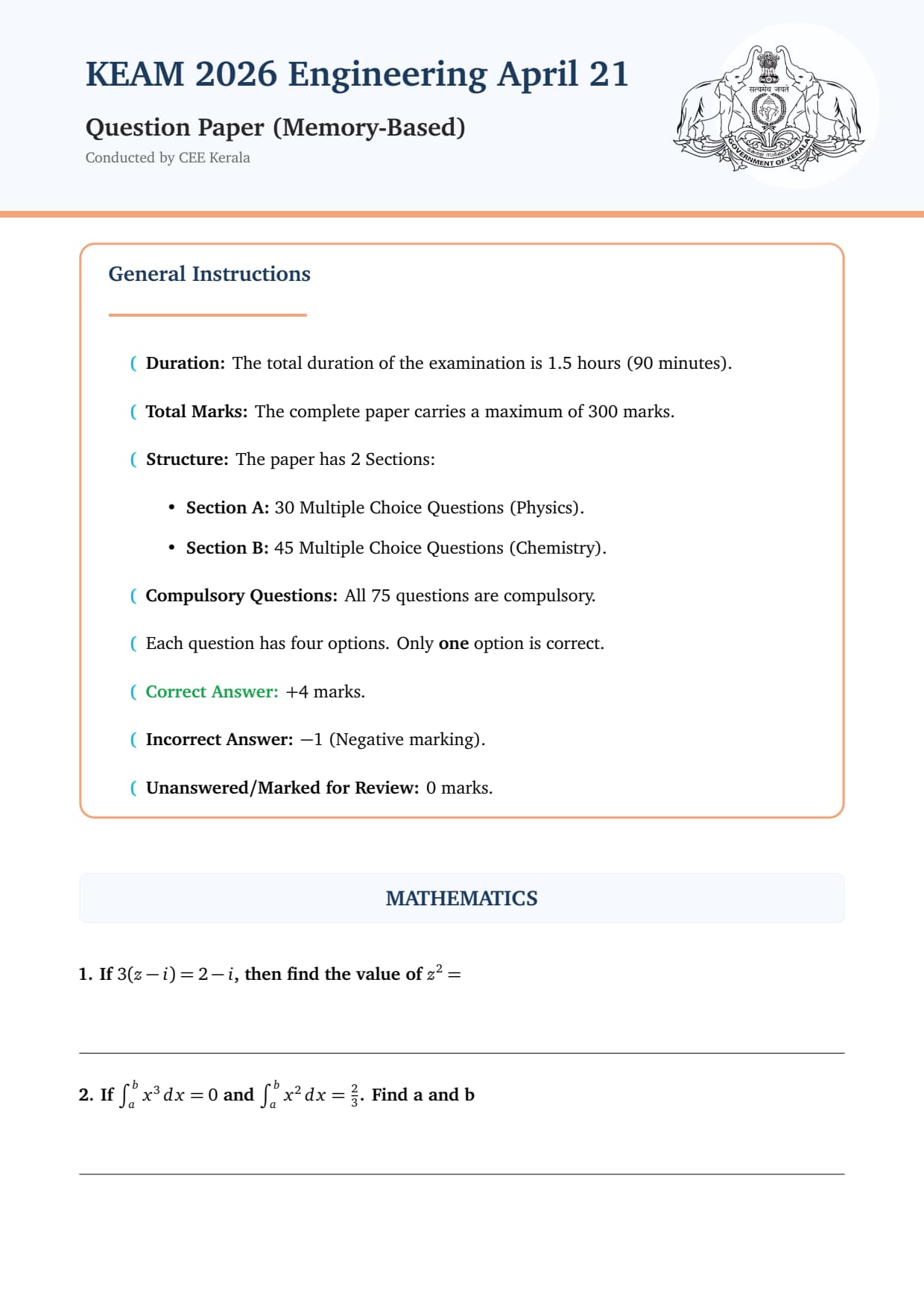
If \( 3(z - i) = 2 - i \), then find the value of \( z^2 = \)
View Solution
Step 1: Understanding the Concept:
We are given a linear equation involving a complex variable \( z \).
The task is to isolate \( z \) to find its value and then compute the square of that complex number, \( z^2 \).
Step 2: Key Formula or Approach:
Use basic algebraic operations to solve for \( z \).
To find \( z^2 \), expand the resulting expression using the algebraic identity \( (a+b)^2 = a^2 + 2ab + b^2 \) and the property of the imaginary unit \( i^2 = -1 \).
Step 3: Detailed Explanation:
We start with the given equation:
\[ 3(z - i) = 2 - i \]
Divide both sides of the equation by 3 to isolate the term with \( z \):
\[ z - i = \frac{2 - i}{3} \]
Add \( i \) to both sides to solve for \( z \):
\[ z = \frac{2 - i}{3} + i \]
Find a common denominator to combine the terms on the right side:
\[ z = \frac{2 - i + 3i}{3} \]
Simplify the numerator by combining the imaginary terms:
\[ z = \frac{2 + 2i}{3} \]
Now that we have the value of \( z \), we need to find \( z^2 \):
\[ z^2 = \left( \frac{2 + 2i}{3} \right)^2 \]
Apply the square to both the numerator and the denominator:
\[ z^2 = \frac{(2 + 2i)^2}{3^2} \]
Expand the numerator using the binomial square formula:
\[ z^2 = \frac{2^2 + 2(2)(2i) + (2i)^2}{9} \] \[ z^2 = \frac{4 + 8i + 4i^2}{9} \]
Substitute \( i^2 = -1 \) into the expression:
\[ z^2 = \frac{4 + 8i + 4(-1)}{9} \] \[ z^2 = \frac{4 + 8i - 4}{9} \]
The real parts cancel out, leaving only the imaginary part:
\[ z^2 = \frac{8i}{9} \]
Step 4: Final Answer:
The value of \( z^2 \) is \( \frac{8}{9}i \).
Quick Tip: When squaring a complex number of the form \( a+bi \), remember that the \( (bi)^2 \) term becomes negative real (\( -b^2 \)) because \( i^2 = -1 \).
If \( \int_a^b x^3 \,dx = 0 \) and \( \int_a^b x^2 \,dx = \frac{2}{3} \). Find a and b
View Solution
Step 1: Understanding the Concept:
We are given two definite integrals with the same unknown limits \( a \) and \( b \).
By evaluating these integrals, we can form a system of equations to solve for the values of \( a \) and \( b \).
Step 2: Key Formula or Approach:
Use the power rule for integration: \( \int x^n \,dx = \frac{x^{n+1}}{n+1} + C \).
Evaluate the definite integral using the Fundamental Theorem of Calculus: \( \int_a^b f(x) \,dx = F(b) - F(a) \).
Step 3: Detailed Explanation:
Let's analyze the first given integral:
\[ \int_a^b x^3 \,dx = 0 \]
Evaluate the integral using the power rule:
\[ \left[ \frac{x^4}{4} \right]_a^b = 0 \]
Substitute the upper and lower limits:
\[ \frac{b^4}{4} - \frac{a^4}{4} = 0 \] \[ \frac{b^4 - a^4}{4} = 0 \]
Multiply both sides by 4:
\[ b^4 - a^4 = 0 \] \[ b^4 = a^4 \]
This equation implies that \( b = a \) or \( b = -a \).
If \( b = a \), then the limits of integration are the same, and any definite integral \( \int_a^a f(x) \,dx \) would be exactly 0.
However, we are given a second integral \( \int_a^b x^2 \,dx = \frac{2}{3} \), which is not zero.
Therefore, we must have \( b \neq a \), which leaves us with the condition:
\[ b = -a \]
Now, let's analyze the second given integral using this relationship:
\[ \int_a^b x^2 \,dx = \frac{2}{3} \]
Substitute \( a = -b \) into the integral:
\[ \int_{-b}^b x^2 \,dx = \frac{2}{3} \]
Since \( f(x) = x^2 \) is an even function, we can use the property \( \int_{-k}^k f(x) \,dx = 2 \int_0^k f(x) \,dx \):
\[ 2 \int_0^b x^2 \,dx = \frac{2}{3} \]
Evaluate this simplified integral:
\[ 2 \left[ \frac{x^3}{3} \right]_0^b = \frac{2}{3} \] \[ 2 \left( \frac{b^3}{3} - 0 \right) = \frac{2}{3} \] \[ \frac{2b^3}{3} = \frac{2}{3} \]
Multiply both sides by \( \frac{3}{2} \):
\[ b^3 = 1 \]
Taking the cube root yields:
\[ b = 1 \]
Since we established that \( a = -b \), we can find \( a \):
\[ a = -(1) = -1 \]
Step 4: Final Answer:
The values are \( a = -1 \) and \( b = 1 \).
Quick Tip: Recognizing even and odd functions can significantly simplify definite integrals with symmetric limits, saving you time and calculation effort.
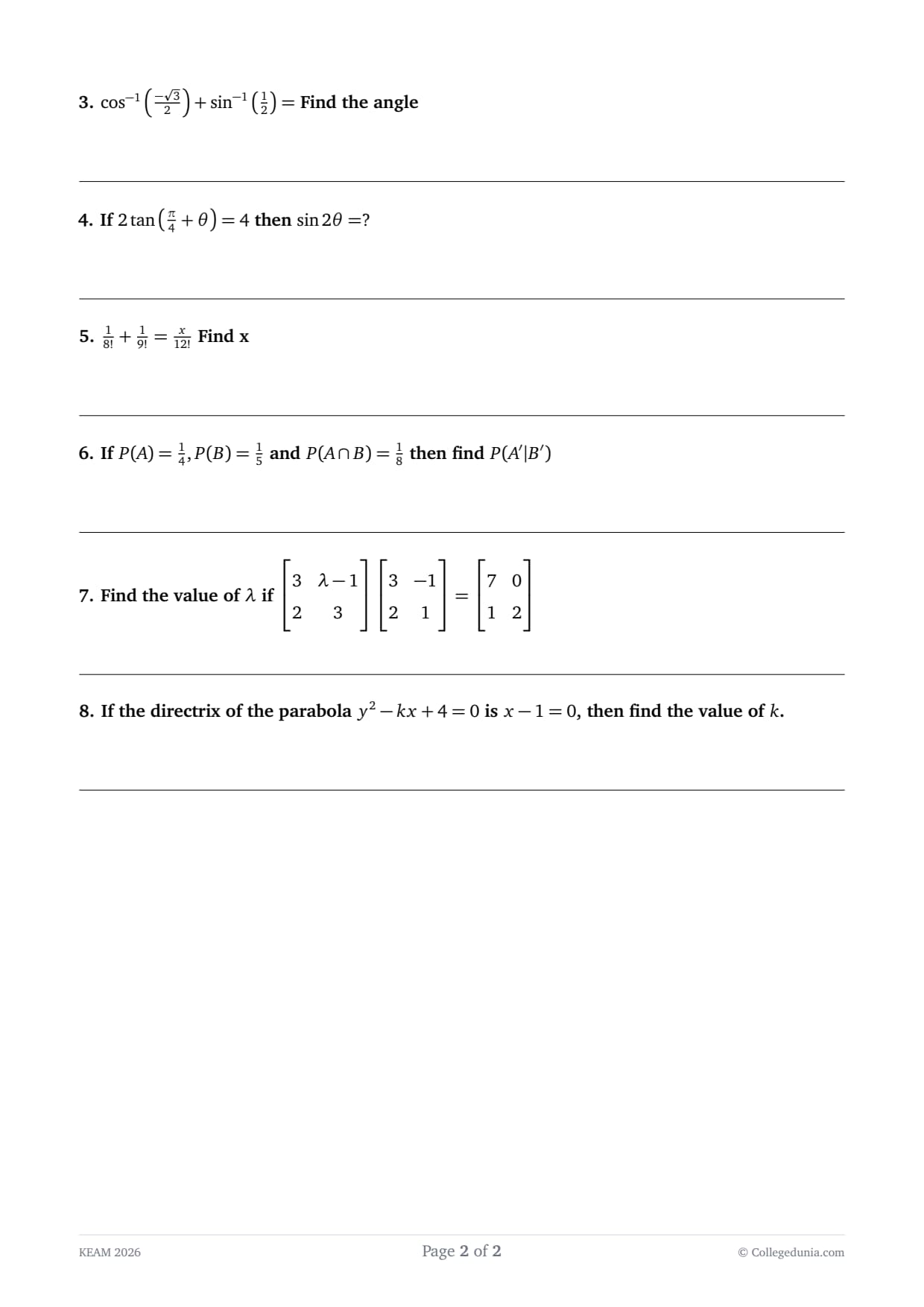
\( \cos^{-1}\left(\frac{-\sqrt{3}}{2}\right) + \sin^{-1}\left(\frac{1}{2}\right) = \) Find the angle
View Solution
Step 1: Understanding the Concept:
We need to evaluate the sum of two inverse trigonometric functions.
This requires knowing the principal value branches for both inverse cosine and inverse sine functions.
Step 2: Key Formula or Approach:
The principal value branch for \( \cos^{-1}(x) \) is \( [0, \pi] \).
The principal value branch for \( \sin^{-1}(x) \) is \( [-\frac{\pi}{2}, \frac{\pi}{2}] \).
Use the property \( \cos^{-1}(-x) = \pi - \cos^{-1}(x) \) for negative arguments.
Step 3: Detailed Explanation:
Let's evaluate the first term: \( \cos^{-1}\left(-\frac{\sqrt{3}}{2}\right) \).
Using the property for negative arguments of inverse cosine:
\[ \cos^{-1}\left(-\frac{\sqrt{3}}{2}\right) = \pi - \cos^{-1}\left(\frac{\sqrt{3}}{2}\right) \]
We know that \( \cos\left(\frac{\pi}{6}\right) = \frac{\sqrt{3}}{2} \), and \( \frac{\pi}{6} \) lies in the principal range \( [0, \pi] \).
So, \( \cos^{-1}\left(\frac{\sqrt{3}}{2}\right) = \frac{\pi}{6} \).
Substituting this back:
\[ \cos^{-1}\left(-\frac{\sqrt{3}}{2}\right) = \pi - \frac{\pi}{6} \] \[ \cos^{-1}\left(-\frac{\sqrt{3}}{2}\right) = \frac{6\pi - \pi}{6} = \frac{5\pi}{6} \]
Now, let's evaluate the second term: \( \sin^{-1}\left(\frac{1}{2}\right) \).
We know that \( \sin\left(\frac{\pi}{6}\right) = \frac{1}{2} \), and \( \frac{\pi}{6} \) lies within the principal range \( [-\frac{\pi}{2}, \frac{\pi}{2}] \).
So, \( \sin^{-1}\left(\frac{1}{2}\right) = \frac{\pi}{6} \).
Finally, we add the two evaluated terms together:
\[ Sum = \frac{5\pi}{6} + \frac{\pi}{6} \] \[ Sum = \frac{5\pi + \pi}{6} \] \[ Sum = \frac{6\pi}{6} \] \[ Sum = \pi \]
Step 4: Final Answer:
The calculated angle is \( \pi \).
Quick Tip: Always double-check that your evaluated angles for inverse trigonometric functions fall strictly within their defined principal value branches.
If \( 2 \tan\left(\frac{\pi}{4} + \theta\right) = 4 \) then \( \sin 2\theta = ? \)
View Solution
Step 1: Understanding the Concept:
We are given an equation involving a tangent function of a compound angle.
We need to find the value of \( \sin 2\theta \), which can be expressed in terms of \( \tan \theta \).
Step 2: Key Formula or Approach:
Use the tangent addition formula: \( \tan(A+B) = \frac{\tan A + \tan B}{1 - \tan A \tan B} \).
Use the double angle formula for sine in terms of tangent: \( \sin 2\theta = \frac{2\tan\theta}{1 + \tan^2\theta} \).
Step 3: Detailed Explanation:
Start with the given equation:
\[ 2 \tan\left(\frac{\pi}{4} + \theta\right) = 4 \]
Divide both sides by 2:
\[ \tan\left(\frac{\pi}{4} + \theta\right) = 2 \]
Expand the left side using the tangent addition formula:
\[ \frac{\tan\left(\frac{\pi}{4}\right) + \tan\theta}{1 - \tan\left(\frac{\pi}{4}\right)\tan\theta} = 2 \]
Substitute the known value \( \tan\left(\frac{\pi}{4}\right) = 1 \):
\[ \frac{1 + \tan\theta}{1 - \tan\theta} = 2 \]
Multiply both sides by the denominator \( (1 - \tan\theta) \):
\[ 1 + \tan\theta = 2(1 - \tan\theta) \] \[ 1 + \tan\theta = 2 - 2\tan\theta \]
Collect the \( \tan\theta \) terms on one side:
\[ \tan\theta + 2\tan\theta = 2 - 1 \] \[ 3\tan\theta = 1 \]
Solve for \( \tan\theta \):
\[ \tan\theta = \frac{1}{3} \]
Now, use the formula to find \( \sin 2\theta \) in terms of \( \tan\theta \):
\[ \sin 2\theta = \frac{2\tan\theta}{1 + \tan^2\theta} \]
Substitute \( \tan\theta = \frac{1}{3} \) into the formula:
\[ \sin 2\theta = \frac{2\left(\frac{1}{3}\right)}{1 + \left(\frac{1}{3}\right)^2} \] \[ \sin 2\theta = \frac{\frac{2}{3}}{1 + \frac{1}{9}} \]
Simplify the denominator:
\[ \sin 2\theta = \frac{\frac{2}{3}}{\frac{9}{9} + \frac{1}{9}} \] \[ \sin 2\theta = \frac{\frac{2}{3}}{\frac{10}{9}} \]
Divide the fractions:
\[ \sin 2\theta = \frac{2}{3} \times \frac{9}{10} \] \[ \sin 2\theta = \frac{2 \times 9}{3 \times 10} \] \[ \sin 2\theta = \frac{18}{30} \]
Reduce the fraction by dividing numerator and denominator by 6:
\[ \sin 2\theta = \frac{3}{5} \]
Step 4: Final Answer:
The value of \( \sin 2\theta \) is \( \frac{3}{5} \).
Quick Tip: Memorizing trigonometric identities that relate multiple angles (like \( 2\theta \)) to single angle tangents is crucial for solving these types of equations efficiently.
\( \frac{1}{8!} + \frac{1}{9!} = \frac{x}{12!} \) Find x
View Solution
Step 1: Understanding the Concept:
We have an algebraic equation involving factorials.
The factorial function \( n! \) means \( n \times (n-1) \times \dots \times 1 \).
Step 2: Key Formula or Approach:
Use the property of factorials: \( n! = n \times (n-1)! \).
Find a common denominator for the fractions on the left side to simplify the expression, then solve for \( x \).
Step 3: Detailed Explanation:
The given equation is:
\[ \frac{1}{8!} + \frac{1}{9!} = \frac{x}{12!} \]
First, express \( 9! \) in terms of \( 8! \) using the factorial property \( 9! = 9 \times 8! \):
\[ \frac{1}{8!} + \frac{1}{9 \times 8!} = \frac{x}{12!} \]
Factor out the common term \( \frac{1}{8!} \) from the left side:
\[ \frac{1}{8!} \left( 1 + \frac{1}{9} \right) = \frac{x}{12!} \]
Simplify the expression inside the parentheses:
\[ 1 + \frac{1}{9} = \frac{9}{9} + \frac{1}{9} = \frac{10}{9} \]
Substitute this back into the equation:
\[ \frac{1}{8!} \times \frac{10}{9} = \frac{x}{12!} \]
Combine the terms on the left:
\[ \frac{10}{9 \times 8!} = \frac{x}{12!} \]
Since \( 9 \times 8! = 9! \), we can rewrite this as:
\[ \frac{10}{9!} = \frac{x}{12!} \]
To isolate \( x \), multiply both sides by \( 12! \):
\[ x = 10 \times \frac{12!}{9!} \]
Expand \( 12! \) down to \( 9! \) to cancel terms:
\[ 12! = 12 \times 11 \times 10 \times 9! \]
Substitute this expansion into the equation for \( x \):
\[ x = 10 \times \frac{12 \times 11 \times 10 \times 9!}{9!} \]
The \( 9! \) terms cancel out:
\[ x = 10 \times (12 \times 11 \times 10) \]
Perform the multiplication step-by-step:
\[ 12 \times 11 = 132 \] \[ 132 \times 10 = 1320 \]
Now multiply by the remaining 10:
\[ x = 10 \times 1320 \] \[ x = 13200 \]
Step 4: Final Answer:
The value of \( x \) is 13200.
Quick Tip: When dealing with a sum of reciprocal factorials, always express the larger factorial in terms of the smaller one to easily find a common denominator.
If \( P(A) = \frac{1}{4}, P(B) = \frac{1}{5} \) and \( P(A \cap B) = \frac{1}{8} \) then find \( P(A' | B') \)
View Solution
Step 1: Understanding the Concept:
We are given probabilities of individual events and their intersection.
We need to find a conditional probability involving the complements of these events.
Step 2: Key Formula or Approach:
Use the formula for conditional probability: \( P(E | F) = \frac{P(E \cap F)}{P(F)} \).
Use De Morgan's Laws: \( (A \cup B)' = A' \cap B' \), which implies \( P(A' \cap B') = P((A \cup B)') = 1 - P(A \cup B) \).
Use the addition rule for probabilities: \( P(A \cup B) = P(A) + P(B) - P(A \cap B) \).
Step 3: Detailed Explanation:
The conditional probability we need to find is \( P(A' | B') \).
Applying the conditional probability formula, we get:
\[ P(A' | B') = \frac{P(A' \cap B')}{P(B')} \]
First, let's find the denominator \( P(B') \):
The probability of a complement event is \( P(B') = 1 - P(B) \).
Given \( P(B) = \frac{1}{5} \), we have:
\[ P(B') = 1 - \frac{1}{5} = \frac{4}{5} \]
Next, we need to find the numerator \( P(A' \cap B') \).
According to De Morgan's Laws, \( A' \cap B' \) is equivalent to \( (A \cup B)' \).
Therefore, \( P(A' \cap B') = P((A \cup B)') = 1 - P(A \cup B) \).
We must first calculate \( P(A \cup B) \) using the addition rule:
\[ P(A \cup B) = P(A) + P(B) - P(A \cap B) \]
Substitute the given values:
\[ P(A \cup B) = \frac{1}{4} + \frac{1}{5} - \frac{1}{8} \]
Find a common denominator, which is 40:
\[ P(A \cup B) = \frac{10}{40} + \frac{8}{40} - \frac{5}{40} \] \[ P(A \cup B) = \frac{10 + 8 - 5}{40} = \frac{13}{40} \]
Now, calculate \( P(A' \cap B') \):
\[ P(A' \cap B') = 1 - P(A \cup B) \] \[ P(A' \cap B') = 1 - \frac{13}{40} = \frac{40 - 13}{40} = \frac{27}{40} \]
Finally, substitute the values of the numerator and denominator back into the conditional probability formula:
\[ P(A' | B') = \frac{\frac{27}{40}}{\frac{4}{5}} \]
To divide by a fraction, multiply by its reciprocal:
\[ P(A' | B') = \frac{27}{40} \times \frac{5}{4} \]
Simplify the expression by cancelling common factors:
\[ P(A' | B') = \frac{27}{8 \times 5} \times \frac{5}{4} \] \[ P(A' | B') = \frac{27}{8} \times \frac{1}{4} \] \[ P(A' | B') = \frac{27}{32} \]
Step 4: Final Answer:
The required probability \( P(A' | B') \) is \( \frac{27}{32} \).
Quick Tip: De Morgan's laws are extremely useful in probability for converting intersections of complements into the complement of a union, which is often easier to compute.
Find the value of \( \lambda \) if \( \begin{bmatrix} 3 & \lambda - 1
2 & 3 \end{bmatrix} \begin{bmatrix} 3 & -1
2 & 1 \end{bmatrix} = \begin{bmatrix} 7 & 0
1 & 2 \end{bmatrix} \)
View Solution
Step 1: Multiply the matrices
\[ \begin{bmatrix} 3 & \lambda - 1
2 & 3 \end{bmatrix} \begin{bmatrix} 3 & -1
2 & 1 \end{bmatrix} = \begin{bmatrix} (3)(3) + (\lambda - 1)(2) & (3)(-1) + (\lambda - 1)(1)
(2)(3) + (3)(2) & (2)(-1) + (3)(1) \end{bmatrix} \]
Step 2: Simplify each element
\[ = \begin{bmatrix} 9 + 2(\lambda - 1) & -3 + (\lambda - 1)
6 + 6 & -2 + 3 \end{bmatrix} \]
\[ = \begin{bmatrix} 9 + 2\lambda - 2 & \lambda - 4
12 & 1 \end{bmatrix} \]
\[ = \begin{bmatrix} 2\lambda + 7 & \lambda - 4
12 & 1 \end{bmatrix} \]
Step 3: Compare with the given matrix
\[ \begin{bmatrix} 2\lambda + 7 & \lambda - 4
12 & 1 \end{bmatrix} = \begin{bmatrix} 7 & 0
1 & 2 \end{bmatrix} \]
Now equate corresponding elements:
From \( (1,2) \) position: \[ \lambda - 4 = 0 \] \[ \lambda = 4 \]
Step 4: Final Answer
\[ \boxed{\lambda = 4} \] Quick Tip: When evaluating matrix multiplications to find a single unknown, target the entry in the result matrix that is zero (if available). Setting an algebraic expression to zero often simplifies the calculation significantly.
If the directrix of the parabola \( y^2 - kx + 4 = 0 \) is \( x - 1 = 0 \), then find the value of \( k \).
View Solution
Step 1: Understanding the Concept:
We are given the general equation of a parabola involving an unknown coefficient \( k \), and we know the equation of its directrix.
To find \( k \), we must convert the given parabola equation into its standard form, extract the theoretical formula for its directrix, and equate it to the provided directrix equation.
Step 2: Key Formula or Approach:
The standard form for a horizontally opening parabola is \( (y - k_y)^2 = 4a(x - h) \), where \( (h, k_y) \) is the vertex.
For this standard form, the equation of the directrix is given by the line \( x = h - a \).
Step 3: Detailed Explanation:
First, let's rearrange the given equation to isolate the \( y^2 \) term:
\[ y^2 - kx + 4 = 0 \] \[ y^2 = kx - 4 \]
Next, we factor out \( k \) on the right side to match the standard form structure \( 4a(x - h) \):
\[ y^2 = k \left( x - \frac{4}{k} \right) \]
By comparing this equation with the standard form \( (y - k_y)^2 = 4a(x - h) \), we can identify the following parameters:
The y-coordinate of the vertex, \( k_y = 0 \).
The x-coordinate of the vertex, \( h = \frac{4}{k} \).
The focal length parameter is found from \( 4a = k \), which means \( a = \frac{k}{4} \).
Using the formula for the directrix \( x = h - a \), we substitute our identified values:
\[ x = \frac{4}{k} - \frac{k}{4} \]
The problem states that the actual directrix is the line \( x - 1 = 0 \), which simplifies to \( x = 1 \).
Now, we equate our theoretical directrix to the given one to solve for \( k \):
\[ \frac{4}{k} - \frac{k}{4} = 1 \]
To eliminate the denominators, multiply the entire equation by \( 4k \):
\[ 4k \left( \frac{4}{k} \right) - 4k \left( \frac{k}{4} \right) = 4k(1) \] \[ 16 - k^2 = 4k \]
Rearrange this into a standard quadratic equation form \( ak^2 + bk + c = 0 \):
\[ k^2 + 4k - 16 = 0 \]
Apply the quadratic formula \( k = \frac{-b \pm \sqrt{b^2 - 4ac}}{2a} \) to find the roots:
\[ k = \frac{-4 \pm \sqrt{4^2 - 4(1)(-16)}}{2(1)} \] \[ k = \frac{-4 \pm \sqrt{16 + 64}}{2} \] \[ k = \frac{-4 \pm \sqrt{80}}{2} \]
Simplify the square root term (\( \sqrt{80} = \sqrt{16 \times 5} = 4\sqrt{5} \)):
\[ k = \frac{-4 \pm 4\sqrt{5}}{2} \]
Divide the numerator by the denominator to get the final values:
\[ k = -2 \pm 2\sqrt{5} \]
Step 4: Final Answer:
The possible values for the constant \( k \) are \( -2 \pm 2\sqrt{5} \).
Quick Tip: Always rewrite conic section equations into their standard forms before attempting to extract properties like the vertex, focus, or directrix. This prevents sign errors and misidentifications.
KEAM 2026 Exam Pattern
| Particulars | Details |
|---|---|
| Paper | Engineering |
| Mode of Exam | Online CBT |
| Subjects | Physics- 45 questions Chemistry- 30 questions Mathematics- 75 questions |
| Type of Question | Objective Type |
| Total Number of questions | 150 |
| Marks are awarded for each correct answer | 4 marks |
| Marks are awarded for each incorrect answer | 1 marks |
| KEAM total marks for Engineering | 600 marks |
| Duration of KEAM Engineering exam | 3 hours |



Comments