


.jpg&w=128&q=75)


Kerala Engineering Architecture Medical (KEAM 2026) is a state-level entrance examination conducted by the Commissioner for Entrance Examinations (CEE), Kerala, for admission to engineering, architecture, and medical degree courses across participating institutions. The entrance examination was conducted earlier this year, and the final rank list was published on June 27, 2026. KEAM 2026 Phase 1 seat allotment result was declared on July 8, 2026, at cee.kerala.gov.in, and the online fee payment must be completed by July 12, 2026.

Source: cee.kerala.gov.in/keam2026/
Key Highlights of the Allotment Process:
- KEAM 2026 Result Declaration: The KEAM 2026 results were declared on May 12, following which candidates were required to submit their plus two marks for rank list preparation.
- Plus Two Marks Submission: The last date to submit plus two marks for the KEAM rank list preparation was June 14.
- Phase 1 Option Registration: The KEAM 2026 option registration for phase 1 counselling was kept open till July 7.
- Phase 1 Trial Allotment: The KEAM 2026 trial seat allotment result was announced by CEE Kerala on July 6, 2026, allowing candidates to review and modify their options before the round 1 option entry deadline.
- Phase 1 Provisional Allotment: The provisional KEAM 2026 round 1 seat allotment result was announced on July 7, 2026. Candidates who found discrepancies in the provisional list were permitted to raise complaints by 2 pm on the day of publication.
- Phase 1 Final Allotment: The final phase of allotment was published after the complaints raised against the provisional list were addressed, with CEE Kerala announcing the round 1 final result on July 8.
- Fee Payment Window: The fee payment process for candidates who have been allotted seats began the day after the final result was published and is expected to continue till July 12.
- Phase 2 Counselling: The schedule for KEAM 2026 Phase 2 seat allotment, including option registration and trial allotment dates, is expected to be released by CEE Kerala following the completion of the Phase 1 fee payment process.

Source: cee.kerala.gov.in/keam2026/
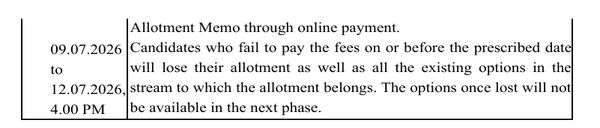
Source: cee.kerala.gov.in/keam2026/
What is KEAM Counselling 2026?
KEAM 2026 Counselling is the Centralised Allotment Process (CAP) administered by the Commissioner for Entrance Examinations (CEE), Kerala. It governs merit-based seat allocation for B.Tech, B.Arch, B.Pharm, B.Sc. Agriculture, and related programmes across government, government-aided, and approved self-financing colleges in Kerala. The allotment is determined by a student’s KEAM 2026 rank, category, and the option list (college-course preferences) submitted during the online option entry phase.
KEAM 2026 rank is calculated using a 50% KEAM exam score + 50% Class 12 marks formula, totalling 600 marks. The exam was held in Computer-Based Test (CBT) mode, and the rank list was published on June 26, 2026 — roughly five days earlier than in 2025. This earlier release may result in a slightly accelerated CAP schedule. CEE Kerala will publish the detailed, date-specific CAP 2026 schedule on cee.kerala.gov.in; students must monitor the official portal regularly. Approximately 1,48,146 students registered for KEAM 2026, the highest in recent years, which means competition for top colleges will be intense.
CAP runs in three regular allotment rounds followed by a Mop-up round. In each round, students enter or revise their preferred college-course options; CEE then runs the allotment algorithm. Students allotted a seat in Round 1 retain all options ranked higher than their current allotment — the algorithm upgrades them in Round 2 if a better option becomes available. The Mop-up round fills seats remaining vacant after the three regular rounds.
Direct Link: KEAM 2026 CAP — Official Portal (cee.kerala.gov.in)
KEAM 2026 Counselling Schedule
The detailed CAP 2026 schedule with exact dates is yet to be published by CEE Kerala. The table below lists events in order of what is coming next (upcoming at the top) followed by completed milestones. Expected 2026 dates are derived from the 2025 pattern, adjusted for the earlier rank list release this year. Treat all upcoming dates as indicative until the official schedule is out on cee.kerala.gov.in.
| Event | Expected Date (2026) | Status |
|---|---|---|
| CAP Registration / Option Entry Opens (Round 1) | 2nd July, 2026 | (Over) |
| Trial Allotment Published (Round 1) | 7th July 2026 | (Over) |
| Option Entry Closes / Options Locked (Round 1) | 7th July 2026 | (Over) |
| Round 1 Seat Allotment Declared | 8th July 2026 | (Out) |
| Reporting to Allotted College (Round 1) | Late July 2026 (Expected) | Upcoming |
| Round 2 Option Entry Opens | Late July 2026 (Expected) | Upcoming |
| Round 2 Seat Allotment Declared | First week of August 2026 (Expected) | Upcoming |
| Reporting to Allotted College (Round 2) | First–Second week of August 2026 (Expected) | Upcoming |
| Round 3 Option Entry Opens | Mid-August 2026 (Expected) | Upcoming |
| Round 3 Seat Allotment Declared | Late August 2026 (Expected) | Upcoming |
| Reporting to Allotted College (Round 3) | Late August – Early September 2026 (Expected) | Upcoming |
| Mop-up Round Registration and Allotment | September 2026 (Expected) | Upcoming |
| Reporting to Allotted College (Mop-up Round) | September 2026 (Expected) | Upcoming |
| KEAM 2026 Rank List Published | June 26, 2026 | (Over) |
| KEAM 2026 Answer Key Released | May 2026 | (Over) |
| KEAM 2026 Exam (CBT Mode) | April 2026 | (Over) |
Note: All 2026 CAP dates marked "Expected" are indicative and based on the 2025 schedule pattern. CEE Kerala has not yet published the confirmed date-wise schedule for CAP 2026. Visit cee.kerala.gov.in regularly for official notifications.
KEAM Counselling Eligibility Criteria 2026
Students must satisfy all the conditions below to participate in KEAM CAP 2026. Holding a valid KEAM rank is necessary but not sufficient — the Class 12 marks threshold, age, and domicile conditions must also be met independently.
- Valid KEAM 2026 Rank: A rank in the appropriate KEAM 2026 rank list (Engineering, Architecture, Pharmacy, Agriculture, or the relevant discipline) is mandatory.
- Engineering (B.Tech): KEAM Engineering rank
- Architecture (B.Arch): KEAM Architecture rank (combination of KEAM score and NATA 2026 score)
- Pharmacy (B.Pharm) and Agriculture: respective KEAM rank lists as notified by CEE Kerala
- Class 12 Pass: Students must have passed Class 12 or an equivalent examination recognised by CEE Kerala.
- For B.Tech: Physics, Mathematics, and Chemistry as core subjects
- For B.Arch: Physics, Mathematics, and Chemistry; also valid NATA 2026 score or JEE Main 2026 Paper 2 qualification
- For B.Pharm: Physics, Chemistry, and Biology or Mathematics
- Minimum Aggregate Marks in Class 12: At least 45% aggregate in Physics, Chemistry, and Mathematics (or Biology for Pharmacy) combined.
- SC and ST students: minimum 40% aggregate in the relevant subject combination
- Architecture (B.Arch): 50% aggregate in PCM, or 50% aggregate across any five subjects
- Age: Students must be at least 17 years of age as of December 31, 2026 (born on or before December 31, 2009). There is no upper age limit for engineering admission under KEAM.
- Nationality: Indian nationals are eligible. PIO and OCI card holders are treated as Indian nationals but cannot claim reserved category benefits (SC, ST, SEBC, EWS) under KEAM CAP.
- Kerala Domicile (for state quota and reserved category benefits): Government and aided college seats under CAP are primarily reserved for Kerala domicile students.
- Domicile is established by a nativity certificate or parents’ nativity proof issued by the Village Officer or Tahsildar
- Students who have studied continuously in Kerala for at least five years also qualify
- Non-Kerala domicile students can participate in CAP but compete only in the general merit pool with no reserved category relaxation
- Physical Fitness: Students allotted a seat must produce a medical fitness certificate from a registered MBBS doctor certifying fitness for professional education, at the time of admission at the college.
Note: Appearing in KEAM 2026 and having a rank does not by itself make you eligible for admission — you must independently satisfy the Class 12 marks threshold. Students who do not meet the marks criteria will be rejected at the document verification stage even if they hold a rank. Verify eligibility carefully before registering for CAP.
Reservation of Quotas for KEAM Counselling 2026
Seat reservations under KEAM CAP 2026 follow the Kerala State Government’s reservation policy for government and government-aided professional colleges. All reservations apply only to Kerala domicile students. Non-domicile students, regardless of their caste or category, compete in the unreserved general merit pool only.
| Category | Reservation (%) | Key Conditions |
|---|---|---|
| Socially and Educationally Backward Classes (SEBC / OBC) | 30% | Non-Creamy Layer certificate required; must be issued within the validity period specified in the KEAM 2026 prospectus; from a competent authority (Tahsildar or above) |
| Scheduled Caste (SC) | 8% | Certificate from Revenue Divisional Officer (RDO) or above; caste must be listed in Kerala SC schedule |
| Scheduled Tribe (ST) | 2% | Certificate from RDO or Tribal Development Office; tribe must be listed in Kerala ST schedule |
| Economically Weaker Section (EWS) | 10% | Income and assets within prescribed limits; certificate from Village Officer / Tahsildar; only for General category families not covered under SC/ST/SEBC |
| Persons with Disability (PwD) | 3% (horizontal — across all categories) | Minimum 40% disability; certificate from authorised Medical Board; PwD reservation is over and above the vertical reservations |
| NRI Quota (Self-Financing Colleges only) | 15% of sanctioned intake per college | Not filled through CAP; managed by the respective institution directly; for NRI-sponsored students |
Seats not filled by reserved category students in any CAP round revert to the General Merit pool and become available in subsequent rounds. Reserved category students who have a strong enough rank can compete for General Merit seats — taking a General Merit seat does not reduce the number of reserved seats available for other students in that category.
Special quota seats are also available in government colleges for students with outstanding achievements in Sports (State / National level), dependants of Ex-Servicemen, and holders of relevant NCC certificates. Students claiming these quotas must produce valid certificates — Grade Certificate from the Kerala Sports Council, discharge certificate for Ex-Servicemen, or NCC certificate as applicable — at the time of CAP registration and college admission. The number of seats and quota details are published in the official KEAM 2026 prospectus on cee.kerala.gov.in.
Note: SEBC (Non-Creamy Layer) certificates that have expired or are issued by an authority below Tahsildar level will not be accepted during document verification at the college. Obtain a fresh certificate well before the CAP reporting deadline.
How to Apply for KEAM Counselling 2026?
KEAM 2026 CAP registration and option entry are expected to open in the first week of July 2026 at cee.kerala.gov.in. The entire counselling process — registration, fee payment, option filling, trial allotment review, and final locking — is online. No physical visit to CEE Kerala’s office is required at the counselling stage.
Registering for counselling is mandatory — your KEAM 2026 rank alone does not guarantee a seat. Students who miss the Round 1 CAP registration deadline cannot be allotted a seat in Round 1, though they may still register for subsequent rounds if CEE allows late or fresh registration.
Step 1: CAP Registration
Visit cee.kerala.gov.in and log in to your KEAM 2026 candidate account using your application number and password (set at the time of KEAM 2026 exam registration). Navigate to the CAP 2026 section and complete the registration form. Verify your personal details, declared category, and the programme(s) you wish to be considered for. First-time login users should reset the default password before proceeding to avoid account access issues later. Submit the registration form to proceed to fee payment.
Step 2: Registration Fee Payment
Pay the CAP 2026 registration fee online through the portal using a debit card, credit card, or net banking. The fee is approximately ₹2,000 for General / OBC / EWS students and lower (approximately ₹500) for SC/ST students; exact amounts will be confirmed in the official 2026 CAP notification. The fee is non-refundable. Registration is complete only after the payment is confirmed — a failed transaction means your registration is not active. Save the payment receipt (download and print from the portal).
Step 3: Option Entry (Choice Filling)
After registration, log back in and open the Option Entry section. You will see all eligible college-course combinations for the programmes you qualify for. Select your preferred options and rank them in your exact order of preference — the most desired combination at rank 1, next at rank 2, and so on. Fill at least 15–20 choices to maximise your chances across all rounds. You can add, remove, and reorder options until the option entry deadline. Use the Trial Allotment (Step 4) to refine your list before final locking.
Step 4: Trial Allotment Review
CEE Kerala publishes a Trial Allotment during the Round 1 option entry window. This is a simulated run of the allotment algorithm using your current option list and rank — it shows the college/course you would likely receive at that point. The trial allotment is purely indicative; it carries no binding weight and does not affect your actual allotment. Use the result to decide whether to add stronger preferences (aspirational colleges ranked higher), safety options (more accessible colleges ranked lower), or both. Modify your option list after reviewing the trial result, then proceed to final locking before the deadline.
Step 5: Option Finalisation and Locking
After reviewing the trial allotment and making any final adjustments to your list, confirm and lock your options before the option entry closing deadline. Once locked, your option list cannot be changed until the next round’s option entry window opens. The CEE allotment algorithm then runs and declares the official Round 1 allotment result. Download and print a copy of your locked option list immediately after locking — this serves as proof of your submission.
How to Lock Your Options: Step-by-Step Guide
Locking your option list is the final, binding action in each CAP round’s entry phase. Once locked, no changes are possible until the next round’s window opens (for remaining active options). Follow the steps below carefully before the deadline.
Step 1: Log In to the CEE Kerala Candidate Portal
- Open cee.kerala.gov.in in a browser.
- Click on the KEAM 2026 CAP section from the homepage.
- Log in using your KEAM 2026 application number and password.
Step 2: Open the Option Entry Module
- From your candidate dashboard, select "Option Entry" or "CAP Option Entry 2026".
- Review all options currently in your list, including their order of preference.
- Check the trial allotment result (if available) to see your likely seat with the current list.
Step 3: Make Final Adjustments
- Add any new college-course combinations you want to include.
- Remove any options you are not genuinely willing to accept.
- Reorder preferences: drag or use the up/down arrows to rank them precisely.
- Do not leave any option in your list that you would refuse if allotted — being allotted an option you do not want means going through a withdrawal process with potential fee loss.
Step 4: Lock Your Options
- Once satisfied with your list, click "Lock Options" (the button label may vary on the portal).
- A confirmation screen summarising your entire locked list will appear.
- Confirm the lock — this action is final for the current round and cannot be undone.
Step 5: Download and Save the Locked Option Confirmation
- Immediately after locking, download the option confirmation slip from the portal.
- Print the slip and store it safely — you may need it during college admission.
- If you do not receive a confirmation on-screen or via email, contact the CEE Kerala helpline without delay to verify your submission status.
Once your options are locked, the CEE allotment algorithm runs and declares the allotment result for that round. You will be notified of the result on the portal.
| Action | Reversible? | Permitted Until |
|---|---|---|
| Adding a new option to the list | Yes (until locking) | Option entry closing deadline |
| Removing an option from the list | Yes (until locking) | Option entry closing deadline |
| Reordering preference of options | Yes (until locking) | Option entry closing deadline |
| Locking the final option list | No — final for that round | Option entry closing deadline |
| Modifying options after locking (current round) | Not possible in the current round | Must wait for next round’s window |
KEAM Counselling Documents Required 2026
Students allotted a seat in KEAM CAP 2026 must carry the following original documents along with at least two sets of photocopies when physically reporting to the allotted college. Document verification is mandatory; failure to produce originals results in cancellation of admission at the college level. All information in the documents must exactly match the data entered in your KEAM 2026 application form.
- KEAM 2026 Admit Card — printout from cee.kerala.gov.in
- KEAM 2026 Rank Card — printout from cee.kerala.gov.in
- CAP 2026 Allotment Memo — downloaded from the candidate portal after seat allotment is declared
- Class 12 Mark Sheet and Passing Certificate — originals issued by the respective Board of Examination
- Class 10 Certificate — as proof of date of birth
- Class 10 Mark Sheet
- Transfer Certificate (TC) — from the last school or college attended
- Conduct Certificate — from the last school or college attended
- Migration Certificate — required for students who studied under a board other than the Kerala Board (e.g., CBSE, ICSE, or State Boards of other states); issued by the respective Board
- Community / Caste Certificate — for SC, ST, and SEBC students; must be issued by a competent authority (Revenue Divisional Officer or Tahsildar level); SEBC certificate must be Non-Creamy Layer and within the validity period set by CEE Kerala
- Income Certificate — for EWS quota applicants or students applying for fee waivers under government schemes
- Nativity / Domicile Certificate — to establish Kerala domicile for state quota and reserved category benefits; issued by Village Officer or Tahsildar
- Aadhaar Card — for identity verification at the college; carry original and a photocopy
- Passport-Size Photographs — minimum 10 recent photographs of the same specification used in the KEAM 2026 application
- Physical Fitness Certificate — from a registered MBBS doctor certifying fitness for professional education; must be on the doctor’s letterhead
- PwD Certificate — if claiming PwD reservation; must be issued by an authorised Medical Board; must clearly state percentage of disability (minimum 40%)
- Sports Certificate — if claiming Sports quota; Grade Certificate from the Kerala Sports Council or relevant State / National sports body
- Ex-Serviceman / NCC Certificate — if claiming the respective quota; issued by the relevant military / NCC authority
- CAP Registration Fee Payment Receipt — printout of the online payment confirmation from cee.kerala.gov.in
- NATA 2026 Score Card — only for B.Arch applicants; printout of the valid NATA 2026 score issued by the Council of Architecture
Note: Students from CBSE, ICSE, or other non-Kerala boards who studied outside Kerala may additionally need an eligibility certificate from CEE Kerala. Check the official 2026 prospectus for programme-specific document requirements — Pharmacy and Agriculture admissions may have additional certificates specified by their respective councils.
How Much Money is Needed for KEAM Counselling 2026?
KEAM CAP 2026 involves two stages of payment: fees paid during the online counselling process, and fees paid at the college during final admission. Amounts below are based on the 2025 pattern; CEE Kerala will publish confirmed figures for 2026 in the official CAP notification. College-level tuition, hostel, and other fees vary significantly across institutions and are not covered here.
Non-Refundable Fees
Non-refundable fees cover administrative and processing costs. These amounts are not returned regardless of whether you ultimately join the allotted college or withdraw.
| Fee Head | General / SEBC / EWS | SC / ST | Remarks |
|---|---|---|---|
| CAP Registration Fee | ~₹2,000 (Expected) | ~₹500 (Expected) | Paid online during CAP registration; not refunded if you withdraw or do not join; exact amount confirmed in 2026 CAP notification |
| Non-Refundable Seat Acceptance Component | To be notified by CEE Kerala | To be notified by CEE Kerala | A portion of the seat acceptance fee collected at the college is non-refundable on withdrawal; specific amount published in the allotment memo |
Refundable Fees
Refundable fees are collected as a security deposit at the college. They are returned at fee settlement at the end of the programme, or on valid exit through a formal process (e.g., cancellation before a specified deadline, or upgrade to a government seat in a later round).
| Fee Head | Expected Amount | Condition for Refund |
|---|---|---|
| Security / Caution Deposit (at college) | Government Colleges: ~₹10,000–15,000 | Refunded at end of course on clearing all dues, or on valid cancellation before the prescribed deadline; forfeited if seat is abandoned without formal exit |
| Self-Financing Colleges: ~₹15,000–25,000 | ||
| Refundable Portion of Seat Acceptance Fee | To be notified by CEE Kerala 2026 | Refunded if seat is surrendered before the cutoff deadline specified in the allotment memo; forfeited on withdrawal after the cutoff |
Note: The amounts above are indicative estimates based on 2025 rates. CEE Kerala will publish confirmed fee details for 2026 in the official CAP 2026 notification on cee.kerala.gov.in. If you withdraw after accepting a seat, the non-refundable portion of the seat acceptance fee is not returned. Verify the exact refund policy and deadlines in the 2026 prospectus before making any withdrawal decision.
KEAM CAP 2026: Round-Wise Allotment Details
KEAM CAP 2026 runs three regular allotment rounds followed by a Mop-up round. Each round follows the same cycle: option entry window opens, students submit or revise preferences, CEE runs the allotment algorithm, and results are declared online. Students are encouraged to participate actively in every round because each round is an opportunity to upgrade to a better college or course.
| Round | Option Entry Window | Allotment Declaration | Reporting Period | Key Feature |
|---|---|---|---|---|
| Round 1 | First week of July 2026 (Expected) | Third–Fourth week of July 2026 (Expected) | Late July 2026 (Expected) | Trial allotment available during option entry to guide choice filling; first allotment of the 2026 cycle |
| Round 2 | Late July 2026 (Expected) | First week of August 2026 (Expected) | First–Second week of August 2026 (Expected) | Students allotted in Round 1 can try for upgrade; all options ranked above their Round 1 allotment remain active automatically |
| Round 3 | Mid-August 2026 (Expected) | Late August 2026 (Expected) | Late August – Early September 2026 (Expected) | Final regular round; students should accept the allotment and complete admission if not pursuing the Mop-up round |
| Mop-up Round | September 2026 (Expected) | September 2026 (Expected) | September 2026 (Expected) | Fills seats remaining vacant after the three regular rounds; fresh registration may be required; open to unallotted students and those who cancelled earlier seats |
How the upgrade mechanism works across rounds: If Round 1 allots you College A (your 5th choice), options 1–4 remain active for Round 2. In Round 2, the algorithm checks whether your rank is competitive for options 1–4 given the seats still available. If it is, you are upgraded to the best available option — say, your 2nd choice. Options ranked 6 and below (worse than your Round 1 allotment) are automatically removed after Round 1. The algorithm only upgrades; it will never move you to a worse option in a later round.
For reference, in 2025 Round 1 allotment was declared on approximately July 18, with subsequent rounds following at 10–14 day intervals. The 2026 schedule is expected to follow a similar cadence given the earlier rank list release, but check cee.kerala.gov.in for confirmed dates.
Reporting to the Allotted College
After each round’s allotment is declared, students who receive a seat must report to the allotted college within the specified deadline. Failing to report forfeits the allotted seat, which is then made available to other students in the next round. The admission process at the college involves document verification followed by fee payment and enrolment.
Step 1: Download the Allotment Memo
- Log in to cee.kerala.gov.in and open the CAP 2026 section.
- Download and print your allotment memo from the portal.
- The memo specifies the allotted college, programme, category, fee details, and the exact reporting deadline.
Step 2: Arrange Documents and Fees
- Collect all original documents listed in the Documents Required section above.
- Prepare at least two sets of photocopies of every document.
- Arrange the first installment of tuition and other fees as specified in the allotment memo and college notification.
Step 3: Report to the College in Person
- Physically visit the allotted college on or before the reporting deadline — not after.
- Carry the printed allotment memo and all original documents.
- Report to the admissions counter or the designated officer at the college.
Step 4: Document Verification
- College authorities verify that all documents are genuine and match the KEAM 2026 application data exactly.
- Reserved category students must present valid category certificates at this stage; expired or defective certificates result in reclassification to general merit.
- If a document defect is identified, check CEE Kerala’s instructions — a short window may be given to produce the corrected certificate. Missing this window results in rejection.
Step 5: Fee Payment and Formal Enrolment
- Pay the required fees (first installment of tuition, caution deposit, and any other charges) at the college fee counter or as directed.
- Collect the fee receipt — keep it safely as proof of payment.
- Complete any other formalities required by the college (anti-ragging declaration, medical examination, photo submission, etc.).
- Your admission is formally confirmed only after fee payment and the college records your enrolment.
Note: Reporting to the college for a Round 1 allotment does not prevent you from participating in Round 2 for a better option. However, if you choose not to report to the allotted college in any round, your allotment for that round is automatically cancelled. Confirm the exact rules for 2026 — including whether reporting is mandatory to retain eligibility for the next round — in the official CEE Kerala 2026 CAP notification.
Upgrade vs Accept vs Withdraw: What to Do After KEAM Allotment?
After each CAP round’s allotment, you must decide what to do with your current seat. Your choice directly determines your final college. Use the guide below based on your specific situation.
| Your Situation | Recommended Action | What Happens |
|---|---|---|
| You received your top-choice college and course | Accept and stop participating | Report to the college within the deadline and complete admission. Do not enter options in the next round. Seat is secured. |
| You received a reasonable seat but have better options higher in your list | Participate in the next round for an upgrade | Options ranked above your current allotment remain active automatically. The system upgrades you only to a better option — your current allotment is protected if no upgrade is available in the next round. |
| You received no allotment in this round | Participate in the next round | Ensure your option list is filled with sufficient choices (15–20 minimum) and locked before the next round’s deadline. More options increase allotment probability. |
| You have been allotted and want to add new (better) options for the next round | Add options during next round’s entry window | New options can be added above your current allotment. Options ranked below the current allotment cannot be re-entered — the system permanently removes options worse than your current seat after each round. |
| You want to exit KEAM CAP entirely (e.g., joining another institution) | Withdraw formally | Your seat is surrendered and becomes available for other students. The non-refundable portion of any fees paid is forfeited. Withdraw only after confirming another admission is secured. |
The CAP allotment system never moves you to a worse option — participating in Round 2 while holding a Round 1 seat is always safe from the perspective of your current allotment. The algorithm either upgrades you to something better, or leaves you with what you already have.
If you withdraw after accepting a seat, the non-refundable component of the seat acceptance fee will not be returned. Before withdrawing, confirm the exact amounts that will be forfeited and the deadline after which the refundable portion is also lost. Both are specified in the allotment memo and the CEE Kerala 2026 prospectus.
FAQs
Ques: What is KEAM CAP 2026 and who conducts it?
Ans: KEAM CAP stands for Centralised Allotment Process. It is the official online seat allotment and counselling process for KEAM 2026, conducted by the Commissioner for Entrance Examinations (CEE), Kerala at cee.kerala.gov.in. CAP covers admissions to engineering (B.Tech), architecture (B.Arch), pharmacy (B.Pharm), agriculture, and related professional programmes in government and private colleges in Kerala. All students with a valid KEAM 2026 rank are eligible to register for CAP — but registration is not automatic; you must actively complete the online registration and submit your option list.
Ques: When will KEAM 2026 CAP registration open?
Ans: CAP 2026 registration and option entry are expected to open in the first week of July 2026. The KEAM 2026 rank list was released on June 26, 2026, and CEE Kerala typically opens CAP within one to two weeks of the rank list — in 2025, CAP registration opened on approximately July 8. However, exact dates for 2026 are yet to be officially confirmed. Monitor cee.kerala.gov.in daily for the official notification once the rank list is out.
Note: Do not rely on informal sources for the CAP opening date. Set up browser bookmarks to cee.kerala.gov.in and check directly — missing the registration window means missing the round.
Ques: How many rounds are there in KEAM CAP 2026?
Ans: KEAM CAP 2026 is expected to have three regular allotment rounds — Round 1, Round 2, and Round 3 — followed by a Mop-up round for seats remaining vacant after the regular rounds. This is consistent with the 2025 CAP structure. Students can participate in all rounds; an allotment in Round 1 does not prevent you from seeking a better seat in Rounds 2 or 3 through the upgrade mechanism.
Ques: How many options should I fill during KEAM 2026 option entry?
Ans: Fill as many options as you are genuinely willing to accept — the minimum recommended is 15 to 20 college-course combinations. There is no penalty for listing more options, and adding more improves your probability of receiving an allotment. Arrange them in strict order of preference: the combination you most want at rank 1, the next at rank 2, and so on. The algorithm allots you the best available option from your list given your rank and category at the time of allotment.
- Add both government and self-financing colleges across the branches you are open to.
- Do not limit yourself to one branch or one city — a wider list significantly increases allotment chances.
- Fill at least 15–20 choices to maximise your chances across all rounds.
- Never list a college you would refuse — the algorithm may allot it, and withdrawing has a fee cost.
Ques: What is the trial allotment and how should I use it?
Ans: The trial allotment is a simulated run of the CAP allotment algorithm that CEE Kerala publishes during the Round 1 option entry window. It shows which college and course you would likely be allotted based on your current option list and rank. It is not binding — it does not result in an actual seat offer and has no effect on your actual allotment. After seeing the trial result, you can revise your list: add aspirational options you may have left out, add safety options if the trial shows no allotment, or reorder preferences to better reflect your priorities. Use the trial result strategically before locking.
Ques: Can I change my options after locking them in KEAM CAP?
Ans: No — once you lock your option list, no changes are possible for that round. Locking is a final, irrevocable action for the current round’s allotment cycle. In the next round’s option entry window (if you choose to participate), you can add new options ranked above your current allotment or reorder the remaining active ones. Options ranked below your current allotment are permanently removed after each round and cannot be re-entered in any future round.
Ques: Can students from outside Kerala participate in KEAM CAP 2026?
Ans: Yes — students from other states who have appeared in KEAM 2026 and hold a valid rank can register for CAP and submit an option list. However, non-Kerala domicile students are not eligible for any reserved category benefits (SC, ST, SEBC, EWS reservations) or state quota relaxations. They compete only in the open general merit pool. Government and aided college seats are predominantly filled by Kerala domicile students given the domicile-based structure, so non-domicile participation is generally more viable for seats in self-financing (private unaided) colleges.
Ques: What documents do I need when reporting to the allotted college?
Ans: Carry all original documents along with two sets of photocopies. The core documents are: KEAM 2026 Admit Card, KEAM 2026 Rank Card, CAP 2026 allotment memo, Class 12 mark sheet and passing certificate, Class 10 certificate (date of birth), transfer certificate, conduct certificate, community certificate (for SC/ST/SEBC), nativity/domicile certificate, Aadhaar card, passport-size photographs, and a physical fitness certificate from a registered MBBS doctor. Architecture students additionally need the NATA 2026 score card. Migration certificate is required if you studied under a non-Kerala board.
Ques: Is the CAP registration fee refundable if I do not get an allotment?
Ans: No — the CAP registration fee is non-refundable regardless of whether you receive an allotment, receive an allotment you do not join, or participate in counselling without any outcome. It is an administrative fee that covers the cost of processing your application and running the allotment algorithm. Exact fee amounts for 2026 will be published in the official CAP notification on cee.kerala.gov.in; amounts are expected to be around ₹2,000 for general category and ₹500 for SC/ST, based on the 2025 structure.
Ques: If I was allotted a seat in Round 1, can I get a better college in Round 2?
Ans: Yes. All options ranked above your Round 1 allotment remain active automatically for Round 2. The CEE allotment algorithm will move you to a better option in Round 2 if your rank is sufficient for that option given the seats still available. The critical guarantee is that the system only upgrades — if no better option is available in Round 2, you retain your Round 1 allotment. You are never downgraded to a worse option in a subsequent round, which makes participating in later rounds completely safe from the perspective of your existing seat.
Ques: What is the Mop-up round and who can participate in it?
Ans: The Mop-up round is an additional allotment round conducted after the three regular CAP rounds to fill seats that remain vacant due to student withdrawals, no-shows, or cancellations. Students eligible to participate include those who did not receive any allotment across all three regular rounds, and students who cancelled their previously allotted seats before the Mop-up round deadline. Fresh registration may be required for the Mop-up round — CEE Kerala typically issues a separate notification for it. The Mop-up round is expected in September 2026; confirm the schedule and eligibility conditions on cee.kerala.gov.in when the notification is released.
Ques: What happens if I miss the college reporting deadline after getting an allotment?
Ans: If you do not report to the allotted college on or before the deadline specified in the allotment memo, your allotted seat is automatically cancelled. The seat is then freed and made available for subsequent rounds. You may still be eligible to participate in the next CAP round (if any), but the specific seat you were allotted is permanently lost. Do not treat the reporting deadline as flexible — plan travel and document collection well in advance of the last date.
The information in this article is based on the KEAM 2026 Centralised Allotment Process as notified by the Commissioner for Entrance Examinations (CEE), Kerala. Expected dates are derived from the 2025 KEAM CAP pattern and are subject to change. For the most current, officially confirmed schedule, fee details, and process instructions, refer to the official portal at cee.kerala.gov.in. This article is updated regularly as new information is published by CEE Kerala.



Comments