

.jpg?h=56&w=56&mode=stretch)


KEAM 2026 Engineering Question Paper for April 20 is available for download here. CEE Kerala conducted KEAM 2026 Engineering exam on April 20 in session 2 from 2 PM to 5 PM. KEAM 2026 Engineering exam is an online CBT with a total of 150 questions carrying a maximum of 600 marks.
- The KEAM Engineering exam is divided into 3 subjects- Physics (45 questions), Chemistry (30 questions) and Mathematics (75 questions).
- 4 marks are given for every correct answer and 1 mark is deducted for every incorrect answer
Candidates can download KEAM 2026 April 20 Engineering Question Paper with Solution PDF from the links provided below.
KEAM 2026 Engineering April 20 Question Paper with Solution PDF
| KEAM 2026 Engineering Question Paper April 20 | Download PDF | Check Solution |

Also Check:
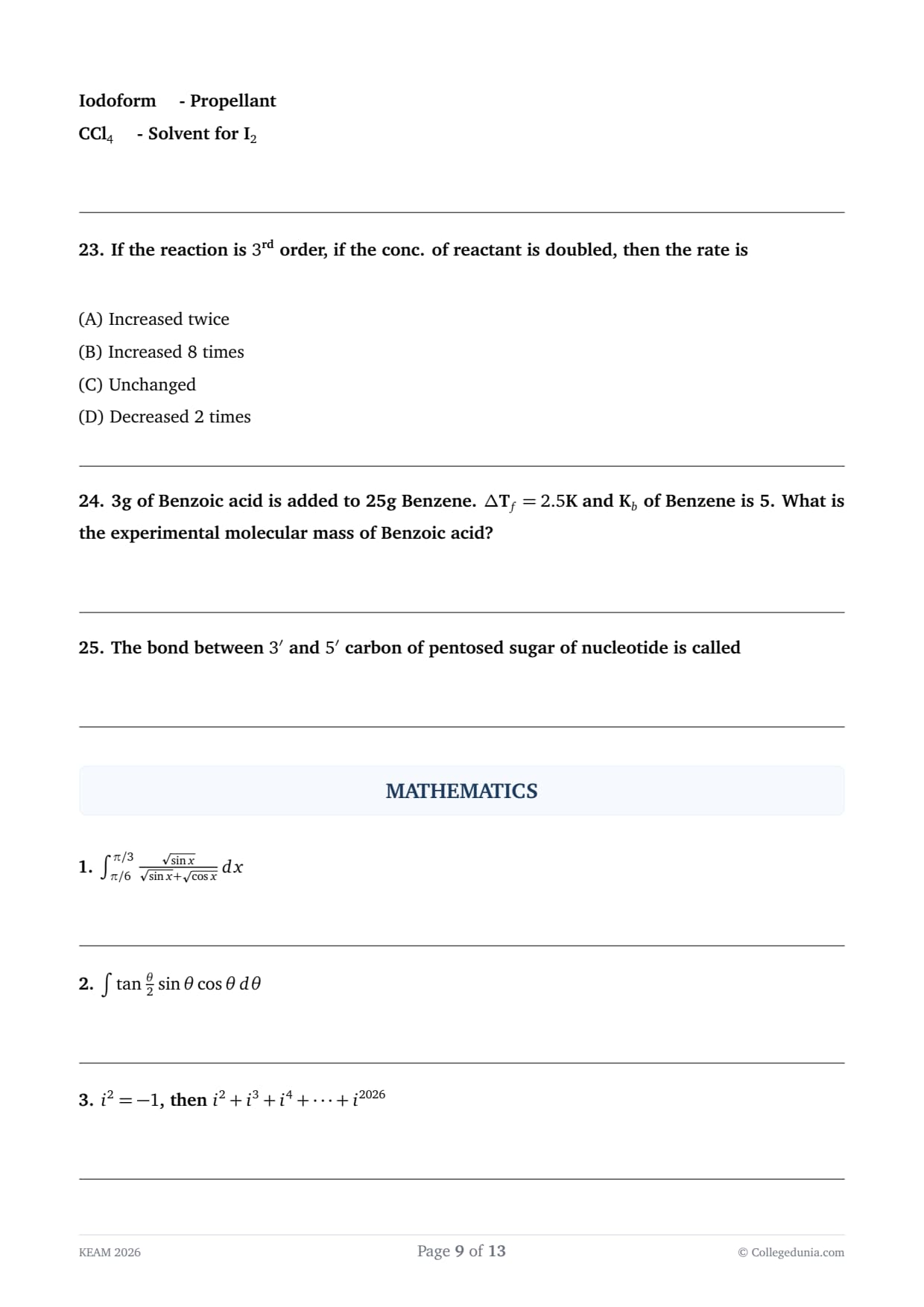
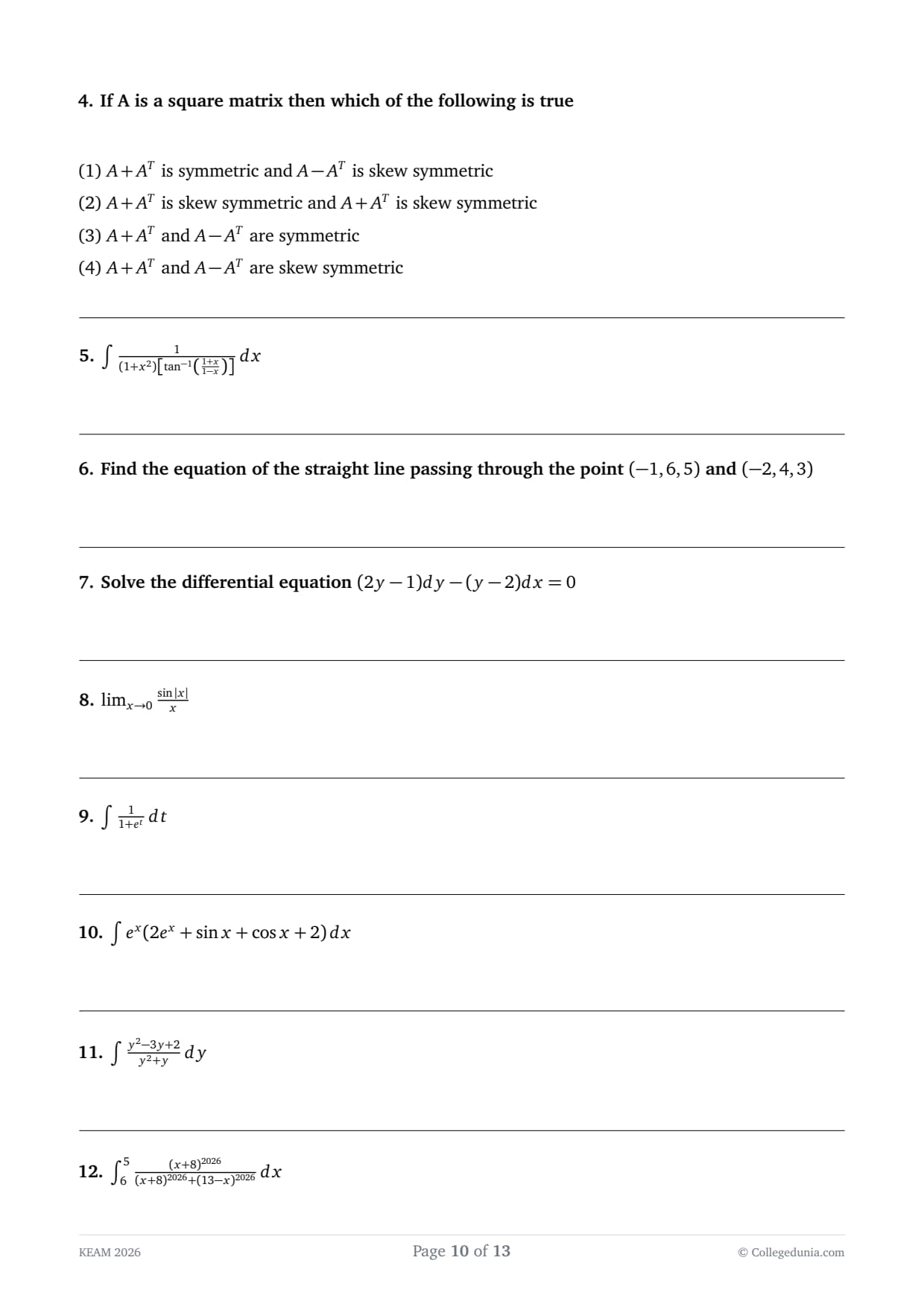
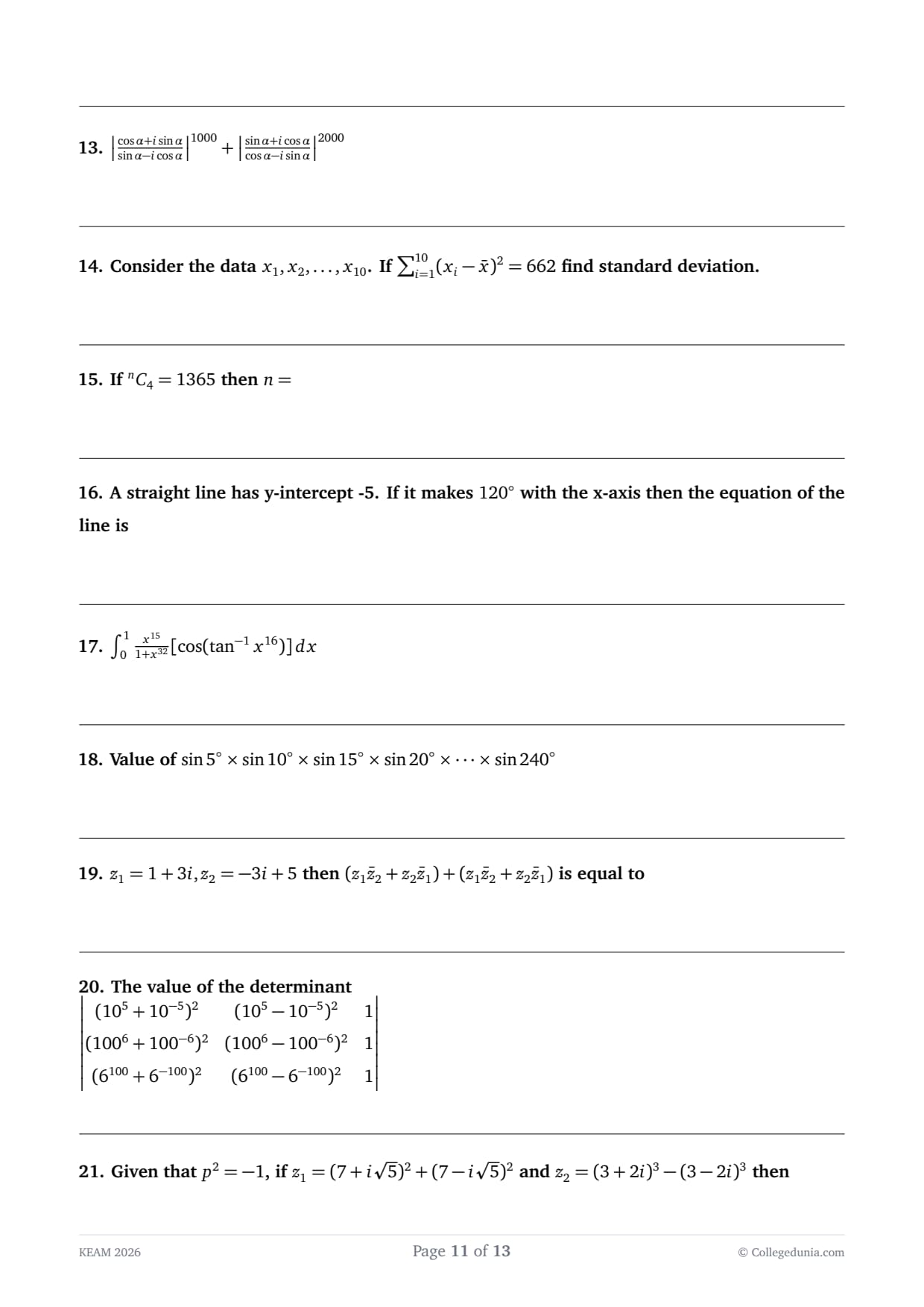
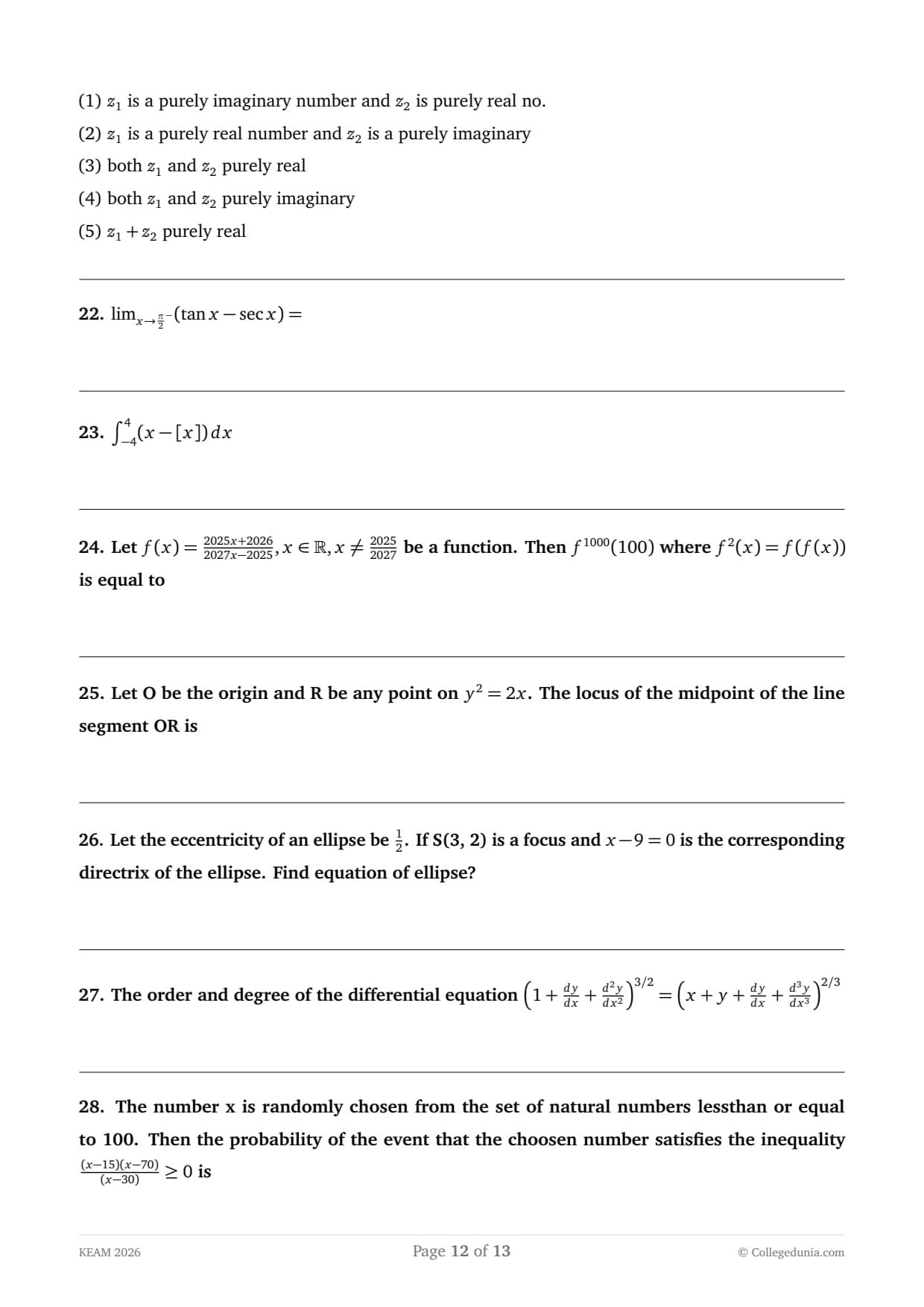
A Bar magnet has a magnetic moment M and length l. If its length is reduced to half, find its new magnetic moment.
View Solution
Step 1: Understanding the Concept:
The magnetic moment (\(M\)) of a bar magnet is defined as the product of its pole strength (\(m\)) and its magnetic length (\(l\)).
Step 2: Key Formula or Approach:
\[ M = m \times l \]
When a bar magnet is cut to reduce its length, we must consider how the cut is made. "Length is reduced to half" typically implies cutting it transversely (perpendicular to its length) into two equal pieces.
Step 3: Detailed Explanation:
Let the initial magnetic moment be \(M = m \times l\).
If the magnet is cut transversely into two equal halves, the length of each new piece is \(l' = l/2\).
The pole strength (\(m\)) depends on the cross-sectional area of the magnet, which remains unchanged by a transverse cut. So, \(m' = m\).
The new magnetic moment (\(M'\)) for one of the halves is:
\[ M' = m' \times l' \]
\[ M' = m \times \left(\frac{l}{2}\right) \]
\[ M' = \frac{m \times l}{2} \]
Substituting the original magnetic moment \(M\):
\[ M' = \frac{M}{2} \]
Step 4: Final Answer:
The new magnetic moment is \(M/2\).
Quick Tip: Remember the two ways to cut a magnet:
1. Transversely (perpendicular to length): length halves (\(l \rightarrow l/2\)), pole strength is constant (\(m \rightarrow m\)). \(M' = M/2\).
2. Longitudinally (along the length): length is constant (\(l \rightarrow l\)), pole strength halves (\(m \rightarrow m/2\)). \(M' = M/2\).
In both typical cutting scenarios into two equal pieces, the magnetic moment halves.
What is the ration of Debroglie wavemength of proton and neutron if kinetic energy is same for both
View Solution
Step 1: Understanding the Concept:
The de Broglie wavelength (\(\lambda\)) of a particle is related to its momentum (\(p\)) by the equation \(\lambda = h/p\). Momentum can be expressed in terms of kinetic energy (\(K\)) and mass (\(m\)).
Step 2: Key Formula or Approach:
The relationship between momentum and kinetic energy is \(K = p^2 / 2m\), which gives \(p = \sqrt{2mK}\).
Substituting this into the de Broglie wavelength formula:
\[ \lambda = \frac{h}{\sqrt{2mK}} \]
Step 3: Detailed Explanation:
For a proton with mass \(m_p\) and kinetic energy \(K\), its de Broglie wavelength is:
\[ \lambda_p = \frac{h}{\sqrt{2m_p K}} \]
For a neutron with mass \(m_n\) and the same kinetic energy \(K\), its de Broglie wavelength is:
\[ \lambda_n = \frac{h}{\sqrt{2m_n K}} \]
Taking the ratio of their wavelengths:
\[ \frac{\lambda_p}{\lambda_n} = \frac{\frac{h}{\sqrt{2m_p K}}}{\frac{h}{\sqrt{2m_n K}}} = \sqrt{\frac{2m_n K}{2m_p K}} = \sqrt{\frac{m_n}{m_p}} \]
The mass of a neutron (\(m_n \approx 1.675 \times 10^{-27}\) kg) is very slightly larger than the mass of a proton (\(m_p \approx 1.672 \times 10^{-27}\) kg). For most approximate calculations in such problems, their masses are considered nearly equal (\(m_n \approx m_p\)).
Therefore, \(\frac{\lambda_p}{\lambda_n} \approx \sqrt{1} = 1\).
Step 4: Final Answer:
The ratio is approximately \(1:1\).
Quick Tip: For particles with the same kinetic energy, their de Broglie wavelengths are inversely proportional to the square root of their masses (\(\lambda \propto 1/\sqrt{m}\)). Since proton and neutron have roughly the same mass, their wavelengths are roughly equal.
A 250W bulb emit light of wavelength 19.6nm. Find the no of electron emitted per second
View Solution
Step 1: Understanding the Concept:
Power (\(P\)) is the total energy emitted per unit time. This energy is carried by discrete packets called photons. By calculating the energy of a single photon, we can determine how many such photons are required to make up the total power output.
Step 2: Key Formula or Approach:
Energy of a single photon: \(E = \frac{hc}{\lambda}\)
Total power: \(P = n \times E\), where \(n\) is the number of photons emitted per second.
Rearranging for \(n\):
\[ n = \frac{P}{E} = \frac{P \lambda}{hc} \]
Step 3: Detailed Explanation:
Given values:
Power, \(P = 250\) W = \(250\) J/s
Wavelength, \(\lambda = 19.6\) nm \(= 19.6 \times 10^{-9}\) m
Planck's constant, \(h \approx 6.626 \times 10^{-34}\) J\(\cdot\)s
Speed of light, \(c \approx 3 \times 10^8\) m/s
Substitute these values into the formula:
\[ n = \frac{250 \times 19.6 \times 10^{-9}}{6.626 \times 10^{-34} \times 3 \times 10^8} \]
Using the approximation \(hc \approx 19.8 \times 10^{-26}\) J\(\cdot\)m or more precisely \(19.878 \times 10^{-26}\) J\(\cdot\)m:
\[ n = \frac{4900 \times 10^{-9}}{19.878 \times 10^{-26}} \]
\[ n = \left(\frac{4900}{19.878}\right) \times 10^{17} \]
\[ n \approx 246.5 \times 10^{17} \]
\[ n \approx 2.465 \times 10^{19} \]
Step 4: Final Answer:
The number of photons emitted per second is approximately \(2.47 \times 10^{19}\).
Quick Tip: To simplify calculations, you can use the value hc ≈ 1240 eV Convert Power to eV/s first (\(250 J/s = 250 / (1.6 \times 10^{-19}) eV/s\)). Then \(n = Total Energy in eV / Energy of one photon in eV\).
Find difference in work function of two different metal if their stopping potential are 0.4V and 1.6V respectively.(metals are illuminated with photons of same energy)
View Solution
Step 1: Understanding the Concept:
Einstein's photoelectric equation relates the maximum kinetic energy of emitted photoelectrons to the energy of incident photons and the work function of the metal. The stopping potential is a direct measure of this maximum kinetic energy.
Step 2: Key Formula or Approach:
Einstein's photoelectric equation is:
\[ K_{max} = h\nu - \Phi \]
Where \(K_{max} = eV_0\) (\(V_0\) is stopping potential, \(e\) is elementary charge).
So, \(eV_0 = h\nu - \Phi\).
Step 3: Detailed Explanation:
Let the energy of the incident photons be \(E = h\nu\).
For the first metal:
Stopping potential \(V_{01} = 0.4\) V
Work function \(\Phi_1 = E - e V_{01}\)
For the second metal:
Stopping potential \(V_{02} = 1.6\) V
Work function \(\Phi_2 = E - e V_{02}\)
We need to find the difference in their work functions, \(\Delta\Phi = |\Phi_1 - \Phi_2|\):
\[ \Delta\Phi = |(E - e V_{01}) - (E - e V_{02})| \]
\[ \Delta\Phi = |e V_{02} - e V_{01}| = e |V_{02} - V_{01}| \]
Substitute the given values:
\[ \Delta\Phi = e |1.6 V - 0.4 V| \]
\[ \Delta\Phi = e (1.2 V) = 1.2 eV \]
Step 4: Final Answer:
The difference in work functions is 1.2 eV.
Quick Tip: When the incident light energy is constant, a higher stopping potential means the electrons had more kinetic energy, which implies they had to overcome a smaller work function. The difference in stopping potentials in Volts is numerically equal to the difference in work functions in electron-Volts (eV).
An \(\alpha\) particle and proton are accelerated in cyclotron under idential conditions. Find the ratio of their cyclotron frequncy
View Solution
Step 1: Understanding the Concept:
In a cyclotron, charged particles are accelerated by an alternating electric field and kept in a spiral path by a constant magnetic field. The cyclotron frequency is the frequency of the alternating electric field, which must match the frequency of revolution of the particle to ensure continuous acceleration.
Step 2: Key Formula or Approach:
The cyclotron frequency (\(f\)) depends on the particle's charge (\(q\)), its mass (\(m\)), and the applied magnetic field (\(B\)):
\[ f = \frac{qB}{2\pi m} \]
Step 3: Detailed Explanation:
"Identical conditions" implies that the magnetic field \(B\) is the same for both particles.
For a proton (\(p\)):
Charge \(q_p = e\)
Mass \(m_p = m\)
Cyclotron frequency \(f_p = \frac{eB}{2\pi m}\)
For an alpha particle (\(\alpha\)), which is a helium nucleus (2 protons, 2 neutrons):
Charge \(q_\alpha = 2e\)
Mass \(m_\alpha \approx 4m\) (mass of 4 nucleons)
Cyclotron frequency \(f_\alpha = \frac{(2e)B}{2\pi (4m)} = \frac{eB}{4\pi m}\)
Now, find the ratio of their frequencies (\(f_\alpha / f_p\)):
\[ Ratio = \frac{f_\alpha}{f_p} = \frac{\frac{eB}{4\pi m}}{\frac{eB}{2\pi m}} \]
\[ Ratio = \frac{1}{4} \times \frac{2}{1} = \frac{2}{4} = \frac{1}{2} \]
The ratio of the cyclotron frequency of an \(\alpha\) particle to that of a proton is \(1:2\).
Step 4: Final Answer:
The ratio is \(1:2\).
Quick Tip: Cyclotron frequency is proportional to the specific charge (\(q/m\)) of the particle. \(f \propto (q/m)\). Since an alpha particle has twice the charge but four times the mass of a proton, its specific charge is half that of a proton.
Two springs with constants k and 2k are connected in series and a mass m is hanged. The time period of oscillation is
View Solution
Step 1: Understanding the Concept:
When springs are connected in series, the same force (tension) acts on each spring, but their extensions add up. This arrangement can be replaced by a single equivalent spring with an effective spring constant. The time period of a mass-spring system depends on mass and this effective spring constant.
Step 2: Key Formula or Approach:
1. The equivalent spring constant (\(k_{eq}\)) for two springs (\(k_1, k_2\)) in series is:
\[ \frac{1}{k_{eq}} = \frac{1}{k_1} + \frac{1}{k_2} \]
2. The time period (\(T\)) of the oscillating mass is:
\[ T = 2\pi\sqrt{\frac{m}{k_{eq}}} \]
Step 3: Detailed Explanation:
Given spring constants: \(k_1 = k\) and \(k_2 = 2k\).
Calculate the equivalent spring constant \(k_{eq}\):
\[ \frac{1}{k_{eq}} = \frac{1}{k} + \frac{1}{2k} \]
Find a common denominator:
\[ \frac{1}{k_{eq}} = \frac{2}{2k} + \frac{1}{2k} = \frac{3}{2k} \]
Inverting both sides gives:
\[ k_{eq} = \frac{2k}{3} \]
Now, substitute \(k_{eq}\) into the time period formula:
\[ T = 2\pi\sqrt{\frac{m}{k_{eq}}} \]
\[ T = 2\pi\sqrt{\frac{m}{\frac{2k}{3}}} \]
\[ T = 2\pi\sqrt{\frac{3m}{2k}} \]
Step 4: Final Answer:
The time period of oscillation is \(2\pi\sqrt{\frac{3m}{2k}}\).
Quick Tip: For springs in series, the equivalent spring constant is always less than the smallest individual spring constant. \(k_{eq} = \frac{product}{sum} = \frac{k \cdot 2k}{k + 2k} = \frac{2k^2}{3k} = \frac{2k}{3}\).
An oil drop of charge q and mass m is in equilibrium in an electric field E. The charge of the oil drop is
View Solution
Step 1: Understanding the Concept:
For an oil drop to be in equilibrium (stationary or moving with constant velocity), the net force acting on it must be zero. The two primary vertical forces acting on the drop in this setup are the downward gravitational force and the upward electric force.
Step 2: Key Formula or Approach:
Gravitational force acting downwards: \(F_g = mg\)
Electric force acting upwards: \(F_e = qE\)
At equilibrium, these forces are equal in magnitude and opposite in direction.
\[ \Sigma F = F_e - F_g = 0 \]
Step 3: Detailed Explanation:
Equating the magnitudes of the two forces:
\[ F_e = F_g \]
\[ qE = mg \]
To find the charge \(q\), rearrange the equation:
\[ q = \frac{mg}{E} \]
Step 4: Final Answer:
The correct option is (A) \(q = \frac{mg}{E}\).
Quick Tip: This is the fundamental principle behind Millikan's oil-drop experiment used to determine the elementary charge. Balancing forces is key to solving such equilibrium problems.
displacement of particle is given by \(x = t^{3/2} + 2\), find time at which velocity becomes zero
View Solution
Step 1: Understanding the Concept:
Velocity is the rate of change of displacement with respect to time. Mathematically, it is the first derivative of the position function \(x(t)\). To find when the velocity is zero, we must find the derivative and set it to zero.
Step 2: Key Formula or Approach:
Velocity \(v(t) = \frac{dx}{dt}\).
Set \(v(t) = 0\) and solve for \(t\).
Step 3: Detailed Explanation:
Given displacement function:
\[ x(t) = t^{3/2} + 2 \]
Find the velocity by differentiating \(x\) with respect to \(t\):
\[ v(t) = \frac{d}{dt}(t^{3/2} + 2) \]
Using the power rule \(\frac{d}{dt}(t^n) = n t^{n-1}\) and knowing the derivative of a constant is 0:
\[ v(t) = \frac{3}{2} t^{(3/2 - 1)} + 0 \]
\[ v(t) = \frac{3}{2} t^{1/2} \]
We need to find the time \(t\) when velocity becomes zero:
\[ v(t) = 0 \]
\[ \frac{3}{2} t^{1/2} = 0 \]
Divide both sides by \(3/2\):
\[ t^{1/2} = 0 \]
Squaring both sides yields:
\[ t = 0 \]
The velocity is zero at the very beginning of the motion.
Step 4: Final Answer:
The velocity becomes zero at time \(t = 0\).
Quick Tip: Always double-check the given function. If the source intended a more typical exam problem like \(x = t^2 - 2t + 2\), the derivative would be \(v = 2t - 2\), yielding \(t=1\) s when \(v=0\).
Time period of particle is \(T = k\sqrt{\frac{\rho r^3}{\sigma}}\) if k \(\rightarrow\) dimensionless constant, \(\rho\) - density, r - radius, dimension of \(\sigma\) is same as
View Solution
Step 1: Understanding the Concept:
The principle of dimensional homogeneity states that an equation is dimensionally correct if the dimensions of all terms on both sides are the same. We can use this to find the unknown dimensions of a physical quantity in a given formula.
Step 2: Key Formula or Approach:
Write the dimensional formula for each known variable in the equation \(T = k\sqrt{\frac{\rho r^3}{\sigma}}\).
Isolate the unknown quantity \(\sigma\) and solve for its dimensions. Compare the result with the dimensions of the given options.
Step 3: Detailed Explanation:
The dimensions of the given quantities are:
- Time period (\(T\)): \([T]\)
- Constant (\(k\)): Dimensionless, so \([1]\)
- Density (\(\rho = mass/volume\)): \([ML^{-3}]\)
- Radius (\(r\)): \([L]\), so \([r^3] = [L^3]\)
Substitute these into the given formula:
\[ [T] = \sqrt{\frac{[ML^{-3}] \cdot [L^3]}{[\sigma]}} \]
\[ [T] = \sqrt{\frac{[M]}{[\sigma]}} \]
Square both sides to remove the square root:
\[ [T]^2 = \frac{[M]}{[\sigma]} \]
Rearrange to solve for the dimensions of \(\sigma\):
\[ [\sigma] = \frac{[M]}{[T]^2} = [MT^{-2}] \]
Now, let's find the dimensions of the given options:
(A) Surface tension (\(S = Force/Length\)): \([S] = \frac{[MLT^{-2}]}{[L]} = [MT^{-2}]\). This matches.
(B) Restoring force (\(F\)): \([F] = [MLT^{-2}]\). Does not match.
(C) Coefficient of viscosity (\(\eta\)): \([\eta] = [ML^{-1}T^{-1}]\). Does not match.
Step 4: Final Answer:
The dimension of \(\sigma\) is the same as surface tension.
Quick Tip: This formula \(T \propto \sqrt{\rho r^3/\sigma}\) specifically relates to the time period of oscillation of a liquid drop, where restoring forces are provided by surface tension \(\sigma\). Knowing standard physical formulas can serve as a quick sanity check.
If two objects of mass \(m_1 = 80\)g and \(m_2 = 120\)g moves with same speed 6cm/s, find the velocity of centre of mass
View Solution
Step 1: Formula for Centre of Mass Velocity
\[ v_{cm} = \frac{m_1 v_1 + m_2 v_2}{m_1 + m_2} \]
Step 2: Assume Directions
Since only speed is given, assume opposite directions:
\[ v_1 = +6 cm/s, \quad v_2 = -6 cm/s \]
Step 3: Substitute Values
\[ v_{cm} = \frac{(80)(6) + (120)(-6)}{80 + 120} \]
Step 4: Simplify
\[ v_{cm} = \frac{480 - 720}{200} \] \[ v_{cm} = \frac{-240}{200} = -1.2 cm/s \]
Step 5: Interpret Result
Negative sign indicates motion towards heavier mass (120 g).
Step 6: Final Answer
\[ \boxed{v_{cm} = 1.2 cm/s} \] Quick Tip: Always pay attention to the vector nature of velocity. "Speed" is a scalar magnitude. If direction isn't specified in a two-body problem, consider opposite directions as it's the more physically interesting case often tested.
An object of mass m is placed in a lift moving upward with acceleration g/2. Find apparant weight.
View Solution
Step 1: Understanding the Concept:
Apparent weight is the normal force exerted by a supporting surface (like the floor of a lift or a weighing scale) on an object. In an accelerating non-inertial frame of reference, we must account for pseudo forces. When a lift accelerates upwards, a pseudo force acts downwards on the object, increasing the normal force required to support it.
Step 2: Key Formula or Approach:
Let \(N\) be the normal force (apparent weight).
From a non-inertial frame (inside the lift), the forces on the object are:
- Gravity downwards: \(mg\)
- Pseudo force downwards: \(ma\)
- Normal force upwards: \(N\)
For equilibrium inside the lift: \(N = mg + ma = m(g + a)\)
Step 3: Detailed Explanation:
The lift is moving upward with acceleration \(a = g/2\).
Using the formula for apparent weight:
\[ W_{app} = N = m(g + a) \]
Substitute \(a = g/2\):
\[ W_{app} = m\left(g + \frac{g}{2}\right) \]
\[ W_{app} = m\left(\frac{2g}{2} + \frac{g}{2}\right) \]
\[ W_{app} = m\left(\frac{3g}{2}\right) \]
\[ W_{app} = \frac{3}{2}mg \]
The apparent weight is greater than the true weight (\(mg\)).
Step 4: Final Answer:
The apparent weight is \(\frac{3}{2}mg\).
Quick Tip: - Lift accelerating UP \(\implies\) feels heavier \(\implies W_{app} = m(g+a)\)
- Lift accelerating DOWN \(\implies\) feels lighter \(\implies W_{app} = m(g-a)\)
If temperature is constant and the electric field is doubled then the drift velocity of electrons in a conductor.
View Solution
Step 1: Understanding the Concept:
Drift velocity (\(v_d\)) is the average velocity attained by charged particles, such as electrons, in a material due to an electric field. It depends on the properties of the material, temperature, and the applied field.
Step 2: Key Formula or Approach:
The relationship between drift velocity (\(v_d\)) and electric field (\(E\)) is given by:
\[ v_d = \mu E \]
Where \(\mu\) is the electron mobility.
Step 3: Detailed Explanation:
Electron mobility (\(\mu\)) is a property that depends on the nature of the conductor and its temperature.
The problem states that the "temperature is constant." Therefore, the mobility \(\mu\) remains constant.
From the equation \(v_d = \mu E\), if \(\mu\) is constant, drift velocity is directly proportional to the electric field:
\[ v_d \propto E \]
Let initial drift velocity be \(v_{d1}\) for electric field \(E_1 = E\).
The new electric field is doubled: \(E_2 = 2E\).
The new drift velocity \(v_{d2}\) will be:
\[ v_{d2} = \mu E_2 = \mu (2E) = 2(\mu E) = 2v_{d1} \]
Therefore, the drift velocity is doubled.
Step 4: Final Answer:
The drift velocity is doubled.
Quick Tip: Remember \(v_d = (\frac{e\tau}{m})E\). At constant temperature, the relaxation time \(\tau\) is constant, making the term in parentheses (mobility) a constant. Thus, linear dependence on \(E\).
If wavelength of light and separation between slit and screen are fixed. If the slit width is halved, then the angular width become
View Solution
Step 1: Understanding the Concept:
This refers to Fraunhofer diffraction due to a single slit. The light passing through the slit spreads out, forming a central bright maximum flanked by secondary maxima and minima. The angular width describes how much the central maximum spreads out angularly.
Step 2: Key Formula or Approach:
The angular width (\(2\theta\)) of the central maximum in a single slit diffraction pattern is given by:
\[ Angular width (2\theta) = \frac{2\lambda}{a} \]
Where:
\(\lambda\) = wavelength of light
\(a\) = width of the slit
Step 3: Detailed Explanation:
The problem states that the wavelength (\(\lambda\)) is fixed. The separation between slit and screen (\(D\)) is also fixed, though it only affects linear width, not angular width.
From the formula, the angular width is inversely proportional to the slit width (\(a\)):
\[ Angular width \propto \frac{1}{a} \]
Let initial slit width be \(a_1 = a\). Initial angular width is \(\theta_1 = \frac{2\lambda}{a}\).
The new slit width is halved: \(a_2 = a/2\).
The new angular width \(\theta_2\) will be:
\[ \theta_2 = \frac{2\lambda}{a_2} \]
\[ \theta_2 = \frac{2\lambda}{a/2} \]
\[ \theta_2 = 2 \times \left(\frac{2\lambda}{a}\right) \]
\[ \theta_2 = 2 \times \theta_1 \]
The new angular width is twice the original angular width.
Step 4: Final Answer:
The angular width becomes doubled.
Quick Tip: Narrower slit \(\implies\) broader diffraction pattern. The angular spread is purely a consequence of the ratio of wavelength to slit size (\(\lambda/a\)).
Energy of radiation incident on a perfect absorbing surface per unit are in unit time is 3.6J. The radiation pressure is:
View Solution
Step 1: Understanding the Concept:
Electromagnetic radiation carries momentum. When it strikes a surface, it exerts a force, and consequently a pressure, called radiation pressure. The magnitude depends on the intensity of the radiation and whether the surface absorbs or reflects it.
Step 2: Key Formula or Approach:
"Energy per unit area per unit time" is the definition of Intensity (\(I\)).
For a perfectly absorbing surface, the radiation pressure (\(P\)) is given by:
\[ P = \frac{I}{c} \]
Where \(c\) is the speed of light in vacuum.
Step 3: Detailed Explanation:
Given:
Intensity, \(I = 3.6\) J/(m\(^2\cdot\)s) = \(3.6\) W/m\(^2\)
Speed of light, \(c = 3 \times 10^8\) m/s
Substitute these values into the formula:
\[ P = \frac{3.6}{3 \times 10^8} \]
\[ P = 1.2 \times 10^{-8} N/m^2 \]
Step 4: Final Answer:
The radiation pressure is \(1.2 \times 10^{-8}\) N/m\(^2\).
Quick Tip: Pay attention to the surface type:
- Perfectly absorbing (black body): \(P = I/c\)
- Perfectly reflecting (mirror): \(P = 2I/c\)
64 identical spheres each having charge q coalesce to form one big sphere. Find the ratio of the surface charge density of the big sphere to that of small sphere
View Solution
Step 1: Understanding the Concept:
When smaller liquid drops or spheres coalesce (merge) into a larger one, two fundamental quantities are conserved:
1. Total charge: The charge of the big sphere is the sum of charges of small spheres.
2. Total volume: The volume of the big sphere is the sum of volumes of small spheres.
Surface charge density (\(\sigma\)) relates charge to surface area.
Step 2: Key Formula or Approach:
Volume of a sphere: \(V = \frac{4}{3}\pi r^3\)
Surface charge density: \(\sigma = \frac{Total Charge}{Surface Area} = \frac{Q}{4\pi r^2}\)
Use volume conservation to find the new radius, then compute the new density.
Step 3: Detailed Explanation:
Let \(r\) and \(q\) be the radius and charge of a small sphere.
Let \(R\) and \(Q\) be the radius and charge of the big sphere formed from \(n=64\) small spheres.
1. Charge conservation:
Total charge \(Q = 64 \times q\)
2. Volume conservation:
Volume of big sphere = \(64 \times\) Volume of small sphere
\[ \frac{4}{3}\pi R^3 = 64 \times \left(\frac{4}{3}\pi r^3\right) \]
\[ R^3 = 64 r^3 \]
Taking the cube root:
\[ R = \sqrt[3]{64} r = 4r \]
3. Surface charge density ratio:
For a small sphere: \(\sigma_{small} = \frac{q}{4\pi r^2}\)
For the big sphere: \(\sigma_{big} = \frac{Q}{4\pi R^2}\)
Substitute \(Q = 64q\) and \(R = 4r\):
\[ \sigma_{big} = \frac{64q}{4\pi (4r)^2} \]
\[ \sigma_{big} = \frac{64q}{4\pi (16r^2)} \]
\[ \sigma_{big} = \frac{64}{16} \left(\frac{q}{4\pi r^2}\right) \]
\[ \sigma_{big} = 4 \times \sigma_{small} \]
The ratio is \(\frac{\sigma_{big}}{\sigma_{small}} = \frac{4}{1} = 4:1\).
Step 4: Final Answer:
The ratio is 4:1.
Quick Tip: For \(n\) coalescing identical drops, general relations are:
Radius: \(R = n^{1/3}r\)
Charge: \(Q = nq\)
Potential: \(V = n^{2/3}v\)
Surface charge density: \(\sigma_{big} = n^{1/3} \sigma_{small}\) (Here \(64^{1/3} = 4\)).
Two identical cells having internal resistance \(1\Omega\) and emf 6v and 2v are connected in series with external resistance \(4\Omega\), find current throught external resistance
View Solution
Step 1: Determine Equivalent EMF
For series aiding connection: \[ E_{eq} = E_1 + E_2 = 6 + 2 = 8 V \]
Step 2: Calculate Internal Resistance
\[ r_{eq} = r_1 + r_2 = 1 + 1 = 2 \Omega \]
Step 3: Total Resistance of Circuit
\[ R_{total} = R_{ext} + r_{eq} = 4 + 2 = 6 \Omega \]
Step 4: Apply Ohm’s Law
\[ I = \frac{E_{eq}}{R_{total}} = \frac{8}{6} \]
Step 5: Simplify
\[ I = \frac{4}{3} A \]
Step 6: Final Answer
\[ \boxed{I = \frac{4}{3} A} \] Quick Tip: Always check the polarity of series connections. If drawing a circuit diagram isn't provided, standard "in series" usually implies adding voltages.
A brass of length 1m is heated throught a temperature rise of \(50^\circ\)C. Find thermal stress developed in the rod
(α = 2 × 10⁻⁵ ◦c−1, Y = 1 × 10¹¹ N/m2)
View Solution
Step 1: Understanding the Concept:
When a solid is heated, it tends to expand. If this expansion is prevented by rigid supports at its ends, internal forces develop to resist the expansion. The force per unit area generated is called thermal stress.
Step 2: Key Formula or Approach:
Thermal strain is given by \(\Delta L / L = \alpha \Delta T\).
According to Hooke's Law, Stress = Young's Modulus (\(Y\)) \(\times\) Strain.
Therefore, Thermal Stress (\(\sigma\)) is:
\[ \sigma = Y \cdot \alpha \cdot \Delta T \]
Step 3: Detailed Explanation:
Given values:
Length \(L\) = 1 m (not needed for the stress calculation, but useful to know it's a rod)
Change in temperature, \(\Delta T = 50^\circ\)C
Coefficient of linear expansion, α = 2 × 10⁻⁵ ◦C−1
Young's Modulus, \(Y = 1 \times 10^{11}\) N/m\(^2\)
Substitute these values into the formula:
σ = (1 × 10¹¹ N/m2) × (2 × 10−5 ◦C−1) × (50◦C)
Group the terms for easier calculation:
\[ \sigma = (1 \times 2 \times 50) \times (10^{11} \times 10^{-5}) \]
\[ \sigma = 100 \times 10^{(11 - 5)} \]
\[ \sigma = 100 \times 10^6 \]
\[ \sigma = 10^2 \times 10^6 = 10^8 N/m^2 \]
Step 4: Final Answer:
The thermal stress developed is \(10^8\) N/m\(^2\).
Quick Tip: Notice that thermal stress (\(Y\alpha\Delta T\)) is independent of the initial length or cross-sectional area of the rod. It only depends on the material properties (\(Y, \alpha\)) and the temperature change.
Two bodies of same mass having temperature \(T_1\) and \(T_2\) place kept contact. Specific heat capacity of bodies are s and 1.2s respectively. find equilibrium temperature.
View Solution
Step 1: Understanding the Concept:
When two bodies at different temperatures are placed in thermal contact in an isolated system, heat flows from the hotter body to the colder body until they reach a common equilibrium temperature. The principle of calorimetry states that heat lost equals heat gained.
Step 2: Key Formula or Approach:
Heat transferred \(Q = m \cdot s \cdot \Delta T\).
Set \(Heat Lost = Heat Gained\).
Step 3: Detailed Explanation:
Let the two bodies be A and B.
Mass of A = \(m_A = m\), Specific heat \(s_A = s\), Initial temp = \(T_1\)
Mass of B = \(m_B = m\), Specific heat \(s_B = 1.2s\), Initial temp = \(T_2\)
Let the final equilibrium temperature be \(T\).
Assume \(T_1 > T_2\). Body A loses heat, Body B gains heat.
Heat lost by A: \(Q_{lost} = m_A \cdot s_A \cdot (T_1 - T) = m \cdot s \cdot (T_1 - T)\)
Heat gained by B: \(Q_{gained} = m_B \cdot s_B \cdot (T - T_2) = m \cdot (1.2s) \cdot (T - T_2)\)
According to calorimetry principle:
\[ Q_{lost} = Q_{gained} \]
\[ m \cdot s \cdot (T_1 - T) = m \cdot 1.2s \cdot (T - T_2) \]
Cancel common terms \(m\) and \(s\):
\[ T_1 - T = 1.2(T - T_2) \]
\[ T_1 - T = 1.2T - 1.2T_2 \]
Rearrange to solve for \(T\):
\[ T_1 + 1.2T_2 = 1.2T + T \]
\[ T_1 + 1.2T_2 = 2.2T \]
\[ T = \frac{T_1 + 1.2T_2}{2.2} \]
Step 4: Final Answer:
The equilibrium temperature is \(\frac{T_1 + 1.2T_2}{2.2}\).
Quick Tip: The equilibrium temperature is a weighted average: \(T_{eq} = \frac{m_1s_1T_1 + m_2s_2T_2}{m_1s_1 + m_2s_2}\). If masses are equal, it simplifies to \(\frac{s_1T_1 + s_2T_2}{s_1 + s_2}\).
Force acting on a particle varies with time t as F = kt, k is a constant. The vecocity of the particle after a time t is
View Solution
Step 1: Understanding the Concept:
According to Newton's Second Law of Motion, force is related to acceleration. Acceleration is the rate of change of velocity. To find velocity from a time-varying force, we need to integrate.
Step 2: Key Formula or Approach:
Newton's Second Law: \(F = m \cdot a = m \frac{dv}{dt}\)
Rearrange to solve for \(dv\): \(dv = \frac{F}{m} dt\)
Integrate both sides to find velocity \(v(t)\).
Step 3: Detailed Explanation:
Given force \(F = kt\).
Substitute this into the equation:
\[ m \frac{dv}{dt} = kt \]
\[ dv = \frac{k}{m} t \ dt \]
Integrate to find the velocity at time \(t\). Typically, for such problems, unless stated otherwise, we assume the particle starts from rest, so initial velocity \(v(0) = 0\) at \(t=0\).
\[ \int_0^v dv' = \int_0^t \frac{k}{m} t' \ dt' \]
\[ [v']_0^v = \frac{k}{m} \left[\frac{t'^2}{2}\right]_0^t \]
\[ v - 0 = \frac{k}{m} \left(\frac{t^2}{2} - 0\right) \]
\[ v = \frac{kt^2}{2m} \]
Step 4: Final Answer:
The velocity after time t is \(\frac{kt^2}{2m}\).
Quick Tip: Remember the hierarchy: Position \(\xrightarrow{differentiate}\) Velocity \(\xrightarrow{differentiate}\) Acceleration (Force/m).
Acceleration (Force/m) \(\xrightarrow{integrate}\) Velocity \(\xrightarrow{integrate}\) Position.
If rms speed is increased 20% and volume is kept constant, then increase in pressure is
View Solution
Step 1: Understanding the Concept:
The Kinetic Theory of Gases relates macroscopic properties like pressure (\(P\)) and volume (\(V\)) to microscopic properties like the root-mean-square (rms) speed (\(v_{rms}\)) of gas molecules.
Step 2: Key Formula or Approach:
The pressure exerted by an ideal gas is given by:
\[ P = \frac{1}{3} \rho v_{rms}^2 = \frac{1}{3} \left(\frac{M}{V}\right) v_{rms}^2 \]
Where \(\rho\) is density, \(M\) is total mass, and \(V\) is volume.
Since mass \(M\) and volume \(V\) are constant, pressure is directly proportional to the square of the rms speed:
\[ P \propto v_{rms}^2 \]
Step 3: Detailed Explanation:
Let the initial rms speed be \(v_1\) and initial pressure be \(P_1\).
The rms speed is increased by 20%, so the new rms speed \(v_2\) is:
\[ v_2 = v_1 + 0.20v_1 = 1.20v_1 \]
The new pressure \(P_2\) relates to \(P_1\) by:
\[ \frac{P_2}{P_1} = \frac{v_2^2}{v_1^2} \]
Substitute \(v_2 = 1.20v_1\):
\[ \frac{P_2}{P_1} = \frac{(1.20v_1)^2}{v_1^2} \]
\[ \frac{P_2}{P_1} = (1.20)^2 = 1.44 \]
So, \(P_2 = 1.44 P_1\).
The increase in pressure is \(\Delta P = P_2 - P_1 = 1.44P_1 - 1.00P_1 = 0.44P_1\).
To express this as a percentage:
\[ Percentage increase = \left(\frac{\Delta P}{P_1}\right) \times 100% = \left(\frac{0.44 P_1}{P_1}\right) \times 100% = 44% \]
Step 4: Final Answer:
The increase in pressure is 44%.
Quick Tip: For small percentage changes (\(<10%\)), you can use approximation: if \(y \propto x^n\), then \(%\Delta y \approx n \times %\Delta x\). Here, \(P \propto v^2\), so \(20%\) change in \(v\) roughly gives \(2 \times 20% = 40%\) change in \(P\). For exact values, square the multiplier: \(1.2^2 = 1.44 \implies +44%\).
Ripple frequency of a full wave rectifier is
View Solution
Step 1: Understanding the Concept:
A rectifier converts alternating current (AC) to direct current (DC). The output is not perfectly smooth DC but contains fluctuations called ripples. The frequency of these ripples depends on the type of rectifier used.
Step 2: Key Formula or Approach:
Understand the operation waveform of a full-wave rectifier. It "flips" the negative half-cycles of the input AC sine wave into positive half-cycles.
Step 3: Detailed Explanation:
Let the input AC signal have a frequency \(f_{in}\). This means it completes one full cycle (one positive half and one negative half) in time \(T = 1/f_{in}\).
A full-wave rectifier conducts current during both half-cycles. The output waveform consists of a series of positive pulses.
For every single full cycle of the input AC, the full-wave rectifier produces two identical positive output pulses.
Therefore, the fundamental frequency of the repeating pattern in the output (the ripple frequency) is twice the frequency of the input signal.
\[ f_{ripple} = 2 \times f_{in} \]
For example, if the standard mains supply frequency is 50 Hz, the ripple frequency from a full-wave rectifier will be 100 Hz.
Step 4: Final Answer:
The ripple frequency is \(2f_{in}\).
Quick Tip: Compare rectifiers:
- Half-wave rectifier: Output has one pulse per input cycle \(\implies f_{ripple} = f_{in}\).
- Full-wave rectifier: Output has two pulses per input cycle \(\implies f_{ripple} = 2f_{in}\).
If resistance of a conductor at \(20^\circ\)C is \(10\Omega\), then the resistance at \(80^\circ\)C is [α = 4 × 10⁻³ ◦c−1]
View Solution
Step 1: Understanding the Concept:
The electrical resistance of most conductors increases with temperature. For moderate temperature ranges, this relationship is approximately linear.
Step 2: Key Formula or Approach:
The formula for temperature dependence of resistance is:
\[ R_T = R_0[1 + \alpha(T - T_0)] \]
Where:
\(R_T\) = Resistance at temperature \(T\)
\(R_0\) = Resistance at reference temperature \(T_0\)
\(\alpha\) = Temperature coefficient of resistance
Step 3: Detailed Explanation:
Given values:
Reference temperature, \(T_0 = 20^\circ\)C
Resistance at reference temp, \(R_{20} = 10\ \Omega\)
Final temperature, \(T = 80^\circ\)C
Temperature coefficient, α = 4 × 10⁻³ ◦C−1
First, find the change in temperature ∆T :
∆T = T − T0 = 80◦C − 20◦C = 60◦C
Now, use the formula to find \(R_{80}\):
\[ R_{80} = R_{20} [1 + \alpha \cdot \Delta T] \]
Substitute the values:
\[ R_{80} = 10 \cdot [1 + (4 \times 10^{-3}) \cdot 60] \]
\[ R_{80} = 10 \cdot [1 + 240 \times 10^{-3}] \]
\[ R_{80} = 10 \cdot [1 + 0.24] \]
\[ R_{80} = 10 \cdot [1.24] \]
\[ R_{80} = 12.4\ \Omega \]
Step 4: Final Answer:
The resistance at \(80^\circ\)C is \(12.4\ \Omega\).
Quick Tip: Always calculate the temperature difference \(\Delta T\) first. Be careful with decimal places when multiplying by \(\alpha\) as it's usually a small number (e.g., \(10^{-3}\) or \(10^{-4}\)).
If T is the time period of satellite in an orbit of radius r, then the time period in an orbit of radius 3r is:
View Solution
Step 1: Understanding the Concept:
The relationship between the orbital time period of a satellite and its orbital radius is governed by Kepler's Third Law of Planetary Motion.
Step 2: Key Formula or Approach:
Kepler's Third Law states that the square of the time period (\(T\)) is directly proportional to the cube of the orbital radius (\(r\)):
\[ T^2 \propto r^3 \]
For two different orbits around the same central body:
\[ \frac{T_2^2}{T_1^2} = \frac{r_2^3}{r_1^3} \]
Step 3: Detailed Explanation:
Let the initial orbit be: radius \(r_1 = r\), time period \(T_1 = T\).
Let the new orbit be: radius \(r_2 = 3r\), time period \(T_2\).
Using the ratio formula:
\[ \frac{T_2^2}{T^2} = \left(\frac{3r}{r}\right)^3 \]
\[ \frac{T_2^2}{T^2} = (3)^3 \]
\[ \frac{T_2^2}{T^2} = 27 \]
Multiply both sides by \(T^2\):
\[ T_2^2 = 27 T^2 \]
Take the square root of both sides:
\[ T_2 = \sqrt{27} \cdot T \]
Simplify the radical (\(\sqrt{27} = \sqrt{9 \times 3} = 3\sqrt{3}\)):
\[ T_2 = 3\sqrt{3} T \]
Step 4: Final Answer:
The new time period is \(3\sqrt{3} T\).
Quick Tip: A useful shortcut for Kepler's 3rd law problems where radius increases by a factor \(k\) (\(r_2 = kr_1\)): the new time period will be \(k^{3/2} \times T_1\) or \(k\sqrt{k} \times T_1\). Here \(k=3\), so \(T_{new} = 3\sqrt{3} T\).
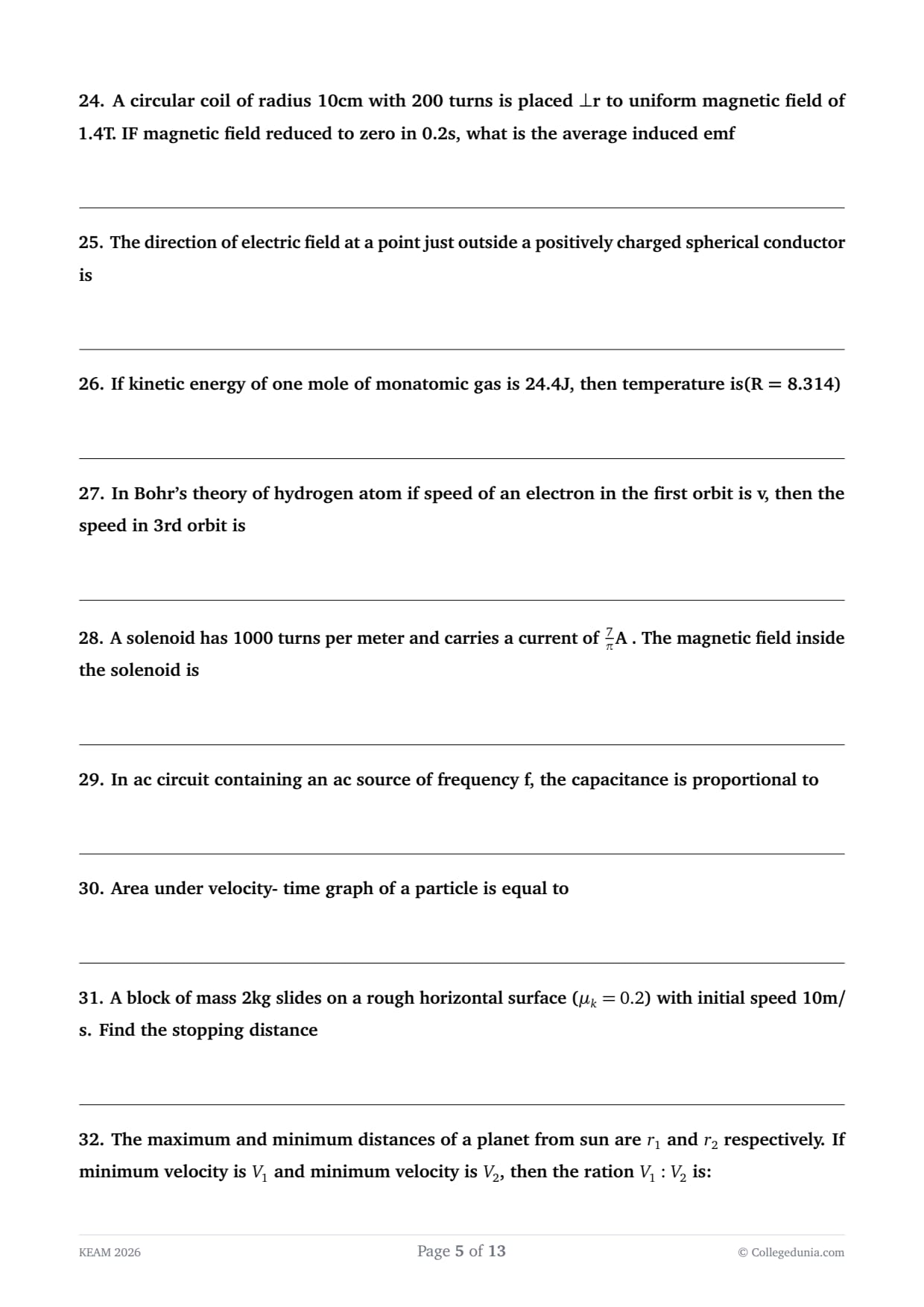
A circular coil of radius 10cm with 200 turns is placed \(\perp\)r to uniform magnetic field of 1.4T. IF magnetic field reduced to zero in 0.2s, what is the average induced emf
View Solution
Step 1: Understanding the Concept:
According to Faraday's Law of Electromagnetic Induction, a changing magnetic flux through a coil induces an electromotive force (EMF). The magnitude of the average induced EMF is proportional to the rate of change of magnetic flux.
Step 2: Key Formula or Approach:
Faraday's Law formula for average induced EMF (\(\mathcal{E}_{avg}\)):
\[ \mathcal{E}_{avg} = -N \frac{\Delta\Phi}{\Delta t} \]
Where:
\(N\) = number of turns
\(\Delta\Phi = \Phi_{final} - \Phi_{initial}\) = change in magnetic flux
\(\Delta t\) = time interval
Magnetic flux \(\Phi = B \cdot A \cos(\theta)\). Since the coil is placed perpendicular to the field, the angle \(\theta\) between the area vector and the B-field is \(0^\circ\), so \(\cos(0^\circ) = 1\), and \(\Phi = BA\).
Step 3: Detailed Explanation:
Given values:
Number of turns, \(N = 200\)
Radius, \(r = 10\) cm = \(0.1\) m
Area of the coil, \(A = \pi r^2 = \pi (0.1)^2 = 0.01\pi\) m\(^2\)
Initial magnetic field, \(B_i = 1.4\) T
Final magnetic field, \(B_f = 0\) T
Time interval, \(\Delta t = 0.2\) s
Calculate initial and final flux per turn:
\(\Phi_i = B_i \cdot A = 1.4 \times 0.01\pi = 0.014\pi\) Wb
\(\Phi_f = B_f \cdot A = 0 \times 0.01\pi = 0\) Wb
Change in flux:
\(\Delta\Phi = \Phi_f - \Phi_i = 0 - 0.014\pi = -0.014\pi\) Wb
Calculate magnitude of average induced EMF:
\[ |\mathcal{E}_{avg}| = \left| -N \frac{\Delta\Phi}{\Delta t} \right| \]
\[ |\mathcal{E}_{avg}| = \left| -200 \times \frac{-0.014\pi}{0.2} \right| \]
\[ |\mathcal{E}_{avg}| = \frac{200 \times 0.014\pi}{0.2} \]
\[ |\mathcal{E}_{avg}| = \frac{2.8\pi}{0.2} \]
\[ |\mathcal{E}_{avg}| = 14\pi V \]
Using the approximation \(\pi \approx 22/7\) often intended in such problems to get a clean integer:
\[ |\mathcal{E}_{avg}| \approx 14 \times \frac{22}{7} = 2 \times 22 = 44 V \]
Step 4: Final Answer:
The average induced emf is 44 V.
Quick Tip: "Placed perpendicular to uniform magnetic field" means the plane of the coil is perpendicular to the B-field lines. This makes the area vector parallel to the field lines (\(\theta = 0^\circ\)), giving maximum flux \(\Phi = BA\).
The direction of electric field at a point just outside a positively charged spherical conductor is
View Solution
Step 1: Understanding the Concept:
In electrostatics, the surface of any conductor acts as an equipotential surface. This means there can be no potential difference between any two points on the surface, and consequently, no component of the electric field parallel to the surface.
Step 2: Key Formula or Approach:
The direction of the electric field \(\mathbf{E}\) is related to the potential \(V\) by \(\mathbf{E} = -\nabla V\). Since the surface is equipotential, the gradient along the surface is zero. Therefore, the entire electric field vector must be perpendicular (normal) to the local surface.
Furthermore, electric field lines originate from positive charges and terminate on negative charges.
Step 3: Detailed Explanation:
1. Perpendicularity: Because the spherical conductor's surface is an equipotential surface, the electric field lines immediately outside it must be strictly perpendicular (normal) to the surface at every point.
2. Direction: The conductor is described as "positively charged". Electric field lines represent the direction of force on a positive test charge. A positive test charge placed outside the sphere would be repelled. Therefore, the field lines must point away from the surface.
Combining these two facts for a spherical geometry: lines perpendicular to a spherical surface point along the radius. Since they point away, the direction is defined as "radially outward".
Step 4: Final Answer:
The direction is radially outward.
Quick Tip: Electric field just outside ANY charged conductor is always perpendicular to its surface. For a sphere, perpendicular means radial. The sign of the charge dictates inward (-) or outward (+).
If kinetic energy of one mole of monatomic gas is 24.4J, then temperature is(R = 8.314)
View Solution
Step 1: Understanding the Concept:
According to the kinetic theory of gases, the translational kinetic energy of an ideal gas is directly proportional to its absolute temperature. A monatomic gas (like Helium or Neon) has only 3 translational degrees of freedom.
Step 2: Key Formula or Approach:
The total translational kinetic energy (\(K\)) for \(n\) moles of a monatomic ideal gas is given by:
\[ K = \frac{3}{2} n R T \]
Where:
\(n\) = number of moles
\(R\) = universal gas constant
\(T\) = absolute temperature in Kelvin
Step 3: Detailed Explanation:
Given values:
Kinetic energy, \(K = 24.4\) J
Number of moles, \(n = 1\) mole
Gas constant, \(R = 8.314\) J/(mol\(\cdot\)K)
Rearrange the formula to solve for temperature \(T\):
\[ T = \frac{2K}{3nR} \]
Substitute the known values:
\[ T = \frac{2 \times 24.4}{3 \times 1 \times 8.314} \]
\[ T = \frac{48.8}{24.942} \]
\[ T \approx 1.9565 K \]
Rounding to a reasonable number of significant figures gives approximately 1.96 K.
Step 4: Final Answer:
The temperature is approximately \(1.96\) K.
Quick Tip: Remember the degrees of freedom (\(f\)):
- Monatomic gas: \(f = 3\) (only translational). \(E = \frac{3}{2}nRT\)
- Diatomic gas: \(f = 5\) (3 translational + 2 rotational at normal temps). \(E = \frac{5}{2}nRT\)
In Bohr's theory of hydrogen atom if speed of an electron in the first orbit is v, then the speed in 3rd orbit is
View Solution
Step 1: Understanding the Concept:
Niels Bohr's model of the hydrogen atom postulates that electrons travel in discrete, quantized circular orbits. The velocity of an electron in these orbits depends on the principal quantum number (\(n\)) and the atomic number (\(Z\)).
Step 2: Key Formula or Approach:
The theoretical derivation of the Bohr model yields the formula for the velocity (\(v_n\)) of an electron in the \(n\)-th orbit:
\[ v_n = \frac{Z e^2}{2 \epsilon_0 n h} \]
From this equation, for a specific atom where \(Z\) is constant, the velocity is inversely proportional to the principal quantum number \(n\):
\[ v_n \propto \frac{1}{n} \]
Step 3: Detailed Explanation:
Let the speed in the first orbit (\(n=1\)) be \(v_1 = v\).
We want to find the speed in the third orbit, so \(n=3\), let's call it \(v_3\).
Using the inverse proportionality:
\[ \frac{v_3}{v_1} = \frac{1/3}{1/1} \]
\[ \frac{v_3}{v_1} = \frac{1}{3} \]
Substitute \(v_1 = v\):
\[ \frac{v_3}{v} = \frac{1}{3} \]
\[ v_3 = \frac{v}{3} \]
Step 4: Final Answer:
The speed in the 3rd orbit is \(v/3\).
Quick Tip: Key proportionalities for Bohr orbits to memorize:
Radius: \(r \propto n^2 / Z\) (gets much bigger)
Velocity: \(v \propto Z / n\) (gets slower)
Energy: \(E \propto -Z^2 / n^2\) (gets less negative/closer to zero)
A solenoid has 1000 turns per meter and carries a current of \(\frac{7}{\pi}\)A . The magnetic field inside the solenoid is
View Solution
Step 1: Understanding the Concept:
An ideal solenoid is a long coil of wire. When current flows through it, it generates a nearly uniform and strong magnetic field concentrated strictly along its interior central axis.
Step 2: Key Formula or Approach:
The magnitude of the magnetic field (\(B\)) well inside a long solenoid is given by Ampere's Law:
\[ B = \mu_0 n I \]
Where:
\(\mu_0\) = permeability of free space = \(4\pi \times 10^{-7}\) T\(\cdot\)m/A
\(n\) = number of turns per unit length (turns/meter)
\(I\) = current in amperes
Step 3: Detailed Explanation:
Given values:
Turn density, \(n = 1000\) turns/m = \(10^3\) m\(^{-1}\)
Current, \(I = \frac{7}{\pi}\) A
Substitute these into the formula:
\[ B = (4\pi \times 10^{-7} Tm/A)) \times (10^3 m^{-1}) \times \left(\frac{7}{\pi} A\right) \]
Notice how the \(\pi\) terms cleanly cancel out:
\[ B = 4 \times 10^{-7} \times 10^3 \times 7 \]
Group the numbers and powers of 10:
\[ B = (4 \times 7) \times (10^{-7} \times 10^3) \]
\[ B = 28 \times 10^{-4} T \]
To write this in standard scientific notation:
\[ B = 2.8 \times 10^{-3} T \]
Step 4: Final Answer:
The magnetic field is \(2.8 \times 10^{-3}\) T.
Quick Tip: Be careful to distinguish between total turns '\(N\)' and turns per unit length '\(n\)'. The formula uses \(n = N/L\). The problem directly gives '\(n\)' (1000 turns per meter).
In ac circuit containing an ac source of frequency f, the capacitance is proportional to
View Solution
Step 1: Understanding the Concept:
It is critical to distinguish between 'capacitance' (\(C\)) and 'capacitive reactance' (\(X_C\)).
- Capacitance is an intrinsic physical property of a capacitor, determined by its geometry (plate area, separation) and the dielectric material between the plates (\(C = \epsilon A / d\)). It describes its ability to store charge.
- Capacitive Reactance is the opposition a capacitor offers to alternating current in an AC circuit. This opposition depends on how fast the voltage is changing.
Step 2: Key Formula or Approach:
Capacitive reactance is calculated as:
\[ X_C = \frac{1}{2\pi f C} \]
Where \(f\) is the frequency of the AC source.
Step 3: Detailed Explanation:
The literal text of the question asks what the capacitance is proportional to regarding frequency.
Based on the physical definition, a 10 \(\mu\)F capacitor has a capacitance of 10 \(\mu\)F whether it is connected to a 50 Hz source, a 1 MHz source, or a DC battery.
Therefore, capacitance is a constant with respect to frequency. It is proportional to \(f^0\).
However, questions worded like this often contain a typo and intend to test the knowledge of reactance. If the question meant to ask about capacitive reactance, then from the formula \(X_C = \frac{1}{2\pi f C}\), we can see that \(X_C\) is inversely proportional to frequency:
\[ X_C \propto \frac{1}{f} \]
Step 4: Final Answer:
Literally, capacitance is independent of frequency. It is highly likely the question meant capacitive reactance, which is proportional to \(1/f\).
Quick Tip: Read carefully!
- Resistance (\(R\)), Inductance (\(L\)), Capacitance (\(C\)) are physical component properties, generally independent of frequency.
- Inductive reactance (\(X_L \propto f\)) and Capacitive reactance (\(X_C \propto 1/f\)) are circuit properties that strongly depend on frequency.
Area under velocity- time graph of a particle is equal to
View Solution
Step 1: Understanding the Concept:
Kinematic graphs relate position, velocity, and acceleration over time. The mathematical relationship between velocity and position is that velocity is the derivative of position with respect to time (\(v = dx/dt\)). Conversely, position change is the integral of velocity over time.
Step 2: Key Formula or Approach:
The definition of velocity is \(v = \frac{dx}{dt}\).
Rearranging this gives \(dx = v \cdot dt\).
To find the total change in position (\(\Delta x\)) between time \(t_1\) and \(t_2\), we integrate:
\[ \Delta x = \int_{t_1}^{t_2} v(t) \ dt \]
Step 3: Detailed Explanation:
In calculus, the definite integral of a function over an interval geometrically represents the "area under the curve" of that function plotted on a graph.
Therefore, computing the integral \(\int v \, dt\) is mathematically identical to finding the area bounded by the velocity-time (\(v-t\)) curve and the time axis.
The physical quantity represented by \(\Delta x\) (change in position) is defined as displacement.
(Note: If the area is calculated considering parts below the time axis as negative, it yields displacement. If the absolute area is summed, it yields total distance traveled. Typically, "area under the graph" implies the signed integral, thus displacement).
Step 4: Final Answer:
The area under a velocity-time graph equals the displacement.
Quick Tip: Graph relationships:
- Slope of \(x-t\) graph = velocity
- Slope of \(v-t\) graph = acceleration
- Area under \(a-t\) graph = change in velocity
- Area under \(v-t\) graph = displacement
A block of mass 2kg slides on a rough horizontal surface (\(\mu_k = 0.2\)) with initial speed 10m/ s. Find the stopping distance
View Solution
Step 1: Understanding the Concept:
When a block slides on a rough surface, kinetic friction exerts a constant force opposing the motion, causing constant deceleration. The stopping distance can be found using kinematics equations or the Work-Energy Theorem. We will use kinematics.
Step 2: Key Formula or Approach:
1. Find the frictional force: \(f_k = \mu_k N = \mu_k mg\)
2. Find the acceleration (deceleration): \(a = \frac{-f_k}{m} = -\mu_k g\)
3. Use the kinematic equation relating velocity, acceleration, and distance: \(v^2 = u^2 + 2as\)
Step 3: Detailed Explanation:
Given values:
Mass, \(m = 2\) kg
Coefficient of kinetic friction, \(\mu_k = 0.2\)
Initial velocity, \(u = 10\) m/s
Final velocity, \(v = 0\) m/s (since it stops)
Let's assume the acceleration due to gravity \(g = 10\) m/s\(^2\) for standard calculation (or \(9.8\) m/s\(^2\), but \(10\) is common when not specified to yield clean numbers).
The acceleration is:
\[ a = -\mu_k g = -0.2 \times 10 = -2 m/s^2 \]
Now, substitute the knowns into the kinematic equation:
\[ v^2 = u^2 + 2as \]
\[ 0^2 = 10^2 + 2(-2)s \]
\[ 0 = 100 - 4s \]
\[ 4s = 100 \]
\[ s = \frac{100}{4} = 25 m \]
(If \(g=9.8\) m/s\(^2\) was intended, \(a = -0.2 \times 9.8 = -1.96\) m/s\(^2\), and \(s = 100 / (2 \times 1.96) \approx 25.5\) m).
Step 4: Final Answer:
The stopping distance is 25 meters.
Quick Tip: Notice that the mass \(m\) cancels out in the calculation (\(a = \mu_k mg / m = \mu_k g\)). The stopping distance of a sliding object is independent of its mass, depending only on its initial speed and the coefficient of friction.
The maximum and minimum distances of a planet from sun are \(r_1\) and \(r_2\) respectively. If minimum velocity is \(V_1\) and minimum velocity is \(V_2\), then the ration \(V_1 : V_2\) is:
View Solution
Step 1: Understanding the Concept:
According to Kepler's Second Law (Law of Areas), a line joining a planet and the sun sweeps out equal areas during equal intervals of time. A direct consequence of this is the conservation of angular momentum for the planet as it orbits the sun.
Step 2: Key Formula or Approach:
The angular momentum \(L\) of a planet of mass \(m\) moving with velocity \(v\) at a distance \(r\) from the sun is given by \(L = mvr\sin(\theta)\).
At the maximum distance (aphelion) and minimum distance (perihelion), the velocity vector is strictly perpendicular to the position vector, so \(\sin(90^\circ) = 1\).
Therefore, conservation of angular momentum simplifies to:
\[ m v_{max} r_{min} = m v_{min} r_{max} \]
Step 3: Detailed Explanation:
The problem text contains an obvious typographical error: "minimum velocity is \(V_1\) and minimum velocity is \(V_2\)".
Based on the physical laws, velocity is inversely proportional to distance. Therefore:
- At maximum distance \(r_1\), the planet moves slowest. Let this minimum velocity be \(V_1\).
- At minimum distance \(r_2\), the planet moves fastest. Let this maximum velocity be \(V_2\).
Applying the conservation of angular momentum:
\[ m \cdot V_1 \cdot r_1 = m \cdot V_2 \cdot r_2 \]
Cancel the mass \(m\):
\[ V_1 \cdot r_1 = V_2 \cdot r_2 \]
We need to find the ratio \(V_1 : V_2\), which is \(V_1 / V_2\):
\[ \frac{V_1}{V_2} = \frac{r_2}{r_1} \]
Step 4: Final Answer:
The ratio \(V_1 : V_2\) is \(r_2 : r_1\).
Quick Tip: Remember the see-saw relationship in elliptical orbits due to angular momentum conservation: Largest radius goes with smallest velocity, and smallest radius goes with largest velocity (\(v \propto 1/r\)).
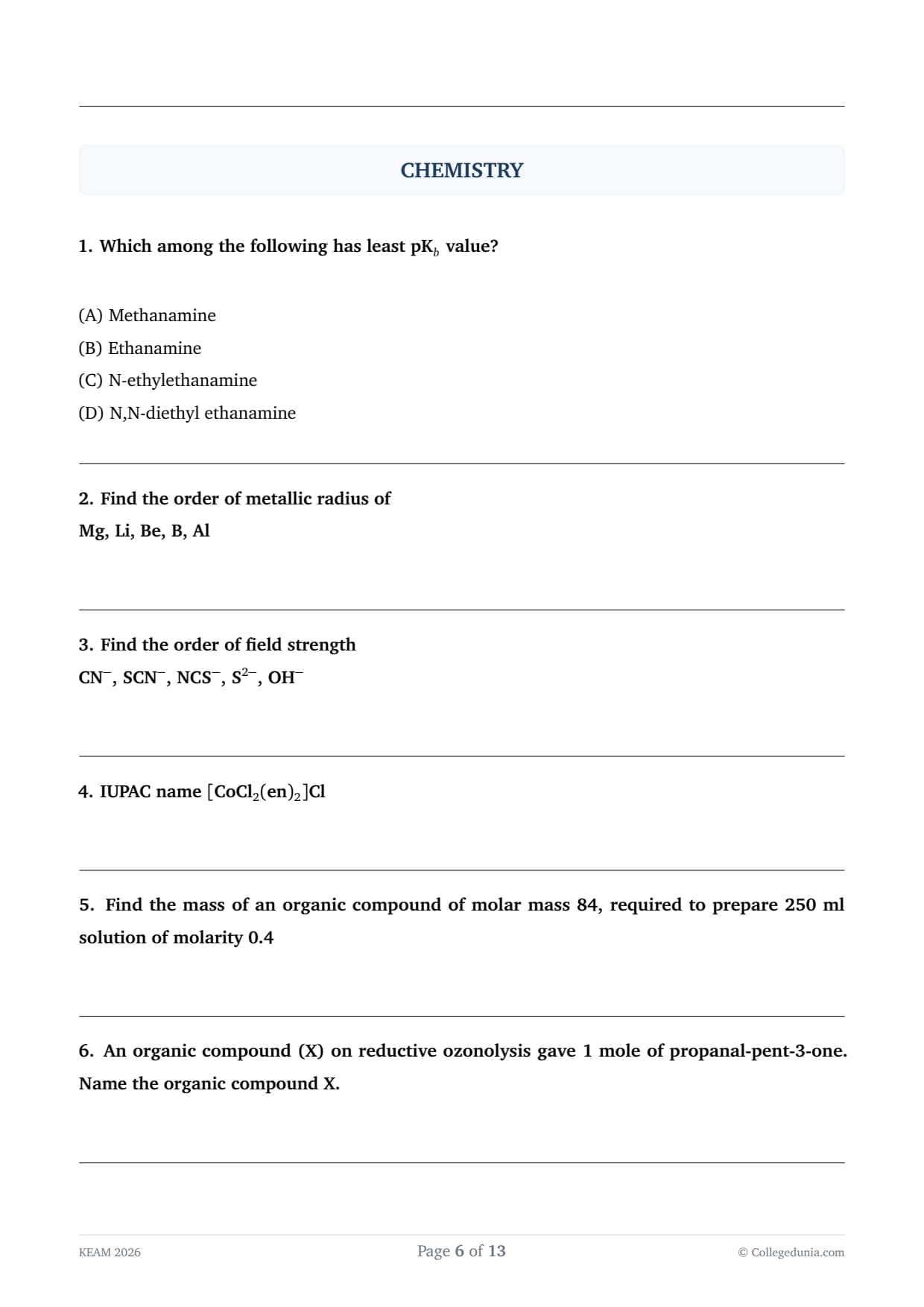
Which among the following has least \(pK_b\) value?
View Solution
Step 1: Understanding the Concept:
The \(pK_b\) value is a quantitative measure of the basic strength of a compound. A lower \(pK_b\) value indicates a stronger base (since \(pK_b = -\log K_b\)). The basicity of aliphatic amines in an aqueous solution depends on a delicate balance of inductive effect, solvation (hydration) effect, and steric hindrance.
Step 2: Key Formula or Approach:
Identify the class of each amine (\(1^\circ, 2^\circ, 3^\circ\)) and apply the established trend for their basicity in an aqueous medium. For ethyl-substituted amines, the order of basicity is \(2^\circ > 3^\circ > 1^\circ > NH_3\).
Step 3: Detailed Explanation:
Let's classify the given options:
- (A) Methanamine: Primary (\(1^\circ\)) methylamine
- (B) Ethanamine: Primary (\(1^\circ\)) ethylamine
- (C) N-ethylethanamine: Secondary (\(2^\circ\)) ethylamine (Diethylamine)
- (D) N,N-diethylethanamine: Tertiary (\(3^\circ\)) ethylamine (Triethylamine)
In an aqueous environment, secondary amines are generally the strongest bases. They possess a good balance: two alkyl groups provide a strong electron-donating inductive (+I) effect to increase electron density on the nitrogen, while still retaining a hydrogen atom to allow for effective stabilization of the conjugate acid via hydrogen bonding with water.
Tertiary amines have a stronger +I effect but suffer from significant steric hindrance, which prevents effective hydration of their conjugate acid, making them weaker bases than secondary amines in water. Primary amines have less steric hindrance but a weaker +I effect.
Therefore, N-ethylethanamine (a \(2^\circ\) amine) is the strongest base among the choices and will have the highest \(K_b\) and the least \(pK_b\) value.
Step 4: Final Answer:
N-ethylethanamine has the least \(pK_b\) value.
Quick Tip: Always assume an aqueous medium unless specified otherwise. Memorize the basicity orders:
Ethylamines: \(2^\circ > 3^\circ > 1^\circ > NH_3\)
Methylamines: \(2^\circ > 1^\circ > 3^\circ > NH_3\)
Find the order of metallic radius of
Mg, Li, Be, B, Al
View Solution
Step 1: Understanding the Concept:
The atomic (or metallic/covalent) radius of elements follows specific periodic trends:
1. It decreases across a period from left to right due to increasing effective nuclear charge, which pulls the electron cloud closer to the nucleus.
2. It increases down a group from top to bottom due to the addition of new principal electron shells, which outweighs the increase in nuclear charge.
Step 2: Key Formula or Approach:
Locate the given elements in the periodic table to compare their radii based on periods and groups.
Step 3: Detailed Explanation:
Let's place the elements in their respective periods and groups:
- Period 2: Li (Group 1), Be (Group 2), B (Group 13)
- Period 3: Mg (Group 2), Al (Group 13)
First, apply the trend across Period 2:
\(Radius of Li > Radius of Be > Radius of B\)
Next, apply the trend across Period 3:
\(Radius of Mg > Radius of Al\)
Now, compare elements down the groups (Period 3 elements are generally larger than Period 2 elements of the same or nearby groups):
- Mg is below Be, so Mg \(>\) Be.
- Al is below B, so Al \(>\) B.
Comparing Li and Mg: This is a diagonal relationship, but generally, Group 1 elements are very large. The standard metallic radius of Mg (\(\sim 160\) pm) is slightly larger than Li (\(\sim 152\) pm).
Comparing Li and Al: Li (\(\sim 152\) pm) is larger than Al (\(\sim 143\) pm).
Combining these observations with standard values:
Mg (160 pm) \(>\) Li (152 pm) \(>\) Al (143 pm) \(>\) Be (112 pm) \(>\) B (85 pm)
Thus, the decreasing order is Mg \(>\) Li \(>\) Al \(>\) Be \(>\) B.
Step 4: Final Answer:
The correct order is Mg \(>\) Li \(>\) Al \(>\) Be \(>\) B.
Quick Tip: While general trends work most of the time, the comparison between Group 1 elements of a lower period and Group 2/13 elements of a higher period (like Li vs Al or Mg) can be tricky. Remembering approximate values or established orders for the first 20 elements is very helpful.
Find the order of field strength
\(CN^-\), \(SCN^-\), \(NCS^-\), \(S^{2-}\), \(OH^-\)
View Solution
Step 1: Understanding the Concept:
The field strength of ligands is experimentally determined and arranged in a series called the spectrochemical series. It ranks ligands based on their ability to split the d-orbitals of a central metal ion (\(\Delta_o\)).
Step 2: Key Formula or Approach:
Recall the general order of the spectrochemical series, which loosely follows the donor atom: Halogens \(<\) Sulfur donors \(<\) Oxygen donors \(<\) Nitrogen donors \(<\) Carbon donors.
Step 3: Detailed Explanation:
Let's analyze the given ligands based on their donor atoms and position in the spectrochemical series:
1. \(S^{2-}\): A pure sulfur donor. It is a very weak field ligand, typically placed near the halogens.
2. \(SCN^-\) (Thiocyanate): An ambidentate ligand coordinating through Sulfur. Sulfur donors are weak.
3. \(OH^-\) (Hydroxide): An oxygen donor. It is stronger than sulfur donors but generally considered a weak to intermediate field ligand.
4. \(NCS^-\) (Isothiocyanate): The same ambidentate ligand, but coordinating through Nitrogen. Nitrogen donors form stronger fields than oxygen donors.
5. \(CN^-\) (Cyanide): A carbon donor. Carbon donors form very strong \(\pi\)-bonds (synergic bonding) with the metal, making them among the strongest field ligands.
Following the general rule (\(S-donor < O-donor < N-donor < C-donor\)), we can arrange them:
\(S^{2-} < SCN^- < OH^- < NCS^- < CN^-\)
Step 4: Final Answer:
The increasing order of field strength is \(S^{2-} < SCN^- < OH^- < NCS^- < CN^-\).
Quick Tip: A simplified version of the spectrochemical series to memorize is:
\(I^- < Br^- < Cl^- < F^- < OH^- < H_2O < NH_3 < en < CN^- < CO\). Use donor atom types (Halogen \(<\) O \(<\) N \(<\) C) as a reliable rule of thumb.
IUPAC name \([CoCl_2(en)_2]Cl\)
View Solution
Step 1: Understanding the Concept:
Naming coordination compounds requires following IUPAC rules: name the cation first, then the anion. Inside the complex ion, list ligands alphabetically, followed by the metal and its oxidation state in Roman numerals.
Step 2: Key Formula or Approach:
1. Identify the complex ion and counter ion.
2. Identify and name the ligands, determining their alphabetical order.
3. Use appropriate prefixes for the number of ligands (di-, tri- or bis-, tris- for complex ligands).
4. Calculate the oxidation state of the central metal.
Step 3: Detailed Explanation:
Let's break down the formula \([CoCl_2(en)_2]Cl\):
- The cation is the complex ion \([CoCl_2(en)_2]^+\).
- The anion is chloride (\(Cl^-\)).
- Ligands:
- '\(Cl\)' represents chloride. As a ligand, it is named 'chlorido'. There are two, so we use the prefix 'di-' \(\rightarrow\) dichlorido.
- '\(en\)' represents ethylenediamine. Its systematic IUPAC name is 'ethane-1,2-diamine'. Since the ligand name contains a number/prefix, we use 'bis-' for two of them \(\rightarrow\) bis(ethane-1,2-diamine).
- Alphabetical order: 'chlorido' comes before 'ethane-1,2-diamine'.
- Central Metal: Cobalt (Co). Since the complex is a cation, the name remains 'cobalt'.
- Oxidation State:
Let the oxidation state of Co be \(x\).
Charge of chlorido ligand = \(-1\)
Charge of 'en' ligand = \(0\) (neutral)
Overall charge of the complex cation \(= +1\) (to balance the one \(Cl^-\) anion outside).
\(x + 2(-1) + 2(0) = +1\)
\(x - 2 = +1 \implies x = +3\)
The oxidation state is (III).
Assembling the name: dichloridobis(ethane-1,2-diamine)cobalt(III) chloride.
Step 4: Final Answer:
The IUPAC name is dichloridobis(ethane-1,2-diamine)cobalt(III) chloride.
Quick Tip: Remember to use "bis", "tris", etc., for ligands whose names already contain numerical prefixes like "di" or "tri" (e.g., ethylenediamine, triphenylphosphine) to avoid confusion.
Find the mass of an organic compound of molar mass 84, required to prepare 250 ml solution of molarity 0.4
View Solution
Step 1: Understanding the Concept:
Molarity (\(M\)) is defined as the number of moles of solute dissolved per liter of solution. To find the mass required, we first calculate the moles needed using the molarity formula, and then convert moles to mass using the molar mass.
Step 2: Key Formula or Approach:
\(Molarity (M) = \frac{moles of solute (n)}{Volume of solution in liters (V)}\)
\(Moles (n) = \frac{Mass (w)}{Molar Mass (M_w)}\)
Combining these: \(w = M \times V \times M_w\)
Step 3: Detailed Explanation:
Given values:
- Molarity (\(M\)) = \(0.4 mol/L\)
- Volume of solution (\(V\)) = \(250 ml = 0.250 L\)
- Molar mass of solute (\(M_w\)) = \(84 g/mol\)
First, find the number of moles required:
\(n = M \times V\)
\(n = 0.4 mol/L \times 0.250 L\)
\(n = 0.1 moles\)
Now, calculate the mass from the number of moles:
\(Mass = moles \times Molar mass\)
\(Mass = 0.1 mol \times 84 g/mol\)
\(Mass = 8.4 g\)
Step 4: Final Answer:
The required mass of the organic compound is 8.4 g.
Quick Tip: Always ensure your volume is converted to Liters before plugging it into the molarity formula \(n = M \times V\).
An organic compound (X) on reductive ozonolysis gave 1 mole of propanal-pent-3-one. Name the organic compound X.
View Solution
Step 1: Understanding the Concept:
Reductive ozonolysis cleaves carbon-carbon double bonds (\(C=C\)) to form carbonyl compounds (aldehydes and ketones). To determine the structure of the original alkene (X), we work backward: place the carbonyl oxygen atoms of the products facing each other, remove them, and connect the corresponding carbon atoms with a double bond.
Step 2: Key Formula or Approach:
The problem text "propanal-pent-3-one" contains a typographical error and should be interpreted as yielding a mixture of "propanal and pentan-3-one".
Draw the structures of the products, align their carbonyl groups, and reconstruct the alkene.
Step 3: Detailed Explanation:
Assuming the products are 1 mole of propanal and 1 mole of pentan-3-one.
Structure of Propanal: \(CH_3-CH_2-CH=O\)
Structure of Pentan-3-one: \(O=C(CH_2CH_3)_2\)
To find compound X, align the molecules so the carbonyl oxygens face each other:
\(CH_3-CH_2-CH=O \quad + \quad O=C(CH_2CH_3)_2\)
Remove the oxygen atoms and join the carbonyl carbons with a double bond:
\(CH_3-CH_2-CH=C(CH_2CH_3)_2\)
Let's find the IUPAC name for this reconstructed alkene.
1. Identify the longest carbon chain containing the double bond. The longest chain spans 6 carbons.
\(C_1H_3-C_2H_2-C_3H=C_4(CH_2CH_3)-C_5H_2-C_6H_3\)
2. Number the chain to give the double bond the lowest possible number. Numbering from left to right gives the double bond at position 3. Numbering right to left also gives position 3.
3. Apply the substituent rule. Numbering left to right gives the ethyl group position 4. Numbering right to left gives the ethyl group position 3. Lower locant rule dictates right-to-left numbering.
Let's re-number correctly right to left:
\(C_6H_3-C_5H_2-C_4H=C_3(CH_2CH_3)-C_2H_2-C_1H_3\)
The substituent is an ethyl group at carbon 3.
The name is 3-ethylhex-3-ene.
Step 4: Final Answer:
The organic compound X is 3-ethylhex-3-ene.
Quick Tip: For reverse ozonolysis problems, simply erase the `=O` from the products and connect the bare carbons with a double bond to find the reactant alkene.
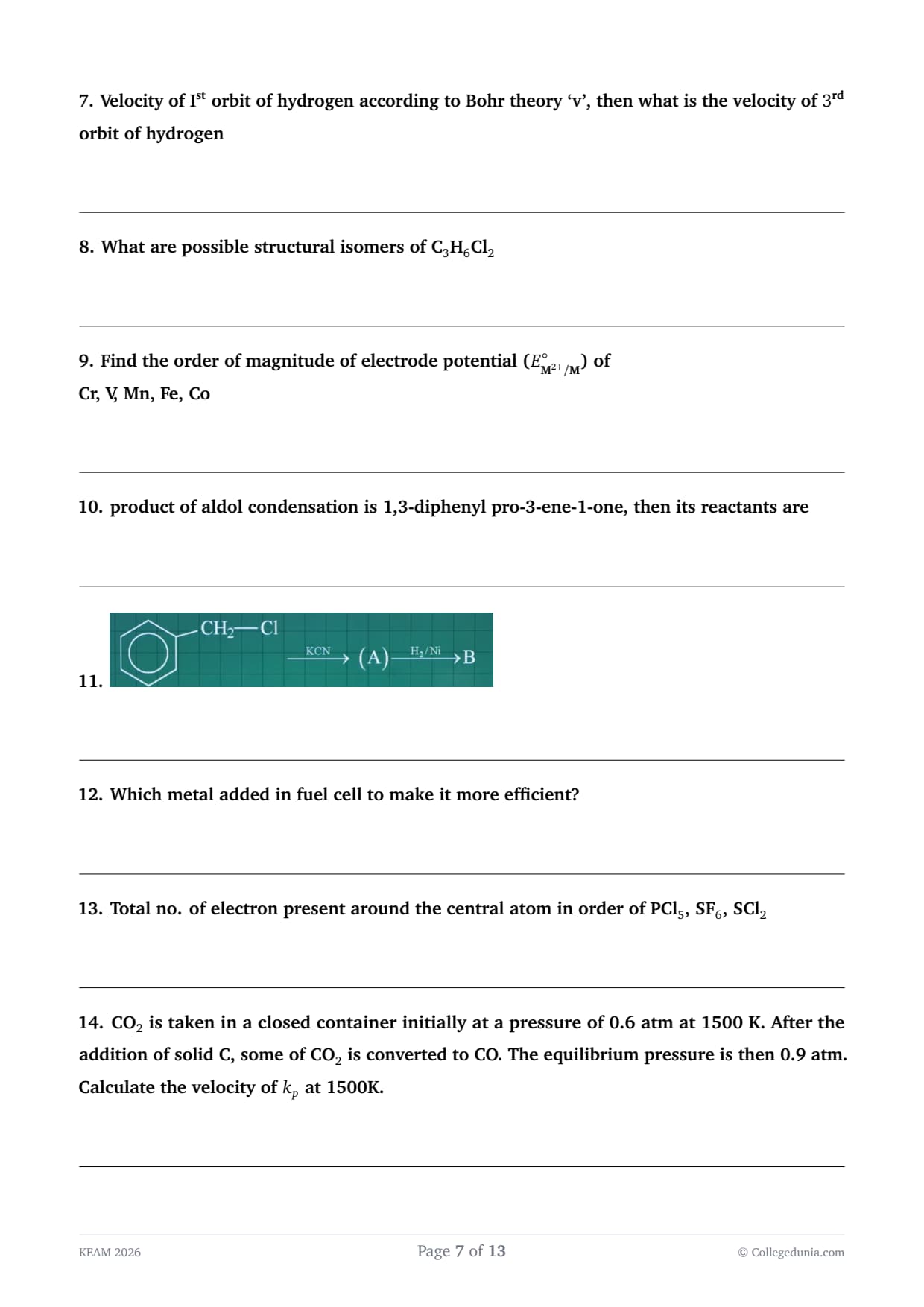
Velocity of \(I^{st}\) orbit of hydrogen according to Bohr theory ‘v’, then what is the velocity of \(3^{rd}\) orbit of hydrogen
View Solution
Step 1: Understanding the Concept:
According to Bohr's model of the hydrogen atom, the velocity of an electron in a specific orbit is quantized. The velocity depends on the atomic number (\(Z\)) and the principal quantum number (\(n\)) of the orbit.
Step 2: Key Formula or Approach:
The formula for the velocity of an electron in the \(n^{th}\) Bohr orbit is given by:
\(v_n = \frac{2\pi k Z e^2}{nh} = v_0 \times \frac{Z}{n}\)
Where \(v_0\) is the velocity of the electron in the first orbit of hydrogen (\(2.18 \times 10^6\) m/s).
This shows the direct proportionality: \(v_n \propto \frac{Z}{n}\)
Step 3: Detailed Explanation:
For a hydrogen atom, the atomic number \(Z = 1\).
Therefore, the velocity in the \(n^{th}\) orbit is inversely proportional to \(n\):
\(v_n \propto \frac{1}{n}\)
Given that the velocity in the \(1^{st}\) orbit (\(n=1\)) is \(v\):
\(v_1 = v\)
We need to find the velocity in the \(3^{rd}\) orbit (\(n=3\)), let's call it \(v_3\).
Using the proportionality:
\(\frac{v_3}{v_1} = \frac{1/3}{1/1} = \frac{1}{3}\)
Substitute \(v_1 = v\):
\(\frac{v_3}{v} = \frac{1}{3}\)
\(v_3 = \frac{v}{3}\)
Step 4: Final Answer:
The velocity in the \(3^{rd}\) orbit is \(\frac{v}{3}\).
Quick Tip: Remember the key proportionalities for Bohr orbits:
Radius \(r \propto \frac{n^2}{Z}\)
Velocity \(v \propto \frac{Z}{n}\)
Energy \(E \propto -\frac{Z^2}{n^2}\)
What are possible structural isomers of \(C_3H_6Cl_2\)
View Solution
Step 1: Understanding the Concept:
Structural isomers are molecules with the same molecular formula but different bonding patterns (connectivity). To find them systematically, first determine the degree of unsaturation, draw the carbon skeleton, and then place the functional groups (chlorine atoms) in all possible unique positions.
Step 2: Key Formula or Approach:
Calculate the Degree of Unsaturation (DU) to confirm there are no rings or double bonds.
\(DU = C + 1 - \frac{H}{2} - \frac{X}{2} + \frac{N}{2}\)
\(DU = 3 + 1 - \frac{6}{2} - \frac{2}{2} = 4 - 3 - 1 = 0\).
Since DU is 0, the carbon skeleton is an open-chain alkane.
Step 3: Detailed Explanation:
The basic carbon skeleton for a 3-carbon alkane is propane: \(C-C-C\).
We need to attach two chlorine atoms to this skeleton. We can classify the possibilities based on whether the chlorine atoms are on the same carbon (geminal) or different carbons (vicinal/terminal).
Case 1: Both Cl atoms on the same carbon (Geminal dihalides)
- Place both on an end carbon (C1): \(CH_3-CH_2-CHCl_2\)
Name: 1,1-dichloropropane
- Place both on the middle carbon (C2): \(CH_3-CCl_2-CH_3\)
Name: 2,2-dichloropropane
Case 2: Cl atoms on different carbons
- Place them on adjacent carbons (C1 and C2): \(CH_3-CHCl-CH_2Cl\)
Name: 1,2-dichloropropane
- Place them on the terminal carbons (C1 and C3): \(CH_2Cl-CH_2-CH_2Cl\)
Name: 1,3-dichloropropane
There are no other unique ways to attach the two chlorine atoms to a 3-carbon chain.
Step 4: Final Answer:
There are 4 possible structural isomers.
Quick Tip: To avoid missing isomers or counting duplicates, work systematically: try placing multiple substituents on the same carbon first, then move one substituent progressively further down the chain. Always name them to ensure they are unique.
Find the order of magnitude of electrode potential (\(E^\circ_{M^{2+}/M}\)) of
Cr, V, Mn, Fe, Co
View Solution
Step 1: Understanding the Concept:
The standard electrode potential (\(E^\circ_{M^{2+}/M}\)) for transition metals indicates their tendency to be reduced from the \(+2\) state to the solid metal. A more negative value implies the solid metal is a stronger reducing agent and more easily oxidized to the \(+2\) state. The trend across the 3d series is generally towards less negative values, but important exceptions exist due to stable electronic configurations (like \(d^5\) for \(Mn^{2+}\)).
Step 2: Key Formula or Approach:
This requires recalling the standard reduction potential values (or their general trends) for the 3d series elements.
Step 3: Detailed Explanation:
Let's list the approximate standard reduction potentials (\(E^\circ\) for \(M^{2+} + 2e^- \rightarrow M\)) for the given metals:
- Vanadium (V): \(-1.18\) V
- Chromium (Cr): \(-0.91\) V
- Manganese (Mn): \(-1.18\) V
- Iron (Fe): \(-0.44\) V
- Cobalt (Co): \(-0.28\) V
Notice that Manganese breaks the general trend of becoming less negative. The \(E^\circ\) value for Mn is more negative than expected (and similar to V) because the resulting \(Mn^{2+}\) ion has a highly stable, half-filled \(3d^5\) electron configuration. This makes solid Mn relatively eager to oxidize to \(Mn^{2+}\), driving the reduction potential down.
Arranging these values in increasing order (from most negative to least negative):
\(-1.18 V (V) \approx -1.18 V (Mn) < -0.91 V (Cr) < -0.44 V (Fe) < -0.28 V (Co)\)
Therefore, the order is V \(\approx\) Mn \(<\) Cr \(<\) Fe \(<\) Co.
Step 4: Final Answer:
The increasing order of standard electrode potentials is V \(\approx\) Mn \(<\) Cr \(<\) Fe \(<\) Co.
Quick Tip: The anomalous values in the 3d series \(E^\circ_{M^{2+}/M}\) trend are crucial to remember: Mn is more negative than expected due to stable \(d^5\) \(Mn^{2+}\), and Zn is very negative due to stable \(d^{10}\) \(Zn^{2+}\).
product of aldol condensation is 1,3-diphenyl pro-3-ene-1-one, then its reactants are
View Solution
Step 1: Understanding the Concept:
An Aldol condensation reaction between two carbonyl compounds (at least one having an \(\alpha\)-hydrogen) yields an \(\alpha,\beta\)-unsaturated carbonyl compound (an enone) after dehydration. To find the reactants, we perform a retrosynthetic analysis on the product, breaking it apart at the double bond.
Step 2: Key Formula or Approach:
Identify the \(\alpha,\beta\)-double bond relative to the carbonyl group. Cleave this double bond. Add two hydrogen atoms to the \(\alpha\)-carbon and an oxygen atom to the \(\beta\)-carbon to regenerate the original carbonyl reactants.
Step 3: Detailed Explanation:
First, let's correct the chemical name provided in the question. "1,3-diphenyl pro-3-ene-1-one" is structurally impossible as a propene chain only has 3 carbons. The correct name for the common aldol product Chalcone is 1,3-diphenylprop-2-en-1-one. Let's proceed with this correct structure.
Structure of the product:
\(C_6H_5 - CH = CH - C(=O) - C_6H_5\)
\(\beta \quad \quad \alpha \quad \quad carbonyl\)
This is a cross-aldol condensation product.
Applying the retrosynthetic cleavage at the \(\alpha,\beta\) double bond:
1. Break the \(C=C\) bond.
2. The carbon adjacent to the carbonyl (\(\alpha\)-carbon) originated from the enolate and must get 2 hydrogen atoms back.
\(-CH \rightarrow -CH_3\)
So, the right fragment becomes \(CH_3 - C(=O) - C_6H_5\), which is Acetophenone.
3. The other carbon of the double bond (\(\beta\)-carbon) was the electrophilic carbonyl carbon and gets an oxygen atom back to form a \(C=O\) group.
\(C_6H_5 - CH= \rightarrow C_6H_5 - CHO\)
So, the left fragment becomes Benzaldehyde.
Reactants: Benzaldehyde (which lacks \(\alpha\)-hydrogens) and Acetophenone (which provides the \(\alpha\)-hydrogens to form the enolate).
Step 4: Final Answer:
The reactants are Benzaldehyde and Acetophenone.
Quick Tip: To quickly find aldol reactants from an enone, simply cut the \(C=C\) bond. Give an 'O' to the carbon further from the carbonyl, and give 'H2' to the carbon next to the carbonyl.

View Solution
Step 1: Understanding the Concept:
This is a two-step reaction sequence.
1. The first step is a nucleophilic substitution (\(S_N2\)) reaction where a cyanide ion replaces a halide.
2. The second step is a catalytic reduction (hydrogenation) of a nitrile to a primary amine.
Step 2: Key Formula or Approach:
Determine the structure of product A by substituting \(-Cl\) with \(-CN\). Then determine product B by reducing the \(-CN\) group to \(-CH_2NH_2\).
Step 3: Detailed Explanation:
Step 1: Formation of A
Reactant: Benzyl chloride (\(C_6H_5-CH_2-Cl\))
Reagent: \(KCN\) (Potassium cyanide)
The nucleophile \(CN^-\) attacks the electrophilic benzylic carbon, displacing the chloride leaving group.
\(C_6H_5-CH_2-Cl + KCN \rightarrow C_6H_5-CH_2-CN + KCl\)
Product (A) is Benzyl cyanide (or 2-phenylacetonitrile).
Step 2: Formation of B
Reactant: Product (A), C6H5 − CH2 − C ≡ N
Reagent: \(H_2/Ni\) (Catalytic hydrogenation)
Catalytic hydrogenation reduces the carbon-nitrogen triple bond. The addition of two moles of
H2 converts the nitrile group (-C ≡ N) into a primary amine group (-CH2-NH2).
C6H5 − CH2 − C ≡ N + 2H2
Ni−→ C6H5 − CH2 − CH2 − NH2
The resulting compound has a two-carbon chain attached to a phenyl ring, with an amine group on the end carbon.
Its IUPAC name is 2-phenylethanamine.
Step 4: Final Answer:
The final product B is 2-phenylethanamine (\(C_6H_5CH_2CH_2NH_2\)).
Quick Tip: Reaction with KCN followed by reduction is a classic sequence for "stepping up" a carbon chain by exactly one carbon atom, resulting in a primary amine.
Which metal added in fuel cell to make it more efficient?
View Solution
Step 1: Understanding the Concept:
Fuel cells, like the hydrogen-oxygen fuel cell, convert chemical energy directly into electrical energy. The reactions at the electrodes (oxidation of fuel and reduction of oxygen) often have high activation energies and proceed slowly at normal temperatures. Catalysts are required to increase the rate of these electrode reactions and improve the overall efficiency of the cell.
Step 2: Key Formula or Approach:
Recall factual knowledge regarding the composition of electrodes in standard fuel cells discussed in typical chemistry curricula.
Step 3: Detailed Explanation:
In a typical \(H_2-O_2\) fuel cell, the electrodes are made of porous carbon. To make the cell operate efficiently, a catalyst is incorporated into these porous electrodes.
Finely divided transition metals are commonly used for this purpose because of their excellent catalytic properties, specifically their ability to adsorb reactant gases and facilitate electron transfer.
The most frequently used catalysts to enhance the efficiency of fuel cell electrodes are:
- Platinum (Pt)
- Palladium (Pd)
- Finely divided Silver (Ag) is also sometimes used.
Among these, Platinum is the most standard and widely cited answer in educational materials for catalyzing both the anode and cathode reactions in hydrogen fuel cells.
Step 4: Final Answer:
Metals like Platinum (Pt) or Palladium (Pd) are added as catalysts to make fuel cells more efficient.
Quick Tip: Whenever catalysts for hydrogenation, dehydrogenation, or electrode reactions in fuel cells are asked, Platinum (Pt) and Palladium (Pd) are usually the primary textbook answers.
Total no. of electron present around the central atom in order of \(PCl_5\), \(SF_6\), \(SCl_2\)
View Solution
Step 1: Understanding the Concept:
To find the total number of electrons around a central atom in a molecule, we need to draw its Lewis dot structure and count the valence electrons surrounding it. This includes all electrons shared in bonds (2 electrons per single bond) plus any unshared non-bonding electrons (lone pairs).
Step 2: Key Formula or Approach:
For each molecule:
1. Identify the central atom and its number of valence electrons.
2. Determine the number of single bonds formed with surrounding atoms.
3. Calculate remaining lone pair electrons on the central atom.
4. Total electrons = (Number of bonds \(\times\) 2) + (Number of lone pair electrons).
Step 3: Detailed Explanation:
Let's analyze each molecule:
1. \(PCl_5\) (Phosphorus pentachloride):
- Central atom: Phosphorus (P), Group 15 \(\rightarrow\) 5 valence electrons.
- It forms 5 single bonds with 5 Chlorine atoms.
- All 5 valence electrons are used in bonding. Lone pairs = 0.
- Total electrons = \(5 bonds \times 2 e^-/bond = 10\) electrons.
(Note: This is an expanded octet).
2.
- Central atom: Sulfur (S), Group 16 \(\rightarrow\) 6 valence electrons.
- It forms 6 single bonds with 6 Fluorine atoms.
- All 6 valence electrons are used in bonding. Lone pairs = 0.
- Total electrons = \(6 bonds \times 2 e^-/bond = 12\) electrons.
(Note: This is an expanded octet).
3. \(SCl_2\) (Sulfur dichloride):
- Central atom: Sulfur (S), Group 16 \(\rightarrow\) 6 valence electrons.
- It forms 2 single bonds with 2 Chlorine atoms (using 2 valence electrons).
- Remaining valence electrons on S = \(6 - 2 = 4\) electrons (which is 2 lone pairs).
- Total electrons around S = (2 bonding pairs \(\times\) 2) + 4 lone pair electrons = \(4 + 4 = 8\) electrons.
Listing them in the requested order: 10, 12, 8.
Step 4: Final Answer:
The total number of electrons are 10, 12, and 8 respectively.
Quick Tip: A quick shortcut formula for total electrons around a central atom:
Total \(e^-\) = (Number of valence \(e^-\) of central atom) + (Number of monovalent atoms attached) - (Charge). For \(PCl_5\): \(5 + 5 = 10\). For \(SF_6\): \(6 + 6 = 12\). For \(SCl_2\): \(6 + 2 = 8\).
\(CO_2\) is taken in a closed container initially at a pressure of 0.6 atm at 1500 K. After the addition of solid C, some of \(CO_2\) is converted to CO. The equilibrium pressure is then 0.9 atm. Calculate the velocity of \(k_p\) at 1500K.
View Solution
Step 1: Write the Balanced Reaction
\[ CO_{2(g)} + C_{(s)} \rightleftharpoons 2CO_{(g)} \]
(Note: Solid carbon does not appear in \(K_p\) expression.)
Step 2: Construct ICE Table (in atm)
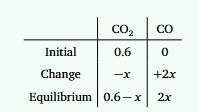
Step 3: Use Total Pressure at Equilibrium
\[ P_{total} = P_{CO_2} + P_{CO} \] \[ 0.9 = (0.6 - x) + 2x \] \[ 0.9 = 0.6 + x \Rightarrow x = 0.3 \]
Step 4: Calculate Equilibrium Partial Pressures
\[ P_{CO_2} = 0.6 - 0.3 = 0.3 atm \] \[ P_{CO} = 2x = 2(0.3) = 0.6 atm \]
Step 5: Calculate \(K_p\)
\[ K_p = \frac{(P_{CO})^2}{P_{CO_2}} \] \[ K_p = \frac{(0.6)^2}{0.3} = \frac{0.36}{0.3} = 1.2 atm \]
Step 6: Final Answer
\[ \boxed{K_p = 1.2 atm} \] Quick Tip: Always remember to exclude pure solids and liquids from equilibrium constant expressions (\(K_c\) and \(K_p\)) because their concentrations/activities remain constant.
The rate of constant of a reaction at 400K and 500K are \(0.04 m^{-1}\) and \(0.08 m^{-1}\) respectively. The Ea of the reaction is about (\(2.303R = 19.15 J/k/mol\))
View Solution
Step 1: Use Arrhenius Equation
\[ \log\left(\frac{k_2}{k_1}\right) = \frac{E_a}{2.303R} \left(\frac{T_2 - T_1}{T_1 T_2}\right) \]
Step 2: Substitute Given Values
\[ k_1 = 0.04,\quad k_2 = 0.08,\quad T_1 = 400K,\quad T_2 = 500K \] \[ \log\left(\frac{0.08}{0.04}\right) = \frac{E_a}{19.15} \left(\frac{500 - 400}{400 \times 500}\right) \]
Step 3: Simplify the Expression
\[ \log(2) = \frac{E_a}{19.15} \times \frac{100}{200000} \] \[ \log(2) = \frac{E_a}{19.15} \times \frac{1}{2000} \]
Step 4: Use Approximation
\[ \log(2) \approx 0.3 \] \[ 0.3 = \frac{E_a}{19.15 \times 2000} \]
Step 5: Calculate \(E_a\)
\[ E_a = 0.3 \times 19.15 \times 2000 \] \[ E_a = 11490 J/mol \]
Step 6: Convert into kJ/mol
\[ E_a = 11.49 kJ/mol \approx 11.5 kJ/mol \]
Step 7: Final Answer
\[ \boxed{E_a = 11.5 kJ/mol} \] Quick Tip: To speed up calculations in competitive exams, memorize \(\log 2 \approx 0.3\) and \(\log 3 \approx 0.48\). Always be mindful of units, converting final energy values from Joules to kiloJoules as options usually require it.
The technique is used to purify liquid having very high b.p and decompose at or below this boiling point is
View Solution
Step 1: Understanding the Concept:
Simple distillation relies on heating a liquid to its boiling point. A liquid boils when its vapor pressure equals the external atmospheric pressure. However, some liquids decompose at temperatures below their normal boiling point.
Step 2: Key Formula or Approach:
The approach is factual recall of separation techniques. To boil such liquids without decomposing them, we must lower their boiling point. This is achieved by lowering the external pressure acting on the liquid surface.
Step 3: Detailed Explanation:
The technique used is Distillation under reduced pressure, also known as vacuum distillation.
By using a vacuum pump to reduce the pressure inside the distillation apparatus, the vapor pressure of the liquid will equal the external pressure at a much lower temperature. Consequently, the liquid boils and distills at a temperature significantly lower than its normal boiling point, thus avoiding thermal decomposition.
A classic example is the purification of glycerol, which decomposes at its normal boiling point (290◦C) but can be safely distilled without decomposition at a lower temperature under reduced pressure.
Step 4: Final Answer:
The technique is distillation under reduced pressure (vacuum distillation).
Quick Tip: Match the technique to the problem:
Decomposes at boiling point \(\rightarrow\) Vacuum distillation
Immiscible with water \& steam volatile \(\rightarrow\) Steam distillation
Small difference in boiling points \(\rightarrow\) Fractional distillation
∆G for 3X(g) + 2Y(g) → 3Z(g) at 293 K is
(∆H◦ = −13 kJ/mol, ∆S◦ = −45 J/mol)
View Solution
Step 1: Write the Formula
\[ \Delta G = \Delta H - T\Delta S \]
Step 2: Convert Units (if required)
\[ \Delta H = -13 kJ/mol = -13000 J/mol \] \[ \Delta S = -45 J K^{-1}mol^{-1}, \quad T = 293K \]
Step 3: Substitute Values
\[ \Delta G = -13000 - (293 \times -45) \]
Step 4: Calculate Entropy Term
\[ 293 \times (-45) = -13185 J/mol \]
Step 5: Calculate \(\Delta G\)
\[ \Delta G = -13000 - (-13185) \] \[ \Delta G = -13000 + 13185 = 185 J/mol \]
Step 6: Convert into kJ/mol
\[ \Delta G = 0.185 kJ/mol \]
Step 7: Final Answer
\[ \boxed{\Delta G = +0.185 kJ/mol} \] Quick Tip: The most common mistake in thermodynamics problems is adding Joules and kiloJoules directly. Always convert \(\Delta S\) by dividing by 1000, or multiply \(\Delta H\) by 1000 before proceeding with the subtraction.
The major products formed by heating \(C_6H_5CH_2 - O - C_6H_5\) with HI are
View Solution
Step 1: Understanding the Concept:
The reaction involves the cleavage of an ether by a strong acid (Hydrogen Iodide, HI). Ethers are cleaved by strong acids via nucleophilic substitution mechanisms (\(S_N1\) or \(S_N2\)). The products depend on the stability of the possible carbocation intermediates and steric hindrance.
Step 2: Key Formula or Approach:
1. Protonate the ether oxygen to form an oxonium ion.
2. Determine which carbon-oxygen bond is more susceptible to cleavage by the nucleophile (\(I^-\)).
Step 3: Detailed Explanation:
The reactant is benzyl phenyl ether: \(C_6H_5-CH_2-O-C_6H_5\)
Step 1: Protonation by HI:
\(C_6H_5-CH_2-O-C_6H_5 + H^+ \rightleftharpoons C_6H_5-CH_2-OH^+-C_6H_5\)
Step 2: Cleavage. We must decide which \(C-O\) bond breaks.
- Bond A: Between Oxygen and the Phenyl ring (\(O-C_6H_5\)). This bond is very strong and possesses partial double-bond character due to the resonance delocalization of oxygen's lone pair into the benzene ring. Furthermore, an \(S_N2\) attack on an \(sp^2\) hybridized aryl carbon is extremely difficult.
- Bond B: Between Oxygen and the Benzyl group (\(O-CH_2C_6H_5\)). This bond is weaker. Cleavage here can proceed rapidly via an \(S_N1\) mechanism because it leads to the formation of a resonance-stabilized benzyl carbocation (\(C_6H_5CH_2^+\)). Even if following \(S_N2\), the benzyl position is reactive.
Because Bond B is much weaker and its cleavage path is highly favorable, the iodide ion (\(I^-\)) attacks the benzylic carbon.
The bond breaks, yielding:
1. Benzyl iodide: \(C_6H_5CH_2I\)
2. Phenol: \(C_6H_5OH\)
Phenol does not react further with HI under normal conditions because its \(C-O\) bond is too strong to be cleaved by halide ions.
Step 4: Final Answer:
The major products are Benzyl iodide and Phenol.
Quick Tip: For alkyl aryl ethers (like anisole or benzyl phenyl ether), the cleavage with HI always yields phenol and an alkyl iodide. The C-O bond attached to the benzene ring is too strong to break due to resonance.
In the reaction, \(O_{2(g)} + 4H^+_{(aq)} + 4e^- \rightarrow 2H_2O_{(l)}\) , the quantity of electricity required to reduce one mole of gaseous oxygen is (\(E^\circ = 1.23V\))
View Solution
Step 1: Identify Electron Requirement
From the balanced reaction: \[ O_2 + 4H^+ + 4e^- \rightarrow 2H_2O \]
1 mole of \(O_2\) requires 4 moles of electrons.
Step 2: Use Faraday's Law
\[ Q = nF \]
where \(n =\) number of moles of electrons, \(F = 96500 C/mol\)
Step 3: Substitute Values
\[ Q = 4 \times 96500 \]
Step 4: Calculate Charge
\[ Q = 386000 C \]
Step 5: Express in Faradays
\[ Q = 4F \]
Step 6: Final Answer
\[ \boxed{Q = 4F = 3.86 \times 10^5 C} \] Quick Tip: Always read the stoichiometry directly from the balanced equation. If a question asks for charge, you don't need voltage (\(E^\circ\)). Voltage is needed to calculate energy (\(\Delta G = -nFE\)). Don't let extra numbers distract you.
A 250 watt bulb emits monochromatic light wavelength 198.78 nm. How many photons are emitted by the bulb per second?
View Solution
Step 1: Understanding the Concept:
Power (Watts) is defined as energy emitted per unit time (Joules/second). The total energy emitted by the bulb in one second is made up of the sum of the discrete energies of all individual photons emitted.
Step 2: Key Formula or Approach:
1. Relate Power to total energy per second: \(E_{total} = Power \times time\)
2. Calculate energy of a single photon: \(E_{photon} = \frac{hc}{\lambda}\)
3. Equate total energy to number of photons times energy per photon: \(E_{total} = n \times E_{photon}\)
Combine to find \(n\) (photons per second): \(n = \frac{P}{E_{photon}} = \frac{P \lambda}{hc}\)
Step 3: Detailed Explanation:
Given values:
- Power (\(P\)) = 250 W = 250 J/s. Therefore, energy emitted in 1 second (\(E_{total}\)) = 250 J.
- Wavelength (\(\lambda\)) = \(198.78 nm = 198.78 \times 10^{-9} m\)
- Planck's constant (\(h\)) \(\approx 6.626 \times 10^{-34} J s\)
- Speed of light (\(c\)) \(\approx 3 \times 10^8 m/s\)
First, calculate the energy of one single photon:
\(E_{photon} = \frac{hc}{\lambda}\)
\(E_{photon} = \frac{(6.626 \times 10^{-34} J s) \times (3 \times 10^8 m/s)}{198.78 \times 10^{-9} m}\)
\(E_{photon} = \frac{19.878 \times 10^{-26}}{198.78 \times 10^{-9}} J\)
Notice the convenient numbers designed for easy calculation without a calculator:
\(E_{photon} = \left(\frac{19.878}{198.78}\right) \times 10^{-26 - (-9)}\)
\(E_{photon} = 0.1 \times 10^{-17} J\)
\(E_{photon} = 10^{-18} J\)
Now, calculate the number of photons (\(n\)) emitted per second:
\(n = \frac{E_{total}}{E_{photon}}\)
\(n = \frac{250 J}{10^{-18} J/photon}\)
\(n = 250 \times 10^{18} photons\)
\(n = 2.5 \times 10^{20} photons\)
Step 4: Final Answer:
The number of photons emitted per second is \(2.5 \times 10^{20}\).
Quick Tip: Look for mathematical simplifications before doing raw arithmetic. Values like \(198.78\) in a physics/chemistry problem are almost always chosen specifically to cancel cleanly with combinations of fundamental constants like \(h\) and \(c\) (\(6.626 \times 3 = 19.878\)).
For the equilibrium,
\(2A_{(g)} \rightleftharpoons 2B_{(g)} + 2C\)
the value of Kp is 0.1662 atm at 1000K. The value of Kc at same temperature is (R = 0.0831)
View Solution
Step 1: Use Relation Between \(K_p\) and \(K_c\)
\[ K_p = K_c (RT)^{\Delta n} \] \[ K_c = \frac{K_p}{(RT)^{\Delta n}} \]
Step 2: Calculate \(\Delta n\)
\[ \Delta n = (moles of gaseous products) - (moles of gaseous reactants) \] \[ \Delta n = (2 + 2) - 2 = 2 \]
Step 3: Substitute Given Values
\[ K_p = 0.1662,\quad R = 0.0831,\quad T = 1000K \] \[ RT = 0.0831 \times 1000 = 83.1 \]
Step 4: Calculate \(K_c\)
\[ K_c = \frac{0.1662}{(83.1)^2} \] \[ K_c = \frac{0.1662}{6905.61} \] \[ K_c \approx 2.4 \times 10^{-5} \]
Step 5: Final Answer
\[ \boxed{K_c = 2.4 \times 10^{-5}} \] Quick Tip: In competitive exams, if solving a problem strictly as written leads to messy, random numbers while a slight, plausible typo correction leads to elegant, perfectly canceling numbers, the corrected path is almost always the intended one. Pay attention to unit clues too!
Match the following
Methyl chloride - Antiseptic
Chloroform - Metal washing
Iodoform - Propellant
\(CCl_4\)- Solvent for \(I_2\)
Methyl chloride - Propellant
Chloroform - Solvent for \(\text{I}_2\)
Iodoform - Antiseptic
\(\text{CCl}_4\) - Metal washing
View Solution
Step 1: Understanding the Concept:
This question tests factual knowledge regarding the commercial and industrial applications of common polyhalogen compounds.
Step 2: Key Formula or Approach:
Recall the specific uses listed in standard chemistry curricula (like NCERT) for each given compound to form correct pairs.
Step 3: Detailed Explanation:
Let's analyze the properties and uses of each compound:
1. Methyl chloride (\(CH_3Cl\)): It is a gas at room temperature and is easily liquefied under pressure. Because of this, it has historically been used widely as a refrigerant and as a propellant in aerosol aerosols.
2. Iodoform (\(CHI_3\)): It is a yellow solid with a distinct smell. It was earlier used extensively as an antiseptic. Its antiseptic properties are not due to iodoform itself, but to the liberation of free iodine when it comes in contact with skin/wounds.
3. Carbon tetrachloride (\(CCl_4\)): It is a heavy, non-flammable liquid. It was widely used in fire extinguishers and as a cleaning fluid, particularly in industry for metal washing (degreasing) and dry cleaning before its toxicity was fully appreciated.
4. Chloroform (\(CHCl_3\)): It is a heavy liquid primarily used today in the production of Freon refrigerant R-22. Historically, it is well known as an anesthetic. It is also an excellent solvent for fats, alkaloids, and iodine. While \(CCl_4\) is also a famous solvent for \(I_2\) (yielding a purple solution), given the remaining options, matching Chloroform as a solvent for \(I_2\) and \(CCl_4\) for industrial metal washing provides the most accurate set of associations.
Matching them up:
- Methyl chloride \(\rightarrow\) Propellant
- Iodoform \(\rightarrow\) Antiseptic
- Carbon tetrachloride (\(CCl_4\)) \(\rightarrow\) Metal washing
- Chloroform \(\rightarrow\) Solvent for \(I_2\)
Step 4: Final Answer:
The correct matches are: Methyl chloride - Propellant; Chloroform - Solvent for \(I_2\); Iodoform - Antiseptic; \(CCl_4\) - Metal washing.
Quick Tip: Uses of haloalkanes are common memory-based questions. Always link Iodoform to 'antiseptic' (iodine release), Freons/Methyl chloride to 'refrigerant/propellant', and heavy liquids like \(CCl_4\)/Chloroform to 'solvents/degreasers'.
If the reaction is \(3^{rd}\) order, if the conc. of reactant is doubled, then the rate is
View Solution
Step 1: Understanding the Concept:
The order of a reaction dictates how sensitive the reaction rate is to changes in the concentration of the reactants. It is represented by the exponent in the rate law equation.
Step 2: Key Formula or Approach:
Write the generic rate law for a 3rd order reaction involving a single reactant. Then, substitute the new concentration to see how the overall rate changes.
Step 3: Detailed Explanation:
Let the initial concentration of the reactant be \([A]\).
For a reaction that is overall 3rd order with respect to a single reactant, the rate law is:
\(Rate_{initial} = k[A]^3\)
The problem states that the concentration of the reactant is doubled.
Let the new concentration be \([A'] = 2[A]\).
Now, calculate the new rate using this new concentration:
\(Rate_{new} = k[A']^3\)
Substitute \([A'] = 2[A]\) into the equation:
\(Rate_{new} = k(2[A])^3\)
\(Rate_{new} = k \cdot (2^3) \cdot [A]^3\)
\(Rate_{new} = k \cdot 8 \cdot [A]^3\)
\(Rate_{new} = 8 \cdot (k[A]^3)\)
Since \((k[A]^3)\) is the initial rate, we have:
\(Rate_{new} = 8 \times Rate_{initial}\)
Therefore, the rate is increased 8 times.
Step 4: Final Answer:
The rate is increased 8 times.
Quick Tip: For these types of questions, simply raise the factor by which concentration changes to the power of the order. If concentration changes by factor \(x\), and order is \(n\), new rate changes by factor \(x^n\). Here, \(2^3 = 8\).
3g of Benzoic acid is added to 25g Benzene. ∆Tf= 2.5K and \(K_b\) of Benzene is 5. What is the experimental molecular mass of Benzoic acid?
View Solution
Step 1: Use Freezing Point Depression Formula
\[ \Delta T_f = K_f \cdot m \] \[ \Delta T_f = K_f \cdot \frac{W_2 \times 1000}{M \times W_1} \]
Step 2: Substitute Given Values
\[ \Delta T_f = 2.5,\quad K_f = 5,\quad W_2 = 3 g,\quad W_1 = 25 g \]
Step 3: Put Values in Formula
\[ 2.5 = 5 \times \frac{3 \times 1000}{M \times 25} \]
Step 4: Simplify Equation
\[ 2.5 = 5 \times \frac{3000}{25M} \] \[ 2.5 = \frac{600}{M} \]
Step 5: Calculate Molecular Mass
\[ M = \frac{600}{2.5} = 240 g/mol \]
Step 6: Final Answer
\[ \boxed{M = 240 g/mol} \] Quick Tip: If calculated molar mass is double the theoretical formula mass, it strongly implies the solute undergoes 100% dimerization in the solvent (van't Hoff factor \(i = 0.5\)).
The bond between \(3'\) and \(5'\) carbon of pentosed sugar of nucleotide is called
View Solution
Step 1: Understanding the Concept:
Nucleic acids (DNA and RNA) are polymers composed of repeating monomer units called nucleotides. To form the long polymer chain, these individual nucleotides must be chemically linked together.
Step 2: Key Formula or Approach:
Identify the specific functional groups that react to join adjacent nucleotides and the name of the resulting chemical linkage.
Step 3: Detailed Explanation:
A nucleotide consists of three parts: a nitrogenous base, a pentose sugar, and a phosphate group.
In a nucleic acid chain, nucleotides are joined end-to-end. This connection is formed by a condensation reaction between:
1. The hydroxyl (\(-OH\)) group attached to the \(3'\) carbon of the pentose sugar of one nucleotide.
2. The phosphate group attached to the \(5'\) carbon of the pentose sugar of the adjacent nucleotide.
Because the phosphate group (\(PO_4\)) forms two ester bonds—one with the \(5'\) carbon of its own sugar and a new one with the \(3'\) carbon of the next sugar—the resulting connection bridging the two sugars is called a phosphodiester linkage (or phosphodiester bond).
This linkage forms the continuous "sugar-phosphate backbone" characteristic of all DNA and RNA strands.
Step 4: Final Answer:
The bond is called a phosphodiester bond.
Quick Tip: Differentiate the key biological bonds:
Nucleotides \(\rightarrow\) Phosphodiester bond
Amino acids \(\rightarrow\) Peptide bond
Monosaccharides \(\rightarrow\) Glycosidic bond
\( \int_{\pi/6}^{\pi/3} \frac{\sqrt{\sin x}}{\sqrt{\sin x} + \sqrt{\cos x}} \,dx \)
View Solution
Step 1: Use Property of Definite Integrals
\[ \int_a^b f(x)\,dx = \int_a^b f(a+b-x)\,dx \]
Here, \[ a = \frac{\pi}{6}, \quad b = \frac{\pi}{3}, \quad a+b = \frac{\pi}{2} \]
Step 2: Let \[ I = \int_{\pi/6}^{\pi/3} \frac{\sqrt{\sin x}}{\sqrt{\sin x} + \sqrt{\cos x}} \,dx \]
Step 3: Apply Transformation
Replace \(x \to \frac{\pi}{2} - x\):
\[ I = \int_{\pi/6}^{\pi/3} \frac{\sqrt{\cos x}}{\sqrt{\cos x} + \sqrt{\sin x}} \,dx \]
Step 4: Add Both Forms
\[ 2I = \int_{\pi/6}^{\pi/3} \frac{\sqrt{\sin x} + \sqrt{\cos x}} {\sqrt{\sin x} + \sqrt{\cos x}} \,dx \]
\[ 2I = \int_{\pi/6}^{\pi/3} 1 \,dx \]
Step 5: Evaluate Integral
\[ 2I = \left[ x \right]_{\pi/6}^{\pi/3} = \frac{\pi}{3} - \frac{\pi}{6} = \frac{\pi}{6} \]
Step 6: Final Answer
\[ I = \frac{\pi}{12} \]
\[ \boxed{\frac{\pi}{12}} \] Quick Tip: Whenever you see an integral of the form \( \int_a^b \frac{f(x)}{f(x) + f(a+b-x)} \,dx \), the answer is always \( \frac{b-a}{2} \). Here, \( \frac{\pi/3 - \pi/6}{2} = \frac{\pi/6}{2} = \frac{\pi}{12} \).
\( \int \tan\frac{\theta}{2} \sin\theta \cos\theta \,d\theta \)
View Solution
Step 1: Understanding the Concept:
The integral involves a product of trigonometric functions with different arguments (\( \frac{\theta}{2} \) and \( \theta \)).
The goal is to use trigonometric identities to express the integrand in a form that is easy to integrate.
Step 2: Key Formula or Approach:
Use the half-angle identity: \( \tan\frac{\theta}{2} = \frac{\sin(\theta/2)}{\cos(\theta/2)} \).
Use the double-angle identity: \( \sin\theta = 2\sin\frac{\theta}{2}\cos\frac{\theta}{2} \).
Use the power-reducing identity: \( \cos^2\theta = \frac{1 + \cos 2\theta}{2} \).
Step 3: Detailed Explanation:
Let \( I = \int \tan\frac{\theta}{2} \sin\theta \cos\theta \,d\theta \).
First, simplify the part \( \tan\frac{\theta}{2} \sin\theta \):
\( \tan\frac{\theta}{2} \sin\theta = \left( \frac{\sin(\theta/2)}{\cos(\theta/2)} \right) \cdot \left( 2\sin\frac{\theta}{2}\cos\frac{\theta}{2} \right) \)
\( = 2\sin^2\frac{\theta}{2} \)
We know that \( 1 - \cos\theta = 2\sin^2\frac{\theta}{2} \), so:
\( \tan\frac{\theta}{2} \sin\theta = 1 - \cos\theta \)
Now substitute this back into the integral:
\[ I = \int (1 - \cos\theta) \cos\theta \,d\theta \]
Distribute the \( \cos\theta \):
\[ I = \int (\cos\theta - \cos^2\theta) \,d\theta \]
Use the identity \( \cos^2\theta = \frac{1 + \cos 2\theta}{2} \) to linearize the square term:
\[ I = \int \left( \cos\theta - \frac{1 + \cos 2\theta}{2} \right) \,d\theta \]
Split the integral into simpler parts:
\[ I = \int \cos\theta \,d\theta - \frac{1}{2} \int 1 \,d\theta - \frac{1}{2} \int \cos 2\theta \,d\theta \]
Integrate each term:
\[ I = \sin\theta - \frac{1}{2}\theta - \frac{1}{2} \left( \frac{\sin 2\theta}{2} \right) + C \]
\[ I = \sin\theta - \frac{\theta}{2} - \frac{\sin 2\theta}{4} + C \]
Step 4: Final Answer:
The evaluated integral is \( \sin\theta - \frac{\theta}{2} - \frac{\sin 2\theta}{4} + C \).
Quick Tip: Converting all trigonometric terms to sines and cosines is often a good first step. Look for opportunities to use double-angle or half-angle formulas to simplify products into sums.
\( i^2 = -1 \), then \( i^2 + i^3 + i^4 + \dots + i^{2026} \)
View Solution
Step 1: Cyclic Nature of Powers of \(i\)
\[ i^1 = i,\quad i^2 = -1,\quad i^3 = -i,\quad i^4 = 1 \]
Powers repeat every 4: \[ i^n = i^{n \bmod 4} \]
Step 2: Number of Terms
\[ Terms = 2026 - 2 + 1 = 2025 \]
Step 3: Group in Sets of 4
\[ (i^2 + i^3 + i^4 + i^5) = (-1 - i + 1 + i) = 0 \]
So every 4 terms sum to 0.
Step 4: Remaining Terms
\[ 2025 = 4 \times 506 + 1 \]
So 506 full groups cancel out, leaving: \[ S = i^{2026} \]
Step 5: Evaluate Remaining Term
\[ 2026 \bmod 4 = 2 \]
\[ i^{2026} = i^2 = -1 \]
Step 6: Final Answer
\[ \boxed{-1} \] Quick Tip: For sums of powers of \( i \), group them in fours as \( i^k + i^{k+1} + i^{k+2} + i^{k+3} = 0 \). The sum will simply be the sum of the remaining terms after forming these groups.
If A is a square matrix then which of the following is true
View Solution
Step 1: Understanding the Concept:
A matrix \( P \) is symmetric if its transpose is equal to itself, i.e., \( P^T = P \).
A matrix \( Q \) is skew-symmetric if its transpose is equal to its negative, i.e., \( Q^T = -Q \).
We need to check these properties for the matrices \( (A + A^T) \) and \( (A - A^T) \).
Step 2: Key Formula or Approach:
Use the properties of transposes:
1. \( (X + Y)^T = X^T + Y^T \)
2. \( (X^T)^T = X \)
Step 3: Detailed Explanation:
Let's analyze the first matrix, \( P = A + A^T \).
Take the transpose of \( P \):
\[ P^T = (A + A^T)^T \]
Apply the addition property of transposes:
\[ P^T = A^T + (A^T)^T \]
Apply the property that the transpose of a transpose is the original matrix:
\[ P^T = A^T + A \]
Since matrix addition is commutative:
\[ P^T = A + A^T = P \]
Because \( P^T = P \), the matrix \( A + A^T \) is symmetric.
Now, let's analyze the second matrix, \( Q = A - A^T \).
Take the transpose of \( Q \):
\[ Q^T = (A - A^T)^T \]
Apply the properties of transposes:
\[ Q^T = A^T - (A^T)^T \]
\[ Q^T = A^T - A \]
Factor out a negative sign:
\[ Q^T = -(A - A^T) = -Q \]
Because \( Q^T = -Q \), the matrix \( A - A^T \) is skew-symmetric.
Step 4: Final Answer:
Therefore, \( A + A^T \) is symmetric and \( A - A^T \) is skew symmetric. Option (1) is correct.
Quick Tip: Any square matrix \( A \) can be uniquely expressed as the sum of a symmetric and a skew-symmetric matrix: \( A = \frac{1}{2}(A + A^T) + \frac{1}{2}(A - A^T) \).
\( \int \frac{1}{(1+x^2)\left[\tan^{-1}\left(\frac{1+x}{1-x}\right)\right]} \,dx \)
View Solution
Step 1: Understanding the Concept:
The integral involves an inverse trigonometric function. A suitable substitution can simplify the expression significantly.
We notice the term \( \frac{1}{1+x^2} \), which is the derivative of \( \tan^{-1}x \), suggesting a substitution related to \( \tan^{-1}x \) might be useful.
Step 2: Key Formula or Approach:
We can use the substitution \( x = \tan\theta \), or we can directly substitute the entire inverse tangent term.
Let's use the property of inverse tangents: \( \tan^{-1}\left(\frac{1+x}{1-x}\right) = \tan^{-1}(1) + \tan^{-1}(x) = \frac{\pi}{4} + \tan^{-1}x \) (assuming \( x < 1 \) for principal values, which is typical for indefinite integrals unless bounds are given).
Step 3: Detailed Explanation:
Let the integral be \( I = \int \frac{1}{(1+x^2)\left[\tan^{-1}\left(\frac{1+x}{1-x}\right)\right]} \,dx \).
Method 1: Direct Substitution
Let \( u = \tan^{-1}\left(\frac{1+x}{1-x}\right) \).
Differentiate \( u \) with respect to \( x \) using the chain rule:
\[ \frac{du}{dx} = \frac{1}{1 + \left(\frac{1+x}{1-x}\right)^2} \cdot \frac{d}{dx}\left(\frac{1+x}{1-x}\right) \]
Apply the quotient rule to the inner term:
\[ \frac{du}{dx} = \frac{1}{\frac{(1-x)^2 + (1+x)^2}{(1-x)^2}} \cdot \frac{(1-x)(1) - (1+x)(-1)}{(1-x)^2} \]
Simplify the expression:
\[ \frac{du}{dx} = \frac{(1-x)^2}{(1-x)^2 + (1+x)^2} \cdot \frac{1 - x + 1 + x}{(1-x)^2} \]
\[ \frac{du}{dx} = \frac{1}{1 - 2x + x^2 + 1 + 2x + x^2} \cdot 2 \]
\[ \frac{du}{dx} = \frac{2}{2 + 2x^2} = \frac{1}{1+x^2} \]
This gives \( du = \frac{1}{1+x^2} \,dx \).
Substitute \( u \) and \( du \) back into the integral:
\[ I = \int \frac{1}{u} \,du \]
\[ I = \ln|u| + C \]
Substitute \( u \) back in terms of \( x \):
\[ I = \ln\left| \tan^{-1}\left(\frac{1+x}{1-x}\right) \right| + C \]
Method 2: Trigonometric Identity
We know \( \tan^{-1}\left(\frac{1+x}{1-x}\right) = \frac{\pi}{4} + \tan^{-1}x \).
Substitute this into the integral:
\[ I = \int \frac{1}{(1+x^2)(\frac{\pi}{4} + \tan^{-1}x)} \,dx \]
Let \( t = \frac{\pi}{4} + \tan^{-1}x \). Then \( dt = \frac{1}{1+x^2} \,dx \).
\[ I = \int \frac{1}{t} \,dt = \ln|t| + C \]
\[ I = \ln\left| \frac{\pi}{4} + \tan^{-1}x \right| + C \]
Both methods yield equivalent results.
Step 4: Final Answer:
The value of the integral is \( \ln\left| \frac{\pi}{4} + \tan^{-1}x \right| + C \).
Quick Tip: Recognizing standard inverse trigonometric identities like \( \tan^{-1}\left(\frac{x+y}{1-xy}\right) = \tan^{-1}x + \tan^{-1}y \) can drastically simplify integration problems.
Find the equation of the straight line passing through the point \( (-1, 6, 5) \) and \( (-2, 4, 3) \)
View Solution
Step 1: Understanding the Concept:
The equation of a line in 3D space passing through two points \( A(x_1, y_1, z_1) \) and \( B(x_2, y_2, z_2) \) requires finding the direction ratios of the line.
Step 2: Key Formula or Approach:
The direction ratios (dr's) of a line joining two points are proportional to the differences of their respective coordinates: \( (x_2 - x_1, y_2 - y_1, z_2 - z_1) \).
The symmetric form of the line equation is \( \frac{x - x_1}{x_2 - x_1} = \frac{y - y_1}{y_2 - y_1} = \frac{z - z_1}{z_2 - z_1} \).
Step 3: Detailed Explanation:
Given points are \( A(-1, 6, 5) \) and \( B(-2, 4, 3) \).
Let \( (x_1, y_1, z_1) = (-1, 6, 5) \) and \( (x_2, y_2, z_2) = (-2, 4, 3) \).
Calculate the direction ratios of the line:
\( a = x_2 - x_1 = -2 - (-1) = -1 \)
\( b = y_2 - y_1 = 4 - 6 = -2 \)
\( c = z_2 - z_1 = 3 - 5 = -2 \)
The direction ratios are \( (-1, -2, -2) \).
We can multiply these by a scalar (like -1) to get a simpler set of proportional direction ratios: \( (1, 2, 2) \).
Now, use the point-direction form using point \( A(-1, 6, 5) \) and dr's \( (1, 2, 2) \):
\[ \frac{x - x_1}{a} = \frac{y - y_1}{b} = \frac{z - z_1}{c} \]
\[ \frac{x - (-1)}{1} = \frac{y - 6}{2} = \frac{z - 5}{2} \]
\[ \frac{x + 1}{1} = \frac{y - 6}{2} = \frac{z - 5}{2} \]
(Using point B would give \( \frac{x+2}{1} = \frac{y-4}{2} = \frac{z-3}{2} \), which represents the same line).
Step 4: Final Answer:
The equation of the straight line is \( \frac{x+1}{1} = \frac{y-6}{2} = \frac{z-5}{2} \).
Quick Tip: Direction ratios can be scaled by any non-zero constant. It's often cleaner to multiply by -1 to remove negative signs from the denominators.
Solve the differential equation \( (2y - 1)dy - (y - 2)dx = 0 \)
View Solution
Step 1: Understanding the Concept:
The given differential equation can be solved by separating the variables. We need to collect all terms involving \( y \) and \( dy \) on one side, and all terms involving \( x \) and \( dx \) on the other side.
Step 2: Key Formula or Approach:
The method of separation of variables: rewrite the equation in the form \( f(y)dy = g(x)dx \) and then integrate both sides.
Step 3: Detailed Explanation:
The given equation is:
\[ (2y - 1)dy - (y - 2)dx = 0 \]
Rearrange to separate the variables:
\[ (2y - 1)dy = (y - 2)dx \]
Divide both sides by \( (y - 2) \):
\[ \frac{2y - 1}{y - 2} dy = dx \]
Now the variables are separated. Integrate both sides:
\[ \int \frac{2y - 1}{y - 2} \,dy = \int \,dx \]
To integrate the left side, we can perform polynomial division or manipulate the numerator to match the denominator:
Write \( 2y - 1 \) as \( 2(y - 2) + 4 - 1 = 2(y - 2) + 3 \).
\[ \int \frac{2(y - 2) + 3}{y - 2} \,dy = \int \,dx \]
\[ \int \left( \frac{2(y - 2)}{y - 2} + \frac{3}{y - 2} \right) \,dy = \int \,dx \]
\[ \int \left( 2 + \frac{3}{y - 2} \right) \,dy = \int \,dx \]
Now, integrate term by term:
\[ 2y + 3\ln|y - 2| = x + C_1 \]
Rearranging to put variables on one side:
\[ x - 2y - 3\ln|y - 2| = C \]
(where \( C = -C_1 \) is an arbitrary constant).
Step 4: Final Answer:
The general solution is \( x - 2y - 3\ln|y - 2| = C \).
Quick Tip: When integrating rational functions where the degree of the numerator is equal to or greater than the denominator, always perform algebraic manipulation or polynomial division first.
\( \lim_{x \to 0} \frac{\sin|x|}{x} \)
View Solution
Step 1: Understanding the Concept:
To evaluate a limit involving an absolute value function at the point where its argument changes sign (here, at \( x=0 \)), we must compute the left-hand limit (LHL) and the right-hand limit (RHL) separately.
If LHL \( \neq \) RHL, the limit does not exist.
Step 2: Key Formula or Approach:
Definition of absolute value:
\( |x| = x \) if \( x \ge 0 \)
\( |x| = -x \) if \( x < 0 \)
Standard limit: \( \lim_{\theta \to 0} \frac{\sin\theta}{\theta} = 1 \).
Step 3: Detailed Explanation:
Let's find the Left-Hand Limit (LHL) as \( x \) approaches 0 from negative values (\( x \to 0^- \)).
When \( x < 0 \), \( |x| = -x \).
\[ LHL = \lim_{x \to 0^-} \frac{\sin(-x)}{x} \]
Using the property \( \sin(-\theta) = -\sin\theta \):
\[ LHL = \lim_{x \to 0^-} \frac{-\sin x}{x} = - \lim_{x \to 0^-} \frac{\sin x}{x} \]
Since \( \lim_{x \to 0} \frac{\sin x}{x} = 1 \):
\[ LHL = -1 \times 1 = -1 \]
Now, let's find the Right-Hand Limit (RHL) as \( x \) approaches 0 from positive values (\( x \to 0^+ \)).
When \( x > 0 \), \( |x| = x \).
\[ RHL = \lim_{x \to 0^+} \frac{\sin x}{x} \]
Using the standard limit:
\[ RHL = 1 \]
Comparing LHL and RHL:
\( LHL = -1 \) and \( RHL = 1 \).
Since \( LHL \neq RHL \), the two-sided limit does not exist.
Step 4: Final Answer:
The limit does not exist.
Quick Tip: Always be cautious with absolute value functions inside limits. Split the limit into left and right limits to correctly handle the piecewise nature of the absolute value.
\( \int \frac{1}{1 + e^t} \,dt \)
View Solution
Step 1: Understanding the Concept:
The integral involves an exponential function in the denominator. A simple algebraic manipulation or substitution can make it integrable.
Step 2: Key Formula or Approach:
We can add and subtract \( e^t \) in the numerator, or factor out \( e^t \) from the denominator to set up a substitution.
Step 3: Detailed Explanation:
Let \( I = \int \frac{1}{1 + e^t} \,dt \).
Method 1: Algebraic Manipulation
Add and subtract \( e^t \) in the numerator:
\[ I = \int \frac{1 + e^t - e^t}{1 + e^t} \,dt \]
Split the fraction:
\[ I = \int \left( \frac{1 + e^t}{1 + e^t} - \frac{e^t}{1 + e^t} \right) \,dt \]
\[ I = \int \left( 1 - \frac{e^t}{1 + e^t} \right) \,dt \]
Integrate each term separately:
For the second term, let \( u = 1 + e^t \), then \( du = e^t \,dt \). The integral becomes \( \int \frac{1}{u} \,du = \ln|u| = \ln(1+e^t) \).
\[ I = \int 1 \,dt - \int \frac{e^t}{1 + e^t} \,dt \]
\[ I = t - \ln(1 + e^t) + C \]
Method 2: Substitution
Multiply the numerator and denominator by \( e^{-t} \):
\[ I = \int \frac{e^{-t}}{e^{-t}(1 + e^t)} \,dt \]
\[ I = \int \frac{e^{-t}}{e^{-t} + 1} \,dt \]
Let \( u = e^{-t} + 1 \). Then \( du = -e^{-t} \,dt \), which means \( e^{-t} \,dt = -du \).
Substitute into the integral:
\[ I = \int \frac{-du}{u} \]
\[ I = -\ln|u| + C \]
Substitute back \( u = e^{-t} + 1 \):
\[ I = -\ln(e^{-t} + 1) + C \]
This is equivalent to the first result because \( -\ln(e^{-t} + 1) = -\ln(\frac{1 + e^t}{e^t}) = -(\ln(1+e^t) - \ln e^t) = -\ln(1+e^t) + t \).
Step 4: Final Answer:
The evaluated integral is \( t - \ln(1 + e^t) + C \).
Quick Tip: A common trick for integrals with \( e^x \) in the denominator is to multiply numerator and denominator by \( e^{-x} \). This often sets up a clean \( u \)-substitution.
\( \int e^x (2e^x + \sin x + \cos x + 2) \,dx \)
View Solution
Step 1: Understanding the Concept:
The integral involves an exponential function multiplied by a sum of functions. We can expand the expression and look for standard integration formulas.
Step 2: Key Formula or Approach:
Distribute the \( e^x \) and split the integral.
Recognize the standard form: \( \int e^x [f(x) + f'(x)] \,dx = e^x f(x) + C \).
Step 3: Detailed Explanation:
Let \( I = \int e^x (2e^x + \sin x + \cos x + 2) \,dx \).
Expand the integrand:
\[ I = \int (2e^{2x} + e^x \sin x + e^x \cos x + 2e^x) \,dx \]
Group the terms strategically. Notice the terms with trigonometric functions.
\[ I = \int (2e^{2x} + 2e^x) \,dx + \int e^x (\sin x + \cos x) \,dx \]
Let's evaluate the two integrals separately.
First integral:
\[ \int (2e^{2x} + 2e^x) \,dx = \int 2e^{2x} \,dx + \int 2e^x \,dx \]
\[ = 2 \frac{e^{2x}}{2} + 2e^x = e^{2x} + 2e^x \]
Second integral:
\[ \int e^x (\sin x + \cos x) \,dx \]
We can use the standard form \( \int e^x [f(x) + f'(x)] \,dx = e^x f(x) + C \).
Let \( f(x) = \sin x \). Then the derivative is \( f'(x) = \cos x \).
The integral exactly matches the form:
\[ \int e^x (\sin x + \cos x) \,dx = e^x \sin x \]
Combine the results of both parts:
\[ I = e^{2x} + 2e^x + e^x \sin x + C \]
Step 4: Final Answer:
The value of the integral is \( e^{2x} + 2e^x + e^x \sin x + C \).
Quick Tip: Always be on the lookout for the pattern \( \int e^x [f(x) + f'(x)] \,dx \) when an integral involves \( e^x \) multiplied by a sum. It's a very common shortcut.
\( \int \frac{y^2 - 3y + 2}{y^2 + y} \,dy \)
View Solution
Step 1: Understanding the Concept:
The integrand is a rational function where the degree of the numerator (2) is equal to the degree of the denominator (2).
Before using partial fractions, we must perform polynomial division or algebraic manipulation to reduce the degree of the numerator.
Step 2: Key Formula or Approach:
1. Express the numerator in terms of the denominator to divide it out.
2. Use partial fraction decomposition on the remaining proper rational function.
Step 3: Detailed Explanation:
Let \( I = \int \frac{y^2 - 3y + 2}{y^2 + y} \,dy \).
First, manipulate the numerator to contain the denominator \( y^2 + y \):
\( y^2 - 3y + 2 = (y^2 + y) - y - 3y + 2 = (y^2 + y) - 4y + 2 \).
Substitute this back into the integral:
\[ I = \int \frac{(y^2 + y) - 4y + 2}{y^2 + y} \,dy \]
Split the fraction:
\[ I = \int \left( \frac{y^2 + y}{y^2 + y} + \frac{-4y + 2}{y^2 + y} \right) \,dy \]
\[ I = \int \left( 1 - \frac{4y - 2}{y(y + 1)} \right) \,dy \]
\[ I = \int 1 \,dy - \int \frac{4y - 2}{y(y + 1)} \,dy \]
\[ I = y - \int \frac{4y - 2}{y(y + 1)} \,dy \]
Now, use partial fractions for the second integral. Let:
\[ \frac{4y - 2}{y(y + 1)} = \frac{A}{y} + \frac{B}{y + 1} \]
Multiply by the common denominator \( y(y + 1) \):
\[ 4y - 2 = A(y + 1) + By \]
To find \( A \), let \( y = 0 \):
\[ 4(0) - 2 = A(0 + 1) \Rightarrow -2 = A \]
To find \( B \), let \( y = -1 \):
\[ 4(-1) - 2 = B(-1) \Rightarrow -6 = -B \Rightarrow B = 6 \]
So, the partial fraction decomposition is:
\[ \frac{4y - 2}{y(y + 1)} = \frac{-2}{y} + \frac{6}{y + 1} \]
Substitute this back into the integral expression:
\[ I = y - \int \left( \frac{-2}{y} + \frac{6}{y + 1} \right) \,dy \]
Integrate the terms:
\[ I = y - (-2\ln|y| + 6\ln|y + 1|) + C \]
\[ I = y + 2\ln|y| - 6\ln|y + 1| + C \]
Step 4: Final Answer:
The integrated expression is \( y + 2\ln|y| - 6\ln|y+1| + C \).
Quick Tip: For rational functions, if the degree of the numerator \( \ge \) degree of the denominator, long division is mandatory before applying partial fractions.
\( \int_6^5 \frac{(x+8)^{2026}}{(x+8)^{2026} + (13-x)^{2026}} \,dx \)
View Solution
Step 1: Use Property of Definite Integrals
\[ \int_0^a f(x)\,dx = \int_0^a f(a-x)\,dx \]
Step 2: Let \[ I = \int_0^5 \frac{(x+8)^{2026}}{(x+8)^{2026} + (13-x)^{2026}} \,dx \]
Step 3: Apply Transformation
Replace \(x\) by \(5-x\): \[ I = \int_0^5 \frac{(13-x)^{2026}}{(13-x)^{2026} + (x+8)^{2026}} \,dx \]
Step 4: Add Both Integrals
\[ 2I = \int_0^5 \frac{(x+8)^{2026} + (13-x)^{2026}}{(x+8)^{2026} + (13-x)^{2026}} \,dx \]
\[ 2I = \int_0^5 1 \,dx \]
\[ 2I = 5 \]
Step 5: Final Answer
\[ I = \frac{5}{2} \]
\[ \boxed{\frac{5}{2}} \] Quick Tip: In integrals of the form \( \int_a^b \frac{f(x)}{f(x) + g(x)} \,dx \), quickly check if \( g(x) = f(a+b-x) \). If it does, the answer is immediately \( \frac{b-a}{2} \). If it doesn't, check for potential typos in the limits or the function.
\( \left| \frac{\cos\alpha + i\sin\alpha}{\sin\alpha - i\cos\alpha} \right|^{1000} + \left| \frac{\sin\alpha + i\cos\alpha}{\cos\alpha - i\sin\alpha} \right|^{2000} \)
View Solution
Step 1: Use Property of Modulus
\[ \left|\frac{z_1}{z_2}\right| = \frac{|z_1|}{|z_2|} \]
Step 2: Evaluate First Term
\[ \left| \frac{\cos\alpha + i\sin\alpha}{\sin\alpha - i\cos\alpha} \right| = \frac{|\cos\alpha + i\sin\alpha|}{|\sin\alpha - i\cos\alpha|} \]
\[ |\cos\alpha + i\sin\alpha| = \sqrt{\cos^2\alpha + \sin^2\alpha} = 1 \]
\[ |\sin\alpha - i\cos\alpha| = \sqrt{\sin^2\alpha + \cos^2\alpha} = 1 \]
\[ \Rightarrow \left( \frac{1}{1} \right)^{1000} = 1 \]
Step 3: Evaluate Second Term
\[ \left| \frac{\sin\alpha + i\cos\alpha}{\cos\alpha - i\sin\alpha} \right| = \frac{|\sin\alpha + i\cos\alpha|}{|\cos\alpha - i\sin\alpha|} \]
\[ |\sin\alpha + i\cos\alpha| = 1, \quad |\cos\alpha - i\sin\alpha| = 1 \]
\[ \Rightarrow \left( \frac{1}{1} \right)^{2000} = 1 \]
Step 4: Add Both Terms
\[ 1 + 1 = 2 \]
Step 5: Final Answer
\[ \boxed{2} \] Quick Tip: Any complex number of the form \( \cos\theta \pm i\sin\theta \) or \( \sin\theta \pm i\cos\theta \) has a modulus of exactly 1. Recognizing this makes calculations trivial.
Consider the data \( x_1, x_2, \dots, x_{10} \). If \( \sum_{i=1}^{10} (x_i - \bar{x})^2 = 662 \) find standard deviation.
View Solution
Step 1: Understanding the Concept:
The problem provides the sum of squared deviations from the mean for a dataset of 10 values. This quantity is directly related to the variance and standard deviation of the data.
Step 2: Key Formula or Approach:
The variance (\( \sigma^2 \)) of a population dataset of size \( N \) is given by the formula:
\[ \sigma^2 = \frac{1}{N} \sum_{i=1}^{N} (x_i - \bar{x})^2 \]
The standard deviation (\( \sigma \)) is the square root of the variance.
\[ \sigma = \sqrt{\sigma^2} \]
Step 3: Detailed Explanation:
From the problem statement:
Number of data points, \( N = 10 \).
Sum of squared deviations from the mean, \( \sum_{i=1}^{10} (x_i - \bar{x})^2 = 662 \).
First, calculate the variance:
\[ \sigma^2 = \frac{662}{10} \]
\[ \sigma^2 = 66.2 \]
Now, calculate the standard deviation by taking the square root:
\[ \sigma = \sqrt{66.2} \]
(This value is approximately 8.136).
Step 4: Final Answer:
The standard deviation is \( \sqrt{66.2} \).
Quick Tip: In competitive exams, standard deviation usually refers to the population standard deviation (dividing by \( N \)) unless it specifically mentions a "sample" (which would require dividing by \( N-1 \)).
If \( ^nC_4 = 1365 \) then \( n = \)
View Solution
Step 1: Use Combination Formula
\[ ^nC_4 = \frac{n(n-1)(n-2)(n-3)}{4!} \]
Step 2: Substitute Given Value
\[ \frac{n(n-1)(n-2)(n-3)}{24} = 1365 \]
Step 3: Simplify Equation
\[ n(n-1)(n-2)(n-3) = 1365 \times 24 \] \[ = 32760 \]
Step 4: Compare with Consecutive Integers
\[ 15 \times 14 \times 13 \times 12 = 32760 \]
Step 5: Identify Value of \(n\)
\[ n = 15 \]
Step 6: Final Answer
\[ \boxed{15} \] Quick Tip: To solve equations like \( n(n-1)\dots = K \), do not expand into a polynomial. Factorize \( K \) into primes and regroup them into consecutive integers.
A straight line has y-intercept -5. If it makes \( 120^\circ \) with the x-axis then the equation of the line is
View Solution
Step 1: Understanding the Concept:
The equation of a straight line can be determined using its slope and y-intercept. This is known as the slope-intercept form.
Step 2: Key Formula or Approach:
The slope-intercept form is \( y = mx + c \), where \( m \) is the slope and \( c \) is the y-intercept.
The slope \( m \) of a line is the tangent of the angle \( \theta \) it makes with the positive direction of the x-axis: \( m = \tan\theta \).
Step 3: Detailed Explanation:
Given the y-intercept, \( c = -5 \).
The angle made with the x-axis is \( \theta = 120^\circ \).
First, calculate the slope \( m \):
\[ m = \tan(120^\circ) \]
We can rewrite \( 120^\circ \) as \( 180^\circ - 60^\circ \).
\[ m = \tan(180^\circ - 60^\circ) \]
In the second quadrant, tangent is negative, so \( \tan(180^\circ - \theta) = -\tan\theta \).
\[ m = -\tan(60^\circ) \]
Since \( \tan(60^\circ) = \sqrt{3} \), the slope is:
\[ m = -\sqrt{3} \]
Now, substitute the slope \( m \) and y-intercept \( c \) into the slope-intercept equation:
\[ y = mx + c \]
\[ y = (-\sqrt{3})x + (-5) \]
Rearrange the equation to the standard general form \( Ax + By + C = 0 \):
Add \( \sqrt{3}x \) and \( 5 \) to both sides:
\[ \sqrt{3}x + y + 5 = 0 \]
Step 4: Final Answer:
The equation of the line is \( \sqrt{3}x + y + 5 = 0 \).
Quick Tip: Remember the signs of trigonometric functions in different quadrants. The angle \( 120^\circ \) is obtuse (2nd quadrant), which means the slope (tangent) must be negative, indicating a downward-sloping line.
\( \int_0^1 \frac{x^{15}}{1+x^{32}} [\cos(\tan^{-1} x^{16})] \,dx \)
View Solution
Step 1: Understanding the Concept:
The integral appears complex but contains recognizable derivative patterns. The presence of \( x^{16} \) and its derivative (up to a constant factor) \( x^{15} \) suggests a substitution will simplify it greatly.
Step 2: Key Formula or Approach:
We will use the method of substitution. Let's choose a substitution that simplifies both the denominator and the argument of the inverse tangent function simultaneously.
Step 3: Detailed Explanation:
Let \( I = \int_0^1 \frac{x^{15}}{1+x^{32}} \cos(\tan^{-1}(x^{16})) \,dx \).
Notice that \( x^{32} = (x^{16})^2 \). The integral can be rewritten as:
\[ I = \int_0^1 \frac{x^{15}}{1+(x^{16})^2} \cos(\tan^{-1}(x^{16})) \,dx \]
Let's make the substitution \( t = x^{16} \).
Differentiate both sides with respect to \( x \):
\[ dt = 16x^{15} \,dx \implies x^{15} \,dx = \frac{dt}{16} \]
Change the limits of integration:
When \( x = 0 \), \( t = 0^{16} = 0 \).
When \( x = 1 \), \( t = 1^{16} = 1 \).
Substitute these into the integral:
\[ I = \int_0^1 \frac{1}{1+t^2} \cos(\tan^{-1}(t)) \frac{dt}{16} \]
\[ I = \frac{1}{16} \int_0^1 \cos(\tan^{-1}(t)) \frac{dt}{1+t^2} \]
Now, perform a second substitution to simplify further. Let \( u = \tan^{-1}(t) \).
Differentiate with respect to \( t \):
\[ du = \frac{1}{1+t^2} \,dt \]
Change the limits again:
When \( t = 0 \), \( u = \tan^{-1}(0) = 0 \).
When \( t = 1 \), \( u = \tan^{-1}(1) = \frac{\pi}{4} \).
Substitute into the new integral:
\[ I = \frac{1}{16} \int_0^{\pi/4} \cos(u) \,du \]
Now the integration is straightforward:
\[ I = \frac{1}{16} [\sin(u)]_0^{\pi/4} \]
Evaluate at the limits:
\[ I = \frac{1}{16} \left( \sin(\frac{\pi}{4}) - \sin(0) \right) \]
\[ I = \frac{1}{16} \left( \frac{1}{\sqrt{2}} - 0 \right) \]
\[ I = \frac{1}{16\sqrt{2}} = \frac{\sqrt{2}}{32} \]
Step 4: Final Answer:
The value of the integral is \( \frac{\sqrt{2}}{32} \).
Quick Tip: You could also use a single, direct substitution: let \( u = \tan^{-1}(x^{16}) \). Then \( du = \frac{1}{1+(x^{16})^2} \cdot 16x^{15} \,dx \), which immediately transforms the entire integral into \( \frac{1}{16} \int \cos(u) \,du \).
Value of \( \sin 5^\circ \times \sin 10^\circ \times \sin 15^\circ \times \sin 20^\circ \times \dots \times \sin 240^\circ \)
View Solution
Step 1: Understanding the Concept:
The problem asks for the product of the sine of several angles. The angles form an arithmetic progression: \( 5^\circ, 10^\circ, 15^\circ, \dots, 240^\circ \).
To find the value of such a large product, we should look for any term in the sequence that evaluates to zero. Since anything multiplied by zero is zero, finding one such term solves the entire problem immediately.
Step 2: Key Formula or Approach:
Identify if any of the angles in the given sequence result in a sine value of zero.
We know that \( \sin(180^\circ) = 0 \).
Step 3: Detailed Explanation:
The given expression is a product of sine values:
\( P = \sin 5^\circ \times \sin 10^\circ \times \sin 15^\circ \times \dots \times \sin 240^\circ \)
The angles are multiples of 5, starting from 5 and going up to 240.
Since 180 is a multiple of 5 (\( 180 = 5 \times 36 \)) and lies between 5 and 240, the term \( \sin 180^\circ \) must be part of this product sequence.
We can write the product explicitly showing this term:
\( P = \sin 5^\circ \times \sin 10^\circ \times \dots \times \sin 175^\circ \times \sin 180^\circ \times \sin 185^\circ \times \dots \times \sin 240^\circ \)
We know from trigonometry that the sine of 180 degrees is zero.
\( \sin 180^\circ = 0 \)
Substituting this into our product:
\( P = (some finite number) \times 0 \times (some finite number) \)
Therefore, the entire product is zero.
Step 4: Final Answer:
The value of the expression is 0.
Quick Tip: In a long product sequence, always scan the terms for any value that might evaluate to zero. This is a very common trick to bypass tedious calculations.
\( z_1 = 1 + 3i, z_2 = -3i + 5 \) then \( (z_1 \bar{z}_2 + z_2 \bar{z}_1) + (z_1 \bar{z}_2 + z_2 \bar{z}_1) \) is equal to
View Solution
Step 1: Understanding the Concept:
The problem involves basic operations with complex numbers and their conjugates. We need to evaluate the given expression by substituting the values of \( z_1 \) and \( z_2 \).
Step 2: Key Formula or Approach:
For a complex number \( z = a + ib \), its conjugate is \( \bar{z} = a - ib \).
The expression \( z_1 \bar{z}_2 + z_2 \bar{z}_1 \) represents twice the real part of the product \( z_1 \bar{z}_2 \), because a number plus its conjugate equals twice its real part: \( w + \bar{w} = 2Re(w) \). Here \( w = z_1 \bar{z}_2 \) and \( \bar{w} = \bar{z}_1 z_2 \).
Let's calculate \( z_1 \bar{z}_2 \) and then find the value of the full expression.
Step 3: Detailed Explanation:
Given complex numbers:
\( z_1 = 1 + 3i \)
\( z_2 = 5 - 3i \) (rearranged for standard format \( a+ib \))
Find their conjugates:
\( \bar{z}_1 = 1 - 3i \)
\( \bar{z}_2 = 5 + 3i \)
Now, calculate the product \( z_1 \bar{z}_2 \):
\[ z_1 \bar{z}_2 = (1 + 3i)(5 + 3i) \]
Multiply the terms:
\[ z_1 \bar{z}_2 = 5 + 3i + 15i + 9i^2 \]
Since \( i^2 = -1 \):
\[ z_1 \bar{z}_2 = 5 + 18i - 9 = -4 + 18i \]
Calculate the product \( z_2 \bar{z}_1 \):
\[ z_2 \bar{z}_1 = (5 - 3i)(1 - 3i) \]
\[ z_2 \bar{z}_1 = 5 - 15i - 3i + 9i^2 \]
\[ z_2 \bar{z}_1 = 5 - 18i - 9 = -4 - 18i \]
Notice that \( z_2 \bar{z}_1 \) is indeed the conjugate of \( z_1 \bar{z}_2 \).
Now find the sum of these two products:
\[ z_1 \bar{z}_2 + z_2 \bar{z}_1 = (-4 + 18i) + (-4 - 18i) \]
\[ z_1 \bar{z}_2 + z_2 \bar{z}_1 = -8 \]
The problem asks for the value of \( (z_1 \bar{z}_2 + z_2 \bar{z}_1) + (z_1 \bar{z}_2 + z_2 \bar{z}_1) \). This is simply twice the value we just calculated.
\[ Expression = (-8) + (-8) = -16 \]
Step 4: Final Answer:
The value of the expression is -16.
Quick Tip: Recognizing that \( z_1 \bar{z}_2 \) and \( z_2 \bar{z}_1 \) are complex conjugates simplifies the calculation. Their sum is always purely real: \( 2Re(z_1 \bar{z}_2) \).
The value of the determinant
\( \begin{vmatrix} (10^5 + 10^{-5})^2 & (10^5 - 10^{-5})^2 & 1
(100^6 + 100^{-6})^2 & (100^6 - 100^{-6})^2 & 1
(6^{100} + 6^{-100})^2 & (6^{100} - 6^{-100})^2 & 1 \end{vmatrix} \)
View Solution
Step 1: Use Identity
\[ (a+b)^2 - (a-b)^2 = 4ab \]
Step 2: Apply Column Operation
Let \( C_1 \rightarrow C_1 - C_2 \)
\[ (x + x^{-1})^2 - (x - x^{-1})^2 = 4 \]
So first column becomes: \[ \begin{vmatrix} 4 & (10^5 - 10^{-5})^2 & 1
4 & (100^6 - 100^{-6})^2 & 1
4 & (6^{100} - 6^{-100})^2 & 1 \end{vmatrix} \]
Step 3: Factor Common Value
\[ = 4 \begin{vmatrix} 1 & (10^5 - 10^{-5})^2 & 1
1 & (100^6 - 100^{-6})^2 & 1
1 & (6^{100} - 6^{-100})^2 & 1 \end{vmatrix} \]
Step 4: Observe Columns
First and third columns are identical: \[ C_1 = C_3 \]
Step 5: Use Determinant Property
If two columns are identical, determinant = 0
\[ \Rightarrow \Delta = 4 \times 0 = 0 \]
Step 6: Final Answer
\[ \boxed{0} \] Quick Tip: Always look for algebraic patterns before expanding a determinant. The identity \( (a+b)^2 - (a-b)^2 = 4ab \) is a very common tool used to simplify such problems.
Given that \( p^2 = -1 \), if \( z_1 = (7 + i\sqrt{5})^2 + (7 - i\sqrt{5})^2 \) and \( z_2 = (3 + 2i)^3 - (3 - 2i)^3 \) then
View Solution
Step 1: Understanding the Concept:
The problem asks us to determine the nature (purely real or purely imaginary) of two complex numbers, \( z_1 \) and \( z_2 \).
These numbers are constructed by adding or subtracting powers of a complex number and its conjugate.
Step 2: Key Formula or Approach:
For any complex number \( w \), its conjugate is denoted by \( \bar{w} \).
Key properties connecting a complex number and its conjugate:
1. \( w + \bar{w} = 2Re(w) \), which is a purely real number.
2. \( w - \bar{w} = 2iIm(w) \), which is a purely imaginary number.
3. The conjugate of a power is the power of the conjugate: \( \overline{(w^n)} = (\bar{w})^n \).
Step 3: Detailed Explanation:
Let's analyze \( z_1 = (7 + i\sqrt{5})^2 + (7 - i\sqrt{5})^2 \).
Let \( w = 7 + i\sqrt{5} \). Then its conjugate is \( \bar{w} = 7 - i\sqrt{5} \).
We can rewrite \( z_1 \) in terms of \( w \):
\[ z_1 = w^2 + (\bar{w})^2 \]
Using the property of conjugates, \( (\bar{w})^2 = \overline{(w^2)} \).
\[ z_1 = w^2 + \overline{w^2} \]
This is the sum of a complex number (\( w^2 \)) and its conjugate.
Therefore, \( z_1 = 2Re(w^2) \).
Since the result is a real number, \( z_1 \) is a **purely real number**.
Now let's analyze \( z_2 = (3 + 2i)^3 - (3 - 2i)^3 \).
Let \( u = 3 + 2i \). Then its conjugate is \( \bar{u} = 3 - 2i \).
We can rewrite \( z_2 \) in terms of \( u \):
\[ z_2 = u^3 - (\bar{u})^3 \]
Using the property of conjugates, \( (\bar{u})^3 = \overline{(u^3)} \).
\[ z_2 = u^3 - \overline{u^3} \]
This is the difference between a complex number (\( u^3 \)) and its conjugate.
Therefore, \( z_2 = 2iIm(u^3) \).
Since the result is a real multiple of \( i \), \( z_2 \) is a **purely imaginary number**.
Comparing our findings with the given options, we see that Option (2) states exactly this.
Step 4: Final Answer:
Option (2) is correct: \( z_1 \) is a purely real number and \( z_2 \) is a purely imaginary.
Quick Tip: You don't need to expand the powers. Recognizing the structure \( z + \bar{z} \) (real) and \( z - \bar{z} \) (imaginary) saves you from tedious binomial expansions.
\( \lim_{x \to \frac{\pi}{2}^-} (\tan x - \sec x) = \)
View Solution
Step 1: Understanding the Concept:
We are asked to evaluate the left-hand limit of a trigonometric function as \( x \) approaches \( \frac{\pi}{2} \).
If we substitute \( x = \frac{\pi}{2} \) directly, both \( \tan x \) and \( \sec x \) approach infinity, leading to an indeterminate form of type \( \infty - \infty \).
Step 2: Key Formula or Approach:
To resolve the \( \infty - \infty \) indeterminate form, we should rewrite the expression as a single fraction. We can do this by expressing tangent and secant in terms of sine and cosine. This will convert the expression into a \( 0/0 \) or \( \infty/\infty \) form, which can then be solved using L'Hôpital's Rule or trigonometric identities.
Step 3: Detailed Explanation:
Let \( L = \lim_{x \to \frac{\pi}{2}^-} (\tan x - \sec x) \).
Convert the terms to sine and cosine:
\[ \tan x = \frac{\sin x}{\cos x} \quad and \quad \sec x = \frac{1}{\cos x} \]
Substitute these into the limit:
\[ L = \lim_{x \to \frac{\pi}{2}^-} \left( \frac{\sin x}{\cos x} - \frac{1}{\cos x} \right) \]
Combine into a single fraction:
\[ L = \lim_{x \to \frac{\pi}{2}^-} \frac{\sin x - 1}{\cos x} \]
Now, let's check the form as \( x \to \frac{\pi}{2}^- \).
The numerator approaches \( \sin(\frac{\pi}{2}) - 1 = 1 - 1 = 0 \).
The denominator approaches \( \cos(\frac{\pi}{2}) = 0 \).
This is an indeterminate form of type \( 0/0 \).
We can apply L'Hôpital's Rule, which involves taking the derivative of the numerator and the denominator separately.
\[ L = \lim_{x \to \frac{\pi}{2}^-} \frac{\frac{d}{dx}(\sin x - 1)}{\frac{d}{dx}(\cos x)} \]
\[ L = \lim_{x \to \frac{\pi}{2}^-} \frac{\cos x}{-\sin x} \]
Now substitute \( x = \frac{\pi}{2} \):
\[ L = \frac{\cos(\frac{\pi}{2})}{-\sin(\frac{\pi}{2})} \]
\[ L = \frac{0}{-1} = 0 \]
Alternative Method (using identities):
Multiply numerator and denominator by \( \sin x + 1 \):
\[ L = \lim_{x \to \frac{\pi}{2}^-} \frac{(\sin x - 1)(\sin x + 1)}{\cos x (\sin x + 1)} \]
\[ L = \lim_{x \to \frac{\pi}{2}^-} \frac{\sin^2 x - 1}{\cos x (\sin x + 1)} \]
Using the identity \( \sin^2 x + \cos^2 x = 1 \), we have \( \sin^2 x - 1 = -\cos^2 x \):
\[ L = \lim_{x \to \frac{\pi}{2}^-} \frac{-\cos^2 x}{\cos x (\sin x + 1)} \]
Cancel one \( \cos x \) term (valid since as \( x \to \frac{\pi}{2}^- \), \( \cos x \neq 0 \)):
\[ L = \lim_{x \to \frac{\pi}{2}^-} \frac{-\cos x}{\sin x + 1} \]
Evaluate the limit directly:
\[ L = \frac{-\cos(\frac{\pi}{2})}{\sin(\frac{\pi}{2}) + 1} = \frac{0}{1 + 1} = 0 \]
Step 4: Final Answer:
The limit is 0.
Quick Tip: When facing an \( \infty - \infty \) limit involving trigonometric functions, converting everything to sines and cosines to form a single fraction often transforms it into a solvable \( 0/0 \) limit.
\( \int_{-4}^4 (x - [x]) \,dx \)
View Solution
Step 1: Understanding the Concept:
The expression \( x - [x] \) represents the fractional part function, denoted by \( \{x\} \).
The fractional part function is a periodic function. Integrating a periodic function over an interval that is an integer multiple of its period can be simplified.
Step 2: Key Formula or Approach:
The fractional part function \( \{x\} = x - [x] \) has a fundamental period \( T = 1 \).
For a periodic function \( f(x) \) with period \( T \), the definite integral over an interval spanning \( n \) full periods is:
\( \int_a^{a+nT} f(x) \,dx = n \int_0^T f(x) \,dx \).
Here, the integration interval is from -4 to 4, which spans a length of 8. Since the period is 1, this covers 8 full periods.
Step 3: Detailed Explanation:
Let the integral be \( I = \int_{-4}^4 (x - [x]) \,dx = \int_{-4}^4 \{x\} \,dx \).
The limits are from an integer \( -4 \) to another integer \( 4 \). The total length of the interval is \( 4 - (-4) = 8 \).
Using the property of periodic functions:
\[ I = 8 \int_0^1 \{x\} \,dx \]
In the interval \( (0, 1) \), the greatest integer function \( [x] = 0 \).
Therefore, the fractional part function \( \{x\} = x - 0 = x \).
Substitute this into the integral:
\[ I = 8 \int_0^1 x \,dx \]
Evaluate the integral:
\[ I = 8 \left[ \frac{x^2}{2} \right]_0^1 \]
\[ I = 8 \left( \frac{1^2}{2} - \frac{0^2}{2} \right) \]
\[ I = 8 \left( \frac{1}{2} \right) = 4 \]
Alternative Method:
Split the integral into two parts: \( I = \int_{-4}^4 x \,dx - \int_{-4}^4 [x] \,dx \).
The first integral is of an odd function \( f(x) = x \) over a symmetric interval \( [-a, a] \), so it evaluates to 0.
\( \int_{-4}^4 x \,dx = 0 \).
The second integral evaluates the step function over unit intervals:
\( \int_{-4}^4 [x] \,dx = \int_{-4}^{-3} (-4) dx + \int_{-3}^{-2} (-3) dx + \dots + \int_{2}^{3} (2) dx + \int_{3}^{4} (3) dx \)
Each sub-integral has a width of 1, so it's just the sum of the constant values:
\( = (-4) + (-3) + (-2) + (-1) + 0 + 1 + 2 + 3 = -4 \).
So, \( I = 0 - (-4) = 4 \).
Both methods give the same result.
Step 4: Final Answer:
The value of the integral is 4.
Quick Tip: Recognizing \( x - [x] \) as the fractional part function \( \{x\} \) and knowing its period is 1 allows you to instantly simplify integrals over large integer ranges into a simple calculation over the interval \( [0, 1] \).
Let \( f(x) = \frac{2025x + 2026}{2027x - 2025}, x \in \mathbb{R}, x \neq \frac{2025}{2027} \) be a function. Then \( f^{1000}(100) \) where \( f^2(x) = f(f(x)) \) is equal to
View Solution
Step 1: Find \( f(f(x)) \)
\[ f(x) = \frac{2025x + 2026}{2027x - 2025} \]
\[ f(f(x)) = \frac{2025\left(\frac{2025x + 2026}{2027x - 2025}\right) + 2026}{2027\left(\frac{2025x + 2026}{2027x - 2025}\right) - 2025} \]
Step 2: Simplify by Taking LCM
Multiply numerator and denominator by \( (2027x - 2025) \):
\[ f(f(x)) = \frac{2025(2025x + 2026) + 2026(2027x - 2025)} {2027(2025x + 2026) - 2025(2027x - 2025)} \]
Step 3: Expand Terms
Numerator: \[ = 2025^2 x + 2025 \cdot 2026 + 2026 \cdot 2027 x - 2026 \cdot 2025 \]
Denominator: \[ = 2027 \cdot 2025 x + 2027 \cdot 2026 - 2025 \cdot 2027 x + 2025^2 \]
Step 4: Cancel Terms
\[ 2025 \cdot 2026 - 2026 \cdot 2025 = 0 \] \[ 2027 \cdot 2025 x - 2025 \cdot 2027 x = 0 \]
So we get: \[ f(f(x)) = \frac{2025^2 x + 2026 \cdot 2027 x}{2027 \cdot 2026 + 2025^2} \]
Step 5: Factor Common Terms
\[ f(f(x)) = x \cdot \frac{2025^2 + 2026 \cdot 2027}{2025^2 + 2026 \cdot 2027} \]
\[ f(f(x)) = x \]
Step 6: Observe Pattern
\[ f^2(x) = x \] \[ f^4(x) = x, \quad f^6(x) = x \]
\[ \Rightarrow f^{2n}(x) = x \]
Step 7: Apply Given Power
\[ 1000 = 2 \times 500 \Rightarrow f^{1000}(x) = x \]
Step 8: Substitute Value
\[ f^{1000}(100) = 100 \]
Step 9: Final Answer
\[ \boxed{100} \] Quick Tip: For linear fractional transformations \( f(x) = \frac{ax+b}{cx+d} \), a quick shortcut to remember is that if \( a + d = 0 \), then the function is its own inverse, and \( f(f(x)) = x \). Here, \( a = 2025 \) and \( d = -2025 \), so \( a+d = 0 \).
Let O be the origin and R be any point on \( y^2 = 2x \). The locus of the midpoint of the line segment OR is
View Solution
Step 1: Understanding the Concept:
The problem asks for the locus (the set of all possible positions) of a specific point. Here, the point of interest is the midpoint of a line segment connecting a fixed point (origin) to a moving point on a given parabola.
To find the locus, we assign coordinates \( (h, k) \) to the midpoint, relate them to the parameters of the moving point, and eliminate those parameters to find an equation purely in terms of \( h \) and \( k \). Finally, we replace \( (h, k) \) with \( (x, y) \).
Step 2: Key Formula or Approach:
Coordinates of the origin \( O \) are \( (0, 0) \).
A general point \( R \) on the parabola \( y^2 = 4ax \) can be represented parametrically as \( (at^2, 2at) \).
The midpoint formula for a line segment joining \( (x_1, y_1) \) and \( (x_2, y_2) \) is \( \left( \frac{x_1 + x_2}{2}, \frac{y_1 + y_2}{2} \right) \).
Step 3: Detailed Explanation:
The given parabola is \( y^2 = 2x \).
Comparing this with standard form \( y^2 = 4ax \), we get \( 4a = 2 \), which means \( a = 1/2 \).
Let a point \( R \) on the parabola be represented by parametric coordinates \( (at^2, 2at) \).
Substituting \( a = 1/2 \), the coordinates of \( R \) are \( \left( \frac{1}{2}t^2, 2(\frac{1}{2})t \right) = \left( \frac{t^2}{2}, t \right) \).
Let \( P(h, k) \) be the midpoint of the line segment \( OR \), where \( O \) is the origin \( (0,0) \).
Using the midpoint formula:
\[ h = \frac{0 + \frac{t^2}{2}}{2} = \frac{t^2}{4} \quad \dots (Equation 1) \]
\[ k = \frac{0 + t}{2} = \frac{t}{2} \quad \dots (Equation 2) \]
Our goal is to find the relationship between \( h \) and \( k \) by eliminating the parameter \( t \).
From Equation 2, we can express \( t \) in terms of \( k \):
\[ t = 2k \]
Substitute this expression for \( t \) into Equation 1:
\[ h = \frac{(2k)^2}{4} \]
\[ h = \frac{4k^2}{4} \]
\[ h = k^2 \]
We have successfully eliminated \( t \). To express the locus in standard variables, replace \( (h, k) \) with \( (x, y) \):
\[ x = y^2 \]
Or, conventionally written:
\[ y^2 = x \]
Step 4: Final Answer:
The locus of the midpoint is the parabola \( y^2 = x \).
Quick Tip: You can also solve this without parameters. Let \( R \) be \( (x_1, y_1) \), so \( y_1^2 = 2x_1 \). Midpoint is \( (h, k) = (x_1/2, y_1/2) \), so \( x_1 = 2h \) and \( y_1 = 2k \). Substitute these back: \( (2k)^2 = 2(2h) \Rightarrow 4k^2 = 4h \Rightarrow k^2 = h \), yielding \( y^2 = x \). This method is often faster.
Let the eccentricity of an ellipse be \( \frac{1}{2} \). If S(3, 2) is a focus and \( x - 9 = 0 \) is the corresponding directrix of the ellipse. Find equation of ellipse?
View Solution
Step 1: Understanding the Concept:
An ellipse is defined as the locus of a point that moves such that the ratio of its distance from a fixed point (focus) to its distance from a fixed straight line (directrix) is a constant (eccentricity, \( e \)), where \( 0 < e < 1 \).
Step 2: Key Formula or Approach:
The fundamental property definition of an ellipse is:
\( SP = e \cdot PM \)
where:
- \( S \) is the focus.
- \( P(x, y) \) is a moving point on the ellipse.
- \( PM \) is the perpendicular distance from \( P \) to the directrix.
- \( e \) is the eccentricity.
Squaring both sides avoids square roots: \( SP^2 = e^2 \cdot PM^2 \).
Step 3: Detailed Explanation:
Given:
Eccentricity, \( e = \frac{1}{2} \).
Focus, \( S(3, 2) \).
Directrix equation: \( x - 9 = 0 \).
Let \( P(x, y) \) be any point on the ellipse.
The square of the distance from \( P \) to focus \( S \) is:
\[ SP^2 = (x - 3)^2 + (y - 2)^2 \]
The perpendicular distance \( PM \) from point \( P(x, y) \) to the line \( x - 9 = 0 \) is:
\[ PM = \frac{|1 \cdot x + 0 \cdot y - 9|}{\sqrt{1^2 + 0^2}} = |x - 9| \]
So, \( PM^2 = (x - 9)^2 \).
Using the definition of the ellipse \( SP^2 = e^2 \cdot PM^2 \):
\[ (x - 3)^2 + (y - 2)^2 = \left(\frac{1}{2}\right)^2 \cdot (x - 9)^2 \]
\[ (x - 3)^2 + (y - 2)^2 = \frac{1}{4} (x - 9)^2 \]
Multiply the entire equation by 4 to clear the fraction:
\[ 4[(x - 3)^2 + (y - 2)^2] = (x - 9)^2 \]
Expand the squares:
\[ 4[(x^2 - 6x + 9) + (y^2 - 4y + 4)] = x^2 - 18x + 81 \]
Simplify the expression inside the brackets:
\[ 4[x^2 + y^2 - 6x - 4y + 13] = x^2 - 18x + 81 \]
Distribute the 4:
\[ 4x^2 + 4y^2 - 24x - 16y + 52 = x^2 - 18x + 81 \]
Bring all terms to one side to form the general equation:
\[ 4x^2 - x^2 + 4y^2 - 24x + 18x - 16y + 52 - 81 = 0 \]
\[ 3x^2 + 4y^2 - 6x - 16y - 29 = 0 \]
Step 4: Final Answer:
The equation of the ellipse is \( 3x^2 + 4y^2 - 6x - 16y - 29 = 0 \).
Quick Tip: Always use the squared form \( SP^2 = e^2 \cdot PM^2 \) to construct the equation, as it immediately eliminates messy square roots and absolute value signs.
The order and degree of the differential equation \( \left(1 + \frac{dy}{dx} + \frac{d^2y}{dx^2}\right)^{3/2} = \left(x + y + \frac{dy}{dx} + \frac{d^3y}{dx^3}\right)^{2/3} \)
View Solution
Step 1: Identify Order
The highest order derivative present is: \[ \frac{d^3y}{dx^3} \] \[ \Rightarrow Order = 3 \]
Step 2: Remove Fractional Powers
Given equation: \[ \left(1 + y' + y''\right)^{3/2} = \left(x + y + y' + y'''\right)^{2/3} \]
Take LCM of denominators (2 and 3) = 6
Raise both sides to power 6: \[ \left(1 + y' + y''\right)^9 = \left(x + y + y' + y'''\right)^4 \]
Step 3: Identify Degree
Now equation is polynomial in derivatives.
Highest derivative is \( y''' \), appearing as: \[ \left(y'''\right)^4 \]
\[ \Rightarrow Degree = 4 \]
Step 4: Final Answer
\[ \boxed{Order = 3, \quad Degree = 4} \] Quick Tip: To clear fractional exponents \( p/q \) and \( r/s \) on different sides of an equation, raise both sides to the power of the Least Common Multiple (LCM) of the denominators \( q \) and \( s \).
The number x is randomly chosen from the set of natural numbers lessthan or equal to 100. Then the probability of the event that the choosen number satisfies the inequality \( \frac{(x-15)(x-70)}{(x-30)} \ge 0 \) is
View Solution
Step 1: Find Critical Points
\[ (x-15)(x-70)=0 \Rightarrow x=15, 70 \] \[ x-30=0 \Rightarrow x=30 \]
Step 2: Make Sign Intervals
Intervals: \[ (-\infty,15),\ (15,30),\ (30,70),\ (70,\infty) \]
Step 3: Check Sign in Each Interval
x < 15 ⇒ −, 15 < x < 30 ⇒ +, 30 < x < 70 ⇒ −, x > 70 ⇒ +
Step 4: Solution of Inequality
\[ \frac{(x-15)(x-70)}{(x-30)} \ge 0 \Rightarrow [15,30) \cup [70,\infty) \]
(Note: \(x=30\) is excluded)
Step 5: Count Favorable Outcomes
Natural numbers from 1 to 100
\[ [15,29] \Rightarrow 29-15+1 = 15 \] \[ [70,100] \Rightarrow 100-70+1 = 31 \]
\[ Total favorable = 15 + 31 = 46 \]
Step 6: Total Outcomes
\[ n(S)=100 \]
Step 7: Probability
\[ P = \frac{46}{100} = \frac{23}{50} \]
Step 8: Final Answer
\[ \boxed{\frac{23}{50}} \] Quick Tip: Always remember to exclude the roots of the denominator from your final solution set when solving rational inequalities, even if the inequality is non-strict (\( \ge \) or \( \le \)).
KEAM 2026 Exam Pattern
| Particulars | Details |
|---|---|
| Paper | Engineering |
| Mode of Exam | Online CBT |
| Subjects | Physics- 45 questions Chemistry- 30 questions Mathematics- 75 questions |
| Type of Question | Objective Type |
| Total Number of questions | 150 |
| Marks are awarded for each correct answer | 4 marks |
| Marks are awarded for each incorrect answer | 1 marks |
| KEAM total marks for Engineering | 600 marks |
| Duration of KEAM Engineering exam | 3 hours |



Comments