




The Second shift of the TS EAMCET 2025 Engineering Exam is being conducted on May 3, 2025, between 3:00 P.M. and 6:00 P.M., at multiple centres in Telangana and Andhra Pradesh. Around 75,000 candidates are expected to appear for the same.
The TS EAMCET 2025 Exam will be held in CBT mode and includes 3 important subjects: Mathematics, Physics, and Chemistry. The TS EAMCET Question Paper has a total of 160 multiple-choice questions and is for 160 marks, with 50% of the questions from Mathematics.
The TS EAMCET 2025 May 3rd Shift 2 Question Paper with solution PDF is available here.
TS EAMCET 2025 Question Paper with Solution PDF
| TS EAMCET 2025 May 3 Shift 2 Question Paper with Answer Key | Download PDF | Check Solution |

Let \(f: R \rightarrow R\) be defined by \(f(x) = 5^{|x|} + sgn(5^{-x})\), where sgn x denotes signum function of x. Then f is
If the range of the real valued function \(f(x) = \frac{x^2 + x + k}{x^2 - x + k}\) is \([\frac{1}{3}, 3]\), then \(k =\)
The value of the greatest integer k satisfying the inequation \(2^{n+4} + 12 \geq k(n+4)\) for all \(n \in N\) is
If the system of simultaneous linear equations \(x - 2y + z = 0\), \(2x + 3y + z = 6\) and \(x + 2y + pz = q\) has infinitely many solutions, then
If the system of linear equations \((\sin\theta)x - y + z = 0\), \(x - (\cos\theta)y + z = 0\), \(x + y + (\sin\theta)z = 0\) has a non-trivial solution, then the least positive value of \(\theta\) is
If \(A = \begin{pmatrix} 1 & 2 & 3
2 & 1 & 1
1 & 3 & 1 \end{pmatrix}\) and \(B = \begin{pmatrix} 2 & 3 & 4
3 & 2 & 2
2 & 4 & 2 \end{pmatrix}\), then \(\sqrt{|Adj(AB)|} =\)
If \(A = \begin{pmatrix} 1 & 5 & 2
4 & 1 & 3
2 & 6 & 3 \end{pmatrix}\), then \(|(Adj A)^{-1}| =\)
The amplitude of the complex number is:
\[\frac{(\sqrt{3}+i)(1-\sqrt{3}i)}{(-1+i)(-1-i)}\]
If a complex number \(z = x+iy\) represents a point \(P(x, y)\) in the Argand plane and z satisfies the condition that the imaginary part of \(\frac{z-3}{z+3i}\) is zero, then the locus of the point P is
\((\sqrt{3}+i)^{10} + (\sqrt{3}-i)^{10} =\)
Number of real values of \((-1-\sqrt{3}i)^{3/4}\) is
If \(\tan\theta\) and \(\cot\theta\) are two distinct roots of the equation \(ax^2+bx+c=0, a\neq0, b\neq0\), then
Sum of all the roots of the equation \(||2x-3|-4| = 2\) is
If the quotient and remainder obtained when the expression \(3x^5-6x^4+2x^3+4x^2-5x+8\) is divided by the expression \(x^2-2x+3\) are \(ax^3+bx^2+cx+d\) and \(px+q\) respectively, then \(ab+cd =\)
If \(\alpha, \beta, \gamma, \delta\) are the roots of the equation \(12x^4-56x^3+89x^2-56x+12=0\) such that \(\alpha\beta = \gamma\delta = 1\) and \(\frac{\alpha+\beta}{\gamma+\delta} > 1\), then \(\frac{\alpha+\beta}{\gamma+\delta} =\)
If all the letters of the word ACADEMICIAN are permuted in all possible ways then the number of permutations in which no two A's are together and all the consonants are together is
The number of all possible three letter words that can be formed by choosing three letters from the letters of the word FEBRUARY so that a vowel always occupies the middle place is
The number of ways in which 6 boys and 4 girls can be arranged in a row such that between any two girls there must be exactly 2 boys is
If \(C_0, C_1, C_2, \dots, C_n\) are the binomial coefficients in the expansion of \((1+x)^n\) then the value of \(\sum r^3 \cdot C_r\) when \(n = 5\) is
The coefficient of \(x^{12}\) in the expansion of \((x^2+2x+2)^8\) is
If \(\frac{x^2+1}{(x^2+2)(x^2+3)} = \frac{Ax+B}{x^2+2} + \frac{Cx+D}{x^2+3}\), then \(A+B+C+D=\)
If \(2 \sin\theta+3 \cos\theta=2\) and \(\theta \neq (2n+1)\frac{\pi}{2}\) then \(\sin\theta+\cos\theta=\)
If \(\sin A = -\frac{24}{25}\), \(\cos B = \frac{15}{17}\), A does not belong to 4th quadrant and B does not belong to 1st quadrant then \((A + B)\) lies in the quadrant
\(4 \cos\frac{70}{2}\cos\frac{30}{2} - \sin 50 =\)
If \(x \in (-\pi,\pi)\) then the number of solutions of the equation \(2 \sin x \sin 3x \sin 5x + \sin 5x \cos 4x = 0\) is
The number of values of x satisfying the equation \(Tan^{-1}(x+\frac{\sqrt{2}}{x}) + Tan^{-1}(x-\frac{\sqrt{2}}{x}) = Tan^{-1}(x)\) is
\(\coth^2 x - \tanh^2 x =\)
If \(a=3, b=5, c=7\) are the sides of a triangle ABC, then its circumradius is
Two ships leave a port at the same time. One of them moves in the direction of E50\(^\circ\)N with a speed of 8 kmph and the other moves in the direction of S20\(^\circ\)E with a speed of 12 kmph. Then the distance between the ships at the end of 2 hours is (in km)
In a triangle ABC, if \(\vec{BC}=\hat{i}-2\hat{j}+2\hat{k}\) and \(\vec{CA}=6\hat{i}+3\hat{j}-2\hat{k}\), then the perimeter of the triangle is
If \(\hat{i}+\hat{j}+\hat{k}\), \(a_1\hat{i}+b_1\hat{j}+c_1\hat{k}\), \(a_2\hat{i}+b_2\hat{j}+c_2\hat{k}\), \(a_3\hat{i}+b_3\hat{j}+c_3\hat{k}\) are the position vectors of the points A, B, C, D respectively, \(\frac{2}{3}(\hat{i}+\hat{j}+\hat{k})\) is the position vector of the centroid of the triangular face BCD of the tetrahedron ABCD, and if \(\alpha\hat{i}+\beta\hat{j}+\gamma\hat{k}\) is the position vector of the centroid of the tetrahedron, then \(2\alpha+\beta+\gamma =\)
If \(\vec{a}=\hat{i}-2\hat{j}+2\hat{k}\) and \(\vec{b}=9\hat{i}+6\hat{j}-18\hat{k}\) are two vectors, then \(\frac{Projection of \vec{b} on \vec{a}}{Projection of \vec{a} on \vec{b}} =\)
Let \(\vec{a} = \hat{i} +2\hat{j}+3\hat{k}\), \(\vec{b}=2\hat{i}-3\hat{j}+\hat{k}\) and \(\vec{c}=3\hat{i}+\hat{j}-2\hat{k}\) be three vectors. If \(\vec{r}\) is a vector such that \(\vec{r}\cdot\vec{a} = 0\), \(\vec{r}\cdot\vec{b} = -2\) and \(\vec{r}\cdot\vec{c} = 6\) then \(\vec{r}\cdot(3\hat{i}+\hat{j}+\hat{k})= \)
Let \(\vec{a}=\hat{i}-\hat{j}+\hat{k}\), \(\vec{b}=\hat{i}-2\hat{j}-2\hat{k}\), \(\vec{c}=6\hat{i}+3\hat{j}-2\hat{k}\) be three vectors. If \(\vec{d}\) is a vector perpendicular to both \(\vec{a}\), \(\vec{b}\) and \(|\vec{d}\times\vec{c}|=14\), then \(|\vec{d}\cdot\vec{c}|=\)
The mean deviation from the mean of the discrete data 2, 3, 5, 7, 11, 13, 17, 19, 22 is
Out of the given 25 consecutive positive integers, three integers are drawn. If the least integer among given 25 integers is an odd number, then the probability that the sum of the three integers drawn is an even number is
If three dice are thrown at a time, then the probability of getting the sum of the numbers on them as a prime number is
Three companies C1, C2, C3 produce car tyres. A car manufacturing company buys 40% of its requirement from C1, 35% from C2 and 25% from C3. The company knows that 2% of the tyres supplied by C1, 3% by C2 and 4% by C3 are defective. If a tyre chosen at random from the consignment received is found defective then the probability that it was supplied by C2 is
The probability distribution of a random variable X is given below. Then, the standard deviation of X is.
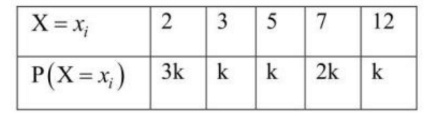
If the mean and variance of a binomial distribution are \(\frac{4}{3}\) and \(\frac{10}{9}\) respectively, then \(P(X \geq 6) =\)
A straight line passing through a point (3,2) cuts X and Y-axes at the points A and B respectively. If a point P divides AB in the ratio 2:3, then the equation of the locus of point P is
By shifting the origin to the point (-1,2) through translation of axes, if \(ax^2+2hxy+by^2+2gx+2fy+c=0\) is the transformed equation of \(2x'^2-x'y'+y'^2-3x'+4y'-5=0\), then \(2(f+g+h) =\)
If a line L passing through the point A(-2,4) makes an angle of 60\(^\circ\) with the positive direction of X-axis in anti-clockwise direction and B(p,q) lying in the 3\(^rd\) quadrant is a point on L at the distance of 6 units from the point A, then \(\sqrt{p^2+q^2-8q} =\)
If the perpendicular drawn from the point (2,-3) to the straight line \(4x-3y+8=0\) meets it at M(a,b) and \(a^3-b^3=k^3\), then \(k =\)
Let Q be the image of a point P(1,2) with respect to the line \(x+y+1=0\) and R be the image of Q with respect to the line \(x-y-1=0\). If M and N are the midpoints of PQ and QR respectively, then MN =
If the slopes of the lines represented by the equation \(6x^2+2hxy+4y^2 = 0\) are in the ratio 2:3, then the value of h such that both the lines make acute angles with the positive X-axis measured in positive direction is
If (3,-2) is the centre of the circle \(S= x^2+y^2+2gx+2fy-23=0\) and A is a point on the circle S = 0 such that its distance from a point P(-1,-5) is least, then A =
Two circles which touch both the coordinate axes intersect at the points A and B. If A = (1,2), then AB =
The line \(4x-3y+2 = 0\) intersects the circle \(x^2+y^2-2x+6y+c=0\) at two points A, B and AB=8. If (1,k) is a point on the given circle and \(k > 0\), then \(k =\)
If \(2x-3y+5=0\) and \(4x-5y+7=0\) are the equations of the normals drawn to a circle and (2,5) is a point on the given circle, then the radius of the circle is
If \((\alpha,\beta)\) is the centre of the circle which passes through the point (1,-1) and cuts the circles \(x^2 + y^2+2x-3y-5=0\), \(x^2+y^2-3x+2y+1=0\) orthogonally, then \(\alpha-5\beta =\)
The centre of the circle touching the circles \(x^2+y^2-4x-6y-12=0\), \(x^2+y^2+6x+18y+26=0\) at their point of contact and passing through the point (1,-1) is
The number of normals that can be drawn through the point (2,0) to the parabola \(y^2 = 7x\) is
If \(m_1\) and \(m_2\) are the slopes of the tangents drawn from the point (1,4) to the parabola \(y^2 = 11x\) then \(2(m_1^2 + m_2^2) =\)
If the perpendicular distance from the focus of an ellipse \(\frac{x^2}{9} + \frac{y^2}{b^2} = 1\) (\(b<3\)) to its corresponding directrix is \(\frac{4}{\sqrt{5}}\), then the slope of the tangent to this ellipse drawn at \((\frac{3}{\sqrt{2}}, \frac{b}{\sqrt{2}})\) is
The length of the chord of the ellipse \(\frac{x^2}{4} + y^2 = 1\) formed on the line \(y = x+1\) is
Let P, Q, R, S be the points of intersection of the circle \(x^2 + y^2 = 4\) and the hyperbola \(xy = \sqrt{3}\). If P = \((\alpha,\beta)\) and \(\alpha > \beta > 0\), then the equation of the tangent drawn at P to the hyperbola is
The number of values of 'k' for which the points (-4,9,k), (-1,6,k), (0,7,10) form a right-angled isosceles triangle is
A line makes angles 60\(^\circ\), 45\(^\circ\), \(\theta\) with positive X, Y, Z-axes respectively. If \(\theta\) is an acute angle, then \(\tan\theta =\)
If the foot of the perpendicular drawn from the point (2,0,-3) to the plane \(\pi\) is (1,-2,0) and the equation of the plane is \(ax+by-3z+d=0\) then \(a+b+d=\)
If \([t]\) represents the greatest integer \(\leq t\) then the value of \(\lim_{x\to 3} \frac{11-[2-x]}{[x+10]}\) is
If the real valued function \(f(x) = \begin{cases} \frac{\cos 3x-\cos x}{x \sin x} & if x < 0
p & if x=0
\frac{\log(1+q \sin x)}{x} & if x > 0 \end{cases}\) is continuous at \(x=0\) then \(p+q=\)
If \(y = \sqrt{\log(x^2+1)+\sqrt{\log(x^2+1)+\sqrt{\log(x^2+1)+...}}}\), \(|x|<1\), then \(\frac{dy}{dx} =\)
If \(x = \sqrt{1-\tan y}\), then \(\frac{dy}{dx} =\)
If \(y = Sec^{-1}x\), then \(\frac{d^2y}{dx^2} =\)
If \(x = \sin 2\theta \cos 3\theta\), \(y = \sin 3\theta \cos 2\theta\), then \(\frac{dy}{dx} =\)
If the tangent and the normal drawn to the curve \(xy^2 + x^2y = 12\) at the point (1,3) meet the X-axis in T and N respectively, then TN =
A man of 5 feet height is walking away from a light fixed at a height of 15 feet at the rate of K miles/hour. If the rate of increase of his shadow is \(\frac{11}{5}\) feet/sec, then K = (Take 1 mile = 5280 feet)
There is a possible error of 0.03 cm in a scale of length 1 foot with which the height of a closed right circular cylinder and the diameter of a sphere are measured as 3.5 feet each. If the radii of both cylinder and sphere are same, then the approximate error in the sum of the surface areas of both cylinder and sphere is (in square feet)
For a real number 'a', if a real valued function \(f(x) = 4x^3 + ax^2 + 3x - 2\) is monotonic in its domain, then the range of 'a' is
If the point P(\(x_1, y_1\)) lying on the curve \(y = x^2-x+1\) is the closest point to the line \(y = x-3\) then the perpendicular distance from P to the line \(3x+4y-2=0\) is
\(\int \frac{3^x(x\log 3 - 1)}{x^2} dx =\)
If \(\frac{5\pi}{4} < x < \frac{7\pi}{4}\), then \(\int \sqrt{\frac{1-\sin 2x}{1+\sin 2x}} dx =\)
\(\int xTan^{-1}\sqrt{\frac{1+x^2}{1-x^2}}dx=\)
\(\int \frac{1}{(2\cos x + \sin x)^2} dx =\)
\(\int_{-1}^{1} \frac{\log 2 - \log(1+x)}{\sqrt{1-x^2}} dx =\)
\(\int_{0}^{\pi/4} \frac{\sec x}{3\cos x + 4\sin x} dx =\)
\(\int_{-2}^{4} |2-x^2| dx =\)
The general solution of the differential equation \(\frac{dy}{dx} + (\sec x \csc x)y = \cos^2 x\) is
If the differential equation having \(y = Ae^x + B\sin x\) as its general solution is \(f(x)\frac{d^2y}{dx^2}+g(x)\frac{dy}{dx}+h(x)y=0\), then \(f(x)+g(x)+h(x) =\)
The range of weak nuclear force is of the order of
A piece of length 3.532 m is cut from a rod of length 43.4 m. The length of the remaining rod in metre is (up to correct significant figures)
A person wearing a parachute jumps off a plane from a height of 2 km from the ground and falls freely for 20 m before his parachute opens. After his parachute opens if he continues to move uniformly with the velocity attained due to his freefall, the total time taken by the person to reach the ground is (Acceleration due to gravity = 10 ms\(^{-2}\))
A ball projected at an angle of 45\(^\circ\) with the horizontal crosses two points at equal heights separated by a distance at times 2 s and 8 s respectively. The horizontal distance between the two points is (Acceleration due to gravity = 10 ms\(^{-2}\))
A truck of mass 8 ton is carrying a block of mass 2 ton. If a breaking force of 25 kN is applied on the truck, then the frictional force acting on the block is (Coefficient of static friction between the block and the truck is 0.3)
The work done in displacing a particle from \(y=a\) to \(y = 2a\) by a force \(F = -\frac{K}{y^2}\) acting along y-axis is
Due to the presence of air resistance, if a body dropped from a height of 20 m reaches the ground with a speed of 18ms\(^{-1}\), then the time taken by the body to reach the ground is nearly
A balance is made using a uniform metre scale of mass 100 g and two plates each of mass 200 g fixed at the two ends of the scale and the balance is pivoted at 45 cm mark of the scale. The error when 300 g weight is placed in the plate at 0 cm to weigh vegetables placed in the plate at 100 cm is
The ratio of radii of gyration of a thin circular ring and a circular disc of same radius about a tangential axis in their own planes is \(\sqrt{12}:\sqrt{K}\). The value of K is
At a given place, to increase the number of oscillations made by a simple pendulum in one minute from 72 to 90, the length of the pendulum is to be decreased by
If the orbital speed of a body revolving in a circular path near the surface of the earth is 8 kms\(^{-1}\), then the orbital speed of a body revolving around the earth in a circular orbit at height of 19,200 km from the surface of earth is (Radius of the earth = 6400 km)
The Young's modulus and Poisson's ratio of a material are respectively Y and \(\sigma\). The force required to decrease the area of cross-section of a wire made of this material by \(\Delta A\) is
A thin film of water is formed between two straight parallel wires each of length 8 cm separated by distance of 0.6 cm. The work done to increase the distance between the wires to 0.8 cm is (Surface tension of water = 0.07 Nm\(^{-1}\))
A rain drop of diameter 1 mm falls with a terminal velocity of 0.7 ms\(^{-1}\) in air. If the coefficient of viscosity of air is \(2\times10^{-5}\) Pas, the viscous force on the rain drop is
The temperature at which the reading on Fahrenheit scale becomes 90% more than the reading on Celsius scale is
A rectangular ice box of total surface area of 1000 cm\(^2\) initially contains 1.5 kg of ice at 0 \(^\circ\)C. If the thickness of the walls of the box is 2 mm and the temperature outside the box is 42 \(^\circ\)C, then the mass of the ice remaining in the box after 160 minutes is (Thermal conductivity of the material of the box = \(10^{-2}\) Wm\(^{-1}\)K\(^{-1}\) and latent heat of the fusion of ice = \(336\times10^3\) Jkg\(^{-1}\))
At constant pressure, equal amounts of heat are supplied to a monatomic gas and a diatomic gas separately. The ratio of the increases in internal energies of the two gases is
If the rms speed of the molecules of a gas at a temperature of 77 \(^\circ\)C is 50 ms\(^{-1}\), then the rms speed of the same gas molecules at a temperature of 150.5 \(^\circ\)C is
Two tuning forks of frequencies 320 Hz and 323 Hz are vibrated together. The time interval between a maximum sound and its adjacent minimum sound heard by an observer is
The frequency of sound heard by an observer moving towards a stationary source with certain speed is \(n_1\) and if the observer moves away from the same source with same speed, the frequency of sound heard by the observer is \(n_2\). If the speed of sound in air is 340ms\(^{-1}\) and \(n_1 : n_2 = 71:65\), then speed of observer is
A Cassegrain telescope uses two mirrors of radii of curvature 25 cm and 16 cm separated by a distance of 2.5 cm. The position of the final image of an object at infinity is
A convex lens of radii of curvature 6 cm and 12 cm is immersed in a liquid of refractive index 1.3. If the refractive index of the material of the lens is 1.5, then the focal length of the lens when immersed in the liquid is
When unpolarised light from air incidents on the surface of a medium of refractive index \(\sqrt{3}\), then the reflected light is totally polarised. The angle of refraction is
An alpha particle and a proton are accelerated from rest in a uniform electric field. The ratio of the times taken by proton and alpha particle to attain equal displacements is
A parallel plate capacitor with air as dielectric has a capacitance of 4 \(\mu\)F. The space between the plates of the capacitor is completely filled with a material of dielectric constant 5 and charged to a potential of 100 V. The work done to completely remove the dielectric material after the capacitor is disconnected from the battery is
The potential difference between the terminals of a cell is 20 V when a current of 2 A flows through the circuit. When the direction of current in the circuit is reversed, the potential difference between the terminals of the cell is 30 V. The internal resistance of the cell is
A straight uniform wire of resistance 36 \(\Omega\) is bent in the form of a semi-circular loop. The effective resistance between the ends of the diameter of the semi-circular loop is
An alpha particle moving with certain speed towards east enters a uniform magnetic field directed vertically up. The alpha particle will then move in
The ratios of the voltage sensitivities, resistances and areas of the coils of two moving coil galvanometers A and B are 4:3, 3:4 and 1:2 respectively. If the number of turns of the coil of galvanometer A is 200, then the number of turns of the coil of galvanometer B is (All other quantities remain same in both the cases)
A solenoid of 1000 turns per metre has a core of material with relative permeability 400. The windings of the solenoid are insulated from the core and a current of 2 A is passed through the solenoid. Then the value of the magnetic intensity inside the solenoid is
An emf of 2.8 mV is induced in a rectangular loop of area 150 cm\(^2\) when the current in the loop changes from 3 A to 8 A in a time of 0.2 s. Then the self-inductance of the loop is
A capacitor and a resistor of resistance \(100\sqrt{3}\Omega\) are connected in series to an ac source of voltage \(100\sin(200t)\) V, where 't' is time in second. If the phase difference between the voltage and the current in the circuit is 30\(^\circ\), then the capacitance of the capacitor is
The amplitude of the electric field associated with a light beam of intensity \(\frac{15}{\pi}\) Wm\(^{-2}\) is
When photons incident on a photosensitive material of work function 1.5 eV, the maximum velocity of the emitted photoelectrons is \(8\times10^5\) ms\(^{-1}\). The stopping potential of the photoelectrons is (Mass of the electron \(= 9\times10^{-31}\) kg and charge of the electron \(= 1.6\times10^{-19}\) C)
The potential energy of an electron in an orbit of hydrogen atom is -6.8 eV. The de Broglie wavelength of the electron in this orbit is (\(r_0\) is Bohr radius)
If a radioactive substance decays 10% in every 16 hours, then the percentage of the radioactive substance that remains after 2 days is
If a nucleus P converts into a nucleus Q by the decay of one alpha particle and two \(\beta^-\) particles, then the nuclei P and Q are
The graph between the input voltage (\(V_i\)) and the output voltage (\(V_o\)) of a transistor connected in common emitter configuration is shown in the figure. The active, saturation and cutoff regions of the transistor are respectively
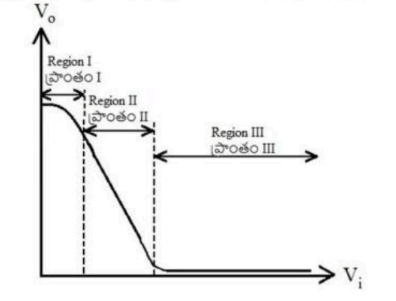
Which of the following logic gates is a universal gate?
The layer of the atmosphere which efficiently reflects high frequency waves particularly at night is
In the atomic spectrum of hydrogen, the wavelengths of the spectral lines corresponding to electronic transitions (i) n = 4 to n = 2 and (ii) n = 3 to n = 1 are \(\lambda_1\) and \(\lambda_2\) \AA{ respectively. The value of \((\lambda_1 - \lambda_2)\) (in cm) is (\(R_H\) = Rydberg constant)
Work functions of four metals M\(_1\), M\(_2\), M\(_3\) and M\(_4\) are 4.8, 4.3, 4.75 and 3.75 eV respectively. The metals which do not show photoelectric effect when light of wavelength 310 nm falls on the metals are
In second period of the modern periodic table, two elements X and Y have higher first ionization enthalpy values than the preceding and succeeding elements. X and Y are respectively
Consider the following pairs of elements and identify the pairs of elements which have nearly same atomic radius.
I. Y, La
II. Zr, Hf
III. Mo, W
IV. Cr, Mo
If the sum of bond orders of O\(_2\) and O\(_2^-\) is x, then bond order of O\(_2^+\) will be
Identify the molecule / ion in which the ratio of \(\sigma\) to \(\pi\) bonds is 3:2
At 298K, a flask 'A' of unknown volume (V) contains oxygen at 5 atm. Another flask 'B' of volume 2L contains helium at 3 atm. Two flasks are connected together by a small tube of zero volume. After the two gases are completely mixed, if the resulting mixture is found to have the mole fraction of oxygen as 0.2, the volume of flask 'A' (in L) is (Assume oxygen and helium as ideal gases)
In which of the following, oxidation state of nitrogen is lowest?
Which of the following processes are reversible?
I. Vaporization of a liquid at its boiling point.
II. Expansion of gas into vacuum.
III. Transformation of a solid substance into liquid at its melting point.
IV. Neutralization of an acid by a base.
At T(K) in a saturated solution of MgCO\(_3\) and Ag\(_2\)CO\(_3\), if the concentration of Mg\(^{2+}\) ion is \(3.2\times10^{-5}\) M, then the concentration of Ag\(^+\) ion in the solution will be [Given: \(K_{sp}(MgCO_3)=1.6\times10^{-6}\) and \(K_{sp}(Ag_2CO_3)=8.0\times10^{-12}\) at T(K)]
Temperature of maximum density of H\(_2\)O is y K and D\(_2\)O is x K. (x - y) (in K) is nearly
How many of the following metals give oxides and nitrides when burnt in air? Be, Na, Mg, Ba, Sr, Li, K
Identify the incorrect order against the property given in brackets
Diborane on hydrolysis gives a compound X. The correct statements about X are
I. It is a tribasic acid
II. It is a weak monobasic acid
III. It has a layer structure
IV. It is highly soluble in water
Choose the correct statements about allotropes of carbon
I. Graphite has layered structure
II. Buckminster fullerene is not aromatic in nature
III. The distance between two adjacent layers in graphite is 141.5 pm
IV. The hybridization of carbons in graphite and Buckminster fullerene is same
Which of the following is a lung irritant that can lead to an acute respiratory disease in children?
Arrange the following in decreasing order of their boiling points
(A) 2-Methylbutane
(B) 2,2-Dimethylpropane
(C) Pentane
(D) Hexane
Which of the following is not an aromatic species?
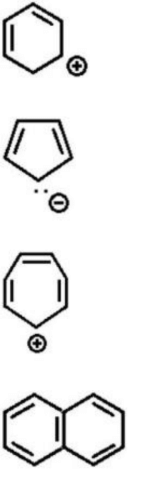
In the estimation of nitrogen by Kjeldahl's method 0.933 g of an organic compound 'X' was analyzed. Ammonia evolved was absorbed in 60 mL of 0.1 M H\(_2\)SO\(_4\). The unreacted acid requires 20 mL of 0.1 M NaOH for complete neutralization. The compound 'X' is
Which of the following is a least stable carbocation?
The incorrect statement about crystals with Schottky defect is
Two liquids 'A' and 'B' form an ideal solution. At 300 K, the vapour pressure of a solution containing 1 mole of 'A' and 3 moles of 'B' is 550 mm Hg. At the same temperature, if one more mole of 'B' is added to the solution, the vapour pressure of solution increases to 560 mm Hg. Then the ratio of vapour pressures of A and B in their pure state is
The molar conductivity of acetic acid solution at infinite dilution is 390 S cm\(^2\) mol\(^{-1}\). What is the molar conductivity of 0.01 M acetic acid solution (in S cm\(^2\) mol\(^{-1}\))? (Given: \(K_a(CH_3COOH)=1.8\times10^{-5}\), assume \(1-\alpha \approx 1\))
The half-life of a zero order reaction A \(\rightarrow\) products, is 0.5 hour. The initial concentration of A is 4 mol L\(^{-1}\). How much time (in hr) does it take for its concentration to come from 2.0 mol L\(^{-1}\) to 1.0 mol L\(^{-1}\)?
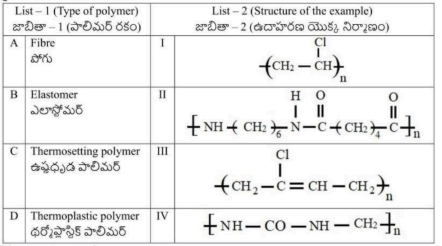
Match the following The correct answer is
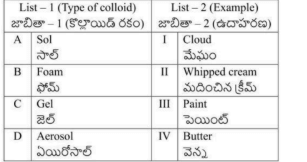
Observe the following statements
Statement - I: The choice of reducing agent for the reduction of an oxide ore can be predicted by using Ellingham diagram, a plot of \(\Delta G^\circ\) Vs T.
Statement - II: According to Ellingham diagram, metal oxide with higher \(\Delta G^\circ\) is more stable than the oxide with lower \(\Delta G^\circ\).
The correct answer is
Which one of the orders is correctly matched with the property mentioned against it?
Noble gas 'X' is used as a diluent for oxygen in modern diving apparatus and noble gas 'Y' is used mainly to provide an inert atmosphere in high temperature metallurgical processes. 'Y' and 'X' are respectively?
The dibasic oxoacid of phosphorus on disproportionation gives two products A and B. A and B are respectively
The number of moles of oxalate ions oxidized by one mole of permanganate ions in acidic medium is
Total number of geometrical isomers possible for the complexes [NiCl\(_4\)]\(^{2-}\), [CoCl\(_2\)(NH\(_3\))\(_4\)]\(^+\), [Co(NH\(_3\))\(_3\)(NO\(_2\))\(_3\)] and [Co(NH\(_3\))\(_5\)Cl]\(^{2+}\) is
Match the following The correct answer is
Maltose on hydrolysis gives two monosaccharide units. The incorrect statement about the monosaccharides formed is
Identify the pair of drugs which act as antihistamines.
Identify the product 'Y' in the given sequence of reactions. (Chlorobenzene reacts with Conc. HNO\(_3\) and Conc. H\(_2\)SO\(_4\) to give X (Major). X then reacts with (i) NaOH, 443 K and (ii) H\(^+\) to give Y.)

What is 'Z' in the given set of reactions?
C\(_6\)H\(_5\)OCH\(_3\) \(\xrightarrow{HI}\) X + Y
Y \(\xrightarrow[Anhy. AlCl_3]{C_6H_6}\) Z
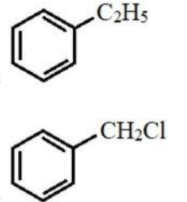
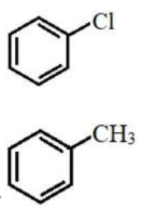
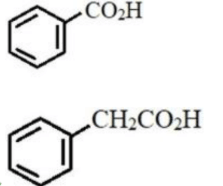
Which of the following reactions is an example of Clemmensen reduction?
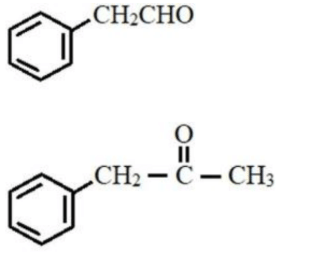
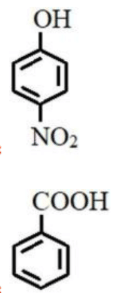
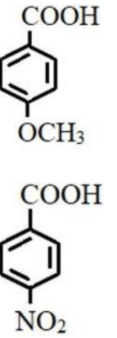
The correct statements about the products B and C in the given reactions are
(Ethanol reacts with HCl/Anhy ZnCl\(_2\) to give A. A reacts with ethanolic AgCN to give B (Minor) and C (Major)).
I. B and C are functional isomers
II. With H\(_2\)|Catalyst B gives 1\(^\circ\) amine and C gives 2\(^\circ\) amine
III. B on acid hydrolysis gives formic acid and C gives C\(_3\)H\(_6\)O\(_2\)
IV. C forms isocyanate with HgO
TS EAMCET 2025 Important Topics
Since more than 75% of the TS EAMCET 2025 questions are usually from selective high-weightage topics, smart preparation involves major chapters of the syllabus.
Subject-Wise Important Topics for TS EAMCET 2025
| Subject | Important Topics |
|---|---|
| Mathematics |
|
| Physics |
|
| Chemistry |
|
Colleges Accepting TS EAMCET 2025 Marks
The TS EAMCET 2025 marks are accepted by more than 200 Telangana engineering colleges, namely, renowned state universities, autonomous colleges, and private engineering colleges.
| College Name | Type | Approx. Closing Rank (CSE) |
| University College of Engineering, OU (UCE OU) | Government | 500 – 1,200 |
| JNTUH College of Engineering, Hyderabad | 400 – 1,000 | |
| Chaitanya Bharathi Institute of Technology (CBIT) | Private (Autonomous) | 1,200 – 3,500 |
| Vasavi College of Engineering | 1,000 – 3,000 | |
| VNR Vignana Jyothi Institute of Engineering & Technology | Private | 1,500 – 4,000 |
| Gokaraju Rangaraju Institute of Engineering & Technology | 1,500 – 4,500 | |
| CVR College of Engineering | 2,000 – 5,000 | |
| MVSR Engineering College | 3,000 – 6,000 | |
| Malla Reddy College of Engineering & Technology | 5,000 – 9,000 | |
| Kakatiya Institute of Technology & Science (KITSW) | 6,000 – 10,000 |



Comments