


NCERT Solutions for Class 12 Physics (2026-27 syllabus) cover every back-exercise question across all 14 chapters of the rationalised NCERT textbook, mapped to the 2026 CBSE boards plus the latest JEE Main and NEET patterns. Every chapter ships as a free downloadable PDF, and the index below lets you jump straight to any chapter's worked-out solutions.
- Chapters covered: 14 chapters across 8 CBSE units, Electrostatics, Current Electricity, Magnetism, EMI & AC, EM Waves, Optics, Modern Physics, Semiconductor Electronics
- Format: chapter-wise downloadable PDFs, plus combined all-chapters compilation, all free
- Exam alignment: CBSE Class 12 Boards (70 theory marks) · JEE Main · JEE Advanced · NEET
Every chapter in this Collegedunia NCERT Solutions for Class 12 Physics compilation is curated by subject experts, mapped to the 2026-27 NCERT, and refined against the last five years of CBSE Board, JEE Main, and NEET papers.
Class 12 Physics NCERT Solutions: All Chapters
Every chapter of the 2026-27 Class 12 Physics syllabus, with the chapter-specific NCERT solutions PDF linked on each row. The list runs in NCERT order, Chapter 1 Electric Charges and Fields through Chapter 14 Semiconductor Electronics, so it mirrors the order you'd attempt the textbook in.
How will Collegedunia's NCERT Solutions for Class 12 Physics Help You?
The page is built for a Class 12 student who wants exam-ready working, every back-exercise question solved end-to-end, with the kind of step-by-step layout an examiner expects to see on a 5-mark or 3-mark question.
- 2026-27 NCERT alignment: every back-exercise question matches the rationalised Class 12 Physics syllabus, with deleted-content callouts flagged inline so you do not waste time on questions that were dropped from the 2025-26 edition.
- Two-tab Solution format per question: a short Solution showing the minimum steps needed for board marks, plus an expanded Expert's Solution that adds the JEE / NEET-style reasoning a topper would write.
- Hand-drawn diagrams and complete derivations: every figure relabelled for clarity, every numerical worked from given data → formula → substitution → answer with units.
- Cross-resource navigation: jump from any solution into the same chapter's Notes, Formula Sheet, Handwritten Notes, or Exemplar Solutions in one click, useful when a back-exercise question reveals a concept gap.
- Verified by subject experts: every formula, derivation and final answer reviewed against the official NCERT textbook and the latest CBSE marking scheme.
- Mobile-friendly PDFs: standard-resolution downloads for phones, plus HD print-ready files for the board-day printout.
NCERT Solutions for Class 12 Physics
Source: Magnet Brains on YouTube
Class 12 Physics Topic Map (2026-27 NCERT)
How the 14 Class 12 Physics chapters group into 8 CBSE units, pick by the unit your weekly test or board section covers. The Topic Map below mirrors the official 2026-27 CBSE curriculum document for Physics (Code 042).
| Unit | Chapters | What this unit covers |
|---|---|---|
| I. Electrostatics | Ch 1 Electric Charges and Fields · Ch 2 Electrostatic Potential and Capacitance | Coulomb's law, electric field, dipole, Gauss's law and its applications, electric potential, equipotential surfaces, capacitors and dielectrics. |
| II. Current Electricity | Ch 3 Current Electricity | Drift velocity, Ohm's law, resistivity and temperature, Kirchhoff's rules, Wheatstone bridge, meter bridge, potentiometer. |
| III. Magnetic Effects of Current and Magnetism | Ch 4 Moving Charges and Magnetism · Ch 5 Magnetism and Matter | Biot-Savart law, Ampere's circuital law, force on a current-carrying conductor, moving-coil galvanometer, bar magnet and earth's magnetism, magnetic materials. |
| IV. Electromagnetic Induction and Alternating Currents | Ch 6 Electromagnetic Induction · Ch 7 Alternating Current | Faraday's laws, Lenz's law, self and mutual inductance, AC generator, LCR series circuit, resonance, power in AC, transformer. |
| V. Electromagnetic Waves | Ch 8 Electromagnetic Waves | Displacement current (qualitative), Maxwell's equations idea, EM wave properties, the EM spectrum from radio to gamma. |
| VI. Optics | Ch 9 Ray Optics and Optical Instruments · Ch 10 Wave Optics | Reflection at spherical surfaces, refraction through prisms, lenses, optical instruments (microscope, telescope); Huygens' principle, Young's double slit, single-slit diffraction, polarisation. |
| VII. Dual Nature of Radiation and Matter | Ch 11 Dual Nature of Radiation and Matter | Photoelectric effect, Einstein's photon equation, de Broglie matter waves, Davisson-Germer experiment idea. |
| VIII. Atoms and Nuclei | Ch 12 Atoms · Ch 13 Nuclei | Rutherford and Bohr models of the atom, hydrogen spectral series, nuclear binding energy, radioactivity (alpha / beta / gamma), nuclear fission and fusion. |
| IX. Electronic Devices | Ch 14 Semiconductor Electronics | Energy bands, intrinsic and extrinsic semiconductors, p-n junction diode, half-wave and full-wave rectifier. |
NCERT Class 12 Physics Deleted Syllabus 2026-27
The NCERT 2026-27 syllabus for Class 12 Physics has been rationalised by the examination authority to reduce content load for CBSE Boards, JEE and NEET. The seven topic drops below are officially out of the 2026-27 question paper, so skip these while revising the back-exercise.
| Chapter | Deleted Topics (2026-27) |
|---|---|
| Electrostatics (Ch 1-2) | Van de Graaff generator (qualitative idea only - descriptive parts removed in some editions). |
| Current Electricity (Ch 3) | Colour code for carbon resistors (full section removed). |
| Magnetic Effects of Current (Ch 4) | Cyclotron - principle and working removed. |
| Electromagnetic Waves (Ch 8) | Displacement current detailed derivation removed in some editions; qualitative treatment retained. |
| Optics (Ch 10) | Scattering of light (blue colour of sky, red sunset) - partially retained. |
| Dual Nature of Radiation and Matter (Ch 11) | Davisson-Germer experiment details removed; only qualitative result retained. |
| Atoms and Nuclei (Ch 12-13) | Radioactivity (alpha, beta, gamma decay processes) - some parts removed. |
The chapter-wise NCERT Solutions linked in the All Chapters index above already flag every deleted line inline so you don't waste revision hours on dropped topics. If a back-exercise question hinges on a deleted derivation, the solution PDF carries a "Deleted from 2026-27 NCERT" callout at the top of that question.
Class 12 Physics Chapter-wise Important Questions (Derivations + Numericals)
The five chapter clusters below carry the bulk of the CBSE 2026 Class 12 Physics paper and repeat almost every year. The Derivations column lists the 3-mark and 5-mark derivations that recur in the long-answer section; the Numericals column lists the application-level questions that appear as 2-mark numericals or as numerical-value questions in JEE Main.
| Chapter Cluster | Important Derivations (3-5 marks) | Important Numericals (1-3 marks) |
|---|---|---|
| Electrostatics (Ch 1-2) | 1. Electric field due to a dipole. 2. Torque on a dipole in a uniform field. 3. Capacitance of a parallel plate capacitor with a dielectric. | Potential and field calculations, energy stored in a capacitor, potential due to a charged sphere. |
| Current Electricity (Ch 3) | 1. Wheatstone bridge balance condition. 2. Potentiometer comparison of EMFs. 3. Kirchhoff's laws applications (loop rule). | Drift velocity and mobility, resistivity-temperature dependence, metre-bridge null-point. |
| Magnetism and EMI (Ch 4-7) | 1. Force on a current-carrying conductor in a magnetic field. 2. Faraday's law and induced EMF. 3. AC generator working principle. | Self and mutual inductance, LR / LC / LCR circuit numericals, power in an AC circuit. |
| Optics (Ch 9-10) | 1. Lens maker's formula. 2. Refraction at a single spherical surface. 3. Young's double slit fringe-width derivation. | Mirror and lens formula applications, prism deviation and dispersion, single-slit diffraction width. |
| Modern Physics (Ch 11-13) | 1. Photoelectric effect equation. 2. Bohr's radius and orbital velocity expression. 3. Radioactivity decay law. | Photoelectric work-function threshold, de Broglie wavelength, nuclear binding energy per nucleon. |
The same five clusters appear in JEE Main 2026 with a near-identical question split - the derivations show up as multi-step numerical-value problems, the numericals as single-step MCQs. The Expert's Solution tab on each chapter page works the JEE / NEET-style alternative path alongside the CBSE board-style minimum-steps version.
NCERT SOLUTIONS · CLASS 12 PHYSICS
Class 12 Physics - Exam Weightage Across CBSE, JEE and NEET
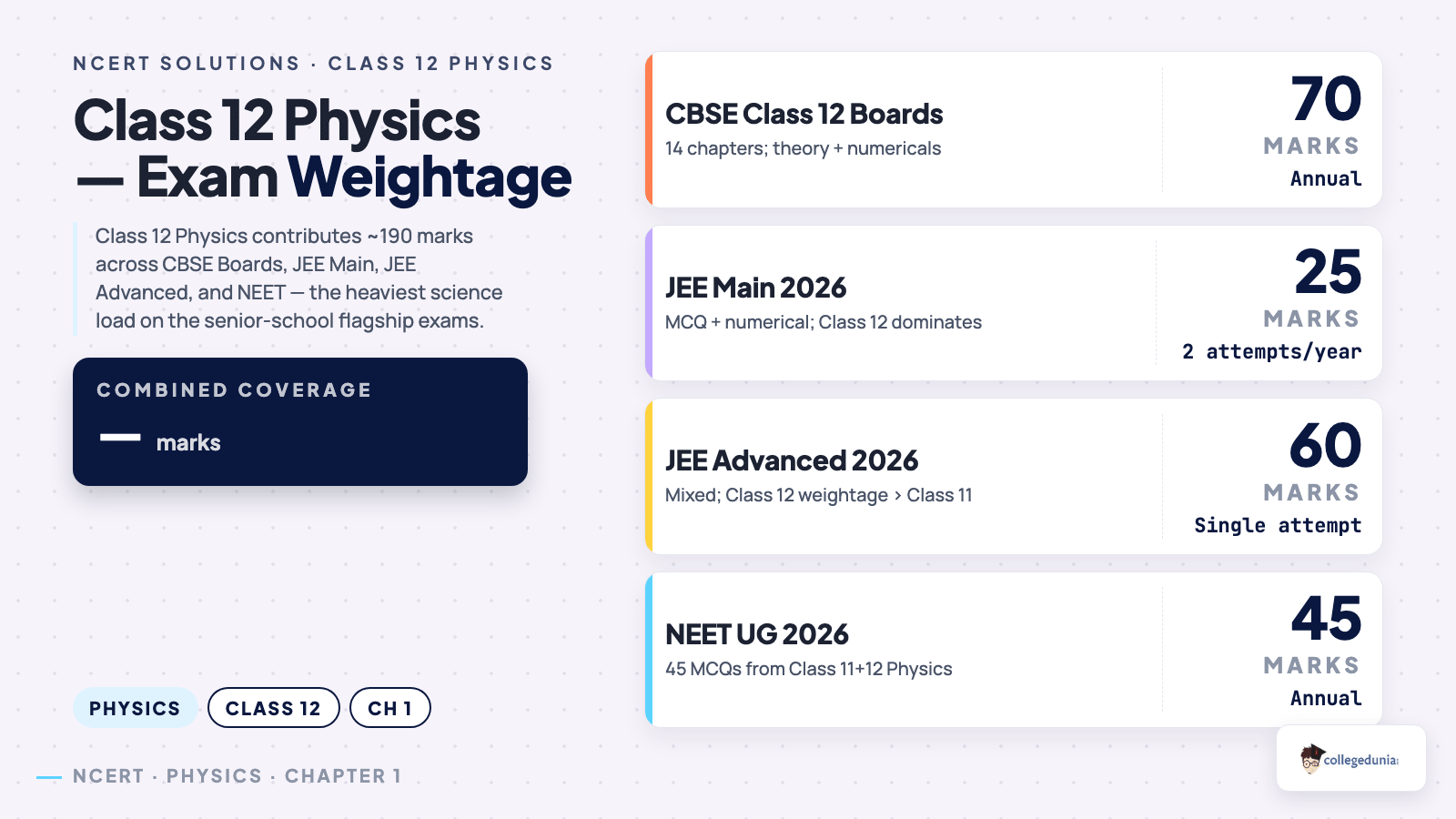
Class 12 Physics contributes roughly 200 marks combined across CBSE Boards, JEE Main, JEE Advanced and NEET UG, the heaviest science load on the senior-school flagship exams.
Class 12 Physics Weightage Snapshot (CBSE 2026 Theory Paper)
The 70-mark CBSE Class 12 Physics theory paper splits unevenly across the 14 chapters. Optics leads the table at 14 marks combined, followed by Magnetism at 11 marks and Electrostatics at 10 marks. The snapshot below uses the official CBSE 2026 blueprint plus the latest sample-paper pattern; the highest-weightage row carries the Collegedunia orange tint.
| Chapter | Topic | CBSE Marks (2026) | JEE Main 2025 Qs |
|---|---|---|---|
| Ch 9 | Ray Optics and Optical Instruments | 10 marks | 2-3 |
| Ch 14 | Semiconductor Electronics | 7 marks | 1-2 |
| Ch 3 | Current Electricity | 6 marks | 2 |
| Ch 4 | Moving Charges and Magnetism | 6 marks | 2 |
| Ch 1 | Electric Charges and Fields | 5 marks | 2 |
| Ch 2 | Electrostatic Potential and Capacitance | 5 marks | 2 |
| Ch 5 | Magnetism and Matter | 5 marks | 1 |
| Ch 6 | Electromagnetic Induction | 4 marks | 1-2 |
| Ch 8 | Electromagnetic Waves | 4 marks | 1 |
| Ch 10 | Wave Optics | 4 marks | 1-2 |
| Ch 11 | Dual Nature of Radiation and Matter | 4 marks | 1 |
| Ch 12 | Atoms | 4 marks | 1 |
| Ch 13 | Nuclei | 4 marks | 1 |
| Ch 7 | Alternating Current | 2 marks | 1-2 |
The table reads like a study-time allocator, Chapter 9 Ray Optics alone delivers ~14% of the theory paper, and pairing it with Chapter 14 Semiconductor Electronics covers nearly a quarter of the entire paper. Plan your week-by-week revision so the high-weightage chapters get a second pass.
Where to Start in the Class 12 Physics NCERT Solutions Index
NCERT order is the safest reading sequence, but students with a tight revision window can re-prioritise by weightage. Use the table below to plan the first three chapters you attempt:
| If you have… | Start with | Then move to | Why |
|---|---|---|---|
| 4+ weeks | Chapter 1 Electric Charges and Fields | NCERT order through Chapter 14 | Builds the field/potential foundation before Chapters 2, 3 and 6 reuse it. |
| 2-3 weeks | Chapter 9 Ray Optics (10 marks) | Chapter 14 Semiconductor Electronics (7 marks), then Chapters 3 & 4 (6 marks each) | Front-loads the four highest-weightage chapters, together 29 of 70 board marks. |
| < 2 weeks | Chapter 9 Ray Optics | Chapter 1 + Chapter 2 Electrostatics cluster | Optics is the single largest score block; Electrostatics is the most cross-referenced unit on the JEE / NEET overlap. |
| One night before | Skim the Notes alongside the Solutions for Chapters 9, 14, 6 | Re-read your marked Solutions only | Re-doing fresh back-exercise the night before is low-ROI; revisit only the questions you previously got wrong. |
Six chapters carry roughly half of the 70-mark theory paper. If you only have time to revise a subset, work this list top-to-bottom:
- Chapter 9, Ray Optics and Optical Instruments (10 marks): the highest single-chapter weightage; sign-convention questions are easy to lose marks on.
- Chapter 14, Semiconductor Electronics (7 marks): consistent JEE Main appearance alongside the board weightage.
- Chapter 3, Current Electricity (6 marks): the Wheatstone-bridge and potentiometer numericals repeat year on year.
- Chapter 4, Moving Charges and Magnetism (6 marks): Biot-Savart and Ampere's-law applications are the routine 5-mark slot.
- Chapter 2, Electrostatic Potential and Capacitance (5 marks): capacitor combinations and dielectric problems recur every cycle.
- Chapter 6, Electromagnetic Induction (4 marks): the long-answer derivation slot on most papers.
Together these six chapters deliver 38 of 70 board marks, a clean revision of just these still guarantees a comfortable theory-paper score.
Class 12 Physics NCERT Solutions: PDF Formats and Languages
Every chapter in the Class 12 Physics NCERT Solutions index ships in three flavours plus a Hindi-medium counterpart where the chapter is also in the Hindi-medium NCERT. The format choice matters, phone reading vs printout vs flipbook all change which file you download.
- HD print-ready PDF, high-resolution figures, recommended for the board-day printout and for printing the chapter as a revision booklet.
- Standard download PDF, smaller file size, optimised for mobile reading and quick reference.
- Hindi-medium PDF, chapter-wise translations that use NCERT's own Hindi vocabulary, including official term equivalents for technical concepts like आवेश (charge), विभव (potential), and चुंबकीय क्षेत्र (magnetic field).
- Combined all-chapters PDF, one file with every chapter back-to-back, useful for offline classroom use or for loading onto a Kindle.
- Handwritten counterpart, every chapter also has a notebook-style version (the Class 12 Physics Handwritten Notes listing) for students who prefer the board-feel revision style.
How Class 12 Physics NCERT Solutions Pair with the Other Resources
The NCERT Solutions for Class 12 Physics handle the back-exercise. They are not a substitute for concept revision, formula recall, or harder problem sets, those live in sibling resources that share the same chapter slugs. Use this map to decide which resource to open alongside the Solutions:
- Class 12 Physics Notes, for the concept revision before you attempt a question. Pair Notes with the Solutions whenever a back-exercise question is built on a derivation you have not seen in a while.
- Class 12 Physics Formula Sheet, every formula in one place for last-day recall. Most students keep the Formula Sheet open while solving NCERT back-exercise numericals so that unit conversions and constants are one glance away.
- Class 12 Physics Exemplar Solutions, worked-out solutions for the harder MCQ / VSA / SA / LA problems beyond the NCERT back-exercise. Switch to Exemplar once you can solve the NCERT back-exercise in under 5 minutes per question.
- Class 12 Physics Handwritten Notes, notebook-style scanned-look notes, useful in the final week before the board paper when the eye benefits from a board-feel revision rather than a typeset one.
- Class 12 Physics NCERT Book PDF, the official textbook itself, chapter-wise downloadable. Open the book whenever a Solution references a worked example or a figure from the chapter.
- Class 12 Physics Exemplar Book PDF, the NCERT Exemplar problem book for additional practice; the source publication for the Exemplar Solutions linked above.
The chapter-wise pages for each of these sibling resources are linked from their respective subject listings as they roll out across the 2026-27 cycle.
How to Use the Class 12 Physics NCERT Solutions Page Most Effectively
The three-block study plan below is the routine most CBSE toppers settle into. It assumes you have already completed the Class 12 syllabus once and you are now in revision mode. Adapt the timings if your boards are further away than 30 days.
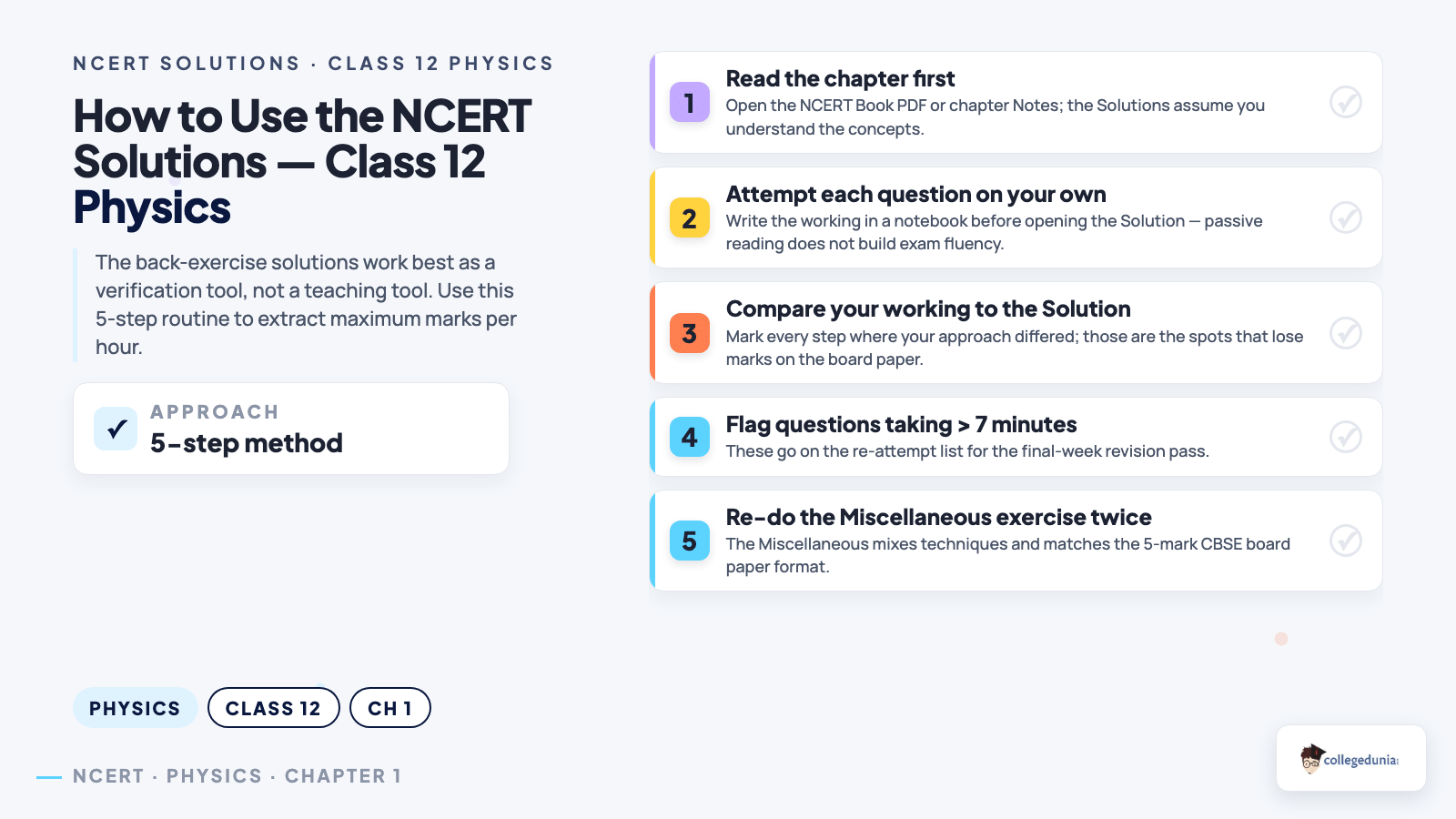
5-STEP METHOD · CBSE TOPPER ROUTINE
How to Use the NCERT Solutions - Class 12 Physics
- 1Read the chapter first. Open the NCERT Book PDF or chapter Notes - the Solutions assume you understand the concepts already.
- 2Attempt each question on your own. Write the working in a notebook before opening the Solution - passive reading does not build exam fluency.
- 3Compare your working to the Solution. Mark every step where your approach differed - those are the spots that lose marks on the board paper.
- 4Flag questions taking over 7 minutes. These go on the re-attempt list for the final-week revision pass.
- 5Re-do the Miscellaneous exercise twice. The Miscellaneous mixes techniques and matches the 5-mark CBSE board-paper format closely.
- 1 month before the boards: Work the chapter-wise back-exercise in NCERT order, opening the Class 12 Physics Notes alongside whenever a concept slips. Spend more time on Chapter 9 Ray Optics and Chapter 14 Semiconductor Electronics because they together carry 17 marks of the 70-mark theory paper.
- 2 weeks before the boards: Switch to the Expert's Solution tab on every question, that is where the JEE / NEET-style longer working sits. Mark every question you could not crack in under 5 minutes; those are the ones you re-attempt in the final week.
- 1 week before the boards: Re-attempt only the marked questions, then close the loop with the Class 12 Physics Formula Sheet for last-day formula recall. Skim the Handwritten Notes the night before for the board-feel revision.
Common Mistakes Class 12 Physics Students Make Across Chapters
- Sign errors on potential and EMF questions: students drop the sign when moving a positive test charge against the field direction. Always sketch the field direction first, then apply the work-done formula.
- Vector vs scalar confusion: electric field is a vector; electric potential is a scalar. Adding potentials as if they were vectors is the most-marked-down board-paper error in Chapter 2.
- Dropping units in numericals: CBSE deducts 1 mark per missing unit on the final answer line. Always carry units through every substitution step, not just on the answer.
- Refractive-index sign convention: in Chapter 9 Ray Optics, students apply the Cartesian sign convention inconsistently across mirrors, lenses and refracting surfaces. Decide which side is positive at the start of every question.
- Confusing peak, rms and average current in AC: Chapter 7 questions routinely ask for one form when students compute another. Memorise the I₀ / √2 and 2I₀ / π conversions.
- Forgetting the photoelectric work function: Chapter 11 students often write Kₐₐₓ = hν instead of Kₐₐₓ = hν − φ₀. The work-function subtraction is the single most-tested step.
- Dropping the λ/4 path-difference in interference: the Class 12 Physics Wave Optics NCERT Solutions for Young's double-slit problems lose marks when students substitute the wavelength as the full path difference for the first dark fringe. Always carry the half-integer multiple of λ/2 explicitly through the substitution.
Student Pulse: What 12,840 Class 12 Physics Students Told Us
What 12,840 students told us about their Class 12 Physics board prep
- 67% of students rated Electromagnetic Induction (Chapter 6) as the hardest concept-cluster overall, ahead of Ray Optics at 54% and Alternating Current at 49%.
- Most-skipped chapter: Chapter 14 Semiconductor Electronics, skipped by ~31% of students in the 2026 board paper attempt despite carrying 7 marks. Toppers flagged this as the highest-ROI chapter to reclaim.
- Toppers reported that working the Expert's Solution tab on every Chapter 6 derivation added 3-4 marks on the 70-mark Physics paper, mostly on the long-answer derivation question.
- The average student took 42 hours across the full 14 chapters to finish the NCERT back-exercise once, with Chapter 9 Ray Optics and Chapter 2 Electrostatic Potential and Capacitance eating the most time per question.
Also Check: Related Class 12 Physics Resources
- Also Check: CBSE Class 12 Physics - chapter notes, formulas, derivations
- Also Check: CBSE Class 12 - exam pattern, dates, full-subject hub
- Also Check: CBSE Class 12 Syllabus 2026-27
- Also Check: JEE Main 2026 - exam pattern, dates, cutoffs
- Also Check: JEE Main 2026 Syllabus
- Also Check: JEE Advanced 2026 - IIT entrance information
- Also Check: NEET 2026 - medical entrance information
- Also Check: NEET 2026 Syllabus
Class 12 Physics NCERT Solutions FAQs
Ques. Where can I download the Class 12 Physics NCERT Solutions PDF for all chapters?
Ans. Every chapter-wise PDF for Class 12 Physics NCERT Solutions is downloadable directly from the index above. The NCERT solution for class 12 physics chapter 1 (Electric Charges and Fields) through the NCERT solutions for class 12 physics chapter 14 (Semiconductor Electronics) are all linked individually, and a combined all-chapters PDF is also available, free in both Normal and HD resolutions.
Ques. Are these NCERT solutions for class 12 physics aligned with the 2026-27 NCERT?
Ans. Yes, every chapter on this page reflects the current 2026-27 syllabus. Where NCERT rationalised content out of the older edition (deleted derivations, removed end-of-chapter questions), the affected solutions carry an inline callout flagging the change so you do not over-revise dropped material.
Ques. How many chapters are there in Class 12 Physics per the 2026-27 NCERT?
Ans. Class 12 Physics has 14 chapters across 8 CBSE units: Electrostatics (Ch 1-2), Current Electricity (Ch 3), Magnetism (Ch 4-5), Electromagnetic Induction & Alternating Current (Ch 6-7), Electromagnetic Waves (Ch 8), Optics (Ch 9-10), Modern Physics (Ch 11-13), and Electronic Devices (Ch 14). The Topic Map table above lists every chapter under its unit; students looking up physics chapter 1 class 12 ncert solutions or chapter 2 physics class 12 ncert solutions will find the same chapter-specific PDFs linked in the All Chapters index regardless of the word-order they typed into Google.
Ques. Which class 12 physics chapter has the highest CBSE board weightage?
Ans. Chapter 9 Ray Optics and Optical Instruments carries the highest CBSE Class 12 Physics weightage at 10 marks per paper, followed by Chapter 14 Semiconductor Electronics at 7 marks and Chapters 3, 4 at 6 marks each. The Weightage Snapshot table above tracks every chapter's mark share.
Ques. How are the NCERT Solutions for Class 12 Physics different from the Notes and Formula Sheet?
Ans. The NCERT solutions class 12 physics page works every back-exercise question end-to-end; the Class 12 Physics Notes condense each chapter's concepts for revision; the Class 12 Physics Formula Sheet strips out everything except equations for last-day recall. Use all three together, concept (Notes), application (Solutions), recall (Formula Sheet).
Ques. Are these class 12 physics ncert solutions useful for JEE Main and NEET?
Ans. Yes. The Expert's Solution tab on every question shows the longer, JEE / NEET-style working, sign conventions made explicit, dimensional checks shown, alternative approaches sketched. Class 12 Physics is the foundation chapter set for both JEE Main (Physics section, ~30 marks) and NEET (Physics section, 45 questions). The chapter-wise links above each lead into Solutions pages that flag the cross-exam relevance per question.
Ques. Are Class 12 Physics NCERT Solutions available in Hindi medium?
Ans. Yes, every chapter ships with a Hindi-medium download alongside the English version. The Hindi solutions follow NCERT's own terminology so that students preparing in Hindi medium for the CBSE boards or for the Hindi-medium JEE / NEET paper find the same vocabulary they have studied in.
Ques. Should I read the chapter first or jump straight to the NCERT Solutions?
Ans. Read the chapter first. The NCERT Solutions are written assuming you understand the concepts, they show you the application, not the derivation. If the chapter is fresh, open the Notes for revision before attempting the back-exercise, then use the Solutions to verify your working. For example, the ncert solution for class 12 physics chapter 1 assumes you already know the field-vs-potential distinction; the ncert solutions for class 12 physics chapter 3 assumes you know Ohm's law and basic circuit topology.
Ques. How many pages is the full Class 12 Physics NCERT Solutions PDF?
Ans. The combined ncert physics class 12 solutions pdf runs approximately 280-320 pages depending on the figure density of each chapter. Chapter-wise PDFs range from 12 pages (Chapter 7 Alternating Current, 2 marks weightage) up to 38 pages (Chapter 9 Ray Optics, 10 marks weightage). The class 12 physics ncert solutions chapter 1 file is around 24 pages, while the dense electrostatics + electromagnetism cluster (Chapters 1, 2, 4, 6) totals roughly 110 pages.
Ques. What does Class 12 Physics cover?
Ans. Class 12 Physics covers the second half of senior-school physics, electrostatics, current electricity, magnetism, electromagnetic induction and alternating current, electromagnetic waves, ray and wave optics, modern physics (photoelectric effect, atoms, nuclei), and semiconductor electronics. The 14-chapter course is the recommended foundation for JEE Main, JEE Advanced and NEET physics, and forms the bulk of the 70-mark CBSE Class 12 Physics theory paper.
Ques. Which is the most-scoring chapter in Class 12 Physics?
Ans. Chapter 9 Ray Optics and Optical Instruments and Chapter 14 Semiconductor Electronics are the two most-scoring chapters, they together carry 17 marks of the 70-mark theory paper. The chapter-1-to-2 Electrostatics cluster is also high-ROI because the concepts repeat in Chapters 3 (Current Electricity) and 6 (Electromagnetic Induction).
Ques. How should I structure my Class 12 Physics preparation?
Ans. Build chapter by chapter, Notes for concepts, NCERT Solutions for back-exercise, Exemplar Solutions for harder problems, Formula Sheet for the last week, Handwritten Notes for the night before. The Study Plan section above sketches a 1-month / 2-week / 1-week countdown that most CBSE Class 12 Physics toppers settle into.



Comments