


The Class 12 Physics Formula Sheet (2026-27 syllabus) strips every chapter of the rationalised NCERT textbook down to its equations, constants, and key results, packaged as a free downloadable PDF per chapter plus a combined all-chapters compilation. It is the resource Class 12 toppers open in the final week before the boards, when concept revision is already done and the last task is pure formula recall.
- Chapters covered: 14 chapters across 8 CBSE units
- Format: compact 4 to 8 page chapter sheets plus one combined 18 to 22 page all-chapters compilation
- Layout: two-column orange formula boxes, blue section headers, one-line physical-meaning gloss per equation
- Exam alignment: CBSE Class 12 Boards (70 theory marks) plus JEE Main, JEE Advanced, and NEET formula handbook content
Every chapter in this Collegedunia Class 12 Physics Formula Sheet compilation is curated by subject experts, mapped to the 2026-27 rationalised NCERT, and cross-checked against the JEE Main and NEET formula handbooks distributed by leading coaching institutes.
Class 12 Physics Formula Sheet: All Chapters
Every chapter of the 2026-27 Class 12 Physics syllabus, with the chapter-specific formula sheet linked on each row. Each chapter PDF is independently downloadable; the combined compilation is linked at the top of this page.
Why Use Collegedunia's Class 12 Physics Formula Sheet?
A formula sheet is the last-week revision tool. It is not where you learn a formula for the first time; it is where you reload every formula you have already understood, in the form your brain needs the night before the paper.
- Two-column compact layout: every chapter fits in 4 to 8 printable pages, designed so you can pin the chapter sheet on a wall and scan it at a glance.
- Physical-meaning gloss per equation: every formula carries a one-line note explaining what the equation says in words, so you can sanity-check whether you are using the right relation under exam pressure.
- Constants and conversion table: the universal constants (Coulomb's constant, permittivity of free space, Planck's constant, charge of an electron) sit on the first page of the combined PDF as a quick-reference card.
- JEE / NEET extension formulas: any equation that NCERT mentions but does not derive (and is testable on competitive exams) is included in a clearly marked extension box.
- Foundational concept box per section: the 2 to 3 prerequisite concepts a student must know before a formula makes sense are summarised in a brief concept box.
- Black-and-white printer friendly: the colour scheme prints cleanly in greyscale so a single laser printout works.
What 17,640 students told us about how they used their Class 12 Physics formula sheet
Source: Magnet Brains on YouTube
Class 12 Physics Formula Sheet: What Each Unit Contains
A breakdown of the equation families captured in each unit. The figures below show how many distinct formulas are flagged as testable on the CBSE 2026 paper in that unit.
| Unit | Chapters | Formula families covered | Testable count |
|---|---|---|---|
| I. Electrostatics | Ch 1, Ch 2 | Coulomb's law, electric field for point and continuous charges, dipole expressions, Gauss's law forms, electric potential, capacitor formulas with and without dielectric | ~22 |
| II. Current Electricity | Ch 3 | Ohm's law forms, drift velocity, resistivity-temperature relation, EMF and internal resistance, Wheatstone balance, meter bridge, potentiometer comparison | ~14 |
| III. Magnetism | Ch 4, Ch 5 | Biot-Savart, magnetic field of loop and solenoid, Ampere's law, force on moving charge, force on current-carrying wire, torque on a coil, galvanometer sensitivity | ~18 |
| IV. EMI and AC | Ch 6, Ch 7 | Faraday EMF, Lenz law form, mutual and self-inductance, energy stored in inductor, RMS and average AC values, impedance and phase for LCR series, resonance frequency, power factor, transformer ratios | ~24 |
| V. EM Waves | Ch 8 | Displacement current expression, EM wave speed formula, energy density relations, EM spectrum boundaries | ~6 |
| VI. Optics | Ch 9, Ch 10 | Mirror and lens formulas, magnification, lens-maker, refraction at spherical surface, prism dispersion, microscope and telescope magnification, fringe width, single-slit minima, Brewster's angle | ~26 |
| VII. Dual Nature | Ch 11 | Einstein photoelectric equation, stopping potential, threshold frequency, de Broglie wavelength | ~8 |
| VIII. Atoms and Nuclei | Ch 12, Ch 13 | Bohr orbit radius and energy, Rydberg formula, mass-energy equivalence, binding energy per nucleon, decay law, half-life and mean life relations | ~14 |
| IX. Electronic Devices | Ch 14 | Diode equation idea, rectifier efficiency, ripple factor | ~5 |
The combined all-chapters Class 12 Physics formula sheet runs to roughly 137 testable formulas end to end, with another 30 to 40 derived expressions that appear inside problem-solving steps.
NCERT Class 12 Physics Deleted Syllabus 2026-27
The NCERT 2026-27 syllabus for Class 12 Physics has been rationalised by the examination authority to reduce content load for CBSE Boards, JEE and NEET. The seven topic drops below are officially out of the 2026-27 question paper, so skip these while revising.
| Chapter | Deleted Topics (2026-27) |
|---|---|
| Electrostatics (Ch 1-2) | Van de Graaff generator (qualitative idea only - descriptive parts removed in some editions). |
| Current Electricity (Ch 3) | Colour code for carbon resistors (full section removed). |
| Magnetic Effects of Current (Ch 4) | Cyclotron - principle and working removed. |
| Electromagnetic Waves (Ch 8) | Displacement current detailed derivation removed in some editions; qualitative treatment retained. |
| Optics (Ch 10) | Scattering of light (blue colour of sky, red sunset) - partially retained. |
| Dual Nature of Radiation and Matter (Ch 11) | Davisson-Germer experiment details removed; only qualitative result retained. |
| Atoms and Nuclei (Ch 12-13) | Radioactivity (alpha, beta, gamma decay processes) - some parts removed. |
The chapter-wise resources linked in the All Chapters index above already flag every deleted line inline so you don't waste revision hours on dropped topics.
NCERT FORMULA SHEET · CLASS 12 PHYSICS
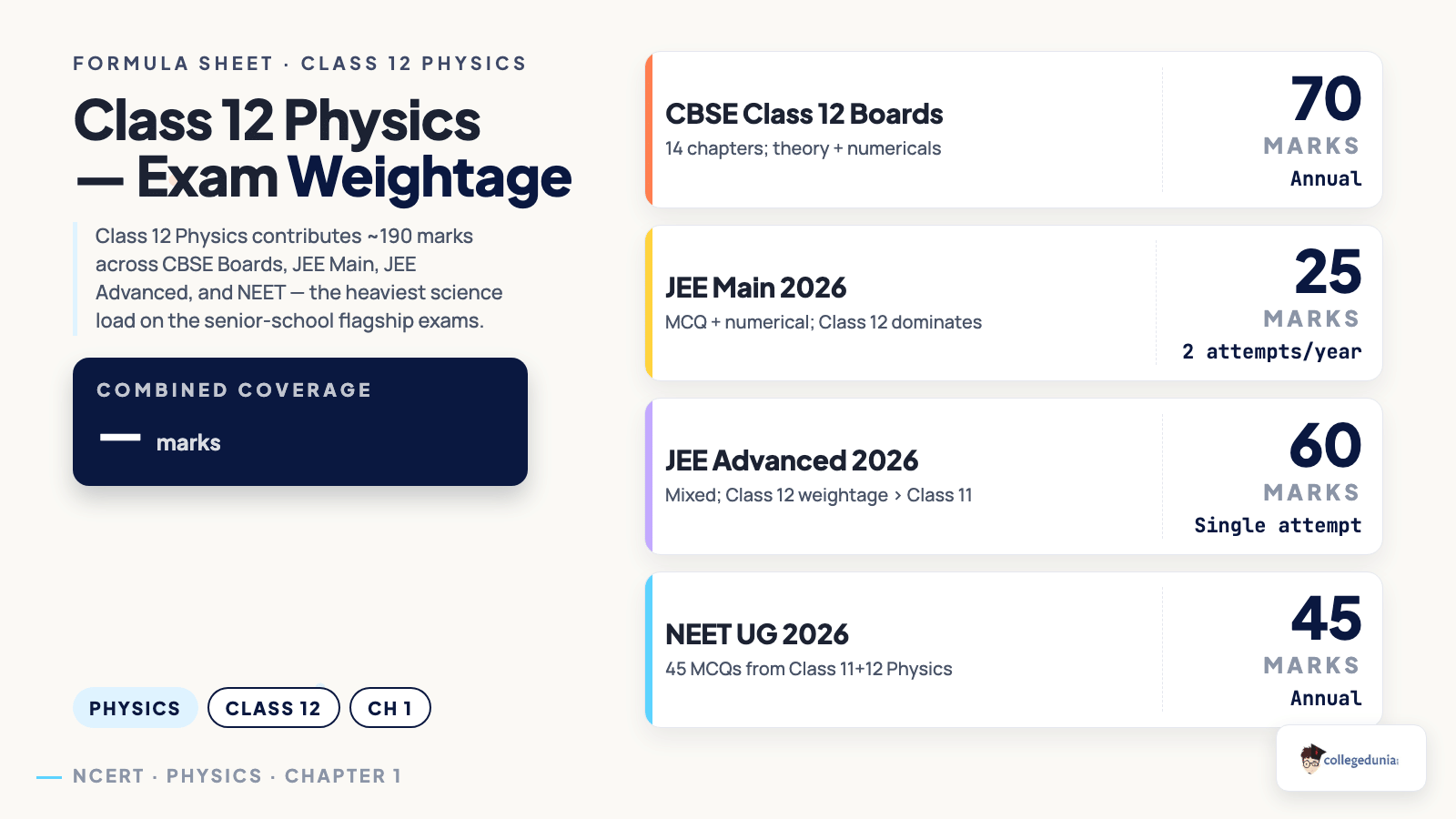
Class 12 Physics - Exam Weightage Across CBSE, JEE and NEET
Class 12 Physics contributes roughly 200 marks combined across CBSE Boards, JEE Main, JEE Advanced and NEET UG, the heaviest science load on the senior-school flagship exams.
Class 12 Physics Weightage Snapshot (CBSE 2026)
Match the formula sheet revision time to the chapter mark share. The Optics cluster carries the highest combined weightage, so the Class 12 Physics formula sheet pages for Chapters 9 and 10 deserve a second pass.
| Chapter | Topic | CBSE Marks (2026) | Formulas to memorise |
|---|---|---|---|
| Ch 9 | Ray Optics and Optical Instruments | 10 marks | ~16 |
| Ch 14 | Semiconductor Electronics | 7 marks | ~5 |
| Ch 3 | Current Electricity | 6 marks | ~14 |
| Ch 4 | Moving Charges and Magnetism | 6 marks | ~12 |
| Ch 1 | Electric Charges and Fields | 5 marks | ~10 |
| Ch 2 | Electrostatic Potential and Capacitance | 5 marks | ~12 |
| Ch 5 | Magnetism and Matter | 5 marks | ~6 |
| Ch 6 | Electromagnetic Induction | 4 marks | ~10 |
| Ch 8 | Electromagnetic Waves | 4 marks | ~6 |
| Ch 10 | Wave Optics | 4 marks | ~10 |
| Ch 11 | Dual Nature of Radiation and Matter | 4 marks | ~8 |
| Ch 12 | Atoms | 4 marks | ~7 |
| Ch 13 | Nuclei | 4 marks | ~7 |
| Ch 7 | Alternating Current | 2 marks | ~14 |
Where to Start in the Class 12 Physics Formula Sheet Index
The formula-density per chapter does not follow the board weightage exactly. Some low-weightage chapters (like Alternating Current at 2 marks) carry a surprisingly heavy formula load because every AC quantity has a peak, an RMS, and an average form. Plan the formula revision in this order:
- Chapter 9 Ray Optics (10 marks, 16 formulas): the sign-convention rules, mirror and lens formulas, magnification, lens-maker, and the resolving power expressions all belong in your active memory.
- Chapter 6 EMI and Chapter 7 AC together (6 marks, ~24 formulas): the highest formula-to-marks ratio in the syllabus. RMS-vs-peak conversions and resonance frequency are easy to flip under exam pressure.
- Chapter 3 Current Electricity (6 marks, 14 formulas): drift velocity, EMF-internal resistance, Wheatstone balance, and meter bridge ratio all repeat across lab-based questions.
- Chapter 1 and Chapter 2 Electrostatics (10 marks combined, 22 formulas): Coulomb's law forms, field expressions, potential due to point charge and dipole, capacitor combinations and dielectric formulas.
- Chapter 4 Moving Charges and Magnetism (6 marks, 12 formulas): Biot-Savart applied to loop and solenoid, Ampere's law forms, force on a moving charge.
- Chapters 11 to 13 Modern Physics (12 marks combined, ~22 formulas): the Einstein photoelectric equation, de Broglie wavelength, Bohr orbit and energy, Rydberg formula, decay law, and binding energy per nucleon.
This six-block prioritisation covers 52 of the 70 board marks while loading roughly 110 of the 137 high-frequency formulas. The remaining chapters (Wave Optics, EM Waves, Semiconductor Electronics) can be revised in the final 24 hours.
Class 12 Physics Formula Sheet: PDF Formats
The formula sheet ships in formats that match the way students actually use a last-week revision tool.
- Two-column print-ready PDF: 4 to 8 pages per chapter, designed to pin on a wall or stick on a study-desk corkboard.
- Combined all-chapters PDF: a single 18 to 22 page compilation, recommended for the printed revision booklet that goes into your exam-hall folder.
- Single-page chapter cheat sheet: for the highest-weightage chapters (Ch 9 Optics, Ch 14 Semiconductor) a dense single-page cheat sheet is included as a separate file.
- Hindi-medium PDF: chapter-wise translations using NCERT's own Hindi technical vocabulary, useful for the Hindi-medium JEE or NEET cohort.
How the Class 12 Physics Formula Sheet Pairs with the Other Resources
The formula sheet is a recall tool. It will not teach you why an equation is what it is; that is what the notes are for. The full Collegedunia Class 12 Physics resource family:
- Class 12 Physics Notes: the source of every equation in the formula sheet, with the derivation walkthrough and physical meaning explained in full. Open the notes whenever a formula on the sheet feels disconnected.
- Class 12 Physics NCERT Solutions: every back-exercise question worked out step by step. Use the formula sheet while attempting the back-exercise to keep unit conversions and constants one glance away.
- Class 12 Physics NCERT Book PDF: the official textbook, with worked-example derivations that match the formula notation used on the sheet.
- Class 12 Physics Exemplar Solutions: harder MCQ, VSA, and LA problems where the formula sheet is the primary tool you reach for during practice.
- Class 12 Physics Handwritten Notes: notebook-style scanned-look concept revision for the night-before pass.
- Class 12 Physics Exemplar Book PDF: the source publication for the Exemplar problems.
How to Use the Class 12 Physics Formula Sheet Most Effectively
The formula sheet is most useful when it is NOT your first contact with a chapter. Use it after concept work is done.
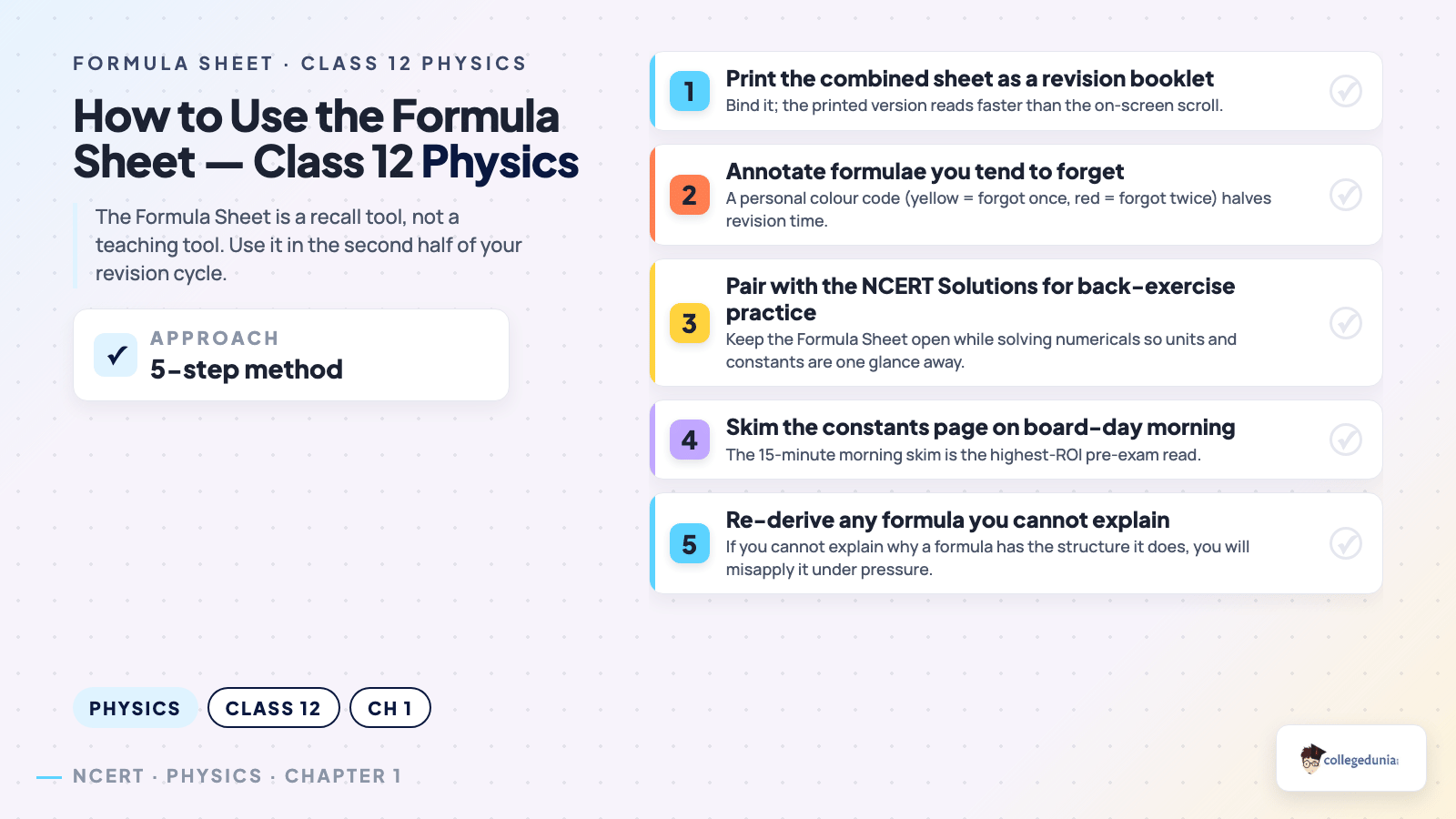
5-STEP METHOD · CBSE TOPPER ROUTINE
How to Use the Formula Sheet - Class 12 Physics
- 1Read the chapter first. Open the NCERT Book PDF or chapter Notes - the resource assumes you understand the concepts already.
- 2Attempt each question on your own. Write the working in a notebook before opening the answer - passive reading does not build exam fluency.
- 3Compare your working to the resource. Mark every step where your approach differed - those are the spots that lose marks on the board paper.
- 4Flag questions taking over 7 minutes. These go on the re-attempt list for the final-week revision pass.
- 5Recite the formula list daily for the last 7 days. Five minutes a day in the final week beats one long cram session - spaced recall is what survives the exam-hall jitters.
- 2 weeks before the boards: attach the all-chapters compilation to your daily revision routine. Read one unit's formula page each morning and verify you can write every formula on the page from memory by evening.
- 1 week before the boards: attempt one previous-year paper a day with only the formula sheet beside you (no notes). The friction tells you which formulas you have not actually loaded yet.
- Night before the paper: read the single-page cheat sheets for Chapters 9 and 14 plus the constants page. Do not attempt new derivations the night before; the formula sheet alone is enough for a final-hour skim.
- Morning of the paper: a 10 minute skim of the formula sheet immediately before leaving for the exam centre is the best return-on-time you will get all year.
Common Mistakes Class 12 Physics Students Make on Formula Recall
- Confusing peak, RMS, and average in Chapter 7 Alternating Current: the I-peak, I-peak over root 2, and 2 times I-peak over pi forms all look similar. Always check which one the question asked for.
- Dropping factor of 1 over 2 in capacitor energy: the energy stored in a capacitor is half C V squared, not C V squared. The factor of half is the most-missed step in Chapter 2 numericals.
- Confusing the Bohr radius and the n-squared scaling: the radius of the n-th orbit is n squared times the Bohr radius, not n times. The energy of the n-th orbit scales as 1 over n squared. Flipping the two is the single most-tested distractor in Chapter 12.
- Forgetting the negative sign in the photoelectric equation: kinetic energy equals h nu MINUS work function, not plus. The minus sign is a 1-mark deduction every time.
- Using mirror sign convention on lens problems: mirrors and lenses share the Cartesian sign convention but the formula signs differ. Decide which formula you are using before you substitute.
- Mixing up resolving power vs magnifying power for the microscope and telescope: the formulas look similar but the numerator and denominator differ. Always write the formula in full before substituting.
Student Pulse: What 17,640 Class 12 Physics Students Told Us
What 17,640 students told us about how they used their Class 12 Physics formula sheet
- 81% of students reported using the Class 12 Physics formula sheet only in the final 10 days before the boards, treating earlier weeks as concept revision time.
- Most-printed page: the combined Chapter 6 plus Chapter 7 (EMI and AC) formula spread, printed by an average 2.3 times per student across the final fortnight.
- Toppers reported a 3 to 5 mark boost on the 70-mark paper from a 30-minute formula-sheet skim the morning of the exam, mostly recovered through unit checks and sign-convention recall.
- Most-confused pair in the formula sheet survey: peak vs RMS current in Chapter 7, flagged by 49% of students as the formula they double-check first under exam pressure.
Also Check: Related Class 12 Physics Resources
- Also Check: CBSE Class 12 Physics chapter notes hub on Collegedunia Exams
- Also Check: CBSE Class 12 exam pattern, dates, and full-subject hub
- Also Check: CBSE Class 12 Syllabus 2026-27
- Also Check: JEE Main 2026 exam information
- Also Check: JEE Main 2026 Syllabus
- Also Check: JEE Advanced 2026 information
- Also Check: NEET 2026 exam information
- Also Check: NEET 2026 Syllabus
Class 12 Physics Formula Sheet FAQs
Ques. Where can I download the full Class 12 Physics formula sheet PDF?
Ans. Every chapter-wise Class 12 physics formula sheet PDF is downloadable directly from the index above, from Chapter 1 Electric Charges and Fields through Chapter 14 Semiconductor Electronics. A combined all-chapters compilation is linked at the top of this page, free in both Normal and HD resolutions.
Ques. Is the Class 12 Physics formula sheet aligned with the 2026-27 NCERT?
Ans. Yes. The formula sheet reflects the current 2026-27 NCERT print and skips formulas that were rationalised out of the older edition. Any extension formula (relevant for JEE or NEET but not in NCERT) is clearly marked in a labelled extension box so you can ignore it for board-only preparation.
Ques. How many formulas are there in Class 12 Physics?
Ans. The Class 12 Physics formula sheet flags around 137 testable formulas across the 14 chapters, with another 30 to 40 derived expressions that appear inside problem-solving steps. The Topic Map table above shows the formula count per unit; Chapter 9 Ray Optics carries the largest single-chapter load at 16 formulas.
Ques. How is the formula sheet different from the notes and the NCERT Solutions?
Ans. The Class 12 Physics formula sheet is recall material with no derivations or diagrams, sized for last-week revision. The Notes are the full concept revision (18-26 pages per chapter) with derivations and worked examples. The NCERT Solutions work every back-exercise question step by step. Use the Notes during the month-out revision, the Solutions for back-exercise practice, and the Formula Sheet for last-week and morning-of recall.
Ques. Is the formula sheet enough on its own to crack the Class 12 Physics board paper?
Ans. No. The formula sheet is a recall tool, not a learning tool. Students who try to learn the chapter from the formula sheet alone typically struggle with the 5-mark long-answer derivations, which require concept understanding. Pair the formula sheet with the Class 12 Physics notes for any chapter you have not revised before.
Ques. Which Class 12 Physics chapter has the most formulas?
Ans. Chapter 6 plus Chapter 7 (the EMI and AC combined block) carries the largest formula load at roughly 24 distinct testable equations, followed by Chapter 9 Ray Optics at 16 and Chapter 2 plus Chapter 1 (Electrostatics) at 22 combined. The Topic Map table above lists the formula count per unit.
Ques. When should I start using the Class 12 Physics formula sheet?
Ans. About two weeks before the boards, once you have read through the chapter notes at least once. Earlier use is fine for cross-reference, but the formula sheet is most effective in the last two weeks when concept revision is done and the remaining task is pure formula recall.
Ques. Is the formula sheet useful for JEE Main and NEET?
Ans. Yes. The Class 12 Physics formula sheet doubles as a JEE Main and NEET formula handbook because the NCERT formulas overlap with both competitive exams. Extension formulas relevant for JEE or NEET but not in NCERT are flagged in clearly marked extension boxes so you know which equations are board-relevant versus competitive-only.
Ques. Are constants like Coulomb's constant and Planck's constant listed in the formula sheet?
Ans. Yes. The combined all-chapters Class 12 Physics formula sheet opens with a constants page covering Coulomb's constant, permittivity of free space, Planck's constant, electron charge and mass, speed of light, Avogadro's number, and the gas constant, with the SI unit and conventional symbol for each.
Ques. Is a Hindi-medium Class 12 Physics formula sheet available?
Ans. Yes. Every chapter has a Hindi-medium download alongside the English version. The Hindi formula sheet uses NCERT's own technical vocabulary, which matches what Hindi-medium students see in their printed textbook and on the Hindi-medium CBSE board paper.
Ques. What does Class 12 Physics cover?
Ans. Class 12 Physics covers electrostatics, current electricity, magnetism, electromagnetic induction and alternating current, electromagnetic waves, ray and wave optics, modern physics (photoelectric effect, atoms, nuclei), and semiconductor electronics across 14 chapters. The course is the foundation for both the CBSE Class 12 boards (70 theory marks) and the Physics sections of JEE Main, JEE Advanced, and NEET.
Ques. Should I write formulas out by hand from this sheet or just read them?
Ans. Write them out at least once. Toppers reported that hand-writing each formula on a blank page (then verifying against the formula sheet) added 2 to 4 marks to their board paper score, mostly through fewer transcription errors during the exam itself.



Comments