


Class 12 Maths Notes (2026-27 syllabus) condense every chapter of the rationalised NCERT textbook into compact, exam-ready revision material, mapped to the 80-mark CBSE theory paper plus the JEE Main, JEE Advanced, and CUET-UG Mathematics patterns. Every chapter ships as a free downloadable PDF, and the index below links to chapter-wise notes with formula boxes, derivation walkthroughs, and quick-revision strips.
- Chapters covered: 13 chapters across 6 CBSE units, from Relations and Functions to Probability
- Format: concept notes, formula highlight boxes, derivation walkthroughs, integration-table reference, quick-revision strips per chapter
- Page count: 16 to 28 pages per chapter; the Calculus chapters run heaviest
- Exam alignment: CBSE Class 12 Maths theory paper (80 marks), JEE Main, JEE Advanced, CUET-UG Mathematics
Every chapter in this Collegedunia Class 12 Maths Notes compilation is curated by subject experts, mapped to the 2026-27 rationalised NCERT, and refined against the last five years of CBSE Board, JEE Main, JEE Advanced, and CUET-UG Mathematics papers.
Class 12 Maths Notes: All Chapters
Every chapter of the 2026-27 Class 12 Maths syllabus, with the chapter-specific notes PDF linked on each row. The list runs in NCERT order, mirroring the order you would revise the textbook in.
Why Use Collegedunia's Class 12 Maths Notes?
Class 12 Maths is a practice-heavy subject, but the practice only pays off if the concept work has already happened. The Class 12 Maths notes on this page are written so a student can revise a full chapter in 35-50 minutes (longer for Calculus chapters) and pick up every theorem, every standard substitution, and every exam-pattern signal the NCERT textbook leaves implicit.
- Concept-first layout: each chapter opens with a 1-page concept map showing how the sections link, followed by formula boxes for every standard result.
- Standard substitution tables: Chapter 7 Integrals carries a 2-page substitution table covering the routinely-tested forms; Chapter 9 Differential Equations carries the integrating-factor recipe for first-order linear DEs.
- Theorem statements with brief proofs: the 6-8 theorems per chapter that recur on CBSE board papers (Mean Value Theorem, Rolle's, Fundamental Theorem of Calculus, Bayes' Theorem) are written with statement, proof outline, and exam-relevance note.
- Quick-revision strip per section: a 4-5 bullet recap at the end of each section, so the night-before revision still touches every concept.
- Common-mistake callouts: 3-4 high-frequency examiner-flagged errors per chapter, in red boxes inline.
- Mapped to JEE Main and CUET extras: any concept in scope for JEE Main or CUET but not derived in NCERT gets a labelled "Extension" box.
- Hindi-medium versions: every chapter ships with a Hindi-medium PDF using NCERT's own Ganit vocabulary.
Class 12 Maths Notes
Source: Magnet Brains on YouTube
Class 12 Maths Topic Map (2026-27 NCERT)
How the 13 Class 12 Maths chapters group into 6 CBSE units. Calculus is the giant block at 5 chapters and 35 of 80 theory marks; the other 5 units share the remaining 45 marks.
| Unit | Chapters | Key concepts the notes cover |
|---|---|---|
| I. Relations and Functions | Ch 1, Ch 2 | Equivalence relations, composition of functions, invertible functions, principal value branches of all six inverse trigonometric functions with domain and range tables. |
| II. Algebra | Ch 3, Ch 4 | Matrix operations, elementary row transformations, types of matrices, transpose, symmetric and skew-symmetric, determinants of order 2 and 3, properties of determinants, adjoint and inverse, matrix method for linear equations. |
| III. Calculus | Ch 5-9 | Continuity at a point and on an interval, differentiability and chain rule, derivatives of inverse trigonometric and logarithmic functions, Mean Value Theorem, applications of derivatives to rate of change, monotonicity, maxima-minima, indefinite integrals with standard substitutions, definite integrals and properties, area under curves, formation and solution of differential equations including integrating-factor method. |
| IV. Vectors and 3D Geometry | Ch 10, Ch 11 | Vector addition, scalar and vector products, scalar triple product, direction cosines and ratios, equation of a line in space (vector and Cartesian forms), equation of a plane (normal, intercept, and three-point forms), angle between lines and planes, distance of a point from a plane. |
| V. Linear Programming | Ch 12 | Linear programming problem formulation in two variables, graphical method, feasible region, optimisation of objective function with constraints. |
| VI. Probability | Ch 13 | Conditional probability, multiplication theorem, independent events, total probability theorem, Bayes' theorem, random variables, probability distribution, mean of a random variable. |
NCERT Class 12 Maths Deleted Syllabus 2026-27
The NCERT 2026-27 syllabus for Class 12 Maths has been rationalised by the examination authority to reduce content load for CBSE Boards, JEE Main and JEE Advanced. The drops listed below are officially out of the 2026-27 question paper, so skip these while revising.
| Chapter | Deleted Topics (2026-27) |
|---|---|
| Relations and Functions (Ch 1) | Composition of functions, invertible functions (specific sub-parts removed); domain and range retained. |
| Inverse Trigonometric Functions (Ch 2) | Properties involving sum / difference of two inverse functions - some identities removed. |
| Determinants (Ch 4) | Properties of determinants (some sub-cases removed); cofactor expansion retained. |
| Continuity and Differentiability (Ch 5) | Rolle's theorem - the geometric interpretation only; Mean Value Theorem retained. |
| Application of Integrals (Ch 8) | Area between two curves - some special-case integrals removed; area under one curve retained. |
| Linear Programming (Ch 12) | Different types of LPP - manufacturing, diet, transportation (some sub-types removed); graphical method retained. |
| Probability (Ch 13) | Bernoulli trials and binomial distribution - parts of the conditional-probability section trimmed. |
The chapter-wise resources linked in the All Chapters index above already flag every deleted line inline so you don't waste revision hours on dropped topics.
Class 12 Maths Chapter-wise Important Questions
The five chapter clusters below carry the bulk of the CBSE 2026 Class 12 Maths paper and repeat almost every year. The first column lists the long-answer topics that recur as 3-mark and 5-mark questions; the second column lists the application-level questions that appear as 1-3 mark numericals / MCQs / case-studies in CBSE and JEE Main.
| Chapter Cluster | Important Derivations / Theorems (3-5 marks) | Important Application Problems (1-3 marks) |
|---|---|---|
| Relations, Functions and Inverse Trig (Ch 1-2) | 1. Composition of functions and one-one onto proof. 2. Properties of inverse trigonometric functions. 3. Derivation of principal-value branches. | Domain and range of inverse trig, simplification of complex inverse-trig expressions. |
| Matrices, Determinants and System of Equations (Ch 3-4) | 1. Properties of determinants - row / column operations. 2. Inverse of a matrix via adjoint method. 3. Cramer's rule for system of equations. | Determinant evaluation, finding inverse, area of triangle using determinant. |
| Calculus - Continuity, Derivatives and Integrals (Ch 5-9) | 1. Rolle's theorem and Mean Value Theorem. 2. Integration by parts and partial fractions. 3. Definite integral as area under a curve - first principles. | Maxima-minima word problems, area between curves, differential equations of homogeneous type. |
| Vectors and 3D Geometry (Ch 10-11) | 1. Scalar triple product geometric interpretation. 2. Equation of a plane in three forms. 3. Shortest distance between two skew lines derivation. | Cross product magnitude, angle between line and plane, foot of perpendicular from a point. |
| Linear Programming and Probability (Ch 12-13) | 1. Graphical solution of LPP with feasible region. 2. Bayes' theorem derivation. 3. Binomial distribution mean and variance. | Optimisation of profit / cost function, conditional probability tree, expected value calculation. |
The same five clusters appear in JEE Main 2026 with a near-identical split - Calculus alone delivers 8-10 of the 25 JEE Main Maths questions every cycle. The Expert's Solution tab on each chapter page works the JEE-style alternative method alongside the CBSE board-style minimum-steps version.
NCERT NOTES · CLASS 12 MATHS
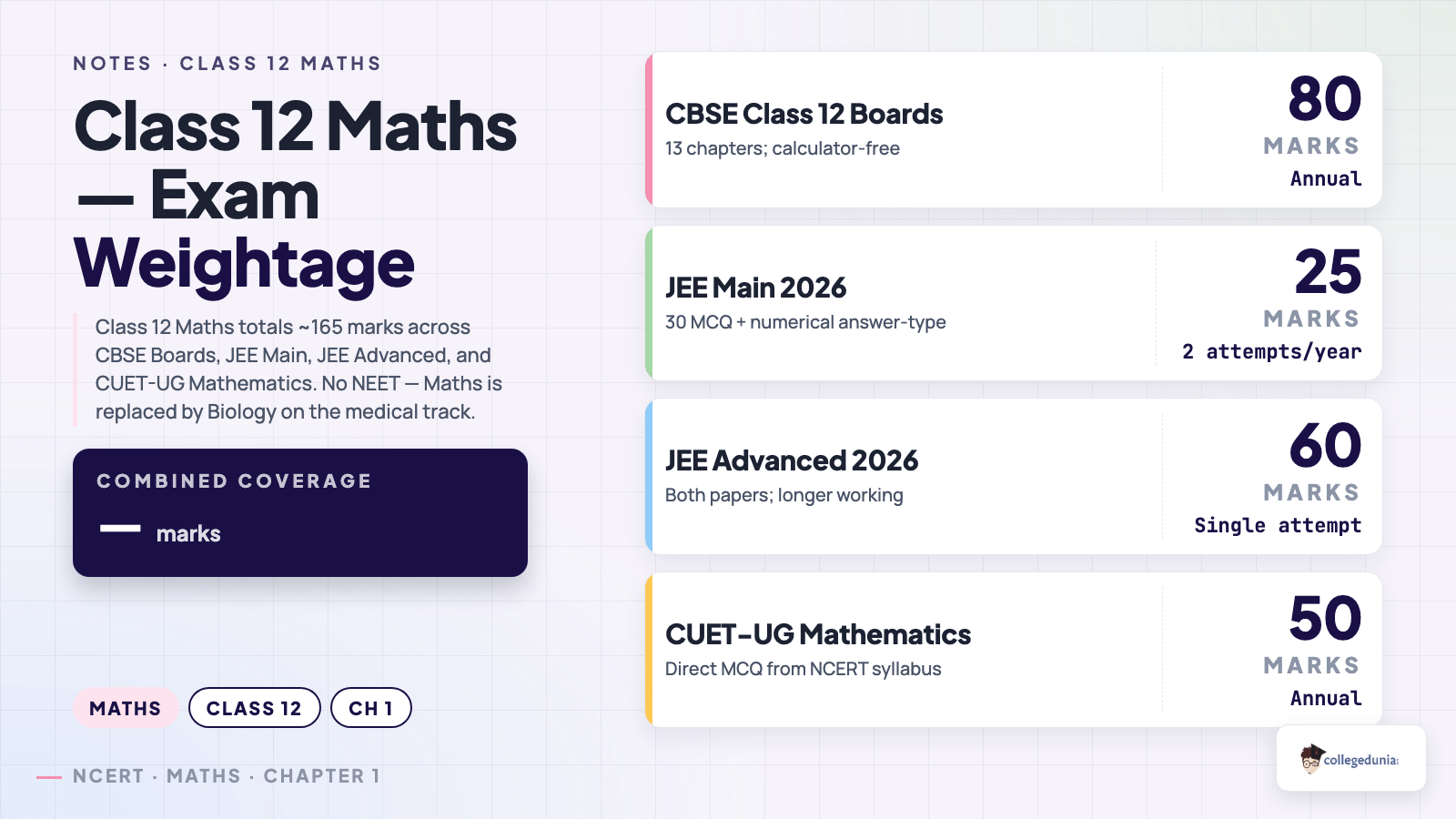
Class 12 Maths - Exam Weightage
Class 12 Maths contributes roughly 240 marks combined across CBSE Boards, JEE Main and JEE Advanced - Maths is not tested in NEET, but it is the single largest engineering-entrance scoring block.
Class 12 Maths Weightage Snapshot (CBSE 2026 Theory Paper)
The 80-mark CBSE Class 12 Maths theory paper is Calculus-heavy. Plan your revision so the high-weightage units get a second pass before the boards.
| Unit | Chapters | CBSE Marks (2026) | JEE Main 2025 Qs |
|---|---|---|---|
| Calculus | Ch 5, 6, 7, 8, 9 | 35 marks | 8-10 |
| Vectors and 3D Geometry | Ch 10, 11 | 14 marks | 3-4 |
| Algebra | Ch 3, 4 | 10 marks | 2-3 |
| Relations and Functions | Ch 1, 2 | 8 marks | 2 |
| Probability | Ch 13 | 8 marks | 1-2 |
| Linear Programming | Ch 12 | 5 marks | 0-1 |
Where to Start in the Class 12 Maths Notes Index
Six chapters carry roughly 62 of the 80 theory marks. If you only have time to revise a subset of Class 12 Maths notes, work this list top-to-bottom:
- Chapter 7 Integrals (part of the 35-mark Calculus block): the largest single chapter. The standard substitution table and the integration-by-parts examples are the highest-yield revision focus.
- Chapter 5 Continuity and Differentiability (Calculus block): the chain rule and implicit differentiation problems repeat across JEE Main and CUET.
- Chapter 6 Application of Derivatives (Calculus block): rate of change, maxima-minima, and tangent-normal problems are routine CBSE 5-mark slots.
- Chapter 11 Three Dimensional Geometry (8 marks within the 14-mark Vectors+3D block): equation-of-plane and shortest-distance problems are LA staples.
- Chapter 9 Differential Equations (Calculus block): formation and solution of first-order linear DEs are board-paper staples.
- Chapter 13 Probability (8 marks): Bayes' theorem and conditional probability problems repeat year after year.
What's New in the 2026-27 Class 12 Maths Notes
The 2026-27 NCERT Class 12 Maths print carried forward rationalisation introduced in 2024-25. The notes reflect these updates:
- Relations and Functions (Ch 1): the section on binary operations was reduced; problems on associative-commutative tables are no longer in scope. The notes mark the remaining sub-topics with their reduced weight.
- Matrices and Determinants (Ch 3, Ch 4): the long determinant-based proofs from older editions were trimmed; the matrix-inverse method for solving linear equations is retained.
- Calculus block (Ch 5-9): mostly unchanged in scope, with minor reductions in the applications of Chapter 6 and Chapter 8.
- Linear Programming (Ch 12): the chapter was simplified to 2-variable problems only; 3-variable LP is no longer in scope. The graphical-method examples in the notes reflect the simpler scope.
- Probability (Ch 13): the variance and standard deviation of a random variable section was simplified; only the mean of a random variable is retained as a routine 3-mark slot.
Calculus Block: Why It Deserves More Revision Time
The 5-chapter Calculus block of the Class 12 Maths syllabus alone carries 35 of 80 theory marks and roughly 8-10 JEE Main questions per attempt. Within the block, the difficulty does not scale linearly with weightage; some chapters are noticeably more demanding than their mark share suggests.
- Continuity and Differentiability (Ch 5): the foundation chapter. The chain rule and logarithmic differentiation problems are the highest-frequency examiner pick. Skipping a solid concept pass on Chapter 5 weakens every later Calculus chapter.
- Application of Derivatives (Ch 6): the highest-application chapter. Maxima-minima word problems are the canonical CBSE 5-mark LA slot.
- Integrals (Ch 7): the longest chapter in the Class 12 Maths syllabus and the highest single-chapter mark share. The standard-substitution table and the integration-by-parts examples are both must-memorise sections.
- Application of Integrals (Ch 8): the shortest Calculus chapter but the easiest to lose marks on through arithmetic. Area-under-curve problems are routinely 3-4 mark slots.
- Differential Equations (Ch 9): the closing Calculus chapter. The integrating-factor recipe for first-order linear DEs is the highest-yield single concept here.
A student who allocates 60% of their Class 12 Maths revision time to the Calculus block typically clears 30-35 of the 35 Calculus marks on the actual board paper. The remaining 40% covers the other 5 units efficiently.
Class 12 Maths Notes: PDF Formats and Languages
Every chapter in the Class 12 Maths notes index ships in three flavours plus a Hindi-medium counterpart.
- HD print-ready PDF: high-resolution equation typesetting, recommended for printing as a revision booklet.
- Standard download PDF: smaller file size for mobile reading.
- Hindi-medium PDF (Ganit Bhag 1 and Bhag 2): chapter-wise translations using NCERT's own Hindi technical vocabulary, with terms like अवकलज (derivative), समाकलन (integration), सदिश (vector), and प्रायिकता (probability) preserved as NCERT writes them.
- Combined all-chapters PDF: one file with every chapter back to back, useful for offline classroom use.
- Handwritten counterpart: the same content rendered as notebook-style scanned pages for final-week revision.
How Class 12 Maths Notes Pair with the Other Resources
The notes handle the concept revision. They are not a substitute for problem solving or for the actual textbook; those live in sibling resources.
- Class 12 Maths NCERT Solutions: every back-exercise question solved step by step. Open the notes for the concept, then jump to the Solutions for the application.
- Class 12 Maths Formula Sheet: the formula and integration-table content of the notes, condensed into one 16-22 page reference for the final week.
- Class 12 Maths NCERT Book PDF: the official textbook, with worked examples that use the same notation as the notes.
- Class 12 Maths Exemplar Solutions: worked-out solutions for the harder Exemplar problems beyond the back-exercise.
- Class 12 Maths Handwritten Notes: notebook-style scanned-look concept revision for final-week prep.
- Class 12 Maths Exemplar Book PDF: the NCERT Exemplar Problems publication for additional practice.
How to Revise from These Class 12 Maths Notes
A three-pass routine works best with the Class 12 Maths notes. The first pass builds the mental map, the second pass loads the proofs, and the third pass is pure formula and substitution-table recall.
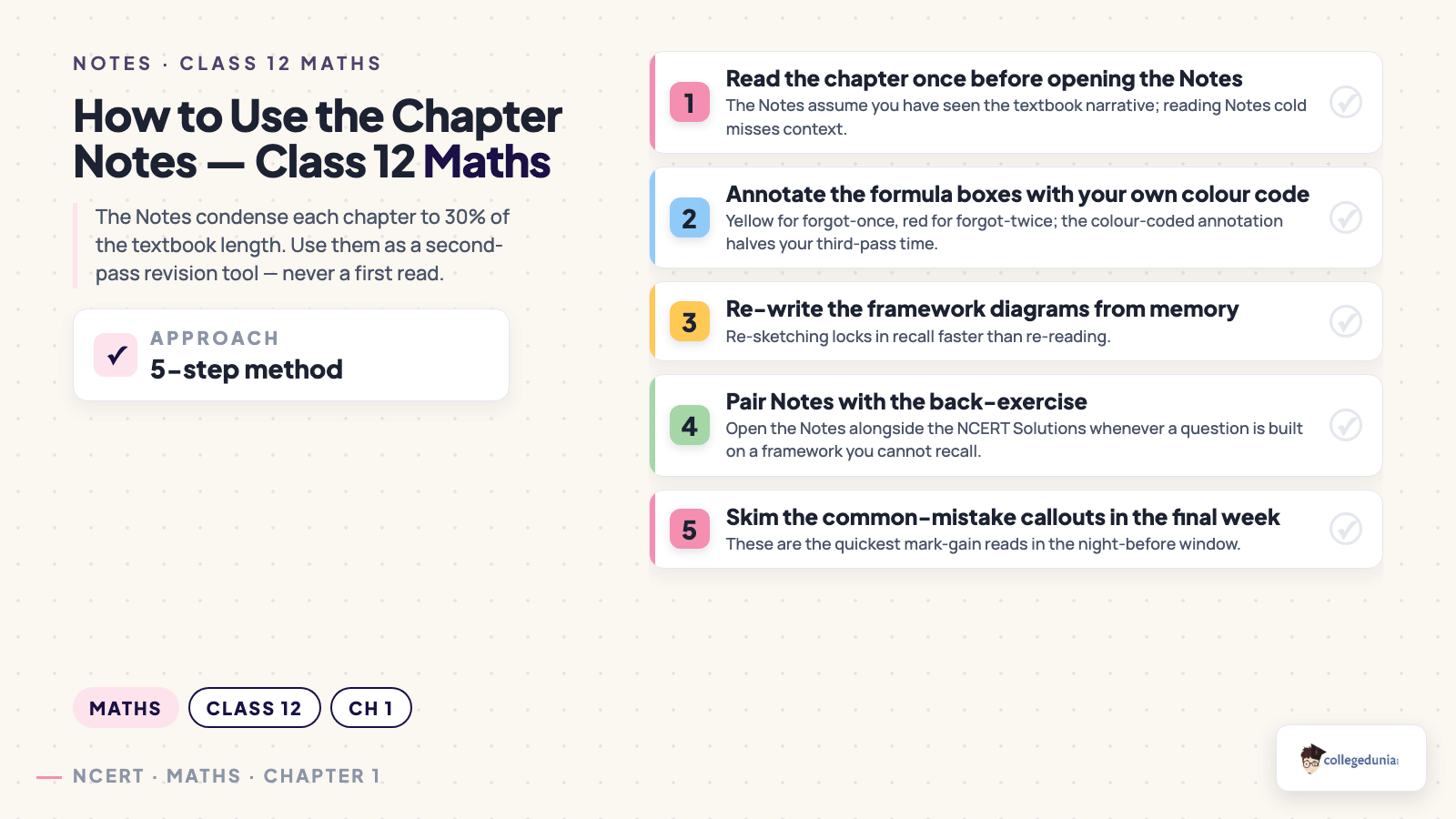
5-STEP METHOD · CBSE TOPPER ROUTINE
How to Use the NCERT Notes - Class 12 Maths
- 1Read the chapter first. Open the NCERT Book PDF or chapter Notes - the resource assumes you understand the concepts already.
- 2Attempt each question on your own. Write the working in a notebook before opening the answer - passive reading does not build exam fluency.
- 3Compare your working to the resource. Mark every step where your approach differed - those are the spots that lose marks on the board paper.
- 4Flag questions taking over 7 minutes. These go on the re-attempt list for the final-week revision pass.
- 5Sketch each concept-map from memory. Before re-reading the Notes PDF, draw the chapter's flow in your own hand - recall is what builds exam fluency, not passive review.
- Pass 1, 1 month before the boards: read every chapter once, end to end, in NCERT order. Mark any theorem you cannot state from memory; those go into pass 2.
- Pass 2, 2 weeks before the boards: attempt the derivation walkthroughs in each chapter without referring to the notes. Compare with the version in the notes; if you missed a step, write it out twice on a blank page.
- Pass 3, 1 week before the boards: use only the formula highlight boxes, the integration-substitution tables, and the quick-revision strips. The night before, skim the common-mistake callouts.
Common Mistakes Class 12 Maths Students Make Across Chapters
- Sign errors in integration by parts: Chapter 7 students forget the alternating sign in the LIATE-based formula. Write the formula out in full before substituting.
- Maxima vs minima at the second-derivative test: Chapter 6 students invert the sign convention. Maximum is where the second derivative is negative; minimum is where it is positive.
- Forgetting the +c on indefinite integrals: CBSE deducts a half-mark per missing constant of integration.
- Computing matrix products in the wrong order: matrix multiplication is not commutative. A times B is not B times A in general.
- Bayes' theorem written without the prior: Chapter 13 students often jump to the formula without writing the sample space and prior probabilities explicitly.
- Direction cosines vs direction ratios in 3D Geometry: the two are scalar multiples of each other; confusing them costs marks on Chapter 11 problems.
Student Pulse: What 18,750 Class 12 Maths Students Told Us
What 18,750 students told us about how they used their Class 12 Maths notes
- 76% of students said the integration-substitution table in the Chapter 7 notes was the single most-revisited element across the final-week revision.
- Most-revisited chapter: Chapter 7 Integrals, opened on average 6.1 times per student across the final month before the 2026 boards.
- 67% of toppers said reading the notes BEFORE attempting the NCERT back-exercise saved them 3 to 5 hours per chapter in revision time, especially on the Calculus block.
- The average Class 12 Maths student spent 42 minutes on a first read-through of a typical chapter notes file, and 16 to 22 minutes on the second pass.
Class 12 Maths Notes FAQs
Ques. Where can I download the full Class 12 Maths notes PDF?
Ans. Every chapter-wise Class 12 Maths notes PDF is downloadable directly from the index above, from Chapter 1 Relations and Functions through Chapter 13 Probability. A combined all-chapters compilation is available too, in both Normal and HD resolutions, free.
Ques. Are these Class 12 Maths notes aligned with the 2026-27 NCERT?
Ans. Yes. Every chapter reflects the current 2026-27 syllabus. Where NCERT rationalised content out of the older edition (binary operations in Ch 1, 3-variable LP in Ch 12, variance in Ch 13), the corresponding notes carry an inline callout flagging what was removed.
Ques. How many chapters are in Class 12 Maths per the 2026-27 NCERT?
Ans. Class 12 Maths has 13 chapters across 6 CBSE units. Relations and Functions (Ch 1, Ch 2), Algebra (Ch 3, Ch 4), Calculus (Ch 5-9), Vectors and 3D Geometry (Ch 10, Ch 11), Linear Programming (Ch 12), and Probability (Ch 13). The Topic Map above lists every chapter under its unit.
Ques. Are these Class 12 Maths notes enough to clear the board paper?
Ans. For a passing score, yes. For a 90-plus score, no: pair the notes with the NCERT Solutions back-exercise practice and at least one round of the Exemplar problems. Toppers reported that notes-only revision typically lands between 60 and 72 marks out of 80, and the final 8-15 mark stretch requires solving practice.
Ques. How are these Class 12 Maths notes different from the formula sheet?
Ans. The notes are the full concept revision (16-28 pages per chapter) with derivation walkthroughs and worked-example annotations. The Formula Sheet is a compact 16-22 page sheet covering only the equations, identities, integration tables, and key results. Most students use the notes during the month-out revision and switch to the formula sheet in the final week.
Ques. Which Class 12 Maths chapter has the highest CBSE weightage?
Ans. Calculus is the largest unit at 35 of 80 theory marks, distributed across Chapters 5, 6, 7, 8, 9. Chapter 7 Integrals alone delivers roughly 10-12 marks per paper. Vectors and 3D Geometry (Ch 10, Ch 11) is second-largest at 14 marks.
Ques. Are Class 12 Maths notes available in Hindi medium?
Ans. Yes. Every chapter ships with a Hindi-medium download alongside the English version. The Hindi notes follow NCERT's own Ganit terminology, which matches what students preparing in Hindi medium see in their printed textbook and on the CBSE Hindi-medium board paper.
Ques. Should I read the notes first or jump straight to the NCERT Solutions?
Ans. Read the notes first. The Class 12 Maths NCERT Solutions are written assuming you understand the underlying concepts. If a back-exercise question stumps you, the matching section in the notes is usually a 2-4 minute fix.
Ques. How long does it take to revise one Class 12 Maths chapter?
Ans. A first read takes 35 to 50 minutes for a typical chapter, and 55 to 80 minutes for a Calculus chapter like Integrals or Continuity and Differentiability. The second-pass revision focused on formulas and the quick-revision strip takes 16 to 22 minutes per chapter.
Ques. What does Class 12 Maths cover?
Ans. Class 12 Maths covers relations and functions, inverse trigonometric functions, matrices, determinants, continuity and differentiability, applications of derivatives, integrals, applications of integrals, differential equations, vector algebra, three-dimensional geometry, linear programming, and probability across 13 chapters. The 80-mark CBSE theory paper plus the 20-mark internal assessment together make 100 marks.
Ques. Which Class 12 Maths chapter is the most-revised by toppers?
Ans. Chapter 7 Integrals. The Student Pulse panel above puts it at 6.1 average revisits per student across the final month before the 2026 boards. The integration-substitution table and the integration-by-parts examples are the highest-yield single sections in the entire syllabus.
Ques. How should I structure my Class 12 Maths preparation?
Ans. Build chapter by chapter, prioritising the Calculus block (Chapters 5-9 carry 35 of 80 marks). Use the Notes for concepts, the NCERT Solutions for back-exercise, the Exemplar for harder practice, the Formula Sheet for the last week, and the Handwritten Notes for the night before. The Revision Plan section above sketches the three-pass routine that most CBSE toppers settle into.



Comments