


The Class 12 English Core Handwritten Notes (2026-27 syllabus) are notebook-style scanned-look revision notes for every chapter of the Flamingo and Vistas readers, rendered as ruled-paper PDFs with hand-drawn character maps, theme webs, and stanza-wise annotations for the poetry chapters. The handwritten format is the closest digital equivalent to the kind of class notes a strong literature topper writes during the year.
- Chapters covered: 19 chapters in total - 8 Flamingo Prose, 5 Flamingo Poetry, 6 Vistas
- Format: handwritten ballpoint-pen rendering on ruled paper, with hand-drawn character maps and theme webs
- Page count: 10 to 18 pages per chapter, in the same density a school topper would write
- Exam alignment: CBSE Class 12 English Core theory paper (80 marks)
Every chapter in this Collegedunia Class 12 English Core Handwritten Notes compilation is curated by subject experts, mapped to the 2026-27 rationalised NCERT, and rendered in the notebook style that toppers actually use during their own revision.
Class 12 English Core Handwritten Notes: Flamingo Poetry
The 5 poems from the Flamingo poetry section, with stanza-by-stanza annotations and figures of speech tagged in the margins.
Class 12 English Core Handwritten Notes: Vistas (Supplementary Reader)
The 6 chapters from the Vistas supplementary reader, with hand-drawn plot diagrams and character webs.
Class 12 English Core Handwritten Notes: Flamingo Prose
The 8 prose pieces from the Flamingo main reader, rendered in notebook style with hand-drawn character maps and theme webs.
Why Use Collegedunia's Class 12 English Core Handwritten Notes?
For literature subjects, handwritten notes work especially well because character maps, theme webs, and stanza annotations recall faster from hand-drawn versions than from typeset ones. The notebook texture triggers a different reading pattern - the eye slows down, and during the exam the recall feels closer to your own class notes.
- Ballpoint-pen rendering on ruled paper: the visual texture mirrors a real English notebook with consistent pen pressure, slight slant, and natural letter spacing.
- Hand-drawn character maps and theme webs: every prose chapter's key characters appear in a hand-drawn relationship diagram; every theme is mapped to its supporting plot moments.
- Stanza-wise annotations for poetry: each poem's stanzas are annotated in the margins with figures of speech, tone shifts, and central-idea pointers.
- Scribble-and-correction artefacts: the occasional strikethrough is preserved (a topper does not write notes perfectly the first time); the corrections feel human.
- Sub-headings in red ink: section breaks like Plot, Characters, Themes, and Value-Based are marked in a contrasting colour.
- Physical imperfections: a few ink drops and pen-touch dots are kept in the scan to make the file feel like an actual photographed notebook.
What 11,820 students told us about their Class 12 English Core Handwritten Notes usage
Source: Magnet Brains on YouTube
Handwritten Notes vs Typeset Notes: When to Use Which
The Handwritten Notes and the typeset Class 12 English Core Notes cover the same content but serve different revision moments.
| Use case | Typeset Notes | Handwritten Notes |
|---|---|---|
| First-time concept learning | Recommended | Less ideal (slower scan speed) |
| Second-pass revision (1-2 weeks out) | Good | Recommended |
| Final-week revision | Good | Recommended |
| Night-before-exam skim | Functional | Strongly recommended |
| Looking up a specific character or theme | Recommended (scannable headings) | Slower |
| Memorising a poetry stanza analysis | Good | Recommended (hand-rendered annotations recall better) |
Class 12 English Core Topic Map (Handwritten Notes Coverage)
How the 19 Class 12 English Core chapters group across the two prescribed books. Each chapter's Handwritten Notes file covers the section listed in NCERT order.
| Book / Section | Chapters | What this section covers |
|---|---|---|
| Flamingo Prose | 8 prose pieces (The Last Lesson, Lost Spring, Deep Water, The Rattrap, Indigo, Poets and Pancakes, The Interview, Going Places) | Short stories, autobiographical sketches, and reportage from Indian and international writers. Tested on theme, characterisation, narrative voice, and value-based questions in the 80-mark CBSE theory paper. |
| Flamingo Poetry | 5 poems (My Mother at Sixty-Six, Keeping Quiet, A Thing of Beauty, A Roadside Stand, Aunt Jennifer's Tigers) | Modern poems by Kamala Das, Pablo Neruda, John Keats, Robert Frost, and Adrienne Rich. CBSE tests imagery, figures of speech, central idea, and stanza-wise meaning. |
| Vistas (Supplementary Reader) | 6 chapters (The Third Level, The Tiger King, Journey to the End of the Earth, The Enemy, On the Face of It, Memories of Childhood) | Longer prose pieces - short stories, travel writing, and a play. Tested as a separate Section in the paper with long-answer questions on theme, plot, and character. |
NCERT Class 12 English Core Deleted Syllabus 2026-27
The NCERT 2026-27 syllabus for Class 12 English Core has been rationalised by the examination authority to reduce content load for CBSE Boards and CUET. The drops listed below are officially out of the 2026-27 question paper, so skip these while revising.
| Chapter | Deleted Topics (2026-27) |
|---|---|
| Flamingo Poetry - A Roadside Stand (Frost) | Removed from the 2026-27 syllabus; the other 5 Flamingo poems are retained. |
| Flamingo Poetry - A Thing of Beauty (Keats - some questions) | Stanza-wise long answer trimmed; theme-based and short-answer questions retained. |
| Flamingo Prose - The Last Lesson (sub-questions) | Symbolism of language and identity - extended-answer prompts trimmed; comprehension and value-based retained. |
| Vistas - The Tiger King | Some long-answer prompts on satire and irony reduced; theme and character analysis retained. |
| Writing Skills - Speech / Debate (formerly Ch) | Some legacy writing-formats removed; current syllabus is letter / report / article / notice. |
| Reading Comprehension (unseen passage) | Some legacy genre types reduced; current syllabus is factual / discursive / literary. |
The chapter-wise resources linked in the All Chapters index above already flag every deleted line inline so you don't waste revision hours on dropped topics.
Class 12 English Core Chapter-wise Important Questions
The five chapter clusters below carry the bulk of the CBSE 2026 Class 12 English Core paper and repeat almost every year. The first column lists the long-answer topics that recur as 3-mark and 5-mark questions; the second column lists the application-level questions that appear as 1-3 mark numericals / MCQs / case-studies in CBSE and CUET UG.
| Chapter Cluster | Important Themes / Long Answers (6 marks) | Important Short-Answer / Value-based (2-3 marks) |
|---|---|---|
| Flamingo Prose (Last Lesson, Lost Spring, Deep Water, Indigo, Poets and Pancakes, Interview, Going Places) | 1. Themes of language and identity in 'The Last Lesson'. 2. Social injustice and exploitation in 'Lost Spring'. 3. Character of Gandhi in 'Indigo' and his Champaran movement. | Symbolism of bangles, Douglas overcoming fear, the role of interviews in journalism. |
| Flamingo Poetry (My Mother at Sixty-six, Keeping Quiet, A Thing of Beauty, Aunt Jennifer's Tigers, A Roadside Stand) | 1. Theme of mortality and ageing in 'My Mother at Sixty-six'. 2. Pablo Neruda's call for introspection in 'Keeping Quiet'. 3. Patriarchy and oppression in 'Aunt Jennifer's Tigers'. | Figures of speech identification, central idea explanation, poetic devices used. |
| Vistas (The Third Level, The Tiger King, Journey to the End of the Earth, The Enemy, On the Face of It, Memories of Childhood, Should Wizard Hit Mommy, Evans Tries an O-Level) | 1. Escapism vs reality in 'The Third Level'. 2. Satire of monarchy in 'The Tiger King'. 3. Climate change urgency in 'Journey to the End of the Earth'. | Character sketches of Sadao, Derry, Evans; theme of human relationships and morality. |
| Reading Comprehension and Note-Making | 1. Critical analysis of an unseen factual passage. 2. Summarising in 80-100 words with title. 3. Note-making in standard format with abbreviations. | Vocabulary in context, identifying tone and purpose, inference-based MCQs. |
| Writing Skills (Letter, Report, Article, Notice, Invitation) | 1. Article writing on a given social / educational topic. 2. Formal letter - complaint, enquiry, application. 3. Report writing on an event or survey finding. | Notice writing for school / community events, invitation and reply (formal / informal), email writing format. |
The same five clusters appear in CUET UG 2026 English with a near-identical split - the language test draws unseen passages and vocabulary from the same reading-comprehension surface as the CBSE board paper. The Expert's Solution tab on each chapter page works the CUET-style elimination alongside the CBSE board-style structured answer.
HANDWRITTEN NOTES · CLASS 12 ENGLISH CORE
Class 12 English Core - Exam Weightage
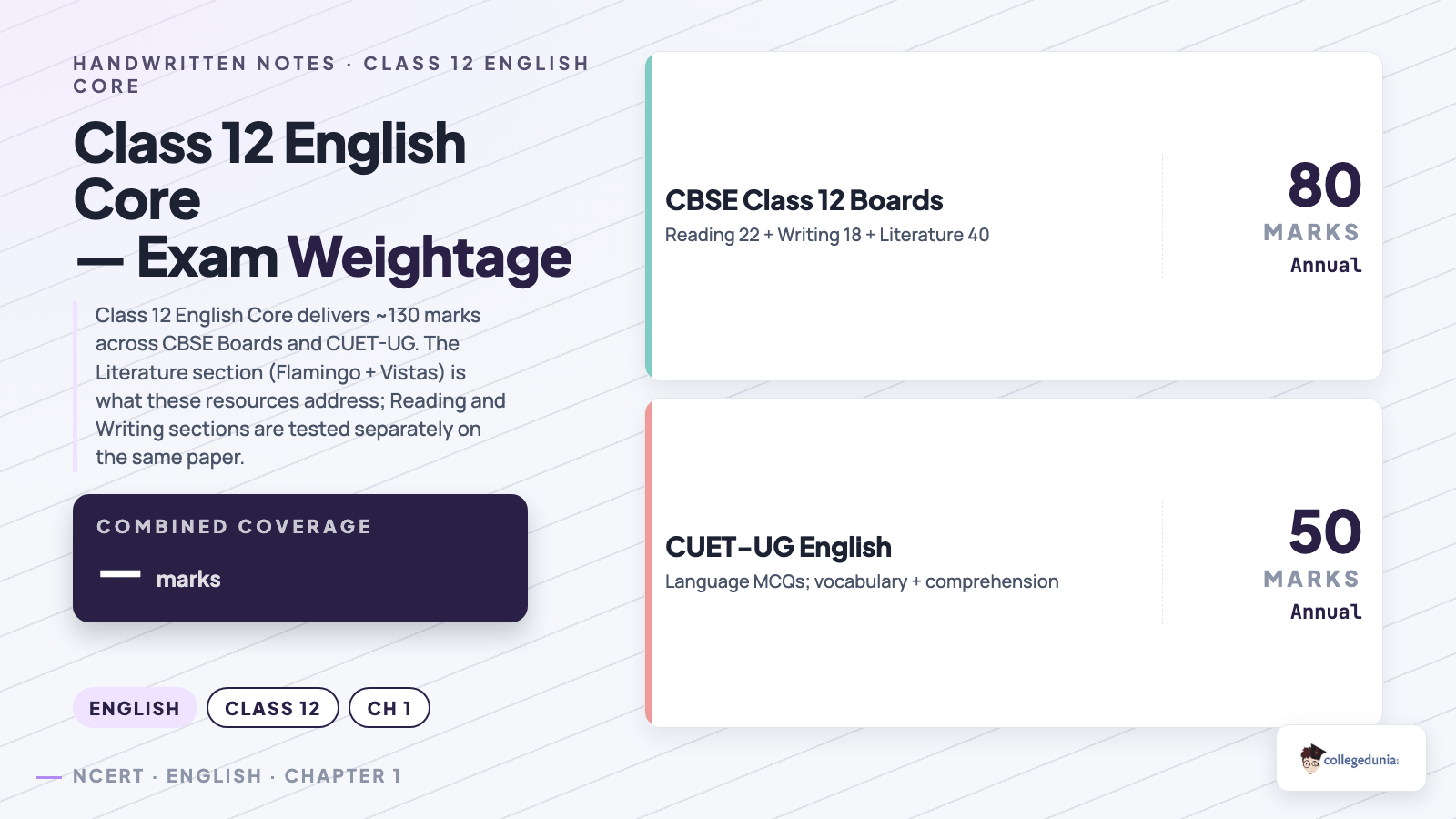
Class 12 English Core contributes roughly 130 marks combined across CBSE Boards and CUET UG (Language section) - English Core is the universal language paper that every CUET candidate writes.
Class 12 English Core Weightage Snapshot (CBSE 2026 Theory Paper)
The 80-mark theory paper splits across three sections. The Literature section (Section C) tests every chapter covered in this Handwritten Notes listing and carries 40 marks.
| Paper Section | What it tests | CBSE Marks (2026) |
|---|---|---|
| Section A - Reading Skills | Unseen passages + note-making | 22 marks |
| Section B - Creative Writing Skills | Notice / invitation / letter / article writing | 18 marks |
| Section C - Literature (Flamingo + Vistas) | Reference-to-context, short and long answer questions on every chapter | 40 marks |
| Internal Assessment | ASL (Assessment of Listening and Speaking), project work | 20 marks |
Class 12 English Core CBSE 2026 Paper Pattern Snapshot
The 80-mark CBSE Class 12 English Core theory paper runs 3 hours and splits across three sections plus the internal-assessment block. Knowing the section-by-section weight is half the revision plan; once you know which section a chapter feeds, you can pick the right resource (Notes for theme recall, NCERT Solutions for back-exercise long answers).
- Section A - Reading Skills (22 marks): two unseen passages plus a note-making task. Unrelated to Flamingo or Vistas chapter content; tests comprehension and summarisation.
- Section B - Creative Writing Skills (18 marks): notice writing, invitation / reply, letter (formal), and article writing. Format and word-limit accuracy are the easy marks here.
- Section C - Literature (40 marks): reference-to-context questions on Flamingo Prose, Flamingo Poetry, and Vistas chapters, plus short and long answer questions. The full chapter content from this listing page is tested here.
- Internal Assessment (20 marks): ASL (Assessment of Listening and Speaking) plus project work and viva. Lab-style assessment, not theory-paper based.
The 80-mark theory paper combined with the 20-mark internal assessment makes the 100-mark scheme. Section C (Literature) is where the chapter-wise NCERT preparation actually shows up; the chapter-by-chapter resources on this listing feed directly into 40 of those 80 marks.
Where to Start in the Class 12 English Core Handwritten Notes Index
Handwritten notes work best as a second-pass revision tool. The chapter shortlist below matches the CBSE long-answer slots most often tested:
- Indigo (Flamingo Prose Ch 5): the hand-drawn character map of Gandhi-Rajkumar Shukla-Indigo Sharecroppers makes the value-based slot easy to recall.
- The Rattrap (Flamingo Prose Ch 4): the theme web around human kindness shows the chapter's arc in one glance.
- Lost Spring (Flamingo Prose Ch 2): two parallel character maps (Saheb / Mukesh) help avoid the confusion between sub-stories.
- The Tiger King (Vistas Ch 2): hand-drawn plot diagram makes the satirical sequence memorable.
- On the Face of It (Vistas Ch 5): character arc diagram for Mr. Lamb and Derry is easier to recall than typeset prose.
- Aunt Jennifer's Tigers (Flamingo Poetry Ch 5): stanza-wise margin annotations for the imagery are board-paper gold.
Class 12 English Core Handwritten Notes: PDF Format
- HD ruled-paper PDF: high-resolution scan with clear ballpoint-pen text.
- Standard download PDF: smaller file size, useful for slow internet.
- Combined all-chapters PDF: all 19 chapter notebooks back to back as a single file, useful for printing the full revision booklet.
- Black-and-white print friendly: the ballpoint-blue ink and pencil shading both print cleanly in greyscale.
- Searchable PDF text layer: despite the handwritten look, every chapter PDF carries a hidden text layer so the find function works for searching specific characters or themes.
How the Class 12 English Core Handwritten Notes Pair with the Other Resources
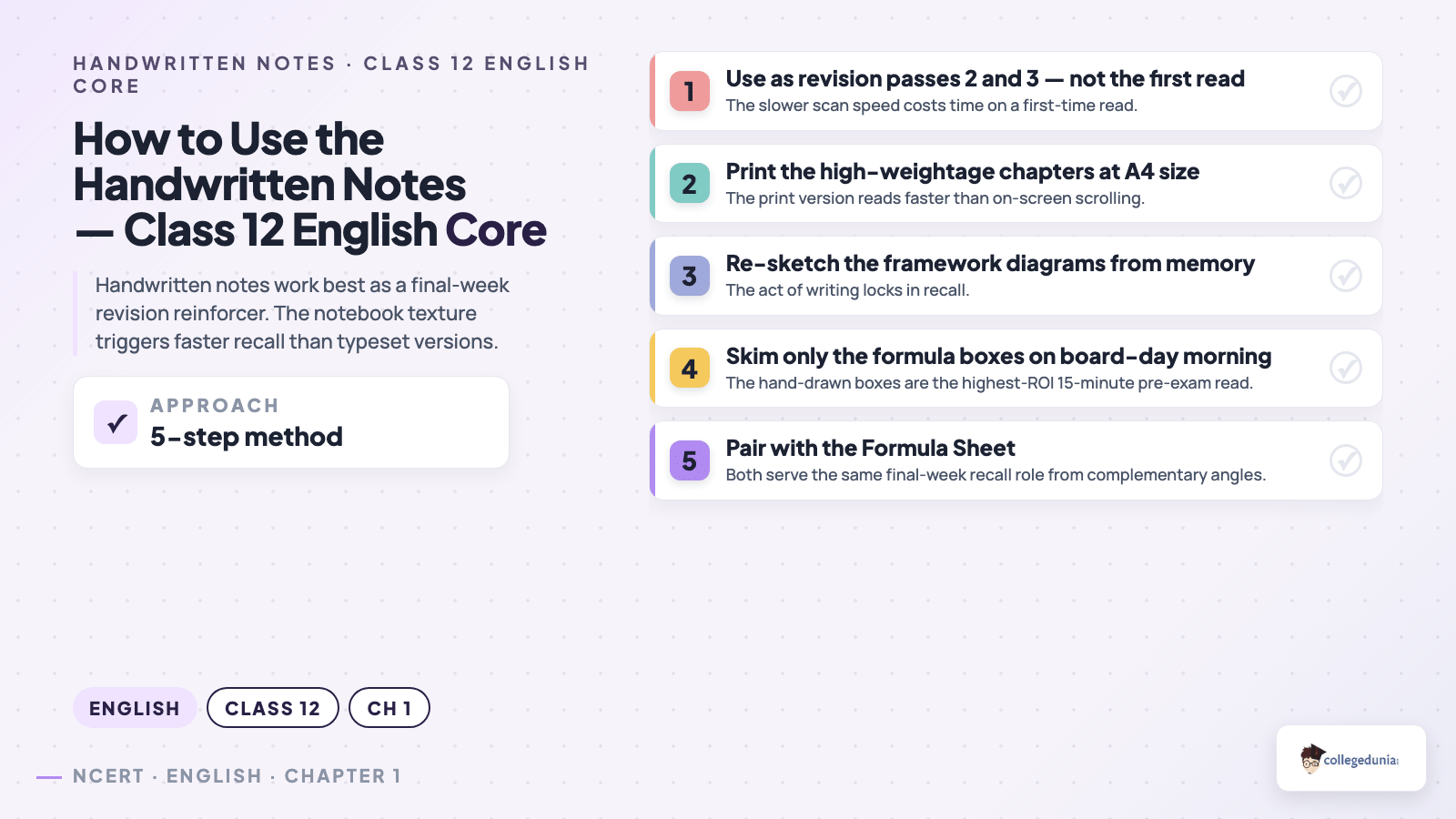
- Class 12 English Core Notes: the typeset concept revision; read this first when you encounter a new chapter, the handwritten notes are for revision passes 2 and 3.
- Class 12 English Core NCERT Solutions: the back-exercise worked end to end; use the handwritten notes alongside while attempting the back-exercise for the second time.
- Class 12 English Core NCERT Book PDF: the original Flamingo / Vistas chapter, useful for cross-checking a specific quotation or line.
How to Use the Handwritten Notes for Final-Week Revision
5-STEP METHOD · CBSE TOPPER ROUTINE
How to Use the Handwritten Notes - Class 12 English Core
- 1Read the chapter first. Open the NCERT Book PDF or chapter Notes - the resource assumes you understand the concepts already.
- 2Attempt each question on your own. Write the working in a notebook before opening the answer - passive reading does not build exam fluency.
- 3Compare your working to the resource. Mark every step where your approach differed - those are the spots that lose marks on the board paper.
- 4Flag questions taking over 7 minutes. These go on the re-attempt list for the final-week revision pass.
- 5Skim the highlighted lines the night before. Do not attempt fresh questions in the last 24 hours - your eye should rest on familiar margins, not on new derivations.
- Days 7 to 10 before the boards: read one chapter's handwritten notes per evening, focusing on the hand-drawn character maps and theme webs.
- Days 4 to 6: re-read the high-weightage chapters one more time; sketch the character map from memory on a blank page, then compare with the handwritten version.
- Days 2 to 3: skim all 19 chapter notes once; the pen-and-paper texture trains your eye to find the specific theme bullet you need on the answer paper.
- Night before the paper: open only the hand-drawn character maps and stanza annotations for the top six high-weightage chapters.
- Morning of the paper: 15 minutes of skimming the hand-drawn theme webs for Indigo, The Rattrap, and The Tiger King is the highest-ROI use of pre-exam time.
Common Mistakes Class 12 English Core Students Make with Handwritten Notes Revision
- Mixing up Flamingo Prose authors: Students attribute Lost Spring to William Douglas or The Rattrap to Anees Jung. Always tie the author to the chapter in your first pass; CBSE often asks the author directly in 1-mark questions.
- Treating poetry questions as factual recall: Poetry answers reward imagery, figures of speech, and tone analysis. A factual paraphrase will lose half the marks on a 5-mark stanza question. Always identify the device + name it + quote the line.
- Skipping the Vistas chapters during revision: Vistas carries roughly 16 of the 40-mark Literature section. Students who focus only on Flamingo lose easy marks on the 5-mark Vistas long-answer slot.
- Writing prose answers without textual references: CBSE marks reward direct quotations or paraphrased lines from the chapter. An answer in your own words without textual anchors loses the lower-band marks.
- Confusing characters across chapters: Saheb (Lost Spring) vs Mukesh (Lost Spring), or Edla (The Rattrap) vs Sophie (Going Places). The Lost Spring confusion is the most common; the two boys are separate sub-stories within one chapter.
- Ignoring the value-based question format: CBSE often appends a value-based prompt to the long-answer question. Answer it as a 2-mark mini-paragraph at the end of your main answer, not as a separate write-up.
- Translating poetry literally word-for-word: Pablo Neruda's Keeping Quiet and Robert Frost's A Roadside Stand reward thematic interpretation, not literal paraphrase. The central idea + the tone is the answer, not the dictionary meaning of every line.
Student Pulse: What 11,820 Class 12 English Core Students Told Us
What 11,820 students told us about their Class 12 English Core Handwritten Notes usage
- 64% of students rated Flamingo Poetry as the highest-effort section, ahead of Vistas long-answer questions at 51% and Flamingo Prose at 38%. The poetry section's figures-of-speech and stanza-analysis demands explain the gap.
- Most-skipped chapter: Memories of Childhood from Vistas (skipped by ~29% of students despite carrying 5 marks). Toppers flagged this as the easiest 5-mark reclaim because both extracts share the same theme of educational humiliation.
- Toppers reported that the value-based add-on at the end of every long-answer question added 2-4 marks on the 80-mark theory paper - a marks block most students lose by skipping the value-based sub-prompt.
- The average student spent 38 hours across the full 19-chapter Class 12 English Core curriculum (Flamingo + Vistas combined), with the Poetry section taking the longest per chapter despite having fewer lines than the prose chapters.
Also Check: Related Class 12 English Core Resources
- Also Check: CBSE Class 12 exam pattern, dates, and full-subject hub
- Also Check: CBSE Class 12 Syllabus 2026-27
- Also Check: CUET-UG 2026 exam information
- Also Check: CUET-UG 2026 Syllabus
Topper-tested takeaways for Class 12 English Core Handwritten Notes
- Use the Handwritten Notes for second-pass revision after you have read the chapter from the NCERT Book.
- The hand-drawn theme maps and character webs in the prose notes are easier to recall during the exam than typeset versions.
- Print the Poetry handwritten notes at A5 size and tape them inside your literature notebook for last-week revision.
- Re-sketch the character map for each prose chapter on a blank page from memory; the act of writing locks in recall.
Class 12 English Core Handwritten Notes FAQs
Ques. Where can I download the Class 12 English Core Handwritten Notes PDF?
Ans. Every chapter-wise Class 12 English Core Handwritten Notes PDF is downloadable directly from the index above - 8 Flamingo Prose chapters, 5 Flamingo Poetry chapters, and 6 Vistas chapters all linked individually. A combined all-chapters PDF is also available, free in both Normal and HD resolutions.
Ques. Is this Class 12 English Core Handwritten Notes aligned with the 2026-27 NCERT?
Ans. Yes. Every chapter reflects the current 2026-27 rationalised NCERT for both Flamingo and Vistas. Where NCERT rationalised content out of the older edition (deleted chapters or trimmed back-exercise questions), the affected resources carry an inline callout flagging the change.
Ques. How many chapters are there in Class 12 English Core per the 2026-27 NCERT?
Ans. Class 12 English Core has 19 chapters in total: 8 Flamingo Prose chapters (The Last Lesson through Going Places), 5 Flamingo Poetry chapters (My Mother at Sixty-Six through Aunt Jennifer's Tigers), and 6 Vistas chapters (The Third Level through Memories of Childhood). The Topic Map table above lists every chapter under its book and section.
Ques. Which Class 12 English Core section has the highest CBSE board weightage?
Ans. Section C (Literature) carries 40 of the 80 theory marks - half the paper. Within Section C, Flamingo Prose and Vistas together account for roughly 30 marks; Flamingo Poetry contributes the remaining ~10 marks via reference-to-context questions and short answers. The Weightage Snapshot above tracks the section-by-section split.
Ques. How are the Class 12 English Core Handwritten Notes different from the other Class 12 English Core resources?
Ans. The Class 12 English Core Handwritten Notes is best paired with the typeset Notes for first-pass concept revision and the NCERT Solutions for back-exercise practice. Each resource type covers the same 19-chapter list but in a different format; together they make a complete revision toolkit.
Ques. Are these Class 12 English Core Handwritten Notes files available in Hindi medium?
Ans. The chapter content for English Core is English-medium only - Flamingo and Vistas are English literature texts, and CBSE expects answers in English. The chapter Notes and Solutions on this listing are therefore English-medium.
Ques. What does Class 12 English Core cover?
Ans. Class 12 English Core covers two CBSE-prescribed books: Flamingo (main reader with 8 prose chapters and 5 poetry chapters) and Vistas (supplementary reader with 6 chapters). The 80-mark theory paper plus the 20-mark internal assessment make 100 marks; the literature section alone carries 40 of those 80 marks.
Ques. Are Vistas chapters tested in the same way as Flamingo chapters?
Ans. Vistas chapters are tested in a separate sub-section of the Literature paper, typically with longer answer-type questions (5 to 6 marks each) testing theme, character, and plot. Flamingo chapters carry a mix of reference-to-context (RTC), short answer, and long answer questions across both Prose and Poetry. The Vistas long-answer slot is the highest-yield mark block for students who plan their preparation well.
Ques. Should I read Flamingo before Vistas?
Ans. Conventionally yes - most CBSE schools teach Flamingo first because the prose pieces are shorter and more accessible. Vistas chapters are longer and reward a slower read; saving them for the second half of the year gives you the reading stamina to engage with the deeper themes. Once both books are read once, revisit them in any order during revision.
Ques. How important is poetry analysis on the CBSE board paper?
Ans. The poetry section carries roughly 10 marks of the 40-mark Literature paper - significant but smaller than prose. The poetry questions test imagery, figures of speech, central idea, and the poet's tone. A well-structured poetry answer (identify the device, name it, quote the line, explain its effect) earns marks faster than a paraphrase-only answer.
Ques. How should I structure my Class 12 English Core preparation?
Ans. Read the chapter from the NCERT Book once, attempt the back-exercise using the NCERT Solutions, revise using the Notes, and skim the Handwritten Notes in the final two weeks. Spread your time across Flamingo Prose, Flamingo Poetry, and Vistas in roughly equal weekly blocks; the marks distribution across the Literature section rewards balanced preparation over Prose-only focus.



Comments