


The Class 12 Business Studies Handwritten Notes (2026-27 syllabus) are notebook-style scanned-look revision notes for every chapter of the rationalised NCERT textbook, rendered as ruled-paper PDFs with hand-drawn framework diagrams (4 Ps, Maslow pyramid, Fayol infographic, three-tier consumer redressal flowchart), importance bullet boxes, and process flowcharts. The handwritten format is the closest digital equivalent to the class notes a strong Business Studies topper writes during the year.
- Chapters covered: 12 chapters across Part A (Ch 1-8) and Part B (Ch 9-12)
- Format: handwritten ballpoint-pen rendering on ruled paper, with hand-drawn framework diagrams and importance bullet boxes
- Page count: 10 to 16 pages per chapter, in the same density a school topper would write
- Exam alignment: CBSE Class 12 Business Studies theory paper (80 marks)
Every chapter in this Collegedunia Class 12 Business Studies Handwritten Notes compilation is curated by subject experts, mapped to the 2026-27 rationalised NCERT, and rendered in the notebook style toppers actually use during their own revision.
Class 12 Business Studies Handwritten Notes: All Chapters
Every chapter of the 2026-27 Class 12 Business Studies syllabus, rendered in notebook style with hand-drawn framework diagrams.
Why Use Collegedunia's Class 12 Business Studies Handwritten Notes?
For Business Studies, handwritten notes work especially well because framework diagrams, importance bullet lists, and process flowcharts recall faster from hand-drawn versions than from typeset ones. The notebook texture triggers a different reading pattern - the eye slows down, and during the exam the recall feels closer to your own class notes.
- Ballpoint-pen rendering on ruled paper: the visual texture mirrors a real Business Studies notebook with consistent pen pressure, slight slant, and natural letter spacing.
- Hand-drawn framework diagrams: Maslow's hierarchy pyramid (Ch 7), the 4 Ps of marketing mix (Ch 11), the three-tier consumer redressal hierarchy (Ch 12), the planning process flowchart (Ch 4) - every key framework appears as a hand-drawn diagram.
- Importance bullet boxes: every chapter's importance points sit inside hand-drawn boxes with bullet markers, mirroring the structure CBSE markers expect on a 5-mark answer.
- Process flowcharts in pen: the staffing process (Ch 6), the recruitment-selection sequence (Ch 6), the channels of distribution (Ch 11), and the controlling process (Ch 8) appear as hand-drawn flowcharts.
- Scribble-and-correction artefacts: the occasional strikethrough is preserved (a topper does not write notes perfectly the first time).
- Physical imperfections: a few ink drops and pen-touch dots kept in the scan to make the file feel like an actual photographed notebook page.
What 13,540 students told us about their Class 12 Business Studies Handwritten Notes usage
Source: Magnet Brains on YouTube
Handwritten Notes vs Typeset Notes: When to Use Which
The Handwritten Notes and the typeset Class 12 Business Studies Notes cover the same content but serve different revision moments.
| Use case | Typeset Notes | Handwritten Notes |
|---|---|---|
| First-time concept learning | Recommended | Less ideal (slower scan speed) |
| Second-pass revision (1-2 weeks out) | Good | Recommended |
| Final-week revision | Good | Recommended |
| Night-before-exam skim | Functional | Strongly recommended |
| Looking up a specific framework or importance bullet | Recommended (scannable headings) | Slower |
| Memorising a process flowchart or hierarchy diagram | Good | Recommended (hand-drawn diagram recalls better) |
Class 12 Business Studies Topic Map (Handwritten Notes Coverage)
How the 12 chapters group across the two CBSE parts.
| Part / Unit | Chapters | What this unit covers |
|---|---|---|
| Part A: Principles and Functions of Management | Ch 1, Ch 2, Ch 3, Ch 4, Ch 5, Ch 6, Ch 7, Ch 8 | Foundational management concepts (nature, significance), Fayol and Taylor's principles, business environment (PESTLE plus international organisations like WTO, IMF and World Bank), and the five functions of management - planning, organising, staffing, directing and controlling. The 50-mark backbone of the CBSE theory paper. |
| Part B: Business Finance and Marketing | Ch 9, Ch 10, Ch 11, Ch 12 | Financial management (objectives, decisions, capital structure, working capital), financial markets (money market, capital market, SEBI), marketing management (4 Ps of marketing mix), and consumer protection under the Consumer Protection Act 2019. The 30-mark Part B block. |
| Project work (internal assessment) | Selected from chapter topics | 20-mark internal assessment with a comprehensive project, viva and report writing. Most CBSE schools assign one chapter-anchored project per student - common choices include a marketing management project, a business environment project, a stock exchange project, or a principles of management application study. |
NCERT Class 12 Business Studies Deleted Syllabus 2026-27
The NCERT 2026-27 syllabus for Class 12 Business Studies has been rationalised by the examination authority to reduce content load for CBSE Boards and CUET. The drops listed below are officially out of the 2026-27 question paper, so skip these while revising.
| Chapter | Deleted Topics (2026-27) |
|---|---|
| Nature and Significance of Management (Ch 1) | Some sub-topics on objectives and importance trimmed; management functions retained. |
| Principles of Management (Ch 2) | Taylor's scientific management - specific techniques (functional foremanship details) removed; Fayol's principles retained. |
| Business Environment (Ch 3) | Economic environment - specific policy examples (older policies) replaced with current ones; demonetisation and GST retained. |
| Planning (Ch 4) | Types of plans - some classification sub-parts removed; planning process and importance retained. |
| Marketing Management (Ch 11) | Marketing concepts (some sub-parts on different views of marketing) removed; 4 Ps and product life cycle retained. |
| Consumer Protection (Ch 12) | Consumer Protection Act 1986 details replaced with 2019 Act; redressal mechanism updated. |
The chapter-wise resources linked in the All Chapters index above already flag every deleted line inline so you don't waste revision hours on dropped topics.
Class 12 Business Studies Chapter-wise Important Questions
The five chapter clusters below carry the bulk of the CBSE 2026 Class 12 Business Studies paper and repeat almost every year. The first column lists the long-answer topics that recur as 3-mark and 5-mark questions; the second column lists the application-level questions that appear as 1-3 mark numericals / MCQs / case-studies in CBSE and CUET UG.
| Chapter Cluster | Important Theory / Long Answers (5-6 marks) | Important Case-Study / Application Problems (3-4 marks) |
|---|---|---|
| Nature and Principles of Management (Ch 1-2) | 1. Management as art / science / profession debate. 2. Taylor's principles of scientific management. 3. Fayol's 14 principles of management. | Distinguishing Taylor vs Fayol, importance of management functions, level-wise managerial roles. |
| Planning, Organising and Staffing (Ch 4-6) | 1. Planning process - steps and limitations. 2. Delegation vs decentralisation comparison. 3. Recruitment, selection and training process. | Types of plans (case-study application), organisational structures pros / cons, methods of training. |
| Directing and Controlling (Ch 7-8) | 1. Maslow's hierarchy of needs. 2. Leadership styles - autocratic / democratic / laissez-faire. 3. Controlling process and its limitations. | Motivational techniques, barriers to effective communication, importance of controlling. |
| Financial Management and Markets (Ch 9-10) | 1. Capital structure decisions and factors. 2. Financial planning - objectives and importance. 3. Functions of stock exchange. | Working-capital estimation, money market vs capital market, NSE / BSE comparison. |
| Marketing and Consumer Protection (Ch 11-12) | 1. Marketing mix (4 Ps) detailed treatment. 2. Functions of marketing. 3. Consumer Protection Act 2019 - rights and redressal. | Product life cycle stages, pricing methods, consumer redressal forums - district / state / national. |
The same five clusters appear in CUET UG 2026 Business Studies with a near-identical split - theory-heavy concepts dominate MCQs and case-study application questions test the same principles in business scenarios. The Expert's Solution tab on each chapter page works the CUET-style multiple-choice elimination alongside the CBSE board-style structured answer.
HANDWRITTEN NOTES · CLASS 12 BUSINESS STUDIES
Class 12 Business Studies - Exam Weightage
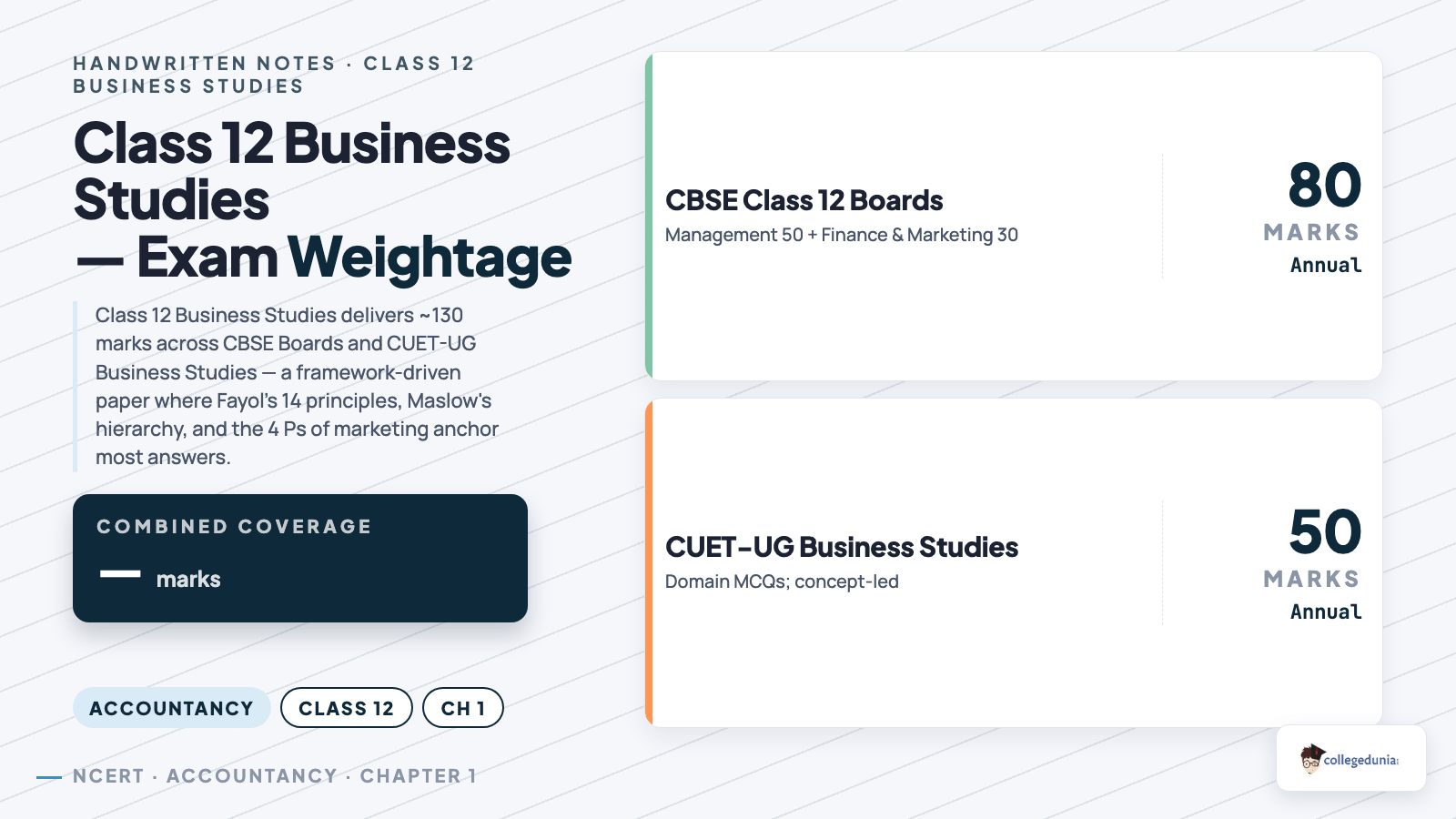
Class 12 Business Studies contributes roughly 130 marks combined across CBSE Boards and CUET UG (Commerce domain) - Business Studies is one of the two highest-scoring commerce papers in CUET, alongside Accountancy.
Class 12 Business Studies Weightage Snapshot (CBSE 2026 Theory Paper)
Chapter 11 Marketing delivers 10 marks of the 80-mark paper - the highest individual-chapter weightage. The handwritten 4 Ps diagram for this chapter is the highest-ROI final-week revision read.
| Unit | Chapter | CBSE Marks (2026) |
|---|---|---|
| Part A: Principles and Functions of Management | Ch 1 to Ch 8 | 50 marks |
| Nature and Significance of Management | Ch 1 | 5 marks |
| Principles of Management | Ch 2 | 7 marks |
| Business Environment | Ch 3 | 6 marks |
| Planning | Ch 4 | 5 marks |
| Organising | Ch 5 | 6 marks |
| Staffing | Ch 6 | 6 marks |
| Directing | Ch 7 | 9 marks |
| Controlling | Ch 8 | 6 marks |
| Part B: Business Finance and Marketing | Ch 9 to Ch 12 | 30 marks |
| Financial Management | Ch 9 | 8 marks |
| Financial Markets | Ch 10 | 6 marks |
| Marketing | Ch 11 | 10 marks |
| Consumer Protection | Ch 12 | 6 marks |
| Theory paper total | 12 chapters | 80 marks |
| Project work | n/a | 20 marks |
Class 12 Business Studies CBSE 2026 Paper Pattern Snapshot
The 80-mark CBSE Class 12 Business Studies theory paper runs 3 hours and splits across two parts plus the internal-assessment project. Knowing the section-by-section weight is half the revision plan; once you know which section a chapter feeds, you can pick the right resource (Notes for definition recall, NCERT Solutions for case-study long answers).
- Part A (50 marks): Principles and Functions of Management. Covers Ch 1 through Ch 8 - the largest block on the paper. Includes the foundational management chapters (Nature, Principles, Business Environment) plus the five functions of management (Planning, Organising, Staffing, Directing, Controlling). Directing (Ch 7) is the heaviest individual chapter at 9 marks.
- Part B (30 marks): Business Finance and Marketing. Covers Ch 9 through Ch 12. Marketing (Ch 11) is the heaviest individual chapter at 10 marks; the entire Part B is heavily case-study driven, with the 4 Ps framework and the Consumer Protection Act 2019 hierarchy serving as the answer-structuring backbone.
- Question types: Section A is Very Short Answer (1 mark, 16 questions); Section B is Short Answer I (3 marks); Section C is Short Answer II (4 marks); Section D is Long Answer (5 to 6 marks); Section E carries the 6-mark case study questions. The case-study questions reward students who can identify the framework (Fayol's principle, motivation theory, marketing mix element, consumer right) from the case-study narrative.
- Project work (20 marks internal assessment): includes a comprehensive project on a chapter topic (marketing management is the most-chosen project, followed by business environment, stock exchange, and principles of management), a viva, and a project report. Marks are awarded by the school in consultation with an external examiner.
The 80-mark theory paper plus the 20-mark project together make the 100-mark scheme. Part A delivers 50 of those 80 marks; building chapter fluency across Ch 7 (Directing, 9 marks) plus Ch 11 (Marketing, 10 marks) plus Ch 2 (Principles of Management, 7 marks) is the highest-ROI revision plan for any Business Studies student.
Where to Start in the Class 12 Business Studies Handwritten Notes Index
Handwritten notes work best as a second-pass revision tool. The chapter shortlist below matches the CBSE long-answer slots most often tested:
- Ch 11 Marketing (10 marks): hand-drawn 4 Ps diagram + channels of distribution flowchart make the chapter's full structure recallable in 5 minutes.
- Ch 7 Directing (9 marks): hand-drawn Maslow pyramid + leadership style comparison + communication-barriers list = the chapter's four sub-topics on one notebook spread.
- Ch 9 Financial Management (8 marks): hand-drawn three-decision diagram + capital structure factor list make the abstract concepts visual.
- Ch 2 Principles of Management (7 marks): hand-drawn Fayol's 14 infographic with mnemonic letters and Taylor's principles comparison side-by-side.
- Ch 3 Business Environment (6 marks): hand-drawn PESTLE diagram + WTO / IMF / World Bank comparison table.
- Ch 12 Consumer Protection (6 marks): hand-drawn three-tier Commission flowchart with jurisdiction limits noted alongside each tier.
Class 12 Business Studies Handwritten Notes: PDF Format
- HD ruled-paper PDF: high-resolution scan with clear ballpoint-pen text.
- Standard download PDF: smaller file size, useful for slow internet.
- Combined all-chapters PDF: all 12 chapter notebooks back to back as a single file, useful for printing the full revision booklet.
- Black-and-white print friendly: the ballpoint-blue ink and pencil shading both print cleanly in greyscale.
- Searchable PDF text layer: despite the handwritten look, every chapter PDF carries a hidden text layer so the find function works for searching specific framework terms.
How the Class 12 Business Studies Handwritten Notes Pair with the Other Resources
- Class 12 Business Studies Notes: the typeset concept revision; read this first when you encounter a new chapter, the handwritten notes are for revision passes 2 and 3.
- Class 12 Business Studies NCERT Solutions: the back-exercise worked end to end; use the handwritten notes alongside while attempting the back-exercise for the second time.
- Class 12 Business Studies NCERT Book PDF: the original NCERT chapter, useful for cross-checking a specific in-chapter case study.
How to Use the Handwritten Notes for Final-Week Revision
5-STEP METHOD · CBSE TOPPER ROUTINE
How to Use the Handwritten Notes - Class 12 Business Studies
- 1Read the chapter first. Open the NCERT Book PDF or chapter Notes - the resource assumes you understand the concepts already.
- 2Attempt each question on your own. Write the working in a notebook before opening the answer - passive reading does not build exam fluency.
- 3Compare your working to the resource. Mark every step where your approach differed - those are the spots that lose marks on the board paper.
- 4Flag questions taking over 7 minutes. These go on the re-attempt list for the final-week revision pass.
- 5Skim the highlighted lines the night before. Do not attempt fresh questions in the last 24 hours - your eye should rest on familiar margins, not on new derivations.
- Days 7 to 10 before the boards: read one chapter's handwritten notes per evening, focusing on the hand-drawn framework diagrams.
- Days 4 to 6: re-read the high-weightage chapters one more time; sketch the 4 Ps diagram and Maslow's pyramid from memory on a blank page, then compare with the handwritten version.
- Days 2 to 3: skim all 12 chapter notes once; the pen-and-paper texture trains your eye to find the specific framework you need on the answer paper.
- Night before the paper: open only the hand-drawn frameworks for the top three high-weightage chapters (Ch 11, Ch 7, Ch 9).
- Morning of the paper: 15 minutes skimming the hand-drawn 4 Ps diagram and Maslow's pyramid is the highest-ROI use of pre-exam time.
Common Mistakes Class 12 Business Studies Students Make with Handwritten Notes Revision
- Confusing Fayol's principles with Taylor's techniques: Ch 2 splits cleanly into Fayol's 14 principles (general management) and Taylor's scientific management techniques (workshop level). Students who mix the two lose marks on the every-other-year Fayol-vs-Taylor comparison question.
- Skipping the importance bullets on a 5-mark question: CBSE marking for Business Studies rewards the importance points separately from the definition and the example. A 5-mark answer typically needs definition + 3-4 importance points + a one-line example.
- Writing 'staffing function' without the staffing process steps: Ch 6 questions on staffing routinely ask for the staffing process; students who answer with just the definition lose the 6-step process marks (estimating manpower → recruitment → selection → placement → training → development).
- Treating motivation theories as optional revision: Ch 7 Maslow's hierarchy is the most-tested theory in the Directing chapter. The five-level pyramid (physiological, safety, social, esteem, self-actualisation) with examples for each level is a guaranteed 5-mark slot most years.
- Ignoring the marketing mix structure on Ch 11 questions: Marketing questions reward the 4 Ps framework (Product, Price, Place, Promotion). Answers that paraphrase without naming the framework lose the structural marks.
- Forgetting the redressal machinery hierarchy in Ch 12: Consumer Protection Act 2019 prescribes a three-tier hierarchy: District Commission (up to Rs 1 crore), State Commission (Rs 1 crore to Rs 10 crore), National Commission (above Rs 10 crore). The jurisdiction limits are a frequent 3-mark question.
- Writing project-style descriptive paragraphs in long-answer questions: The 20-mark internal project rewards descriptive writing; the 80-mark theory paper rewards structured point-form answers with headings, sub-headings and bullet points. Don't carry project-style prose into the theory paper.
Student Pulse: What 13,540 Class 12 Business Studies Students Told Us
What 13,540 students told us about their Class 12 Business Studies Handwritten Notes usage
- 63% of students rated Chapter 7 Directing as the highest-effort chapter, ahead of Chapter 2 Principles of Management at 57% and Chapter 11 Marketing at 49%. The breadth of Directing (supervision, motivation, leadership, communication - four sub-topics in one chapter) explains the gap.
- Most-skipped chapter: Chapter 12 Consumer Protection (skipped by ~24% of students despite carrying 6 marks). Toppers flagged this as the easiest 6-mark reclaim because the Consumer Protection Act 2019 hierarchy is memorisable in a single sitting.
- Toppers reported that adding the framework name (4 Ps, Fayol's 14, Taylor's principles, three-tier redressal) at the top of every long-answer question added 3-5 marks on the 80-mark theory paper - CBSE markers award framework-recognition marks separately from the explanation.
- The average Class 12 Business Studies student spent 42 hours across the 12 chapters of the syllabus to finish the NCERT back-exercise once, with Chapter 7 (Directing) and Chapter 11 (Marketing) eating the most time per question.
Also Check: Related Class 12 Business Studies Resources
- Also Check: CBSE Class 12 exam pattern, dates, and full-subject hub
- Also Check: CBSE Class 12 Syllabus 2026-27
- Also Check: CUET-UG 2026 (commerce-stream colleges)
- Also Check: CUET-UG 2026 Syllabus
Topper-tested takeaways for Class 12 Business Studies Handwritten Notes
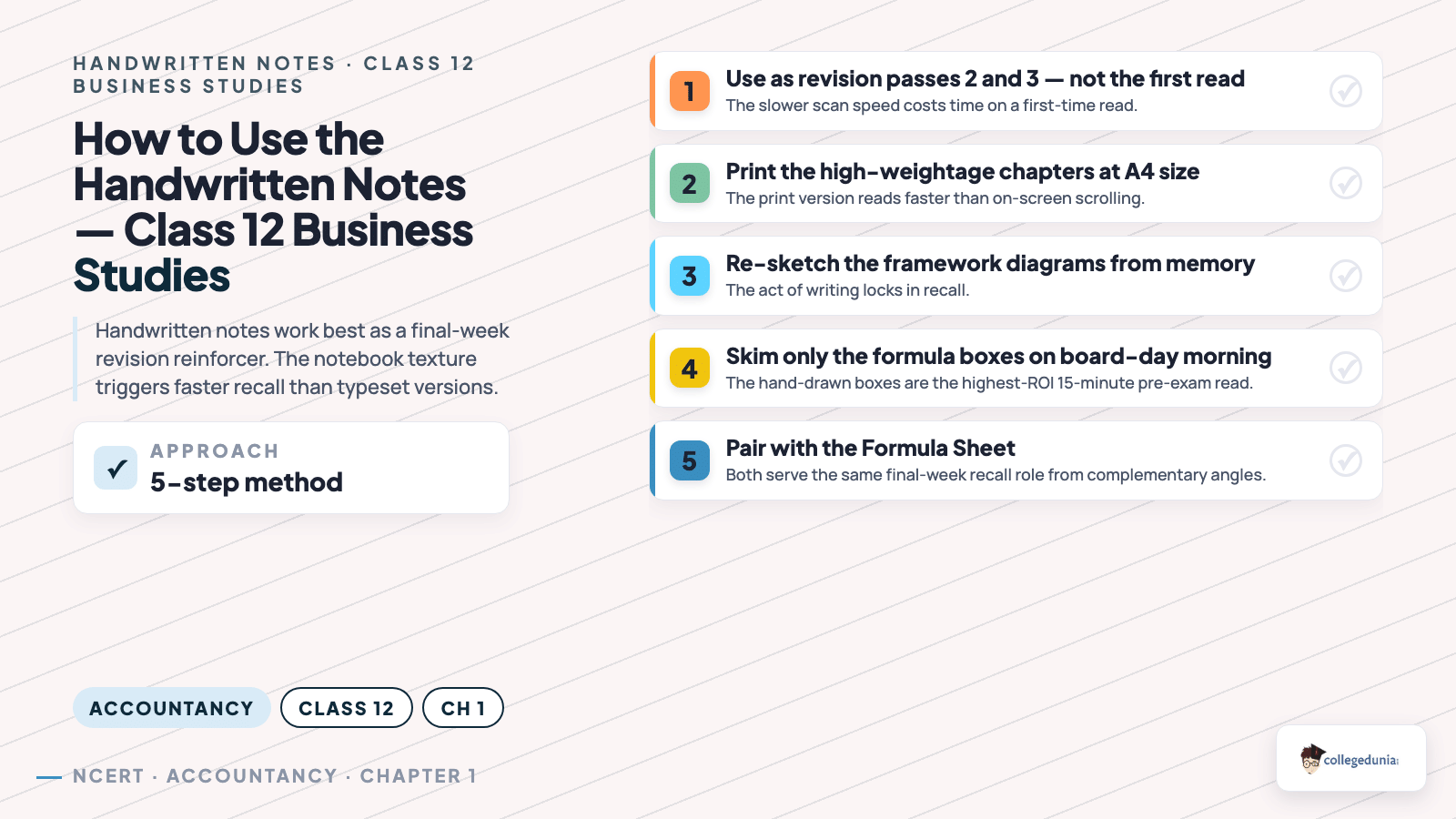
- Use the Handwritten Notes as a recall reinforcer after you have already attempted the NCERT back-exercise; the notebook texture triggers faster framework recall during the exam.
- Print the high-weightage chapters (Ch 7 Directing, Ch 11 Marketing, Ch 2 Principles of Management) at A4 size; the hand-drawn framework diagrams read faster from print than from screen.
- Re-sketch the 4 Ps marketing mix diagram and Maslow's hierarchy pyramid from memory on a blank page after each reading pass; the act of writing locks in the framework structure.
- The handwritten Chapter 12 (Consumer Protection) is the highest-ROI reclaim chapter; the three-tier Commission hierarchy fits cleanly into a hand-drawn flowchart.
Class 12 Business Studies Handwritten Notes FAQs
Ques. Where can I download the Class 12 Business Studies Handwritten Notes PDF for all chapters?
Ans. Every chapter-wise Class 12 Business Studies Handwritten Notes PDF is downloadable directly from the index above, covering all 12 chapters - Ch 1 (Nature and Significance of Management) through Ch 12 (Consumer Protection). A combined all-chapters PDF is also available, free in both Normal and HD resolutions.
Ques. Is this Class 12 Business Studies Handwritten Notes aligned with the 2026-27 NCERT?
Ans. Yes. Every chapter reflects the current 2026-27 rationalised NCERT for both Part A (Principles and Functions of Management) and Part B (Business Finance and Marketing). Where NCERT rationalised content out of the older edition, the affected sections carry an inline callout flagging the change.
Ques. How many chapters are there in Class 12 Business Studies per the 2026-27 NCERT?
Ans. Class 12 Business Studies has 12 chapters across two CBSE parts: Part A covers the foundational management concepts and the five functions of management (Ch 1 through Ch 8), and Part B covers business finance, financial markets, marketing and consumer protection (Ch 9 through Ch 12). The Topic Map table above lists every chapter under its CBSE part.
Ques. Which Class 12 Business Studies chapter has the highest CBSE board weightage?
Ans. Chapter 11 Marketing carries the highest individual-chapter weightage at 10 marks, followed by Chapter 7 Directing at 9 marks and Chapter 9 Financial Management at 8 marks. Part A as a block carries 50 marks; Part B carries 30. The Weightage Snapshot table above tracks each chapter's mark share.
Ques. How are the Class 12 Business Studies Handwritten Notes different from the other Class 12 Business Studies resources?
Ans. The Class 12 Business Studies Handwritten Notes is best paired with the typeset Notes for first-pass concept revision and the NCERT Solutions for the back-exercise working. Each resource type covers the same 12-chapter syllabus but in a different format; together they make a complete revision toolkit.
Ques. What does the Class 12 Business Studies project work cover?
Ans. The 20-mark internal-assessment project is a chapter-anchored research project plus a viva and a project report. The most-chosen project topics map onto Ch 11 Marketing (marketing management of a real product), Ch 3 Business Environment (impact of a recent policy change on a business sector), Ch 10 Financial Markets (stock exchange or SEBI case study), and Ch 2 Principles of Management (Fayol or Taylor application study). The project should be started in the first quarter so research and report writing have a realistic timeline.
Ques. Are these Class 12 Business Studies Handwritten Notes files available in Hindi medium?
Ans. Yes. Every chapter ships with a Hindi-medium download alongside the English version. The Hindi files follow NCERT's own technical vocabulary (Vyavasaya Adhyayan), with terms like प्रबंध (management), नियोजन (planning), and उपभोक्ता संरक्षण (consumer protection) preserved as NCERT writes them.
Ques. Are the NCERT solutions enough for the CBSE Class 12 Business Studies board paper or do I also need Sandeep Garg / Poonam Gandhi?
Ans. The NCERT Business Studies back-exercise is the canonical source for every CBSE board question; building fluency on the NCERT alone is sufficient to score in the 70-80 mark range. Supplementary textbooks like Sandeep Garg, Poonam Gandhi, and Subhash Dey are useful for additional case-study volume - especially the longer 6-mark case studies - but they are not a substitute for the NCERT. Open them only after the NCERT chapter and back-exercise are complete.
Ques. How should I attempt the case-study questions on the CBSE Business Studies paper?
Ans. Identify the framework first (Fayol's principle, Taylor's principle, motivation theory, leadership style, marketing mix element, consumer right, financial decision). Write the framework name in the first line of the answer. Then explain how the case-study narrative maps onto that framework. CBSE markers award framework-recognition marks separately from the explanation - missing the framework name loses 1-2 marks per case study even when the explanation is correct.
Ques. What does Class 12 Business Studies cover?
Ans. Class 12 Business Studies covers 12 chapters across two CBSE parts: Part A (Principles and Functions of Management, 50 marks) covers nature and significance of management, Fayol and Taylor's principles, business environment (including WTO, IMF and World Bank), and the five functions of management - planning, organising, staffing, directing and controlling. Part B (Business Finance and Marketing, 30 marks) covers financial management, financial markets and SEBI, the 4 Ps of marketing, and consumer protection under the Consumer Protection Act 2019. The 80-mark theory paper plus the 20-mark internal-assessment project together make the 100-mark scheme.
Ques. Which is the most-scoring chapter in Class 12 Business Studies?
Ans. Chapter 11 Marketing is the highest-yield individual chapter at 10 marks. Chapter 7 Directing follows at 9 marks, and Chapter 9 Financial Management at 8 marks. Together these three chapters deliver 27 of the 80 theory marks - the priority shortlist for any revision plan with limited time.
Ques. How should I structure my Class 12 Business Studies preparation?
Ans. Build chapter by chapter in NCERT order, prioritising Part A (50 marks: Ch 1-8) over Part B (30 marks: Ch 9-12). Use the NCERT Book PDF for concept reading, the NCERT Solutions for back-exercise and case-study practice, the Notes for second-pass revision, and the Handwritten Notes for the final two weeks. Start the 20-mark internal project early (first quarter) and pair every long-answer practice with framework-naming discipline.



Comments