


The NCERT Formula Sheet for Class 12 Chemistry, Chapter 6 Haloalkanes and Haloarenes, will be helpful during exam revision. You can also learn important organic chemistry reactions such as SN1, SN2, β-elimination, Sandmeyer, Finkelstein, and Swarts through mnemonics or mind maps.
In this page, all important derivations and reactions mentioned in the NCERT Chapter 6 are included at one place in an organised manner. During last-minute revision, you can complete the NCERT formula sheet of Haloalkanes and Haloarenes in just 30-40 minutes if read earlier.
- CBSE Weightage: 3 to 5 marks
- JEE Main Weightage: 2 to 3 per cent (2 to 3 questions per paper)
- NEET Weightage: 2 to 3 questions per year
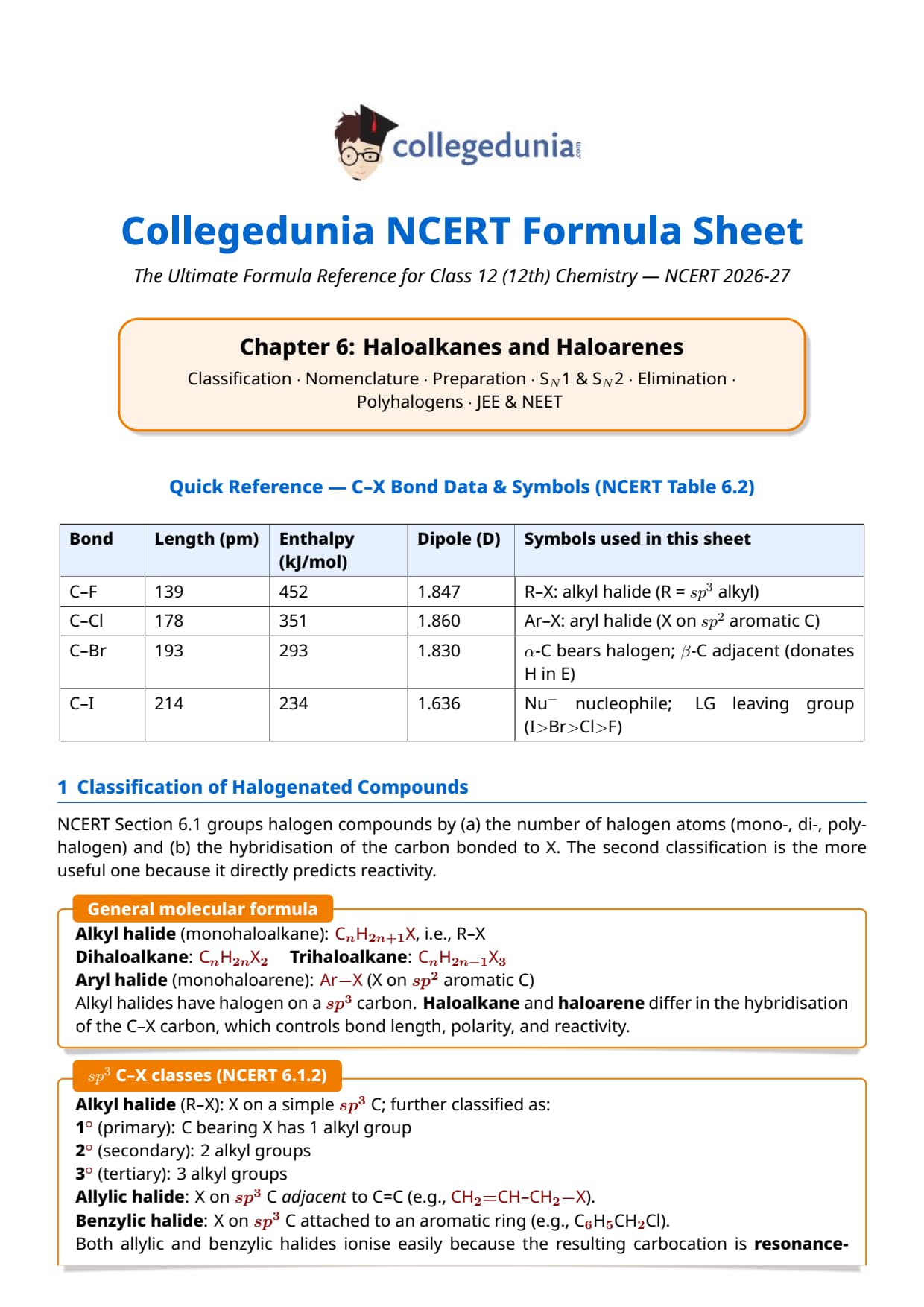

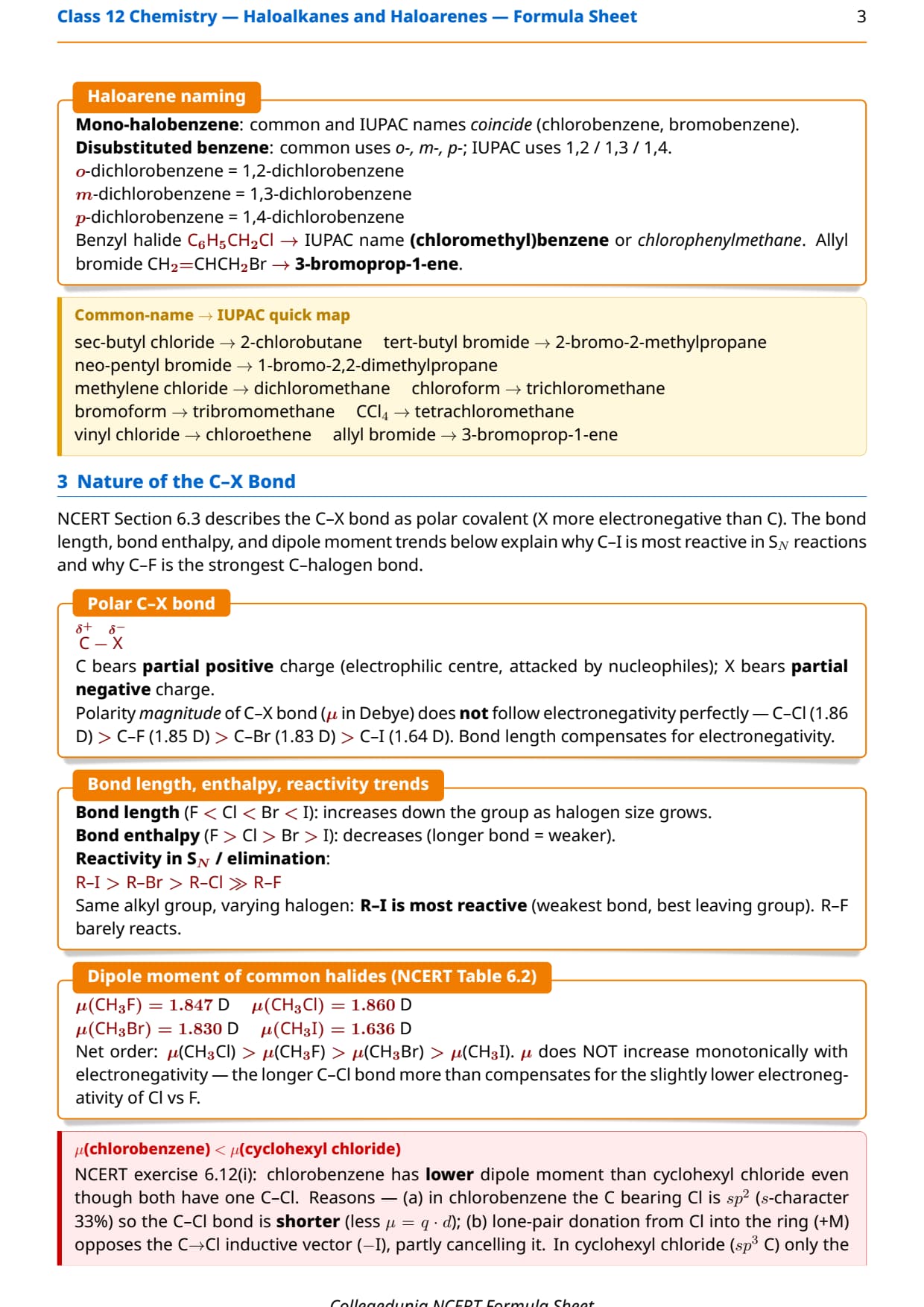
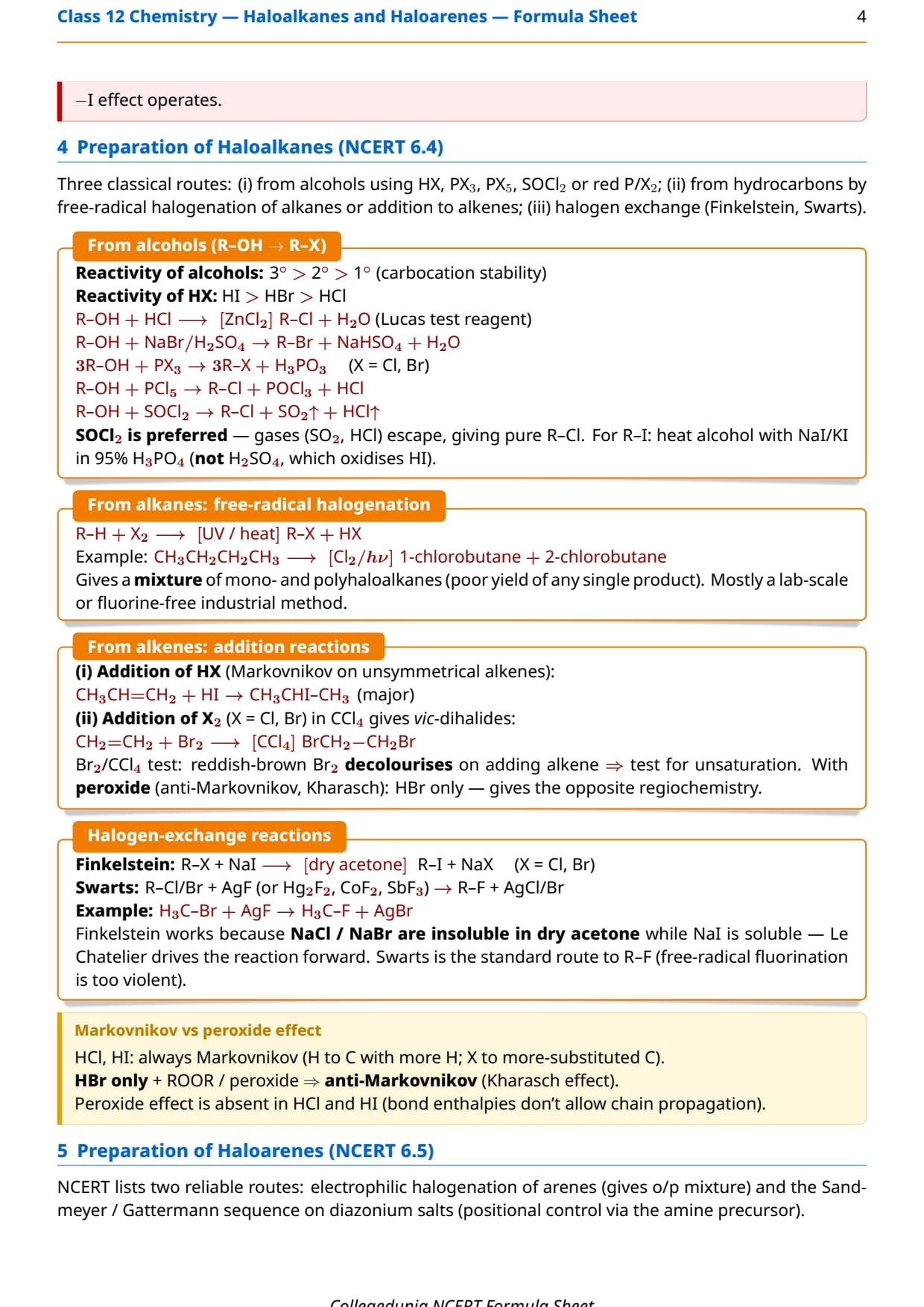
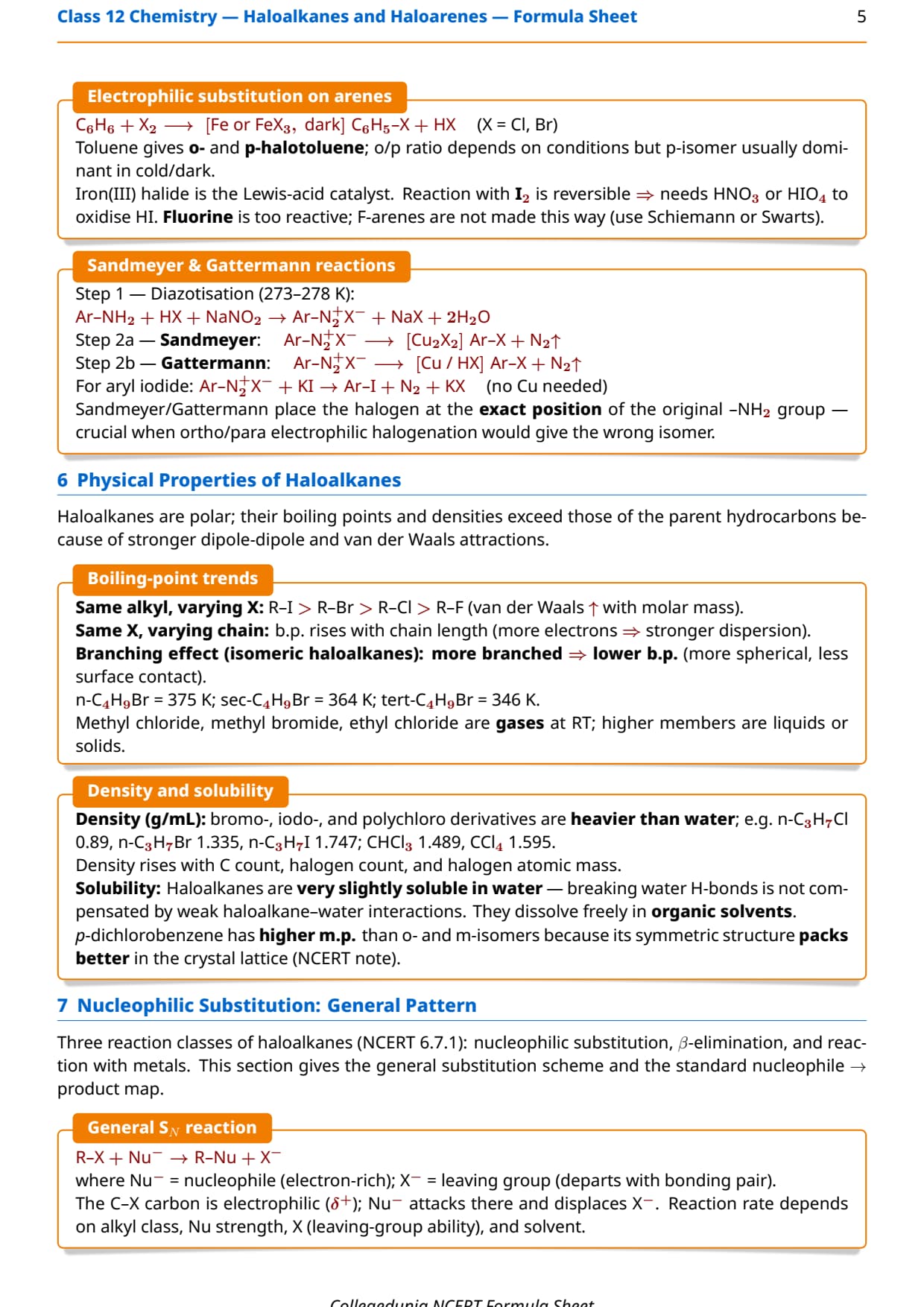
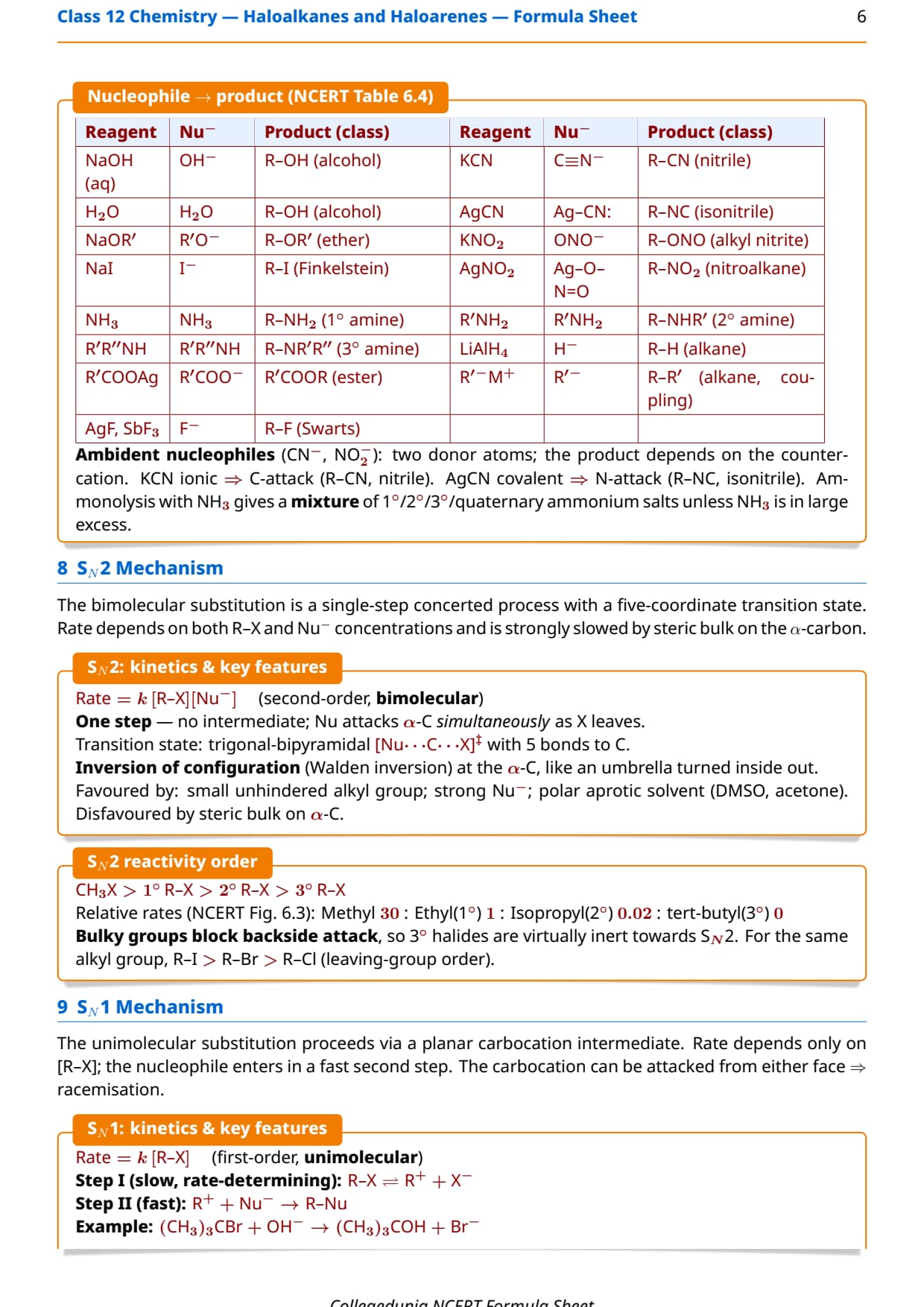
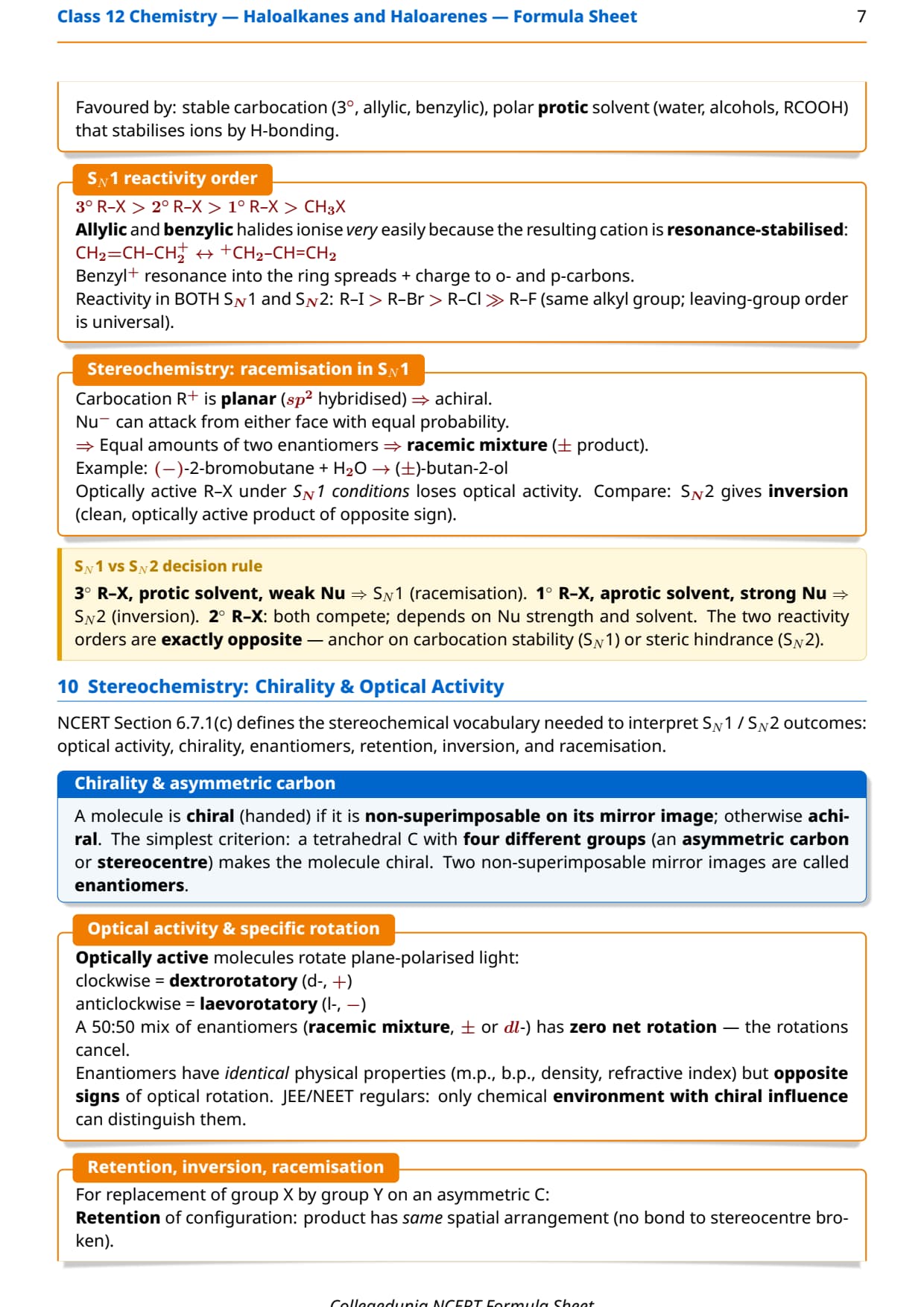
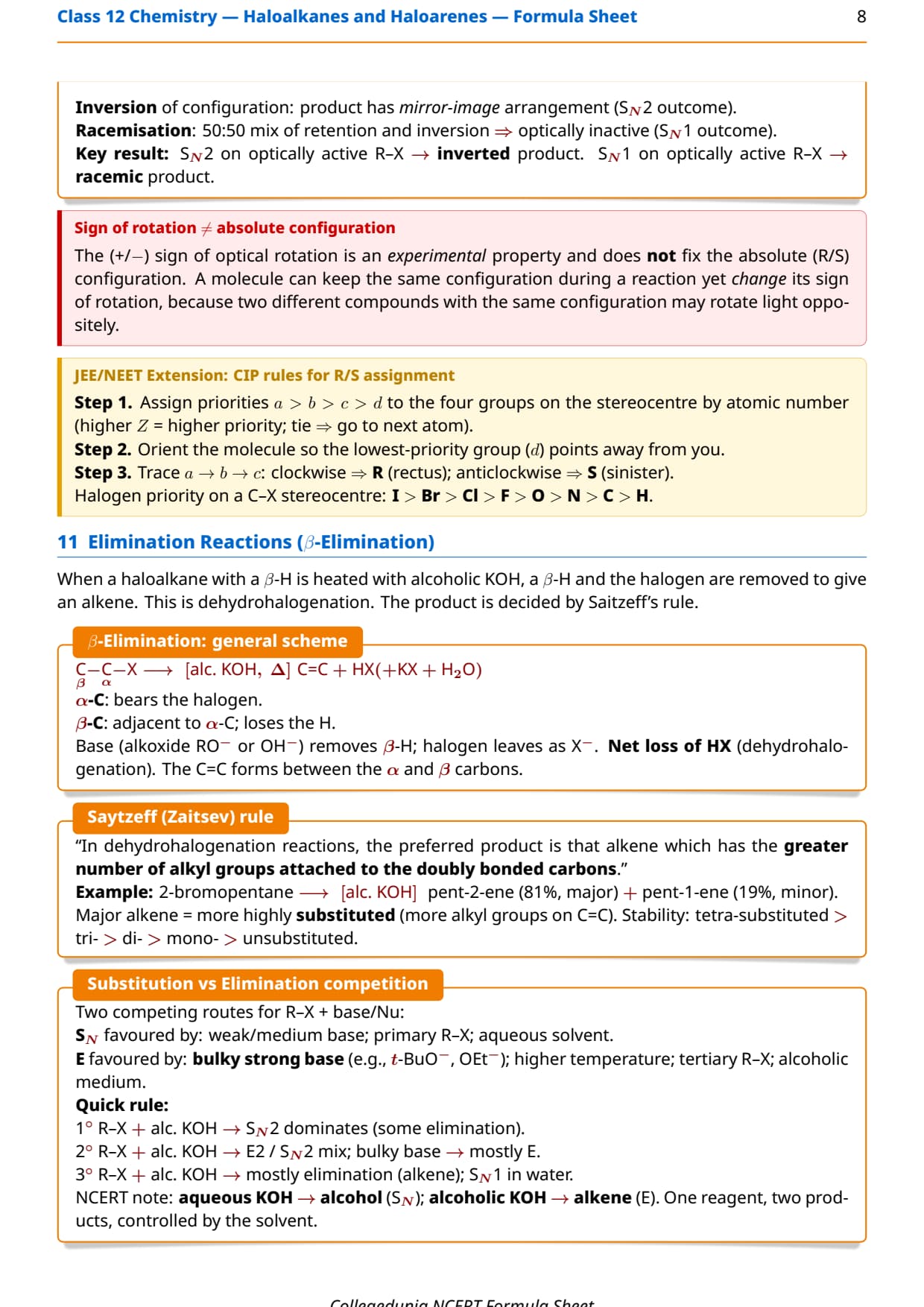
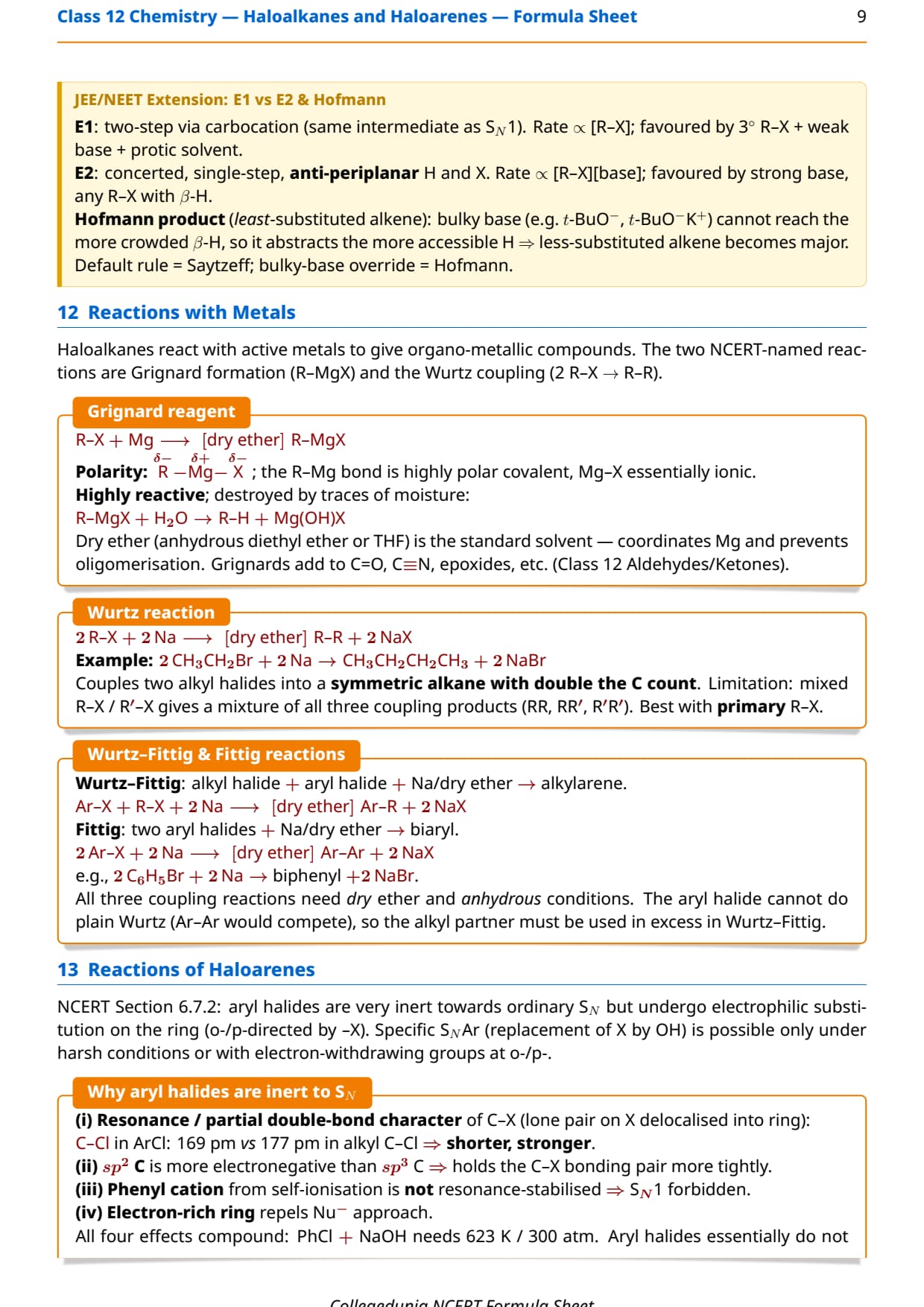
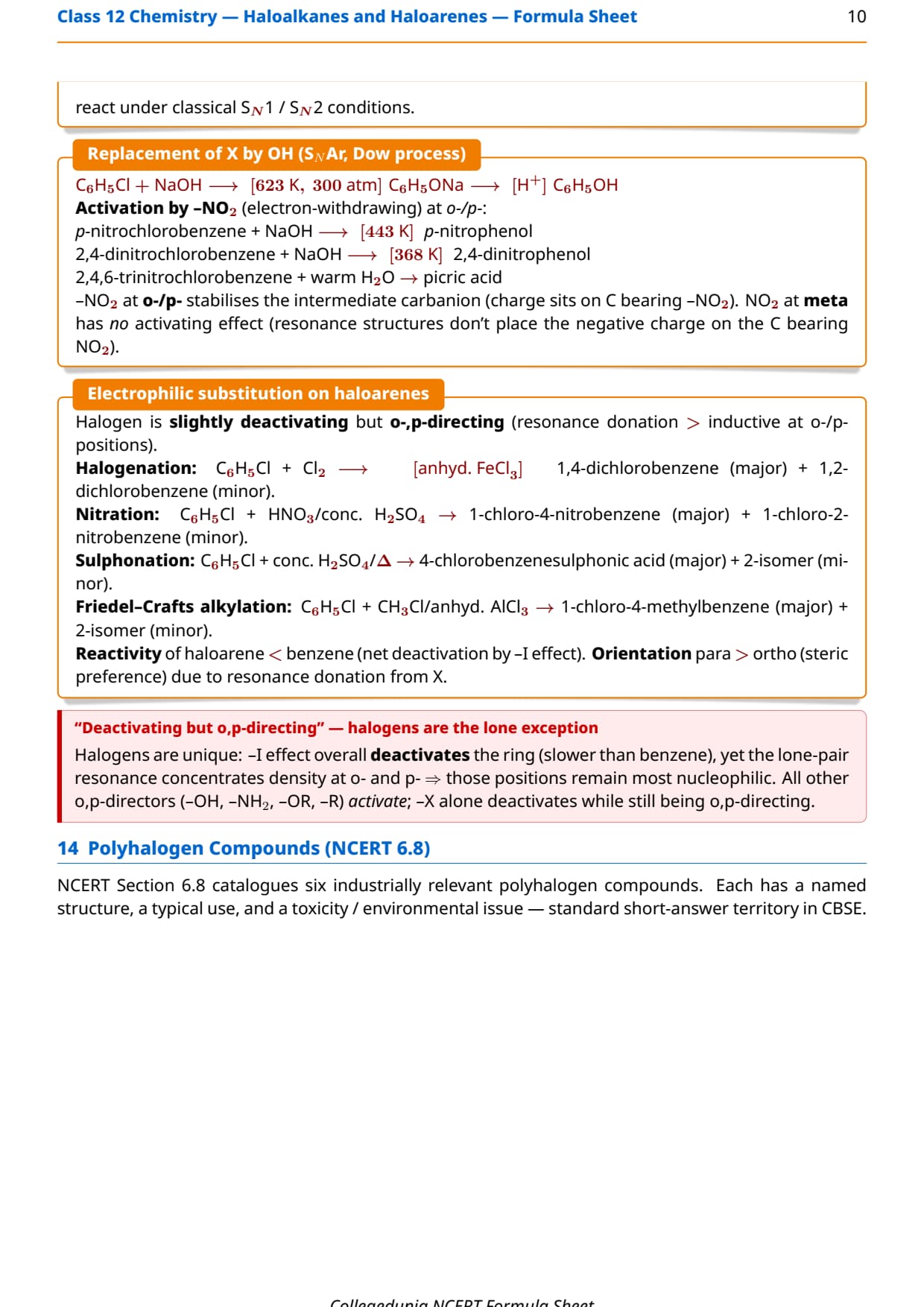
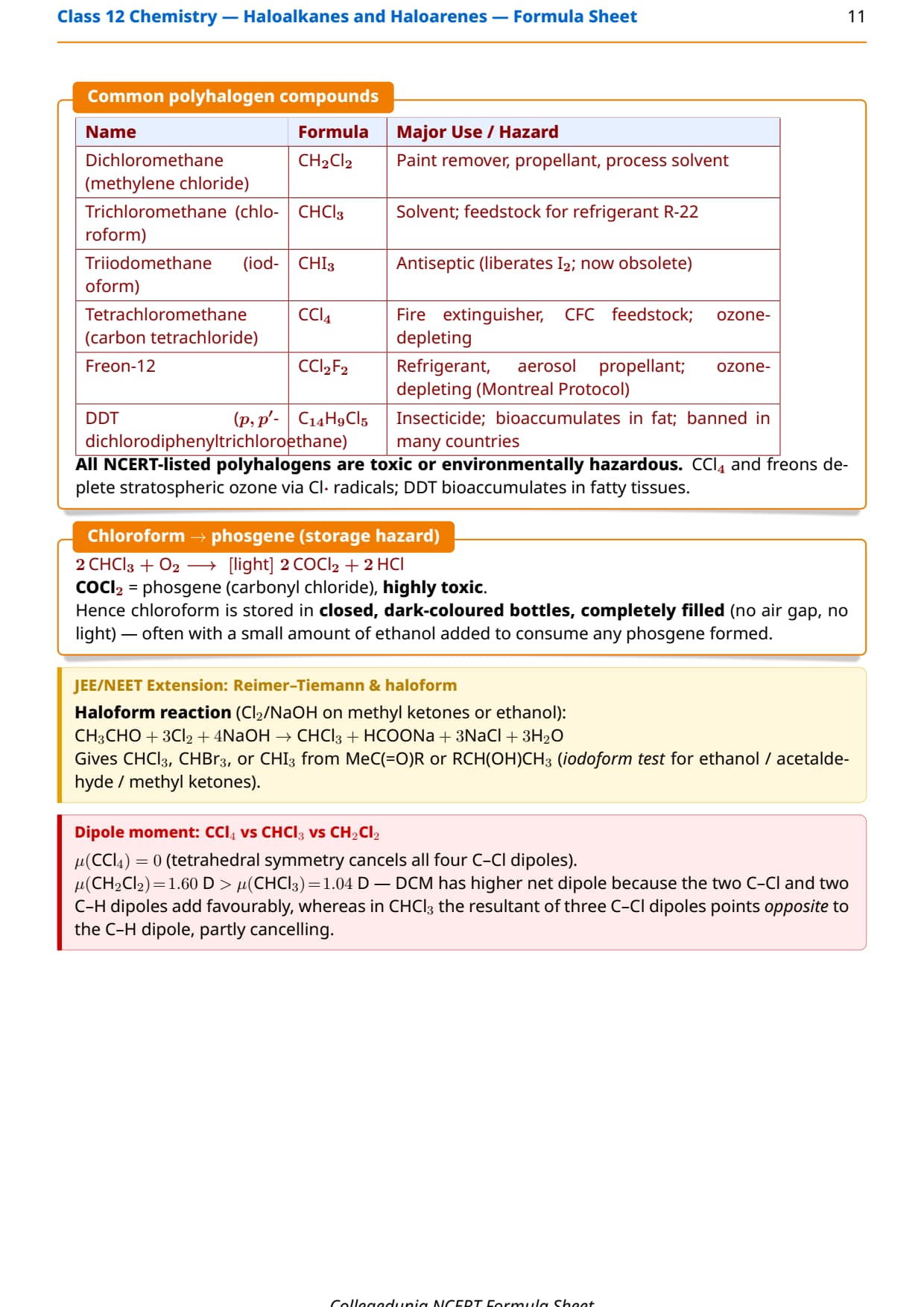
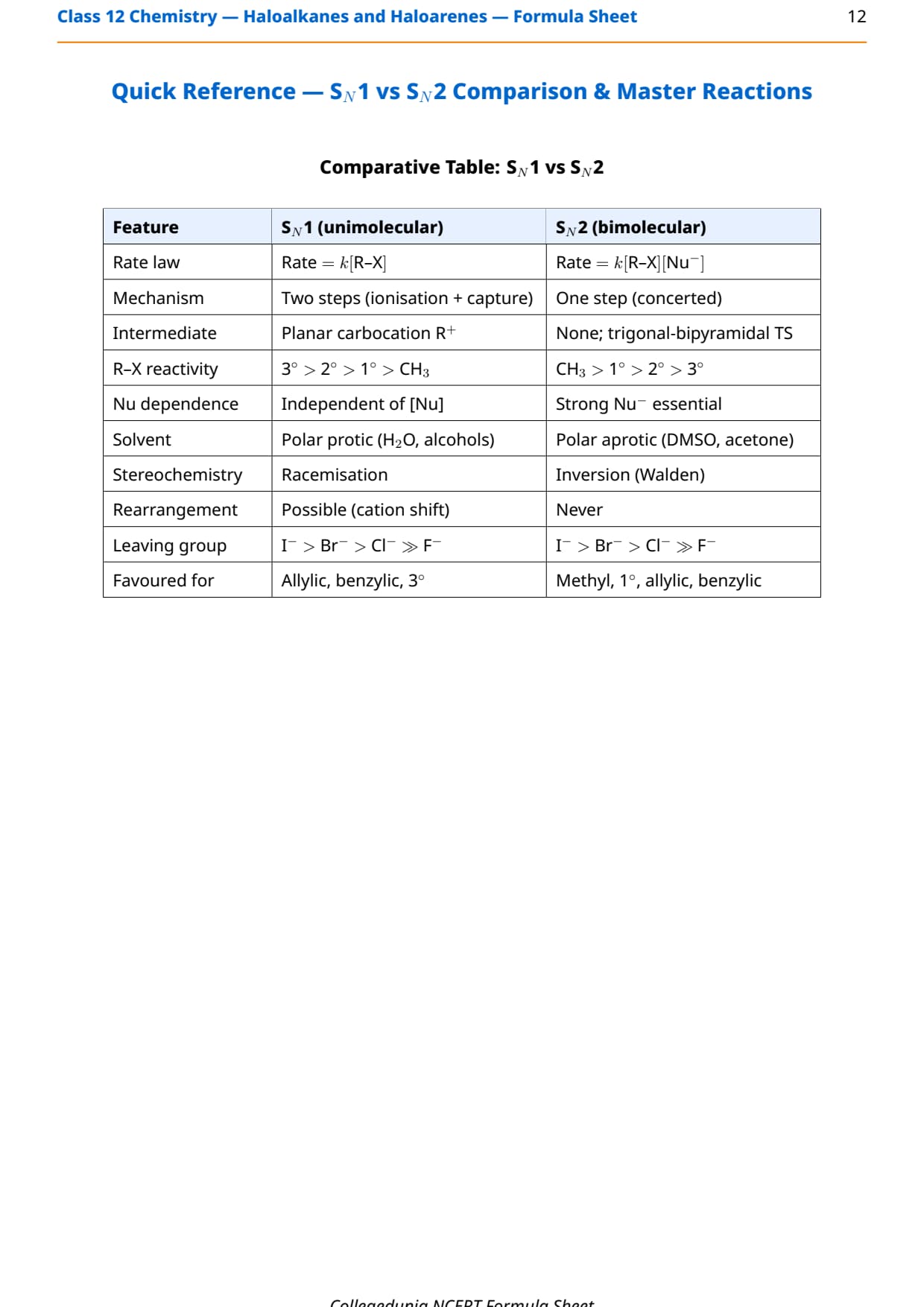
This formula sheet is curated by Collegedunia subject experts, mapped to the 2026-27 new NCERT edition, and refined against the last five years of CBSE Board, JEE Main, and NEET papers.
The compact sheet that follows lists every formula, mechanism cue, and reactivity ladder, with its NCERT section reference.
Also Check:
- Haloalkanes and Haloarenes Class 12 Chemistry Notes
- Haloalkanes and Haloarenes Class 12 Chemistry NCERT Solutions
- CBSE Class 12 Chemistry Syllabus 2026-27

Haloalkanes and Haloarenes Symbol Glossary for Class 12 Chemistry
Mixing up the α-carbon (bears the halogen) with the β-carbon (donates the H in elimination) is the most common slip on mechanism questions. The glossary below locks in every notation used in the master table.
| Symbol | Meaning | Typical Unit / Value |
|---|---|---|
| R-X | Generic alkyl halide (X on sp3 C) | - |
| Ar-X | Aryl halide (X on sp2 aromatic C) | - |
| α-C | Carbon bearing the halogen (electrophilic centre) | - |
| β-C | Carbon adjacent to α-C; donates H in elimination | - |
| Nu- | Nucleophile (electron-rich species) | - |
| LG | Leaving group (departs with the bonding pair) | I > Br > Cl > F (best to worst) |
| SN1 | Unimolecular substitution; first-order rate | Rate = k[R-X] |
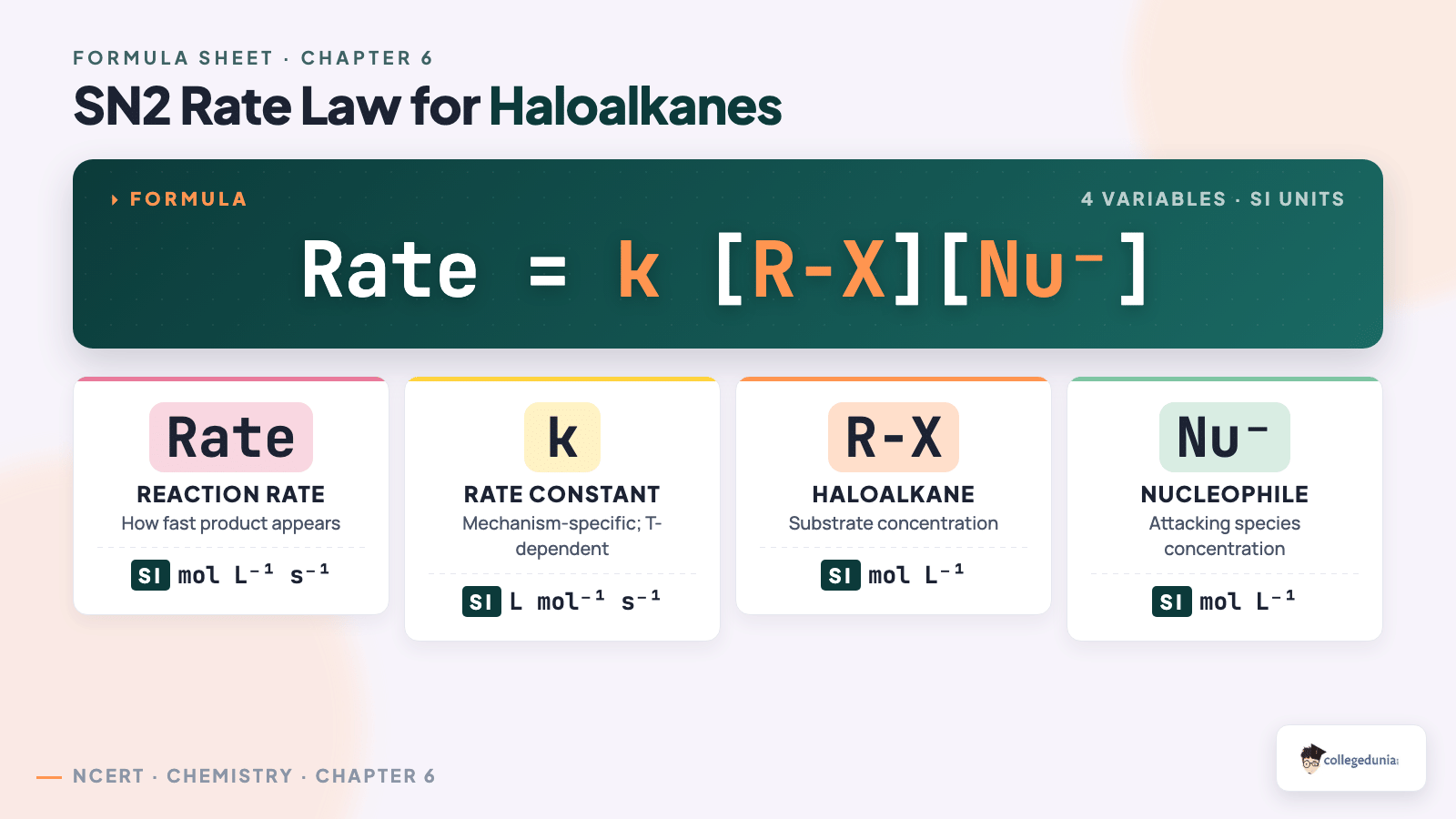
| SN2 | Bimolecular substitution; second-order rate | Rate = k[R-X][Nu-] |
| μ | Dipole moment of C-X bond | Debye (D) |
| E | β-elimination (dehydrohalogenation) | Net loss of HX |
| (±), dl- | Racemic mixture (50:50 enantiomers) | Zero net rotation |
Haloalkanes and Haloarenes Video Walkthrough
Source: Magnet Brains on YouTube
Haloalkanes and Haloarenes All Important Formulae for Class 12 Chemistry
The canonical master table below lists every working formula, rate law, named reaction, and quantitative trend in NCERT Chapter 6, with values, section reference, and the typical exam-use cue. All entries below are retained in the 2026-27 syllabus.
| Concept | Formula / Relation | Value or Unit | NCERT Ref | Common Use |
|---|---|---|---|---|
| Alkyl halide general formula | CnH2n+1X | - | 6.1 | Monohaloalkane |
| Dihaloalkane general formula | CnH2nX2 | - | 6.1 | gem or vic |
| Trihaloalkane general formula | CnH2n-1X3 | - | 6.1 | e.g. CHCl3 |
| Aryl halide general formula | Ar-X | - | 6.1 | X on sp2 aromatic C |
| C-F bond length / enthalpy / μ | 139 pm / 452 kJ mol-1 / 1.847 D | NCERT Table 6.2 | 6.3 | Strongest C-X bond |
| C-Cl bond length / enthalpy / μ | 178 pm / 351 kJ mol-1 / 1.860 D | NCERT Table 6.2 | 6.3 | Highest μ of CH3X |
| C-Br bond length / enthalpy / μ | 193 pm / 293 kJ mol-1 / 1.830 D | NCERT Table 6.2 | 6.3 | Moderate reactivity |
| C-I bond length / enthalpy / μ | 214 pm / 234 kJ mol-1 / 1.636 D | NCERT Table 6.2 | 6.3 | Most reactive (weakest bond) |
| Bond length trend | C-F < C-Cl < C-Br < C-I | pm | 6.3 | Grows down group |
| Bond enthalpy trend | C-F > C-Cl > C-Br > C-I | kJ mol-1 | 6.3 | Longer bond, weaker |
| Reactivity in SN (same R) | R-I > R-Br > R-Cl ≫ R-F | - | 6.3 / 6.7 | Leaving-group ability |
| R-OH + HX (Lucas test, anhydrous ZnCl2) | R-OH + HCl anhyd. ZnCl2 R-Cl + H2O | - | 6.4 | 3° immediate; 2° 5-10 min; 1° nil at RT |
| R-OH + PX3 | 3R-OH + PX3 → 3R-X + H3PO3 | X = Cl, Br | 6.4 | Lab-scale prep |
| R-OH + SOCl2 | R-OH + SOCl2 → R-Cl + SO2↑ + HCl↑ | - | 6.4 | Preferred (gases escape) |
| Free-radical halogenation | R-H + X2 UV/heat R-X + HX | - | 6.4 | Mixture of products |
| Markovnikov addition | CH3CH=CH2 + HX → CH3CHX-CH3 | - | 6.4 | H goes to C with more H |
| Kharasch (anti-Markovnikov) | CH3CH=CH2 + HBr ROOR CH3CH2-CH2Br | HBr only | 6.4 | Peroxide effect |
| X2 addition (vic-dihalide) | CH2=CH2 + Br2 CCl4 BrCH2-CH2Br | - | 6.4 | Test for C=C |
| Finkelstein reaction | R-X + NaI dry acetone R-I + NaX | X = Cl, Br | 6.4 | Prep of R-I |
| Swarts reaction | R-Cl/Br + AgF → R-F + AgCl/Br | also Hg2F2, CoF2, SbF3 | 6.4 | Prep of R-F |
| Electrophilic halogenation of arene | C6H6 + X2 Fe or FeX3 C6H5-X + HX | X = Cl, Br | 6.5 | Prep of Ar-X |
| Sandmeyer reaction | Ar-N2+X- Cu2X2 Ar-X + N2 | X = Cl, Br, CN | 6.5 | Exact-position Ar-X |
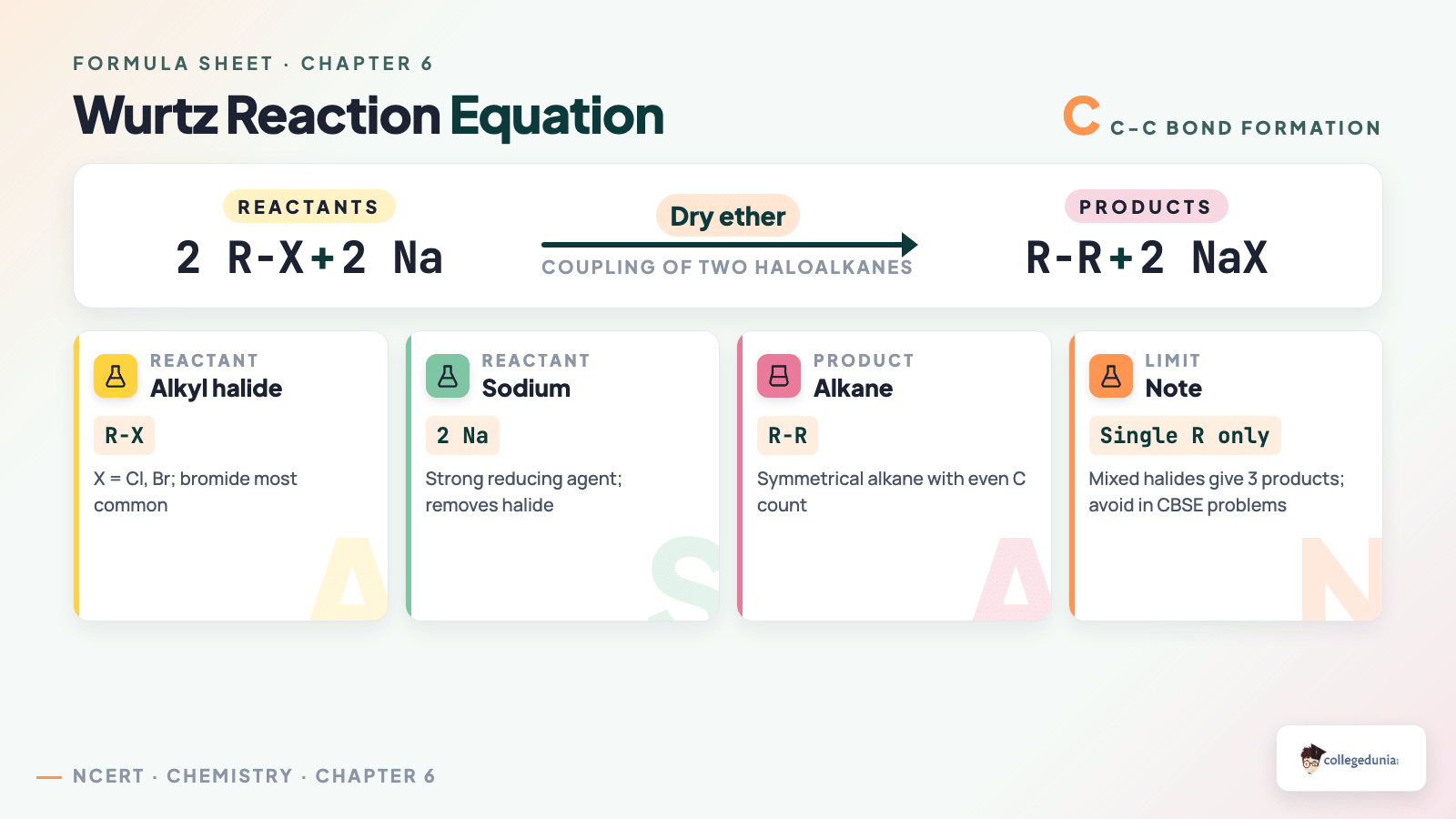
| Wurtz reaction | 2R-X + 2Na dry ether R-R + 2NaX | Symmetrical alkane | 6.4 | Same R both sides |
| Wurtz-Fittig reaction | Ar-X + R-X + 2Na dry ether Ar-R + 2NaX | Alkylarene | 6.5 | Mixed alkyl-aryl coupling |
| Fittig reaction | 2Ar-X + 2Na dry ether Ar-Ar + 2NaX | Biaryl | 6.5 | Same Ar both sides |
| Gattermann reaction | Ar-N2+X- Cu/HX Ar-X + N2 | X = Cl, Br | 6.5 | Cheaper than Sandmeyer |
| Aryl iodide (no Cu) | Ar-N2+X- + KI → Ar-I + N2 + KX | - | 6.5 | I- reduces directly |
| SN2 rate law | Rate = k[R-X][Nu-] | second-order | 6.7 | Bimolecular, one step |
| SN2 reactivity (alkyl class) | CH3X > 1∘ R-X > 2∘ R-X > 3∘ R-X | Relative 30 : 1 : 0.02 : 0 | 6.7 | Steric bulk slows it |
| SN1 rate law | Rate = k[R-X] | first-order | 6.7 | Unimolecular, two steps |
| SN1 reactivity (alkyl class) | 3∘ R-X > 2∘ R-X > 1∘ R-X > CH3X | - | 6.7 | Carbocation stability |
| Saytzeff rule (E) | C-C-X alc. KOH, Δ C=C + HX | - | 6.7 | More substituted alkene wins |
| Substitution vs Elimination | aq. KOH → SN (R-OH); alc. KOH → E (alkene) | - | 6.7 | Same reagent, different solvent |
| Walden inversion (SN2) | Optically active R-X → inverted product | - | 6.7 | Backside attack |
| Racemisation (SN1) | Optically active R-X → (±) racemic mixture | Zero net rotation | 6.7 | Planar R+ intermediate |
| R/S configuration (CIP) | Rank 4 groups; orient 4 away; 1→2→3 cw = R; acw = S | Absolute config. | 6.7 | 2-bromobutane, 2-chloropentane |
| Chiral centre identification | Carbon with 4 different substituents | - | 6.7 | One per chiral C (2n stereoisomers) |
| Optical isomerism | Enantiomers rotate plane-polarised light by ±α | Equal & opposite | 6.7 | Resolved by chiral chromatography |
| DDT preparation | 2 C6H5Cl + CCl3CHO ⟶[conc.\ H2SO4] (p-ClC6H4)2CHCCl3 | - | 6.8 | Banned pesticide |
| Freon (CFC) preparation | CCl4 + SbF3/HF → CCl2F2 (Freon-12) | Swarts route | 6.8 | Ozone-depleting (Montreal) |
Use the C-X bond-enthalpy ladder as the single anchor for every reactivity question: R-I is most reactive because the C-I bond is the weakest, not because I is most electronegative. The polarity trend (C-Cl > C-F > C-Br > C-I in μ) is a separate fact and does NOT mirror reactivity. Confusing polarity with reactivity is the most common 1-mark slip in CBSE 2024 and 2025 booklets.
Haloalkanes and Haloarenes Bond-Property Reference Table
The four-row table below is the lookup students need for every C-X numerical and trend question. CBSE has asked at least one bond-enthalpy or dipole-moment ranking item every year since 2021.
| Halogen | Bond length (pm) | Bond enthalpy (kJ mol-1) | Dipole moment of CH3X (D) | Relative reactivity |
|---|---|---|---|---|
| F | 139 | 452 | 1.847 | Least reactive (very strong bond) |
| Cl | 178 | 351 | 1.860 | Slow |
| Br | 193 | 293 | 1.830 | Moderate |
| I | 214 | 234 | 1.636 | Most reactive (weakest bond, best LG) |
How will Collegedunia's Haloalkanes and Haloarenes Formula Sheet Help You?
The sheet is built for a 30-minute last-pass revision the night before any Chemistry paper.
- 2026-27 NCERT Alignment: Every formula, rate law, and reactivity ladder matches the current syllabus print of Sections 6.1 to 6.7.
- One-Page Printability: The master table fits on a single A4 landscape sheet.
- Mechanism Tagging: Each reaction is tagged SN1, SN2, E, or named (Sandmeyer, Finkelstein, Swarts).
- Expert Verification: Cross-checked against NCERT Sections 6.1 to 6.7 and the last five JEE Main and NEET papers.
SN1 vs SN2 Decision Tree for 12th Chemistry Mechanism Questions
Match the substrate, nucleophile, and solvent to the mechanism, and the rate law falls out. This four-line decision tree handles every CBSE and JEE Main mechanism MCQ on Chapter 6.
- 3° R-X + polar protic solvent + weak Nu: SN1 dominates. Rate = k[R-X]. Product is racemic.
- 1° R-X + polar aprotic solvent + strong Nu: SN2 dominates. Rate = k[R-X][Nu-]. Product is inverted (Walden).
- 2° R-X: both mechanisms compete; the stronger Nu and aprotic solvent push it to SN2, weaker Nu and protic solvent push to SN1.
- 3° R-X + alcoholic KOH: elimination wins (E), gives the more-substituted alkene (Saytzeff).
Haloalkanes Quick-Fact Cards for MCQ Recall
The four facts below are the ones JEE Main and NEET rotate as 1-mark MCQs. Lock them in cold.
Haloalkanes and Haloarenes Common-Numerical Pattern Templates
The four numerical setups below have dominated CBSE, JEE Main, and NEET papers since 2021.
| Pattern | What the question gives | Formula to apply | Common trap |
|---|---|---|---|
| Mechanism prediction | R-X class + Nu + solvent | Run the SN1 vs SN2 decision tree above | Forgetting that 3° R-X with alc. KOH gives elimination, not substitution |
| Reactivity ranking | List of R-X with same R, varying X | R-I > R-Br > R-Cl ≫ R-F (leaving-group order) | Mixing up bond polarity with bond strength |
| Product of E reaction | R-X with multiple β-H positions | Saytzeff: pick alkene with more alkyl groups on C=C | Counting H instead of alkyl substituents on the C=C |
| Named-reaction product | Aryl diazonium + reagent (Cu2X2, KI, Cu/HX) | Sandmeyer (Cu2X2), Gattermann (Cu/HX), aryl-I via KI alone | Using direct electrophilic halogenation when a specific position is required |
Haloalkanes and Haloarenes Top 3 Most-Asked PYQ Topics in CBSE, JEE and NEET
The three patterns below have repeated most often since 2021. The full year-by-year map sits on the Collegedunia NCERT Solutions page.
| Topic | Frequency (CBSE + JEE + NEET, 2026 to 2021) | Typical mark band |
|---|---|---|
| SN1 vs SN2 mechanism / rate-law identification | 12 times | 1 to 3 marks |
| Named reactions: Sandmeyer, Finkelstein, Swarts, Gattermann | 9 times | 2 to 3 marks |
| Reactivity order across halogens and alkyl classes | 8 times | 1 to 2 marks |
Full year-wise PYQ map: Haloalkanes and Haloarenes Class 12 Chemistry NCERT Solutions
One-Shot Revision Tips for Class 12th Chemistry Haloalkanes and Haloarenes
- IUPAC nomenclature rule: halogen as halo- prefix, numbering gives the halogen the lowest locant, prefixes listed alphabetically (bromo before chloro before methyl).
- gem vs vic dihalide: gem = both X on the same C (alkylidene halide); vic = X on adjacent C (alkylene halide). vic-dihalides are the standard Br2/CCl4 addition product on alkenes.
- Phenols cannot give aryl halides via direct HX / PX3 / SOCl2 because the C-O bond in Ar-OH has partial double-bond character and is too strong to cleave.
- SOCl2 is preferred for R-OH → R-Cl: by-products SO2 and HCl escape as gases, giving pure R-Cl.
- p-dichlorobenzene has higher m.p. than o- and m-isomers because its symmetric structure packs better in the crystal lattice (NCERT note).
Haloalkanes and Haloarenes Weightage Compared Across Class 12 Chemistry Chapters
Typical CBSE marks distribution across the 10 chapters of the 2026-27 NCERT, averaged over the last five board papers. Haloalkanes and Haloarenes sits in the lower-mid tier because much of its content is mechanism-explanation rather than long-answer numerical.
Related Links:
- Coordination Compounds Class 12 Chemistry Formula Sheet (Previous Chapter)
- Alcohols, Phenols and Ethers Class 12 Chemistry Formula Sheet (Next Chapter)
More Haloalkanes and Haloarenes Chemistry Class 12 Resources
- Haloalkanes and Haloarenes Class 12 Chemistry NCERT Solutions
- Haloalkanes and Haloarenes Class 12 Chemistry Notes
- Haloalkanes and Haloarenes Class 12 Chemistry NCERT Book PDF
- Haloalkanes and Haloarenes Class 12 Chemistry NCERT Exemplar Book PDF
- Haloalkanes and Haloarenes Class 12 Chemistry NCERT Exemplar Solutions
- Haloalkanes and Haloarenes Class 12 Chemistry Handwritten Notes
NCERT Formula Sheet for Class 12 Chemistry: All Chapters
Jump to the formula sheet for any other chapter of Class 12 Chemistry below.
| Chapter | Resource |
|---|---|
| Chapter 1 | Solutions Formula Sheet |
| Chapter 2 | Electrochemistry Formula Sheet |
| Chapter 3 | Chemical Kinetics Formula Sheet |
| Chapter 4 | d- and f-Block Elements Formula Sheet |
| Chapter 5 | Coordination Compounds Formula Sheet |
| Chapter 7 | Alcohols, Phenols and Ethers Formula Sheet |
| Chapter 8 | Aldehydes, Ketones and Carboxylic Acids Formula Sheet |
| Chapter 9 | Amines Formula Sheet |
| Chapter 10 | Biomolecules Formula Sheet |
Haloalkanes and Haloarenes Class 12 Chemistry Formula Sheet FAQs
Ques. Where can I download the Haloalkanes and Haloarenes Class 12 Chemistry Formula Sheet PDF?
Ans. You can download the Haloalkanes and Haloarenes Class 12 Chemistry Formula Sheet PDF directly from this Collegedunia page. Both the Normal and HD versions are available and free.
Ques. Is this Formula Sheet aligned with the 2026-27 NCERT?
Ans. Yes. This page reflects the current 2026-27 syllabus for Class 12 Chemistry. Haloalkanes and Haloarenes is fully retained in the new edition with no formula cuts; every relation in Sections 6.1 to 6.7 of the NCERT remains examinable.
Ques. How many pages is the Class 12th Chemistry Haloalkanes and Haloarenes Formula Sheet PDF?
Ans. The Formula Sheet PDF runs approximately 8 pages and covers the master formula table, symbol glossary, bond-property reference, SN1 vs SN2 decision tree, quick-fact MCQ cards, and four common numerical pattern templates.
Ques. Why is R-I more reactive than R-Cl in nucleophilic substitution?
Ans. The C-I bond enthalpy (234 kJ mol-1) is much lower than the C-Cl bond enthalpy (351 kJ mol-1), so the C-I bond breaks more easily. I- is also a much better leaving group than Cl- because its larger size disperses the negative charge over a bigger volume. Bond strength, not polarity, sets the reactivity order R-I > R-Br > R-Cl in both SN1 and SN2.
Ques. What is the difference between SN1 and SN2 in haloalkanes?
Ans. SN1 is unimolecular with Rate = k[R-X], proceeds via a planar carbocation intermediate, gives racemic product, and is favoured by 3° R-X in polar protic solvents. SN2 is bimolecular with Rate = k[R-X][Nu-], proceeds via a single trigonal-bipyramidal transition state, gives Walden inversion, and is favoured by 1° R-X with strong nucleophiles in polar aprotic solvents.
Ques. What is the Sandmeyer reaction and how is it different from the Gattermann reaction?
Ans. Sandmeyer: Ar-N2+X- + Cu2X2 → Ar-X + N2. Gattermann: Ar-N2+X- + Cu/HX → Ar-X + N2. Both place a halogen at the exact position of the original -NH2 group (via the diazonium salt). Sandmeyer uses Cu(I) halide as the catalyst-reagent; Gattermann uses copper powder with HX, which is cheaper but generally lower yield.
Ques. Why are aryl halides less reactive than alkyl halides towards nucleophilic substitution?
Ans. Two reasons. First, the C-X bond in Ar-X is on an sp2 C, which is shorter and stronger than the sp3 C-X of haloalkanes (more s-character pulls bonding electrons closer to the nucleus). Second, lone-pair donation from X into the aromatic π system gives the C-X bond partial double-bond character, making it harder to cleave. Together these effects make vinyl and aryl halides virtually inert to SN1 or SN2 under normal conditions.
Ques. What is Saytzeff's rule for β-elimination of haloalkanes? How does Hofmann's rule differ?
Ans. Saytzeff's rule states that in dehydrohalogenation with a small base (alc. KOH, ethoxide) the major alkene is the more substituted (more stable) one. For example, 2-bromopentane gives pent-2-ene (81 percent) over pent-1-ene (19 percent). Hofmann's rule applies with bulky bases (potassium tert-butoxide): the less-substituted (less hindered) alkene becomes the major product. Saytzeff vs Hofmann is a 2-mark CBSE distinction.
Ques. What is the Kharasch effect (peroxide rule) and when does anti-Markovnikov addition apply?
Ans. The Kharasch peroxide effect is the anti-Markovnikov addition of HBr to an unsymmetrical alkene in the presence of organic peroxides (R-O-O-R). The Br radical attaches to the less-substituted (more H-bearing) carbon. The peroxide effect operates only for HBr because only the Br radical chain is energetically favourable; HCl and HI follow regular Markovnikov regardless of peroxide.
Ques. How are R and S configurations assigned for chiral haloalkanes?
Ans. Use the CIP (Cahn-Ingold-Prelog) rules: rank the four substituents on the chiral carbon by atomic number (highest = 1, lowest = 4). Orient the molecule with priority 4 pointing away. Tracing 1 to 2 to 3 clockwise gives R (rectus); anti-clockwise gives S (sinister). For 2-bromobutane: Br > C2H5 > CH3 > H gives the assignment.
Ques. What is anhydrous ZnCl2 used for and why is the Lucas reagent dry?
Ans. Anhydrous ZnCl2 + conc. HCl is the Lucas reagent for distinguishing primary, secondary, and tertiary alcohols by converting them to alkyl chlorides. ZnCl2 is a Lewis acid that polarises the C-O bond and accelerates ionisation. The reagent must be anhydrous because water competes with HCl at the protonation step, slowing the reaction and blurring the cloudiness end-point. Tertiary alcohols turn cloudy at once; secondary in 5-10 min; primary, not at room temperature.
Ques. How are DDT and freons (CFCs) prepared and why are they environmentally banned?
Ans. DDT is prepared by condensing chlorobenzene with chloral (CCl3CHO) in conc. H2SO4. Freons (e.g. CCl2F2) are made from CCl4 by the Swarts reaction using SbF3/HF or Hg2F2. Both bio-accumulate (DDT in fat tissues) or photo-dissociate in the stratosphere releasing Cl radicals that catalytically destroy ozone (CFCs). DDT is banned in most countries; CFCs are phased out under the Montreal Protocol.
Ques. What is racemisation and which mechanism causes it?
Ans. Racemisation is the conversion of an optically active substrate to a 1:1 mixture of (R) and (S) enantiomers (racemic mixture), giving zero net optical rotation. SN1 reactions of chiral substrates cause racemisation because the planar sp2 carbocation is attacked by the nucleophile from both faces with equal probability. SN2 by contrast gives complete inversion (Walden inversion).



Comments