



KCET 2026 Mathematics Question Paper is available for download here. KEA has conducted KCET 2026 Mathematics exam on April 24 in Shift 1 from 10.30 AM to 11.50 AM.
- KCET Mathematics Question Paper consists of 60 questions to be attempted in 80 minutes.
- Each correct answer will get you 1 mark and there is no negative marking for incorrect answers.
Candidates can download KCET 2026 Mathematics Question Paper with Answer Key and Solution PDF from the links provided below.
Related Links
Candidates can download KCET 2026 Mathematics Question Paper with Answer Key and Solution PDF from the links provided below. Based on initial student reaction, KCET 2026 Mathematics Paper was of a moderate level.
KCET 2026 Mathematics Question Paper with Solution PDF
| KEAM 2026 Mathematics Question Paper | Download PDF | Check Solution |
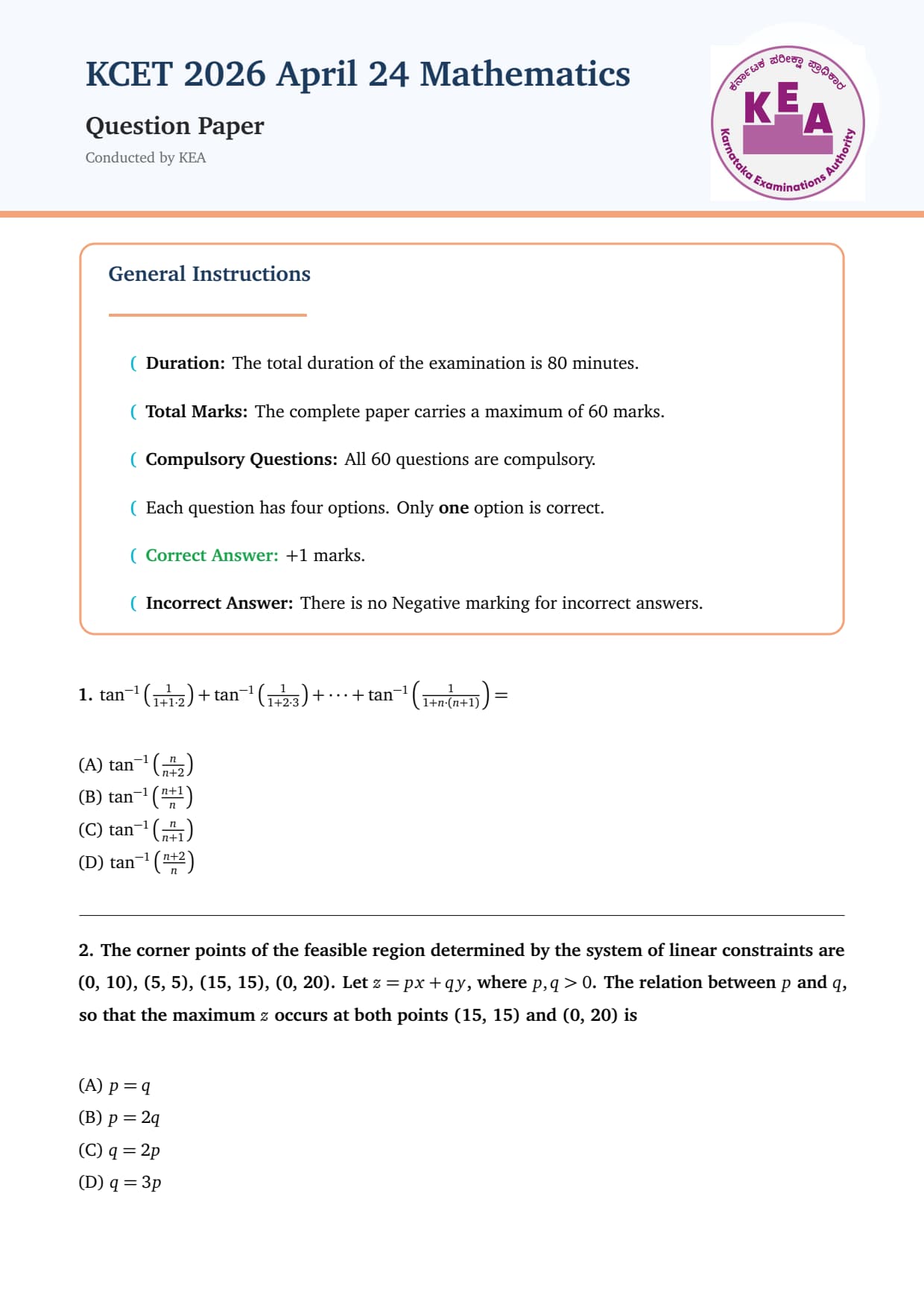
\(\tan^{-1} \left( \frac{1}{1 + 1 \cdot 2} \right) + \tan^{-1} \left( \frac{1}{1 + 2 \cdot 3} \right) + \dots + \tan^{-1} \left( \frac{1}{1 + n \cdot (n+1)} \right) =\)
The corner points of the feasible region determined by the system of linear constraints are (0, 10), (5, 5), (15, 15), (0, 20). Let \(z = px + qy\), where \(p, q > 0\). The relation between \(p\) and \(q\), so that the maximum \(z\) occurs at both points (15, 15) and (0, 20) is
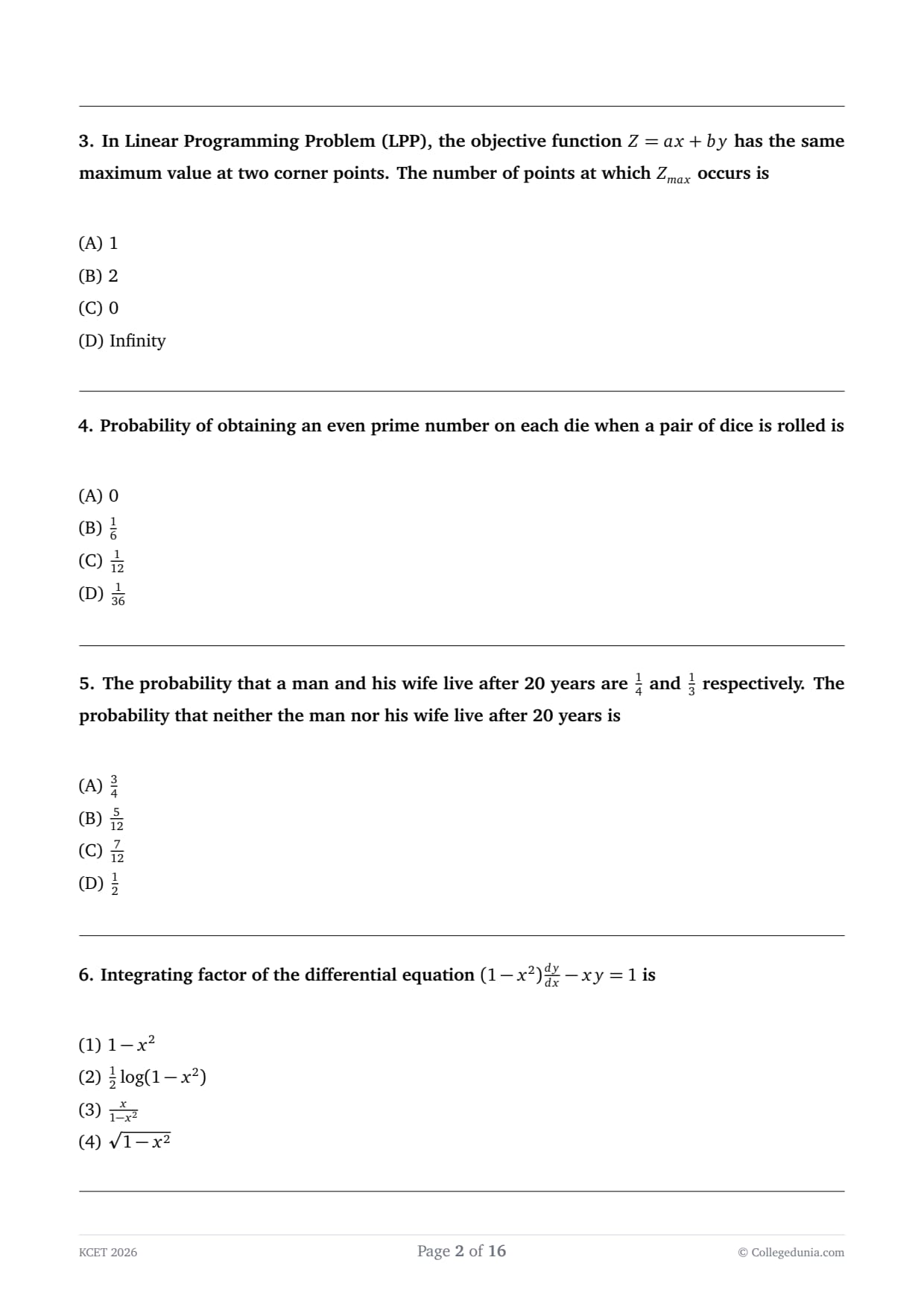
In Linear Programming Problem (LPP), the objective function \(Z = ax + by\) has the same maximum value at two corner points. The number of points at which \(Z_{max}\) occurs is
Probability of obtaining an even prime number on each die when a pair of dice is rolled is
The probability that a man and his wife live after 20 years are \(\frac{1}{4}\) and \(\frac{1}{3}\) respectively. The probability that neither the man nor his wife live after 20 years is
Integrating factor of the differential equation \((1 - x^2)\frac{dy}{dx} - xy = 1\) is
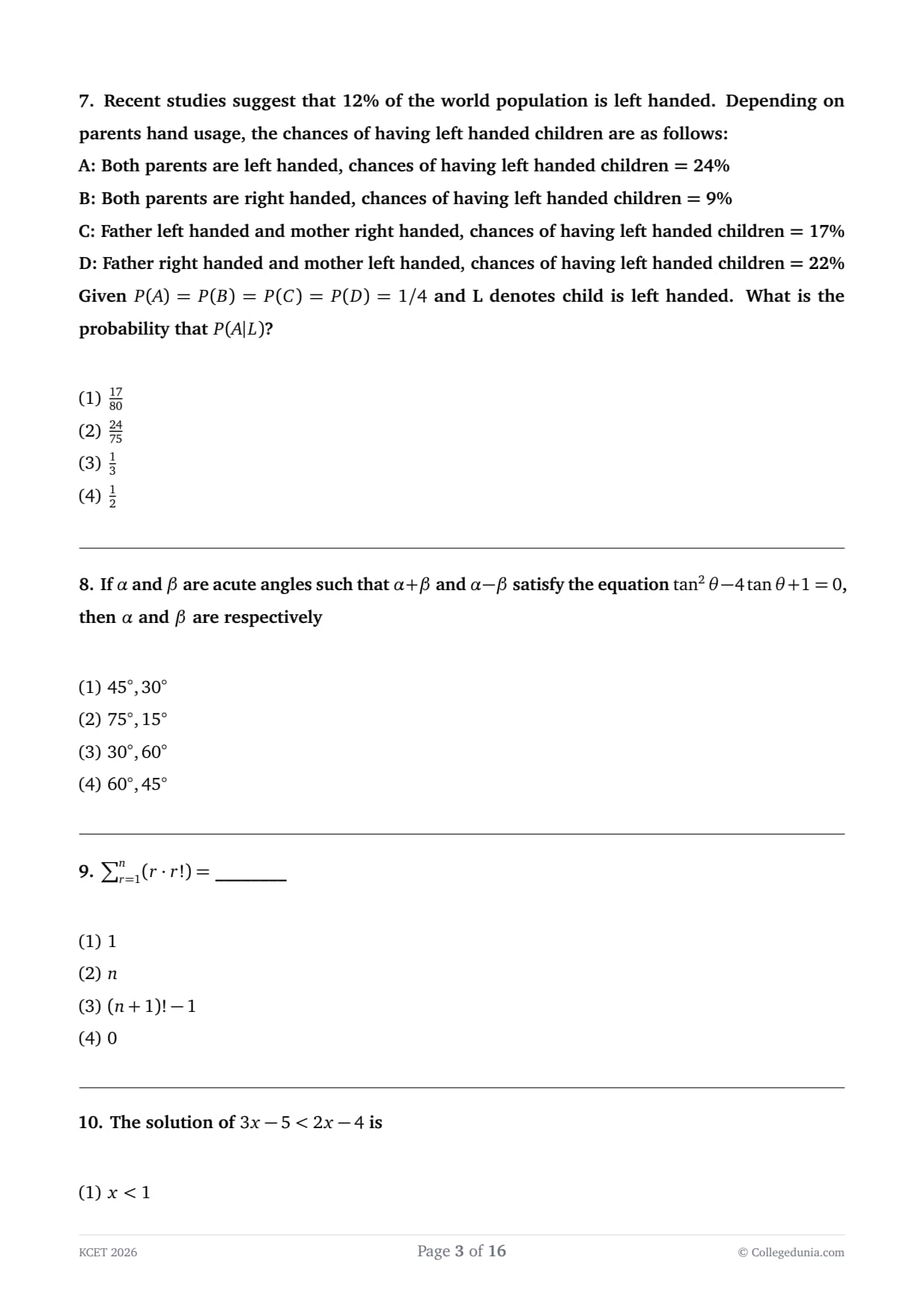
Recent studies suggest that 12% of the world population is left handed. Depending on parents hand usage, the chances of having left handed children are as follows:
A: Both parents are left handed, chances of having left handed children = 24%
B: Both parents are right handed, chances of having left handed children = 9%
C: Father left handed and mother right handed, chances of having left handed children = 17%
D: Father right handed and mother left handed, chances of having left handed children = 22%
Given \(P(A) = P(B) = P(C) = P(D) = 1/4\) and L denotes child is left handed. What is the probability that \(P(A|L)\)?
If \(\alpha\) and \(\beta\) are acute angles such that \(\alpha + \beta\) and \(\alpha - \beta\) satisfy the equation \(\tan^2 \theta - 4\tan \theta + 1 = 0\), then \(\alpha\) and \(\beta\) are respectively
\(\sum_{r=1}^{n} (r \cdot r!) = \) ________
The solution of \(3x - 5 < 2x - 4\) is
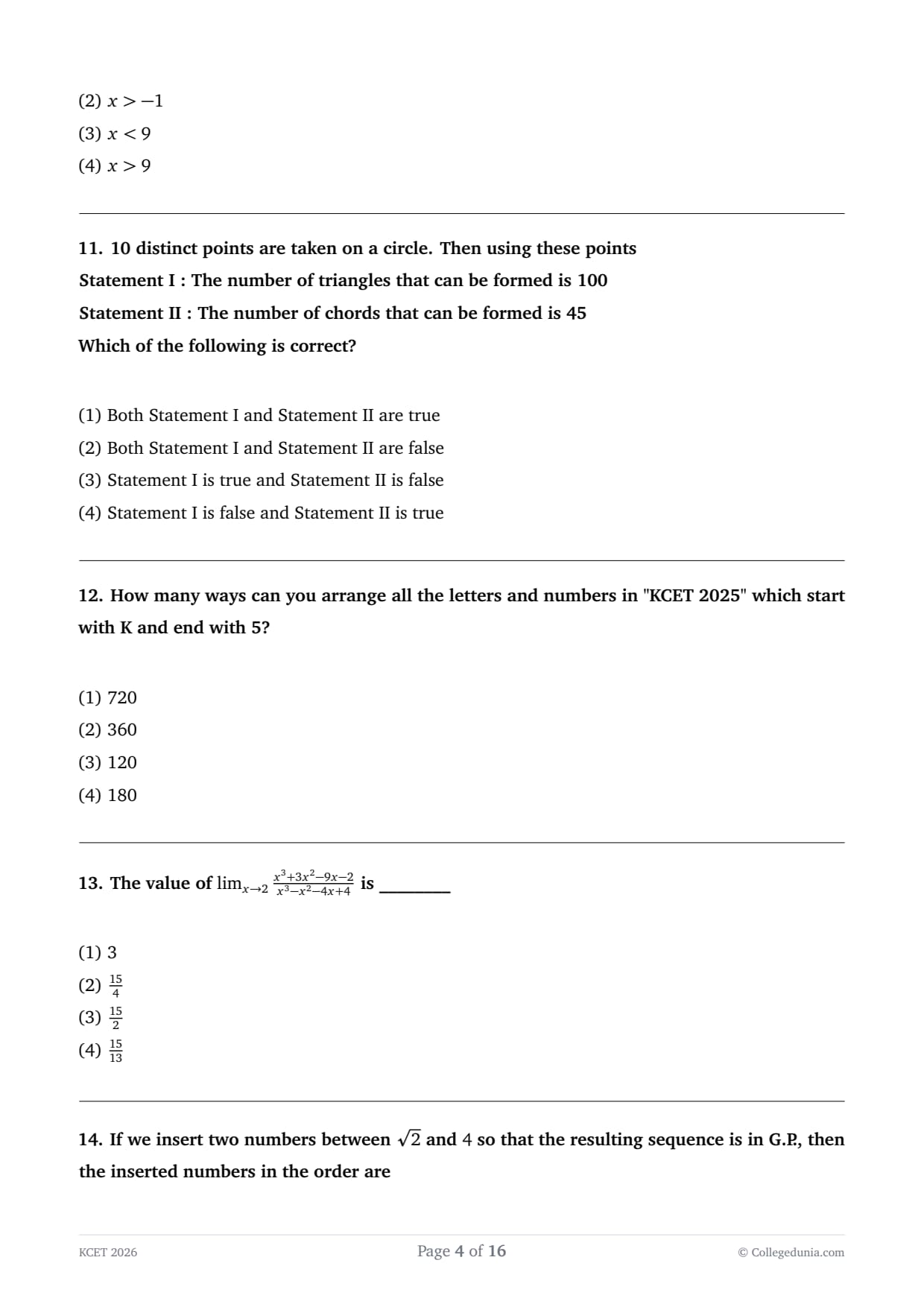
10 distinct points are taken on a circle. Then using these points
Statement I : The number of triangles that can be formed is 100
Statement II : The number of chords that can be formed is 45
Which of the following is correct?
How many ways can you arrange all the letters and numbers in "KCET 2025" which start with K and end with 5?
The value of \(\lim_{x \to 2} \frac{x^3 + 3x^2 - 9x - 2}{x^3 - x^2 - 4x + 4}\) is ________
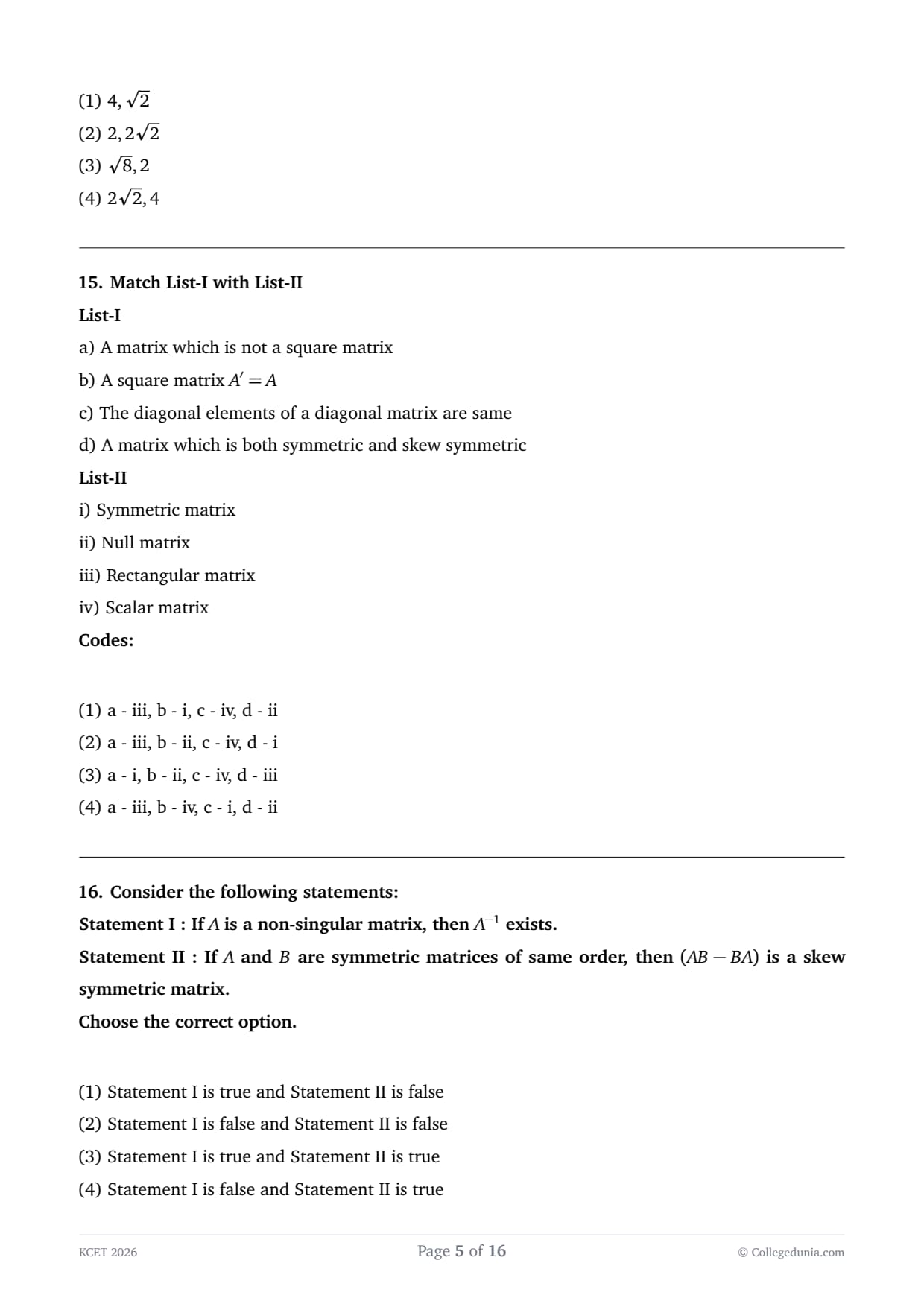
If we insert two numbers between \(\sqrt{2}\) and \(4\) so that the resulting sequence is in G.P., then the inserted numbers in the order are
Match List-I with List-II
List-I
a) A matrix which is not a square matrix
b) A square matrix \(A' = A\)
c) The diagonal elements of a diagonal matrix are same
d) A matrix which is both symmetric and skew symmetric
List-II
i) Symmetric matrix
ii) Null matrix
iii) Rectangular matrix
iv) Scalar matrix
Codes:
Consider the following statements:
Statement I : If \(A\) is a non-singular matrix, then \(A^{-1}\) exists.
Statement II : If \(A\) and \(B\) are symmetric matrices of same order, then \((AB - BA)\) is a skew symmetric matrix.
Choose the correct option.
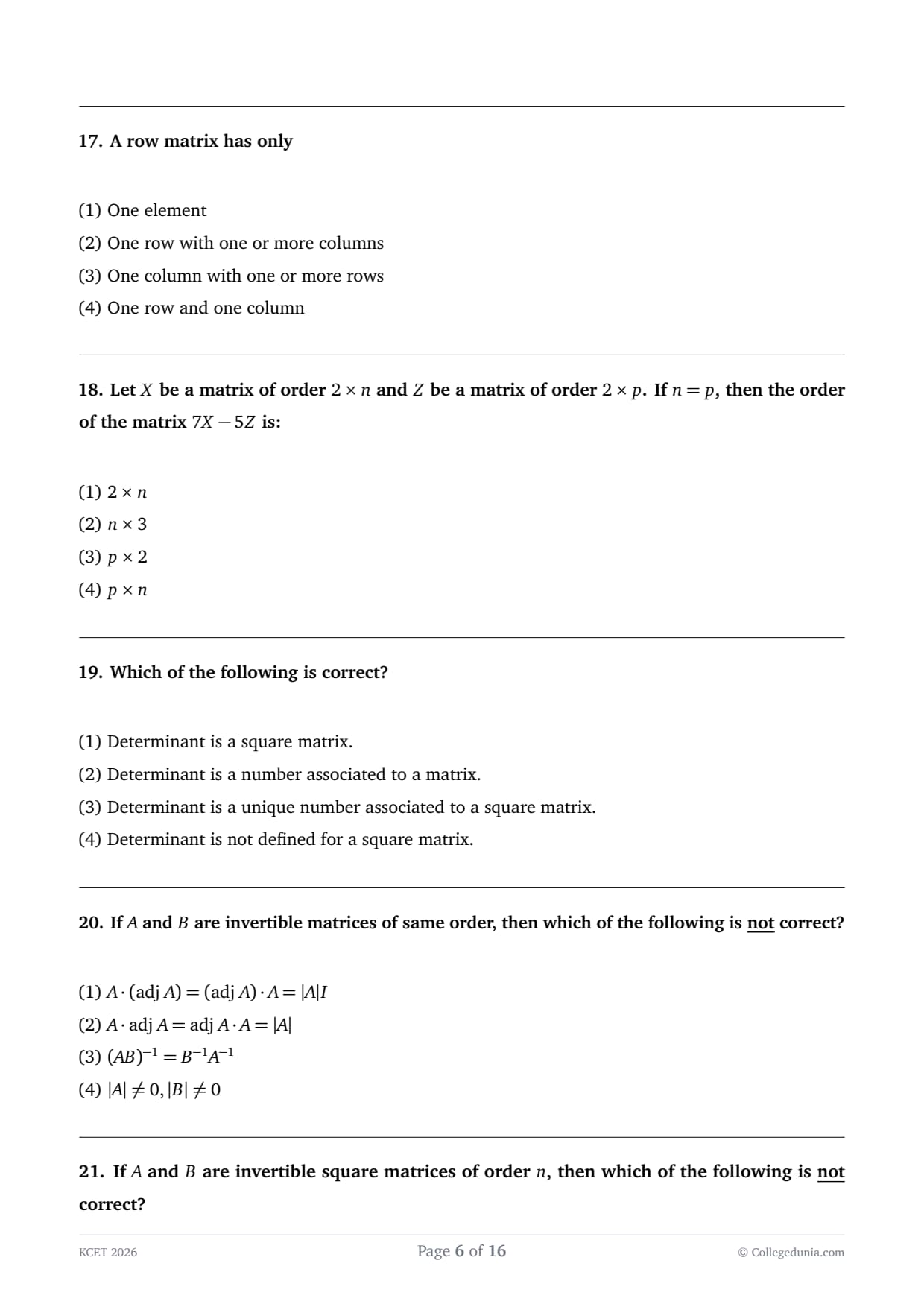
A row matrix has only
Let \(X\) be a matrix of order \(2 \times n\) and \(Z\) be a matrix of order \(2 \times p\). If \(n = p\), then the order of the matrix \(7X - 5Z\) is:
Which of the following is correct?
If \(A\) and \(B\) are invertible matrices of same order, then which of the following is \underline{not correct?
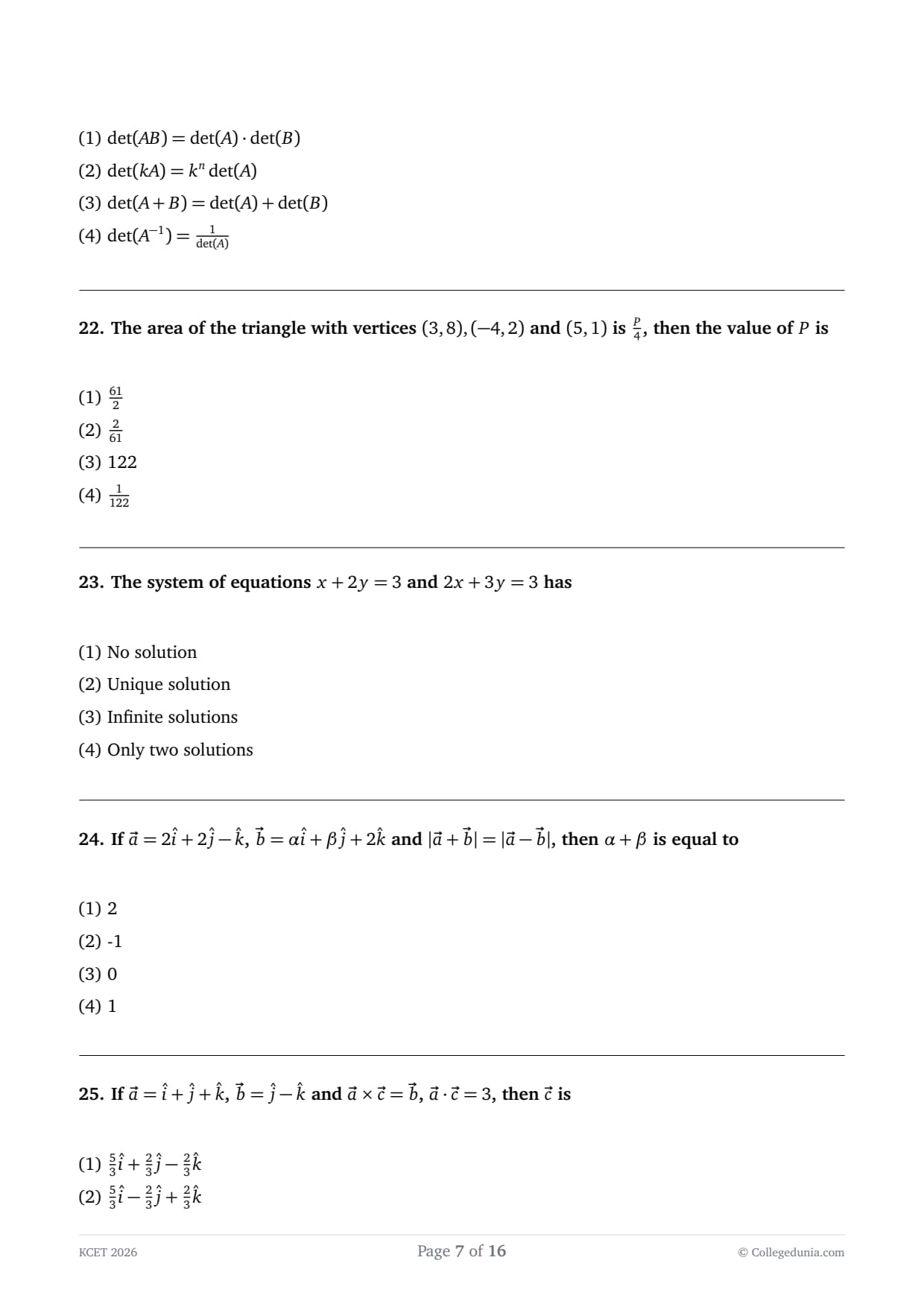
If \(A\) and \(B\) are invertible square matrices of order \(n\), then which of the following is \underline{not correct?
The area of the triangle with vertices \((3, 8), (-4, 2)\) and \((5, 1)\) is \(\frac{P}{4}\), then the value of \(P\) is
The system of equations \(x + 2y = 3\) and \(2x + 3y = 3\) has
If \(\vec{a} = 2\hat{i} + 2\hat{j} - \hat{k}\), \(\vec{b} = \alpha\hat{i} + \beta\hat{j} + 2\hat{k}\) and \(|\vec{a} + \vec{b}| = |\vec{a} - \vec{b}|\), then \(\alpha + \beta\) is equal to
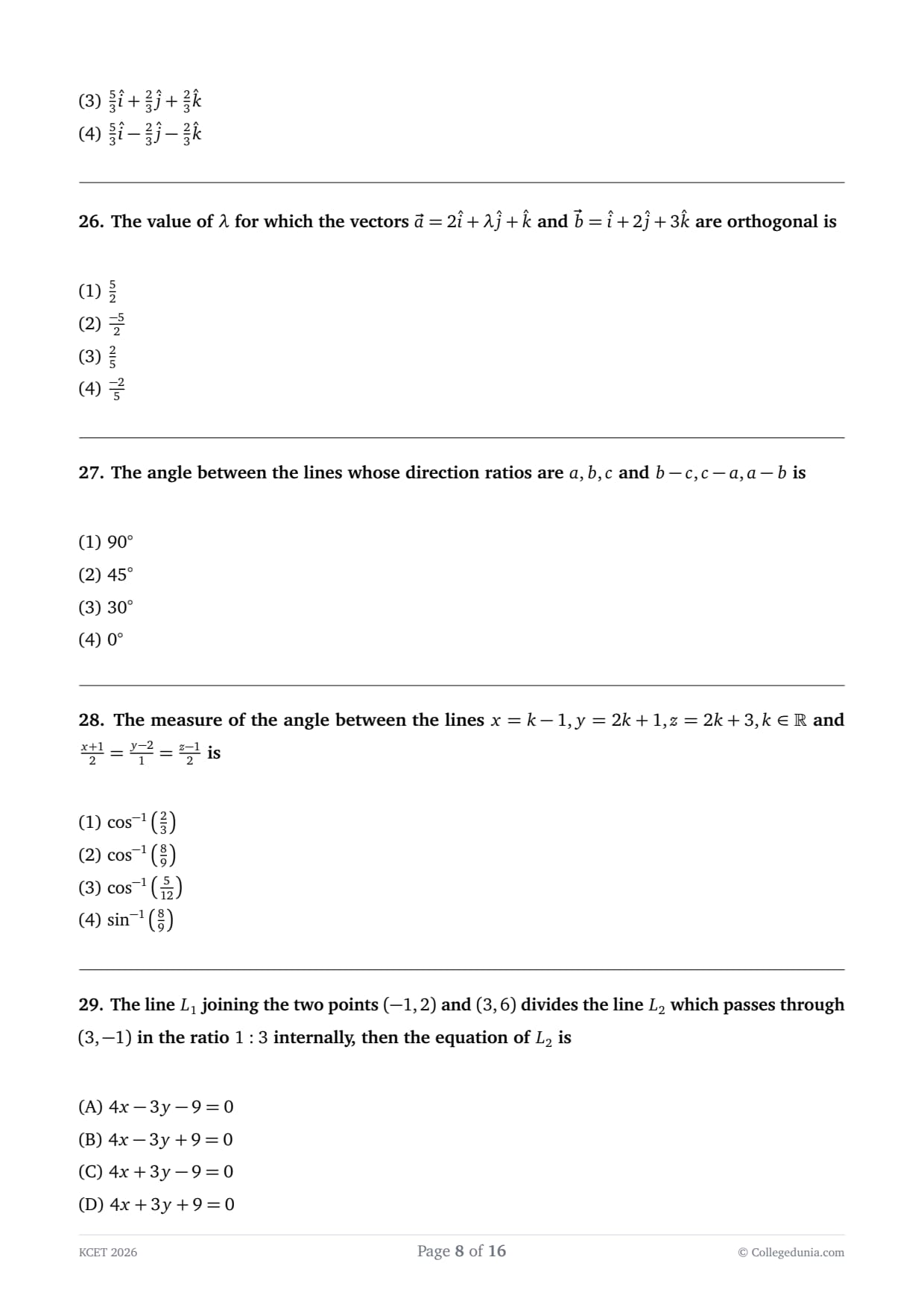
If \(\vec{a} = \hat{i} + \hat{j} + \hat{k}\), \(\vec{b} = \hat{j} - \hat{k}\) and \(\vec{a} \times \vec{c} = \vec{b}\), \(\vec{a} \cdot \vec{c} = 3\), then \(\vec{c}\) is
The value of \(\lambda\) for which the vectors \(\vec{a} = 2\hat{i} + \lambda\hat{j} + \hat{k}\) and \(\vec{b} = \hat{i} + 2\hat{j} + 3\hat{k}\) are orthogonal is
The angle between the lines whose direction ratios are \(a, b, c\) and \(b - c, c - a, a - b\) is
The measure of the angle between the lines \(x = k - 1, y = 2k + 1, z = 2k + 3, k \in \mathbb{R}\) and \(\frac{x+1}{2} = \frac{y-2}{1} = \frac{z-1}{2}\) is
The line \(L_{1}\) joining the two points \((-1, 2)\) and \((3, 6)\) divides the line \(L_{2}\) which passes through \((3, -1)\) in the ratio \(1 : 3\) internally, then the equation of \(L_{2}\) is
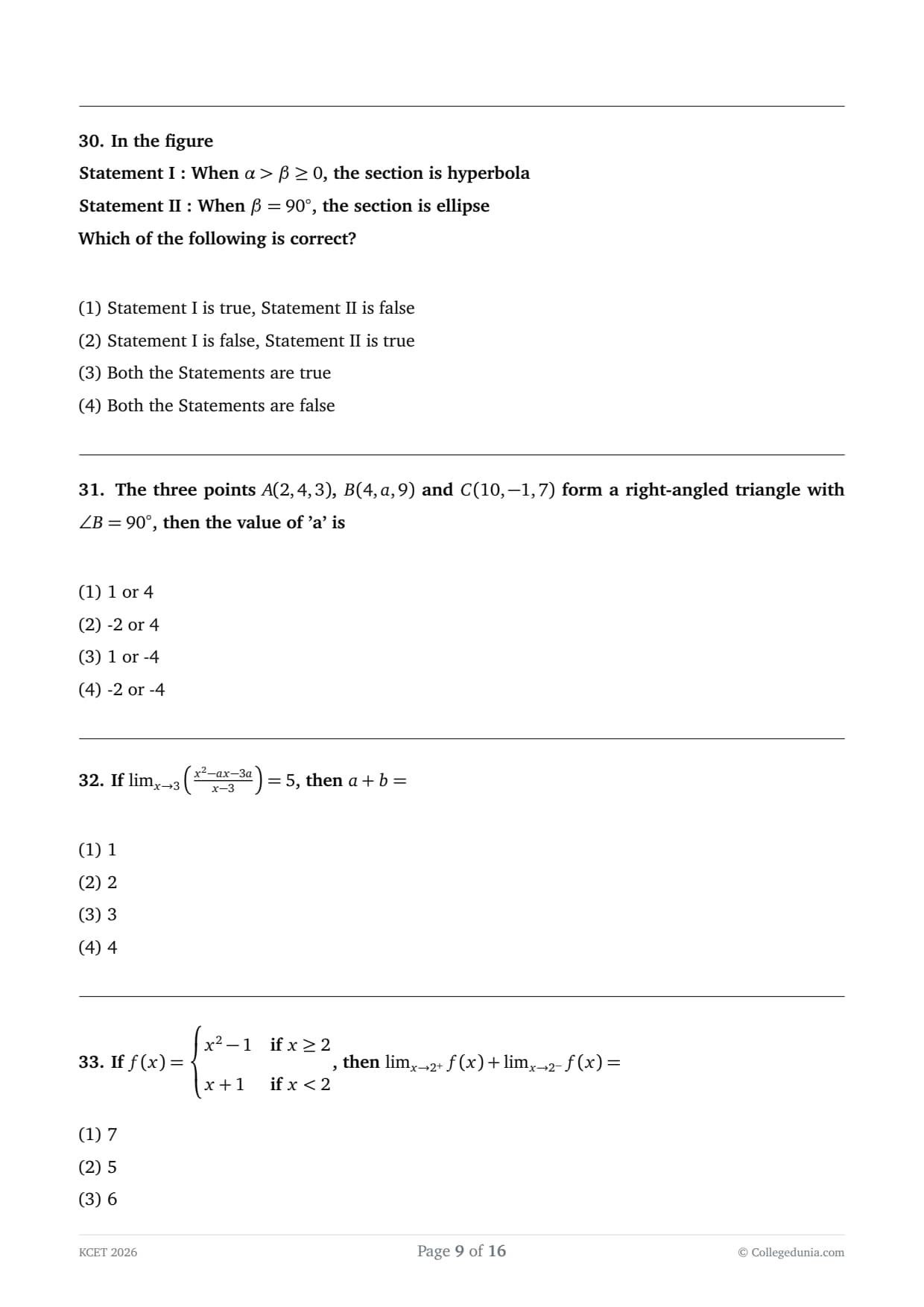
In the figure
Statement I : When \(\alpha > \beta \ge 0\), the section is hyperbola
Statement II : When \(\beta = 90^\circ\), the section is ellipse
Which of the following is correct?
The three points \(A(2, 4, 3)\), \(B(4, a, 9)\) and \(C(10, -1, 7)\) form a right-angled triangle with \(\angle B = 90^\circ\), then the value of 'a' is
If \(\lim_{x \to 3} \left( \frac{x^2 - ax - 3a}{x - 3} \right) = 5\), then \(a + b =\)
If \(f(x) = \begin{cases} x^2 - 1 & if x \ge 2
x + 1 & if x < 2 \end{cases}\), then \(\lim_{x \to 2^+} f(x) + \lim_{x \to 2^-} f(x) = \)
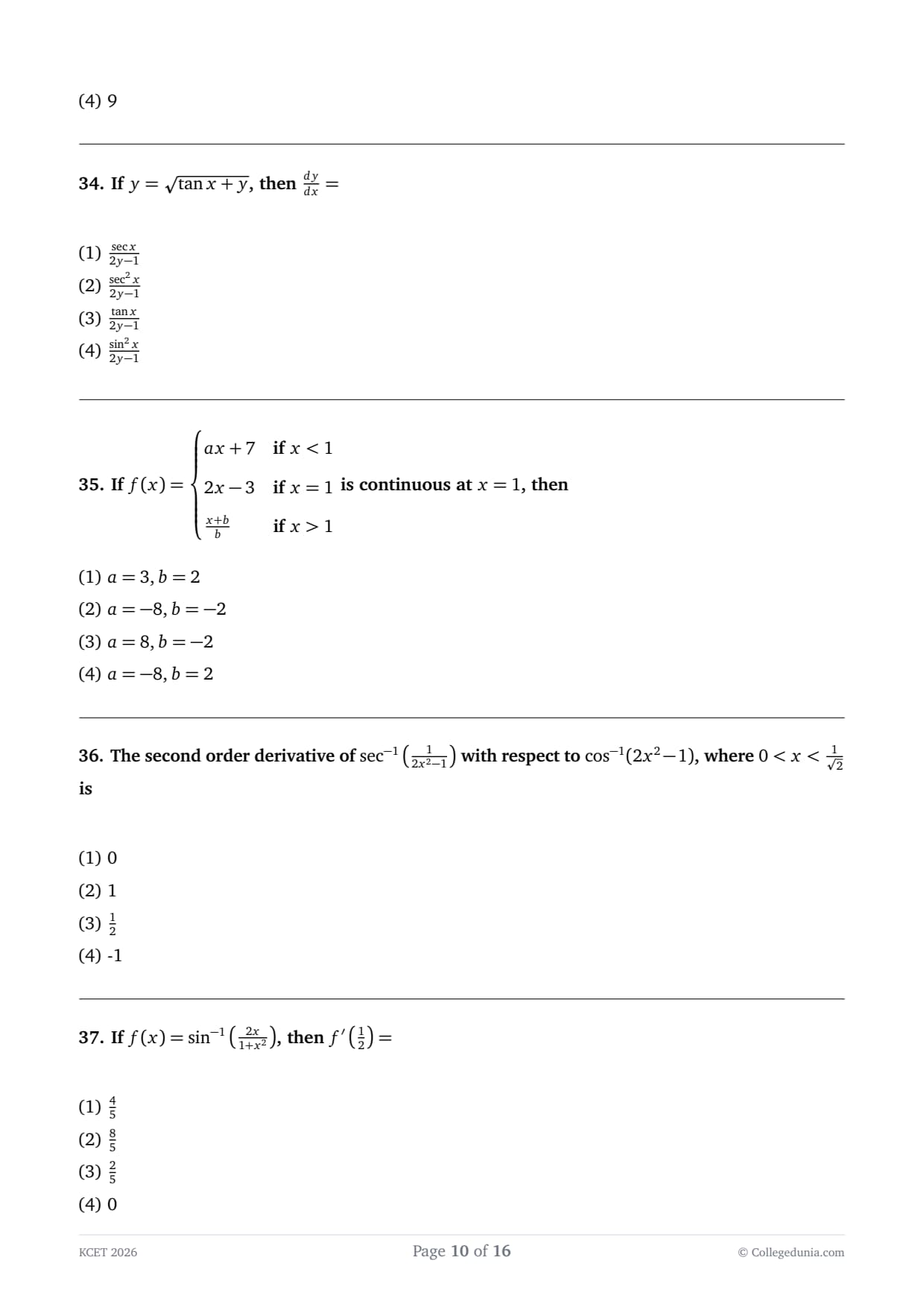
If \(y = \sqrt{\tan x + y}\), then \(\frac{dy}{dx} = \)
If \(f(x) = \begin{cases} ax + 7 & if x < 1
2x - 3 & if x = 1
\frac{x+b}{b} & if x > 1 \end{cases}\) is continuous at \(x = 1\), then
The second order derivative of \(\sec^{-1}\left(\frac{1}{2x^2 - 1}\right)\) with respect to \(\cos^{-1}(2x^2 - 1)\), where \(0 < x < \frac{1}{\sqrt{2}}\) is
If \(f(x) = \sin^{-1}\left(\frac{2x}{1 + x^2}\right)\), then \(f'\left(\frac{1}{2}\right) =\)
If \(\sqrt{x} \sqrt[3]{y} = (x + y)^n\) and \(x\frac{dy}{dx} - y = 0\), then \(n =\)
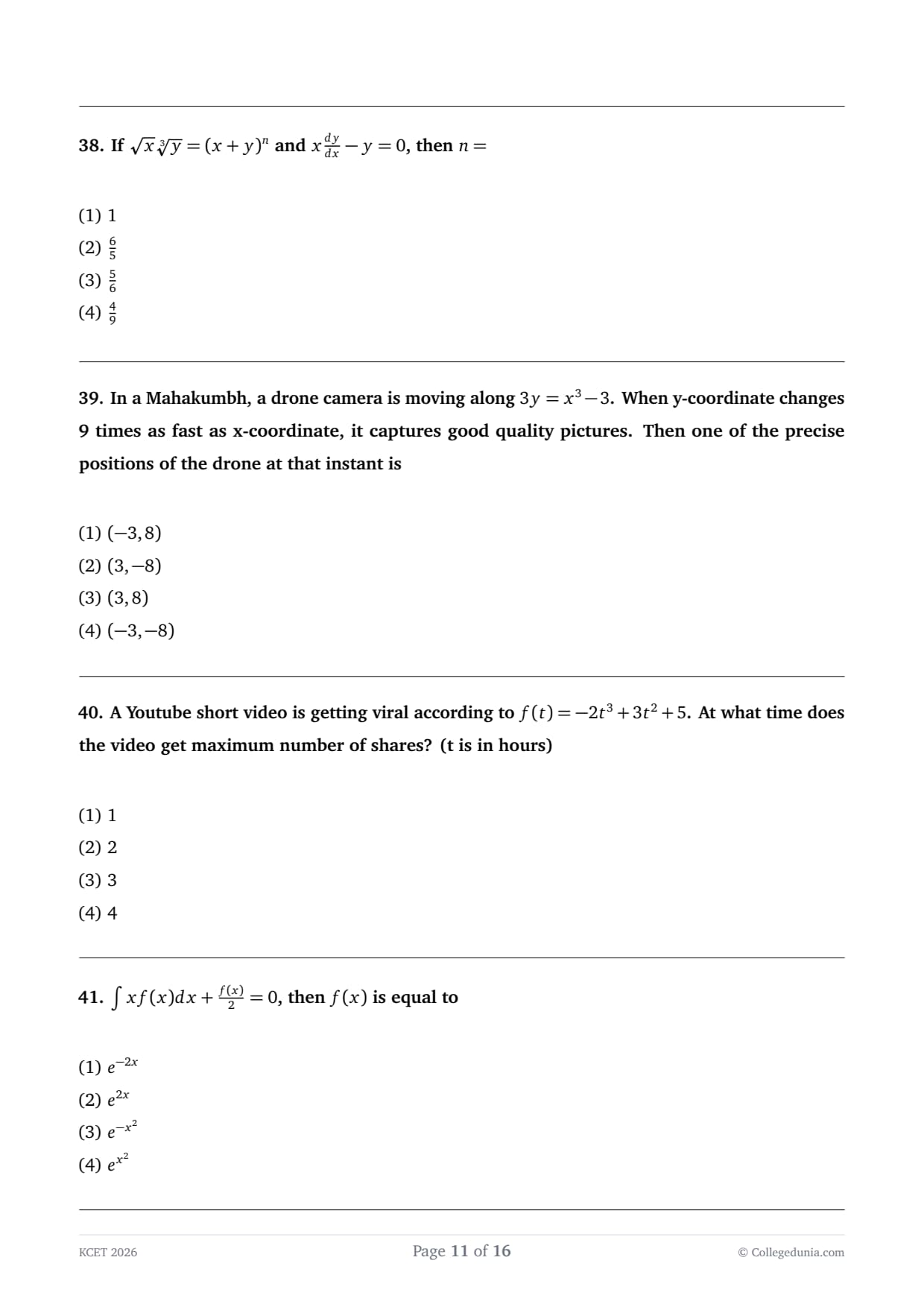
In a Mahakumbh, a drone camera is moving along \(3y = x^3 - 3\). When y-coordinate changes 9 times as fast as x-coordinate, it captures good quality pictures. Then one of the precise positions of the drone at that instant is
A Youtube short video is getting viral according to \(f(t) = -2t^3 + 3t^2 + 5\). At what time does the video get maximum number of shares? (t is in hours)
\(\int x f(x) dx + \frac{f(x)}{2} = 0\), then \(f(x)\) is equal to
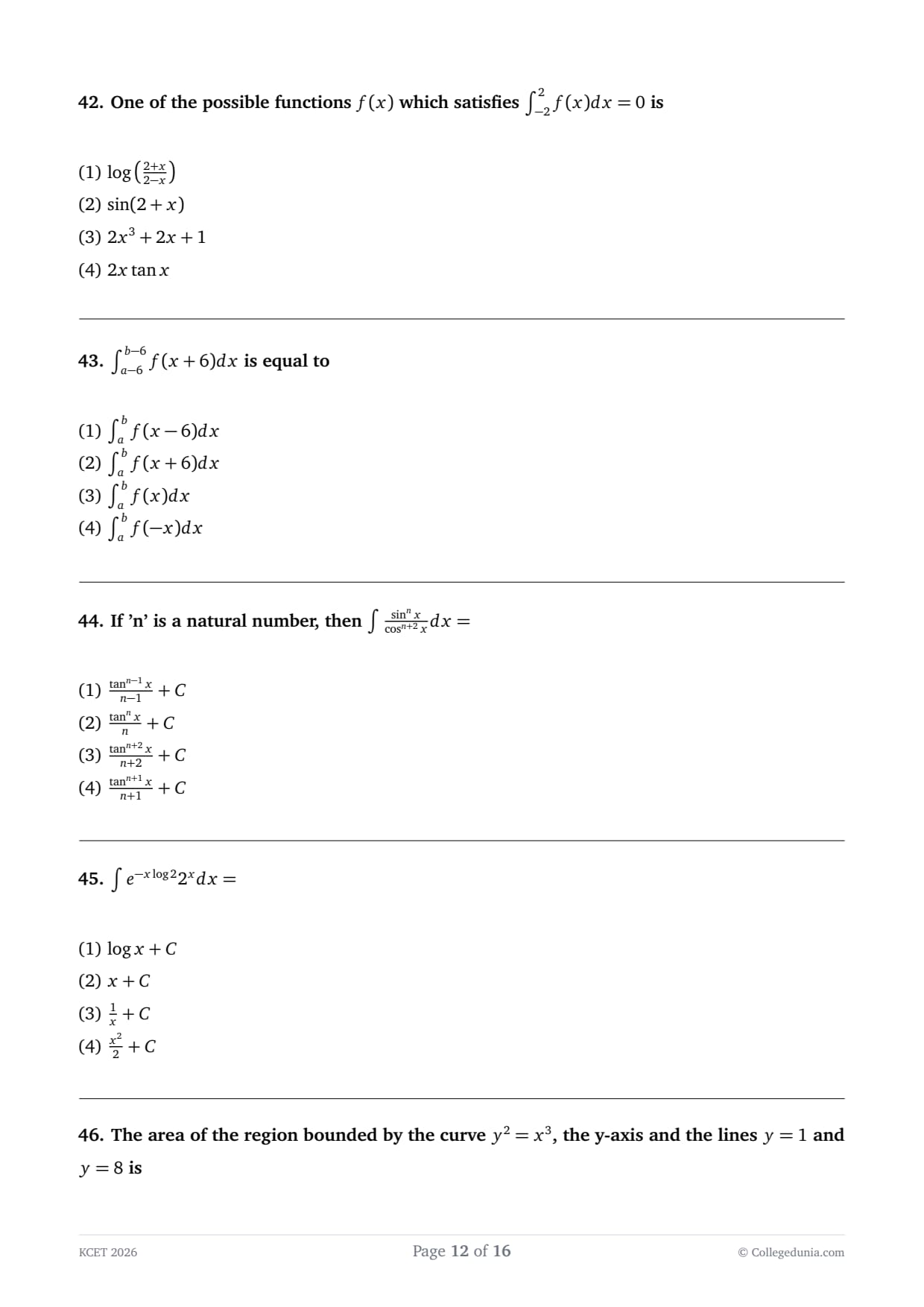
One of the possible functions \(f(x)\) which satisfies \(\int_{-2}^{2} f(x) dx = 0\) is
\(\int_{a-6}^{b-6} f(x + 6) dx\) is equal to
If 'n' is a natural number, then \(\int \frac{\sin^n x}{\cos^{n+2} x} dx =\)
\(\int e^{-x \log 2} 2^x dx =\)
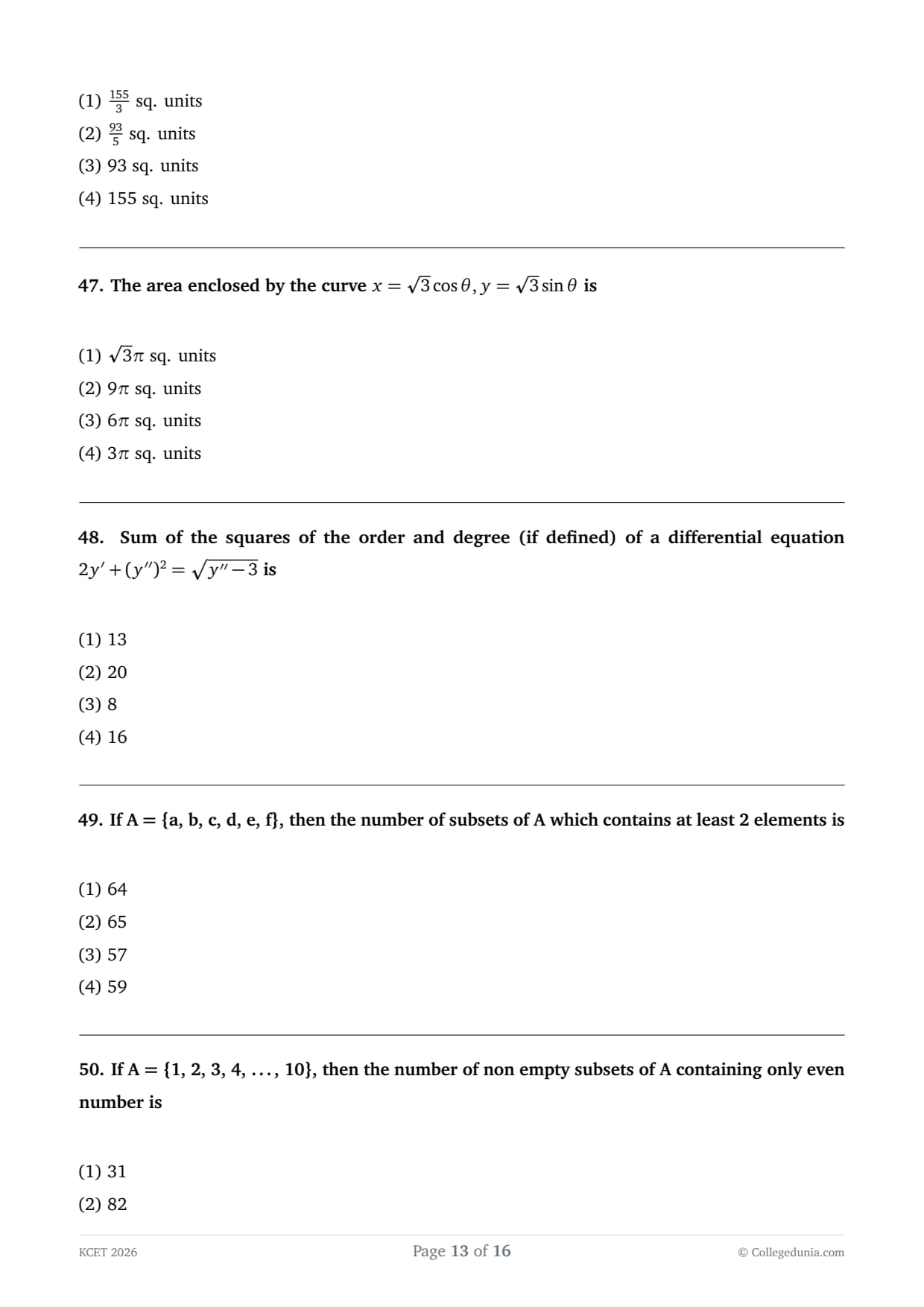
The area of the region bounded by the curve \(y^2 = x^3\), the y-axis and the lines \(y = 1\) and \(y = 8\) is
The area enclosed by the curve \(x = \sqrt{3} \cos \theta, y = \sqrt{3} \sin \theta\) is
Sum of the squares of the order and degree (if defined) of a differential equation \(2y' + (y'')^2 = \sqrt{y'' - 3}\) is
If A = {a, b, c, d, e, f}, then the number of subsets of A which contains at least 2 elements is
If A = {1, 2, 3, 4, \dots, 10}, then the number of non empty subsets of A containing only even number is
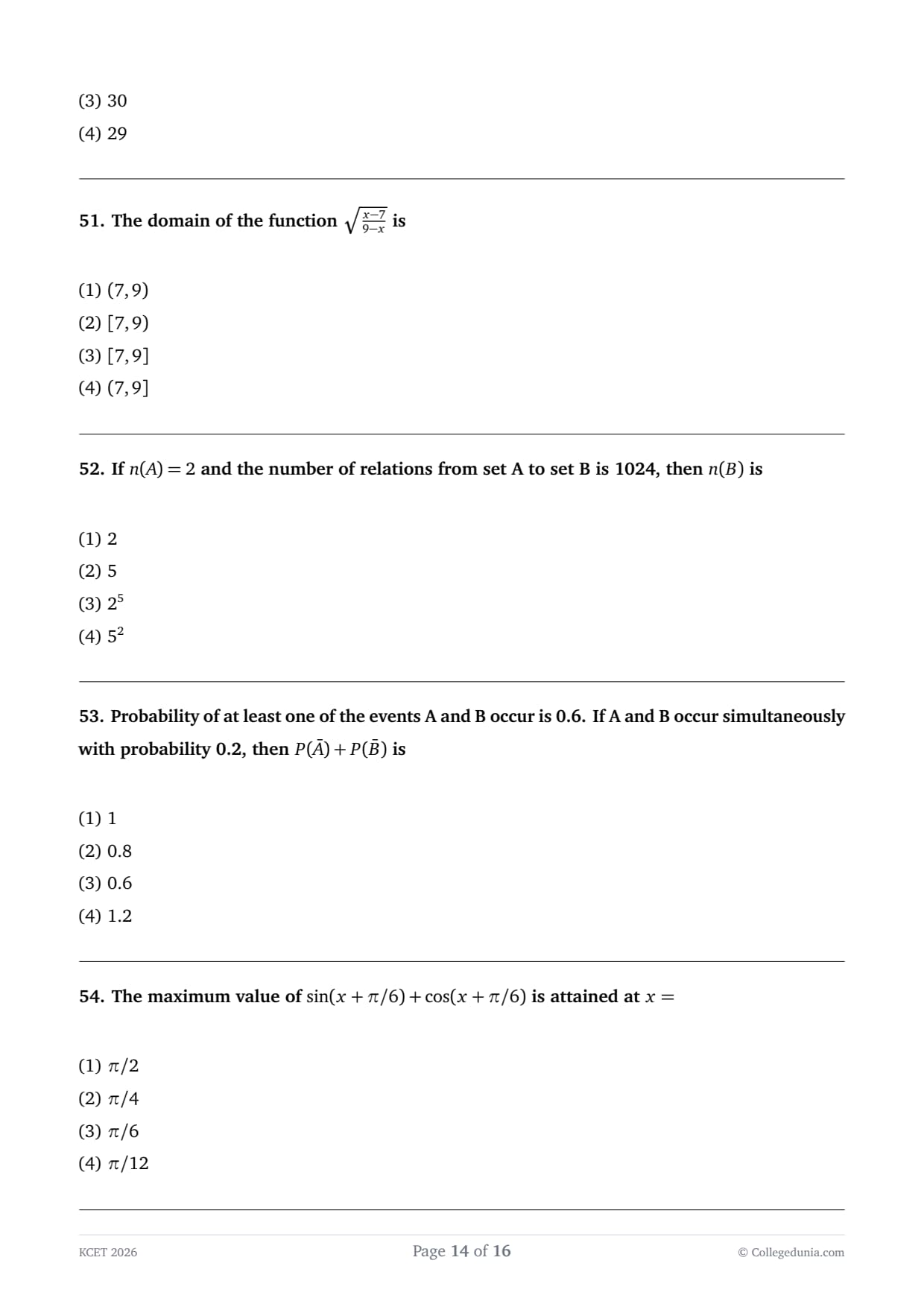
The domain of the function \(\sqrt{\frac{x - 7}{9 - x}}\) is
If \(n(A) = 2\) and the number of relations from set A to set B is 1024, then \(n(B)\) is
Probability of at least one of the events A and B occur is 0.6. If A and B occur simultaneously with probability 0.2, then \(P(\bar{A}) + P(\bar{B})\) is
The maximum value of \(\sin(x + \pi/6) + \cos(x + \pi/6)\) is attained at \(x =\)
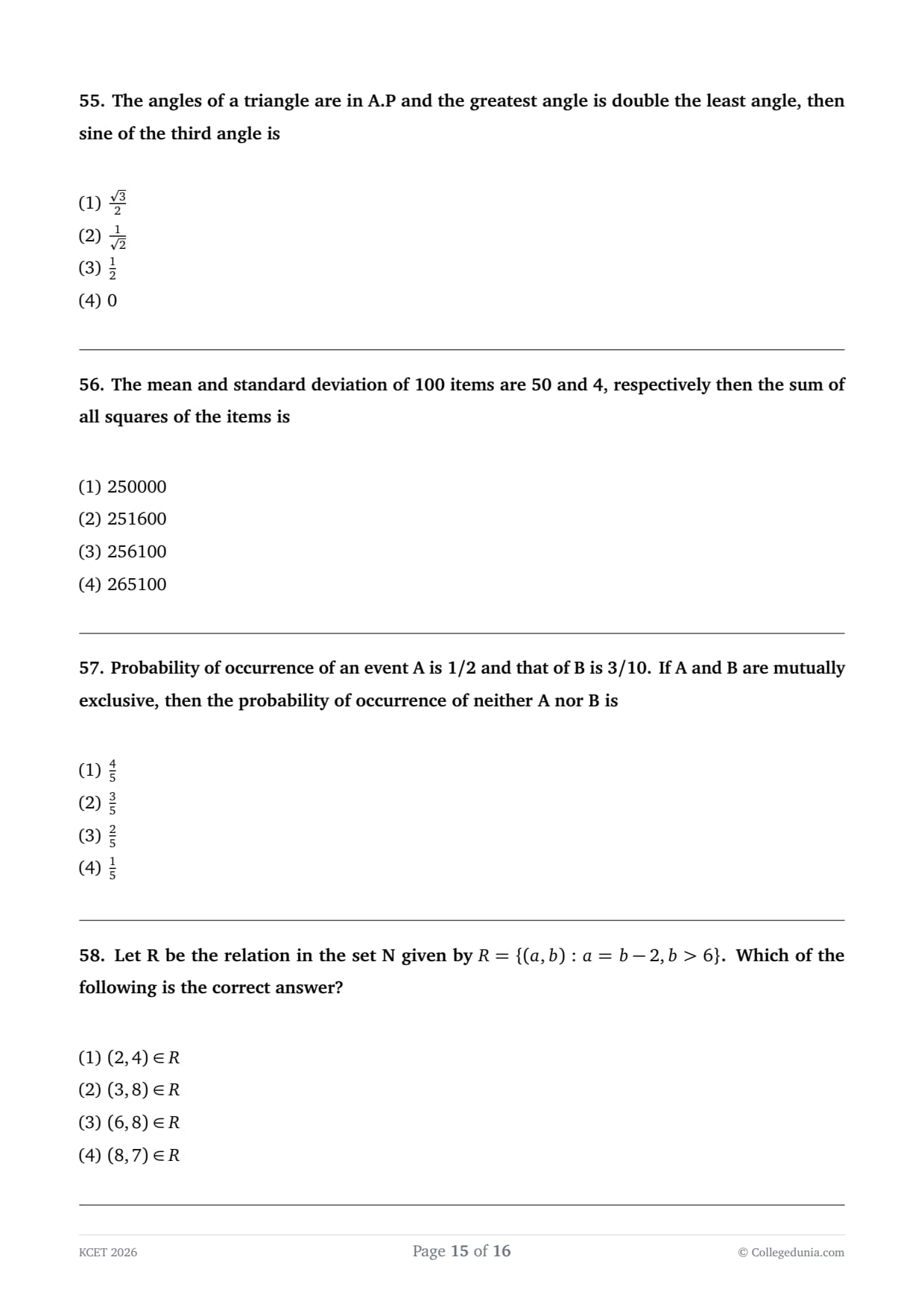
The angles of a triangle are in A.P and the greatest angle is double the least angle, then sine of the third angle is
The mean and standard deviation of 100 items are 50 and 4, respectively then the sum of all squares of the items is
Probability of occurrence of an event A is 1/2 and that of B is 3/10. If A and B are mutually exclusive, then the probability of occurrence of neither A nor B is
Let R be the relation in the set N given by \(R = \{(a, b) : a = b - 2, b > 6\}\). Which of the following is the correct answer?
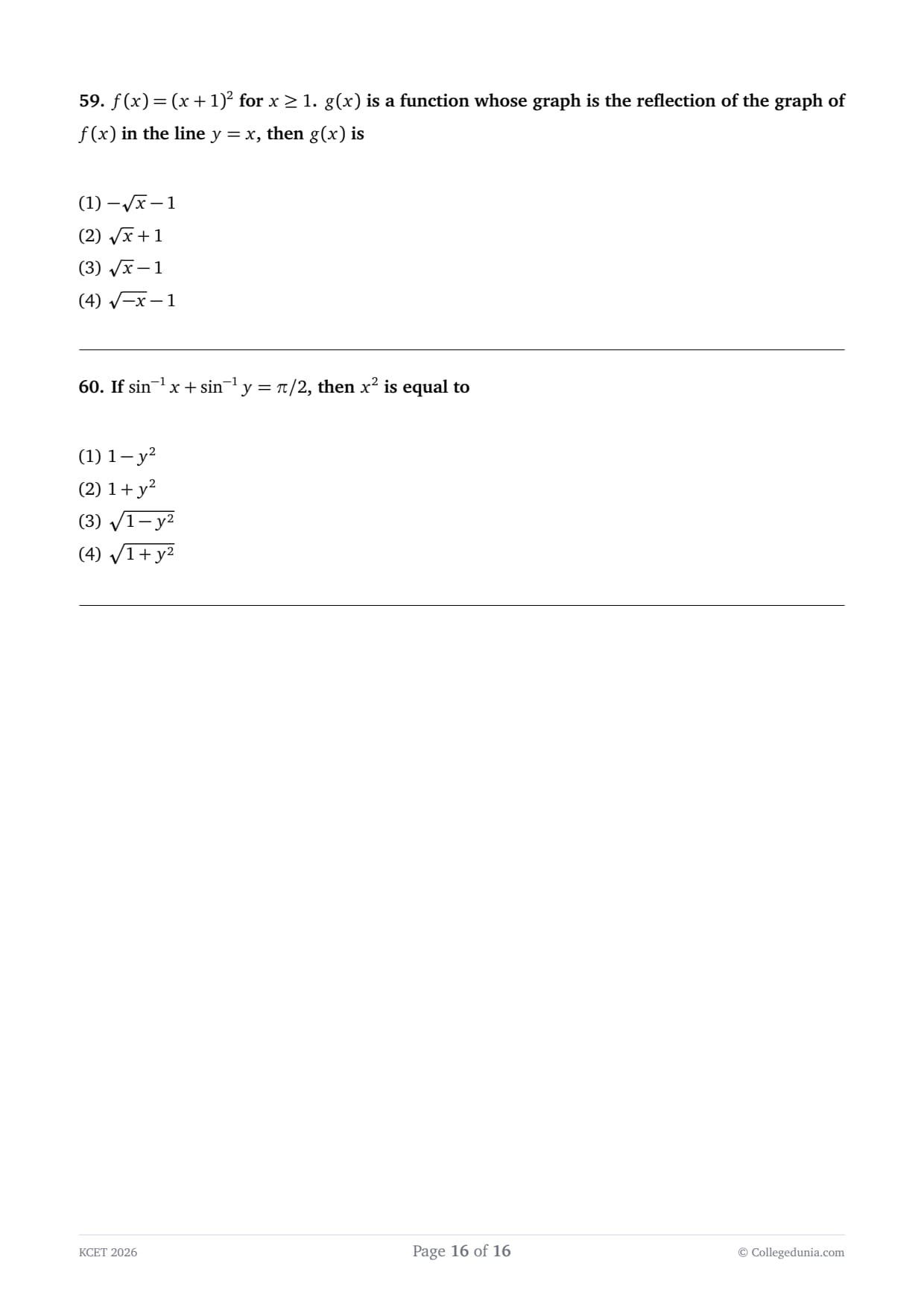
\(f(x) = (x + 1)^2\) for \(x \ge 1\). \(g(x)\) is a function whose graph is the reflection of the graph of \(f(x)\) in the line \(y = x\), then \(g(x)\) is
If \(\sin^{-1} x + \sin^{-1} y = \pi/2\), then \(x^2\) is equal to
KCET 2026 Mathematics: Expected Section-Wise Weightage
| Chapter | Expected Questions |
|---|---|
| Complex Numbers & Quadratic Equations | 5 – 6 |
| Permutation & Combination | 5 – 6 |
| Binomial Theorem | 4 – 5 |
| Sets | 4 – 5 |
| Introduction to 3D Geometry | 3 – 4 |
| Linear Inequalities | 3 – 4 |
| Statistics | 3 – 4 |
| Mathematical Reasoning | 3 – 4 |
| Principle of Mathematical Induction | 2 – 3 |
| Matrices | 5 – 6 |
| Inverse Trigonometric Functions | 4 – 5 |
| Application of Integrals | 4 – 5 |
| Linear Programming | 3 – 4 |



Comments