


The NEET PG 2024 Shift 1 question paper is available here with detailed solutions for free download. NEET PG 2024 was conducted by the National Board of Examinations in Medical Sciences (NBEMS) on August 11, 2024, as a 200-question computer-based test of 3 hours 30 minutes held in two shifts.
| NEET PG 2024 Shift 1 Question Paper with Solutions | Download PDF | Check Solutions |
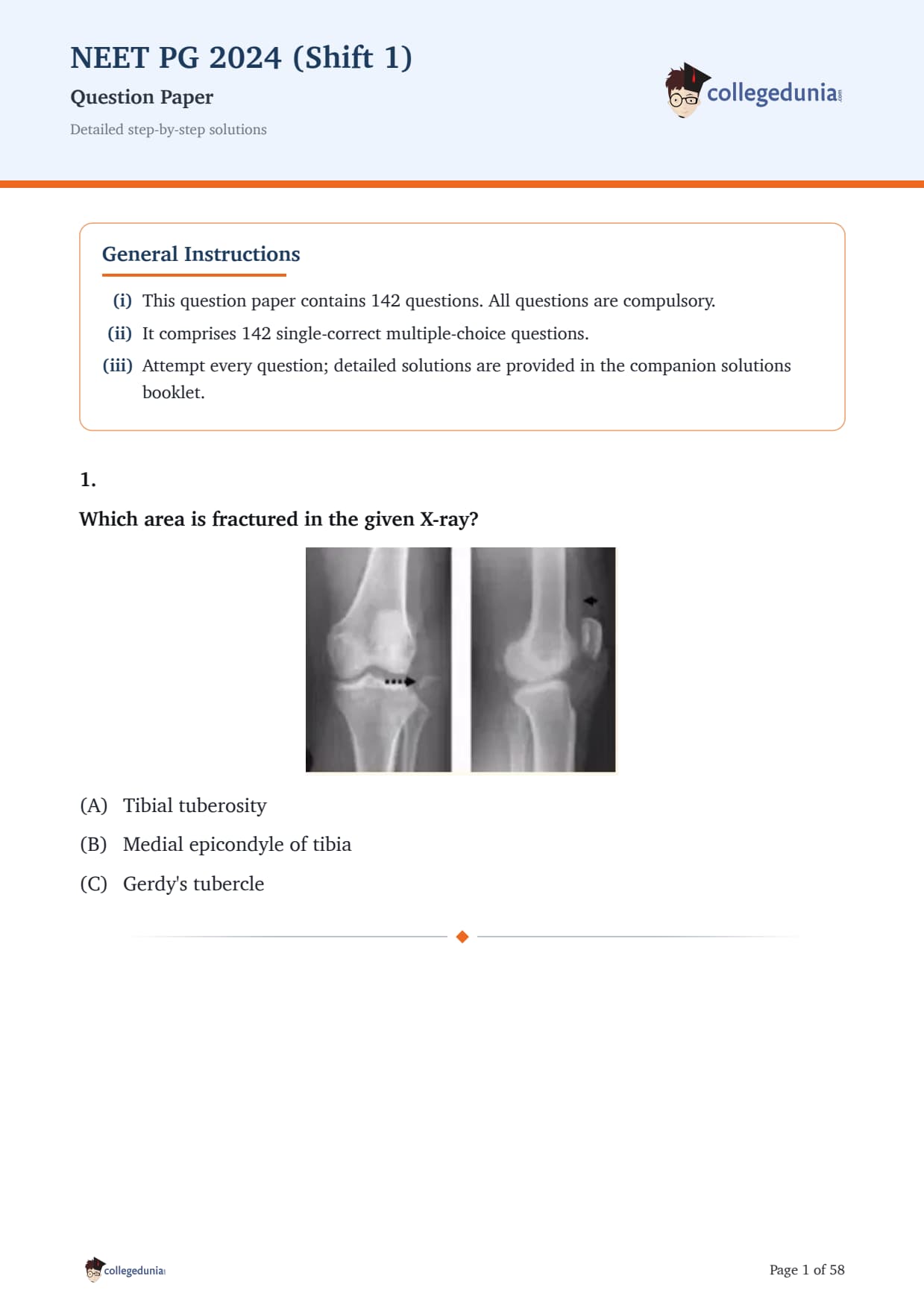
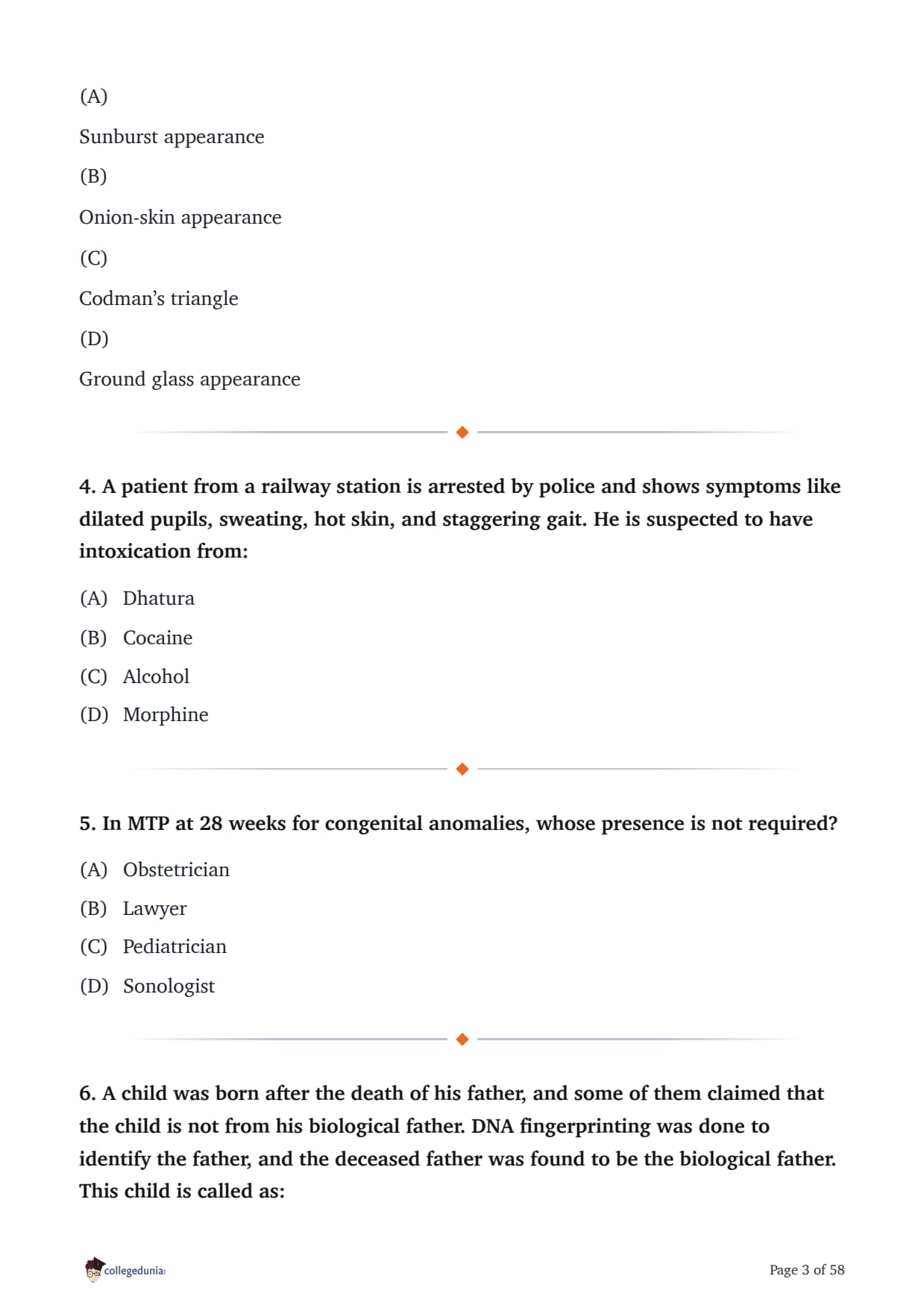
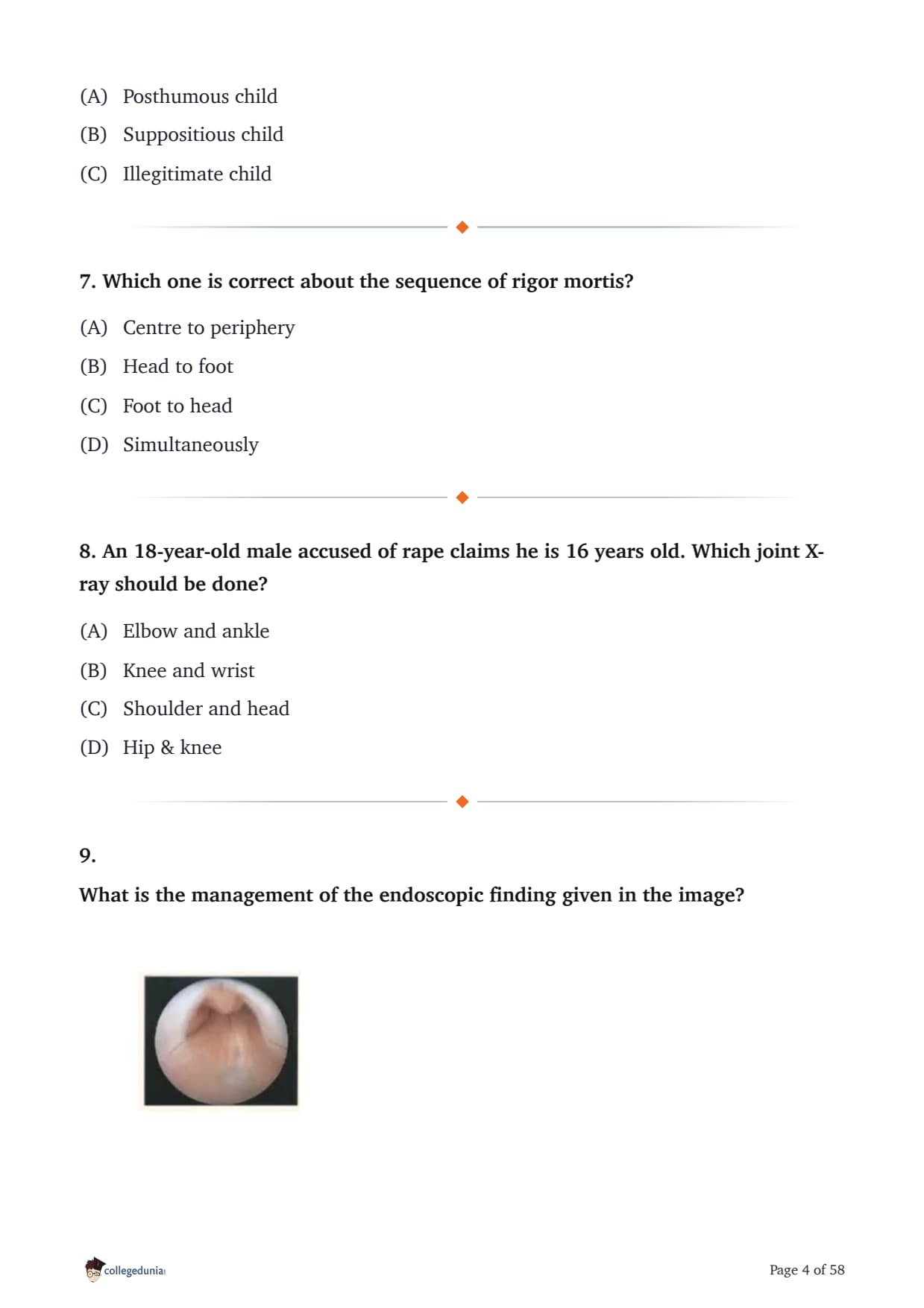
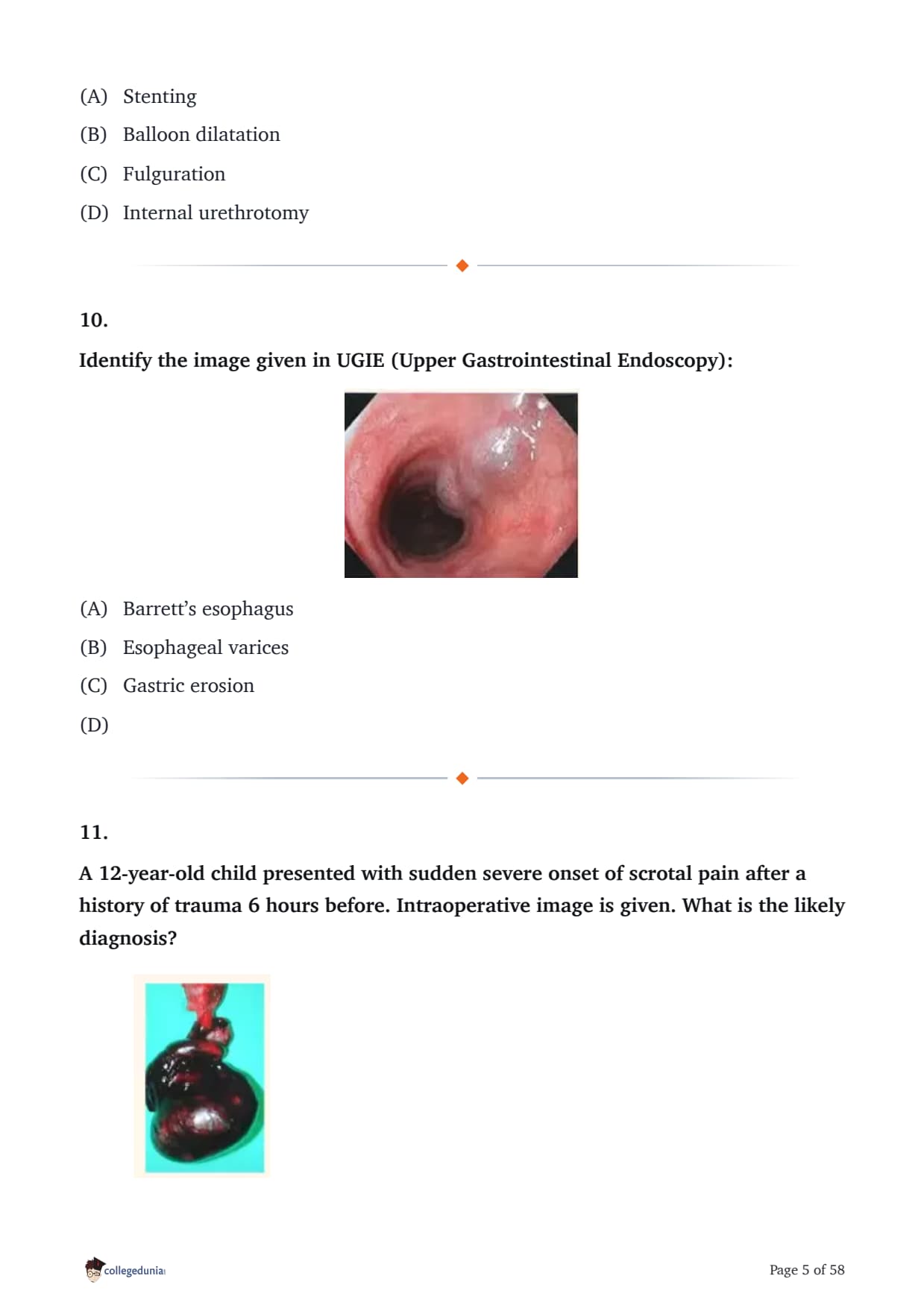
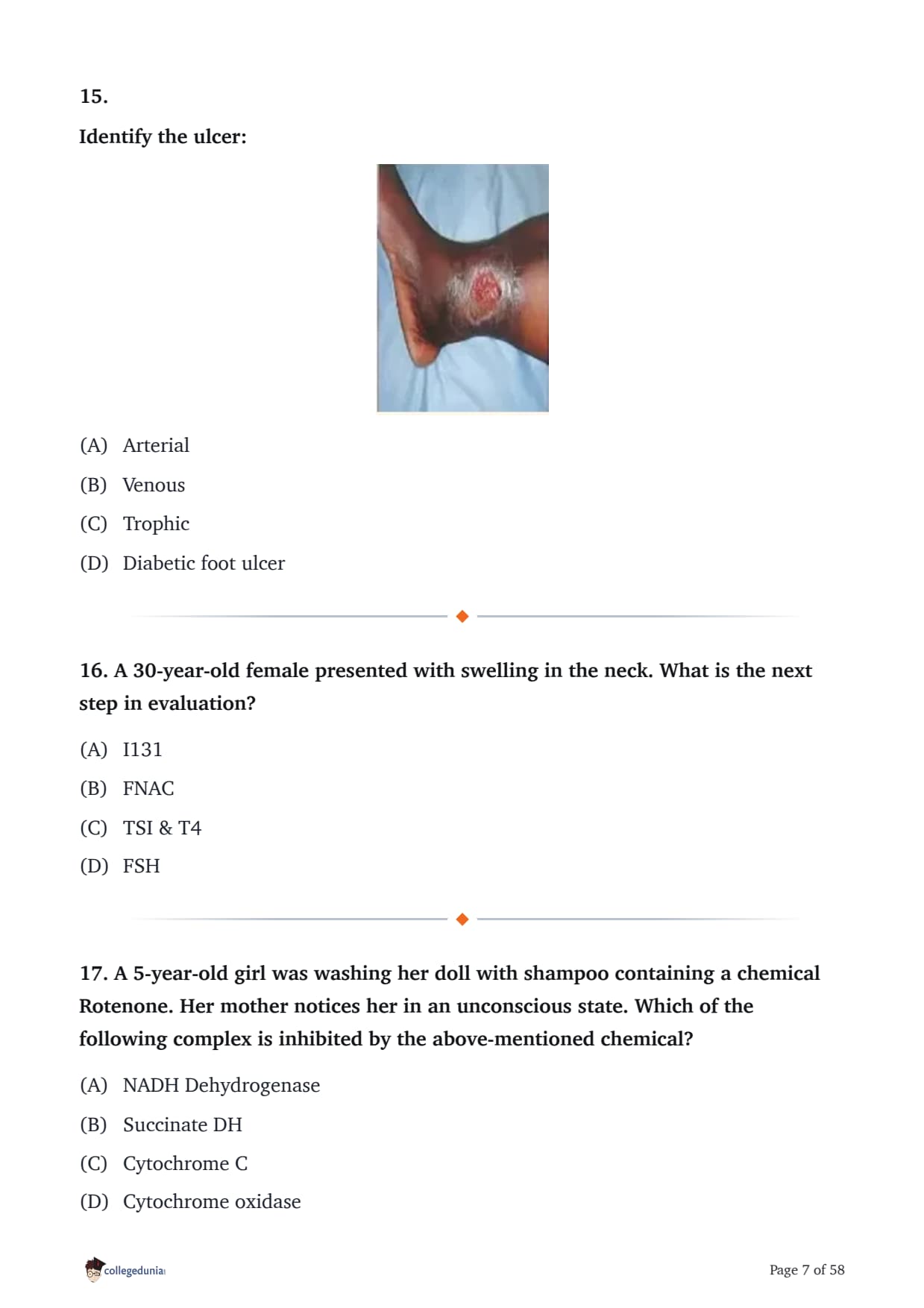
NEET PG 2024 Shift 1 Questions with Solutions

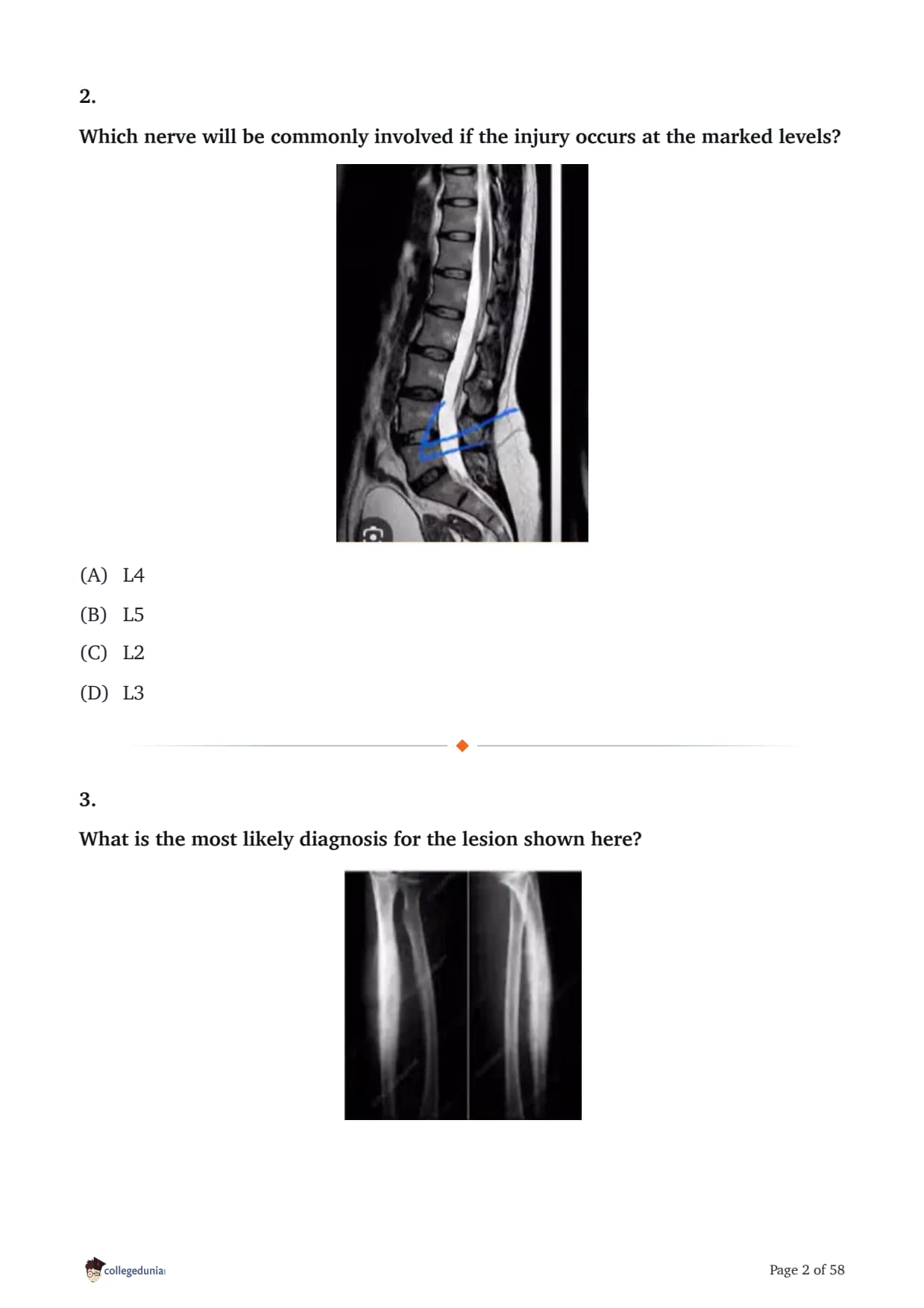
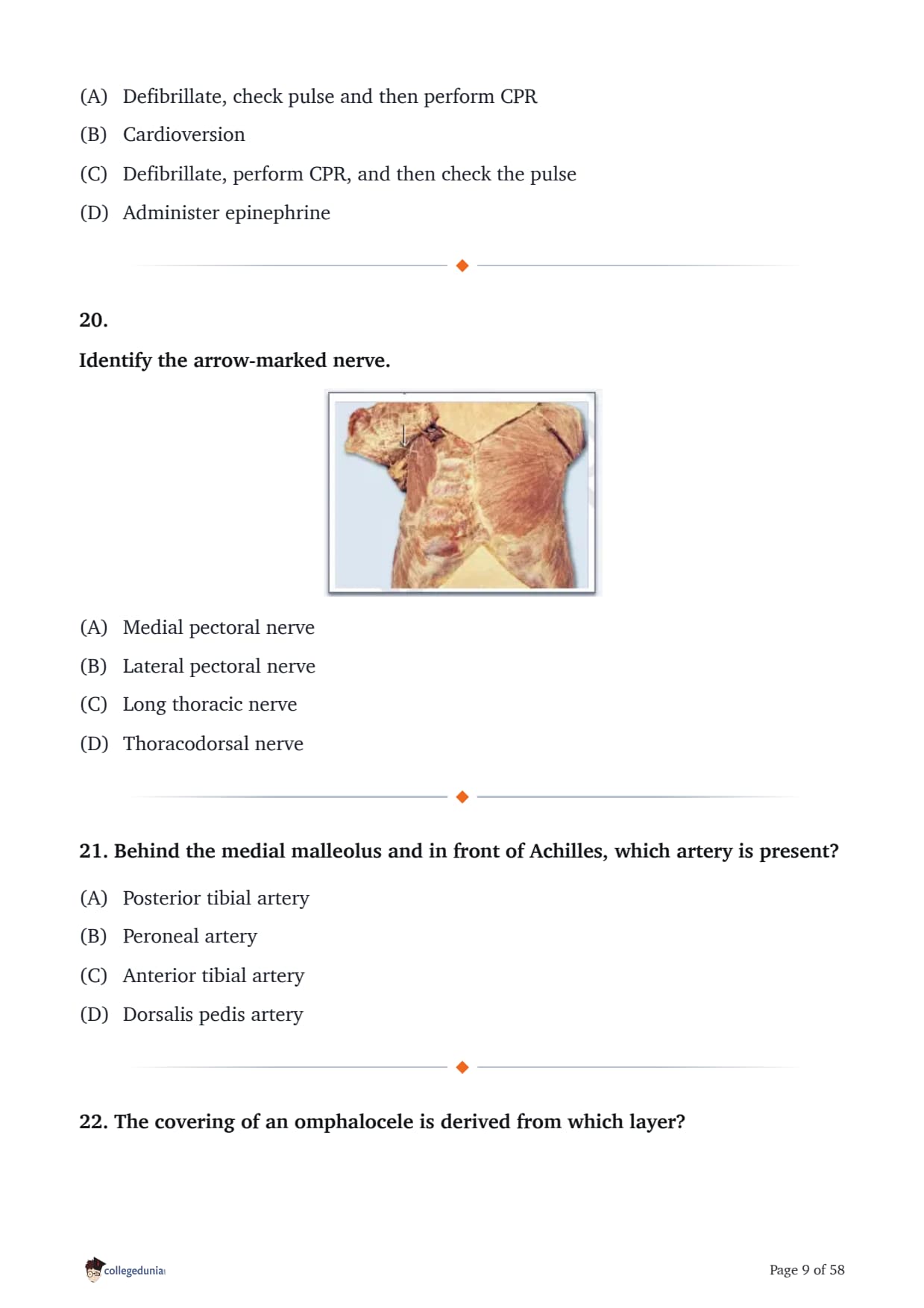
Which nerve will be commonly involved if the injury occurs at the marked levels?

A patient from a railway station is arrested by police and shows symptoms like dilated pupils, sweating, hot skin, and staggering gait. He is suspected to have intoxication from:
In MTP at 28 weeks for congenital anomalies, whose presence is not required?
A child was born after the death of his father, and some of them claimed that the child is not from his biological father. DNA fingerprinting was done to identify the father, and the deceased father was found to be the biological father. This child is called as:
Which one is correct about the sequence of rigor mortis?
An 18-year-old male accused of rape claims he is 16 years old. Which joint X-ray should be done?


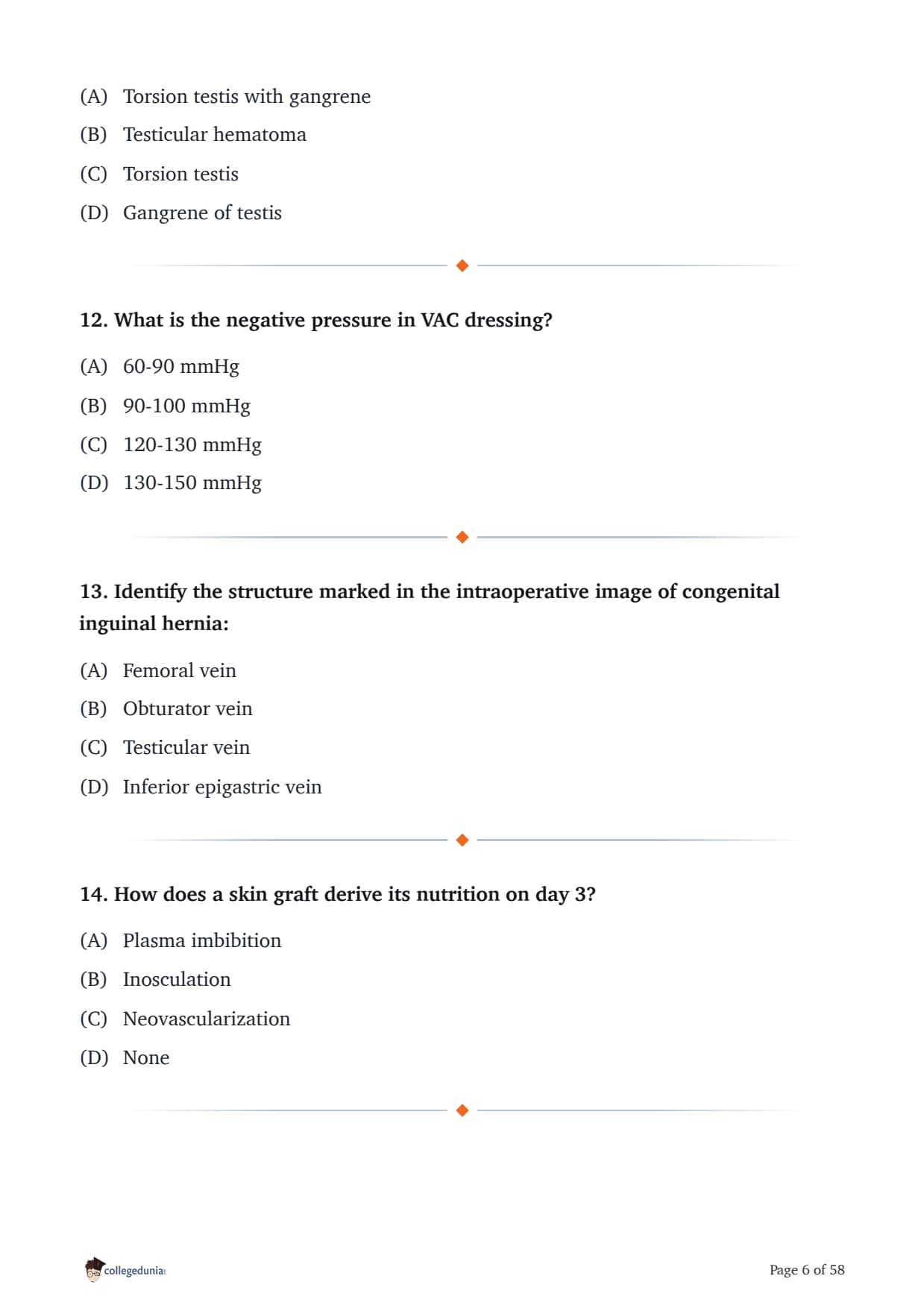
A 12-year-old child presented with sudden severe onset of scrotal pain after a history of trauma 6 hours before. Intraoperative image is given. What is the likely diagnosis?

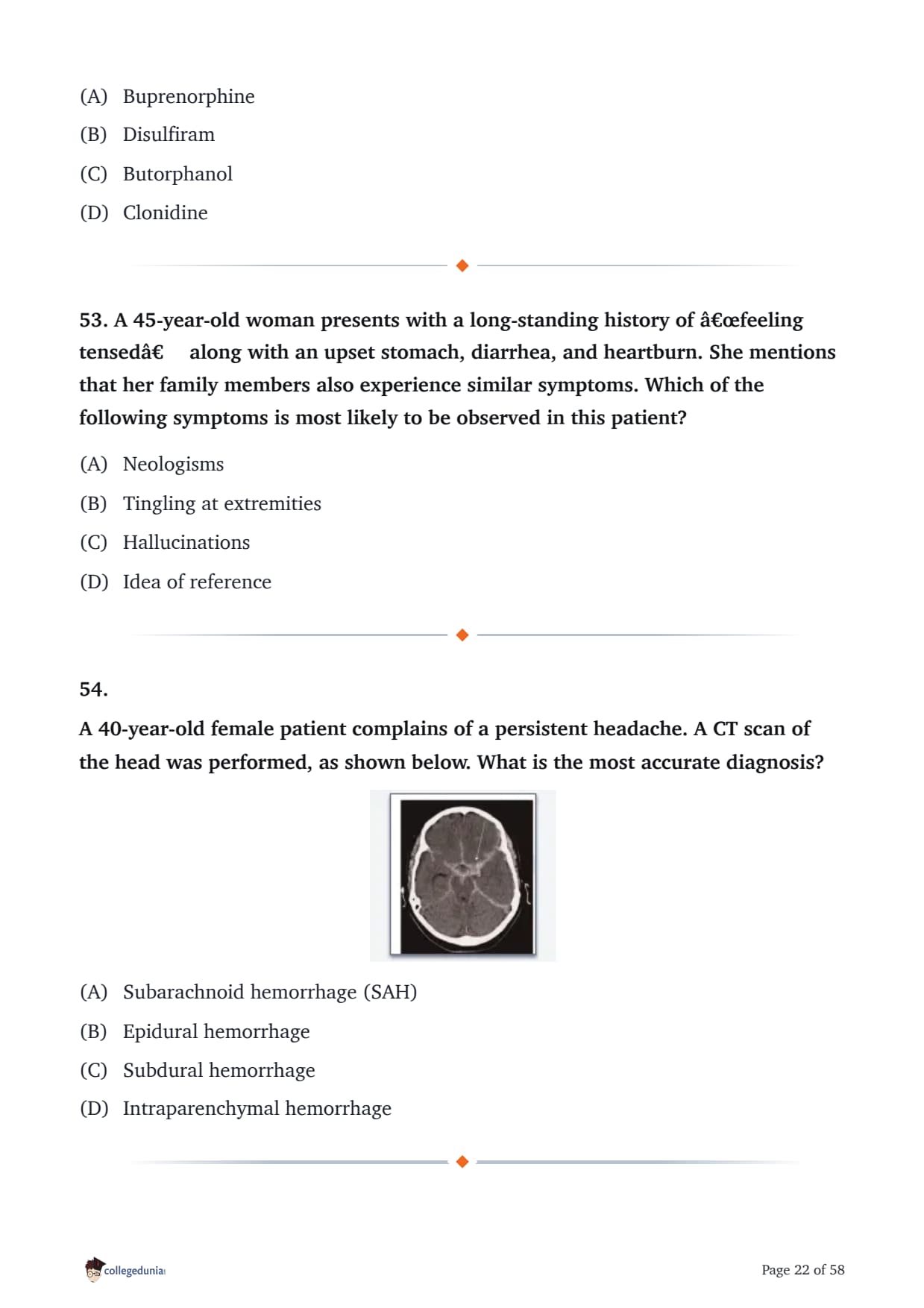
What is the negative pressure in VAC dressing?
Identify the structure marked in the intraoperative image of congenital inguinal hernia:
How does a skin graft derive its nutrition on day 3?

A 30-year-old female presented with swelling in the neck. What is the next step in evaluation?
A 5-year-old girl was washing her doll with shampoo containing a chemical Rotenone. Her mother notices her in an unconscious state. Which of the following complex is inhibited by the above-mentioned chemical?

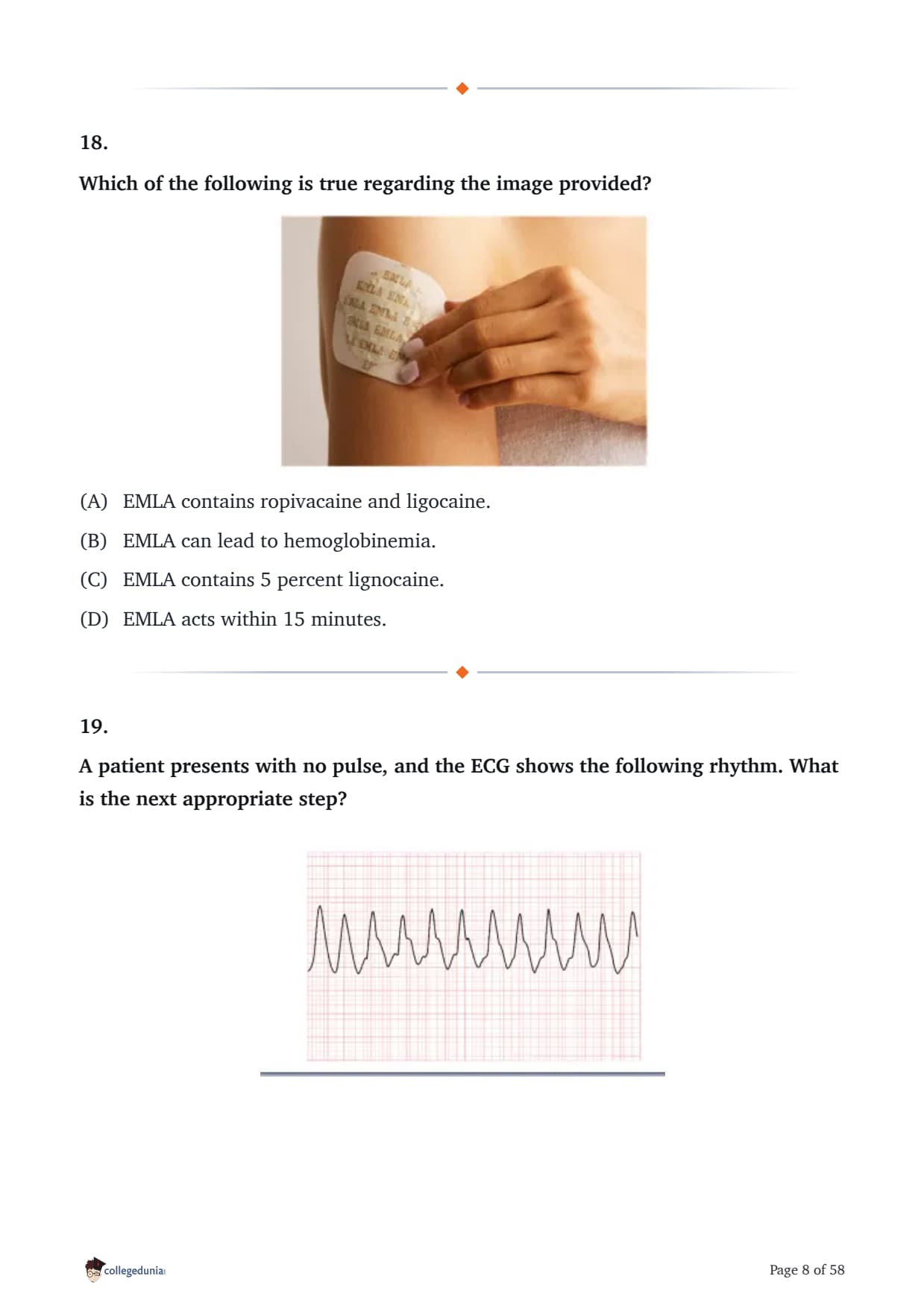
A patient presents with no pulse, and the ECG shows the following rhythm. What is the next appropriate step? 

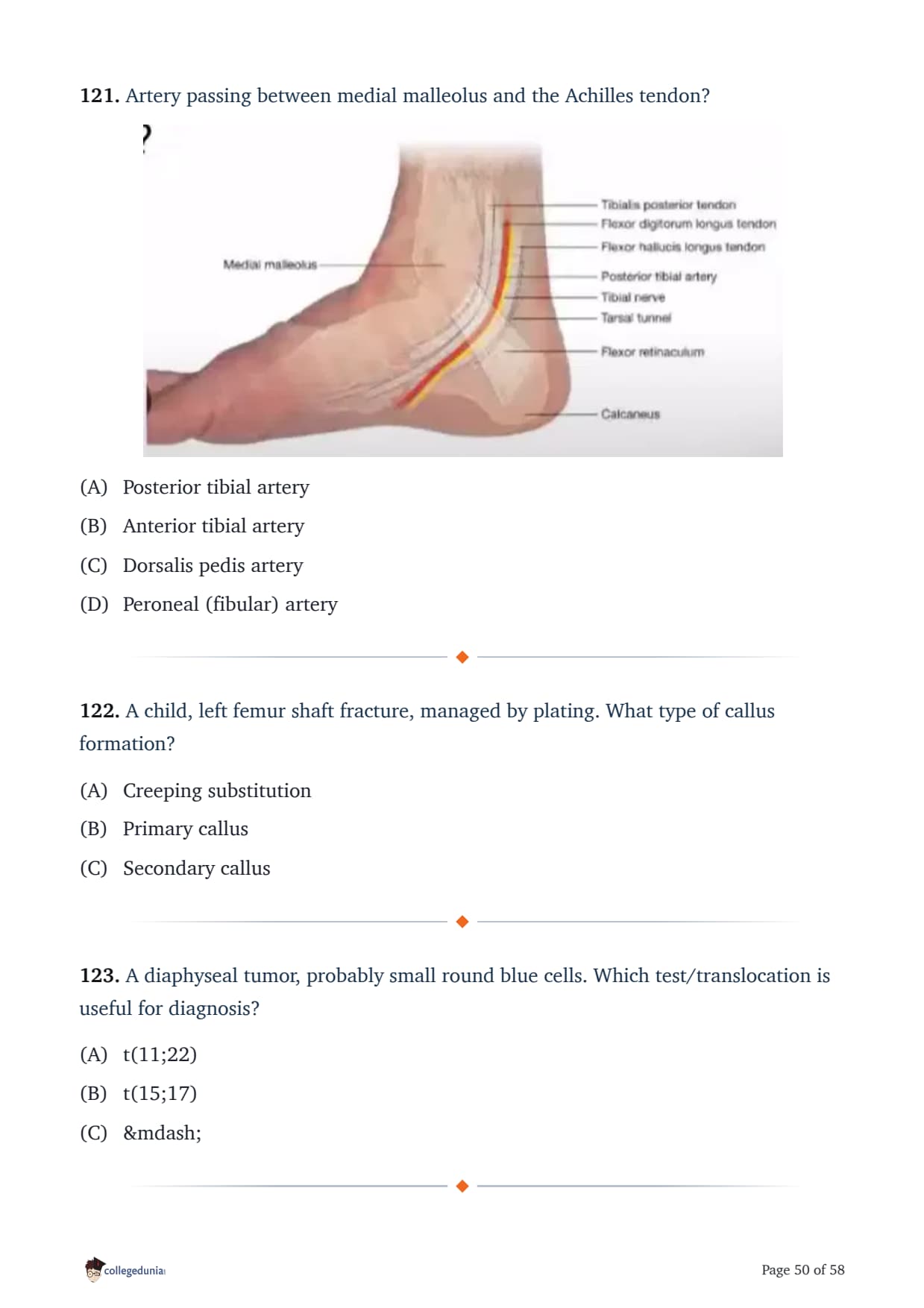
Behind the medial malleolus and in front of Achilles, which artery is present?
The covering of an omphalocele is derived from which layer?
A 13-year-old boy presents with jaundice, fatigue, muscle stiffness, tremors, behavioral changes, hepatosplenomegaly, and Kayser-Fleischer rings. Which test is definitive for the diagnosis?
A patient presents with xanthomas on the Achilles tendon. Which of the following is the most likely diagnosis?
A patient with multiple tendon xanthomas is found to have a serum cholesterol level of 398 mg/dL and an LDL level of 220 mg/dL. What is the most likely defect?
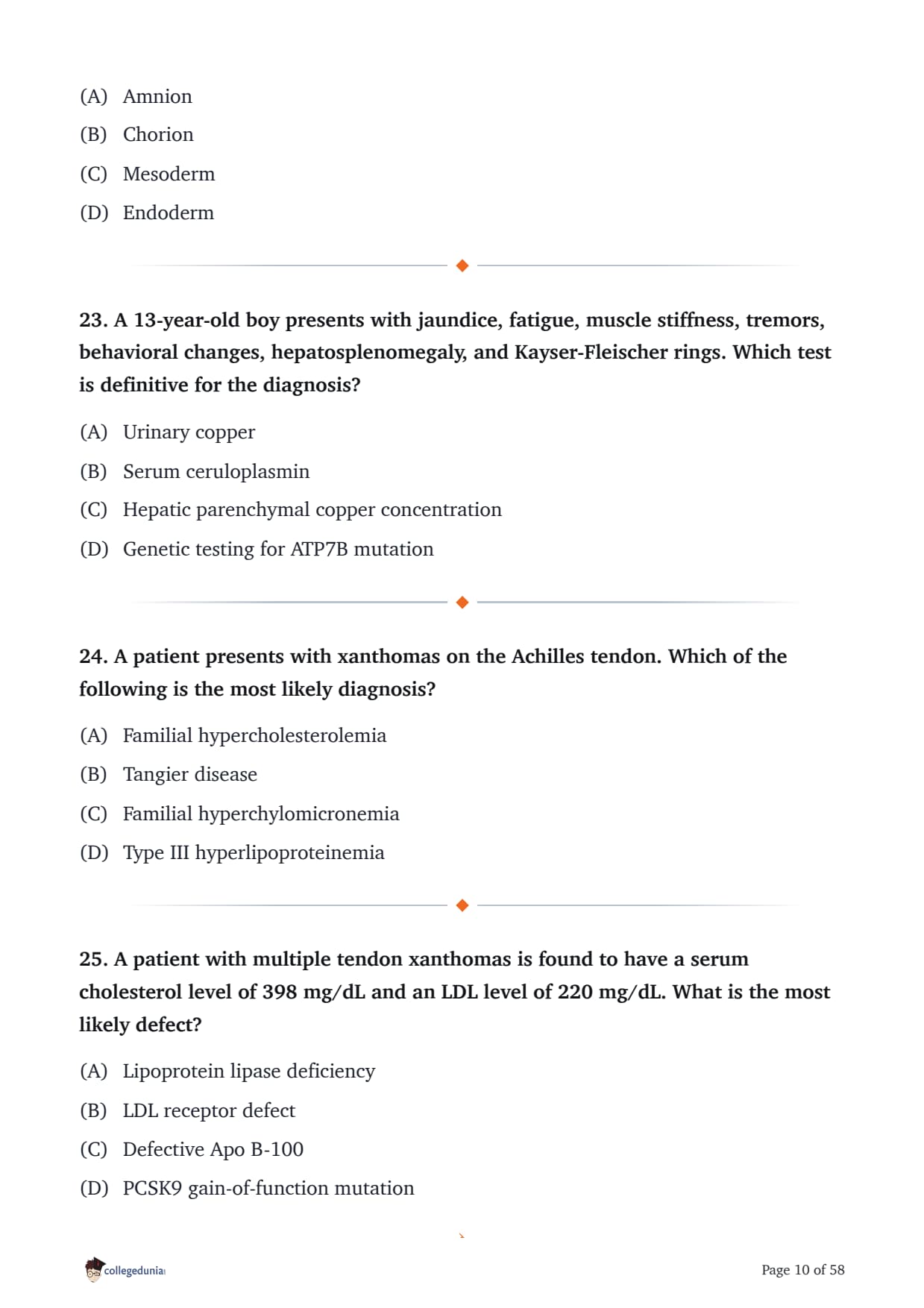
A 30-year-old patient presents with a history of flat lesions near the anal canal, rashes on the body, and hair loss that follows a particular pattern, as shown in the image. What is the diagnosis? 
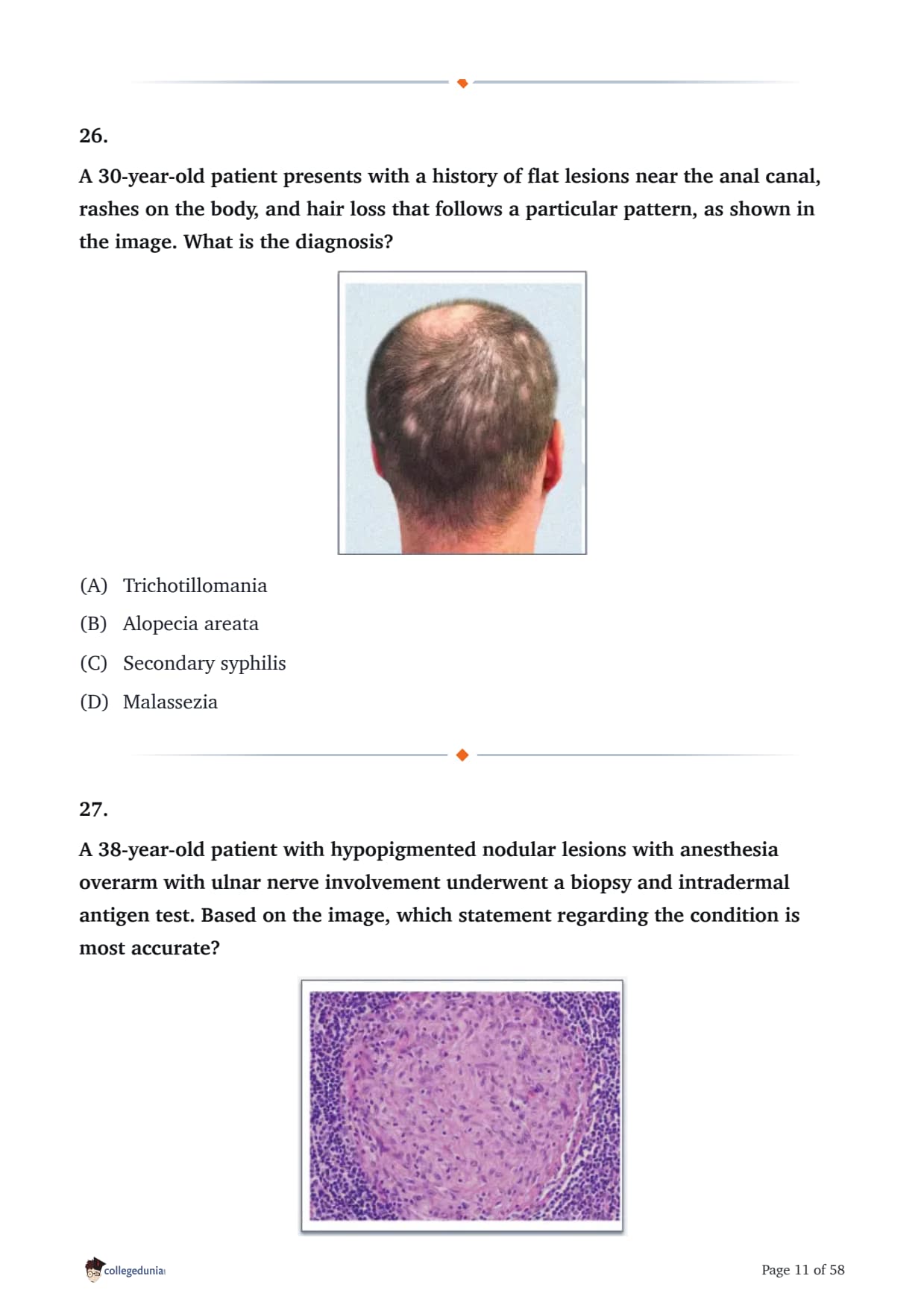
A 38-year-old patient with hypopigmented nodular lesions with anesthesia overarm with ulnar nerve involvement underwent a biopsy and intradermal antigen test. Based on the image, which statement regarding the condition is most accurate? 
A singer is finding difficulty raising the pitch of her voice. On examination, her vocal cords were depressed and bowing. Which of the following muscles is involved?
A 45-year-old woman is diagnosed with right vestibular neuritis. What findings are expected during the head impulse test in this patient?
In medicolegal examination, the accused 18-year-old male claims he is 16 years old. Which joint x-ray should be done?
Police brought a person from the railway track with features of a dry, dilated pupil, dry skin, slurring of speech, and altered sensorium. The poisoning is?
The flexion point in a ventouse delivery is located at which of the following positions on the fetal head?

The patient is having a headache and confusion. A brain tumor diagnosis is made. Family history reveals brain and kidney tumors. Choose the correct option.
A 62-year-old patient presents with left-sided arm and leg weakness, right-sided facial paralysis, and difficulty with horizontal eye movements. Based on the clinical presentation, which of the following syndromes is most consistent with these symptoms?
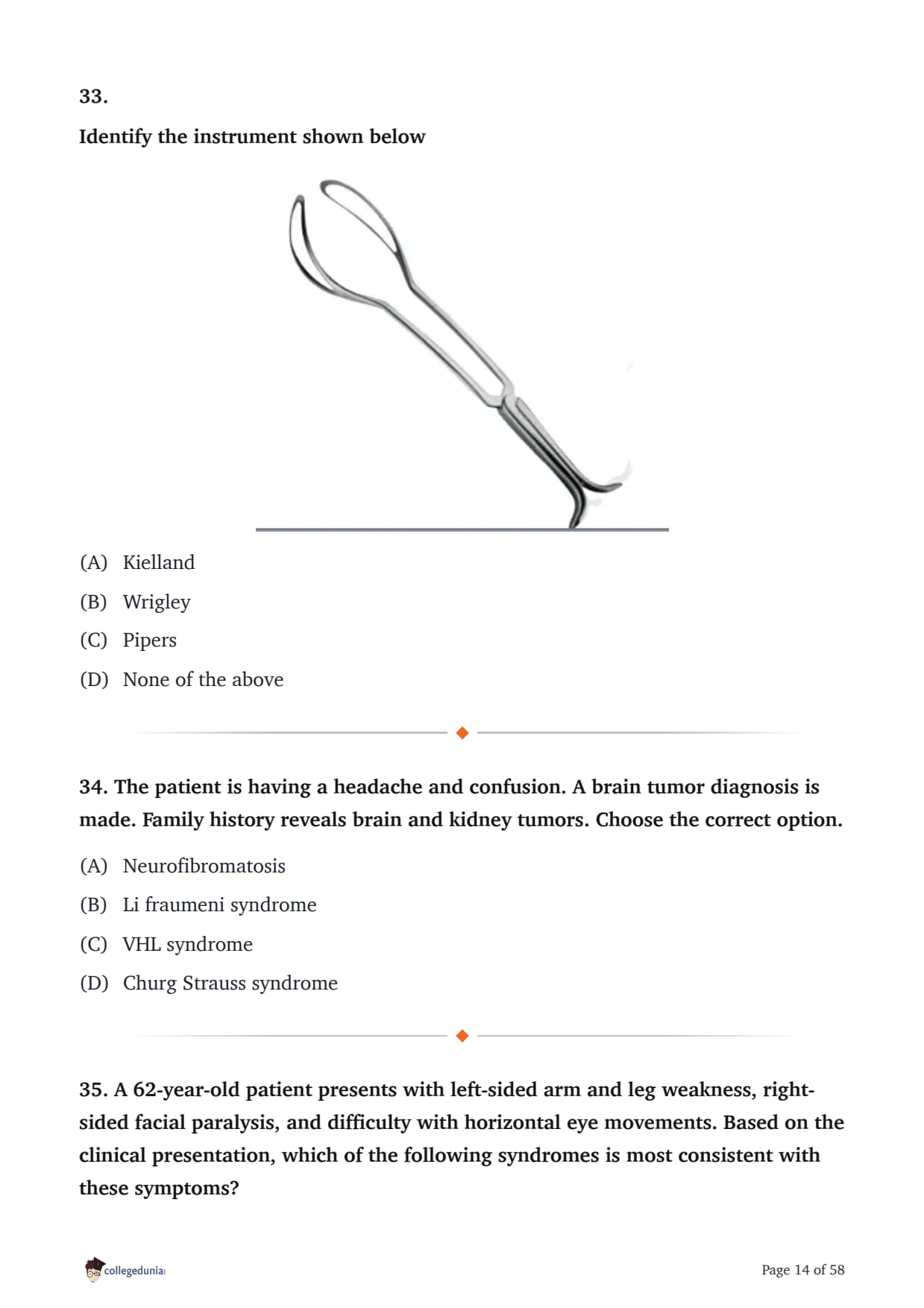
A patient presents with painful vesicles in the genital region. Identify the lesion shown in the image and choose the correct diagnosis. 
A patient presents with perianal itching. A peripheral swab was taken, and the image below shows the findings. What is the most likely diagnosis?
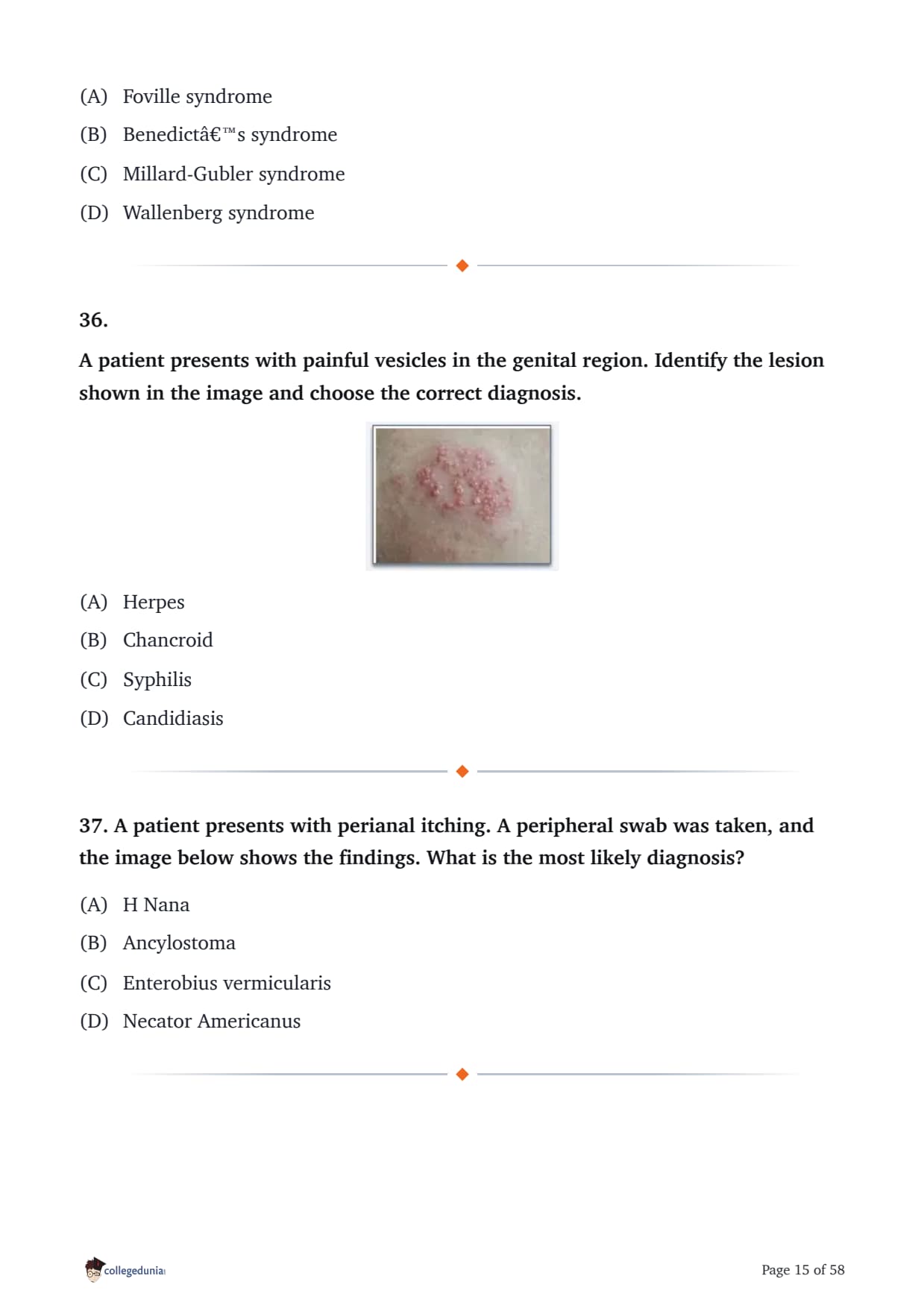
A 2-month-old child is brought to the ophthalmology OPD with the following presentation. What is the ideal management? 
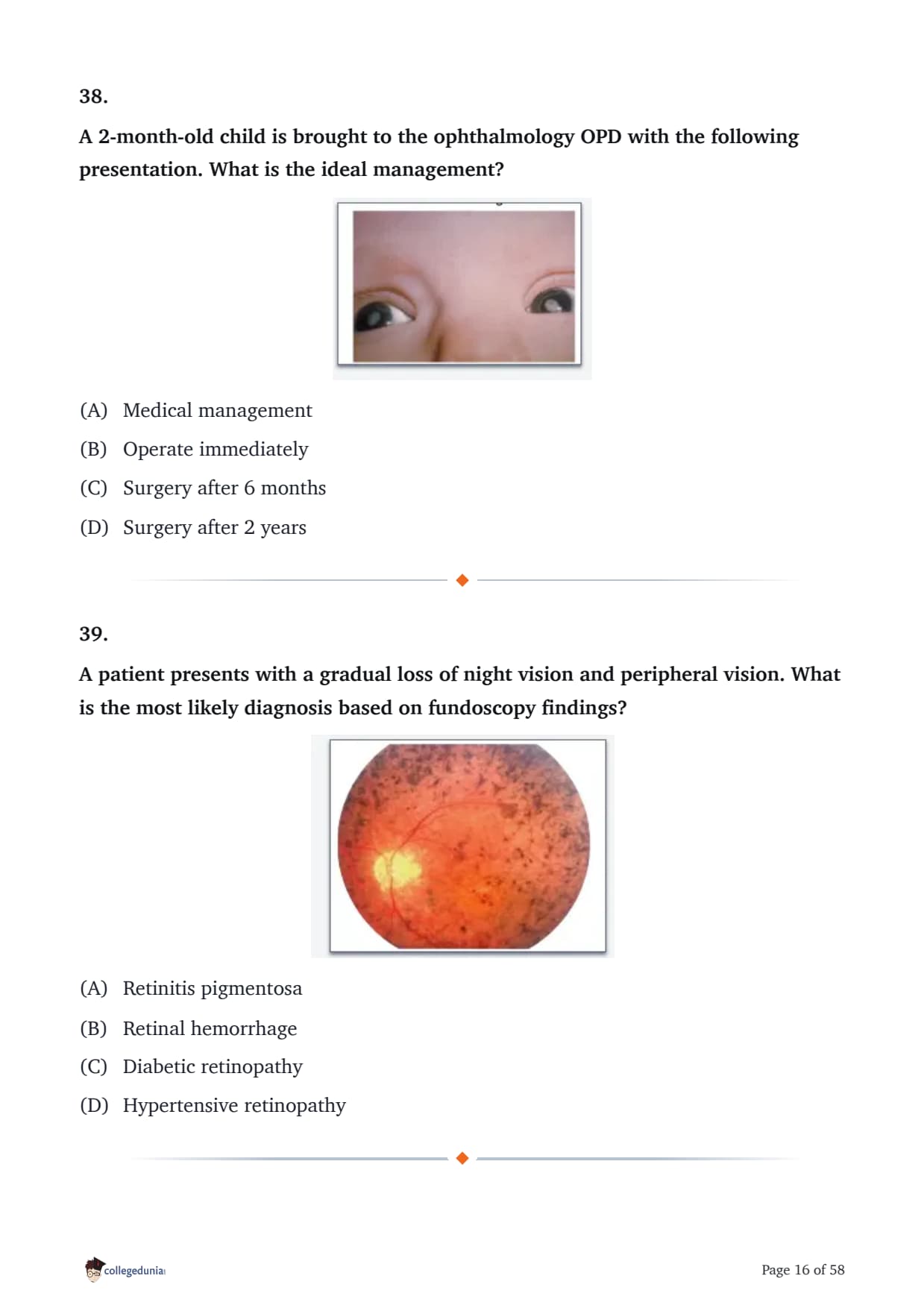
A patient presents with a gradual loss of night vision and peripheral vision. What is the most likely diagnosis based on fundoscopy findings? 
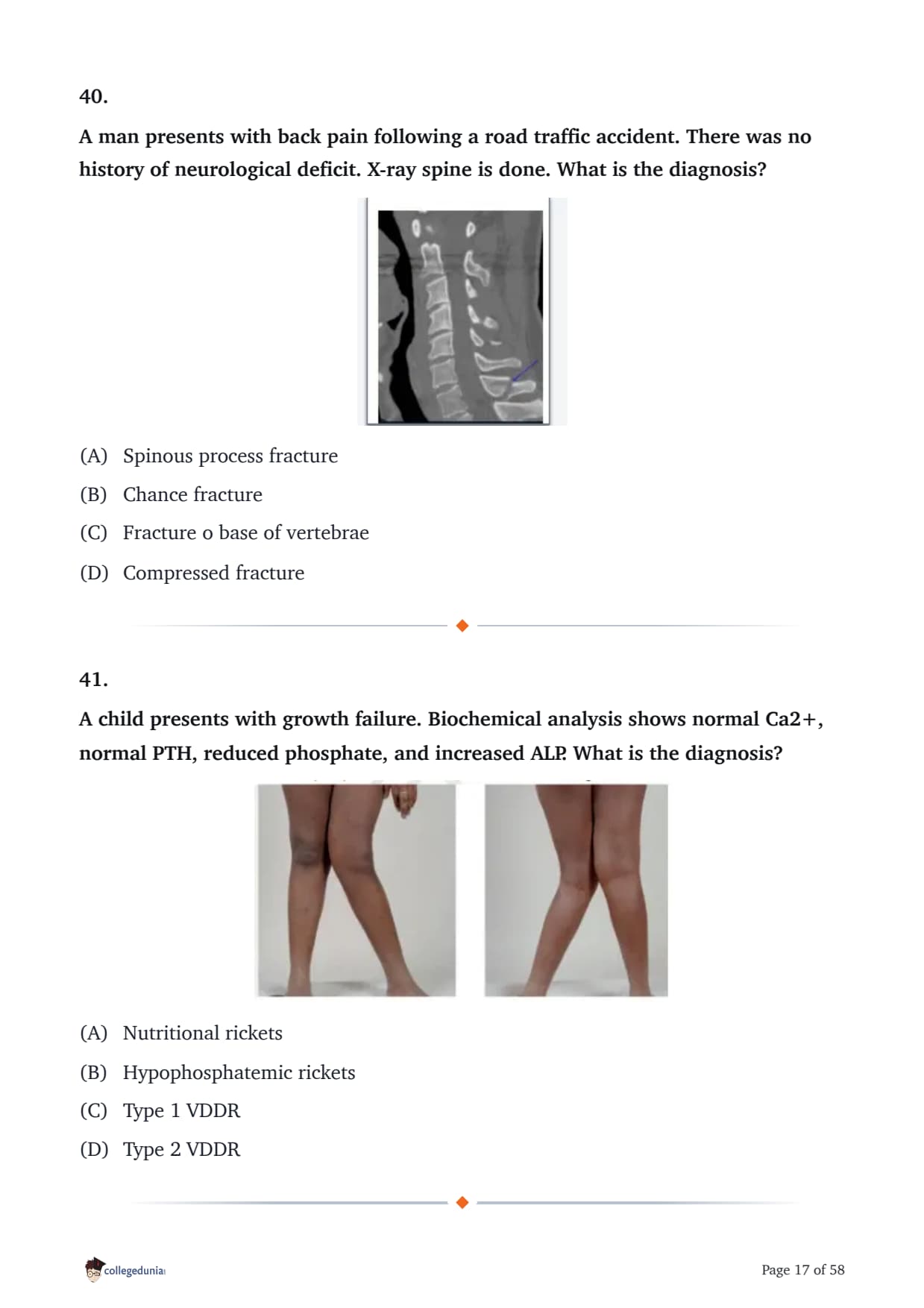
A man presents with back pain following a road traffic accident. There was no history of neurological deficit. X-ray spine is done. What is the diagnosis? 
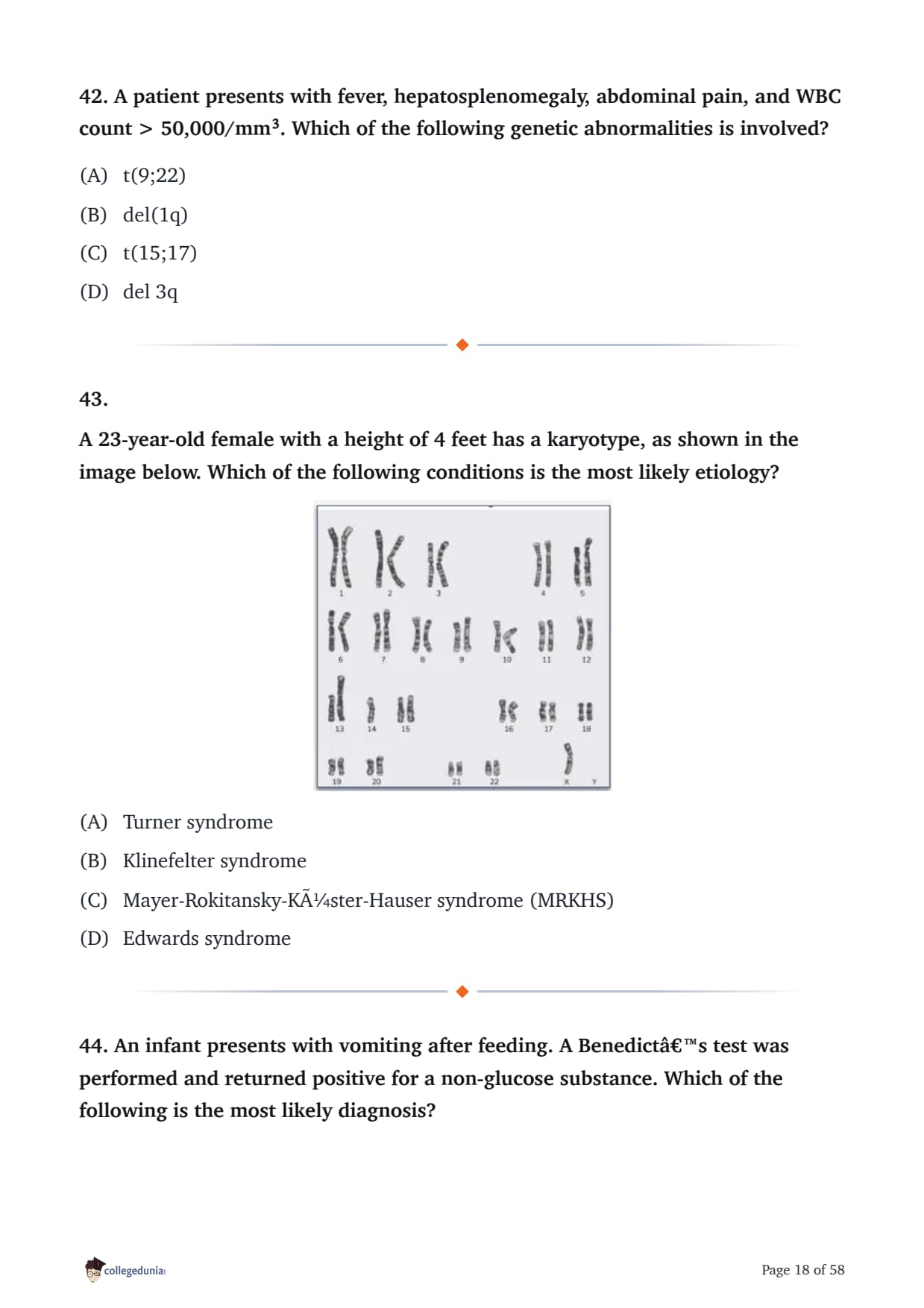
A child presents with growth failure. Biochemical analysis shows normal Ca2+, normal PTH, reduced phosphate, and increased ALP. What is the diagnosis? 
A patient presents with fever, hepatosplenomegaly, abdominal pain, and WBC count > 50,000/mm\(^3\). Which of the following genetic abnormalities is involved?
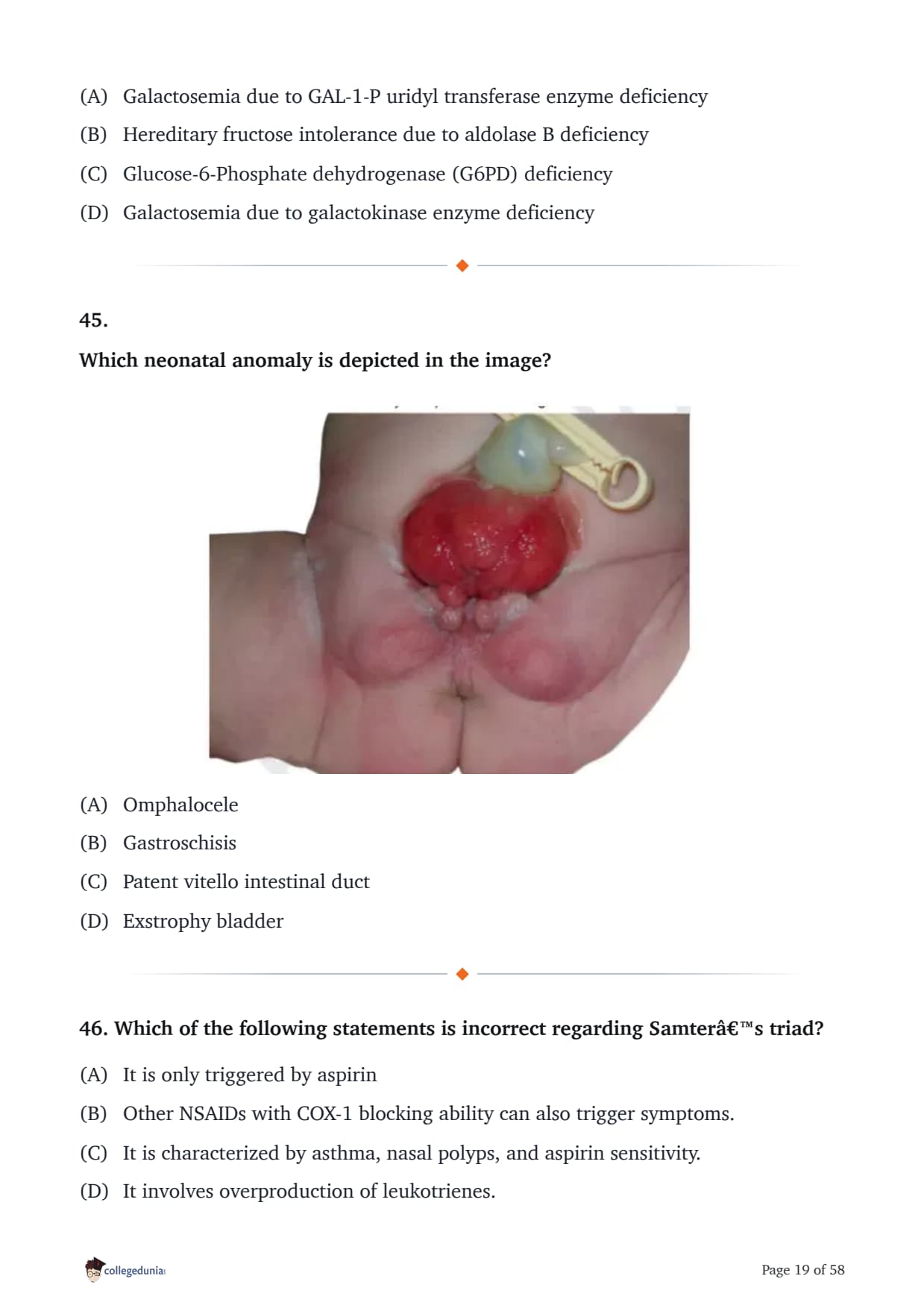
A 23-year-old female with a height of 4 feet has a karyotype, as shown in the image below. Which of the following conditions is the most likely etiology? 
An infant presents with vomiting after feeding. A Benedict’s test was performed and returned positive for a non-glucose substance. Which of the following is the most likely diagnosis?

Which of the following statements is incorrect regarding Samter’s triad?
Aprepitant, a drug used to prevent late-onset chemotherapy-induced nausea and vomiting, acts through which of the following mechanisms?
Sour taste is perceived by which receptors?
Which ion is most responsible for the resting membrane potential (RMP)?
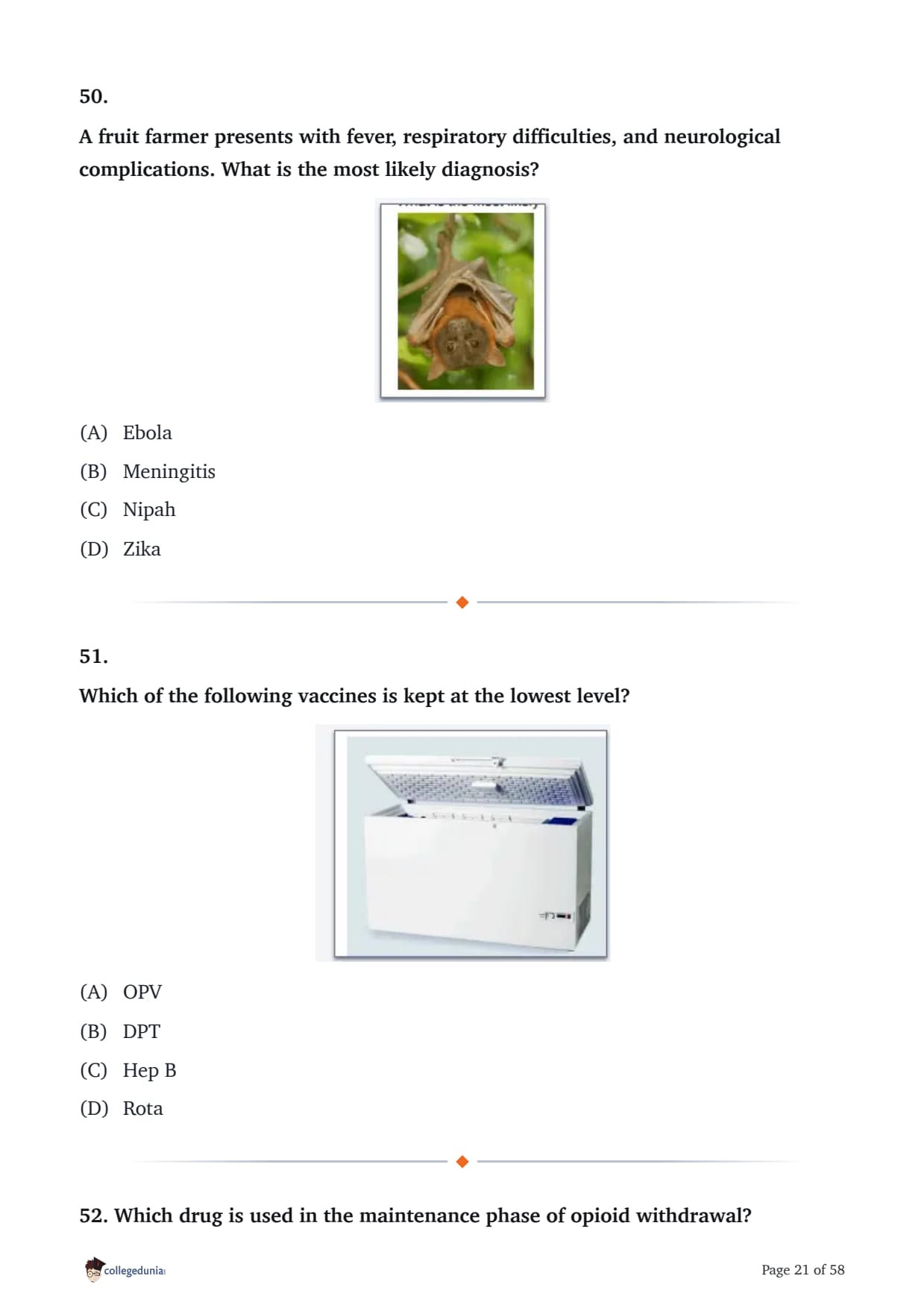
A fruit farmer presents with fever, respiratory difficulties, and neurological complications. What is the most likely diagnosis? 

Which drug is used in the maintenance phase of opioid withdrawal?
A 45-year-old woman presents with a long-standing history of “feeling tensed†along with an upset stomach, diarrhea, and heartburn. She mentions that her family members also experience similar symptoms. Which of the following symptoms is most likely to be observed in this patient?
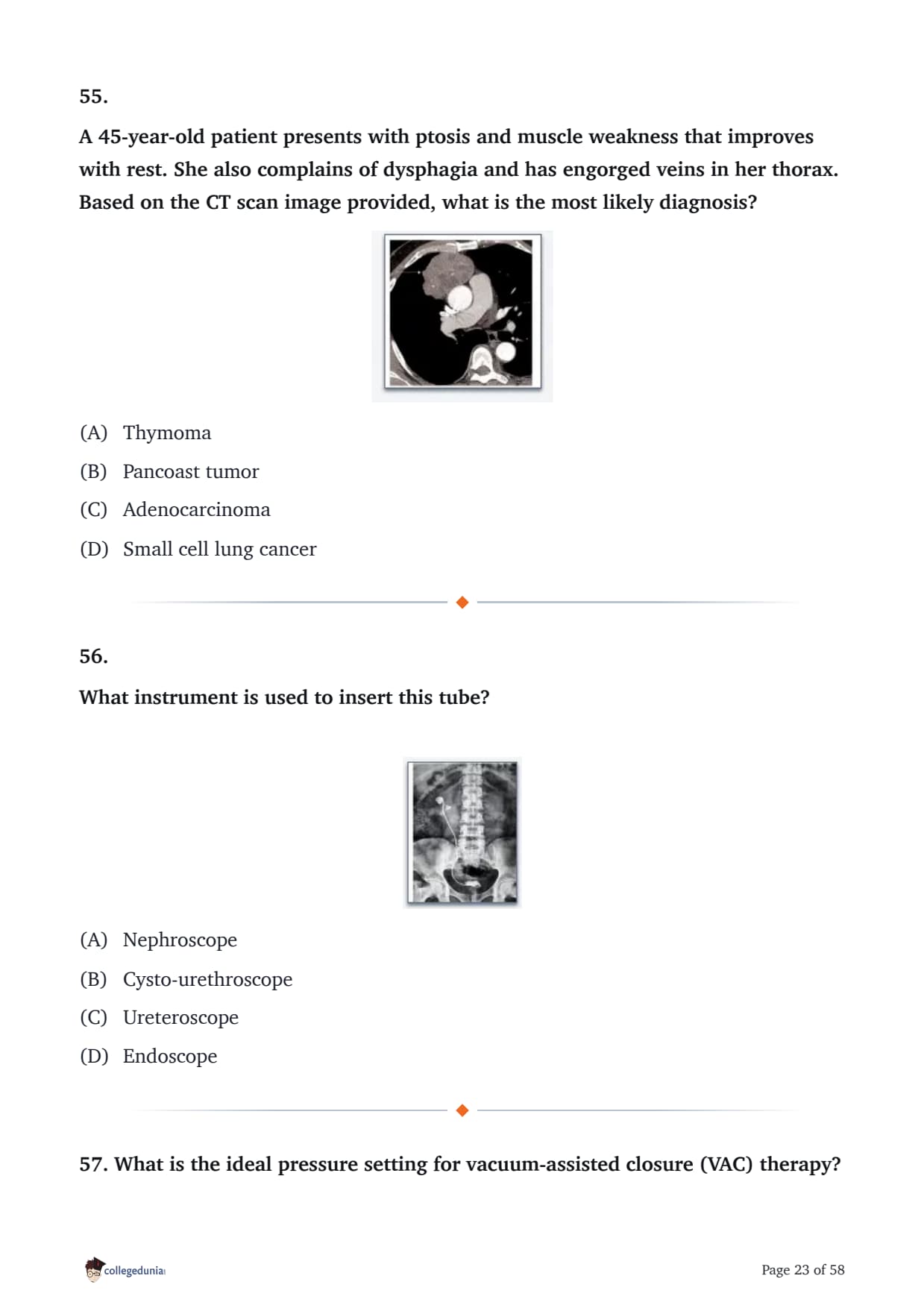
A 40-year-old female patient complains of a persistent headache. A CT scan of the head was performed, as shown below. What is the most accurate diagnosis? 
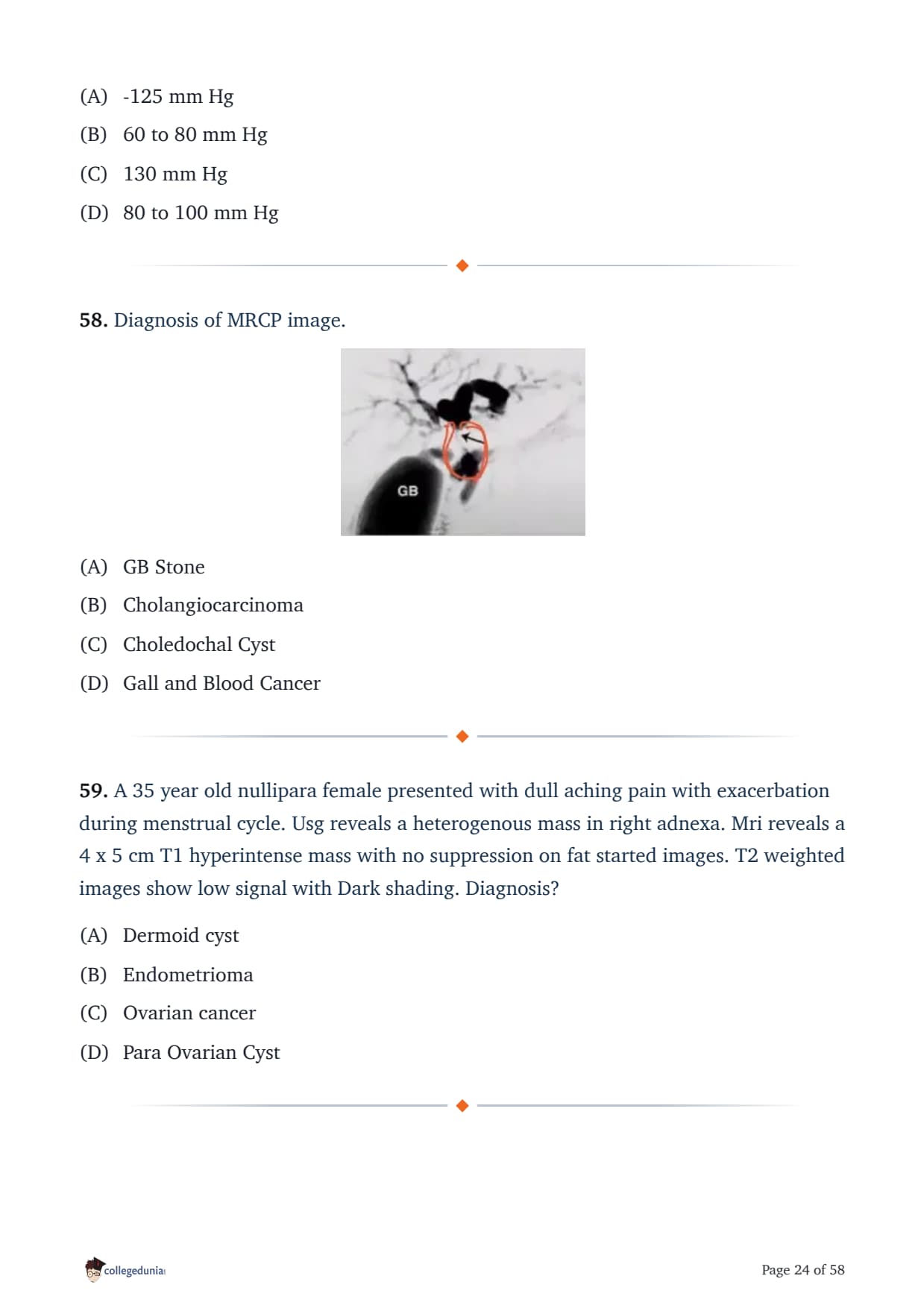
A 45-year-old patient presents with ptosis and muscle weakness that improves with rest. She also complains of dysphagia and has engorged veins in her thorax. Based on the CT scan image provided, what is the most likely diagnosis? 

What is the ideal pressure setting for vacuum-assisted closure (VAC) therapy?
Diagnosis of MRCP image.
A 35 year old nullipara female presented with dull aching pain with exacerbation during menstrual cycle. Usg reveals a heterogenous mass in right adnexa. Mri reveals a 4 x 5 cm T1 hyperintense mass with no suppression on fat started images. T2 weighted images show low signal with Dark shading. Diagnosis?
Diagnosis of following Plain Xray of abdomen.
A patient has Proteus infection and now plain xray of abdomen was done and a large stone was shown in urinary bladder. Stone is made up of
Correct statement regarding esophageal FB (foreign body).
Gastrectomy patient needs supplemental: (PART A)
After a right limb amputation, the patient is experiencing severe pain phantom limb.
What is the mechanism behind this?
Patient had SUN BURN, now takes bath in 40 degree water, and feels pain.
A 50 yr old female presented with dyspnoea and chest pain. Which of the following proves that she has aortic stenosis rather than aortic regurgitation?
Taste is absent in which taste bud (papilla)?
Which receptor (transporter) helps in improvement of insulin resistance in DM2 (type 2 diabetes mellitus) with regular exercise and physical activity?
A man has difficulty in sleep during the night. He has a habit of drinking coffee before bed time. What is the role of caffeine in wakefulness?
Resting membrane potential (RMP) is predominantly affected by which ion?
Alcoholic gait, nystagmus after RTA (road traffic accident) — which lobe of the cerebellum is affected?
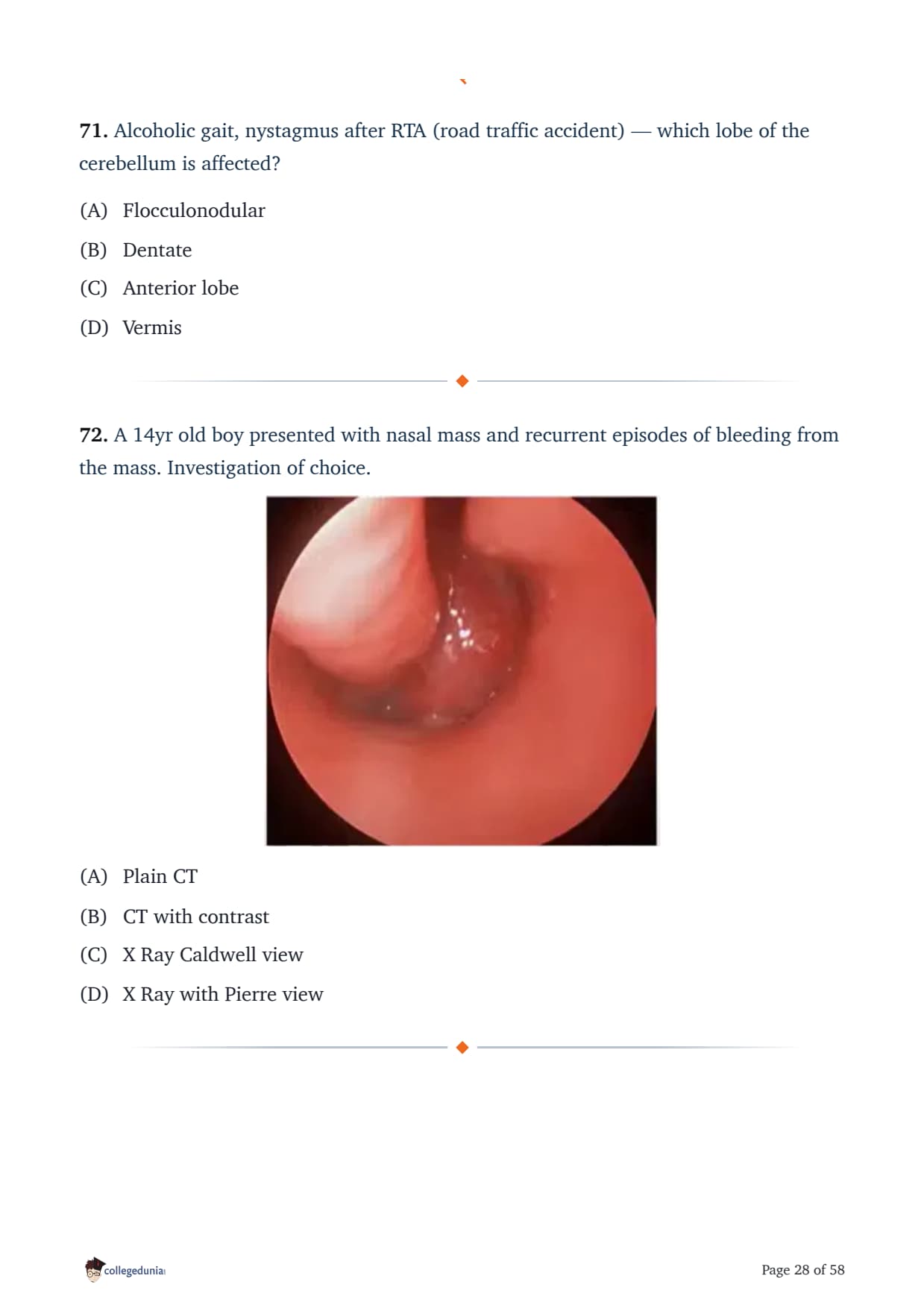
A 14yr old boy presented with nasal mass and recurrent episodes of bleeding from the mass. Investigation of choice.
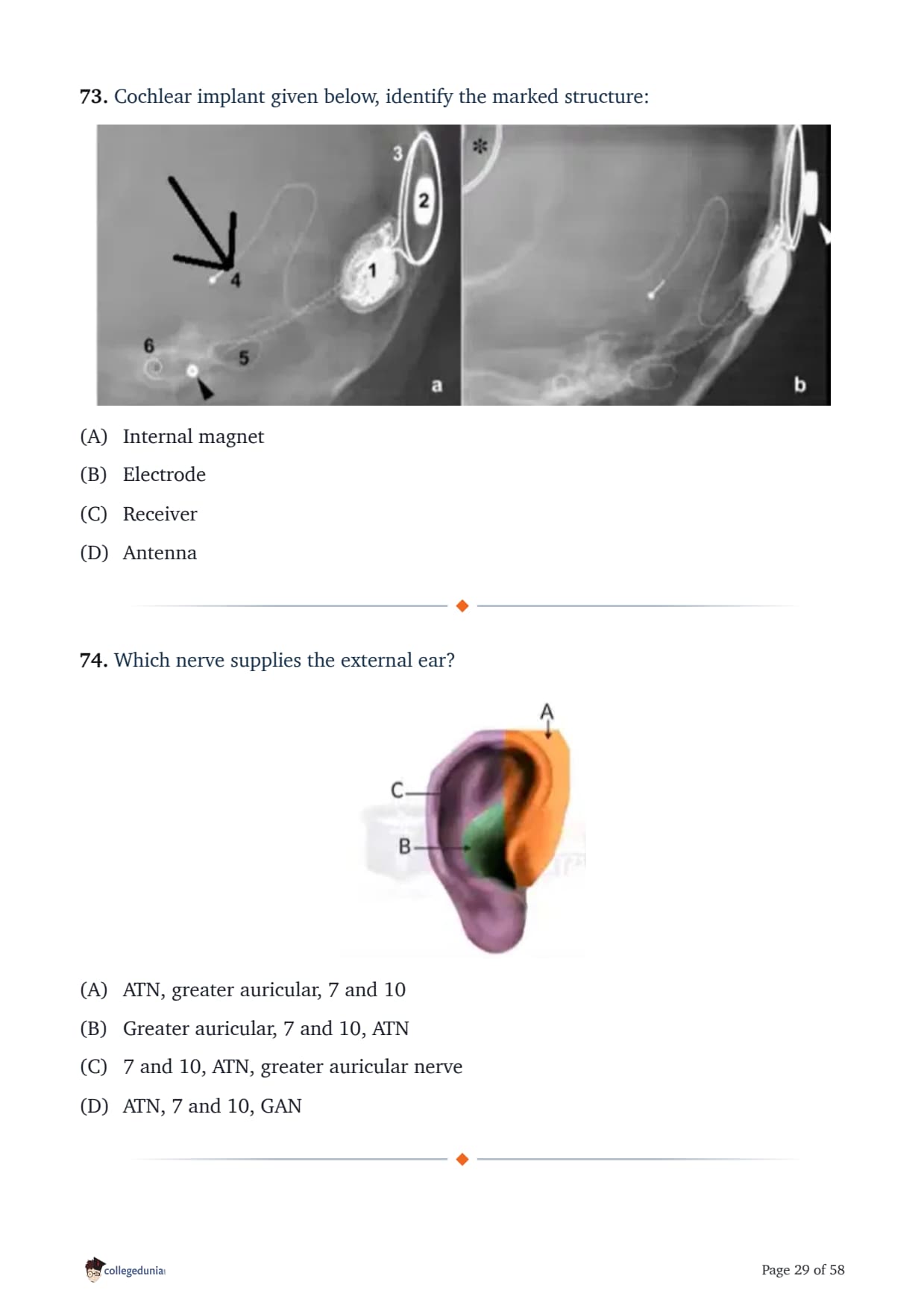
Cochlear implant given below, identify the marked structure:
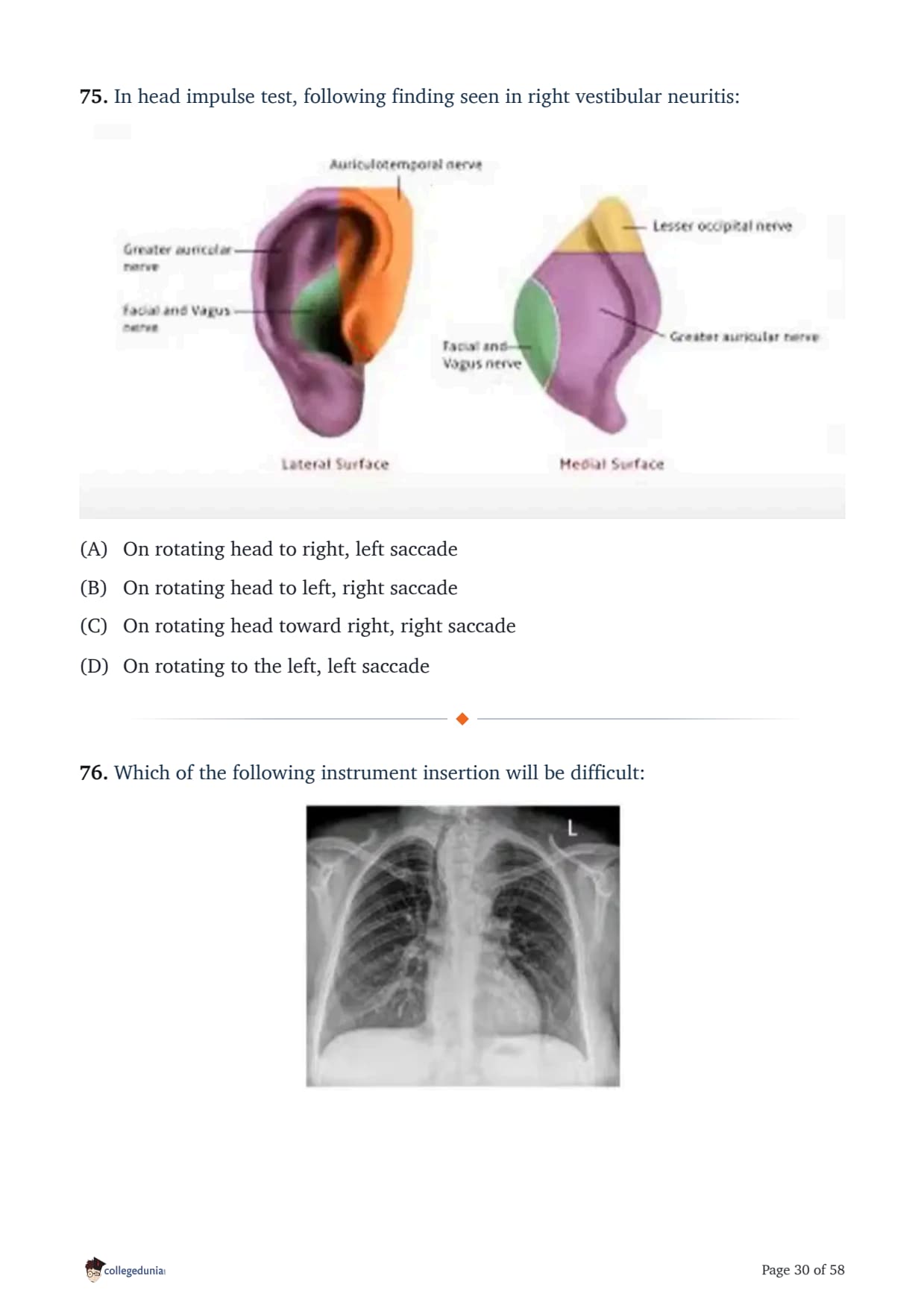
Which nerve supplies the external ear?
In head impulse test, following finding seen in right vestibular neuritis:
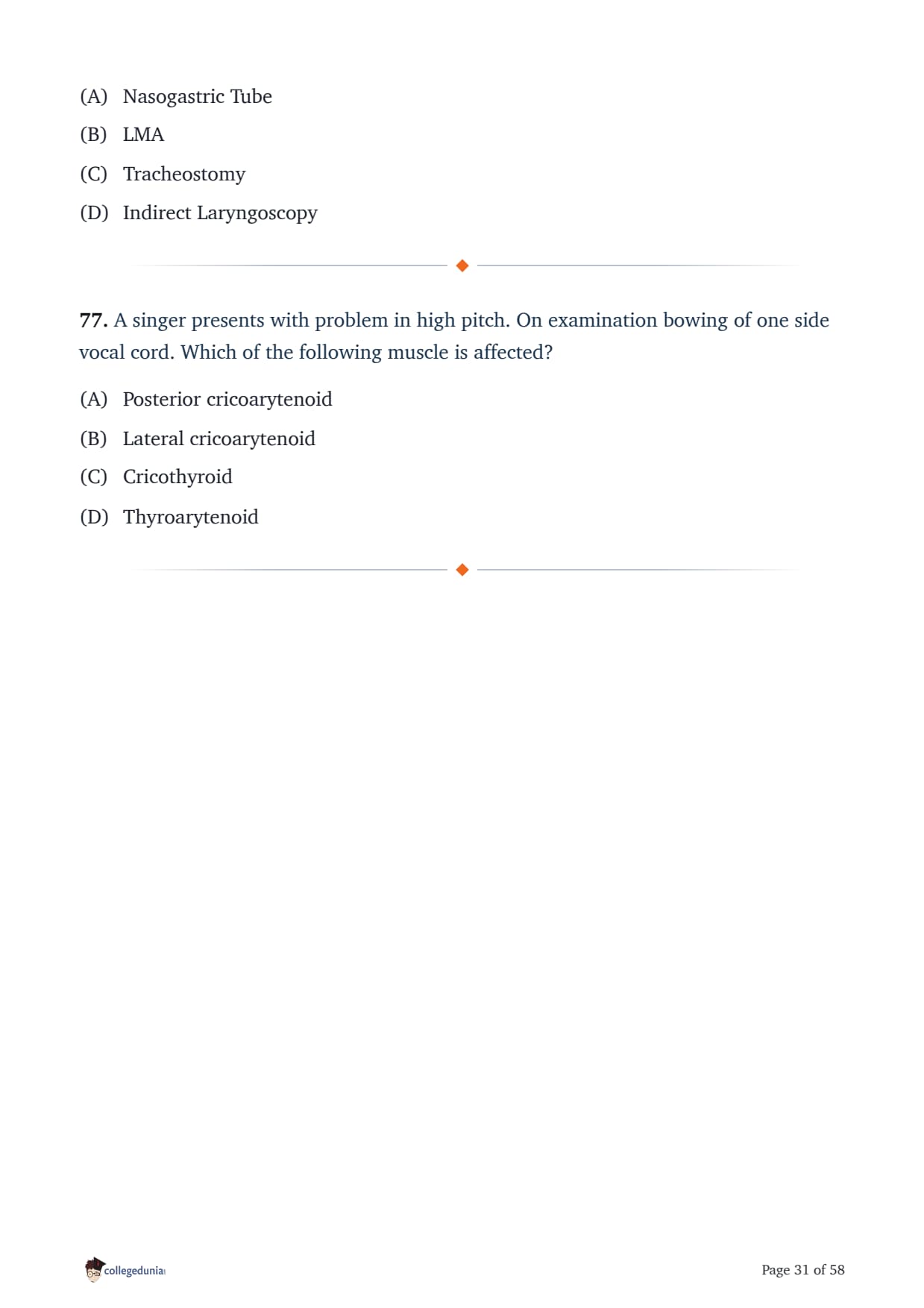
Which of the following instrument insertion will be difficult:
A singer presents with problem in high pitch. On examination bowing of one side vocal cord. Which of the following muscle is affected?
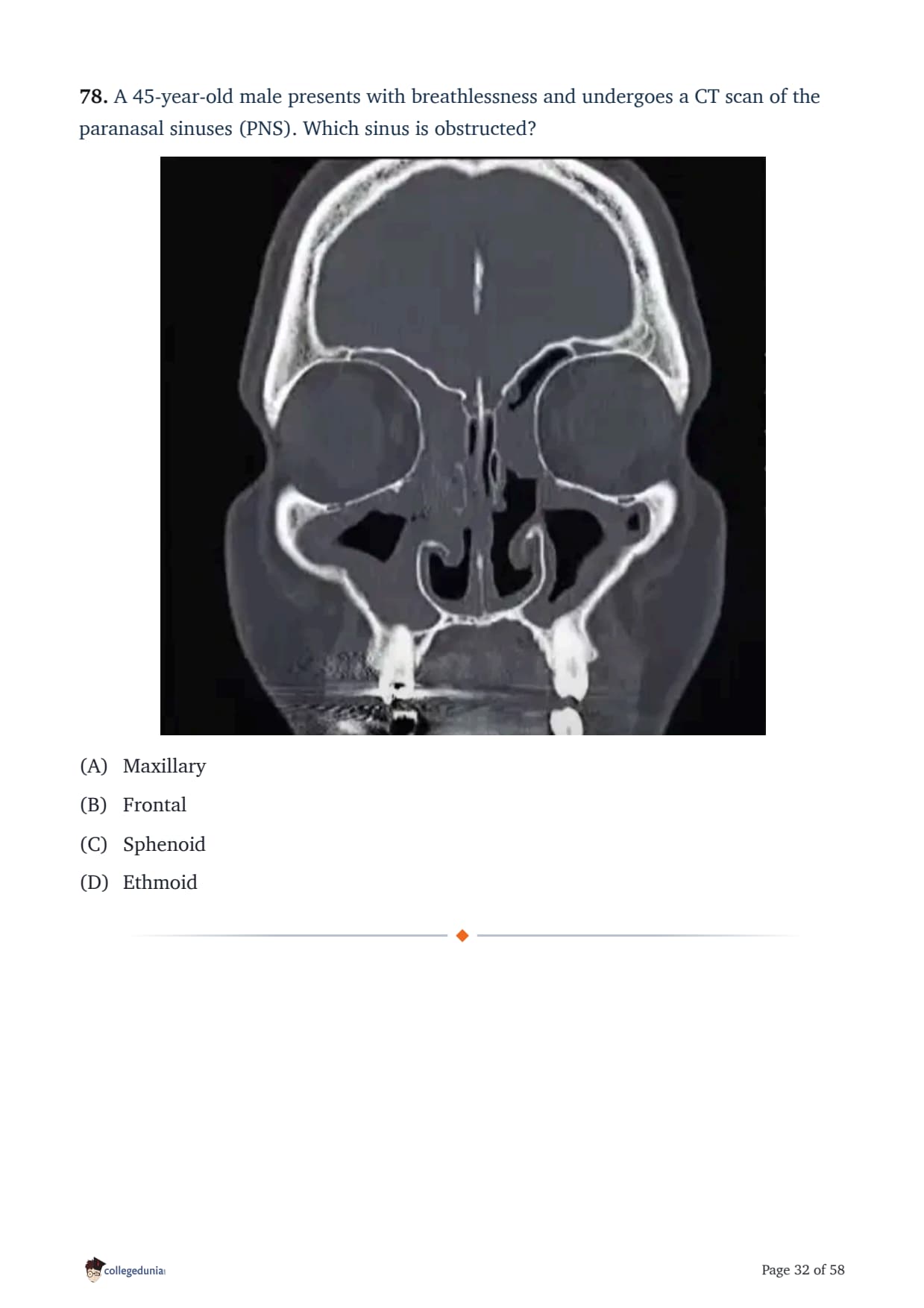
A 45-year-old male presents with breathlessness and undergoes a CT scan of the paranasal sinuses (PNS). Which sinus is obstructed?
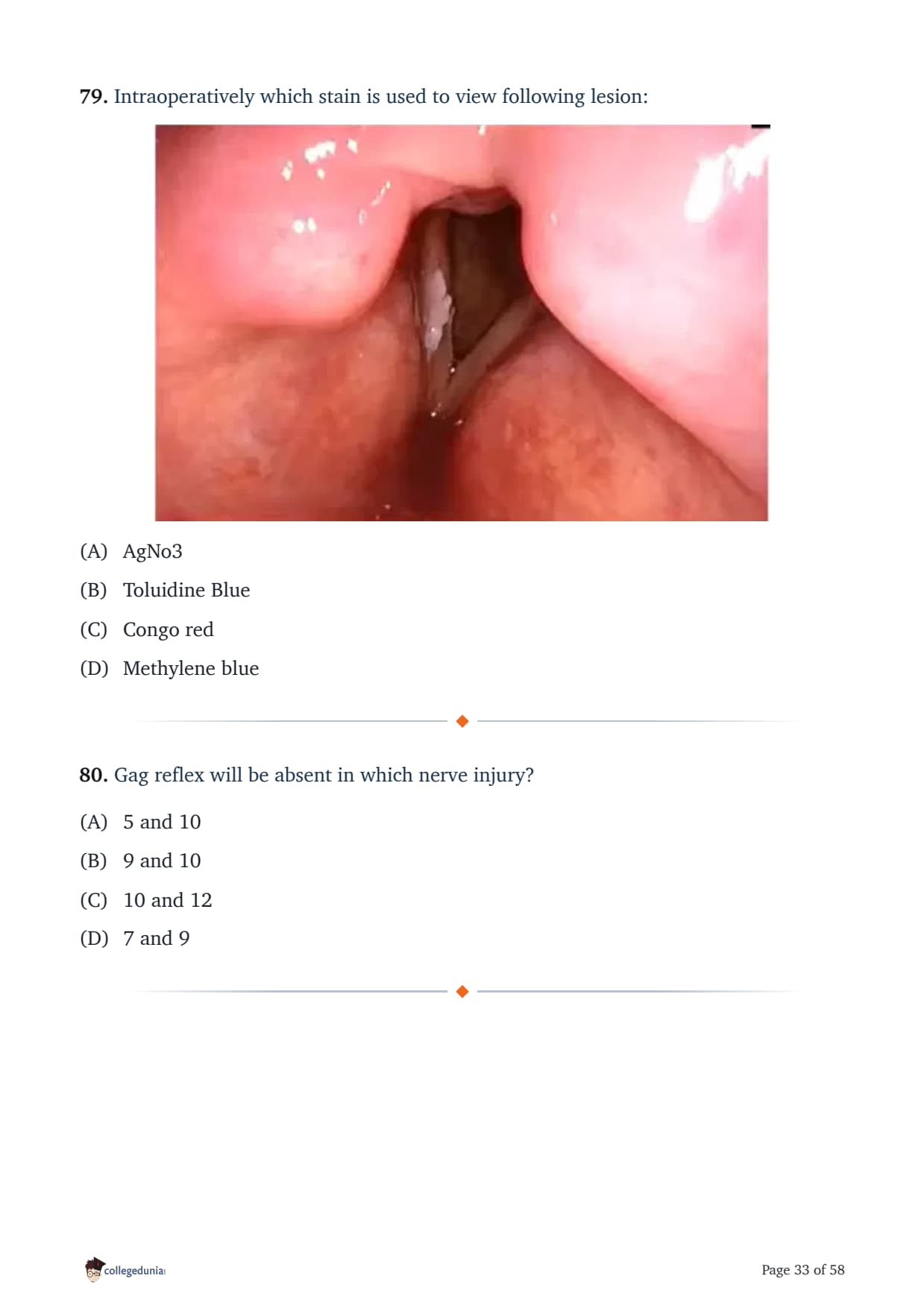
Intraoperatively which stain is used to view following lesion:
Gag reflex will be absent in which nerve injury?
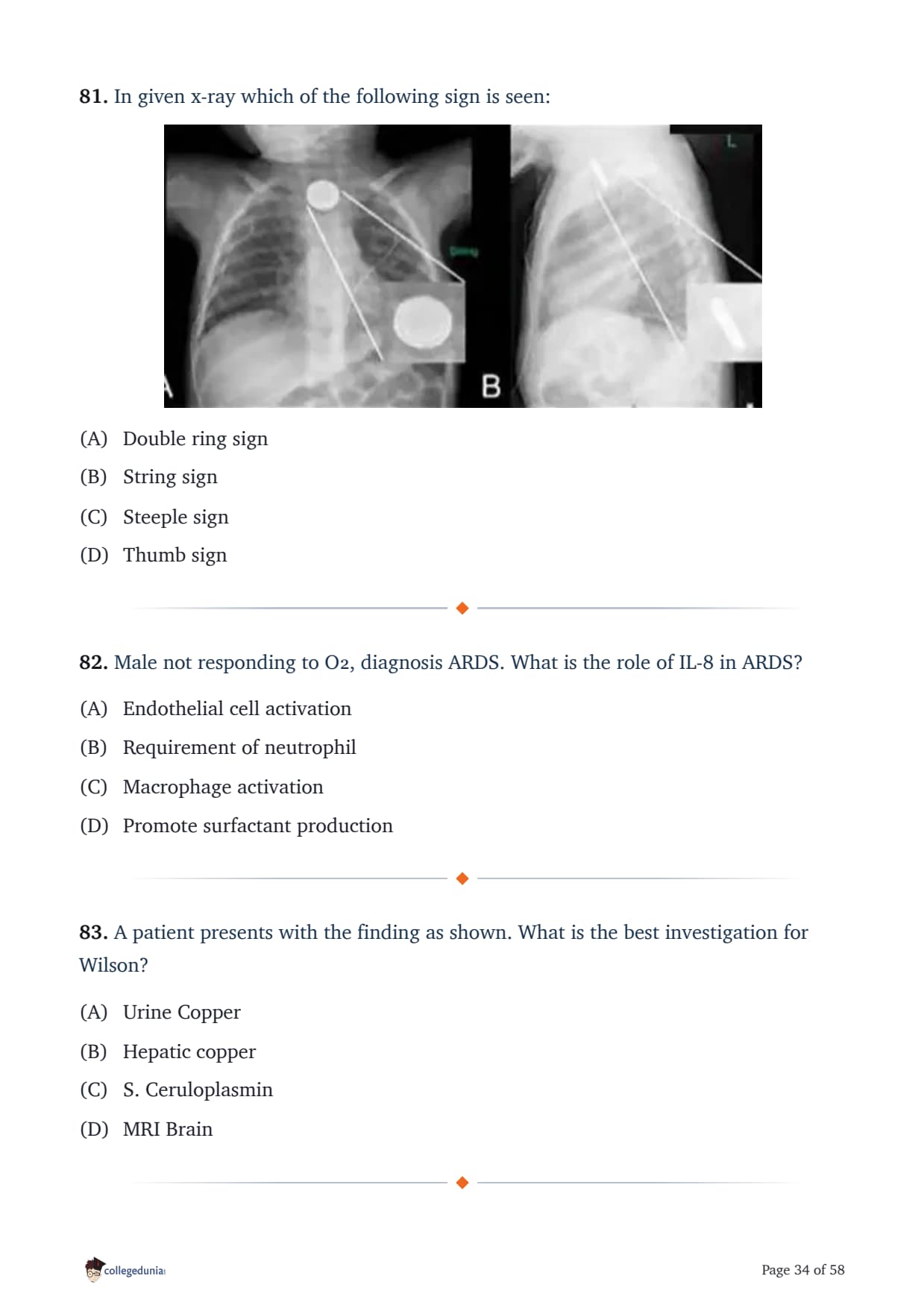
In given x-ray which of the following sign is seen:
Male not responding to O₂, diagnosis ARDS. What is the role of IL-8 in ARDS?
A patient presents with the finding as shown. What is the best investigation for Wilson?
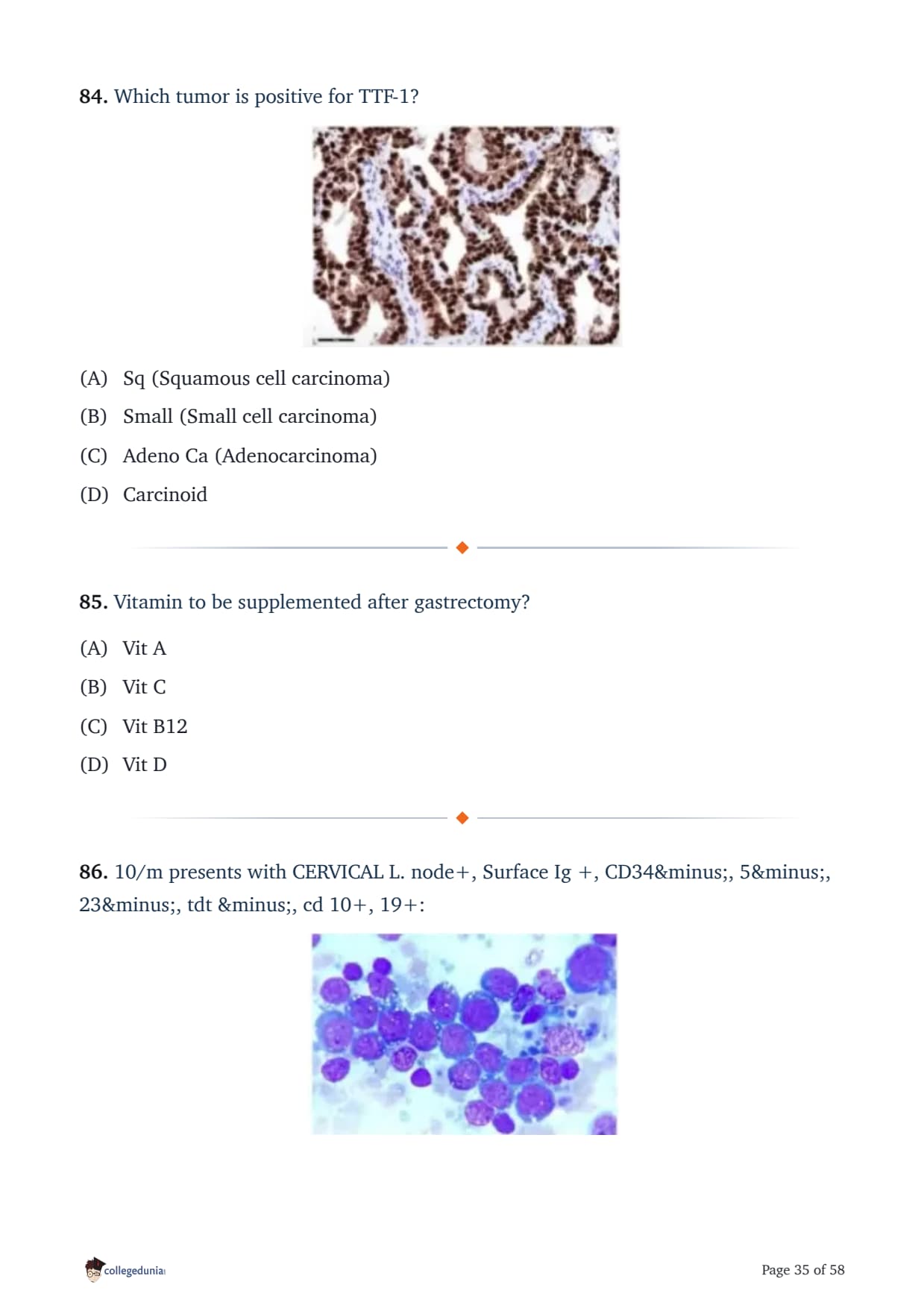
Which tumor is positive for TTF-1?
Vitamin to be supplemented after gastrectomy?
10/m presents with CERVICAL L. node+, Surface Ig +, CD34−, 5−, 23−, tdt −, cd 10+, 19+:
Most common mutation in Papillary cell CA?
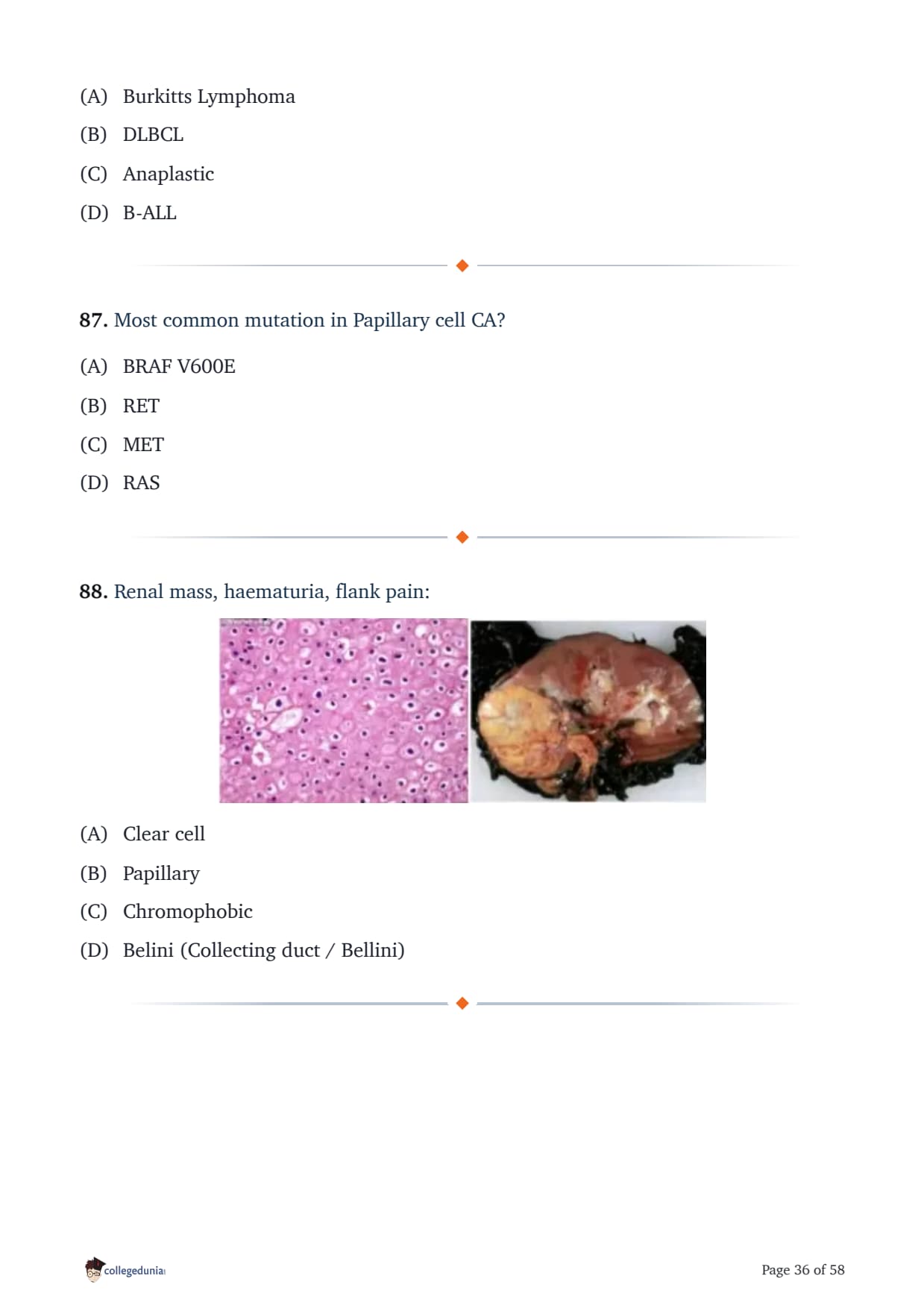
Renal mass, haematuria, flank pain:
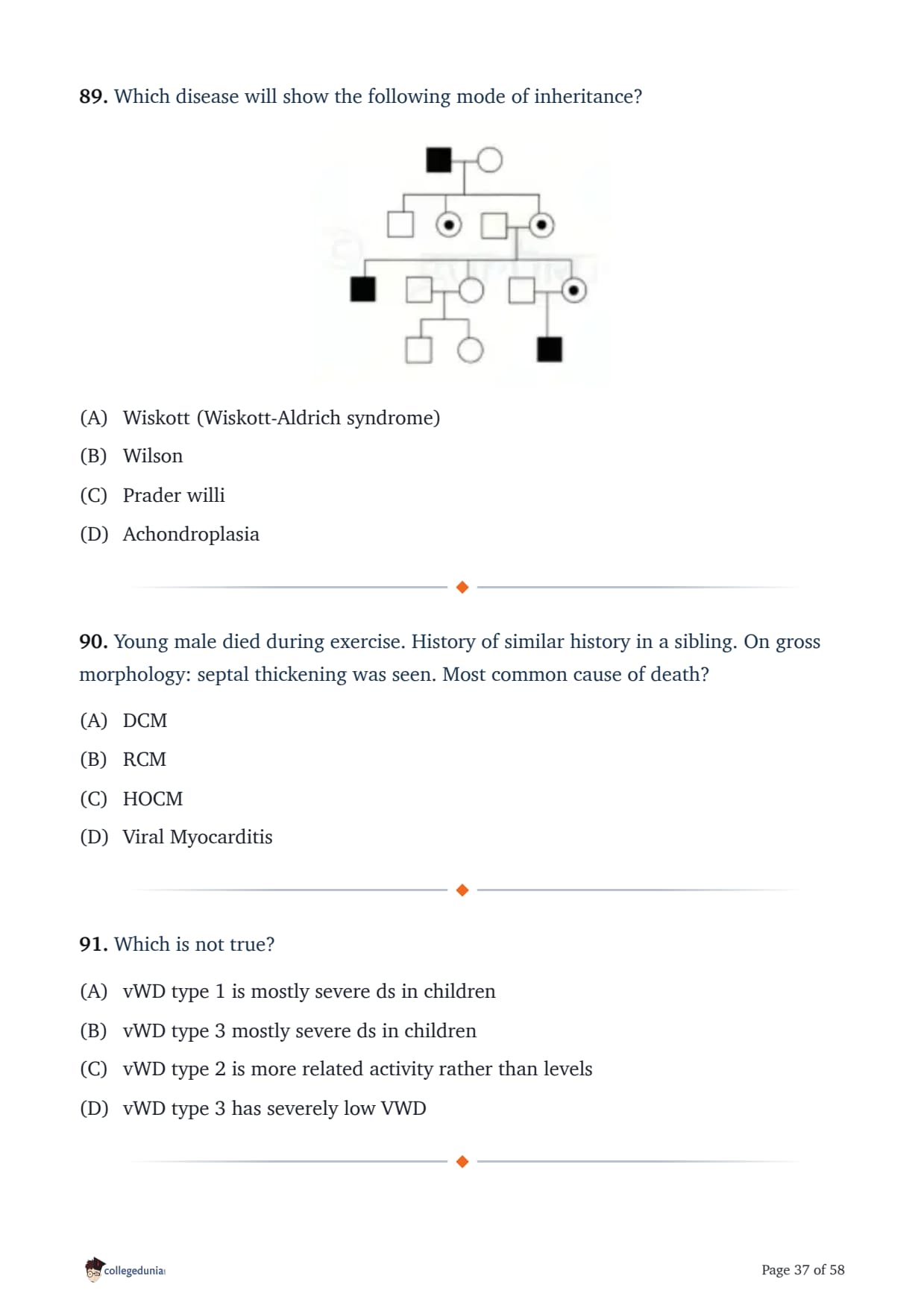
Which disease will show the following mode of inheritance?
Young male died during exercise. History of similar history in a sibling. On gross morphology: septal thickening was seen. Most common cause of death?
Which is not true?
Child. Sunlight causes eruptions, diagnosed as DNA repair defect. Which defect can it be?
18/M. Hepatosplenomegaly, Hb 7 gm%, LN+, WBC 50K, Platelets 30, petechiae, purpura, fatigue. What is the most appropriate management?
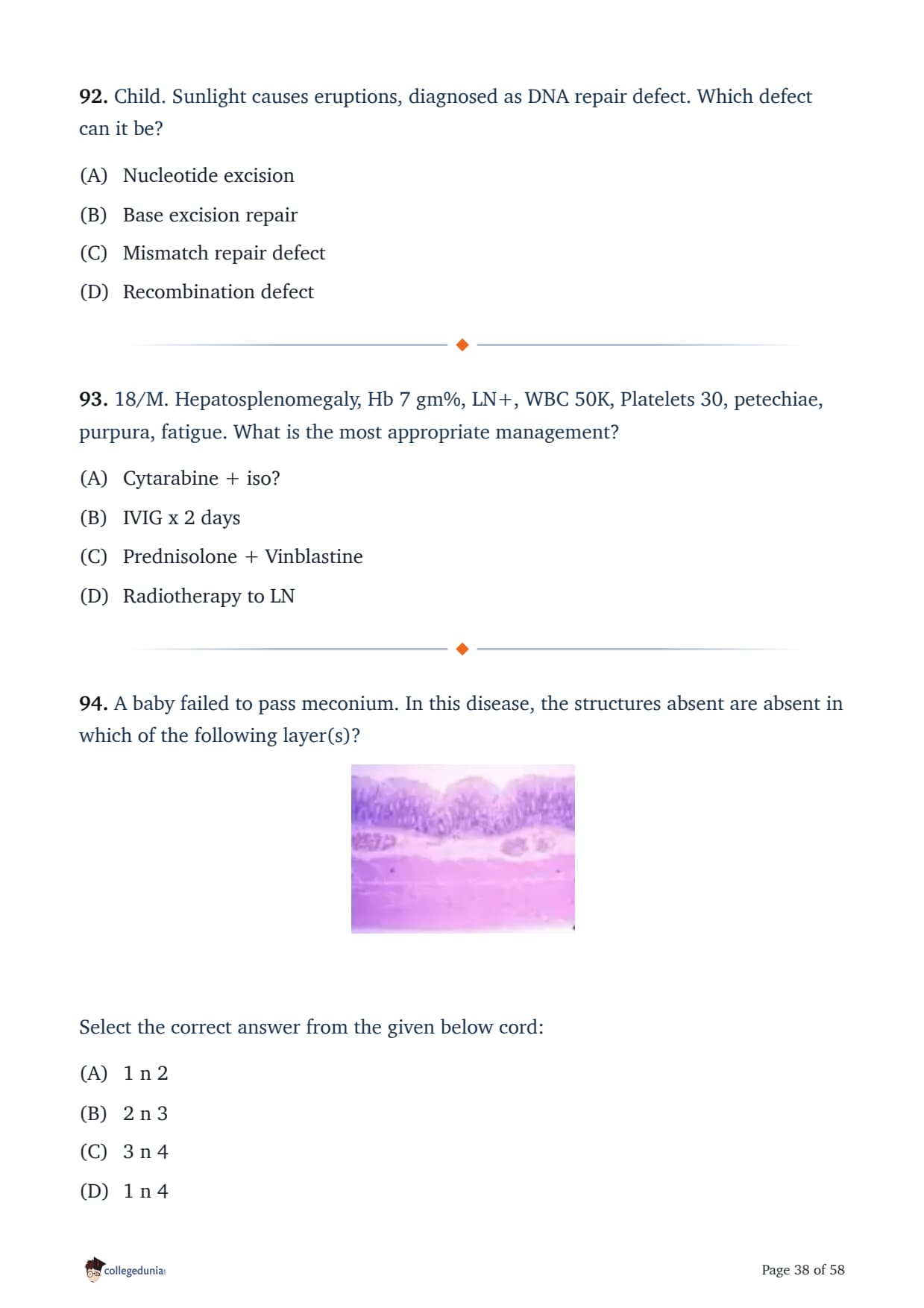
A baby failed to pass meconium. In this disease, the structures absent are absent in which of the following layer(s)? 
Select the correct answer from the given below cord:
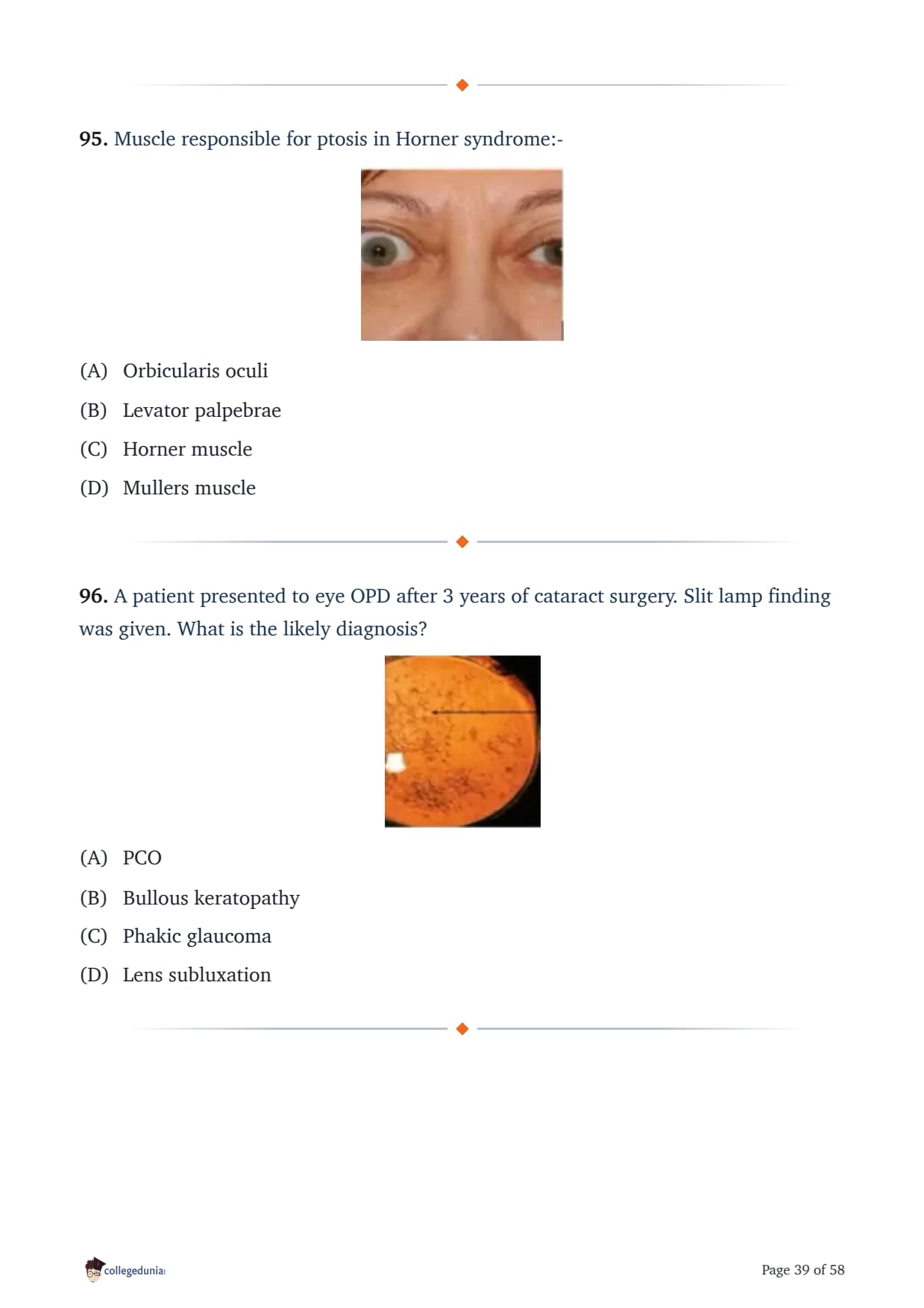
Muscle responsible for ptosis in Horner syndrome:- 
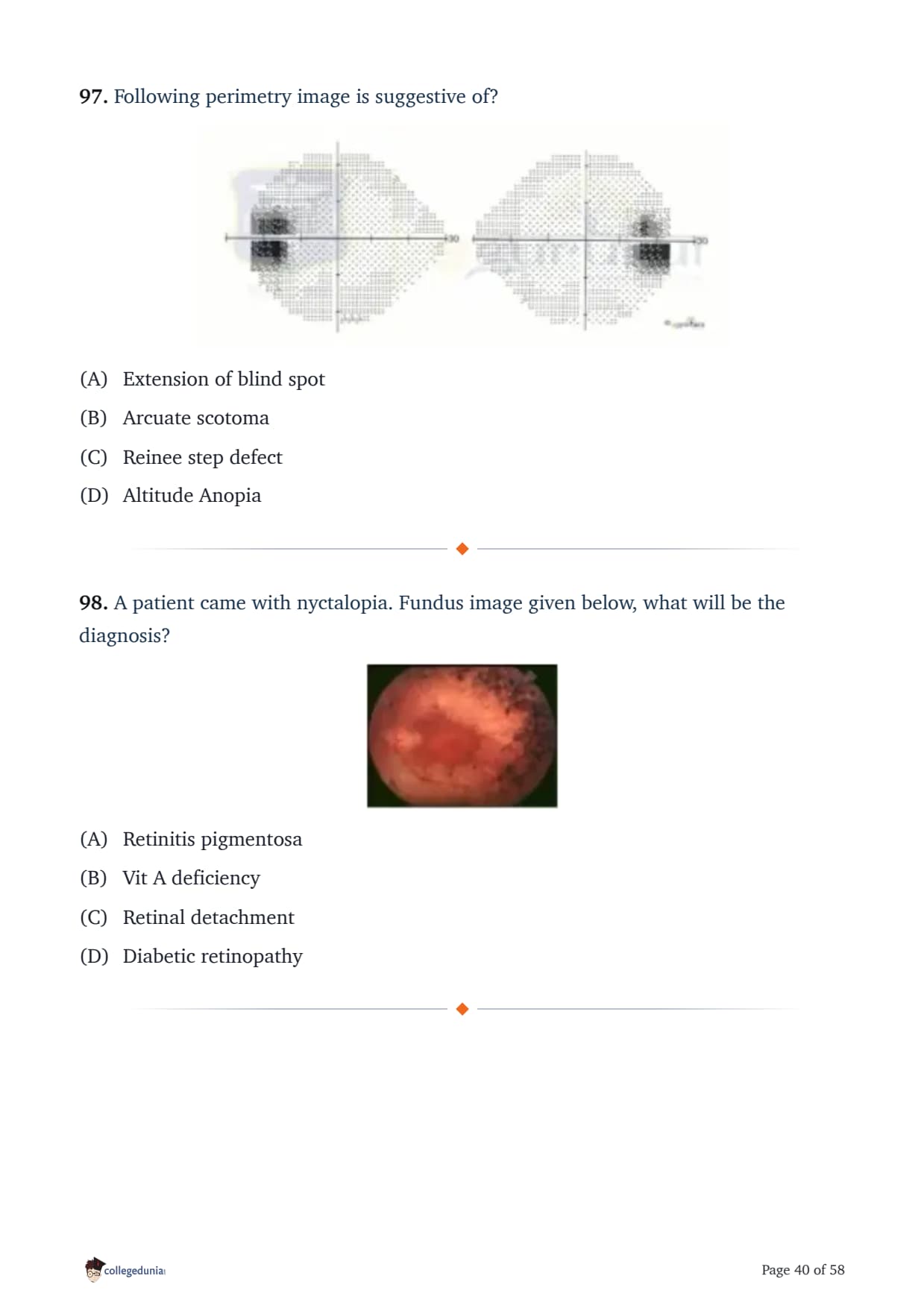
A patient presented to eye OPD after 3 years of cataract surgery. Slit lamp finding was given. What is the likely diagnosis? 
Following perimetry image is suggestive of? 
A patient came with nyctalopia. Fundus image given below, what will be the diagnosis?
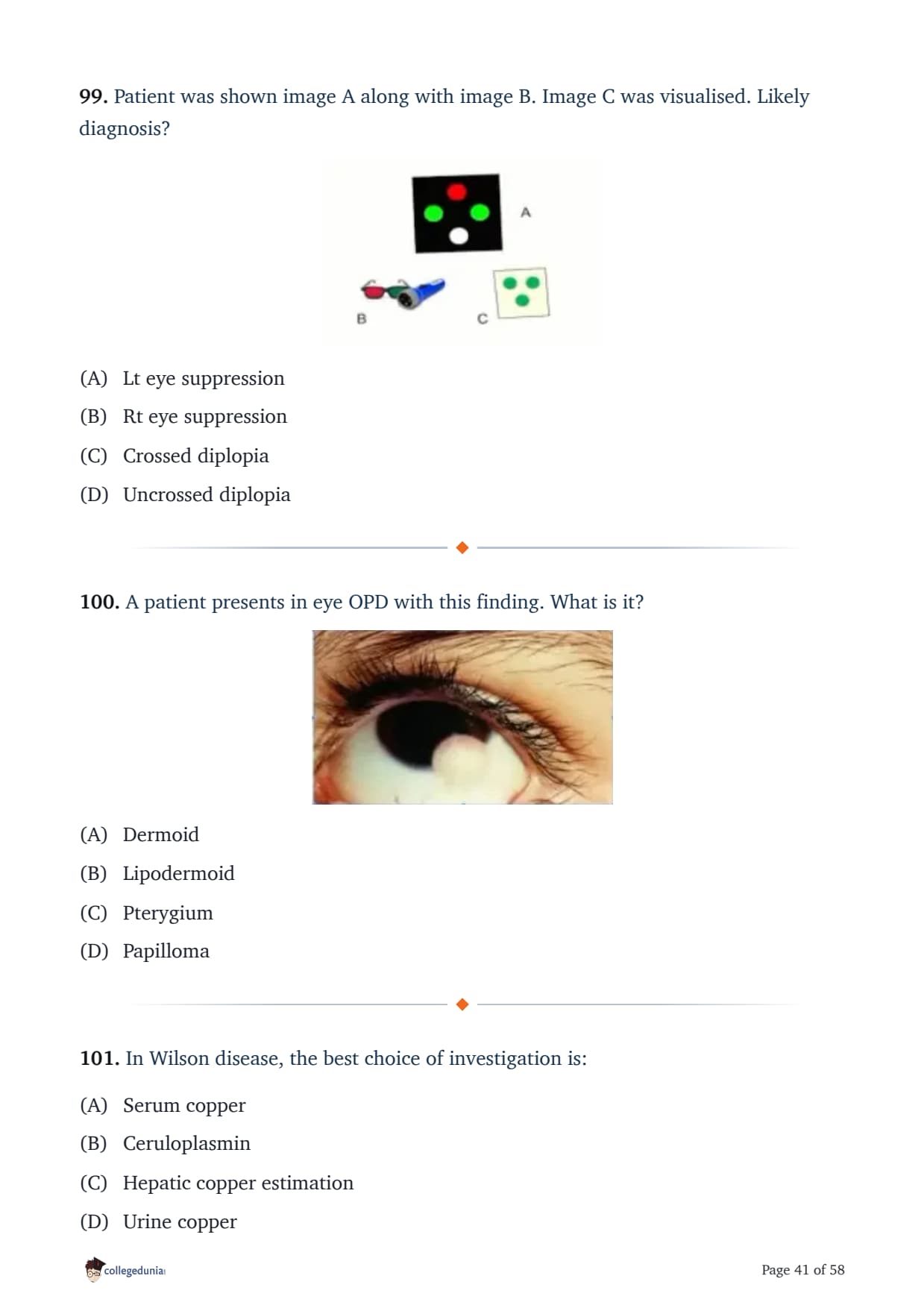
Patient was shown image A along with image B. Image C was visualised. Likely diagnosis?
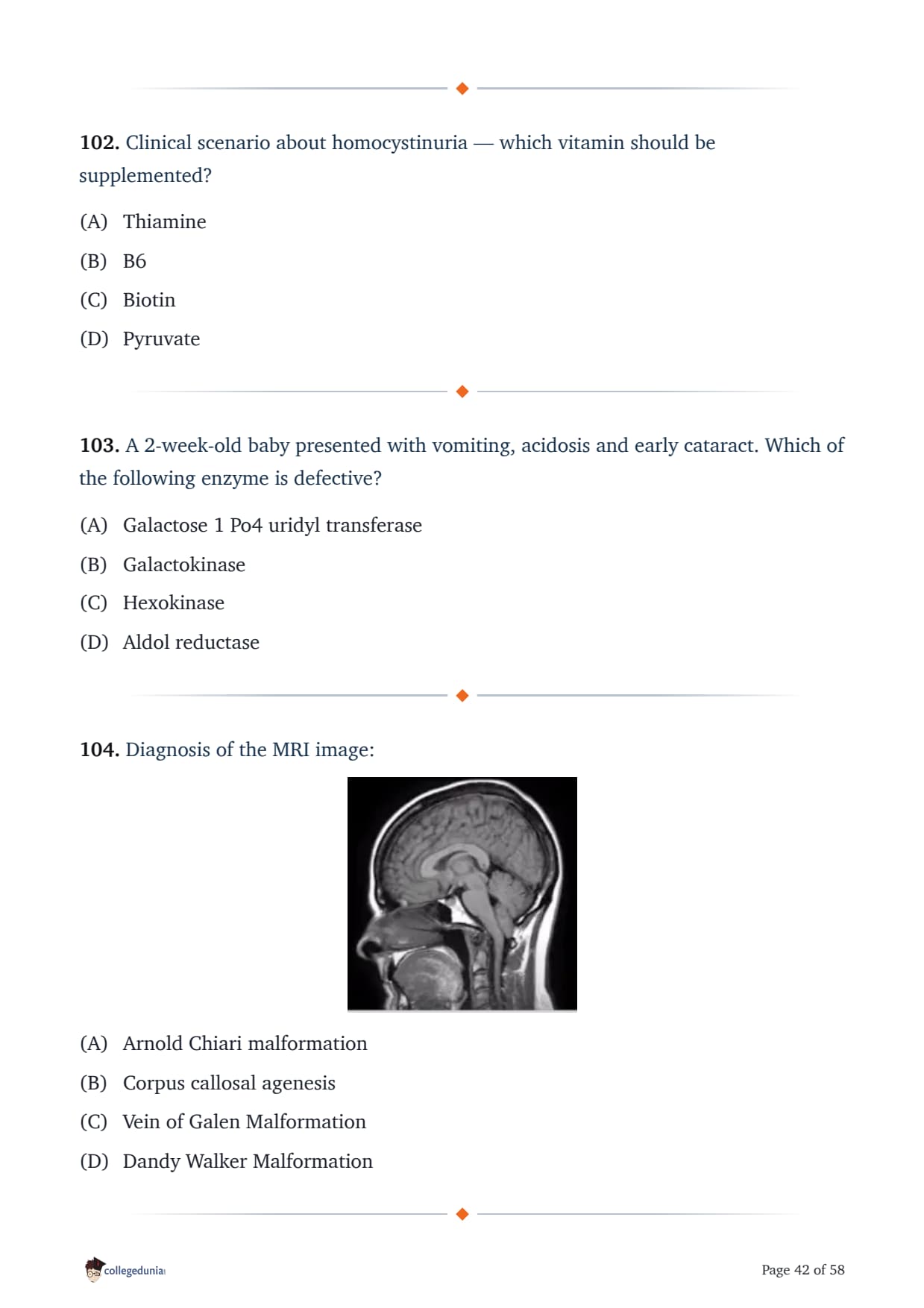
A patient presents in eye OPD with this finding. What is it?
In Wilson disease, the best choice of investigation is:
Clinical scenario about homocystinuria — which vitamin should be supplemented?
A 2-week-old baby presented with vomiting, acidosis and early cataract. Which of the following enzyme is defective?
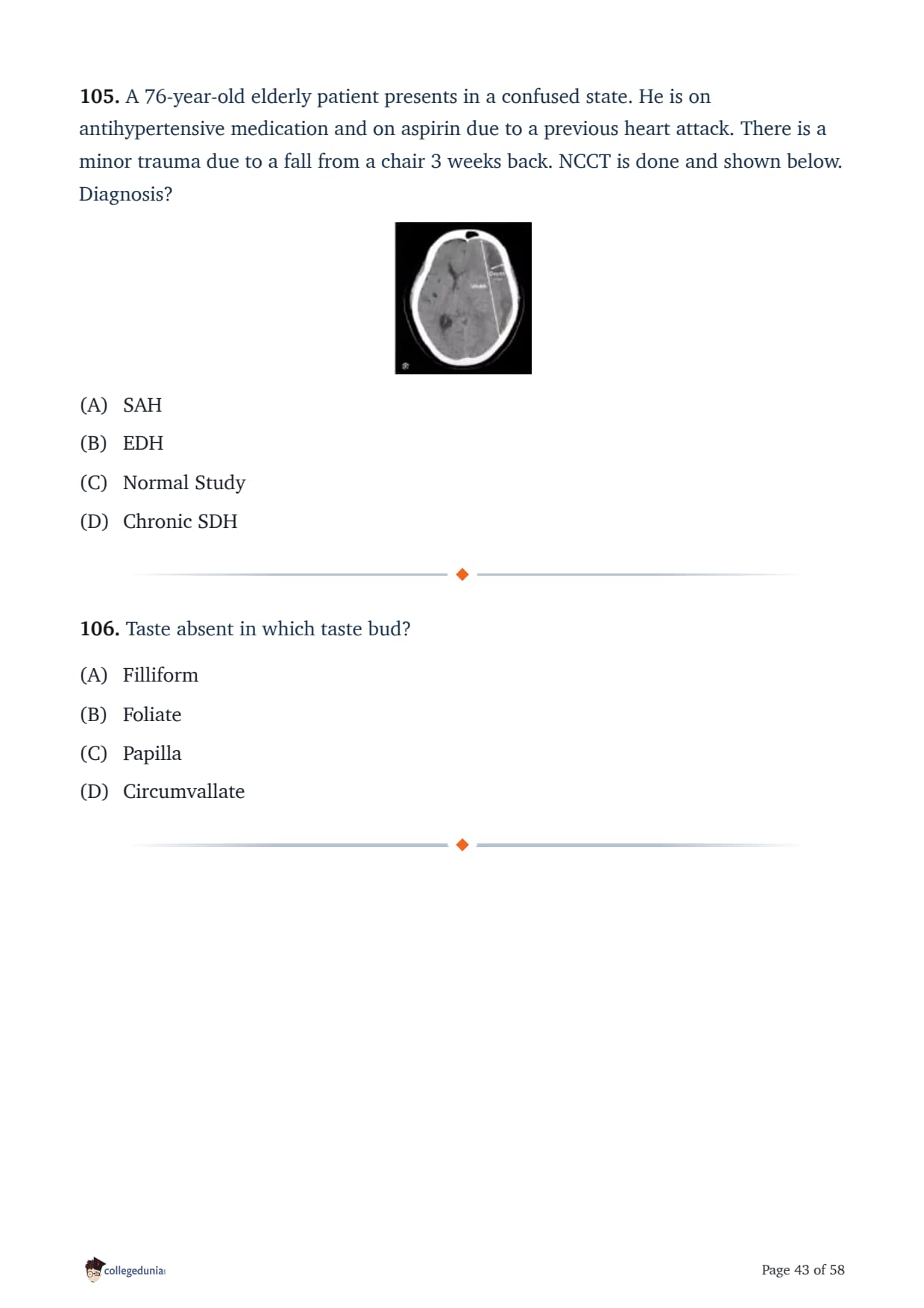
Diagnosis of the MRI image:
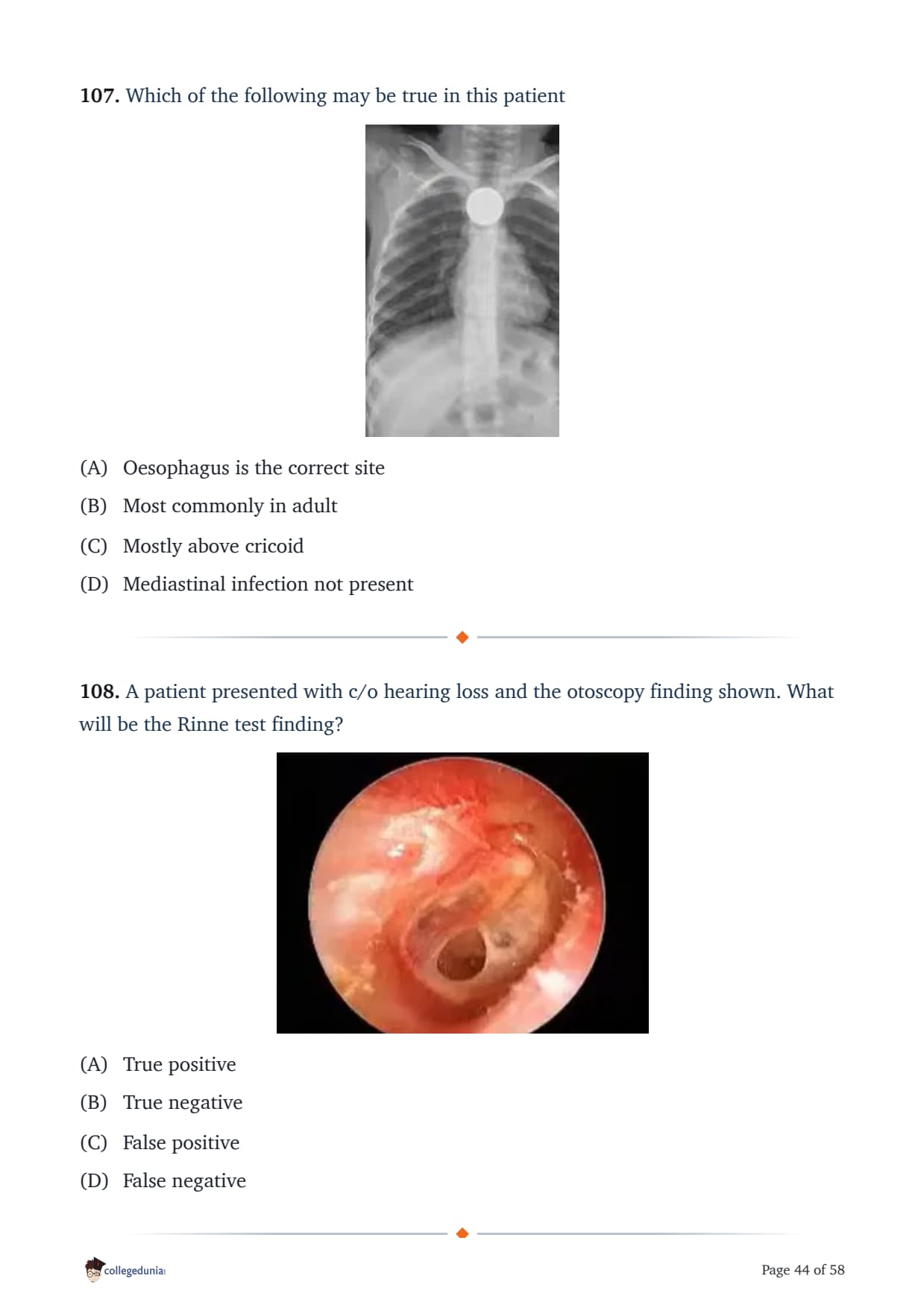
A 76-year-old elderly patient presents in a confused state. He is on antihypertensive medication and on aspirin due to a previous heart attack. There is a minor trauma due to a fall from a chair 3 weeks back. NCCT is done and shown below. Diagnosis?
Taste absent in which taste bud?
Which of the following may be true in this patient
A patient presented with c/o hearing loss and the otoscopy finding shown. What will be the Rinne test finding?
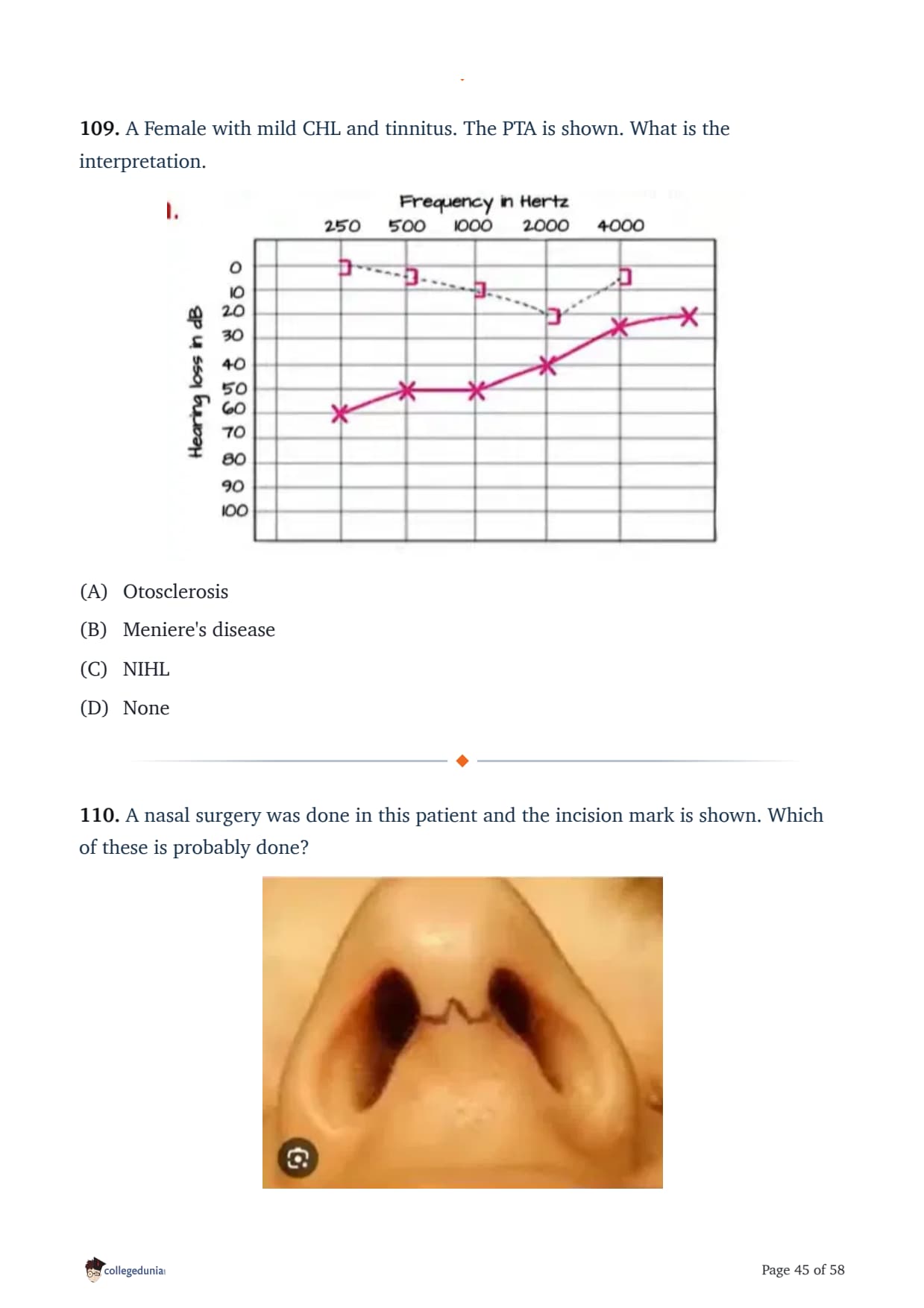
A Female with mild CHL and tinnitus. The PTA is shown. What is the interpretation.
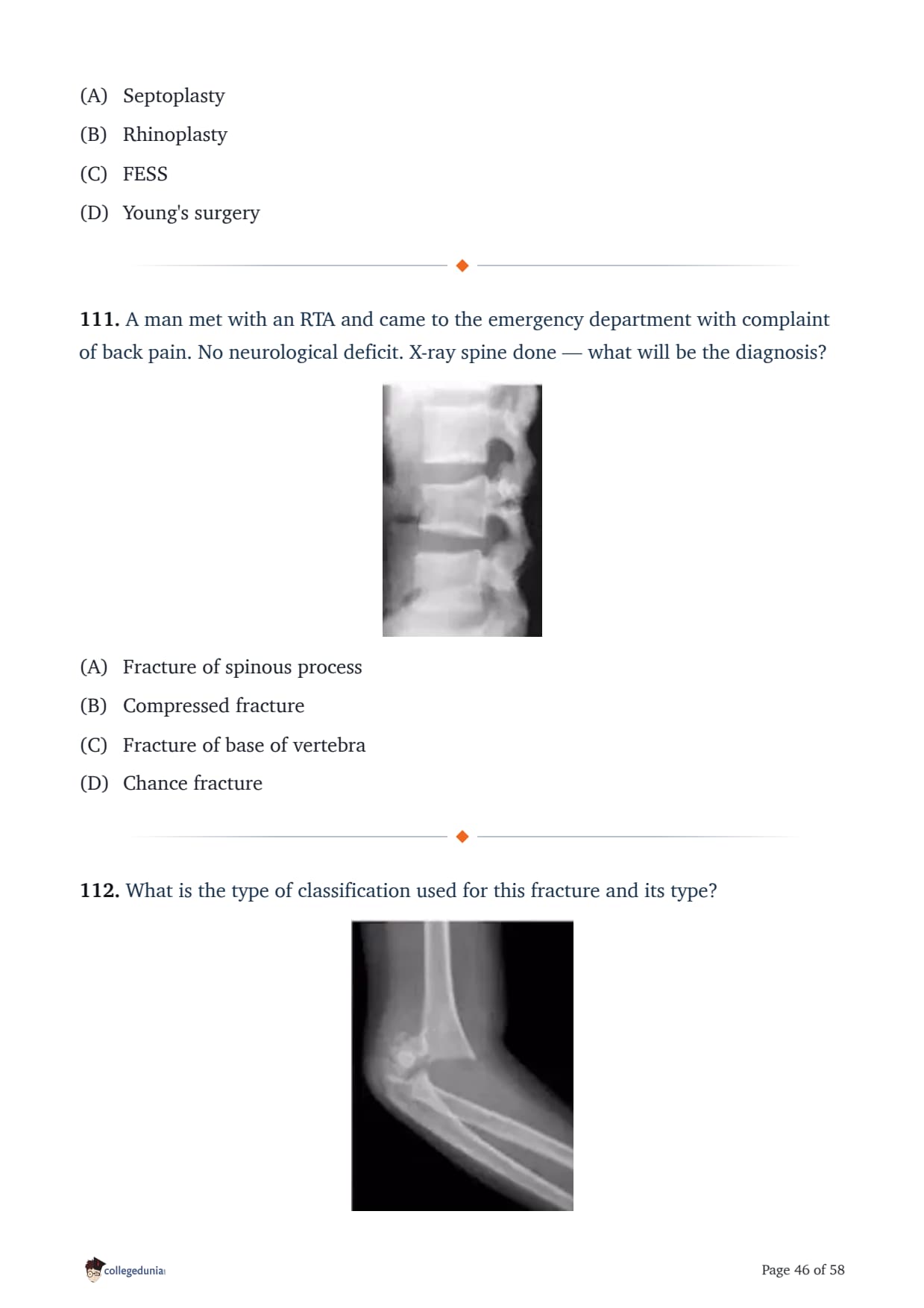
A nasal surgery was done in this patient and the incision mark is shown. Which of these is probably done?
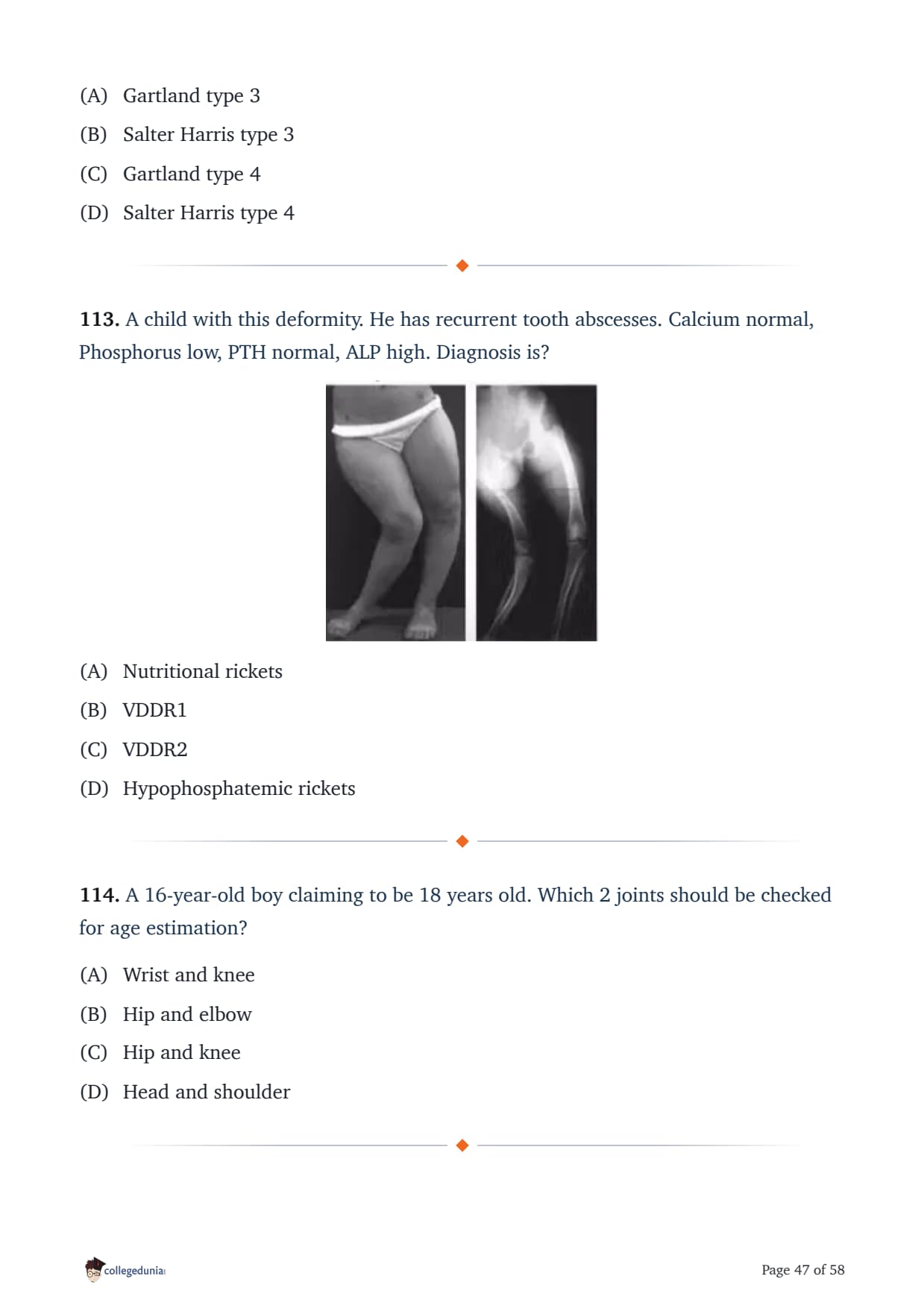
A man met with an RTA and came to the emergency department with complaint of back pain. No neurological deficit. X-ray spine done — what will be the diagnosis?
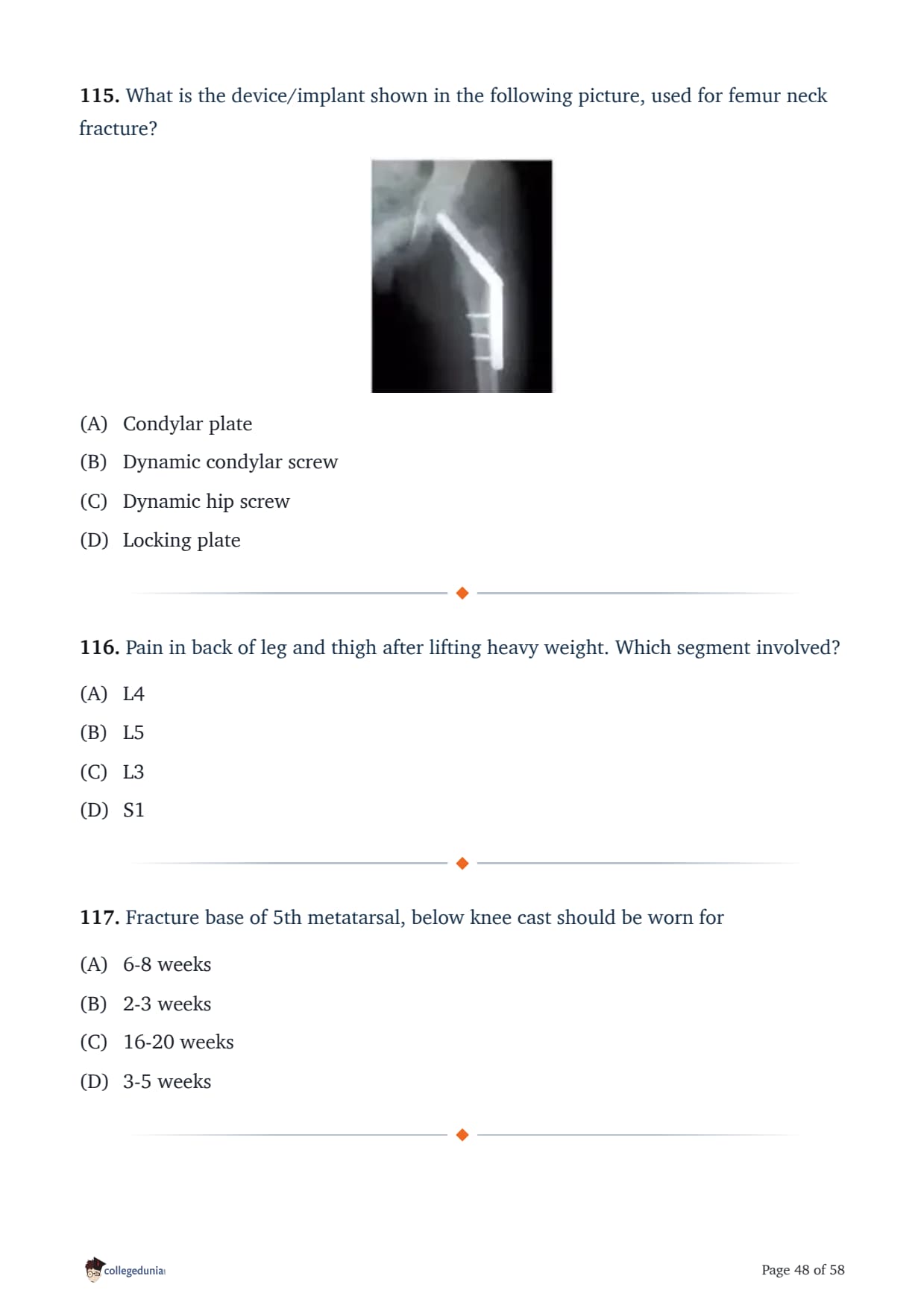
What is the type of classification used for this fracture and its type?
A child with this deformity. He has recurrent tooth abscesses. Calcium normal, Phosphorus low, PTH normal, ALP high. Diagnosis is?
A 16-year-old boy claiming to be 18 years old. Which 2 joints should be checked for age estimation?
What is the device/implant shown in the following picture, used for femur neck fracture?
Pain in back of leg and thigh after lifting heavy weight. Which segment involved?
Fracture base of 5th metatarsal, below knee cast should be worn for
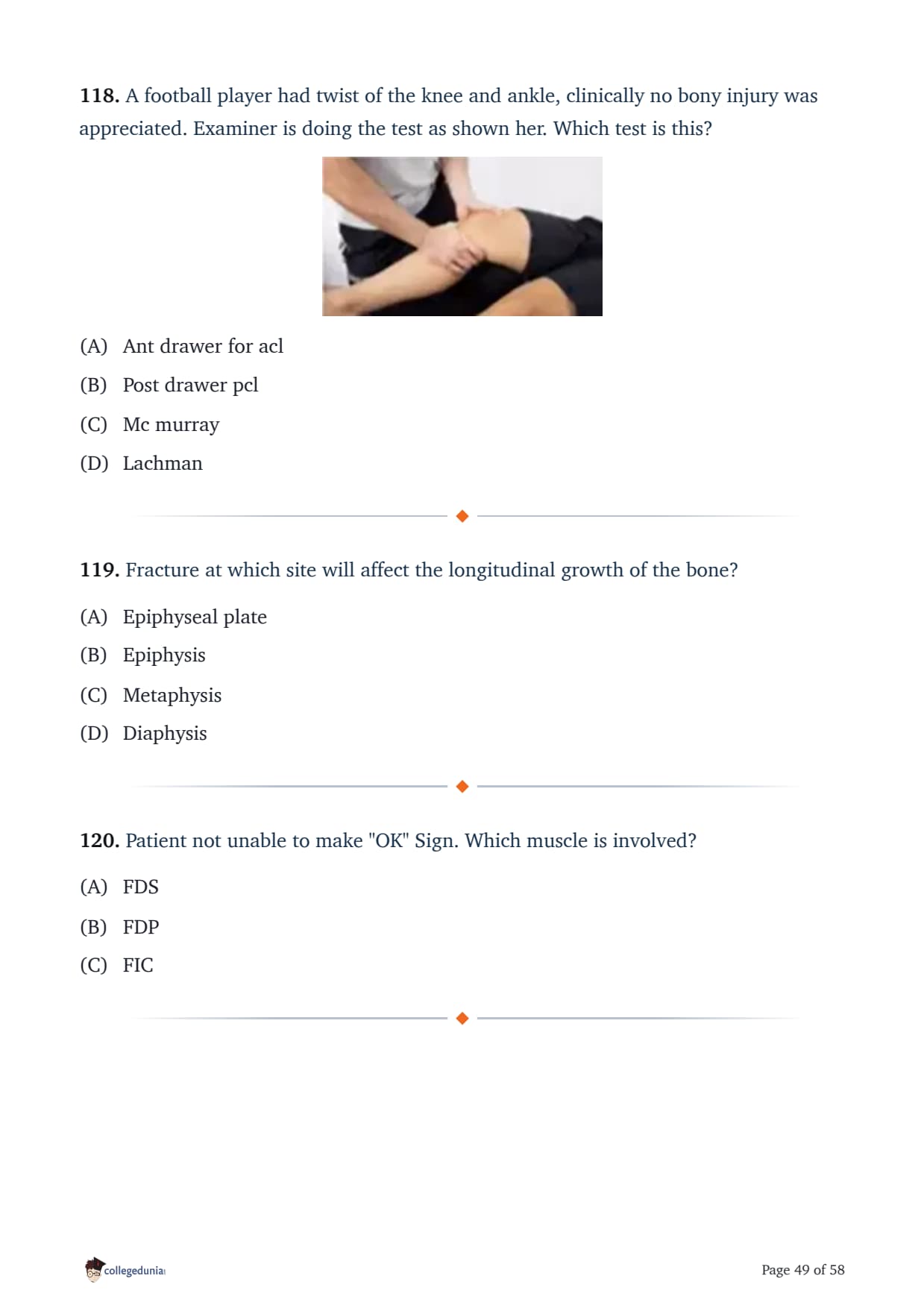
A football player had twist of the knee and ankle, clinically no bony injury was appreciated. Examiner is doing the test as shown her. Which test is this?
Fracture at which site will affect the longitudinal growth of the bone?
Patient not unable to make "OK" Sign. Which muscle is involved?
Artery passing between medial malleolus and the Achilles tendon?
A child, left femur shaft fracture, managed by plating. What type of callus formation?
A diaphyseal tumor, probably small round blue cells. Which test/translocation is useful for diagnosis?
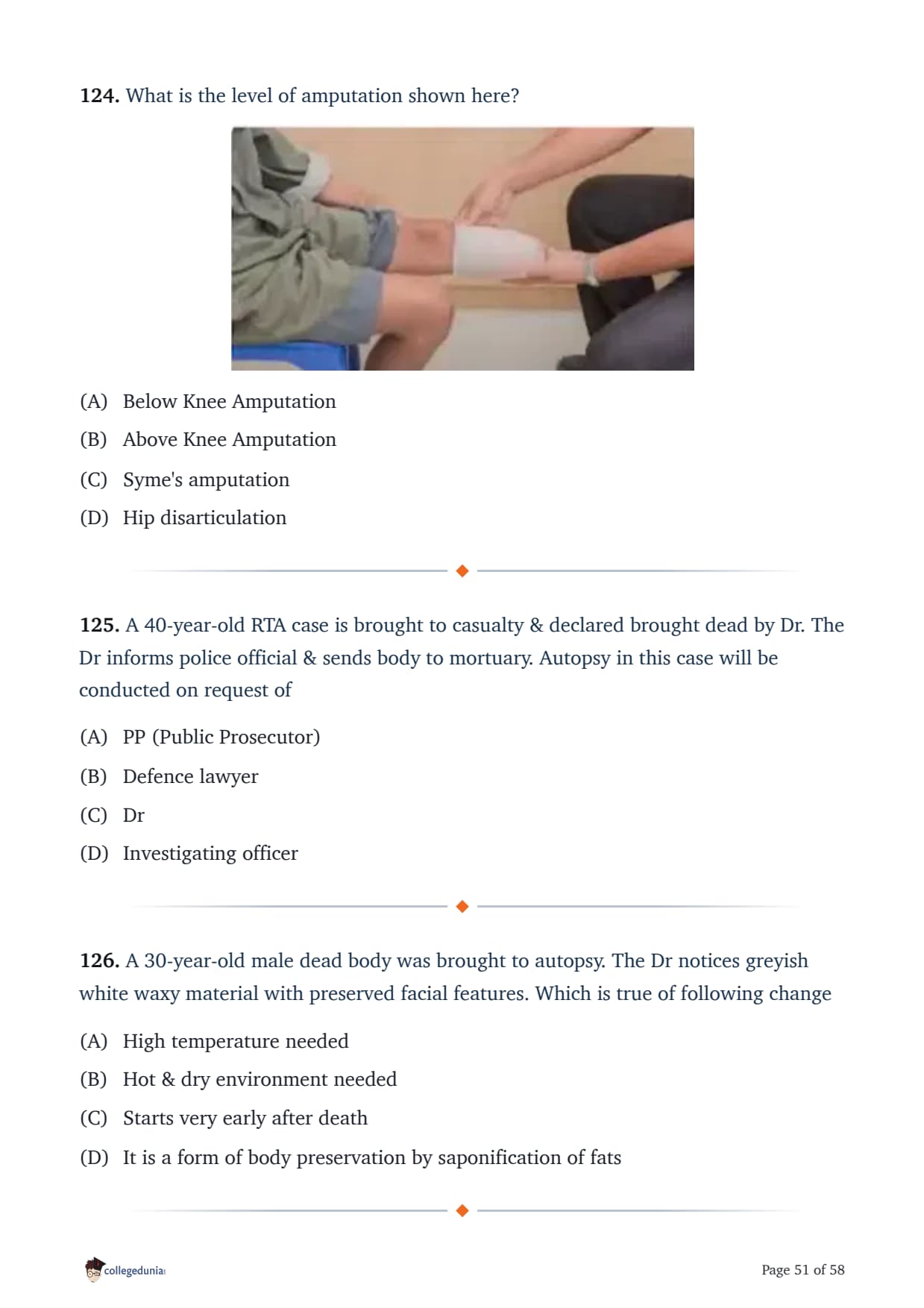
What is the level of amputation shown here?
A 40-year-old RTA case is brought to casualty & declared brought dead by Dr. The Dr informs police official & sends body to mortuary. Autopsy in this case will be conducted on request of
A 30-year-old male dead body was brought to autopsy. The Dr notices greyish white waxy material with preserved facial features. Which is true of following change
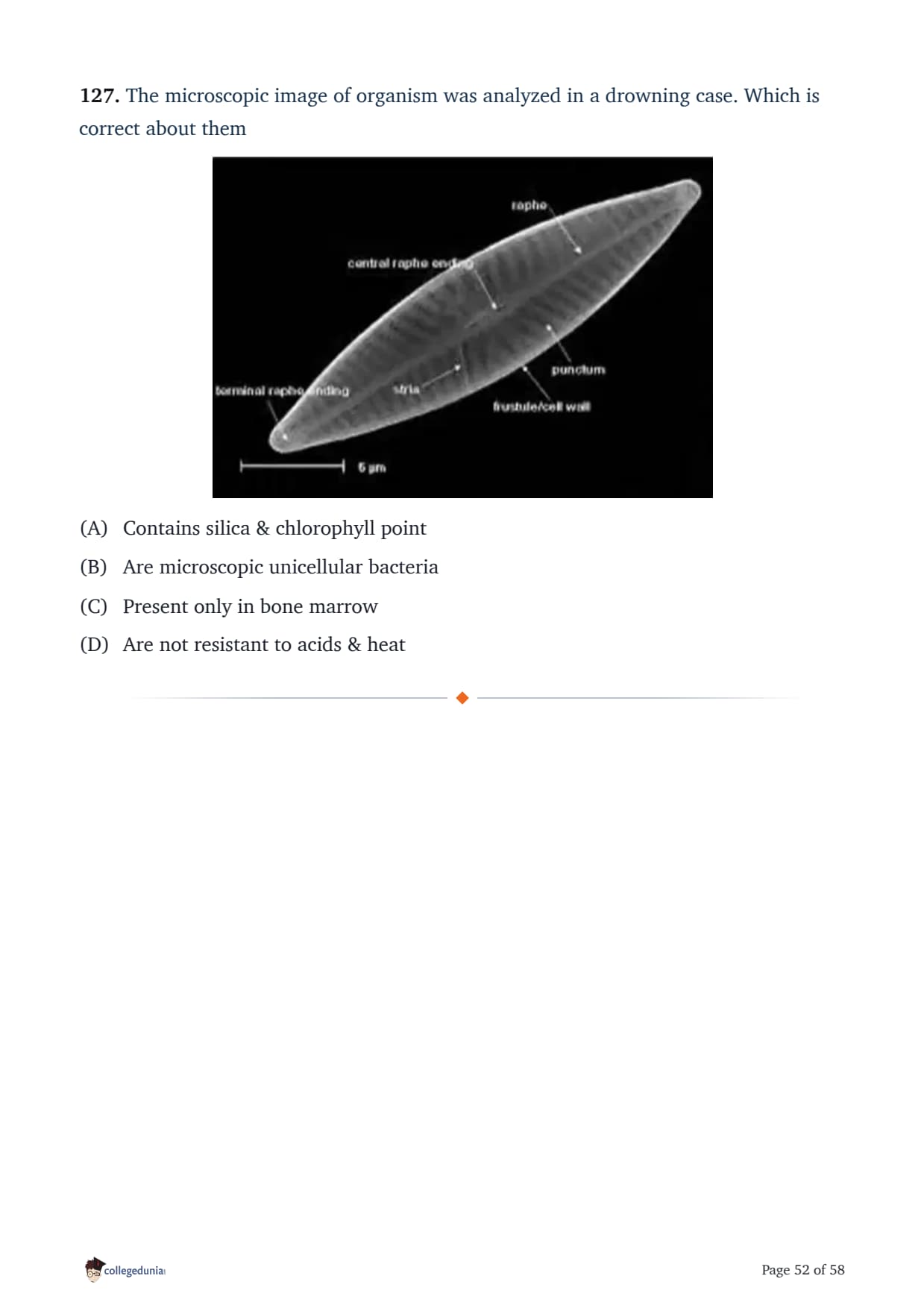
The microscopic image of organism was analyzed in a drowning case. Which is correct about them
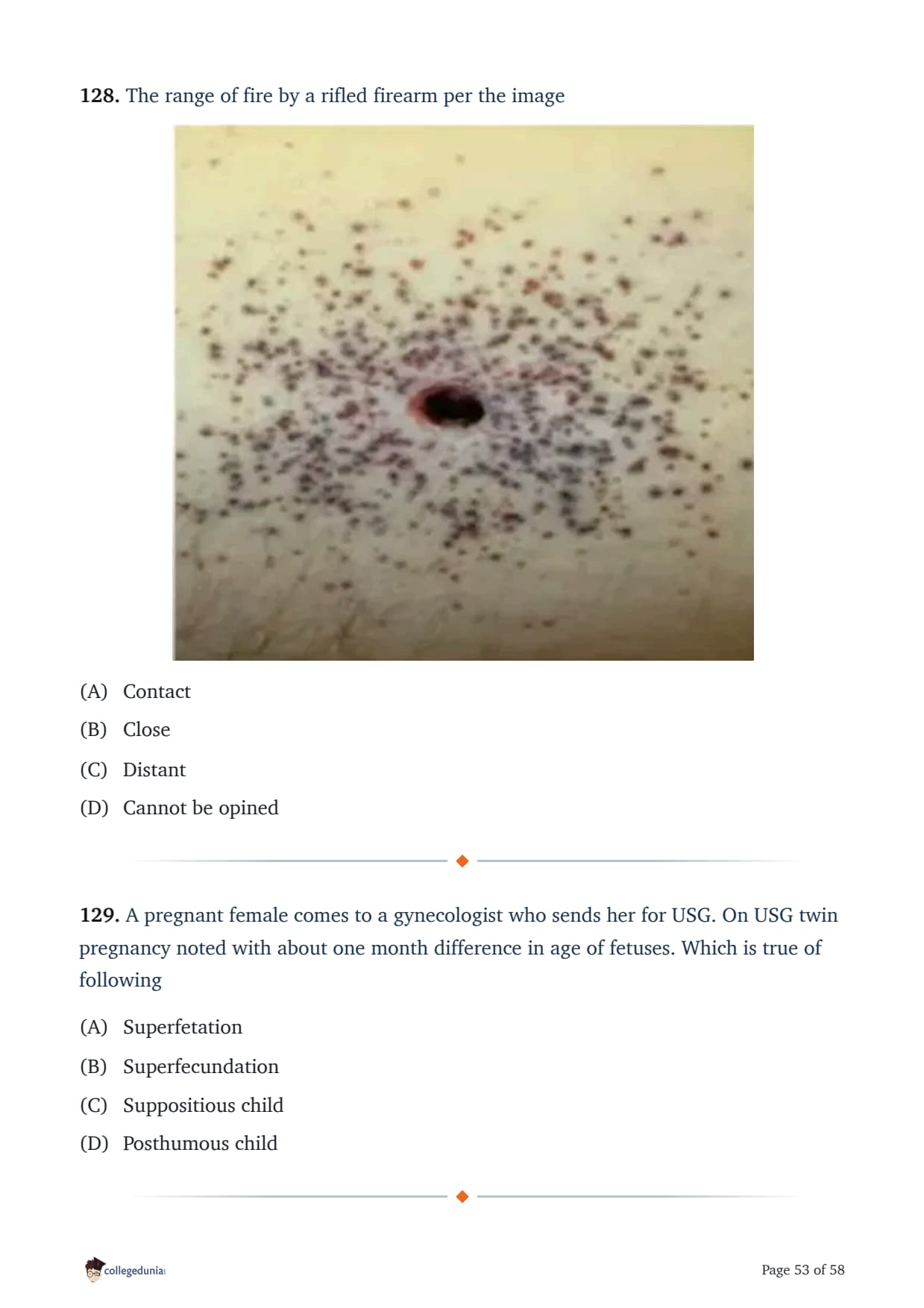
The range of fire by a rifled firearm per the image
A pregnant female comes to a gynecologist who sends her for USG. On USG twin pregnancy noted with about one month difference in age of fetuses. Which is true of following
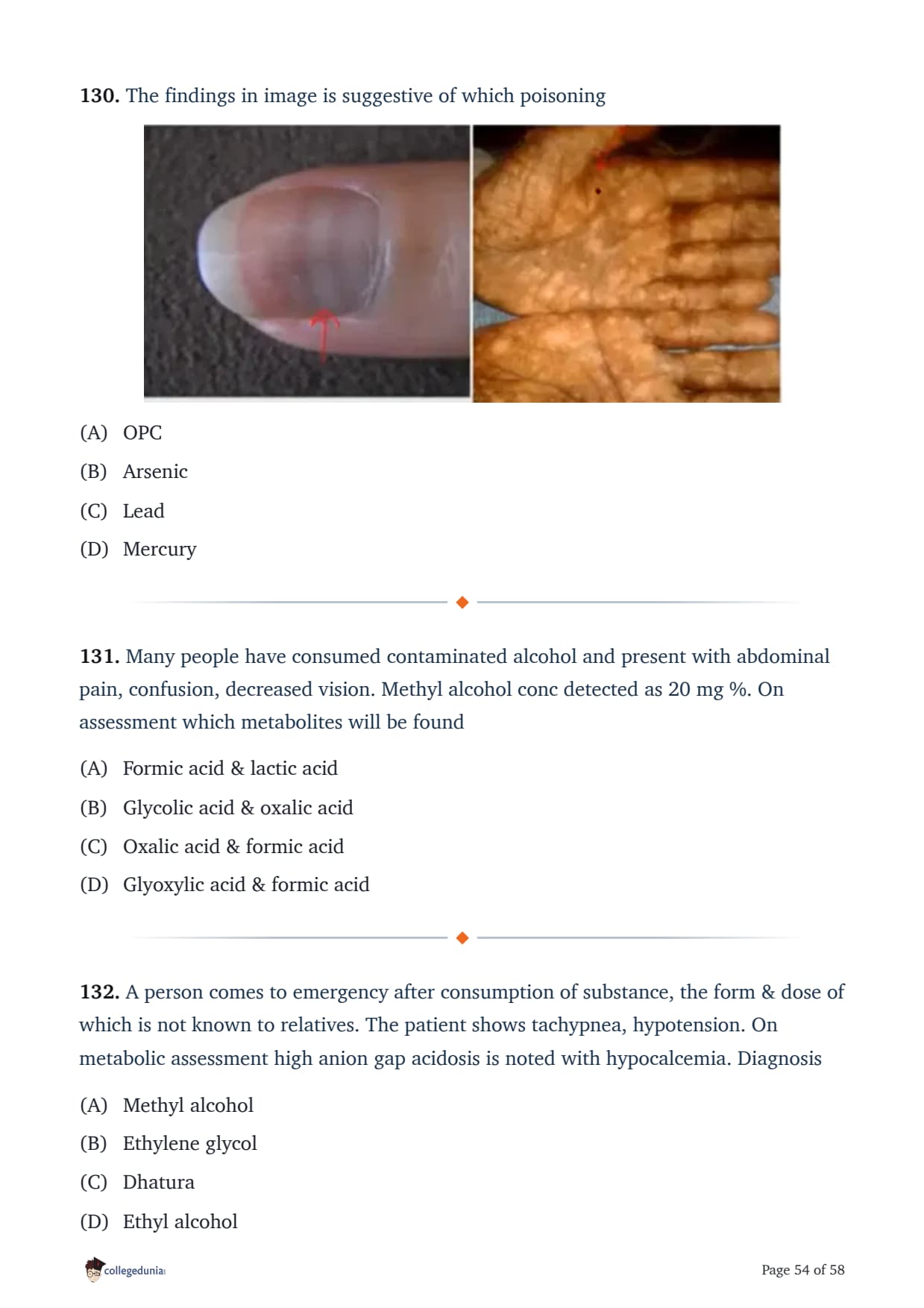
The findings in image is suggestive of which poisoning
Many people have consumed contaminated alcohol and present with abdominal pain, confusion, decreased vision. Methyl alcohol conc detected as 20 mg %. On assessment which metabolites will be found
A person comes to emergency after consumption of substance, the form & dose of which is not known to relatives. The patient shows tachypnea, hypotension. On metabolic assessment high anion gap acidosis is noted with hypocalcemia. Diagnosis
36 yr - G4L3P3- FULL TERM PREG Labor arrested at 8cm cervical dilation. EM CS done after counselling patient. Baby alive but intractable PPH. EM HYSTERECTOMY done to save life of mother
A 30-year-old female abuser with suicidal tendency brought to hospital. Mydriasis, tachypnea, tachycardia +. Diagnosis
MTP in 21-year-old, 10-week pregnancy is to be done by medical methods using
A 22 weeks of gestation unmarried 14-year-old girl, who is rape victim comes at your clinic medical termination. What is true for medical abortion?
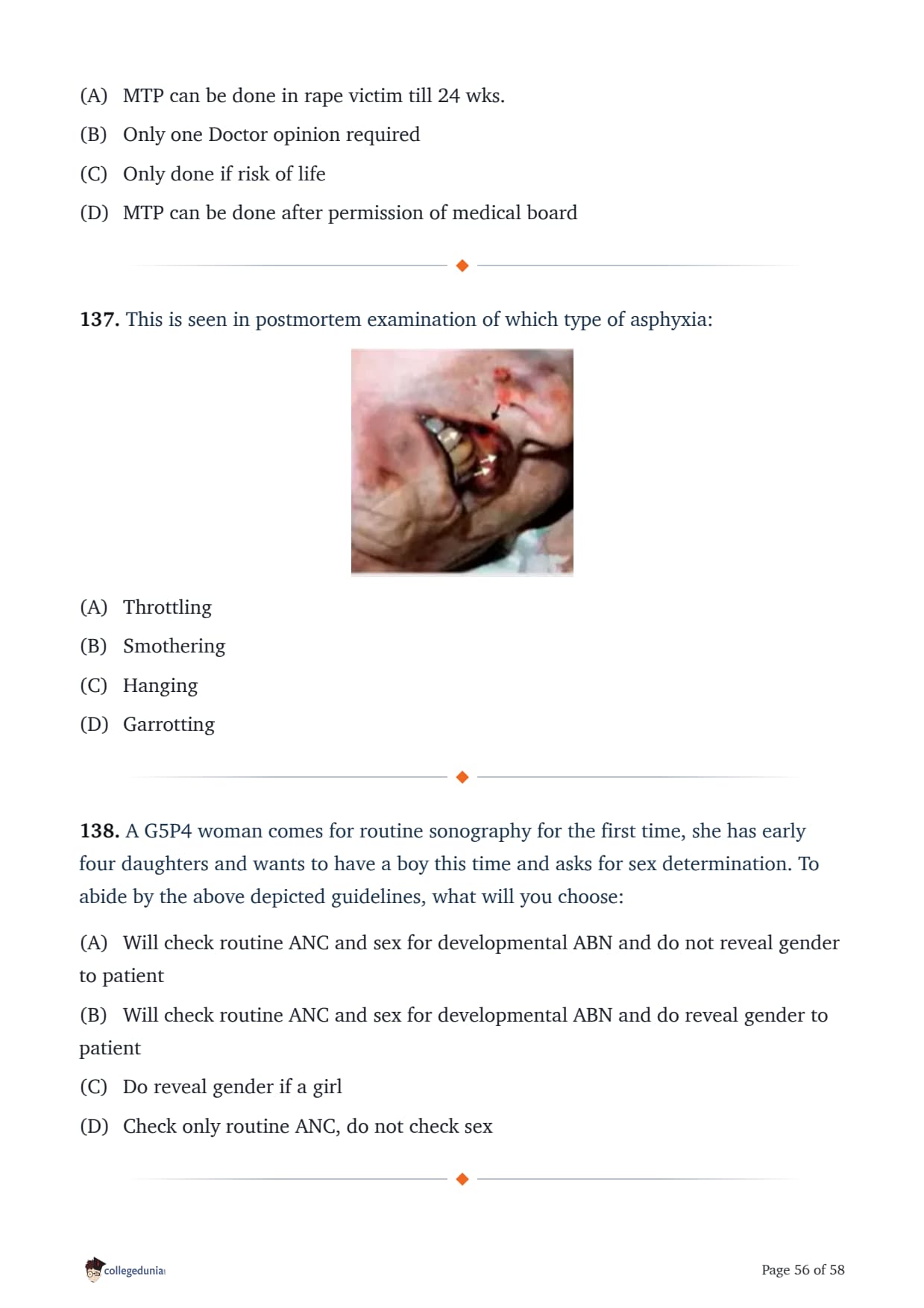
This is seen in postmortem examination of which type of asphyxia:
A G5P4 woman comes for routine sonography for the first time, she has early four daughters and wants to have a boy this time and asks for sex determination. To abide by the above depicted guidelines, what will you choose:
A child was born after the death of his father. Some of them claimed that the child is not from his biological father. DNA fingerprinting was done to identify the father, and the dead father was found to be the biological father. This child is called as:
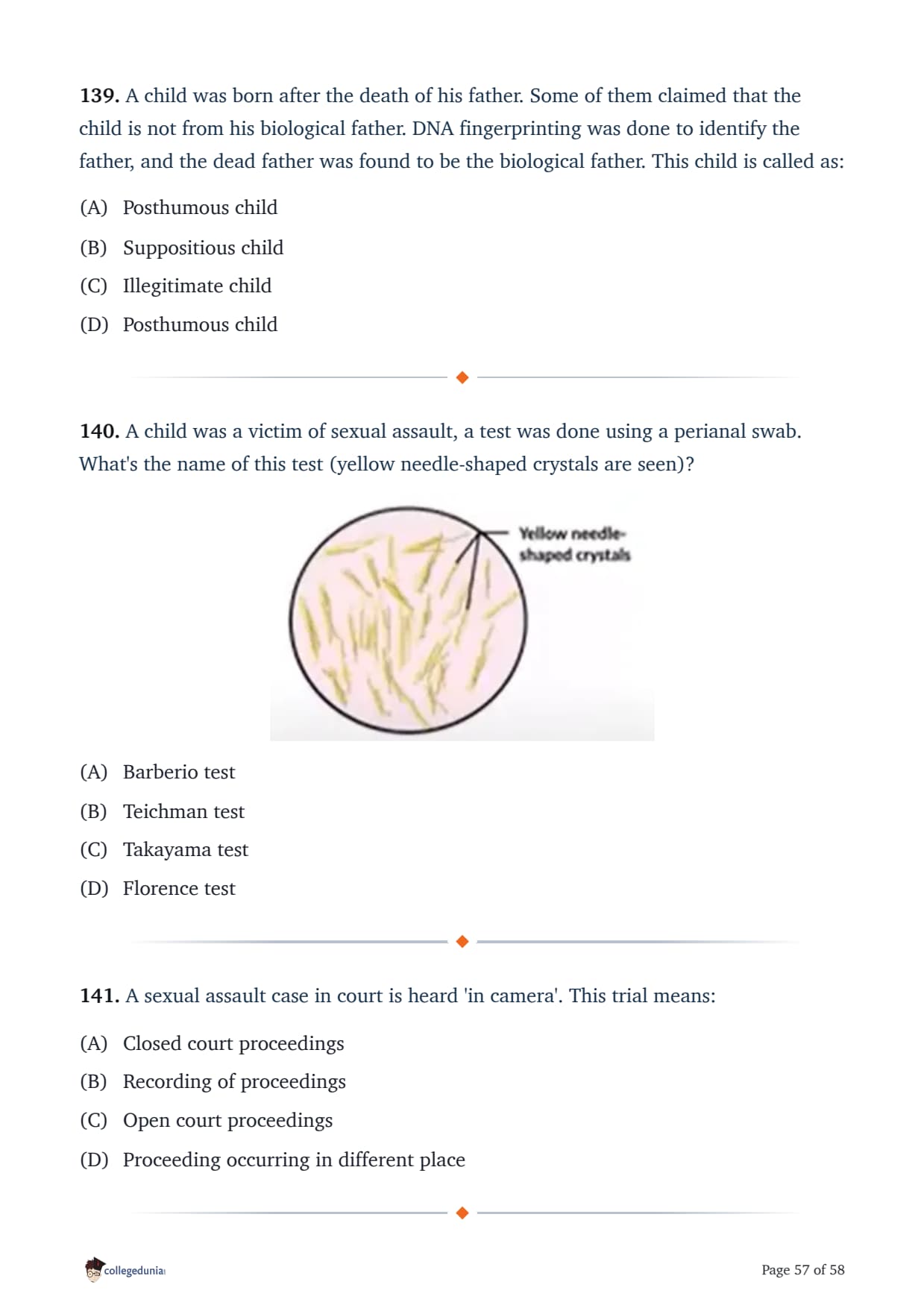
A child was a victim of sexual assault, a test was done using a perianal swab. What's the name of this test (yellow needle-shaped crystals are seen)?
A sexual assault case in court is heard 'in camera'. This trial means:
Sour taste is mediated by:
NEET PG 2024 Exam Pattern and Marking Scheme Explained
As per the NBEMS information bulletin on the official website (natboard.edu.in), NEET PG 2024 was a computer-based test of single-best-response MCQs spread across the major clinical and pre-clinical subjects.
- Total questions: 200 single-best-answer MCQs
- Duration: 3 hours 30 minutes
- Total marks: 800
- Marking scheme: +4 for a correct answer, -1 for a wrong one
- Mode and slots: computer-based, held in 2 shifts (Shift 1: 9:00 AM to 12:30 PM)
- Question types: clinical case-based, image-based (x-ray, ECG, histopathology, clinical photos), and direct single-best-answer MCQs
High-Weightage Subjects in NEET PG 2024 to Focus On First
The Shift 1 paper stayed clinical and image-heavy, with the largest share coming from Medicine and the short subjects together carrying real weight.
- Medicine and allied: the single largest block, with several image- and case-based stems
- Pharmacology: mechanism, antidote and drug-of-choice questions recurred
- Pathology: histopathology-photo identification and tumour markers
- Forensic Medicine: unusually well represented in this shift - asphyxia, firearm injuries, poisoning and medico-legal sections
- Radiology and Orthopaedics: a heavy run of x-ray/MRI sign-reading questions (fractures, sunburst lesion, chronic SDH)
- ENT and Ophthalmology: image-based diagnosis (audiograms, otoscopy, fundus, perimetry)
How to Use the NEET PG 2024 Question Paper for Practice
Solve Shift 1 as a timed 3.5-hour mock first, then review every question with the solution PDF above - both the main solution and the alternate explanation.
- Attempt it in one sitting under the real +4/-1 pressure before you look at any answer
- Use the image-based questions to drill pattern recognition - this paper was full of them
- Redo the Forensic, Pharmacology and Radiology sets, where one-line facts decide the mark
NEET PG 2024 Good Attempts and Qualifying Score Benchmark
- Most students attempted 185 to 195 of the 200 questions in this paper
- The general-category qualifying line is the 50th percentile (around 291 marks in 2023); for 2024 the qualifying percentile was later reduced to the 5th percentile to fill vacant seats
- Use roughly 115-125 accurate attempts as a healthy weekly target when you redo the paper
NEET PG 2024 Shift 1 Question Paper FAQs
Ques. Was NEET PG 2024 Shift 1 tougher than Shift 2?
Ans. Shift 1 was rated moderate but lengthy, with a heavy load of image-based clinical questions in Radiology, Orthopaedics and ENT. Most students still managed 185 to 195 attempts, so the length mattered more than raw difficulty.
Ques. How many questions should I attempt in NEET PG 2024 to qualify?
Ans. Aim for 185 or more attempts with high accuracy. The general-category cutoff sits at the 50th percentile (about 291 marks in 2023), so roughly 115-125 correct answers keeps you safely above the qualifying line.
Ques. Which subjects had the highest weightage in NEET PG 2024?
Ans. Medicine carried the largest share, followed by strong showings from Pharmacology, Pathology, Forensic Medicine and image-based Radiology/Orthopaedics. Forensic Medicine was notably well represented in Shift 1.
Ques. Are NEET PG questions repeated from previous years?
Ans. Yes - concepts recur heavily year on year, and several Shift 1 stems mirrored earlier NEET PG and INI-CET themes. Solving previous-year papers like this one is one of the highest-yield ways to prepare.
Ques. What was the NEET PG 2024 qualifying cutoff for the general category?
Ans. The general-category qualifying standard is the 50th percentile. For 2024, the Ministry of Health later reduced the qualifying percentile to the 5th percentile so that vacant counselling seats could be filled.
Ques. Where can I download the NEET PG 2024 Shift 1 question paper with solutions PDF for free?
Ans. Use the download table above on Collegedunia for the Shift 1 paper with full solutions. For the official paper and result, check the NBEMS website at natboard.edu.in.





Comments