




IISER Aptitude Test 2024 Question Paper is available for download. As per the schedule, the IISER Aptitude Test 2024 was held on June 09, 2024, for admission to 5-year BS-MS programmes at IISERs. The IISER 2024 Question Paper was Moderate to Tough.
IISER Aptitude Test 2024 Question Paper with Solutions
| IISER Aptitude Test 2024 Question Paper Pdf | Download PDF | Check Solutions |
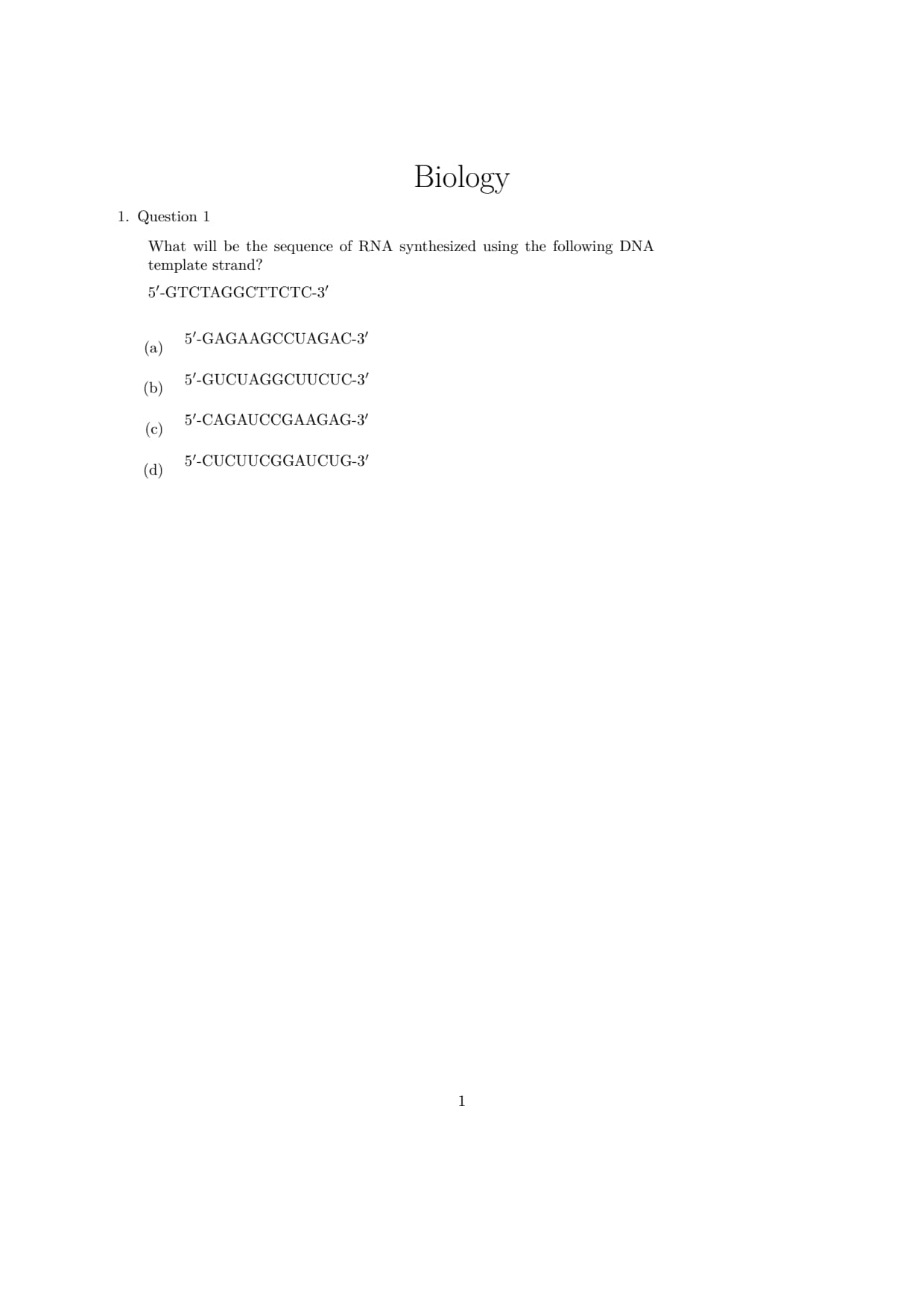
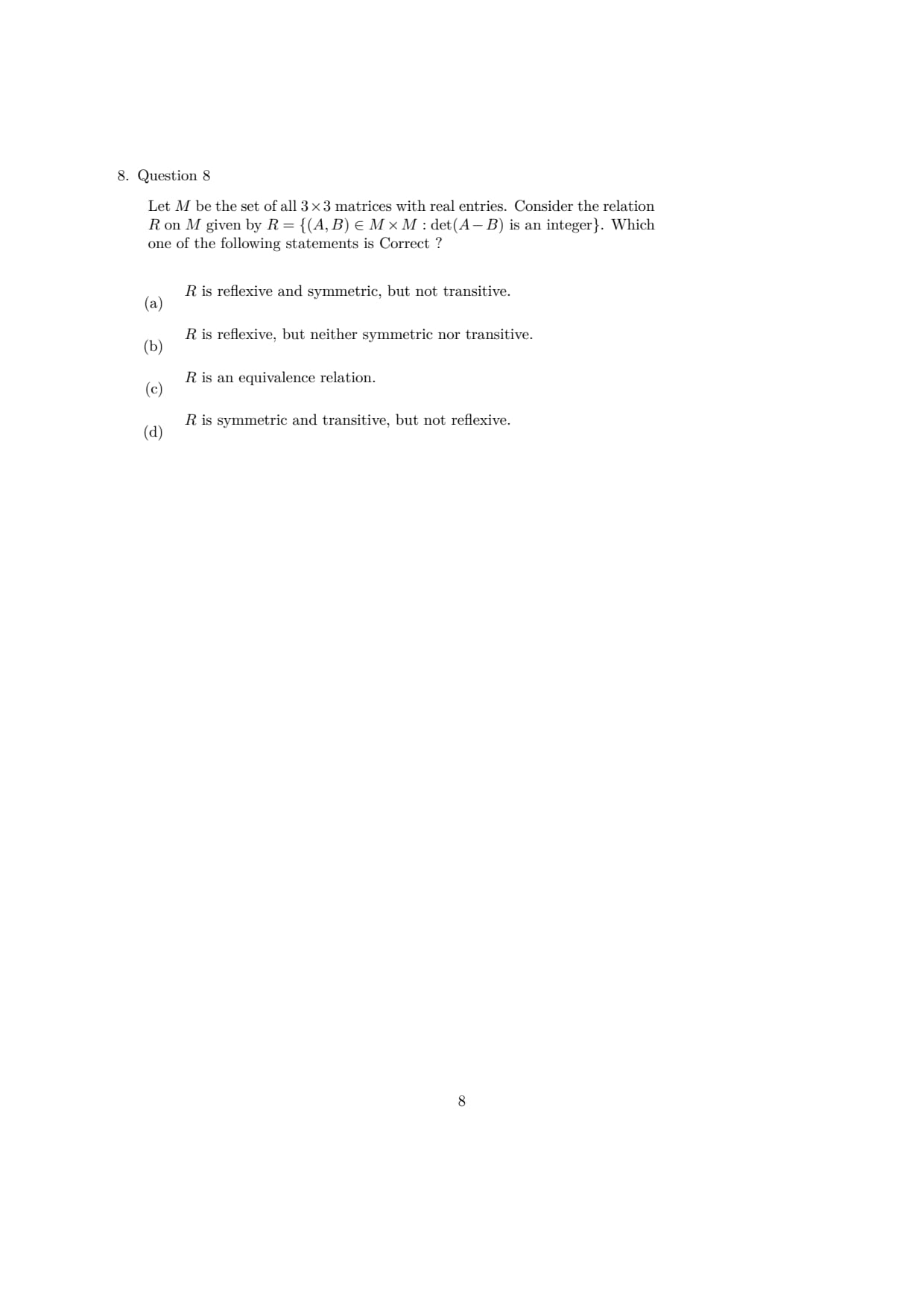
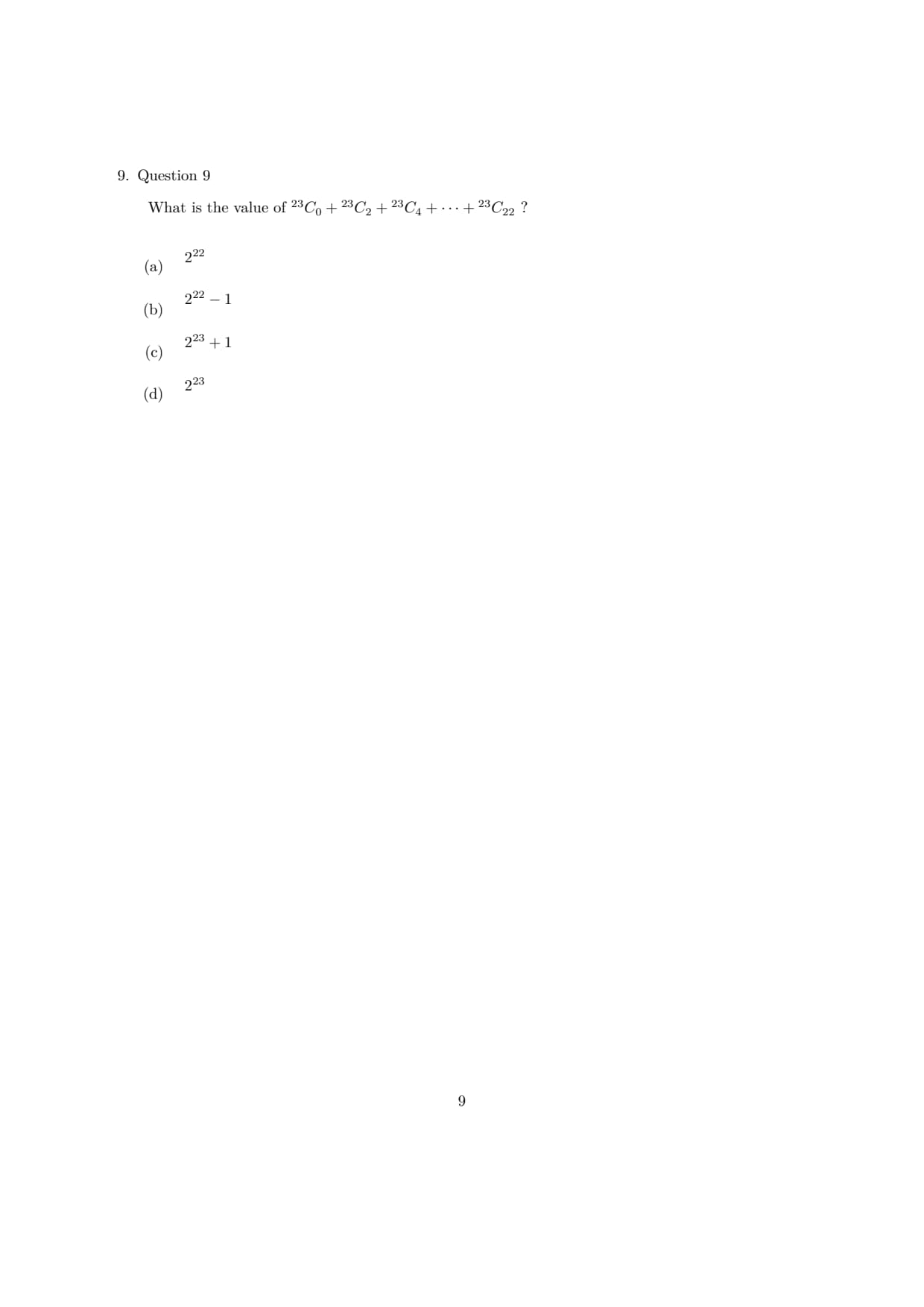
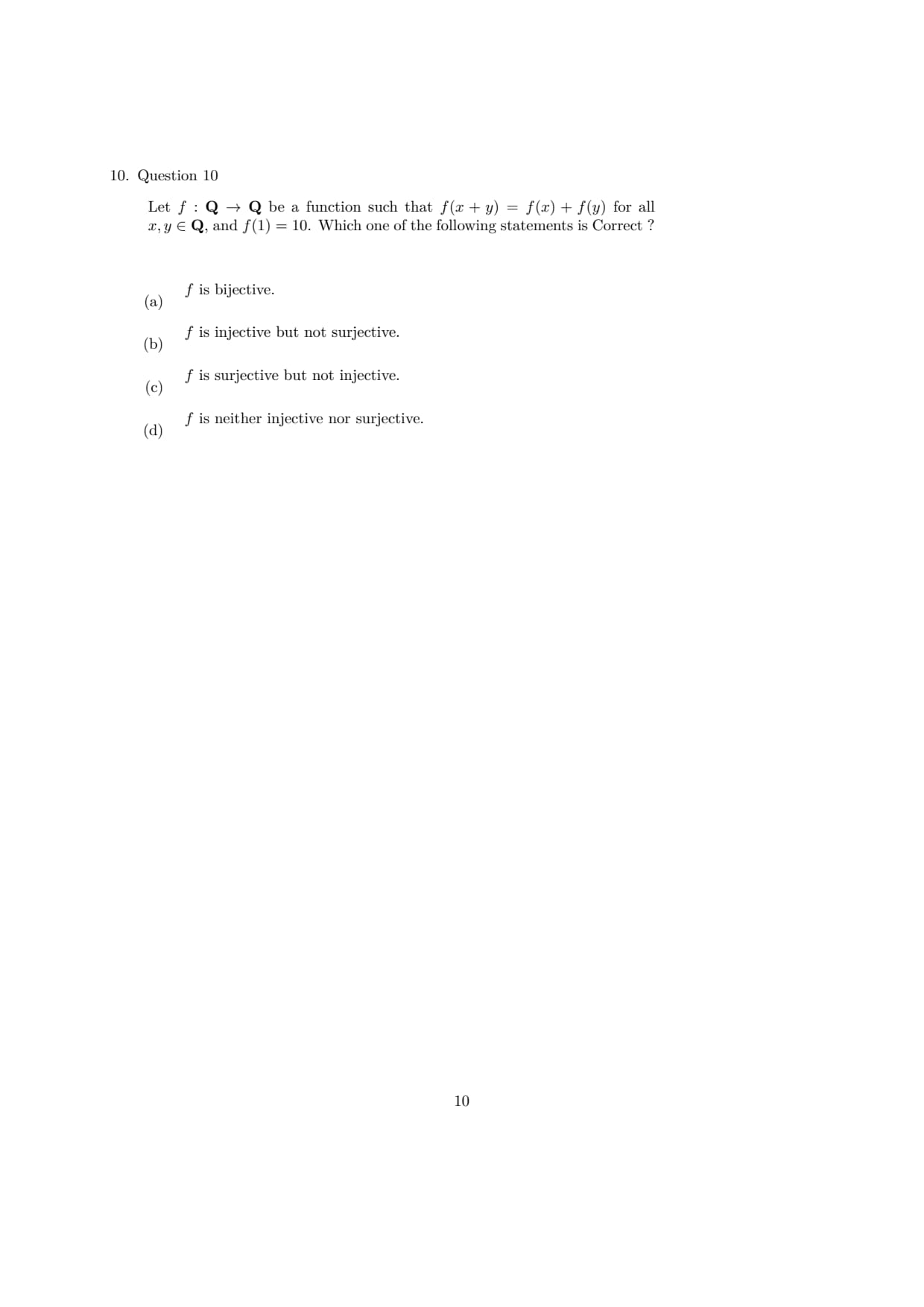
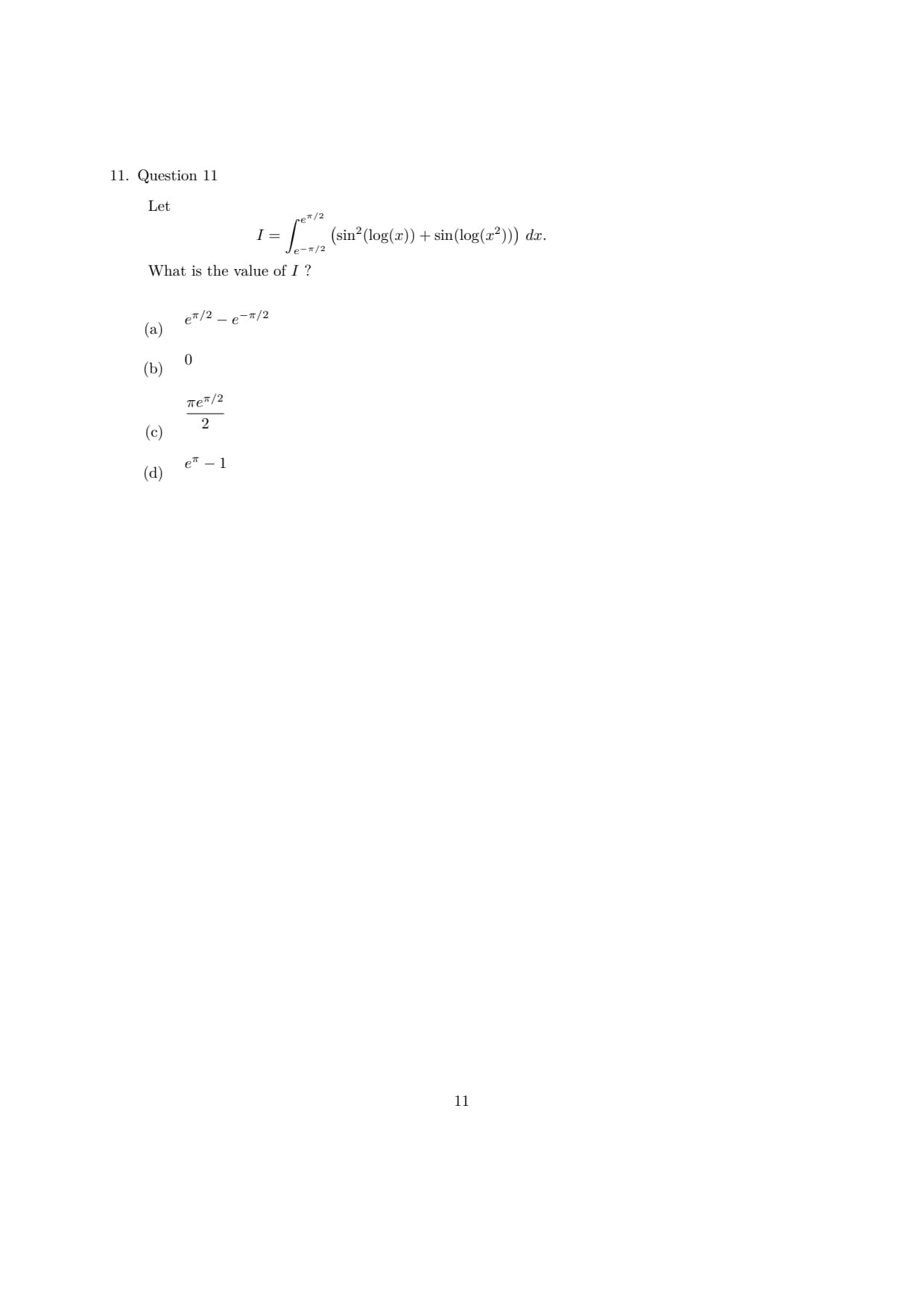
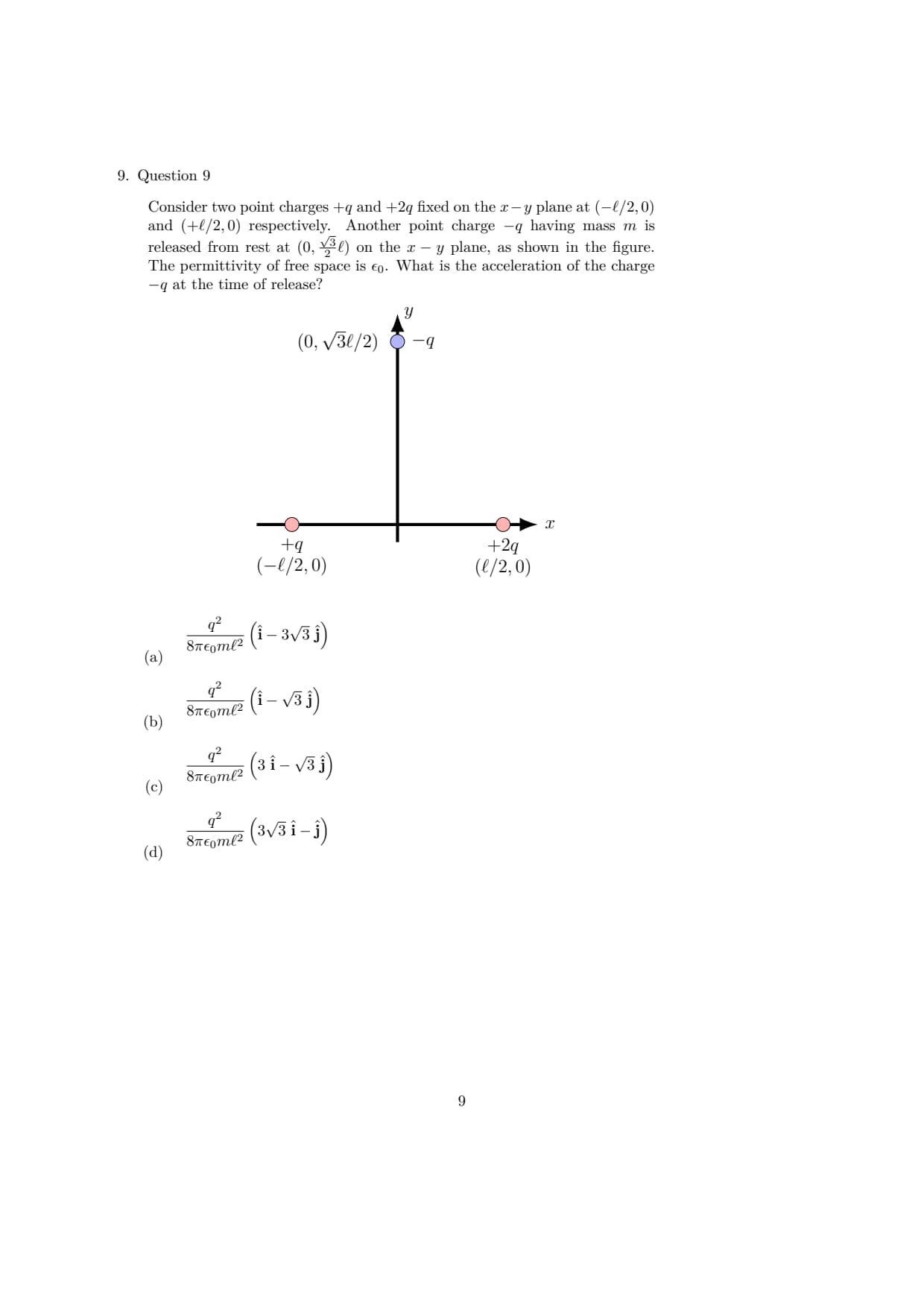
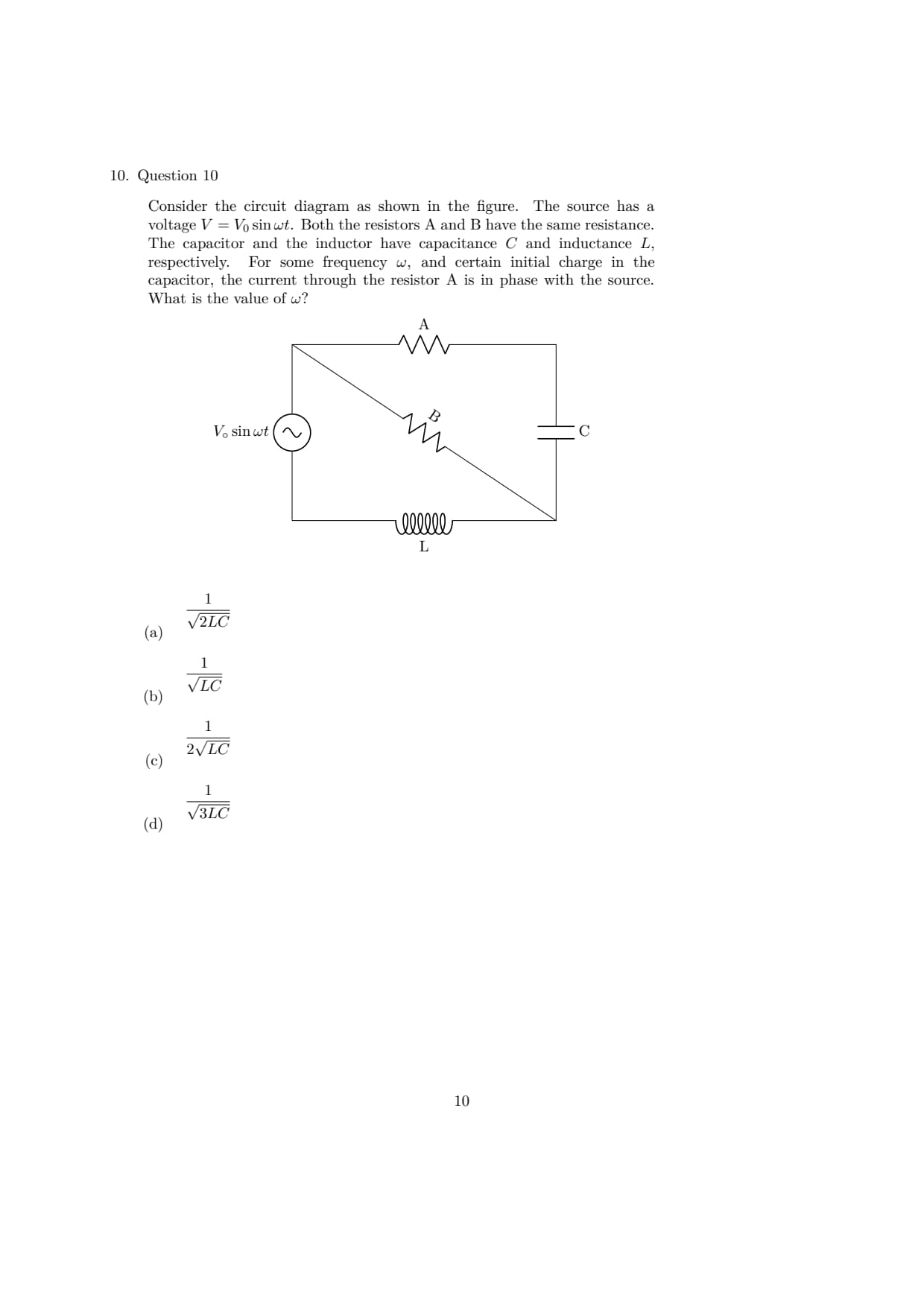
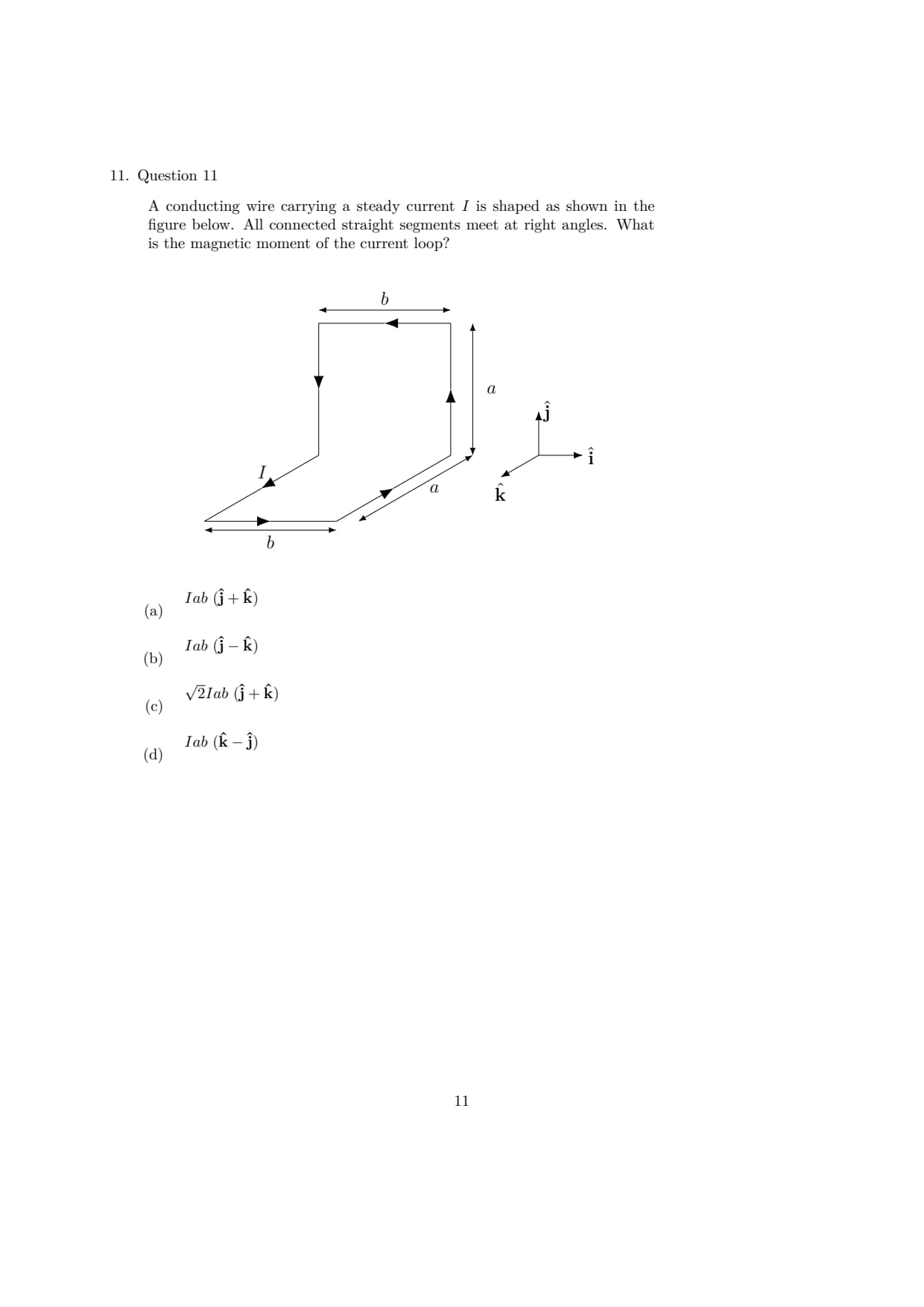
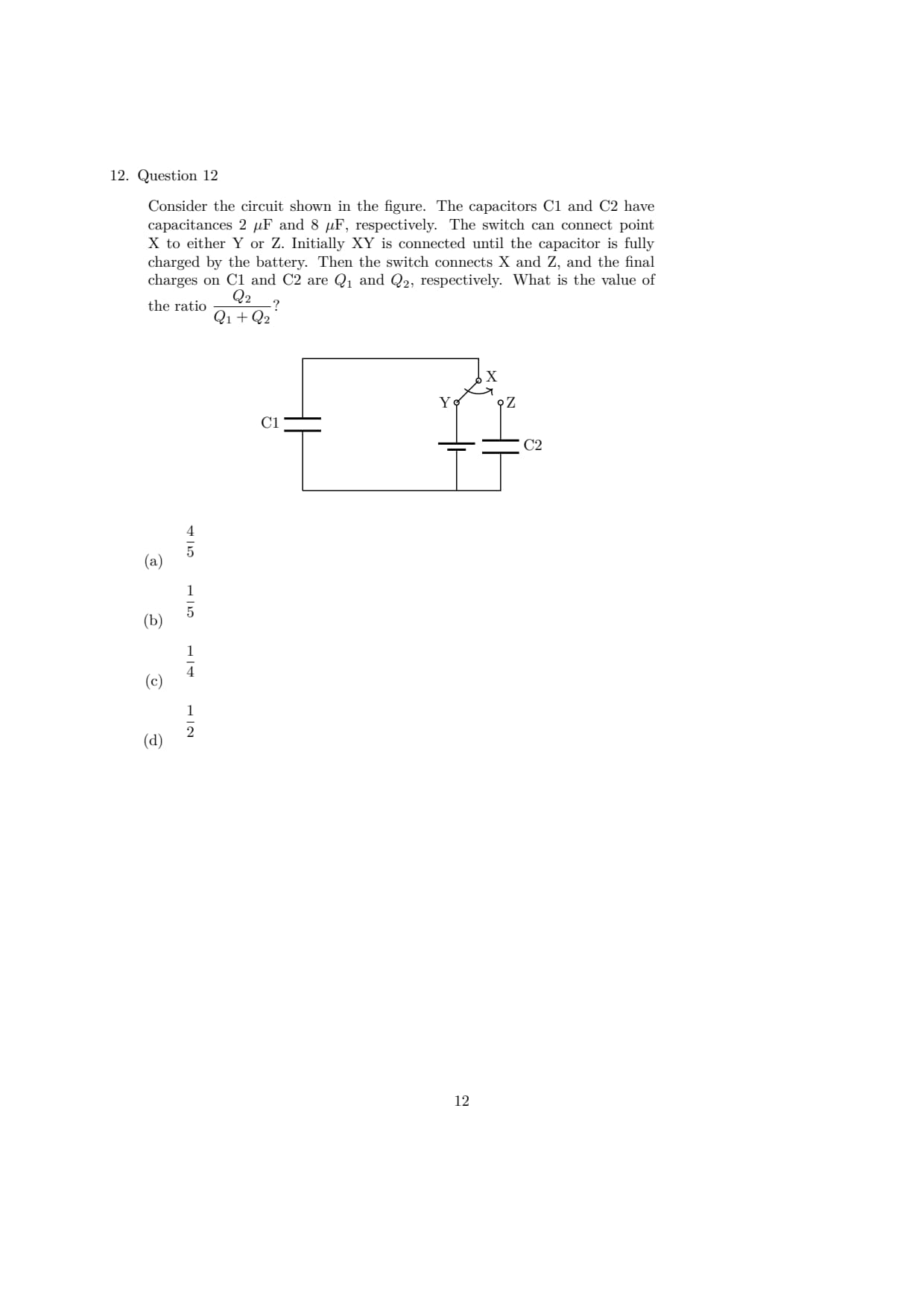
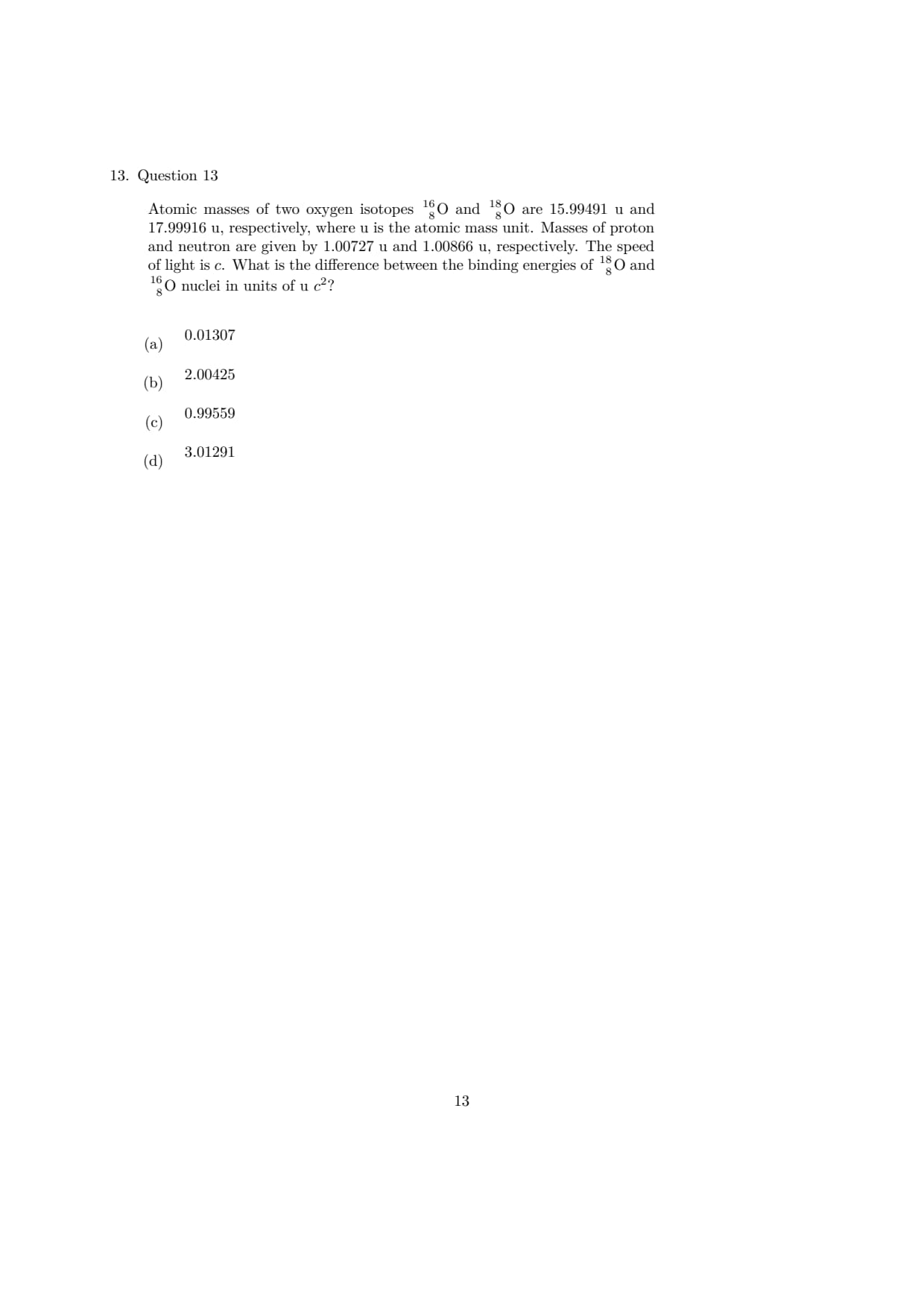
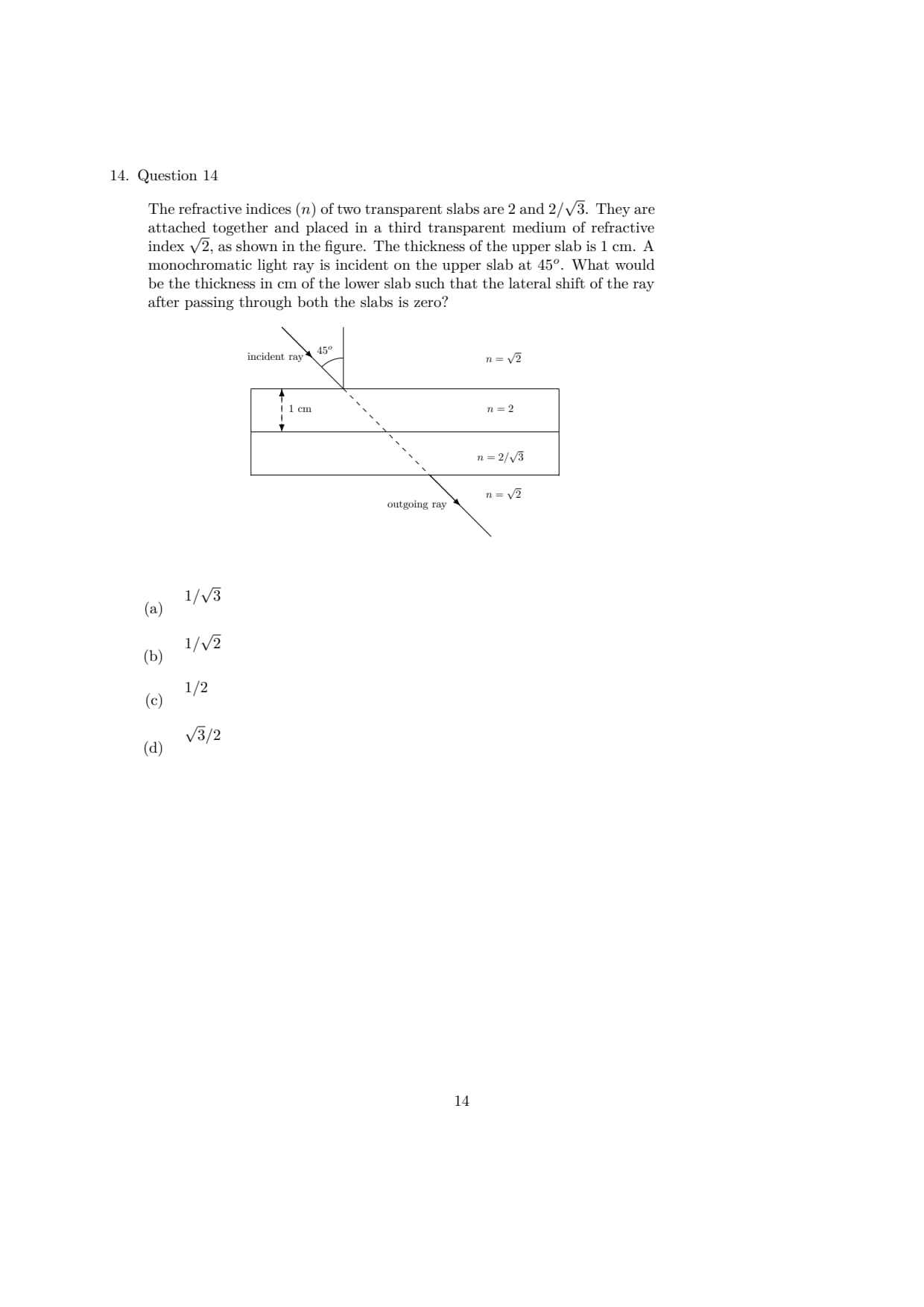
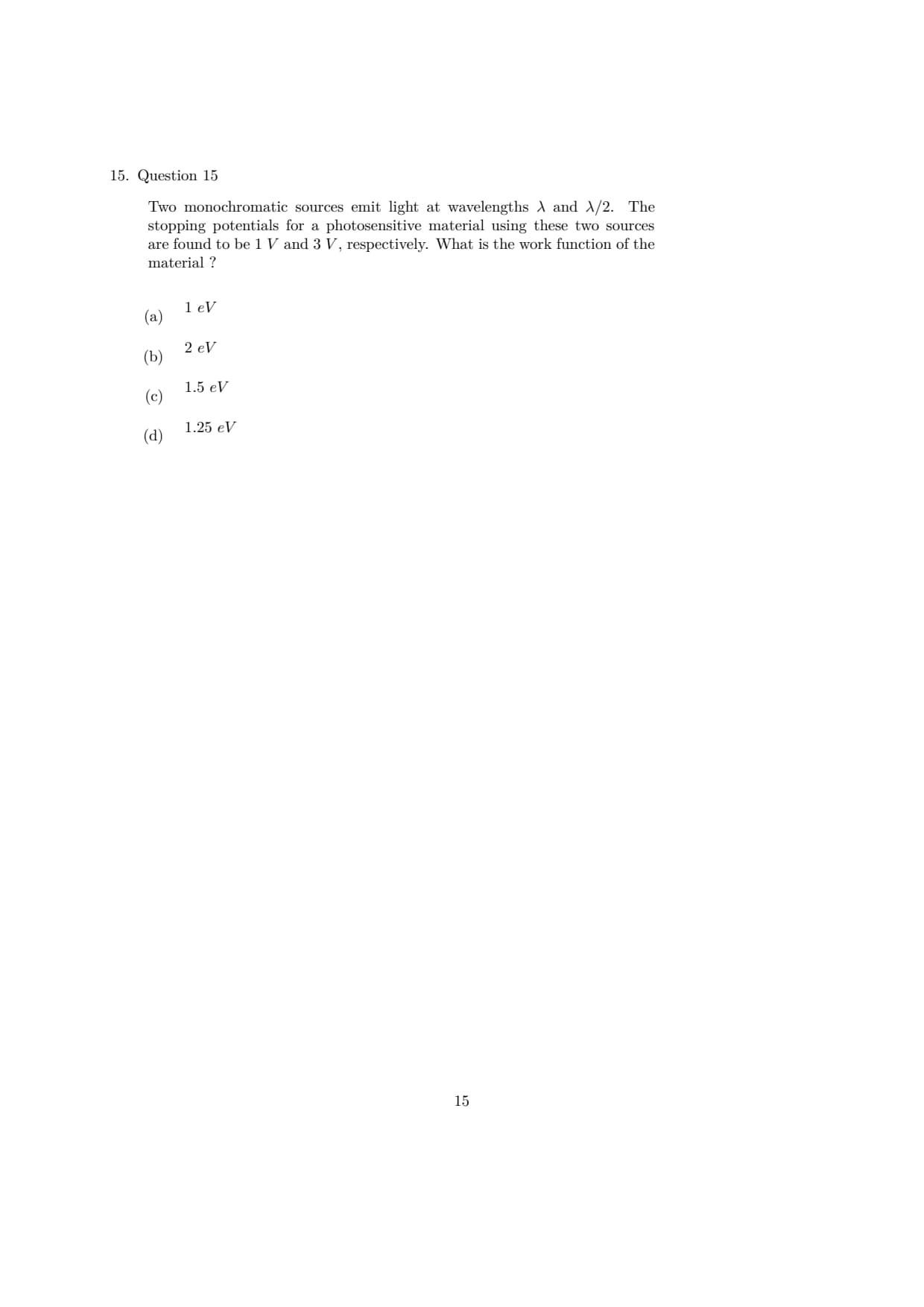
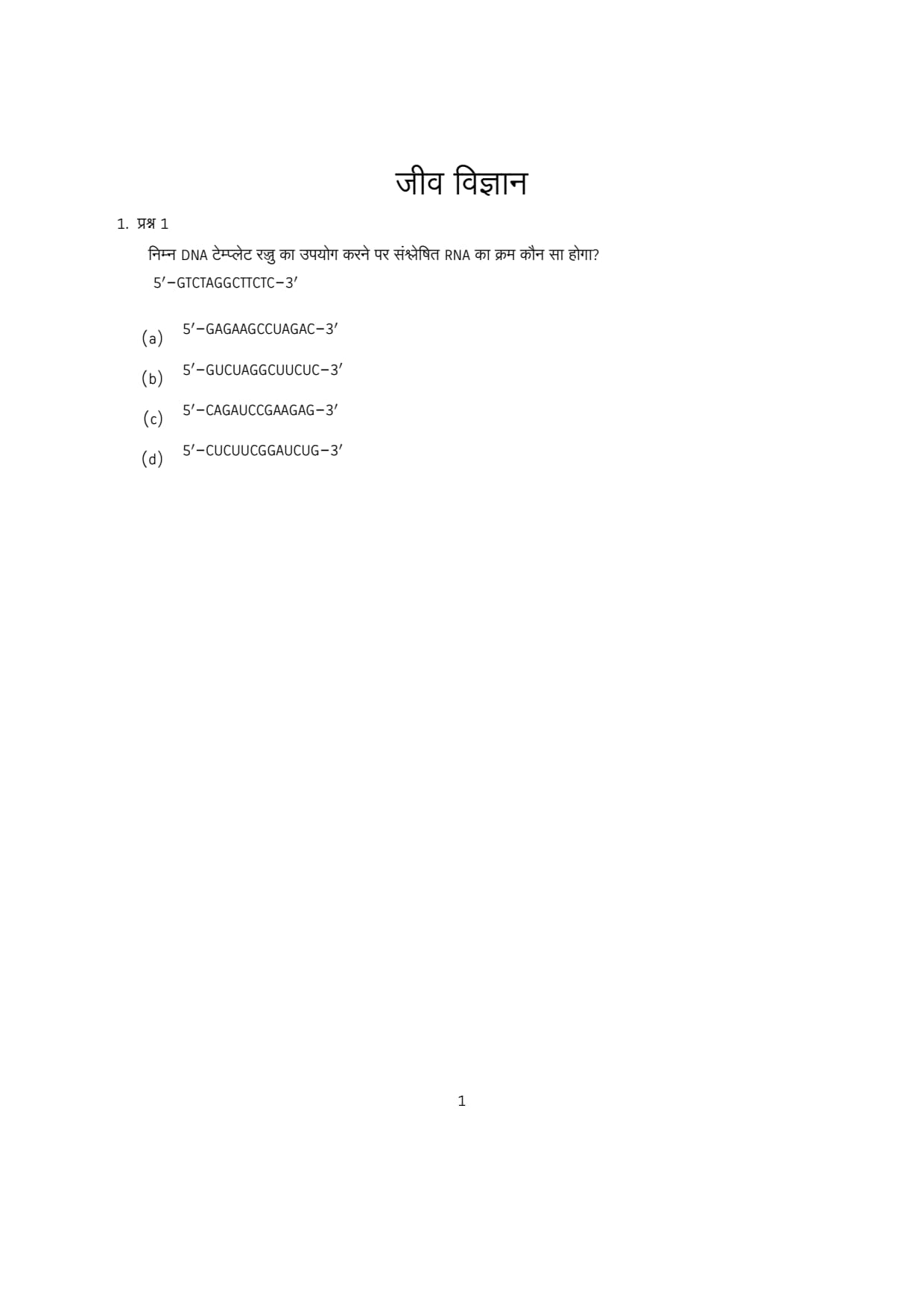
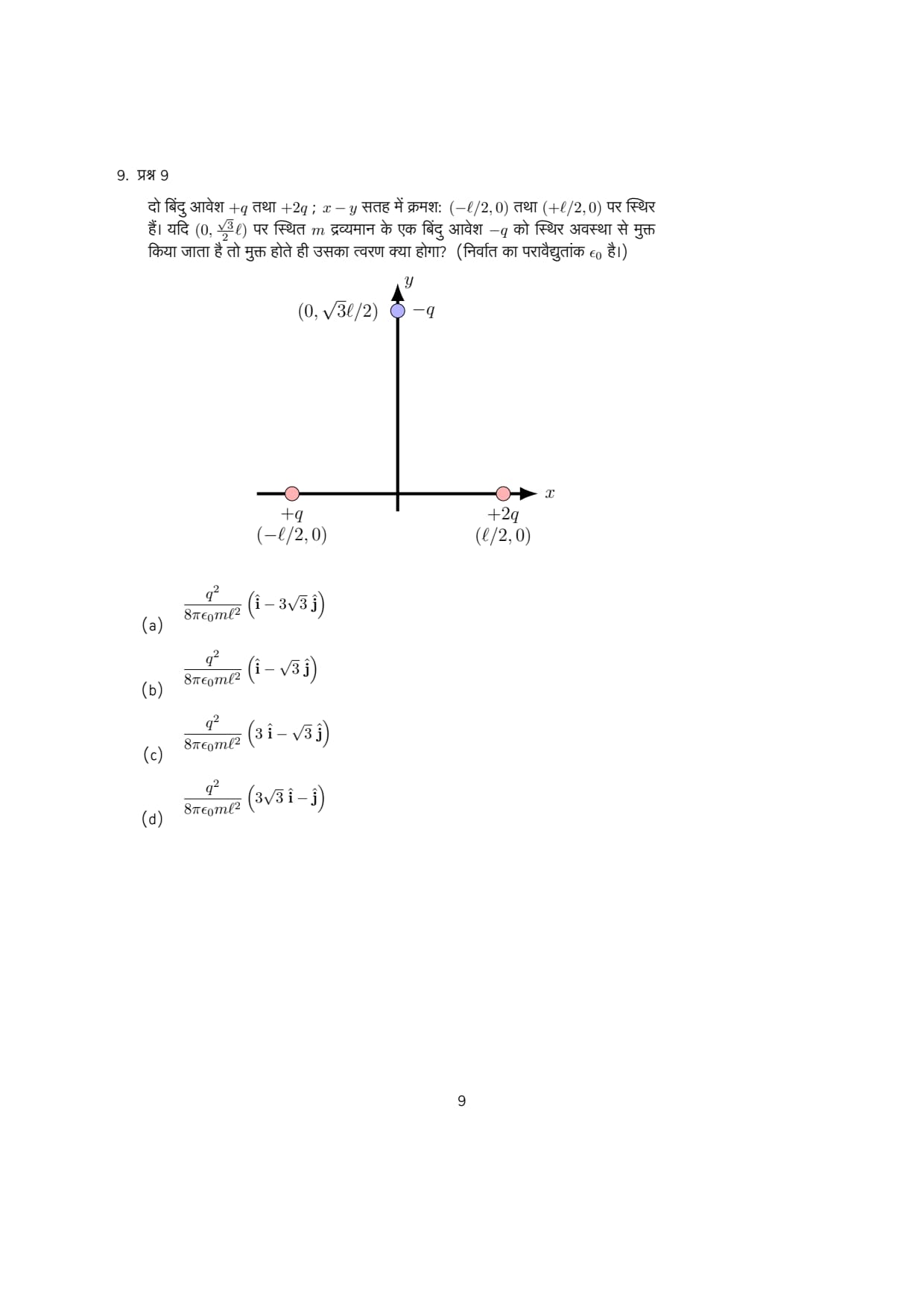
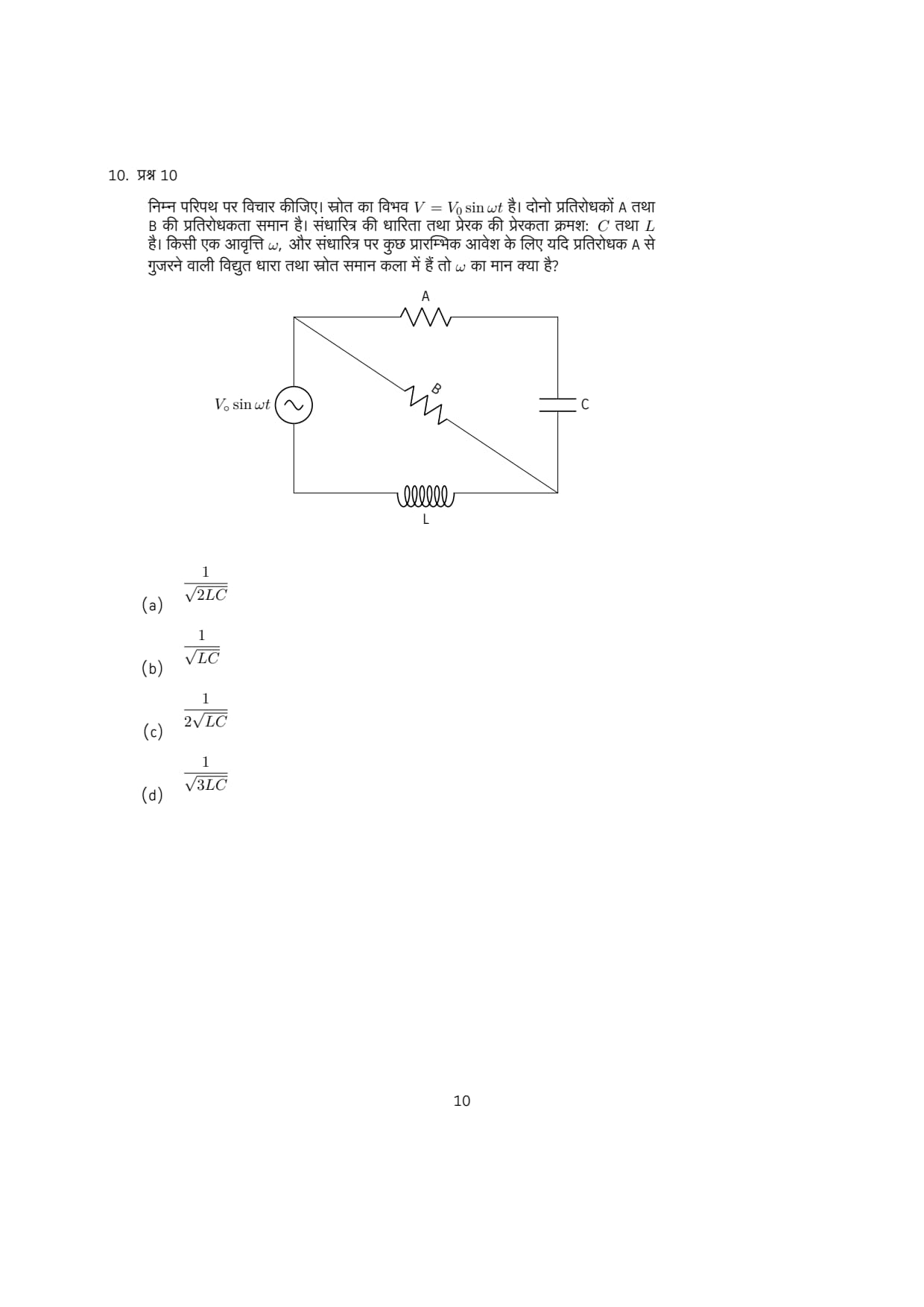
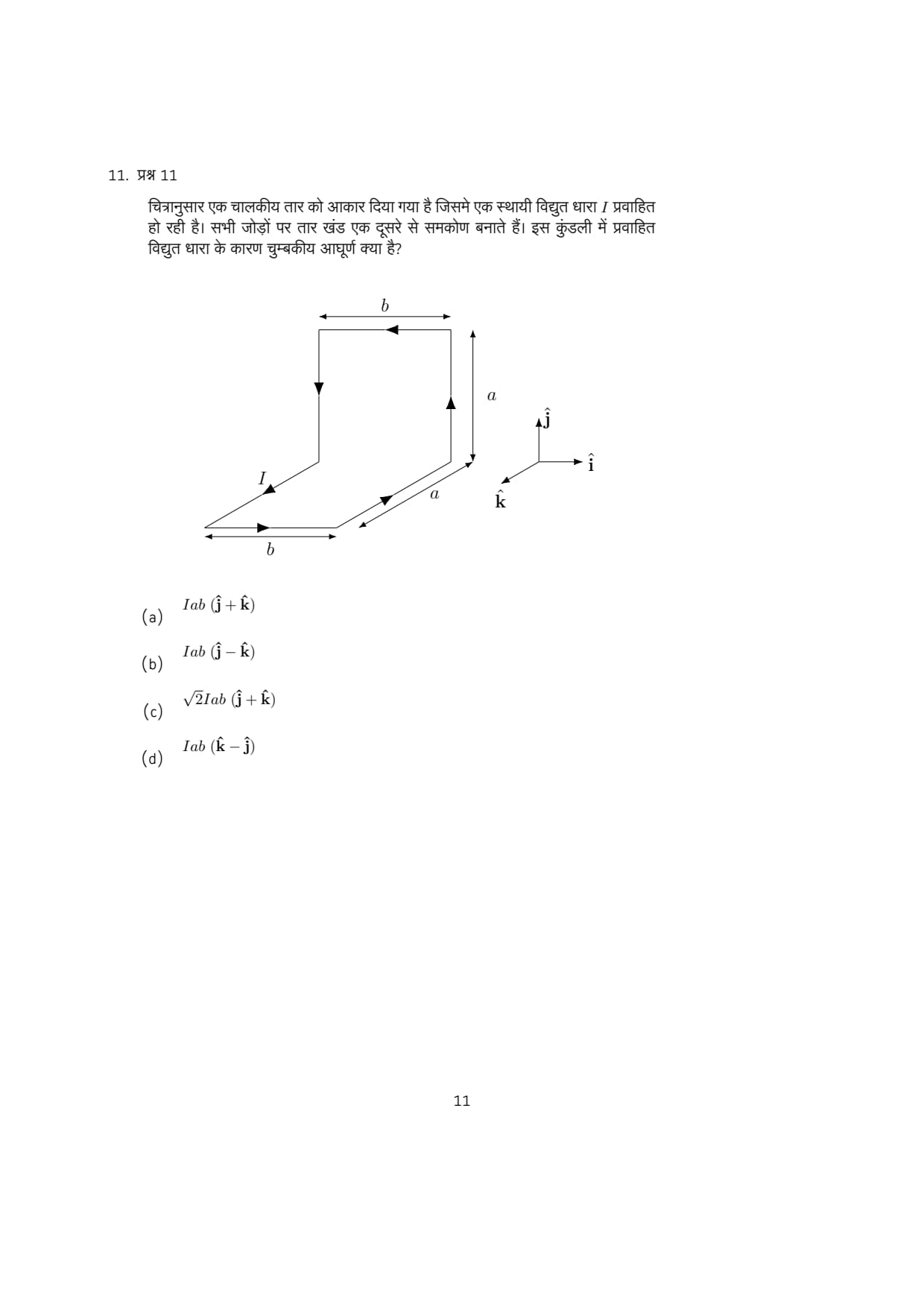
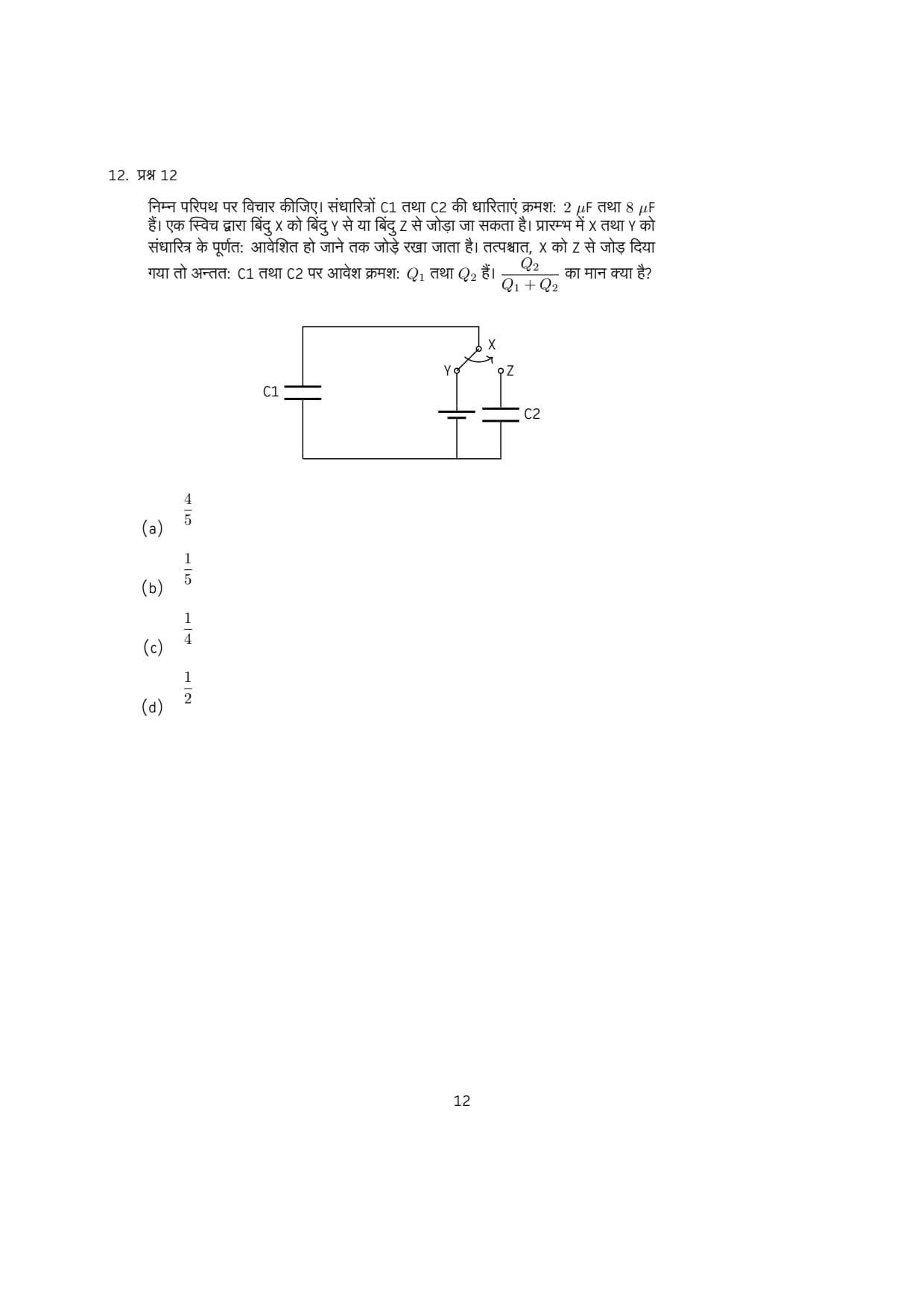
What will be the sequence of RNA synthesized using the following DNA template strand?
5'-GTCTAGGCTTCTC-3'
View Solution
Step 1: Understanding the Question:
The question asks us to find the sequence of the RNA molecule synthesized from a given DNA template strand.
The template strand is read by RNA polymerase in the \(3' \to 5'\) direction to synthesize RNA in the \(5' \to 3'\) direction.
The bases in the RNA are complementary to those in the DNA template strand.
Step 2: Key Formula or Approach:
To find the complementary RNA strand:
1. Complementary base pairing rules apply: Adenine (A) pairs with Uracil (U) in RNA, Thymine (T) pairs with Adenine (A), Cytosine (C) pairs with Guanine (G), and Guanine (G) pairs with Cytosine (C).
2. The RNA strand is synthesized antiparallel to the DNA template strand.
Thus, the \(5'\) end of the RNA is complementary to the \(3'\) end of the DNA template.
Step 3: Detailed Explanation:
Let's write down the given DNA template strand:
\[ 5'-GTCTAGGCTTCTC-3' \]
To easily construct the complementary RNA strand in the standard \(5' \to 3'\) direction, we first write the DNA template in the \(3' \to 5'\) direction:
\[ 3'-CTCTTCGGATCTG-5' \]
Now, we find the complementary RNA bases starting from the \(5'\) end (which corresponds to the \(3'\) end of the DNA template):
- Cytosine (C) at \(3'\) end of DNA pairs with Guanine (G) at \(5'\) end of RNA.
- Thymine (T) pairs with Adenine (A).
- Cytosine (C) pairs with Guanine (G).
- Thymine (T) pairs with Adenine (A).
- Thymine (T) pairs with Adenine (A).
- Cytosine (C) pairs with Guanine (G).
- Guanine (G) pairs with Cytosine (C).
- Guanine (G) pairs with Cytosine (C).
- Adenine (A) pairs with Uracil (U).
- Thymine (T) pairs with Adenine (A).
- Cytosine (C) pairs with Guanine (G).
- Thymine (T) pairs with Adenine (A).
- Guanine (G) at \(5'\) end of DNA pairs with Cytosine (C) at \(3'\) end of RNA.
Putting these together from \(5'\) to \(3'\) gives:
\[ 5'-GAGAAGCCUAGAC-3' \]
Step 4: Final Answer:
Therefore, the sequence of the synthesized RNA is 5'-GAGAAGCCUAGAC-3', which matches option (A).
Quick Tip: Always write down the template strand in the \(3' \to 5'\) direction first.
This makes writing the complementary \(5' \to 3'\) RNA strand straightforward and prevents directionality errors.
Remember that RNA contains Uracil (U) instead of Thymine (T).
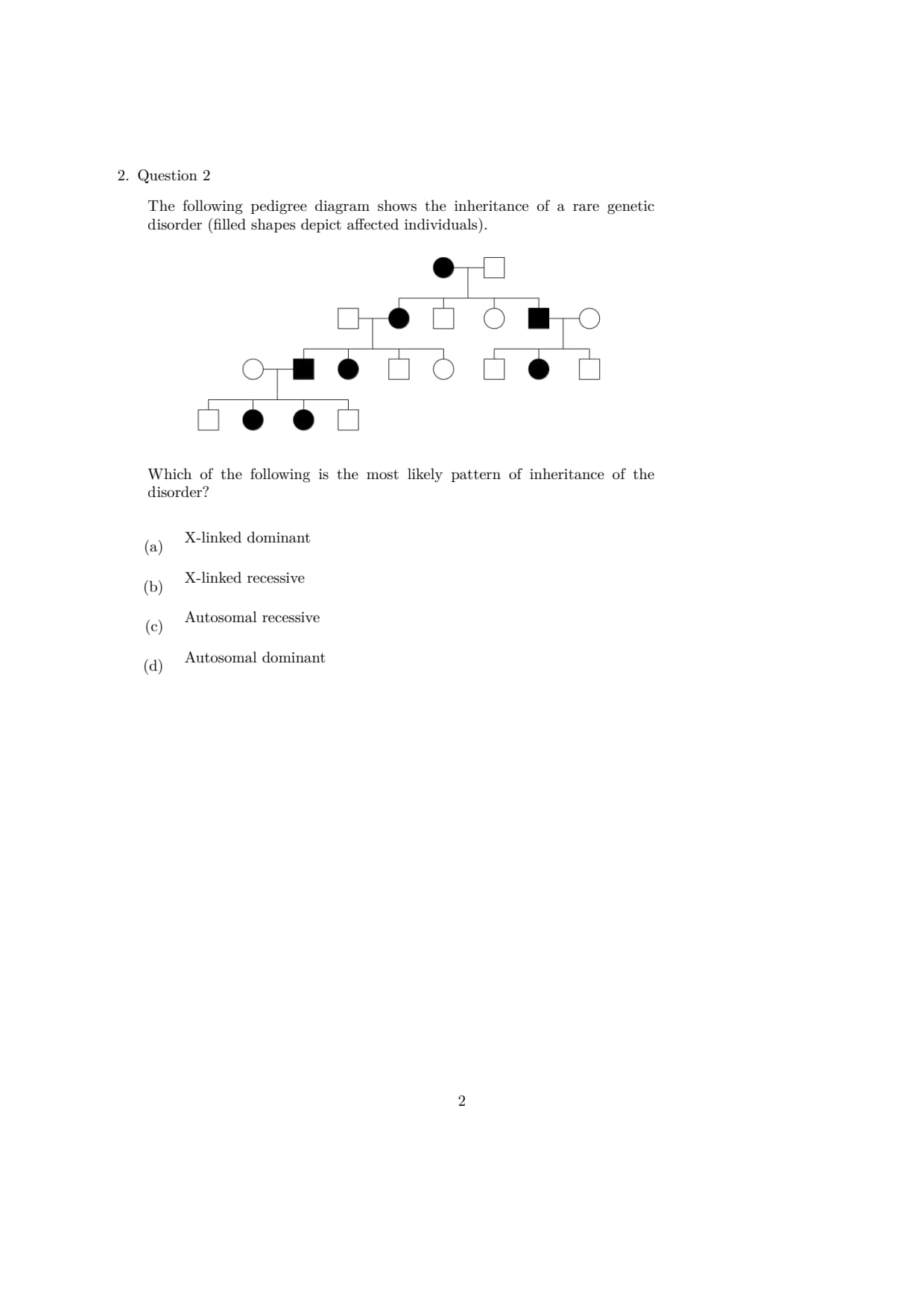
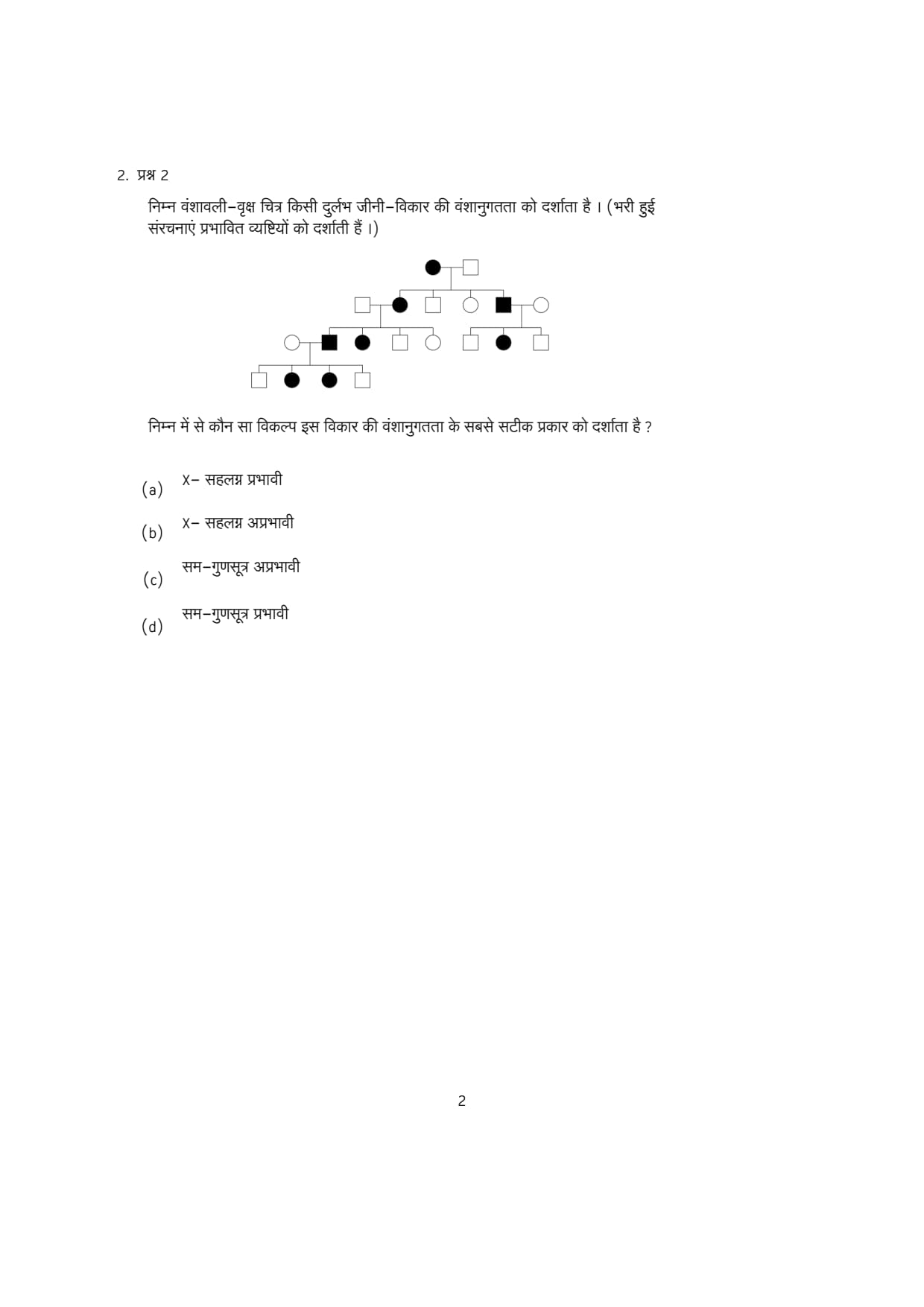
The following pedigree diagram shows the inheritance of a rare genetic disorder (filled shapes depict affected individuals).

Which of the following is the most likely pattern of inheritance of the disorder?
View Solution
Step 1: Understanding the Question:
The question presents a pedigree diagram representing the transmission of a rare genetic disorder across three generations.
We need to determine the mode of inheritance by analyzing the transmission of the trait between parents and offspring.
Step 2: Key Formula or Approach:
To identify the mode of inheritance, we test the given choices against key genetic rules:
1. X-linked dominant: Affected fathers must pass the trait to all of their daughters (since they receive his only X chromosome), but none of their sons (since they receive his Y chromosome). Affected mothers can pass the trait to both sons and daughters with a 50% probability.
2. X-linked recessive: Affected mothers must pass the trait to all of their sons. Unaffected parents cannot have affected daughters unless the father is affected.
3. Autosomal dominant: The trait typically does not skip generations, and affected parents can have unaffected offspring.
4. Autosomal recessive: The trait can skip generations, and unaffected parents can have affected offspring.
Step 3: Detailed Explanation:
Let us analyze the pedigree diagram step-by-step:
- In Generation II, we observe two affected males (black squares).
- Let's look at the rightmost affected male in Generation II. He is married to an unaffected female (white circle).
- Their offspring in Generation III consist of:
- One affected daughter (black circle).
- Two unaffected sons (white squares).
- Let's also look at the leftmost affected male in Generation II. He is married to an unaffected female (white circle).
- Their offspring in Generation III consist of:
- Two affected daughters (black circles).
- Two unaffected sons (white squares).
- In both cases, the affected fathers transmit the disease to 100% of their daughters and 0% of their sons.
- This is the signature pattern of an X-linked dominant inheritance, because a father passes his X chromosome to all his daughters and his Y chromosome to all his sons.
- Additionally, the affected female in Generation I (black circle) married to an unaffected male (white square) passes the trait to approximately 50% of her children:
- She has one affected daughter, one unaffected daughter, one affected son, and two unaffected sons.
- This 50% transmission rate is expected for a heterozygous mother carrying a dominant allele (\(X^D X^d\)).
Step 4: Final Answer:
Based on the perfect correlation of the pedigree with the rules of X-linked dominant inheritance, the correct option is (A).
Quick Tip: In pedigree analysis, look first at the offspring of affected males.
If all daughters of an affected male are affected and all his sons are unaffected, the trait is almost certainly X-linked dominant.
This simple rule helps save valuable time during competitive examinations.
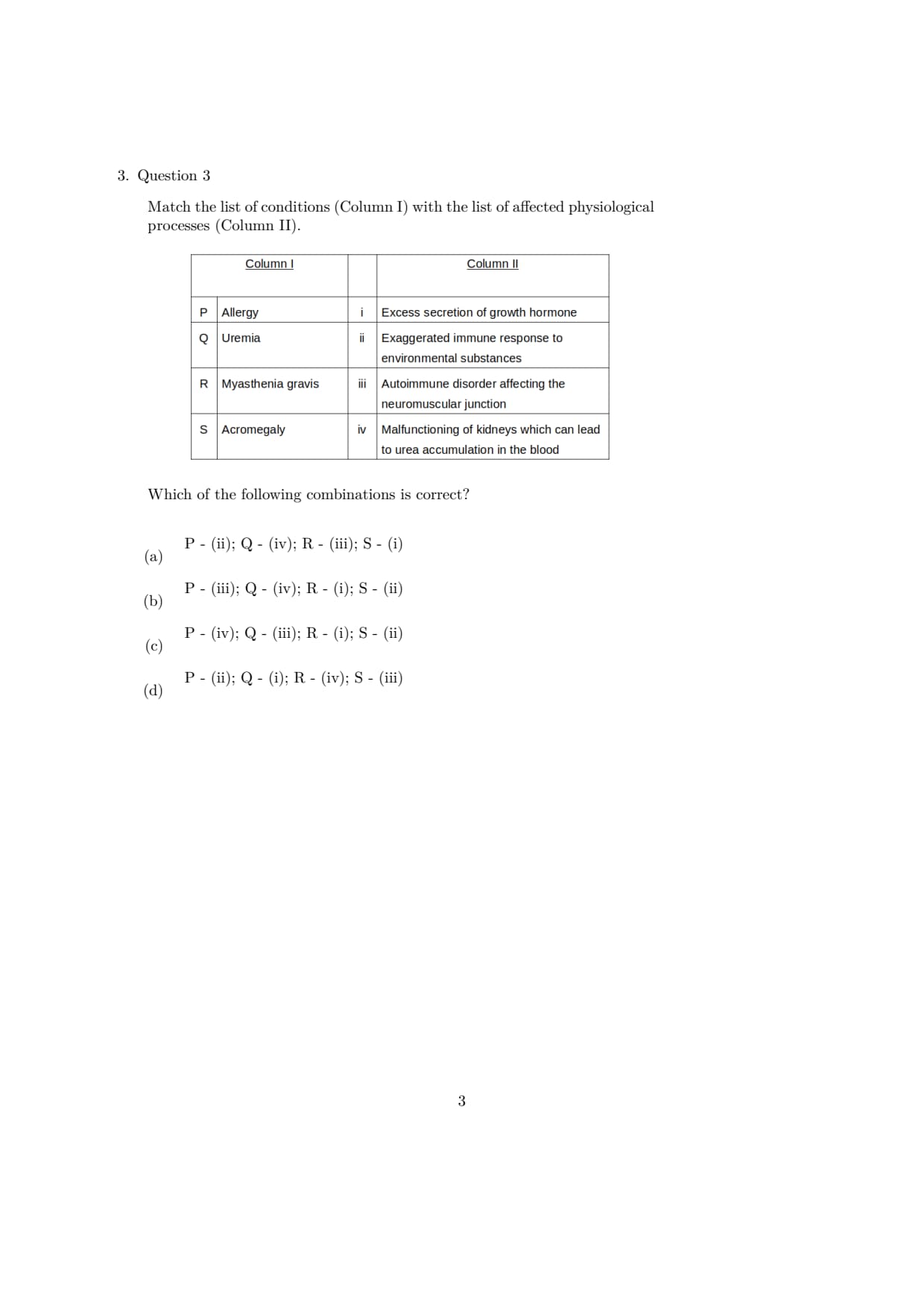
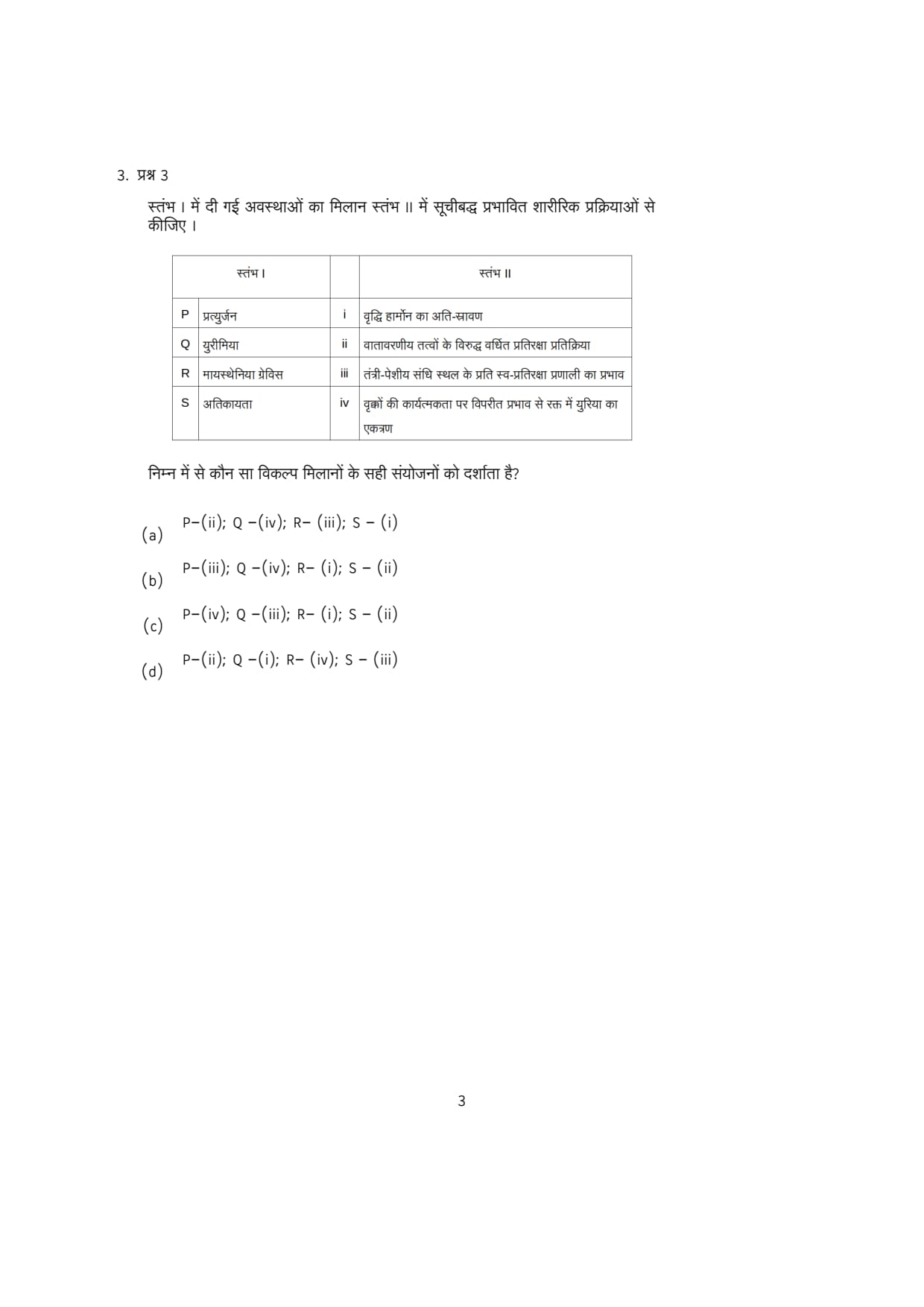
Match the list of conditions (Column I) with the list of affected physiological processes (Column II).

Which of the following combinations is correct?
View Solution
Step 1: Understanding the Question:
We are asked to match the clinical conditions listed in Column I with their corresponding physiological causes or descriptions in Column II.
Step 2: Key Formula or Approach:
We can match the terms based on standard human physiology definitions:
1. Allergy: An exaggerated response of the immune system to certain foreign substances (allergens) present in the environment.
2. Uremia: An accumulation of urea and other nitrogenous waste products in the blood, which occurs due to renal failure or malfunctioning of kidneys.
3. Myasthenia gravis: An autoimmune neuromuscular disorder where antibodies destroy or block acetylcholine receptors at the neuromuscular junction, leading to skeletal muscle weakness.
4. Acromegaly: A hormonal disorder that results from the excess secretion of growth hormone (GH) by the pituitary gland, typically in adults.
Step 3: Detailed Explanation:
Let's match each condition to its corresponding process:
- P. Allergy directly relates to (ii) "Exaggerated immune response to environmental substances".
- Q. Uremia directly relates to (iv) "Malfunctioning of kidneys which can lead to urea accumulation in the blood".
- R. Myasthenia gravis directly relates to (iii) "Autoimmune disorder affecting the neuromuscular junction".
- S. Acromegaly directly relates to (i) "Excess secretion of growth hormone".
Comparing our matches with the given combinations:
- P - (ii), Q - (iv), R - (iii), S - (i) matches option (A).
Step 4: Final Answer:
Thus, the correct option representing the right matches is (A).
Quick Tip: In matching questions, always start with the term you are most confident about.
For instance, Uremia contains 'urea' in its name, which points directly to kidneys and urea accumulation.
This allows you to quickly eliminate incorrect options and find the correct option faster.
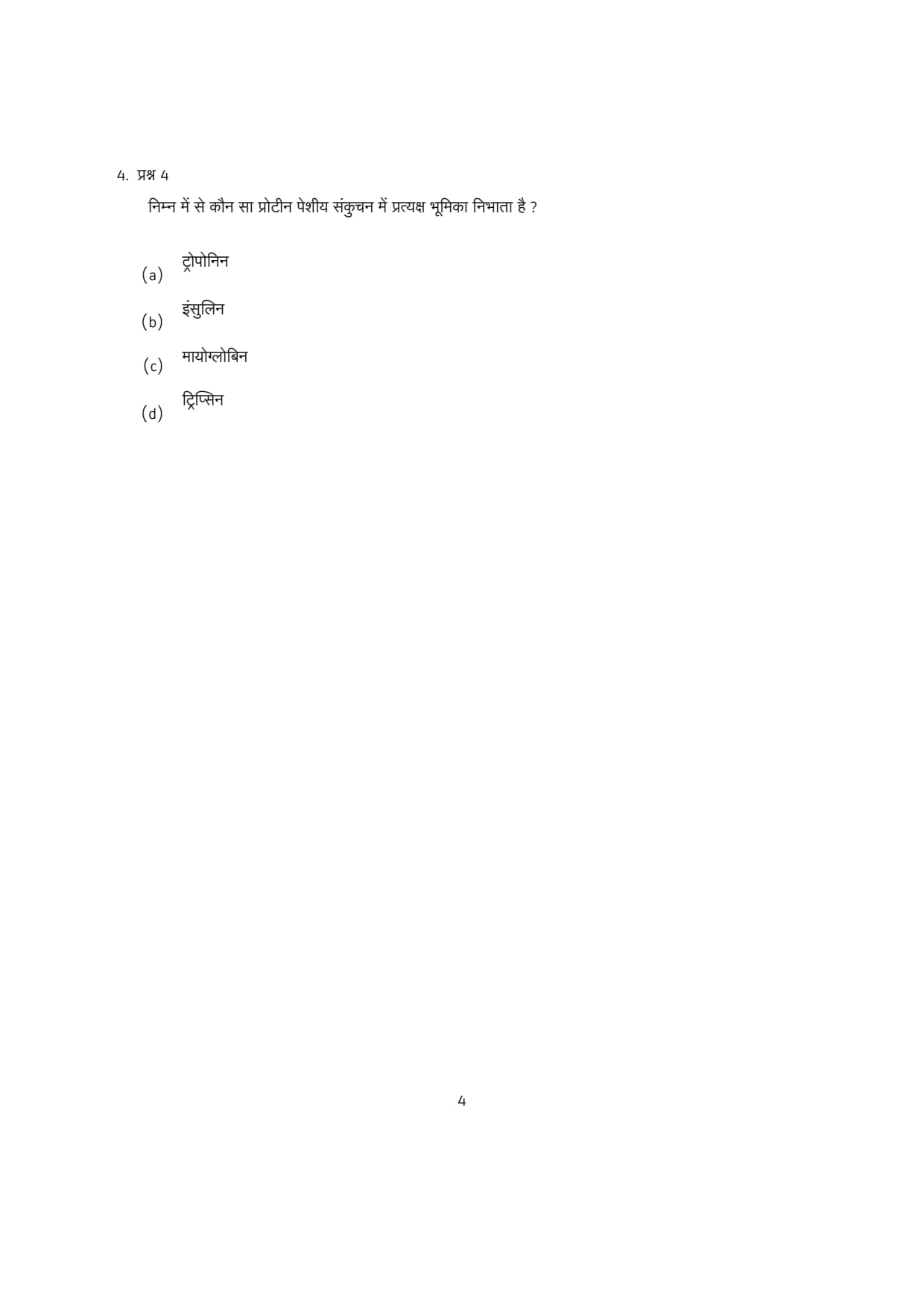
Which of the following proteins plays a direct role in muscle contraction?
View Solution
Step 1: Understanding the Question:
The question asks us to identify the protein among the choices that is directly involved in the mechanism of muscle contraction.
Step 2: Key Formula or Approach:
Let's evaluate the physiological role of each protein choice:
1. Troponin: A regulatory protein complex located on the actin filament of muscle fibers that plays a central role in triggering muscle contraction.
2. Insulin: A peptide hormone produced by the pancreas that regulates carbohydrate and fat metabolism.
3. Myoglobin: An iron- and oxygen-binding protein found in the muscle tissue of vertebrates, which stores oxygen but does not play a direct contractile role.
4. Trypsin: A digestive proteolytic enzyme produced in the pancreas that breaks down proteins in the small intestine.
Step 3: Detailed Explanation:
In skeletal muscle, contraction is regulated by calcium ions (\(Ca^{2+}\)).
- The thin filaments are composed of actin, tropomyosin, and the troponin complex.
- In the resting state, tropomyosin covers the active myosin-binding sites on actin.
- Upon muscle stimulation, \(Ca^{2+}\) ions are released from the sarcoplasmic reticulum.
- These \(Ca^{2+}\) ions bind to Troponin C, causing a conformational change in the troponin complex.
- This change shifts the position of tropomyosin, exposing the active sites on actin.
- Myosin heads then bind to actin, initiating the cross-bridge cycle and muscle contraction.
- Since troponin directly regulates and allows the interaction between actin and myosin, it plays a direct role in muscle contraction.
Step 4: Final Answer:
Therefore, the protein with a direct role in muscle contraction is Troponin, which is option (A).
Quick Tip: Remember the three main regulatory and structural proteins of muscle contraction: Actin, Myosin, Tropomyosin, and Troponin.
Calcium binding to Troponin is the key 'switch' that initiates contraction.
Which of the following is NOT derived from the epidermal cell layer in plants?
View Solution
Step 1: Understanding the Question:
We need to identify which of the given plant structures is NOT an anatomical derivative of the epidermal cell layer (the protoderm).
Step 2: Key Formula or Approach:
The plant tissue systems are divided into three main types based on their origin and structure:
1. Epidermal tissue system: Forms the outer protective covering of the plant. Examples include guard cells, subsidiary cells, trichomes, root hairs, and bulliform cells.
2. Ground tissue system: Comprises the cortex, endodermis, pericycle, medullary rays, and pith.
3. Vascular tissue system: Comprises xylem and phloem.
Step 3: Detailed Explanation:
Let's analyze each of the options:
- Trichomes (Option B): Hair-like outgrowths on the epidermis of leaves and stems, which are derived from epidermal cells.
- Subsidiary cells (Option C): Specialized epidermal cells bordering the guard cells of stomata, helping in stomatal movement.
- Bulliform cells (Option D): Large, empty, bubble-shaped epidermal cells found on the upper surface of leaves in monocots (such as grasses) that help in leaf rolling during water stress.
- Casparian strip (Option A): A band of suberin deposited on the radial and transverse walls of the endodermis in roots.
- The endodermis is the innermost layer of the root cortex, which originates from the ground meristem (part of the ground tissue system), not the protoderm (epidermal tissue system).
- Therefore, the Casparian strip is not derived from the epidermal cell layer.
Step 4: Final Answer:
The Casparian strip is derived from the ground tissue system (endodermis) and not the epidermal layer, making option (A) the correct choice.
Quick Tip: Remember the developmental origin of root layers: Epidermis \(\to\) Cortex \(\to\) Endodermis \(\to\) Pericycle \(\to\) Vascular bundles.
Since the Casparian strip is exclusively located in the endodermis, it must belong to the ground tissue system, not the epidermal tissue system.
Which of the following statements about meiosis in sexually reproducing plants is INCORRECT?
View Solution
Step 1: Understanding the Question:
The question asks us to identify the incorrect statement regarding meiosis in sexually reproducing plants.
Step 2: Key Formula or Approach:
Let's review the fundamental differences between plant and animal life cycles:
1. In animals, meiosis directly produces haploid gametes (sperm and egg), a process known as gametic meiosis.
2. In plants, meiosis is sporic. It occurs in sporophytes to produce haploid spores (microspores and megaspores). These spores undergo mitosis to form multicellular gametophytes (pollen grain and embryo sac) which then produce gametes.
Step 3: Detailed Explanation:
Let us evaluate each of the given statements:
- Statement (A): "The end products of meiosis II are haploid gametes."
- In plants, the direct products of meiosis II are haploid spores (sporic meiosis), not gametes.
- For example, microsporogenesis produces four microspores, which develop into pollen grains (male gametophyte) that subsequently produce male gametes via mitosis.
- Thus, this statement is biologically incorrect for plants.
- Statement (B): "The four products of meiosis are genetically different."
- This is correct. Crossing over (recombination) during Prophase I and independent assortment of chromosomes during Metaphase I ensure genetic diversity.
- Statement (C): "Meiotic recombination takes place in both males and females."
- This is correct. Recombination occurs in both microsporogenesis (male) and megasporogenesis (female) to generate genetic diversity.
- Statement (D): "In most flowering plants, only one of the four products of meiosis survives in females."
- This is correct. During megasporogenesis, a single megaspore mother cell undergoes meiosis to produce a linear tetrad of four haploid megaspores.
- In the vast majority of angiosperms (monosporic development), three of these megaspores degenerate, and only one survives to develop into the functional embryo sac.
Step 4: Final Answer:
Since statement (A) is incorrect, it is the correct choice.
Quick Tip: Always pay attention to the organism group mentioned in the question.
Plants undergo sporic meiosis (forming spores), whereas animals undergo gametic meiosis (forming gametes).
Keeping this distinction in mind prevents easy mistakes.
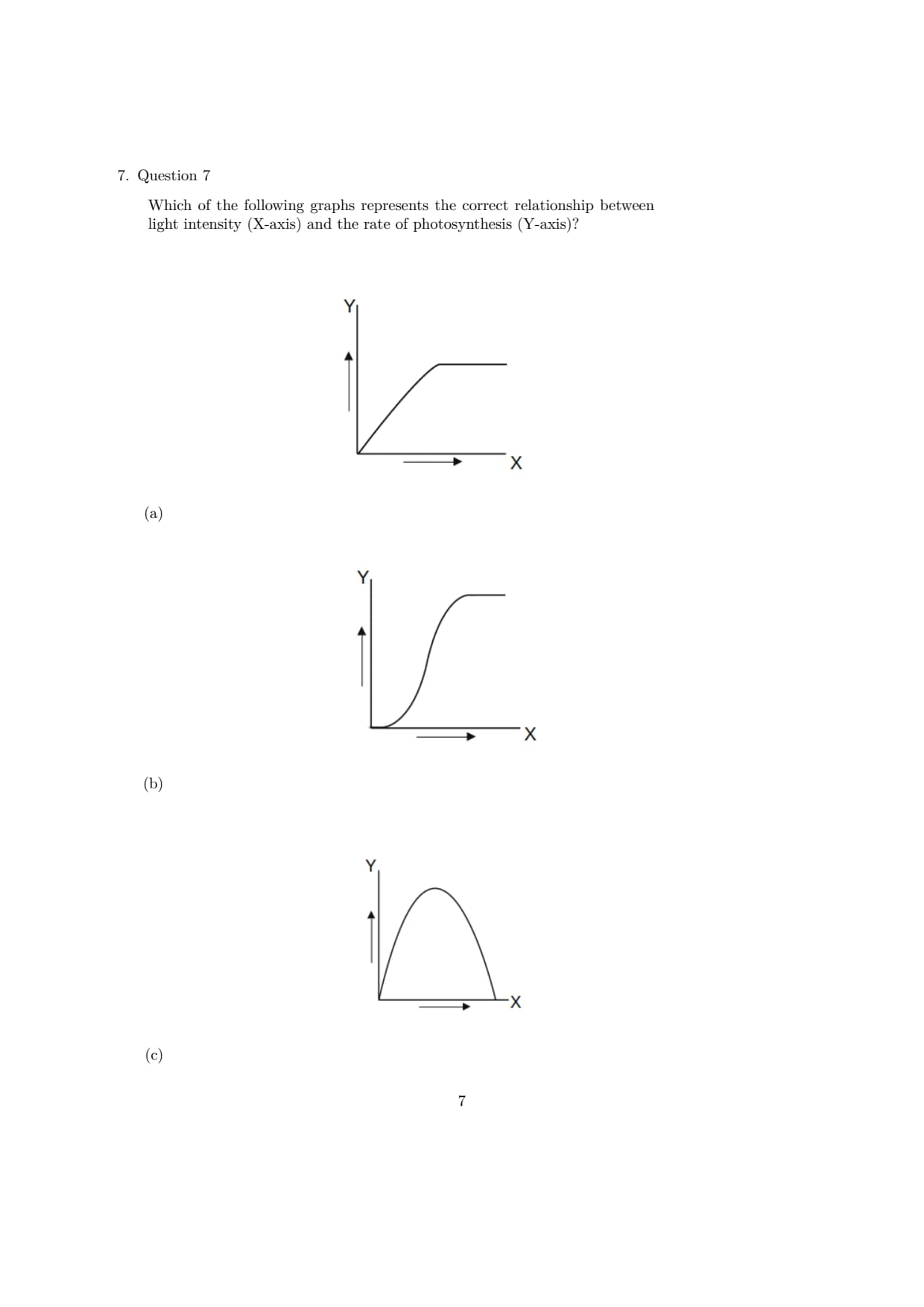
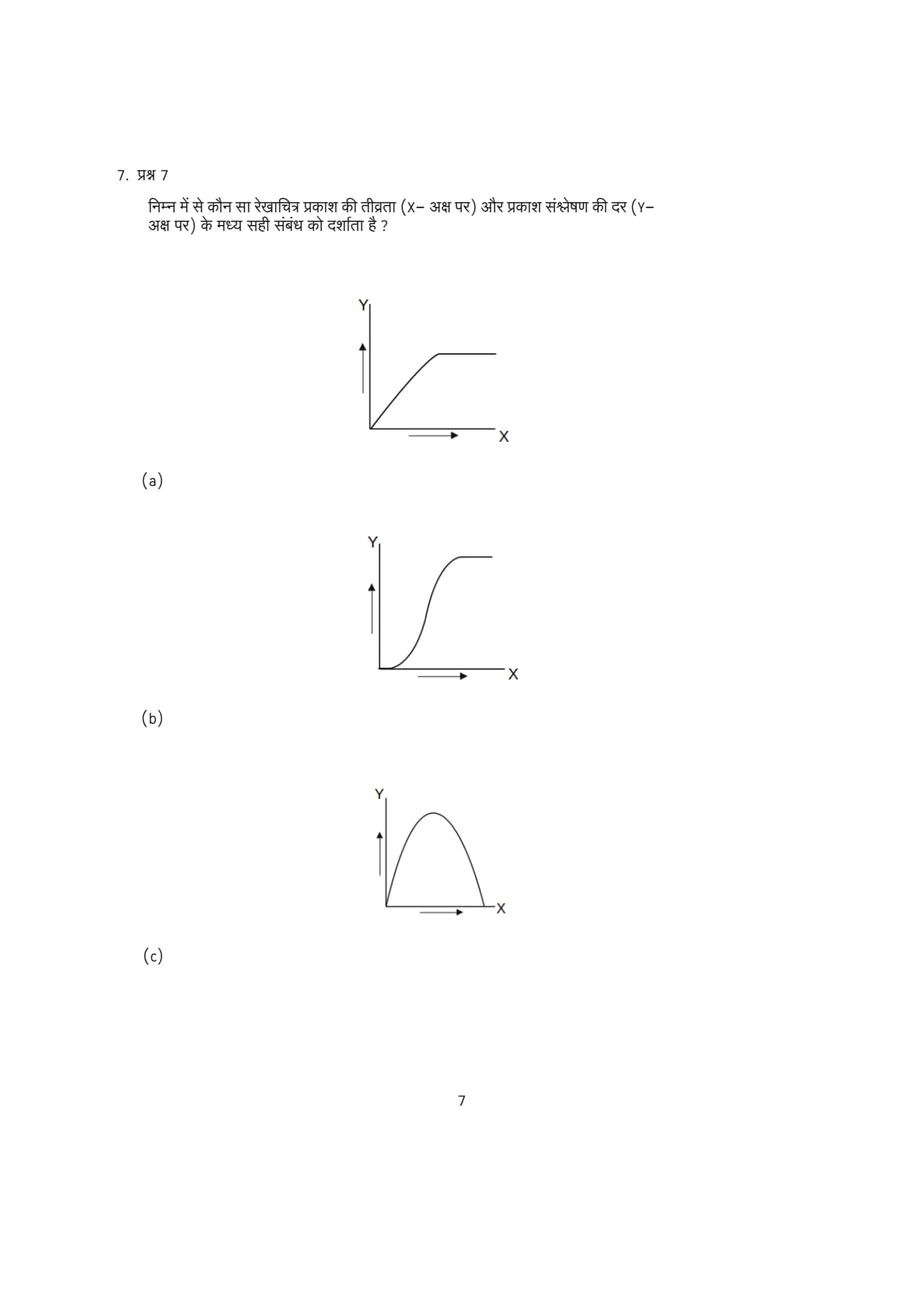
Which of the following graphs represents the correct relationship between light intensity (X-axis) and the rate of photosynthesis (Y-axis)?
- (A)
![]()
- (B)
![]()
- (C)
![]()
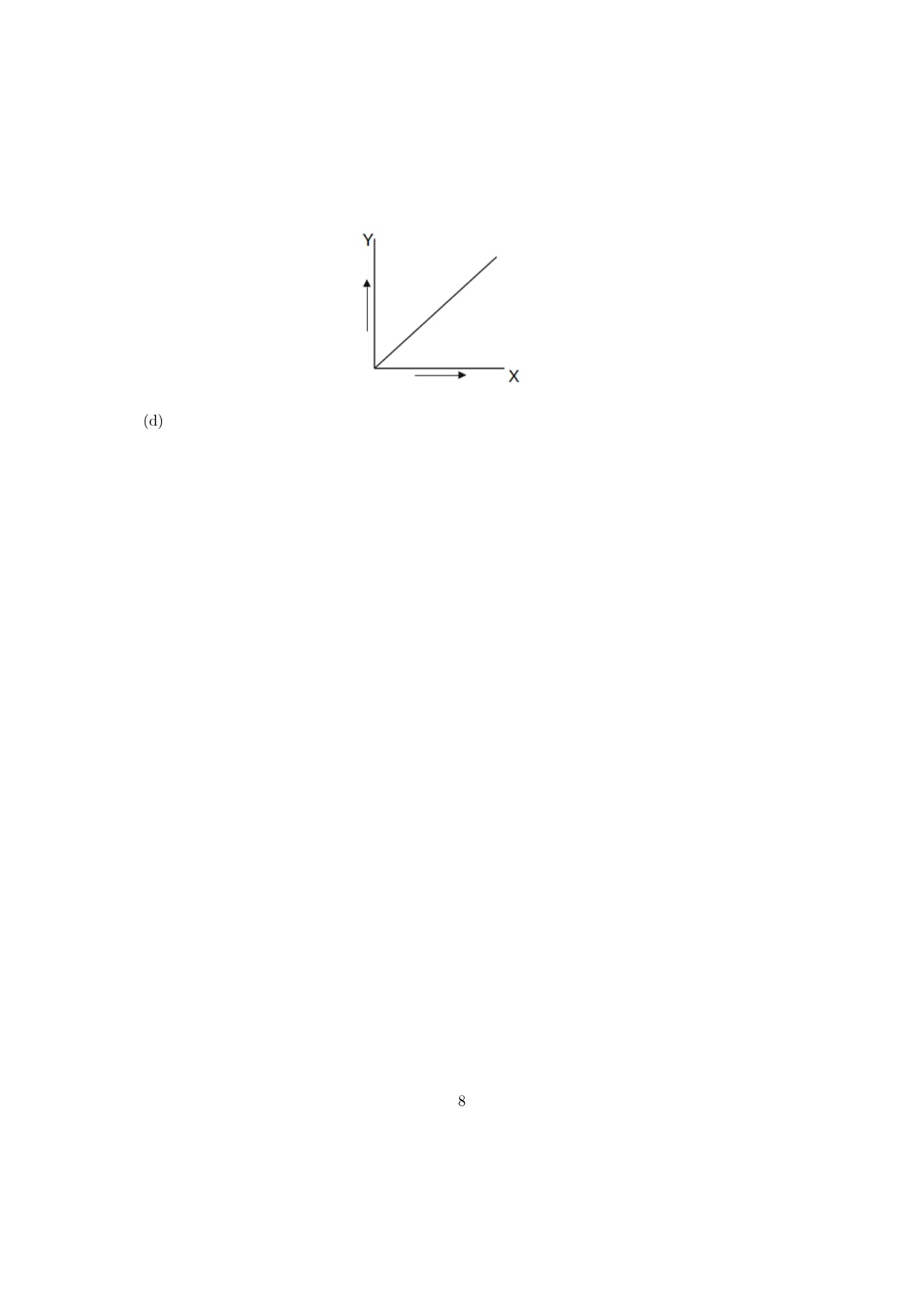
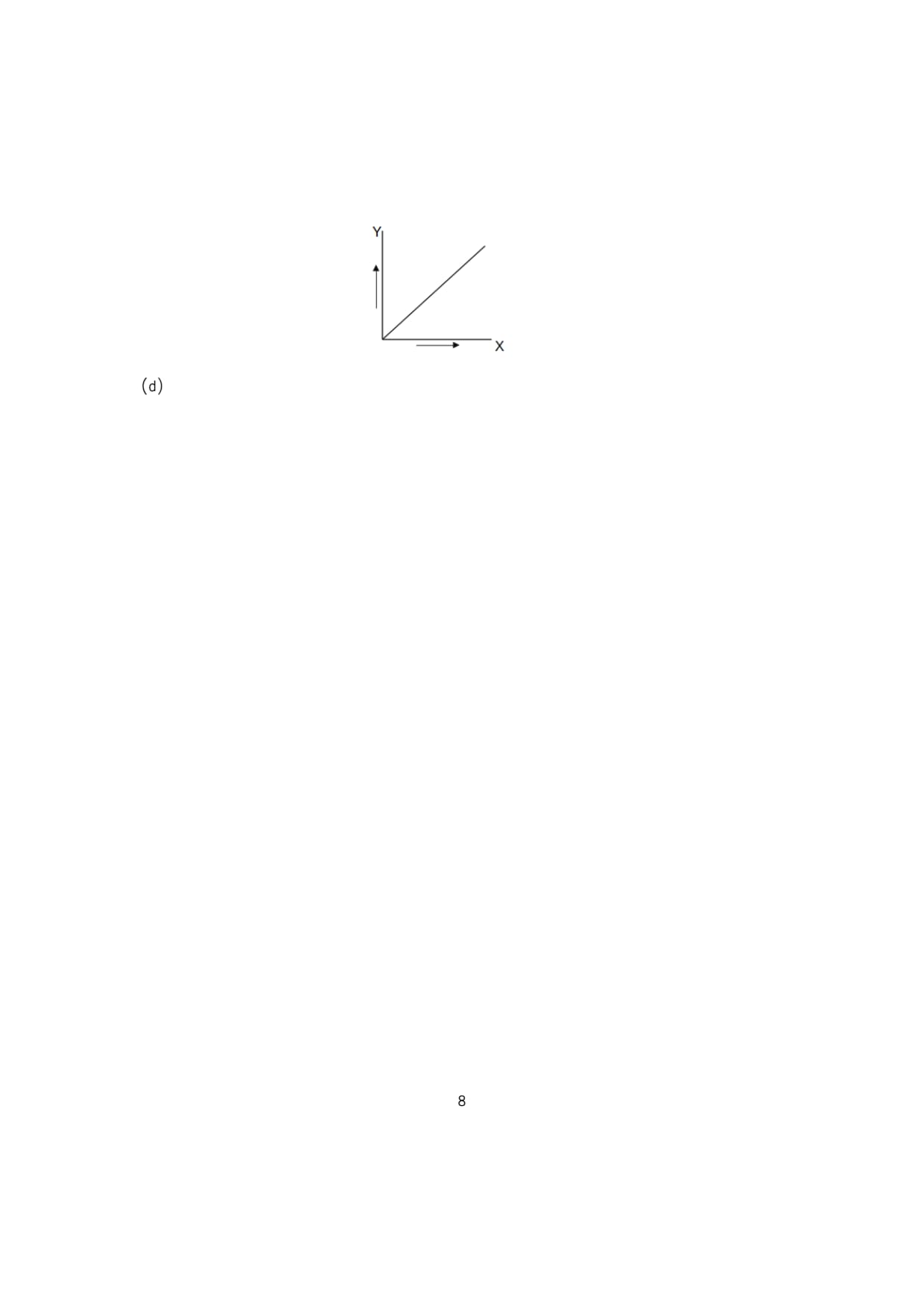
- (D)
![]()


View Solution
Step 1: Understanding the Question:
The question asks us to identify the graph that correctly shows how the rate of photosynthesis (Y-axis) changes as a function of light intensity (X-axis).
Step 2: Key Formula or Approach:
This question is based on Blackman's Law of Limiting Factors:
1. At low light intensities, light is the limiting factor. The rate of photosynthesis increases linearly with an increase in light intensity.
2. As light intensity increases further, other factors (such as \(CO_2\) concentration or temperature) become limiting, and the rate of photosynthesis begins to level off.
3. At very high light intensities, the rate reaches a plateau (light saturation point), and further increases in light do not increase the rate.
Step 3: Detailed Explanation:
Let's analyze the shapes of the graphs shown:
- Graph (a): Shows a linear increase in the rate of photosynthesis at low light levels, which then curves and reaches a flat plateau (asymptote) as saturation is reached. This matches the established scientific understanding of the light response curve of photosynthesis.
- Graph (b): Shows a sigmoidal curve, which is not characteristic of the light-photosynthesis relationship.
- Graph (c): Shows a parabolic curve where the rate decreases to zero at high light intensity. Although extreme light intensity can cause photoinhibition (solarization) due to chlorophyll damage, the standard relationship under physiological ranges is represented by a saturation curve.
- Graph (d): Shows a straight line continuing upwards indefinitely, which is physically impossible because biological systems have saturation limits and other limiting factors.
- Therefore, Graph (a) is the correct representation.
Step 4: Final Answer:
Graph (a) represents the correct relationship, making option (A) the correct answer.
Quick Tip: The photosynthetic light curve is a classic saturation curve.
Remember that light saturation occurs at about 10% of full sunlight for most plants.
This plateau behavior is typical of many enzyme-catalyzed and physiological processes.
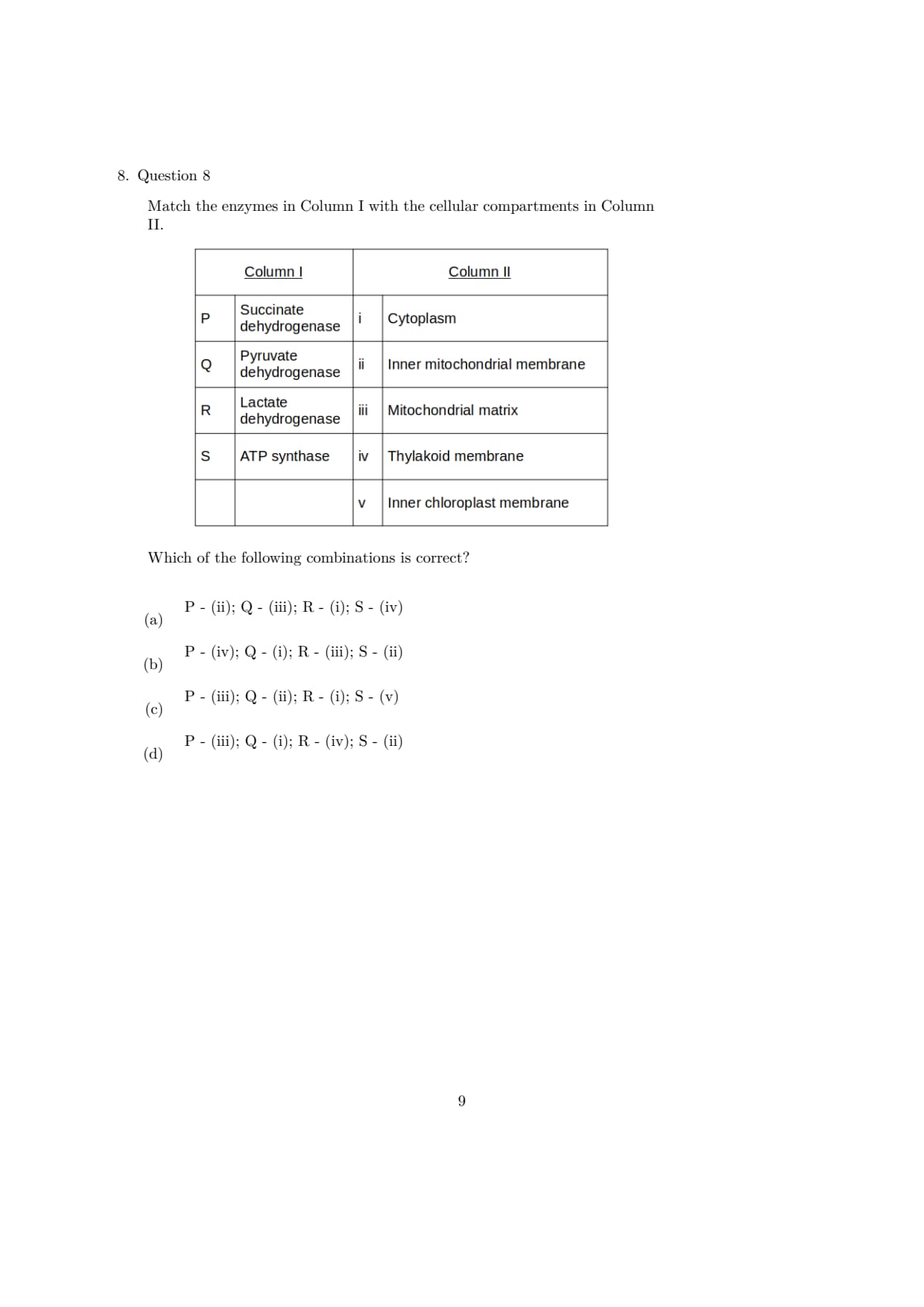
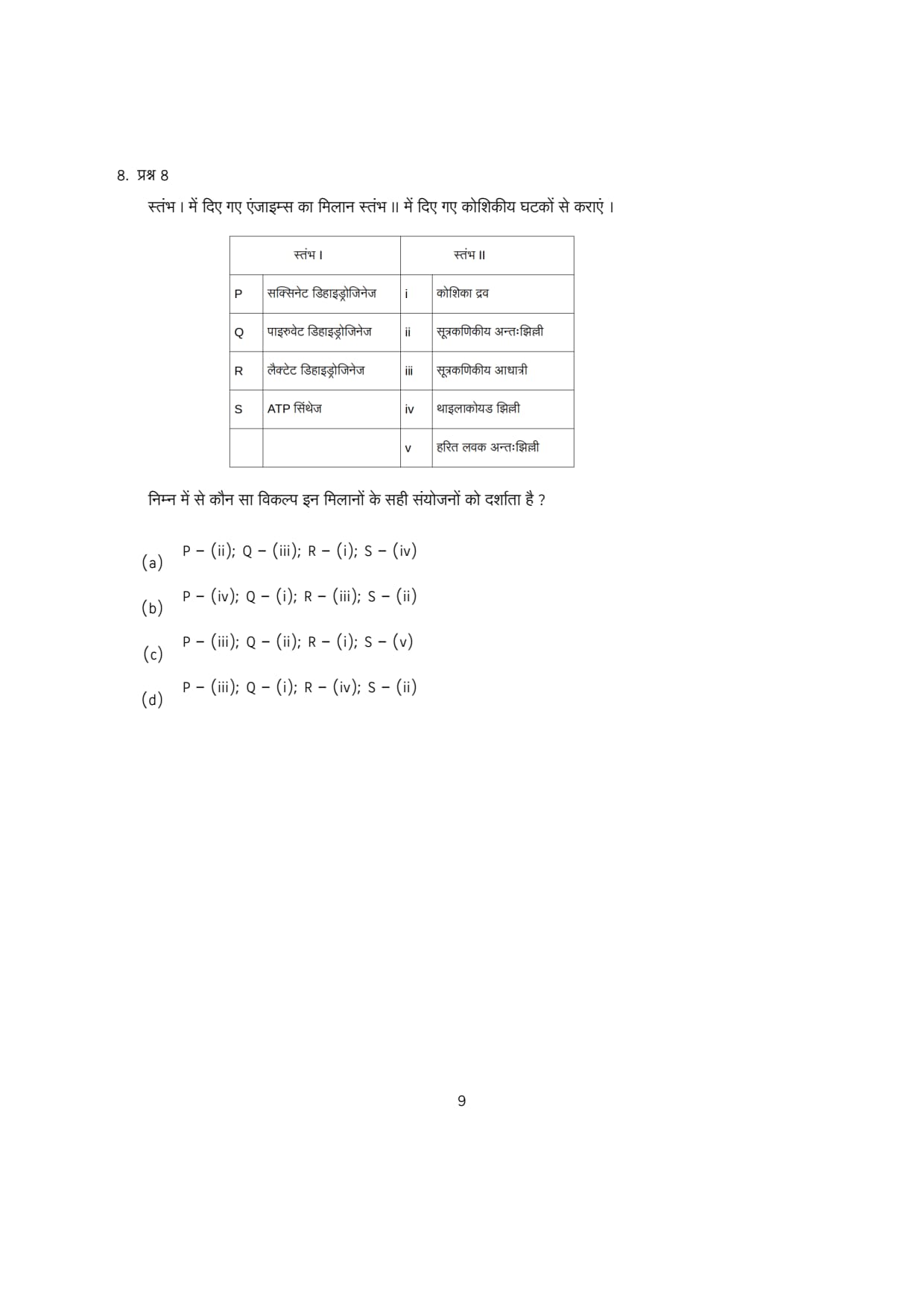
Match the enzymes in Column I with the cellular compartments in Column II.

Which of the following combinations is correct?
View Solution
Step 1: Understanding the Question:
We need to match the key cellular enzymes involved in respiration and energy production (Column I) with their specific subcellular locations (Column II).
Step 2: Key Formula or Approach:
Let's recall the locations of metabolic pathways:
1. Glycolysis and Fermentation: Occurs in the cytoplasm. Thus, Lactate dehydrogenase (catalyzing pyruvate \(\leftrightarrow\) lactate) is cytoplasmic.
2. Link Reaction: Occurs in the mitochondrial matrix. Thus, Pyruvate dehydrogenase is located here.
3. Krebs Cycle: Mostly occurs in the mitochondrial matrix, except for Succinate dehydrogenase, which is membrane-bound.
4. Oxidative Phosphorylation and Photophosphorylation: ATP Synthase complexes are located on the inner mitochondrial membrane and the thylakoid membrane of chloroplasts.
Step 3: Detailed Explanation:
Let's do the matching:
- P. Succinate dehydrogenase: This is a unique Krebs cycle enzyme because it is bound to the inner mitochondrial membrane (acting as Complex II of the respiratory chain). Thus, P matches (ii).
- Q. Pyruvate dehydrogenase: This multi-enzyme complex catalyzes the decarboxylation of pyruvate to acetyl-CoA inside the mitochondrial matrix. Thus, Q matches (iii).
- R. Lactate dehydrogenase: This enzyme catalyzes the reversible conversion of pyruvate to lactate during anaerobic respiration in the cytoplasm. Thus, R matches (i).
- S. ATP synthase: This complex is responsible for ATP synthesis during light reactions of photosynthesis and is located on the thylakoid membrane of chloroplasts (or inner mitochondrial membrane). Among the choices, matching S with (iv) (thylakoid membrane) yields the correct and complete set.
Let's check the combinations:
- P - (ii), Q - (iii), R - (i), S - (iv) corresponds to option (A).
Step 4: Final Answer:
The only correct matching combination is option (A).
Quick Tip: Succinate dehydrogenase is an excellent marker enzyme for the inner mitochondrial membrane.
Remembering this single fact instantly points to P - (ii), allowing you to find the correct answer (A) immediately!
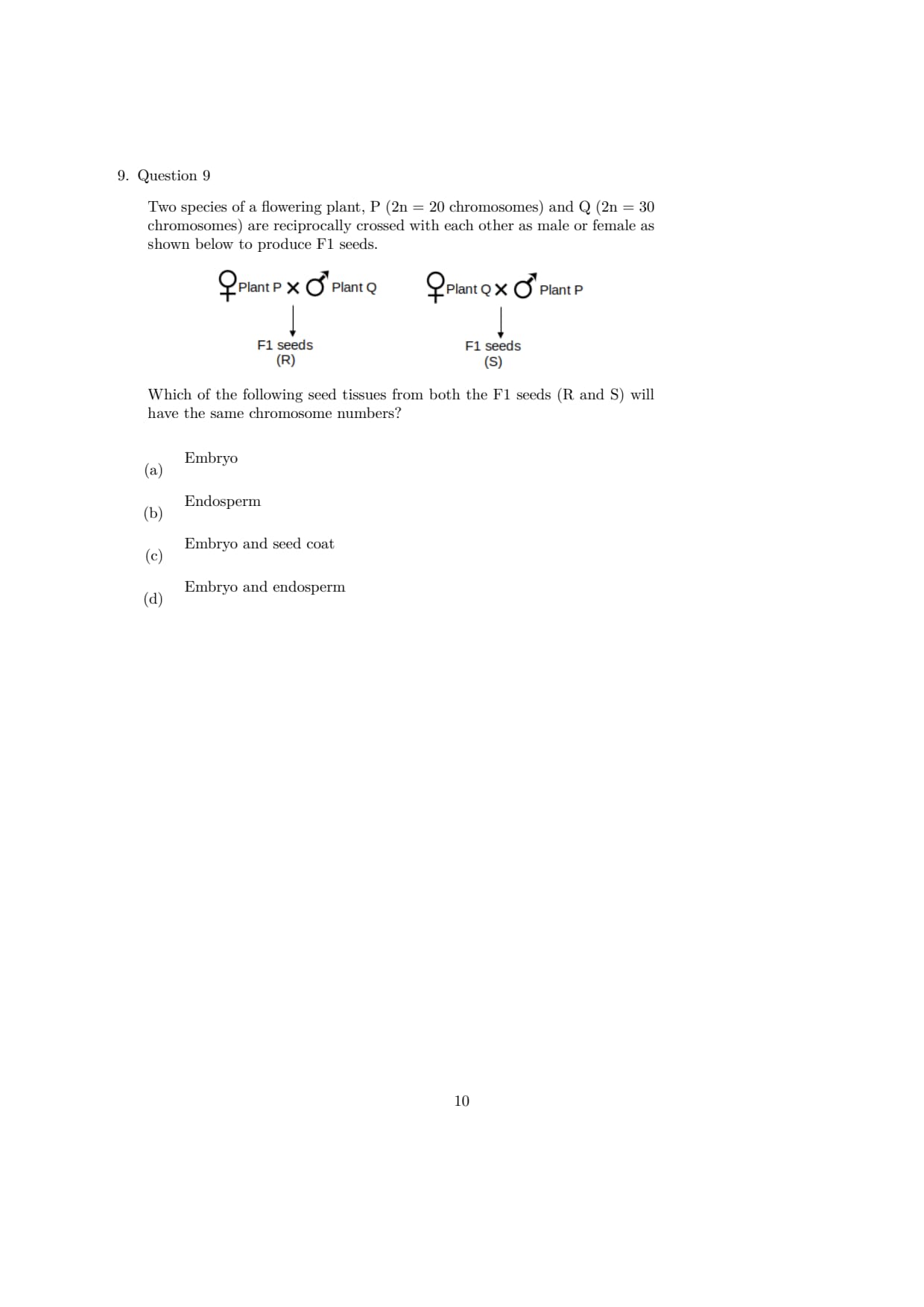
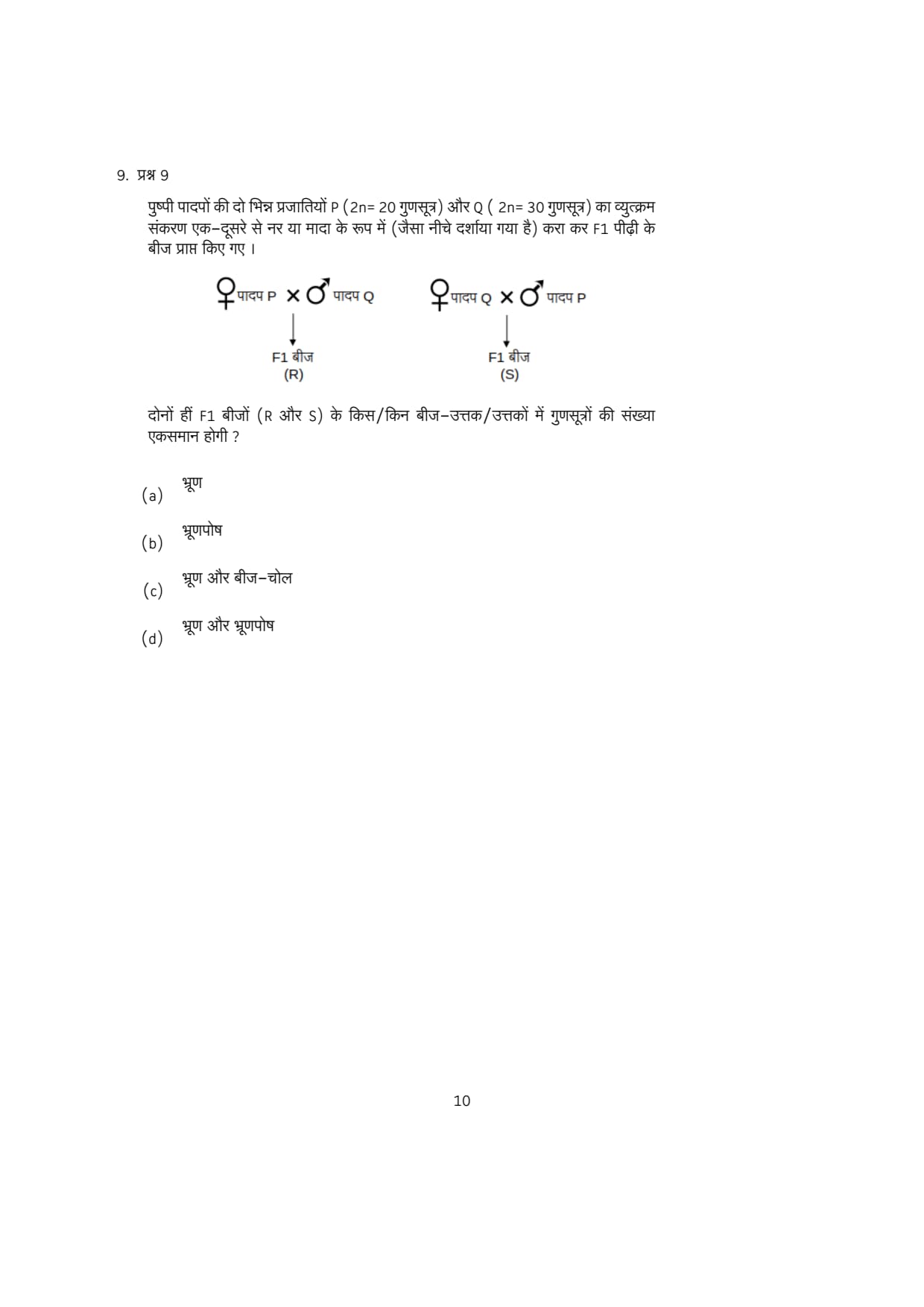
Two species of a flowering plant, P (\(2n = 20\) chromosomes) and Q (\(2n = 30\) chromosomes) are reciprocally crossed with each other as male or female as shown below to produce F1 seeds.

Which of the following seed tissues from both the F1 seeds (R and S) will have the same chromosome numbers?
View Solution
Step 1: Understanding the Question:
We are given two parent plants: P with a diploid number of \(2n_P = 20\) chromosomes, and Q with a diploid number of \(2n_Q = 30\) chromosomes.
They are crossed reciprocally:
- Seed R: Female P \(\times\) Male Q
- Seed S: Female Q \(\times\) Male P
We need to determine which of the resulting seed tissues (embryo, endosperm, and seed coat) will have the exact same chromosome number in both seeds R and S.
Step 2: Key Formula or Approach:
Let us define the ploidy and origin of seed tissues in angiosperms:
1. Embryo (\(2n\)): Formed by fusion of one haploid female gamete (egg cell) and one haploid male gamete (sperm cell).
\[ Ploidy = n_{female} + n_{male} \]
2. Endosperm (\(3n\)): Formed by fusion of two haploid female polar nuclei (central cell) and one haploid male gamete.
\[ Ploidy = 2n_{female} + n_{male} \]
3. Seed coat (testa): Derived directly from maternal integuments (diploid tissue of the female parent).
\[ Ploidy = 2n_{female} \]
Step 3: Detailed Explanation:
Let's calculate the chromosome counts for each tissue in both crosses:
- Haploid numbers of the parents:
- For P (\(2n = 20\)): \(n_P = 10\).
- For Q (\(2n = 30\)): \(n_Q = 15\).
- For Seed R (Female P \(\times\) Male Q):
- Embryo: egg cell (\(n_P = 10\)) + sperm cell (\(n_Q = 15\)) \(\to 10 + 15 = 25\) chromosomes.
- Endosperm: 2 polar nuclei (\(2 \times n_P = 20\)) + sperm cell (\(n_Q = 15\)) \(\to 20 + 15 = 35\) chromosomes.
- Seed coat: maternal tissue from plant P \(\to 2n_P = 20\) chromosomes.
- For Seed S (Female Q \(\times\) Male P):
- Embryo: egg cell (\(n_Q = 15\)) + sperm cell (\(n_P = 10\)) \(\to 15 + 10 = 25\) chromosomes.
- Endosperm: 2 polar nuclei (\(2 \times n_Q = 30\)) + sperm cell (\(n_P = 10\)) \(\to 30 + 10 = 40\) chromosomes.
- Seed coat: maternal tissue from plant Q \(\to 2n_Q = 30\) chromosomes.
- Comparison:
- Embryo: \(25\) in R vs \(25\) in S (Same).
- Endosperm: \(35\) in R vs \(40\) in S (Different).
- Seed coat: \(20\) in R vs \(30\) in S (Different).
Step 4: Final Answer:
Only the embryo has the same chromosome number in both F1 seeds R and S. Therefore, the correct option is (A).
Quick Tip: In reciprocal crosses, any tissue formed by symmetric genomic contributions (like the diploid embryo, which always receives exactly \(1n\) from each parent) will have the same chromosome count regardless of who was the male or female parent.
Tissues with maternal bias (endosperm, which is \(2/3\) maternal, or seed coat, which is \(100%\) maternal) will vary depending on the mother.
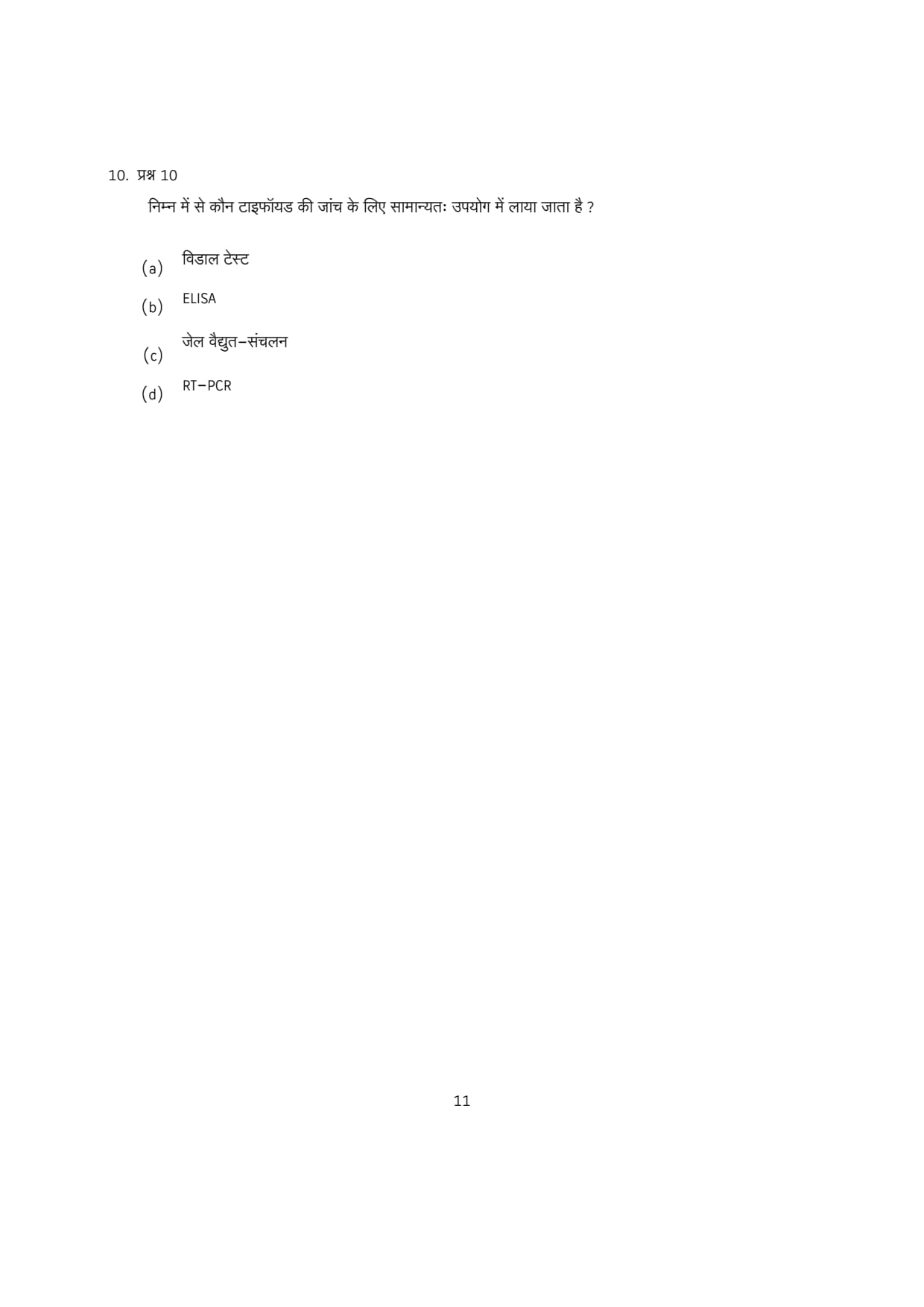
Which of the following is routinely performed to detect typhoid?
View Solution
Step 1: Understanding the Question:
The question asks us to identify the diagnostic test routinely used to detect Typhoid fever.
Step 2: Key Formula or Approach:
Typhoid fever is a bacterial infection caused by \textit{Salmonella enterica serovar Typhi.
Let's review the diagnostic tools listed:
1. Widal test: A classic serological agglutination test specifically designed to detect antibodies against the O (somatic) and H (flagellar) antigens of \textit{Salmonella typhi in a patient's serum.
2. ELISA: Used for various viral and bacterial infections (like HIV), but not the primary classic routine test for typhoid.
3. Gel electrophoresis: A method to separate DNA, RNA, or protein molecules based on size, not a direct clinical diagnostic test.
4. RT-PCR: Used primarily for detecting RNA viruses (such as SARS-CoV-2).
Step 3: Detailed Explanation:
- Typhoid is contracted through contaminated food or water.
- Clinically, the infection is diagnosed using the Widal test, which is highly cost-effective and routinely performed in healthcare settings, especially in developing countries.
- During the test, the patient's blood serum is mixed with dead Salmonella bacteria containing specific antigens. If antibodies are present, visible clumping (agglutination) occurs.
- Therefore, the Widal test is the correct diagnostic option.
Step 4: Final Answer:
The correct diagnostic test for typhoid is the Widal test, which corresponds to option (A).
Quick Tip: Remember standard diagnostic tests from the NCERT syllabus:
- Typhoid \(\to\) Widal test
- AIDS \(\to\) ELISA (screening) and Western Blot (confirmatory)
- Tuberculosis \(\to\) Mantoux test
These are frequently asked in competitive medical entrance exams.
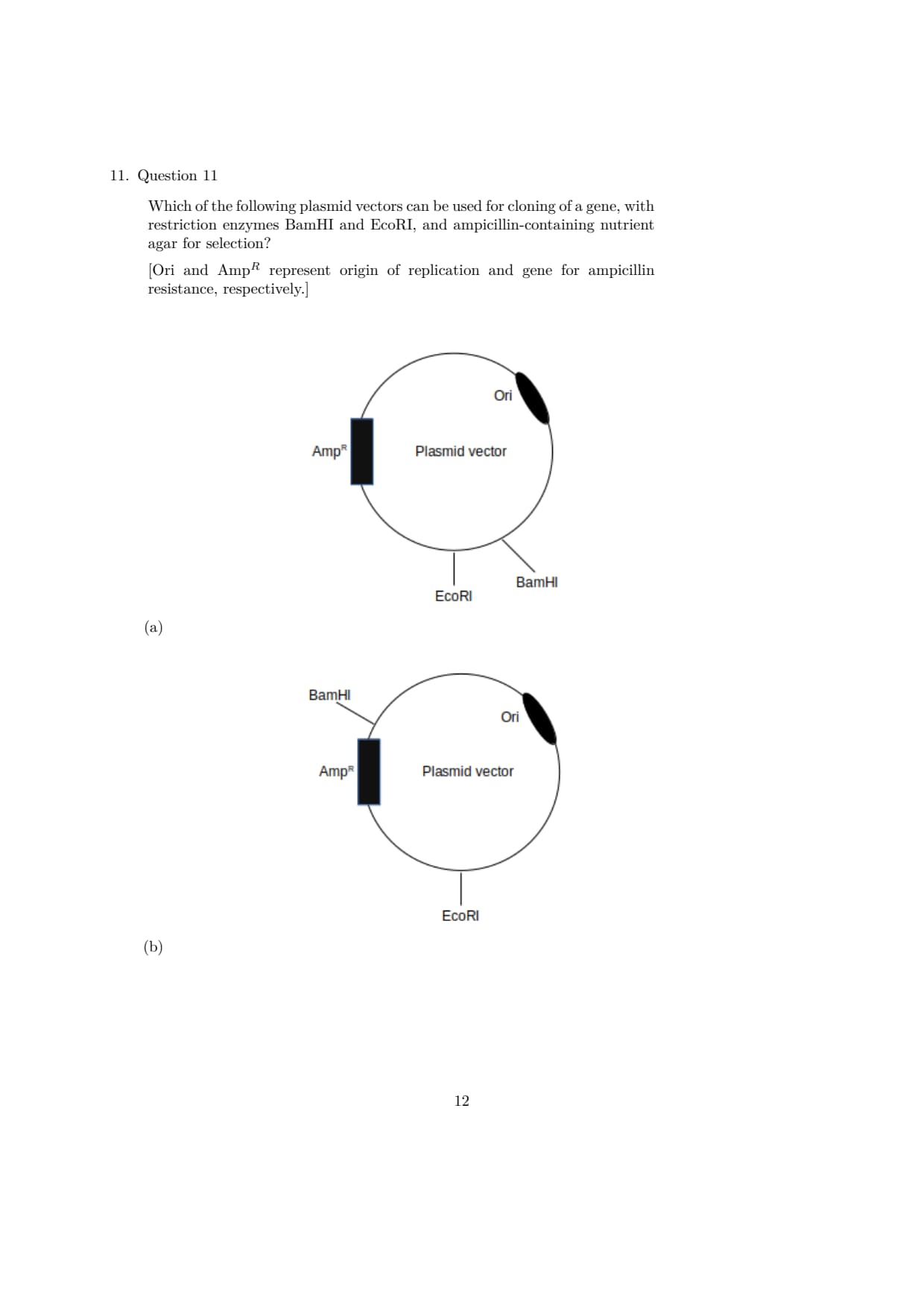
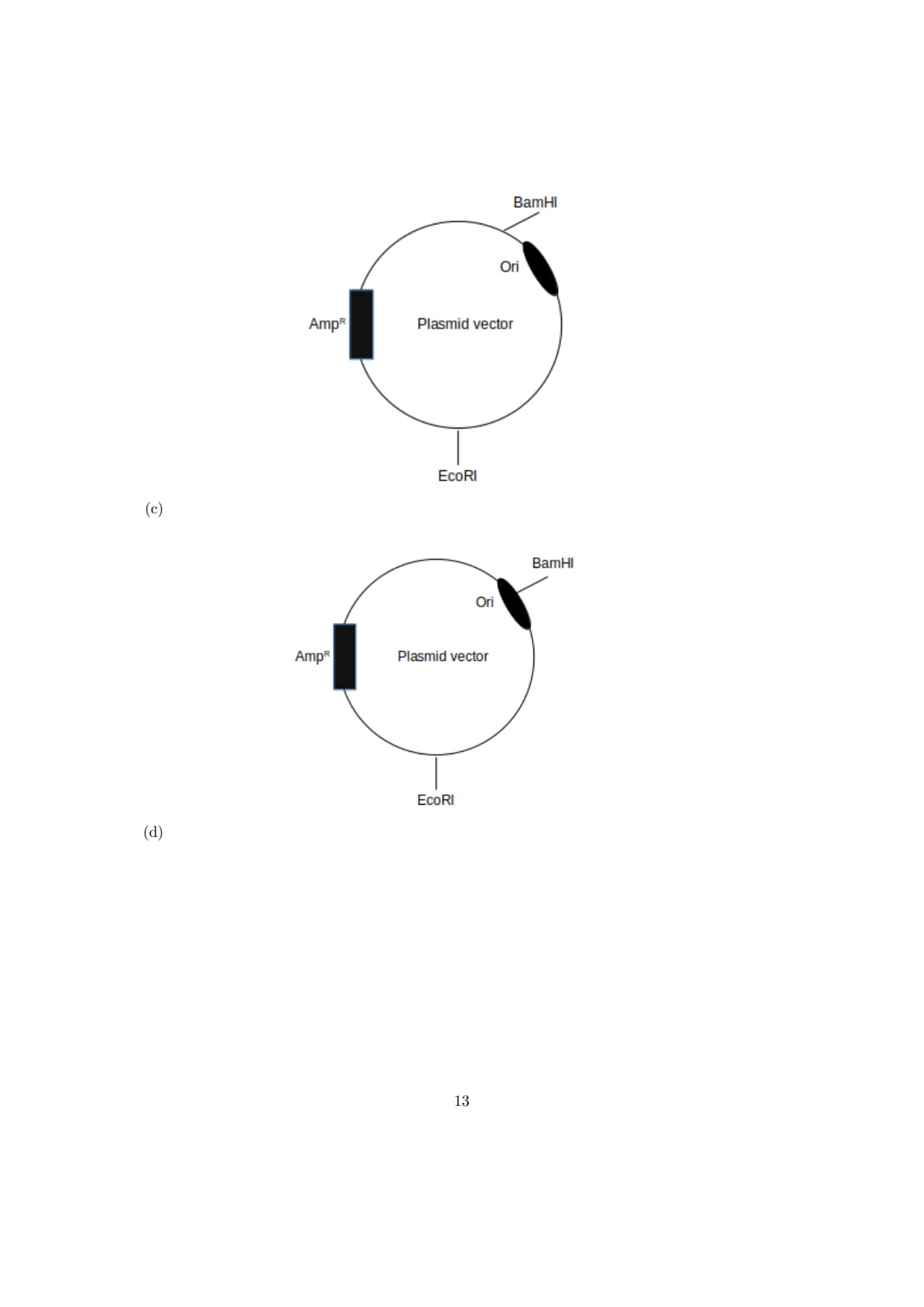
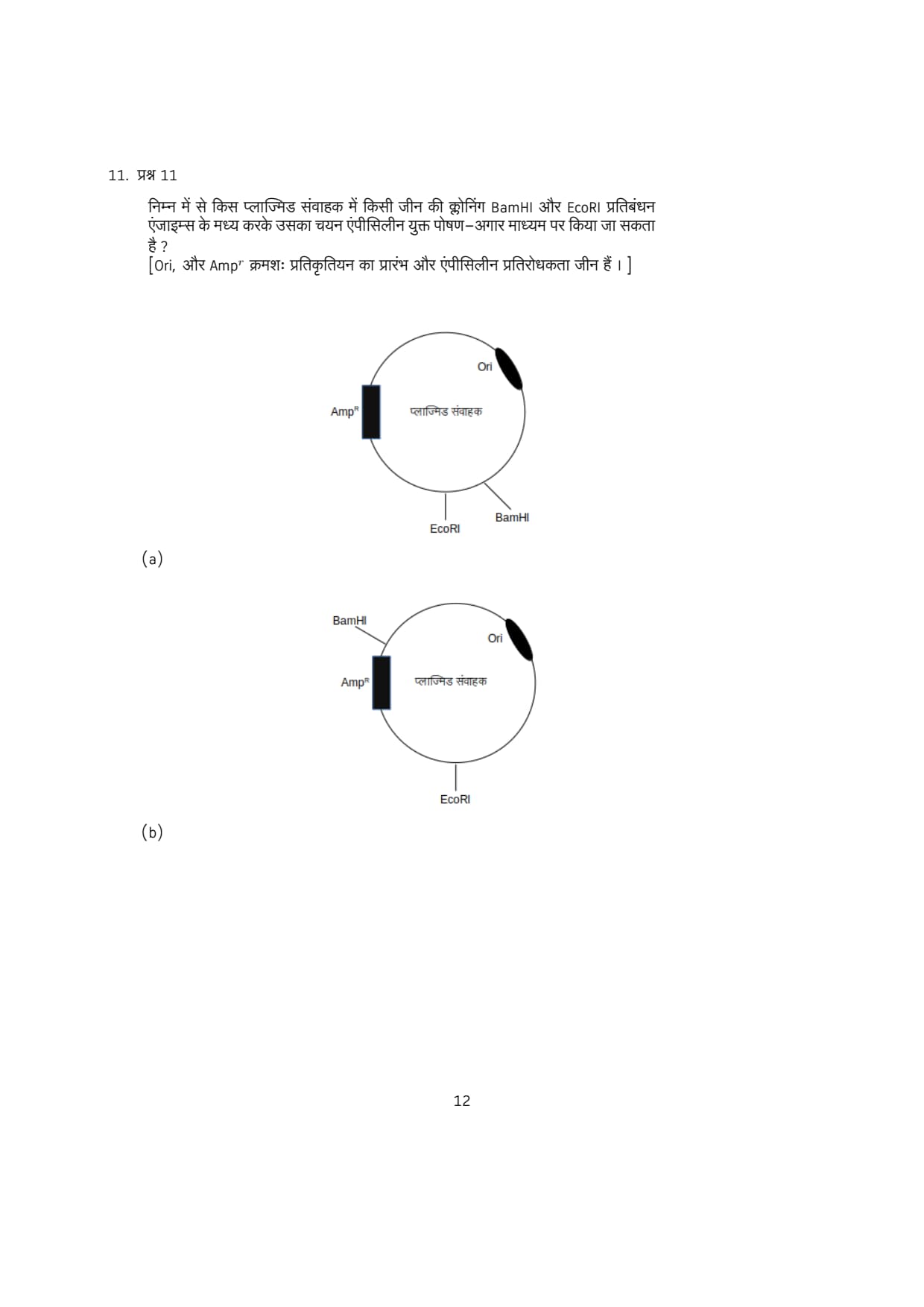
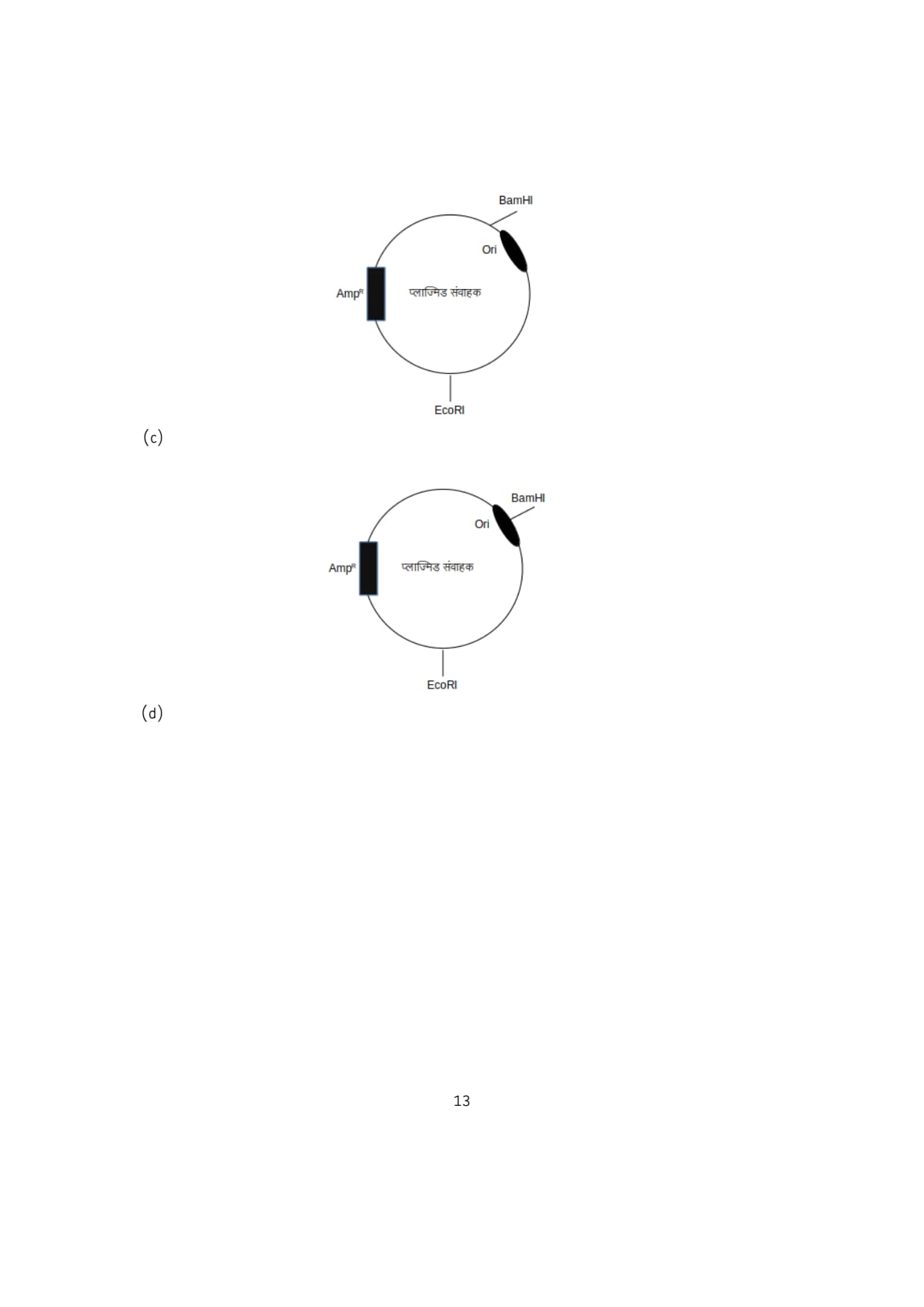
Which of the following plasmid vectors can be used for cloning of a gene, with restriction enzymes BamHI and EcoRI, and ampicillin-containing nutrient agar for selection?
[Ori and \(Amp^R\) represent origin of replication and gene for ampicillin resistance, respectively.]
- (A)
![]()
- (B)
![]()
- (C)
![]()
- (D)
![]()


View Solution
Step 1: Understanding the Question:
We need to identify the correct plasmid vector configuration that allows cloning of a gene using the restriction enzymes BamHI and EcoRI, while maintaining the ability to select the transformants on ampicillin-containing agar.
Step 2: Key Formula or Approach:
To successfully use a plasmid vector for cloning and selection:
1. The origin of replication (Ori) must remain fully functional so the plasmid can replicate inside the host.
2. The ampicillin resistance gene (\(Amp^R\)) must remain functional so the host cells can grow on ampicillin selection plates.
3. The restriction sites used for cloning (BamHI and EcoRI) must NOT lie inside either the Ori or the \(Amp^R\) gene. If they do, digesting the plasmid with these enzymes and inserting a foreign gene will cause insertional inactivation (disruption) of these essential features.
Step 3: Detailed Explanation:
Let's analyze the positions of the restriction sites in each option:
- Option (a): Both EcoRI and BamHI are located in a region external to both the \(Amp^R\) gene and the Ori. Cloning a gene into these sites will leave both \(Amp^R\) and Ori completely intact and functional, allowing easy selection on ampicillin agar.
- Option (b): The BamHI site is located directly inside the \(Amp^R\) gene. If we clone using BamHI, the ampicillin resistance gene will be disrupted (insertional inactivation), and the transformed cells will not survive on ampicillin-containing agar.
- Option (c) and (d): The BamHI site is located inside the Ori. Disruption of Ori will prevent the plasmid from replicating altogether, rendering it useless as a cloning vector.
- Therefore, only the configuration in (a) is suitable.
Step 4: Final Answer:
Thus, plasmid (a) is the only one that satisfies all conditions, making option (A) the correct choice.
Quick Tip: Always ensure cloning restriction sites are located outside key genetic elements (like Ori) and outside your target selection marker to avoid inactivation.
This is a core principle in designing recombinant DNA experiments.
Polymerase chain reaction (PCR) is used to amplify a gene of interest (GOI). If, after 30 cycles of PCR, 1 billion copies of GOI are produced, approximately how many copies of GOI were present at the end of the \(20^{th}\) cycle?
View Solution
Step 1: Understanding the Question:
We are given that a PCR reaction yields 1 billion (\(10^9\)) copies of a gene of interest (GOI) after 30 cycles of amplification.
We need to calculate the approximate number of copies of the GOI that were present at the end of the \(20^{th}\) cycle.
Step 2: Key Formula or Approach:
In an ideal PCR, the number of target DNA copies doubles with each cycle.
The formula relating the number of DNA copies after \(n\) cycles (\(N_n\)) to the initial amount (\(N_0\)) is:
\[ N_n = N_0 \times 2^n \]
Similarly, the relationship between the DNA amount at cycle 30 (\(N_{30}\)) and cycle 20 (\(N_{20}\)) is:
\[ N_{30} = N_{20} \times 2^{30 - 20} = N_{20} \times 2^{10} \]
Step 3: Detailed Explanation:
Let's perform the calculation:
- We are given:
\[ N_{30} = 1 billion = 10^9 copies \]
- Using the relationship:
\[ N_{20} = \frac{N_{30}}{2^{10}} \]
- We know that:
\[ 2^{10} = 1024 \approx 10^3 = 1000 \]
- Substituting this approximation into the equation:
\[ N_{20} = \frac{10^9}{1024} \approx \frac{10^9}{1000} = 10^6 copies \]
- \(10^6\) copies is equal to 1 million copies.
- Let's check the options:
- Option (A) is 1 million.
- Option (B) is 0.66 billion.
- Option (C) is 10 million.
- Option (D) is 0.1 billion.
Step 4: Final Answer:
Therefore, approximately 1 million copies were present at the end of the \(20^{th}\) cycle, matching option (A).
Quick Tip: A very handy rule of thumb in biology/informatics is that \(2^{10}\) is approximately equal to \(10^3\) (1024 vs 1000).
This means 10 cycles of PCR results in a \(1000\)-fold amplification.
So going from 20 cycles to 30 cycles increases the amount 1000 times (from 1 million to 1 billion).
A population with \(N = 400\) individuals increases in numbers till it reaches an asymptote at \(K = 500\) individuals, \(K\) being the carrying capacity. Assuming the intrinsic rate of natural increase (\(r\)) to be 0.01, what would be the population growth rate (\(dN/dt\))?
View Solution
Step 1: Understanding the Question:
The question describes a population growing until it reaches an asymptote at a carrying capacity (\(K\)).
This signifies Verhulst-Pearl logistic growth.
We are asked to calculate the population growth rate (\(\frac{dN}{dt}\)) given the population size (\(N = 400\)), carrying capacity (\(K = 500\)), and intrinsic rate of natural increase (\(r = 0.01\)).
Step 2: Key Formula or Approach:
The equation for logistic population growth is:
\[ \frac{dN}{dt} = r N \left( \frac{K - N}{K} \right) \]
Where:
- \(\frac{dN}{dt}\) is the rate of population change.
- \(r\) is the intrinsic rate of natural increase.
- \(N\) is the population size.
- \(K\) is the carrying capacity.
Step 3: Detailed Explanation:
Let's substitute the given values into the formula:
- \(N = 400\)
- \(K = 500\)
- \(r = 0.01\)
Now, plug these into the logistic growth equation:
\[ \frac{dN}{dt} = 0.01 \times 400 \times \left( \frac{500 - 400}{500} \right) \]
- Simplify the terms:
\[ 0.01 \times 400 = 4 \]
\[ \frac{500 - 400}{500} = \frac{100}{500} = 0.2 \]
- Now multiply the simplified terms:
\[ \frac{dN}{dt} = 4 \times 0.2 = 0.8 \]
- Thus, the population growth rate is 0.8.
Step 4: Final Answer:
The calculated population growth rate is 0.8, which corresponds to option (A).
Quick Tip: Always pay attention to the term "reaches an asymptote".
This is the key term indicating that you should use the logistic growth formula rather than the exponential growth formula (\(\frac{dN}{dt} = rN\)).
Double check your basic arithmetic to avoid simple calculation errors.
Which one of the following statements is correct?
View Solution
Step 1: Understanding the Question:
The question asks us to identify the correct taxonomic and anatomical description of the Phylum Hemichordata.
Step 2: Key Formula or Approach:
We can evaluate the taxonomic placement and key characteristics of Hemichordates based on animal classification:
1. Hemichordates were previously classified as a sub-phylum under Phylum Chordata due to a buccal diverticulum once mistaken for a notochord.
2. Today, they are placed as a separate independent phylum under Non-Chordata (Invertebrates).
3. They possess a rudimentary structure in the collar region called the stomochord (buccal diverticulum), which is structurally different from a true chordate notochord.
Step 3: Detailed Explanation:
Let's analyze the statements one by one:
- Option (A): "Hemichordata is not considered as a chordate sub-phylum, and possesses a proto-notochord called stomochord."
- This statement is correct. Hemichordata is now treated as a separate phylum of non-chordates.
- The structure once thought to be a primitive notochord is now known as a stomochord.
- Option (B) and (C): These are incorrect because Hemichordata is no longer considered a sub-phylum under Chordata, nor does it possess a true/proper notochord.
- Option (D): This is incorrect because the water vascular system is a unique diagnostic feature of Phylum Echinodermata, not Hemichordata. Hemichordates do not possess a water vascular system.
Step 4: Final Answer:
Thus, option (A) is the only accurate statement.
Quick Tip: Taxonomy classification schemes change as new evolutionary evidence emerges.
Keep in mind that Hemichordates are now placed between Echinoderms and Chordates, and their characteristic "notochord-like" structure is the stomochord.
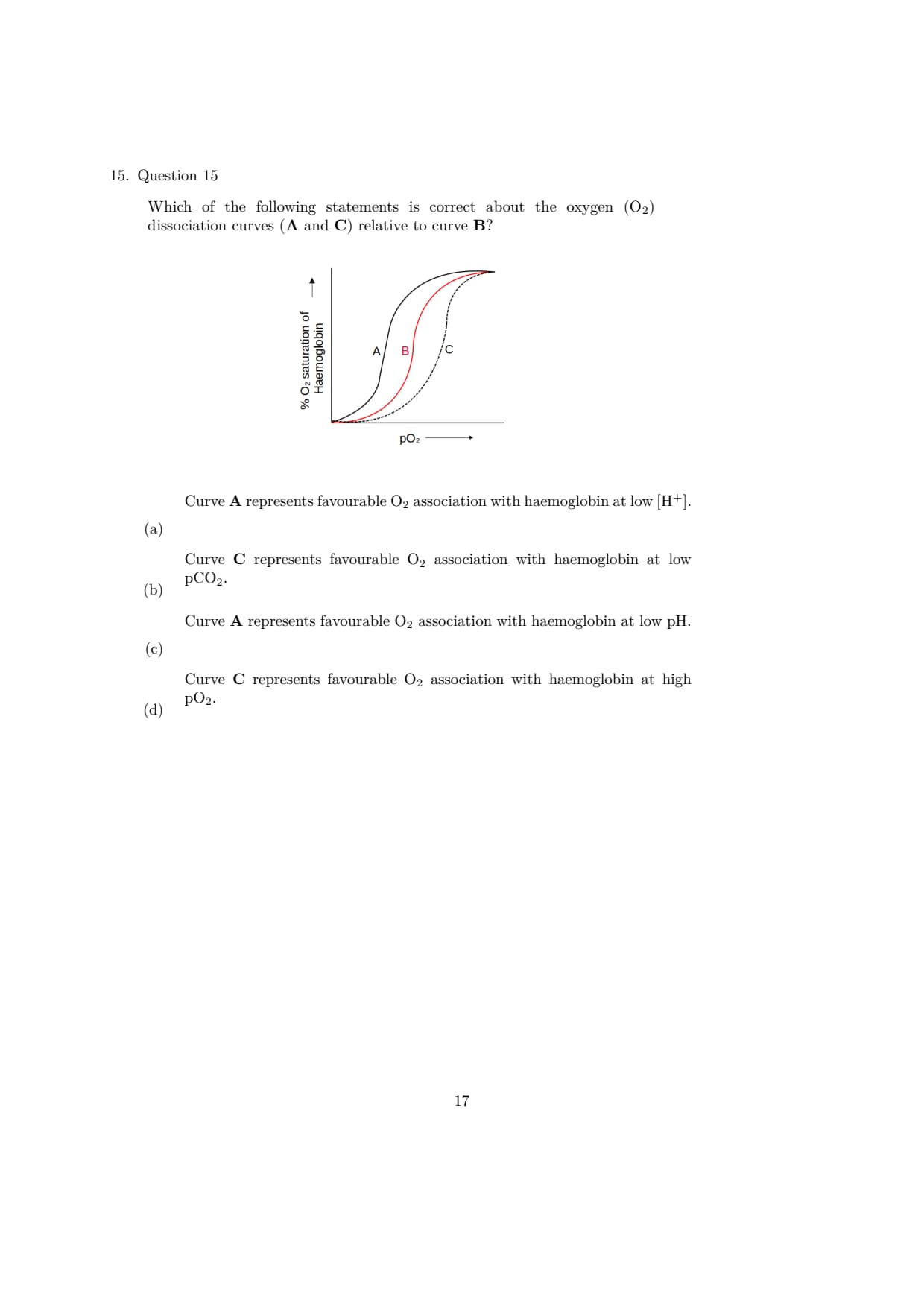
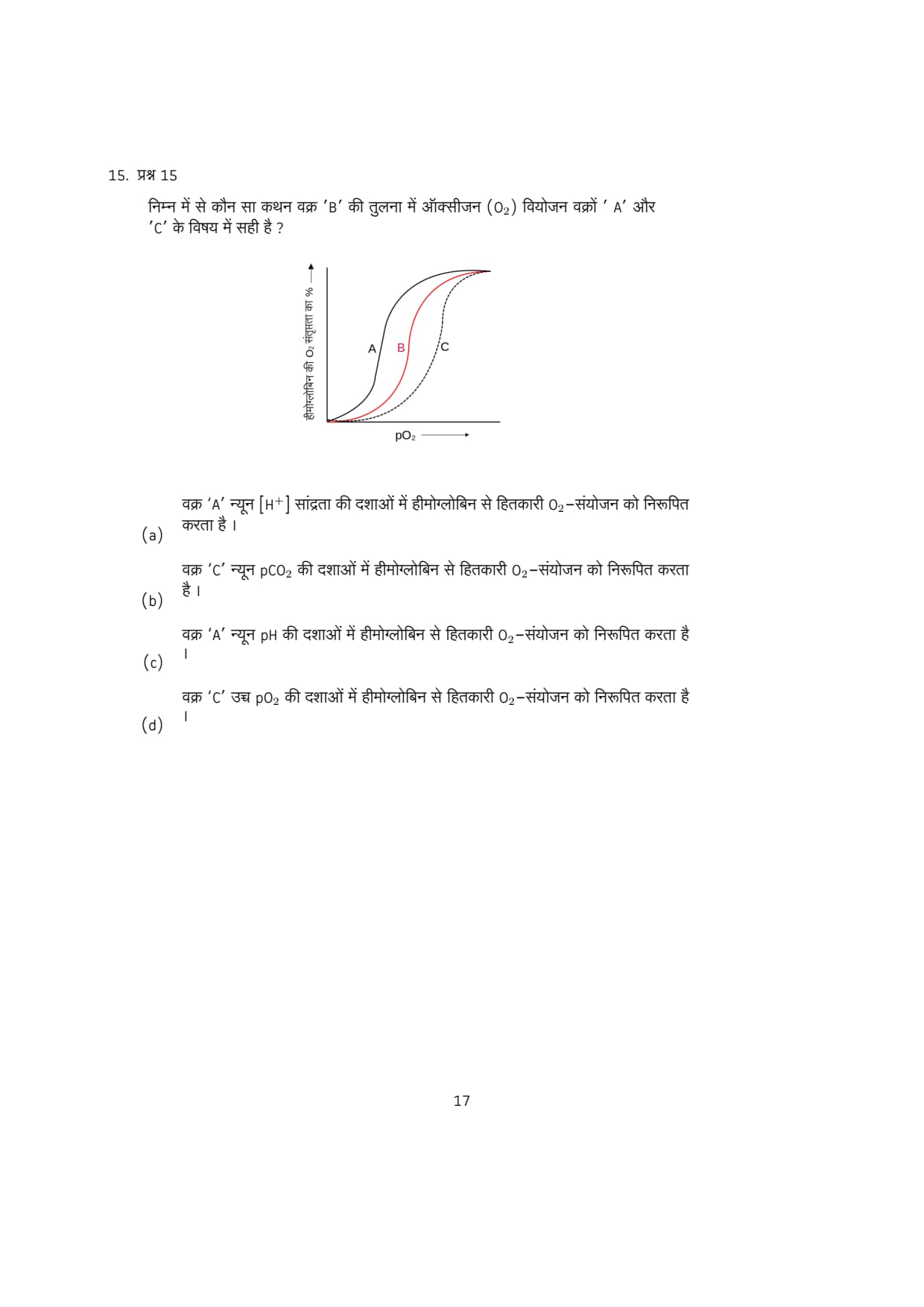
Which of the following statements is correct about the oxygen (\(O_2\)) dissociation curves (A and C) relative to curve B?

View Solution
Step 1: Understanding the Question:
We are given a graph showing three oxygen dissociation curves:
- Curve B: The standard/normal physiological curve.
- Curve A: Shifted to the left of B.
- Curve C: Shifted to the right of B.
We need to determine which statement correctly describes the physiological conditions associated with these shifts.
Step 2: Key Formula or Approach:
The affinity of hemoglobin for oxygen is influenced by several factors:
1. Left Shift (Curve A): Indicates increased oxygen affinity (favourable \(O_2\) association/loading). This occurs under conditions found in the lungs:
- Low partial pressure of carbon dioxide (\(pCO_2\))
- Low hydrogen ion concentration (\([H^+]\)), which means high pH
- Low temperature
- Low 2,3-BPG concentration
2. Right Shift (Curve C): Indicates decreased oxygen affinity (favourable \(O_2\) dissociation/unloading to tissues). This occurs under active metabolizing tissue conditions:
- High \(pCO_2\)
- High \([H^+]\) (low pH)
- High temperature
- High 2,3-BPG concentration
Step 3: Detailed Explanation:
Let us evaluate the options:
- Option (A): "Curve A represents favourable \(O_2\) association with haemoglobin at low \([H^+]\)."
- Since Curve A is left-shifted, it represents higher affinity, which means more favourable association.
- Low \([H^+]\) (alkaline conditions) is indeed one of the primary drivers of a left shift. Therefore, this statement is biochemically and physiologically correct.
- Option (B): "Curve C represents favourable \(O_2\) association with haemoglobin at low \(pCO_2\)."
- This is incorrect because Curve C is right-shifted (favours dissociation, not association). Also, low \(pCO_2\) causes a left shift.
- Option (C): "Curve A represents favourable \(O_2\) association with haemoglobin at low pH."
- This is incorrect because low pH (acidic) corresponds to high \([H^+]\), which shifts the curve to the right (Curve C), not left.
- Option (D): "Curve C represents favourable \(O_2\) association with haemoglobin at high \(pO_2\)."
- This is incorrect because high \(pO_2\) is associated with normal loading, but Curve C is specifically a right-shifted curve representing decreased affinity.
Step 4: Final Answer:
Therefore, the only correct statement is (A).
Quick Tip: Use the acronym "CADET, face Right!" to remember the factors that shift the oxygen-hemoglobin curve to the Right:
- \textbf{C} \(\to\) \(CO_2\) increase
- \textbf{A} \(\to\) Acid (\([H^+]\) increase / pH decrease)
- \textbf{D} \(\to\) 2,3-DPG increase
- \textbf{E} \(\to\) Exercise
- \textbf{T} \(\to\) Temperature increase
A decrease in these factors shifts the curve to the Left.
If an element with Z = 120 is discovered, then which group of elements will it belong to?
View Solution
Step 1: Understanding the Question:
The question asks us to identify the group in the periodic table to which a newly discovered element with atomic number \(Z = 120\) would belong.
Step 2: Key Formula or Approach:
To find the position of any element in the periodic table:
1. We locate the nearest noble gas that precedes or ends the period.
2. Period 7 of the modern periodic table is completed at the noble gas Oganesson (\(Og\)) with atomic number \(Z = 118\), which belongs to Group 18.
3. Elements with atomic numbers greater than 118 will enter the newly started Period 8.
Step 3: Detailed Explanation:
Let's trace the atomic numbers sequentially starting from the end of Period 7:
- \(Z = 118\) is Oganesson (\(Og\)), which is the noble gas ending Period 7 in Group 18.
- \(Z = 119\) will be the first element of Period 8. It will be placed in Group 1 (Alkali metals) with an outer electronic configuration of \([118Og] 8s^1\).
- \(Z = 120\) will be the second element of Period 8. It will be placed in Group 2 (Alkaline earth metals) with an outer electronic configuration of \([118Og] 8s^2\).
- Therefore, the element with \(Z = 120\) belongs to the alkaline earth metals group.
Step 4: Final Answer:
The element with \(Z = 120\) will belong to the alkaline earth metals group, which corresponds to option (A).
Quick Tip: Remember the atomic numbers of the noble gases: He (2), Ne (10), Ar (18), Kr (36), Xe (54), Rn (86), and Og (118).
Any element with \(Z = noble gas atomic number + 1\) is an alkali metal (Group 1).
Any element with \(Z = noble gas atomic number + 2\) is an alkaline earth metal (Group 2).
Which one of the following statements is correct about \(N_2\), \(CO\), and \(NO^+\)?
View Solution
Step 1: Understanding the Question:
The question asks us to analyze the relationship between the three chemical species \(N_2\), \(CO\), and \(NO^+\) in terms of their electronic count (isoelectronic nature) and their bond orders.
Step 2: Key Formula or Approach:
1. Isoelectronic species: Chemical species that contain the exact same number of total electrons.
2. Bond Order: Calculated using Molecular Orbital (MO) theory. For homonuclear and heteronuclear diatomic molecules with 14 electrons, the bond order can be determined using the standard MO configuration:
\[ Bond Order = \frac{N_b - N_a}{2} \]
where \(N_b\) is the number of bonding electrons and \(N_a\) is the number of antibonding electrons.
Step 3: Detailed Explanation:
Let's first calculate the total number of electrons in each species:
- For \(N_2\): Each Nitrogen atom has 7 electrons.
\[ Total electrons = 7 + 7 = 14 electrons \]
- For \(CO\): Carbon has 6 electrons, and Oxygen has 8 electrons.
\[ Total electrons = 6 + 8 = 14 electrons \]
- For \(NO^+\): Nitrogen has 7 electrons, Oxygen has 8 electrons, and the positive charge indicates the loss of 1 electron.
\[ Total electrons = 7 + 8 - 1 = 14 electrons \]
Since all three species have exactly 14 electrons, they are isoelectronic.
Now let's determine their bond order:
- For any 14-electron diatomic system, the molecular orbital filling configuration is:
\[ \sigma_{1s}^2 \sigma^*_{1s}^2 \sigma_{2s}^2 \sigma^*_{2s}^2 (\pi_{2p_x}^2 = \pi_{2p_y}^2) \sigma_{2p_z}^2 \]
- The number of bonding electrons (\(N_b\)) is 10 (from \(\sigma_{1s}\), \(\sigma_{2s}\), \(\pi_{2p_x}\), \(\pi_{2p_y}\), and \(\sigma_{2p_z}\)).
- The number of antibonding electrons (\(N_a\)) is 4 (from \(\sigma^*_{1s}\) and \(\sigma^*_{2s}\)).
- Calculating the bond order:
\[ Bond Order = \frac{10 - 4}{2} = 3 \]
Since they are isoelectronic and share analogous molecular orbital configurations, they all have an identical bond order of 3.
Step 4: Final Answer:
Therefore, \(N_2\), \(CO\), and \(NO^+\) are isoelectronic and have identical bond order, which corresponds to option (A).
Quick Tip: Diatomic species with 14 electrons (like \(N_2\), \(CO\), \(NO^+\), \(CN^-\)) are extremely stable and have a bond order of 3.
For any diatomic species, you can quickly find the bond order using 14 electrons as the baseline (Bond Order = 3), and subtracting 0.5 for every electron added or removed from 14.
Which of the following complexes exhibit(s) magnetic moment close to 2 Bohr Magneton?
[\(Fe(H_2O)_6\)](\(NO_3\))\(_2\), \(K_2\)[\(MnCl_4\)], \(K_4\)[\(Mn(CN)_6\)], and [\(Ni(CO)_4\)]
View Solution
Step 1: Understanding the Question:
The question asks us to identify which of the given coordination complexes have a spin-only magnetic moment close to 2 Bohr Magneton (BM).
Step 2: Key Formula or Approach:
The spin-only magnetic moment (\(\mu\)) of a coordination complex depends on the number of unpaired electrons (\(n\)) in the central metal ion:
\[ \mu = \sqrt{n(n + 2)} BM \]
Let's find the value of \(n\) that corresponds to a magnetic moment close to 2 BM:
- For \(n = 1\): \(\mu = \sqrt{1(3)} = \sqrt{3} \approx 1.73 BM\) (which is close to 2 BM).
- For \(n = 2\): \(\mu = \sqrt{2(4)} = \sqrt{8} \approx 2.83 BM\).
Thus, we need to find the complex(es) with exactly \(n = 1\) unpaired electron.
Step 3: Detailed Explanation:
Let's analyze the oxidation state, coordination number, d-electron configuration, and ligand field strength for each complex:
1. [\(Fe(H_2O)_6\)](\(NO_3\))\(_2\):
- Central metal: \(Fe^{2+}\) (\(d^6\) configuration).
- Ligand: \(H_2O\) is a Weak Field Ligand (WFL), causing no pairing.
- Octahedral splitting: High-spin configuration is \(t_{2g}^4 e_g^2\).
- Number of unpaired electrons (\(n\)) = 4.
- \(\mu = \sqrt{4(6)} = \sqrt{24} \approx 4.90 BM\).
2. \(K_2\)[\(MnCl_4\)]:
- Central metal: \(Mn^{2+}\) (\(d^5\) configuration).
- Ligand: \(Cl^-\) is a Weak Field Ligand in a tetrahedral geometry.
- Tetrahedral splitting: High-spin configuration is \(e^2 t_2^3\).
- Number of unpaired electrons (\(n\)) = 5.
- \(\mu = \sqrt{5(7)} = \sqrt{35} \approx 5.92 BM\).
3. \(K_4\)[\(Mn(CN)_6\)]:
- Central metal: \(Mn^{2+}\) (\(d^5\) configuration).
- Ligand: \(CN^-\) is a Strong Field Ligand (SFL), causing pairing.
- Octahedral splitting: Low-spin configuration is \(t_{2g}^5 e_g^0\).
- Number of unpaired electrons (\(n\)) = 1.
- \(\mu = \sqrt{1(3)} = \sqrt{3} \approx 1.73 BM\) (which is close to 2 BM).
4. [\(Ni(CO)_4\)]:
- Central metal: \(Ni^0\) (\(d^{10}\) configuration after reorganization due to strong field \(CO\) ligand).
- Number of unpaired electrons (\(n\)) = 0.
- \(\mu = 0 BM\).
Step 4: Final Answer:
Only \(K_4\)[\(Mn(CN)_6\)] has 1 unpaired electron, giving a magnetic moment of 1.73 BM (close to 2 BM). Thus, the correct option is (A).
Quick Tip: If the magnetic moment is close to a whole number, that whole number minus one or the digit before the decimal point usually represents the number of unpaired electrons.
For example, a magnetic moment of 1.73 BM (\(\approx 2\) BM) indicates 1 unpaired electron.
A magnetic moment of 5.92 BM indicates 5 unpaired electrons.
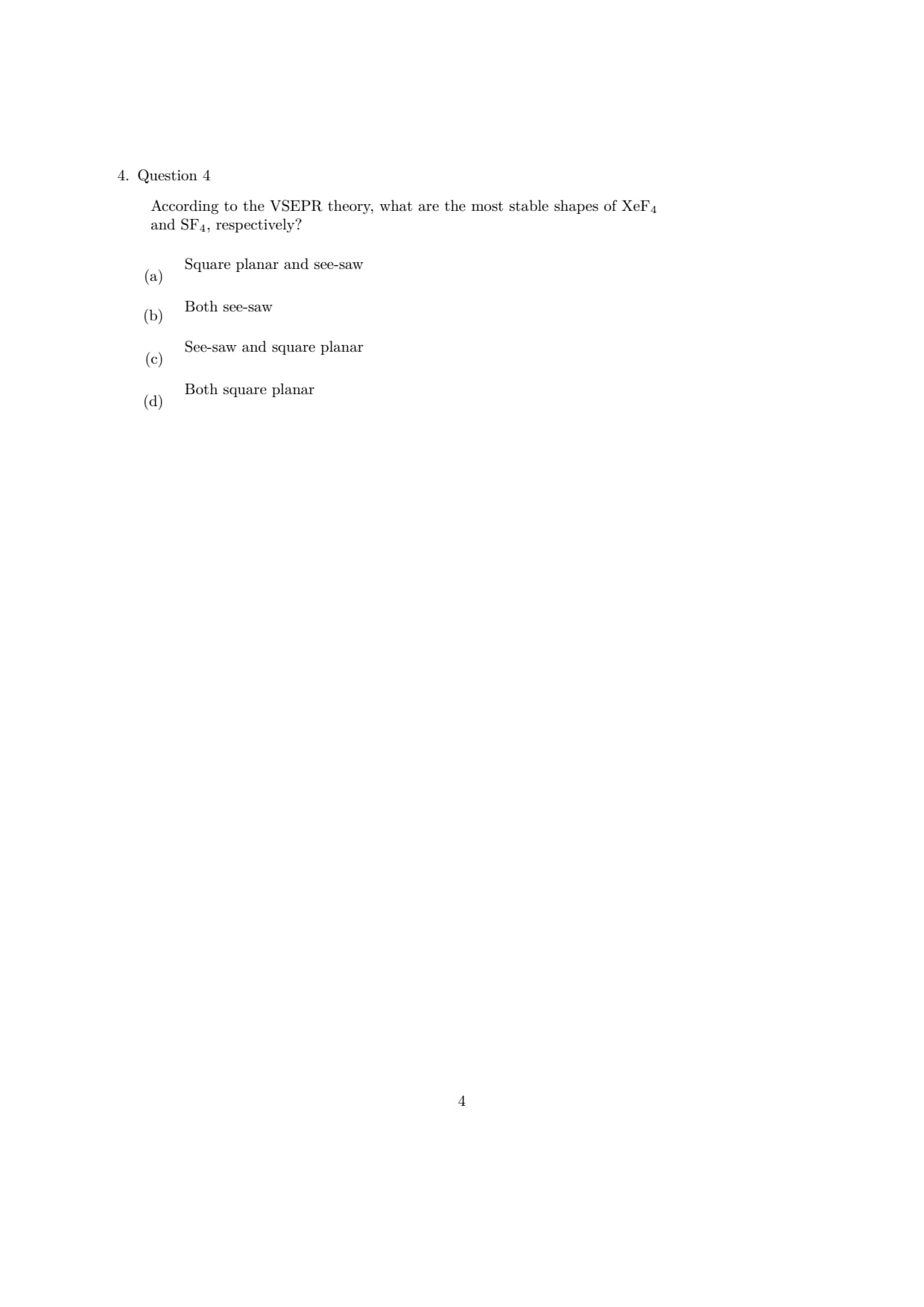
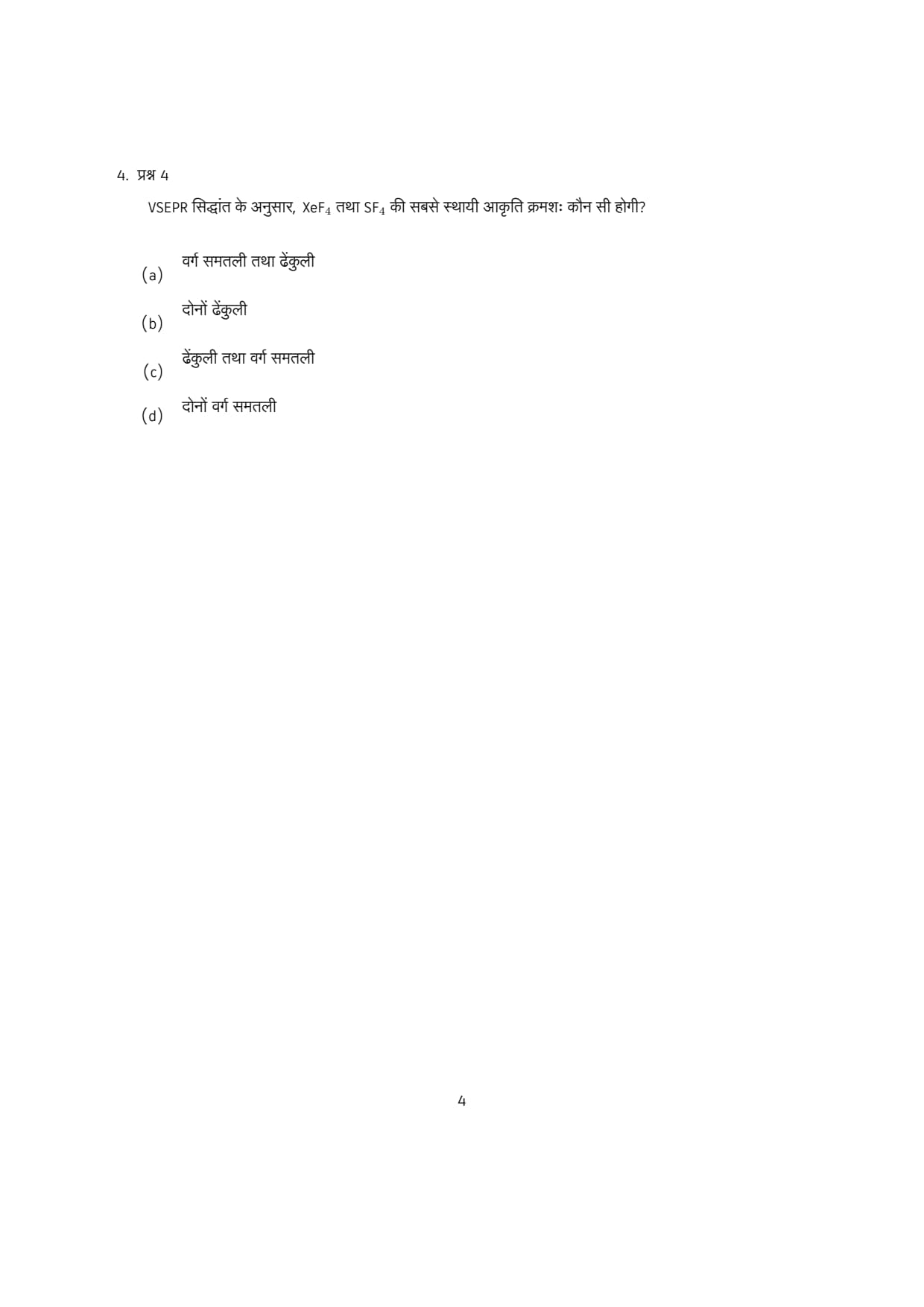
According to the VSEPR theory, what are the most stable shapes of \(XeF_4\) and \(SF_4\), respectively?
View Solution
Step 1: Understanding the Question:
The question asks for the molecular shapes of Xenon tetrafluoride (\(XeF_4\)) and Sulfur tetrafluoride (\(SF_4\)) based on Valence Shell Electron Pair Repulsion (VSEPR) theory.
Step 2: Key Formula or Approach:
According to VSEPR theory, molecular shape is determined by the total steric number (SN):
\(Steric Number (SN) = \) \[Number of single bonds (bond pairs) + Number of lone pairs on the central atom \]
The spatial arrangement minimizes repulsive interactions between electron pairs in the order:
\[ lone pair - lone pair > lone pair - bond pair > bond pair - bond pair \]
Step 3: Detailed Explanation:
Let's analyze both molecules individually:
1. Xenon tetrafluoride (\(XeF_4\)):
- Central atom: Xenon (\(Xe\)), which has 8 valence electrons.
- Number of fluorine atoms attached = 4 (4 bond pairs).
- Remaining valence electrons = \(8 - 4 = 4\) electrons, which form 2 lone pairs.
- Steric number = \(4 bond pairs + 2 lone pairs = 6\).
- Electronic geometry: Octahedral.
- To minimize lone pair-lone pair repulsion, the two lone pairs occupy the axial positions (opposite to each other).
- This leaves the four fluorine atoms in the equatorial plane, resulting in a stable square planar shape.
2. Sulfur tetrafluoride (\(SF_4\)):
- Central atom: Sulfur (\(S\)), which has 6 valence electrons.
- Number of fluorine atoms attached = 4 (4 bond pairs).
- Remaining valence electrons = \(6 - 4 = 2\) electrons, which form 1 lone pair.
- Steric number = \(4 bond pairs + 1 lone pair = 5\).
- Electronic geometry: Trigonal bipyramidal.
- To minimize repulsion, the lone pair occupies an equatorial position (where it experiences fewer \(90^\circ\) interactions).
- This arrangement results in a distorted trigonal bipyramid, commonly known as a see-saw shape.
Step 4: Final Answer:
The shapes of \(XeF_4\) and \(SF_4\) are square planar and see-saw, respectively, which corresponds to option (A).
Quick Tip: For a quick recall of steric configurations:
- \(AB_4E_2\) systems (like \(XeF_4\)) are always square planar.
- \(AB_4E\) systems (like \(SF_4\)) are always see-saw.
This simple classification covers most of the shape questions in exams.
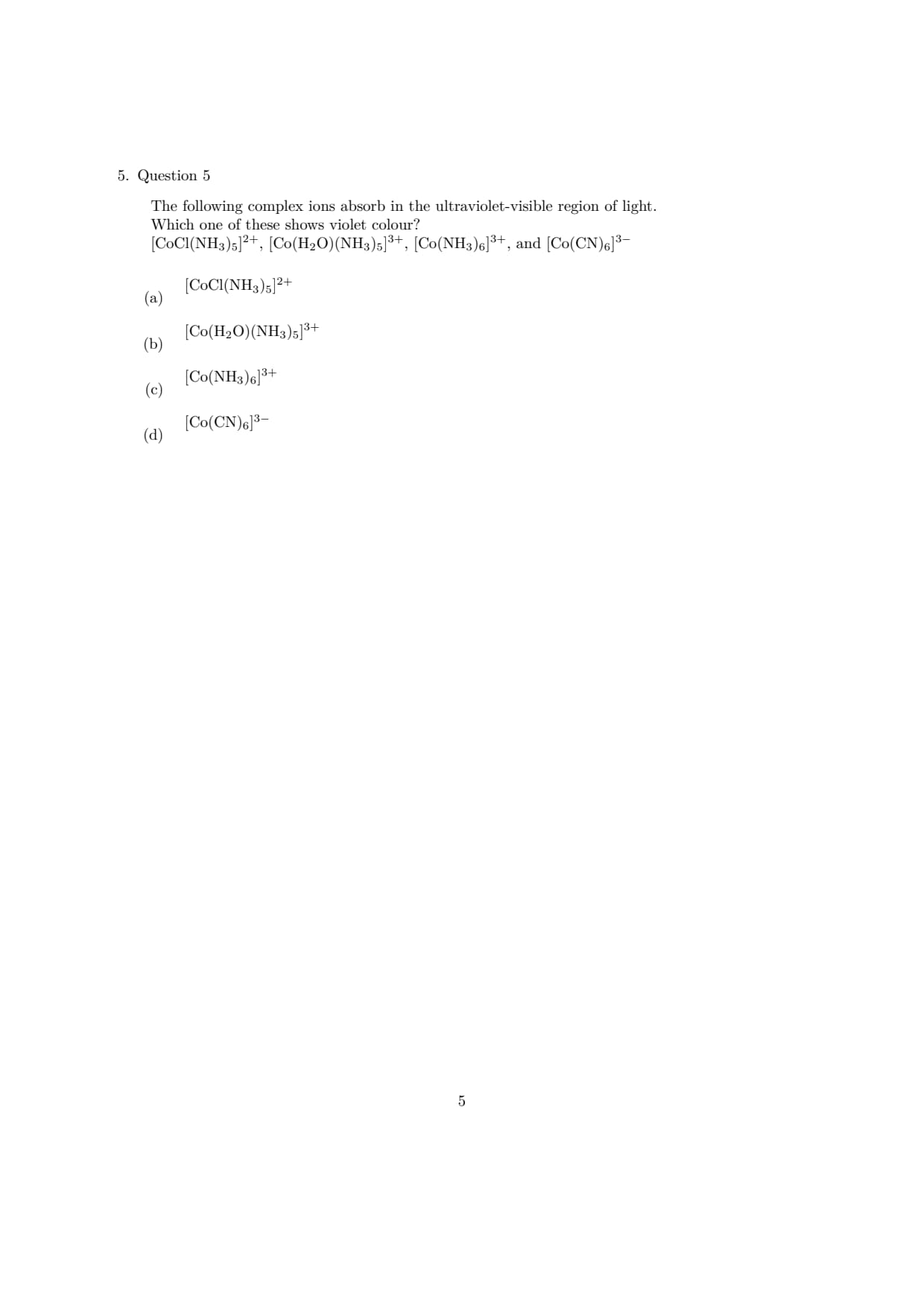
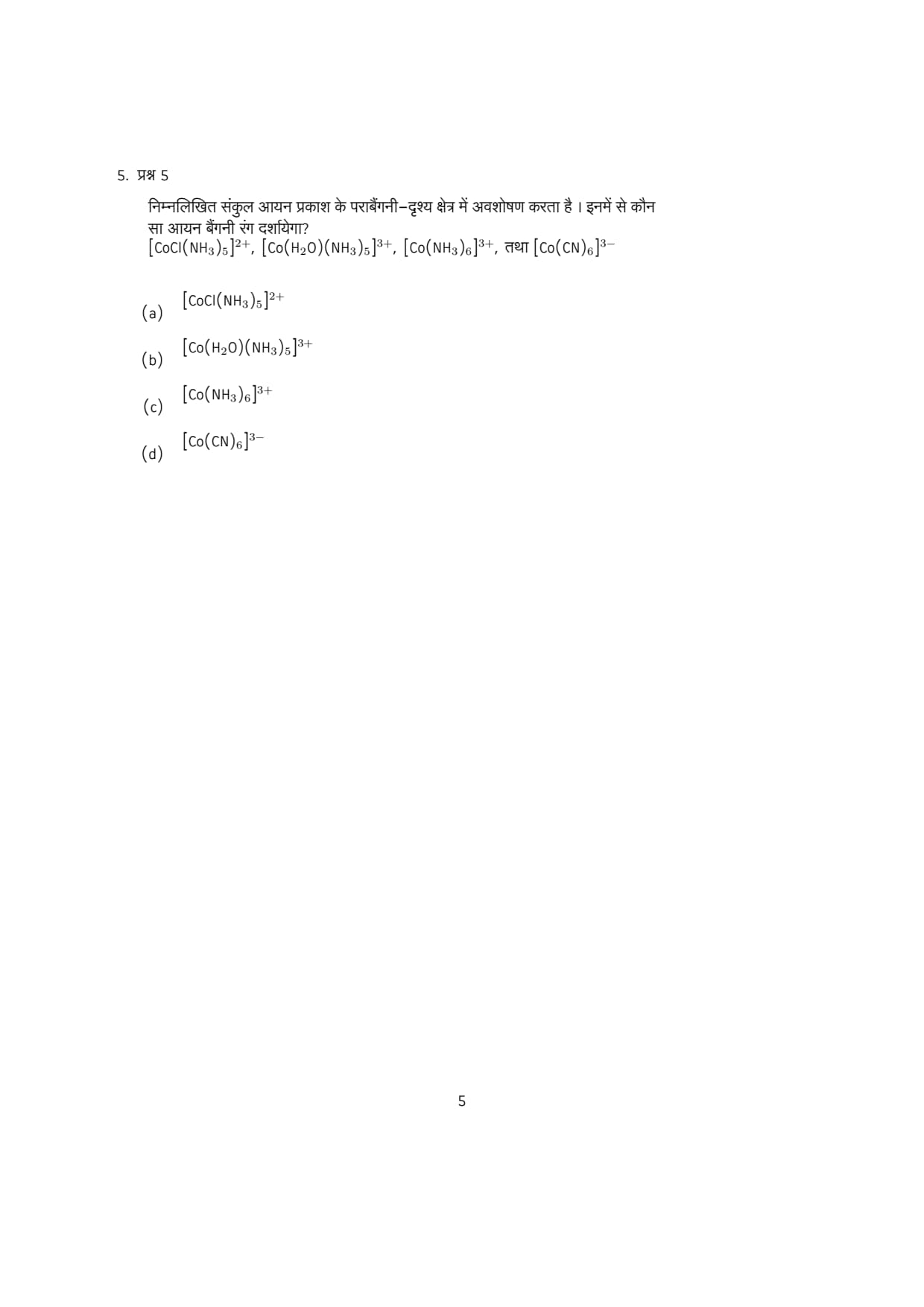
The following complex ions absorb in the ultraviolet-visible region of light. Which one of these shows violet colour?
[\(CoCl(NH_3)_5\)]\(^{2+}\), [\(Co(H_2O)(NH_3)_5\)]\(^{3+}\), [\(Co(NH_3)_6\)]\(^{3+}\), and [\(Co(CN)_6\)]\(^{3-}\)
View Solution
Step 1: Understanding the Question:
The question asks us to identify which of the listed Cobalt(III) coordination complexes displays a violet color when it absorbs light in the UV-visible region.
Step 2: Key Formula or Approach:
The color exhibited by a coordination complex is the complementary color of the wavelength of light it absorbs.
1. The wavelength of light absorbed (\(\lambda_{abs}\)) is inversely proportional to the crystal field splitting energy (\(\Delta_o\)):
\[ \Delta_o = \frac{hc}{\lambda_{abs}} \]
2. The value of \(\Delta_o\) depends on the strength of the ligands surrounding the metal ion, as defined by the spectrochemical series:
\[ Cl^- < H_2O < NH_3 < CN^- \]
Step 3: Detailed Explanation:
Let's analyze the absorption properties and complementary colors of the complexes based on ligand field strength:
- \(CN^-\) is an extremely strong field ligand, resulting in a very large \(\Delta_o\). The complex [\(Co(CN)_6\)]\(^{3-}\) absorbs high-energy ultraviolet light, and thus appears pale yellow or virtually colorless in the visible range.
- \(NH_3\) is a strong ligand, giving a relatively high \(\Delta_o\) value. [\(Co(NH_3)_6\)]\(^{3+}\) absorbs blue-violet light (\(\lambda \approx 475 nm\)), showing its complementary color: yellow-orange.
- In [\(Co(H_2O)(NH_3)_5\)]\(^{3+}\), replacing one \(NH_3\) with the weaker \(H_2O\) ligand decreases \(\Delta_o\) slightly. It absorbs blue-green light (\(\lambda \approx 500 nm\)) and displays its complementary color: red-pink.
- In [\(CoCl(NH_3)_5\)]\(^{2+}\), the weak field ligand \(Cl^-\) decreases \(\Delta_o\) further. It absorbs yellow-green light (\(\lambda \approx 535 nm\)), and thus displays its complementary color: violet.
Step 4: Final Answer:
Based on the spectrochemical series and complementary color relationships, [\(CoCl(NH_3)_5\)]\(^{2+}\) is the complex that exhibits a violet color, which corresponds to option (A).
Quick Tip: Remember the relationship from the standard NCERT table for Cobalt(III) complexes:
- \(Cl^-\) (weakest ligand here) \(\to\) smallest \(\Delta_o\) \(\to\) longest absorbed wavelength (yellow-green) \(\to\) complementary observed color is violet.
This simple logical link saves you from memorizing the entire table.
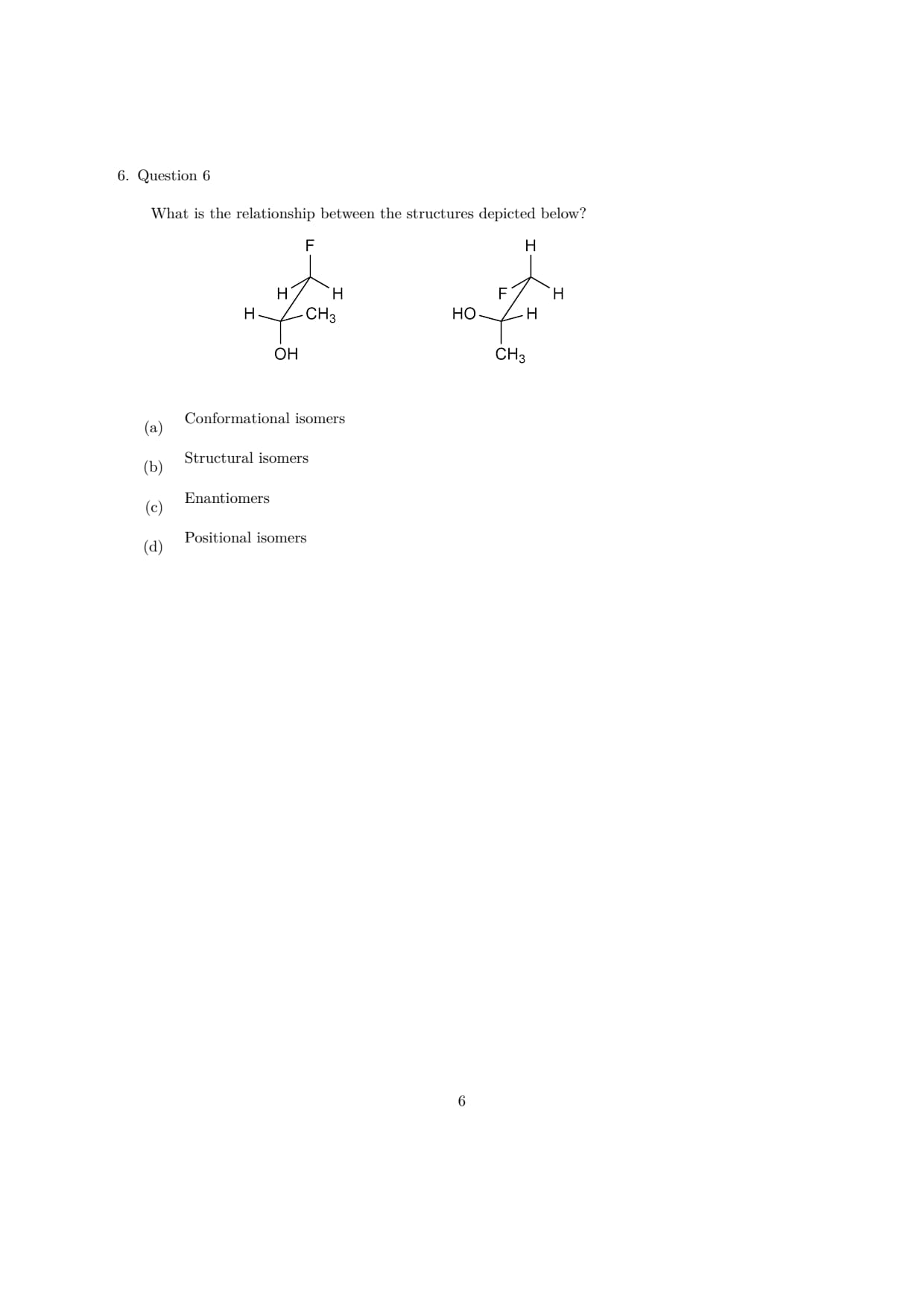
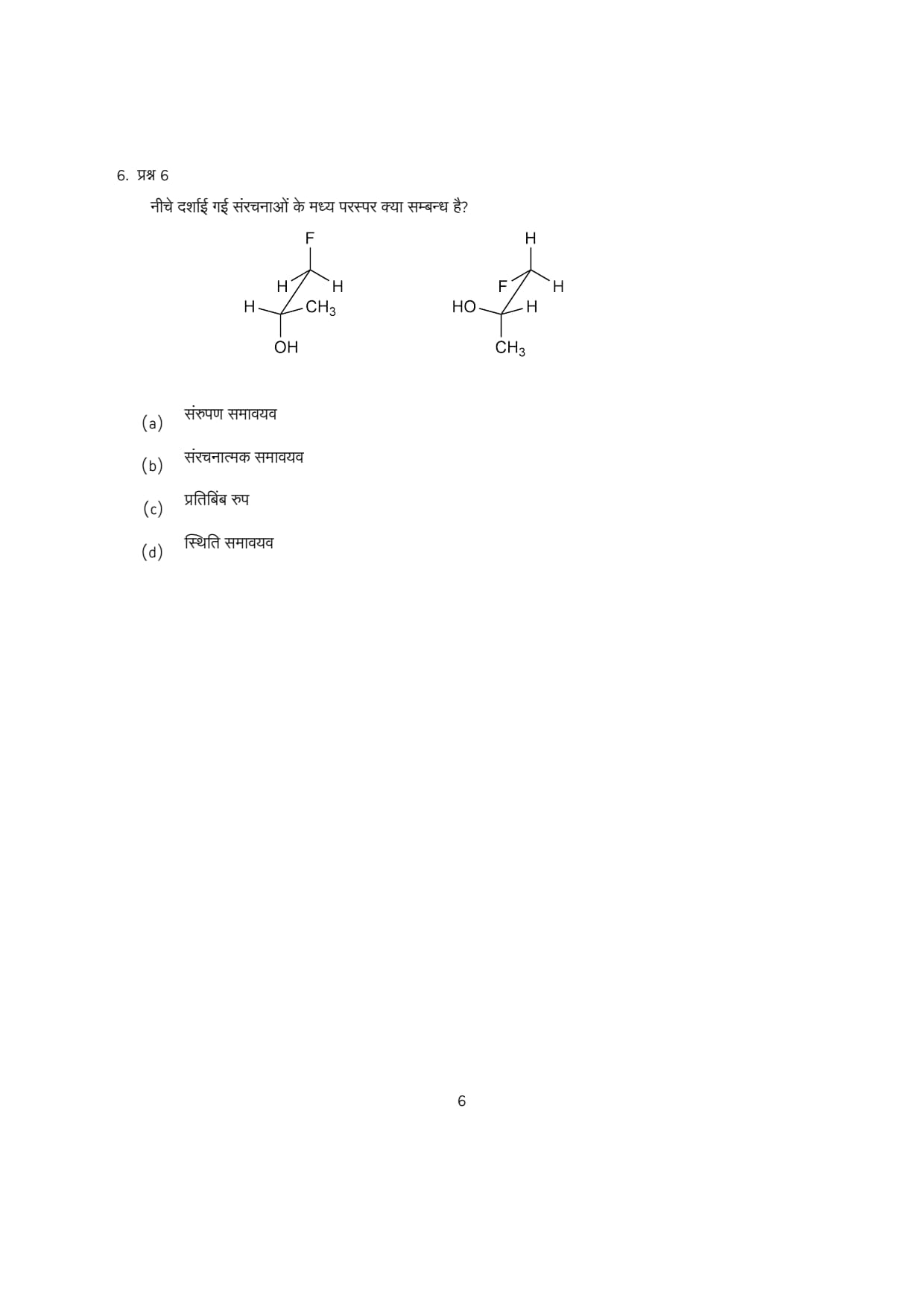
What is the relationship between the structures depicted below?

View Solution
Step 1: Understanding the Question:
The question presents two three-dimensional representations of a 1,2-disubstituted ethane derivative, specifically 1-fluoropropan-2-ol. We need to determine the isomerism relationship between these two structures.
Step 2: Key Formula or Approach:
To identify the relationship between two stereochemical projections:
1. Check the connectivity of the atoms. If the connectivity is identical, they are stereoisomers, not structural or positional isomers.
2. Determine if the structures can be interconverted solely by rotating around single bonds (specifically the central \(C-C\) bond). If so, they are conformational isomers (conformers).
3. If they require bond-breaking to interconvert, analyze if they are non-superimposable mirror images (enantiomers) or diastereomers.
Step 3: Detailed Explanation:
Let's analyze the connectivity of both drawn structures:
- Both structures have a front carbon bonded to \(H\), \(OH\), and \(CH_3\), and a back carbon bonded to \(F\), \(H\), and \(H\). Both represent the same molecule: 1-fluoropropan-2-ol.
- Let's check the spatial orientation in the first structure:
- The back carbon has the \(F\) atom pointing vertically upwards (at 12 o'clock).
- The front carbon has the \(OH\) group pointing downwards (at 6 o'clock).
- Let's check the second structure:
- The back carbon has the \(F\) atom pointing downwards to the left (at 8 o'clock).
- The front carbon has the \(OH\) group pointing upwards to the left (at 10 o'clock).
- Let's test if rotating the entire molecule or rotating around the central carbon-carbon (\(C-C\) single bond) of the first structure can yield the second structure:
- If we rotate the back carbon of the first structure by \(120^\circ\) clockwise relative to the front, the \(F\) atom moves from 12 o'clock to 4 o'clock.
- If we rotate the entire first structure around the central axis by \(120^\circ\) clockwise, we observe that the positions of all groups perfectly match the second structure.
- Since the two arrangements can be interconverted without breaking any bonds, simply by rotating groups around the carbon-carbon single bond, they represent different spatial conformations of the exact same molecule.
- Hence, they are conformational isomers.
Step 4: Final Answer:
The two depicted structures represent conformational isomers, making option (A) the correct choice.
Quick Tip: When dealing with Newman or Sawhorse projections, always check if a simple rotation of one or both carbons around the central \(C-C\) bond can match the configurations.
If yes, the relationship is always conformational isomers.
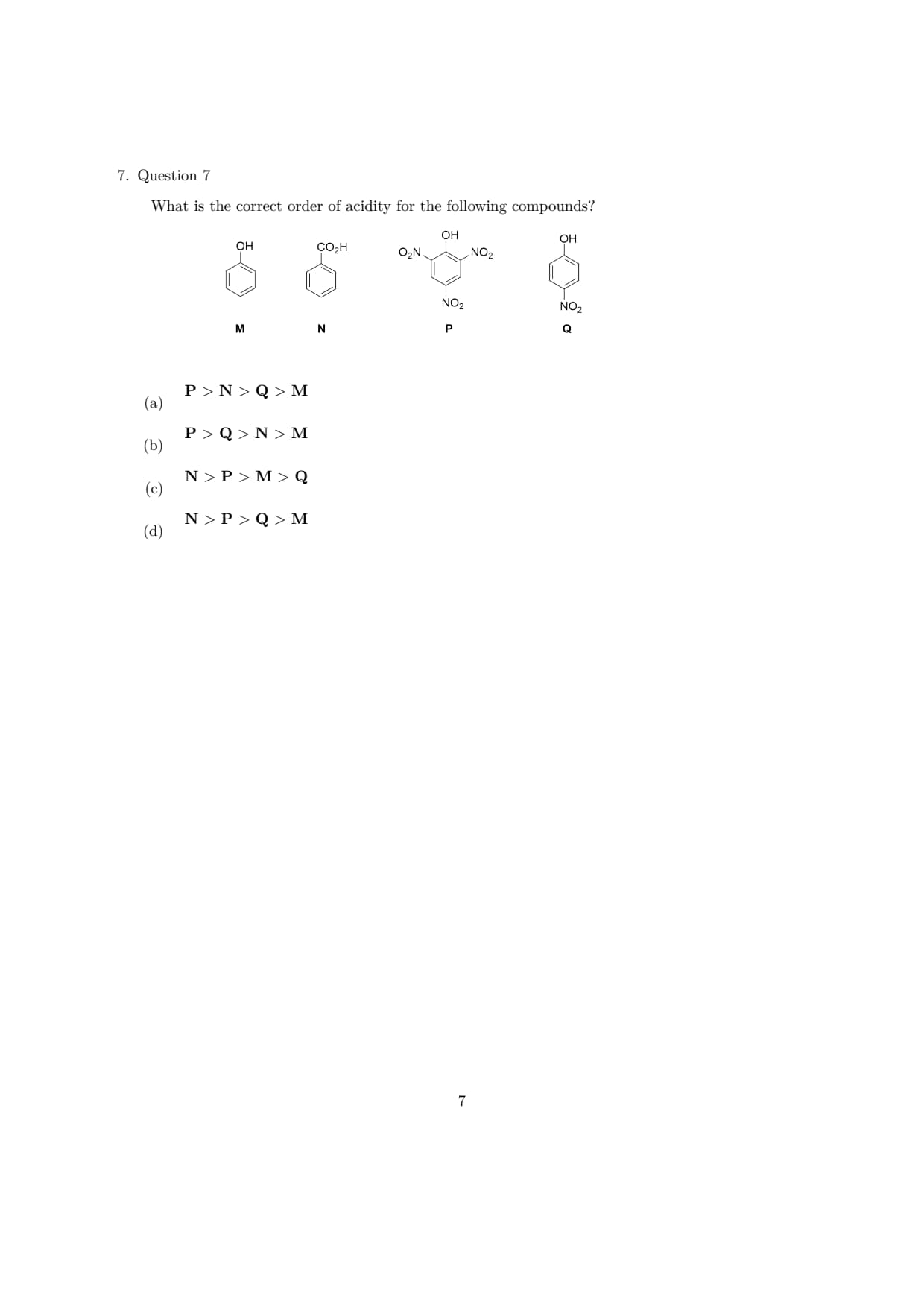
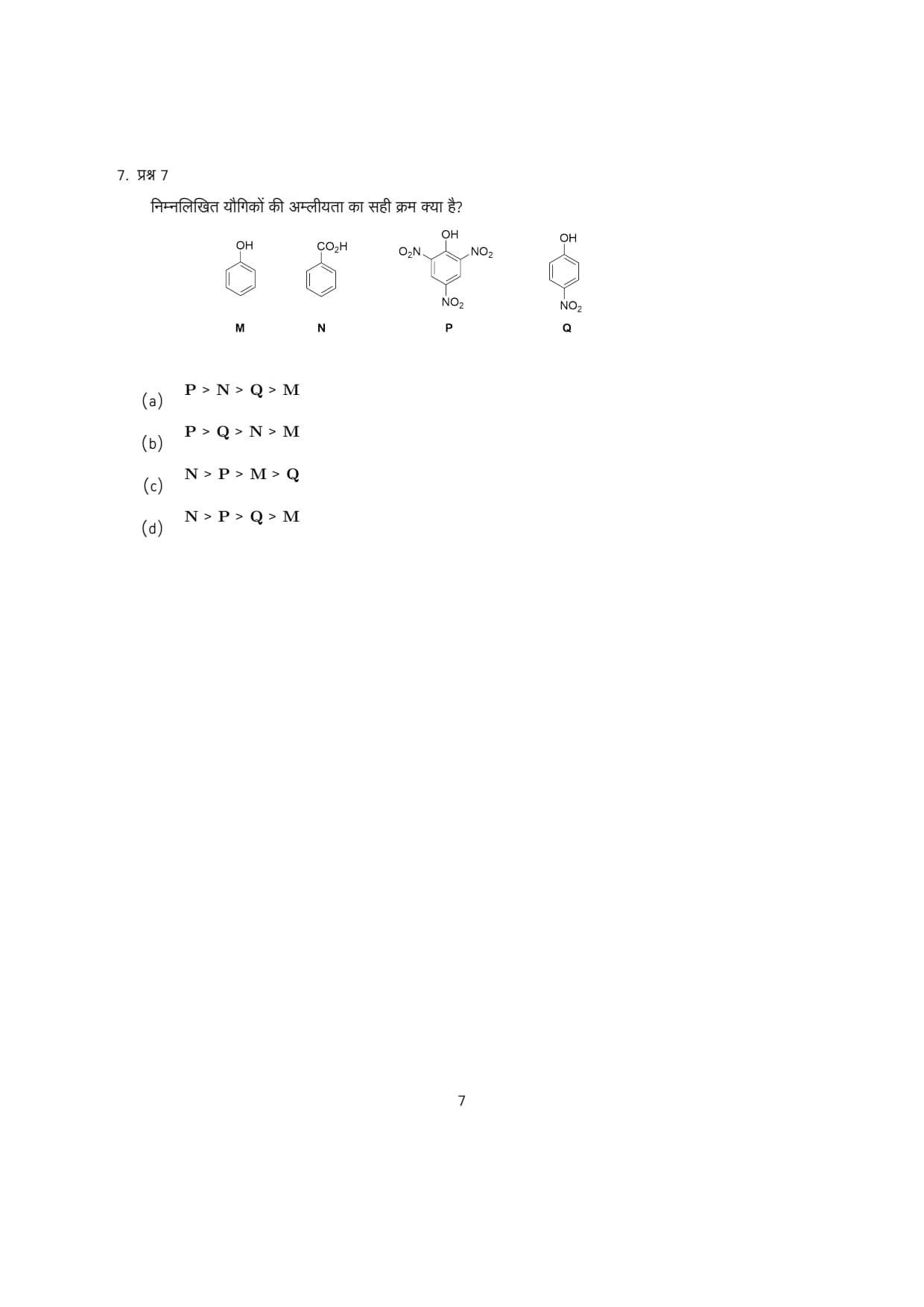
What is the correct order of acidity for the following compounds?

View Solution
Step 1: Understanding the Question:
The question asks us to arrange four organic compounds—Phenol (M), Benzoic acid (N), 2,4,6-trinitrophenol (P), and 4-nitrophenol (Q)—in decreasing order of their acid strength.
Step 2: Key Formula or Approach:
The acidity of a compound depends on the stability of its conjugate base (anion) formed after losing a proton (\(H^+\)):
1. A more stable conjugate base corresponds to a stronger acid.
2. Carboxylic acids are generally more acidic than phenols because the negative charge in the carboxylate ion is delocalized over two highly electronegative oxygen atoms.
3. However, the presence of strong electron-withdrawing groups (like \(-NO_2\)) on a phenol ring via resonance (\(-M\) effect) and inductive (\(-I\) effect) stabilizes the phenoxide ion enormously, which can make substituted phenols even stronger than carboxylic acids.
Step 3: Detailed Explanation:
Let's analyze the stability of the conjugate bases for each compound:
- M (Phenol): The phenoxide ion is stabilized by resonance, but the negative charge is delocalized onto less electronegative carbon atoms of the benzene ring. It is a weak acid with a \(pK_a \approx 10\).
- N (Benzoic acid): The carboxylate ion (\(C_6H_5COO^-\)) is highly stable due to equivalent resonance structures where the negative charge is shared between two electronegative oxygen atoms. It is much more acidic than phenol, with a \(pK_a \approx 4.2\).
- P (2,4,6-trinitrophenol, or Picric acid): This compound has three highly electron-withdrawing nitro groups (\(-NO_2\)) at the ortho and para positions relative to the hydroxyl group.
- These groups exert very powerful \(-M\) and \(-I\) effects, stabilizing the negative charge on the phenoxide oxygen to an extreme degree.
- Consequently, picric acid is exceptionally acidic, with a \(pK_a \approx 0.38\). This is much more acidic than benzoic acid.
- Q (4-nitrophenol): The presence of one electron-withdrawing \(-NO_2\) group at the para position stabilizes the phenoxide ion via resonance, making it significantly more acidic than phenol (\(pK_a \approx 7.15\)). However, with only one nitro group, it remains less acidic than benzoic acid.
Comparing the \(pK_a\) values:
Picric acid (P, \(pK_a \approx 0.38\)) \(>\) Benzoic acid (N, \(pK_a \approx 4.2\)) \(>\) 4-nitrophenol (Q, \(pK_a \approx 7.15\)) \(>\) Phenol (M, \(pK_a \approx 10\)).
Therefore, the decreasing order of acidity is: \(P > N > Q > M\).
Step 4: Final Answer:
The correct order of acidity is \(P > N > Q > M\), which corresponds to option (A).
Quick Tip: Picric acid (\(P\)) is a unique phenol containing three nitro groups, making it extremely acidic (stronger than benzoic acid and many mineral acids).
Remembering that Picric acid is stronger than Benzoic acid (\(P > N\)) immediately allows you to narrow down to the correct option (A).
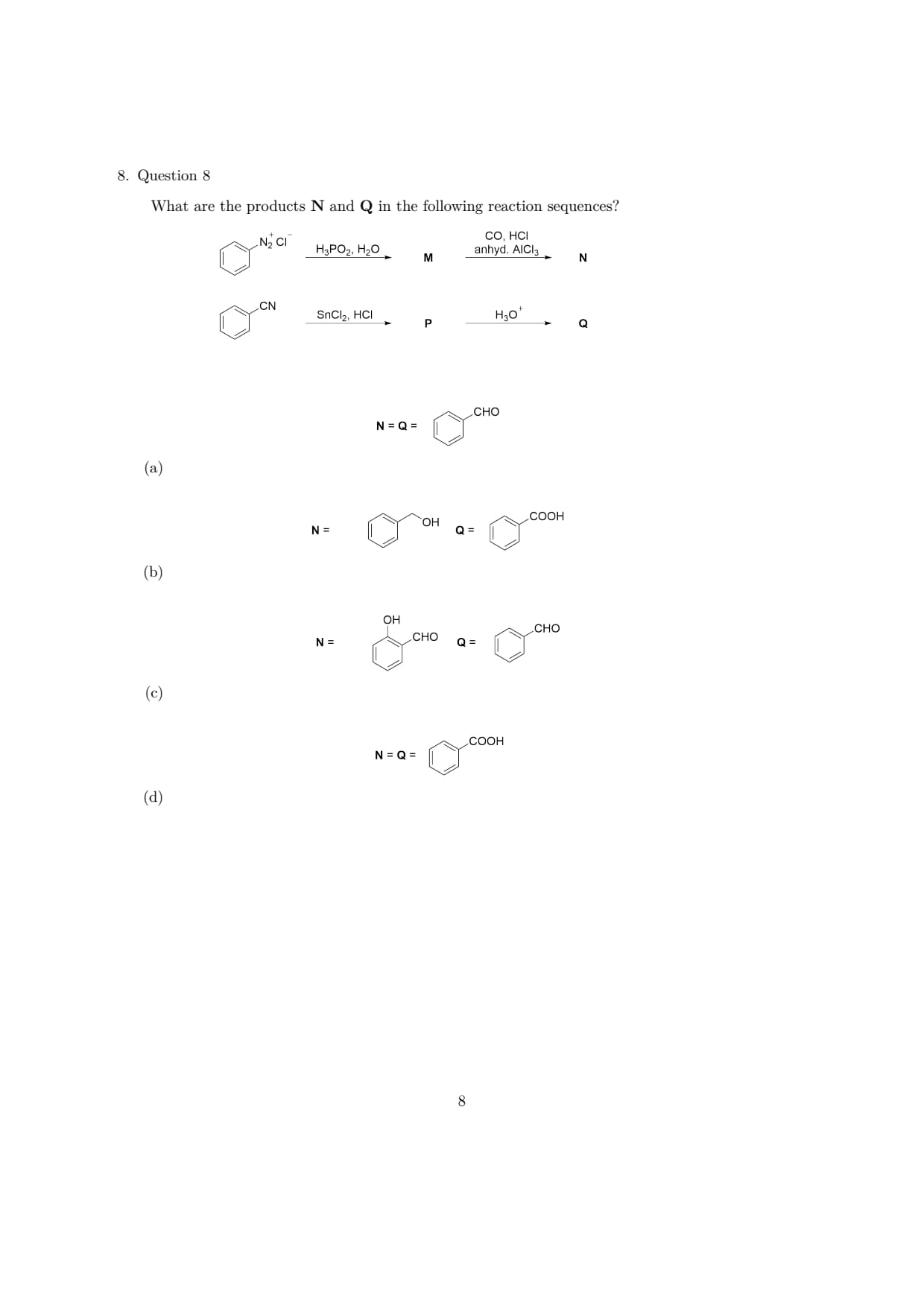
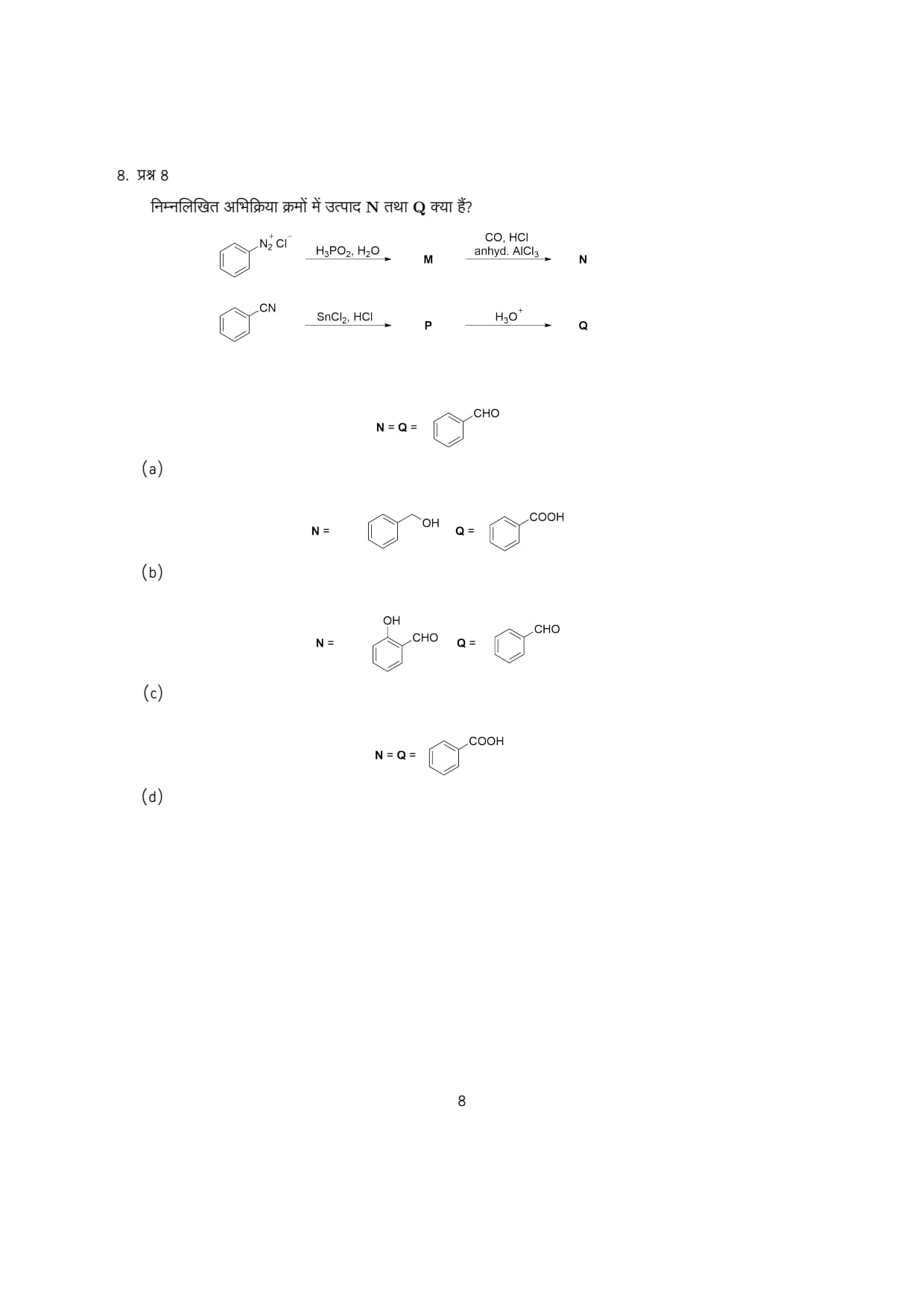
What are the products N and Q in the following reaction sequences?

- (A)
![]()
- (B)
![]()
- (C)
![]()
- (D)
![]()


View Solution
Step 1: Understanding the Question:
The question asks us to identify the final organic products \(N\) and \(Q\) in two different chemical reaction pathways starting from benzene derivatives.
Step 2: Key Formula or Approach:
Let's analyze the steps in both reaction sequences:
1. Sequence 1: Treatment of benzenediazonium chloride with mild reducing agents (\(H_3PO_2\)), followed by formulation of the ring using \(CO\) and \(HCl\) in the presence of anhydrous \(AlCl_3\) (Gattermann-Koch reaction).
2. Sequence 2: Partial reduction of benzonitrile with tin(II) chloride and hydrochloric acid, followed by acidic hydrolysis (Stephen reduction).
Step 3: Detailed Explanation:
- Analysis of Reaction Sequence 1:
- Starting material: Benzenediazonium chloride (\(C_6H_5N_2^+Cl^-\)).
- Step 1: Reaction with hypophosphorous acid (\(H_3PO_2\)) and water reduces the diazonium group to a hydrogen atom, yielding benzene (\(M\)).
\[ C_6H_5N_2^+Cl^- \xrightarrow{H_3PO_2, H_2O} C_6H_6 (M) \]
- Step 2: Benzene (\(M\)) is reacted with carbon monoxide (\(CO\)) and hydrogen chloride (\(HCl\)) gas in the presence of anhydrous aluminum chloride (\(AlCl_3\)). This is the Gattermann-Koch reaction, which introduces a formyl group (\(-CHO\)) onto the benzene ring to yield benzaldehyde (\(N\)).
\[ C_6H_6 (M) \xrightarrow{CO, HCl / anhyd. AlCl_3} C_6H_5CHO (N) \]
- Analysis of Reaction Sequence 2:
- Starting material: Benzonitrile (\(C_6H_5CN\)).
- Step 1: Benzonitrile is treated with tin(II) chloride (\(SnCl_2\)) in the presence of \(HCl\). This partially reduces the nitrile group to an iminium chloride intermediate (\(P\)).
\[ C_6H_5CN \xrightarrow{SnCl_2, HCl} C_6H_5CH=NH\cdotHCl (P) \]
- Step 2: Acidic hydrolysis (\(H_3O^+\)) of the imine intermediate (\(P\)) converts it into benzaldehyde (\(Q\)). This classic reaction is known as the Stephen reduction.
\[ C_6H_5CH=NH\cdotHCl (P) \xrightarrow{H_3O^+} C_6H_5CHO (Q) \]
Comparing both pathways, we find that both \(N\) and \(Q\) are benzaldehyde (\(C_6H_5CHO\)).
Step 4: Final Answer:
Both reaction sequences yield benzaldehyde as the final product (\(N = Q = Benzaldehyde\)), which corresponds to option (A).
Quick Tip: Stephen reduction is a very selective method to convert nitrilies (\(-CN\)) to aldehydes (\(-CHO\)).
Similarly, the Gattermann-Koch reaction is a standard method to formylate benzene to benzaldehyde.
Recognizing these named reactions helps solve multi-step synthesis questions instantly.
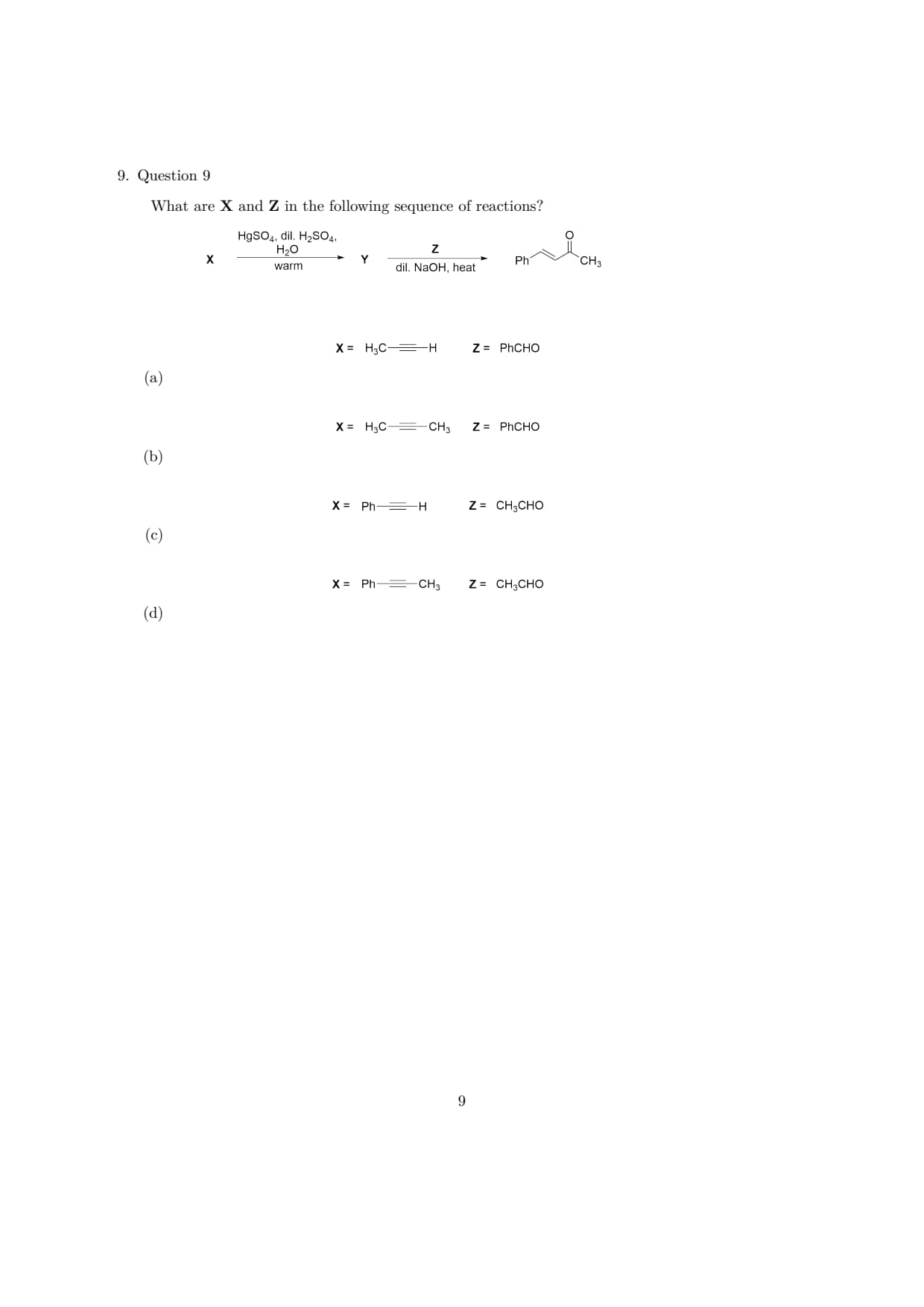
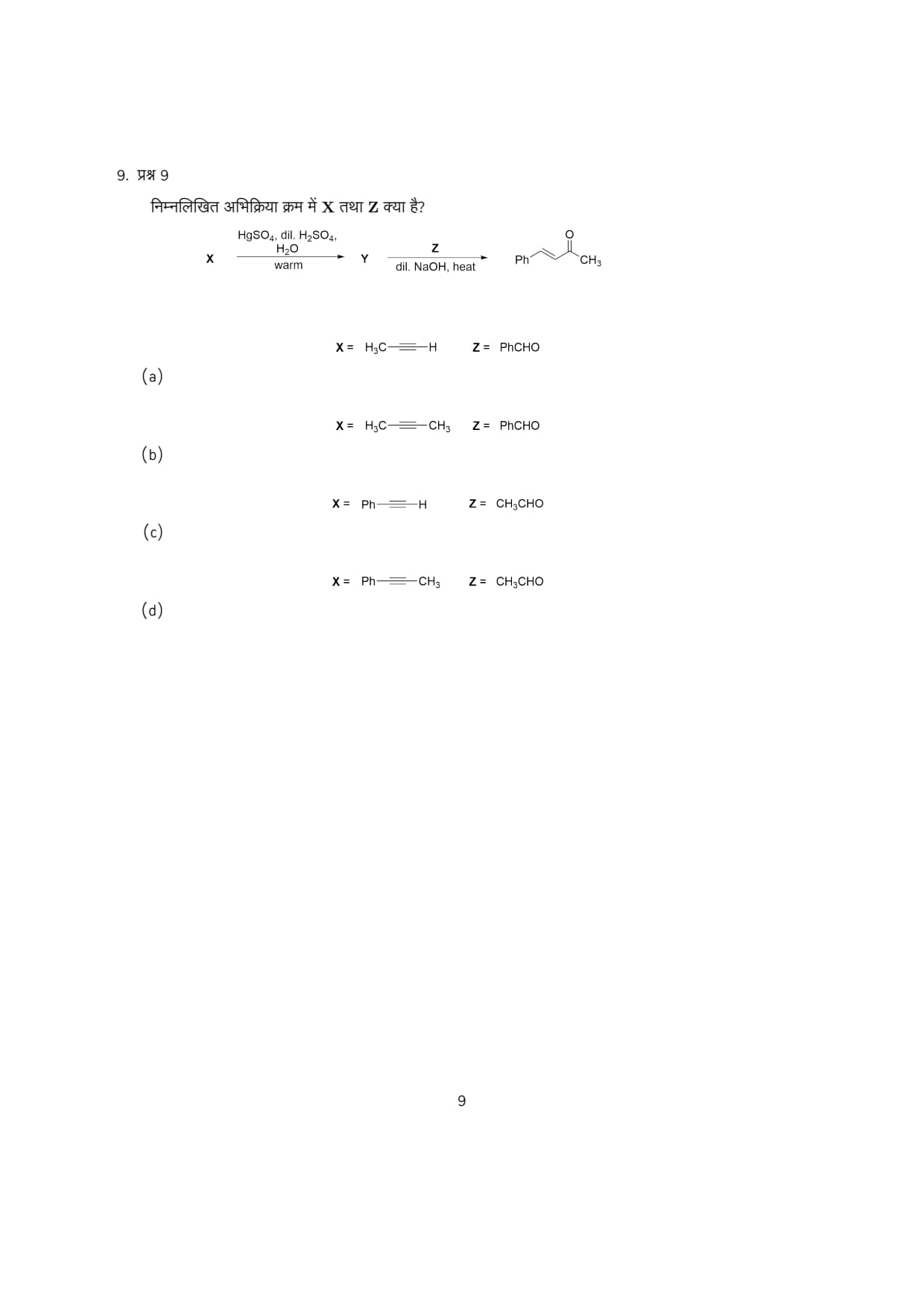
What are X and Z in the following sequence of reactions?

- (A) \(\text{X} = \text{H}_3\text{C}-\text{C}\equiv\text{CH}\), \(\text{Z} = \text{PhCHO}\)
- (B) \(\text{X} = \text{H}_3\text{C}-\text{C}\equiv\text{C}-\text{CH}_3\), \(\text{Z} = \text{PhCHO}\)
- (C) \(\text{X} = \text{Ph}-\text{C}\equiv\text{CH}\), \(\text{Z} = \text{CH}_3\text{CHO}\)
- (D) \(\text{X} = \text{Ph}-\text{C}\equiv\text{C}-\text{CH}_3\), \(\text{Z} = \text{CH}_3\text{CHO}\)
View Solution
Step 1: Understanding the Question:
The question asks us to identify the alkyne reactant \(X\) and the carbonyl compound \(Z\) in a two-step reaction sequence that produces an \(\alpha,\beta\)-unsaturated ketone, specifically 4-phenylbut-3-en-2-one (\(Ph-CH=CH-CO-CH_3\)).
Step 2: Key Formula or Approach:
Let's work backward from the final product:
1. The final product is \(Ph-CH=CH-CO-CH_3\). This conjugate system is typically formed via a crossed aldol condensation between a non-enolizable aldehyde (like benzaldehyde, \(PhCHO\)) and a methyl ketone (like acetone, \(CH_3COCH_3\)) under basic conditions.
2. The intermediate \(Y\) must undergo this aldol condensation with reactant \(Z\).
3. \(Y\) is synthesized by hydration of an alkyne \(X\) using Kucherov's reaction conditions (\(HgSO_4\), \(dil. H_2SO_4\), water).
Step 3: Detailed Explanation:
Let's analyze the steps sequentially:
- Step 1: Analyzing the Kucherov reaction on alkyne X:
- If we choose propyne \(\left(\text{H}_3\text{C}-\text{C}\equiv\text{CH}\right)\) as \(X\):
- Hydration occurs via Markovnikov's addition of water across the triple bond:
\[ \text{H}_3\text{C}-\text{C}\equiv\text{CH} \xrightarrow{\text{Hg}^{2+}/\text{H}^+,\,\text{H}_2\text{O}} [\text{H}_3\text{C}-\text{C}(\text{OH})=\text{CH}_2] \]
- The enol intermediate tautomerizes rapidly to form the more stable ketone, acetone (\(Y\)):
\[ [H_3C-C(OH)=CH_2] \rightleftharpoons H_3C-CO-CH_3 (Acetone, Y) \]
- Step 2: Analyzing the Aldol Condensation with Z:
- Acetone (\(Y\)) is treated with reactant \(Z\) in the presence of dilute \(NaOH\) and heat.
- To obtain \(Ph-CH=CH-CO-CH_3\), the active \(\alpha\)-hydrogen of acetone must attack the carbonyl carbon of benzaldehyde (\(Z = PhCHO\)):
\[ PhCHO (Z) + CH_3-CO-CH_3 (Y) \xrightarrow{dil. NaOH} Ph-CH(OH)-CH_2-CO-CH_3 \]
- Heating causes dehydration of the aldol product to yield the conjugated \(\alpha,\beta\)-unsaturated ketone:
\[ Ph-CH(OH)-CH_2-CO-CH_3 \xrightarrow{\Delta} Ph-CH=CH-CO-CH_3 + H_2O \]
This matches the product shown in the reaction. Thus, \(X\) is propyne and \(Z\) is benzaldehyde.
Step 4: Final Answer:
The reactants are \(\text{X} = \text{H}_3\text{C}-\text{C}\equiv\text{CH}\) and \(Z = PhCHO\), which matches option (A).
Quick Tip: To find the components of an aldol condensation product, mentally "cleave" the double bond \(C=C\):
- Change the \(C\) on the side without the carbonyl back to a carbonyl (\(C=O\)), which gives \(PhCHO\).
- Add two hydrogens to the other \(C\) to get the original ketone, \(CH_3COCH_3\).
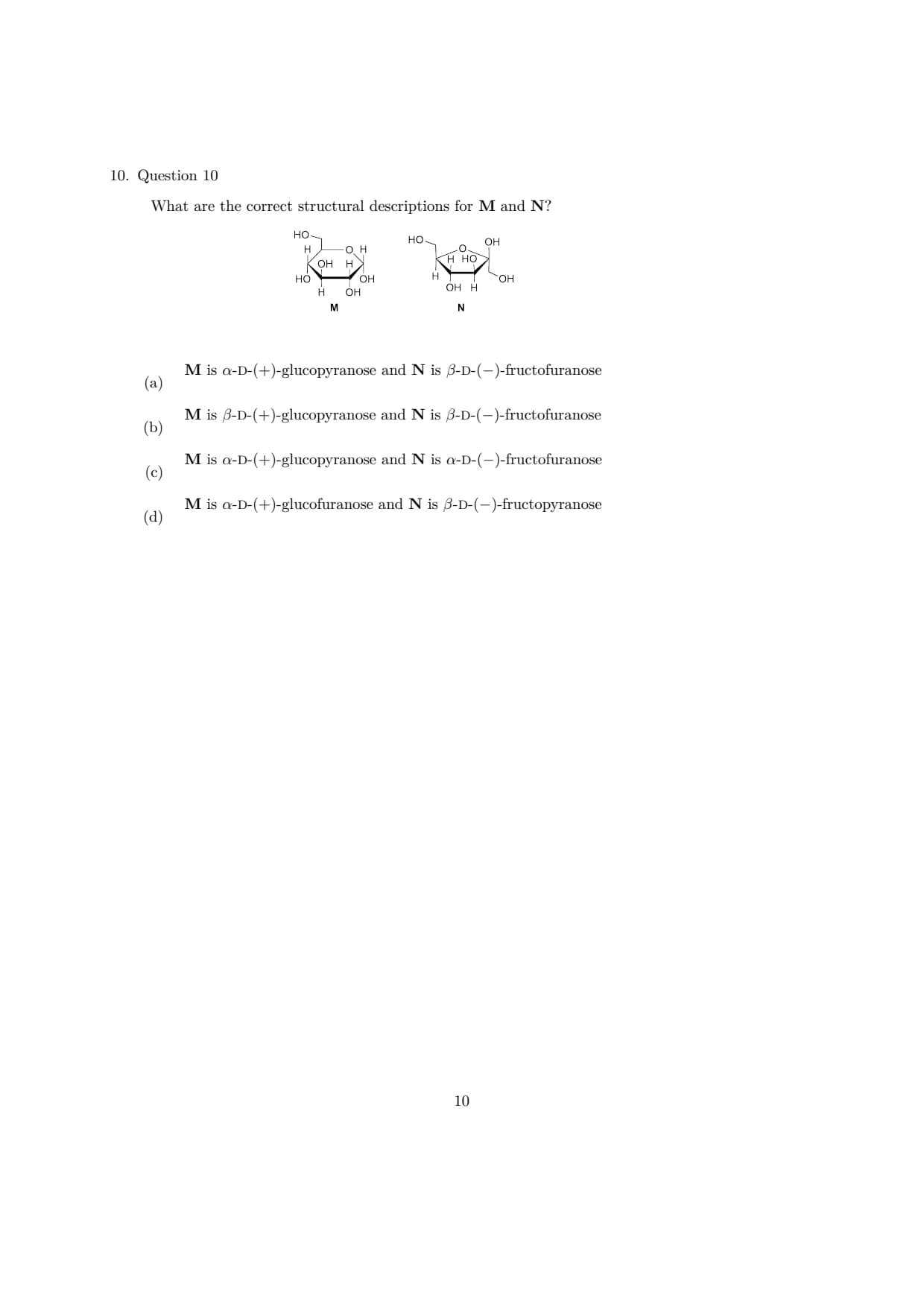
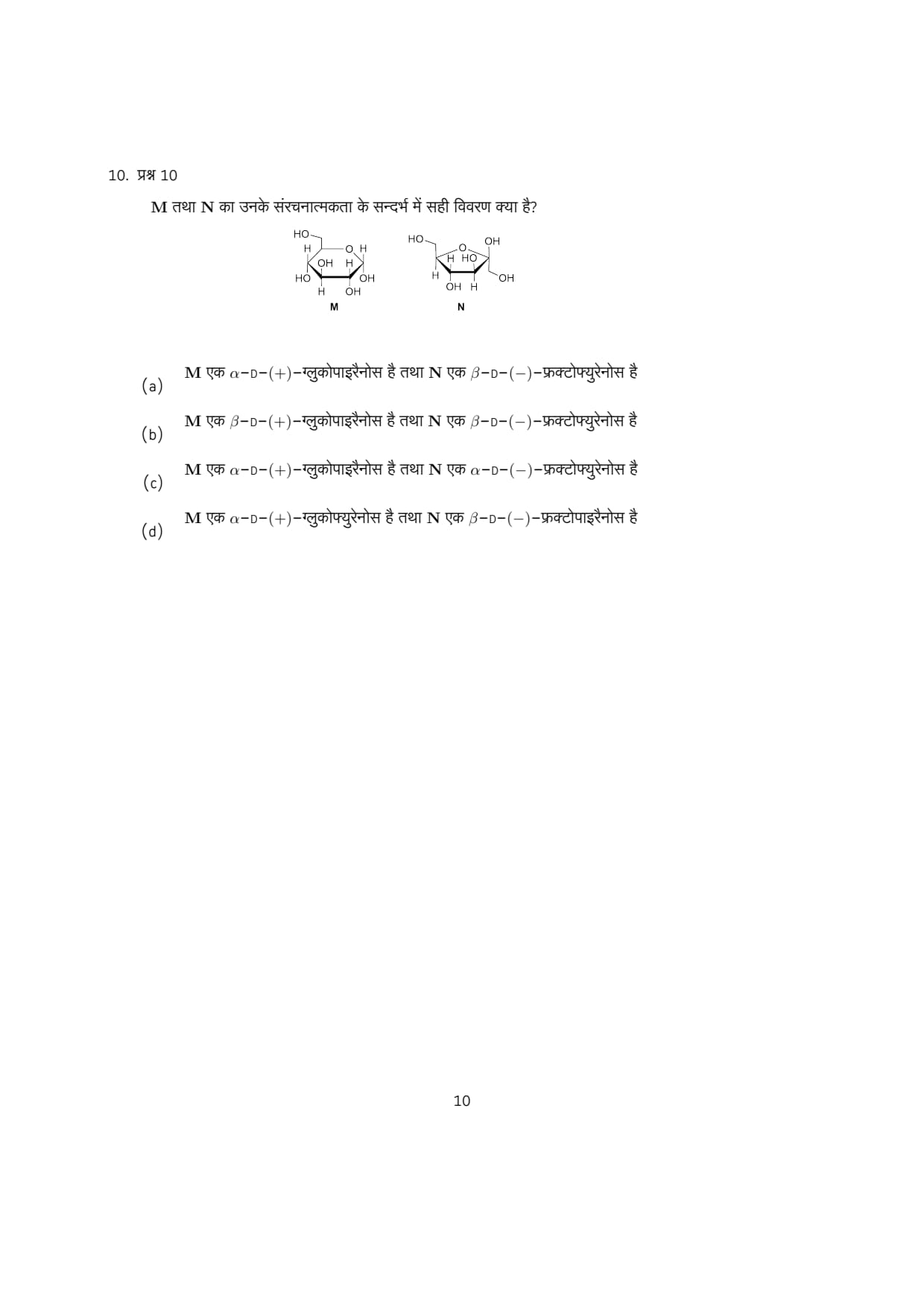
What are the correct structural descriptions for M and N?

View Solution
Step 1: Understanding the Question:
The question asks for the correct chemical names and stereochemical configurations of the two carbohydrate structures labeled \(M\) and \(N\), represented as Haworth projections.
Step 2: Key Formula or Approach:
To classify the carbohydrate structures in Haworth projections:
1. Count the ring size: A 6-membered ring containing oxygen is a pyranose, and a 5-membered ring containing oxygen is a furanose.
2. Identify the monomer: Glucose forms a pyranose ring (glucopyranose), whereas Fructose forms a furanose ring (fructofuranose).
3. Determine the anomeric configuration (\(\alpha\) or \(\beta\)):
- For D-sugars, if the hemiacetal hydroxyl group (\(-OH\)) on the anomeric carbon points downwards (trans to the terminal \(-CH_2OH\) group), it is the \(\alpha\)-anomer.
- If the hydroxyl group points upwards (cis to the terminal \(-CH_2OH\) group), it is the \(\beta\)-anomer.
Step 3: Detailed Explanation:
- Analyzing Structure M:
- Ring size: 6-membered ring containing oxygen, indicating a pyranose ring of D-glucose.
- Anomeric carbon (C1, rightmost carbon): The hydroxyl group (\(-OH\)) is pointing downwards.
- Since the anomeric \(-OH\) is down, it is the \(\alpha\)-anomer.
- Therefore, \(M\) is \(\alpha\)-D-(+)-glucopyranose.
- Analyzing Structure N:
- Ring size: 5-membered ring containing oxygen, indicating a furanose ring of D-fructose.
- Anomeric carbon (C2, rightmost carbon): The hydroxyl group (\(-OH\)) is pointing upwards, and the \(-CH_2OH\) group is pointing downwards.
- Since the anomeric \(-OH\) is up, it is the \(\beta\)-anomer.
- Therefore, \(N\) is \(\beta\)-D-(\(-\))-fructofuranose.
Step 4: Final Answer:
Thus, \(M\) is \(\alpha\)-D-(+)-glucopyranose and \(N\) is \(\beta\)-D-(\(-\))-fructofuranose, which corresponds to option (A).
Quick Tip: Remember a simple visual trick for Haworth projections of D-sugars:
- \textbf{Down} is \(\alpha\) (like 'A' for Alpha points down).
- \textbf{Up} is \(\beta\) (like 'B' for Beta points up).
This mnemonic helps you identify anomers in a fraction of a second.
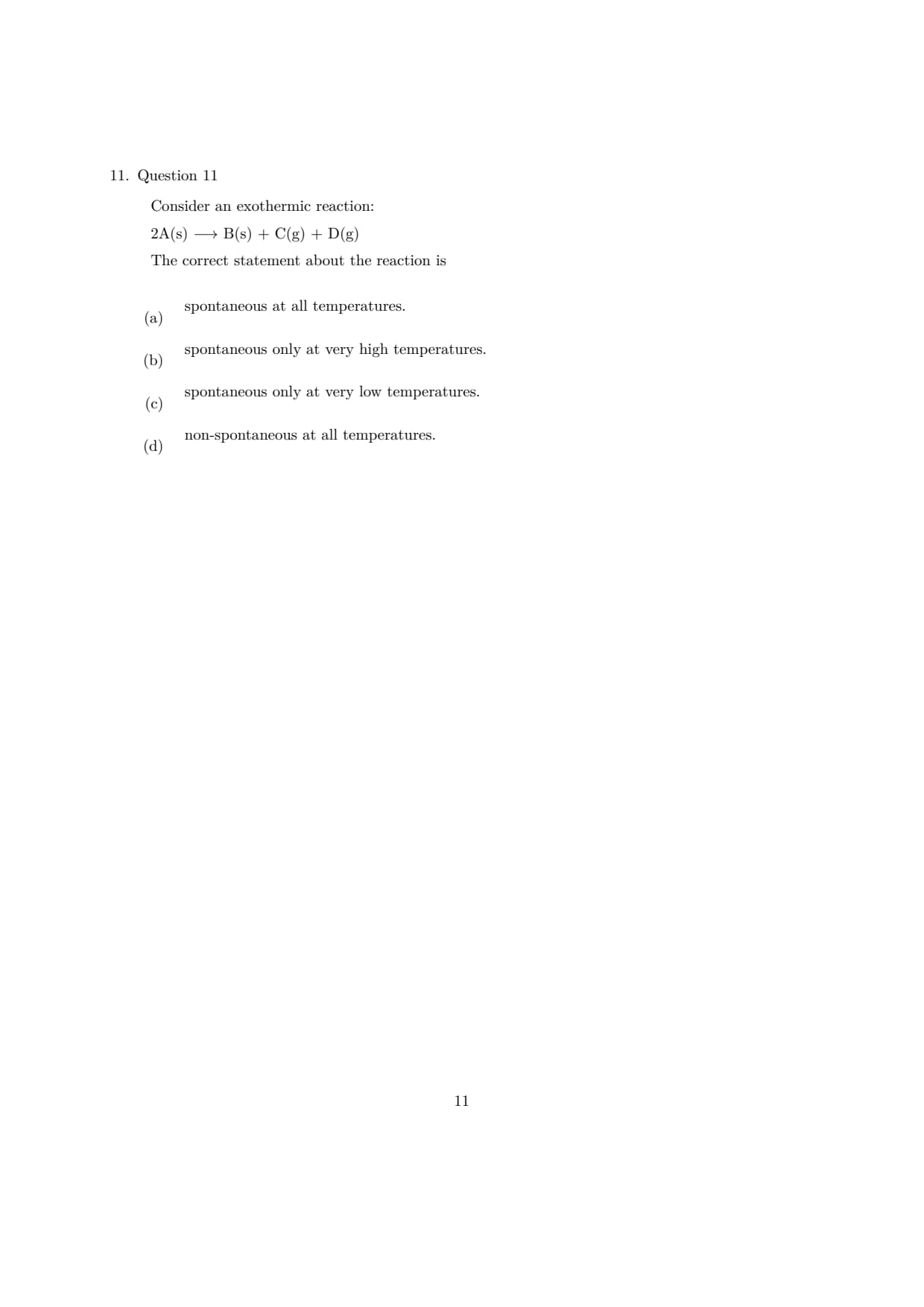
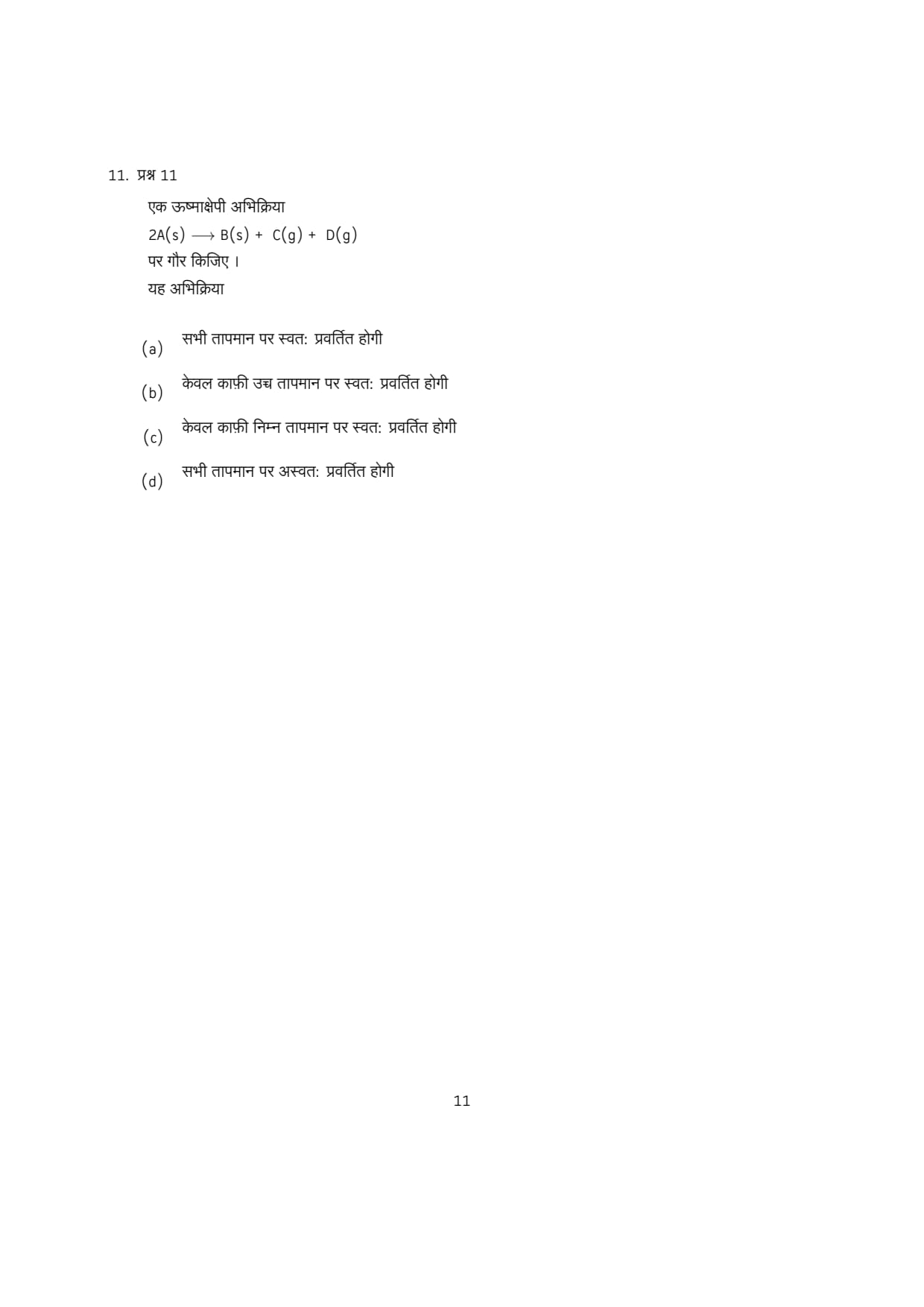
Consider an exothermic reaction:
2A(s) \(\longrightarrow\) B(s) + C(g) + D(g)
The correct statement about the reaction is
View Solution
Step 1: Understanding the Question:
The question asks us to determine the thermodynamic spontaneity of a given chemical reaction under varying temperatures, based on its enthalpy and entropy changes.
Step 2: Key Formula or Approach:
The spontaneity of a reaction at constant pressure and temperature is governed by the Gibbs Free Energy change (\(\Delta G\)):
\[ \Delta G = \Delta H - T\Delta S \]
- For a reaction to be spontaneous, we must have \(\Delta G < 0\).
- Here, \(T\) is the absolute temperature in Kelvin, which is always positive (\(T > 0\)).
Step 3: Detailed Explanation:
Let's evaluate the signs of enthalpy change (\(\Delta H\)) and entropy change (\(\Delta S\)) for the given reaction:
1. Enthalpy Change (\(\Delta H\)):
- The reaction is explicitly described as "exothermic".
- For any exothermic process, heat is released, so \(\Delta H < 0\) (negative).
2. Entropy Change (\(\Delta S\)):
- Let's look at the states of the reactants and products:
\[ 2A(s) \longrightarrow B(s) + C(g) + D(g) \]
- The reactants consist of 2 moles of solid (\(A\)), which is highly ordered.
- The products consist of 1 mole of solid (\(B\)) and 2 moles of gas (\(C\) and \(D\)).
- Since the process converts a solid into gaseous products, there is a large increase in randomness and disorder.
- Therefore, the entropy of the system increases, meaning \(\Delta S > 0\) (positive).
3. Applying the Gibbs Free Energy Equation:
- Substitute the signs into the Gibbs equation:
\[ \Delta G = (negative) - T(positive) \]
- Since both terms are negative, \(\Delta G\) must be negative at all values of \(T\) (since \(T\) cannot be negative).
- Because \(\Delta G < 0\) is satisfied universally, the reaction is spontaneous at all temperatures.
Step 4: Final Answer:
The reaction is spontaneous at all temperatures, which corresponds to option (A).
Quick Tip: A reaction that is exothermic (\(\Delta H < 0\)) and increases entropy (\(\Delta S > 0\)) is thermodynamically favored in both driving forces.
Such reactions are always spontaneous, regardless of the temperature.
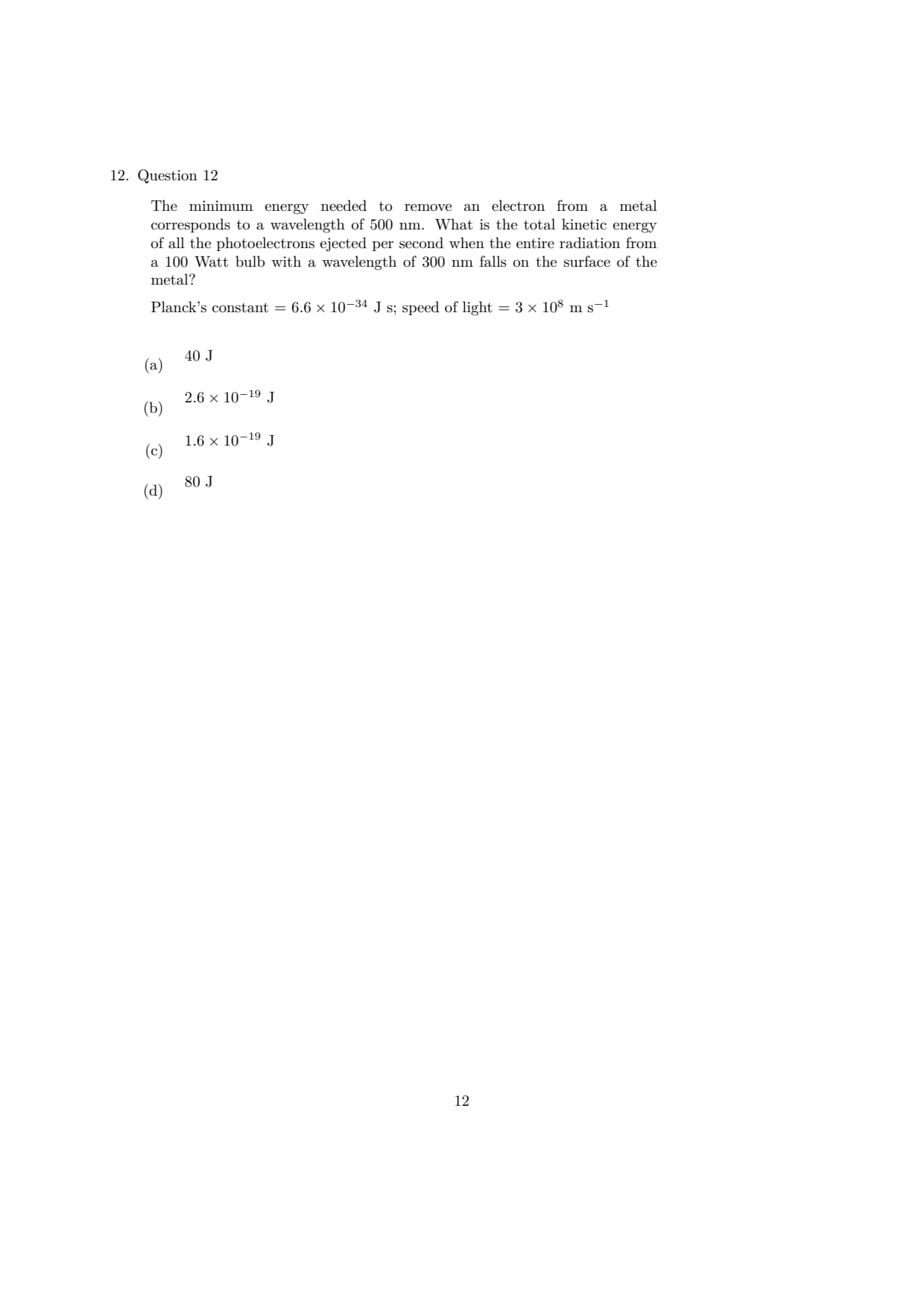
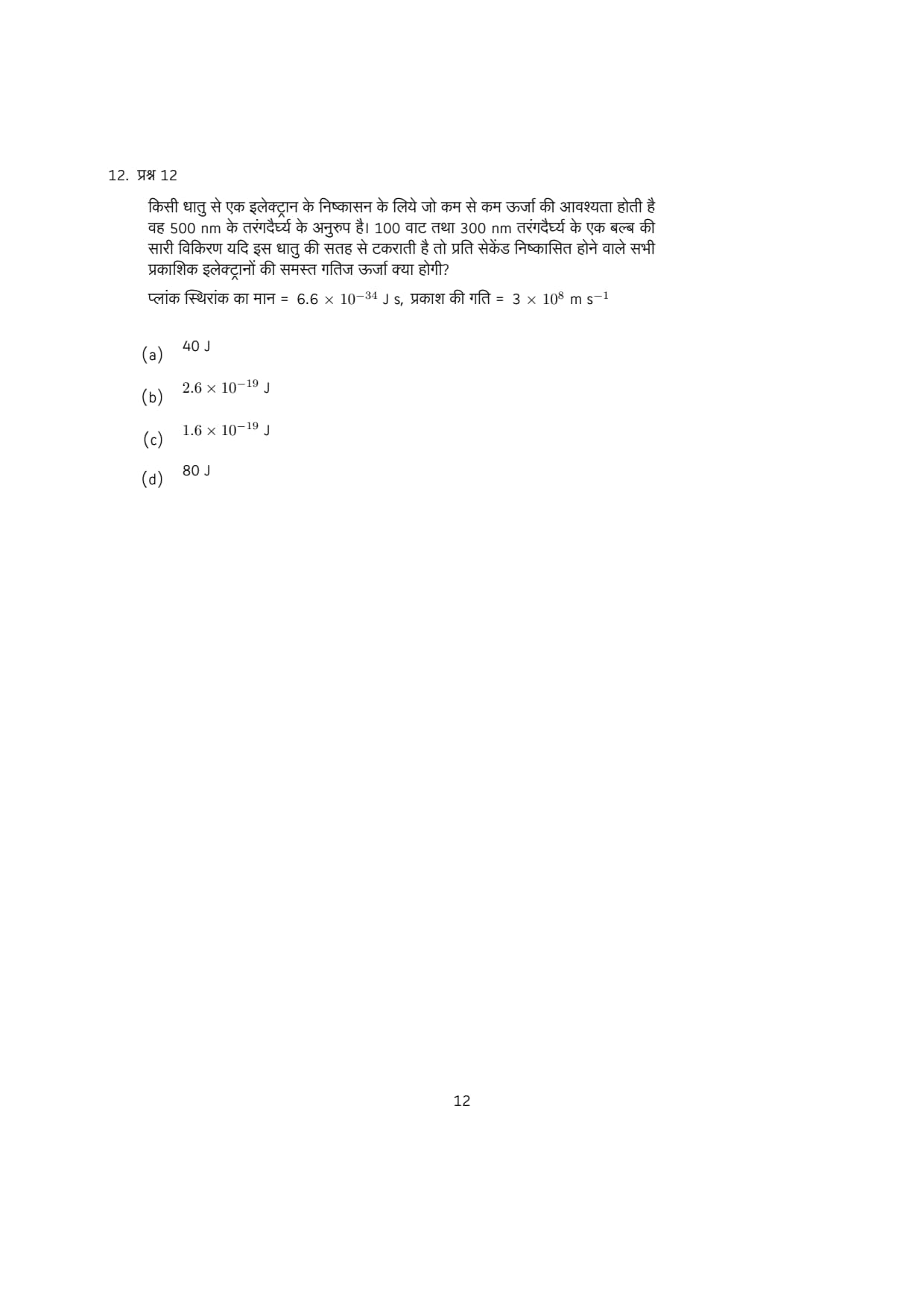
The minimum energy needed to remove an electron from a metal corresponds to a wavelength of 500 nm. What is the total kinetic energy of all the photoelectrons ejected per second when the entire radiation from a 100 Watt bulb with a wavelength of 300 nm falls on the surface of the metal?
Planck’s constant = 6.6 \(\times 10^{-34}\) J s; speed of light = 3 \(\times 10^8\) m s\(^{-1}\)
View Solution
Step 1: Understanding the Question:
This is a problem based on the photoelectric effect. We are given the threshold wavelength (\(\lambda_0 = 500 nm\)) and the incident light wavelength (\(\lambda = 300 nm\)). We need to calculate the total kinetic energy of all photoelectrons ejected per second when the metal is illuminated by a 100 Watt source.
Step 2: Key Formula or Approach:
1. The energy of a single incident photon is:
\[ E = \frac{hc}{\lambda} \]
2. The threshold energy (work function, \(W_0\)) of the metal is:
\[ W_0 = \frac{hc}{\lambda_0} \]
3. The kinetic energy of a single ejected photoelectron is:
\[ KE_{single} = E - W_0 = hc \left( \frac{1}{\lambda} - \frac{1}{\lambda_0} \right) \]
4. The power of the bulb is \(P = 100 W = 100 J/s\). This is the total incident energy per second.
5. The number of photons falling on the metal per second is:
\[ N = \frac{P}{E} \]
6. Assuming every photon with \(E > W_0\) ejects one photoelectron, the total kinetic energy of all photoelectrons ejected per second is:
\[ KE_{total} = N \times KE_{single} = \frac{P}{E} \times (E - W_0) = P \left( 1 - \frac{W_0}{E} \right) \]
Step 3: Detailed Explanation:
Let's simplify the ratio of work function to photon energy:
\[ \frac{W_0}{E} = \frac{\frac{hc}{\lambda_0}}{\frac{hc}{\lambda}} = \frac{\lambda}{\lambda_0} \]
Substitute the given wavelengths into this ratio:
\[ \frac{W_0}{E} = \frac{300 nm}{500 nm} = 0.6 \]
Now, substitute this ratio into our formula for total kinetic energy per second:
\[ KE_{total} = P \left( 1 - \frac{\lambda}{\lambda_0} \right) \]
Given the power \(P = 100 W\):
\[ KE_{total} = 100 J/s \times (1 - 0.6) \]
\[ KE_{total} = 100 \times 0.4 = 40 J/s \]
Thus, the total kinetic energy of all photoelectrons ejected in one second is 40 Joules.
Step 4: Final Answer:
The total kinetic energy of the ejected photoelectrons per second is 40 J, which corresponds to option (A).
Quick Tip: Using the ratio \(\frac{KE_{total}}{P} = 1 - \frac{\lambda}{\lambda_0}\) bypasses all tedious calculations involving Planck's constant and the speed of light.
This shortcut is extremely powerful and saves invaluable time during exams!
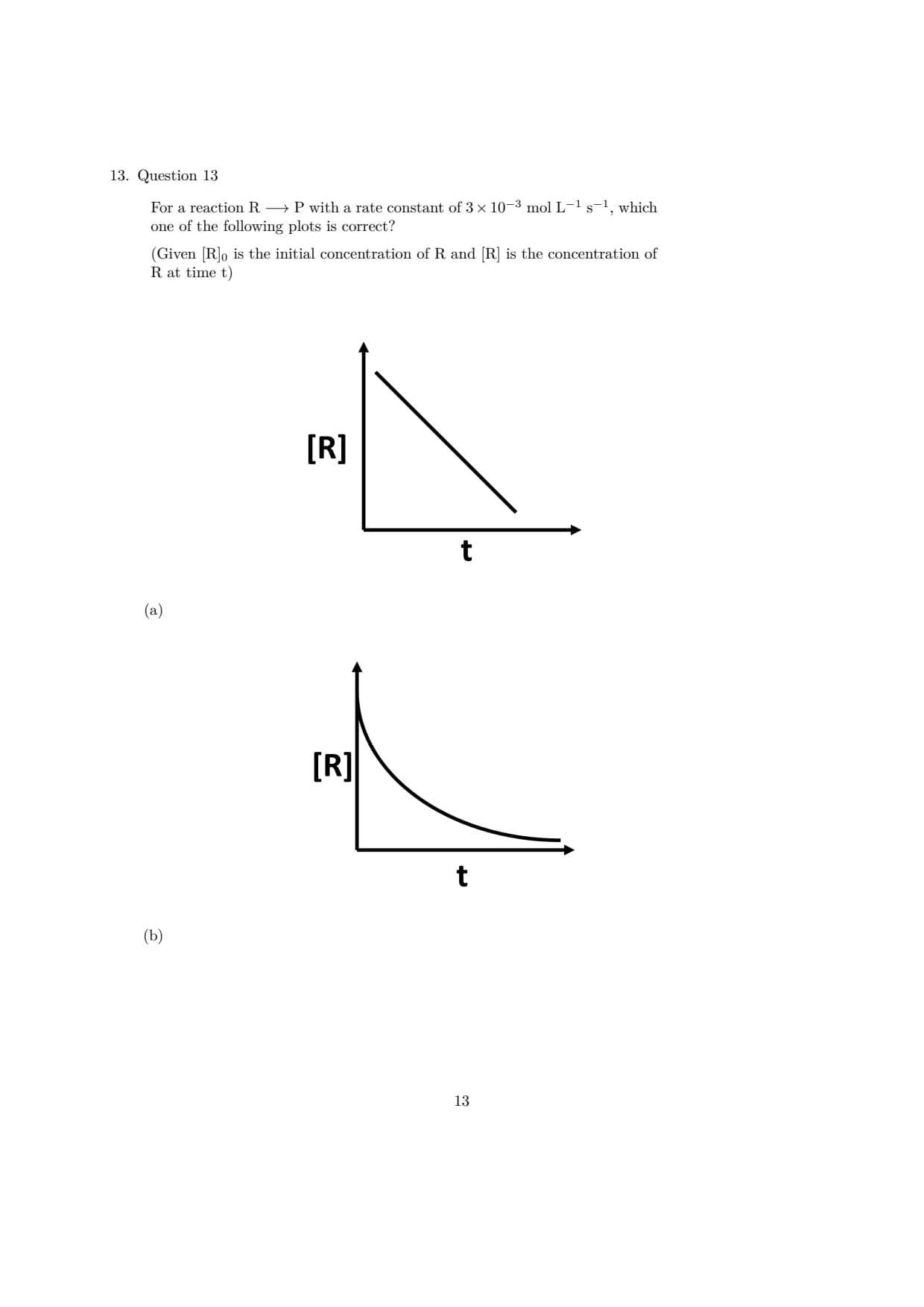
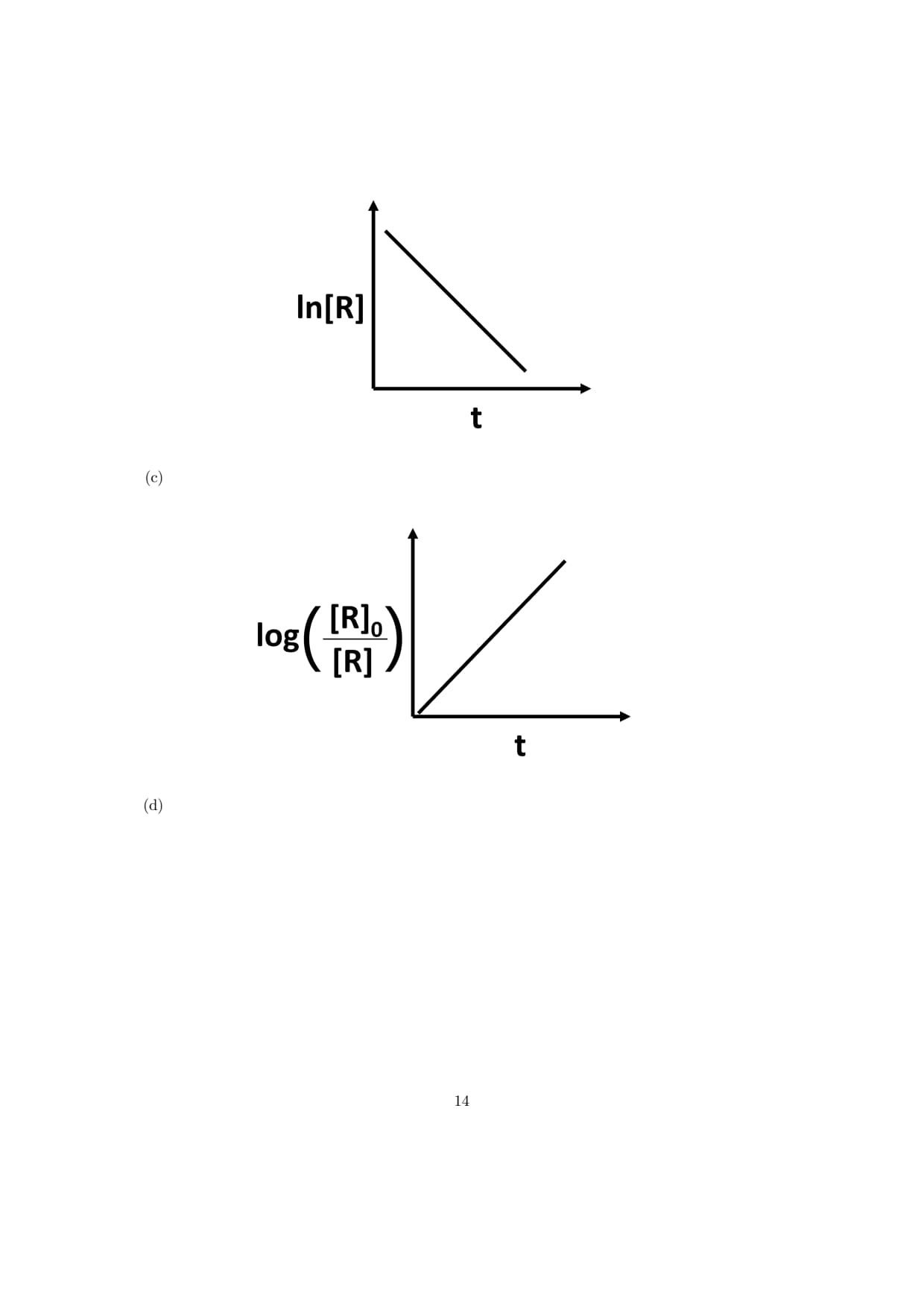
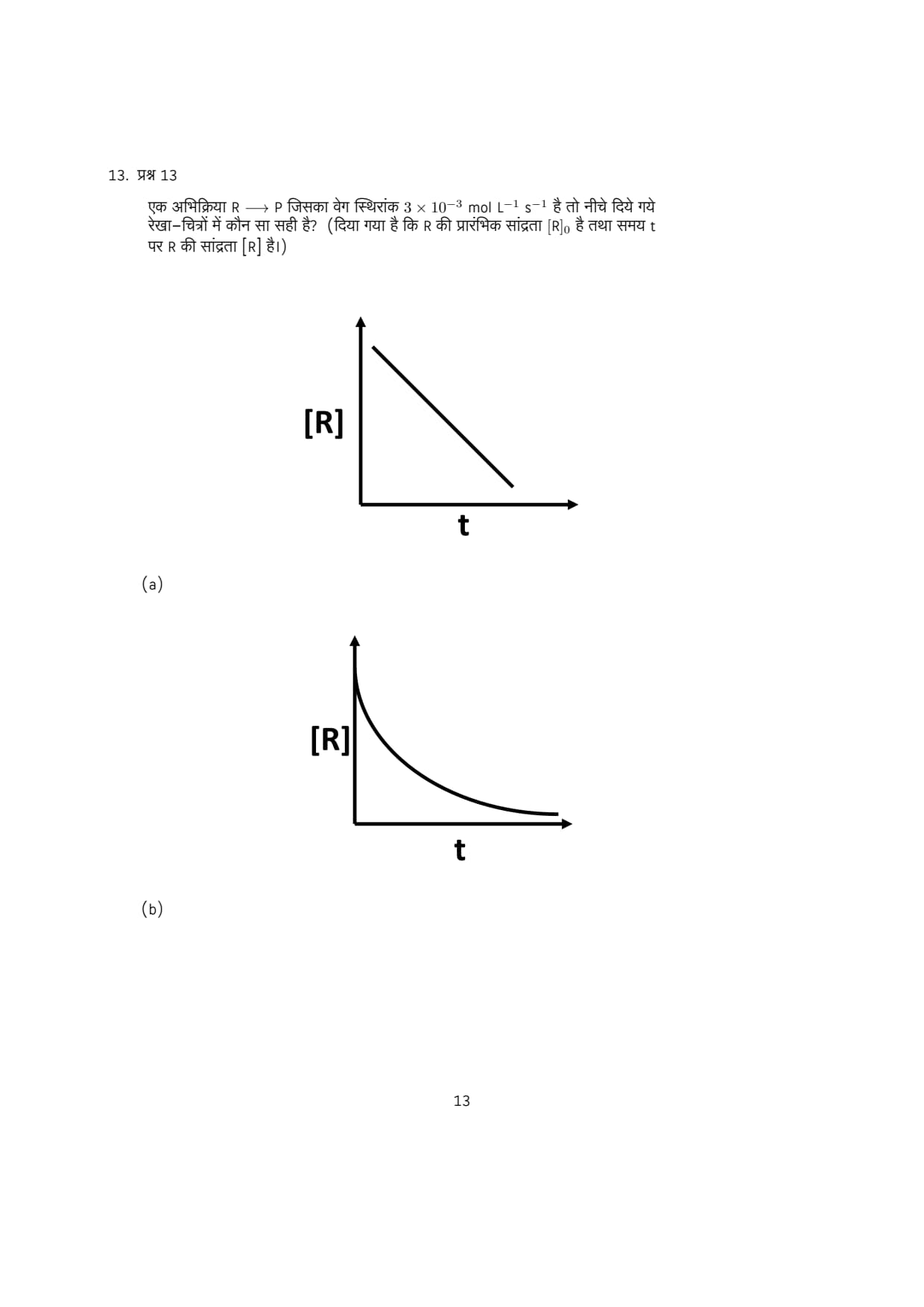
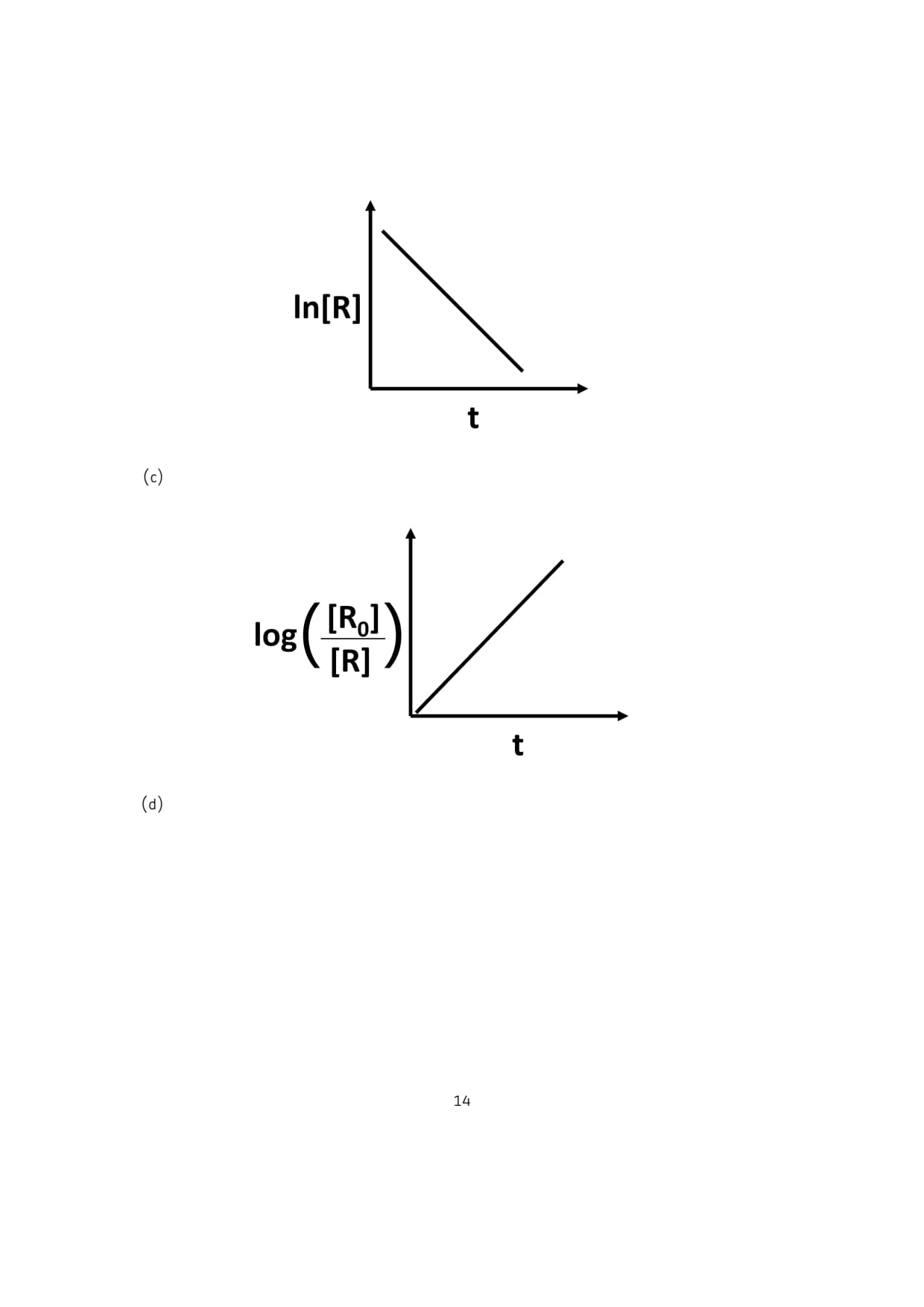
For a reaction R \(\longrightarrow\) P with a rate constant of 3 \(\times 10^{-3}\) mol L\(^{-1}\) s\(^{-1}\), which one of the following plots is correct?
- (A)
![]()
- (B)
![]()
- (C)
![]()
- (D)
![]()


View Solution
Step 1: Understanding the Question:
The question asks us to identify the correct concentration-time plot for a given chemical reaction \(R \rightarrow P\) with a rate constant \(k = 3 \times 10^{-3} mol L^{-1} s^{-1}\).
Step 2: Key Formula or Approach:
We must first determine the order of the reaction by looking at the units of the rate constant \(k\):
1. The unit of a rate constant is given by:
\[ Unit of k = (mol L^{-1})^{1-n} s^{-1} \]
where \(n\) is the order of the reaction.
2. For the given rate constant, the unit is \(mol L^{-1} s^{-1}\), which corresponds to \(n = 0\) (a zero-order reaction).
Step 3: Detailed Explanation:
Let's analyze the integrated rate equation for a zero-order reaction:
- The rate of reaction is independent of the reactant concentration:
\[ -\frac{d[R]}{dt} = k \]
- Integrating both sides with respect to time \(t\):
\[ [R] = [R]_0 - kt \]
where \([R]_0\) is the initial concentration of reactant R at \(t = 0\), and \([R]\) is the concentration at time \(t\).
- This equation represents a straight line of the form \(y = mx + c\):
- \(y\)-axis: \([R]\)
- \(x\)-axis: \(t\)
- Slope (\(m\)): \(-k\) (negative constant slope)
- Intercept (\(c\)): \([R]_0\)
- Therefore, a plot of \([R]\) versus \(t\) must be a straight line with a downward slope.
- Comparing with the given choices:
- Plot (a) shows a straight line with a negative slope for \([R]\) vs \(t\). This matches the zero-order kinetics perfectly.
- Plot (b), (c), and (d) represent first-order reaction graphs (exponential decay, \(\ln[R]\) vs \(t\) linear, and \(\log([R]_0/[R])\) vs \(t\) linear, respectively).
Step 4: Final Answer:
Plot (a) represents the correct graph for this zero-order reaction, which corresponds to option (A).
Quick Tip: Always check the units of the rate constant \(k\) first:
- \(mol L^{-1} s^{-1}\) \(\to\) Zero order \(\to\) \([R]\) vs \(t\) is linear.
- \(s^{-1}\) \(\to\) First order \(\to\) \(\ln[R]\) vs \(t\) is linear.
This basic diagnostic step avoids any confusion.
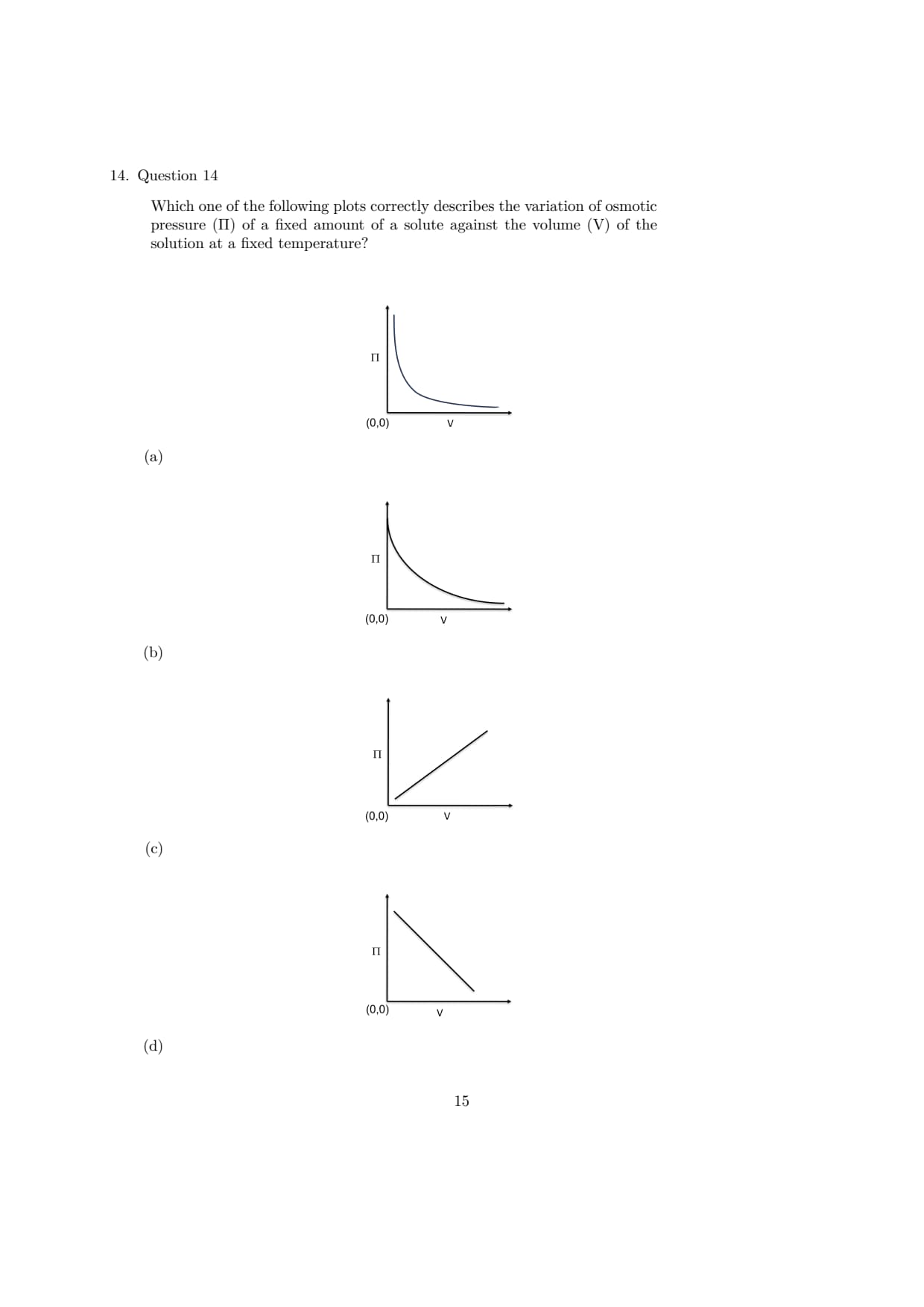
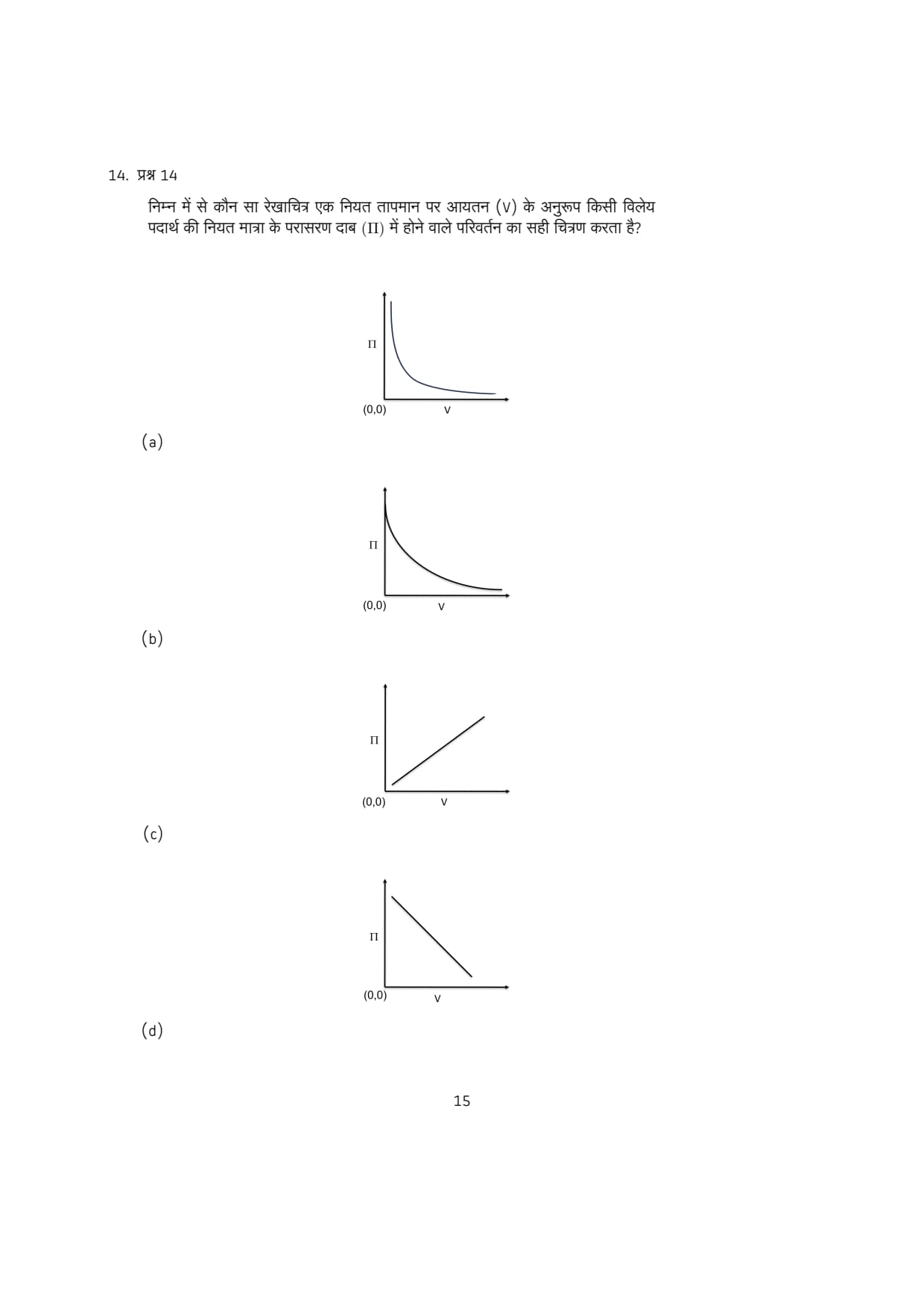
Which one of the following plots correctly describes the variation of osmotic pressure (H) of a fixed amount of a solute against the volume (V) of the solution at a fixed temperature?
- (A)
![]()
- (B)
![]()
- (C)
![]()
- (D)
![]()


View Solution
Step 1: Understanding the Question:
The question asks us to identify the graph that correctly represents the relationship between the osmotic pressure (\(\Pi\)) of a solution and its volume (\(V\)) for a fixed amount of solute at a constant temperature.
Step 2: Key Formula or Approach:
The osmotic pressure of a dilute solution is given by the van 't Hoff equation:
\[ \Pi = CRT \]
where:
- \(C\) is the molar concentration of the solute (\(C = \frac{n}{V}\)).
- \(n\) is the number of moles of solute (fixed amount).
- \(R\) is the gas constant.
- \(T\) is the absolute temperature (fixed temperature).
Step 3: Detailed Explanation:
Let's substitute the concentration formula into the osmotic pressure equation:
\[ \Pi = \frac{n}{V} RT \]
Since \(n\), \(R\), and \(T\) are all constant, we can write:
\[ \Pi \cdot V = nRT = constant \]
This equation is mathematically analogous to Boyle's law for ideal gases (\(P \cdot V = constant\)).
- The relationship between \(\Pi\) and \(V\) is inversely proportional:
\[ \Pi \propto \frac{1}{V} \]
- A plot of \(\Pi\) against \(V\) will yield a rectangular hyperbola.
- In a rectangular hyperbola:
- As \(V \rightarrow 0\), \(\Pi \rightarrow \infty\).
- As \(V \rightarrow \infty\), \(\Pi \rightarrow 0\).
- The curve approaches but never actually touches either the vertical (\(\Pi\)) or horizontal (\(V\)) axis (it is asymptotic to the axes).
- Let's evaluate the given plots:
- Plot (a) shows a perfect rectangular hyperbola that is asymptotic to both axes.
- Plot (b) shows a curve that erroneously intersects or touches the axes.
- Plot (c) and (d) show straight lines, which do not represent an inverse relationship.
Step 4: Final Answer:
The correct graph is represented by Plot (a), which corresponds to option (A).
Quick Tip: Whenever two variables \(y\) and \(x\) satisfy \(y \cdot x = constant\), their graph is always a rectangular hyperbola asymptotic to the axes.
This is a standard mathematical rule applicable across physics and chemistry.
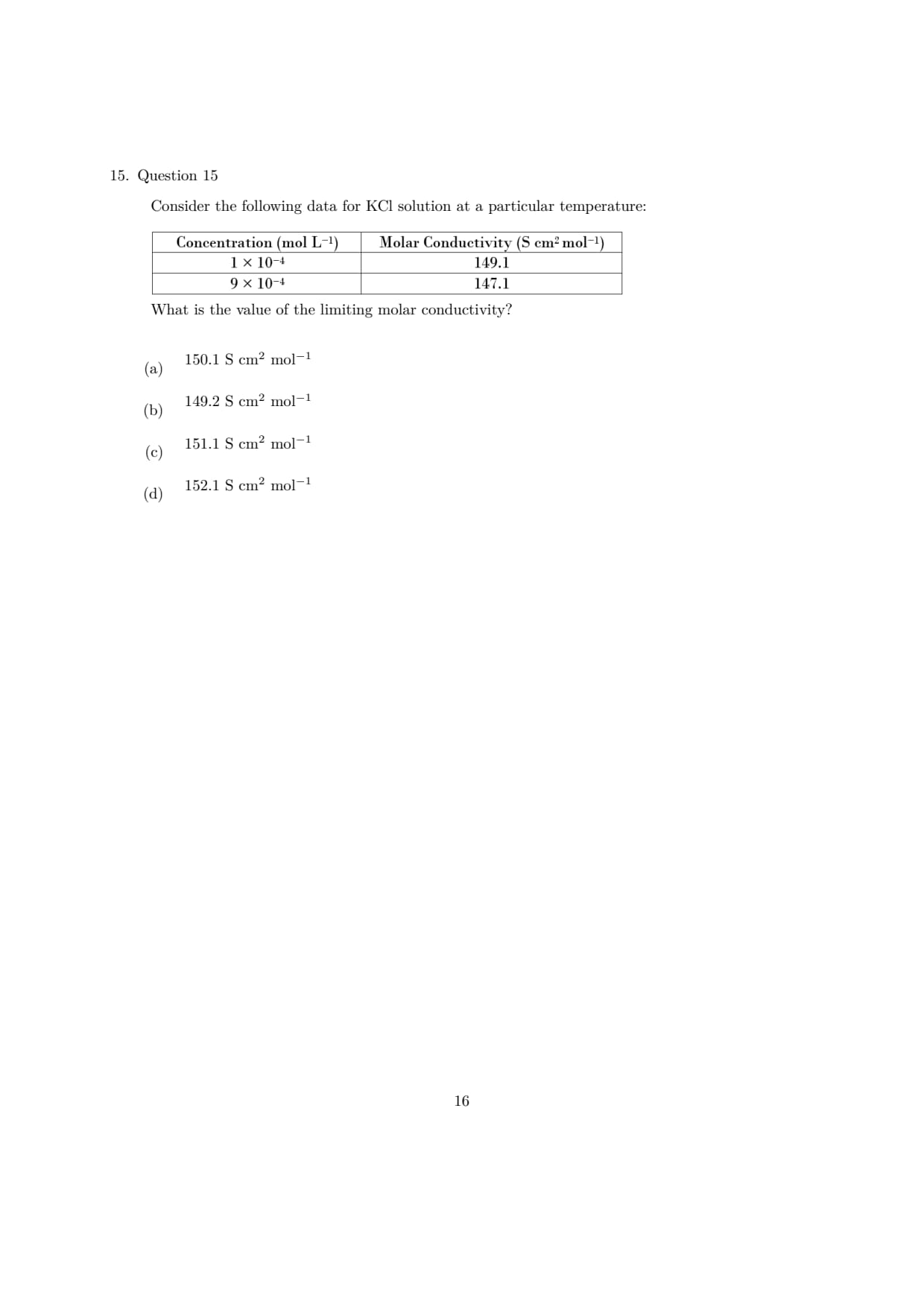
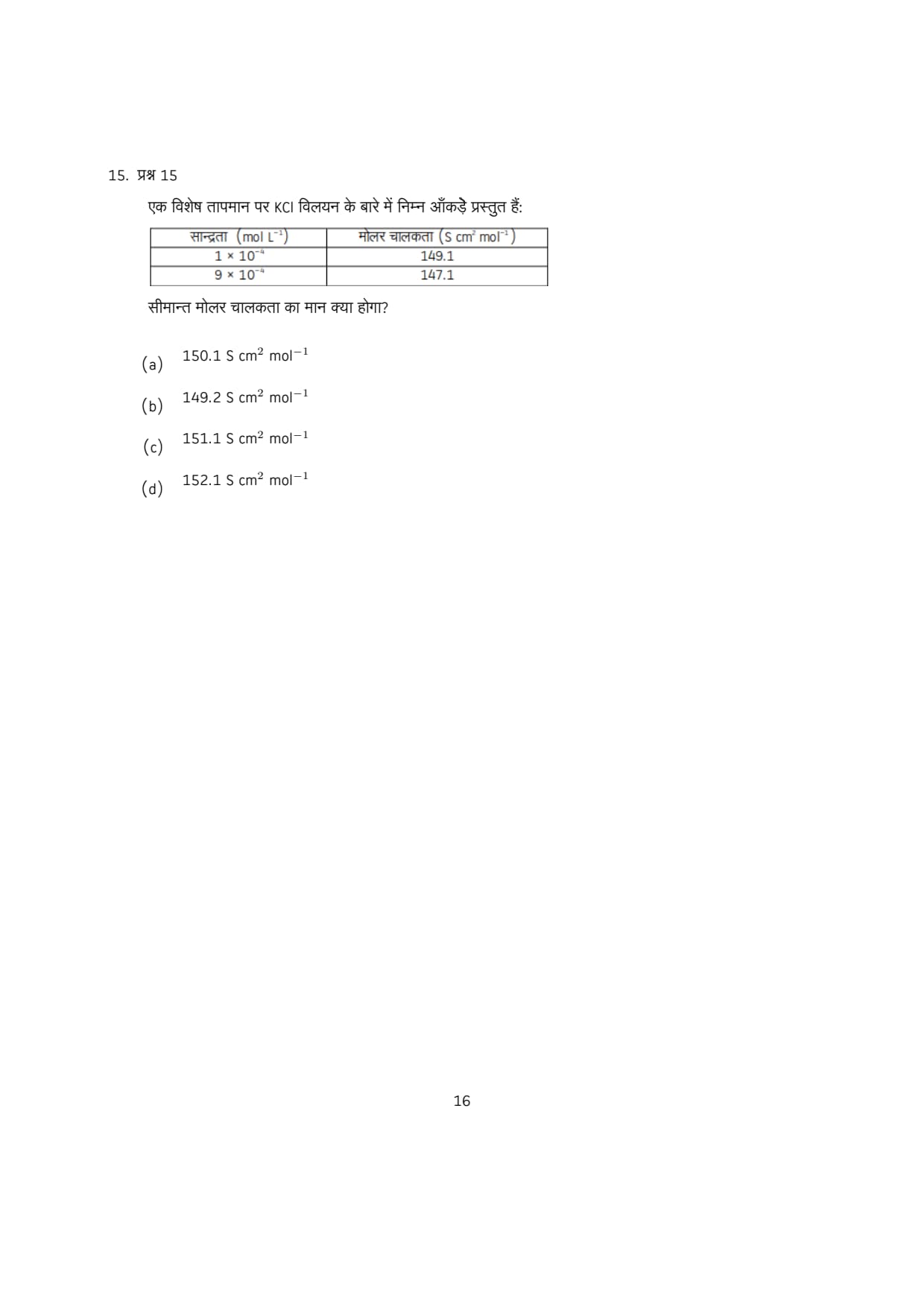
Consider the following data for KCl solution at a particular temperature:

What is the value of the limiting molar conductivity?
View Solution
Step 1: Understanding the Question:
The question provides two data points of concentration and molar conductivity for a strong electrolyte (\(KCl\)) solution and asks us to calculate its limiting molar conductivity (\(\Lambda_m^\circ\)).
Step 2: Key Formula or Approach:
For a strong electrolyte like \(KCl\), the variation of molar conductivity (\(\Lambda_m\)) with concentration (\(C\)) is given by the Debye-Hückel-Onsager equation:
\[ \Lambda_m = \Lambda_m^\circ - A \sqrt{C} \]
where:
- \(\Lambda_m^\circ\) is the limiting molar conductivity.
- \(A\) is a constant.
- \(C\) is the concentration.
Step 3: Detailed Explanation:
Let's plug the two data points into the Debye-Hückel-Onsager equation:
1. For the first concentration \(C_1 = 1 \times 10^{-4} mol L^{-1}\):
- Molar conductivity \(\Lambda_{m,1} = 149.1 S cm^2 mol^{-1}\).
- Calculate \(\sqrt{C_1}\):
\[ \sqrt{C_1} = \sqrt{1 \times 10^{-4}} = 10^{-2} = 0.01 \]
- Substitute into the equation:
\[ 149.1 = \Lambda_m^\circ - A(0.01) \quad --- (Equation 1) \]
2. For the second concentration \(C_2 = 9 \times 10^{-4} mol L^{-1}\):
- Molar conductivity \(\Lambda_{m,2} = 147.1 S cm^2 mol^{-1}\).
- Calculate \(\sqrt{C_2}\):
\[ \sqrt{C_2} = \sqrt{9 \times 10^{-4}} = 3 \times 10^{-2} = 0.03 \]
- Substitute into the equation:
\[ 147.1 = \Lambda_m^\circ - A(0.03) \quad --- (Equation 2) \]
3. Solving the system of equations:
- Subtract Equation 2 from Equation 1:
\[ 149.1 - 147.1 = [\Lambda_m^\circ - A(0.01)] - [\Lambda_m^\circ - A(0.03)] \]
\[ 2.0 = A(0.03 - 0.01) \]
\[ 2.0 = A(0.02) \]
\[ A = \frac{2.0}{0.02} = 100 \]
- Substitute the value of \(A = 100\) back into Equation 1 to find \(\Lambda_m^\circ\):
\[ 149.1 = \Lambda_m^\circ - 100(0.01) \]
\[ 149.1 = \Lambda_m^\circ - 1.0 \]
\[ \Lambda_m^\circ = 149.1 + 1.0 = 150.1 S cm^2 mol^{-1} \]
Step 4: Final Answer:
The limiting molar conductivity of the \(KCl\) solution is \(150.1 S cm^2 mol^{-1}\), which corresponds to option (A).
Quick Tip: The Debye-Hückel-Onsager plot is linear with \(\sqrt{C}\) on the x-axis.
Always convert the concentration \(C\) to \(\sqrt{C}\) before doing calculations, as using \(C\) directly is a common mistake in this type of problem.
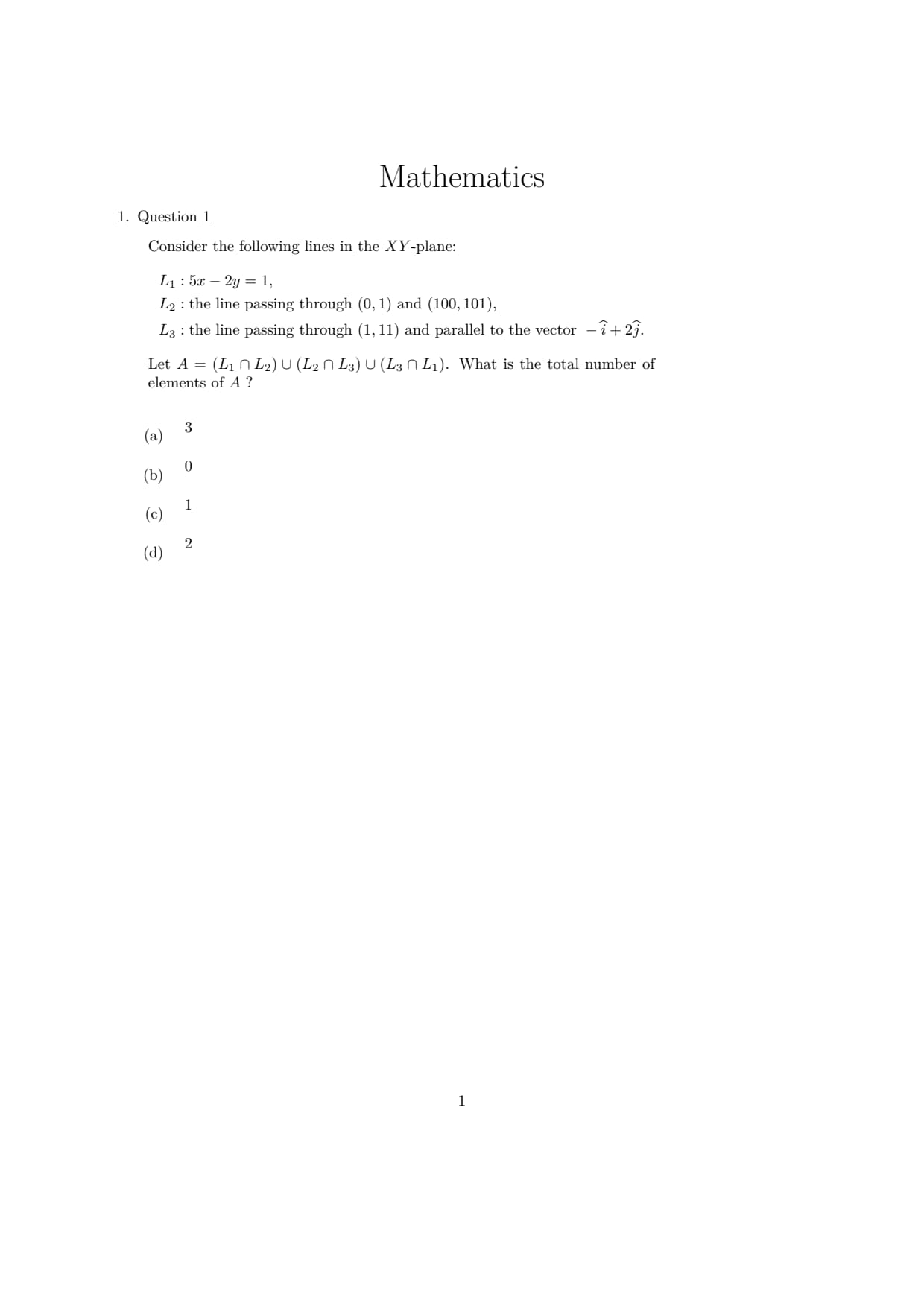
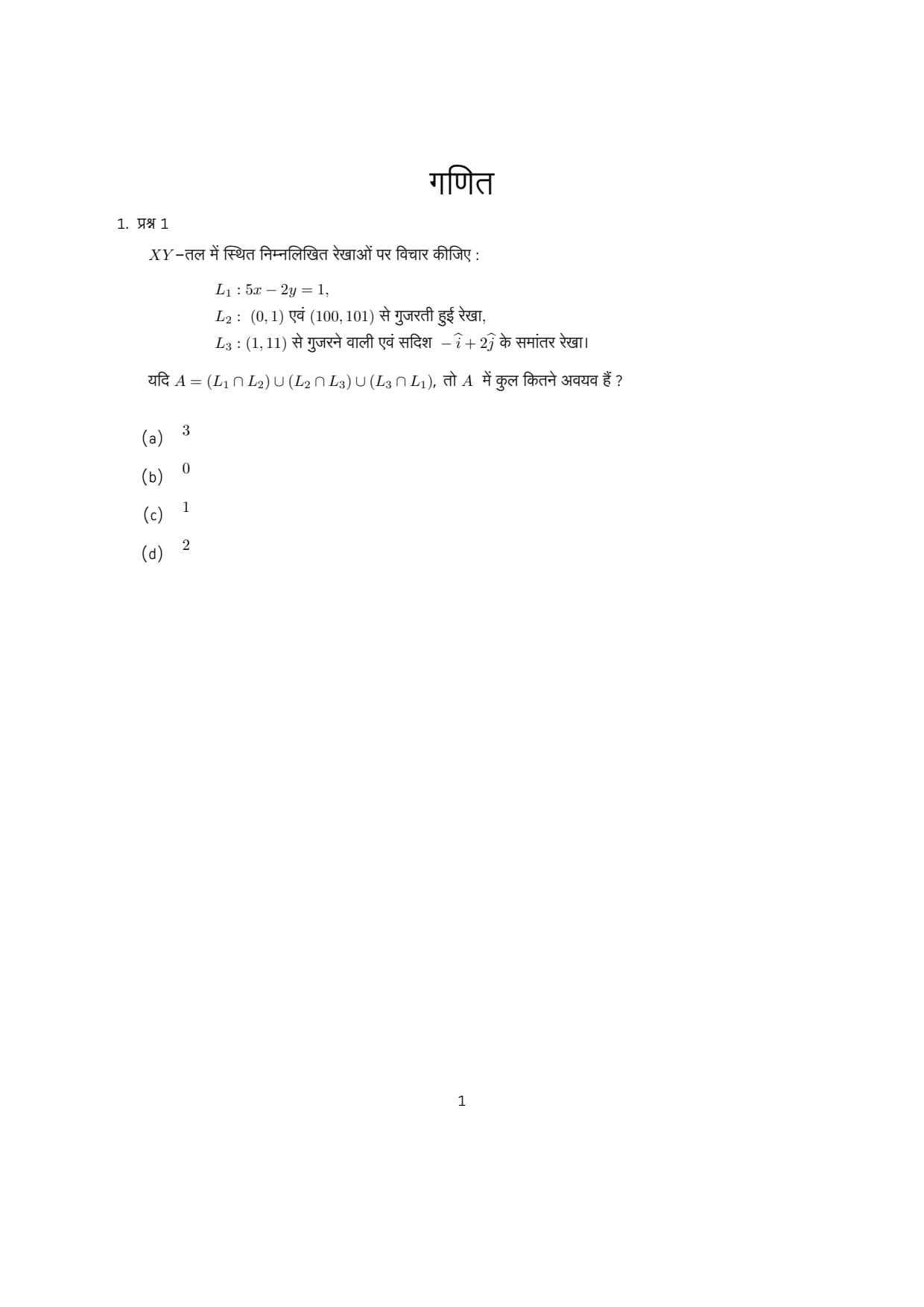
Consider the following lines in the \(XY\)-plane:
\(L_1 : 5x - 2y = 1\),
\(L_2 :\) the line passing through \((0, 1)\) and \((100, 101)\),
\(L_3 :\) the line passing through \((1, 11)\) and parallel to the vector \(-\hat{i} + 2\hat{j}\).
Let \(A = (L_1 \cap L_2) \cup (L_2 \cap L_3) \cup (L_3 \cap L_1)\). What is the total number of elements of \(A\)?
View Solution
Step 1 : Understanding the Question:
In this problem, we are given three distinct straight lines, \(L_1\)., \(L_2\)., and \(L_3\). in the Cartesian plane.
The set \(A\) is defined as the union of the pairwise intersection points of these three lines.
Specifically, \(A\) contains all points where at least two of these lines intersect.
We need to determine the cardinality of \(A\)., which is the total number of unique intersection points.
Step 2 : Key Formula or Approach:
First, we determine the explicit equations of all three lines.
The slope of a line passing through \((x_1, y_1)\) and \((x_2, y_2)\) is given by \(m = \frac{y_2 - y_1}{x_2 - x_1}\).
The slope-intercept form or point-slope form is used to write down the equation of the line.
If the slopes of the three lines are distinct, then no two lines are parallel, and they will intersect pairwise in exactly three points unless they are concurrent.
If they are concurrent, they intersect at a single common point, and the cardinality of \(A\) would be 1.
Step 3 : Detailed Explanation:
Let us find the equation and slope of each line:
The equation of the first line is:
\[ L_1: 5x - 2y = 1 \]
The slope of \(L_1\) is \(m_1 = \frac{5}{2} = 2.5\).
The second line \(L_2\) passes through the points \((0, 1)\) and \((100, 101)\).
The slope of \(L_2\) is:
\[ m_2 = \frac{101 - 1}{100 - 0} = \frac{100}{100} = 1 \]
Using the point-slope form with point \((0, 1)\)., the equation of \(L_2\) is:
\[ y - 1 = 1(x - 0) \implies x - y = -1 \]
The third line \(L_3\) passes through \((1, 11)\) and is parallel to the vector \(-\hat{i} + 2\hat{j}\).
The slope of \(L_3\) is:
\[ m_3 = \frac{2}{-1} = -2 \]
Using the point-slope form with point \((1, 11)\)., the equation of \(L_3\) is:
\[ y - 11 = -2(x - 1) \implies y - 11 = -2x + 2 \implies 2x + y = 13 \]
Let us analyze the slopes of the three lines:
\[ m_1 = \frac{5}{2}, \quad m_2 = 1, \quad m_3 = -2 \]
Since all three slopes are distinct, no two lines are parallel.
This guarantees that each pair of lines has exactly one unique intersection point.
Now, we check if the three lines are concurrent by finding the intersection of \(L_2\) and \(L_3\) and checking if it lies on \(L_1\).
From the equation of \(L_2\)., we have:
\[ y = x + 1 \]
Substitute this into the equation of \(L_3\):
\[ 2x + (x + 1) = 13 \implies 3x + 1 = 13 \implies 3x = 12 \implies x = 4 \]
Then, the corresponding \(y\)-coordinate is:
\[ y = 4 + 1 = 5 \]
Thus, \(L_2 \cap L_3 = \{(4, 5)\}\).
We substitute this point into the equation of \(L_1\):
\[ 5(4) - 2(5) = 20 - 10 = 10 \neq 1 \]
Since the point \((4, 5)\) does not satisfy the equation of \(L_1\)., the three lines are not concurrent.
Therefore, the three pairwise intersection points:
\[ P_{12} = L_1 \cap L_2, \quad P_{23} = L_2 \cap L_3, \quad P_{31} = L_3 \cap L_1 \]
are distinct.
Consequently, the set \(A = \{P_{12}, P_{23}, P_{31}\}\) has exactly 3 elements.
Step 4 : Final Answer:
The total number of elements of \(A\) is 3.
This corresponds to option (A).
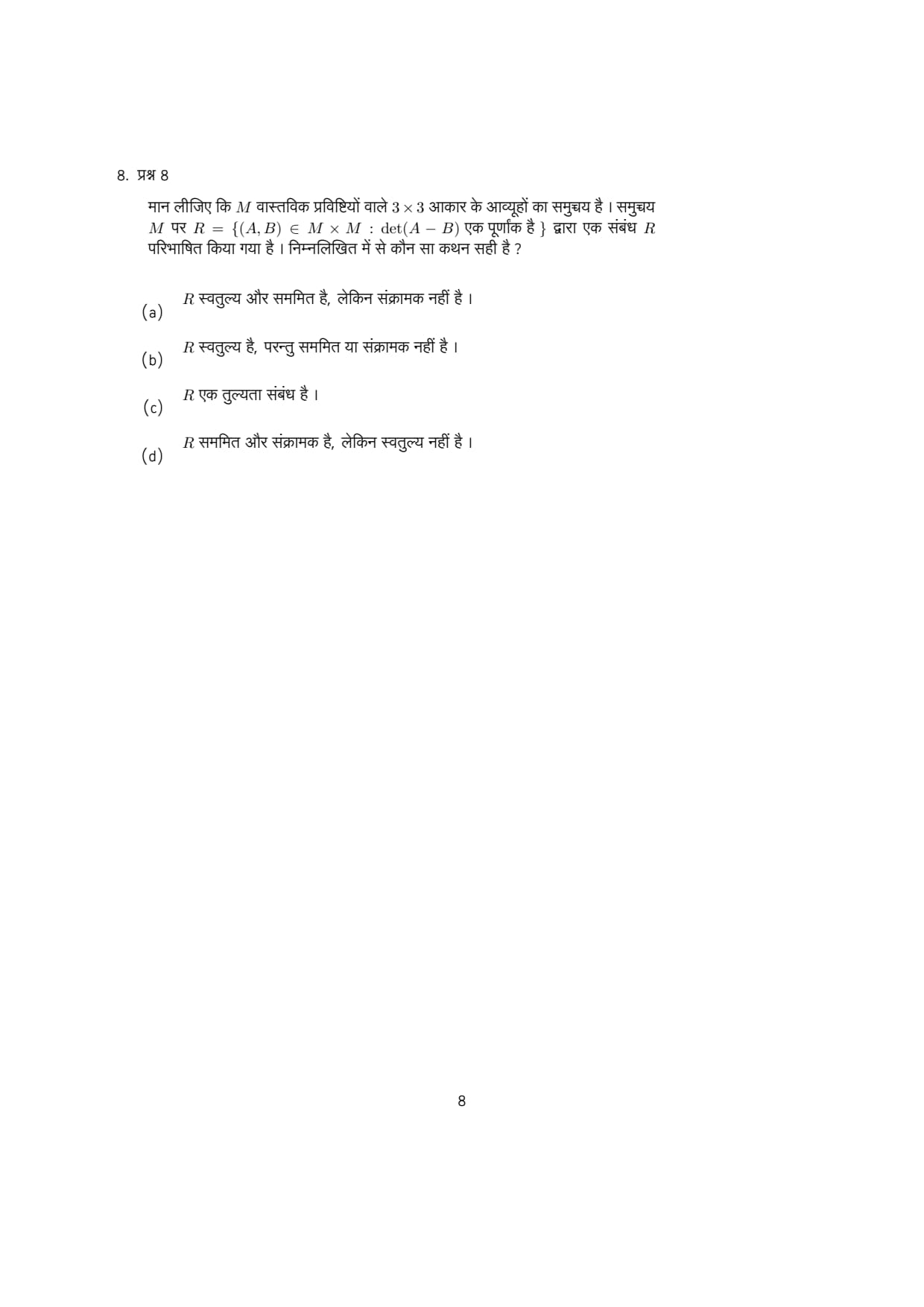
Quick Tip: If the slopes of three lines are all distinct, they are not parallel.
They will form a triangle with exactly 3 intersection points unless they are concurrent.
Simply finding the intersection of two lines and verifying if it lies on the third is a highly efficient way to confirm non-concurrency.
Let \(A\) be the set of points in the \(XY\)-plane which are equidistant from \(P(-1, 0)\) and \(Q(1, 0)\). Let \(B\) be the set of points in the \(XY\)-plane which are equidistant from \(A\) and \(Q\). If \((5, y)\) is a point in \(B\), then what is the value of \(y^2\)?
View Solution
Step 1 : Understanding the Question:
In this question, we need to find the locus of two sets of points.
First, the set \(A\) is defined as the set of points equidistant from two fixed points \(P(-1, 0)\) and \(Q(1, 0)\).
Second, the set \(B\) is the set of points equidistant from the set \(A\) (which will be a line) and the point \(Q(1, 0)\).
Once the equation representing set \(B\) is obtained, we substitute \(x = 5\) to find the value of \(y^2\).
Step 2 : Key Formula or Approach:
The locus of points equidistant from two fixed points is the perpendicular bisector of the line segment joining them.
The distance from a point \((x_0, y_0)\) to a line \(ax + by + c = 0\) is given by:
\[ d = \frac{|ax_0 + by_0 + c|}{\sqrt{a^2 + b^2}} \]
The distance between two points \((x_1, y_1)\) and \((x_2, y_2)\) is given by:
\[ d = \sqrt{(x_2 - x_1)^2 + (y_2 - y_1)^2} \]
Equating the two distances gives the locus of set \(B\).
Step 3 : Detailed Explanation:
Let us find the set \(A\) first.
The points \(P(-1, 0)\) and \(Q(1, 0)\) lie on the \(X\)-axis.
The midpoint of the segment \(PQ\) is:
\[ M = \left( \frac{-1 + 1}{2}, \frac{0 + 0}{2} \right) = (0, 0) \]
Since the segment \(PQ\) lies on the \(X\)-axis, its perpendicular bisector is the \(Y\)-axis.
Thus, set \(A\) is the line with the equation:
\[ x = 0 \]
Now, let us find the set \(B\).
Let a point in the set \(B\) be denoted by \((x, y)\).
The distance from \((x, y)\) to the line \(A\) (the \(Y\)-axis, \(x = 0\)) is:
\[ d_1 = |x| \]
The distance from \((x, y)\) to the point \(Q(1, 0)\) is:
\[ d_2 = \sqrt{(x - 1)^2 + (y - 0)^2} = \sqrt{(x - 1)^2 + y^2} \]
Since the points in \(B\) are equidistant from \(A\) and \(Q\)., we have:
\[ d_1 = d_2 \implies |x| = \sqrt{(x - 1)^2 + y^2} \]
Squaring both sides of the equation:
\[ x^2 = (x - 1)^2 + y^2 \]
\[ x^2 = x^2 - 2x + 1 + y^2 \]
\[ 0 = -2x + 1 + y^2 \implies y^2 = 2x - 1 \]
This equation represents a parabola.
We are given that the point \((5, y)\) lies in the set \(B\).
Substituting \(x = 5\) into the equation of the locus \(B\):
\[ y^2 = 2(5) - 1 \]
\[ y^2 = 10 - 1 = 9 \]
Therefore, the value of \(y^2\) is 9.
Step 4 : Final Answer:
The value of \(y^2\) is 9.
This corresponds to option (A).
Quick Tip: The definition of set \(B\) is equivalent to the definition of a parabola.
The line \(x = 0\) acts as the directrix, and the point \(Q(1, 0)\) acts as the focus.
Remember that the standard equation of a parabola with focus \((a, 0)\) and directrix \(x = -a\) is \(y^2 = 4ax\).
Shifting the coordinates appropriately gives \(y^2 = 2x - 1\) directly.
Consider the lines \(L_1\) and \(L_2\) given below:
\(L_1 : x = 2 + \lambda, \quad y = 3 + 2\lambda, \quad z = 4 + 3\lambda\);
\(L_2 : x = 4 + \lambda, \quad y = 4, \quad z = 4 + \lambda\).
If \((2, 3, 4)\) is the point of \(L_1\) that is closest to \(L_2\), then which point of \(L_2\) is closest to \(L_1\)?
View Solution
Step 1 : Understanding the Question:
We are given two skew lines in three-dimensional space, \(L_1\) and \(L_2\).
We are given the point \(P_1(2, 3, 4)\) on the line \(L_1\) which is closest to \(L_2\).
We need to find the point \(P_2\) on the line \(L_2\) which is closest to \(L_1\).
Step 2 : Key Formula or Approach:
The line segment joining the closest points on two skew lines is perpendicular to both lines.
Thus, the vector \(\vec{P_1P_2}\) connecting the closest point \(P_1\) on \(L_1\) to the closest point \(P_2\) on \(L_2\) must be perpendicular to the direction vector of \(L_2\).
The direction vector of \(L_2\) is obtained from the coefficients of the parameter in the equation of \(L_2\).
If two vectors \(\vec{u}\) and \(\vec{v}\) are perpendicular, their dot product is zero: \(\vec{u} \cdot \vec{v} = 0\).
Step 3 : Detailed Explanation:
Let us write down the parametric equations of the lines:
For \(L_1\):
\[ x = 2 + \lambda, \quad y = 3 + 2\lambda, \quad z = 4 + 3\lambda \]
The direction vector of \(L_1\) is \(\vec{d}_1 = (1, 2, 3)\).
The point \(P_1(2, 3, 4)\) corresponds to \(\lambda = 0\) on \(L_1\).
For \(L_2\):
\[ x = 4 + \mu, \quad y = 4, \quad z = 4 + \mu \]
where we use \(\mu\) as the parameter to avoid confusion with \(\lambda\).
The direction vector of \(L_2\) is \(\vec{d}_2 = (1, 0, 1)\).
Any arbitrary point \(P_2\) on \(L_2\) can be written as:
\[ P_2 = (4 + \mu, 4, 4 + \mu) \]
Let us find the vector connecting \(P_1(2, 3, 4)\) and \(P_2\):
\[ \vec{P_1P_2} = P_2 - P_1 = (4 + \mu - 2, 4 - 3, 4 + \mu - 4) = (2 + \mu, 1, \mu) \]
Since \(P_1\) and \(P_2\) are the closest points, the vector \(\vec{P_1P_2}\) must be perpendicular to the direction vector of \(L_2\).
Therefore:
\[ \vec{P_1P_2} \cdot \vec{d}_2 = 0 \]
\[ (2 + \mu)(1) + (1)(0) + (\mu)(1) = 0 \]
\[ 2 + \mu + \mu = 0 \implies 2\mu = -2 \implies \mu = -1 \]
Now, substitute \(\mu = -1\) into the coordinates of \(P_2\):
\[ P_2 = (4 - 1, 4, 4 - 1) = (3, 4, 3) \]
Let us also verify if \(\vec{P_1P_2}\) is perpendicular to the direction vector of \(L_1\):
For \(\mu = -1\)., the vector is \(\vec{P_1P_2} = (1, 1, -1)\).
The dot product with \(\vec{d}_1 = (1, 2, 3)\) is:
\[ \vec{P_1P_2} \cdot \vec{d}_1 = 1(1) + 1(2) - 1(3) = 1 + 2 - 3 = 0 \]
Since the vector is perpendicular to both lines, \((3, 4, 3)\) is indeed the unique closest point.
Step 4 : Final Answer:
The point on \(L_2\) closest to \(L_1\) is \((3, 4, 3)\).
This corresponds to option (A).
Quick Tip: The shortest distance vector between two skew lines is always perpendicular to the direction vectors of both lines.
Finding the dot product of the parametric vector with the direction vector of the second line is a robust and straightforward way to find the unknown parameter.
Let \(a_1, a_2, a_3, \dots\) be a sequence of real numbers. Let \(s_n = a_1 + a_2 + \dots + a_n\).
If \(2s_n = n(c + a_n)\) for some real number \(c\) and for all \(n = 1, 2, 3, \dots\), then which one of the following statements is Correct?
View Solution
Step 1 : Understanding the Question:
We are given a sequence of real numbers \(a_n\) and its sum of the first \(n\) terms, \(s_n\).
We are given the relation \(2s_n = n(c + a_n)\) for all \(n \ge 1\)., where \(c\) is a real constant.
We need to determine the nature of the sequence \(a_n\) or a transformed sequence.
Step 2 : Key Formula or Approach:
The relationship between the term \(a_n\) and the sum of terms \(s_n\) is given by:
\[ s_n - s_{n-1} = a_n \quad for n \ge 2 \]
For \(n = 1\)., we have \(s_1 = a_1\).
By setting \(n = 1\)., we can find the value of the constant \(c\).
We then substitute this into the recurrence relations to establish the standard properties of the sequence.
Step 3 : Detailed Explanation:
Let us start by substituting \(n = 1\) into the given relation:
\[ 2s_1 = 1(c + a_1) \]
Since \(s_1 = a_1\)., we have:
\[ 2a_1 = c + a_1 \implies c = a_1 \]
Substituting \(c = a_1\) back into the general relation:
\[ 2s_n = n(a_1 + a_n) \implies s_n = \frac{n}{2}(a_1 + a_n) \]
This is precisely the formula for the sum of the first \(n\) terms of an Arithmetic Progression with the first term \(a_1\) and the \(n\)-th term \(a_n\).
To prove this mathematically, let us use the relation \(s_n - s_{n-1} = a_n\) for \(n \ge 2\):
\[ \frac{n}{2}(a_1 + a_n) - \frac{n-1}{2}(a_1 + a_{n-1}) = a_n \]
Multiplying by 2 on both sides:
\[ n(a_1 + a_n) - (n-1)(a_1 + a_{n-1}) = 2a_n \]
\[ n a_1 + n a_n - (n-1)a_1 - (n-1)a_{n-1} = 2a_n \]
Simplifying the terms:
\[ a_1 + n a_n - (n-1)a_{n-1} = 2a_n \]
\[ (n - 2)a_n = (n - 1)a_{n-1} - a_1 \]
Let us evaluate this for small values of \(n\):
For \(n = 3\):
\[ (3 - 2)a_3 = (3 - 1)a_2 - a_1 \implies a_3 = 2a_2 - a_1 \implies a_3 - a_2 = a_2 - a_1 \]
This shows that the difference between successive terms is constant. Let this common difference be \(d\).
Thus, \(a_2 = a_1 + d\) and \(a_3 = a_1 + 2d\).
For \(n = 4\):
\[ (4 - 2)a_4 = (4 - 1)a_3 - a_1 \implies 2a_4 = 3(a_1 + 2d) - a_1 = 2a_1 + 6d \implies a_4 = a_1 + 3d \]
By induction, \(a_n = a_1 + (n-1)d\) for all \(n \ge 1\).
Therefore, the sequence \(a_1, a_2, a_3, \dots\) is an Arithmetic Progression.
Step 4 : Final Answer:
The sequence \(a_1, a_2, a_3, \dots\) is an Arithmetic Progression.
This corresponds to option (A).
Quick Tip: The sum formula of an Arithmetic Progression is \(s_n = \frac{n}{2}(a_1 + a_n)\).
Recognizing this structure immediately when \(c = a_1\) saves significant algebraic effort.
Let \(f : \mathbb{R} \to \mathbb{R}\) be a strictly decreasing function with \(|f(t)| < \pi/2\) for all \(t \in \mathbb{R}\). Let \(g : [0, \pi] \to \mathbb{R}\) be a function defined by \(g(t) = \sin(f(t))\). Which one of the following statements is Correct?
View Solution
Step 1 : Understanding the Question:
We are given a strictly decreasing function \(f(t)\). on \(\mathbb{R}\). such that its values always lie within the open interval \((-\pi/2, \pi/2)\).
We are asked to determine the monotonicity of the function \(g(t) = \sin(f(t))\) on the interval \([0, \pi]\).
Step 2 : Key Formula or Approach:
The composition of two functions \(h(f(t))\) depends on the monotonicity of both functions.
If \(f\) is strictly decreasing, and \(h\) is strictly increasing on the range of \(f\)., then their composition \(h \circ f\) is strictly decreasing.
Alternatively, we can use the chain rule for differentiation if \(f\) is differentiable: \(g'(t) = \cos(f(t)) \cdot f'(t)\).
Step 3 : Detailed Explanation:
Let us use the definition of monotonicity:
Let \(t_1, t_2 \in [0, \pi]\) such that \(t_1 < t_2\).
Since the function \(f\) is strictly decreasing on \(\mathbb{R}\)., we have:
\[ f(t_1) > f(t_2) \]
We are given that \(|f(t)| < \pi/2\) for all \(t \in \mathbb{R}\)., which means:
\[ f(t_1), f(t_2) \in \left(-\frac{\pi}{2}, \frac{\pi}{2}\right) \]
Let us consider the sine function, \(h(x) = \sin(x)\).
The derivative of \(h(x)\) is \(h'(x) = \cos(x)\).
Since \(\cos(x) > 0\) for all \(x \in \left(-\frac{\pi}{2}, \frac{\pi}{2}\right)\)., the sine function is strictly increasing on this interval.
Since \(h(x) = \sin(x)\) is strictly increasing, it preserves the order of its inputs:
\[ \sin(f(t_1)) > \sin(f(t_2)) \]
This implies:
\[ g(t_1) > g(t_2) \]
Since \(t_1 < t_2 \implies g(t_1) > g(t_2)\)., the function \(g(t)\) is strictly decreasing on the entire interval \([0, \pi]\).
Step 4 : Final Answer:
The function \(g\) is decreasing on \([0, \pi]\).
This corresponds to option (A).
Quick Tip: Remember this simple composition rule:
Increasing \(\circ\) Decreasing = Decreasing.
Since \(\sin(x)\) is increasing on \((-\pi/2, \pi/2)\). and \(f(t)\) is decreasing, the composition is decreasing on the entire domain.
Let \(f, g : \mathbb{R} \to \mathbb{R}\) be functions. If \(g\) is continuous, then which one of the following cases implies that \(f\) is continuous?
View Solution
Step 1 : Understanding the Question:
We are given that \(g(x)\) is a continuous function. We need to find which relation between \(g(x)\) and \(f(x)\) guarantees that \(f(x)\) must also be continuous.
Step 2 : Key Formula or Approach:
The composition of two continuous functions is continuous.
If \(g(x) = \phi(f(x))\) is continuous, we can express \(f(x)\) as \(f(x) = \phi^{-1}(g(x))\).
If the inverse function \(\phi^{-1}\) is continuous everywhere on \(\mathbb{R}\)., then \(f(x)\) must be continuous.
If \(\phi\) is not one-to-one or its inverse is not continuous, we can find a counterexample where \(f(x)\) is discontinuous but \(g(x)\) is continuous.
Step 3 : Detailed Explanation:
Let us evaluate each option:
- Option (A): \(g(x) = (f(x))^3\).
The function \(\phi(t) = t^3\) is strictly increasing and bijective on \(\mathbb{R}\).
Its inverse function is \(\phi^{-1}(y) = y^{1/3}\)., which is a continuous function on all of \(\mathbb{R}\).
Since \(f(x) = (g(x))^{1/3}\)., and \(f\) is the composition of the continuous cube root function and the continuous function \(g\)., \(f(x)\) must be continuous.
- Option (B): \(g(x) = |f(x)|\).
Let \(f(x) = \begin{cases} 1 & if x \ge 0
-1 & if x < 0 \end{cases}\).
Then \(g(x) = |f(x)| = 1\) for all \(x \in \mathbb{R}\).
Here, \(g(x)\) is a constant function, which is continuous, but \(f(x)\) is discontinuous at \(x = 0\).
Thus, this case does not imply that \(f\) is continuous.
- Option (C): \(g(x) = (f(x))^2\).
Using the same counterexample as in (B)., \(g(x) = 1\) is continuous, but \(f(x)\) is discontinuous at \(x = 0\).
Thus, this case does not imply that \(f\) is continuous.
- Option (D): \(g(x) = \sin(f(x))\).
Let \(f(x) = 2\pi \lfloor x \rfloor\)., where \(\lfloor x \rfloor\) is the greatest integer function.
Then \(g(x) = \sin(2\pi \lfloor x \rfloor) = \sin(0) = 0\) for all \(x \in \mathbb{R}\).
Here, \(g(x) = 0\) is continuous, but \(f(x)\) has step discontinuities at every integer.
Thus, this case does not imply that \(f\) is continuous.
Therefore, only the first case implies that \(f\) is continuous.
Step 4 : Final Answer:
The case \(g(x) = (f(x))^3\) implies that \(f\) is continuous.
This corresponds to option (A).
Quick Tip: An odd power function like \(t^3\) is a homeomorphism of \(\mathbb{R}\)., meaning both the function and its inverse are continuous.
This ensures that taking the cube root preserves continuity.
Even powers or periodic functions lose information about the sign or interval, allowing discontinuities to be hidden.
What is the largest area of a rectangle, whose sides are parallel to the coordinate axes, that can be inscribed under the graph of the curve
\(y = 1 - x^2\)
and above the \(X\)-axis?
View Solution
Step 1 : Understanding the Question:
We need to find the maximum possible area of a rectangle inscribed under the parabola \(y = 1 - x^2\) and above the \(X\)-axis.
The sides of the rectangle are parallel to the coordinate axes.
Step 2 : Key Formula or Approach:
By symmetry, the vertical sides of the rectangle will be at some \(x\) and \(-x\) for \(x \in (0, 1)\).
The width of this rectangle is \(2x\).
The height of the rectangle is given by the \(y\)-coordinate of the curve at \(x\)., which is \(y = 1 - x^2\).
The area of the rectangle is \(A(x) = width \times height = 2x(1 - x^2)\).
To find the maximum area, we differentiate \(A(x)\) with respect to \(x\)., find the critical points, and apply the second derivative test.
Step 3 : Detailed Explanation:
Let the width of the rectangle extend from \(-x\) to \(x\)., where \(0 < x < 1\).
Thus, the length of the base of the rectangle is \(2x\).
The height of the rectangle is:
\[ y = 1 - x^2 \]
The area function \(A(x)\) is given by:
\[ A(x) = 2x(1 - x^2) = 2x - 2x^3 \]
We differentiate \(A(x)\) with respect to \(x\) to find the critical points:
\[ A'(x) = \frac{d}{dx} (2x - 2x^3) = 2 - 6x^2 \]
Set the derivative to zero:
\[ 2 - 6x^2 = 0 \implies 6x^2 = 2 \implies x^2 = \frac{1}{3} \]
Since \(x\) must be positive, we take:
\[ x = \frac{1}{\sqrt{3}} \]
Let us apply the second derivative test to confirm this is a local maximum:
\[ A''(x) = -12x \]
Evaluating at \(x = \frac{1}{\sqrt{3}}\):
\[ A''\left(\frac{1}{\sqrt{3}}\right) = -12\left(\frac{1}{\sqrt{3}}\right) = -4\sqrt{3} < 0 \]
Since the second derivative is negative, the area is indeed maximized at \(x = \frac{1}{\sqrt{3}}\).
Now, let us calculate the maximum area:
\[ A_{max} = 2\left(\frac{1}{\sqrt{3}}\right) \left(1 - \left(\frac{1}{\sqrt{3}}\right)^2\right) \]
\[ A_{max} = \frac{2}{\sqrt{3}} \left(1 - \frac{1}{3}\right) = \frac{2}{\sqrt{3}} \cdot \frac{2}{3} = \frac{4}{3\sqrt{3}} \]
Step 4 : Final Answer:
The largest area of the inscribed rectangle is \(\frac{4}{3\sqrt{3}}\).
This corresponds to option (A).
Quick Tip: For any rectangle inscribed under \(y = a - bx^2\)., the maximum area is achieved when the width is \(2x\) where \(x = \sqrt{\frac{a}{3b}}\).
Applying this shortcut directly to \(y = 1 - x^2\) gives \(x = \frac{1}{\sqrt{3}}\) instantly.
Let \(M\) be the set of all \(3\times 3\) matrices with real entries. Consider the relation \(R\) on \(M\) given by \(R = \{(A, B) \in M \times M : \det(A-B) is an integer\}\). Which one of the following statements is Correct ?
View Solution
Step 1 : Understanding the Question:
We are given a relation \(R\) defined on the set of all \(3 \times 3\) real matrices \(M\).
Two matrices \(A\) and \(B\) are related, i.e., \((A, B) \in R\)., if and only if the determinant of their difference \(\det(A - B)\) is an integer.
We need to check the three properties of relations: reflexivity, symmetry, and transitivity.
Step 2 : Key Formula or Approach:
- Reflexivity: A relation is reflexive if \((A, A) \in R\) for all \(A \in M\).
- Symmetry: A relation is symmetric if \((A, B) \in R \implies (B, A) \in R\).
- Transitivity: A relation is transitive if \((A, B) \in R\) and \((B, C) \in R \implies (A, C) \in R\).
We use the property of determinants: \(\det(-X) = (-1)^n \det(X)\) where \(n\) is the order of the matrix. Here, \(n = 3\).
Step 3 : Detailed Explanation:
- Let us check Reflexivity:
For any matrix \(A \in M\)., we have:
\[ \det(A - A) = \det(0) = 0 \]
Since 0 is an integer, \((A, A) \in R\) for all \(A \in M\).
Thus, \(R\) is reflexive.
- Let us check Symmetry:
Suppose \((A, B) \in R\)., which means \(\det(A - B) = k\) where \(k \in \mathbb{Z}\).
Now, consider \(\det(B - A)\):
\[ \det(B - A) = \det(-(A - B)) = (-1)^3 \det(A - B) = -\det(A - B) = -k \]
Since \(k\) is an integer, \(-k\) is also an integer.
Thus, \(\det(B - A) \in \mathbb{Z}\)., which means \((B, A) \in R\).
Thus, \(R\) is symmetric.
- Let us check Transitivity:
Suppose \((A, B) \in R\) and \((B, C) \in R\).
This means \(\det(A - B) \in \mathbb{Z}\) and \(\det(B - C) \in \mathbb{Z}\).
Does this imply \(\det(A - C) \in \mathbb{Z}\)?
Let us find a counterexample:
Let \(A - B = I = \begin{pmatrix} 1 & 0 & 0 \\
0 & 1 & 0 \\
0 & 0 & 1 \end{pmatrix}\).
Then \(\det(A - B) = 1 \in \mathbb{Z}\)., so \((A, B) \in R\).
Let \(B - C = \begin{pmatrix} 1/2 & 0 & 0 \\
0 & 0 & 0 \\
0 & 0 & 0 \end{pmatrix}\).
Then \(\det(B - C) = 0 \in \mathbb{Z}\)., so \((B, C) \in R\).
Now, let us calculate \(A - C\):
\[ A - C = (A - B) + (B - C) = \begin{pmatrix} 1 & 0 & 0 \\
0 & 1 & 0 \\
0 & 0 & 1 \end{pmatrix} + \begin{pmatrix} 1/2 & 0 & 0 \\
0 & 0 & 0 \\
0 & 0 & 0 \end{pmatrix} = \begin{pmatrix} 3/2 & 0 & 0 \\
0 & 1 & 0 \\
0 & 0 & 1 \end{pmatrix} \]
The determinant of \(A - C\) is:
\[ \det(A - C) = \frac{3}{2} \cdot 1 \cdot 1 = 1.5 \]
Since \(1.5\) is not an integer, \((A, C) \notin R\).
Thus, \(R\) is not transitive.
Step 4 : Final Answer:
The relation \(R\) is reflexive and symmetric, but not transitive.
This corresponds to option (A).
Quick Tip: A simple diagonal matrix addition counterexample is the easiest way to test transitivity of determinant relations.
Since \(\det(X+Y) \neq \det(X) + \det(Y)\). in general, transitivity rarely holds for determinant-based conditions.
What is the value of \(^{23}C_0 + {}^{23}C_2 + {}^{23}C_4 + \dots + {}^{23}C_{22}\) ?
View Solution
Step 1 : Understanding the Question:
We are asked to find the sum of alternate binomial coefficients starting from \({}^{23}C_0\) up to \({}^{23}C_{22}\).
These are the binomial coefficients with even indices for \(n = 23\).
Step 2 : Key Formula or Approach:
According to the binomial theorem:
\[ (1 + x)^n = {}^nC_0 + {}^nC_1 x + {}^nC_2 x^2 + \dots + {}^nC_n x^n \]
By substituting \(x = 1\) and \(x = -1\)., we get two equations.
Adding these two equations eliminates all the odd-indexed terms, leaving only twice the sum of the even-indexed terms.
Step 3 : Detailed Explanation:
Let us write down the expansion for \(n = 23\):
\[ (1 + x)^{23} = {}^{23}C_0 + {}^{23}C_1 x + {}^{23}C_2 x^2 + \dots + {}^{23}C_{23} x^{23} \]
Substitute \(x = 1\):
\[ 2^{23} = {}^{23}C_0 + {}^{23}C_1 + {}^{23}C_2 + \dots + {}^{23}C_{23} \quad --- (Equation 1) \]
Substitute \(x = -1\):
\[ 0 = {}^{23}C_0 - {}^{23}C_1 + {}^{23}C_2 - {}^{23}C_3 + \dots - {}^{23}C_{23} \quad --- (Equation 2) \]
Now, add Equation 1 and Equation 2:
\[ 2^{23} + 0 = 2 \left( {}^{23}C_0 + {}^{23}C_2 + {}^{23}C_4 + \dots + {}^{23}C_{22} \right) \]
Dividing both sides by 2:
\[ {}^{23}C_0 + {}^{23}C_2 + {}^{23}C_4 + \dots + {}^{23}C_{22} = \frac{2^{23}}{2} = 2^{22} \]
Step 4 : Final Answer:
The value of the sum is \(2^{22}\).
This corresponds to option (A).
Quick Tip: For any odd power \(n\)., the sum of even-indexed binomial coefficients is always exactly equal to half of the total sum of binomial coefficients:
\[ Sum = \frac{2^n}{2} = 2^{n-1} \] With \(n = 23\)., the answer is directly \(2^{22}\).
Let \(f : \mathbb{Q} \to \mathbb{Q}\) be a function such that \(f(x + y) = f(x) + f(y)\) for all \(x, y \in \mathbb{Q}\), and \(f(1) = 10\). Which one of the following statements is Correct ?
View Solution
Step 1 : Understanding the Question:
We are given a function \(f\) defined on the rational numbers \(\mathbb{Q}\).
The function satisfies Cauchy's functional equation: \(f(x + y) = f(x) + f(y)\) for all \(x, y \in \mathbb{Q}\).
We are also given the value of the function at 1: \(f(1) = 10\).
We need to determine if \(f\) is injective, surjective, or bijective.
Step 2 : Key Formula or Approach:
Cauchy's functional equation \(f(x+y) = f(x) + f(y)\) over the domain of rational numbers \(\mathbb{Q}\) has a unique family of solutions:
\[ f(x) = kx \quad for all x \in \mathbb{Q} \]
where \(k = f(1)\). is a constant.
We will prove this general form and then analyze its injectivity and surjectivity.
Step 3 : Detailed Explanation:
Let us prove that \(f(x) = kx\) for all rational numbers \(x\):
- For \(x = y = 0\):
\[ f(0) = f(0) + f(0) \implies f(0) = 0 \]
- For any positive integer \(n \in \mathbb{N}\):
\[ f(n) = f(1 + 1 + \dots + 1) = n \cdot f(1) = 10n \]
- For negative integers, let \(y = -x\):
\[ f(0) = f(x) + f(-x) \implies f(-x) = -f(x) \]
Thus, \(f(n) = 10n\) holds for all \(n \in \mathbb{Z}\).
- Now, let \(x = \frac{p}{q}\) be a rational number, where \(p \in \mathbb{Z}\) and \(q \in \mathbb{N}\).
Using the additive property:
\[ f(p) = f\left( q \cdot \frac{p}{q} \right) = q \cdot f\left( \frac{p}{q} \right) \]
Substitute \(f(p) = 10p\):
\[ 10p = q \cdot f\left( \frac{p}{q} \right) \implies f\left( \frac{p}{q} \right) = 10 \cdot \frac{p}{q} \]
Thus, \(f(x) = 10x\) for all \(x \in \mathbb{Q}\).
Now, let us analyze the properties of \(f(x) = 10x\):
- Injectivity:
Let \(x_1, x_2 \in \mathbb{Q}\) such that \(f(x_1) = f(x_2)\).
\[ 10x_1 = 10x_2 \implies x_1 = x_2 \]
Thus, \(f\) is injective.
- Surjectivity:
Let \(y \in \mathbb{Q}\) be any element in the codomain.
We need to find \(x \in \mathbb{Q}\) such that \(f(x) = y\).
\[ 10x = y \implies x = \frac{y}{10} \]
Since \(y\) is rational, \(\frac{y}{10}\) is also a rational number.
Thus, every element in the codomain has a pre-image in the domain, which means \(f\) is surjective.
Since \(f\) is both injective and surjective, \(f\) is bijective.
Step 4 : Final Answer:
The function \(f\) is bijective.
This corresponds to option (A).
Quick Tip: Over the rational numbers \(\mathbb{Q}\)., any additive function \(f(x+y) = f(x)+f(y)\) is strictly linear, i.e., \(f(x) = f(1)x\).
Since \(f(1) \neq 0\)., the linear map \(f(x) = 10x\) is a bijection on \(\mathbb{Q}\).
This property does not automatically hold over \(\mathbb{R}\) without assuming continuity or monotonicity.
Let
\(I = \int_{e^{-\pi/2}}^{e^{\pi/2}} \left( \sin^2(\log(x)) + \sin(\log(x^2)) \right) dx\).
What is the value of \(I\) ?
View Solution
Step 1 : Understanding the Question:
We are given a definite integral involving trigonometric functions of logarithmic arguments.
We need to evaluate the value of the integral \(I\). between the limits \(e^{-\pi/2}\) and \(e^{\pi/2}\).
Step 2 : Key Formula or Approach:
First, we simplify the integral using substitution.
Let \(t = \log(x)\)., which implies \(x = e^t\) and \(dx = e^t dt\).
Also, note that \(\log(x^2) = 2\log(x) = 2t\).
This transforms the integral into the standard form:
\[ \int e^t \left( f(t) + f'(t) \right) dt = e^t f(t) + C \]
We identify \(f(t) = \sin^2(t)\) and verify if \(f'(t) = \sin(2t)\).
Step 3 : Detailed Explanation:
Let us apply the substitution:
\[ t = \log(x) \implies x = e^t \implies dx = e^t dt \]
Let us determine the new limits of integration:
When \(x = e^{-\pi/2}\)., we have \(t = \log(e^{-\pi/2}) = -\frac{\pi}{2}\).
When \(x = e^{\pi/2}\)., we have \(t = \log(e^{\pi/2}) = \frac{\pi}{2}\).
Now, rewrite the integrand:
\[ \sin^2(\log(x)) = \sin^2(t) \]
\[ \sin(\log(x^2)) = \sin(2t) \]
Substituting these into the integral:
\[ I = \int_{-\pi/2}^{\pi/2} \left( \sin^2(t) + \sin(2t) \right) e^t dt \]
Let us define \(f(t) = \sin^2(t)\).
Its derivative is:
\[ f'(t) = \frac{d}{dt} \left( \sin^2(t) \right) = 2\sin(t)\cos(t) = \sin(2t) \]
Thus, the integrand is exactly of the form \(e^t (f(t) + f'(t))\).
The antiderivative is:
\[ F(t) = e^t \sin^2(t) \]
Now we evaluate the definite integral using the limits:
\[ I = F\left(\frac{\pi}{2}\right) - F\left(-\frac{\pi}{2}\right) \]
\[ I = e^{\pi/2} \sin^2\left(\frac{\pi}{2}\right) - e^{-\pi/2} \sin^2\left(-\frac{\pi}{2}\right) \]
Since \(\sin\left(\frac{\pi}{2}\right) = 1\) and \(\sin\left(-\frac{\pi}{2}\right) = -1\)., their squares are both 1:
\[ \sin^2\left(\frac{\pi}{2}\right) = 1, \quad \sin^2\left(-\frac{\pi}{2}\right) = 1 \]
Therefore:
\[ I = e^{\pi/2}(1) - e^{-\pi/2}(1) = e^{\pi/2} - e^{-\pi/2} \]
Step 4 : Final Answer:
The value of the integral is \(e^{\pi/2} - e^{-\pi/2}\).
This corresponds to option (A).
Quick Tip: Whenever you see \(\log(x)\) in the integrand, substituting \(x = e^t\) often simplifies the integral into a form involving \(e^t\).
Always look for the standard form \(\int e^t(f(t) + f'(t)) dt = e^t f(t)\) to avoid tedious integration by parts.
Consider the following subset of the \(XY\)-plane:
\(S = \{(|z - iz|, |z|^2) : z is a complex number\}\).
Which one of the following statements is Correct ?
View Solution
Step 1 : Understanding the Question:
We are given a subset \(S\) of the \(XY\)-plane defined parametrically by a complex number \(z\).
Specifically, the coordinates \((x, y)\) of points in \(S\) are given by \(x = |z - iz|\) and \(y = |z|^2\).
We need to determine the geometric curve represented by this set of points.
Step 2 : Key Formula or Approach:
We can simplify the expression for \(x\) by factoring out the complex number \(z\).
Recall the property of modulus of complex numbers: \(|w_1 w_2| = |w_1| |w_2|\).
Once both \(x\) and \(y\) are written in terms of \(|z|\)., we can eliminate \(|z|\) to find the direct algebraic relationship between \(x\) and \(y\).
Step 3 : Detailed Explanation:
Let us write the coordinates of a point \((x, y) \in S\):
\[ x = |z - iz| \]
\[ y = |z|^2 \]
Let us simplify the expression for \(x\):
\[ z - iz = z(1 - i) \]
Using the multiplicative property of the modulus:
\[ x = |z(1 - i)| = |z| \cdot |1 - i| \]
The modulus of the complex number \(1 - i\) is:
\[ |1 - i| = \sqrt{1^2 + (-1)^2} = \sqrt{2} \]
Therefore:
\[ x = \sqrt{2} |z| \]
From this, we can express \(|z|\) as:
\[ |z| = \frac{x}{\sqrt{2}} \]
Now, substitute this expression for \(|z|\) into the equation for \(y\):
\[ y = |z|^2 = \left( \frac{x}{\sqrt{2}} \right)^2 = \frac{x^2}{2} \]
This simplifies to:
\[ x^2 = 2y \]
Since \(x = \sqrt{2}|z| \ge 0\)., this represents the right half of the parabola \(x^2 = 2y\).
The locus of points is a parabola.
Step 4 : Final Answer:
The set \(S\) represents a parabola.
This corresponds to option (A).
Quick Tip: Factorizing the term \(z - iz\) as \(z(1 - i)\) simplifies the modulus immediately.
Whenever the relation between the coordinate variables results in a quadratic relation of the form \(x^2 = ky\) or \(y^2 = kx\)., the shape is always a parabola.
A ship sets off on a voyage with three engines, labelled A, B, and C, which work independently. The ship can complete the voyage only if at least two of these engines keep working. The probability that engine A breaks down is 1/4, that engine B breaks down is 1/4, and that engine C breaks down is 1/2. What is the probability that the ship can complete the voyage ?
View Solution
Step 1 : Understanding the Question:
We are given a system with three independent engines, A, B, and C.
The breakdown probabilities of the three engines are given.
The ship completes the voyage if at least two engines keep working.
We need to find the total probability of a successful voyage.
Step 2 : Key Formula or Approach:
The probability of an engine working is \(1 - P(breakdown)\).
The voyage is successful if:
1. All three engines work.
2. Exactly two engines work.
Since these scenarios are mutually exclusive, the total probability is the sum of the individual probabilities.
Step 3 : Detailed Explanation:
Let us define the probabilities of working for each engine:
- Engine A:
\[ P(A_{break}) = \frac{1}{4} \implies P(A_{work}) = 1 - \frac{1}{4} = \frac{3}{4} \]
- Engine B:
\[ P(B_{break}) = \frac{1}{4} \implies P(B_{work}) = 1 - \frac{1}{4} = \frac{3}{4} \]
- Engine C:
\[ P(C_{break}) = \frac{1}{2} \implies P(C_{work}) = 1 - \frac{1}{2} = \frac{1}{2} \]
Since the engines work independently, we can multiply their individual probabilities to find the probability of simultaneous occurrences.
Let us calculate the probabilities of the successful cases:
- Case 1: All three engines work:
\[ P(A work, B work, C work) = P(A_{work}) \cdot P(B_{work}) \cdot P(C_{work}) \]
\[ P(All 3 work) = \frac{3}{4} \cdot \frac{3}{4} \cdot \frac{1}{2} = \frac{9}{32} \]
- Case 2: Exactly two engines work. This can happen in three ways:
1. A and B work, C breaks down:
\[ P(A_{work} \cap B_{work} \cap C_{break}) = \frac{3}{4} \cdot \frac{3}{4} \cdot \frac{1}{2} = \frac{9}{32} \]
2. A and C work, B breaks down:
\[ P(A_{work} \cap B_{break} \cap C_{work}) = \frac{3}{4} \cdot \frac{1}{4} \cdot \frac{1}{2} = \frac{3}{32} \]
3. B and C work, A breaks down:
\[ P(A_{break} \cap B_{work} \cap C_{work}) = \frac{1}{4} \cdot \frac{3}{4} \cdot \frac{1}{2} = \frac{3}{32} \]
Summing up all the mutually exclusive successful scenarios:
\[ P(Voyage Completed) = \frac{9}{32} + \frac{9}{32} + \frac{3}{32} + \frac{3}{32} \]
\[ P(Voyage Completed) = \frac{24}{32} = \frac{3}{4} \]
Step 4 : Final Answer:
The probability that the ship completes the voyage is \(\frac{3}{4}\).
This corresponds to option (A).
Quick Tip: An alternative way is to use the complement:
\[ P(Complete) = 1 - P(0 engines work) - P(Exactly 1 engine works) \] Often, direct computation is equally fast when the number of successful cases is small.
Consider the differential equation
\(\cos(y) \frac{dy}{dx} + \frac{1}{x} \sin(y) = x, \quad (x > 0)\);
given that \(y = \frac{\pi}{2}\) at \(x = \sqrt{3}\). Which one of the following is the value of \(y\) at \(x = \sqrt{\frac{3}{2}}\) ?
View Solution
Step 1 : Understanding the Question:
We are given a first-order non-linear differential equation.
We are also given an initial condition: \(y = \frac{\pi}{2}\) when \(x = \sqrt{3}\).
We need to find the value of \(y\) at \(x = \sqrt{\frac{3}{2}}\).
Step 2 : Key Formula or Approach:
We can transform this non-linear differential equation into a linear one using substitution.
Let \(u = \sin(y)\)., then \(\frac{du}{dx} = \cos(y) \frac{dy}{dx}\).
This gives a first-order linear differential equation in \(u\) of the form:
\[ \frac{du}{dx} + P(x) u = Q(x) \]
We solve this using the Integrating Factor method:
\[ I.F. = e^{\int P(x) dx} \]
The solution is given by:
\[ u \cdot (I.F.) = \int Q(x) \cdot (I.F.) dx + C \]
Step 3 : Detailed Explanation:
Let us apply the substitution:
\[ u = \sin(y) \implies \frac{du}{dx} = \cos(y) \frac{dy}{dx} \]
Substituting this into the differential equation:
\[ \frac{du}{dx} + \frac{1}{x} u = x \]
This is a linear first-order differential equation with \(P(x) = \frac{1}{x}\) and \(Q(x) = x\).
Let us find the Integrating Factor (I.F.):
\[ I.F. = e^{\int \frac{1}{x} dx} = e^{\log(x)} = x \]
Multiplying both sides by the integrating factor:
\[ x \frac{du}{dx} + u = x^2 \implies \frac{d}{dx}(ux) = x^2 \]
Integrating both sides with respect to \(x\):
\[ ux = \frac{x^3}{3} + C \]
Substitute back \(u = \sin(y)\):
\[ x \sin(y) = \frac{x^3}{3} + C \]
Now we apply the boundary condition: \(y = \frac{\pi}{2}\) when \(x = \sqrt{3}\).
\[ \sqrt{3} \sin\left(\frac{\pi}{2}\right) = \frac{(\sqrt{3})^3}{3} + C \]
Since \(\sin\left(\frac{\pi}{2}\right) = 1\) and \((\sqrt{3})^3 = 3\sqrt{3}\):
\[ \sqrt{3} = \sqrt{3} + C \implies C = 0 \]
So the solution is:
\[ x \sin(y) = \frac{x^3}{3} \implies \sin(y) = \frac{x^2}{3} \]
Now, let us find the value of \(y\) at \(x = \sqrt{\frac{3}{2}}\):
\[ \sin(y) = \frac{\left(\sqrt{\frac{3}{2}}\right)^2}{3} = \frac{3/2}{3} = \frac{1}{2} \]
Since \(\sin(y) = \frac{1}{2}\)., the principal value of \(y\) is:
\[ y = \frac{\pi}{6} \]
Step 4 : Final Answer:
The value of \(y\) at \(x = \sqrt{\frac{3}{2}}\) is \(\frac{\pi}{6}\).
This corresponds to option (A).
Quick Tip: Notice that substituting \(u = \sin(y)\) simplifies the equation into a very common linear differential equation.
Always verify the value of the constant of integration \(C\) first to avoid carrying over algebraic errors.
In the given figure, the angles \(\angle BAQ = \angle CPQ = \angle CBQ = \frac{\pi}{2}\); and the lengths \(QA = 3\) unit, \(AB = 4\) unit, and \(BC = 1\) unit. What is the length of \(PQ\)?

View Solution
Step 1 : Understanding the Question:
We are given a geometric figure with three right angles: \(\angle BAQ\)., \(\angle CPQ\)., and \(\angle CBQ\). are all \(\frac{\pi}{2}\).
The given lengths are \(QA = 3\) units, \(AB = 4\) units, and \(BC = 1\) unit.
We need to find the length of the segment \(PQ\).
Step 2 : Key Formula or Approach:
The easiest and most rigorous way to solve this problem is to place the entire configuration on a Cartesian coordinate system.
Let \(Q\) be the origin \((0, 0)\).
Since \(\angle BAQ = \frac{\pi}{2}\)., we can place \(QA\) along the \(X\)-axis and \(AB\) as a vertical line.
We can then calculate the coordinates of the points \(B\)., \(C\)., and \(P\). using vectors.
Step 3 : Detailed Explanation:
Let us establish the coordinates:
Let \(Q\) be at the origin:
\[ Q = (0, 0) \]
Since \(QA = 3\) is horizontal, the point \(A\) is at:
\[ A = (3, 0) \]
Since \(\angle BAQ = \frac{\pi}{2}\)., the line segment \(AB\) is vertical.
Given that \(AB = 4\) units, the point \(B\) is at:
\[ B = (3, 4) \]
Let us compute the vector \(\vec{QB}\):
\[ \vec{QB} = B - Q = (3, 4) \]
The length of \(QB\) is \(\sqrt{3^2 + 4^2} = 5\).
The slope of the line \(QB\) is \(\frac{4}{3}\).
Since \(\angle CBQ = \frac{\pi}{2}\)., the line segment \(BC\) is perpendicular to \(QB\).
The slope of \(BC\) must be the negative reciprocal of the slope of \(QB\):
\[ m_{BC} = -\frac{3}{4} \]
We are given that \(BC = 1\) unit.
Let the vector \(\vec{BC}\) be represented by \((x_{BC}, y_{BC})\).
Since the slope is \(-\frac{3}{4}\)., the unit vector along \(BC\) must point in the direction where the \(x\)-coordinate decreases and the \(y\)-coordinate increases (as seen from the geometric representation in the diagram):
\[ \vec{BC} = 1 \cdot \left(-\frac{4}{5}, \frac{3}{5}\right) = (-0.8, 0.6) \]
Now we can find the coordinates of \(C\):
\[ C = B + \vec{BC} = (3 - 0.8, 4 + 0.6) = (2.2, 4.6) \]
Since \(\angle CPQ = \frac{\pi}{2}\)., the line \(CP\) is perpendicular to the \(X\)-axis (which is the line \(QA\)).
Thus, \(P\) is the orthogonal projection of \(C\) onto the \(X\)-axis.
The \(x\)-coordinate of \(P\) must be the same as that of \(C\)., and its \(y\)-coordinate is 0:
\[ P = (2.2, 0) \]
The length of \(PQ\) is the distance from the origin \(Q(0, 0)\) to \(P(2.2, 0)\):
\[ PQ = 2.2 units \]
Step 4 : Final Answer:
The length of \(PQ\) is 2.2 units.
This corresponds to option (A).
Quick Tip: Using Cartesian coordinates is a highly efficient technique for solving complex geometric configurations with multiple right angles.
By setting one point as the origin, you can easily use vector slopes to determine the positions of all other vertices.
On a circular track, two cyclists, Abhijit and Vani, start moving in opposite directions from a point. Abhijit moves with a constant speed. Vani starts with a constant acceleration from rest. They meet again on the track with the same speed. Which of the following is correct?
View Solution
Step 1: Understanding the Question:
This question involves analyzing the kinematics of two bodies moving along a circular path in opposite directions.
Abhijit moves with a constant speed, whereas Vani starts from rest and moves with a constant acceleration.
We need to determine the relation between the distances traveled by both cyclists when they meet again with the same speed.
Step 2: Key Formula or Approach:
For Abhijit, who moves with a constant speed \(v_A\).:
The distance traveled in time \(t\) is:
\[ d_A = v_A \cdot t \]
For Vani, who starts from rest (\(u_V = 0\)) with constant acceleration \(a_V\).:
Her speed at time \(t\) is:
\[ v_V = a_V \cdot t \]
The distance traveled by her in time \(t\) is:
\[ d_V = \frac{1}{2} a_V \cdot t^2 \]
Step 3: Detailed Explanation:
Let the time at which they meet again on the track be \(t\).
According to the problem statement, at this meeting time \(t\), their speeds are equal.
Therefore, we can equate their speeds:
\[ v_A = v_V(t) \implies v_A = a_V \cdot t \]
Now, let us express the distance traveled by Abhijit using this speed relation:
\[ d_A = v_A \cdot t = (a_V \cdot t) \cdot t = a_V \cdot t^2 \]
Next, we calculate the distance traveled by Vani in the same time interval:
\[ d_V = \frac{1}{2} a_V \cdot t^2 \]
Comparing the two distances, we find:
\[ d_A = 2 \cdot d_V \]
This implies that the distance traveled by Abhijit is twice the distance traveled by Vani.
Step 4: Final Answer:
Thus, Abhijit travelled double the distance travelled by Vani.
Quick Tip: For any motion starting from rest with constant acceleration, the average velocity is exactly half of the final velocity.
Since Abhijit travels at a constant velocity equal to Vani's final velocity, Abhijit's average speed is twice that of Vani's.
Consequently, for the same time interval, Abhijit must travel twice the distance.
Consider a simple pendulum undergoing simple harmonic motion with a time period \(T\), and a fixed amplitude \(\theta_0\) of angular oscillation. Its angular momentum about the point of suspension exhibits an oscillatory behavior with an amplitude \(A\). Which of the following relations between \(A\) and \(T\) is correct?
View Solution
Step 1: Understanding the Question:
This question asks for the relationship between the amplitude of the oscillatory angular momentum of a simple pendulum and its time period.
We are given that the angular amplitude of the oscillation is fixed.
Step 2: Key Formula or Approach:
The time period of a simple pendulum of length \(L\) is:
\[ T = 2\pi \sqrt{\frac{L}{g}} \implies L \propto T^2 \]
The moment of inertia of the pendulum bob of mass \(m\) about the suspension point is:
\[ I = m L^2 \]
The angular displacement is given by \(\theta(t) = \theta_0 \sin(\omega t)\), where the angular frequency is:
\[ \omega = \frac{2\pi}{T} \]
The angular velocity is \(\dot{\theta}(t) = \theta_0 \omega \cos(\omega t)\).
The angular momentum is:
\[ L(t) = I \dot{\theta} = I \theta_0 \omega \cos(\omega t) \]
Step 3: Detailed Explanation:
The amplitude of the angular momentum oscillation is the maximum value of \(L(t)\), which we denote as \(A\).:
\[ A = I \theta_0 \omega \]
Substitute the expression for the moment of inertia \(I = m L^2\).:
\[ A = (m L^2) \theta_0 \omega \]
Since the mass \(m\) and the angular amplitude \(\theta_0\) are constant, we have:
\[ A \propto L^2 \omega \]
From the relation for the time period, we know that \(L \propto T^2\).
Also, the angular frequency is related to the time period as \(\omega \propto T^{-1}\).
Substituting these proportionality relations into the expression for \(A\).:
\[ A \propto (T^2)^2 \cdot T^{-1} \]
\[ A \propto T^4 \cdot T^{-1} = T^3 \]
Step 4: Final Answer:
Therefore, the relation between \(A\) and \(T\) is \(A \propto T^3\).
Quick Tip: Express all variables in terms of the primary variable \(T\).
Length \(L \propto T^2\), which means moment of inertia \(I \propto L^2 \propto T^4\).
Since angular momentum amplitude is \(I \omega\) and \(\omega \propto T^{-1}\), we directly get \(T^4 \cdot T^{-1} = T^3\).
An inextensible cord of negligible mass passes over the rim of a solid disc of mass \(M\) and radius \(R\). The disc is free to rotate about an axis passing through the centre perpendicular to the plane of the screen, as shown in the figure. Two blocks of masses \(M\) and \(M/2\) are attached to the two free ends of the cord. Assume that there is no slipping of the cord on the disc. The acceleration due to gravity is \(g\). What is the value of the angular acceleration of the disc?

View Solution
Step 1: Understanding the Question:
This problem is a rotational dynamics task involving a modified Atwood machine.
A massive pulley (a solid disc of mass \(M\)) has a cord passing over it with two different masses hanging from its sides.
The friction between the cord and the disc prevents slipping, meaning the rotation of the disc is coupled to the linear motion of the blocks.
Step 2: Key Formula or Approach:
Moment of inertia of a solid disc of mass \(M\) and radius \(R\).:
\[ I = \frac{1}{2} M R^2 \]
Torque equation for the disc:
\[ \tau_{net} = (T_1 - T_2) R = I \alpha \]
Newton's second law for the hanging masses:
For mass \(M\).: \( M g - T_1 = M a \)
For mass \(M/2\).: \( T_2 - \frac{M}{2} g = \frac{M}{2} a \)
No-slip condition:
\[ a = R \alpha \implies \alpha = \frac{a}{R} \]
Step 3: Detailed Explanation:
Let the tension in the cord supporting the block of mass \(M\) be \(T_1\), and the tension in the cord supporting the block of mass \(M/2\) be \(T_2\).
Write the force equations for the translation of the two blocks:
\[ M g - T_1 = M a \quad --- (Equation 1) \]
\[ T_2 - \frac{M}{2} g = \frac{M}{2} a \quad --- (Equation 2) \]
For the rotation of the solid disc:
\[ (T_1 - T_2) R = I \alpha = \left(\frac{1}{2} M R^2\right) \left(\frac{a}{R}\right) \]
\[ T_1 - T_2 = \frac{1}{2} M a \quad --- (Equation 3) \]
Now, let us add Equation 1, Equation 2, and Equation 3 together:
\[ (M g - T_1) + (T_2 - \frac{1}{2} M g) + (T_1 - T_2) = M a + \frac{1}{2} M a + \frac{1}{2} M a \]
The tension terms cancel out, giving:
\[ \frac{1}{2} M g = 2 M a \]
\[ a = \frac{g}{4} \]
Finally, we find the angular acceleration \(\alpha\) of the disc using the no-slip relation:
\[ \alpha = \frac{a}{R} = \frac{g}{4R} \]
Step 4: Final Answer:
The angular acceleration of the disc is \(\frac{g}{4R}\).
Quick Tip: For Atwood machines with a massive pulley of mass \(M_p\) and inertia shape factor \(\beta\) (where \(I = \beta M_p R^2\)), the linear acceleration can be quickly computed as:
\[ a = \frac{(m_1 - m_2)g}{m_1 + m_2 + \beta M_p} \]
Here, \(m_1 = M\), \(m_2 = M/2\), and \(\beta = 1/2\) for a solid disc of mass \(M\).
Substituting these gives \(a = \frac{M/2}{M + M/2 + M/2} g = \frac{g}{4}\), so \(\alpha = \frac{g}{4R}\).
A solid bob of a material having density twice that of water is suspended with a massless and inextensible string of length \(L\). The whole set-up is placed inside a water-filled tank. The bob is imparted a horizontal velocity \(V_0\) at the lowest point \(A\), while the other end of the string is fixed, such that the bob completes a semi-circular trajectory in the vertical plane. The string becomes slack only when the bob reaches the topmost point \(C\). Assume that the effects of viscosity and water currents are negligible. The acceleration due to gravity is \(g\). What is the expression for \(V_0\)?

View Solution
Step 1: Understanding the Question:
The problem concerns vertical circular motion of a suspended bob inside a fluid medium (water).
Because the bob is submerged, it experiences a constant upward buoyant force in addition to gravity.
This modifies the effective acceleration due to gravity acting on the system.
Step 2: Key Formula or Approach:
Net downward force (effective weight):
\[ F_{eff} = W - F_B = m g_{eff} \]
For a bob to just complete vertical circular motion, the minimum velocity at the lowest point \(A\) is given by:
\[ V_0 = \sqrt{5 g_{eff} L} \]
Step 3: Detailed Explanation:
Let the density of the bob be \(\rho_b\) and the density of water be \(\rho_w\). We are given \(\rho_b = 2\rho_w\).
The mass of the bob is \(m = \rho_b V\), where \(V\) is its volume.
The buoyant force exerted by water on the bob is:
\[ F_B = \rho_w V g \]
The gravitational force on the bob is:
\[ W = \rho_b V g = 2 \rho_w V g \]
The effective downward force is:
\[ F_{eff} = W - F_B = 2 \rho_w V g - \rho_w V g = \rho_w V g \]
Thus, the effective gravitational acceleration is:
\[ g_{eff} = \frac{F_{eff}}{m} = \frac{\rho_w V g}{2 \rho_w V} = \frac{g}{2} \]
For vertical circular motion, the condition for the string to just go slack at the highest point \(C\) is:
\[ V_0 = \sqrt{5 g_{eff} L} \]
Substituting the value of \(g_{eff}\).:
\[ V_0 = \sqrt{5 \left(\frac{g}{2}\right) L} = \sqrt{\frac{5}{2} g L} \]
Step 4: Final Answer:
The expression for \(V_0\) is \(\sqrt{\frac{5}{2}gL}\).
Quick Tip: Whenever a system is immersed in a fluid, replace gravity \(g\) with effective gravity \(g_{eff} = g\left(1 - \frac{\rho_{fluid}}{\rho_{solid}}\right)\).
Since \(\rho_{solid} = 2 \rho_{fluid}\), we get \(g_{eff} = g/2\).
The standard critical velocity formula \(\sqrt{5gL}\) then directly becomes \(\sqrt{5(g/2)L}\).
Consider a solid sphere of radius \(R\) floating in a pond with half of the sphere submerged. The sphere is pushed vertically downwards at the topmost point and released, such that it executes a simple harmonic motion. Acceleration due to gravity is \(g\). What is the time period of oscillation?
View Solution
Step 1: Understanding the Question:
This question involves a floating solid sphere in equilibrium that is displaced vertically.
The displacement changes the buoyant force, creating a linear restoring force that drives simple harmonic motion.
Step 2: Key Formula or Approach:
Floating equilibrium condition:
\[ W = F_B \implies \rho_s V_s g = \rho_w V_{sub} g \]
Time period of SHM:
\[ T = 2\pi \sqrt{\frac{m}{k}} \]
Restoring force for a small displacement \(y\).:
\[ F = -\rho_w A g y \implies k = \rho_w A g \]
where \(A\) is the cross-sectional area at the waterline.
Step 3: Detailed Explanation:
Since half of the sphere is submerged at equilibrium, we have:
\[ V_{sub} = \frac{1}{2} V_s = \frac{1}{2} \left(\frac{4}{3}\pi R^3\right) = \frac{2}{3}\pi R^3 \]
The mass of the sphere is:
\[ m = \rho_s V_s = \rho_w V_{sub} = \rho_w \left(\frac{2}{3}\pi R^3\right) \]
At the waterline of a half-submerged sphere, the cross-sectional area of the interface is a circle of radius \(R\).:
\[ A = \pi R^2 \]
When the sphere is pushed down by a small vertical displacement \(y\), the extra volume submerged is \(\Delta V \approx A y = \pi R^2 y\).
The restoring force due to the increased buoyancy is:
\[ F_{restoring} = -\rho_w (\Delta V) g = -\rho_w (\pi R^2 g) y \]
Thus, the effective spring constant is:
\[ k = \rho_w \pi R^2 g \]
Now, we calculate the period of oscillation \(T\).:
\[ T = 2\pi \sqrt{\frac{m}{k}} = 2\pi \sqrt{\frac{\frac{2}{3}\pi \rho_w R^3}{\rho_w \pi R^2 g}} = 2\pi \sqrt{\frac{2R}{3g}} \]
Step 4: Final Answer:
The time period of oscillation is \(2\pi \sqrt{\frac{2R}{3g}}\).
Quick Tip: For any floating body of constant cross-section \(A\) at the waterline, the effective SHM spring constant is \(k = \rho_{fluid} A g\).
Using \(m = \rho_{body} V\), the time period can be directly solved as \(T = 2\pi \sqrt{\frac{V_{sub}}{A g}}\).
For a half-submerged sphere, \(V_{sub}/A = \frac{2/3 \pi R^3}{\pi R^2} = \frac{2R}{3}\), giving the time period immediately.
One mole of an ideal gas of volume \(V\) and temperature \(T\) is allowed to expand adiabatically to volume \(2V\) while doing no external work. The universal gas constant is \(R\). What is the pressure of the gas after expansion?
View Solution
Step 1: Understanding the Question:
This question asks for the final pressure of an ideal gas undergoing free expansion.
The expansion is described as adiabatic, and no work is performed by the gas.
Step 2: Key Formula or Approach:
First Law of Thermodynamics:
\[ \Delta U = Q - W \]
For an ideal gas, internal energy is a function of temperature only:
\[ U = n C_v T \]
Ideal Gas Law:
\[ P V = n R T \]
Step 3: Detailed Explanation:
The expansion process is adiabatic, meaning there is no heat exchange with the surroundings:
\[ Q = 0 \]
The gas expands without doing any external work (free expansion into a vacuum):
\[ W = 0 \]
Applying the First Law of Thermodynamics:
\[ \Delta U = 0 - 0 = 0 \]
Since the internal energy of an ideal gas depends solely on its temperature, a constant internal energy (\(\Delta U = 0\)) means the temperature of the gas remains unchanged:
\[ T_{final} = T_{initial} = T \]
The final volume of the gas is given as:
\[ V_{final} = 2V \]
The number of moles is \(n = 1\).
Applying the Ideal Gas Law to the final state:
\[ P_{final} \cdot V_{final} = n R T_{final} \]
\[ P_{final} \cdot (2V) = 1 \cdot R T \implies P_{final} = \frac{RT}{2V} \]
Step 4: Final Answer:
The final pressure of the gas after expansion is \(\frac{RT}{2V}\).
Quick Tip: Do not confuse "adiabatic free expansion" with "reversible adiabatic expansion".
In reversible adiabatic expansion, \(P V^{\gamma} = constant\).
But in free expansion, no work is done, temperature is constant, and the process is highly irreversible.
Simply apply the ideal gas law with \(T = constant\).
Consider the motion of a particle along the \(x\)-axis. The position of the particle varies with time \(t\) as \(x(t) = \sin^2(\omega t) \cos^3(\omega t)\), where \(\omega\) is a constant. What is the time period of the motion?
View Solution
Step 1: Understanding the Question:
We need to find the fundamental time period of a complex periodic motion defined by the product of two trigonometric functions: \(\sin^2(\omega t)\) and \(\cos^3(\omega t)\).
Step 2: Key Formula or Approach:
A function \(f(t)\) is periodic with period \(T\) if:
\[ f(t + T) = f(t) \]
For component functions:
The period of \(\sin^2(\omega t)\) is \(T_1 = \frac{\pi}{\omega}\).
The period of \(\cos^3(\omega t)\) is \(T_2 = \frac{2\pi}{\omega}\).
The fundamental period of the product function is the Least Common Multiple (LCM) of the periods of its individual components.
Step 3: Detailed Explanation:
Let the function be \(x(t) = \sin^2(\omega t) \cos^3(\omega t)\).
Let us test if \(T = \frac{2\pi}{\omega}\) satisfies the periodicity condition:
\[ x\left(t + \frac{2\pi}{\omega}\right) = \sin^2\left(\omega \left(t + \frac{2\pi}{\omega}\right)\right) \cos^3\left(\omega \left(t + \frac{2\pi}{\omega}\right)\right) \]
\[ = \sin^2(\omega t + 2\pi) \cos^3(\omega t + 2\pi) \]
Since \(\sin(\theta + 2\pi) = \sin(\theta)\) and \(\cos(\theta + 2\pi) = \cos(\theta)\).:
\[ x\left(t + \frac{2\pi}{\omega}\right) = \sin^2(\omega t) \cos^3(\omega t) = x(t) \]
Let us check if there is a smaller period, such as \(T' = \frac{\pi}{\omega}\).:
\[ x\left(t + \frac{\pi}{\omega}\right) = \sin^2(\omega t + \pi) \cos^3(\omega t + \pi) \]
Since \(\sin(\theta + \pi) = -\sin(\theta)\) and \(\cos(\theta + \pi) = -\cos(\theta)\).:
\[ \sin^2(\omega t + \pi) = (-\sin(\omega t))^2 = \sin^2(\omega t) \]
\[ \cos^3(\omega t + \pi) = (-\cos(\omega t))^3 = -\cos^3(\omega t) \]
This gives:
\[ x\left(t + \frac{\pi}{\omega}\right) = -\sin^2(\omega t) \cos^3(\omega t) = -x(t) \neq x(t) \]
Hence, the smallest value of \(T\) that satisfies the periodicity condition is \(\frac{2\pi}{\omega}\).
Step 4: Final Answer:
The time period of the motion is \(\frac{2\pi}{\omega}\).
Quick Tip: To find the period of a product of trigonometric functions, identify the period of each term.
If one term has period \(\pi/\omega\) and the other has \(2\pi/\omega\), the fundamental period of their product is the LCM, which is \(2\pi/\omega\).
Two identical boxes contain the same ideal gas. Let \((n_1, \lambda_1, T_1)\) and \((n_2, \lambda_2, T_2)\) be the number density, mean free path and temperature of the gas in the first and the second box, respectively. One of the boxes is emptied into the other one. What will be the mean free path \(\lambda\) and temperature \(T\) of the gas now?
View Solution
Step 1: Understanding the Question:
We are mixing two quantities of the same ideal gas contained in identical boxes of volume \(V\).
One box is emptied into the other, keeping the volume of the mixture constant at \(V\).
We must find the new mean free path and the final temperature of the gas.
Step 2: Key Formula or Approach:
Mean free path formula:
\[ \lambda = \frac{1}{\sqrt{2} \pi d^2 n} \implies \lambda \propto \frac{1}{n} \]
Conservation of internal energy for ideal gases:
\[ U_{final} = U_1 + U_2 \implies N_{final} T_{final} = N_1 T_1 + N_2 T_2 \]
Step 3: Detailed Explanation:
Let the volume of each box be \(V\).
The total number of particles in the final mixture is:
\[ N = N_1 + N_2 \implies n V = n_1 V + n_2 V \implies n = n_1 + n_2 \]
Since \(\lambda \propto \frac{1}{n}\), we can write \(n = \frac{C}{\lambda}\) for some constant \(C\).:
\[ \frac{C}{\lambda} = \frac{C}{\lambda_1} + \frac{C}{\lambda_2} \implies \frac{1}{\lambda} = \frac{1}{\lambda_1} + \frac{1}{\lambda_2} \]
\[ \lambda = \frac{\lambda_1 \lambda_2}{\lambda_1 + \lambda_2} \]
Now, we apply conservation of internal energy to find the final temperature:
\[ U_{final} = U_1 + U_2 \]
\[ \frac{f}{2} N k_B T = \frac{f}{2} N_1 k_B T_1 + \frac{f}{2} N_2 k_B T_2 \]
\[ N T = N_1 T_1 + N_2 T_2 \]
Substitute \(N_1 = n_1 V\), \(N_2 = n_2 V\), and \(N = (n_1 + n_2) V\).:
\[ (n_1 + n_2) V T = (n_1 T_1 + n_2 T_2) V \]
\[ T = \frac{n_1 T_1 + n_2 T_2}{n_1 + n_2} \]
Step 4: Final Answer:
The mean free path is \(\lambda = \frac{\lambda_1 \lambda_2}{\lambda_1 + \lambda_2}\) and the temperature is \(T = \frac{n_1 T_1 + n_2 T_2}{n_1 + n_2}\).
Quick Tip: Mean free path \(\lambda\) is inversely proportional to the number density \(n\).
Since the final number density is the sum of the initial densities (\(n = n_1 + n_2\)), the final mean free path behaves like parallel resistors: \(\lambda^{-1} = \lambda_1^{-1} + \lambda_2^{-1}\).
Consider two point charges \(+q\) and \(+2q\) fixed on the \(x-y\) plane at \((-\ell/2, 0)\) and \((+\ell/2, 0)\) respectively. Another point charge \(-q\) having mass \(m\) is released from rest at \((0, \frac{\sqrt{3}}{2}\ell)\) on the \(x-y\) plane, as shown in the figure. The permittivity of free space is \(\epsilon_0\). What is the acceleration of the charge \(-q\) at the time of release?

View Solution
Step 1: Understanding the Question:
We need to find the acceleration vector of a charge \(-q\) placed at point \(P(0, \frac{\sqrt{3}}{2}\ell)\) due to two fixed positive charges: \(+q\) at \(A(-\ell/2, 0)\) and \(+2q\) at \(B(\ell/2, 0)\).
Step 2: Key Formula or Approach:
Coulomb's Law:
\[ \vec{F} = \frac{1}{4\pi\epsilon_0} \frac{q_1 q_2}{r^2} \hat{r} \]
Superposition Principle:
\[ \vec{F}_{total} = \vec{F}_A + \vec{F}_B \]
Acceleration:
\[ \vec{a} = \frac{\vec{F}_{total}}{m} \]
Step 3: Detailed Explanation:
Distance from \(A(-\ell/2, 0)\) to \(P(0, \frac{\sqrt{3}}{2}\ell)\).:
\[ r_{AP} = \sqrt{\left(0 - \left(-\frac{\ell}{2}\right)\right)^2 + \left(\frac{\sqrt{3}}{2}\ell - 0\right)^2} = \sqrt{\frac{\ell^2}{4} + \frac{3\ell^2}{4}} = \ell \]
Similarly, distance from \(B(\ell/2, 0)\) to \(P(0, \frac{\sqrt{3}}{2}\ell)\).:
\[ r_{BP} = \sqrt{\left(0 - \frac{\ell}{2}\right)^2 + \left(\frac{\sqrt{3}}{2}\ell - 0\right)^2} = \ell \]
The unit vector from \(A\) to \(P\) is:
\[ \hat{r}_{AP} = \frac{1}{2}\hat{i} + \frac{\sqrt{3}}{2}\hat{j} \]
The unit vector from \(B\) to \(P\) is:
\[ \hat{r}_{BP} = -\frac{1}{2}\hat{i} + \frac{\sqrt{3}}{2}\hat{j} \]
Force on \(-q\) due to \(+q\) at \(A\).:
\[ \vec{F}_A = \frac{1}{4\pi\epsilon_0} \frac{q(-q)}{\ell^2} \hat{r}_{AP} = -\frac{q^2}{4\pi\epsilon_0\ell^2} \left(\frac{1}{2}\hat{i} + \frac{\sqrt{3}}{2}\hat{j}\right) \]
Force on \(-q\) due to \(+2q\) at \(B\).:
\[ \vec{F}_B = \frac{1}{4\pi\epsilon_0} \frac{2q(-q)}{\ell^2} \hat{r}_{BP} = -\frac{2q^2}{4\pi\epsilon_0\ell^2} \left(-\frac{1}{2}\hat{i} + \frac{\sqrt{3}}{2}\hat{j}\right) \]
Adding these forces:
\[ \vec{F}_{total} = -\frac{q^2}{4\pi\epsilon_0\ell^2} \left[ \left(\frac{1}{2}\hat{i} + \frac{\sqrt{3}}{2}\hat{j}\right) + 2\left(-\frac{1}{2}\hat{i} + \frac{\sqrt{3}}{2}\hat{j}\right) \right] \]
\[ \vec{F}_{total} = -\frac{q^2}{4\pi\epsilon_0\ell^2} \left[ -\frac{1}{2}\hat{i} + \frac{3\sqrt{3}}{2}\hat{j} \right] = \frac{q^2}{8\pi\epsilon_0\ell^2} \left[ \hat{i} - 3\sqrt{3}\hat{j} \right] \]
The acceleration is:
\[ \vec{a} = \frac{\vec{F}_{total}}{m} = \frac{q^2}{8\pi\epsilon_0 m \ell^2} (\hat{i} - 3\sqrt{3}\hat{j}) \]
Step 4: Final Answer:
The acceleration of the charge is \(\frac{q^2}{8\pi\epsilon_0 m \ell^2} (\hat{i} - 3\sqrt{3}\hat{j})\).
Quick Tip: Notice that the distances of the test charge from both source charges are identical (\(\ell\)).
Because the charge on the right is twice as large, the net horizontal force must point to the right (\(+\hat{i}\)).
Both forces attract the charge downwards, so the vertical force component must be in the \(-\hat{j}\) direction.
This immediately eliminates any options with a positive \(\hat{j}\) component or a negative \(\hat{i}\) component.
Consider the circuit diagram as shown in the figure. The source has a voltage \(V = V_0 \sin \omega t\). Both the resistors A and B have the same resistance. The capacitor and the inductor have capacitance \(C\) and inductance \(L\), respectively. For some frequency \(\omega\), and certain initial charge in the capacitor, the current through the resistor A is in phase with the source. What is the value of \(\omega\)?

View Solution
Step 1: Understanding the Question:
This AC circuit question asks us to find the angular frequency \(\omega\) such that the current through resistor A is in phase with the source voltage.
Step 2: Key Formula or Approach:
We use AC nodal analysis with complex impedances:
Resistor impedance: \(Z_R = R\)
Inductor impedance: \(Z_L = i \omega L\)
Capacitor impedance: \(Z_C = \frac{1}{i \omega C}\)
For the current in resistor A to be in phase with the source, the ratio of the node voltage across A to the source voltage must be purely real.
Step 3: Detailed Explanation:
Let the bottom-left node connected to the source be the reference node (0 V).
The top-left node has potential \(V_1 = V\).
Let the top-right node be \(V_2\), and the bottom-right node be \(V_3\).
Resistor A is connected between \(V_1\) and \(V_2\). Resistor B is connected between \(V_1\) and \(V_3\).
Applying Kirchhoff's Current Law (KCL) at node 2:
\[ \frac{V_2 - V_1}{R} + i\omega C(V_2 - V_3) = 0 \implies V_2(1 + i\omega RC) - i\omega RC V_3 = V_1 \quad --- (Eq. 1) \]
Applying KCL at node 3:
\[ \frac{V_3 - V_1}{R} + i\omega C(V_3 - V_2) + \frac{V_3}{i\omega L} = 0 \implies V_3\left(1 + i\omega RC - i\frac{R}{\omega L}\right) - i\omega RC V_2 = V_1 \quad --- (Eq. 2) \]
Solving Eq. 1 for \(V_3\).:
\[ i\omega RC V_3 = V_2(1 + i\omega RC) - V_1 \]
Substituting this into Eq. 2 and organizing terms yields:
\[ V_2 \left[ \left(1 + \frac{R^2 C}{L}\right) + i\left(2\omega RC - \frac{R}{\omega L}\right) \right] = V_1 \left[ 1 + i\left(2\omega RC - \frac{R}{\omega L}\right) \right] \]
For the voltage \(V_2\) (and thus the current through A) to be in phase with \(V_1\), the imaginary terms in the bracket must equal zero:
\[ 2\omega RC - \frac{R}{\omega L} = 0 \]
\[ 2\omega^2 L C = 1 \implies \omega = \frac{1}{\sqrt{2LC}} \]
Step 4: Final Answer:
The value of \(\omega\) is \(\frac{1}{\sqrt{2LC}}\).
Quick Tip: For bridge-like symmetric circuits in phase resonance, look for a balance of inductive and capacitive reactance.
The factor of 2 in \(\omega = \frac{1}{\sqrt{2LC}}\) is a result of the two parallel resistive paths sharing the reactive current.
A conducting wire carrying a steady current \(I\) is shaped as shown in the figure below. All connected straight segments meet at right angles. What is the magnetic moment of the current loop?

View Solution
Step 1: Understanding the Question:
This question asks for the net magnetic dipole moment of a non-planar loop of wire carrying a steady current \(I\).
The loop consists of six straight segments oriented along the coordinate axes.
Step 2: Key Formula or Approach:
The magnetic moment of a closed loop of area vector \(\vec{A}\) carrying current \(I\) is:
\[ \vec{M} = I \vec{A} \]
A complex non-planar loop can be analyzed by decomposing it into multiple planar closed loops.
We do this by adding and subtracting fictitious currents along a shared edge.
Step 3: Detailed Explanation:
Let us add a virtual current \(I\) along the line segment from \((-b, 0, 0)\) to \((0, 0, 0)\) and an equal and opposite current from \((0, 0, 0)\) to \((-b, 0, 0)\).
This decomposes our single 3D loop into two independent closed 2D loops:
Loop 1 (Vertical, in the \(x-y\) plane):
The current flows in a rectangle of dimensions \(a \times b\).
Tracing the path: \((0,0,0) \to (0,a,0) \to (-b,a,0) \to (-b,0,0) \to (0,0,0)\).
The normal to this loop is in the \(+\hat{k}\) direction.
\[ \vec{M}_1 = I (a b) \hat{k} \]
Loop 2 (Horizontal, in the \(x-z\) plane):
The current flows in a rectangle of dimensions \(b \times a\).
Tracing the path: \((-b,0,0) \to (-b,0,a) \to (0,0,a) \to (0,0,0) \to (-b,0,0)\).
The normal to this loop is in the \(-\hat{j}\) direction.
\[ \vec{M}_2 = I (a b) (-\hat{j}) \]
The net magnetic moment is the vector sum of these two components:
\[ \vec{M} = \vec{M}_1 + \vec{M}_2 = I a b \hat{k} - I a b \hat{j} = I a b (\hat{k} - \hat{j}) \]
Step 4: Final Answer:
The magnetic moment of the current loop is \(I a b (\hat{k} - \hat{j})\).
Quick Tip: To find the area vectors of non-planar loops quickly, project the loop onto the principal planes (\(xy\), \(yz\), \(xz\)).
The magnetic moment vector is simply the sum of the moments of these projected 2D loops.
Consider the circuit shown in the figure. The capacitors C1 and C2 have capacitances \(2\ \mu F\) and \(8\ \mu F\), respectively. The switch can connect point X to either Y or Z. Initially XY is connected until the capacitor is fully charged by the battery. Then the switch connects X and Z, and the final charges on C1 and C2 are \(Q_1\) and \(Q_2\), respectively. What is the value of the ratio \(\frac{Q_2}{Q_1 + Q_2}\)?

View Solution
Step 1: Understanding the Question:
This is a standard charge-sharing problem involving capacitors.
Initially, C1 is charged by a battery. It is then connected in parallel with C2.
We need to find the fraction of the total charge that ends up on capacitor C2.
Step 2: Key Formula or Approach:
Charge on a capacitor:
\[ Q = C V \]
When connected in parallel, the capacitors share a common potential \(V_f\).:
\[ Q_1 = C_1 V_f \]
\[ Q_2 = C_2 V_f \]
The ratio of the charge on one capacitor to the total charge is:
\[ \frac{Q_2}{Q_1 + Q_2} = \frac{C_2 V_f}{C_1 V_f + C_2 V_f} = \frac{C_2}{C_1 + C_2} \]
Step 3: Detailed Explanation:
Let the electromotive force (EMF) of the battery be \(V\).
When X is connected to Y, C1 is fully charged to the potential \(V\).:
\[ Q_{initial} = C_1 V \]
When the switch is moved to connect X to Z, the battery is disconnected, and C1 is placed in parallel with the uncharged capacitor C2.
The total charge is conserved:
\[ Q_{total} = Q_1 + Q_2 = Q_{initial} \]
Let the final common potential across both capacitors be \(V_f\).:
\[ V_f = \frac{Q_{total}}{C_1 + C_2} \]
The charge on C2 is:
\[ Q_2 = C_2 V_f \]
The desired ratio is:
\[ \frac{Q_2}{Q_1 + Q_2} = \frac{C_2}{C_1 + C_2} \]
Substituting the values \(C_1 = 2\ \mu F\) and \(C_2 = 8\ \mu F\).:
\[ \frac{Q_2}{Q_1 + Q_2} = \frac{8}{2 + 8} = \frac{8}{10} = \frac{4}{5} \]
Step 4: Final Answer:
The ratio \(\frac{Q_2}{Q_1 + Q_2}\) is \(\frac{4}{5}\).
Quick Tip: When capacitors are connected in parallel, the charge distributes in direct proportion to their capacitances (\(Q \propto C\)).
Thus, the fraction of charge on \(C_2\) is simply \(\frac{C_2}{C_1 + C_2} = \frac{8}{2+8} = \frac{4}{5}\).
You do not need to calculate the actual voltages or intermediate charges.
Atomic masses of two oxygen isotopes \(^{16}_{8}O\) and \(^{18}_{8}O\) are \(15.99491\ u\) and \(17.99916\ u\), respectively, where \(u\) is the atomic mass unit. Masses of proton and neutron are given by \(1.00727\ u\) and \(1.00866\ u\), respectively. The speed of light is \(c\). What is the difference between the binding energies of \(^{18}_{8}O\) and \(^{16}_{8}O\) nuclei in units of \(u c^2\)?
View Solution
Step 1: Understanding the Question:
We need to find the difference between the binding energies of the oxygen isotopes \(^{18}_{8}O\) and \(^{16}_{8}O\) using the given isotopic and nucleon masses.
Step 2: Key Formula or Approach:
Binding energy of a nucleus \(^{A}_{Z}X\).:
\[ BE = [Z m_p + (A - Z) m_n - M(^{A}_{Z}X)] c^2 \]
Difference in binding energy:
\[ \Delta BE = BE(^{18}_{8}O) - BE(^{16}_{8}O) \]
Step 3: Detailed Explanation:
For \(^{16}_{8}O\).:
Protons, \(Z = 8\); Neutrons, \(N_1 = 16 - 8 = 8\).
\[ BE(^{16}_{8}O) = [8 m_p + 8 m_n - M(^{16}_{8}O)] c^2 \]
For \(^{18}_{8}O\).:
Protons, \(Z = 8\); Neutrons, \(N_2 = 18 - 8 = 10\).
\[ BE(^{18}_{8}O) = [8 m_p + 10 m_n - M(^{18}_{8}O)] c^2 \]
Subtracting the two equations to find the difference \(\Delta BE\).:
\[ \Delta BE = \left[ (8 m_p + 10 m_n - M(^{18}_{8}O)) - (8 m_p + 8 m_n - M(^{16}_{8}O)) \right] c^2 \]
\[ \Delta BE = \left[ 2 m_n - (M(^{18}_{8}O) - M(^{16}_{8}O)) \right] c^2 \]
Substituting the numerical values given in the problem:
\[ 2 m_n = 2 \times 1.00866 = 2.01732\ u \]
\[ M(^{18}_{8}O) - M(^{16}_{8}O) = 17.99916 - 15.99491 = 2.00425\ u \]
Now calculate the difference:
\[ \Delta BE = [2.01732 - 2.00425]\ c^2 = 0.01307\ u c^2 \]
Step 4: Final Answer:
The difference between the binding energies is \(0.01307\ u c^2\).
Quick Tip: Notice that the proton terms cancel out completely when subtracting the binding energies.
The difference is simply the mass of the two extra neutrons minus the actual difference in the isotopic masses.
This significantly reduces the arithmetic load.
The refractive indices (\(n\)) of two transparent slabs are \(2\) and \(2/\sqrt{3}\). They are attached together and placed in a third transparent medium of refractive index \(\sqrt{2}\), as shown in the figure. The thickness of the upper slab is \(1\ cm\). A monochromatic light ray is incident on the upper slab at \(45^\circ\). What would be the thickness in \(cm\) of the lower slab such that the lateral shift of the ray after passing through both the slabs is zero?

View Solution
Step 1: Understanding the Question:
We are given a light ray passing through two parallel-faced slabs of different refractive indices.
The assembly is immersed in a medium of refractive index \(\sqrt{2}\).
We need to find the thickness of the second slab so that the exiting ray aligns exactly with the straight-line extension of the incident ray (i.e., zero net lateral shift).
Step 2: Key Formula or Approach:
Snell's law of refraction:
\[ n_0 \sin i = n \sin r \]
Horizontal displacement inside slab \(i\) of thickness \(t_i\) and refraction angle \(r_i\).:
\[ \Delta x_i = t_i \tan r_i \]
For zero net lateral displacement relative to the undeflected ray, the total actual horizontal displacement must equal the hypothetical undeflected horizontal displacement:
\[ \sum t_i \tan r_i = \left(\sum t_i\right) \tan i \]
Step 3: Detailed Explanation:
Apply Snell's law at the first interface:
\[ \sqrt{2} \sin(45^\circ) = 2 \sin(r_1) \implies \sqrt{2} \cdot \frac{1}{\sqrt{2}} = 2 \sin(r_1) \]
\[ \sin(r_1) = \frac{1}{2} \implies r_1 = 30^\circ \]
Apply Snell's law for the second slab:
\[ \sqrt{2} \sin(45^\circ) = \frac{2}{\sqrt{3}} \sin(r_2) \implies 1 = \frac{2}{\sqrt{3}} \sin(r_2) \]
\[ \sin(r_2) = \frac{\sqrt{3}}{2} \implies r_2 = 60^\circ \]
The horizontal shift inside the first slab (\(t_1 = 1\ cm\)) is:
\[ \Delta x_1 = t_1 \tan(30^\circ) = 1 \cdot \frac{1}{\sqrt{3}} = \frac{1}{\sqrt{3}}\ cm \]
The horizontal shift inside the second slab of thickness \(t_2\) is:
\[ \Delta x_2 = t_2 \tan(60^\circ) = t_2 \sqrt{3} \]
The hypothetical horizontal shift if the ray travelled undeflected at \(45^\circ\) is:
\[ \Delta x_{undeflected} = (t_1 + t_2) \tan(45^\circ) = (1 + t_2) \cdot 1 = 1 + t_2 \]
Setting actual shift equal to undeflected shift:
\[ \frac{1}{\sqrt{3}} + t_2 \sqrt{3} = 1 + t_2 \]
\[ t_2 (\sqrt{3} - 1) = 1 - \frac{1}{\sqrt{3}} = \frac{\sqrt{3} - 1}{\sqrt{3}} \]
\[ t_2 = \frac{1}{\sqrt{3}}\ cm \]
Step 4: Final Answer:
The thickness of the lower slab is \(1/\sqrt{3}\ cm\).
Quick Tip: Using Snell's law, we can easily find the refraction angles as \(30^\circ\) and \(60^\circ\).
Setting the actual horizontal shift equal to the straight line shift \((1+t_2)\tan 45^\circ\) gives a simple linear equation in \(t_2\) which yields the answer in one step.
Two monochromatic sources emit light at wavelengths \(\lambda\) and \(\lambda/2\). The stopping potentials for a photosensitive material using these two sources are found to be \(1\ V\) and \(3\ V\), respectively. What is the work function of the material?
View Solution
Step 1: Understanding the Question:
This question involves the photoelectric effect.
We need to determine the work function of a photosensitive material when illuminated by two different wavelengths, given their respective stopping potentials.
Step 2: Key Formula or Approach:
Einstein's Photoelectric Equation:
\[ e V_s = \frac{h c}{\lambda} - \phi \]
where \(V_s\) is the stopping potential, \(\phi\) is the work function, and \(\frac{h c}{\lambda}\) is the incident photon energy.
Step 3: Detailed Explanation:
For the first light source of wavelength \(\lambda\) and stopping potential \(1\ V\).:
\[ e (1) = \frac{h c}{\lambda} - \phi \implies 1\ eV = \frac{h c}{\lambda} - \phi \quad --- (Eq. 1) \]
For the second light source of wavelength \(\lambda/2\) and stopping potential \(3\ V\).:
\[ e (3) = \frac{h c}{\lambda/2} - \phi \implies 3\ eV = 2 \left(\frac{h c}{\lambda}\right) - \phi \quad --- (Eq. 2) \]
From Eq. 1, we can express the photon energy as:
\[ \frac{h c}{\lambda} = \phi + 1\ eV \]
Substitute this expression into Eq. 2:
\[ 3\ eV = 2(\phi + 1\ eV) - \phi \]
\[ 3\ eV = 2\phi + 2\ eV - \phi \]
\[ 3\ eV = \phi + 2\ eV \]
\[ \phi = 3\ eV - 2\ eV = 1\ eV \]
Step 4: Final Answer:
The work function of the material is \(1\ eV\).
Quick Tip: Halving the wavelength doubles the energy of the incident photons.
Let \(E\) be the initial photon energy.
We have \(E - \phi = 1\ eV\) and \(2E - \phi = 3\ eV\).
Subtracting twice the first equation from the second equation directly yields \(\phi = 1\ eV\) with minimal calculation.




Comments