


Many people think Computer Science and Engineering is only about coding alone on a computer. That's not true, and this wrong idea stops many students from choosing it as a career.

The doctor who caught your relative's illness early? Software helped. The bank that blocked that suspicious transaction on your account before you even noticed? A system flagged it in real time. That game you've been playing for weeks? A team of engineers built every single second of it. CSE is behind all of it. Not in a vague, background kind of way. Directly, specifically, and in ways that affect daily life.
So if you're a student figuring out what to do after Class 12, this matters more than you might think.
More Careers Than You'd Expect
Software developer. That's what most people imagine when they think of a CSE graduate. And while that's a real and good career, it's honestly just one option on a very long list.
CSE graduates today are doing all kinds of work. Some analyse data to help companies make smarter decisions. Some build the security systems that protect hospitals, banks, and governments from cyberattacks. Some are behind the apps on your phone. Others work on AI systems, cloud platforms, or even design video games professionally.
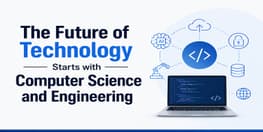
Computer Science and Engineering is more than coding. You can build apps, websites, games, and other technology people use every day.
These people know how to use technology to fix something that wasn't working, build something that didn't exist, or make something complicated much simpler. That thinking is what CSE trains you to do.
Why Specialisation Matters
These days, companies want more than coders. They want people who are good at a specific skill or area.
A company running AI tools needs someone who understands AI. A business moving everything to the cloud needs someone who has actually worked with cloud systems before. The days of a general degree being enough are fading.
That's why specialising during your degree is such a smart move now.
At Chitkara University, students in the B.E. CSE program can choose a specialisation based on what genuinely interests them. The options include Full Stack Development, Cybersecurity, Data Science and Analytics, Cloud Computing with AWS, Game Design and Technology, and Mobile App Development.
You still cover the core computer science fundamentals, the stuff every good engineer should know. But alongside that, you go deep into one area. By graduation, you're not just someone with a degree. You're someone with a specific skill set that companies are actively searching for.
AI Is Not the Future Anymore. It's Right Now.
A few years ago, people were talking about Artificial Intelligence like it was something coming eventually. That time has passed.
AI is already reading medical scans in hospitals. It's catching fraud at banks before a human analyst even looks at the data. Retailers are using it to predict what you'll want to buy next. Factories are using it to reduce waste and avoid breakdowns. Schools are experimenting with it to help students learn at their own pace.
What's interesting is that AI rarely works by itself. Behind most AI systems, there's also cloud computing keeping everything running, cybersecurity making sure nothing gets compromised, IoT devices feeding in real-world data, and sometimes even robotics or blockchain involved in the process. It's all connected.
Chitkara University has two programs built around this reality. One is a B.E. CSE developed in collaboration with Microsoft, covering Artificial Intelligence and Machine Learning. The other is a B.E. CSE in AI and Future Technologies, which puts AI together with robotics, IoT, blockchain, and cybersecurity so students understand how these technologies actually work together in the field.
Both are built around what employers are hiring for right now, not five years ago.
The Classroom Is Only Part of It
Here's something nobody tells students when they're choosing a university. The grades you get in your exams are rarely the main thing employers care about. What they want to know is what you've actually built, what problems you've worked on, and whether you can function in a real work environment.
The students who tend to land the best opportunities are usually the ones who did more than attend lectures. They worked on projects. They competed in hackathons. They interned somewhere and figured out how professional teams actually operate.
Chitkara University has set up centres specifically to give students that kind of experience. The iOS Development Centre was built with Apple and Infosys. There's a Jio Games Innovation Centre for students interested in gaming technology. And the Capgemini CodeXperience Centre is designed around real software development practices.
These aren't just well-equipped labs. They're spaces designed to feel and function like actual industry environments.
Beyond the centres, students also get chances to work on live industry projects, join coding competitions, pursue international internships, and even spend a semester at a partner university abroad. Over 700 companies recruit from the campus across various sectors.
So How Do You Choose the Right University?
Chitkara University has a NAAC A+ grade and is ranked among universities for Computer Science.
But rankings should not be the only factor.
Before choosing a university, ask: Does it teach skills that companies need? Can you choose a specialisation? Will you work on projects? Are internships part of the program?
Technology is changing industries like healthcare, finance, education, and entertainment.
Students who succeed are those who build skills and gain experience while studying.
ABOUT CHITKARA UNIVERSITY
Chitkara University is a UGC-recognised and NAAC A+ accredited private university with campuses in Punjab and Himachal Pradesh, recognised among India's leading institutions by NIRF, QS World University Rankings, and Times Higher Education. It offers undergraduate and postgraduate programs across Engineering, Business, Healthcare, Pharmacy, Design, Architecture, Hospitality, and emerging technologies including Artificial Intelligence, Data Science, and Machine Learning.
The University's academic model integrates internships, live industry projects, and research into core curricula, supported by 2,000+ campus recruiters and 300+ international academic and industry partners. Global Pathway programs, developed in partnership with leading universities in the United States, Australia and Canada, allow students to complete part of their degree abroad. With a focus on innovation, entrepreneurship, and applied learning, Chitkara University, prepares graduates for careers in India and internationally.


.jpeg?h=132&w=263&mode=stretch)

![MBA/PGDM | admission | 2024 | Narsee Monjee Institute of Management Studies - [NMIMS Deemed to be University]](https://image-static.collegedunia.com/public/college_data/images/logos/1506323004Logo.jpg?h=72&w=72&mode=stretch)


![MBA/PGDM | admission | 2024 | Indian Institute of Management - [IIMC]](https://image-static.collegedunia.com/public/college_data/images/logos/1488950580d2.png?h=72&w=72&mode=stretch)





Comments