

![Delhi University - [DU]](https://image-static.collegedunia.com/public/college_data/images/logos/1491817267UniversityofDelhi.png?h=71.7&w=71.7&mode=stretch)
.png?h=18&w=18&mode=stretch)
DU CSAS Preferences 2026 refers to the list of college + course combinations that a student submits on DU CSAS portal during Phase II (Preference Filling). Delhi University uses this order along with the candidate's CUET score, category, and eligibility to allot a seat.
The Delhi University Admission 2026 through CUET is conducted in three stages. In the first stage, students complete registration on the CSAS portal using their CUET UG 2026 application details. In the second stage, applicants select their preferred courses and colleges in the order of their choice. The last stage is the seat allocation, where students are allotted seats based on their DU CSAS preference list.
DU CSAS Preference Filling is done on the official CSAS portal @ugadmission.uod.ac.in.
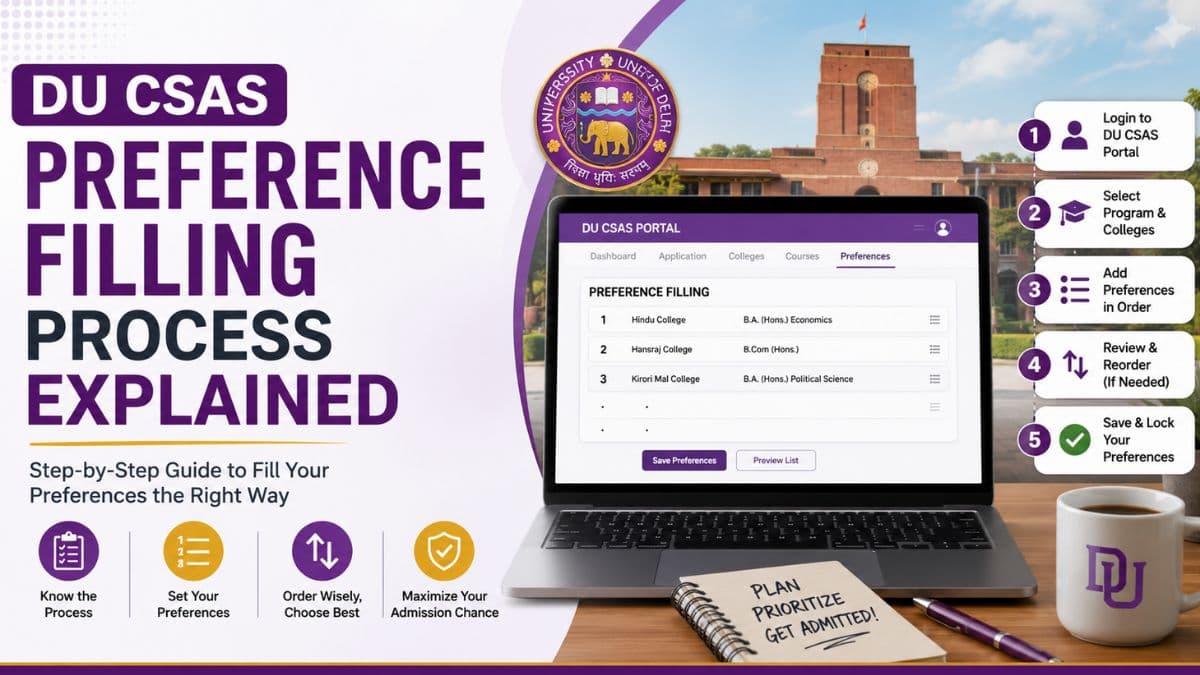
How to Fill DU CSAS Preferences 2026?
Step 1: DU CSAS 2026 registration and Complete Profile Details
- DU CSAS 2026 registration is the first step for admission to UG and PG courses at the Delhi University. Candidates must register on the CSAS portal using their CUET 2026 details to participate in seat allotment, preference filling, document upload, and counselling rounds.
- Go to the official Delhi University admission portal and log in using your CUET Application Number and password.
- Before filling in preferences, complete all important details carefully, including:
- Personal information
- Category certificate upload (if applicable)
- Required documents
- Subject mapping
Step 2: Open the Preference Filling Section
- After the declaration of CUET results and CSAS Registration, the Delhi University opens CSAS Phase II for preference filling. This is the most important phase where students can:
- Search courses using the search bar
- Add your preferred colleges and courses together
- Arrange them in your order of preference (most preferred at the top)
- Then add your next preferred options below it.
- Keep comparatively achievable colleges lower in the preference list.
- Students can add up to 200 preferences (recommended to fill the maximum).
- Save & Lock Your Preferences
- After arranging your college and course preferences, click on “Save” to update the list.
- Students can edit their preference order multiple times before the deadline.
- Once satisfied, they must click on “Lock Preferences” to submit the final list.
- After the last date, preferences get automatically locked, and no further changes are allowed. Students should also keep a screenshot or a PDF copy of the final preference list for safety.
Important Note:
- Students should check the preference order carefully before locking because once the preferences are locked, the order cannot be changed later.
- The DU CSAS preference filling window is usually very short, with students getting only around 5- 7 days to submit their preferences before the portal auto-locks.
- Subject mapping is very important in CUET-UG. If a student chooses the wrong subjects or subject combination, they may become ineligible for admission to their desired course.
Tip: Rank your high-priority, dream choices at the top, as the system automatically grants the highest possible preference available based on your merit.
Read More: Delhi University Courses & Fees 2026
Why Preference Order Matters in DU Admission?
Students can better understand the DU CSAS allocation process through the example below, which uses the official DU B.Com (Hons.) 2025 Round 1 cutoffs for illustrative purposes.
Note: Actual DU 2026 cutoffs may vary depending on CUET scores, category, seat availability, and admission trends.
Scenario 1:
Student 'A' is looking for a BA (Hons.) Political Science in a top college. His CUET scores is 940. What colleges can he apply to?
To understand how the DU CSAS allocation process works, the following example uses the official DU BA (Hons.) Political Science Round 1 Cutoffs 2025 as a reference.
| Preference | Colleges | BA (Hons.) Political Science 2025 Cutoff | Type |
|---|---|---|---|
| 1 | Hindu College | 950.58 | Dream Choice |
| 2 | Miranda House | 925.98 | Realistic Choice |
| 3 | Lady Shri Ram College | 915.70 | Realistic Choice |
| 4 | Kirori Mal College | 909.69 | Safe Choice |
| 5 | Ramjas College | 894.95 | Safe Choice |
What happens During Seat Allotment?
The CSAS system first checks whether Student A can get admission to Hindu College, which is his top preference.
- The DU CSAS system begins checking Student A's preferences from the top of the list.
- First, it checks Hindu College, which is the student's first preference. However, the 2025 cutoff for B.A. (Hons.) Political Science at Hindu College was 950.58, which is higher than Student A's score of 940. Therefore, he is not allotted a seat there.
- The system then moves to Miranda House, the student's second preference. Since the 2025 cutoff was 925.98 and Student A's score of 940 is above that level, he qualifies for admission. As seats are available, he is allotted Miranda House – B.A. (Hons.) Political Science.
- The system stops checking further preferences because it has already allotted the highest preference for which the student is eligible.
If Student A chooses the Upgrade option
After accepting the allotted seat, Student A can choose the Upgrade option. If a seat becomes available in Hindu College during later CSAS rounds, the system will automatically consider him for an upgrade based on his preference order and merit.
Important Note: Your first preference should always be your dream college, even if admission is uncertain. The next few preferences should be realistic colleges where your score gives you a strong chance of admission, followed by safe options. This approach maximizes both your immediate allotment chances and your upgrade opportunities.
Scenario 2:
The scenario below helps students understand how to arrange college preferences strategically based on their CUET score and previous year's admission data.
Student B is looking for admission to B.Com (Hons.) at Delhi University and has secured a CUET score of 905/1000. The example below illustrates how the student may fill preferences during the DU CSAS admission process based on the official DU B.Com (Hons.) 2025 Round 1 cutoffs.
The table below illustrates how Student B may arrange college preferences for B.Com (Hons.) admission through DU CSAS.
| Preference | College | B.Com (Hons.) Cut-off 2025 | Type |
|---|---|---|---|
| 1 | SRCC | 917.00 | Dream Choice |
| 2 | Hindu College | 912.22 | Dream Choice |
| 3 | Hansraj College | 906.37 | Realistic Target |
| 4 | Kirori Mal College | 901.71 | Realistic Target |
| 5 | Atma Ram Sanatan Dharma College | 897.17 | Safe Option |
What Happens During Seat Allotment?
The DU CSAS system checks preferences one by one in the exact order submitted by the student.
- It first checks SRCC, the student's top preference. Since the 2025 cutoff was 917.00 and Student B scored 905, he is not eligible for admission there.
- The system then moves to Hindu College, where the previous year's cutoff was 912.22. Again, his score falls slightly short.
- Next, it checks Lady Shri Ram College. The 2025 cutoff was 906.37, which is still marginally higher than Student B's score.
- The system then reaches Hansraj College. Since the previous year's cutoff was 901.71 and Student B scored 905, he qualifies for admission and is allotted B.Com (Hons.) at Hansraj College.
- Since Hansraj College is the highest preference for which he is eligible, the allotment process stops there.
If Student B chooses the Upgrade Option
If Student B selects the Upgrade option, DU will check whether a seat becomes available in any college placed higher in his preference list.
If a seat becomes available in a higher-preference college, such as SRCC or Hindu College, he may be upgraded to that college in a later round.
Important Note:
A score of 905 may not be enough for colleges like SRCC or Hindu College, but it remains highly competitive for colleges such as Hansraj College and Kirori Mal College. This is why students should always create a balanced preference list with a mix of dream, realistic, and safe options instead of focusing only on the most competitive colleges.
Why Students Should Include Multiple College Preferences?
The above example clearly demonstrates why students should fill as many relevant college and course preferences as possible during the CSAS admission process.
With respect to Scenario 1: Student A could not get admission to Hindu College because his score was below 950.58. However, since he had also included Miranda House, LSR, Kirori Mal College, and Ramjas College in his preference list, the CSAS system allotted him the highest preference for which he was eligible.
- By filling multiple preferences, Student A secured a seat while still remaining eligible for an upgrade to Hindu College.
- Had he filled only Hindu College as his preference, he might have missed the chance to secure admission to another top Political Science programme.
With respect to scenario 2:By filling multiple college preferences, Student B maximized his chances of securing admission while remaining eligible for upgrades to higher-preference colleges in future rounds.
- Many students make the mistake of filling only dream colleges. If Student B had listed only SRCC and Hindu College, he might have missed out on securing a seat in the initial rounds.
- By including realistic options such as Hansraj College and Kirori Mal College, he significantly improves his chances of admission while still keeping the possibility of future upgrades open.
How DU Checks Your Preferences?
The CSAS system reads your preference list from top to bottom.
- It first checks whether you can get admission to your 1st preference.
- If your score is not sufficient for that college and course, it automatically checks your 2nd preference.
- If you don't qualify there either, it moves to the 3rd preference and continues until it finds the highest preference for which you are eligible.
What Happens After Seat Allotment in DU CSAS?
The Freeze and Upgrade options appear after a student gets a seat allotment in any CSAS round of Delhi University admissions. These options become available only after the student accepts the allotted seat and pays the admission fee.
- Upgrade: Be considered for higher preferences in the next round
- Freeze: Keep the current seat and stop further upgrades
Even after locking your preferences, the Upgrade option still works during later Delhi University CSAS rounds. Your preference order remains fixed, but DU automatically checks the same list again in every round to see if a better college or course becomes available.
DU PG Allocation Round Rules 2026
- DU may conduct multiple allocation rounds based on vacant seats created due to cancellations, withdrawals, or rejected admissions.
- All registered CSAS(PG) 2026 candidates can participate in further rounds, except those whose admission or allotted seat has been cancelled.
- Candidates who choose the “Upgrade” option will be considered for higher preferences in upcoming allocation rounds, subject to seat availability.
- Candidates who already receive their first preference programme in any round will not be considered for that programme again in later rounds.
Subject-wise DU Preference List 2026
A subject-wise DU preference list helps candidates organize colleges and courses according to their academic interests and admission goals. It enables students to prioritize their preferred programmes and colleges in a structured manner during the DU CSAS admission process.
The following preference order is based on DU 2025 cutoffs, expected CUET scores, and admission trends and can be used as a reference while filling DU CSAS 2026 preferences.
DU Commerce Preference Order list 2026
Check the list of the best DU colleges for the commerce subjects below.
DU preference list for B.Com (Hons.)
| Preference order | College |
|---|---|
| 1 | Shri Ram College of Commerce (SRCC) |
| 2 | Hindu College |
| 3 | Lady Shri Ram College (W) |
| 4 | Hansraj College |
| 5 | Kirori Mal College |
| 6 | Ramjas College |
| 7 | Sri Venkateshwara College |
| 8 | Sri Guru Tegh Bahadur Khalsa College |
| 9 | Daulat Ram College (W) |
| 10 | Sri Guru Gobind Singh College of Commerce |
DU Preference List for BMS
| Preference order | College |
|---|---|
| 1 | Shaheed Sukhdev College of Business Studies (SSCBS) |
| 2 | Sri Guru Gobind Singh College of Commerce (SGGSCC) |
| 3 | Deen Dayal Upadhyaya College (DDUC) |
| 4 | Keshav Mahavidyalaya |
| 5 | College of Vocational Studies (CVS) |
| 6 | Ramanujan College |
| 7 | Aryabhatta College |
| 8 | Ramanujan College |
DU Preference List for Arts Students 2026
Check the list of the best DU colleges for the arts subjects below
DU B.A (Hons) English Top College Preference List
| Preference order | College name |
|---|---|
| 1 | Hindu College |
| 2 | Miranda College |
| 3 | Lady Sri Ram College |
| 4 | St. Stephen's College |
| 5 | Hansraj College |
| 6 | Kirori Mai College |
| 7 | Ramjas College |
| 8 | Sri Venkateshwara |
| 9 | Atma Ram Sanatan DharmaCollege |
| 10 | Daulat ram |
DU B.A.(Hons) Economics Top College Preference List
| Preference No. | College Name |
|---|---|
| 1 | Shri Ram College of Commerce (SRCC) |
| 2 | St. Stephen’s College |
| 3 | Hindu College |
| 4 | Lady Shri Ram College |
| 5 | Miranda House |
| 6 | Hansraj College |
| 7 | Kirori Mal College |
| 8 | Ramjas College |
| 9 | Gargi College |
| 10 | Shaheed Bhagat Singh College |
DU Preference List for Science Students 2026
Check the list of the best DU colleges for the arts subjects below.
B.Sc (Hons) Mathematics – Preference List
| Preference | College Name |
|---|---|
| 1 | St. Stephen’s College |
| 2 | Hindu College |
| 3 | Hansraj College |
| 4 | Kirori Mal College |
| 5 | Ramjas College |
| 6 | Sri Venkateswara College |
| 7 | Atma Ram Sanatan Dharma (ARSD) College |
B.Sc (Hons) Physics – Preference List
| Preference | College Name |
|---|---|
| 1 | St. Stephen’s College |
| 2 | Hindu College |
| 3 | Hansraj College |
| 4 | Ramjas College |
| 5 | Kirori Mal College |
| 6 | Sri Venkateswara College |
| 7 | Atma Ram Sanatan Dharma (ARSD) College |
DU Top College Preference List for B.Sc (Hons) Chemistry
| Preference | College Name |
|---|---|
| 1 | St. Stephen’s College |
| 2 | Hindu College |
| 3 | Hansraj College |
| 4 | Ramjas College |
| 5 | Kirori Mal College |
| 6 | Sri Venkateswara College |
| 7 | Atma Ram Sanatan Dharma (ARSD) College |
DU Top College Preference List for B.Sc (Hons) Zoology
| Preference | College Name |
| 1 | Hindu College |
| 2 | Hansraj College |
| 3 | Kirori Mal College |
| 4 | Ramjas College |
| 5 | Sri Venkateswara College |
Note: This sample preference list is for reference only. Candidates should fill their DU CSAS preferences based on their own CUET score, category, course choice, and admission priorities. Admission is subject to seat availability and cutoff trends.
DU CSAS Preferences Filling Important Tips 2026
- Add as many college-course combinations as possible to improve your chances of securing a seat.
- Place your most preferred college and course combinations at the top, as DU follows the preference order strictly during seat allotment.
- Decide whether your priority is a specific course, a specific college, or a balance of both before preparing the list.
- Check previous years' cutoff trends and seat availability to create realistic preferences.
- Students belonging to reserved categories should make full use of their category benefits while preparing the preference list.
- Maintain a balanced mix of dream colleges, realistic options, and backup choices.
- Avoid common mistakes such as keeping the list too short, selecting only a few top colleges, or forgetting to lock preferences before the deadline.
- Do not leave unnecessary gaps in your preference list; adding more valid options can increase admission opportunities.
- Students who do not receive a seat in the first round should not panic, as DU conducts multiple rounds and upgrades may be available later.
- Save your progress regularly while filling preferences to avoid losing data due to technical issues.
Note: Focus on the course first if you have a clear career goal. For example, if studying B.Com (Hons.), Psychology, or Computer Science is your priority, rank colleges accordingly rather than choosing solely based on college reputation.
Why Preference Filling is Important in DU CSAS?
In DU CSAS(PG) 2026, an “Allocated Seat” refers to a specific Programme + College/Department combination. The preference list is very important for final seat allotment.
- Your preference order determines which college-course combination is considered first.
- The system always tries to allot the highest preference for which you are eligible.
- Adding more preferences increases your chances of receiving a seat.
- A balanced list should include dream colleges, realistic options, and backup choices.
- Incorrect ordering may result in missing out on a preferred college or programme.
- Candidates can benefit from upgrades in later rounds if a higher preference becomes available.
Important Note:
- Students cannot change the order of their preferences.
- Since there is no limit on the number of preferences, candidates should include as many relevant college-course combinations as possible to maximize their admission opportunities.
Frequently Asked Questions
Ques. What is DU CSAS?
Ans. DU CSAS (Common Seat Allocation System) is the official admission portal used by the University of Delhi for admission to Undergraduate (UG) and Postgraduate (PG) courses. Students must register on the CSAS portal to participate in the DU admission and seat allotment process.
Ques. Should students prepare their DU CSAS preference list before filling it at DU?
Ans. Yes, students should prepare their DU CSAS preference list in advance using Excel or Google Sheets before filling it on the official University of Delhi CSAS portal. Preparing the list beforehand helps students arrange colleges and courses in the correct order, avoid confusion during counselling, reduce last-minute mistakes, and improve their chances of getting a better seat allotment at DU.
Ques. How many preferences should I fill in DU CSAS?
Ans. You should fill as many preferences as possible, ideally, 150 to 200. DU allows a maximum of 200 preferences. Filling more preferences significantly increases your chances of getting a seat. Many students make the mistake of filling only 30-50 preferences and later regret it when they don’t get a seat. It is recommended to include Dream, Reach, and Safe colleges across multiple courses.
Ques. What happens if I don’t get a seat in the first DU CSAS allotment round 1?
Ans. Don’t worry. DU conducts multiple allotment rounds (usually 4 to 5 rounds). If you don’t get a seat in Round 1, you will be considered in the next rounds based on your same preference list. Your chances improve in later rounds as many students withdraw or upgrade. You can also participate in the Spot Round (final round) if seats remain vacant. Always keep checking the CSAS portal regularly.
Ques. In DU CSAS counselling, should I give more importance to the course or the college?
Ans. It depends on your goal. If you are very particular about a specific course (e.g., B.Com Hons or Psychology), give course priority. If you want to study in a reputed college at any cost, give college priority. Most students follow a mix best college for their favourite course at the top.
Ques. Can I choose the same course in different DU colleges during CSAS counselling?
Ans. Yes. You can add the same course (e.g., B.Com Hons) in many different colleges. Just make sure you arrange them according to your preference (e.g., LSR B.Com Hons at top, then Venky, then ARSD, etc.).
Ques. What happens if I save my DU CSAS preferences but do not lock them?
Ans. If you do not lock your preferences before the deadline, your preferences will not be considered for seat allotment. Saving is not enough - you must click on “Lock Preferences”.





.jpeg?h=132&w=263&mode=stretch)



Comments