

.png?h=56&w=56&mode=stretch)


If you are planning to study, work, or settle in Canada in 2026, proving your English skills is an important step. PTE is one of the most popular English tests accepted by Canadian universities, colleges, and immigration authorities (IRCC). Many top universities, including the University of Toronto, University of British Columbia, and University of Alberta, accept PTE scores in the range of 65 - 68.
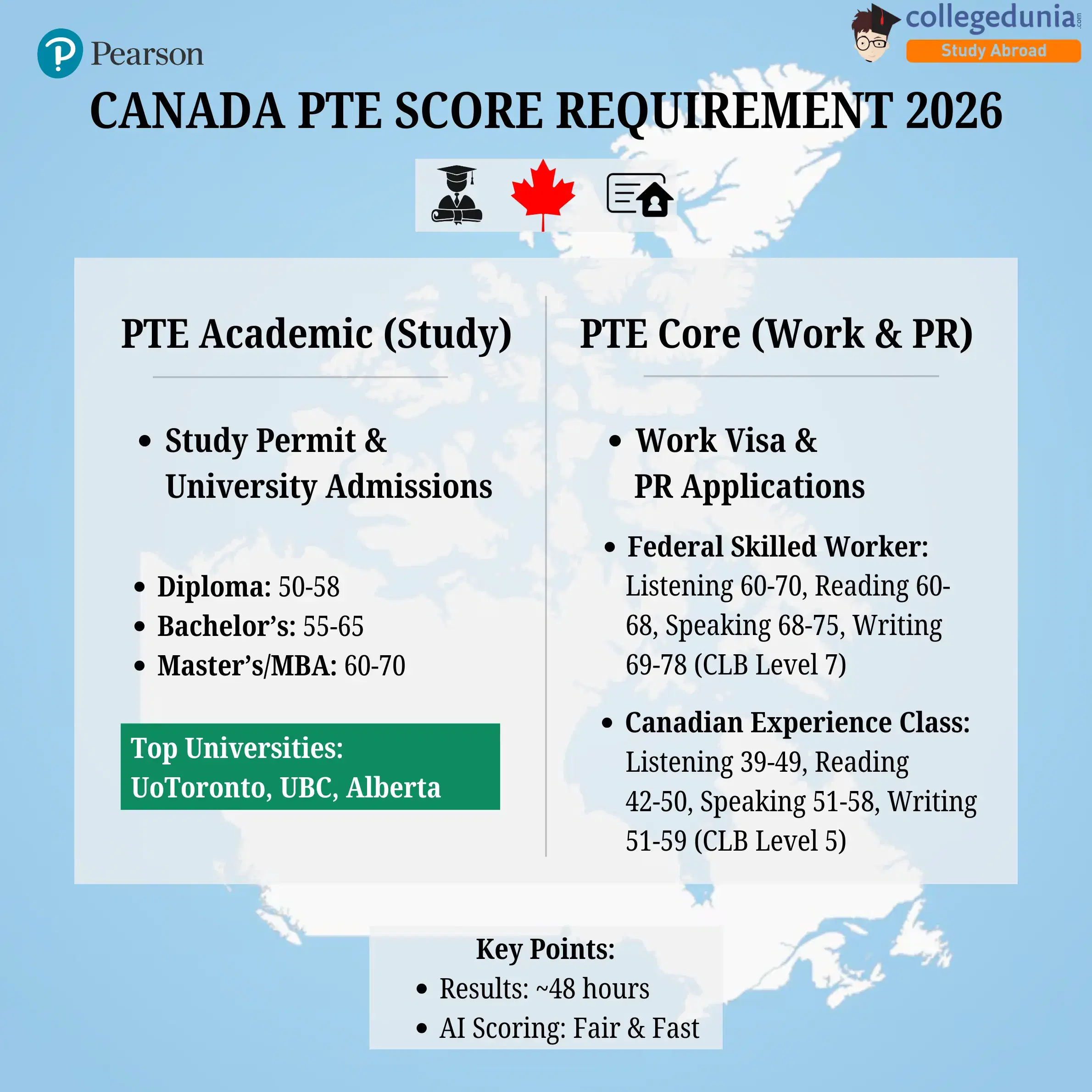
The PTE minimum score for Canada generally falls between 50 and 70 for the study permit, depending on the institution and program. Apart from studies, the Canadian immigration department also accepts PTE scores in the range of 50 - 60 for work and PR visas.
Click Here to Register for PTE
| Requirement | Minimum PTE Score Required |
|---|---|
| MBA Program | 61 - 68 |
| MS Programs | 60 - 70 |
| BS Programs | 60 - 70 |
| Work and PR Visas | 50 - 70 |
In this guide, we’ll break down everything you need to know about the Canada PTE score requirement for 2026, including minimum score criteria for different visa types, university cutoffs, and tips to help you achieve your target score.
Must Read: Canada Tightens Student Visa Rules
- What is PTE?
- Why PTE is Popular for Canada in 2026?
- PTE Requirement for Canada Student Visa
- Is PTE Accepted in Canada for PR?
- PTE Score Requirement for Canadian Universities
5.1 PTE Score Required for MBA in Canada
- PTE vs IELTS for Canada: Which is Better?
- Tips to Achieve Your Target PTE Score
- FAQs
What is PTE?
PTE is a computer-based English language proficiency test that measures your skills in speaking, writing, reading, and listening. It is designed for people who want to work, immigrate, or study abroad in English-speaking countries like Canada.
There are 2 types of PTE accepted in Canada: PTE Academic and PTE Core. Both are recognized by the Immigration, Refugees and Citizenship Canada (IRCC), but they serve different purposes.
PTE Academic vs PTE Core for Canada
While both PTE Academic and PTE Core share the same Reading and Listening sections, as well as an identical overall structure (2-hour computer-based test, AI-scored, results in 2 days, scores 10-90), the Speaking & Writing module is where the 2 tests have significant differences. These differences are designed to match the distinct purposes of each test, are mentioned in the table below. This will help you choose the right test depending on whether you plan to apply for PR and work, or study in Canada.
| Feature | PTE Core | PTE Academic |
|---|---|---|
| Purpose | For Permanent Residency (PR), work visas, and immigration | For student visas and university/college admissions |
| Accepted By | IRCC (for PR and work permits) | Canadian universities, colleges, and the IRCC for study permits |
| Speaking & Writing Question Types |
|
|
| Key Task Differences |
|
|
Must Read: PTE New Updates 2025
Which Test Should You Take for Canada?
- Choose PTE Academic if you’re applying for a Canadian university or college.
- Choose PTE Core if you’re applying for Permanent Residency (PR) or a work visa through IRCC.
- Can you use one test for both? No. Canadian universities generally do not accept PTE Core for admission, and IRCC does not accept PTE Academic for Express Entry or most economic immigration programs (except study permits).
Both tests are fully computer-based and are conducted at authorized PTE test centers worldwide. PTE uses responsible AI engines, trained by human language experts for scoring.
Why is PTE Popular for Canada in 2026?
Canada has become one of the top destinations for international students and skilled professionals, and English proficiency tests play a key role in its visa and admission processes. PTE is officially accepted by the Immigration, Refugees and Citizenship Canada (IRCC) for both study and immigration purposes. Below are some key reasons why PTE is popular for Canada:
- Accepted by Canada: Canada accepts PTE Core for PR and work visas, and PTE Academic for student visas.
- Accepted by Top Universities: Most top Canadian universities and colleges accept PTE Academic scores, including Toronto, UBC, and McGill.
- Fast Results: You get your PTE result typically within 2 days, helping you apply faster.
- Fair and Accurate Scoring: PTE uses responsible AI trained by human language experts to score your test.
- Worldwide Recognition: Accepted in Canada, Australia, New Zealand, and the UK, making it useful for global study and work plans.
PTE Requirement for Canada Student Visa
Canada does not require a separate PTE score for a student visa. You only need to meet the PTE Academic requirement of the university or college you are applying to. Once you receive your Letter of Acceptance (LOA), you can use the same score for your student visa application.
Also Read: Canadian Study Permit
The table below mentions the typical PTE Academic scores required for different programs in Canadian universities and colleges.
| Program Type | Minimum PTE Score Required |
|---|---|
| Diploma | 50 - 58 |
| Bachelor’s | 55 - 65 |
| Master’s | 60 - 70 |
| MBA Programs | 61 - 68 |
Also Read
Is PTE Accepted in Canada for PR?
Yes, PTE is accepted in Canada for PR! Though PTE Academic for Canada PR is not accepted, skilled Indian immigrants can easily get it through the Express Entry system. The system has 3 major pathways:
- Federal Skilled Worker Program
- Federal Skilled Trades Program
- Canadian Experience Class
Given below is a brief table on the minimum PTE requirements for Canada immigration, showing that PTE is valid for Canada PR:
| Program | Minimum CLP Level | PTE Listening | PTE Reading | PTE Speaking | PTE Writing |
|---|---|---|---|---|---|
| Federal Skilled Worker Program | 7 | 60 - 70 | 60 - 68 | 68 - 75 | 69 - 78 |
| Federal Skilled Trades Program | 4 | 28 - 38 | 33 - 41 | 42 - 50 | 41 - 50 |
| Canadian Experience Class | 5 | 39 - 49 | 42 - 50 | 51 - 58 | 51 - 59 |
Tip: The best way to apply for a Canadian PR for Indians is via the Federal Skilled Workers Program (FSWP). This program allows candidates with work experience and no connection to Canada or a job offer to apply for permanent residence.
Read More: Canada PR Requirements for Indians
PTE Score Requirement for Canadian Universities
Many top universities in Canada, including the University of Toronto, University of Waterloo, and the University of British Columbia, accept PTE scores for admission to their MBA, MS, and Bachelor's programs. The sections below mention the minimum PTE score for each.
Also Check: PTE Exam Pattern
PTE Score Required for MBA in Canada
Canada offers a wide range of MBA programs in top-ranked universities. Most institutions require a minimum PTE score of 60, but each university has specific requirements. Along with PTE scores, other criteria like academic transcripts, work experience, and GMAT/GRE scores may also be necessary.
Also Read
Top Canadian Universities and Their Entrance Exam Requirements| University | Minimum PTE Score |
|---|---|
| University of Alberta School of Business | 61 overall, 60 in each section |
| Simon Fraser University Beedie School of Business | 65 overall, 60 in each section |
| UBC Sauder School of Business | 70 overall |
| Queen’s University Smith School of Business | 60 overall |
| University of Manitoba | 61 overall |
| Concordia University | 61 overall, 46 each in Speaking and Writing |
| Toronto Metropolitan University | 60 overall |
Also Check: Top MBA Colleges in Canada
PTE Score Required for MS in Canada
Canada is home to more than 100 universities that offer Master’s programs in various fields of study. The PTE scores for MS programs vary based on the university and program. Here are some of the top universities that accept PTE for MS courses:
| University | Minimum PTE Score |
|---|---|
| McMaster University | 60 overall, 60 each in Speaking and Writing |
| University of Alberta | 61 overall, 60 in each section |
| The University of British Columbia | 65 overall, 60 in each section |
| University of Manitoba | 61 overall |
| University of Waterloo | 63 overall, 65 each in Speaking and Writing |
| Simon Fraser University | 65 overall, 60 in each section |
| Dalhousie University | 65 overall, 54 in each section |
| University of Guelph | 60 overall, 60 in each section |
| York University | 61 overall, 55 in each section |
Also Read
PTE Score Required for UG in Canada
If you want to study in Canada after 12th, you need to submit a PTE score required for Canada. Universities typically set both an overall score and sometimes individual minimum section scores. Below is a table listing the minimum PTE score required for Canada after 12th for undergraduate admission.
| University | Minimum PTE Score Required |
|---|---|
| University of Toronto | 65 overall, 60 in each section |
| University of British Columbia | 65 overall, 60 in each section |
| University of Alberta | 61 overall, 60 in each section |
| York University | 65 overall |
| Western University | 58 overall, 56 in each section |
| Concordia University | 61 overall, 53 in each section |
Also Read
PTE vs IELTS for Canada: Which One is Better?
Both PTE and IELTS are accepted in Canada. Your choice depends on what you prefer. PTE is fully computer-based, gives results faster, and has more consistent scoring. IELTS has been around longer and offers both paper-based and computer-based options.
IELTS vs PTE for Canada: Score Conversion
The table below gives a comparison of the scores of IELTS and PTE.
| PTE Score | IELTS Score |
|---|---|
| 85 - 90 | 7.5 - 9.0 |
| 76 - 84 | 7 |
| 66 - 75 | 6.5 |
| 56 - 65 | 6 |
| 47 - 55 | 5.5 |
| 36 - 46 | 5 |
| 30 - 36 | 4.5 |
Tips to Achieve Your Target PTE Score
Achieving your desired PTE score for Canada requires practice, strategy, and focus. Here are some simple tips to help you succeed:
- Know the Format: Learn all PTE sections: Speaking, Writing, Reading, and Listening, to avoid surprises.
- Practice Often: Take mock tests to spot weak areas and build speed.
- Manage Time: Practice finishing each section within the time limit.
- Boost Vocabulary & Grammar: Strong language skills improve scores.
- Listen & Speak Daily: Practice English speaking and listening for fluency.
- Use Official Material: Study with Pearson’s official PTE guides and tests.
- Stay Calm: Be confident and relaxed on exam day for better performance.
Note: The score requirements may change from time to time, so always verify the score requirements from the university/government sites before applying for your visa.
Also Read
In 2026, achieving the right PTE score is crucial for studying, working, or settling in Canada. Universities typically require 60 to 70 for postgraduate programs, while the minimum for study, work, and PR visas ranges from 50 to 70. Preparing strategically using official PTE materials and regular practice can help you meet these requirements and increase your chances of a smooth admission or immigration process.
Also Read
Key Summary
- PTE is officially accepted for Canada study, work, and PR applications.
- Two test types: PTE Academic (for study) and PTE Core (for PR and work).
- Most universities need a PTE score between 50-70, depending on the program.
- PTE Core scores of 50-60 are valid for PR and work visa pathways.
- Top universities like Toronto, UBC, and Alberta accept PTE Academic.
- PTE results are typically available within 2 days of the test.
- Scores are valid for 2 years from the test date.
- PTE is fully computer-based and uses responsible AI engines for scoring, which are trained by human language experts.
- Higher scores improve your visa approval and admission chances.
FAQs
Ques. What is the minimum PTE score required for a Canadian study permit?
Ans. Canada does not require a separate score for a study permit. You only need to meet the minimum PTE Academic score set by your university, usually 50 to 70, depending on the program.
Ques. What PTE score is required for Canadian PR?
Ans. For Permanent Residency (PR), PTE Core is accepted. A score of 50–60 is generally needed, with higher scores giving better CRS points under Express Entry.
Ques. Which PTE test should I take for Canada?
Ans. Take PTE Academic for university or college admission and PTE Core for PR or work visa applications.
Ques. How long is a PTE score valid for Canada?
Ans. PTE scores are valid for 2 years, both for study and immigration purposes.
Ques. How quickly can I get PTE results for Canada?
Ans. PTE results are usually available within 48 hours, helping you apply faster for visas or admissions.
Ques. Do all Canadian universities accept PTE?
Ans. Most top Canadian universities, including the University of Toronto, UBC, McGill, and the University of Alberta, accept PTE Academic scores for admission.
Ques. Can a low PTE score affect my visa application?
Ans. Yes. If your score is below the university or IRCC requirement, your admission or visa application may be rejected.
Ques. Can I retake the PTE test if I don’t get my desired score?
Ans. Yes. You can retake the PTE test as many times as you want. You just need to wait until you get your previous result.
Ques. Is PTE easier than IELTS for Canada?
Ans. Many students find PTE easier because it’s computer-based and scored by AI, making it fair and quick. But difficulty depends on your English skills.
Ques. What is the Canada study visa PTE requirement?
Ans. For a Canada study visa, you must meet your university’s PTE Academic score requirement. Usually, it’s between 50 and 70, depending on the course and institution.
Ques. Can I use the same PTE score for both study and PR in Canada?
Ans. No. For study, you must take PTE Academic, and for PR or work, you must take PTE Core. There are different tests for different purposes.



Comments