




MHT CET 2024 23 April Shift 2 question paper is available for download here. MHT CET 2024 question paper comprises 150 MCQs carrying a total weightage of 200 marks. MHT CET 2024 23 April Shift 2 Question Paper for PCB is divided into three subjects- Physics, Chemistry and Biology. The Physics and Chemistry section of MHT CET 2024 23 April Shift 2 question paper consists of 50 questions (10 questions from Class 11 and 40 questions from Class 12th syllabus). Meanwhile, the Biology paper of MHT CET 2024 23 April Shift 2 question paper consists of 100 questions (20 questions from Class 11th and 80 questions from Class 12th syllabus).
MHT CET 2024 23 April Shift 2 Question Paper PDF Download
| MHT CET 2024 23 April Shift 2 Question Paper 2024 with Answer Key |  Download Download |
Check Solutions |
MHT CET 2024 23 April Shift 2 Questions with Solutions.
Question 1:
Let the six numbers a1, a2, a3, a4, a5, a6 be in A.P., and a1 + a3 = 10. If the mean of these six numbers is 19/2 and their variance is σ2, then 8σ2 is equal to:
View Solution
Step 1: Represent the A.P. terms using the first term a1 and common difference d.
The general terms of the arithmetic progression are: a1, a1 + d, a1 + 2d, a1 + 3d, a1 + 4d, a1 + 5d.
Step 2: Using the condition a1 + a3 = 10:
a1 + (a1 + 2d) = 10
2a1 + 2d = 10
a1 + d = 5 ...... (1)
Step 3: Using the mean condition to find a1:
Mean = (a1 + (a1 + d) + (a1 + 2d) + (a1 + 3d) + (a1 + 4d) + (a1 + 5d)) / 6 = 19/2
(6a1 + 15d) / 6 = 19/2
6a1 + 15d = 57 ...... (2)
Step 4: Solving equations (1) and (2):
From (1), d = 5 - a1
Substituting into (2):
6a1 + 15(5 - a1) = 57
6a1 + 75 - 15a1 = 57
-9a1 + 75 = 57
-9a1 = -18
a1 = 2.
Substituting into (1): d = 5 - 2 = 3.
Step 5: Calculating the variance σ2:
The terms of the A.P. are: 2, 5, 8, 11, 14, 17.
Mean = (2 + 5 + 8 + 11 + 14 + 17) / 6 = 19/2.
Variance formula: σ2 = (Sum of squares / Number of terms) - (Square of mean).
Sum of squares = 22 + 52 + 82 + 112 + 142 + 172 = 699.
σ2 = (699 / 6) - (19/2)2 = 116.5 - 90.25 = 26.25.
Step 6: Calculating 8σ2:
8σ2 = 8 × 26.25 = 210.
Question 2:
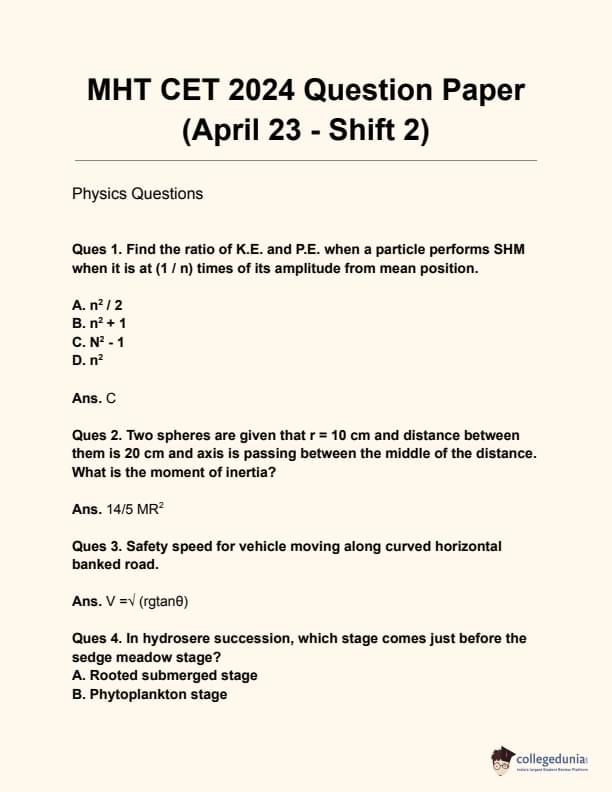
Two spheres are given with radius *r* = 10 cm, and the distance between them is 20 cm. The axis passes through the midpoint of the distance between the two spheres. What is the moment of inertia of the system?
Question 3:
What is the safety speed for a vehicle moving along a curved horizontal banked road?
Question 4:
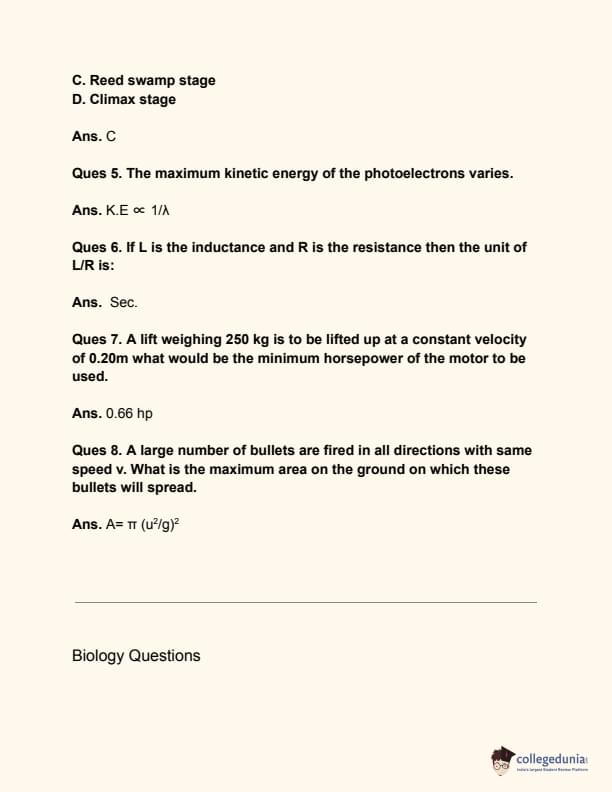
In hydrosere succession, which stage comes just before the sedge meadow stage?
Question 5:
The maximum kinetic energy of the photoelectrons varies.
Question 6:
If L is the inductance and R is the resistance, then the unit of L/R is:
Question 7:
A lift weighing 250 kg is to be lifted up at a constant velocity of 0.20 m/s. What would be the minimum horsepower of the motor to be used?
Question 8:
A large number of bullets are fired in all directions with the same speed *v*. What is the maximum area on the ground on which these bullets will spread?
Question 9:
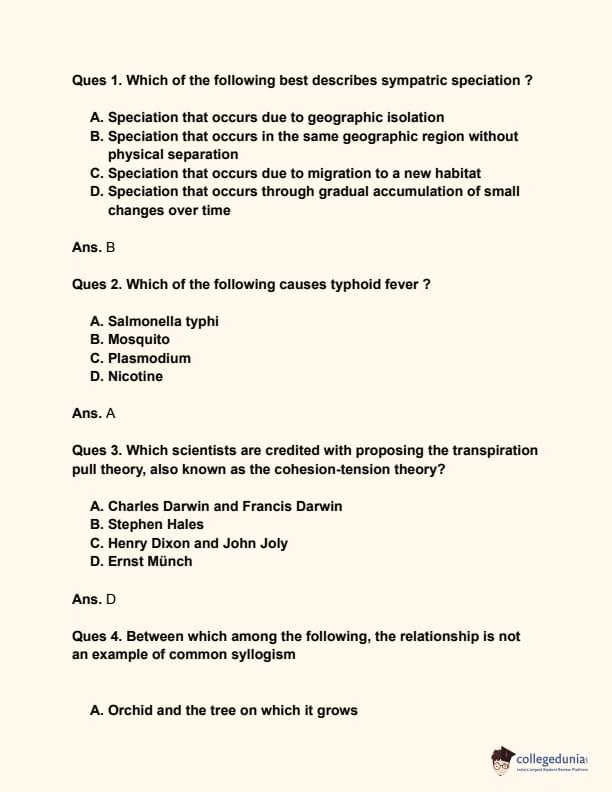
Which of the following best describes sympatric speciation?
Question 10:
Which of the following causes typhoid fever?
Question 11:
Which scientists are credited with proposing the transpiration pull theory, also known as the cohesion-tension theory?
Question 12:
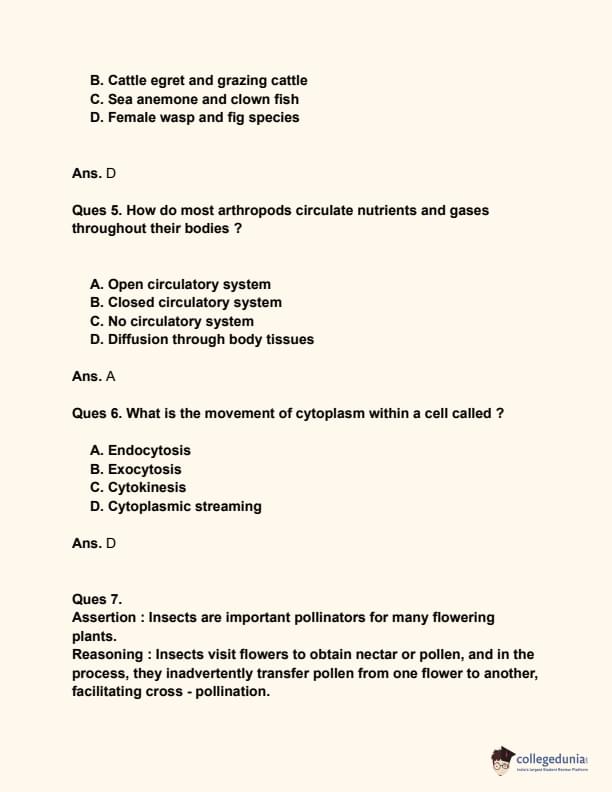
Between which among the following, the relationship is not an example of common symbiosis?
Question 13:
How do most arthropods circulate nutrients and gases throughout their bodies?
Question 14:
What is the movement of cytoplasm within a cell called?
Question 15:
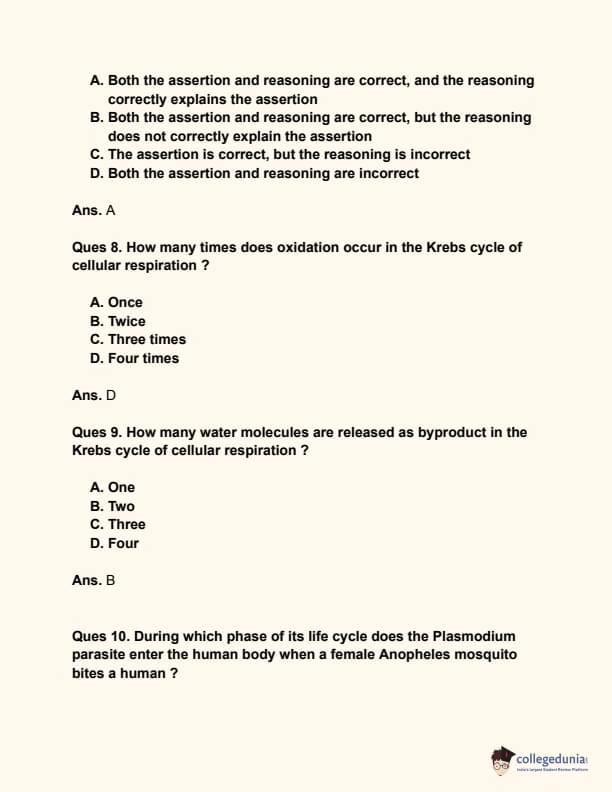
Assertion: Insects are important pollinators for many flowering plants. Reasoning: Insects visit flowers to obtain nectar or pollen, and in the process, they inadvertently transfer pollen from one flower to another, facilitating cross-pollination.
Question 16:
How many times does oxidation occur in the Krebs cycle of cellular respiration?
Question 17:
How many water molecules are released as byproducts in the Krebs cycle of cellular respiration?
Question 18:
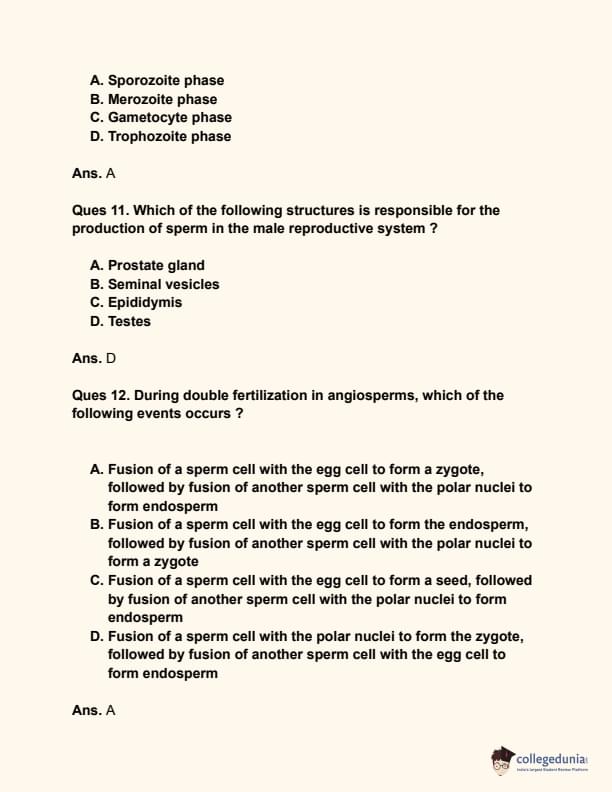
During which phase of its life cycle does the *Plasmodium* parasite enter the human body when a female *Anopheles* mosquito bites a human?
Question 19:
Which of the following structures is responsible for the production of sperm in the male reproductive system?
Question 20:
During double fertilization in angiosperms, which of the following events occurs?
Question 21:
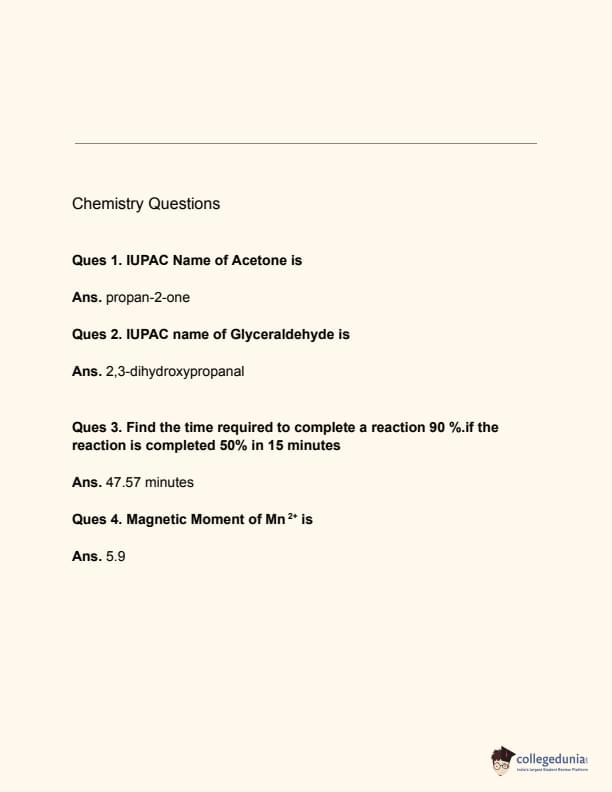
IUPAC Name of Acetone is:
Question 22:
IUPAC Name of Glyceraldehyde is:
Question 23:
Find the time required to complete a reaction 90% if the reaction is completed 50% in 15 minutes.
Question 24:
Magnetic Moment of Mn2+ is:
Also Check:
MHT CET Previous Year Question Papers
| MHT CET 2023 Question Paper | MHT CET 2022 Question Paper |
| MHT CET 2021 Question Paper | MHT CET 2020 Question Paper |
| MHT CET 2019 Question Paper | MHT CET 2018 Question Paper |
Also Check:



Comments