




Maharashtra Board Class 10 Science and Technology Part-2 Question Paper 2025 PDF (Code N 853) is available for download here. The Science and Technology exam was conducted on March 12, 2025 from 11:00 AM to 2:00 PM. The Maharashtra State Board of Secondary and Higher Secondary Education (MSBSHSE) conducted the Class 10 examination for a total duration of 3 hours, and the question paper had a total of 80 marks.
Maharashtra Board Class 10 Science and Technology Part-2 Question Paper 2025 (Code N 853) with Solutions
| UP Board Class Science and Technology Question Paper with Answer Key |  Download Download |
Check Solutions |
(A)(i) A molecule of glucose is completely oxidised in aerobic respiration and molecules of H\(_2\)O and .................... are produced along with energy.
View Solution
Answer: A molecule of glucose is completely oxidised in aerobic respiration and molecules of H₂O and CO₂ are produced along with energy.
Correct Answer: (A) CO₂
Explanation:
In aerobic respiration, glucose (C₆H₁₂O₆) is oxidized in the presence of oxygen to produce carbon dioxide (CO₂), water (H₂O), and energy (in the form of ATP). The carbon atoms from glucose are released as CO₂ during the process of respiration. Therefore, the correct answer is CO₂. Quick Tip: \textbf{Quick Tip:} Understanding the basic processes like aerobic respiration, fermentation, mutations, and energy conversion in photovoltaic cells helps explain various biological and physical phenomena.
(ii) Vinegar contains ............................ acid.
View Solution
Answer: Vinegar contains acetic acid.
Correct Answer: (A) acetic
Explanation:
Vinegar is a solution that contains acetic acid, which gives it its sour taste. Acetic acid is produced by the fermentation of ethanol by acetic acid bacteria. Therefore, the correct answer is acetic. Quick Tip: \textbf{Quick Tip:} Acetic acid is responsible for the tangy taste of vinegar and is produced through the fermentation process by acetic acid bacteria.
(iii) Any nucleotide of the gene suddenly changes its position that causes a minor change which is nothing but the ....................
View Solution
Answer: Any nucleotide of the gene suddenly changes its position that causes a minor change which is nothing but the mutation.
Correct Answer: (B) mutation
Explanation:
A mutation refers to a change in the nucleotide sequence of a gene. This can occur due to various factors, including errors during DNA replication or environmental influences. Even a minor change in the sequence can lead to a mutation, which can affect the gene’s function. Thus, the correct answer is mutation. Quick Tip: \textbf{Quick Tip:} Mutations are changes in the genetic sequence that can be caused by errors during DNA replication or external factors like radiation.
(iv) In humans, sperm production occurs in the .................... organ.
View Solution
Answer: In humans, sperm production occurs in the testes.
Correct Answer: (C) testes
Explanation:
In humans, sperm production (spermatogenesis) occurs in the testes, which are the male reproductive organs. The testes produce sperm and the hormone testosterone, which is essential for male reproductive function. Therefore, the correct answer is testes. Quick Tip: \textbf{Quick Tip:} Spermatogenesis, or sperm production, occurs in the testes, and is regulated by hormones like testosterone.
(v) Solar photovoltaic cell converts the solar radiation energy directly into .................... energy.
View Solution
Answer: Solar photovoltaic cell converts the solar radiation energy directly into electrical energy.
Correct Answer: (D) Electrical
Explanation:
A solar photovoltaic (PV) cell converts solar radiation (light energy) directly into electrical energy using the photovoltaic effect. When sunlight strikes the solar cells, electrons are knocked loose from their atoms, generating electricity. Therefore, the correct answer is electrical energy. Quick Tip: \textbf{Quick Tip:} Solar photovoltaic cells convert light energy directly into electricity through the photovoltaic effect, making them a clean and renewable energy source.
(B) (i) Find the odd one out :
Fragmentation, Regeneration, Budding, Fertilization.
View Solution
Correct Answer: (D) Fertilization
Explanation:
Fragmentation, regeneration, and budding are all methods of asexual reproduction, where offspring are produced without the involvement of gametes (sperm and egg). Fertilization, on the other hand, is part of sexual reproduction, where male and female gametes fuse to form a zygote. Hence, Fertilization is the odd one out. Quick Tip: \textbf{Quick Tip:} Understanding the differences between asexual and sexual reproduction, as well as the role of fossils in evolution, helps clarify basic biological concepts that are commonly tested.
(ii) Write the correct co-relation :
Diabetes : Insulin :: Cancer : ..................
View Solution
Correct Answer: (A) Chemotherapy
Explanation:
Diabetes is treated with Insulin, and Cancer is commonly treated with Chemotherapy. Chemotherapy involves using drugs to kill cancer cells or stop their growth. Therefore, the correct co-relation between Cancer and its treatment is Chemotherapy. Quick Tip: \textbf{Quick Tip:} Chemotherapy is a standard treatment for cancer, targeting and destroying cancerous cells, often alongside other methods like surgery or radiation.
(iii) State whether true or false :
Study of fossils is an important aspect of the study of evolution.
View Solution
Correct Answer: True
Explanation:
The study of fossils plays a crucial role in understanding the process of evolution. Fossils provide evidence of past life forms, helping scientists track changes in species over time, and giving insight into the process of natural selection and evolutionary trends. Hence, the statement is true. Quick Tip: \textbf{Quick Tip:} Fossils are key to understanding evolutionary biology as they provide direct evidence of how life forms have changed and evolved over time.
(iv) Give any two commercial uses of Biotechnology.
View Solution
Correct Answer: (D) All of the above
Explanation:
Biotechnology has widespread commercial applications in various fields. It is used in agriculture for the development of genetically modified crops, in the food industry for the production of enzymes and preservatives, and in the medical industry for the production of insulin, vaccines, and gene therapy. Therefore, the best answer is All of the above. Quick Tip: \textbf{Quick Tip: Biotechnology is a versatile field with applications across agriculture, food production, and medicine, driving innovation in multiple sectors.
(v) Being a fish, I perform respiration with the help of lungs. Who am I ?
View Solution
Correct Answer: (A) Dolphin
Explanation:
Dolphins are mammals, not fish, and they breathe through lungs. However, they are often referred to as "sea creatures" in exams, which is why the question may trick you into thinking about fish. Sharks and tuna are true fish, and they respire with gills, not lungs. The correct answer is Dolphin, as they perform respiration through lungs. Quick Tip: \textbf{Quick Tip: While dolphins are often mistakenly called fish, they are mammals and breathe using lungs, just like humans.
(A) Give scientific reasons (any two):
(i) Sometimes, higher plants and animals too perform anaerobic respiration.
View Solution
Correct Answer: True
Explanation:
In the absence of sufficient oxygen, higher plants (e.g., waterlogged roots) and animals (e.g., human muscles during vigorous exercise) switch to anaerobic respiration. This process produces less energy compared to aerobic respiration and results in the formation of lactic acid in animals or ethanol in plants. Despite the lower energy yield, anaerobic respiration is vital for survival in oxygen-deprived conditions. Quick Tip: \textbf{Quick Tip:} Anaerobic respiration is a temporary solution used by organisms in low-oxygen environments. While it provides energy, it is less efficient and produces waste products like lactic acid or ethanol.
(ii) It is not right to consider the mother responsible for giving birth to a girl child.
View Solution
Correct Answer: True
Explanation:
The sex of a child is determined by the father’s sperm. The mother always contributes an X chromosome, while the father contributes either an X chromosome (resulting in a girl) or a Y chromosome (resulting in a boy). Therefore, it is the father’s sperm that ultimately determines the sex of the child, not the mother. Quick Tip: \textbf{Quick Tip:} The determination of a child's sex is based on the chromosomes carried by the father's sperm, not the mother's egg, as the mother can only contribute an X chromosome.
(iii) The energy generated from nuclear fuels is not environment friendly.
View Solution
Correct Answer: True
Explanation:
While nuclear energy can generate large amounts of energy, it is not entirely environmentally friendly. Nuclear power plants produce radioactive waste that remains hazardous for thousands of years. Additionally, accidents like Chernobyl and Fukushima have demonstrated the severe environmental and health consequences of nuclear energy. Therefore, nuclear energy, despite being low in greenhouse gas emissions, poses significant risks to the environment and human health. Quick Tip: \textbf{Quick Tip:} Though nuclear energy is a low-carbon energy source, its associated risks, such as radioactive waste and potential accidents, make it less environmentally friendly compared to renewable energy sources.
(B) Answer the following questions (any three) :
(i) Complete the following food chain :

View Solution
Food Chain:
\[ Grass \rightarrow Grasshopper \rightarrow Frog \rightarrow Snake \rightarrow Eagle \rightarrow Decomposer (Bacteria/Fungi) \] Quick Tip: \textbf{Quick Tip:} In a food chain, energy is transferred from one organism to another, starting with producers (plants) and moving through herbivores, carnivores, and finally decomposers.
(ii) Distinguish between the following :
Class Pisces and Class Reptiles
View Solution
Answer: (A) Pisces have scales, Reptiles have dry skin.
Explanation:
Class Pisces (Fishes) and Class Reptiles (Snakes, Lizards, Crocodiles, etc.) differ in various physical characteristics:
Skin:
Fishes are covered with scales, while reptiles have dry skin covered with horny scales or shields.
Habitat:
Fishes are primarily aquatic and live in water, while reptiles are mainly terrestrial, though some are semi-aquatic.
Respiration:
Fishes respire through gills, while reptiles breathe through lungs.
Fertilization:
Most fish exhibit external fertilization, whereas reptiles usually have internal fertilization.
Body Temperature:
Both Pisces and Reptiles are cold-blooded (poikilothermic), meaning their body temperature is regulated by the environment. Quick Tip: \textbf{Quick Tip:} The main distinguishing feature between Pisces and Reptiles is that fishes have scales, while reptiles have dry, scaly skin. Additionally, reptiles are primarily land-dwelling, unlike the aquatic nature of fishes.
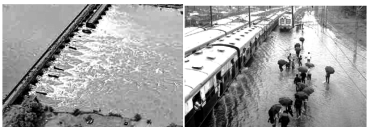
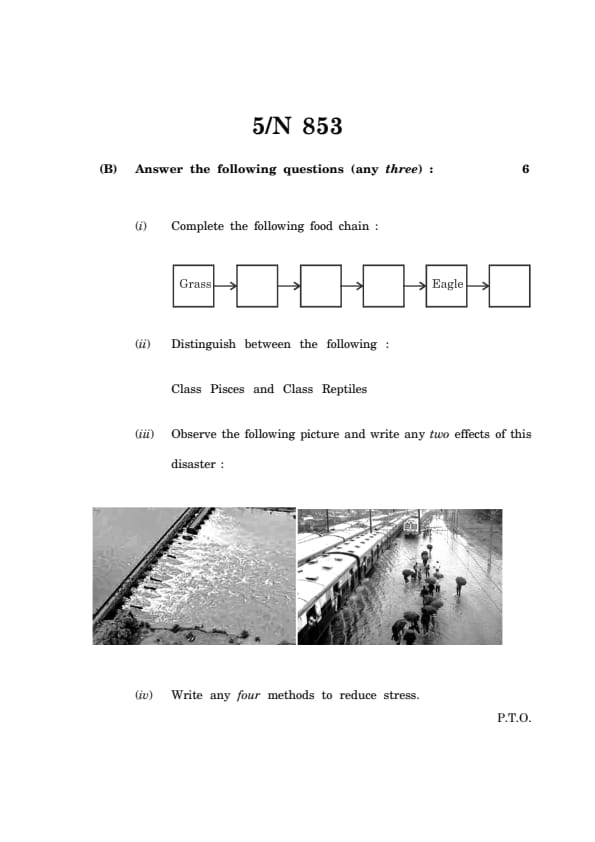
(iii) Observe the following picture and write any two effects of this disaster :
View Solution
(iii) Effects of Floods
Floods are natural disasters that occur when water exceeds its normal levels, submerging land that is usually dry. Floods can be caused by heavy rainfall, melting snow, or the overflow of rivers, and they have devastating effects on communities, agriculture, and infrastructure.
Two Major Effects of Floods:
Loss of Life and Property: Floods can lead to the submergence of entire villages, towns, and farmlands, resulting in the loss of life and the destruction of homes, businesses, and essential infrastructure. The impact on communities can be long-lasting, with families displaced and property ruined, leading to immense social and economic hardships.
Spread of Waterborne Diseases: The stagnant water left behind by floods can harbor harmful pathogens, leading to the spread of waterborne diseases such as cholera, typhoid, and dysentery. Additionally, floods can damage crops and soil, leading to food shortages. The loss of infrastructure, including sanitation facilities, further exacerbates the risk of disease outbreaks. Quick Tip: \textbf{Quick Tip:} Flood management strategies, such as flood forecasting, early warning systems, and floodplain zoning, can help minimize the impact of floods and reduce the risks to life and property.
(iv) Methods to Reduce Stress
View Solution
Stress is a natural response to challenging situations, but chronic stress can negatively affect physical and mental health. It is essential to adopt stress-reduction techniques to manage stress and promote overall well-being.
Four Methods to Reduce Stress:
Meditation and Deep Breathing: Practicing meditation helps to calm the mind and relax the body. Deep breathing exercises, such as diaphragmatic breathing, promote relaxation by reducing heart rate and blood pressure, which can help in managing stress.
Regular Physical Activities or Yoga: Engaging in physical exercise, such as walking, running, or yoga, has been proven to reduce stress by releasing endorphins (the body's natural stress relievers) and improving mood. Yoga combines physical movement with controlled breathing, further enhancing relaxation.
Maintaining a Healthy Lifestyle: A balanced lifestyle that includes proper sleep, nutrition, and hydration helps the body manage stress more effectively. A well-rested mind and body are better equipped to handle stressful situations.
Sharing Feelings or Practicing Hobbies: Talking about your feelings with friends, family, or a counselor can help alleviate stress by providing emotional support. Additionally, engaging in relaxing hobbies, such as reading, painting, or gardening, allows the mind to unwind and focus on something enjoyable. Quick Tip: \textbf{Quick Tip:} Reducing stress requires consistent effort. Incorporating stress-reducing practices into your daily routine, even for just a few minutes, can have long-term benefits for your mental and physical health.
(v) Complete the following conceptual picture :
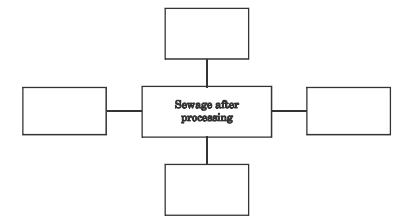
Uses of Biogas and Byproducts
View Solution
Biogas, primarily composed of methane (CH₄), is a renewable source of energy produced from the anaerobic digestion of organic waste. Along with biogas, several valuable byproducts are generated during the process, each with its own useful application.
Uses and Benefits:
Biogas (Methane): Biogas is a clean and efficient fuel that can be used for cooking, heating, and even generating electricity. Methane, the primary component of biogas, has a high calorific value, making it a viable alternative to fossil fuels for energy production.
Manure/Sludge: The remaining organic material after biogas production is a nutrient-rich manure or sludge that can be used as an excellent organic fertilizer. This material helps improve soil quality, enhance water retention, and reduce the need for chemical fertilizers.
Clean Water: The process of biogas production often involves the treatment of wastewater, resulting in the production of clean water. This water can be reused for agricultural irrigation or in industrial processes, reducing the overall demand for freshwater resources.
Nutrients: During the digestion process, valuable nutrients such as nitrogen, phosphorus, and potassium are retained in the byproducts. These nutrients can be recovered and used for soil enrichment, supporting sustainable agricultural practices. Quick Tip: \textbf{Quick Tip:} The use of biogas as a renewable energy source and its byproducts as fertilizers and irrigation water significantly contribute to sustainable farming and waste management, making it a key component in reducing environmental impact.
Answer the following questions (any five) :
(i) Define heredity. Explain the mechanism of hereditary changes.
View Solution
Answer :
Heredity is the process through which genetic information is passed down from one generation to the next. This transmission of genetic traits occurs through genes, which are segments of DNA. In sexual reproduction, the offspring inherit a combination of genes from both parents, resulting in traits that may vary from those of their ancestors. The genetic material is carried in the form of DNA, which is found in the chromosomes within the cells of living organisms.
Mechanism of Hereditary Changes:
DNA and Chromosomes: The characters are carried by DNA, which is packed into structures known as chromosomes. These chromosomes are located in the nucleus of the cell. DNA contains all the instructions necessary for the development, functioning, and reproduction of organisms.
Genes and Proteins: Genes are specific segments of DNA that carry the instructions for making proteins. These proteins determine the traits or characteristics that are expressed in an organism, such as eye color, height, or disease resistance.
Gametes and Genetic Material: During sexual reproduction, organisms produce gametes (sperm and egg). These gametes contain only half of the genetic material, which ensures that when fertilization occurs, the offspring will have a full set of chromosomes, restoring the diploid condition.
Hereditary Variations: As a result of the mixing of genetic material during fertilization, there is a combination of genes from both parents, leading to hereditary variations in the offspring. This variation is essential for evolution and adaptation. Quick Tip: \textbf{Quick Tip:} Heredity plays a fundamental role in genetics and is the reason why offspring may inherit both traits and genetic conditions from their parents. Understanding heredity helps explain why genetic variation exists within populations.
(ii) Write any four stages of mitosis and explain any two of them.
View Solution
Answer :
Mitosis is a type of cell division that results in two genetically identical daughter cells. The process of mitosis is divided into several stages, each with specific events that ensure the proper distribution of chromosomes.
The four stages of mitosis are:
Prophase: During prophase, the chromosomes condense and become visible under a microscope. The nuclear membrane begins to disintegrate, and the spindle fibers start to form. The centrioles, found in animal cells, move towards opposite poles of the cell.
Metaphase: In this stage, the chromosomes align at the equatorial plane of the cell. Spindle fibers attach to the centromere of each chromosome, ensuring that each sister chromatid is attached to opposite poles of the cell.
Anaphase: The centromeres divide, and the sister chromatids are pulled toward opposite poles by the spindle fibers. This ensures that each daughter cell will receive an identical set of chromosomes.
Telophase: In telophase, the chromosomes begin to de-condense, and a new nuclear membrane forms around each set of chromosomes. The spindle fibers dissolve, and the cell prepares for the final division.
Explanation of Prophase and Metaphase:
Prophase: The chromosomes, which were previously uncondensed, become visible as distinct structures. The nuclear membrane begins to break down, allowing the chromosomes to interact with the spindle fibers. The spindle apparatus starts to form between the two centrioles.
Metaphase: The chromosomes align at the cell's equator, ensuring that each chromosome is attached to the spindle fibers. This alignment is critical for the accurate separation of chromosomes into daughter cells during anaphase. Quick Tip: \textbf{Quick Tip:} Mitosis ensures the preservation of the chromosome number in the daughter cells, making it crucial for growth, repair, and asexual reproduction in multicellular organisms.
(iii) Explain with examples types of asexual reproduction in unicellular organism.
Answer :
View Solution
Asexual reproduction is a process where a single organism can reproduce without the involvement of another organism, producing offspring that are genetically identical to the parent. This process is common in unicellular organisms, which can reproduce rapidly under favorable conditions.
Types of Asexual Reproduction:
Binary Fission: In binary fission, the parent cell divides into two equal daughter cells. The genetic material is duplicated and divided equally between the two new cells.
Example: Amoeba and Paramecium.
Multiple Fission: In multiple fission, the nucleus of the parent cell divides multiple times before the cytoplasm divides, resulting in several daughter cells.
Example: Plasmodium, the causative agent of malaria.
Budding: A small outgrowth (bud) forms on the parent cell. This bud eventually detaches and grows into a new organism. The parent cell and the new organism are genetically identical.
Example: Yeast.
Spore Formation: In spore formation, specialized cells called spores are produced by the parent organism. These spores can develop into new individuals under the right conditions.
Example: Bacteria and fungi. Quick Tip: \textbf{Quick Tip:} Asexual reproduction allows organisms to reproduce rapidly, but it limits genetic diversity. Organisms that reproduce sexually have greater variation, which can enhance survival in changing environments.
(iv) Which fuel is used in thermal power plant? Write any two problems associated with this type of power generation.
Answers :
View Solution
Thermal power plants use fuels that can be burned to generate heat, which is then used to produce electricity. The most common fuels used in thermal power plants include coal, petroleum, and natural gas.
Fuel Used:
Coal is the most widely used fuel in thermal power plants. It is burned to produce heat, which is used to convert water into steam. The steam drives a turbine connected to a generator, producing electricity.
Petroleum and natural gas are also used, though less commonly than coal, due to their higher costs.
Problems with Thermal Power Generation:
Air Pollution: The burning of coal and other fossil fuels releases harmful gases such as carbon dioxide (CO₂), sulfur dioxide (SO₂), and nitrogen oxides (NOx) into the atmosphere. These gases contribute to air pollution, global warming, and acid rain.
Fly Ash and Thermal Pollution: The combustion of coal produces fly ash, which can be harmful to both human health and the environment. Additionally, the cooling process in thermal plants often involves discharging heated water into nearby water bodies, raising their temperature and disrupting aquatic ecosystems. Quick Tip: \textbf{Quick Tip:} While thermal power plants are an important source of electricity, their environmental impact must be mitigated by adopting cleaner energy sources and more efficient technologies.
(vi) What are the constituents of acid rain? What are its two effects on earth’s surface?
Answer :
View Solution
Acid rain is a form of precipitation that contains elevated levels of sulfuric and nitric acids. It is primarily caused by the emission of sulfur dioxide (SO₂) and nitrogen oxides (NOx) from industrial processes, vehicles, and power plants.
Constituents of Acid Rain:
Sulfuric Acid (H₂SO₄): Formed when sulfur dioxide (SO₂) reacts with water vapor in the atmosphere.
Nitric Acid (HNO₃): Formed when nitrogen oxides (NOx) combine with water vapor.
Effects of Acid Rain:
Corrosion of Buildings and Structures: Acid rain can damage buildings, monuments, and metal structures by corroding surfaces. It accelerates the deterioration of materials like marble, limestone, and concrete.
Damage to Soil and Aquatic Life: Acid rain can lower the pH of soil and water bodies, making them more acidic. This disrupts nutrient availability in the soil, harms plant life, and can lead to the death of fish and other aquatic organisms. Quick Tip: \textbf{Quick Tip:} Preventing acid rain requires reducing emissions of sulfur dioxide and nitrogen oxides by transitioning to cleaner energy sources and implementing stricter regulations on industrial activities.
(viii) Write down the reasons, effects and remedial measures taken for any one disaster seen or heard by you.
View Solution
Floods are one of the most destructive natural disasters, caused by an overflow of water onto land that is usually dry. They can occur in various regions due to different factors such as heavy rainfall, poor infrastructure, or human activities. Flooding can have severe consequences for the affected areas and can take months or years for communities to recover.
Reasons for Floods:
Heavy and Prolonged Rainfall: Flooding often occurs after heavy monsoonal rains or cyclonic storms that bring large amounts of water in a short period. This water can overwhelm the natural drainage systems, leading to flash floods or prolonged flooding in low-lying areas.
Poor Drainage Systems: In urban areas, inadequate or blocked drainage systems are a major contributing factor. When drains are blocked by garbage or poorly maintained, rainwater cannot be properly drained, leading to urban flooding.
Deforestation and Loss of Wetlands: Trees and wetlands naturally absorb excess water, but deforestation and the draining of wetlands reduce the earth's ability to absorb rainfall. This results in increased surface runoff and more frequent and severe flooding.
Release of Excess Water from Reservoirs or Dam Failure: Flooding can also occur when large reservoirs release excess water to prevent dam failure, or when a dam itself fails, releasing a massive amount of water downstream.
Effects of Floods:
Loss of Life, Injuries, and Displacement: Floods often result in the loss of human life and widespread injuries. Thousands of people may be displaced from their homes, resulting in temporary or permanent loss of shelter and livelihood.
Damage to Infrastructure: Houses, roads, bridges, and public utilities like water supply and electricity systems can be severely damaged, leading to a long recovery process. Flooding also damages agricultural crops, leading to food shortages and economic loss for farmers.
Spread of Waterborne Diseases: Stagnant floodwater can harbor harmful bacteria and pathogens, leading to the spread of diseases such as cholera, typhoid, and dysentery. Contaminated water further exacerbates the health crisis in the affected areas.
Contamination of Drinking Water and Soil Degradation: Floodwaters often contaminate freshwater sources, making drinking water unsafe. Flooding also leads to long-term soil degradation, making it harder to grow crops and leading to the loss of arable land.
Remedial Measures for Floods:
Short-term Measures:
Evacuate People to Safe Shelters: Immediately evacuating people from affected areas to shelters is crucial to prevent loss of life and injury.
Provide Clean Drinking Water and Medical Aid: Ensuring that affected populations have access to clean drinking water and medical supplies is essential for preventing waterborne diseases and treating injuries.
Distribute Food and Blankets: In the aftermath of a flood, relief efforts should include the distribution of food, blankets, and other essential supplies to help survivors cope with the immediate aftermath.
Set Up Temporary Sanitation Facilities: Flooding often disrupts sanitation systems, leading to contamination. Temporary sanitation facilities such as mobile toilets are necessary to prevent the spread of disease.
Long-term Measures:
Improve River Management: Constructing embankments, dredging rivers, and building flood barriers can help control the flow of water and prevent rivers from overflowing their banks during heavy rains.
Restore Forests and Wetlands: Reforestation and the restoration of wetlands help to absorb excess water and prevent soil erosion, reducing the risk of floods.
Construct Better Drainage Systems: Upgrading drainage systems in urban areas can prevent blockages and ensure that excess water is quickly drained away during rainfall, reducing the risk of urban flooding.
Flood Forecasting and Early-Warning Systems: Developing and implementing flood forecasting systems can help predict floods and issue timely warnings, giving people the chance to evacuate in advance.
Land-Use Planning and Zoning: Implementing land-use policies to avoid building in floodplains can reduce the damage caused by floods. This includes enforcing building codes and zoning regulations that take flood risks into account.
Community Awareness and Preparedness: Promoting public awareness about flood risks and disaster preparedness, including emergency evacuation plans and safety measures, is vital for reducing the impact of future floods. Quick Tip: \textbf{Quick Tip:} Flood management requires a multi-pronged approach, involving infrastructure improvements, environmental restoration, and community engagement. Early warning systems and efficient disaster response can save lives and minimize damage.
What is biodiversity? Write any four steps to conserve biodiversity.
View Solution
Biodiversity refers to the variety and variability of living organisms present on Earth, including plants, animals, fungi, and microorganisms. It encompasses the diversity of species, genes, and ecosystems that exist across the planet. The concept of biodiversity is often referred to as the foundation of life on Earth because it supports ecosystem services such as air and water purification, climate regulation, and pollination. Biodiversity also contributes to human health, food security, and provides raw materials for industry.
Biodiversity is categorized into three main levels:
Genetic diversity: The variation in genetic material within a species.
Species diversity: The variety of species within an ecosystem or across the planet.
Ecosystem diversity: The variety of habitats, biotic communities, and ecological processes.
The ongoing loss of biodiversity due to human activities like deforestation, pollution, and climate change has significant negative impacts on ecosystems and the services they provide.
Four steps to conserve biodiversity:
Establishment of protected areas: Creating and maintaining protected areas such as national parks, wildlife sanctuaries, and biosphere reserves is crucial in conserving ecosystems and species. These areas provide a safe haven for species to live and reproduce without the immediate threat of human interference, such as poaching or habitat destruction.
Conservation of species: This involves preserving genetic material and restoring species populations through techniques like gene banks, seed banks, and tissue culture. These methods ensure that genetic diversity is maintained and can be used for future breeding programs or restoration efforts.
Reforestation and afforestation: Planting trees and restoring degraded habitats helps to rebuild ecosystems and provide the necessary resources for wildlife. Reforestation restores the original forest cover, while afforestation creates new forests where there were none previously.
Spreading awareness and enforcing laws: Educating the public about the importance of biodiversity and the threats it faces, coupled with the enforcement of laws to prevent activities like hunting, poaching, and deforestation, is critical. Sustainable practices should be encouraged, and illegal activities should be strictly controlled. Quick Tip: \textbf{Quick Tip:} Effective biodiversity conservation requires the combined efforts of governments, conservation organizations, and local communities. Sustainable development practices should be integrated into conservation efforts to create a balance between human needs and ecosystem protection.



Comments