




The CBSE Board conducted Class 12 Political Science Exam 2026 on March 23, 2026. Class 12 Political Science Question Paper 2026 – Set 3 with Solution PDF is available here for download.
The CBSE Class 12 Political Science Set 3 paper covers key topics from Indian Politics, Comparative Politics, and Political Theory and considered moderately difficult. The exam is marked out of 100, with 80 marks for the theory paper and 20 for internal assessment.
CBSE Class 12 Political Science Question Paper 2026 with Solution PDF – Set 3
| CBSE Class 12 Political Science Question Paper 2026 – Set 3 | Download PDF | Check Solutions |
Given below are two statements:
Statement I: The International Monetary Fund (IMF) is an international organization that oversees those financial institutions and regulations that act at the international level.
Statement II: All the 189 members of IMF organization have equal say. In the light of above statements, choose the correct answer from the options given below:
View Solution
Step 1: Understanding the Question:
The question asks to evaluate the truthfulness of two statements regarding the International Monetary Fund (IMF).
Step 2: Detailed Explanation:
Statement I is true because the IMF is indeed an international financial institution that monitors the global financial system and oversees the exchange rates and balance of payments of its member nations.
Statement II is false because the IMF does not operate on a one-member-one-vote basis. Voting power in the IMF is weighted based on the quota of each member, which is generally determined by the member's economic size. Thus, larger economies have a greater say than smaller ones.
Step 3: Final Answer:
Since statement I is factually correct and statement II is incorrect, the correct option is (C).
Quick Tip: Remember that in international organizations like the IMF and World Bank, voting rights are usually proportional to financial contribution, unlike the UN General Assembly where each country has one vote.
The alliance that has formed the government at the centre the maximum number of times:
Which one of the following statements is True about the concept of 'Co-operative Security'?
Arrange the following events in chronological order:
(i) Declaration of National Emergency on the basis of internal disturbances.
(ii) Railway strike by government employees under the leadership of George Fernandes.
(iii) Sixth General Election held in India.
(iv) Declaration of the doctrine of 'basic structure' of the Constitution in the 'Keshavananda Bharti' case by the Supreme Court. Choose the correct option:
View Solution
Step 1: Understanding the Question:
The goal is to sequence historical events in India correctly by date.
Step 2: Detailed Explanation:
(iv) Keshavananda Bharti case occurred in 1973.
(ii) Railway strike led by George Fernandes occurred in 1974.
(i) Declaration of National Emergency occurred in June 1975.
(iii) The Sixth General Election was held in 1977.
Ordering these: 1973, 1974, 1975, 1977 corresponds to (iv), (ii), (i), (iii).
Step 3: Final Answer:
The correct chronological order is (iv), (ii), (i), (iii).
Quick Tip: Create a timeline of the 1970s in India, as this decade is crucial for Understanding the Emergency and its aftermath in the Political Science syllabus.
Which statement is the best description of 'Veto Power'?
Which one of the following is NOT a consequence of 'Shock Therapy'?
Which one of the following is related to the traditional notion of security?
Identify the correct trio of Baltic Republics :
Which was the last state toured by Rajiv Gandhi for his election campaign in May 1991?
Which one of the following statements is NOT correct about the first two Five Year Plan?
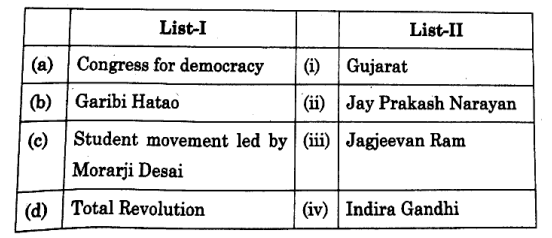
Match List-I with List-II correctly and choose the correct answer from the codes given below :
Given below are two statements marked as Assertion (A) and Reason (R). Read these statements and choose the correct answer from the given options :
Assertion (A) : The idea of Five Year Plans (FYP) in India was inspired by the USSR.
Reason (R) : Due to acute economic crisis, the Indian Government started 'Plan Holiday' in 1966.
View Solution
Step 1: Understanding the Question:
This is an assertion-reason question testing the knowledge of India's economic planning history.
Step 2: Detailed Explanation:
Assertion (A) is true; India adopted the Five Year Plan model from the Soviet Union's centralized planning system.
Reason (R) is true; due to droughts, the wars of 1962 and 1965, and economic instability, there was a break in the planning process, leading to the 'Plan Holiday' (1966-1969).
However, the 'Plan Holiday' is not the reason for the adoption of the Five Year Plan model itself. Thus, (R) is true but does not explain (A).
Step 3: Final Answer:
Both statements are historically correct independently, so (B) is the right choice.
Quick Tip: Always check if the 'Reason' is logically causing the 'Assertion'. Often both statements are true, but the causal link is missing.
Highlight any two internal threats which any state may face.
Analyse the main reason responsible for the formation of Coalition Governments after 1989.
Explain any two differences between the refugees and the migrants.
How does the geographical location of the North-East region has affected the expression of its regional demands ? Explain.
View Solution
Step 1: Understanding the Question:
The question asks to explain the link between the unique physical geography of North-East India and the political nature of the demands raised by the people residing there.
Step 3: Detailed Explanation:
The geography of the North-East has significantly shaped its political landscape in the following ways:
1. Physical Isolation and the 'Chicken’s Neck': The region is connected to the rest of India by a very narrow strip of land (Siliguri Corridor). This physical distance and limited connectivity led to a feeling of being neglected by the central government, fostering demands for more autonomy and better infrastructure.
2. International Borders: The North-East shares about 99% of its borders with foreign countries (China, Myanmar, Bangladesh, and Bhutan). This makes the region highly sensitive to cross-border migration. The fear of being reduced to a minority by "outsiders" or illegal migrants has fueled intense regionalist movements and demands for legal protections (like the NRC or ILP).
3. Hilly Terrain and Ethnic Diversity: The rugged, mountainous terrain led to the historical isolation of various tribes from each other and the plains. This preserved distinct cultural identities, which later manifested as demands for separate states (like Meghalaya or Nagaland) to protect their unique customs from being submerged into a "mainstream" Indian culture.
Step 4: Final Answer:
Geographical isolation created a sense of alienation, while international borders raised fears about demographic changes, both of which intensified regional demands for political autonomy and cultural protection.
Quick Tip: When discussing the North-East, always mention the Siliguri Corridor and the region's vast international borders to show geographical impact.
State any two reasons for the Students' Movement in Bihar in 1974.
View Solution
Step 1: Understanding the Question:
The question seeks to identify the socio-economic and political triggers that led students in Bihar to launch a massive protest against the state government in 1974.
Step 3: Detailed Explanation:
The Bihar movement (or JP movement) was triggered by severe grievances among the youth. Two major reasons were:
1. Acute Economic Crisis: In the early 1970s, India faced high inflation and a rise in the prices of food grains and essential commodities. Bihar was particularly hard hit, and the students suffered due to the high cost of education and living, leading to widespread frustration.
2. Widespread Corruption: There were serious allegations of corruption and maladministration against the ruling Congress government in Bihar. The students felt that the political leadership was indifferent to the problems of the common people and was solely interested in retaining power through unfair means. This prompted them to demand the resignation of the state government.
Step 4: Final Answer:
The two primary reasons were the crushing economic pressure caused by inflation and food scarcity, and the deep-seated anger against the corruption in the state administration.
Quick Tip: This movement is crucial because it led to Jay Prakash Narayan's call for 'Total Revolution' and eventually played a role in the imposition of the Emergency.
Assess the impact of outside powers on the South Asian Countries.
Explain any four differences between the governments formed in the first three General Elections held in India after independence and the coalition governments formed after the year 1989.
Explain any four advantages of coalition governments with reference to Indian politics.
Describe any two areas of co-operation and any two reasons for conflicts between India and Pakistan.
Describe any two areas of co-operation and any two reasons for conflicts between India and Nepal.
Highlight any four points of the political ideology of Communist Party of India.
Why could the reforms initiated by Mikhail Gorbachev not save the disintegration of Soviet Union? Explain any two reasons.
Describe any four factors responsible to make Indira Gandhi's government popular in the beginning of 1970s decade.
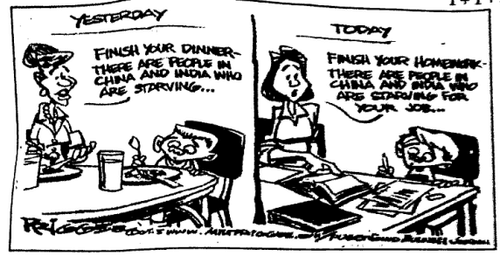
Study the given cartoon carefully and answer the questions that follow:
24(i).
Which change does the cartoon reflect?
What kind of shift is shown in America's attitude towards developing countries?
Mention any one positive and any one negative impact of globalization in reference to the cartoon.
Questions for Visually Impaired Candidates only in lieu of Q. No. 24:
Question 24(i):
In which year did India embark on reforms for economic growth?
View Solution
Step 1: Understanding the Question:
The question requires recalling the specific year when India formally adopted structural economic reforms, shifting away from a heavily state-regulated economy.
Step 3: Detailed Explanation:
Facing a severe balance of payments crisis, the Indian government, under Prime Minister P.V. Narasimha Rao and Finance Minister Dr. Manmohan Singh, introduced major economic reforms.
These reforms, encompassing Liberalization, Privatization, and Globalization (LPG), were officially launched in the year 1991.
Step 4: Final Answer:
India embarked on economic reforms in the year 1991.
Quick Tip: 1991 is a watershed year in Indian history. It marks the shift to LPG (Liberalization, Privatization, Globalization) policies.
In which year and at what place was the first meeting of World Social Forum (WSF) organized?
State any two cultural consequences of globalization.
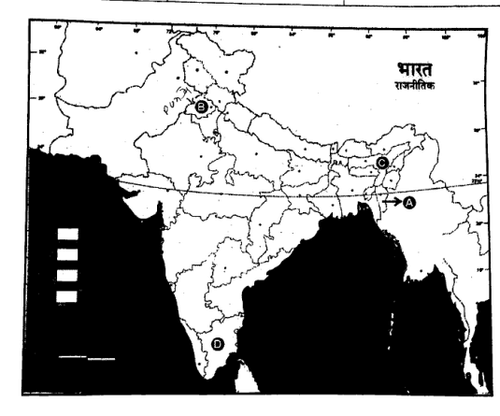
In the given political outline map of India, four states have been marked as A, B, C and D. Identify these on the basis of the information given below and write their correct names in your answer-book along with their respective serial number of the information used and the concerned alphabet as per the format that follows:
25(i).
The state related to the leader of Dravidian Movement E.V. Ramasami Naicker.
The state whose formation was supported by Master Tara Singh.
The state where the movement against outsiders was started by students.
The state for which Rajiv Gandhi and Laldenga signed an agreement for peace.
Questions for Visually Impaired Candidates only in lieu of Q. No. 25:
Question 25(i):
Name the Article related to Jammu and Kashmir which was abrogated in 2019.
View Solution
Step 1: Understanding the Question:
The question asks for the specific constitutional article that provided special autonomous status to the state of Jammu and Kashmir before its revocation.
Step 3: Detailed Explanation:
Article 370 of the Indian Constitution granted special autonomous status to the region of Jammu and Kashmir, allowing it to have its own constitution, a separate flag, and independence over all matters except foreign affairs, defense, and communications.
On August 5, 2019, the Government of India revoked this special status by abrogating Article 370.
Step 4: Final Answer:
Article 370.
Quick Tip: Article 370 is one of the most frequently tested topics regarding recent political changes in India. Memorize the year (2019) and the article number.
Name any one regional political party of Jammu and Kashmir.
In which year Arunachal Pradesh became a separate state?
Name the popular leader of Mizo National Front (MNF).
Read the passage given below carefully and answer the questions that follow :
On the reform of structures and processes, the biggest discussion has been on the functioning of the Security Council. Related to this has been the demand for an increase in the UN Security Council's permanent and non-permanent membership so that the realities of contemporary world politics are better reflected in the structure of the organisation. In particular, there are proposals to increase membership from Asia, Africa and South America. Beyond this, the US and other Western countries want improvements in the UN's budgetary procedures and its administration.
26(i).
Which organ of the United Nations has five permanent members?
Which country contributes the most in the budget of United Nations Organisation?
In which year was the strength of non-permanent members of Security Council increased?
Which of the following statements is NOT correct about the reforms in Security Council?
State any three major differences between the economic policies followed by China before and after 1970.
Explain ASEAN as an 'alternative centre of power' in the contemporary world.
How did Princely states posed a threat to the National Security of India? Explain.
View Solution
Step 1: Understanding the Question:
The question asks to analyze the security risks and territorial challenges India faced immediately after independence due to the existence of 565 semi-independent princely states.
Step 3: Detailed Explanation:
1. Threat of Balkanization: The British gave princely states the choice to join India, Pakistan, or remain independent.
If many large states chose independence, India would have fractured into dozens of small, scattered nations (Balkanization), completely destroying the territorial integrity and unity of the newly independent country.
2. Strategic Vulnerability: Several crucial princely states shared borders with Pakistan or occupied critical geographical positions.
For example, if Junagadh or Hyderabad (which was deep inside Indian territory) aligned with Pakistan, it would have created hostile enclaves within India's borders, causing perpetual internal security nightmares.
Similarly, the indecision of Jammu and Kashmir led to immediate conflict and foreign intervention.
3. Disruption of Supply Lines: Many princely states sat astride vital railway, road, and communication networks connecting different parts of British India.
If these states remained independent or turned hostile, they could easily choke the movement of Indian troops and essential supplies, severely compromising national defense.
Step 4: Final Answer:
Princely states posed a severe threat by risking the balkanization of the subcontinent, creating hostile enclaves within Indian borders, and potentially disrupting critical communication and defense supply lines.
Quick Tip: Use the term "Balkanization" to effectively describe the threat of India breaking up into multiple smaller, vulnerable states.
Explain any four problems faced during the process of partition of India.
Analyse any three principles of India's foreign policy which you would like to alter in the present international scenario.
"India's nuclear policy is a blend of strategic autonomy and a commitment to global disarmament." Justify the statement with any three suitable arguments.
Examine any four environmental concerns that have influenced the global politics.
Suggest any four steps that the Government of India should take to protect the environment.





Comments