GRE 2024 Quantitative Reasoning Practice Test 3 Question Paper with Solutions PDF

Shivam Yadav logo
QHgemN, Oct 14, 2025

byShivam Yadav

GRE 2024 Quantitative Reasoning Practice Test 3 Question Paper with Solutions PDF is available for download. The overall test time is about 1 hour and 58 minutes. GRE has total 5 sections:

  • Analytical Writing  (One "Analyze an Issue" task, Alloted time 30 minutes)
  • Verbal Reasoning  (Two Sections, with 12 questions and 15 questions respectively)
  • Quantitative Reasoning (Two Sections, with 12 questions and 15 questions respectively)

GRE 2024 Qantitative Reasoning Practice Test 3 Question Paper with Solutions PDF

GRE 2024 Quantitative Reasoning Question Paper with Solutions PDF download iconDownload Check Solutions
GRE 2024 Qantitative Reasoning Practice Test 3 Question Paper with Solutions PDF

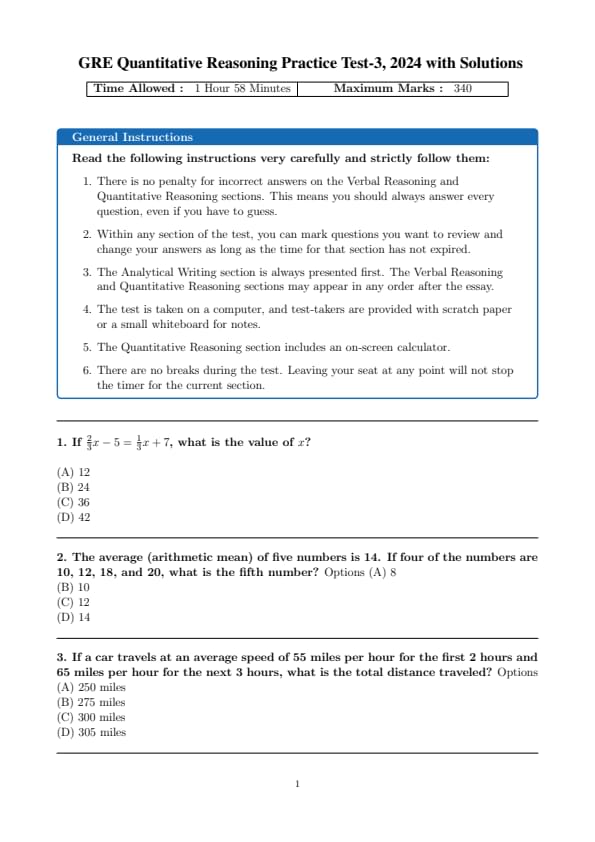
Question 1:

If \( \frac{2}{3}x - 5 = \frac{1}{3}x + 7 \), what is the value of \( x \)?

  • (A) 12
  • (B) 24
  • (C) 36
  • (D) 42

Question 2:

The average (arithmetic mean) of five numbers is 14. If four of the numbers are 10, 12, 18, and 20, what is the fifth number?
Options

  • (A) 8
  • (B) 10
  • (C) 12
  • (D) 14

Question 3:

If a car travels at an average speed of 55 miles per hour for the first 2 hours and 65 miles per hour for the next 3 hours, what is the total distance traveled?
Options

  • (A) 250 miles
  • (B) 275 miles
  • (C) 300 miles
  • (D) 305 miles

Question 4:

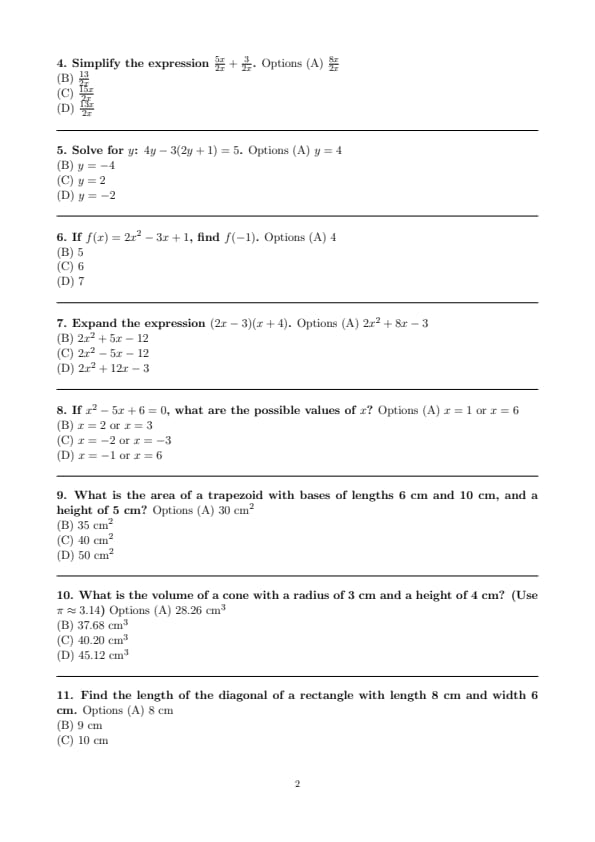
Simplify the expression \( \frac{5x}{2x} + \frac{3}{2x} \).
Options

  • (A) \( \frac{8x}{2x} \)
  • (B) \( \frac{13}{2x} \)
  • (C) \( \frac{15x}{2x} \)
  • (D) \( \frac{13x}{2x} \)

Question 5:

Solve for \( y \): \( 4y - 3(2y + 1) = 5 \).
Options

  • (A) \( y = 4 \)
  • (B) \( y = -4 \)
  • (C) \( y = 2 \)
  • (D) \( y = -2 \)

Question 6:

If \( f(x) = 2x^2 - 3x + 1 \), find \( f(-1) \).
Options

  • (A) 4
  • (B) 5
  • (C) 6
  • (D) 7

Question 7:

Expand the expression \( (2x - 3)(x + 4) \).
Options

  • (A) \( 2x^2 + 8x - 3 \)
  • (B) \( 2x^2 + 5x - 12 \)
  • (C) \( 2x^2 - 5x - 12 \)
  • (D) \( 2x^2 + 12x - 3 \)

Question 8:

If \( x^2 - 5x + 6 = 0 \), what are the possible values of \( x \)?
Options

  • (A) \( x = 1 \) or \( x = 6 \)
  • (B) \( x = 2 \) or \( x = 3 \)
  • (C) \( x = -2 \) or \( x = -3 \)
  • (D) \( x = -1 \) or \( x = 6 \)

Question 9:

What is the area of a trapezoid with bases of lengths 6 cm and 10 cm, and a height of 5 cm?
Options

  • (A) 30 cm\(^2\)
  • (B) 35 cm\(^2\)
  • (C) 40 cm\(^2\)
  • (D) 50 cm\(^2\)

Question 10:

What is the volume of a cone with a radius of 3 cm and a height of 4 cm? (Use \( \pi \approx 3.14 \))
Options

  • (A) 28.26 cm\(^3\)
  • (B) 37.68 cm\(^3\)
  • (C) 40.20 cm\(^3\)
  • (D) 45.12 cm\(^3\)

Question 11:

Find the length of the diagonal of a rectangle with length 8 cm and width 6 cm.
Options

  • (A) 8 cm
  • (B) 9 cm
  • (C) 10 cm
  • (D) 12 cm

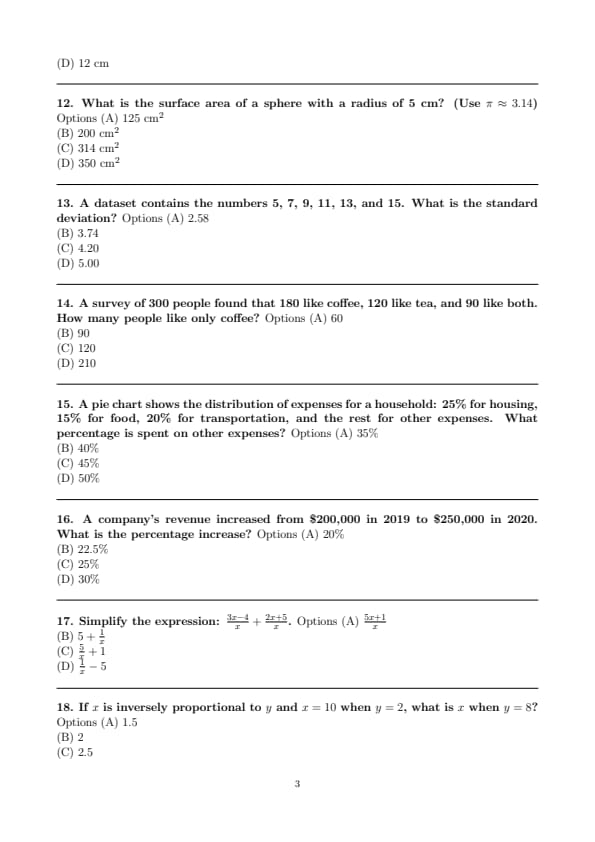
Question 12:

What is the surface area of a sphere with a radius of 5 cm? (Use \( \pi \approx 3.14 \))
Options

  • (A) 125 cm\(^2\)
  • (B) 200 cm\(^2\)
  • (C) 314 cm\(^2\)
  • (D) 350 cm\(^2\)

Question 13:

A dataset contains the numbers 5, 7, 9, 11, 13, and 15. What is the standard deviation?
Options

  • (A) 2.58
  • (B) 3.74
  • (C) 4.20
  • (D) 5.00

Question 14:

A survey of 300 people found that 180 like coffee, 120 like tea, and 90 like both. How many people like only coffee?
Options

  • (A) 60
  • (B) 90
  • (C) 120
  • (D) 210

Question 15:

A pie chart shows the distribution of expenses for a household: 25% for housing, 15% for food, 20% for transportation, and the rest for other expenses. What percentage is spent on other expenses?
Options

  • (A) 35%
  • (B) 40%
  • (C) 45%
  • (D) 50%

Question 16:

A company's revenue increased from
(200{,}000 in 2019 to
)250{,}000 in 2020. What is the percentage increase?
Options

  • (A) 20%
  • (B) 22.5%
  • (C) 25%
  • (D) 30%

Question 17:

Simplify the expression: \( \frac{3x - 4}{x} + \frac{2x + 5}{x} \).
Options

  • (A) \( \frac{5x + 1}{x} \)
  • (B) \( 5 + \frac{1}{x} \)
  • (C) \( \frac{5}{x} + 1 \)
  • (D) \( \frac{1}{x} - 5 \)

Question 18:

If \( x \) is inversely proportional to \( y \) and \( x = 10 \) when \( y = 2 \), what is \( x \) when \( y = 8 \)?
Options

  • (A) 1.5
  • (B) 2
  • (C) 2.5
  • (D) 4

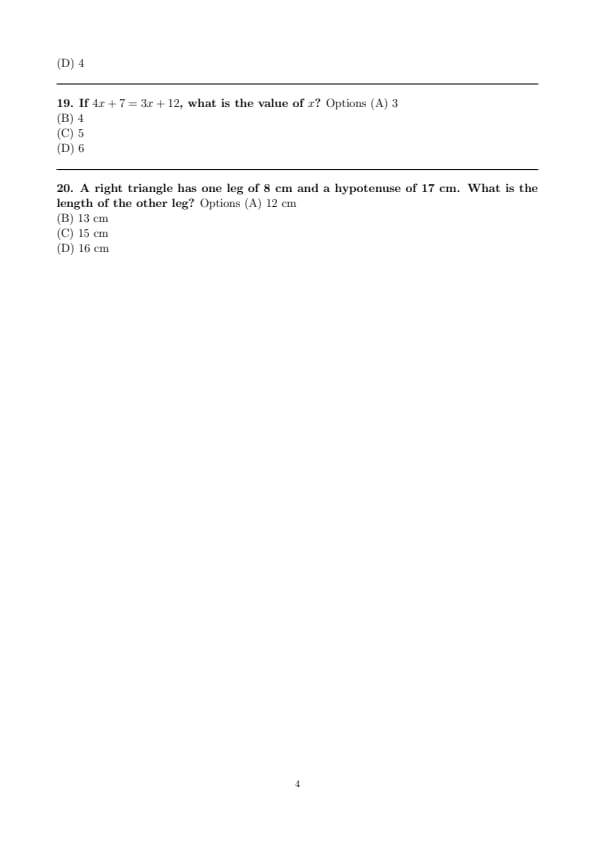
Question 19:

If \( 4x + 7 = 3x + 12 \), what is the value of \( x \)?
Options

  • (A) 3
  • (B) 4
  • (C) 5
  • (D) 6

Question 20:

A right triangle has one leg of 8 cm and a hypotenuse of 17 cm. What is the length of the other leg?
Options
  • (A) 12 cm
  • (B) 13 cm
  • (C) 15 cm
  • (D) 16 cm

4ADFK1

  • 1.
    Jean Valjean, the protagonist in Victor Hugo’s novel Les Misérables, spends the bulk of his lengthy _______ plotting a very clever set of revenge schemes, which he executes upon his escape.

      • ruination
      • peregrination
      • immolation
      • rumination

    • 2.
      The following appeared in a memorandum from the manager of WWAC radio station.
      “To reverse a decline in listener numbers, our owners have decided that WWAC must change from its current rock-music format. The decline has occurred despite population growth in our listening area, but that growth has resulted mainly from people moving here after their retirement. We must make listeners of these new residents. We could try playing music tailored to their tastes, but a continuing decline in local sales of recorded music suggests limited interest in music. Instead, we should change to a news and talk format, a form of radio that is increasingly popular in our area.”
      Write a response in which you discuss one or more alternative explanations that could rival the proposed explanation and explain how your explanation(s) can plausibly account for the facts presented in the argument.


        • 3.
          Complete the paragraph from the given words. It is refreshing to read a book about our planet by an author who does not allow facts to be (i) _________ by politics: well aware of the political disputes about the effects of human activities on climate and biodiversity, this author does not permit them to (ii) _________ his comprehensive description of what we know about our biosphere. He emphasizes the enormous gaps in our knowledge, the sparseness of our observations, and the (iii) _________, calling attention to the many aspects of planetary evolution that must be better understood before we can accurately diagnose the condition of our planet. Fill in the blanks from the following:

            • overshadowed
            • invalidated
            • illuminated
            • enhance
            • obscure

          • 4.
            Should we really care for the greatest actors of the past could we have them before us? Should we find them too different from our accent of thought, of feeling, of speech, in a thousand minute particulars which are of the essence of all three? Dr. Doran's long and interesting records of the triumphs of Garrick, and other less familiar, but in their day hardly less astonishing, players, do not relieve one of the doubt. Garrick himself, as sometimes happens with people who have been the subject of much anecdote and other conversation, here as elsewhere, bears no very distinct figure. One hardly sees the wood for the trees. On the other hand, the account of Betterton, "perhaps the greatest of English actors," is delightfully fresh. That intimate friend of Dryden, Tillatson, Pope, who executed a copy of the actor's portrait by Kneller which is still extant, was worthy of their friendship; his career brings out the best elements in stage life. The stage in these volumes presents itself indeed not merely as a mirror of life, but as an illustration of the utmost intensity of life, in the fortunes and characters of the players. Ups and downs, generosity, dark fates, the most delicate goodness, have nowhere been more prominent than in the private existence of those devoted to the public mimicry of men and women. Contact with the stage, almost throughout its history, presents itself as a kind of touchstone, to bring out the bizarrerie, the theatrical tricks and contrasts, of the actual world.


              • 5.
                “Reviving the practice of using elements of popular music in classical composition, an approach that had been in hibernation in the United States during the 1960s, composer Philip Glass (born 1937) embraced the ethos of popular music in his compositions. Glass based two symphonies on music by rock musicians David Bowie and Brian Eno, but the symphonies' sound is distinctively his. Popular elements do not appear out of place in Glass's classical music, which from its early days has shared certain harmonies and rhythms with rock music. Yet this use of popular elements has not made Glass a composer of popular music. His music is not a version of popular music packaged to attract classical listeners; it is high art for listeners steeped in rock rather than the classics.


                  • 6.
                    Melvin’s little sister was so ________ that she would believe anything he told her, and his burgeoning sense of maturity rendered him increasingly loath to gull her.

                      • dogged
                      • tenable
                      • fractious
                      • frivolous
                      • credulous

                    Comments


                    No Comments To Show