GRE 2024 Quantitative Reasoning Practice Test 2 Question Paper with Solutions PDF

Shivam Yadav logo
QHgemN, Oct 14, 2025

byShivam Yadav

GRE 2024 Quantitative Reasoning Practice Test 2 Question Paper with Solutions PDF is available for download. The overall test time is about 1 hour and 58 minutes. GRE has total 5 sections:

  • Analytical Writing  (One "Analyze an Issue" task, Alloted time 30 minutes)
  • Verbal Reasoning  (Two Sections, with 12 questions and 15 questions respectively)
  • Quantitative Reasoning (Two Sections, with 12 questions and 15 questions respectively)

GRE 2024 Qantitative Reasoning Practice Test 2 Question Paper with Solutions PDF

GRE 2024 Quantitative Reasoning Question Paper with Solutions PDF download iconDownload Check Solutions
GRE 2024 Qantitative Reasoning Practice Test 2 Question Paper with Solutions PDF

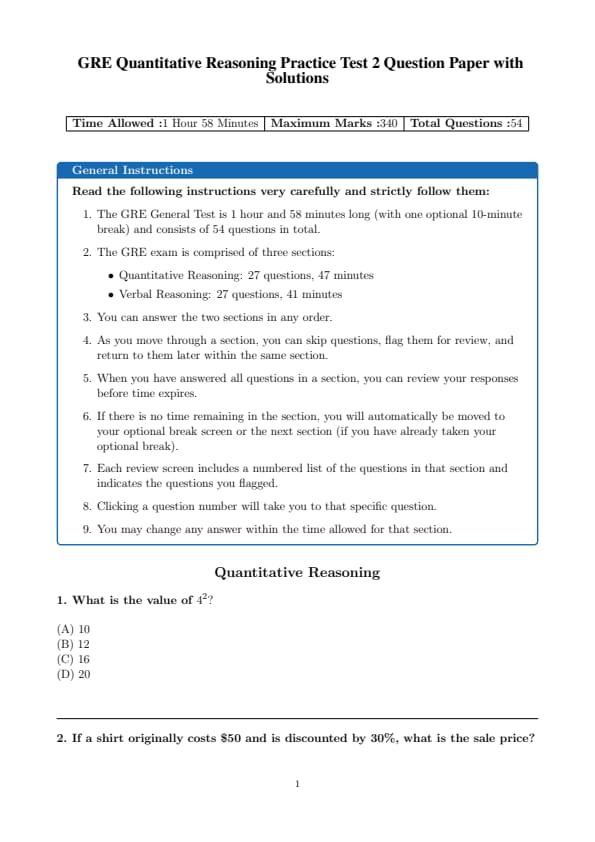
Question 1:

What is the value of \(4^2\)?

  • (A) 10
  • (B) 12
  • (C) 16
  • (D) 20

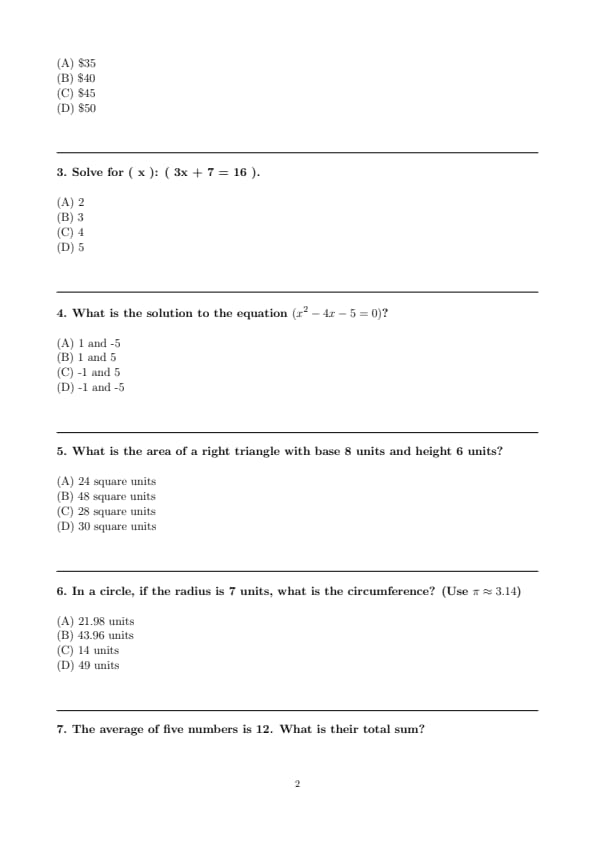
Question 2:

If a shirt originally costs 50 and is discounted by 30%, what is the sale price?

  • (A)35
  • (B)40
  • (C)45
  • (D)50

Question 3:

Solve for ( x ): ( 3x + 7 = 16 ).

  • (A) 2
  • (B) 3
  • (C) 4
  • (D) 5

Question 4:

What is the solution to the equation \( (x^2 - 4x - 5 = 0) \)?

  • (A) 1 and -5
  • (B) 1 and 5
  • (C) -1 and 5
  • (D) -1 and -5

Question 5:

What is the area of a right triangle with base 8 units and height 6 units?

  • (A) 24 square units
  • (B) 48 square units
  • (C) 28 square units
  • (D) 30 square units

Question 6:

In a circle, if the radius is 7 units, what is the circumference? (Use \(\pi \approx 3.14\))

  • (A) 21.98 units
  • (B) 43.96 units
  • (C) 14 units
  • (D) 49 units

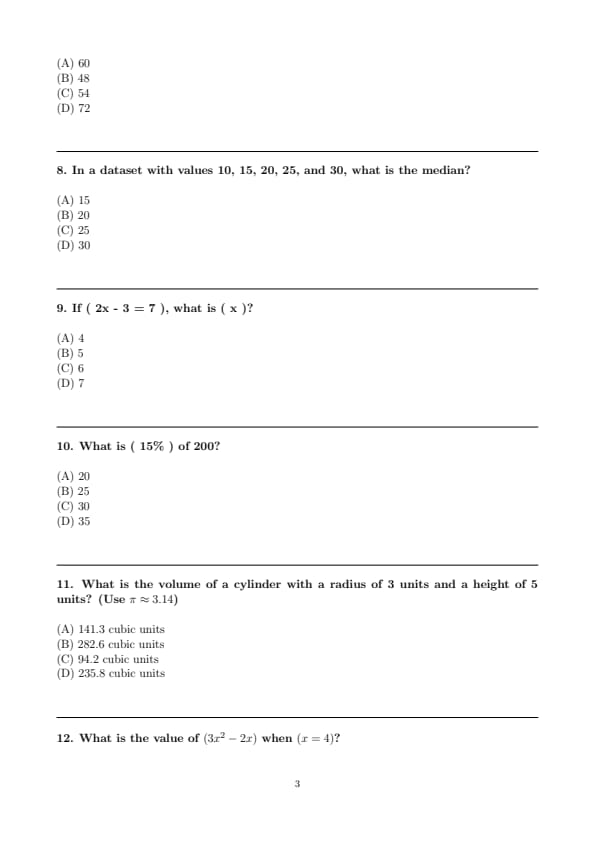
Question 7:

The average of five numbers is 12. What is their total sum?

  • (A) 60
  • (B) 48
  • (C) 54
  • (D) 72

Question 8:

In a dataset with values 10, 15, 20, 25, and 30, what is the median?

  • (A) 15
  • (B) 20
  • (C) 25
  • (D) 30

Question 9:

If ( 2x - 3 = 7 ), what is ( x )?

  • (A) 4
  • (B) 5
  • (C) 6
  • (D) 7

Question 10:

What is ( 15% ) of 200?

  • (A) 20
  • (B) 25
  • (C) 30
  • (D) 35

Question 11:

What is the volume of a cylinder with a radius of 3 units and a height of 5 units? (Use \(\pi \approx 3.14\))

  • (A) 141.3 cubic units
  • (B) 282.6 cubic units
  • (C) 94.2 cubic units
  • (D) 235.8 cubic units

Question 12:

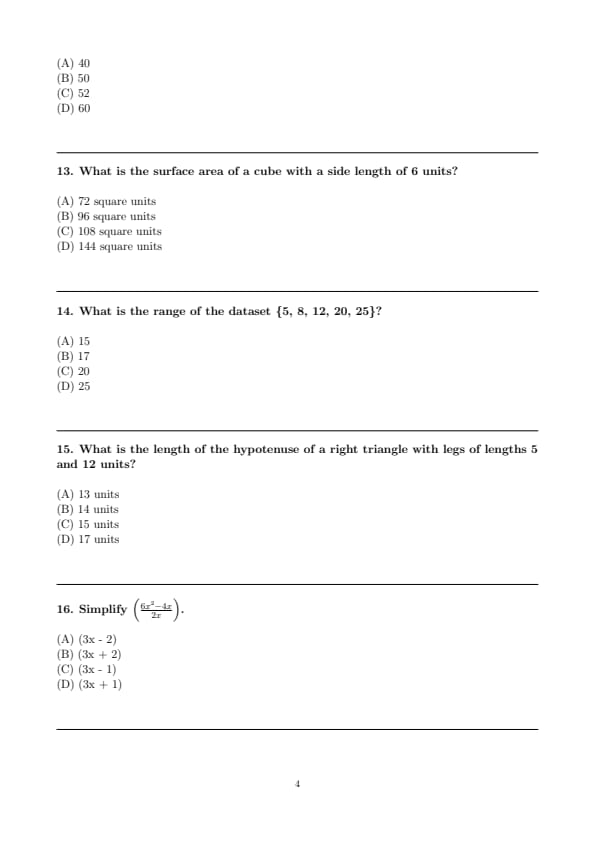
What is the value of \( (3x^2 - 2x) \) when \( (x = 4) \)?

  • (A) 40
  • (B) 50
  • (C) 52
  • (D) 60

Question 13:

What is the surface area of a cube with a side length of 6 units?

  • (A) 72 square units
  • (B) 96 square units
  • (C) 108 square units
  • (D) 144 square units

Question 14:

What is the range of the dataset {5, 8, 12, 20, 25}?

  • (A) 15
  • (B) 17
  • (C) 20
  • (D) 25

Question 15:

What is the length of the hypotenuse of a right triangle with legs of lengths 5 and 12 units?

  • (A) 13 units
  • (B) 14 units
  • (C) 15 units
  • (D) 17 units

Question 16:

Simplify \( \left( \frac{6x^2 - 4x}{2x} \right) \).

  • (A) (3x - 2)
  • (B) (3x + 2)
  • (C) (3x - 1)
  • (D) (3x + 1)

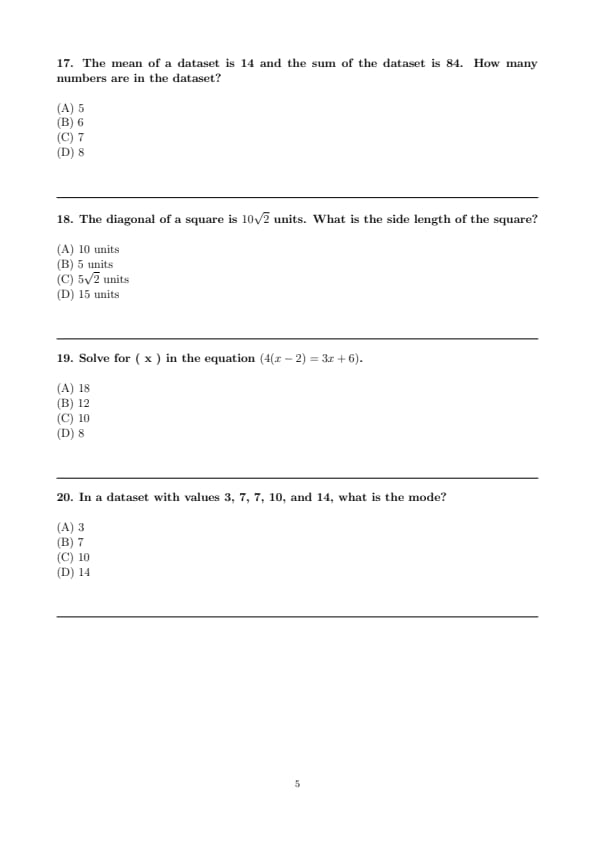
Question 17:

The mean of a dataset is 14 and the sum of the dataset is 84. How many numbers are in the dataset?

  • (A) 5
  • (B) 6
  • (C) 7
  • (D) 8

Question 18:

The diagonal of a square is \(10\sqrt{2}\) units. What is the side length of the square?

  • (A) 10 units
  • (B) 5 units
  • (C) \(5\sqrt{2}\) units
  • (D) 15 units

Question 19:

Solve for ( x ) in the equation \( (4(x - 2) = 3x + 6) \).

  • (A) 18
  • (B) 12
  • (C) 10
  • (D) 8

Question 20:

In a dataset with values 3, 7, 7, 10, and 14, what is the mode?
  • (A) 3
  • (B) 7
  • (C) 10
  • (D) 14

4ADFK1

  • 1.
    The best way to solve environmental problems caused by consumer-generated waste is for towns and cities to impose strict limits on the amount of trash they will accept from each household.
    Write a response in which you discuss the extent to which you agree or disagree with the claim. In developing and supporting your position, be sure to address the most compelling reasons and/or examples that could be used to challenge your position.


      • 2.
        Claim: Though often considered an objective pursuit, learning about the historical past requires creativity.
        Reason: Because we can never know the past directly, we must reconstruct it by imaginatively interpreting historical accounts, documents, and artifacts.
        Write a response in which you discuss the extent to which you agree or disagree with the claim and the reason on which the claim is based.


          • 3.
            “Claim: A person in authority should always encourage those under him or her to share their thoughts and ideas. Reason: A leader’s main goal should be to promote innovation and change.”

              • Agree, as open dialogue fosters creativity and innovation.
              • Disagree, as not all ideas are practical or beneficial to share.
              • Agree, but only when it is necessary for progress.
              • Disagree, as promoting change without evaluating all ideas can be harmful.

            • 4.
              Jean Valjean, the protagonist in Victor Hugo’s novel Les Misérables, spends the bulk of his lengthy _______ plotting a very clever set of revenge schemes, which he executes upon his escape.

                • ruination
                • peregrination
                • immolation
                • rumination

              • 5.
                Complete the paragraph from the given words. It is refreshing to read a book about our planet by an author who does not allow facts to be (i) _________ by politics: well aware of the political disputes about the effects of human activities on climate and biodiversity, this author does not permit them to (ii) _________ his comprehensive description of what we know about our biosphere. He emphasizes the enormous gaps in our knowledge, the sparseness of our observations, and the (iii) _________, calling attention to the many aspects of planetary evolution that must be better understood before we can accurately diagnose the condition of our planet. Fill in the blanks from the following:

                  • overshadowed
                  • invalidated
                  • illuminated
                  • enhance
                  • obscure

                • 6.
                  “Color photography has eliminated the need for realism in artistic painting, in the opinion of a number of art scholars and artists. At the same time, many members of the art community still feel that realistic artwork is still valuable and worthwhile.”

                    • Agree, because color photography has eliminated the need for realistic art.
                    • Disagree, as realism in art serves as an important expression of human creativity.
                    • Agree, but only in some cases, color photography does not affect all artistic forms.
                    • Disagree, as traditional forms of art hold inherent value independent of color photography.

                  Comments


                  No Comments To Show