



Jasmine Grover Study Abroad Expert
Study Abroad Expert | Updated On - Jan 13, 2026
With Australia joining the United States, the United Kingdom and Canada in tightening student visa rules, Indian students planning education abroad are reassessing their options for 2026 intakes. Australia’s decision to move India into the highest-risk category for student visas comes amid a broader global shift. Governments across major study destinations are seeking to curb migration numbers, strengthen visa integrity, and manage pressure on housing and public services—making traditional routes increasingly restrictive for Indian applicants.
Check Out: Australia Moves India to Highest-Risk Category for Student Visas Under SSVF
However, the tightening by the “Big Four” has also accelerated interest in alternative destinations that actively welcome international students to address labour shortages.
Why Traditional Destinations Are Closing Ranks?
Across the US, UK, Canada and Australia, policy changes share common drivers.
- Visa scrutiny has intensified
- Financial proof thresholds have risen
- Post-study work pathways are becoming more selective.
- Governments are also acting against the misuse of student visas and institutions that fail to ensure genuine academic engagement.
At the same time, housing shortages in major cities and domestic political pressures have pushed international education into the spotlight, resulting in tighter controls on dependents, work rights and visa conversions.
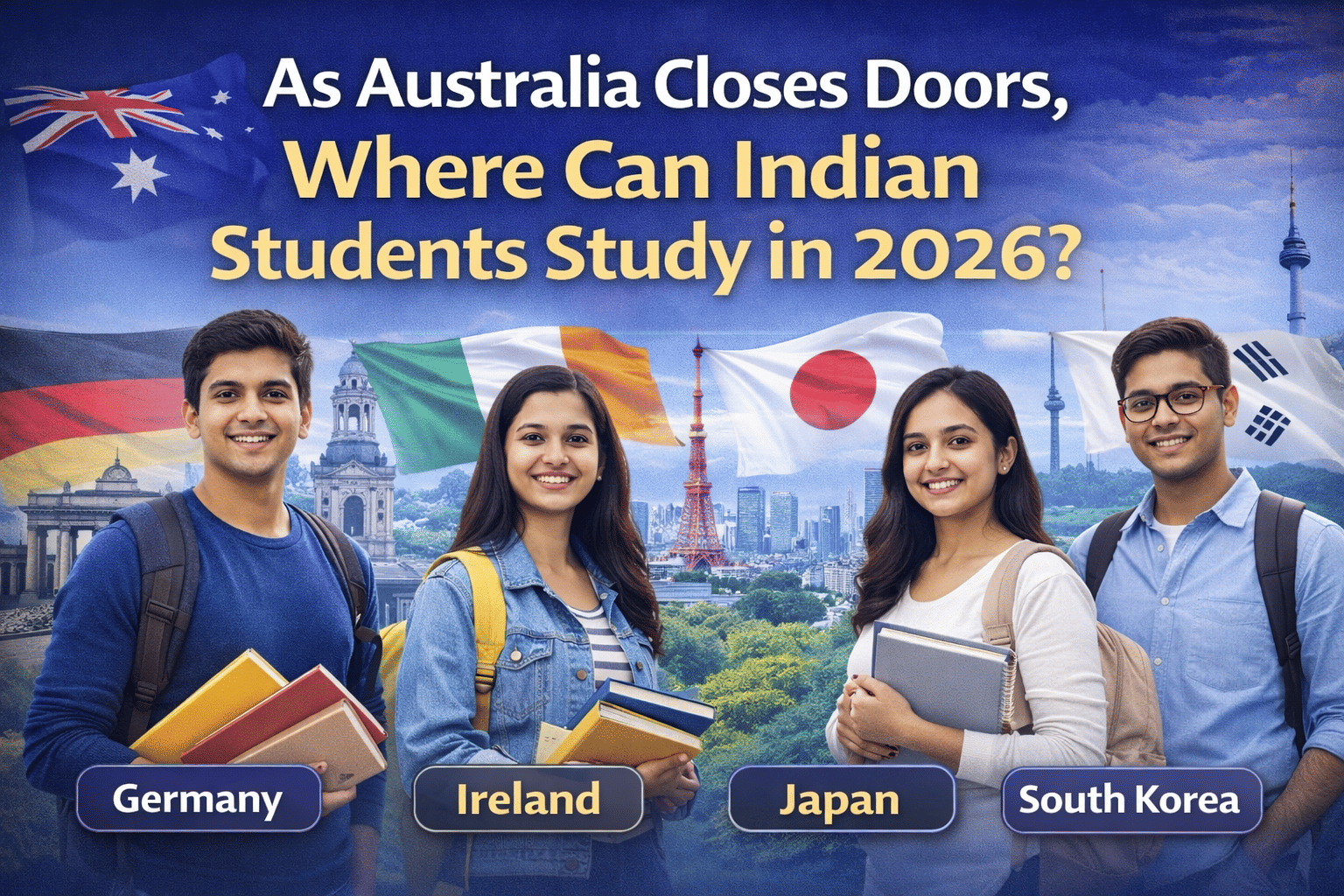
Emerging Study Destinations for Indian Students in 2026
As pathways narrow elsewhere, Germany, Ireland, Japan and South Korea are positioning education as a strategic tool to support their economies.
Germany: Low Cost, Clear Work Pathway
Germany remains one of the most attractive options for Indian students in 2026. Public universities in Germany charge no tuition fees, with students typically paying only a modest semester contribution that often includes public transport.
- The country offers thousands of English-taught programmes, particularly in STEM, management and applied sciences.
- Graduates are eligible for an 18-month job-seeker residence permit.
- Employment related to the degree can lead to the EU Blue Card and permanent residence within a few years.
Check: Top Universities in Germany
Ireland: English-Speaking Gateway to the EU
Ireland has emerged as the leading English-speaking alternative within the European Union. Graduates of Master universities in Ireland are eligible for a two-year post-study stay-back option.
- The country hosts the European headquarters of major global employers in technology, pharmaceuticals and life sciences.
- Demand remains strong for graduates in data science, cybersecurity, engineering and biotech, making Ireland a strategic choice for students prioritising employability.
Check: Top Universities in Ireland
Japan: Education Linked to Labour Demand
Japan is actively expanding international enrolment as it addresses workforce shortages driven by an ageing population.
- Graduates are allowed to stay for up to one year to search for employment, and outcomes are particularly strong in engineering, nursing, manufacturing and applied sciences.
- The government is also increasing the number of English-taught programmes while encouraging language acquisition to improve long-term settlement prospects.
South Korea: Scholarships and Industry Access
South Korea is scaling up its international education ambitions with lower tuition costs than Western destinations and a growing number of English-taught degrees.
- Government-backed scholarships often cover tuition, airfare and living expenses.
- Students in AI, robotics, electronics and semiconductors benefit from proximity to global industry leaders, strengthening internship and employment opportunities after graduation.
Where Indian Students Are Looking Next?
| Country | Tuition Cost | Post-Study Work | Key Advantage |
| Germany | Very low / free | 18 months | Clear PR pathway |
| Ireland | High | 2 years (Master’s) | English + EU jobs |
| Japan | Moderate | Up to 1 year | Labour shortages |
| South Korea | Moderate–low | Varies by role | Strong scholarships |
For 2026 aspirants, destination choice is no longer just about rankings. Students must weigh visa certainty, cost of study, post-study work rights and long-term settlement options. As policies continue to evolve, early planning, country diversification and programme-specific research are becoming critical to securing a stable overseas education pathway.
While the US, UK, Canada and Australia are tightening entry, global demand for skilled graduates remains strong. Countries aligning education with workforce needs are opening new doors for Indian students—making 2026 a year of strategic redirection rather than reduced opportunity.

1768195186.png?tr=w-305,h-145,c-force?h=40&w=40&mode=stretch)

1768031645.png?tr=w-305,h-145,c-force?h=40&w=40&mode=stretch)




Comments