



| Updated On - Aug 12, 2026
IELTS 2026 is an English language proficiency test conducted by IDP in India. It is accepted by more than 12,500 organisations across 140 countries for study, work and migration. The IELTS test covers 4 skills (Listening, Reading, Writing and Speaking), lasts 2 hours 45 minutes and is scored on a 0 to 9 band scale with no pass or fail.
- IELTS exam fee in India 2026: ₹19,000 for both IELTS Academic and IELTS General Training. The IELTS fee is the same across all Indian cities and both paper-based and computer-delivered formats.
- IELTS goes fully computer-based in India from September 2026: IDP will run the final paper-based IELTS tests on 25 July, 6 August and 22 August 2026. From September, only IELTS on Computer and IELTS Online will be available.
- IELTS One Skill Retake (OSR): Retake only one IELTS section for ₹12,650 within 60 days of your computer-delivered IELTS test. Not all universities accept IELTS OSR scores, so confirm with your target university first.
Check the Latest Changes in the IELTS Exam 2026.
Key Highlights
IELTS Update (August 2026): Only 1 Paper-Based Date Left in India. The last paper-based IELTS test in India is on 22 August 2026. IDP has already conducted the 25 July and 6 August 2026 paper tests.
- From 1 September 2026, all IELTS tests in India will run in computer-delivered format only.
- Booking paper-based IELTS: Slots for 22 August 2026 are almost sold out across Delhi, Mumbai, Bangalore, Hyderabad, Chennai and Kolkata centres.
- Book on the IDP portal today if you still need paper format. Winter intake 2026 IELTS booking rush: September to November 2026 computer-delivered slots are filling up fast for Winter intake applications. Popular centres like Bangalore Whitefield and Delhi Nehru Palace have limited weekend availability.
IELTS results speed up from September: Every Indian IELTS candidate will get results in 1-2 days from September 2026, since the slower 7-day paper-based cycle ends. No pattern or scoring change: The IELTS exam pattern, question types, difficulty, and 0-9 band scale stay the same. Only the delivery mode changes.
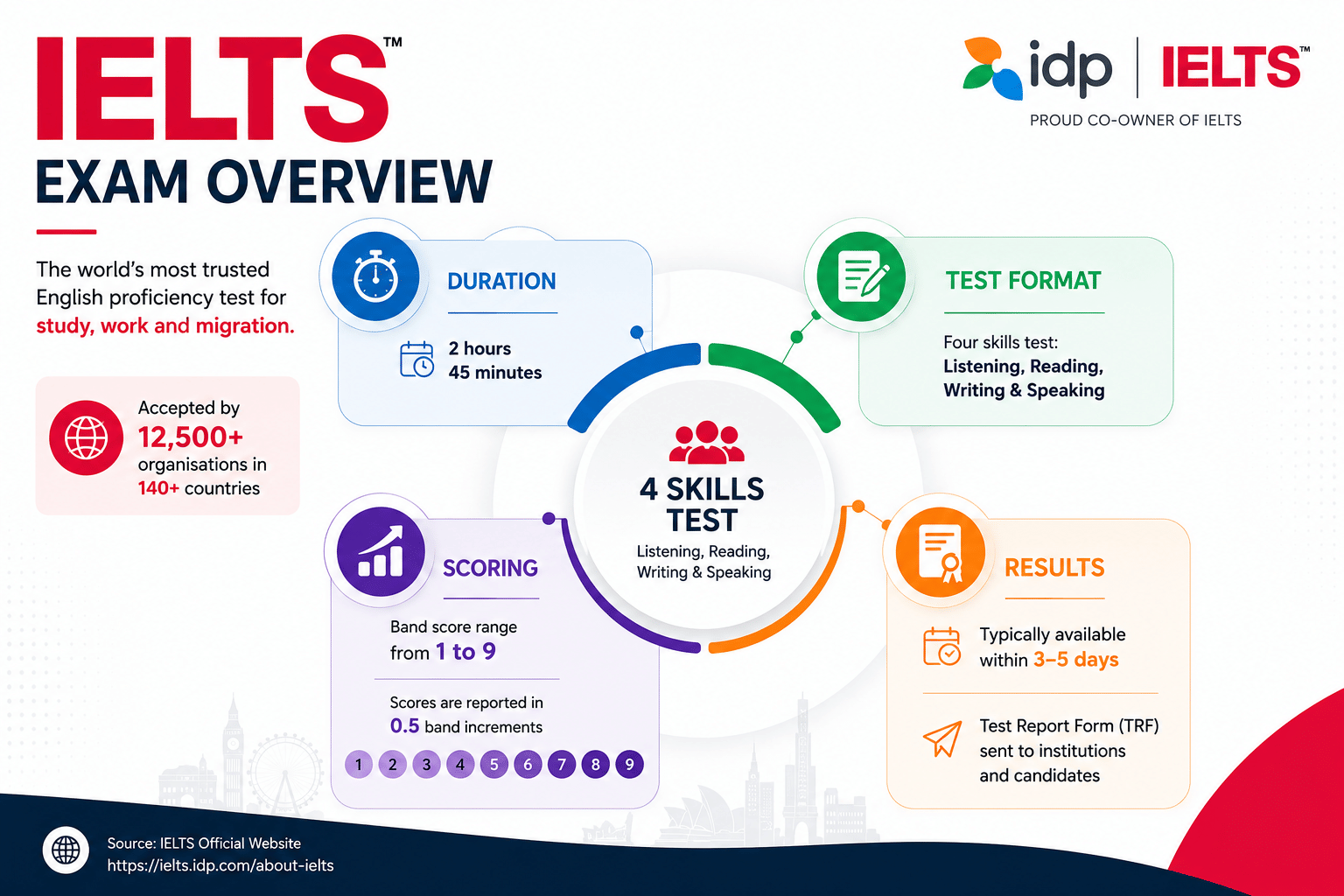
Table of Contents
- IELTS Exam Highlights 2026
- Types of IELTS Exam 2026
- Free IELTS Mock Tests 2026
- IELTS Exam Fees in India 2026
- IELTS Exam Registration Process 2026
- IELTS Exam Eligibility 2026
- IELTS Exam Dates in India 2026
- IELTS Test Centres in India 2026
- IELTS Exam Syllabus 2026
- IELTS Exam Pattern 2026
- How to Check Your IELTS Test Results 2026
- IELTS Score Validity 2026
- IELTS Score Requirement for Top Universities Abroad 2026
- IELTS Band Score vs University Tier Mapping
- IELTS Exam Challenges Faced by Indian Students 2026
- IELTS Exam Tips for Indian Students 2026
- FAQs
IELTS Exam Highlights 2026
The IELTS exam highlights below give you a snapshot of everything you need to know before booking your test.
| Particulars | Details |
|---|---|
| Exam Name | IELTS |
| IELTS Full Form | International English Language Testing System |
| Official Website | ieltsidpindia.com |
| Owned and Conducted by | IDP, British Council and Cambridge University Press & Assessment |
| Purpose | Study, work or migrate abroad |
| Accepted by | More than 12,500 organisations, including universities, employers and governments in over 140 countries |
| Types | IELTS Academic, IELTS General Training, IELTS for UKVI, IELTS Life Skills |
| Test Pattern | 4 sections: Listening (30 min), Reading (60 min), Writing (60 min), Speaking (11-14 min) |
| Test Formats | Paper-based (till August 2026 in India), Computer-delivered |
| IELTS Exam Fee | ₹19,000 for IELTS Academic and General Training, ₹19,250 for IELTS UKVI |
| Available Dates | Around 20-24 computer-delivered dates every month for computer-based |
| Results Time | 1-2 days (computer-based), up to 7 days (paper-based) |
| Score Range | 1-9 bands (0.5 increments) |
| Score Validity | 2 years |
Types of IELTS Exam 2026
There are different types of IELTS exams depending on your purpose, like study, work or migration. Each IELTS type has the same 4 sections. Only the Reading and Writing tasks differ between Academic and General Training.
| Aspect | IELTS Academic | IELTS General Training |
|---|---|---|
| Purpose | University admissions (UG, PG), professional registration for doctors and nurses, student visa | Migration, work and citizenship |
| Who needs it? | Most Indian students studying abroad | Applicants for immigration and PR |
| Reading & Writing | Academic texts from journals, books and articles | Everyday texts from ads, notices and letters |
| Fee in India 2026 | ₹19,000 | ₹19,000 |
Also read: IELTS Academic vs General Training
UKVI IELTS
UKVI IELTS is a UK-specific version of the IELTS exam. It is used to study in UK universities and to obtain UK visas.
- Same Academic and General Training modules as the regular IELTS exam.
- Same pattern and syllabus as the regular IELTS.
- It is a Secure English Language Test (SELT), which means additional security checks.
- Due to fewer test centres and extra security, the UKVI IELTS fee is slightly higher at ₹19,250.
IELTS Life Skills
IELTS Life Skills is another UK-specific version of IELTS designed for UK visas other than a UK student visa.
- Life Skills A1: For a family visa.
- Life Skills A2: For extension of the family visa (not available in India, only in the UK).
- Life Skills B1: For settlement and citizenship.
What is the IELTS One Skill Retake?
IELTS One Skill Retake (OSR) is a useful feature that lets you retake only one skill to improve your overall band score. It is a lower-cost alternative to sitting the full IELTS test again.
- Available only for computer-based IELTS tests.
- Taken at the same test centre as the original test.
- Only one skill can be retaken, and only once per test.
- Must be taken within 60 days of the original test date.
- IELTS One Skill Retake fee is ₹12,650, paid separately.
Also read: Check IELTS One Skill Retake Fees and How to Apply.
Applicants must note that OSR is not accepted everywhere!
Not all universities and immigration bodies accept IELTS One Skill Retake scores. Top universities such as the University of Oxford do not accept IELTS One Skill Retake scores. Australian visa processing and Canadian Express Entry currently do not treat OSR as a full test result. Confirm acceptance with your target university or visa office before paying the ₹12,650 OSR fee.
Free IELTS Mock Tests 2026
Indian applicants preparing for the IELTS exam in 2026 can download free IELTS mock test PDFs 2026 from the table below. Practising with mock tests is essential for time management and getting used to the computer-delivered IELTS format.
IELTS Exam Fees in India 2026
The IELTS exam fees in India for different types of tests are given in the table below. The IELTS fee is the same across all Indian cities. It does not change based on your test centre or your chosen format.
| IELTS Test Type | Fees in India 2026 | Test Formats |
|---|---|---|
| IELTS (Academic and General Training) | ₹19,000 | Paper-based (till August 2026) and Computer-delivered |
| IELTS for UKVI (Academic and General Training) | ₹19,250 | Paper-based and Computer-delivered |
| IELTS Life Skills (A1 and B1) | ₹18,000 | Face-to-face or video call interview with an examiner |
| IELTS One Skill Retake | ₹12,650 |
Computer-delivered only |
The IELTS exam fee in India is refundable if you cancel at least 9 days before the test date. IDP charges an administrative fee of 25% of your IELTS fee for cancellations and gives a 75% refund if done before 9 days. If you cancel within 9 days of the exam, you’ll get only a 50% refund.
Also Read: What are the scholarships available for Indian students through the IELTS exam 2026?
What is the IELTS exam fee in Kolkata for 2026?
The IELTS exam fee in Kolkata is ₹19,000 for the Academic and General Training tests. The UKVI IELTS fee in Kolkata is ₹19,250, and the Life Skills tests cost ₹18,000. The IELTS exam fee is the same for all Indian cities, so Kolkata, Delhi, Mumbai and Bangalore charge the same amount.
Insider Tip: Fee waivers are rare but real
IDP occasionally runs IELTS fee waiver programmes for students from low-income backgrounds through selected NGOs and government schemes. These waivers cover up to 100% of the IELTS fee for a small pool of eligible Indian candidates.
Check more details: IELTS Fee Waiver 2026
Must-read about IELTS fees, scholarships, and payment options:
IELTS Exam Registration Process 2026
You can register for the IELTS both online and offline. Online IELTS booking is done through the official IDP website. Offline IELTS registration is done by visiting the nearest IDP branch.
IELTS Online Registration
- Visit the official IDP IELTS India website.
- Click on the "Book Now" button.
- Choose your IELTS test type (Academic, General Training, UKVI or Life Skills).
- Select your location, test centre, date and time slot.
- Fill out your personal details and passport information.
- Pay the IELTS fee via credit card, debit card, net banking or UPI.
- You will receive an email or SMS confirming your IELTS booking.
IELTS Offline Registration
- Download the application form and fill it out: IELTS Application Form PDF.
- Attach a passport photocopy and a Demand Draft for the fee, payable to IDP Education India Pvt. Ltd., New Delhi.
- Submit the form and documents at any IDP branch or the head office.
IDP Education India Pvt. Ltd.
Global Gateway Towers, Tower B, 5th Floor
Sikanderpur Ghosi, Sector-26, M.G. Road
Gurugram - 122002, Haryana, India
Contact: +91-124-4445999
Insider Tip: Match your passport name exactly
Most IELTS registration rejections in India happen because the applicant's name on the IELTS form does not match the passport. IDP is strict on this. Enter your name exactly as it appears on your passport, including middle names, initials, and spelling. Any mismatch delays your Test Report Form and your university application.
IELTS Exam Eligibility 2026
IELTS conducting body has set no specific eligibility requirements. There are no strict education or age barriers. However, a valid passport is the only mandatory requirement for Indian test-takers. Here’s an overview of the eligibility:
| Criteria | Requirement |
|---|---|
| Age | No minimum or maximum age limit |
| Education | No minimum qualification needed |
| ID Required | A valid and updated passport is mandatory for Indian test-takers |
| Number of Attempts | Unlimited, without a waiting period |
Note: For successful university admissions or visa applications, you must meet the minimum IELTS band score set by the target organisation.
Can I take IELTS if I don't have a passport?
No. At the time of IELTS registration in India, you must provide your passport number. IDP does not accept Aadhaar, PAN, or driver's licence as valid ID for the IELTS exam. Apply for a passport before you book your IELTS test date.
Also read: Check IELTS Exam Eligibility 2026.
IELTS Exam Dates in India 2026
The upcoming IELTS test schedule in India for 2026 covers around 20-24 computer-delivered dates every month. Paper-based dates are limited to 3 to 4 per month, and paper-based IELTS ends completely in India after 22 August 2026.
- Final paper-based IELTS dates in India: 25 July, 6 August, 22 August 2026.
- Computer-delivered IELTS dates: Available almost daily from September 2026 onwards.
Advice for applicants who are willing to take the test in 2026:
- Test dates vary from test centre to test centre. Delhi Nehru Palace and Bangalore Whitefield centres are among the busiest.
- July to September 2026 slots are filling up fast for the Winter intake 2026.
- Book at least 2-3 months early for your preferred city and date.
How do I check the availability of IELTS test dates in my city?
You can check availability on the official IDP IELTS registration website by entering your city name and preferred month. You can also contact your nearest IELTS test centre by phone for real-time slot availability. Bangalore Whitefield and Delhi Nehru Palace centres are the fastest to fill.
IELTS Test Centres in India 2026
IDP conducts the IELTS exam in more than 75 Indian cities. Both paper-based (till August 2026) and computer-delivered IELTS tests are available across all major metros and tier-2 cities. Popular IELTS test centres in India include:
- North India: Delhi (Nehru Palace, Connaught Place), Gurugram, Noida, Chandigarh, Jaipur, Lucknow, Amritsar, Ludhiana, Jalandhar.
- South India: Bangalore (Whitefield, Koramangala), Hyderabad, Chennai, Kochi, Trivandrum, Coimbatore, Visakhapatnam.
- West India: Mumbai (Andheri, Powai), Pune, Ahmedabad, Surat, Vadodara, Nagpur.
- East India: Kolkata, Bhubaneswar, Guwahati, Patna.
Insider Tip: Whitefield fills up 3 months ahead
The Bangalore Whitefield IELTS centre is one of the most in-demand slots in India for computer-delivered IELTS. During the July to October window (Winter intake booking rush), Whitefield slots fill up by early April. Book by March if you want a specific weekend date in this window.
Must read about IELTS test centres, dates and city guides:
IELTS Exam Syllabus 2026
The IELTS syllabus covers 4 core language skills. The IELTS syllabus 2026 is the same across paper-based and computer-delivered tests. Only the delivery mode differs.
- Listening: 4 recordings covering everyday conversations, monologues, academic discussions and lectures. Accents mixed across British, Australian, American, Canadian and New Zealand speakers.
- Reading: 3 passages. Academic passages come from books and journals. General Training passages come from ads, notices, newspapers and everyday sources.
- Writing: 2 tasks. Task 1 is a graph or letter (150 words). Task 2 is an essay (250 words). Same for both formats.
- Speaking: 3 parts. Introduction, cue card monologue and examiner discussion. Conducted face-to-face with an IELTS examiner.
IELTS Exam Pattern 2026
The IELTS test has 4 sections: Speaking, Listening, Reading and Writing. Each is scored on a 0 to 9 band scale and combined into an overall IELTS band score.
| Section | Duration | Number of Questions | Question Types |
|---|---|---|---|
| Listening | 30 minutes + 10 minutes transfer time in paper-based test | 4 recordings, 40 questions | MCQs, matching, fill-in-the-blanks, short answer |
| Reading | 60 minutes | 3 passages, 40 questions | Academic: journal and book texts. General: ads, notices and newspaper articles |
| Writing | 60 minutes | 2 tasks | Task 1 (150 words, 20 min): graph or letter. Task 2 (250 words, 40 min): essay |
| Speaking | 11-14 minutes | 3 parts | Part 1: familiar topic questions. Part 2: 2-minute cue card. Part 3: examiner discussion |
Indian students often find IELTS Writing Task 2 the hardest section. Read More Here.
What do you talk about in the IELTS Speaking test?
In IELTS Speaking Part 1, you answer questions on familiar topics like your hobbies, family and daily routine. In Part 2, you speak for 2 minutes on one cue card topic. In Part 3, you discuss deeper ideas linked to the Part 2 topic with the examiner.
Are Reading and Writing easier in IELTS General Training?
Yes. IELTS General Training Reading and Writing are more practical and based on everyday situations. Passages come from ads, notices and simple letters. The tasks are less academic than IELTS Academic, so most Indian test-takers find them easier.
Must-read about IELTS section-wise prep and tips:
How to Check Your IELTS Test Results 2026
IELTS test results are released in 1-2 days for the computer-based test and up to 7 days for the paper-based IELTS Academic. From September 2026, all Indian IELTS results will come in the faster 1-2 day window as the IELTS will be fully computer-based.
- Visit the IDP IELTS Candidate Login page.
- Enter your username and password.
- Click Submit to view your IELTS band scores.
- Your scores appear in the "Declared Result" section.
- You can download your IELTS Test Report Form within 2 working days.
IELTS Score Validity 2026
The IELTS score is valid for 2 years from the test date. This applies to all versions: IELTS Academic, IELTS General Training, IELTS for UKVI and IELTS Online. After 2 years, your IELTS Test Report Form is no longer accepted for university admissions or visa applications.
Most top universities accepting IELTS prefer scores from the last 12 to 18 months, even if the official validity is 2 years. UK Visa and Immigration (UKVI) also accepts IELTS scores within the 2-year window for student and skilled worker visas.
If your IELTS score expires during your university application cycle, you must retake the full test. There is no way to extend or renew an IELTS score once it crosses 2 years.
Also read: Check IELTS Score Validity Details 2026
IELTS Score Requirement for Top Universities Abroad in 2026
IELTS score requirements of the top universities abroad in 2026 are listed in the table below. Most Ivy League and top UK universities set an IELTS band of 7.0 or higher for postgraduate admissions.
| University | QS World University Ranking 2027 | IELTS Score Requirement |
|---|---|---|
| Massachusetts Institute of Technology | #=1 | 7.0 |
| Imperial College London | #=2 | 7.0 |
| Stanford University | #=2 | 7.0 |
| University of Oxford | #=4 | 7.5 |
| Harvard University | #=5 | 6.5 |
| University of Cambridge | #=6 | 7.0 |
| ETH Zurich | #=8 | 7.0 |
| National University of Singapore | #=10 | 7.0 |
| California Institute of Technology | #=7 | 7.5 |
| The University of Hong Kong | #=11 | 6.5 |
| Princeton University | #=27 | 8.0 |
| UC Berkeley | #=20 | 7.0 |
| Yale University | #=16 | 7.0 |
| University of Toronto | #=32 | 7.0 |
| Johns Hopkins University | #=20 | 7.0 |
| Technical University of Munich | #=25 | 6.5 |
Note: The IELTS score requirement may vary by program. Check the requirements of your target program from the respective university's admissions page.
Also read:
IELTS Band Score vs University Tier Mapping
Use this IELTS band score mapping to shortlist realistic target universities based on your practice test scores. The bands below reflect published minimums, but typical admit averages often run 0.5 bands higher.
| IELTS Band | University Tier | Typical Programmes |
|---|---|---|
| 8.0 and above | Ivy League, Oxbridge, top global universities | Strong PG and PhD applications, competitive law and MBA |
| 7.5 | Most Russell Group, top US universities | PG programmes at Oxford, Imperial, Cambridge, Caltech |
| 7.0 | Standard for most US, UK, Canada, Australia PG programmes | MS, MBA and PG at MIT, Stanford, Yale, Toronto, NUS |
| 6.5 | Standard for most UG programmes, mid-tier universities | Bachelor's programmes, Master's at Harvard, TUM, HKU |
| 6.0 | Pathway and foundation programmes | Conditional offers with pre-sessional English |
| Below 6.0 | Limited university options | Foundation, ESL and diploma programmes |
Insider Tip: Chase 7.0 even when 6.5 is enough
Most Indian students who score 6.5 in IELTS Writing repeat the exam targeting 7.0. Top US Master's programmes prefer 7.0 or higher even when their published minimum is 6.5. A stronger and good IELTS score band also improves your visa profile for Canada and Australia.
Confused about which IELTS band you need for your dream university? Get a free profile evaluation from Collegedunia Study Abroad counsellors. Find the right IELTS score target, university and country for your profile.
When Should You Take the IELTS Test for Winter Intake 2026?
Students planning admission for Winter intake 2026 should take the IELTS test between July and September 2026. Book your IELTS date well in advance because slots run out in peak months. July 2026 dates are already filling up quickly ahead of the upcoming Winter intake.
Also Read
Which Universities Abroad are Accepting IELTS for 2026 Admissions?Can I still apply to universities if I don't meet the minimum IELTS requirement?
Some universities offer conditional admission or allow you to take pre-sessional English courses if you fall short of the minimum IELTS band. Others let you submit a Duolingo or TOEFL score instead. Confirm the acceptance policy directly with your target university before applying.
IELTS Exam Challenges Faced by Indian Students 2026
Mentioned below are the common challenges Indian students face in the IELTS exam.
- Paper-based IELTS results take longer than computer-delivered results. From September 2026, this problem disappears as all Indian tests move to computer delivery.
- Indian test-takers report concerns about IELTS Speaking evaluation, especially around clarity and pronunciation. IDP maintains that examiners are trained to assess intelligibility, not accent.
- Writing Task 2 is the most challenging section for Indian candidates. It requires structured argument development, precise vocabulary and strict adherence to task requirements.
- According to official IELTS test-taker performance data for 2024, Indian candidates recorded their lowest average scores in Writing (6.2), followed by Listening (6.4). Productive skills remain the key improvement area.
Also read:
IELTS Exam Tips for Indian Students 2026
Writing and Speaking are the weakest sections for most Indian IELTS test-takers. The tips below follow the official IELTS scoring criteria used by IDP examiners.
- Task Achievement (Writing Task 1): For Academic Task 1, summarise the graph or chart data and present key trends clearly. For General Training Task 1, fulfil the letter's purpose (request, complaint, invitation). Higher bands need full coverage with the correct format.
- Task Response (Writing Task 2): Answer the question directly, take a clear position and support ideas with 2 examples. Higher bands need a fully developed 4-paragraph structure with introduction, 2 body paragraphs and conclusion.
- Coherence and Cohesion: Use clear paragraphs, link ideas logically with "however", "in addition" and "as a result", and avoid repeating sentence starters.
- Lexical Resource: Show varied vocabulary and paraphrasing. Higher bands use precise topic-specific words instead of general phrases.
- Grammatical Range and Accuracy: Use a mix of simple and complex sentences with few errors. Punctuation matters as much as grammar.
- Fluency in Speaking: Speak clearly without hesitating or rushing. Use linking words like "on the other hand" and "for example" to connect ideas.
- Pronunciation: Focus on rhythm and stress, not accent. Clear intonation matters more than sounding British or American.
- Resources: Cambridge IELTS Vol. 18 to 20, IELTS Liz, E2 IELTS and IELTS Advantage are the most trusted prep materials for Indian test-takers.
Insider Tip: Intonation beats accent
Former IELTS examiners on YouTube consistently say intonation matters more than accent for Speaking. A clear Indian English speaker with good stress patterns scores higher than someone faking an American accent. Focus on natural rhythm, pauses at commas and rising tone for questions.
Must read about IELTS scores by country and preparation:
IELTS is a widely accepted English test for study, work and migration abroad, with over 12,500 organisations recognising its scores. It offers Academic and General Training options based on your goal. With flexible IELTS test dates and paper or computer formats, the results are used by universities, employers and governments to assess English language ability. Proper IELTS preparation and regular practice help you achieve the score required by your chosen institution or country.
FAQs
Ques. Is a 7.5 IELTS score easy?
Ans. A 7.5 IELTS score is not easy but it is achievable with regular practice. You need strong English skills, especially in IELTS Writing and Speaking. Most Indian test-takers hit 7.5 after 3 to 4 months of focused prep.
Ques. Is IELTS very difficult?
Ans. IELTS is not very difficult if your English basics are clear. With proper IELTS preparation and mock test practice, most Indian students score Band 6.5 or higher. Focus on Writing Task 2 and Speaking, which are the weakest areas for Indian candidates.
Ques. Can I learn IELTS in 3 months?
Ans. 3 months is enough for candidates already scoring Band 6 to 6.5 in mock tests. Consistent daily study and full-length mock tests are the key. See the full IELTS Preparation Time guide for a section-wise schedule.
Ques. Can I take both IELTS and PTE for the same application?
Ans. Yes, you can take both IELTS and PTE and submit whichever score is higher. However, most universities accept either IELTS or PTE, so check the specific university requirement first before paying for both tests.
Ques. Can I crack IELTS in 7 days?
Ans. Yes, IELTS prep in 7 days is possible only if your English is already strong. In that time you focus on IELTS test format, question types and time management, not English learning. Plan several hours of focused mock practice every day.
Ques. Is IELTS better than TOEFL for Indian students?
Ans. IELTS and TOEFL are equally accepted for study abroad, but the right choice depends on your destination. IELTS is more common for UK, Australia and Canada, with a real examiner for Speaking. TOEFL is mostly used in the US and is fully computer-based, including recorded Speaking.
Ques. Is 4.5 a fail in IELTS?
Ans. An IELTS score of 4.5 is not a fail because IELTS does not have a pass or fail. Band 4.5 indicates limited English ability. It is usually not enough for most university courses, which need Band 6.0 or higher, but it may be accepted for some basic work or visa purposes.
Ques. Is the Duolingo English Test easier than IELTS?
Ans. Duolingo English Test is shorter and cheaper than IELTS, and some universities accept it as an alternative. Duolingo is often considered easier for students comfortable with online tests. However, Duolingo is not accepted by all institutions, especially top UK and Canadian programmes.
Ques. Is IELTS going fully computer-based in India in 2026?
Ans. Yes. IDP has confirmed that IELTS in India goes fully computer-based from September 2026. The final paper-based IELTS dates in India are 25 July, 6 August and 22 August 2026. From September, only IELTS on Computer and IELTS Online are available.
Ques. How many times can I take the IELTS exam in a year?
Ans. There is no limit on IELTS attempts. You can take the IELTS exam as many times as you need, with no mandatory cooldown period between attempts. Each attempt requires a fresh ₹19,000 registration fee.
Ques. What is the IELTS One Skill Retake fee in India?
Ans. The IELTS One Skill Retake (OSR) fee in India is ₹12,650. You can retake only one skill within 60 days of your original computer-delivered IELTS test. Not all universities accept OSR scores, so confirm with your target university.
Ques. Which IELTS band do I need for Canada PR?
Ans. For Canada Express Entry PR, you typically need IELTS Band 6.0 in each section (CLB 7) as a minimum. Higher IELTS bands like 7.0 to 8.0 give more CRS points. Read the full IELTS to CLB Calculator guide for band-to-CLB mapping.


1787567517.png?tr=w-305,h-145,c-force?h=175&w=350&mode=stretch)



Comments
Found 1 Comment