



Education Journalist | Study Abroad Strategy Lead | Updated On - Jan 13, 2026
India and Germany have adopted a comprehensive roadmap on higher education, placing universities, student mobility and institutional presence at the centre of their expanding bilateral partnership.
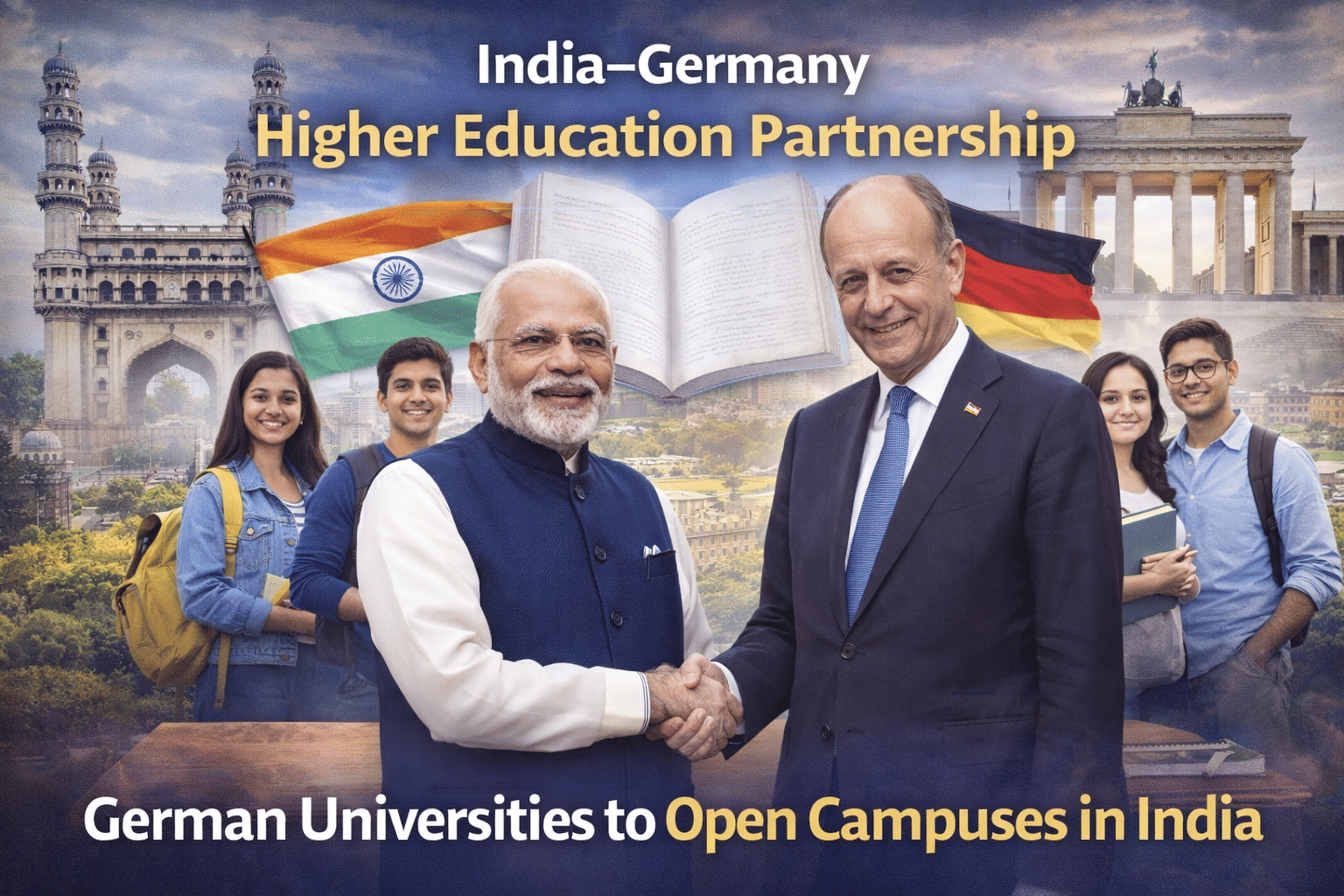
During German Chancellor Friedrich Merz’s official visit to India, Prime Minister Narendra Modi invited German universities to establish campuses in India, signalling a shift toward deeper academic integration rather than limited exchange programmes.
According to an official government release, the roadmap is designed to strengthen cooperation in higher education, skills development, vocational training, and student mobility, positioning education as a core pillar of the India–Germany strategic partnership.
Higher Education as a Policy Priority, Not Just Exchange
Addressing a joint press interaction, Prime Minister Modi said the roadmap would give “a new direction” to education ties between the two countries. The invitation to foreign universities to open campuses in India aligns with India’s National Education Policy (NEP), which allows regulated entry of top global institutions into the Indian higher education system.
The Ministry of External Affairs confirmed that the education roadmap was adopted as part of a broader package of 19 agreements concluded during the two-day engagement, spanning education, skilling, human resources, technology and renewable energy.
Why Campus Presence Matters for Students?
For Indian students, the emphasis on foreign university campuses in India is significant. Local campuses of German universities could offer:
- International curricula and degrees
- Reduced cost compared to studying abroad
- Access to German academic standards and research ecosystems without overseas relocation
For German institutions, campus presence enables long-term engagement with India’s talent pool and research infrastructure rather than short-term mobility arrangements.
Student Mobility and Visa Facilitation
Student mobility also featured prominently in the bilateral outcomes. Germany announced visa-free transit for Indian passport holders transiting through German airports. While this does not change student visa rules, it reduces travel friction for Indian students heading to Europe for education, conferences and academic collaboration.
Both leaders noted the rising number of Indian students choosing Germany and welcomed the expansion of joint and dual-degree programmes, collaborative research initiatives, and institutional partnerships.
IIT–German University Ties and Research Collaboration
The two sides acknowledged the growing network of partnerships between Indian Institutes of Technology (IITs) and German Technical Universities, describing them as key drivers of:
- Advanced research collaboration
- Innovation
- High-end skills development
An official statement highlighted that these linkages are also supporting job-market integration of Indian graduates in Germany, especially in engineering, applied sciences and technology-driven fields.
Linking Higher Education with Skilling and Jobs
As part of the roadmap, India and Germany will establish a National Centre of Excellence for Skilling in Renewable Energy at the National Skill Training Institute in Hyderabad.
In addition, both countries signed a Joint Declaration of Intent on a Global Skills Partnership, creating an ethical and sustainable framework for skilled mobility. The initiative focuses on:
- Curriculum development aligned with Indian and German labour markets
- Cooperation with industry in both countries
- Training of trainers, particularly in renewable energy
Education Within a Broader Strategic Partnership
Education cooperation was positioned alongside technology, renewable energy, defence and critical emerging technologies as a long-term pillar of the India–Germany relationship.
The visit coincides with 75 years of diplomatic relations and 25 years of strategic partnership, underscoring the intent to embed universities and students into the long-term architecture of bilateral ties.
What Comes Next for Students?
While the roadmap signals intent rather than immediate enrolment changes, its impact will depend on:
- Regulatory approvals for foreign campuses
- Faculty and quality assurance frameworks
- Visa and mobility implementation beyond transit facilitation
Still, by anchoring higher education in a government-backed bilateral roadmap, India and Germany have created a clear institutional pathway for future campus openings, programme expansion and student mobility.
The India–Germany Higher Education Roadmap marks a shift from symbolic cooperation to structural academic integration. For Indian students, it opens the possibility of German degrees at home, stronger Europe-facing mobility, and closer links between education, skills and employment. The real test will be execution—but the policy signal is clear: universities and students are now central to the India–Germany partnership, not peripheral beneficiaries.












Comments