



| Updated On - Sep 8, 2025
The IELTS band score is an internationally recognized indicator of English language proficiency, widely used for university admissions, career opportunities, and immigration to English-speaking countries. IELTS results are reported on a 0 to 9 band scale, with each band describing a specific level of language ability. For instance:
- Band 9 represents an expert user with complete command of English - accurate, fluent, and contextually appropriate.
- Band 6 reflects a competent user who can communicate effectively but may make occasional errors or face misunderstandings.
- Scores below Band 5 indicate limited to modest proficiency, often with frequent errors and communication gaps.
The overall IELTS score is the average of the 4 section scores in:
- Listening
- Reading
- Writing
- Speaking
The IELTS band score is rounded to the nearest whole or half band. For example, an average of 7.30 is rounded up to 7.5. The IELTS scoring system uses a straightforward calculation method to convert your raw scores into final bands. Admission to top universities abroad generally requires a 7.0 or higher, while most visa and migration authorities worldwide accept a minimum of 6.5.
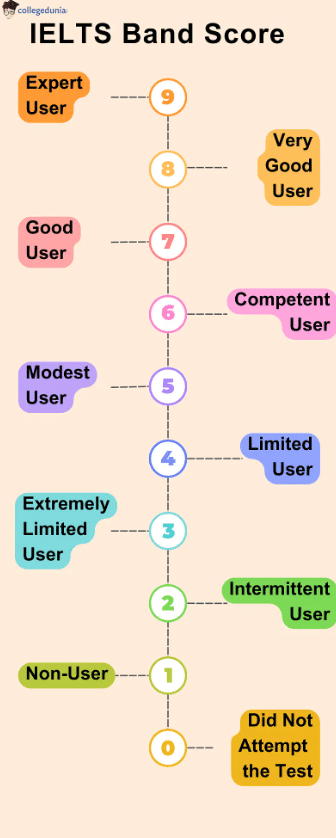
Understand Your IELTS Band and Score Levels
Understanding the IELTS band scale helps you interpret your score accurately and plan your preparation effectively. A 7.0 band score reflects a strong command of English. However, IELTS score requirements vary by university and academic program, so it’s essential to review the official university websites before applying. Refer to the table below for a clear breakdown of IELTS bands and corresponding proficiency levels:
| IELTS Band Score | Skill Level |
|---|---|
| Band 9 | Expert User |
| Band 8 | Very Good User |
| Band 7 | Good User |
| Band 6 | Competent User |
| Band 5 | Modest User |
| Band 4 | Limited User |
| Band 3 | Extremely Limited User |
| Band 2 | Intermittent User |
| Band 1 | Non-User |
| Band 0 | Did Not Attempt the Test |
IELTS Reading Band Score
The IELTS Reading section features different topics for Academic and General Training formats. The test includes 40 questions, with 1 mark awarded for each correct answer. Securing a strong Reading band score is essential, especially for academic admissions. The table below outlines how raw scores are converted into IELTS Reading band scores for both Academic and General Training tests:
| Correct Answers | Academic Reading | General Training Reading |
|---|---|---|
| 15 | Band Score 5 | Band Score 4 |
| 23 | Band Score 6 | Band Score 5 |
| 30 | Band Score 7 | Band Score 6 |
| 35 | Band Score 8 | Band Score 7 |
Must Read: IELTS Reading Tips
IELTS Listening Band Score
The IELTS Listening band score is calculated using the same method as the Reading section. The Listening test is identical for both Academic and General Training formats, comprising 40 questions, each worth 1 mark. The table below shows how raw scores are converted into IELTS Listening band scores:
| Correct Answers | Listening Band Score |
|---|---|
| 16 | Band Score 5 |
| 23 | Band Score 6 |
| 30 | Band Score 7 |
| 35 | Band Score 8 |
Must Read: IELTS Listening Tips
IELTS Writing Band Score
In the IELTS Writing section, you are required to describe visual information and compose an essay based on it. Examiners assess your responses using four key criteria, with each task evaluated separately. However, Task 2 carries more weight in the overall score than Task 1. Refer to the details below to understand the four assessment criteria and how they contribute to the IELTS Writing band score chart:
| Criteria | What It Measures | Weight |
|---|---|---|
| Task Achievement / Task Response | Covers all key points in Task 1 and presents and supports ideas in Task 2. | 25% |
| Coherence & Cohesion | Logical flow of ideas, clear paragraph structure, and effective linking between sentences. | 25% |
| Lexical Resource | Range and accuracy of vocabulary, use of appropriate words and expressions. | 25% |
| Grammatical Range & Accuracy | Correct grammar usage, sentence structure, and punctuation. | 25% |
Read More: IELTS Writing Tips
IELTS Speaking Band Score
The IELTS Speaking score is assessed using four equally weighted criteria, each contributing to your final band score for this section. Many universities and organizations set higher Speaking band score requirements compared to other IELTS components.
| Criteria | What It Measures | Weight |
|---|---|---|
| Fluency & Coherence | Speaks smoothly with natural pace and minimal hesitation. Connects ideas logically and clearly. |
25% |
| Lexical Resource | Uses a wide and accurate range of vocabulary. Effectively paraphrases when needed. |
25% |
| Grammatical Range & Accuracy | Uses varied sentence structures, including complex clauses, with correct grammar and word order. | 25% |
| Pronunciation | Clear speech with correct sounds, rhythm, stress, and intonation for easy understanding. | 25% |
Check Out: IELTS Speaking Tips
IELTS Band Calculator
There is no official IELTS band score converter for combining section scores into the overall band. Your official Test Report Form (TRF) will display both the overall band score and individual section scores. The overall score is determined by averaging the four section scores (Listening, Reading, Writing, and Speaking) and rounding the result to the nearest whole or half band. See the calculation example below to understand how the IELTS band score table works:
| Category | Candidate 1 | Candidate 2 | Candidate 3 |
|---|---|---|---|
| Reading | 6.0 | 6.5 | 5.5 |
| Writing | 5.5 | 7.0 | 6.5 |
| Listening | 6.0 | 5.0 | 6.0 |
| Speaking | 5.0 | 6.5 | 6.5 |
| Average Score | 5.625 | 6.25 | 6.125 |
| Final Band Score | 6.0 | 6.5 | 6.0 |
In conclusion, the IELTS band score system offers a clear and standardized way to assess English language proficiency, with bands ranging from 0 to 9. Many leading universities set a minimum requirement of 7.0 for admission, while a 6.5 is generally accepted for visa and migration purposes. With 40 questions each in the Reading and Listening sections, and well-defined assessment criteria for Writing and Speaking, this scoring framework allows test-takers to monitor their progress effectively and aim for their desired band score.
Also Read
FAQs
Ques. Is a Band 7 in IELTS considered good?
Ans. Yes. A Band 7 reflects a good command of English, enabling you to perform well in most social, academic, and professional situations. However, whether it’s “good enough” depends on the specific university or program requirements you are targeting.
Ques. What is the average or typical IELTS band score?
Ans. There’s no universal “normal” score, as it varies by institution and program. Generally, a 6.0 or higher is competitive for undergraduate admissions, while postgraduate programs often require 6.5 or 7.0.
Ques. Is 6.25 rounded up to 6.5 in IELTS?
Ans. Yes. In IELTS scoring, results are reported in whole and half bands (e.g., 6.0, 6.5, 7.0). Scores ending in .25 or .75 are rounded up to the nearest half or whole band. For example, 6.25 becomes 6.5, and 6.75 becomes 7.0.
Ques. Is an IELTS Band 8 a good score?
Ans. Absolutely. A Band 8 indicates a Very Good User with excellent fluency, accuracy, and the ability to understand and express complex ideas with minimal errors in both academic and professional settings.
Ques. Can I score 8.5 in IELTS?
Ans. Yes, but it requires focused preparation, consistent practice, and strong test strategies. Using high-quality study materials, taking practice tests, and, if needed, joining expert-led coaching can significantly boost your chances of achieving 8.5 or above.




1720429164.png?tr=w-305,h-145,c-force?h=40&w=40&mode=stretch)



Comments