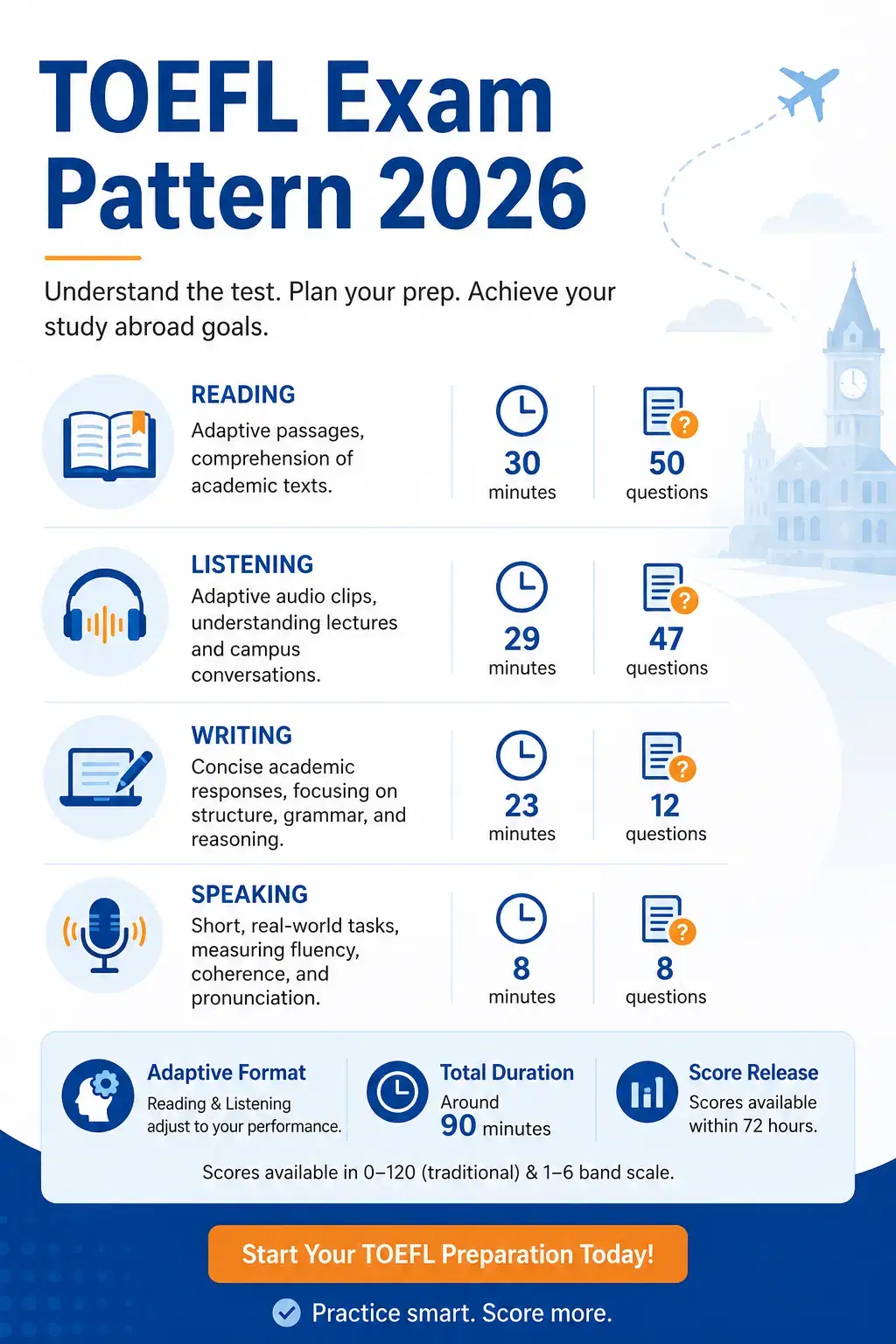
The TOEFL iBT exam pattern in 2025 follows its established non-adaptive format, a computer-based test lasting under 2 hours (expect 2.5 hours with check-in). It assesses academic English proficiency across 4 sections: Reading, Listening, Speaking, and Writing, with no mandatory breaks but an optional 10-minute break after Listening. The test is delivered at centers or via Home Edition (proctored online), emphasizing integrated tasks that are similar to university-level English use.
Major updates are set for January 21, 2026, introducing a multistage adaptive format where difficulty adjusts in real-time based on performance, shortening the total duration to 67-85 minutes. New task types will replace some integrated questions and the essay, with a simplified 1-6 band score (in half-point increments) per section alongside the traditional 0-120 scale during a transition period until 2028. Scores will be released within 72 hours, enhancing efficiency for applicants.
The TOEFL iBT, administered by ETS, is a critical step for Indian students aiming to study abroad, particularly in the US, Canada, UK, or Australia. With over 50,000 Indian test-takers annually, understanding the exam pattern is key to scoring 90-100+ for competitive programs. This article focuses exclusively on the TOEFL iBT exam structure for 2025, covering sections, question types, timing, and strategies.
| Important Articles | ||
|---|---|---|
| How to Register for TOEFL? | TOEFL Exam Fee in India 2025 | TOEFL Test Centers in India |
TOEFL January 2026 Updates
- Starting January 21, 2026, the TOEFL iBT will have major changes.
- The test will be shorter, lasting only 67-85 minutes (instead of 116 minutes).
- You will get your scores faster—within 72 hours (instead of 4-8 days).
- The Reading and Listening sections will change to adaptive, adjusting the difficulty based on your answers.
- Some tasks will be shorter and focus on modern topics, making the test fairer.
- There will be two scoring systems: the regular 0-120 scale and a new 1-6 band scale (like the CEFR levels).
- Reading will have shorter, easier passages and new questions, like quick summaries.
- Listening will include shorter audio clips with more everyday campus conversations and different accents.
- Speaking will have new tasks with shorter prep and response times, including summarizing discussions.
- Writing will no longer have long essays; instead, there will be short tasks, like writing 100 words.
- The changes will help Indian students by reducing pressure and providing faster results.
TOEFL Exam Pattern 2025
The TOEFL iBT is a computer-based test that takes less than 2 hours (around 2.5 hours including check-in). It checks your academic English skills in 4 areas: Reading, Listening, Speaking, and Writing. There’s no required break, but you can take an optional 10-minute break after the Listening section. You can take the test at a test center or the Home Edition with online proctoring.
| Section | Duration | No. of Questions / Tasks | Score Range | Key Skills Tested |
|---|---|---|---|---|
| Reading | 35 min | 20 questions (2 passages) | 0 - 30 | Comprehension of academic texts |
| Listening | 36 min | 28 questions (3 lectures, 2 conversations) | 0 - 30 | Understanding lectures / conversations |
| Speaking | 16 min | 4 tasks | 0 - 30 | Fluency, pronunciation, coherence |
| Writing | 29 min | 2 tasks | 0 - 30 | Grammar, organization, vocabulary |
| Total | ~116 min | - | 0 - 120 | - |
- Delivery Mode: Computer-based (test center or Home Edition).
- Scoring: Each section scored 0-30; total 0-120. Scores available in 4–8 days via ETS account (MyBest combines highest section scores from last 2 years).
- For Indians: Aim for 90-100 (mid-tier unis) or 100-110 (Ivy League). Minimum 20 per section for STEM programs.
Learn About STEM Programs
Ques. Does the TOEFL iBT in 2025 allow note-taking during all sections?
Ans. Yes, scratch paper is provided for notes in all sections, but you cannot use it during Speaking responses.
Ques. Are the 2025 and 2026 TOEFL iBT scores interchangeable for admissions?
Ans. Most universities will accept both, but check specific program policies, as some may prefer the new format’s band scores.
Ques. How does TOEFL iBT ensure fairness for Indian test-takers?
Ans. Questions are designed to avoid cultural bias, and the 2026 update introduces more globally relatable topics.
TOEFL Exam Pattern 2025: Section-Wise Details
This section dives into each TOEFL iBT section for 2025, detailing structure, question types, and Indian-specific challenges. For more on TOEFL preparation, explore our resources.
1. Reading (35 minutes, 20 questions, 0-30 points)
TOEFL Reading tests comprehension of university-level texts, requiring quick analysis. In 2025, it’s non-adaptive; in 2026, adaptive passages adjust to performance.
- Structure: 2 academic passages (~700 words each), 10 questions per passage. Topics include history, science, or social sciences (e.g., "Impact of Urbanization").
- Question Types (Multiple-choice, 4 options):
- Vocabulary (context-based meanings).
- Factual/Detail (identify specific info).
- Inference (draw conclusions).
- Rhetorical Purpose (why author includes info).
- Sentence Insertion (place sentence logically).
- Summary (select key ideas).
- Challenges for Indians: Unfamiliar topics; dense academic style.
- 2026 Update: Adaptive format adjusts passage difficulty; more relatable, modern content to reduce cultural bias.
- Strategies:
- Skim passages (2-3 min) for structure; focus on topic sentences.
- Highlight keywords (e.g., “however,” “thus”).
- Practice with Indian academic texts (The Hindu editorials) to bridge style gap.
- Answer vocabulary first; they’re quicker.
Check out a few TOEFL Reading practice tests below:
Also Read
Ques. Can I revisit Reading questions within the 35 minutes?
Ans. Yes, you can move back and forth within the section until time expires.
Ques. How will 2026’s adaptive Reading benefit Indian students?
Ans. It tailors difficulty to your level, potentially reducing stress on overly complex passages.
Ques. Are Reading passages in 2025 based on Indian contexts?
Ans. No, they’re global academic topics, but 2026 introduces more culturally neutral content.
2. Listening (36 minutes, 28 questions, 0-30 points)
TOEFL Listening evaluates comprehension of academic and campus dialogues. It’s fixed in 2025, but 2026’s adaptive format personalizes difficulty.
- Structure: 3 lectures (3-5 min, 6 questions each) + 2 campus conversations (3 min, 5 questions each). Lectures may include student-professor discussions; conversations involve campus scenarios (e.g., library issues).
- Question Types (Multiple-choice, some multi-select):
- Main Idea (lecture’s purpose).
- Detail (specific points).
- Function (why speaker says something).
- Attitude (speaker’s tone).
- Organization (how info is structured).
- Challenges for Indians: US/UK accents; note-taking under time pressure.
- Strategies:
- Practice with US podcasts (NPR, TED Talks) to adapt to accents.
- Note key phrases, not full sentences (e.g., “problem: X, solution: Y”).
- Focus on transitions (e.g., “next,” “in contrast”).
- Answer detail questions first; revisit inference if time allows.
Check out the TOEFL Listening practice tests below:
Also Read
Ques. Can I replay audio in the Listening section?
Ans. No, each clip plays once, so practice one-time listening with online resources.
Ques. Will 2026 Listening include Indian accents?
Ans. Unlikely, but new topics will be more globally relevant, easing comprehension.
Ques. How to handle distractions during Listening?
Ans. Use noise-canceling headphones (provided at centers) or ensure a quiet Home Edition setup.
3. Speaking (16 minutes, 4 tasks, 0-30 points)
TOEFL Speaking tests fluency in academic and campus scenarios. 2025 uses fixed tasks, while 2026 introduces new formats for real-world relevance.
- Structure:
- Task 1 (Independent): Personal opinion (e.g., “Describe a teacher who inspired you”). 15-sec prep, 45-sec response.
- Tasks 2-4 (Integrated):
- Task 2: Campus situation (read 75-100 words, listen to 60-80 sec conversation, 30-sec prep, 60-sec response).
- Task 3: Academic lecture (read 75-100 words, listen to 60-90 sec lecture, 30-sec prep, 60-sec response).
- Task 4: Lecture summary (listen to 90-120 sec lecture, 20-sec prep, 60-sec response).
- Scoring: Based on fluency, pronunciation, vocabulary, and coherence.
- Challenges for Indians: Indian accents may score lower; organizing thoughts quickly.
- Strategies:
- Use templates (e.g., Task 1: “I believe X because [reason 1], [reason 2]”).
- Record responses; aim for neutral accent via apps like ELSA Speak.
- Practice with timers (15-30 sec prep strict).
- For integrated tasks, summarize reading/listening points before stating opinion.
Check out the TOEFL Speaking practice papers below:
Also check: TOEFL Speaking Topics
Ques. Does TOEFL penalize Indian accents in 2025?
Ans. No, but clarity is key—scores depend on intelligibility, not accent type.
Ques. How will 2026 Speaking tasks differ?
Ans. Expect tasks mimicking real-time discussions, like summarizing group chats, for practical skills.
Ques. Can I pause during Speaking responses?
Ans. Brief pauses are fine, but avoid long silences to maintain fluency scores.
4. Writing (29 minutes, 2 tasks, 0-30 points)
TOEFL Writing tests structured academic responses. 2025 features a long essay; 2026 shifts to shorter, adaptive tasks with dual scoring.
- Structure:
- Task 1 (Integrated, 20 min): Read 250-300 word passage, listen to 2-3 min lecture (contrasting view), write 150-225 words summarizing lecture’s counterpoints.
- Task 2 (Academic Discussion, 10 min): Respond to online forum-style prompt (e.g., “Should universities require internships?”). State/support opinion in 100+ words.
- Scoring: Grammar, coherence, vocabulary, task fulfillment.
- Challenges for Indians: Typing speed; integrating listening/reading.
- Strategies:
- Integrated: Use template (“The lecture challenges the reading by…”). Note 2-3 lecture points.
- Academic Discussion: Structure: Opinion + 2 reasons + example. Practice typing 200 words/10 min.
- Build academic vocab (e.g., “mitigate,” “substantial”).
- Proofread last 2 min for grammar (subject-verb agreement).
Check out the TOEFL Writing practice papers below:
Also check: TOEFL Writing Topics
Ques. Can I use bullet points in Writing tasks?
Ans. No, both tasks require paragraph format for coherence and academic style.
Ques. How does 2026’s band scoring affect Writing?
Ans. It simplifies feedback (e.g., 4.5 = strong), making it easier to track improvement.
Ques. What if my typing speed is slow?
Ans. Practice typing 30 words/min on free online tools to meet word count goals.
Key Features of TOEFL Exam Pattern
Discover unique aspects of the 2025 TOEFL iBT pattern, with insights into how 2026 updates enhance fairness and efficiency for Indian students.
- No Negative Marking: Guess if unsure.
- Integrated Tasks: Speaking (Tasks 2-4) and Writing (Task 1) combine skills—practice synthesizing info.
- Adaptive Format: Not in 2025; current test is fixed difficulty.
- MyBest Scores: Combines best section scores (e.g., Reading 25 from Test 1, Speaking 27 from Test 2).
- For Indians: Leverage CBSE/ICSE grammar for Writing, but practice US academic style.
Ques. How do integrated tasks prepare Indian students for universities?
Ans. They mimic real academic tasks like summarizing lectures, building critical thinking for coursework.
Ques. Will 2026’s adaptive format be harder?
Ans. Not necessarily—it adjusts to your skill level, potentially making it less intimidating.
Ques. Does TOEFL iBT allow spell-check in Writing?
Ans. No, so practice manual proofreading to catch errors.
TOEFL Preparation Tips for Indian Students
Tailored strategies for Indian students to ace the 2025 TOEFL iBT, addressing accent and speed challenges while preparing for 2026’s adaptive shift.
- Start Early: 2-3 months (4-6 hours a week). Take ETS diagnostic test to identify weak sections.
- Reading: Practice skimming (3 min per passage). Use free ETS samples or Indian journals.
- Listening: Watch US shows (Friends, The Office) for casual accents; note-taking drills.
- Speaking: Join Toastmasters or practice with peers on Reddit (r/ToeflAdvice). Focus on clarity over accent.
- Writing: Practice typing essays; use Grammarly for feedback.
- Mock Tests: Take 1-2 full-length ETS TOEFL Practice Online tests (free/paid). Simulate test conditions (no breaks, quiet room).
- Resources:
- Avoid Pitfalls: Don’t translate Hindi thoughts mid-test; practice thinking in English.
| Must Read | ||
|---|---|---|
| TOEFL Score for Top US Universities | TOEFL Score for UK Universities | Universities Accepting ONLY TOEFL Scores |
Ques. Can group study help for TOEFL prep?
Ans. Yes, especially for Speaking—practice with peers to simulate real-time feedback.
Ques. Are there apps for 2026 adaptive prep?
Ans. Apps like Magoosh are updating for adaptive formats; check for beta versions.
Ques. How to balance TOEFL prep with board exams?
Ans. Allocate 1-2 hours daily, focusing on weak sections, and use weekends for mocks.
TOEFL Scoring Insights for Indian Students
Understand 2025 TOEFL scoring, target bands, and 2026’s dual-scale system, crucial for Indian students aiming for global admissions.
- Target Scores: 90-100 for mid-tier unis (Purdue); 100+ for top-tier (MIT). Some programs require 20+/section.
- Indian Advantage: Strong grammar aids Writing; focus on Speaking fluency.
- Weak Areas: Listening (accents) and Speaking (pronunciation). Practice daily with US media.
Ques. Do universities see MyBest scores automatically?
Ans. No, you must select MyBest® when sending scores via ETS—confirm with institutions.
Ques. How will 2026 band scores impact Indian applicants?
Ans. They align with CEFR, simplifying comparisons for European and Australian universities.
Ques. Can low Speaking scores hurt STEM admissions?
Ans. Some programs require 20+ in Speaking—check specific university guidelines.
TOEFL iBT 2026 Updates: What Indian Students Need to Know
Starting January 21, 2026, the TOEFL iBT undergoes significant updates to make it shorter, more adaptive, and aligned with modern academic English use. These changes aim to reduce test fatigue, enhance fairness, and speed up results. While the core skills (Reading, Listening, Speaking, Writing) remain, the format shifts to multistage adaptive testing for Reading and Listening, with new task types across sections. Both old and new formats will coexist until full transition, and scores from either will be accepted by most universities, including top ones like MIT. Prepare by practicing with ETS's updated resources, focusing on concise responses and adaptive pacing.
- Overall Duration: Reduced to 67-85 minutes (from 116 minutes), with faster scoring in 72 hours (vs. 6-10 days).
- Adaptive Format: Multistage for Reading and Listening—difficulty adjusts based on your performance in real-time, personalizing the test.
- New Task Types: Shorter, modern tasks replace some integrated ones; topics shift to contemporary, culturally neutral content (e.g., current events over historical texts) to minimize bias.
- Scoring Changes: Dual system—traditional 0-120 scale + new 1-6 band scale (half-point increments, aligned with CEFR levels like 4.5 = B2); both available until 2028 for easy comparisons.
- Section-Specific Updates:
- Reading: Shorter passages (fewer but adaptive); new question types like quick summaries.
- Listening: Adaptive audio clips; more real-life campus dialogues with equitable accents.
- Speaking: New integrated tasks (e.g., real-time discussion summaries); shorter prep/response times.
- Writing: No long integrated essay—replaced by concise tasks (e.g., 100-word responses); focuses on practical academic writing.
- Benefits for Indians: Less time pressure suits JEE/NEET prep schedules; faster results aid tight visa deadlines; reduced cultural bias helps with unfamiliar topics.
- Transition Timeline: 2025 tests use current format; book early for 2026 slots. ETS will offer free practice tests for the new format by late 2025.
Quick Tips for TOEFL Test Day
Last-minute advice for 2025 TOEFL success, with a nod to 2026’s faster results, helping Indian students stay focused.
- Arrive 30 min early (center) or test setup 15 min prior (Home Edition).
- Use scratch paper wisely (provided at centers).
- Skip tough questions; return if time allows (Reading/Listening).
- Stay calm during Speaking; pause briefly if stuck.
Understanding the TOEFL iBT exam pattern for 2025 is crucial for Indian students aiming to achieve competitive scores for global admissions. By focusing on section-specific strategies, practicing integrated tasks, and leveraging resources tailored to Indian strengths and challenges, you can improve your chances of success. With major changes expected in 2026, staying updated on these shifts will further streamline your preparation and help you adapt to the new format.
FAQs
Ques. How can I improve my TOEFL Listening score despite challenges with native accents?
Ans. To improve your Listening score, immerse yourself in various English accents by listening to podcasts, audiobooks, and watching international news channels. This practice helps you adapt to diverse pronunciations and improves your note-taking during the test.
Ques. Are there any specific resources for TOEFL Speaking practice?
Ans. Yes, you can use platforms like ELSA Speak or join conversation groups on italki to practice fluency and pronunciation. Recording your responses and analyzing them helps identify areas for improvement in both delivery and coherence.
Ques. How does TOEFL assess Speaking fluency and pronunciation?
Ans. TOEFL evaluates fluency based on how smoothly you communicate ideas, while pronunciation is judged on how clearly your speech can be understood. It’s important to focus on clear articulation and avoid long pauses during your responses.
Ques. Can I use external tools like a dictionary or a thesaurus during the TOEFL?
Ans. No, external tools such as dictionaries or thesauruses are prohibited during the test. However, you can use the scratch paper provided to jot down notes or organize your thoughts for the Speaking and Writing sections.
Ques. How will the introduction of the adaptive TOEFL in 2026 affect my preparation?
Ans. With the adaptive format in 2026, TOEFL will adjust question difficulty based on your performance. This means more targeted practice is essential to ensure you're comfortable with varying question difficulty levels, especially in the Reading and Listening sections.
*The article might have information for the previous academic years, which will be updated soon subject to the notification issued by the University/College.




Comments