




| Updated On - May 13, 2026
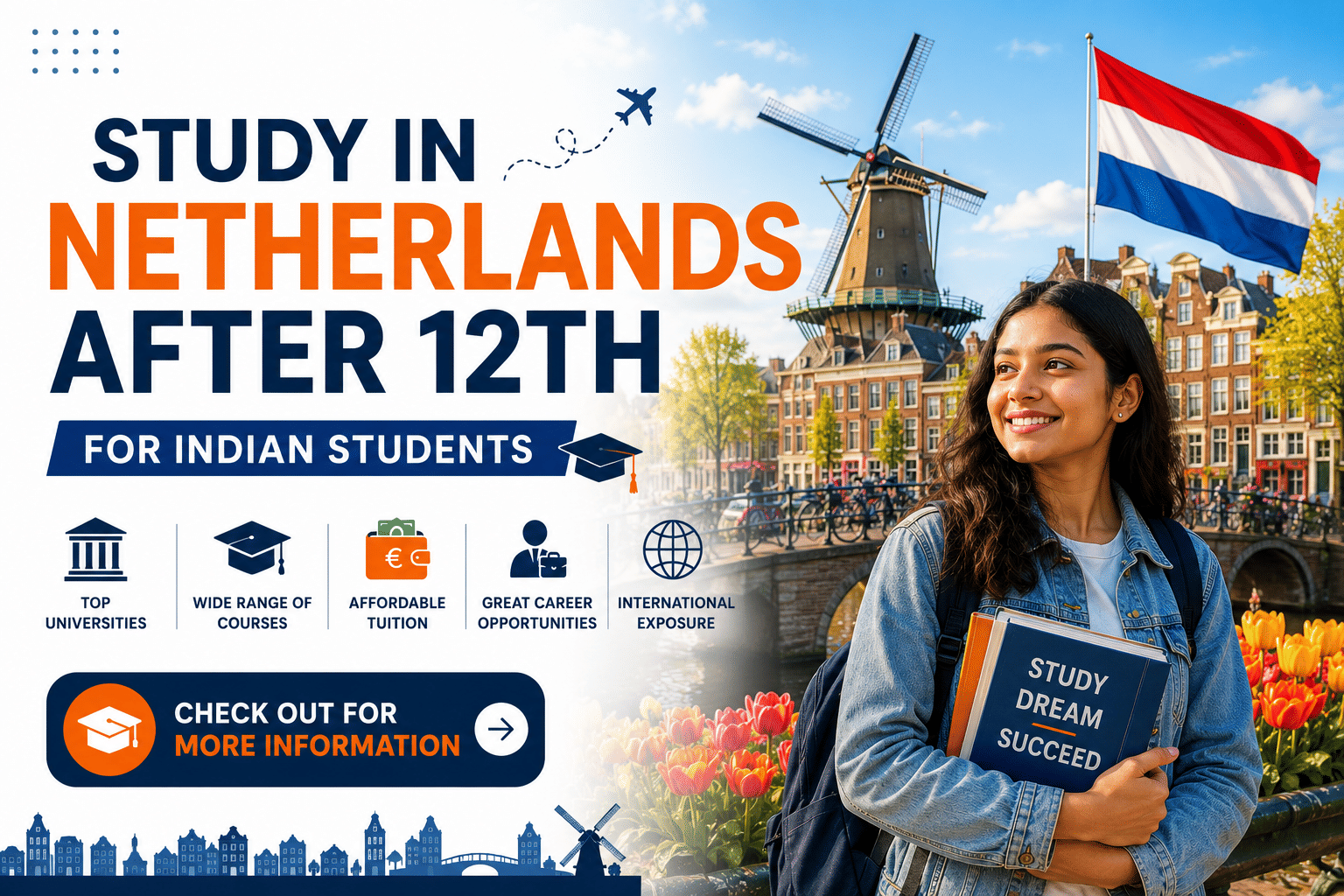
The Netherlands is an excellent study destination for Indian students after Class 12, offering world-class education, affordable tuition fees (€6,000–€20,000/year), and strong career opportunities in tech and business. With over 3,500 Indian students currently enrolled and growing interest, the Netherlands provides access to 2,100+ English-taught programs at top universities like TU Delft, University of Amsterdam, and Erasmus University. Minimum CBSE marks required range from 60% to 75%, depending on the university and program. The Netherlands student visa requires €1,250/month living expenses proof and university sponsorship. Students can work 16 hours/week during studies and full-time during summer holidays. After graduation, the 1-year Job Seeker Visa allows graduates to find employment without a job offer.
- Study in the Netherlands: Find Programs, Universities, and Costs
- Best Universities in the Netherlands: Ranking and Courses
Why Study in the Netherlands?
The Netherlands has become an increasingly popular destination for Indian students seeking quality education and career opportunities.
Key Advantages of Studying in the Netherlands
- Affordable Tuition: €6,000–€20,000/year (cheaper than UK, USA, Canada)
- 2,100+ English-Taught Programs: No language barrier for Indian students
- World-Class Universities: TU Delft (#47 QS), University of Amsterdam (#60 QS)
- 1-Year Job Seeker Visa: Stay and work after graduation without a job offer
- 16-Hour Work Rights: Work 16 hours/week during studies, full-time in summer
- Strong Job Market: High demand for tech, engineering, and business professionals
- EU Gateway: Access to 450+ million EU market
- Quality of Life: Safe, multicultural, excellent infrastructure
- Scholarships Available: Holland Scholarship (€5,000), university scholarships
- Growing Indian Community: 3,500+ Indian students creating support networks
Why Indian Students Are Choosing the Netherlands (2026)
- Visa restrictions in Canada, the UK, and Australia are pushing students toward the Netherlands
- Strong tech job market with competitive salaries (€30,000–€60,000/year)
- Clear pathway to permanent residency through work experience
- Affordable compared to traditional study destinations
- High quality of life and multicultural environment
Also check,
- Netherlands Student Visa: Types, Requirements, and Financial
- Work Visa in the Netherlands
- Best public universities in the Netherlands
Top Universities in the Netherlands
The Netherlands has several world-class universities welcoming Indian students.
Top 10 Universities in the Netherlands
| University | QS Ranking | Location | Minimum CBSE Marks | Tuition (€/year) |
|---|---|---|---|---|
| Delft University of Technology (TU Delft) | #47 | Delft | 75% | €15,000–€20,000 |
| University of Amsterdam (UvA) | #60 | Amsterdam | 75% | €12,000–€18,000 |
| Erasmus University Rotterdam | #70 | Rotterdam | 70% | €10,000–€16,000 |
| University of Utrecht (UU) | #100 | Utrecht | 70% | €10,000–€15,000 |
| Wageningen University & Research | #120 | Wageningen | 70% | €8,000–€14,000 |
| University of Groningen | #150 | Groningen | 65% | €8,000–€13,000 |
| Leiden University | #180 | Leiden | 70% | €10,000–€15,000 |
| University of Twente | #200 | Enschede | 65% | €8,000–€13,000 |
| Eindhoven University of Technology (TU/e) | #220 | Eindhoven | 70% | €12,000–€18,000 |
| Maastricht University | #250 | Maastricht | 65% | €8,000–€14,000 |
University Specializations
- TU Delft: Engineering, computer science, architecture
- University of Amsterdam: Business, law, social sciences
- Erasmus University: Business, economics, management
- Wageningen University: Agriculture, life sciences, environmental studies
- University of Groningen: Engineering, sciences, business
Popular Courses for Indian Students
Here are the most popular and in-demand courses for Indian students in the Netherlands.
Top 15 Popular Courses
- Computer Science & IT: Software engineering, AI, cybersecurity
- Data Science & Analytics: Big data, machine learning, analytics
- Engineering: Mechanical, electrical, civil, chemical engineering
- Business Analytics: Data analytics, business intelligence
- Artificial Intelligence: Machine learning, deep learning, NLP
- Business Administration (MBA): Master of Business Administration
- Finance & Accounting: Financial management, accounting
- Sustainable Energy: Renewable energy, sustainability
- Biotechnology: Biomedical research, genetic engineering
- Supply Chain Management: Logistics, supply chain
- Digital Marketing: Marketing, digital strategy
- Environmental Science: Sustainability, environmental management
- Aerospace Engineering: Aircraft design, aerospace systems
- International Business: Global business, international trade
- Psychology: Clinical psychology, organizational psychology
Most In-Demand Courses (2026)
- Computer Science & IT (highest demand)
- Data Science & Analytics (strong job market)
- Engineering (consistent demand)
- Artificial Intelligence (growing sector)
- Business Analytics (always in demand)
Cost of Studying in the Netherlands
Understanding the total cost of studying in the Netherlands is crucial for financial planning.
Annual Cost Breakdown
| Expense | Amount (€/year) | Amount (INR/year) |
|---|---|---|
| Tuition Fees (Bachelor's) | €6,000–€15,000 | ₹4,80,000–₹12,00,000 |
| Tuition Fees (Master's) | €8,000–€20,000 | ₹6,40,000–₹16,00,000 |
| Accommodation (Shared Room) | €400–€700 | ₹3,20,000–₹5,60,000 |
| Accommodation (Private Room) | €700–€1,200 | ₹5,60,000–₹9,60,000 |
| Food & Groceries | €200–€300 | ₹1,60,000–₹2,40,000 |
| Transport | €50–€100 | ₹40,000–₹80,000 |
| Utilities & Phone | €100–€150 | ₹80,000–₹1,20,000 |
| Personal & Entertainment | €150–€250 | ₹1,20,000–₹2,00,000 |
| Total Annual Cost | €14,000–€28,000 | ₹11,20,000–₹22,40,000 |
Cost Comparison: Netherlands vs Other Countries
| Country | Annual Cost (INR) | Tuition (INR) | Living Costs (INR) |
|---|---|---|---|
| Netherlands | ₹11,20,000–₹22,40,000 | ₹4,80,000–₹16,00,000 | ₹6,40,000–₹8,00,000 |
| Germany | ₹6,40,000–₹15,20,000 | ₹0–₹5,00,000 | ₹6,40,000–₹10,00,000 |
| Ireland | ₹14,40,000–₹28,00,000 | ₹8,00,000–₹20,00,000 | ₹6,40,000–₹8,00,000 |
| UK | ₹20,00,000–₹35,00,000 | ₹12,00,000–₹20,00,000 | ₹8,00,000–₹15,00,000 |
| Canada | ₹15,00,000–₹27,00,000 | ₹8,00,000–₹15,00,000 | ₹7,00,000–₹12,00,000 |
4-Year Total Cost
- Netherlands (1-year master's): ₹11,20,000–₹22,40,000
- Netherlands (4-year bachelor's): ₹44,80,000–₹89,60,000
- Germany (4-year bachelor's): ₹25,60,000–₹60,80,000
- Ireland (4-year bachelor's): ₹57,60,000–₹1,12,00,000
Admission Requirements
Here are the typical admission requirements for Dutch universities.
General Admission Requirements
| Requirement | Minimum | Competitive | Notes |
|---|---|---|---|
| CBSE Class 12 Marks | 60% | 75%+ | Varies by university and program |
| IELTS | 6.0 | 6.5–7.0 | Most common English test |
| TOEFL iBT | 80 | 90–100 | Alternative to IELTS |
| PTE Academic | 50 | 59–67 | Alternative to IELTS/TOEFL |
| Duolingo English Test | 95 | 110+ | Increasingly accepted |
Required Documents
- Class 12 marksheet and certificate
- Class 10 marksheet (some universities)
- IELTS/TOEFL score report
- Statement of Purpose (SOP)
- Letters of Recommendation (2–3)
- Valid passport (minimum 2 blank pages)
- Proof of financial support (€1,250/month)
- Medical certificate (TB test after arrival)
- Health insurance proof
Netherlands Student Visa Process (MVV)
The Netherlands uses the MVV (Machtiging tot Voorlopig Verblijf) entry visa system for non-EU students.
Netherlands Student Visa Requirements
| Requirement | Details | Amount (€) | Amount (INR) |
|---|---|---|---|
| Monthly Living Expenses Proof | Bank balance for living costs | €1,250 | ₹1,00,000 |
| Annual Living Expenses | €1,250 × 12 months | €15,000 | ₹12,00,000 |
| First Year Tuition | University tuition fees | €6,000–€20,000 | ₹4,80,000–₹16,00,000 |
| Total Financial Proof | Living expenses + tuition | €21,000–€35,000 | ₹16,80,000–₹28,00,000 |
Visa Application Steps
- Step 1: Receive an admission offer from a Dutch university
- Step 2: University initiates MVV visa application with IND
- Step 3: Gather financial proof (€1,250/month + tuition)
- Step 4: Collect required documents (passport, admission letter, etc.)
- Step 5: IND reviews application (60–90 days)
- Step 6: Attend biometric appointment (if required)
- Step 7: Receive MVV approval
- Step 8: Apply for residence permit at Dutch municipality
- Step 9: Travel to Netherlands
Visa Processing Timeline
- IND application review: 60–90 days
- Biometric appointment: 1–2 weeks after application
- Total timeline: 8–12 weeks
- Recommended: Apply 4–5 months before course start date
Work Opportunities While Studying
Netherlands allows international students to work while studying, helping offset living costs.
Work Rights on Student Visa
| Period | Maximum Hours/Week | Details |
|---|---|---|
| During Academic Term | 16 hours/week | Part-time work only |
| During Summer (June–August) | Full-time (40 hours/week) | Full-time work allowed |
| Other Holiday Periods | Full-time (40 hours/week) | Full-time work allowed |
Popular Part-Time Jobs for Indian Students
- Retail and hospitality (€12–€15/hour)
- Tutoring and teaching (€15–€20/hour)
- Campus jobs (€12–€14/hour)
- Customer service (€12–€14/hour)
- Internships (€12–€18/hour)
- Freelance work (varies)
Average Earnings
- Part-time work (16 hours/week): €192–€240/week (₹15,360–₹19,200)
- Full-time work during summer: €480–€600/week (₹38,400–₹48,000)
- Annual part-time earnings: €10,000–€12,500 (₹8,00,000–₹10,00,000)
Post-Study Work Visa (Job Seeker Visa)
Netherlands offers excellent post-study work opportunities through the 1-year Job Seeker Visa.
Job Seeker Visa Details
| Aspect | Details |
|---|---|
| Duration | Up to 12 months (1 year) |
| Work Rights | Full-time work allowed (no restrictions) |
| Job Offer Required | NO – can search for jobs without offer |
| Sponsorship Required | NO – no employer sponsorship needed |
| Salary Range | €30,000–€60,000/year (₹24,00,000–₹48,00,000) |
| Eligibility | Bachelor's or master's degree from Dutch university |
Advantages of Job Seeker Visa
- No job offer required to apply
- No employer sponsorship needed
- Full-time work rights (no hour restrictions)
- Can change jobs freely
- Pathway to permanent residency
- Access to skilled worker permits
- Competitive salaries in Netherlands
Pathway to Permanent Residency
- Complete bachelor's or master's degree (1–4 years)
- Work on Job Seeker Visa (1 year)
- Apply for skilled worker permit (if job found)
- Work on skilled worker permit (2–5 years)
- Apply for permanent residency after 5 years total residence
FAQs
Ques. Can I study in Netherlands after Class 12 directly?
Ans. YES, you can study in Netherlands directly after Class 12. Dutch universities accept students who have completed their 12th grade from recognized boards (CBSE, ISC, State Boards). You need minimum 60–75% CBSE marks (depending on university), IELTS 6.0–6.5, and required documents. Many universities offer direct admission to Class 12 pass students. The application process typically takes 4–6 months from application to admission offer.
Ques. What is the minimum CBSE percentage required for Dutch universities?
Ans. The minimum CBSE percentage varies by university: TU Delft (75%), University of Amsterdam (75%), Erasmus University (70%), University of Utrecht (70%), University of Groningen (65%), Maastricht University (65%). However, these are minimum requirements. For better universities and more course options, aim for 75%+ CBSE marks. Top universities like TU Delft and UvA typically require 75%+ marks. Remember that CBSE marks are just one factor; universities also consider IELTS scores, essays, and extracurricular activities.
Ques. How much financial proof is required for Netherlands student visa?
Ans. For Netherlands student visa, you need: (1) €1,250/month living expenses proof (€15,000 for 12 months), (2) First year tuition fees (€6,000–€20,000 depending on university). Total financial proof required: €21,000–€35,000 (approximately ₹16,80,000–₹28,00,000). This must be liquid and available in your bank account. The university will verify these funds during the visa application process.
Ques. Can I work while studying in Netherlands?
Ans. YES, you can work while studying in Netherlands. On a student visa, you can work: (1) Up to 16 hours/week during academic term, (2) Full-time (40 hours/week) during summer holidays (June–August) and other holiday periods. Average part-time wage is €12–€15/hour. You can earn €10,000–€12,500 annually through part-time work, which helps offset living costs. After graduation, you can work full-time on the 1-year Job Seeker Visa without any hour restrictions.



Comments