



Study Abroad Expert | KdTvCV - Mar 31, 2026
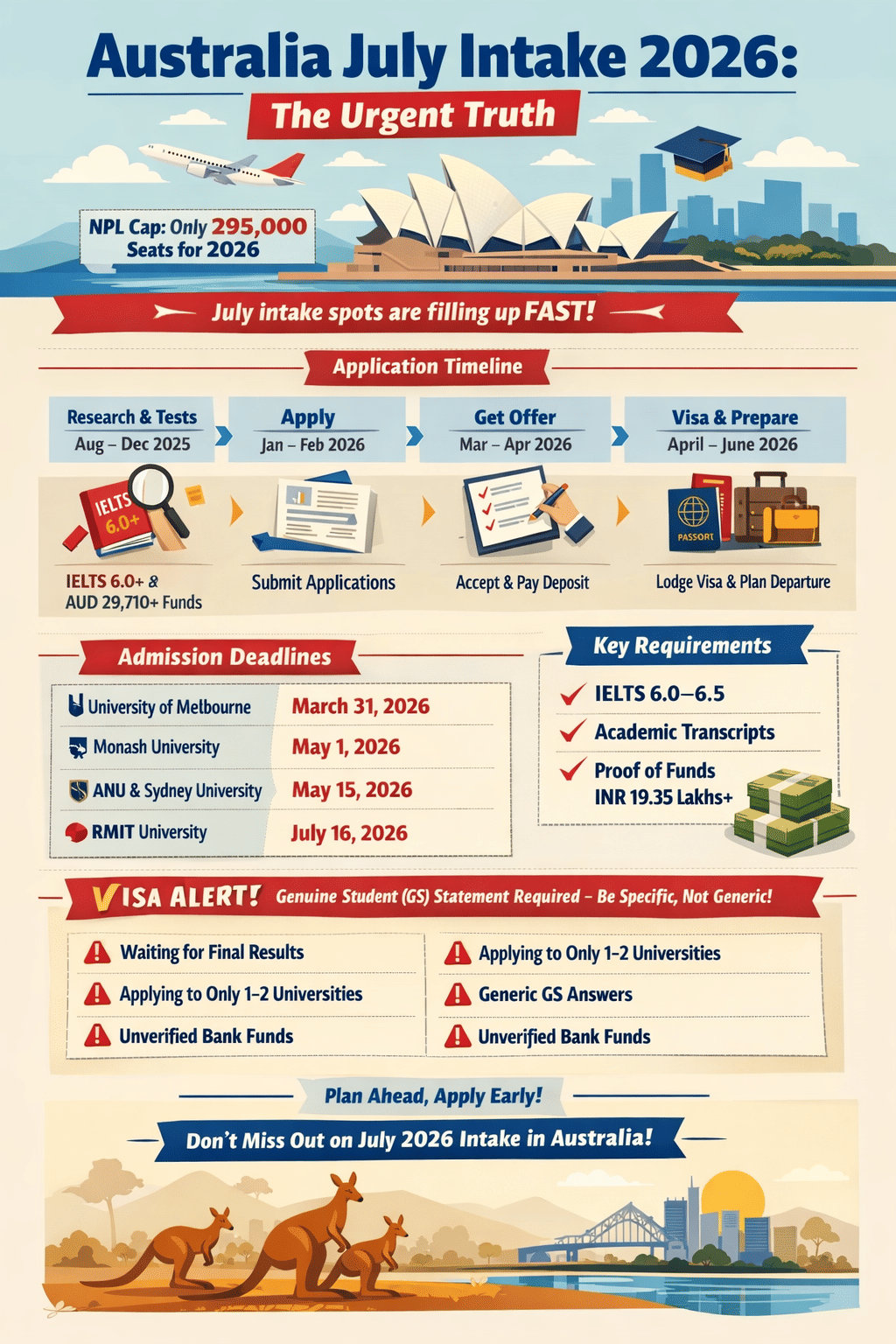
Most Indian students assume the July 2026 intake in Australia is the "easier" option — fewer applicants, less competition, more time to prepare. Here is the truth: with Australia's new National Planning Level (NPL) cap of 295,000 new international students for 2026, seats for July are filling up faster than ever before. Universities that exhaust their quota in the February intake leave very few places for July. Speed and preparation are no longer optional — they are mandatory.
In this guide, you will find everything you need to act now: exact application deadlines for top universities, the new Genuine Student (GS) visa requirement explained, and the critical mistakes that get Indian students rejected.
The Australia July intake 2026 (Semester 2) starts between late July and early August 2026. Application deadlines range from March 31 (University of Melbourne) to July 16 (RMIT). You need IELTS 6.0–6.5 overall, academic transcripts, and proof of funds of at least AUD 29,710 (approx. INR 19.35 Lakhs) for living costs alone.
(AUD to INR conversion at 1 AUD = INR 65.19, as of March 31, 2026)
- What is the Australia July Intake 2026?
- Australia July Intake 2026 Application Timeline
- Top Universities Offering July Intake 2026 in Australia
- Eligibility and Documents Required for July Intake 2026
- Australia Student Visa (Subclass 500) for July 2026
- Cost of Studying in Australia: Tuition Fees and Living Expenses
- Scholarships for July Intake 2026 in Australia
- Part-Time Work Rights for International Students in 2026
- Common Mistakes to Avoid for July 2026 Intake
- Frequently Asked Questions (FAQs)
What is the Australia July Intake 2026?
The July intake in Australia, also called Semester 2, is the second major academic intake of the year. Classes begin between late July and early August 2026, and the application window runs from February to May 2026.
Australia operates three intakes per year:
- February (Semester 1)
- July (Semester 2)
- November (Semester 3)
The July intake is the second largest, offering a wide range of undergraduate, postgraduate, and doctoral programmes — though with fewer options than February.
According to the Australian Bureau of Statistics, 132,970 international students arrived in Australia on student visas in July 2024 alone. The July intake is particularly popular among Indian students because it aligns with the Indian academic calendar — students finishing their final exams in May or June can transition directly into an Australian programme without a gap year.
The table below summarises the key differences between the three intakes:
| Intake | Start Date | Application Window | Programme Availability | Scholarships |
|---|---|---|---|---|
| February (Semester 1) | Late Jan – March 2026 | July – November 2025 | All programmes | Maximum availability |
| July (Semester 2) | Late July – August 2026 | February – May 2026 | Majority of programmes | Limited but available |
| November (Semester 3) | Late Oct – November 2026 | July – October 2026 | Selected programmes only | Minimal |
Understanding which intake suits your profile is the first step. The July intake is ideal if you are finishing your degree in mid-2026, need more time to prepare English scores, or missed the February deadline. However, it is not a shortcut — the same academic and financial standards apply.
Explore all intakes in Australia and find the right one for your profile
July Intake vs. February Intake — Key Differences
The February intake is Australia's primary intake, with the widest course availability and the most scholarship opportunities. The July intake is secondary but still substantial, especially for postgraduate programmes in IT, engineering, business, and health sciences.
The critical 2026 difference is the NPL cap. Because the cap is shared across both intakes, universities that recruit heavily in February may have very limited July allocations.
Who Should Choose the July 2026 Intake?
The July intake is the right choice if you:
- Are completing your bachelor's degree in May or June 2026 and want to start a master's immediately
- Missed the February 2026 intake deadline
- Need additional time to improve your IELTS or PTE score
- Are waiting for final transcripts or academic results
- Prefer a mid-year start to align with the Australian winter semester
It is not the right choice if you are hoping for a wider scholarship pool, maximum course options, or a larger orientation experience — those advantages belong to the February intake.
Australia July Intake 2026 Application Timeline
The safe application window for the July 2026 intake is January to March 2026. Waiting until April or May significantly increases your risk of missing university quotas and facing visa processing delays.
The table below outlines the complete month-by-month action plan. Note that "published deadlines" are not the same as "safe deadlines" — universities process applications on a rolling basis, and popular programmes fill up before the official cutoff.
| Phase | Timeline | Critical Actions |
|---|---|---|
| Research and Preparation | Aug – Oct 2025 | Shortlist 5–8 universities; identify cap-safe options (regional/Go8); audit family finances |
| Tests and Documents | Nov – Dec 2025 | Take IELTS/PTE; draft Genuine Student (GS) statement; gather transcripts |
| Application Submission | Jan – Feb 2026 | Submit applications to 3–5 universities; applying now puts you at the front of the July quota queue |
| Offer and Deposit | Mar – Apr 2026 | Accept offer letter; pay tuition deposit; receive Confirmation of Enrolment (CoE) |
| Visa Filing | April 2026 | Lodge Subclass 500 student visa; lodging by April avoids the May peak bottleneck |
| Pre-Departure | May – June 2026 | Arrange OSHC (Overseas Student Health Cover); book flights; secure accommodation |
| Arrival | Mid-July 2026 | Arrive for Orientation Week (typically July 13–17, 2026) |
One important note: do not wait for your final degree results to begin the application process. Most Australian universities accept conditional applications based on pre-final semester marks. You can submit your application now and provide final transcripts once available.
Safe Deadlines vs. Published Cutoffs
Published deadlines are the last possible date a university will accept an application. Safe deadlines are 6–8 weeks earlier, accounting for offer letter processing (4–6 weeks), CoE issuance, and visa lodgement time (4–8 weeks processing).
For example, the University of Melbourne's published deadline for July 2026 is March 31, 2026. If you apply on March 30, receive your offer in early May, and lodge your visa in mid-May, you are cutting it extremely close for a late July start. Applying in January gives you a comfortable buffer.
Top Universities Offering July Intake 2026 in Australia
Almost all major Australian universities offer a July intake, but seat availability, deadlines, and programme options vary significantly. The table below covers the top universities, their QS 2026 rankings, popular programmes, application deadlines, and acceptance rates.
The following data is sourced from official university academic calendars:
| University | QS Rank 2026 | Popular Programmes | Application Deadline (July 2026) | Acceptance Rate |
|---|---|---|---|---|
| University of Melbourne | 19 | MBA, MS, Law, Psychology, MFA | March 31, 2026 | ~70% |
| University of Sydney | 25 | Architecture, Business, Arts & Social Sciences | May 15, 2026 | ~30% |
| Australian National University (ANU) | 32 | Bachelor of Arts, Bachelor of Science, Law, Health | May 15, 2026 | ~35% |
| Monash University | 36 | Engineering, Computer Science, Nursing, Business Analytics | May 1, 2026 | ~40% |
| University of Queensland (UQ) | 42 | Business, Engineering, Criminology, Chemical Engineering | March 31, 2026 | ~40% |
| University of Western Australia (UWA) | 77 | Robotics, Biomedical Science, Civil Engineering | June 30, 2026 | ~38% |
| University of Adelaide | 82 | AI and Machine Learning, Data Science, Business Analytics | May 1, 2026 | ~75% |
| RMIT University | 125 | Communication Design, Digital Media, Games Design | July 16, 2026 | ~22% |
| La Trobe University | 233 | IT, Business, Nursing, Engineering Management | July 13, 2026 | ~100% |
| Griffith University | 268 | Nursing, Hospitality, Business, Computer Science, Law | July 6, 2026 | ~50% |
Note: Acceptance rates are approximate and vary by programme. Always verify deadlines directly on the official university website before applying.
The University of Melbourne has the earliest deadline (March 31, 2026) among Go8 universities. If you are targeting Melbourne, your application should already be submitted or in progress. For students who have not yet applied, universities like RMIT, La Trobe, and Griffith offer later deadlines with strong programme options.
Group of Eight (Go8) Universities and Their July 2026 Deadlines
The Group of Eight are Australia's eight leading research-intensive universities. They are high-demand institutions with strict cap management. For July 2026, the key Go8 deadlines are:
- University of Melbourne: March 31, 2026 — late applications are rarely considered
- University of Sydney: May 15, 2026 — wide course range, but subject to strict cap management
- Monash University: May 1, 2026 — relatively high student cap (11,300 places), making it a strong option
- ANU: May 15, 2026 — strong for research-based programmes
- University of Queensland: March 31, 2026 — apply early; popular engineering and business programmes fill fast
Technology and Regional Universities for July 2026
Regional universities often have more flexible NPL cap allocations than major metropolitan universities. This makes them a strategically safer bet for July 2026 applicants who are applying later in the window.
- RMIT University (Melbourne): Classes start mid-July; advise applying 4–6 months in advance
- University of Adelaide: Strong in AI, Data Science, and Business Analytics; 75% acceptance rate
- Deakin University (Geelong): Offers excellent education and access to additional Post-Study Work rights for regional graduates
- University of Wollongong: Regional campus option with Destination Australia scholarship eligibility
Eligibility and Documents Required for July Intake 2026
To apply for the Australia July intake 2026, you must meet both academic and English language proficiency requirements. The 2026 NPL caps mean precision and completeness in your application are more important than ever.
Academic and English Proficiency Requirements
| Level | Academic Requirement | IELTS Score | PTE Score |
|---|---|---|---|
| Undergraduate | Class 12 with 60–65% (varies by board and university) | 6.0–6.5 overall | 50–58 |
| Postgraduate | Bachelor's degree with 60–65% from a recognised Indian university | 6.5 overall (no band below 6.0) | 58–65 |
| Health and Teaching Programmes | As above, with higher academic requirements | 7.0+ overall | 65+ |
IELTS and PTE Academic are the most widely accepted English proficiency tests. TOEFL iBT and Duolingo English Test are also accepted at many universities, though not universally. Always check the specific requirements of your chosen programme on the official university website.
Complete Document Checklist
Having all documents ready before you apply is critical under the 2026 "first-come, first-served" cap system. Missing documents cause delays that can cost you your place.
| Document | Details |
|---|---|
| Academic Transcripts | Class 10, 12, and Bachelor's degree marksheets (provisional accepted for initial application) |
| English Proficiency Score | Valid IELTS, PTE, TOEFL, or Duolingo scorecard |
| Genuine Student (GS) Statement | Replaces the old SOP; details your ties to India and career value of the course |
| Proof of Funds | Liquid funds of AUD 29,710+ for living costs; total recommended AUD 68,000–83,000 (approx. INR 44.3–54.1 Lakhs) |
| Valid Passport | Valid for the full duration of your course |
| Letters of Recommendation (LOR) | Two LORs from professors or employers |
| CV or Resume | Required especially for work-experience-based programmes (MBA, etc.) |
| Statement of Purpose (SOP) | Required by some universities in addition to the GS statement |
| Application Fee Receipt | Proof of fee payment |
| Passport-Sized Photographs | Two recent, identical photographs |
Australia Student Visa (Subclass 500) for July 2026
To study in Australia, Indian students must apply for the Student Visa (Subclass 500). For the July 2026 intake, you should lodge your visa application by April 2026 to avoid the May processing bottleneck.
The student visa allows you to study full-time, work up to 48 hours per fortnight during the academic term, and work unlimited hours during official semester breaks.
The Genuine Student (GS) Requirement Explained
The Genuine Student (GS) requirement replaced the old Genuine Temporary Entrant (GTE) requirement on March 23, 2024. It applies to all Subclass 500 applications and assesses whether you genuinely intend to study in Australia — not use the student visa as a migration pathway.
According to the Department of Home Affairs (immi.homeaffairs.gov.au), the online visa application asks you to answer the following questions (150 words maximum per response, in English):
- Current circumstances: Your ties to family, community, employment, and economic circumstances in India
- Why this course and provider: Your understanding of the course requirements and why you chose this specific university over options in India
- How the course benefits you: How completing the course will advance your career in India or elsewhere
- Any other relevant information: Additional context supporting your genuine student status
What makes a strong GS statement:
- Specific links between the course and your career goals
- Evidence of ties to India (family, property, job offers, community)
- Clear academic progression (e.g., Bachelor of IT → Master of Cyber Security)
- Verifiable financial history
What gets applications rejected:
- Generic or AI-generated answers
- Unexplained study gaps of more than 2 months
- Course downgrade moves (e.g., Master's to Diploma) without explanation
- Unverified or borrowed funds in bank statements
Financial Proof — How Much Money Do You Need?
The financial requirements for the Subclass 500 visa are set by the Department of Home Affairs. As of 2026, you must demonstrate access to the following funds:
| Requirement | Amount (AUD) | Amount (INR approx.) |
|---|---|---|
| Living costs (self) — per year | AUD 29,710 | INR 19.36 Lakhs |
| Additional for partner | AUD 10,394 | INR 6.77 Lakhs |
| Additional per child | AUD 4,449 | INR 2.90 Lakhs |
| Typical annual tuition (Master's) | AUD 22,000 – AUD 50,000 | INR 14.34 – 32.60 Lakhs |
| Recommended total (self, no dependants) | AUD 52,000 – AUD 80,000 | INR 33.90 – 52.15 Lakhs |
AUD to INR conversion at 1 AUD = INR 65.19, as of March 31, 2026. Exchange rates fluctuate; verify the current rate before financial planning.
Funds must be genuine — visa officers examine bank statement history to verify that the money belongs to you and has not been recently deposited to meet the threshold. Consistent savings over 6–12 months carry significantly more weight than a lump sum deposited shortly before application.
Cost of Studying in Australia
The total cost of studying in Australia for Indian students includes tuition fees, living expenses, health cover, and travel. Planning your budget accurately before applying is essential — both for your own financial security and for meeting visa requirements.
Tuition Fees by Degree Level
| Degree Level | Annual Tuition (AUD) | Annual Tuition (INR approx.) |
|---|---|---|
| Bachelor's Degree | AUD 20,000 – AUD 45,000 | INR 13.04 – 29.34 Lakhs |
| Master's Degree | AUD 22,000 – AUD 50,000 | INR 14.34 – 32.60 Lakhs |
| Doctoral Degree | AUD 20,000 – AUD 42,000 | INR 13.04 – 27.38 Lakhs |
Tuition fees vary significantly by university and programme. Technology, medicine, and MBA programmes tend to sit at the higher end of the range. Regional universities and some newer institutions offer lower fees — for example, Victoria University charges AUD 18,000–20,000 per year, and the University of Southern Queensland charges AUD 24,000–30,000 per year.
Scholarships for July Intake 2026 in Australia
Scholarships for the July intake are more limited than for February, but they do exist. University merit bursaries, the Destination Australia Programme, and select government scholarships are all available for mid-year starters.
The key point: most major government scholarships (like Australia Awards) are tied to the February intake. However, university-specific merit scholarships and the Destination Australia Programme are available for July 2026 applicants.
| Scholarship | Provider | Value | Eligibility |
|---|---|---|---|
| Australia Awards Scholarship | Australian Government (DFAT) | Full tuition + return airfare + living allowance + OSHC | Indian citizens; strong academic record; leadership qualities; primarily February intake |
| Destination Australia Programme | Australian Government | AUD 15,000 per year | Students studying at regional campuses; available for July intake |
| Deakin Vice-Chancellor's International Scholarship | Deakin University | 50% or 100% of tuition fees | Academic record of 80%+ in previous studies |
| University Merit Bursaries (various) | Individual universities | 15–25% tuition fee reduction | Based on Indian GPA; automatic consideration at many universities |
| Monash International Merit Scholarship | Monash University | AUD 10,000 per year | Academic excellence; available for July intake |
The Destination Australia Programme is particularly valuable for July intake students. It offers AUD 15,000 per year (approx. INR 9.78 Lakhs) to students studying at regional campuses — and regional universities often have more flexible NPL cap allocations, making them a double strategic advantage.
Explore scholarships to study in Australia for Indian students
Part-Time Work Rights for International Students in 2026
International students in Australia on a Subclass 500 visa can work up to 48 hours per fortnight (every two weeks) during the academic term, and unlimited hours during official semester breaks.
This translates to approximately 24 hours per week during term time. At the current minimum wage of approximately AUD 24 per hour, a student working the maximum allowed hours can earn approximately AUD 1,000–1,200 per month.
Here is the critical reality check: the minimum annual living cost set by the Department of Home Affairs is AUD 29,710 — approximately AUD 2,476 per month. Part-time work covers roughly 40–50% of living costs at best. It is pocket money, not a financial plan.
Common Mistakes to Avoid for July 2026 Intake
The 2026 intake is unforgiving of errors. The NPL cap, stricter GS requirements, and tighter visa processing timelines mean that mistakes which were manageable in previous years can now result in missed seats or visa refusals.
1. Waiting for final transcripts before applying
Do not wait until June to apply. Universities accept conditional applications based on pre-final semester marks. Apply now and provide final transcripts once available.
2. Applying only to one or two universities
Apply to 3–5 universities across different tiers. If your first-choice university has exhausted its NPL allocation, you need backup options with open seats.
3. Using generic or AI-generated GS answers
Visa officers are trained to identify generic statements. Your GS answers must be specific to your background, your chosen course, and your career goals. Generic answers are a leading cause of visa refusals in 2026.
4. Course hopping or downgrading
Applying for a Master's and then switching to a Diploma after arrival is actively blocked under 2026 rules. This practice can result in visa cancellation. Apply for the course you genuinely intend to complete.
5. Unverified or recently deposited funds
Bank statements showing a large lump sum deposited shortly before the visa application raise red flags. Visa officers look for a consistent savings history over 6–12 months.
6. Applying to low-ranked private colleges in the "red zone"
Some private colleges have been flagged by the Department of Home Affairs as high-risk providers. Applications to these institutions face extra scrutiny and higher refusal rates. Stick to public universities and established private providers.
7. Trying to switch from a visitor or 485 visa onshore
Since 2024, you cannot switch from a visitor visa or Temporary Graduate (485) visa to a student visa while onshore in Australia. If you are currently in Australia on either of these visas, you must apply for the student visa from outside Australia.
Frequently Asked Questions (FAQs)
Ques. What is the last date to apply for Australia July intake 2026?
Ans. Application deadlines vary by university. The University of Melbourne closes applications on March 31, 2026 — the earliest among Go8 universities. Monash University closes May 1, 2026; ANU and the University of Sydney close May 15, 2026; RMIT closes July 16, 2026. However, safe deadlines are 6–8 weeks earlier than published cutoffs to allow time for offer letters, CoE issuance, and visa processing.
Ques. How much money do I need to show for an Australia student visa in 2026?
Ans. According to the Department of Home Affairs (immi.homeaffairs.gov.au), you must show a minimum of AUD 29,710 (approx. INR 19.36 Lakhs) per year for living costs alone. When adding tuition fees and travel, the recommended total liquid funds are AUD 52,000–80,000 (approx. INR 33.90–52.15 Lakhs). Funds must be genuine and verifiable — a consistent savings history over 6–12 months carries more weight than a recent lump sum deposit.
Ques. Is July intake easier to get into than February intake in Australia?
Ans. No. This is one of the most common misconceptions. The same academic requirements, English proficiency standards, and financial proof requirements apply to both intakes. In 2026, the July intake is arguably more competitive because universities that exhaust their NPL cap allocation in February have fewer seats available for July. Apply early and with a strong profile.
Ques. What happens if I miss the July 2026 intake deadline?
Ans. If you miss the July 2026 intake deadline, the next option is the November 2026 intake (Semester 3), which starts in late October or November 2026. However, November intake has significantly fewer programme options and is not available at all universities. The February 2027 intake is the next full intake with maximum course availability and scholarship opportunities. Contact your chosen university's admissions office directly to explore late application options or deferral possibilities.
Ques. Which Australian cities are most affordable for Indian students arriving in July 2026?
Ans. Adelaide and Darwin are the most affordable major Australian cities for students, with estimated monthly living costs of AUD 3,502 and AUD 3,486 respectively (approx. INR 2,28,296 and INR 2,27,253). Adelaide also offers strong university options, including the University of Adelaide (QS Rank 82). Sydney and Canberra are the most expensive cities. Regional cities and towns outside major metropolitan areas are generally more affordable and may also offer access to the Destination Australia scholarship.
Ques. Do Australian universities accept gap year students for the July intake?
Ans. Yes, most Australian universities accept gap year students across all intakes, provided the gap can be justified with valid reasons and supporting documents — such as work experience, internships, skill-building activities, or personal circumstances. For undergraduate programmes, gaps of up to 1–2 years are generally accepted. For postgraduate programmes, gaps of up to 5 years are typically considered. Unexplained gaps of more than 2 months during an academic year must be addressed in your Genuine Student (GS) statement.









Comments